



Abstract
The role of time in game development has seen increasing study, but the role of time in creating gaming ‘content’ has rarely been explored. To explore how time is strategised and rationalised by content creators, I examine how game streamers on Twitch navigate dynamics of time and temporality in their broadcasts. Through semi-structured interviews, this article reveals complex and dynamic decision-making processes in the seemingly simple decision of ‘when to stream’, highlighting the interplay of geography, game genre, game community, and life commitments. I demonstrate how three main factors – pragmatics, discourses, and happenstance – combine to shape game streamers’ thinking about temporal elements of streaming. The article thus unpacks the multi-layered dynamics of these decisions, and how live streamers’ broadcasts become structured and routinised over time, which inevitably shapes and drives both the creation and the consumption of video content on the platform.
Introduction
The relationship between time, and the creation of games, has begun to see scholarly attention. One leading strand involves interrogating the working conditions of labourers in the games industry, which inevitably has a significant time dimension (Dyer-Witheford and De Peuter, 2006; Harvey and Fisher, 2013; Schumacher, 2007). This is especially apparent in the discussion and critique of so-called ‘crunch’ practices (Cote and Harris, 2021; Peticca-Harris et al., 2015) in which overtime is forced on employees to achieve a deadline. However, relationships between gaming-related ‘content creation’ and time – Twitch streaming, ‘Let’s Play’ videos on YouTube, modding, cosplaying, games podcasts, game fan art, and so on – has not yet been explored. Although outside of the formal games industry, these practices represent sites of tremendous gaming-related activity and labour. I propose examining these practices and their time dimensions via a study of game streamers on Twitch, whose number and impact within gaming (Taylor, 2018; Johnson, 2024) makes them a valuable case study. In doing so I hope to achieve two goals. First, to offer an interesting case study of how time is far more deeply interwoven in gaming-related content creation than has previously been noted, and second, to further develop our understanding of Twitch game streamers and their practices, strategies, and perspectives on their streaming lives (cf. Johnson & Woodcock, 2019; Bingham, 2020; Scully-Blaker et al., 2017; etc.). In the second case such a study also sheds light on the Twitch platform as a whole, in how the strategies and actions of individual streamers – but repeated or reiterated across millions of streamers in total – shape norms and expectations on the site more broadly.
I begin with a literature review addressing gaming ‘content creation’ and game live streaming, before then outlining my method (semi-structured interviews with popular game streamers) and describing the analysis and coding of these data. The article’s discussion is then split into three sections, titled ‘When do I stream?’, ‘When should I stream?’, and ‘With whom do I compete?’, which explore the three main elements of understanding game live streaming’s temporalities. The first of these sections finds that these streamers are primarily broadcasting in the evening and examines why this might be, with evening streaming being a dynamic implicitly taken for granted in much Twitch research but not before explicitly confirmed by scholarship. The subsequent two sections, however, then branch out into entirely new findings, with the former demonstrating that streamers articulate complex and varied rationales for what an ‘optimal’ streaming time looks like, and the latter showing how streamers understand competition on the platform as being integral to when they stream, and how the concept of consistency in game streaming times is widely taken to be an essential part of building a successful channel. Through all of these I particularly examine the relationship between the pragmatic and the discursive elements of when game streamers go live, and also identify the surprisingly important role that happenstance plays in shaping a game streamer’s broadcasting schedule. I conclude by summarising the core findings of the article and discussing what these mean for our understanding of Twitch game streaming practices, and for our understanding of contemporary online time and temporality, as well as proposing future research directions opened up by this study.
Existing research
Studies that have addressed the labour and practices of creating game-related content have often noted the deep investments of time required from fans or creators to realise their intentions. Cosplaying, for instance, ‘represents a significant commitment in time’ (Rosenberg and Letamendi, 2013: 16), with cosplayers spending a ‘considerable amount’ of hours selecting characters and creating costumes (Rahman et al., 2012: 321–322), potentially into the dozens of hours per week. In fan-led digital game modification or ‘modding’, meanwhile, creators can put in ‘extensive time and effort’ even potentially to the point of ‘burnout’ (Hong and Chen, 2014: 299–300), with ambitious mods requiring ‘a lot of time’ (Sotamaa, 2010: 244) that might stretch over months or even years of work. There is a comparison in all such practices to be thus drawn with professional game creation in the scope and ambition of tasks undertaken, although these projects are not of course – in general – remunerated in any way. On YouTube, in turn, gaming videos of the sort studied by Postigo (2016: 12) took ‘10–15 hours to produce, if not more, taking into account time to game, commentate, produce, render, and post’. We again in this example see the drive to fan production in gaming, and some of the avenues through which fan production can be shared, distributed, and consumed. These studies – although diverse in specific focus – show that ‘content creation’ in gaming is a time-demanding (if also evidently very personally rewarding) process for many, and they collectively provide useful comparison points for our consideration of the temporality of game streaming by highlighting the major time investments in many kinds of gaming-related creative activity.
Time regimes and time cultures in the digital context more generally have also seen significant scholarly attention in recent decades. For example, Hartmut Rosa’s (2013: 8) work identifies three temporal perspectives, each of which we see reflected in game live streaming. Previous research has noted that the third and grandest of these, the idea of ‘our time’ – an epoch or an age in which one is living – is reflected in Twitch streamers who often perceive themselves as living in a time of opportunity for gamers and content creators because of the platform (Johnson & Woodcock, 2019). The second is the temporal sense of one’s individual life or lifetime, with the question of time’s use being posed ‘with respect to our life as a whole’ (Rosa, 2013: 8). Research has similarly shown the articulation of Twitch as a kind of aspirational life project for some broadcasters (Johnson et al., 2019; Consalvo et al., 2020). However, the first of Rosa’s temporal perspectives – the most immediate and day-to-day orientation to time – has not yet been examined in the context of game streaming, which is to say ‘the time structures of [our] everyday lives’ such as the ‘recurring routines and rhythms of work and leisure time’ and the ‘connected problems of synchronization, speed, duration, and the sequencing of actions’ (Rosa, 2013: 8). In turn, as other scholars have noted, major digital platforms are all ‘powerful time-structuring devices’ (Repenning, 2024: 1504) which yield a ‘mix of multiple, overlapping, mutually interfering, and influencing temporalities’ (Otto, 2015: 101) and tend to emphasise ‘constant flow, immediacy and newness’ (Kaun, 2015: 221) – trends extremely familiar to live streamers, and to those who study them.
In this article, I thus propose that Twitch makes for an excellent case study for understanding the relationships between time and gaming content creation. The hours invested into game streaming can be long and demanding (Witkowski et al., 2016; Johnson et al., 2019), while handling moderators, talking to viewers, undertaking self-surveillance, and dealing with potential harassment (e.g. Partin, 2019; Walker, 2014; Wolff and Shen, 2022; etc.), also all require attention. Understanding the existing demands of Twitch in these terms forms an important background to the discussions. The time spent live streaming is nevertheless a far more obvious and visible form of labour than deciding when to stream, and one which has seen scholarly attention to date – but in this article, I hope to demonstrate that this latter element, though more subtle, is also of surprisingly significant importance to understanding what Twitch’s game streamers are doing, how gaming channels form and maintain themselves on the platform, and how streamers think about and reflect on their own practices and ambitions. Doing so will give new insights into both the role of time in gaming content creation and fan production, and the activities, rationales, and thought processes of game live streamers. Equally, the ‘temporal perspective on digital platforms is not prominent in the academic debate’ (Repenning, 2024: 1505), and I therefore hope also to provide here a novel case study of the relationships between time and platform use that will contribute to understanding the ongoing ‘entanglement of everyday practices and media technologies’ (Otto, 2015: 88) on sites like Twitch, via practices and discourses of time and temporality.
Methodology
This article draws on nineteen interviews conducted with game live streamers based in Australia. The country was selected as a valuable case study due to its position both as a native English-speaking country – the dominant language on Twitch – yet also one in a time zone shared by neither North America nor Europe. The goal was to examine how Australian streamers navigated these dynamics on the platform, and the different time zones seemed likely to shed particular light on how time-related decisions might be made. Freely available services that track Twitch live streamers were examined to capture initial lists of Australian game live streamers. Twitch does not at present have any central repository of live streamers’ countries of residence, which means that unless a live streamer is identified as such in one of these databases, or identifies themselves as being from a given country, it is hard to judge the residence of Twitch’s broadcasters. Contact was made with potential respondents who were then presented with consent forms and participant information sheets, which led to interviews being conducted with 19 of those contacted. These interviews were all conducted online during 2021, lasted between 30 and 70 minutes, and were then transcribed. Almost all respondents were Twitch ‘Partners’ and around half appeared to be full-time broadcasters, while the others – given their Partner status – had also built substantial followings. The follower counts – viewers who have signed up to be notified when the streamer goes live, but who do not necessarily financially support them – of the streamers interviewed ranged from ~4,400 at the lowest end up to ~114,000 at the highest end. Average concurrent viewer counts are difficult to establish but ranged from around 100 for the smallest channels in the sample, and around 600 for the largest channels in this sample. The interviews were semi-structured in nature (Adams, 2015; Schmidt, 2004), an orientation selected to capture the potential unknown complexities in an under-researched topic better than a structured interview might, while still remaining on-topic and maintaining stronger focus than unstructured interviewing. The interviewees were of course not pressured for any information they might not be willing to give about their strategies or perspectives, but in line with other research showing the networks of mutual support and the culture of knowledge sharing among live streamers (Johnson and Baguley, In Press), none proved at all reticent in giving their insights and points of view.
Coding began with a first read of the transcripts looking to identify key themes in the data about the times they streamed, and what went into decision-making processes about their broadcasting schedules. This was in line with the approach proposed by Deterding and Waters (2021) and was followed by a second read of the transcripts using initial key ideas around time to pin down everything said by interviewees that discussed timing, time slots, time zones, temporality, or related topics. Six well-used primary codes emerged during the coding of these data, which were ‘Streaming Times’, ‘Ideal Streaming Times’, ‘Countries’, ‘Time Zones’, ‘Competition’ and ‘Consistency’. Some of these were in direct responses to specific questions asked in the interviews, while some – such as the last two – were not specific responses to questions but were raised independently by significant percentages of the respondents. The first theme forms the core of the first (‘When do I stream?’) discussion section of this article; the second and third are the basis of the second ( ‘When should I stream?’) section; the fourth is used throughout the article; and the fifth and sixth are the core of the third discussion section (‘With whom am I competing?’). Quotes have been lightly edited for clarity by removing filler words such as ‘er’, ‘um’ and ‘like’, and all respondents have been given pseudonyms which have no relationship to the real names, cultural backgrounds, or gender identities of the respondents. This study was approved by the University of Sydney Human Research Ethics Committee, with project code 2021/488.
Results and discussion
When do I stream?
When do streamers go live, and why do they choose these times? Existing research on Twitch has not explicitly addressed this question, but this study found that broadcasting in the evening and often into the night was by far the most common response. Two explanations for this arose: pragmatic concerns about the management of time in a streamer’s day, and discourses around a particular imaginary of what ‘game time’ might entail. This relationship – between pragmatic and discursive elements – occurred many times in the data and marks one of the key findings of this study, and was first identified in these justifications for streaming times. In the first case, two dominant time commitments were mentioned by respondents: employment, and higher education. Selenna stated the ‘biggest factor’ in streaming at night was their ‘work schedule’, while Scarlet described working ‘nine to five Monday to Friday’ which ‘restricts when I can stream’. Bruce said that full-time work meant they had to ‘stream in the evening’, and Milano similarly said that ‘I do the 9-to-5 and then it’s at night that I can stream’. Nicoli stated their ‘only free time’ from work and study was at night, and Ian said that as someone both ‘working and studying’ the evening was the obvious time for streaming. The idea of striving or labouring in one’s ‘free time’ (Scholz, 2012: 17) has been noted as an element of social media practices, and we see this strongly reflected here. Such balancing acts of time commitments are comparable to, for example, the observation of Hong and Chen (2014: 301) on how – between a ‘day job and modding’ – little time might remain for much else. I noted in previous research that the ‘entrepreneurial use of time as a resource remains essential’ (Johnson et al., 2019) to game streaming, but here we also see that the scheduling of time is something game streamers are thinking about as well. The ‘rhythm, speed, duration, and sequence’ of our actions are ‘almost never determined by us as individuals’ (Rosa, 2013: 9) but rather by broader societal expectations or obligations, and here we see this reflected in the times that streamers are actually available to stream.
However, respondents also offered further justifications about the selection of this evening time, which in part moved beyond the purely pragmatic. For example, Selenna said they originally ‘found that it was easier to stream after dinner when I was settled down, just doing my own stuff without any interruptions from my parents and that sort of thing’, and that now (years later) this pattern continues even after moving out of the family home. They explained how game streaming is something they see as a ‘sort of night-time activity’ which one can ‘dedicate’ that period to. This was echoed by both Scarlet and Roland. Scarlet said they felt that in the evenings their viewers were ‘getting ready for bed, or [they’re] finishing up for the day, finishing their work, going home for dinner’, while Roland explained that it ‘is the time when everyone’s at home watching’. We see here not unreasonable practical assumptions being made about the schedules of others, but also gaming as a practice or a hobby being conceptually slotted into a particular temporal frame. Gaming in the evenings (or at weekends) is of course normal for children and teenagers who must fit it in around school, for example (Cain and Gradisar, 2010; cf. Chen et al., 2020), and Twitch game streamers and viewers are mostly in their 20s or 30s, potentially suggesting one antecedent for this temporal framing. As people progress from school into work, the evening remains the default time for relaxation, and a practical element gradually becomes one with a sense of fit and rightness, alongside simple necessity. By combining the pragmatic responsibilities of life (work, study, etc.) and this imaginary of gaming as an evening or night-time activity – one chosen for that time, not just forced into that time – we can paint a clear image of the evening preference for streamers. These observations also anticipate one of the continued points this article will make – how pragmatic concerns, and discourses, combine in our understanding of the temporality of game streamers and game streaming. However, while properly establishing these evening schedules is important, it is the study’s other findings which tell us far more about streamers’ temporal orientations, and it is to these I now turn.
When should I stream?
The above first set of findings confirms what has been widely tacitly accepted about most game streamers while also contributing new information about how these creators see meaning, as well as pragmatics, in their time choices. Moving now more fully into uncharted territory, however, the second key finding of this study is that streamer perceptions of when they should stream – and the nature of this perceived sense of correctness – are not always in alignment with when they do stream. This discovery adds a second layer of complexity into the temporal activities and decision-making of game streamers, and helps us to expand our understanding of their activities beyond the ‘individual’ to something much larger and systemic involving time zones, countries and game communities, as well as streamers’ personal lives and the imagined lives of their (local) viewers described above.
First, we note that although relatively few streamers reported broadcasting in the mornings, a large number suggested that mornings would actually be an ideal time to stream. Given the discussion of the evening as the gaming (and hence game stream-watching) time for viewers, this is worth unpacking. For example, Ian said that streaming in the daytime in Australia would be ‘best’, because ‘you get the evening for America’. Nicoli echoed this by asserting that in pursuit of a ‘global’ audience one should stream in the Australian morning, ‘because that’s the time when a lot of global audience are online’. Jacob noted they started streaming in this way as well (before moving to the afternoon), with ‘the main reason’ being the ‘[large] American audience’ one could get access to, and in turn ‘you’re just more likely to get more viewers’ and ‘you’re opening yourself up to more potential people’. Bruce agreed, explicitly mentioning successful American streamers – ‘who are obviously the ones pumping with the views and all that kind of stuff’ – broadcasting in the Australian morning, so if one was looking to ‘capture the largest potential number of viewers’ without interest in geographical location, ‘I would probably recommend that they stream in the morning’. This was what Milano called the ‘primetime’ for Australian streamers. Scarlet in particular, however, had a lot to say on this, arguing that ‘the best time zones for streamers in Australia would be the Australian morning’ because ‘you’ve got the American viewers who are finishing up at work [and] you’ve got the European viewers who are either staying up a bit late or getting ready for bed’. It is worth quoting this particular respondent here at length – the specifics are less important than the degree of detail this respondent gave, and the degree of thought which presumably has gone into these assessments:
So you’d be looking between 9am to 11am start – that time of day. Whereas, for where I am, Europe is only waking up – so for my UK viewers I start at 7am [and] a lot of them are sort of still making the commute to work, or are still asleep; for the US it’s only really the West Coast that is probably on at a reasonable time, and that’s sort of maybe between 11pm to 1am Pacific Time; but then you’ve got the whole sort of Central America, the Midwest, the Eastern time zones – it’s all the middle of the night for them. So I definitely see [that at] 10pm to 11pm you start to see all the Americans on the East Coast start to filter in, and there is a significant jump in my numbers at that time. While Australians are starting to go to bed the Americans coming in [to] offset that if not increase the number, rather than it falling off.
This is a strikingly detailed and intricate assessment of the time one should stream, noting different time periods, the repercussions of these selections for both European and North American viewers even down to the level of different North American time zones, and hypothesising on the lives and daily schedules of viewers – and how one’s stream might fit in. Such thought processes are comparable to other game content creation areas. Just as cosplayers for example devote ‘meticulous attention to every detail’ of their outfits (Rahman et al., 2012: 322), we see here a streamer giving their broadcast timings a comparable degree of attention. Previous work has addressed the often entrepreneurial spirit of game live streamers (Johnson & Woodcock, 2019; Bingham, 2020; Törhönen et al., 2021), even those who in no way aspire to make streaming their primary income, and one element of this is reflected not just in the time committed, but also in the degree of strategic thought and decision-making that such a complex comment evinces. While research has shown this level of intricate decision-making in regard to other streaming-related topics, this is the first case where such complex thought processes with regard to the scheduling of time have been identified among game streamers. The complication of multiple digitally overlapping local times (Otto, 2015) created by the Internet is thus a foundational source of these strategic considerations, and the lengths streamers go to in thinking about their temporal decisions.
However, the other half of the respondents did recommend that game streaming on Twitch was best done in the evening or at night (rather than in the morning). Some justifications of this we have seen previously – people are at home, the framing of gaming as a nocturnal activity, and so on – but other distinct rationales also surfaced. For example, Eva explicitly said that if one wants ‘to see the biggest amount of viewers on Twitch’ then Australian game streamers should broadcast at night, ‘around 9 pm onwards’, because ‘you’ve got the Americas and Europe are both awake’. Jacob explained that some ‘big Australian streamers’ only start streaming very early in the morning, such as 3 am, ‘because it’s maximising their [international] audience’, adding that a game streamer trying to ‘maximise your potential’ should be ‘completely disregarding Australian time zones’. Marissa also described a friend who ‘stream[s] through the night because he gets better viewer numbers’ – the night here meaning the early hours of the morning Australian time – ‘because then he can target all the viewers in America, all the viewers in Europe, and any late-night Australians’. Cossette recommended night for a similar reason, noting that it’s ‘good for European[s] because it’s their morning’ so they will ‘wake up and watch’. What these data show, therefore, is that both morning and evening streamers thus emphasised the global market, and the best time to reach it. In this regard we see that temporal calculations for game streamers are not just about personal schedules – their own, or their viewers’, or both – but also here begin to encompass a more global mindset and considerations of time zones and daily rhythms thousands of miles away from their own. For the many live streamers outside of the Americas (Australian or otherwise) we might then reasonably expect similar thought processes, while for American streamers we might expect a less-interrogated choice to stream in the local evening for the same reasons – something that future research should look to confirm.
One of the most important things to, therefore, note here is the emphasis on non-Australian viewers and potential audiences in streamers (from Australia) deciding when to broadcast. It is clear that the country (and time zone) one streams from is not the sole determining factor in where one’s viewers might be based, and this emerged as one of the most important considerations for game streaming schedules. While some respondents did stress their broadcasting to Australian audiences – Bruce, for example, said Australia was the ‘largest chunk of my demographic’, and Killian said, ‘90 percent at least’ of their viewers were Australian – most focused on attention from viewers in the United States. For example, Steffan stated that ‘most of [my viewers] are from the US’ and they are ‘a mostly American audience in general’; Ariel also said, ‘most of my viewers are from the United States’; Milano told us, ‘the majority of my viewership [is] from the US’; and Crystal said at the top of her viewer figures is the ‘United States with 47% of my viewership’ because they ‘outnumber the rest of us’. Jacob also said that ‘most of Twitch is America’ and so ‘no matter what you do on Twitch [you’re] going to get a United States audience’, which was echoed by Ariel’s comment that ‘a majority of streamers would have a majority of their audience in the United States’. Other countries were, however, mentioned – but never as places to explicitly target, nor with viewer populations seen to be as valuable as those from North America. For example, Crystal acknowledged they get ‘perhaps some Brazilian’ viewers in their channel, Nicoli reported that they had many viewers ‘in the Philippines and in Thailand’, and Milano also noted that after the US their largest viewer demographic ‘is actually the Philippines’. Two respondents also mentioned that the countries whose citizens showed up often in a stream as viewers were – sometimes – dependent on the specific game being played. For example, Eva said the main game they stream ‘has a big following in Brazil’ and that they consequently ‘notice a huge amount of people from Latin American countries’. In a similar vein Crystal said that when they played as particular nations in strategy games they would see an uptick from that country – ‘if I played Finland in Hearts of Iron IV and I looked at my viewer statistics, the Finnish viewer count would almost always triple or quadruple’. These respondents made it clear that one’s Twitch viewers can be acquired from any country, even if there are some which clearly dominate – and which are most sought-after.
Yet while these unexpected viewer demographics were appreciated by the respondents who reported them, not one of them suggested trying to actively seek viewers from these countries. This is not intended as criticism of the respondents, but rather an observation about the dynamics of geography and community forming on Twitch. Large numbers of viewers from outside ‘major’ locations may well tune in to a streamer’s broadcasts, but their spectatorship does not appear to be actively sought. They might sometimes be prioritised after the fact, but specific countries and regions outside of North America, Europe, and one’s home country (in this case Australia), were never mentioned as strategic priorities for any streamer interviewed in this project. By contrast, viewers from these three dominant locales are actively sought, and game streamers shape when they stream with this in mind, but not always with success. This is an interesting finding because it again illustrates the relationship between the pragmatic and the discursive that we see in game streamers’ analyses of (and strategies regarding) streaming timings. Streamers’ pursuit of viewers in peak Twitch viewership territories (and local ones) reinforces those territories’ status, although the outcomes of that pursuit can sometimes be unpredictable. In his work, Rosa (2013: 109) draws attention to what he calls increasingly ‘arbitrary [re]combinations’ of cultural practices across countries, whose constellations appear increasingly ‘beyond intentional control’ – here we see on Twitch how streamers are scheduling their broadcasts (cf. Sixto-García and Losada-Fernández, 2023) according to particular pragmatic and discursive concerns, yet the complexity of the situation often results in unexpected outcomes and unexpected rationales emerging for when one ought to be broadcasting – what Otto (2015: 88) calls ‘continually produce[d] transformations’ in the ordering of time and its associations. This is, therefore, the first context where we see a significant role for happenstance, where the unpredictability of audience dynamics can shape how streamers later focus their streaming time.
In summary, these data, therefore, demonstrate that many game streamers’ actual broadcast times, and their perceptions of the ‘ideal’ or ‘optimal’ or ‘best’ broadcast times, do not always align. A few Australian game streamers stream in the morning; a few in the afternoon; and the majority in the evening, but when addressing the time of day that one should stream it is mornings and evenings that dominate equally. The specific respondents who recommended morning streams rarely reported streaming in the morning, just as those who did stream in the morning rarely presented it as the best time. In understanding this disparity, the core dividing line for the respondents appeared to be the question: are they targeting Australian audiences, or are they targeting audiences abroad? The quotes listed in this section and the previous one continually interweave ideas of the geographical locations of desired audiences with the times one should be streaming to catch those audiences. Discussion of a streamer’s geographical or cultural target audience is, therefore, not merely not a digression from the article’s discussion of game streaming temporality, but is in fact integral to it. We see two different priorities in broadcasting – what one can stream, and when one should stream – which can lead to different outcomes. Being unable to align the two will result in the prioritising of shared physical location (in this case via Australian audiences), while aligning the two deprioritises shared physical location but still provides a novel relationship between physical location and stream schedule – except this time on the part of the audience. One might be physically based in Australia but one’s game streams might – in a sense – be ‘based’ in another country whose viewers one covets, and therefore whose time zones one prioritises over others, including perhaps one’s own. These points are illustrated below in Table 1, which shows the diversity of streaming times, ideal streaming times, and rationales for those ideal streaming times that were collected in the study – making clear the diversity of perspectives, streamer lifestyles, and aspirations, that come through here in a study of live streaming temporality.
Comparison of streaming times, ideal streaming times, and rationales for ideal times, demonstrating the range of perspectives and arguments presented.
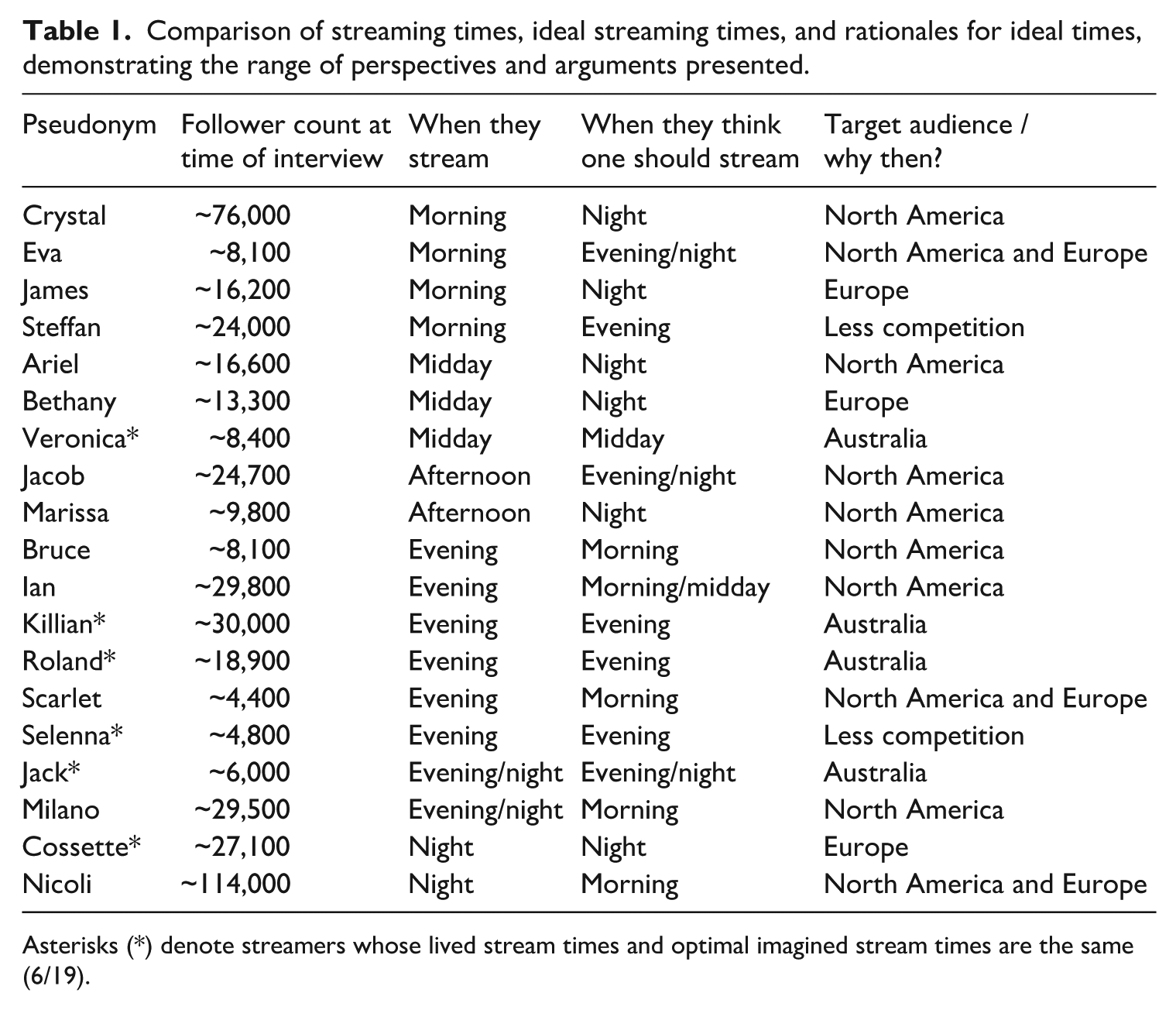
Asterisks (*) denote streamers whose lived stream times and optimal imagined stream times are the same (6/19).
With whom am I competing?
A diverse set of factors influencing Twitch broadcasting schedules have now been identified, but there is another which further complicates this already multi-faceted picture of time, time zone, geography, work, employment, and life rhythm. This is the perception of competition. To begin with, Steffan explained to us that game streamers fundamentally choose between ‘streaming in high-traffic times to get the largest audience, or [in] low-traffic times because there’s the least competition’. They noted ‘pros and cons’ to both options, with the former having more potential viewers but greater competition, and the latter having fewer potential viewers but less competition. They suggested that ‘as a small streamer [it is probably] a better idea to stream in low-traffic times’ because of the difficulty competing with the big names, so ‘starting out it’s much better to be in the low-traffic time zones’. However, Steffan explained one can reach ‘a ceiling’ doing this, and because ‘it is such a low traffic time you’re never going to grow a huge American audience’ – highlighting again the perceived importance of reaching this target market. Selenna similarly explained that ‘early in the morning’ many of the ‘big American streamers are on’ and so one will face ‘more competition with who might want to watch’, whereas later in the day (in Australia) ‘there’s [fewer] people online’ so ‘that can help people find you instead of watching other bigger streamers’. This was echoed by Roland, who said ‘depending on what time of day it is it’s quite easy’ for Twitch to become ‘saturated’. Veronica made a comparable comment – and used the same language – by stating they believed Twitch to be ‘super saturated around [midday] because that’s when all the American streamers are on’.
Yet it must also be noted that other interviewees argued the exact opposite. Several stated that all time slots can be potentially valid, and that this competition-focused strategising is unnecessary or simply irrelevant. This is interesting to note because it complicates any idea of a consensus-based ‘best strategy’ for live streaming, and instead highlights that even after a decade of Twitch – and a decade of this pursuit being a potential career for aspirant streamers – there are still diverse schools of thought about the best way to grow one’s channel. For example, Jack asserted, ‘I don’t think there is a best quote-unquote “time zone”’ for game streaming. They explained that there are ‘a lot of factors that weigh into it’ and such decisions depend on one’s ‘target audience’. Ian stated explicitly that ‘there’s no best time to stream’, adding that there are ‘so many time zones to appeal to’. Selenna similarly said that ‘I don’t think it matters too much what time you stream to how many viewers you potentially get’ – mentioning also a friend who streams at a different time and still gets equivalent viewership – and Bethany said that no matter what one streams, ‘there’s always someone around’. In contrast to the first set of respondents quoted in this section, these respondents, therefore, dismissed the idea of superior or inferior streaming times as a consideration in choosing when to broadcast. They instead asserted that some of the temporal and geographic complexity already discussed is, in fact, so complex that it evades any single ‘correct’ strategy – there are possibilities for visibility, and the lack thereof, at all moments of the day. We therefore see that two different discourses of optimal timings are circulating among Twitch’s game streamers, adding a further complicating layer to the decision-making processes involved in scheduling broadcasts.
Despite the above disagreement, what respondents did almost wholly agree on was the importance of consistency in streaming times, regardless of how competitive that time is. Jack explicitly said that they saw their time slot as ‘the chunk of time that I’ve built my audience in’, and Kilian said that when people ‘develop an audience purely from streaming in [a] time zone’, that then becomes ‘how they build their audience going forward’. Bruce asserted that if one is ‘consistently streaming at [a] time, you’ll end up building a larger viewership’, while Jacob, who said they ‘don’t have a set schedule’, echoed this by saying that they felt this absence ‘has actually always been an issue’ for their channel. We therefore see the idea that a streamer becomes locked in to a particular broadcasting time – whatever the reasons for originally streaming in that slot. My previous research has noted that streamers with a significant number of viewers ‘tend to be very constant in their broadcast timings’ (Johnson et al., 2019) and that live streaming is a career (or hobbyist) path that ‘depends upon regularity and reliability’ in one’s streams (Johnson & Woodcock, 2019: 337). Here, therefore, the ‘length and sequence of activities’ that Twitch game streamers are doing become ‘fixed and planned ahead of time’ (Rosa, 2013: 235) as a means to develop one’s channel and maximise the number of viewers who are going to return, and who are going to come to understand one’s channel as a fixture in their lives (cf. Spilker et al., 2020). By giving viewers ‘some certainty of orientation, evaluation, and expectation’ (Rosa, 2003:7) in broadcasting times, it is clear that regularity and consistency are not just important as part of the temporal regulation of game streamers’ own lives as well, but also to their perception of how best to build a fanbase. While in general it is the media technologies themselves that shape ‘the organization and experience of time’ (Kaun, 2015: 226), here we see it is streamers who are setting their own times and routines on a site that has no centralised time zone or equivalent. Twitch streamers structure their own activities and create regions of temporal order that encourage viewers back with promises of consistency and regularity, 1 even though the apparent promise of ‘flexible’ work is, ironically, one of the most seemingly appealing parts of labour on digital platforms (Repenning, 2024: 1514). Given the importance these schedules assume, streamers might, therefore, be well advised to think hard about when they first go live, regardless of whether it is a more or less ‘competitive’ time slot to be broadcasting in.
Overall, then, the notion of competition described here is interesting as it serves both an instrumental role, in the sense that it shapes when streamers go live, but also can be understood in a purely discursive sense – as something that streamers feel hanging over them, as something that feels like it must be considered, and as something that factors into their thought processes of game streaming and, inevitably, their own sense of themselves on the platform. The interaction between pragmatic concerns, discourses and ideas that circulate among streamers, and how each of these feeds into and shapes the other, is especially clear in the context of these comments around competition and consistency. At the same time, however, happenstance once again plays its part here, with streamers explaining that the time ‘slot’ they start in (which might not have been carefully planned) often becomes the time they stay in. The combination of pragmatics (e.g. ‘Australia only has a small Twitch population’), discourse (e.g. ‘I should be pursuing American viewers’), and happenstance (e.g. ‘To my surprise a lot of Brazilians watch my channel’), therefore appears to be fundamental to how game streamers select their broadcast times, and in turn gives rise to a range of different overall logics, rationales, and articulations. We thus also see how these three elements – pragmatics, discourse, and happenstance – in turn shape ideas about temporality that become shared, discussed, and debated within the wider Twitch community. What comes through most strongly here is the fact that Twitch game streamers certainly have significant control and agency over their streaming schedules, yet events can also overtake them, and reshape their practices very suddenly – especially if they aspire to high ‘success’ on the platform.
Conclusion
In this article, I have examined the answer(s) to a seemingly simple question: how do game streamers on Twitch decide when to go live? Drawing on semi-structured interview data, I examined when game streamers are going live; when game streamers think they should be going live (rarely the same); and the influence of discourses of competition and consistency, both of which seem to be considered highly important, yet the first is far from settled in the minds of Twitch streamers. The analysis shows that the dynamics of time are far more than just selecting a period in the day when one feels like making a broadcast. Timing decisions are neither random nor whimsical. Instead, questions of employment, education, when gaming best fits into a day, countries, time zones, concepts of competition, perceptions of Twitch’s viewer base, and more, are all factoring into time-related decisions. While some are specific only to broadcasters outside of the American time zones, the majority are not, and demonstrate the sorts of decision-making shaping streamer strategies on the platform. This examination also sheds significant new light on how Twitch game streamers think about and plan their streaming more generally, as well as on some of the local and international dynamics at play in the creation, and in the viewing, of Twitch game streaming channels. The study of Twitch streamers is a growing and important area of media and communications research (Johnson & Woodcock, 2019; Bingham, 2020; Ruberg and Lark, 2021; Scully-Blaker et al., 2017; etc.) and this article offers a new contribution through its examination of temporal dynamics on the platform. At a moment when ‘digital media platforms have become rhythm makers that co-shape the temporal practices and experience of time’ for their users (Repenning, 2024: 1517), this is an enquiry which can tell us important new information about Twitch streamers and their viewers, but also about the roles of time, time zones, and concepts of temporality more broadly, on major online sites. It also offers insights into how liveness online via sites like Twitch is mediated by a substantial number of factors that viewers rarely perceive, all of which contribute to the shaping of both individual channels and larger-scale norms, expectations, and daily rhythms on such a platform.
There are two concluding points that are worth making here. The first is that through examining these temporal behaviours and rationales of Twitch’s game streamers, we see a further demonstration of Postigo’s (2016: 9) assertion that play is not ‘bounded outside worldly considerations of time’. Just as streamers ‘commodify their streaming time’ (Johnson et al., 2019) in the sense of the time they spend streaming, we have seen here that streamers also commodify their streaming time by articulating and explaining time slots and time considerations from a range of strategic perspectives. This leads us to the idea that Twitch – like other domains of digital and contemporary life – is now exhibiting its own idiosyncratic ‘temporal rhythms, patterns, and horizons’ (Rosa, 2003: 23). As what Rosa would call an ‘autopoetic subsystem’ of time (Rosa, 2003: 22), the temporal dynamics of Twitch game streaming have some similarities with other practices – gaming, social media use, television consumption and so on – but have also mutated into their own sets of patterns and norms, and streamer discourse and discussion around (and shaping) those same patterns and norms. In turn the role of happenstance, such as accidentally gaining an unexpected community or arbitrarily selecting a streaming time which then becomes codified as ‘your slot’, adds a third layer atop the pragmatics and the discourses of game streaming time.
A final point, therefore, is to emphasise this interplay between pragmatics and discourse, and the role of happenstance. There are so many factors at play here that one might reasonably ask not how streamers integrate these into their temporal decision-making, but rather how they are not overwhelmed. To resolve this question, I suggest that this complexity and multiplicity leads each streamer – perhaps daunted by the scope and scale of the platform, the number of other broadcasters, a desire to be heard and engaged with on the site – to select some rationales and to downplay others. Streamers appear to thus be finding ways to navigate this complexity by trying to render it more understandable, and more graspable. For all the streamers interviewed it was clear that ‘the regular exercise of reflexivity relating to one’s use of time’ was important to their streaming success (Johnson et al., 2019), particularly given that in any context of rapid change – Twitch has itself undergone a number of significant shifts and policy changes during the writing of this article – it can become hard to discern what the best choice is, and hence how to make the best use of one’s time. Based on this evidence, I do not believe we should expect to see a single ‘temporal rationality’ emerge on the platform any time soon.
For future research two main areas thus stand out – time and gaming content creation, and time (and geography) on Twitch. In the first case this article demonstrates that we should examine not just how long gaming content creation or fan creation activities take, but also how such hours are slotted into creators’ lives, when are these activities carried out, what are the creators’ orientations to time, what unique dynamics of time might exist for a particular activity (e.g. waiting for paint to dry in cosplay, or waiting for others to contribute their parts of a collaboratively made mod), and so on. This would shed significant new light on how these practices fit into creators’ lives, and open up a new dimension of game temporality for consideration and study. In the second case, it is clear that time is an important element of Twitch game streamers when they plan their streams, and that complex decision-making processes are at play here. Further research should, therefore, examine time zone and time slot considerations for Twitch streamers in other geographical contexts, and how the requirements of Twitch interact with other time commitments such as time spent with family, or performing caring duties. We also require studies of Twitch streamers from other countries to corroborate – or challenge – what has been presented here, and to promote a deeper understanding of how Twitch’s temporal dynamics connect to global and local geographies. The foundations laid in this article tell us much about how time can play out in Twitch game streaming, but the full picture has only begun to be explored.
Footnotes
Acknowledgements
The author wishes to express sincere appreciation to the interviewees who generously offered their time for this study, and to the Hoso Bunka Foundation for funding this research.
Data availability statement
Consent forms signed by interviewees did not include the sharing of the raw data, but the author is more than happy to discuss the data set with any interested researcher.
Ethical approval
This project was granted ethical approval by the University of Sydney Human Research Ethics Committee, with project code 2021/488, and all respondents completed informed consent forms detailing the research project.
Funding
The author(s) disclosed receipt of the following financial support for the research, authorship and/or publication of this article: This project was generously funded by the Hoso Bunka Foundation.
