




Abstract
Selfies are frequently used among adolescents. Yet little is known about how selfies relate to body dissatisfaction over time and the mechanisms involved. The present study examined the longitudinal relationships between selfies (i.e. taking, manipulating, investing in and posting) and body dissatisfaction via sociocultural mediators; thin-ideal internalisation and comparisons. Adolescents (N = 573; Mage = 15.38, SD = 1.34; 68.2% female) completed online surveys twice over 4 months. A cross-lagged mediation model demonstrated unidirectional relationships, whereby body dissatisfaction predicted higher investment and lower posting 4 months later. Mediation was only found via one pathway; body dissatisfaction predicted greater selfie investment via upward comparisons. Gender did not moderate the relationships. These findings provide little support for sociocultural mechanisms, suggesting researchers pursue alternative frameworks.
Body dissatisfaction – defined as a negative evaluation of one’s body size, shape or appearance – is a well-established risk factor for the development of eating disorders and poor mental health (Bornioli et al., 2020; Stice et al., 2011). Adolescence is a particularly vulnerable developmental period, during which physical changes, peer comparisons and sociocultural influences heighten body-related concerns (Bucchianeri et al., 2013). In recent years, social media has emerged as a powerful contributor to adolescent body image, providing a constant stream of appearance-related content and opportunities for appearance-based self-presentation. Meta-analyses have demonstrated that social media use is both associated with and contributes to greater body dissatisfaction among adolescents and adults (de Valle et al., 2021; Saiphoo and Vahedi, 2019). This effect is thought to stem from the highly visual and interactive nature of social media, which amplifies exposure to idealised images and fosters frequent appearance comparisons – often leading to dissatisfaction when an individual perceives that their own appearance does not match these unrealistic ideals (Choukas-Bradley et al., 2022; Perloff, 2014).
Given the popularity and appearance-focused nature of selfies, researchers have started to explore their relationship with body dissatisfaction. A selfie is defined as a self-taken photograph, often taken with a smartphone or webcam and shared on social media (Oxford Dictionary, 2013). While preliminary evidence supports sociocultural theory as a useful framework for understanding selfie-related appearance concerns (e.g. Wang et al., 2023), much of this work has relied on cross-sectional data, limiting insight into directionality or potential bidirectional effects (Felig and Goldenberg, 2023). The present study addresses this gap by examining reciprocal longitudinal associations between distinct selfie behaviours and body dissatisfaction, along with mediating psychological mechanisms.
Selfies and body dissatisfaction
The social media experience encompasses a broad range of activities. One of the most common activities, particularly among adolescents, is the creation and sharing of selfies (Dhir et al., 2016). Analyses of large-scale selfie datasets suggest that appearance is a dominant focus; for example, a study of 2.5 million Instagram selfies found that over half (52%) emphasised appearance, while a smaller proportion (14%) centred on social interactions, such as sharing images with friends or documenting social events (Deeb-Swihart et al., 2017). As such, selfie behaviours have been proposed to be linked to body image.
Although often referred to collectively, selfie behaviours are multifaceted and have been proposed to have distinct psychological effects. In the current literature (McLean et al., 2015; Schreurs and Vandenbosch, 2022), four commonly examined components include selfie taking (capturing photos of oneself), selfie manipulation (editing, filtering, or retouching selfies), selfie investment (time, cognitive effort, and emotional energy devoted to planning and curating selfies) and selfie posting (sharing selfies on social media). While these behaviours are interrelated, they involve distinct cognitive and emotional processes that may uniquely contribute to body image concerns (McLean et al., 2019). Without examining them separately, important nuances in their psychological effects may be overlooked. The following sections will briefly summarise key research findings on each behaviour and explore the underlying mechanisms that may explain these effects.
Experimental research among young women has found that taking and manipulating selfies leads to higher facial dissatisfaction and negative mood (Fox et al., 2021; Mills et al., 2018; Tiggemann et al., 2020). These authors propose that these selfie behaviours encourage individuals to view themselves from a third-person perspective and place heightened attention and emphasis on appearance. Taking selfies directs attention towards one’s appearance and may prompt individuals to scrutinise their physical features. The ability to manipulate selfies may then lead the individual to identify areas for improvement and address these using editing features, resulting in a comparison between their real appearance to an idealised version of themselves.
Selfie investment, defined as the time and effort taken to select and present favourable selfies, has been linked to higher body dissatisfaction in adolescent girls and adult men and women (Lonergan et al., 2018; McLean et al., 2015). One possible explanation is that individuals who are highly invested in selfies may place increased value on appearance as a source of contingent self-worth (Crocker and Wolfe, 2001). This increasing preoccupation with idealised appearances of the self and others may create an impossibly high, unrealistic standard for themselves, making them more vulnerable to dissatisfaction.
Another aspect of selfie-related behaviours is selfie posting. Contrary to selfie taking, manipulating and investment, the literature examining the impact of selfie posting on body dissatisfaction has produced mixed findings, including positive (McLean et al., 2015), negative (Chang et al., 2019) or no relationship (Wang et al., 2019) among adolescents, with results possibly dependent on the valence of feedback received from peers. For instance, positive feedback (e.g. likes or comments) on one’s selfie may promote body satisfaction, whereas negative feedback may promote body dissatisfaction (McLean et al., 2019). In a recent narrative review, McGovern et al. (2022) noted that some inconsistencies in the relationships between selfie behaviours and body dissatisfaction may indicate that direct effects do not present the whole picture, instead highlighting the need for more research to explore the mechanisms which may exist, including through internalisation and comparisons.
Tripartite influence model
When trying to understand mediating factors linking selfies to body dissatisfaction, it is helpful to draw on established theoretical frameworks. According to the sociocultural Tripartite Influence Model (Thompson et al., 1999), sociocultural pressures from (social) media, peers and family contribute to body dissatisfaction through two key mechanisms: internalisation (i.e. adopting societal appearance ideals as your own personal standard) and appearance comparisons (i.e. comparing your appearance to that of others). The model theorises that repeated exposure to sociocultural appearance pressures increases the salience of appearance as a central aspect of self-worth and normalises unrealistic beauty standards. Given the appearance-focused and idealised nature of much social media content, repeated exposure to social media has been proposed to increase internalisation of appearance and facilitate upward appearance comparisons (Perloff, 2014). This will typically result in the evaluation that their own appearance does not match societal standards, resulting in body dissatisfaction. Some prospective support has been found for this framework among adolescents in relation to social media frequency. For example, empirical studies with adolescents have found that internalisation and comparisons mediate the relationship between social media use and body dissatisfaction (e.g. Jarman et al., 2021c; Roberts et al., 2022). For broader applications of the Tripartite Influence Model that do not specifically assess social media, see recent empirical studies by Iannattone et al. (2025) and Kakar et al. (2023). A handful of studies have begun to explore selfie-related behaviours using the Tripartite Influence Model, with mixed findings.
From selfies to body dissatisfaction
In line with the Tripartite Influence Model, selfies may increase upward appearance comparison and thin-ideal internalisation which then lead to higher body dissatisfaction. The latter pathways are theorised to highlight discrepancies between one’s actual and edited or internalised appearance, hence causing body dissatisfaction (Thompson et al., 1999), with established empirical support for this relationship among adolescents over time (e.g. Rodgers et al., 2015). However, the former pathways (i.e. from selfie behaviours to internalisation and comparisons) are less evaluated, particularly over time.
Selfie taking
With respect to selfie taking, it has been argued that adolescents take selfies as a means to evaluate their appearance (e.g. selfies as a mirror; Warfield, 2015). This may be considered a form of body surveillance where individuals view their selfies from an observer’s perspective. The act of taking and then viewing selfies may increase the salience of idealised images and trigger upward appearance comparison, as comparing oneself with others’ (idealised) social media images can be applied as a strategy to evaluate and monitor one’s appearance (e.g. Lyu et al., 2022). In line with this, cross-sectional evidence has demonstrated a positive relationship between selfie taking and internalisation and comparisons (Cohen et al., 2018; Rousseau, 2021).
Selfie manipulation
The act of manipulating selfies heightens an individual’s focus on how they look and amplify perceived differences between their real appearance and an idealised, digitally enhanced version (Stewart and Clayton, 2022). This discrepancy between how they look and how they wish they looked may generate a perceived pressure to conform to sociocultural ideals of beauty, leading to the internalisation of appearance ideals. In addition, this discrepancy may (unconsciously) prompt people to attend and evaluate body-related stimuli (Rodgers and DuBois, 2016), including engaging in comparisons. In line with this, self-improvement motives (Rousseau et al., 2017, 2020) and selfie manipulation (McLean et al., 2015; Mingoia et al., 2019) have been linked to both internalisation and upward appearance comparisons.
Selfie investment
Selfie investment refers to the time, effort, and emotional energy devoted to selfies. This includes carefully selecting the most flattering images and sensitivity to social feedback. Such investment may foster a form of (social) surveillance, heightening attention towards appearance-related content which promotes internalisation with repeated exposure. This, in turn, may trigger upward appearance comparisons as individuals evaluate their own appearance against idealised or socially rewarded images (Rodgers and DuBois, 2016). This notion has been supported, with cross-sectional evidence finding a positive relationship between selfie investment and internalisation and comparisons (Mingoia et al., 2019; Rousseau, 2021).
Selfie posting
Another commonly studied behaviour is selfie posting, which refers to sharing one’s selfies on social media platforms. Research has shown that adolescents post selfies for idealised self-presentation (e.g. representing appearance ideals, camouflaging perceived inefficiencies; Chua and Chang, 2016; Döring et al., 2016) and to gain peer approval (Throuvala et al., 2019). Selfie posting and the subsequent exposure to and engagement with posted (idealised) selfies increases the focus on one’s appearance and associated feedback received (i.e. likes, comments), hence it may contribute to internalisation and upward appearance comparison (cf. self-effects, Valkenburg, 2017). While a positive association has been found between selfie posting and comparisons, the relationship with internalisation is mixed, demonstrating a positive (Mingoia et al., 2019), negative (Rousseau, 2021) or no relationship (Cohen et al., 2018).
From body dissatisfaction to selfies
Although selfies have been proposed to impact body image, emerging research also suggests that body dissatisfaction may reinforce selfie-related behaviours, highlighting a potentially reciprocal relationship. Specifically, adolescents with higher body dissatisfaction may engage in selfie behaviours to alleviate appearance concerns (Jarman et al., 2021a). From a self-improvement perspective, this may include selfie taking, manipulating, investment and posting (e.g. Veldhuis et al., 2020). Indeed, research has shown a reciprocal relationship between facial dissatisfaction and selfie editing and viewing over 6 months (Wang et al., 2019). Despite this, no study has examined whether internalisation and comparisons mediate longitudinal relationships from body dissatisfaction to selfie behaviours.
Evidence suggests that adolescents who are dissatisfied with their body and appearance engage in upward appearance comparison and internalise the thin-ideal (Rodgers et al., 2015; van Oosten et al., 2023). These mechanisms may, in turn, reinforce behaviours. Adolescents who internalise appearance ideals and/or wish to compare themselves may use selfies as self-presentation/impression management tools. Selfie investment and manipulation enable the user to present their idealised self, typically with the aim of moving closer to appearance ideals. While selfie taking can be perceived as a private act of self-evaluation, selfie posting may be regarded as a more public form of self-assessment where one’s appearance evaluation is guided by the amount and type of selfie feedback received. Given that edited selfies are often negatively viewed by adolescent users (i.e. as fake and egotistical; Burnette et al., 2017), investment in the selection and presentation of selfies may help adolescents mitigate the risk of unfavourable feedback.
Gender as a potential moderator
The strength of the relationship between selfie-related behaviours and body dissatisfaction may be impacted by self-reported gender. Adolescent girls and women typically report higher engagement in selfie activities (e.g. posting; Salomon and Brown, 2018; manipulating; Stefanone et al., 2019) and body dissatisfaction than adolescent boys and men, although no differences were found for investment in others’ response to selfies (Lonergan et al., 2018). Given the heightened pressure for girls to appear attractive, they often place greater importance on appearing attractive on social media than boys (Yau and Reich, 2018). As a result, it could be proposed that gender moderates the relationship between selfie-related behaviours and body dissatisfaction, with stronger relationships among adolescent girls than boys. Despite different rates of use and body image, only a handful of studies have compared the effect across boys and girls. Current evidence is mixed for the moderating role of gender, with some research finding stronger relationships between social media and body image among adolescent girls and women (de Valle et al., 2021) and other finding no difference when examining selfies specifically (Wang et al., 2023).
The present study
The above-mentioned research shows that selfie behaviours relate differently to body dissatisfaction, depending on underlying sociocultural mechanisms (i.e. appearance comparison and internalisation). This highlights the need to distinguish between selfie taking, manipulation, investment and posting as unique behaviours with unique motivations and outcomes (Stefanone et al., 2019). Distinguishing between these will enable researchers to identify which behaviours are most problematic and the specific psychological mechanisms involved. This distinction allows for more precise theoretical models, targeted interventions and a deeper understanding of the nuanced ways social media engagement impacts body image and mental health. Despite some initial work, there is a lack of longitudinal studies examining these relationships, especially within a framework like the Tripartite Influence Model.
Drawing on the mechanisms within the Tripartite Influence Model, the present study aims to examine the longitudinal relationships between selfie behaviours (i.e. selfie taking, manipulating, investment and posting) and body dissatisfaction among Belgian adolescents using a survey design, paying specific attention to upward appearance comparison and internalisation as underlying mechanisms. Given prior evidence suggesting a potential bidirectional relationship between social media behaviours and body image concerns, we tested both directions of influence via appearance-related psychological mechanisms (internalisation and upward appearance comparisons). See Figure 1 for a visual representation of the relationships examined. Note, while the Tripartite Influence Model originally conceptualises media, family and peers as key sociocultural influences on body dissatisfaction (Thompson et al., 1999), many studies have applied the model specifically to social media influences, given its growing prominence as a primary source of appearance-related pressures (e.g. Gahler et al., 2023; Jarman et al., 2021b; Wang et al., 2023). In line with this approach, the present study focuses on the mediating mechanisms of thin-ideal internalisation and appearance comparison within the context of social media, acknowledging that future research may benefit from incorporating family and peer influences more explicitly.
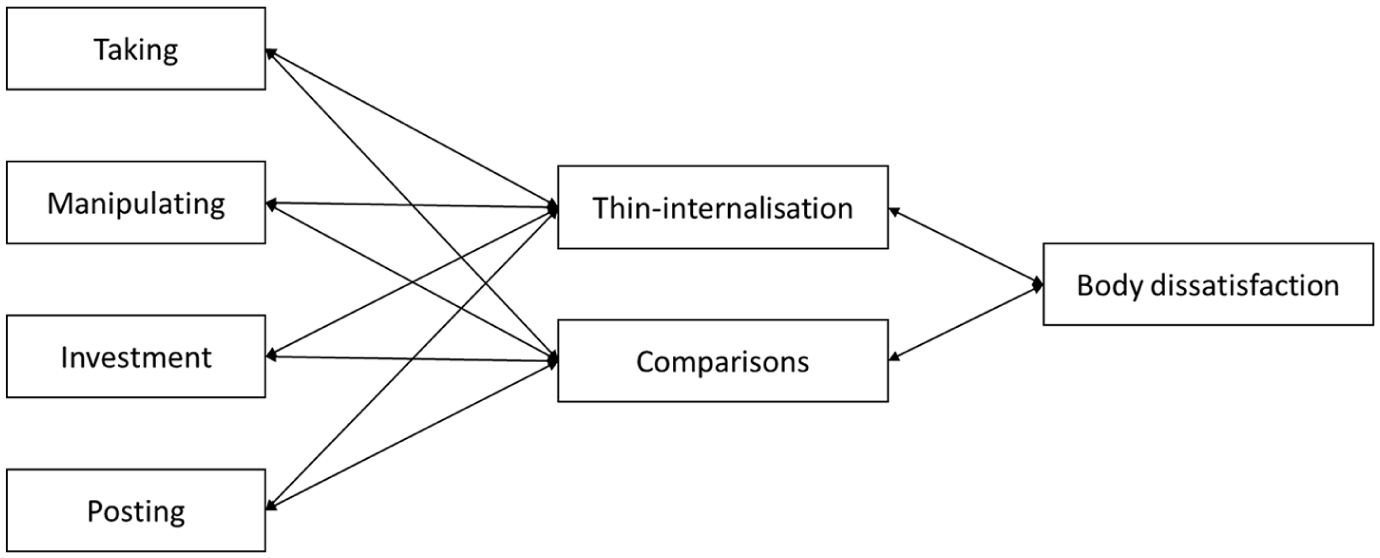
Reciprocal indirect relationships between selfie behaviours, thin-ideal internalisation, comparisons, and body dissatisfaction.
The strength of the relationships between selfie-related behaviours and body dissatisfaction may be impacted by various factors, including gender. As a result, a secondary aim of this research was to examine whether gender moderated the effects.
Method
Sample
This study used a two-wave longitudinal survey design to collect data among a sample of Belgian adolescents (aged 13–19 years). The first wave of data collection took place in October 2019 (w1), the second 4 months later in February 2020 (w2). A 4-month interval was chosen to balance capturing meaningful changes in body image while minimising attrition and the influence of rapid adolescent development. Ethical approval was received from the ethical committee of KU Leuven university. Schools were randomly selected from a list including all secondary schools in Flanders and invited to participate in the research project. After providing the educational staff with information about the research project, 10 secondary schools agreed to participate in the first and second wave. Active parental consent and student assent were required for participants to fill out the questionnaires. Participating schools were visited during school hours by the main researcher and/or two research assistants. Participants were given a link to the online survey administered through the university’s Qualtrics platform. All participants completed the survey in a computer classroom under supervision of the researcher(s).
In total, 1248 adolescents completed the survey at baseline (w1). Of these, 214 were excluded because they failed the attention check, 94 because of missing values in more than 30% of the items and another 26 because of lacking an account on at least one of the following social media: Snapchat, Facebook and Instagram. Of the remaining 914 participants, 573 accurately completed the survey at both data collections (response rate = 63%). A multivariate analysis of covariance (MANCOVA; controlling for gender, age, body mass index [BMI] and social media use) using Pillai’s Trace, V = .01, F(7, 811) = .82, p = .569, ηp2 = .01, showed no significant differences between those who participated only in the first wave and those who participated in both waves with respect to all relevant wave 1 variables (e.g. body dissatisfaction, selfie taking, selfie manipulation, selfie investment, selfie posting, thin-ideal internalisation and upward appearance comparison on social media).
The final analytical sample consisted of 573 participants aged 13–19 years (M = 15.38, SD = 1.34), of which 68.2% identified as female. Most were born in Belgium (92.8%) and just over a quarter had a mother (28.5%) or a father (27.1%) with a university degree.
Measures
Upward appearance comparisons on social media
We used an adapted version of the 10-item upward physical appearance comparisons scale (UPACS; O’Brien et al., 2009) to measure the extent to which participants compared their appearance to that of other social media users who look better. Using a 5-point scale ranging from 1 (Strongly disagree) to 5 (Strongly agree), participants evaluated 10 items (e.g. ‘I tend to compare myself to other social media users I think look better than me’). Item scores were averaged to create an estimate of participants’ engagement in upward appearance comparison on social media. The scale showed good internal consistency (α W1 = .96, α W2 = .96). In the results section, we refer to upward appearance comparison on social media as upward comparison.
Internalisation of the thin ideal
The Thin/Low Body Fat Internalisation subscale of the Sociocultural Attitudes Towards Appearance Questionnaire-4 (SATAQ-4; Schaefer et al., 2015) was used to measure the extent to which participants adopted the thin-ideal body as a personal standard. Although our sample included both adolescent boys and girls, we examined thin-ideal internalisation given that social media content, including selfie-related behaviours (e.g. taking, editing, posting), typically reflect pursuit of thinness and conventional attractiveness more so than muscularity. In addition, empirical evidence suggests that thin-ideal internalisation remains a relevant predictor of body dissatisfaction in both genders during adolescence (Jarman et al., 2021c), supporting the use of this subscale in the present context. Using a 5-point scale (1 = Strongly disagree to 5 = Strongly agree) participants evaluated five items (e.g. ‘I want my body to look very lean’ and ‘I want my body to look like it has little fat’). Item scores were averaged to create an estimate of participants’ thin-ideal internalisation. The scale showed good internal consistency (α W1 = .91, α W2 = .91).
Selfie activities on social media
We used McLean et al.’s (2015) photo activity measure to assess participants’ selfie taking/posting frequency, selfie editing and selfie investment.
Selfie taking
Using an 8-point scale (1 = Less than once a month to 8 = More than twice a day), participants indicated how frequently they took (1) pictures of themselves (i.e. selfies) and (2) pictures of themselves with other people in the photo (i.e. usies). Item scores were averaged to create an estimate of participants’ selfie-taking frequency. Spearman–Brown (internal consistency) coefficient for two-item scales (Eisinga et al., 2013) was .86 at w1 and .81 at w2.
Selfie manipulation
To measure the extent to which participants manipulated or edited selfies before sharing them online, we used a modified version of the 10-item Photo Manipulation Scale used in McLean et al. (2015). Using a 5-point scale (1 = Never to 5 = Always), participants evaluated 10 items; Eight items addressed edits related to one’s physical appearance (e.g. ‘Highlight facial features, e.g., cheekbones or eye colour/brightness’), and two items addressed edits related to the general look of the photo and use of filters (e.g. ‘Adjusting the light/darkness of the photo’). In line with recent suggestions to differentiate between general and appearance-related photo editing (McGovern et al., 2022), we evaluated the factor structure of these items. Exploratory factor analysis using direct oblimin yielded two factors. The first factor captured photo editing in general (eigenvalue = 4.06, explained variance = 40.58%), including ‘Adjusting the light/darkness of the photo’, ‘Use a filter to change the overall look of the photo, e.g., making it black and white, or blurring and smoothing images’ and ‘Get rid of red eye’. The second factor captured photo editing related to making yourself look better and creating self-images that conform to sociocultural appearance ideals (eigenvalue = 1.40, explained variance = 13.99%), including ‘Make yourself look larger’, ‘Make yourself look skinnier’, ‘Whiten your teeth’, ‘Make specific parts of your body look larger or look smaller’, ‘Edit or use apps to smooth skin’ and ‘Highlight facial features, e.g., cheekbones or eye colour/brightness’. One item (‘Edit to hide blemishes like pimples’) was removed due to cross-loadings >.30 on both factors. For the purpose of this study, we only used the six items that loaded onto the second factor (Terán et al., 2019) (see Supplementary Materials). Item scores were averaged to create an estimate of participants’ appearance-ideal related selfie manipulation. The scale showed good internal consistency (α W1 = .82, α W2 = .87).
Selfie investment
To measure participants’ time and effort expended in choosing selfies before sharing them online and their concern about the attractiveness of their taken selfie, we used the 8-item Selfie-Investment subscale (McLean et al., 2015). Using a 5-point scale ranging from 1 (Not at all) to 5 (Very much), participants evaluated eight items (e.g. ‘I carefully select the best photo to share/post’). Item scores were averaged to create an estimate of participants’ selfie investment. The 8-item scale showed poor internal consistency (α = .57). After removing the two negatively worded items (‘I don’t care what others will think about how I look’ and ‘I don’t care whether anyone will “Like” my photos’) the 6-item scale showed adequate consistency (α W1 = .74, α W2 = .75). The six item scores were averaged to create an estimate of participants’ selfie investment.
Selfie posting
Using a 5-point scale (1 = Never to 5 = Always) participants indicated how often they (1) posted photos of themselves online or shared them through social media and (2) avoided putting photos of themselves on social media. The latter item was reverse coded. Item scores were averaged to create an estimate of participants’ selfie-posting frequency. Spearman–Brown coefficient was .28 at w1 and .18 at w2, indicating poor internal consistency. In line with Cohen et al. (2018), we opted to remove the reverse coded item and measured selfie-posting frequency with only one item (‘Do you post photos of yourself online or share them through services like “Snapchat” or “Instagram”?’).
Body dissatisfaction
We used the Appearance Evaluation subscale of the Multidimensional Body Self-Relations Questionnaire (MBSQR; Cash, 2000) to measure participants’ general satisfaction with their appearance. Using a 5-point scale ranging from 1 (Definitely disagree) to 5 (Definitely agree), participants evaluated seven items (e.g. ‘I feel physically unattractive’). Note that items that refer to satisfaction with one’s appearance were reverse coded such that lower scorers feel mostly satisfied with their appearance, while higher scorers have a general unhappiness with their physical appearance. Item scores were averaged. The scale showed good internal consistency (αW1 = .84, αW2 = .88).
Control variables
Gender (1 = boy, 2 = girl), age (continuous variable), BMI, and general social media use were included as control variables. With respect to the latter, participants indicated on which social media platforms they were active and reported the amount of daily time spent on those platforms using a 5-point Likert-type scale ranging from 1 = less than 10 minutes a day to 5 = more than two hours a day. A social media use score was computed by averaging the items.
Data analysis
To test the hypothesised cross-lagged mediation model we conducted path analysis (AMOS) using maximum likelihood estimation. Five fit indices were used to evaluate model fit: Chi-square to degrees of freedom ratio (χ2/df), comparative fit index (CFI), Tucker–Lewis index (TLI), root mean square error of approximation (RMSEA) and standardised root mean square residual (SRMR). General guidelines suggest acceptable model fit for CFI and TLI .90, and RMSEA and SRMR .08 (Little, 2013).
An autoregressive cross-lagged mediation model was specified to examine longitudinal reciprocal relationships between body dissatisfaction and selfie activities and test if upward comparison and thin-ideal internalisation mediated these relationships (see Figure 1). Although a three-wave design might be the best suited for testing mediation in a three variable chain, two-time point half-longitudinal structural equation models allow to examine each link longitudinally using only two waves of data (Cole and Maxwell, 2003). The only prerequisite is that predictor, mediator and outcome variables are measured at both time points, which was the case in this study. Hence, following Cole and Maxwell (2003), a two-time point, half-longitudinal structural equation model (SEM) was estimated to test the across time relationships between body dissatisfaction, upward comparison and thin-ideal internalisation, and selfie activities.
All analyses included autoregressive relationships for the endogenous variables (e.g. body dissatisfaction at w1 was entered as an exogenous variable body dissatisfaction at w2). We controlled for participants’ age, gender, BMI and average social media use, by allowing covariances with each other and the exogenous variables and estimating predictive paths from them to all endogenous variables. We estimated covariances between variables measured at the same wave and correlated the measurement errors of corresponding manifest items of latent constructs over time. To test for significant indirect relationships between the variables of interest, we specified user-defined estimands using a bootstrapping procedure (Cheung and Lau, 2008). Multiple imputation was performed as the bootstrapping method does not tolerate missing values (Honaker and King, 2010).
To examine whether the hypothesised pathways were moderated by participants’ gender (male/female), we conducted two multiple group analyses. As a preliminary analysis, we first conducted a CFI difference test to confirm metric invariance (i.e. factor loadings of manifest variables are equal across gender). Following Cheung and Rensvold (2002), a CFI difference score (ΔCFI) below .01 indicates metric invariance. Having established metric invariance, a second CFI difference test was used to confirm structural invariance (i.e. structural weights of hypothesised pathways are equal across groups). A ΔCFI < .01 indicates structural invariance (Cheung and Rensvold, 2002).
Results
Data were not missing completely at random, Little’s MCAR test, χ2(2772) = 3097.95, p < .001, with missing values for all included variables ranging from 0% to 2.8%. Five data sets were created with imputed values being restricted to the range of observed scores of the available data, and the hypothesised model was tested with each dataset (e.g. Rousseau and Eggermont, 2018). The resulting findings did not differ substantially, and the model that is reported in the results section was produced using the first imputed dataset. In addition, for sensitivity analyses, the multiple mediator model estimated with the imputed data was compared to the one estimated with the un-imputed data. Results were compared and no significant differences in model fit, factor loadings and structural paths were found.
Descriptive statistics and zero-order correlations between key and control variables are presented in Table 1. While the majority of variables were positively correlated, selfie manipulation was not related to selfie taking and only cross-sectionally related to selfie posting. Furthermore, selfie posting and internalisation were not associated, either cross-sectionally or longitudinally.
Descriptive statistics and correlations between study variables across Waves 1 and 2.
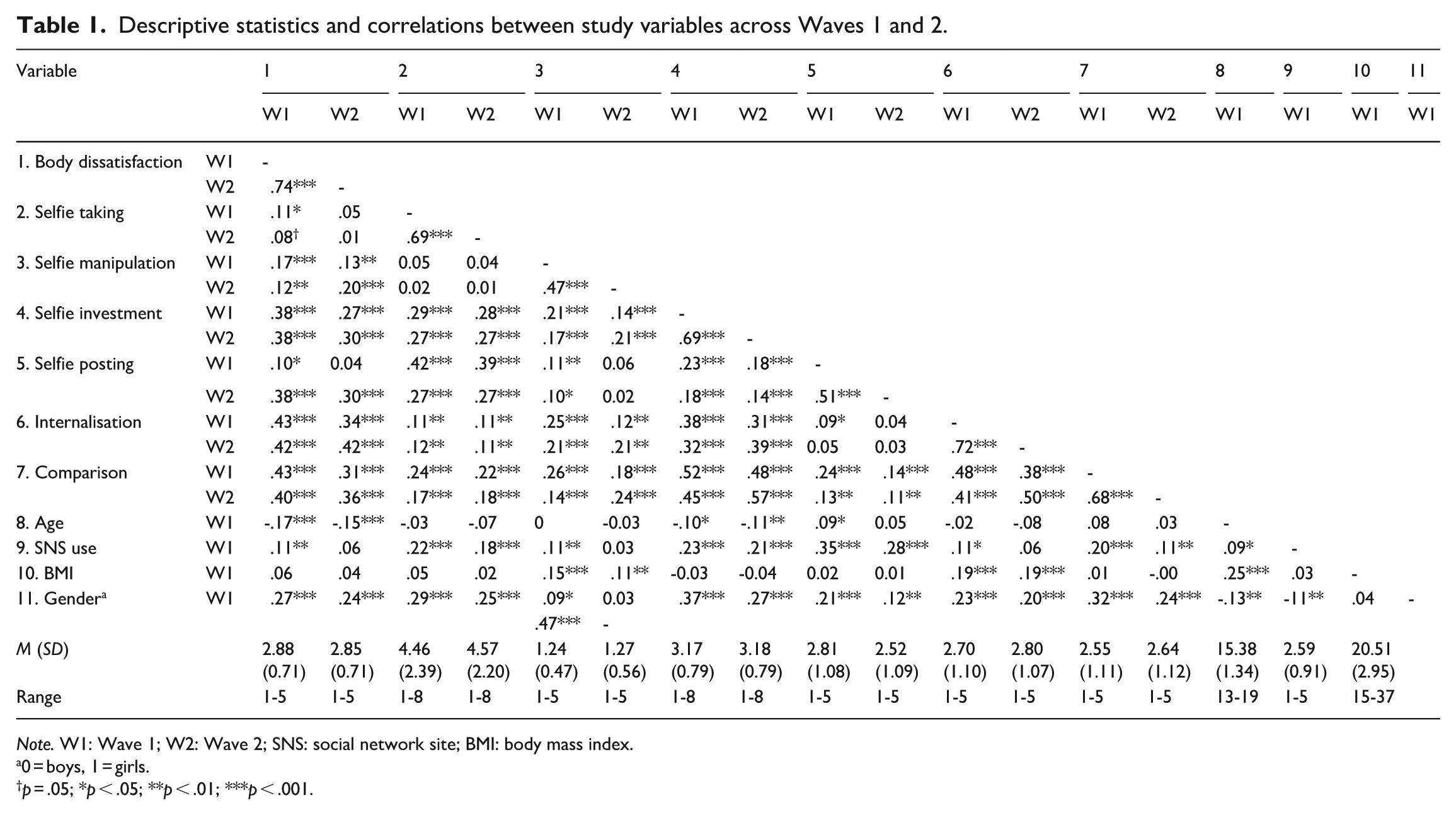
Note. W1: Wave 1; W2: Wave 2; SNS: social network site; BMI: body mass index.
0 = boys, 1 = girls.
p = .05; *p < .05; **p < .01; ***p < .001.
Measurement model
All of the indicator variables loaded significantly onto the respective latent factor (p < .001), with standardised factor loadings ranging from .40 to .92. Correlations among the main variables were weak to moderate but were all significant except for selfie taking and selfie posting, which did not significantly correlate to most other variables. The measurement model showed a rather moderate to low fit to the data: chi-square value of 6043.33 with 2526 degrees of freedom, χ2/df = 2.39, p < .001, CFI = .88, TLI = .87, RMSEA = .05, SRMR = .19. Inspection of the modification indices suggested that model fit would improve by allowing correlated errors between three items of the upward appearance comparison scale that refer to ‘wondering’ about how one looks compared to others on social media (i.e. ‘When I see good-looking people on social media I wonder how I compare to them’, ‘When I see a person with a great body on social media, I tend to wonder how I “match up” with them’ and ‘When I see beach or sport photos of other people on social media, I wonder if my body is as attractive as the people I see there with very attractive bodies’). After these modifications, the measurement model showed an acceptable fit: chi-square value of 4882.00 with 2494 degrees of freedom, χ2/df = 1.96, p < .001, CFI = .92, TLI = .92, RMSEA = .04, SRMR = .06. All indicator variables continued to load significantly onto the respective latent construct (p < .001), and the standardised factor loadings were very similar to those in the original measurement model (range: .40–.93), suggesting that the indicator variables adequately measured the latent constructs.
Structural model
The observed structural model (see Figure 2) showed an acceptable fit: chi-square value of 5430.69 with 2823 degrees of freedom, χ2/df = 1.92, p < .001, CFI = .92, TLI = .91, RMSEA = .04, SRMR = .06.
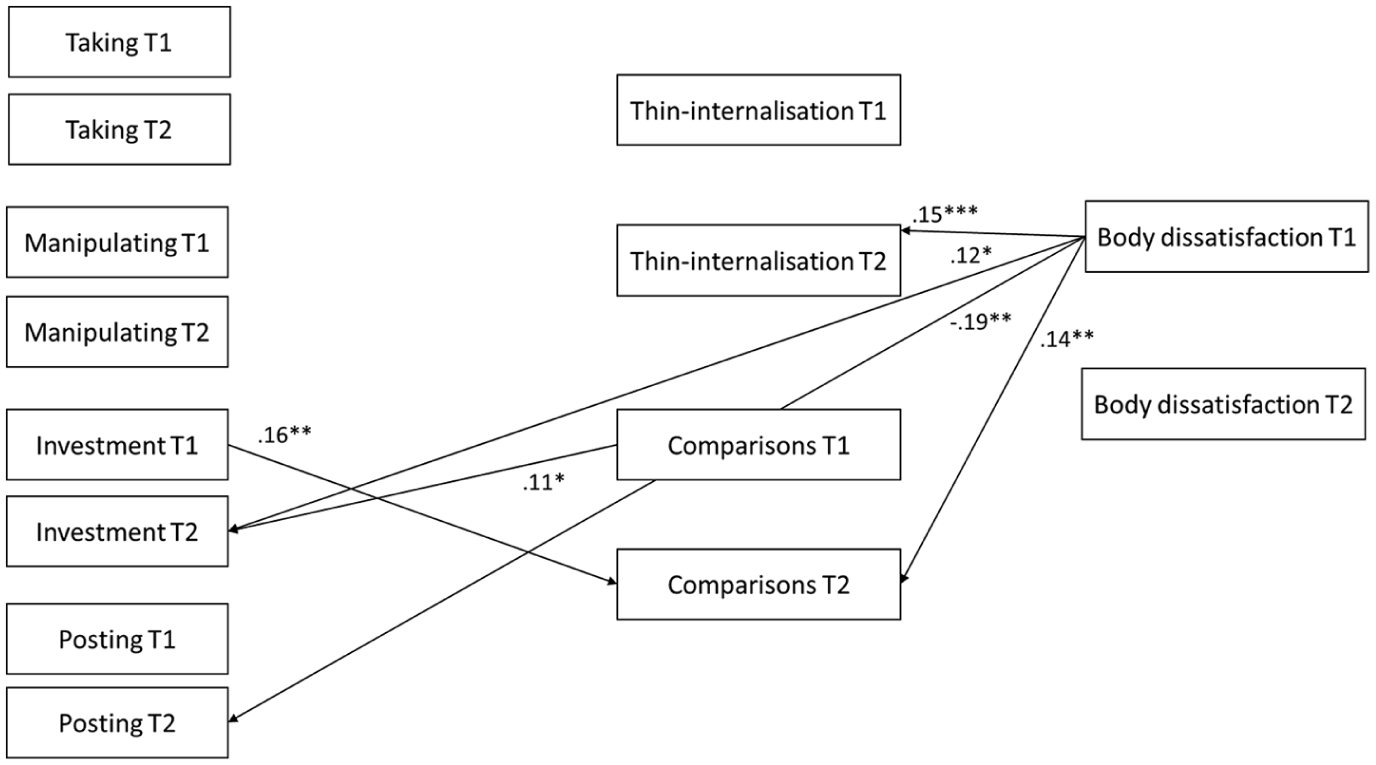
Observed significant relationships between selfie-related behaviours, thin-ideal internalisation, upward comparisons on social media and body dissatisfaction.
Direct relationships
From selfies to body dissatisfaction
None of the selfie activities w1 were directly related to body dissatisfaction w2 (taking: β = −.08, b = −.03, SE = .02, p = .121; manipulation: β = –.00, b = .01, SE = .11, p = .914; investment: β = –.07, b = –.05, SE = .04, p = .167; posting: β = –.05, b = –.03, SE = .04, p = .374).
We did not find evidence for an indirect relationship between selfie activities w1 and body dissatisfaction w2 via thin-ideal internalisation. None of the selfie activities w1 significantly predicted thin-ideal internalisation w2 (taking: β = .05, b = .02, SE = .02, p = .266; manipulation: β = .02, b = .07, SE = .13, p = .554; investment: β = .00, b = .00, SE = .04, p = .941; posting: β = –.03, b = –.02, SE = .04, p = .571). Thin-ideal internalisation w1 did not significantly predict body dissatisfaction w2 (β = .03, b = .03, SE = .04, p = .490).
Considering upward comparison as mediator, selfie investment w1 was the only selfie activity that significantly predicted upward comparison w2 (β = .16, b = .14, SE = .05, p = .003). All other selfie activities w1 did not significantly predict upward comparison w2 (taking: β = .05, b = .02, SE = .02, p = .266; manipulation: β = –.04, b = –.15, SE = .14, p = .270; posting: β = –.02, b = –.01, SE = .05, p = .765). Upward comparison w1 did not significantly predict body dissatisfaction w2 (β = −.03, b = −.03, SE = .04, p = .510).
From body dissatisfaction to selfies
Body dissatisfaction w1 was positively related to selfie investment w2 (β = .12, b = .16, SE = .06, p = .010) and negatively related to selfie posting w2 (β = −.19, b = −.24, SE = .08, p = .002). No direct significant relationships emerged between body dissatisfaction w1 and selfie taking w2 (β = −.05, b = −.13, SE = .14, p = .358) and manipulation w2 (β = .04, b = .03, SE = .04, p = .473).
We did not find evidence for an indirect relationship between body dissatisfaction w1 and selfie activities w2 via thin-ideal internalisation. Body dissatisfaction w1 significantly predicted thin-ideal internalisation w2 (β = .15, b = .17, SE = .05, p < .001), but thin-ideal internalisation w1 was not significantly related to selfie taking W2 (β = .02, b = .04, SE = .12, p = .742), manipulation W2 (β = –.09, b = –.05, SE = .03, p = .110), investment W2 (β = –.06, b = –.06, SE = .05, p = .210) and posting W2 (β = .02, b = .02, SE = .06, p = .698). Considering upward comparison as mediator, we only found an indirect relationship between body dissatisfaction w1 and selfie investment w2. Body dissatisfaction w1 significantly predicted upward comparison w2 (β = .14, b = .18, SE = .06, p = .001). Upward comparison w1 significantly predicted selfie investment w2 (β = .11, b = .12, SE = .05, p = .024), but not selfie taking w2 (β = .04, b = .09, SE = .12, p = .465), manipulation W2 (β = .08, b = .05, SE = .04, p = .149) and posting W2 (β = .00, b = .00, SE = .07, p = .991).
Mediation analysis
To further examine the indirect relationship between body dissatisfaction w1 and selfie investment w2 via upward comparison, we calculated user-defined estimands (Arbuckle, 2013). The results revealed a significant positive indirect association between body dissatisfaction w1 and selfie investment w2 via upward comparison (.021 = .179 × .119, CI = [.001, .052]).
Moderation analysis
To examine whether the hypothesised pathways were moderated by participants’ gender, we conducted a multiple group analysis. After having established metric invariance (CFI unconstrained model = .887; CFI constrained model = .883; ΔCFI = .004 < .01), the CFI difference test for structural invariance (CFI metric invariance model = .883; CFI constrained model = .883; ΔCFI = 0 < .01) indicated that hypothesised pathways did not differ across genders.
Discussion
Despite preliminary work examining the relationship between selfie-related behaviours and body dissatisfaction, no prospective research has yet used the Tripartite Influence Model to examine direct and indirect effects via thin-ideal internalisation and appearance comparisons. To address this, the present study aimed to longitudinally examine the bidirectional relationship between selfie-related behaviours (i.e. taking, manipulating, investment and posting) and body dissatisfaction using the mechanisms of the Tripartite Influence Model (i.e. mediation via thin-ideal internalisation and upward appearance comparisons) among a sample of Belgian adolescents. As a secondary aim, the moderating role of gender was also examined. The hypotheses were largely not supported. Specifically, selfie taking, manipulation and posting were not positively related to body dissatisfaction via higher levels of upward appearance comparison and internalisation. While body dissatisfaction did positively relate to selfie investment via comparisons, no other direct or indirect effects were found for the other selfie behaviours via comparisons or internalisation.
Direct relationships between body dissatisfaction and selfies
When the direct associations between selfie-related and behaviours and body dissatisfaction were examined, a unidirectional relationship was found. Rather than selfies predicting concerns, higher body dissatisfaction predicted greater selfie investment and lower posting 4 months later. This suggests adolescents invest in selfies as a way to manage concerns, with higher investment and lower posting potentially seen as a safer, more socially acceptable option than behaviours (like editing which is viewed as ‘fake’ by some teens) as it does not leave them open to negative social feedback. However, these findings are inconsistent with Wang et al. (2019) who found a unidirectional effect in the reverse direction, from selfie editing to body dissatisfaction, among Chinese adolescents. This disparity between findings could be explained by cultural differences with how Chinese and Dutch adolescents engage in selfies. Specifically, research found that Chinese and Taiwan samples are more likely to post pictures of themselves motivated by self-presentation needs, whereas Dutch samples are more likely to post selfies with friends with retention of moments and entertainment as motives (Bij de Vaate et al., 2018, 2023; Zheng et al., 2016). Posting pictures of oneself alone may leave adolescents more vulnerable to negative feedback than other types of images, possibly leading to body dissatisfaction among Chinese adolescents. Alternatively, it may be that for some adolescents in our sample selfie manipulation brings them closer to the ideal and thus lowers body dissatisfaction (Lee and Lee, 2019), while for others selfie manipulation makes the discrepancy between their actual and ideal body image even more salient, maintaining and even increasing body dissatisfaction. However, given this is speculative, future research examining person-specific effects is needed to shed light on this.
Indirect relationships between body dissatisfaction and selfies
The mediating pathways of thin-ideal internalisation and comparisons were largely not supported in either direction, providing little support for the mechanisms of the Tripartite Influence Model within the context of selfies. This was an unexpected finding and contradictory to preliminary cross-sectional research examining the relationship between selfies, mediators and appearance dissatisfaction (e.g. Rousseau, 2021; Wang et al., 2023). While dissatisfied individuals were more likely to internalise and compare themselves, this did not necessarily result in selfie behaviours, possibly because they did not believe these behaviours would get them closer to the ideal. Moreover, as suggested by Tylka et al. (2023), individuals who are invested in their appearance and seek out appearance-related content will, most likely, also be exposed to body-positive content (i.e. content aimed to deconstruct appearance ideals and point to the curated nature of social media content). Such body-positive content, in conjunction with the distress caused by the perceived gap between the actual and internalised body ideal may progressively lead some adolescents to question the utility of pursuing unrealistic appearance ideals (Rousseau and Eggermont, 2018). It is crucial for future research to examine why some dissatisfied adolescents engage in maladaptive selfie behaviours and others use more adaptive rational body image coping strategies.
While there was limited support for mediation, one pathway was significant; body dissatisfaction predicted greater selfie investment through higher comparisons. Although the direction of these findings are somewhat contrary to previous research (Chang et al., 2019; Wang et al., 2023), this is the first study to examine these mediated relationships over time. The indirect positive relationship between body dissatisfaction and investment suggests that adolescents use social media in a goal-oriented way, in this case, to manage body image issues (Luong et al., 2019). Upward appearance comparisons may serve as a means to gather information on how to best present oneself, eventually leading to selfie investment (i.e. the careful selection of selfies that facilitate impression management and elicit positive feedback). In other words, adolescents’ concerns may drive their self-evaluation via comparisons, then leading to a desire for information on how to best present themselves online for self-improvement.
Investment and comparisons were reciprocally related, suggesting a maintenance effect. Feelings of body dissatisfaction may prompt upward appearance comparison and investment in selfies through self-improvement motives. Selfie-investment, in turn, may create self-surveillance needs (e.g. the need to check whether or not posted selfies are receiving positive comments and inspect which type of others’ selfies are being positively rewarded online) which are likely to prompt further upward appearance comparisons (Rodgers and DuBois, 2016). Yet, investment did not lead to body dissatisfaction, either directly or indirectly. This may be explained by body image investment (Cash et al., 2004). As a concept, body image investment comprises two elements: motivational salience (i.e. efforts to manage appearance) and self-evaluative salience (i.e. appearance as a key defining feature of worth). While the latter is associated with poorer psychological functioning, the former may be considered a benign adaptive interest in appearance management which may not necessarily impact body dissatisfaction (Cash et al., 2004; Tylka and Wood-Barcalow, 2015). In line with this, selfie investment may be used as an adaptive strategy which does not lead to appearance concerns. For instance, those who invest in their selfies likely receive less negative feedback. Thus, although selfie investment results in appearance comparisons – a well-known trigger of body dissatisfaction – the positive feedback received or absence of negative feedback may decrease body dissatisfaction. In line with this, it is also possible that investment then predicts selfie behaviours (e.g. selfie editing and posting), as proposed by the Selfie Stadium Model (Bij de Vaate et al., 2018). Although we did not find an indirect relationship between body dissatisfaction and selfie behaviours via internalisation and/or comparison, this might have been the case when including investment as a second serial mediator in this chain. Future longitudinal research should collect data over more time points to investigate how sociocultural mechanism and selfie investment serially mediate the relation between body dissatisfaction and selfie-related behaviours.
The present findings suggest that selfie investment is more closely linked, both directly and indirectly, to body dissatisfaction than other selfie-related behaviours. It has been argued that investment encompasses internal experiences influenced largely by one’s own values and attitudes (McLean et al., 2015; Terán et al., 2019), whereas the act of taking, editing and posting selfies may be more influenced by external factors such as feedback from peers. Given the considerable variability in feedback (e.g. number of likes, the valence of comments), this may either decrease or increase body dissatisfaction, hence reinforcing or discouraging selfie-related behaviours. For example, selfie manipulation may lead to higher body dissatisfaction when feedback is negative but lower body dissatisfaction when feedback is positive. This variation could explain the lack of relationships between the other selfies-related behaviours and body dissatisfaction in the present study. It is also possible that our hypotheses were largely not supported because they were assuming adolescents are motivated to use selfies for idealised self-presentation and evaluation. However, this may not necessarily be the case for all. While selfies have been found to be used for entertainment and moment-retention among emerging adults (Bij de Vaate et al., 2018), more research is needed to better understand what motivates adolescents to engage in selfies, and how different motives relate to selfie-related behaviours and subsequent body image outcomes.
Gender did not moderate the findings, suggesting that the relationship between selfie-related behaviours and body dissatisfaction is consistent across adolescent boys and girls. While this finding aligns with previous studies among Australian adolescents (Jarman et al., 2021b), it is among the first which has demonstrated a lack of moderation when specifically examining selfie-related behaviours. This highlights the importance of additional research among adolescent boys who have been somewhat excluded in existing research compared to girls (Mahon and Hevey, 2021).
Limitations and implications
When interpreting these findings, it is important to highlight a number of study limitations. The research collected data across two waves and while this is advantageous compared to the existing cross-sectional literature, it would have been preferable to collect data over more time points. Another issue is related to the measurement of selfie-related behaviours. These were self-reported which means the information may not have been accurate, either unintentionally (i.e. recall bias) or due to response bias. Selfies are perceived as somewhat socially undesirable among adolescents girls due to their perceived egocentric nature (Burnette et al., 2017), which may have resulted in lower reporting of selfie-related behaviours. Future research would benefit from exploring alternative, objective means of data collection such as data scraping. Relatedly, to capture the nuances of selfie-related behaviours, researchers should also consider collecting more detailed information, including the type (e.g. silly, posed) and nature (e.g. platform posted on, temporality) of selfies, as well as feedback received (e.g. likes, valence of comments). Regarding social media platforms, the present study did not collect data on the specific platforms used for selfie-related behaviours, which limits our ability to examine potential platform-specific influences (Stefanone et al., 2019). Future research should explore this factor, as different platforms may vary in their norms, editing tools and audience engagement, potentially shaping the relationship between selfie behaviours and body dissatisfaction in distinct ways.
Another limitation is the focus on body dissatisfaction as the outcome measure. While the Appearance Evaluation subscale is widely used and demonstrates strong psychometric properties, it primarily reflects general satisfaction with appearance and may not fully capture the multidimensional nature of negative body image. Relatedly, this outcome may be less sensitive to the facial or upper-body appearance concerns that are especially relevant in the context of selfies. To better capture the potential positive role of selfies in adolescents’ body image, future research should also include positive body image variables such as rational body image coping and body appreciation (Rodgers et al., 2022). In addition, the current paper focused specifically on the role of social media within the sociocultural model. While this approach is often used in the body image literature (e.g. Gahler et al., 2023; Jarman et al., 2021b; Wang et al., 2023), it does miss more general sociocultural factors such as family and peer pressures. As a result, this broader sociocultural context should be examined in future research. Furthermore, the thin-ideal internalisation measure may not have been as relevant for adolescent boys who typically desire a more muscular physique and so future research with mixed gender samples should consider muscular-ideal internalisation measures. Finally, while the scales used in this study have been widely used among Belgian adolescent samples (Palmeroni et al., 2021; Rousseau, 2021; Trekels, 2025), these have not been formally validated.
Despite these limitations, the present findings have several important implications. A key contribution of the present study is the longitudinal nature, extending cross-sectional data to demonstrate preliminary evidence that selfies were not found to directly impact body dissatisfaction over time. Instead, higher selfie investment and lower posting appear to be used as coping strategies among adolescent boys and girls in an attempt to alleviate body dissatisfaction. In addition, the finding of a negative prospective relation between body dissatisfaction and posting contributes nuance to cross-sectional research (e.g. Cohen et al., 2018). Specifically, those who are dissatisfied refrain from posting selfies online (i.e. avoidant coping), which may mean they lack the opportunity of receiving positive feedback (e.g. likes and comments). Together these findings highlight the importance of prospective research to confirm directionality of associations. To understand these relationships further, additional longitudinal and experimental studies are needed (Felig and Goldenberg, 2023). Research could also benefit from mixed method approaches (e.g. combining objective with survey data; Marengo et al., 2021) that enable us to integrate individual motives with actual selfie-related behaviours, and investigate how different motives relate to body image outcomes.
Theoretically, the findings offer limited support for the mechanisms derived from the Tripartite Influence Model, as we did not observe significant direct or indirect effects between selfie-related behaviours and body dissatisfaction via internalisation and comparisons. While the model remains a valuable framework for understanding sociocultural pressures, future research may benefit from incorporating its full set of predictors when examining selfie-related behaviours. In addition, it may be useful to consider alternative theories when examining selfies, including objectification theory (Fredrickson and Roberts, 1997), impression management (Goffman, 1959), or the self- and affect-management (SESAM) model (Knobloch-Westerwick, 2014). Theories which stress the importance of individual motives in adolescents’ social media use and online self-presentation and subsequent body image outcomes, and assume that (body image) media effects develop across time in dynamic-transactional way may be especially helpful. That is, whereby individual concerns and related needs (e.g. body dissatisfaction, social validation) drive the selection and use of social media (e.g. selfie behaviours), in turn, engagement in specific social media behaviours and the resulting outcomes may create new needs. These theories should be examined in future research to better understand the relationships between selfies and body dissatisfaction over time.
Practically, these findings suggest that selfies may function more as a coping mechanism than a direct cause of body dissatisfaction in adolescents. Interventions should focus on promoting healthier strategies for managing appearance concerns, such as media literacy and self-compassion. As effects were consistent across girls and boys, these approaches may be broadly applicable among universal adolescent samples.
Conclusion
The present study examined the relationship between selfies and body dissatisfaction over time among adolescents. The lack of direct and indirect effects found offers little support for the Tripartite Influence Model, suggesting alternative frameworks be explored or developed. The findings provide preliminary evidence that selfies may not be as harmful for adolescents’ body image as previously thought. Instead, adolescents appear to use them as a coping mechanism to alleviate appearance concerns, albeit not a particularly effective strategy. Gender did not moderate the findings, suggesting these relationships are consistent across girls and boys.
Supplemental Material
sj-docx-1-nms-10.1177_14614448251371022 – Supplemental material for Selfies and body dissatisfaction: Using the tripartite influence model to examine adolescents over time
Supplemental material, sj-docx-1-nms-10.1177_14614448251371022 for Selfies and body dissatisfaction: Using the tripartite influence model to examine adolescents over time by Hannah K Jarman and Ann Rousseau in New Media & Society
Footnotes
Author contributions
H.K.J.: Conceptualization; Writing – original draft; Writing – review & editing. A.R.: Conceptualization; Data curation; Formal analysis; Investigation; Methodology; Project administration; Resources; Software; Validation; Visualization; Roles/Writing – original draft; Writing – review & editing.
Ethics approval
Obtained by the relevant university and informed consent was collected.
Funding
The author(s) disclosed receipt of the following financial support for the research, authorship and/or publication of this article: This work was supported by the FWO under Grant 12U6419N.

Data availability
May be made available upon request.
Supplemental material
Supplemental material for this article is available online.
Author biographies
References
Supplementary Material
Please find the following supplemental material available below.
For Open Access articles published under a Creative Commons License, all supplemental material carries the same license as the article it is associated with.
For non-Open Access articles published, all supplemental material carries a non-exclusive license, and permission requests for re-use of supplemental material or any part of supplemental material shall be sent directly to the copyright owner as specified in the copyright notice associated with the article.
