




Abstract
This study examines how different opinion formation processes in digital spaces differentially influence commenters, conceptualized as modern opinion leaders, and lurkers, passive observers. Using a 2 (news bias: liberal vs conservative) × 4 (comment bias: liberal, conservative, mixed, or apolitical) between-subjects experimental design, the study reveals that commenters are more susceptible to news bias that cues the issue stance of their preferred party. In contrast, lurkers are more affected by comment bias, interpreting comments as indicator of the general public opinion climate. These findings suggest a cascading process, wherein news bias influences commenters’ opinions, and commenters’ posts subsequently shape lurkers’ perceptions. Two cognitive mechanisms underlie these effects: Partisan cue-taking explains the influence of news bias on commenters, whereas the bandwagon heuristic accounts for the impact of comment bias on lurkers. This study highlights the multi-layered nature of public opinion formation in digitized news environments.
Keywords
Expanding upon the literature of news effects on public opinion, research has found that user comments significantly influence how readers perceive news articles. For example, negative user comments erode news credibility (Naab et al., 2020; Waddell, 2018) and diminish readers’ attention to the news story (Dutceac Segesten et al., 2022). Comments expressing opposing views can prompt readers to question the fairness of the news coverage (Lee, 2012). Most importantly, the impact of user comments sometimes outweighs that of the news article itself in shaping readers’ perception of the issue at hand (Boot et al., 2021; Lee et al., 2021; Winter et al., 2015).
As partisan media continues to proliferate, the role of user comments in either reinforcing or counterbalancing these partisan slants has become an increasingly relevant topic in public opinion research. When user comments align with a one-sided partisan news story, the reinforced voices are more likely to shape public opinion in a supportive direction. By contrast, when a partisan news story faces challenges from diverse user comments, the partisan slant in the news story may be softened by the wider range of perspectives, allowing for a more balanced and nuanced public opinion on the issue (see Han et al., 2023 for an exploration of whether the comment sections of partisan news outlets function as online echo chambers or not). Despite the pivotal importance of this interplay, existing research has not thoroughly explored the myriad possibilities that arise from these dynamics (see Lee and Jang, 2010 as a rare exception).
Moreover, there is a significant gap in understanding how news bias and comment bias differently influence specific subpopulations of online news consumers – specifically, those who actively contribute comments (hereafter referred to as commenters) and those who passively observe without contributing (hereafter referred to as lurkers). Recognizing that writing and reading comments are distinctive modes of online user engagement (Diakopoulos and Naaman, 2011; Springer et al., 2015) and that online news juxtaposed with user comments creates a hybrid form of mass and interpersonal communication (Lee and Tandoc, 2017), there is a pressing need to elucidate how these different types of online news consumers interact with news content and user comments, both collectively and individually.
In addressing this imperative, this study adopts the two-step flow of communication as the overarching theoretical framework. By positioning news commenters as opinion leaders within the model, this study hypothesizes that commenters are directly affected by partisan news bias, aligning their opinions with their party’s position presented in the news story. Conversely, lurkers who observe user comments to gauge public opinion climate are expected to be more attuned to the bias embedded in user comments. To test these hypotheses, an online experiment is conducted, targeting commenters and lurkers separately. The findings reveal distinct opinion formation processes between these two groups: Commenters are more susceptible to the partisan slant of the news, whereas lurkers are more influenced by the political leanings of user comments. These results suggest a cascading effect, wherein news bias influences commenters’ opinions, and commenters’ posts subsequently shape lurkers’ perceptions.
The following section begins by reviewing the various motivations behind comment writing and reading online, establishing the distinct roles of commenters and lurkers within the two-step flow of communication model. Two cognitive mechanisms – that is, partisan cue-taking and the bandwagon heuristic – are introduced to explain how partisan news content and the political leanings of user comments influence the issue positions of commenters and lurkers, respectively. The subsequent sections delineate the research context, methodology and findings, concluding with a discussion on the broader implications of the cascading effect of news comments on online public discourse.
Motivations behind comment writing and reading
User comments on the news story showcase the participatory nature of digital journalism, providing a source of information that can be as influential as the news itself. Research supports the far-reaching impacts of user comments, as they are widely consumed, with 69% of Germans (Springer et al., 2015), 79% of Australians (Barnes, 2015), 78% of Americans (Stroud et al., 2016), and 74.7% of Koreans (Yang, 2023) reporting that they read comments. Comment readers consider user comments as reliable indicators of public opinion (Barnes, 2015; Diakopoulos and Naaman, 2011) and are inclined to adjust their views accordingly (Boot et al., 2021; Lee et al., 2021; Lee and Jang, 2010; Winter et al., 2015). Nonetheless, a relatively small proportion of online news users contributes comments such as 14% of Germans, 19% of Britons, 29% of Americans, and 16% of South Koreans (Newman et al., 2019).
Writing and reading comments represent distinct forms of user engagement, each with unique motivations. Springer et al. (2015) discover that German online news users primarily submit comments to express personal views and interact with journalists. Similarly, Chung et al. (2015) observe that individuals prefer to comment on news that contradicts their views, often to challenge perceived bias. Extending this line of inquiry, Han et al. (2023) demonstrate through behavioral data that a substantial number of commenters traverse the ideological spectrum, offering their perspectives on ideologically discordant partisan media. Molina et al.’s (2022) two experimental studies further reveal that users are more inclined to comment on false news than on real news, as the discomfort provoked by encountering falsehoods intensifies their intention to correct misinformation, prompting more vocal participation in comment sections. Conversely, lurkers generally read comments to gather additional information, learn others’ opinions, or even find entertainment in the evolving discussions (Diakopoulos and Naaman, 2011; Springer et al., 2015).
These varying motivations point to the distinct roles of commenters and lurkers within the two-step flow model. Commenters act as contemporary opinion leaders, shaping the views of lurkers, who tend to passively consume information through comment reading. Nevertheless, the interplay between commenters and lurkers has yet to be fully integrated into theories of opinion formation within the realm of digital journalism. To initiate this theoretical exploration, Katz and Lazarsfeld’s (2017 [1955]) two-step flow of communication model is expanded to account for the unique dynamics of the digitized news environment.
Commenters as opinion leaders
The two-step flow model posits that mass media effects do not operate directly, but are transmitted through opinion leaders (Katz, 1957; Katz and Lazarsfeld, 2017 [1955]). Despite various adaptations, including multi-step (Brosius and Weimann, 1996) and curated (Soffer, 2021; Thorson and Wells, 2016) flows of communication, the model has consistently emphasized opinion leaders as intermediaries between mass media and the wider audience (except Bennett and Manheim, 2006 one-step model).
In its original formulation, opinion leaders were not defined by unique personality traits or formal authority but were distributed fairly evenly across all social strata, with influence that was typically situational and domain-specific. They tended to resemble those they influenced – most commonly family members, friends, or colleagues – and gained influence through proximity and trust. Importantly, opinion leaders were also receptive to influence, though not primarily from their followers. Rather, they often consulted those with greater knowledge or institutional legitimacy. Katz (1957) termed these individuals “the opinion leaders of opinion leaders” (p. 68), while Troldahl (1966) described them as “some higher-level opinion leader” (p. 612) – figures who often served as information sources for mass media, highlighting their informational closeness to the media.
In today’s digital media environment, the mediating role of opinion leaders has evolved but remains observable. Studies find that opinion leaders on platforms like Facebook and Twitter often function more as content distributors than creators (Choi, 2015), following mainstream news sources and political figures (Karlsen, 2015). In the context of partisan media, Druckman et al. (2018) argue that viewers of partisan cable news channels play a similar role to opinion leaders, transmitting partisan perspectives to non-viewers through interpersonal persuasion; these indirect effects are often more substantial than the direct impact of partisan news exposure itself.
These characteristics of opinion leaders and their relational dynamics with followers parallel the interactions between commenters and lurkers in the digitized news environment. Commenters exhibit the persuasive intent associated with opinion leadership. They post responses to news articles not only to share their perspectives, but also influence others’ opinions (Chung et al., 2015; Han et al., 2023; Molina et al., 2022; Springer et al., 2015). Like traditional opinion leaders, they are ordinary citizens rather than political elites. By contrast, lurkers read comments to monitor the public opinion climate by observing a collective chorus of lay perspectives, rather than attending to the voices of specific commenters. They treat comment sections as indicators of public consensus – signals formed through the aggregated presence of many ordinary users – which often leads them to assign greater weight to comment sections than to the news articles themselves (Boot et al., 2021; Lee et al., 2021; Lee and Jang, 2010; Winter et al., 2015). This recursive engagement, where lurkers repeatedly return to such spaces to infer prevailing opinion, mirrors the relational structure of the two-step flow model: Influence emerges not from direct interpersonal ties, but from ongoing exposure to socially resonant cues embedded in user comments.
Building on these functional similarities, this study hypothesizes that commenters primarily align their opinions with the news content, whereas lurkers are more susceptible to the bias present in user comments.
Distinct opinion formation processes for commenters and lurkers
To examine distinct pathways of opinion formation for commenters and lurkers, this study draws on two well-established cognitive mechanisms: partisan cue-taking and the bandwagon heuristic. These mechanisms are theoretically consistent with the differing motivations of commenters and lurkers within the two-step flow of communication model. Specifically, commenters, as contemporary opinion leaders, may be more attuned to elite cues embedded in the news story. Lurkers, by contrast, engage less directly with the article itself and instead rely on user comments as indicators of majority opinion. Each mechanism is elaborated below in relation to its relevance for opinion formation among these two user groups.
Partisan cue-taking among commenters: A mechanism for news bias effects
Partisan media is often regarded as a key driver of political polarization. With an unequivocal ideological preference, these outlets strategically emphasize particular aspects of a narrative (Baum and Groeling, 2008; Druckman et al., 2018; Motta et al., 2020), use favorable language for preferred parties (Holtzman et al., 2011), and selectively quote political elites who advocate their viewpoints (Dvir-Gvirsman et al., 2016; Han and Wackman, 2017). Through these carefully curated narratives, partisan media serve as interpreters and influencers, guiding their audiences in comprehending and reacting to the complex landscape of news.
Exposure to partisan news provides audiences with cues about their preferred party’s stance on various social issues. These party cues function as informational shortcut (Bisgaard and Slothuus, 2018), enabling individuals to adopt positions aligned with their party without extensive deliberation on the issue at hand (Barber and Pope, 2019; Goren et al., 2009; Han and Federico, 2018). This phenomenon, known as partisan cue-taking, is particularly relevant in understanding how commenters form their opinions. As active participants in online discussions, commenters often express their view on news topics (Chung et al., 2015; Han et al., 2023; Springer et al., 2015) and tend to seek direct communication with journalists and political figures rather than engage with other users (Choi, 2015; Karlsen, 2015; Springer et al., 2015). Therefore, commenters are expected to be more receptive to partisan cues present in the news stories than to the perspectives found in user comments. This leads to the first hypothesis.
Hypothesis 1: Commenters are more influenced by news content that cues their preferred party’s position on an issue than by user comments (H1a), leading them to form opinions consistent with perceived party cues (H1b).
Bandwagon heuristic among lurkers: A mechanism for comment bias effects
Gunther (1998) contends that news media influence public opinion by shaping individuals’ perceptions of the majority view. His experimental studies show that shifts in perceived public opinion occur depending on whether news coverage frame topics, such as Bovine Growth Hormone or federal support for college grants and loans, in a favorable or unfavorable manner. Even with the emergence of partisan media delivering ideologically skewed narratives, exposure to ideologically congruent news continues to reinforce the perception that public opinion aligns with the direction of the news slant (Dvir-Gvirsman et al., 2018; Tsfati et al., 2014).
However, commenters prioritize direct communication with political elites over engagement with other users (Choi, 2015; Karlsen, 2015; Springer et al., 2015). Oriented more toward persuading other rather than being persuaded themselves (Chung et al., 2015; Han et al., 2023), they are more likely to attune to partisan cues that serve their persuasive goals than to signals of majority opinion. It is thus reasonable to hypothesize that commenters’ responses to partisan media are shaped more by the party cues embedded in news stories than by perceptions of the dominant view.
Conversely, lurkers rely on user comments to gauge prevailing public sentiment. As passive observers, they perceive user comments as direct indicators of public opinion (Boot et al., 2021; Lee et al., 2021; Lee and Jang, 2010; Soffer and Gordoni, 2020; Winter et al., 2015). While other popularity metrics, such as likes, shares and emoji reactions, also contribute to shaping perceptions of public opinion (Leong and Ho, 2021), these aggregate cues have been found to exert weaker effects compared to user comments (for a review, see Ross et al., 2021). Lee and Tandoc (2017) argue that the unfiltered, user-generated nature of comments enhances their perceived influence. Supporting this, Lee et al. (2021) demonstrated that identical messages are seen as less influential when presented as direct quotes in news stories, emphasizing the unique impact of user comments that have not undergone editorial gatekeeping.
Online, “other users” serve as crucial sources of information, activating the bandwagon heuristic, whereby individuals conform to perceived majority opinion (Sundar, 2008). Studies consistently find that online news consumers infer the dominant view more from user comments than from news content itself, and tend to align their opinions accordingly (Boot et al., 2021; Lee et al., 2021; Lee and Jang, 2010; Soffer and Gordoni, 2020; Winter et al., 2015). This heuristic is particularly salient for lurkers, who read comments to gather cues about the broader opinion climate (Diakopoulos and Naaman, 2011; Springer et al., 2015). This leads to the second hypothesis.
Hypothesis 2: Lurkers are more influenced by user comments, which they perceive as representing the majority view, than by news content (H2a), leading them to align their opinions with the biases presented in the comments sections (H2b).
While this study proposes two potential cognitive mechanisms – that is, partisan cue-taking for commenters and the bandwagon heuristics for lurkers – it is plausible that both processes concurrently influence each group. Thus, these cognitive mechanisms are tested simultaneously. Figure 1 illustrates the proposed hypotheses.
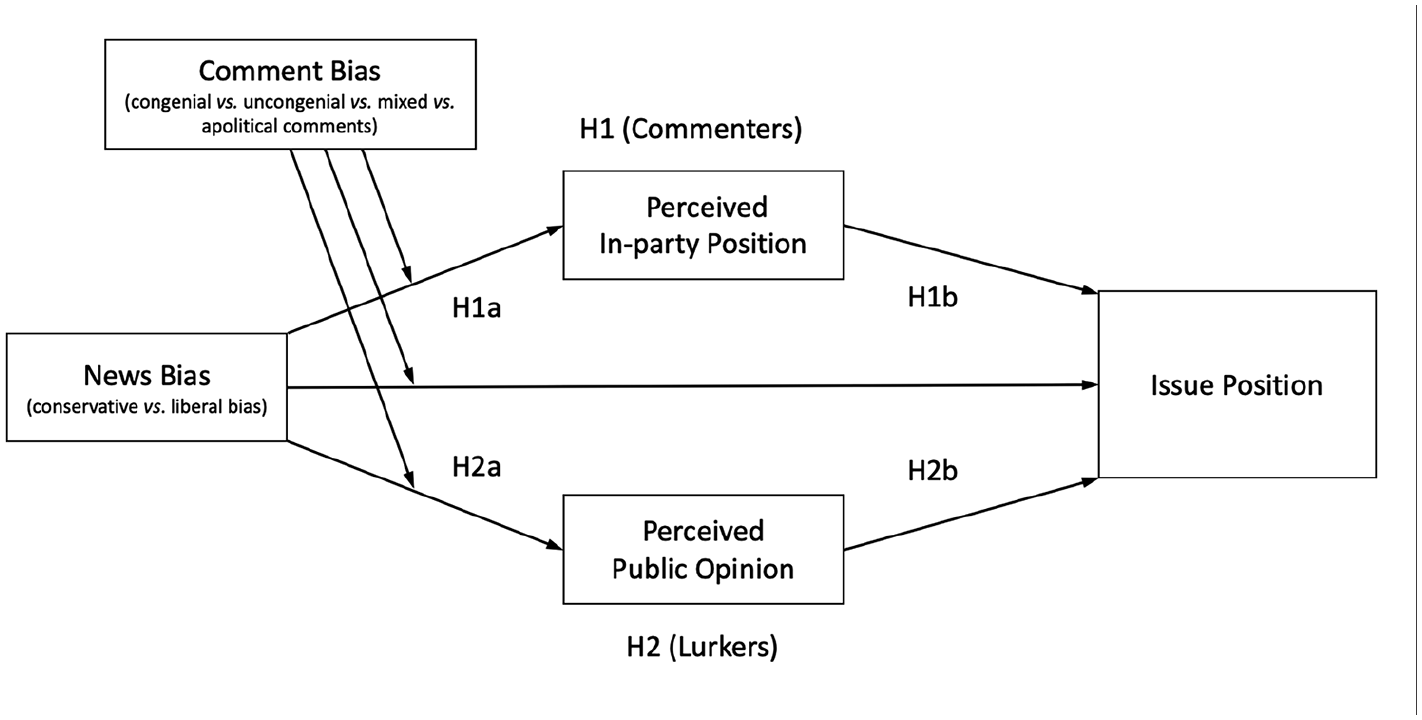
Conceptual model.
South Korea as a strategic context for hypotheses testing
South Korea holds a unique place in the global history of democratic development. Emerging from the devastation of Japanese colonial rule and the Korean War, it accomplished an unparalleled transformation, transitioning from an aid recipient to a donor nation by 2022 (Organisation for Economic Co-operation and Development [OECD], 2024). Since democratizing in 1987, South Korea has also demonstrated political maturity through peaceful transfers of power via national elections. This political stability, combined with economic advancement, has fostered a fertile environment for civic engagement in the digital era.
With one of the world’s most extensive high-speed Internet infrastructures, South Koreans are empowered to actively engage with social issues and hold the government accountable. Notable examples of this civic engagement include the 2008 candlelight protests against U.S. beef imports (Yun and Chang, 2011) and the 2016–2017 protests that resulted in the impeachment of the former President Park Geun-hye over abuse of power and corruption (Keller et al., 2020). Most recently, in 2024, citizens opposing the military swiftly gathered at the National Assembly following the imposition of martial law, leading to its revocation within hours (Hawkins & Rashid, 2024). This underscores the enduring strength and immediacy of civic activism in South Korea.
One of the essential factors in understanding South Koreans’ active civic participation lies in their centralized digital news consumption through web portals and the popularity of news comment sections on these platforms. According to Korea Press Foundation (Yang, 2023), about 74.4% of Koreans access news on portal sites daily, with the majority (93.4%) using Naver, followed by Daum (40.7%). Notably, only a quarter (25.3%) of portal news users indicated that they rarely engage with comment sections, preferring to read news articles exclusively.
The significance of news comment sections as a space for public discourse became evident in the early 2010s, when the South Korean government was found to have operated an online public opinion manipulation team. The team posted favorable comments supporting the conservative administrations of then-presidents Lee Myung-bak and Park Geun-hye (BBC, 2017). A special investigation revealed that before the 2012 presidential election, the National Intelligence Service (NIS) managed 30 teams, comprising 3500 personnel, with a budget of approximately 3.0 billion won (around 2.2 million USD; Choi, 2017).
What is more, following the tragic sinking of the Sewol ferry in 2014, which left over 300 people dead or missing, the Defense Security Command (DSC) formed a special task force initially composed of 60 members, later expended to 500 (Lee, 2018). This team was directed to generate negative public opinion against the grieving families of the disaster by leaving comments accusing them of demanding excessive compensation from the government. Leading up to the 2017 presidential election, it was also discovered that a team led by a blogger known as Druking used special software to post 1.4 million comments on Naver, aimed at supporting the progressive candidate Moon Jae-in (Choe, 2019). Such conspiratorial efforts to manipulate online news comments continue to surface to this day.
Most importantly, such a context raises a critical question: How effective are (orchestrated or organic) user comments in shaping public opinion? Given its centralized news ecosystem, widespread engagement with comment sections, and history of both civic activism and comment manipulation, South Korea offers a compelling empirical setting in which to test the hypotheses proposed in this study.
Method
To test the hypotheses, an online experiment was conducted using a 2 (news bias: liberal vs conservative bias) × 4 (comment bias: liberal vs conservative vs mixed vs apolitical comments) between-subjects design. For the analyses, the experimental conditions were regrouped as news with (1) congenial, (2) uncongenial, (3) mixed, and (4) apolitical user comments. Specifically, in the congenial condition, all six comments resonated with the political bias of the news story. Conversely, the uncongenial condition consisted of six comments that challenged the political bias of the news story. The mixed condition included half of the comments supporting the political bias of the news story, while the other half opposed it. Finally, in the apolitical condition, six comments were unrelated to politics such as weather and celebrities.
Participants
A total of 1,066 Koreans was recruited from Micromill Embrain (www.embrain.com), a large research company. Quota sampling was utilized based on the population and housing census conducted by Statistics Korea (https://kostat.go.kr/board.es?mid=a10301100200&bid=203&tag=&act=view&list_no=377115&ref_bid=203,236). The sample consisted of 50.8% women and participants had a mean age of 43.97 years (SD = 12.49), ranging from 20 to 64. The majority (73.3%) had achieved some college education or higher. Among the participants, 47.6% held white-collar jobs, while 13.7% were housewives, 10.3% were small business owners, and 10.3% held blue-collar jobs. The median household income was between KRW 40,001,000 (about USD 35,000) and KRW50,000,000 (about USD 44,000). The sample was purposefully balanced based on partisan identity, with 549 supporters of the liberal Minjoo Party of Korea (MPK, 51.5%) and 517 supporters of the conservative Liberty Korean Party (LKP, 48.5%). The experiment was fielded from February 11st to 18th in 2020, with participants categorized into commenters and lurkers (see preliminary analyses section for more details).
Procedure
Participants first answered questions about their demographics and commenting behavior. They were then randomly assigned to one of the experimental conditions. Prior to being exposed to the news stimuli, participants were informed that they would be presented with a news story along with user comments. Following the news exposure, participants responded to a series of questions.
Stimuli
For the experiment, two news stimuli were tailored to align with either the liberal MPK or the conservative LKP perspective on the minimum wage issue based on real-world news stories. During the 2017 presidential campaign, all major candidates across the ideological spectrum pledge to raise the minimum wage to KRW 10,000 per hour by 2020. President Moon Jae-in, after taking office, reaffirmed this goal as a key election commitment. Since then, the minimum wage topic has been a subject of intense controversy, with the progressive ruling party (i.e. MPK: Minjoo Party of Korea) supporting for the minimum wage hike and the opposing conservative party (i.e. LKP: Liberty Korean Party) alleging putting breaks on the wage hike. 1
The news story with a liberal bias underscored the positive outcomes of the minimum wage hike, quoting the liberal MPK to emphasize an increase in new jobs, the highest overall employment rates since 1982, and the first reduction in household income inequality in four years. On the flip side, the news story with a conservative bias accentuated the drawbacks of minimum wage hike. It referenced the conservative LKP, casting doubt on overall employment figures, challenging improved income distribution by attributing it to tax subsidies for low-income households, and advocating for a shift toward a growth-centered economic policy.
Each news story was paired with either six liberal, six conservative, six mixed (three liberal and three conservative), or six apolitical comments. These user comments were authentic selections from Han et al.’s (2023) dataset, which classified the political bias of 297 K user comments submitted to news stories on minimum wage on Naver News. 2 Comments supporting a minimum wage hike included, “Griping about the 30% increase? It didn’t improve during the 10 years of conservative rule. Sheesh.” Opposing ones were “Taxing heavily and. . . using that to pay wages. What kind of insane economy is that?” Apolitical comments were “Cozy, fresh air. This year, I haven’t had a proper chance to enjoy the snow. It feels like winter is disappearing.”
The news article and user comments were presented in the exact layout of Naver News. The activated news tab labeled “Ranking News” indicated that the article was among the most-viewed and thus highly visible to other users. 3 To minimize potential source-related bias, the name of news outlet and journalist bylines were blurred. Likewise, popularity metrics – such as the number of emoji reactions, likes, and comments – were obscured to control for the confounding effects of aggregate cues. Six user comments appeared underneath the article. Each comment displayed upvote and downvote icons, but their respective counts were blurred to prevent social influence. On Naver, users can sort comments by total votes, recency, or upvote-to-downvote ratio. In this study, the sorting tab was fixed to “Most Recent,” indicating that the comments presented were the six most recently posted. Supplemental Appendix A contains an example of the actual news and user comment stimuli.
Measures
Questions were assessed in the following order, except the demographic control variables. The question sets related to partisan cue-taking and the bandwagon heuristic were presented in random order.
After exposure to news stimuli, perceived partisan cues were measured by the perceived in-party position with two questions in random order: (1) “To what extent do you think the Minjoo Party of Korea (or the Liberty Korean Party) supports or opposes the minimum wage increase?” (1 = Extremely oppose, 9 = Extremely support), and (2) “To what extent do you think the Minjoo Party of Korea (or the Liberty Korean Party) is positive or negative towards the minimum wage increase?” (1 = Extremely negative, 9 = Extremely positive). The estimated positions of the liberal Minjoo Party of Korea (MPK) were used for the perceived in-party position of the MPK supporters (r = .89, Spearman-Brown coefficient = .90) and the same approach was used for the conservative Liberty Korean Party (LKP) supporters (r = .91, Spearman-Brown coefficient = .91).
To capture perceived public opinion, participants responded to (1) “To what extent do you think the public opinion supports or opposes the minimum wage increase?” (1 = Extremely oppose, 9 = Extremely support, and (2) “To what extent do you think the public opinion is positive or negative towards the minimum wage increase?” (1 = Extremely negative, 9 = Extremely positive) in random order (r = .93, Spearman-Brown coefficient = .93).
Finally, participants also indicated their own position on the minimum wage increase with two questions in random order: (1) “To what extent do you support or oppose to the minimum wage increase?” (1 = Extremely oppose, 9 = Extremely support) and (2) “To what extent are you positive or negative towards the minimum wage increase?” (1 = Extremely negative, 9 = Extremely positive; r = .97, Spearman-Brown coefficient = .97).
For control variables, gender, age, education level, occupation, family income, and partisan identity (0 = Supporters of the liberal MPK and MPK leaners, 1 = Supporters of the conservative LKP and LKP leaners) were used.
Results
Manipulation checks
Manipulation check questions examined perceived political bias in the news content and user comments. These questions were presented after the dependent variables.
Regarding the question on the political bias of the news story (1 = Strongly in favor of the MPK, 3 = Neither in favor of MPK nor LKP, 5 = Strongly in favor of the LKP), participants found the news with a liberal bias leaned more toward the progressive side (n = 534, M = 2.73, SD = .88) than the midpoint 3, t(533) = −7.10, p < .001. Conversely, the opposite was true for news with a conservative bias (n = 532, M = 3.39, SD = .90), t(531) = 9.97, p < .001.
Participants also acknowledged the intended political bias of the user comments (1 = Strongly in favor of the MPK, 3 = Neither in favor of MPK nor LKP, 5 = Strongly in favor of the LKP), F(3, 1062) = 124.75, p < .001, partial η2 = .261. The Scheffe post hoc test for multiple group comparison revealed that, as compared to apolitical (n = 275, M = 2.99, SD = .66) and mixed (n = 263, M = 3.23, SD = .95) conditions, liberal comments expressed stronger support for the progressive MPK (n = 267, M = 2.38, SD = .83; ps < .001), while conservative comments were more supportive of the conservative LKP (n = 261, M = 3.74, SD = .76; ps < .001).
Preliminary analyses: Commenters versus lurkers
Participants were categorized as commenters or lurkers based on their level of engagement with news comments. Specifically, prior to exposure to news stimuli, participants indicated how often they (1) read user comments when viewing news stories online and (2) have ever posted user comments to online news story (1 = Never, 2 = Rarely, 3 = Sometimes, 4 = Frequently).
In the total sample, 760 participants (71.3%) reported that they sometimes or frequently read news comments. Among these readers, 489 participants (64.3%) stated little or no prior history of submitting comments, and these individuals were categorized as lurkers (N = 489) who prefer to observe public discussions without direct participation. On the other hand, 311 participants (29.2%) from the total sample reported that they occasionally or frequently engaging in commenting behaviors and were identified as commenters (N = 311) who are actively involved in public discourse by posting their opinions online. Notably, 87% of the commenters also reported reading user comments regularly.
On average, there was no significant differences in exposure time to news stimuli (in seconds) between commenters (M = 126.30, SD = 351.75) and lurkers (M = 181.53, SD = 897.05), t(798) = 1.04, p = .301. However, commenters (M = 2.40, SD = 1.07) exhibited stronger partisan identities than lurkers (M = 2.14, SD = .98), t(789) = 3.53, p < .001.
Table 1 provides a summary of descriptive statistics and inter-correlations among key variables for commenters and lurkers.
Descriptive statistics and bivariate correlations of focal variables.
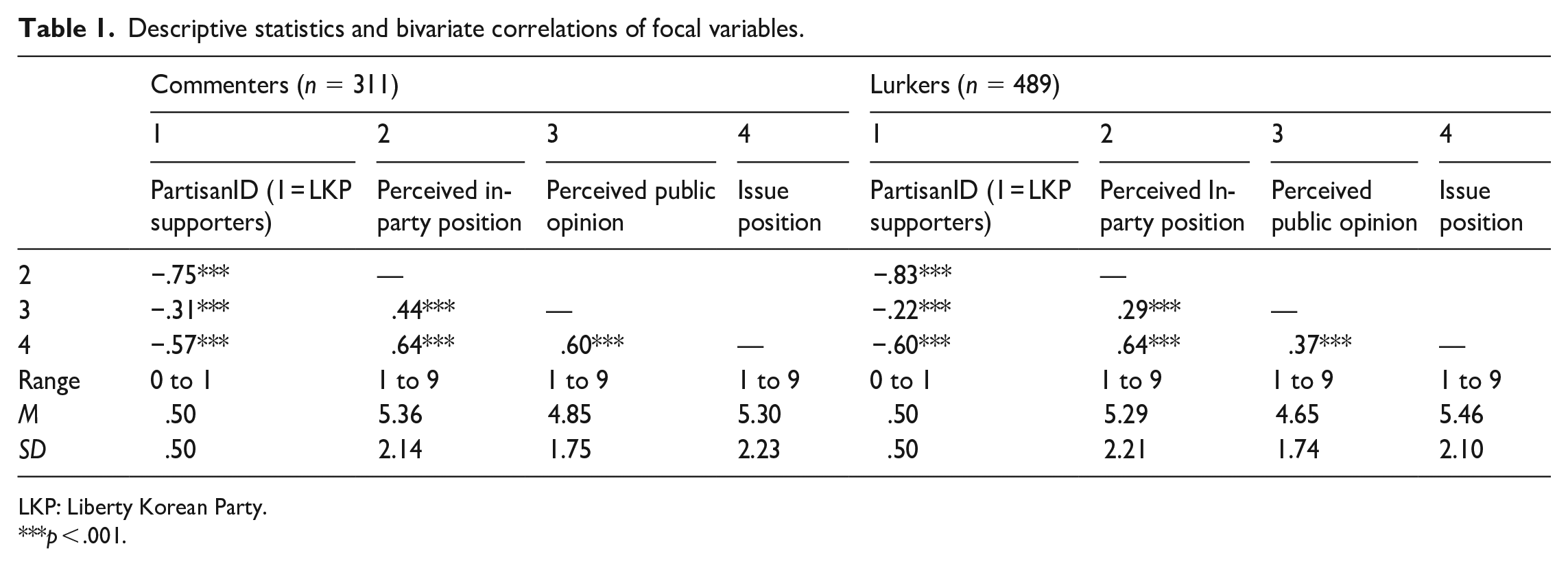
LKP: Liberty Korean Party.
***p < .001.
Hypothesis tests
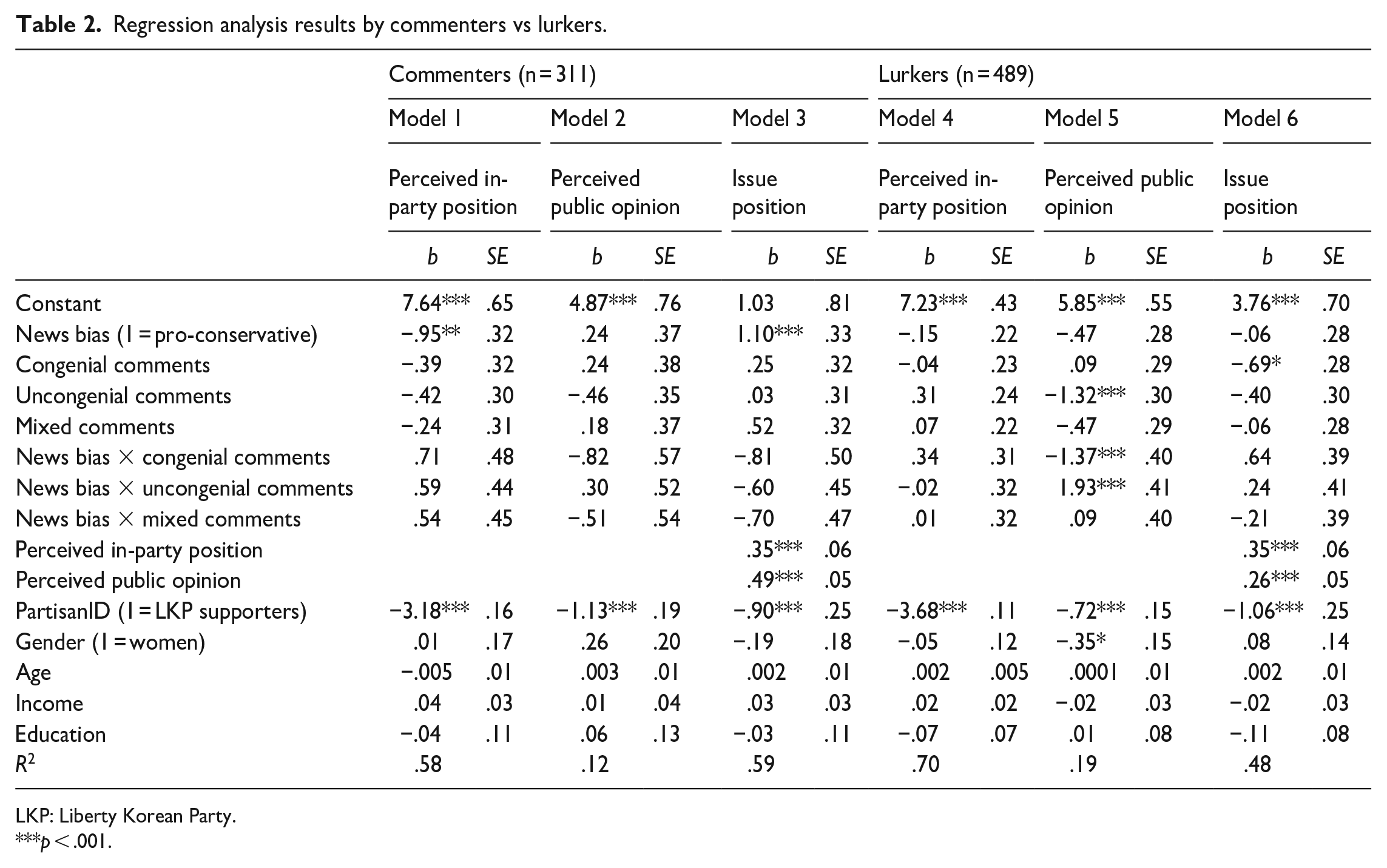
As illustrated in Figure 1, the hypotheses supported a moderate-mediation model in which the news condition, favoring either the liberal or conservative party, functioned as the independent variable. Comment bias, encompassing congenial, uncongenial, mixed, or apolitical comments, operated as moderators. Perceived in-party position and perceived public opinion acted as mediators. Participants’ issue position served as the dependent variable. A series of OLS regression analyses were performed using Hayes’ (2017) PROCESS macro (Model = 8). This approach simultaneously estimated bootstrap confidence intervals (CIs) for the presumed indirect effects. Prior to the analyses, one dummy variable was created to represent the two news bias conditions (1 = news with a conservative bias). Three dummy variables (i.e. congenial, uncongenial, and mixed comments) were generated for the four comment bias conditions, with the apolitical comment condition serving as the reference group. Interaction terms were computed by multiplying the independent variable and moderators. The analyses were conducted separately for commenters (n = 311) and lurkers (n = 489). Table 2 summarizes the regression results.
Regression analysis results by commenters vs lurkers.
LKP: Liberty Korean Party.
p < .001.
Given their projected role as opinion leaders within the two-step flow of communication model, H1 posited that commenters would be more influenced by partisan bias in the news than by the political leaning of user comments. Specifically, commenters were expected to identify the stance of their favored party based on the news story (H1a) and subsequently adopted the party cue accordingly (H1b).
Supporting H1a, a significant main effect of news bias on perceived in-party position was observed (b = −.95, SE = .32, t = −3.02, p = .003; see Model 1 in Table 2). This result indicated that, after exposure to a news story endorsing the conservative (vs liberal) side, commenters rated their preferred party as less supportive of the minimum wage increase, aligning with the news bias (M = 5.10, SD = 2.19 vs M = 5.58, SD = 2.07; see Figure 2). The effect was robust regardless of whether the juxtaposed user comments were congenial, uncongenial, or mixed. Political bias in user comments showed neither a main effect nor interaction effects on perceived in-party position. Concerning perceived public opinion, there were no main effects of news bias or comment bias, nor any interactions between them (see Model 2 in Table 2).
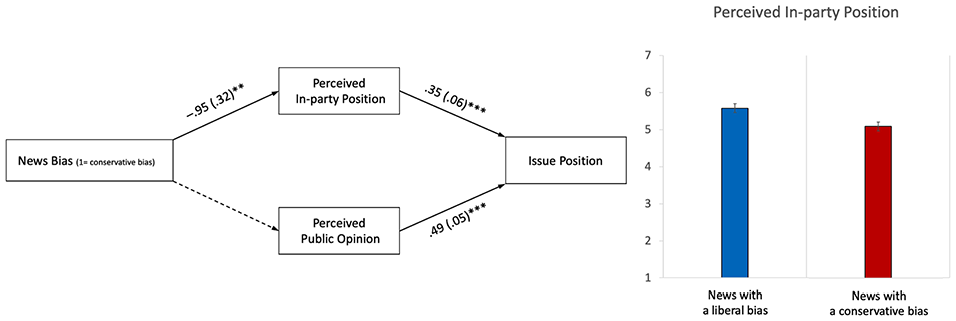
Effects of news bias on commenters’ issue position through partisan cue-taking.
Next, consistent with H1b, perceived in-party position positively predicted commenters’ own issue positions (b = .35, SE = .06, t = 5.46, p < .001; see Model 3 in Table 2).
The indirect effect of news bias on commenters’ issue position via partisan cue-taking were supported by a bootstrap resampling analysis based on 5,000 samples, indirect effect = −.17, bootSE = .06, 95% bias-corrected CI [–.3045 to –.0635]. No corresponding effect emerged via perceived public opinion (see Model 2 in Table 2), indirect effect = .02, bootSE = .10, 95% bias-corrected CI [–.1596 to .2196].
Building on prior research suggesting that lurkers seek the unfiltered voices of people through user comments, H2 posited that lurkers would be more influenced by partisan bias in user comments than in news stories. Specifically, lurkers were expected to infer the public opinion climate from user comments (H2a) and adjust their personal views accordingly (H2b).
Support for H2a was found by significant interaction effects between news bias and comment bias on perceived public opinion. First, there was a significant interaction between new bias and congenial user comments (b = −1.37, SE = .40, t = −3.43, p < .001; see Model 5 in Table 2). As illustrated in Figure 3, which decomposed the interaction, when news bias resonated with congenial user comments, lurkers evaluated public opinion as more congruent with the synchronized direction. Specifically, lurkers’ estimation of public opinion on the minimum wage increase was high after exposure to news and user comments both supporting the liberal MPK (M = 5.31, SD = 1.82), but low after exposure to news and user comments both supporting the conservative LKP (M = 3.46, SD = 1.48).
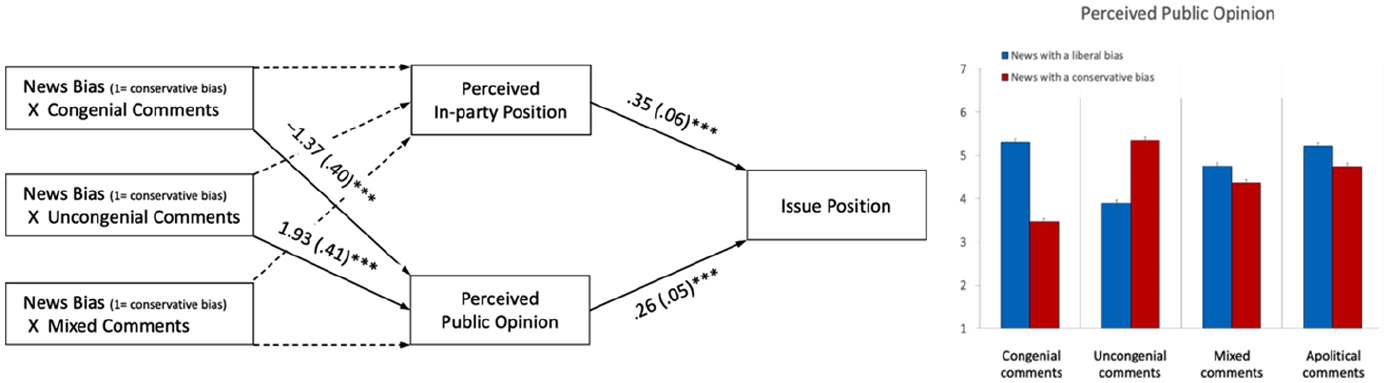
Effects of comment bias on lurkers’ issue position through the bandwagon heuristic.
Second, a significant interaction also emerged between new bias and uncongenial user comments (b = 1.93, SE = .41, t = 4.70, p < .001; see Model 5 in Table 2). As shown in Figure 3, when news bias was countered by uncongenial other users, lurkers relied more on user comments than on the news story to assess public opinion. Specifically, after exposure to news with a liberal bias accompanied by conservative user comments, lurkers discerned greater public opposition to the minimum wage increase (M = 3.89, SD = 1.85). Conversely, when exposed to news with a conservative bias paired with liberal user comments, lurkers conceived more public support for the issue (M = 5.35, SD = 1.77).
No such interaction was found between news bias and mixed user comments on perceived public opinion (b = .09, SE = .40, t = .22, p = .823; see Model 5 in Table 2). Regarding perceived in-party position, no main or interaction effects of news bias and comment bias were observed (see Model 4 in Table 2).
Furthermore, in line with H2b, perceived public opinion positively predicted lurkers’ own issue positions (b = .26, SE = .5, t = 5.67, p < .001; see Model 6 in Table 2).
Finally, a bootstrap resampling analysis based on 5,000 samples supported the conditional indirect effects of news bias on lurkers’ issue position via perceived public opinion when the partisan news was presented both with congenial, indirect effect = −.33, bootSE = .09, 95% bias-corrected CI [–.5322 to –.1767], and uncongenial, indirect effect = .16, bootSE = .08, 95% bias-corrected CI [–.0097 to –.3263] user comments. No corresponding effect appeared via perceived in-party position (see Model 4 in Table 2), with indirect effects ranging from .02 to .11, bootSEs from .07 to .09, and 95% bias-corrected CIs [–.1332 to .2886].
Discussion
This study explored the multi-layered processes of public opinion formation in digital spaces, focusing on scenarios where partisan news stories are paired with congenial, uncongenial, mixed, and apolitical user comments. By distinguishing between active and passive forms of user engagement, the study examined the differing motivations of commenters, who contribute comments, and lurkers, who simply read them. Commenters, motivated by their inclinations to influence others and engage closely with politicians and journalists, were positioned as online opinion leaders within the Katz and Lazarsfeld’s two-step flow of communication model. As such, commenters were hypothesized to be more affected by news bias that cued their preferred party’s issue position. They were also expected to adopt these party cues, regardless of the content of accompanying user comments. In contrast, lurkers, as passive observers, were hypothesized to be more influenced by comment bias. Lurkers were expected to drive their understanding of public opinion from user comments rather than the news articles, aligning their opinions with what they perceive to be the majority view.
The experimental findings supported these hypotheses. When exposed to a conservative (vs liberal) leaning news story juxtaposed with various comment conditions – including congenial, uncongenial, mixed, and apolitical comments – commenters consistently internalized the cues of their preferred party and remained uninfluenced by comment bias. In contrast, lurkers showed a different pattern of opinion formation. They inferred the majority view from the political leaning of news comment sections. Their personal positions subsequently aligned with what they perceived to be the prevailing public opinion expressed in the comments. The findings underscore a cascading process in the formation of public opinion in online discussions. Commenters act as modern opinion leaders who interpret and disseminate political cues. This input cascades down to lurkers, who rely on user comments to shape their understanding of broader public sentiment. The dynamic reinforces the two-step flow of communication model in the digital age, illustrating how public opinion formation flows from a few active participants to a larger, passive audience.
This cascading effects through user comments can foster democratic engagement by providing more people with access to political cues and public sentiment, thereby encouraging online discussion and participation. However, it also exposes the vulnerability of online public discussions to manipulation. Real-world examples of the South Korean government’s public opinion manipulation teams, which posted favorable comments supporting conservative administrations, and the Druking’s use of specialized software to amplify support for progressive candidates, illustrate how a small group of actors can exploit the cascading nature of online opinion formation to distort the broader public opinion climate.
These examples are particularly instructive given South Korea’s distinctive digital media environment, marked by centralized news consumption via portals (e.g. Never and Daum) and prominently displayed comment sections with high user engagement.
Similar manipulation strategies have been employed globally, though with important differences in tactic and context. For instance, the Chinese “50 Cent Party” floods platforms with pro-government content to suppress dissent and redirect attention, rather than to misrepresent the majority view (King et al., 2017). Russian troll operations during the 2016 U.S. election aimed to sow discord by impersonating users and spreading polarizing narratives across decentralized platforms like Facebook and Twitter (Golovchenko et al., 2020). While all cases demonstrate the global vulnerability of online spaces to coordinated disinformation campaigns, the South Korean context combining centralized news ecosystem and exceptionally high user engagement with comment sections uniquely lends itself to
To address these vulnerabilities posed by coordinated manipulation – whether through organized task forces or automated bots 4 – South Korean news portals like Naver and Daum have implemented various safeguards aimed at reducing the impact of comment sections. These measures include limiting the number of comments a user can post per day and per news article, imposing a 60 second intervals between posts, and revealing the users’ identities and comment histories. Daum has gone further by collapsing comment sections by default (requiring users to manually expand them) and even replacing them with real-time chat formats that automatically delete all content 24 hours after the news article is published. While these efforts have been somewhat successful in curbing incivility and hate speech (Keum, 2023), they have also produced unintended consequences, such as a decline in comment volume (Oh, 2020) and a loss of market share for the platforms (Min, 2023). These suggest that the restrictive nature of these measures may dampen opportunities for meaningful dialogues and hinder the platforms’ potential to foster civic engagement.
It is worth noting that in the mixed comment condition there were no significant comment bias effects on the perceived public opinion. This points to an effective strategy to counter orchestrated efforts to manipulate public opinion in the digital space by balancing perspectives in the news comment section. In light of these findings, news portals and news organizations are encouraged to reconsider their comment curation algorithms. Rather than top-listing the latest or most popular comments, they should prioritize showcasing a more politically diverse range of perspectives. Facilitating balanced and inclusive comment sections could mitigate the polarizing effects of partisan news and provide lurkers with a more nuanced understanding of public opinion. A promising example is The New York Times’ (NYT) comment policy, where all comments undergo rigorous verification to filter out spam, repetitive, or malicious content. Only approved, high-quality comments are featured prominently under the “NYT Pick” section, promoting accountability and fostering constructive online dialogue. However, it is important to note that such intensive moderation may also limit the role of user comments as a vox populi, the collective voice of the public.
This study is not without limitations. First, user engagement occurs along a continuum, with individuals in each group varying in the frequency and intensity of their behaviors (e.g. occasional vs habitual commenting or lurking). Nonetheless, for the sake of conceptual clarity, this study adopted binary classification of commenters and lurkers, treating them as functionally distinct actors – analogous to opinion leaders and followers – in the digitized news environment. This dichotomy also enabled clearer empirical contrasts between more active, participatory users and more passive, observational ones. Future research could benefit from adopting more granular approaches, such as behavioral frequency measures or user typologies, to better capture potential variability within each user group.
Second, this study focused on a single news portal. While Naver is the dominant news gateway for Koreans, the media landscape is shifting, with platforms like YouTube gaining prominence as a source of news. Future research should explore the combined influence of video content and user discussions on public opinion formation.
Third, this study examined a single highly partisan issue, the minimum wage. While this choice allowed for clear partisan alignment and policy relevance, it may limit the generalizability of the findings. Notably, although the issue was contentious at the time of data collection, it was not yet long-standing or ideologically crystallized. Had the issue involved more morally charged and deeply entrenched topics (e.g. immigration or LGBT rights), the partisan cues embedded in the news story might have been less impactful, as commenters would likely hold stable, pre-existing preferences. Consistent with this speculation, a supplementary analysis incorporating the strength of partisan identity showed that commenters with stronger partisan identities were more responsive to partisan cues from the news story, perceiving their party’s stance as more polarized.
Similarly, the influence of user comments might diminish in the context of such ideologically saturated issues, since many lurkers would not be seeking a majority view, but would instead already be aligned with their party’s position. Future research should consider a broader continuum of issue types – ranging from newer, less ideologically crystallized topics to long-standing, entrenched partisan issues – to better understand how issue characteristics condition the dynamics of online discourse and the role that commenters and lurkers play within it.
Finally, 87% of commenters in the sample reported that they also read user comments, whereas lurkers did not submit comments. Consistently, there was no significant difference in exposure time to news stimuli between commenters and lurkers, as detailed in the analysis section. This suggests that for commenters, unlike lurkers, writing and reading comments are interconnected activities that deepen their engagement with online news content. However, the findings revealed no measurable effects of user comments on the commenters themselves. This suggests that commenters primarily use comment sections as a venue for self-expression rather than for opinion change, leaving little room for them to reconsider their own positions. Alternatively, it is possible that, despite similar exposure time, commenters and lurkers allocated their attention unevenly such that commenters may have focused more on processing the news content, while lurkers may have spent more time reading through user comments. Future research could address this possibility by employing eye-tracking or attention-monitoring tools to capture how commenters and lurkers engage with different components of the news interface.
In conclusion, this study highlights the complex dynamics of public opinion formation in digital spaces, emphasizing the distinct yet complementary roles of commenters and lurkers. Commenters act as opinion leaders, reinforcing partisan cues, while lurkers are more influenced by the perceived majority sentiment in user comments. These findings reaffirm the relevance of the two-step flow model in the digital age and underscore the potential of comment sections to foster democratic dialogue. At the same time, they reveal the vulnerabilities of online platforms to manipulation. To ensure that comment sections remain spaces for meaningful engagement and civic participation, platforms must adopt more inclusive and balanced curation systems. Future research should explore how emerging platforms like YouTube reshape these dynamics and test interventions across diverse social and political issues.
Supplemental Material
sj-pdf-1-nms-10.1177_14614448251363954 – Supplemental material for Commenters and lurkers: Navigating the two-step flow of communication in online news discourse
Supplemental material, sj-pdf-1-nms-10.1177_14614448251363954 for Commenters and lurkers: Navigating the two-step flow of communication in online news discourse by Jiyoung Han in New Media & Society
Footnotes

Ethical considerations
KAIST IRB approved this study: KH2020-08
Funding
The author(s) disclosed receipt of the following financial support for the research, authorship, and/or publication of this article: This work was supported by Korea Advanced Institute of Science and Technology (KAIST), Korea Press Foundation (KPF) and the National Research Foundation of Korea (NRF) grant funded by the Korea government (MSIT: grant no. RS-2023-00252535).
Supplemental material
Supplemental material for this article is available online.
Notes
Author biography
References
Supplementary Material
Please find the following supplemental material available below.
For Open Access articles published under a Creative Commons License, all supplemental material carries the same license as the article it is associated with.
For non-Open Access articles published, all supplemental material carries a non-exclusive license, and permission requests for re-use of supplemental material or any part of supplemental material shall be sent directly to the copyright owner as specified in the copyright notice associated with the article.
