




Abstract
To governments worldwide, Internet shutdowns are the trip-switch solution to civic unrest, and they occur with surprising regularity. In Sri Lanka, Internet shutdowns have been tactically deployed to geo-specific regions and specific platforms on three occasions during episodes of extraordinary violence and resistance. The concept of ‘algorithmic folklore’ has been used to describe the speculative ideas and tactics that users of digital technology exhibit in order to make sense of their relationship with opaque computational systems. Using this conceptual approach, I consider the modes through which Sri Lankans experience Internet shutdowns and offer the novel term ‘affordance folklore’ to illustrate the discursive constructions and practical strategies that help people make sense of complex sociotechnical events, such as Internet shutdowns. The article examines three core practices of affordance folklore relating to truth, community, and visibility that emerge to theorise the intrinsic values of social media.
Keywords
Introduction
To governments worldwide, Internet shutdowns are the trip-switch solution to civic unrest, and they occur with surprising regularity. Commonly referring to ‘intentional disconnections of digital communications by government authorities’, (Wagner, 2018: 3918) Internet shutdowns are associated with authoritative regimes and strongmen in the Global South who pull the plug on Internet access to quell citizen unrest or obfuscate information around elections and other times of political importance. In India, for example, there were an estimated 380 separate Internet shutdowns in the 6 years between 2014 and 2020, equating to an average of five individual shutdowns a month (Marchant and Stremlau, 2020). But Internet shutdowns were first implemented in Europe in the 1990s, and continue to sporadically occur there, such as the Wi-Fi breakdown installed on the London Underground in 2019 to disrupt the communication networks of an Extinction Rebellion protest (Vincent, 2019). Despite this frequency as a tool of digital violence, little is documented about the causality of Internet shutdowns, and they remain understudied and difficult to study (Marchant and Stremlau, 2020). Moreover, Internet shutdowns are not a homogeneous phenomenon, and they are not simply the case of the Internet being turned ‘off’ or ‘on’; rather they relate to culturally specific experiences of digital platforms, the local wider legacy media sphere, and evolving post-colonial power structures.
In this article’s case study of Sri Lanka, a nation besieged by ethnic, political, and religious conflict, I argue to get closer to better understanding on social media’s relationship with violence, we need to consider the implicit symbolic violence served by Internet shutdowns orchestrated by despotic governments, the perpetuation of violence that occurs in moments of information blackout, and how communities mobilise to contest the symbolic and material violence as it plays out in real time. In the volatile media ecosystem of Sri Lanka, Internet shutdowns have been tactically deployed to geo-specific regions and on specific platforms and websites on three occasions that this paper will explore in detail. The Sri Lankan government implemented the February 2018 Internet shutdown in order to subdue the anti-Muslim riots that were triggered by a ‘fake news’ video shared on social media showing a Muslim restaurant owner confessing to poisoning the stock of his Sinhala patrons (Aguilera-Carnerero, 2021). The shutdowns were provincialised to specific towns and villages around the cities of Kandy and Ampara where the violence was most vicious, and to specific social media platforms, including Facebook, YouTube and WhatsApp (Freedom House, 2018). The 9-day Internet shutdown that followed the Easter Sunday Attacks of April 2019, a coordinated terrorist bombing of several Christian churches and Western hotels that killed more than 250 people and seriously injured hundreds more, was island-wide and targeted to the same platforms as 2018, plus Instagram, Snapchat and Viber (Amarasingam and Rizwie, 2020). In 2022, during the Aragalaya protests that were orchestrated via social media and evolved into a 4-month continuous occupation of Galle Face Green in the heart of Colombo’s busy centre, culminating in the ousting of Prime Minister Mahinda Rajapaksa and President Gotabaya Rajapaksa, it is less clear whether Internet shutdowns were implemented, or if breakdowns in Internet connectivity that protestors reported were the result of the daily electrical blackouts due to the country’s economic crisis (Centre for Policy Alternatives, 2023). In all three cases, the structural violence of blocking or mismanaging access to social media meant that journalists, activists and ordinary citizens could not report, record or keep up with the mob violence and acts of resistance on the ground. Given that several years later there remains a question mark over the extent of the violence, especially against Muslim communities in 2018 and 2019, the pursuit of justice and reconciliation is unviable, thereby situating the availability of the digital platforms in the perpetuation of violence (Amarasingam, 2019; Amarasingam and Rizwie, 2020).
The forthcoming discussion draws on 18 months of ethnographic fieldwork with 20 highly active and influential Sri Lankan social media commentators who were all affected in some way by the Internet shutdowns. The mixed and changing experiences of the three Internet shutdowns under analysis are summarised by Nala, an Aragalaya activist, and popular Facebook personality:
I cannot say for Muslim people as they have been the target and victims of shutdowns [previously], but from my point of view, I think that the most fear we experienced at ‘GGG’ [the Aragalaya protest site] was during internet shutdowns; where we were outside, in a fight, and anything can happen – they can open fire, arrest us, whatever. . . When internet shutdowns happen, it made us feel like we lost our connectedness. It affected our sense of safety. When you see that the messages you are sending are not being delivered, that you can’t communicate, there was a sense of losing safety and losing connectedness. That’s the thing I can clearly remember. . . But I don’t think internet shutdowns have the same power it once had. People are not afraid of them now; people are prepared to meet them head on. I think we are very seasoned at that.
Nala’s experience, like many descriptions of Internet shutdowns by my interlocutors, revolve around fear and unknowing but also optimism and change; the loss of connection, the fear of the authorities, plus the reclamation of power. Interestingly, Nala points out a difference of experience between Sri Lanka’s different ethnic groups. Herself, a Sinhalese Catholic, a minority within the island’s largest ethnic group of Sinhala-Buddhists, is describing the loss and disconnection she suffered during the 2022 Aragalaya protests, while empathising with the experience of her Muslim countryman who had suffered the worst of the violence, digital and non-digital, in 2018 and 2019. Internet coverage, and the government’s grip on who has access and who does not, figures significantly in how people experience the pain of the political violence and upheaval that has affected Sri Lanka in recent years.
An interdisciplinary body of work has advanced the emergent concept of algorithmic folklore (see Bishop, 2020; De Seta, 2024a, 2024b; MacDonald, 2023; Savolainen, 2022) to describe the speculative ideas, tactics, stories and myths that users of digital technology exhibit in order to make sense of their relationship and experience of the opaque computational systems that they interface with. Because algorithms are black boxes, meaning their inner workings and the causality of their outputs are unknowable, users make up ‘beliefs and narratives about moderation systems that are passed on informally and can exist in tension with official accounts’ (Savolainen, 2022: 1092). While various iterations of the concept have emerged in recent years, scholars broadly agree that there is a kind of information asymmetry that exists between social media platforms and their users, and algorithmic folklore is an agential resistance practice against platform overreach or inertia. For example, ‘algorithmic lore’ (Bishop, 2020; MacDonald, 2023) describes the tactics influencers develop about how to ‘game the algorithm’ in order to meet their content goals, while ‘platform folklore’ (Junman, 2025) is a type of emergent political philosophy that activists adopt to rationalise why a social media platform may support, or ‘shadow ban’ (Cotter, 2023; Savolainen, 2022) their political content. Using this conceptual approach, I consider the modes through which my Sri Lankan interlocutors experienced Internet shutdowns and offer the novel term ‘affordance folklore’ to frame their responses to Internet shutdowns and its associated violence.
Famously, affordance theory describes the social outcomes a technological artefact allows, for better or worse (Gibson, 1986). More recently, the concept of affordances has been widely critiqued as relational to human subjectivities and cultural setting (Davis, 2020), and in co-dependence with adjacent actant technologies (Hopkins, 2019). Illustrating something akin to what Nagy and Neff (2015) describe as ‘imagined affordances’, I argue here that the built feeling and lived relationship with social media is actively registered during times of Internet shutdown – making ‘the expectations for technology that are not fully realised in conscious, rational knowledge’ (p. 1) cognisant and available. In times of extraordinary strife, affordance folklore emerges as discursive constructions and practical strategies that theorise the intrinsic values of social media, helping people make sense of a complex sociotechnical event such as an Internet shutdown. In Nala’s quotation above, safety and connectedness surface as the affordance folklore of social media because these are the things she felt were most palpably lost when Internet access was cut. Later we will discover that tools such as VPNs (virtual private networks) enabled activists to regain control of their Internet access, and that’s why Nala alludes to Internet shutdowns losing their ‘power’ and why people are prepared to meet them head on.
The article examines three core practices of affordance folklore that emerged through the data analysis relating to truth, community and visibility. Affordance folklore is distinct from previous genres of algorithmic folklore because it is specifically about affordances; that is to say, it is vernacular knowledge about what is possible to achieve with social media, not conjectural theories about how algorithms function. Like any essential infrastructure, Internet connectivity is only notable when it is absent or fails (Negroponte, 1998), and what my findings reveal is that during times of Internet shutdown, the intrinsic affordances of social media become visible, by being discussed and experienced as an infrastructure for the social construction of truth, as a mode of community building, and a means of achieving visibility. By acknowledging the prevalence of Internet shutdowns as a repertoire of digital violence, the power disparity between users and social media platforms that studies of algorithmic folklore emphasise are resituated to additionally observe the real-world power imbalances between citizens and the governments that hold power, and ostensible ownership, over who has access to social media platforms. The main argument advanced in this article is that affordance folklore can provide research with a new object of study to explore situated discourses of platform accountability in countries prone to Internet shutdowns and have therefore been difficult to study.
Internet shutdowns as affordance folklore
Commonly, Internet shutdowns may refer to ‘intentional disconnections of digital communications by government authorities’ (Wagner, 2018: 3918) but there is some definitional complexity to deal with. Literature on Internet shutdowns emphasise the uneven power relations surrounding who Internet shutdowns are directed at and the reasons they are deployed. These approaches draw attention to the ways that the politics and practices of Internet shutdowns relate to specific geographies and demographics, cultural events, and political ideologies and philosophies that are typically ambiguous or veiled (Taye, 2019, 2020). For example, Marchant and Stremlau (2020) argue that Internet shutdowns are not simply a homogeneous practice of switching off Internet access, rather shutdowns should be seen on a spectrum constitutive of numerous elements including the duration, breadth and depth of suspension. Wagner (2018) argues that Internet shutdowns are more than an extreme expression of content moderation and should be studied as something separate from information censorship because Internet shutdowns are a ‘disciplinary measure to prevent marginalized ‘others’ from taking part in the national political debate and documenting their grievances’ (p. 3932). Shah (2021) considers Internet shutdowns to be an insufficient descriptor because widespread Internet blackout is seldom achieved, or, critically, rarely intended. Instead, what is often productively incurred by intentional disconnections of digital communications is a landscape that enables ‘state (dis)information and propaganda to spread without resistance and thus become potent tools in curbing protests and rightful critique of authoritarian practices’ (Shah, 2021: 2693).
Other studies highlight the paradox of Internet shutdowns. While shutdowns are routinely rolled out under the proviso to quell dissent, the experience of digital violence can have the adverse effect of forcing people on to the street to protest, thereby exacerbating anti-government sentiment (Howard et al., 2011). Another paradox is demonstrated in India, the nation with the most recorded cases of Internet shutdowns. In the world’s largest democracy, the bio-citizen identification scheme, Aadhaar, that includes national identity and contact tracing for pandemic control, requires participation from an entire population mediated via regular Internet access (Nair, 2021). However, the state of Kashmir, in India’s far north, has suffered the longest telecommunications blackout ever imposed by a government on its own people. Starting in August 2019, the people in Kashmir lived for nearly 6 months without broadband or mobile Internet after the central government unilaterally revoked the region’s semi-autonomous status granted by Article 370 of the constitution (Grover, 2025). Given Kashmir is a separatist state almost entirely composed of Kashmiri Muslims, the Indian government’s decision to target this specific region and ethnic group with Internet shutdowns appears to reflect the sectarian Hindutva politics of the ruling Bharatiya Janata Party (BJP).
The emerging literature on Internet shutdowns tends to focus on the intentional aspect of why governments deploy Internet shutdowns. For example, in the case studies of Pakistan (Wagner, 2018), India (Pankaj, 2022) and the Middle East and North Africa during the Arab Spring, (Howard et al., 2011), the government’s excuse for restricting Internet access is a coin-toss between population safety and crowd control. This article does something different than previous studies by turning a spotlight on the ways in which the people affected by the Internet shutdowns discursively and performatively react. I argue that the dialectic between the imagined and experiential describes the way Internet shutdowns are perceived in Sri Lanka to reveal important dynamics around the affordances of social media. For 15 years, the correlation between a social media’s design architecture and the social outcomes they offer have been framed in the language of affordances (boyd, 2010). Platforms are broadly recognised as affording outcomes in relation to the subjective experience of the user, pertaining to their physical attributes, intellectual knowhow and cultural background and setting (Davis, 2020; Davis and Chouinard, 2016). The upshot is that what a social media platform affords one user is very likely to be different to what it affords another. In addition, affordances have been conceptualised as an unbounded assemblage of technological entanglements (Hopkins, 2019). In other words, because a digital technology rarely stands alone, a platform’s affordances are not only relational to its human interlocutors but other technological actants (see also Tresch and Latour, 2013). Costa (2018) argues that affordance manipulation is a haptic measure practised by Facebook users against the hegemonic power of social media platforms. Others suspect affordances are a simultaneous mix of the material and the perceptual, imagined by users in radically different ways to how the designers practically intended (Nagy and Neff, 2015). We can summarise from these influential studies that the way affordances become visible, whether unknowingly or with predetermination, is a kind of agential resistance against the hegemonic power structures of the platforms themselves, plus other platform stakeholders including fellow users, technology providers, and, critically, the governments who control access to the Internet. Thus, by drawing attention to the folkloric responses and activities of affected Internet users, the examples that follow illustrate that the complex affordances of social media are actively registered and realised during Internet shutdowns. By focussing on how Sri Lankans’ discuss and experience Internet shutdowns, the way Internet shutdowns have been theorised as a top-down power-move by despotic governments may be reevaluated in order to reassess shutdowns as a point of resistance where subaltern populations can configure workarounds against governmental oppression.
One of the objectives of introducing the new term ‘affordance folklore’ is to offer conceptual nuance around the emerging conditions of algorithmic folklore (see Bishop, 2020; De Seta, 2024a, 2024b; MacDonald, 2023; Savolainen, 2022). Scholars of algorithmic folklore share the baseline assumption that ‘algorithmic imaginaries’ (Bucher, 2016) emerge at the intersection of technological black boxes and user unknowing. Defined as a collection of ‘beliefs and narratives about moderation systems that are passed on informally and can exist in tension with official accounts’, (Savolainen, 2022: 1092) algorithmic folklore takes on many guises. For example, Bishop (2020) demonstrates in her study on YouTube influencers how content made by successful influencers explaining how they ‘game the algorithm’ to maximise their visibility and meet their content goals is devoured by thousands of fellow users all eager to understand how the YouTube recommendation system really functions. Junman (2025) adopts the term ‘platform folklore’ to describe the emergent political philosophies users develop to make sense of why platforms promote certain content genres and downsize others. The right-wing activists of Junman’s study believe their content underperforms due to their political incompatibility with Twitter, a platform they consider to be politically left-leaning. The platform folklore of these activists could be considered an example of the opaque phenomenon of ‘shadowbanning’, whereby active social media users experience a sudden drop of engagement in their analytics and therefore determine that the platform has purposefully minimised the visibility of their content for moral or political reasons (Cotter, 2023; Savolainen, 2022). Platforms’ ambivalence to confirm the existence of shadowbanning leaves users to agonise whether the visibility of the poorly performing content was downsized due to algorithmic interference, or if their content merely competed badly in the busy attention economy. Cotter (2023) calls this process ‘black box gaslighting’ (p. 1226) because platforms seem to benefit from user anxiety and therefore actively cultivate it. I suspect something analogous may be occurring with Internet shutdowns because the causality of a platform blackout is also difficult to pinpoint. Sometimes governments claim responsibility for an Internet shutdown so there is no doubt, but dips and cracks in Internet connectivity may be due to a myriad of sociotechnical reasons, and people can start to imagine that shutdowns are being enforced when it is technical infrastructure (actually) failing. Notably, the way algorithmic folklore is understood to emerge due to the asymmetrical power imbalance between user and platform, I observe affordance folklore materialising during Internet shutdowns, when the uneven power relation between citizen and government is most severely felt.
These theoretical developments have been compiled via the prism of contemporary Sri Lanka and three different instances of Internet shutdowns that this article attends to in detail. The proclivity of Internet shutdowns in Sri Lanka must be seen in the context of a long history of restrictive measures against media freedoms (Shah, 2021). It was the Dutch colonial administration who first introduced the printing press to Ceylon, succeeded by the British who published the first newspaper in Sri Lanka, thus, news and media has historically been under the control of the powerful (Ratnatunga, 2015). Since 1948 and national independence, the extremities of bloody civil war between the Sri Lanka state and the Tamil separatist group, the Liberation Tigers of Tamil Eelam (LTTE), eroded the prospect of a democratic media sphere as violence against journalists became entrenched (Crawley et al., 2015). Forty-three journalists were killed between 2004 and 2010 (CPJ, 2021); most infamously, Lasantha Wickrematunge, the editor of The Sunday Leader, who was assassinated outside his home in a wealthy Colombo neighbourhood in January 2009, epitomising the Sri Lanka’s government’s bloodlust for information control. As a result of this egregious grip on the dissemination of information, the numbers of citizens killed, injured and displaced through the civil war remains ambiguous and contested (Weiss, 2012 [2011]). The infrastructural roll out of widespread Internet connectivity through the 2010s therefore presented new opportunities and challenges to information security. As such, the prevalence of Internet shutdowns should not be detached from the government’s historical relationship with media violence and the ongoing tensions between the Sri Lankan state and ethnic minorities and resistance movements.
The global reporting of Sri Lanka’s recent spate of Internet shutdowns has appeared to overlook the Sri Lankan state’s entrenched and disconcerting relationship with media violence. The international media have tended to frame the Internet shutdowns in relation to broader concerns about the lack of accountability of Silicon Valley’s most powerful platforms in the Global South. Headlines from the global media seemed to capture, and influence, the widespread consensus that the reason for the riots was Facebook’s negligence for not safely monitoring hate speech in vernacular languages and not removing egregious content swiftly enough. Tambiah (1996) has previously chartered the prevalence of anti-Muslim riots running through the 20th century, beginning in 1918, but the New York Times headline, ‘Where Countries are Tinderboxes and Facebook is the match’ during the 2018 anti-Muslim riots seemed to brazenly overlook Sri Lanka’s long history of sporadic mob violence against minority groups. Certainly, digital technologies played no role in the violent and persistent incidents that have plagued Sri Lanka’s postcolonial history. In addition, while Facebook has been shown to be an instrumental tool in cultivating Sinhala Buddhist Nationalism among the Sinhalese youth and is therefore a factor in the ethnic tensions (Holgersson Ivarsson, 2019), scapegoating social media also misreads the active role of the Sri Lanka state and radical Buddhist groups such as the Bodu Bala Sena (BBS) in seeding anti-Muslim sentiment since the end of the Sri Lankan civil war in 2009 (Haniffa, 2016a, 2016b; Holt, 2016). On Twitter, I observed several activists arguing that rather than banning social media to prevent violence and preserve public safety, the government should declare the controversial BSS a ‘terrorist organisation’ for inciting violence.
Method
When a government’s response to civic violence is to pull the plug on Internet access, plunging communities into an information chasm, research is difficult to pursue. Sri Lanka, like much of South Asia, has undergone a rapid digital transformation, and Meta’s three platforms Facebook, Instagram and WhatsApp have become entrenched across ethnic lines and age groups. Smaller platforms such as Reddit, Telegram and TikTok have limited take up, but they are emerging in relation to hyper-specific subcultures. Twitter, or X as it rebranded in 2023 (after the research period), is of special interest here because it remained operational through all the Internet shutdowns in question, and therefore received a significant migration of Sri Lanka users to the platform. Consequently, as the following tweet illustrates (Image 1), Twitter became a useful site for understanding the experience of the Internet shutdowns:
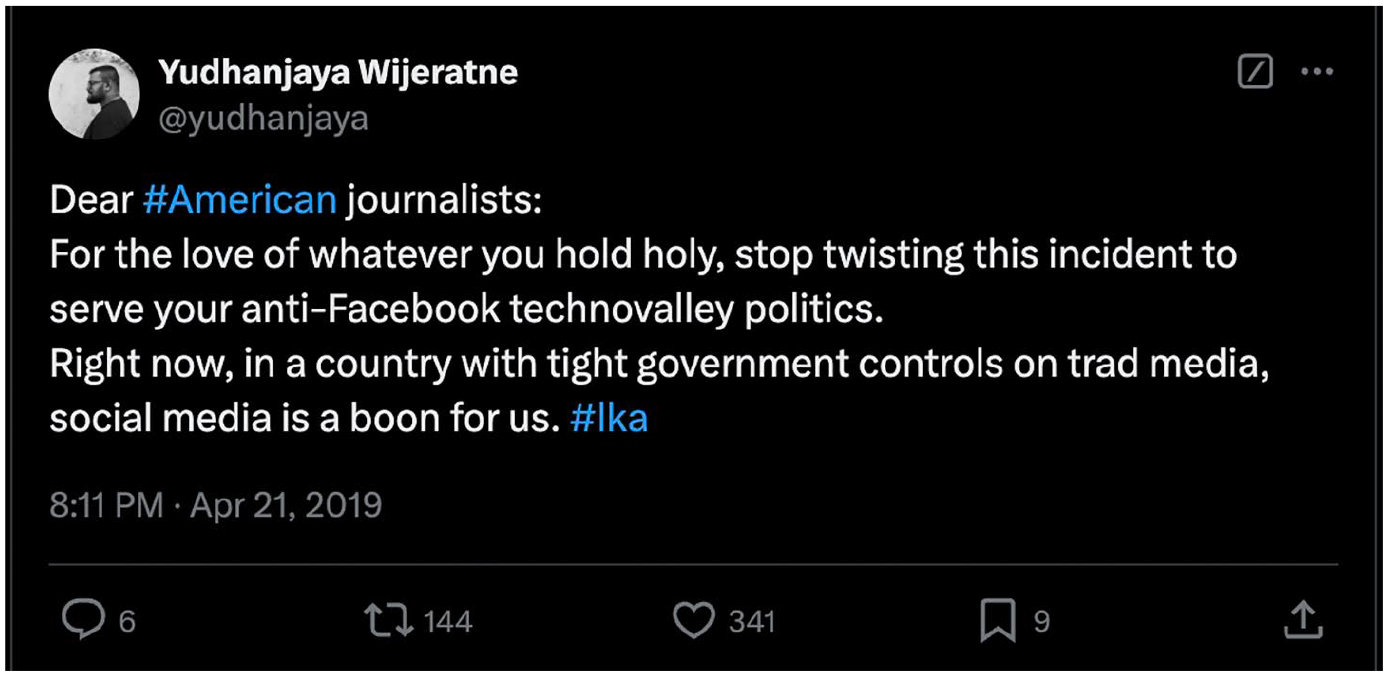
A prominent Sri Lankan activist expressing affordance folklore as he articulates why social media is useful for Sri Lankans at a time of crisis.
Posted in the days following the devastating Easter Sunday attacks in 2019, the Sri Lankan activist, Yudhanjaya Wijeratne, swiftly summarises the tension between the international media blaming social media for Sri Lanka’s long running ethnic conflicts, and Sri Lanka’s own internal battle with media freedoms. The tweet also provides a clear example of how affordance folklore emerges at the time of a complex sociotechnical event like an Internet shutdown by articulating the value of social media. This article took Wijeratne’s tweet as a springboard into broader ethnographic investigation into how Sri Lankans experienced three instances of political upheaval exacerbated by Internet shutdowns. The data analysis, developed through 18 months of ethnographic fieldwork in Sri Lanka identified 20 highly active and influential social media commentators to ethnographically collaborate with. This process involved collaborative discourse analysis, semi-structured interviews, and long-term participation observation, not only observing their social media activities but also participating in the activities of their everyday lives.
Truth is socially constructed during the 2018 anti-Muslim riots
At the time of the 2018 Internet shutdown, I was working as a journalist for a local media organisation, and we were asked by the management to down tools due to the severity of the block and the media house’s almost exclusive reliance on Facebook as the site of audience engagement. Faiza, who I worked alongside producing English-language news content in the trilingual news agency, was a liberal Muslim woman in her twenties. As an active and well-known Twitter and Facebook activist, one of Faiza’s primary practices on social media was to inform the public — ‘mostly Sinhala Buddhist racists’ — of the ongoing violence against Sri Lanka’s minority communities, historically against Tamils, and most recently against Muslims, to contest the state-led narrative that these groups are conspiring to create discord on the island. When the government pulled the plug on Internet access during the anti-Muslim riots of 2018, Faiza’s daily social media practices were curtailed. In order to track the spread of the riots from the Central Province towards the Muslim communities that line the north-western coast between Puttalam and Colombo so families and communities could prepare for the onslaught, she was reduced to making ‘old-skool telephone calls’. Widespread Internet access would have made this gruelling task more achievable as she would naturally rely on content posted by users experiencing the riots firsthand. When I asked Faiza years later in 2024, how did the Internet shutdown affect her ability to document the riots as a journalist and as a responsible member of the Muslim community, she said: Well, I couldn’t. I mean, I tried. I tried to talk to as many people as possible. But people were scared and people were only reporting rumours anyway. . . I wanted photos. We needed facts’.
The riots were triggered by a video recorded on a smartphone and shared widely on Facebook and WhatsApp showing a Muslim restaurant owner confessing to poisoning the stock of his Sinhala patrons. The restaurant owner’s confession was later discovered to have been coerced. However, regardless of the veracity of the video’s content, the government’s decision to ban access to several social media platforms appeared to make logical sense because social media was allowing the rapid dissemination of incendiary information. From the many Sri Lankans I interviewed who had experienced the shutdown firsthand, social media’s ability to allow for multiple discussions to occur and for top-down narratives to be contested and alternative evidence and theories to be tabled emerged as a fundamental affordance of social media, and one that becomes even more invaluable in a time of crisis. I characterise this affordance folklore as truth is socially constructed.
Contributing to this sense that social media provided a forum to socially construct truth together, for some of my research participants, it was important to make sense of the 2018 Internet shutdown as a power grab by the state to control the circulation of news and information. On the shutdowns, another activist, Nala said:
It created a dangerous amount of fake news. Not only did it mean that we were silenced, and other information resources were shut down, but it allowed them [the state] to control the narrative. They used it violently. They published many news stories and fake images.
The affordance folklore seems to be built and maintained in opposition to the governmental narrative that social media was to blame for the riots because of its role in promoting hate speech and fake news. But what did Sri Lankans miss out on when social media was banned?
Design features such as posts, retweets, likes and comments facilitate public engagement on social media making platforms dynamic spaces for mass interactivity. Augmented by widespread mobile access and round-the-clock Internet connectivity, social media enables real-time or near-real-time interaction between users, allowing for dialogue, collaboration and social bonding. Miller et al. (2016) have previously called the advent of polylogical communications the technological innovation that sets social media apart from previous communications systems, because many nodes interacting simultaneously is distinct from dialogical telephonic communications and the one-to-many broadcast media of press, radio and television. In the fraught media ecosystem of Sri Lanka, a country with a long history of egregious crimes against media freedoms, the interactivity that social media affords allows for context, facts, denial and counter narratives to emerge. Faiza’s scepticism towards trusting firsthand accounts based on rumour reinforces the widespread post-structuralist perspective that news and information are socially constructed. With only a limited number of accounts acquired through dialogic communications, Faiza found it difficult to sufficiently crosscheck information against other resources. On social media, the design features of comments, and likes and retweets to a certain extent, creates an environment where information is consistently validated, contested and challenged by the affordances of interactivity.
In addition to the difficulty of documenting actual news in a time of crisis exacerbated by an Internet blackout, it is useful to consider how social media functions in times of ordinary connectivity. For all the activists I observed and spent time with, many of the everyday routines of social media interaction were focused upon determining the veracity of content produced by the mainstream media and producing rival or alternative perspectives. At a programmatic level, this involved posting unique content or reposting the content of others with a leading proposition, criticism or question, and commenting provocatively on others content with hyperlinks to alternative media or opinions. Compared to the government’s assessment that social media was allowing the rapid dissemination of bad information, Sri Lankan activists had a unified preference for ubiquitous Internet access during times of crisis so they could use their digital technologies to question and disprove top-down information. While some participants did not always demonstrate empathy for the producers of fake news, the work of fact checking, debating and listening between different groups was largely seen as the primary purpose of their social media activity. Unlike much of the discourse around information veracity and echo chambers in the social media literature (Farkas and Schou, 2019; Thorson, 2016), activists noted that their practices were motivated by a desire to socially construct accurate information in a way that was acceptable to the many.
There is a broader regime of value that shapes Faiza and Nala everyday social media practices and attitude towards social media – the affordance folklore that truth is socially constructed. Because many Sri Lankan Internet users are aware that Internet shutdowns exacerbate the proliferation of state disinformation, they reactively produce the affordance folklore that interactivity via social media enables the pursuit of truth and justice. In fact, and not unlike what Shah (2021) found on shutdowns in Gujarat, India, the consequence of Internet shutdowns is not the reduction of fake news as is often premised by authoritative regimes, rather, the practice of an Internet shutdown is an episode of digital violence where the government attempts to monopolise the production of news by taking control of the information infrastructure. The Sri Lankans of my study appear to understand an Internet shutdown as a crackdown on the dissemination of truth. As an ethical journalist, Faiza, considers herself to be the nodal point of speaking truth to power in a heavily restricted media sphere, but her own accountabilities are inhibited when shutdowns persist.
Community is everything in the aftermath of the Easter Sunday Attacks
Community is everything is the second example of affordance folklore that I identified as it emerged around the 9-day Internet shutdown that followed the devastating Easter Sunday Attacks on 21 April 2019. While the Sri Lankan government’s technical intervention was framed under the mandate of preserving public safety, ordinary people were inhibited from contacting loved ones, and from sharing grief and offering solace to their family and friends at a time of extraordinary pain and suffering. While the affordance folklore of how truth is socially constructed was also present in the general narratives, the perceived community that social media fosters not only between close kin, but also across ethnic groups and throughout the wider nation was the most notably visible affordance folklore in 2019. As Nala, a Sinhala Catholic, recalls:
I remember the trauma of the attack firsthand. I lost some people close to me, and many [other] people close to me were heartbroken and traumatized. The easiest way to talk to each other, and share our pain was via WhatsApp. But that had been banned
The ability to send instant 1-2-1 messages and group messages on tools such as WhatsApp (and Facebook Messenger and Viber which were also banned), plus the broader polylogical engagement enabled by social media platforms such as Facebook and Instagram, stopped Sri Lankans from accessing and building community in a time of crisis. The everyday actions of checking in on a family message, a small emoji reaction, or even a post of what one is having for breakfast or dinner (as is so often is derided as a torment of social media!), serves to share experience and indicate that one is alive, well, maybe only ok. This process of actively building one’s community was inhibited by the government’s assessment that by banning social media they were protecting the public from harm. However, perhaps what was most striking about the 2019 Internet shutdowns was how it motivated people into committing extraordinary acts of community in real life (IRL). While many people stayed at home as was instructed by the island wide curfew, many activists went out on to the street to display solidarity with their frightened countrymen. Nala, known for her fearless activism on Facebook, explained that when it became apparent that Muslim communities were going to be arbitrary targeted by mob violence for retribution of the terrorists’ attacks, demonstrations of in-person solidarity by some Sinhalese groups was an essential practice in this moment of extraordinary digital disconnection:
I remember there were a lot of things happening on the ground – violence and riots – and after a few hours we realized the whole thing was going to turn against Muslims. So, as a community we started calling our Muslim friends, visiting them, trying to be seen with them. Basically, trying to ensure we are seen with them so that the harm won’t come their way.
This account has immediate value in demonstrating the paradoxes inherent in the government intervention of Internet shutdowns in times of extraordinary national crisis. The banning of WhatsApp, which has developed into something of an infrastructural community tool, globally, meant Sri Lankan citizens could not access the messaging service that most people rely on for the most basic and intimate of human interactions, including grieving, offering support and showing solidarity. Because people could not offer their solidarity towards their Muslim countrymen online, as would be the most natural and widespread practice, Sinhalese-Catholics like Nala and her friends and family including her husband, Vincenzo, were forced out onto the street and into the community spaces of Muslims to visibly show solidarity and offer protection against mob violence. Internet shutdowns have been previously described as having paradoxical effects (Grover, 2025), such as galvanising protesters to take to the streets during the Arab Spring (Howard et al., 2011), and the example of the social media block following the Easter Sunday Attacks in Sri Lanka animates the shutdown paradox. The government’s intention of quelling civic unrest has no regard for the importance of platforms in enabling connections between communities, thus digitally mediated connections manifest IRL.
In addition to the paradox of Internet shutdowns forcing people onto the street to build community, it is helpful to consider how community is built more programmatically on social media at an everyday level. Shruti was a student at the University of Colombo and she spends a significant proportion of her social media activity promoting gender equality, rights for the LGBT community and broader access to sexual health and education. Perhaps because she was the youngest person I spent time with, and therefore can be considered a true digital native, she had the most prescriptive actions of how to build her social media community, and she took me through her self-taught processes. Once a week she would spend time actively seeking out new people to follow, often followers of followers or screening those recommended by algorithms. Importantly, Shruti did not shy away from following people she does not agree with, personally or politically, because it was her view that social media served as a venue to interact with people you would not normally speak to IRL. While she did concede that over the years she has had to block and mute several particularly aggressive people, in the main, she tries to maintain a community of plurality. In 2023, when we were conducting fieldwork together, Shruti experienced an astonishing shift from some of the trolls she had been battling. For several years Shruti had been suffering abuse from three female Facebook users all accusing her of being ‘a bitch’ and ‘a troublemaker’ for promoting women’s rights, but Shruti always tried to reply with decency – calmly pointing to facts, sharing human experiences, and remaining empathic. Then:
One of the girls reached out to me. She says she has been inspired by my content. So much so that she wants to invite me to her wedding and for me to be a “witness”. We have been arguing online for years and now I am going to be a guest at her wedding! She says I’ve helped her see the errors of her ways and she wants to honour that.
This extraordinary shift of Shruti enemies literally transforming socially and politically through her content dramatically highlights the potential power of community building enabled by social media. It also describes how online communities and IRL communities are less distinct, as connections built online cross over to the real world (and vice versa). Interestingly, one of the key elements of the story is time. Shruti said the interactions (and abuse) from these three individuals started around 2018-2019 and it took until 2023 for the story to dovetail into its remarkable conclusion with Shruti as an esteemed guest at one of her assailant’s wedding. Time is not afforded by social media, but what platforms do allow is persistence. Social media enabled Shruti to consistently and persistently post content and respond to abuse with decency – daily, weekly, monthly and yearly – to a community politically and socially un-unified. Indeed, by leaning into the affordance folklore that interactively socially constructs truth, a related idea evolves that good information creates cohesive communities. Repeatedly, we are told that social media is the root of contemporary polarisation, but the activists’ stories here seem to also suggest that social media does the opposite of allowing for conversations, even aggressive and challenging ones, to evolve into productive ends (Udupa and Pohjonen, 2019).
Visibility is a double-edged sword during the Aragalaya
The Internet shutdowns that ‘happened’ during the Aragalaya protests are an altogether different phenomenon to consider because the government did not ever claim responsibility for breakdowns in digital communications so it is unclear as to whether they occurred at all (Centre for Policy Alternatives, 2023). Having interviewed and spent time with more than 20 activists active during the mass occupation of the Galle Face Green in downtown Colombo, some of my participants were unclear whether Internet shutdowns were enforced, while others were adamant that they were victims of government-enforced Internet shutdowns. I suspect there are two understandable reasons why many believed shutdowns were enforced. First, the Aragalaya was a protest against the endemic government corruption that had brought the country to the brink of financial collapse. By defaulting on its debts daily blackouts had become normalised for 6 months leading up to and through the protests meaning people could not connect to home Wi-Fi or mobile connectivity and/or they could not sufficiently charge their devices. In short, the Sri Lanka public were living under the conditions of Internet shutdowns if they were purposefully enforced or not. Second, widespread distrust in the government, directly related to their financial corruption, and also to the way they had managed previous crises by implementing Internet shutdowns, meant that many people assumed that the government would cut the Internet any time civic unrest erupted, even if it was not officially announced. As Lahiru explains: I think we reached a point where we accepted that one way our government was handling anything violent or anything important was immediately going to an internet shutdown. So people were ready for that, they knew exactly how to activate VPN. When I say people, I mean all social media users’.
We know that the Aragalaya was the most successful people’s movement in Sri Lankan history, ousting a long-standing corrupt Rajapaksa political regime. What set the Aragalaya apart from previous resistant movements in Sri Lanka was its peaceful and cross-ethnic nature (Kodikara et al., 2022). Unlike the JVPs uprisings of 1971 and 1989 and the long civil war fought by the LTTE, the comrades of the Aragalaya did not bear arms. In addition, and perhaps, crucially, the Aragalaya was the first anti-government movement in Sri Lanka in the digital era, therefore amplified, encouraged and challenged by activity and actors on social media. While it would be quixotic to overstate the role social media played in the Aragalaya’s success, the deployment of VPNs, to circumvent presumed Internet shutdowns, paired with the use of hashtags to enhance content visibility, appeared to advance and elevate the protestors’ objective.
Popular Twitter personality and Aragalaya activist, Lahiru showed me the outcome of widespread VPN and hashtag usage. He is adamant that the government shut the Internet down in early April as the occupation of Galle Face Green in downtown Colombo intensified. However, he believes that by strategically using VPNs to access international Internet providers the Aragalaya protestors purposefully caused their protest hashtags to trend in foreign Twitterspheres. As Image 2 illustrates, by early April 2022, the protest hashtags #GoHomeRajapaksas, #GoHomeGota and #SriLankaCrisis were trending in the Twittersphere of Singapore and Netherlands, and Lahiru says he also saw Sri Lankan protest hashtags trend in Malaysia and UAE. From the very beginning of the Aragalaya, the ‘subversive affordances’ (Santos et al., 2024) of VPNs were married with the visibility afforded by hashtags to make the Sri Lankan struggle visible across the world, from Western Europe to the Middle East to East Asia. No wonder, Lahiru mused, the shutdown was quickly ‘hooked’ by the government.
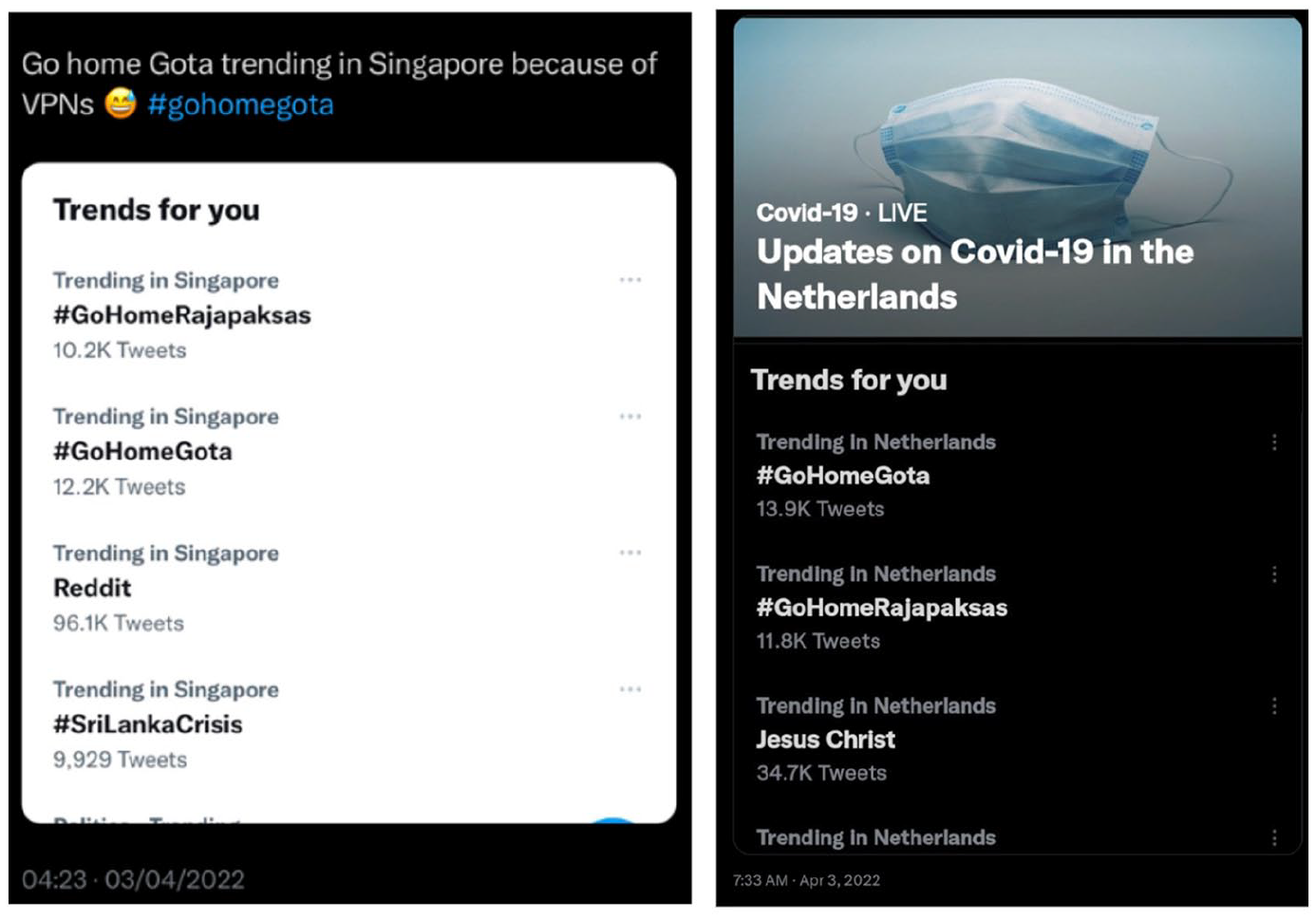
Screenshots of social media affording visibility. The Sri Lankan protest hashtags were trending in Singapore and Netherlands thanks to the protestors collaboratively appropriating VPN technologies and hashtags.
Due to the proclivity of the government installing Internet shutdowns in the previous crisis, many Sri Lankans had become accustomed to activating VPNs, or virtual private network, on their devices during the Aragalaya. A VPN enables a user to temporarily shift or relocate their device’s IP (Internet protocol) to an international provider, thereby allowing them to access alternative Internet connectivity, and circumvent restrictions or blocks installed by a local government. Because the Aragalaya was a people’s revolt against endemic government corruption and an active kick-back against gross structural violence, the acts of visibility during the 2022 shutdowns appeared to involve an intentional form of disrupting the status quo and resisting hegemonic power structures. Thus, the most notable affordance folklore that emerged during this period of great economic turmoil and political upheaval was that about visibility.
However, under an authoritative regime, visibility is a double-edged sword. Clearly, the posting of Sri Lankan protests hashtags while connecting to the international provider encouraged the widespread globalisation of Sri Lankan content, and perhaps motivated the Sri Lankan state to renege on its authoritative intervention. But, the visibility afforded by VPNs could not solve all connectivity issues and visibility can also invite trouble. For example, Faiza explained that the #lka hashtag – shorthand for Sri Lanka – is a useful tool if one wants their content to be seen by everyone, but some of the time she does not want that. As a liberal Muslim woman advocating for female and minority group equality, there are times when Faiza wants to fly under the radar and avoid interacting with Sinhala-Buddhist nationalists and conservative Muslims, so she opts to not use the #lka hashtag.
Moreover, the widespread distrust in government had additional effects of making activists believe they were being surveyed and tracked via their mobile phones. According to several activists who had been on the ground at the protest site, the government continued to deploy targeted campaigns of digital violence around specific eruptions of unrest that had disabling and alarming effects on citizens. Nala thinks one particularly effective Internet shutdown happened on the ninth of April 2022 because she remembers being at the protest site and becoming stranded from her friends following a brutal melee between the police, hired mobs and protestors. In addition, there were multiple other occasions during 4-month occupation that the mobile data packages of her and her comrades were faulty and unreliable, creating fear among the protestor community. Previously, I suggested the controversial phenomenon of platform shadow banning (Cotter, 2023; Savolainen, 2022) was analogous to Internet shutdowns because the opacity of the practice is what grants it its power and keeps users/citizens second guessing as to whether they are experiencing some sort of egregious intervention or otherwise. On the ground during the Aragalaya, the government’s control over who had Internet access, and its predilection for installing Internet shutdowns, had instilled widespread fears of monitoring and surveillance into the protestors. Nala said:
We were all scared to access public WIFI because we thought it was a surveillance trap by the authorities who were forcing us into nearby malls and hotels to access the internet.
Whether there were official shutdowns or if activists had faulty data packages, clearly there is a lot of emotion embedded into the availability of Internet access. The parents of the protestors in faraway suburbs or towns had begged them to stay in contact and stay safe during the occupation. But by inhibiting protestors the basic affordance of online visibility, the Internet shutdowns were either forcing the protestors into highly visible and spatially controlled public environments in order to digitally-communicate back home, or to head back home all together. In fact, the fear of surveillance became so intense, on some days, the protestors would voluntarily turn off their personal mobile connectivity to feel safe, thereby blocking any of the social media affordances celebrated and presented here.
Conclusion
This article argues that affordance folklore about social media becomes the primary site for personal, cultural and political participation during times of Internet shutdown. As has become evident in the lives of Sri Lankans that I had spent up to 18 months conducting ethnographic fieldwork with, when access to the Internet is compromised, the affordances of social media are imaginatively contested, questioned and reinforced through a range of practical and symbolic activities and narratives. Under analysis are three separate incidents of Internet shutdowns that followed moments of civic violence or political upheaval, and I have identified three different examples of affordance folklore among my personal correspondence. The first affordance folklore that truth is socially constructed relates to how activists were conscious that Internet shutdowns exacerbate the proliferation of state disinformation during the 2018 anti-Muslim riots (Shah, 2021). At this time, the intrinsic value of social media’s interactivity and potential for bottom-up conversations to empower the public to speak truth to power was most actively eulogised. Community is everything was the most visible affordance folklore following the Easter Sunday Attacks and refers to how social media has become an infrastructure for the maintenance of essential human needs: checking in, grieving and expressing solidarity. The final folkloric response, visibility is a double-edged sword, pertains to how social media advanced the protester message via hashtags and subversive VPN usage, while also making activists’ cognisant of the surveillance potential embedded in their mobile devices. It would be facile to imply that the three affordances folklore are distinct to each historic event because they have been purposely presented in this way for the basis of argument. There is no doubt that the affordance folklore of truth, community and visibility were present in each historic case study and each genre of affordance co-exists in collaboration and tension with the next.
Unlike various other critical media scholars, I am less interested in the disinformation campaigns and hate speech that provide the rationale for the Internet shutdowns (Aguilera-Carnerero, 2021; Hattotuwa, 2018), because I am more concerned with how folkloric theories escalate around the affordances of the social media when it is restricted or shutdown. I have situated affordance folklore as a novel variation in the burgeoning subfield of algorithmic folklore studies. Unifying these studies is the notion that all Internet users produce grassroots, bottom up, untechnical folk theories about how digital systems best serve, or marginalise, us due to the intellectual chasm between users’ understanding of how web-based technologies operate and the actual algorithmic formulas and platform programming that moderate content. What makes affordance folklore distinct is that the narratives expressed by Sri Lankans during the three Internet shutdowns under analysis are not about algorithms or platforms, per se, rather, they refer to the broader affordances of social media and its relationship with media freedoms and human rights. Due to existing iterations of algorithmic folklore being premised on the power disparity between influencers and algorithms (Bishop, 2020; MacDonald, 2023) or activists and platforms (Junman, 2025), there has been a failure to observe the real-world power imbalances between citizens and the governments that hold power, and ostensible ownership, over who has access to social media platforms. While these existing conceptions are useful, they are concerned with the opacity of social media’s black box algorithms, not the baseline fact that Internet shutdowns are prevalent throughout the world and this creates emerging and unparalleled levels of uncertainty between states, citizens and platforms. Citizens living under governments with authoritative tendencies have a relationship with social media that is more complex than merely how users relate to opaque algorithms. The suggestion of affordance folklore is helpful because affordances, in all their complexity, allow for a wider abstraction of the imagined and the material, and the online and the offline.
Footnotes
Funding
The author(s) disclosed receipt of the following financial support for the research, authorship, and/or publication of this article: The author’s PhD research was funded by the Consortium for Arts and Humanities South-East England (CHASE c/o AHRC).
