




Abstract
This article explores the notion of the child as found in the growing body of research on child influencer culture. While much of the existing literature adopts a reductionist and risk-focused perspective, this article explores the complexities and variations of the child figure in this field. Through an empirical case study of a successful Swedish child influencer, we highlight how multiple representations of ‘the child’ – as professional, creative, vulnerable, and marketing subject – can coexist within a single campaign. Theoretically, we draw on complexity theory, the concept of multiplicity and the feminist idea of ‘staying with the troubles’. We argue for a more nuanced approach to studying child influencers by embracing the uncertainties and challenges involved, and acknowledge that influencing is only one of many roles children occupy in their lives. This approach encourages thinking about children in dynamic, interconnected ways, recognising the fluidity of their roles across time, space and context.
Keywords
Introduction
It is important to examine how social media influences the notion of the child and how phenomena such as children as influencers affect societal perceptions of children. Recognising this enables a more nuanced understanding of the evolving role of children in society and helps avoid moralising, exotifying or marginalising children.
Today, influencers are part of a monetised visual, digital ‘creator culture’ industry (Abidin, 2018; Cunningham and Craig, 2021). They curate an authentic and interactive persona that blurs the lines between public and private, creating a sense of closeness and intimacy (Jorge et al., 2023; Marwick, 2013). The process of performing authenticity, referred to as authenticity labour by Maares et al. (2021), is one of the cornerstones of influencer marketing. Sedda and Husson (2023) argue that influencers represent a form of hybrid professional identity that is situated between profane and expert activities, leisure and work. To maintain a high level of visuality, creators must also learn how to engage with different platforms that each have different logics and social norms that shape what is valued and how value is measured (Burges, 2021: 27).
Child influencers, that is, children who invest large amounts of time in activities in their leisure time – such as dancing, make-up tutorials, making funny movies, gaming, toy reviews, cooking, musicians, sports talent or child actors in film and musicals – and who share these in social media, independently or through parents’ involvement, are rapidly growing phenomena (Hudders et al., 2024). Given that their content is child oriented and highly popular among their peers, these young influencers are in high demand by companies seeking to promote products (Ruiz-Gomez et al., 2022; Van den Abeele et al., 2024). As a result, child-created content has become an integral part of a flourishing digital economy (Burroughs and Feller, 2020). This raises questions about children and labour and about leisure and responsibility in the modern digital culture (Coulter, 2020; Marsh, 2016). Media phenomena, including children, such as child influencers, are also often surrounded by debates and discussions. In the case of child influencers, these concern the use of social media as such, market collaboration, parents’ influence on activities, children’s independence, age, time consumption, privacy and health; this list is non exhaustive.
Our starting point is seeing children as social and cultural actors who produce and reproduce the worlds and societies in which they live (e.g. James et al., 1998). This means that children are agents who take part in creating their and other people’s lives, regardless of gender, class, ethnicity or age (Esser et al., 2016; Gallagher, 2019). However, the idea of the child is not straight forward, and cannot be understood in binary terms. It is never either/or, it is always a mixture of both the imagined child and the living acting child, taking numerous forms depending on context, discourse and perspective. The imagined child is shaped by cultural narratives, policies and societal expectations, while the acting child navigates everyday practices (Sparrman, 2024).
To address this complexity in research, it is helpful to work with the concepts such as child perspective and children’s perspectives (Bergnhér, 2019; Halldén, 2003). The difference between a child perspective and children’s perspective is the way in which the child is focused. The child perspective carries a more structural connotation, focusing on the child as an idea, and examining how children are represented in policy documents, curricula and media. Conducting research from a child perspective means analysing, as far as it is possible, from the position of the child. A children’s perspective, on the contrary, emphasise children’s lived experiences: what they say, what they do and how they relate to the world and live their lives. In research, the aim is to understand children’s actions as much as possible from children’s own perspectives. There is a reciprocity between these two approaches, relating the imaginary child within the child perspective with the child as an actor in children’s perspectives.
Much of the existing literature on child influencers does not include theories about children from the well-established interdisciplinary research field of child studies and tends to assign fixed roles to children, rather than acknowledging the complex realities they navigate. This article thus contributes to the field by reflecting on, theorising and perhaps challenging the notion of the child in child influencer culture, using theories of the child as developed in child studies. The approach is reflective and suggestive rather than argumentative, and exploratory in its endeavour (Mol, 2002; Sparrman, 2020) to examine how the notion of the child stands out in research on children as influencers. We expand this discussion through an empirical example of a successful Swedish child influencer. 1 We ask the following:
What notion of the child comes forward, and what ideas about the child are imbued in the idea and actions of the child influencer?
Background
There are multiple ways to describe and categorise the many different types of adult and child influencers. Some of the most common methods involve the number of followers, the type of content or the level of influence. Using a combination of follower count, accessibility, expertise and cultural capital, Campbell and Farrell (2020) identified five distinct categories: nanoinfluencers (1 K–10 K followers), microinfluencers (10 K–100 K followers), macroinfluencers (100 K–1 M followers) and mega and celebrity influencers (1 M + followers) (see also Van den Abeele et al., 2024). When children’s commercial activities on social media are discussed, different concepts flourish.
Abidin (2015) introduced the term ‘micromicrocelebrity’ to highlight children under 4 years of age inheriting fame and exposure from their influencer mothers. The concept is closely related to the practice of ‘sharenting labour’ (Blum-Ross and Livingstone, 2017; Jorge et al., 2021), which involves parents earning income from creating content displaying their children online (Beuckels et al., 2024; Ågren, 2023). These accounts are owned and created by adults, with the child as a central figure, but the content is primarily designed to engage other parents (Hudders et al., 2024).
With the number of minors creating content and launching products or services for businesses on what appear to be individual social media profiles rapidly increasing, the term ‘kidfluencers’ has emerged (Callens, 2020; Rasmussen et al., 2022; Van den Abeele et al., 2024). Feller and Burroughs (2022: 3) described the concept as ‘a new category of child stars’ who produce content that is both child-oriented and popular among their peers, with marketing strategies embedded in their influencer activities (see also Bakioğlu, 2024; Divon et al., 2025). A key characteristic of kidfluencer content is that the child’s life is the primary focus, and the child remains central to the content (Hudders et al., 2024). Building on this perspective, Hudders and Beuckels (2024: 1) expand the understanding of the term to also include young children who feature prominently on accounts run by their parents, such as momfluencer, dadfluencer, or family influencer profiles. Although the content in these cases is curated by adults, the child remains at the core of both the narrative and the commercial value of the account.
Several related terms have emerged, including Insta-kidfluencer (Archer and Delmo, 2023), YouTube influencers (Ruiz et al., 2022), and curators (Marquez et al., 2022). Since many children operate across platforms, these labels primarily reflect the context of individual studies rather than distinct influencer types. The age range associated with kidfluencers is not always specified but generally refers to preschool-aged children or those under 13, whose accounts are run by parents due to platform age restrictions and the need for adult negotiation in commercial partnerships (Feller and Burroughs, 2022; Hudders et al., 2024; Van den Abeele et al., 2024).
A common feature of these conceptualisations is that adults, often implicitly, adopt and reinforce particular ideas about the child. As a result, children are framed as stable entities based on factors such as age, number of followers or the specific media platform they engage with.
In a comprehensive review of the phenomenon of kidfluencers, Hudders et al. (2024: 78) reported that many existing studies focus on content and discourse analyses, often emphasising the potential negative consequences of the influencer industry, not least in relation to commercial exploitation and manipulation, children’s private lives and health and the complex relationship between children and parents. For example, Bakioğlu (2024) analysed popular YouTube channels featuring kidfluencers, arguing that some children engage in content production that resembles intense labour, which disregards their rights. Archer and Delmo (2023) also highlighted the need for more frameworks, potentially legislation, after analysing an Australian influencer’s Instagram account with siblings, where gender stereotypes were reinforced by children advertising gender-coded products. Through a case study of Pocket Watch, Feller and Burroughs (2022) investigated emerging shifts in children’s digital media industries and called for urgent need for further discussions and intensive regulatory responses in relation to child-generated content and the media industry. Hudders et al. (2024) also highlighted that traditional child labour laws and regulations are difficult to apply to child influencers, leaving them vulnerable to economic exploitation.
Despite a growing industry, there is limited but emerging academic research with child influencers themselves. Examining one of the most popular Danish YouTubers, the 10-year-old girl Naja Münster, Johansen (2021) illustrated how Naja successively grew into celebrity status. Naja emphasised the fun and joy of producing social media content and that she was, in many ways, a normal girl. As her fame increased, the boundaries between play, leisure and work become blurred. In 2020, Naja’s mother quit her regular job to manage the family’s different social media platforms, something Naja expressed happiness about. However, as Johansen (2021: 168) noted, the mother was partly dependent on her child’s social media channels for her livelihood, which could increase the pressure on Naja to create content. The same type of paradox appears in Van den Abeele et al’.s (2024) in-depth interviews with 19 kidfluencers and their parents. The study explored how child influencers manage authenticity and self-presentation in relation to social dynamics with parents, followers and commercial partners, demonstrating how mothers manage, curate and stage the content. Although it is the mothers who were the most in focus in the study, it emerged that children could feel both resistance and reluctance to create a certain content but that they do it anyway. This highlighted a discrepancy, while parents or guardians are expected to act in the child’s best interests and safeguard their privacy, these boundaries may be crossed when the child’s influence becomes financially valuable. However, some of the children in Van den Abeele et al’.s (2024) study also emphasised that there was a desire to break through as an influencer, with the children expressing a sense of purpose to achieve this.
The fact that social media is a possible future career, but that hard work will be required, is expressed by many children in both surveys (Rasmussen et al., 2022) and interviews (Ågren, 2020). Children’s and young people’s determination to impact social media is also described in an ethnographic study on how teens performed their digital identity on Instagram (Marquez et al., 2022). Central here was how the teenagers observed, imitated and reinterpreted famous personalities and Instagrammers and tried to use the same complex strategies and skills to attract followers and advertisers. Children’s replication of professional content and production and branding strategies are also described through a content analysis of 100 toy unboxing videos on YouTube by Nicoll and Nansen (2018). Interestingly, although ‘ordinary’ children strive to adopt a professional stance in their content, ‘professional’ channels often seek to produce an impression of playful amateur authenticity, referred to as calibrated amateurism by Abidin (2017).
In summary, as Hudders et al. (2024) observed, although some studies highlight the empowerment of children engaged in influencer activities, much academic research has focused on the potential negative consequences of these activities, portraying children as vulnerable and in need of protection from adult world. In addition, the impact of the influencer on other children has also often been emphasised, yet fewer studies have centred on the perspectives of child influencers themselves and their experiences of being in this role. In this text, focus is on accounts that feature children as the primary content creators.
Troubling the complexity of the child influencer – theoretical perspective
To explore and emphasise the ways in which child influencer culture is articulated in contemporary research, we ask for clearer accounts of the conceptualisation of the child and address the difficulties, troubles (Haraway, 2016) and complexities (Law and Mol, 2002) of the notion of the child. Inspired by Donna Haraway’s (2016) way of presenting trouble as to ‘stir up’, ‘to make cloudy’, [and] ‘to disturb’ (p. 1), the idea is to stay with what chafes and stirs our own values and ideas about child influencers. That is not to go for an either/or, for example, either awful or salvific interpretation of actions. It is about staying with entanglements, the unfinished, the unpacked and the not seemingly solvable (Haraway, 2016). Staying with the trouble also means staying with complexity. Complexity is about, on one hand, not neglecting variables that are at hand but might not fit the picture aimed for and, on the other hand, not avoiding the unpredictable (Law and Mol, 2002). To allow complexity in research then also involves challenging culturally taken-for-granted ideas that trouble a phenomenon, for example, the phenomenon of a child influencer. It is about disentangling the singularity of the phenomenon to see what it coexists with, if it does coexist with other singularities and if there are contradictions, different logics or orders that combat one another (Law and Mol, 2002). It is about unpacking, in this case, the child influencer in practice, through an empirical example to see what it is that holds the concept together. It is about looking into what is more and less in the concept.
This approach is combined with contemporary theoretical developments within child studies. Agency is one of the most central concepts in childhood research, so central it is that it is almost impossible not to mention it. Since the early 1990s, children have been conceptualised as active social agents who both shape and are shaped by their world, challenging the notion of the child as a fixed category with inherent characteristics (James et al., 1998). This perspective has since evolved further. Rather than viewing agency as an intrinsic attribute of the child, scholars now understand it as something created and negotiated within social and cultural relations (Oswell, 2016). This line of thinking is combined with theoretical developments on relational ontology within child studies (Esser et al., 2016; Gallagher, 2019; Oswell, 2016; Spyrou, 2022). A relational ontological approach to agency emphasises the child’s embeddedness in relationships with both human and nonhuman entities, highlighting interdependence and fluidity in an ever-changing social world. This perspective challenges traditional notions of independent and pre-existing values (Spyrou, 2022). The relational perspective aligns with the concept of ‘child studies multiple’ (Sparrman, 2020: 22), which frames the child as interdisciplinary and multiple in the sense that it is not cumulative but added in layers. Thinking with this framework allows for an analytical stance that moves beyond singular definitions of the child, making room for diverse and shifting understandings of the child. By combining this approach with both a child perspective and children’s perspective, this article constructs a theoretical package helping us investigate the notion of the child in the child influencer culture without aiming for coherency.
Introducing the empirical example
Tilda
To consider the concept of a child influencer, we use an example from the Swedish child influencer Tilda (pseudonym). Tilda is a white, blonde, middle-class girl who has been active as an influencer for over 5 years. Our choice to focus on Tilda is based on her status as one of the earliest child influencers in Sweden, having gained recognition at a young age when the field was still emerging. As such, she has inspired many child influencers who have followed in her footsteps. Currently, she has approximately 110k followers on Instagram and 200k followers on TikTok. Over the years, Tilda has done several paid collaborations with large and small companies.
With dance as a major interest and leisure activity, Tilda started posting short dance videos on TikTok (by then Musically) at the age of 10 and quickly gained many followers. Shortly afterwards, an Instagram account was set up in her name together with a parent. She instantly became very popular on social media, and over the years, her career has expanded to include acting on television and modelling jobs.
As her account grew, Tilda also received more and more messages from people who appeared to be much older than her. The messages contained sexual invitations, and Tilda was asked to send pictures, among other things. Tildas parents were reluctant to let Tilda continue but decided together with her that, instead of keeping quiet and giving up, they would create a strategy to respond. Therefore, in 2020, Tilda and her mother started an account together with content aiming to help young people stay safe online. When Tilda was 13, they won an award for this work. Tilda was active on the account until 2021, when she announced decided to leave the account. The online safety account still exists, although dormant, and is now managed solely by her mother. It has approximately 9,000 followers. 2
The ‘Let kids be kids’—collaboration
The example we want to discuss is from 2021, when Tilda collaborated with a Swedish clothing company, and she was still active on the Safety Online account. The clothing company was founded in the 1960s and focuses on fashion for young people. In the 2000s, a recurring initiative of the company was to commission famous artists and performers to design limited edition clothing collections.
Tilda’s collaboration with the clothing company came shortly after she and her mum won an award for raising awareness of children’s right to online safety, which resulted in a limited edition of the T-shirt designed by Tilda. The T-shirt is light pink, and the phrase ‘Let kids be kids’, written with large brush strokes by Tilda, is printed in light green on the back. The cost of the T-shirt when it was launched was SEK 695 (approximately 61.50 euros). The launch of the T-shirt included many pictures and short movies that were used by both Tilda and the company on their social media platforms. Tilda and her mother also created content by themselves to promote the T-shirt.
‘Let kids be kids’ is a phrase that circulates in many different areas today, indicating that children should be allowed to be just children. Focus should be on play and child innocence, and it is also often used as a rhetorical phrase to protect children from phenomena or practices that adults consider potentially harmful (e.g. sex education; see https://letkidsbekidscoalition.org). Moreover, the word ‘kid’ also connotes obstructiveness in the sense of playing around with regulations, non-age-appropriate behaviours and kidding (https://www.etymonline.com/word/kid). Therefore, it is important who uses the concept and for what purpose. In the case of Tilda’s writing, the phrase is used to talk against adults approaching her and other children with sexual content online.
The data collected consist of images and videos published in connection with the release of the T-shirt as well as the subsequent promotion of the T-shirt. In total, approximately 35 posts were published across Tilda’s various platforms as well as on the company’s social media channels. Following the theoretical framework outlined above, this article adopts an analytical approach that avoids generalising the empirical material. Focus is on illuminating the complexity of the notion of the child by staying close to the empirical ‘case’. To explore this complexity in detail, we conduct a close theoretical reading of one individual child and a single influencer activity consisting of three social media posts. These posts exemplify what a singular influencer engagement can look like and how it involves multiple versions of one and the same child.
Before setting off, we want to clarify that while Tilda co-founded the online safety account with her mother, the mother remains a secondary figure in this article. It is however evident that the mother strongly believes in Tilda’s rights, both in terms of protection and the right to participate in social media. This perspective aligns with the UN Convention on the Rights of the Child, which holds significant legal standing in Sweden and was implemented in Swedish legislation in 2020. The convention upholds children’s rights to information, freedom of speech, and to be listened to when their lives are concerned.
There is an ongoing discussion about visual online material, the distinctions around what is considered public or private are complex, and researchers engage with these issues differently (Harris, 2016; Warfield et al., 2019). Children are not an ethically sensitive research group per se (Schiratzki, 2001). However, when conducting research with and about children, it is always necessary to consider the power dynamics between children and adults (Danby and Farrell, 2005). There is also a significant difference between publishing material online and being part of research (Harris, 2016). Because the focus here is on exploring what notions of the child that comes forward in these examples, rather than on Tilda as a specific person, we have chosen a semianonymous approach where we do not name or show the influencers face or publish any URLs. Because no consent to use the images was given by Tilda, we also created simulated illustrations (cf. Ågren, 2023).
‘The professional child’
Figure 1 is from the Swedish clothing company’s webshop. Alongside a photograph of Tilda wearing the T-shirt, the webpage displayed pricing and size options. Under the heading About the product, one can read: ‘Meet Tilda who, despite her young age of 13, has managed to achieve incredible things. She is a dancer, an influencer and, above all, an incredibly brave young woman who fights every day for children to be safe online’.
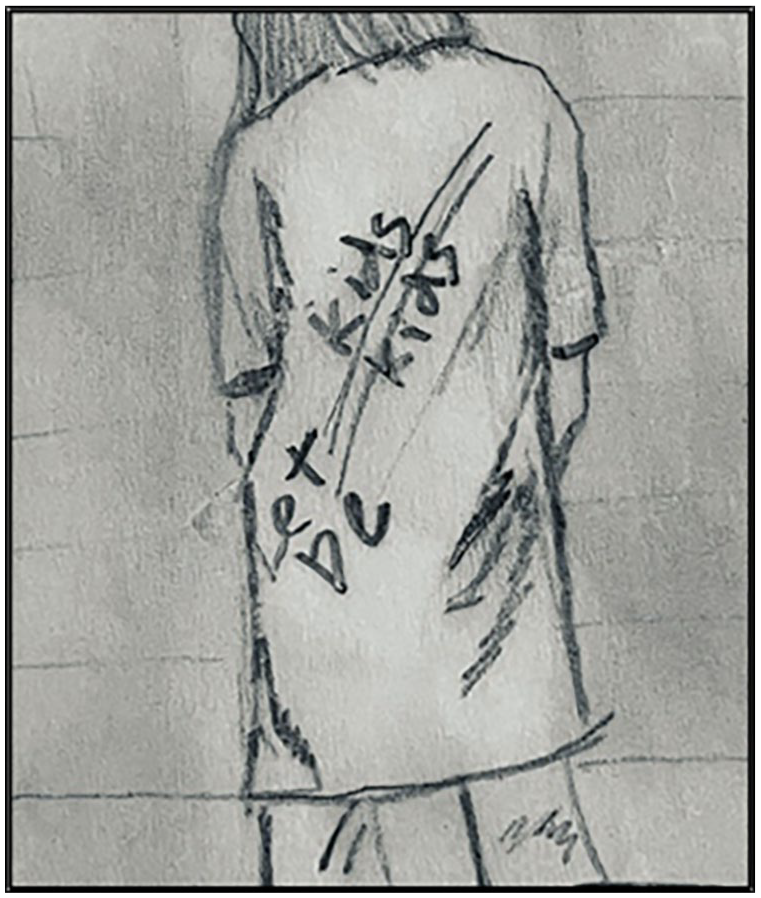
The company’s ad for Tilda’s T-shirt.
In one of the short movies released together with the launch of the T-shirt, Tilda is walking up and down a brick staircase and dancing street dances in a ruffled backyard. She is wearing pink trousers, sneakers and the limited edition T-shirt. Tilda says, ‘Hello (laughing). My name is Tilda, and I am 13 years old. What I love the most is dancing, acting and social media; that is what I do every day, and I love it’. She goes on to talk about when she started dancing, how she loves to learn new things and how one of the most enjoyable things she has ever done was taking part in a televised competition where she performed contemporary dance and disco dance. She continues (in a more serious voice),
I write a lot about sexual harassment online and “Let kids be kids” is the very definition of that, that children should be allowed to be children and not be sexually harassed online; they should be as safe online as they are in real life, and it is so cool that I was able to put that print on the shirt.
Here, we have Tilda’s perspective; she uses several strategies to position herself both as a marketer and a socially conscious individual. She addresses viewers as consumers while retaining an authentic and everyday appeal (Jorge et al., 2023; Marwick, 2013). She first and foremost presents herself as a dancer and an actor, which makes sense because that is how most of her followers know her. She describes what she loves and cares for. To some extent, she also downplays the collaboration with the company, emphasising the humbleness of being able to design her own T-shirt, which can also be a successful strategy for maintaining a relationship with followers (cf. Sedda and Husson, 2023).
In the film the company makes and in the text about the product in the web shop, it is the commodity Tilda that is part of the sales strategy and to reach out to a potential new group of buyers. Tildas skills, such as dancing, acting and modelling, are also used in the advertising film, which has professional standards in terms of light, sound and quality of the pictures. Tilda walks down the stairs within a straight and proud posture. She adjusts her hair and pulls it away from her face, looking straight into the camera, holding her gaze and showing confidence. It is the professional child displayed here, one with a vigour, that is not only a dancer and influencer but also fighting for the rights of other children to be safe online.
The ‘creative’ child and the ‘vulnerable’ children
In Figure 2, a screenshot from a short video on the Safety Online account, Tilda is sitting outdoors on a white blanket or sheet with piles of paint and brushes around her.

Tilda writing the phrase “Let kids be kids”.
The white coaster has patches of colour, as if it has been used many times before or as if there is a playfulness in being able to smear more paint and paint outside the edges. Tilda is dressed in a comfortable costume and has no make-up, and her hair is pulled back in two tassels, giving a child-like impression. Tilda is writing the text ‘Let kids be kids’ in red paint on a large piece of white paper. When finished, she holds up the paper towards the camera. The film then cuts to scenes from the produced movie with the fashion company. Tilda is in the same backyard, street dancing, wearing the designed T-shirt and with styled hair and make-up. Instead of Tilda’s voice, the soundtrack to this clip is Whitney Houston’s song ‘Greatest Love of All’:
I believe the children are our future, teach them well and let them lead the way, show them all the beauty they possess inside. Give them a sense of pride to make it easier, let the children’s laughter remind us how we used to be.
The connection to the slogan ‘Let kids be kids’ is made even clearer with the lyrics about teaching children well, giving them a sense of pride, and allowing them to lead the way. This resonates with Tilda’s stance against sexual harassment and as a child influencer, as it highlights the importance of creating a world where children can express themselves without fear or harm.
The Instagram account is a clear demand from Tilda (and her mother) for the rights of children not to be sexually harassed on social media. We do not know who initiated the phrase ‘Let kids be kids’, whether it was Tilda and her mum or the company or them together, but the phrase relays much of the values and concerns about what is considered important, desirable or worthy of discussing (cf. Hrechaniuk, 2021). Interestingly, this time the slogan is in the hands of a child who argues for her own and other children’s innocence and protection. As Tilda notes, ‘Children should be safe online’, a statement that most people can agree with and a value, in a normative sense, such as a desirable ideal or principle.
‘The playful child marketer’
As part of the agreement between the clothing company and Tilda, she shared the videos and images of the collaboration several times on her own channels and created her own content featuring the T-shirt.
The third and final picture (Figure 3) is from Tilda’s own Instagram account and was also posted on the Safety Online account. It is one of a series of photographs of Tilda and a male friend. They are outdoors, facing away from the camera, showing the ‘Let kids be kids’ print, demonstrating how it can be worn by both girls and boys and in different ways. The caption reads, ‘Take the opportunity to buy my ‘Let kids be kids’ shirt, for children’s vulnerability online, now with a 30% DISCOUNT with code XX’.
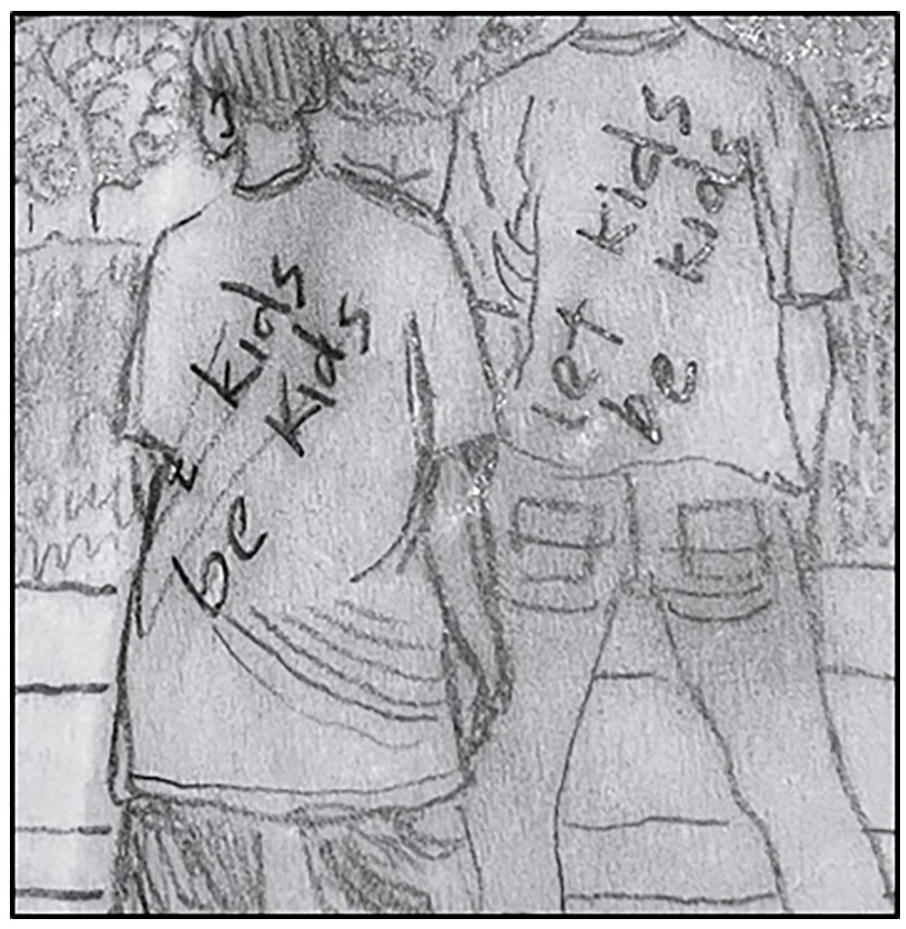
Tilda promoting her T-shirt with a friend.
Influencer marketing is often based on the personal and intimate mode of address, which strengthens relationships with followers, where collaboration with brands and advertising for products appear more credible (Abidin, 2015; Petersson McIntyre, 2020). This also applies to the different logics of various platforms, where the influencer, to maintain their visibility, needs to adopt an approach that follows the social norm of that particular platform (Burges, 2021). Figure 3 is more unedited than the previous ones and conveys a sense of everyday authenticity. The male friend is familiar to her followers and has appeared on her social media accounts many times before. The idea of the child that comes forward is the everyday child who is hanging out with friends, laughing and playing, which is, as has been mentioned earlier, yet one more way of relating to the phrase ‘Let kids be kids’. As Divon et al. (2025) point out, such content can blur the line between play and promotion, where commercial messages are embedded in children’s everyday social interactions and expressions of playfulness. The child becomes both messenger and medium, and brands may function as co-players in these narratives. Moreover, the picture positions the followers as consumers by indicating that the T-shirt is available at a 30% discount. Hence, there is also a child encouraging other children to consume. The account suggests that the T-shirt is made by children for children, and by buying and wearing it, supporters can become goodwill ambassadors, raising awareness of children’s vulnerability online. Thus, aspects of power, sexual vulnerability, consumerism, marketing and play alternate, mix, and intertwine in this example. This also points to how the notion of the child multiplies and how being a child influencer always is entangled.
Multiple values
The analyses have focused on four aspects of the child influencer in a special campaign. We have identified different features in the portrayal of Tilda that blend and overlap. In this section, we explore the different values that emerge from these examples and examine how additional notions of the child are brought to the fore.
At the heart of the influencer market is the relationship between the emotional and economic spheres (Maares et al., 2021; Marwick, 2013). Tilda is building her brand value by working with a reputable company and as a way to reach out to new and wider audiences. The authenticity of the T-shirts is shown in Figure 2. Viewers can follow Tilda in her creativity and creation of the text, seeing her investing time and effort in a message that she believes is important. Taking social action for a cause can also be a way to build legitimacy (Sedda and Husson, 2023). Her making of the print adds value and increases the perception of the exclusivity of the T-shirt.
The T-shirt is a limited edition and is quite expensive. With the T-shirt and its message, Tilda and the company address the viewer as both a consumer and recipient of an ideological message, carrying an emotional value. Tilda becomes both an actor and commodity in her own right, spreading the message that children should be safe online and arguing that consumers help other children, thereby at the same time downplaying the economic value of the sweater. As such, the child influencer becomes a representation of value, a child that is worth preserving and protecting. Hrechaniuk (2021) explore how for-profit and nonprofit actors mobilise values about children together in charity campaigns, showing how a win‒win rhetoric, here when a company contributes to a societal good, legitimises and downplays the monetary aspect and can become a way of avoiding criticism. Similarly, the clothing company gains goodwill from Tilda’s campaign and Tilda (maybe) receives economic value, getting some of the proceeds of the T-shirt from the company and good will from her followers. Thus, in this process, multiple values are created in the interaction; the company strengthens its corporate social responsibility profile, consumers gain a sense of ethical participation and Tilda consolidates her personal brand and influence. These overlapping values highlight how commercial, ethical, and emotional dimensions are entangled in the influencer economy (Jorge et al., 2023; Ågren, 2023).
The clothing company recognised Tilda as an authentic and strong personality, who, ‘despite her young age of 13, has managed to achieve incredible things’. Age is presented here as a value, a rhetoric in her favour, with the number 13 reinforcing Tildas’ uniqueness. This implies that 13-year olds according to the company are generally not expected to be as profound as Tilda, that is, that ‘normal’ 13-year olds are perhaps not capable. In this context, age is presented as a compliment; the older Tilda is, the less age is in her favour in terms of having achieved things, which is also consistent with research showing that younger children are especially sought after by companies to promote products and are popular among their peers (Feller and Burroughs, 2022; Van den Abeele et al., 2024). This also shows the expectations of what children normally do or should do. The phrase ‘Let kids be kids’ can refers to play and the ‘natural child’. It can also be used when children are discussed in relation to commercialisation (Cook, 2010; Sparrman et al., 2012; Zelizer, 1994[1985]) or in child labour policies, carrying a strong discourse that children should not work (Peleg, 2018; Prout, 2005; White, 1999).
The ambiguity of the phrase and who carries it shows the complexity of child influencers, as the phrase ‘Let kids be kids’ is in some ways the opposite of what the child influencer Tilda is doing: She is both working and arguing for children’s rights to have a safe online playground.
Discussion of the notion of the child influencer
Being a child – or even ideas about the child – is multifaceted. In this article, we explore how different versions of ‘the child’ emerge through the example of one child influencer’s campaign. Unsurprisingly, our analysis shows that a child is never just a child since their identity is shaped by and intertwined with the world in both expected and unexpected ways.
Our exploration highlights how Tilda, a child influencer, navigates multiple roles within a single marketing campaign. The ‘professional’ child blends with the ‘creative’, ‘vulnerable’ and ‘marketing’ child, constructing a complex position that intertwines both the imagined and the living acting child (Sparrman, 2024). The goal of an influencer is to inspire, motivate, promote a product or shape an opinion. In her campaign, ‘Let kids be kids’, Tilda embodies these roles while also confronting the reality of online sexual abuse. Her collaboration with her mother on their shared account about online safety reflects a joint commitment to ensuring her continued presence online. She crafts a slogan, launches a website with her mother and collaborates with commercial companies and friends to spread her message. Some of her actions, such as painting the slogan with a broad brush, may seem more ‘child-like’, reflecting the creative child. Other actions, such as working with adult-run companies, place her in a commercial space that resists easy categorisation.
Tilda occupies all these roles simultaneously. The real difficulties and complexities emerge when we stir up and stay with the ‘trouble’ and what chafes (Haraway, 2016). While some may see clear-cut answers to questions such as whether 13-year olds should work and earn money or whether a child can navigate the market without being exploited, we argue that the reality is far more nuanced, and we need to account for this. Children are never either/or: they are both/and. Different values and different ways of being a child coexist through one another, and with a one-sided focus on children constantly being at risk, we are likely to overlook the nuanced realities that children inhabit and shape (see also Hudders and Beuckels, 2024). Tilda’s life as an influencer tells only part of her story – she also attends school, has friendships, experiences joy and pain and lives a full life beyond her online persona. The relationality and entanglement (Law and Mol, 2002; Spyrou, 2022) between the powerful and vulnerable child is manifested here, as Tilda has no problem exposing her vulnerabilities and strengths at the same time.
To understand the impact of child influencers, we must look beyond social media and consider their everyday lives as well as sociodemographic factors such as age, gender and socioeconomic status (cf. Hudders et al., 2024). We need to move beyond seeing children as either empowered or disempowered because this dichotomy oversimplifies the complex realities of the child. Our responsibility as researchers is to engage with children’s experiences, regardless of our personal views, and to seriously consider the power dynamics at play. This, we argue, begins with rethinking how we name and label children.
Currently, child influencers are referred to by various terms, including micromicrocelebrities (Abidin, 2015), kidfluencers (Callens, 2020; Rasmussen et al., 2022; Van den Abeele et al., 2024), child stars (Feller and Burroughs, 2022), insta kid influencers (Archer and Delmo, 2023), YouTube influencers (Ruiz et al., 2022) and curators (Marquez et al., 2022). Each of these labels carries distinct implications: some emphasise youth, others highlight celebrity status, while some categorise children based on their platform of influence. Notably, only the term ‘curator’ explicitly acknowledges children as active creators, rather than merely being subjects of online engagement.
The term ‘kid’ is particularly interesting as Tilda herself uses it in her campaign to advocate for children’s right to be free from online sexual harassment. To succeed with this obstructiveness, she needs to use the full rhetoric of ‘kid’ by positioning children as innocent and rescuable. Still, she reframes what it means to be a ‘kidfluencer’. Rather than portraying children as naive or easily manipulated, her campaign acknowledges her relational agency and her ability to engage with the commercial sphere. Tilda’s use of the word kid in this way does not endorse the term ‘kidfluencer’ as used by researchers. While some perspectives suggest that children are innocent and unaware of the mechanisms of influence, others recognise their rebelliousness and ability to navigate these spaces. Both perspectives reflect predetermined values, but only the former carries a diminishing view of children, potentially devaluing their roles and contributions.
The aim of this article is to open up a critical discussion about the implications of the terminology of children used when talking about children as influencers. This is necessary to avoid stigmatising children based on taken-for-granted ideas about markets, adults, visuality, and children, especially since there is a field of research addressing social and cultural notions of children. The theoretical perspective used in this article encourages us to think about the child in dynamic, interconnected ways, recognising their fluidity across time and space. This open for a wider understanding of the commercial and social media worlds that children today are born into and, in part, live their lives through.
Footnotes
Acknowledgements
The authors would like to thank the anonymous reviewers for their insightful comments on this paper.
Data availability statement
The datasets generated during and/or analysed during this study are not publicly available due to ethical considerations and the need to protect anonymity, but are available from the corresponding author on reasonable request
Funding
The author(s) disclosed receipt of the following financial support for the research, authorship, and/or publication of this article: This work was supported by the Riksbankens Jubileumsfond (grant no. P22-0368).
Ethical approval
Ethics approval was granted by the Swedish Ethical Review Authority (Dnr 2023-02945-01).
Informed consent statements
Not applicable
