




Abstract
This essay expatiates on the collective practices of image sharing of “direct-to-consumer” (DTC) genetic ancestry tests (GAT) results on social media, specifically the strategic, selective, and structural coupling of DNA charts, ancestry maps, and selfies. Building upon Guy Debord’s theory of the spectacle, I propose the concept of “platformed racial spectacle” to theorize such online phenomena: an aggregate of images voluntarily shared online, facilitated by the social media platform affordances and its sociality culture, fabricating the mythical connections between race, DNA, bodily traits, and geographies. Indicative of the racial structure and racial formations insidiously reified through such practices, the mobilization of racialization, semantics, and somatics can be found through the platformed racial spectacle and the collective practices of conjuring such a racial project. Contextualized in the subreddit r/23andme, I further explicate the emergence and existence of platformed racial spectacle, unfurl its texture and format, and expound its spectacular functionality of unification and alteration.
Keywords
Introduction
During the first US presidential debate of 2024, Donald Trump, facing a room full of Black journalists, nefariously attacked Kamala Harris as guilty of “turning” Black after always being Indian—as if Harris’ Blackness was not part of her when she was born to a Black father—and that race is easily disposable, detached from one’s lived experience. Outside the pandemonium of the newsroom, in the similarly cacophonous corner of the Internet, similar talks on racial authenticity have been created and circulated, not by eminent politicians but by everyday people who purchased commercial DNA tests.
Indeed, embarking on a journey of self-discovery has never been easier—an unassuming box of DNA test kit on one’s doorstep is all one needs for unboxing profound information about oneself: a vial revealing the enigma of one’s past and a swab that unlocks one’s secrets. The increasing availability and accessibility of “direct-to-consumer” (DTC) genetic ancestry tests (GAT) debuted in public sight in the early 2000s and spurred heightened public involvement with genetic and genomic technologies for personal identities and family relationships. “Welcome to you”—the slogan of 23andMe is the mantra that has been chanted repeatedly to conjure collective fantasies about authentic selfhood, identity, and DNA.
What is equivalently effortless nowadays is communication—a tap on the screen is everything required for information sharing of any bits. Social media has become part and parcel of our lives—another kind of technology that facilitates not just one’s daily activities but also an array of identity work, such as identity management and negotiation (Guta and Karolak, 2015). Images on social media play a pivotal role in such identity work. People utilize social media platforms’ functionalities to show nuanced images, conveying identity for recognition and, in general, for personal branding and reflexive social interaction (Lindahl and Öhlund, 2013).
The focus on race, therefore, emerges as a confluence where these two streams of scholarship entwine. On the one hand, the collective hypnosis contrived by GAT services has it fixated on race and ethnicity. Scholars have cautioned that the marketing strategies from DTC GAT services risk reinvigorating dubious connections between biology and race, which in turn promote the notion that ethnicity and race are biological phenomena, potentially cloaking racist abuse of genetic science (Scodari, 2017). On the other hand, waves of discourses about race and ethnicity on social media never subside, especially through visual means. The image sharing of social media, especially selfies, advances a racialization process—race, while undeniably socially constructed, is ocularly irreducible, as human bodies are “visually read, understood, and narrated by means of symbolic meanings and associations” (Omi and Winant, 2014: 13). When users post images online, the symbols signifying their self-identification of race could be promoted and promulgated through the social nature of social media.
Therefore, the interplay of the two usages—users of DTC GAT services and social media image sharing—is a fruitful line of fresh inquiry. As Putman and Cole (2020) stated, customers of DTC GAT services enjoy a multitude of freedom in utilizing the results; they are autonomous in their interpretation of the results, the self-initiated search of the meaning behind the results, and their disposition and placements of these meanings. While scattered research hints at a few interesting directions, it remains under-theorized and under-researched regarding what happens when a user purchases DTC GAT services and then posts their results online, how users frame and format their postings, and what these posts signal and imply. Research following this post-test path, focusing on the increased and intensified interactions between DTC GAT and social media, is an area of critical examination, given the significance of both DTC GAT and social media in one’s racial identity work.
Research roadmap
DNA does not encode race, but the way people decode DNA test results could be deciphered to understand how people perceive, probe, and perpetuate their racial and ethnic identity, as well as the relationship between authentic selfhood.
Against this backdrop, I drew on the theory of spectacle by Guy Debord (1967) to propose a conceptualization of such a phenomenon: platformed racial spectacle (PRS). This conceptualization concerns precisely this hidden point of intersection between the use of the DTC GAT services and social media for image sharing at the same time—in their strategic, selective, and structural juxtaposition of DNA result charts, ancestry maps, and selfies. Standing at the nexus of race and ethnicity, social media image sharing, selfhood and authenticity, and GAT, this concept encodes how the public is engaging with genetics, personal identities, biology, and bodies, mediated by social media platforms and orchestrated by social interactions online.
I contend that social media conspires in the creation of PRS as contextualized by my analysis of the image-sharing posts on the subreddit r/23andMe. I extend previous scholarship on racial spectacles, moving beyond the traditional understanding of racial spectacles from mass media to social media, where the dynamics are variegated and sophisticated, and more importantly, the producers of the spectacle are the same as consumers. Simultaneously, this is also an extension of research on the online sharing of DNA test results from the modality of text to images. I portend that the emergence of PRS animates the biologicalization of race and revitalizes the racialization of genetics. I recommend this conceptualization as a research praxis to thread the work on race, technology, and social media, to critically conceptualize the spectacular phenomenon of voluntary sharing of images by everyday people and how such quotidian acts bear significance in our current understanding of racial formation in the digital age.
Related work
“It’s all in the genes”: GAT, genetics, and social media
GAT, an ambitious attempt to trace human origins through human migration patterns, traces its origins to population genetics research in the mid-20th century, notably shaped by population geneticist Luigi Luca Cavalli-Sforza’s genetic clustering studies and culminated in the large-scale genomic sequencing of the Human Genome Project in 2003 (Roberts, 2011). The commercialization of DTC GAT became widely popular in the 2010s, spearheaded by 23andMe, AncestryDNA, and MyHeritage, marking a meteoric rise of a million-dollar industry (Jones and Roberts, 2020).
Despite its popularity, a plethora of works problematized the social implications of GAT toward race. Scholars have warned about the essentializing effects of GAT on race in the larger biomedical literature, where GAT produces biological reification of race (Duster, 2005; Gannett, 2004; Morning, 2014). The proliferation of DTC GAT products, without critical scrutiny, leads to believers in the “genetic race” (Jones and Roberts, 2020). Therefore, DTC GAT service might conspire a racial project where racial identity is geneticized through the institutions of science (Hunt and Merolla, 2022).
The conflation between population and race in DNA results interpretation often undergirds such problems (Duster, 2005; Fullwiley, 2014). Although ancestry informative markers (AIMs) rely on patterns of genetic variation among geographically defined populations, their presentation in commercial testing often oversimplifies these probabilistic relationships, inadvertently suggesting biological foundations for racial identities (Duster, 2005; Hunt and Merolla, 2022; Roberts, 2011). They capitalize on the idea of self-discovery of one’s “authentic” race, ethnicity, and family history (Marcon et al., 2021).
GAT also instigates new forms of racial datafication: when race is compartmentalized into neatly sized parcels of biometrics, the paradigmatic signification of race also undergoes drastic shifts, leading to “informationization of race” (Chow-White, 2008) and “digital epidermalization” (Browne, 2010). Therefore, GAT paves the pathways for new forms of racial data production, quantitatively transforming race into data that can be universally and structurally produced, processed, and ultimately utilized. It thus furthers new ways, pragmatically, for racial profiling in incarceration and forensics (Skinner, 2020; St Louis, 2022), and structurally, reinforcing racialized subjects’ subjectivation under systematic violence and racial hierarchy (Valdivia and Tazzioli, 2023).
Nonetheless, such investigation operates on the upstream of the genomic information lifecycle—its downstream, when genomic information is handed to consumers—also warrants critical investigations. A handful of research has illuminated how such “genomic individuation” (Rose, 2008) might stoke the geneticization of racial identity. For instance, GAT might be used for multiracial people to demystify their racial ambiguity (Johfre et al., 2021) and for Black GAT testers to seek ancestral affiliation (Nelson, 2008). White Americans are more likely to take on alternative races through GAT results, partaking in “the social deconstruction of whiteness” (Hunt and Merolla, 2022).
Moving the locality of users from offline to online, the Internet is an allegedly important actor in the rise of the so-called “biodigital publics,” where personal genomes as “digital media artefacts” constitute online spaces (O’Riordan, 2013). As O’Riordan (2013) theorized, the publicity of personal genomics is an indefinite public that has indefinite audiences through the indefinite circulation of digital genomic texts. Hence, the social interactions and relations among GAT consumers are worthy of investigation. This could be a broader and unknown realm that could potentially “reinterpret or challenge the power relations of genomics” (O’Riordan, 2013: 524). Users are the ones who “keep data alive” by utilizing genetic information across various online and offline spheres, willingly serving as “data subjects” (Ruckenstein, 2017).
Indeed, the informational discourses and dynamics on GAT are present and prevalent on multiple social media platforms where users ooze over much excitement and exuberance regarding GAT services (Chow-White et al., 2018; Toussaint et al., 2022). Nonetheless, some work sobered the genetic fervor, raising concerns over user-generated content. Online GAT discourses were found to harbor consistent and profound racist sentiments that sometimes erupted into disturbing, coordinated online racist acts (Mittos et al., 2018, 2020; Toussaint et al., 2022).
While some of the racist content was direct and declared, other concerning phenomena were internalized and implicit. The narratives created by the test takers reinforced the reification of race as genetic or biological (Marcon et al., 2021). Zarrugh and Romero (2023) theorized such an idea as “genetic racialization,” pointing to the bifurcated paths of this process: science was extolled to unveil ancestral links while biology recuperated the understanding of race.
“It’s all on the maps”: maps, genealogy, and genetic mapping
The practice of mapping, along with its substantialization of maps, has an illustrative history hitching up on racism and colonialism. Cartographic practices have historically constructed racial meanings by attempting to erase or escape racialized subjects, discrediting Indigenous knowledge, establishing white supremacy on mapped territories, and projecting racial biases and anxieties (Piper, 2002). Such domination showed up not only in the visualization of geographies but also in its complementary materials (Akerman, 2009), for example, place naming practices (Williamson, 2023).
Maps and mapping are also part and parcel of genealogy, which itself inherently activates the geopolitical imagination: one has to envision landscapes of their ancestors’ lives to understand genealogy. Maps, in this milieu, are artifacts of belonging, fuelling identity formation through the conjunction of place and memory (Saunders, 2024).
However, the geographical understanding of genetics, as seen in genetic mapping, exposed its fallacy both technically and conceptually. The very notion that DNA alone dictates geographically defined ancestral groups is scientifically untenable (Gannett, 2014). Such a misleading alignment between genetic clusters and geographical groupings can also be distorted by sampling methods (Abel and Schroeder, 2020).
What is more unsettling is how genetic mapping can further compound the racialization and colonializing effects of historical cartography. Some genetic mapping relies on ethnographic maps derived from colonial anthropologists; imbued with colonial logic (Braun and Hammonds, 2008), the genetic maps potentially promote ethnic reductionism and homogenization (MacEachern, 2000). Postgenomic expands biological capitalism beyond DNA, enclosing the entire regulatory landscape—epigenome, proteome, microbiome, and whole body—by embedding genetic function within spatial and temporal contexts (Stallins et al., 2018).
In such a “genographic” project, individuals resuscitate the colonialist hyperbole by reassociating the genetic discovery of human mobilities with explorer heroics, reinforcing the masculine, heroic, and altruistically noble image of them as both the explorer and savior for the common good for the humanities (Nash, 2015). The irony is also observed in their adaptation to the market. While DTC GAT companies claim to construct lost ancestry over centuries, their reports on genetic ethnicities are mapped onto modern nation-states, aligning with the colonial-era migrations, mixtures, and identity disruptions that shaped national consciousness in the United States (Abel and Frieman, 2023). Commodified ancestry on maps could further adulterate with commercial tourism, where consumers are siphoned to “roots tourism” for their imagined communities and genetic homelands (Abel, 2021; Abel and Frieman, 2023).
The mingling between the continental model of differences and geographical ancestral origin not only has racializing effects but is also complicit in constructing a genetic constitution in cultural geographies of differences. Such a genetic understanding is unavoidably risky as it reinforces a genetic determinism in social structures such as race, ethnicity, or nationalities, implying that place and its dwellers can be distinguished by genetics (Nash, 2015). This is the danger of essentialism and ironically belies its own use—the use of biogenealogy intended to circumvent the misleading implications of using conventional racial categories in human variation, substituting race in genetics with neutral and objective terms. However, geography can only appear neutral if one disregards the influential role it plays in shaping collective identities and perceptions of difference—whether local, regional, national, racial, or ethnic (Gannett, 2014; Nash, 2015).
The naturalization of imperial maps requires both imagination and acceptance of the empire, which includes consumers of such ideologies and their materialization of maps (Akerman, 2009). The problematic understanding of geography embedded in genetic maps also requires consumers. Personalized genomics marketed from DTC GAT could further direct individual actions toward genomic maps, spotlighting the question of who belongs where (Saunders, 2024). White nationalists indoctrinated with identitarianism could use such geneticized geographical information to advance their racial purity agenda (Panofsky and Donovan, 2019). Genetic mapping is then complicit in constituting racialized spatiality.
“It’s all about me”: selfies and racial authenticity on social media
Selfie is a constant presence on social media, indexing online users’ exuberance in visually expressive authenticity. Social media platforms provide ample opportunities for individuals to portray themselves through iconic representations, photos, and memes (Santer et al., 2023). These visual social media thus help people contextualize their self-understanding and sociality (Gorea, 2021).
As an epitome of expressive authenticity, selfies are more than the photographed: they are an assembly of the photographer, the photographic subject, and the user (Jin Kwon and Kwon, 2014). Iqani and Schroeder (2016) considered selfies as a type of social currency since self-portraits are commodified. It resonates with the “objectified self” theory, where taking selfies is employing “real selves,” which are subject to social consumption rituals (Jin Kwon and Kwon, 2014). A few studies also reiterated Cooley’s (1902) concept of the “looking glass self,” where selfies lubricate the co-construction of self with others; our perceptions of how others view and evaluate us fundamentally shape our self-perception. Structurally, Morelock and Narita (2021) elevated the significance of selfies by proposing the idea of “the society of the selfie.” Selfies, in their postulation, represent a cultural symbol of neoliberal individuation, encapsulating “the contemporary love affair between self-obsession and social media” (Morelock and Narita, 2021: 5).
Selfies are also inextricable from racial meanings. Social media provides users with a conspicuous pro-sumption of experience of race and gender (Williams and Marquez, 2015). Selfies play a role in signifying one’s identity, including one’s race, liberating the users as well as their identities from the offline confines of self-identification (Barker and Rodriguez, 2019). Selfies could also become a site for racial beauty standards, as a battleground negotiating the relationship between reinforcing white privilege or empowering racialized bodies (Grindstaff and Torres Valencia, 2021).
Racial authenticity, evidently, is the crux to understanding selfies and is found sporadically in the context of GAT results. Deftly tapping into a common human longing for individual distinction, DTC GAT companies wove a narrative that stirred up a genuine desire for authentic and verifiable ethnic identity (Putman and Cole, 2020). It is not difficult to understand the shared commitments between DTC GAT and selfies: GAT companies cultivating the social media culture are explicit in their emphasis on “continuous and constant sharing of oneself with others” (Levina, 2010: 1), conceptually the “personal DNA self” (Marcon et al., 2021), which coincides with the spirit of sharing selfies on social media.
A lush jungle of literature on the vexed relationship between race with GAT, mapping, and selfies reveals that the intersection of the three—the construction of race utilizing these three informational materials on social media—remains uncharted territory. Bridges between existing theoretical understanding of them invite us to investigate how GAT discourses were racialized perniciously and how digital media further platforms such a race-making process, tainted with racialized meanings in genetic mapping and expressive, visual, and racial online authenticity. My examination, against the backdrop of the current literature, threads them together under my proposition of PRS. In the following texts, I introduce the research specifics and provide its standard definition.
Research design
Analytical approaches and research site
I collected data on the subreddit r/23andme—the most popular subreddit for genetic discussions with more than 140k subscribers—and conducted close readings for my following explication of the concept of PRS. I only included posts with images that are related to the discussion on one’s DNA test results about race and ethnicity. Relevant posts can be found through the flair (tags for posts) called “Results.” My data collection lasted from February to March 2024, excluding posts older than 10 years old.
Statements on ethics, positionality, and reflexivity
Studying online communities bears ethical implications that I am obliged to clarify. Formally, this research does not meet the criteria for human-subjects research since I did not contact and will not re-identify subjects, and the data are publicly available. I am, nonetheless, cautious about the issues around privacy, considering that this publicized data is packed with personal selfies and DNA information. As a theoretical work, I chose to intentionally abstract the online sharing behavior without directly referencing any specific users and the images or selfies they shared online. In general, I deliberately avoided any disclosure of Redditor’s IDs and other identifying information.
The author self-identifies as a queer person of color who is a non-disabled, cisgender man, not a citizen of the United States, and has previously researched race and racism. This work is the continuation of his research interests, aligning with his overall academic commitment to antiracism. While the paper is written through a critical lens, the author decisively refrains from vilifying any specific community member or their individual behaviors. Instead, I embrace a collectivist and constructive perspective to understand individuality; thus, my focus and critique target are toward the underlying social and racial structures and ideologies that enact such acts.
Defining PRS
PRS is, first and foremost, a spectacle; it is spectacular. The nature of visuality accumulated by the amalgamated images lies at its core. This spectacle, standing in contrast with the Debordian conceptualization situated in mass media, possessed a specific luster of racialization and platformness. My proposition is a combination of previous literature on the three, weaving the web of discourses on the original spectacle theory, racial spectacles, and the norms of the platforms.
PRS is spectacular
The concept of “society of the spectacle” by Guy Debord (1967) depicted a gloomy society driven by media and consumerism. Standing as a contentious yet clairvoyant critique of the consumer culture crowded with images, the spectacles “concentrate our gaze into a unified and often deceptive understanding or false consciousness that serves the interests of elites and capital” (Noble, 2014: 13). As a corollary, we are distracted and detached from reality and are alluded to by the conformity of capitalism.
Image is the bastion of the enterprise of the theory of spectacle; however, the spectacle is not just “a collection of images” but “a social relation between people that is mediated by images” (Debord, 1967: 7). The image thus serves to expose the undercurrent of the capitalist mode of production that arrested the mass’ attention.
PRS is racialized
Racial spectacle is anchored on social processes regarding race and racialization in media, involving a deliberate presentation and consumption of racialized imagery and performances to reinforce an existing racial hierarchy. Lynchings, as one of the epitomes of racial spectacles, were ritualistically performed to implant potent messages about white individuals’ perceived white superiority and simultaneously evoke a relentless cycle of terror that plagues Black Americans (Wood, 2011). Markovitz (2011) echoed such power analysis, suggesting that racial spectacle possesses a function of racial formation. Pertinent to lynchings in traditional racial spectacles, death is a spectral topic that still looms over the racial spectacles. Extant work has cast attention on spectacular events such as the killings of Trayvon Martin (Noble, 2014) or George Floyd (Reinhardt, 2023). Noble (2014) suggests that widespread media coverage of Trayvon Martin turned the tragic killing and the ensuing Black Lives Matter movement into commodities—“stories for consumption, including the way in which their stories proliferated and were consumed” (p. 14). In such commodification, racialized spectacles deliver us not only with images but also with a representation of a version of racial relations reified through them yet separated from realities (Noble, 2014).
It is worth noting that most racial spectacle research operates on the white-Black dichotomy, especially on Blackness, rendering spectacle studies themselves a spectacular phenomenon. The opposite of Black hypervisibility, whiteness, has been problematized in media spectacles as well. The invisibility of whiteness enables it to colonize other axes of identities and mask itself as a category, making those who do not fall in line with whiteness otherized (Dyer, 2013; Foster, 2003). Even when whiteness is visible, it can be conspicuously and strategically deployed by media to reinforce white privilege at the expense of racial justice movements and encompass white supremacy (Vilanova, 2025). Overall, racial spectacles are important sites of struggle for social change.
PRS is platformed
Genealogically, mass media has been the field of vision for racial spectacles. However, the ethos of Debordian spectacle—the distraction and detachment from reality, and the allure into conformity—could reverberate in today’s social media. It could be readily observed in the ways that social media users harvest attention and online status by fabricating online profiles through visual and textual means; the rampant dissemination of misinformation prioritizes persuasion over verifiable facts; and the elevated emphasis on quantification through social metrics (Faucher, 2018).
However, social media as a platform distinguishes itself from mass media. Faucher (2018) emphasized the change of the audience; they shall no longer be seen as passive as in the mass media; instead, they are both consumers and producers. Moreover, social media platform designs, imbued with automation, recommendations, and reminders, mischievously scheme users to keep the platform productive and profitable, all while cloaking this with the patina of neoliberal positivity and unremitting connectivity. Putting individual users at the center (Quinn and Papacharissi, 2014), the platform architecture bestows the nature of sociality. Users on the platform are expected to socialize with each other. Another case in point is social media’s potential of “going viral” and its ability to accumulate the gaze of the public (Penner, 2019). However, Penner (2019) also warned against the fleeting nature of online spectacles, illuminated in his analysis of the Occupy movement, cautioning against the conflation of crucial radical politics and superficial spectacle politics.
With a mixture of possibilities and problems, the effects of social media racial spectacles warrant our attention. While social media democratized the creation of racialized spectacles, where everyday users could participate in citizen journalism documenting police violence toward Black people, the focus is still on episodic racism encounters (Phelps and Hamilton, 2022; Richardson, 2020). It is also crucial to center other types of racial spectacles that were created by ordinary folks without coordinated media power, given the participatory practices on social media and also the prosumer culture underlined by Faucher (2018).
Ultimately, I aim to grasp this phenomenon as a racial project. My goal, aligned with Bonilla-Silva (2006), is to “uncover the collective practices that help reinforce the contemporary racial order” (p. 18). To achieve this, I dissected PRS in the context of r/23andme, revealing its functions as a spectacle by synthesizing relevant theories and its undertow of the racial order, ideologies, and practices. It concerns specifically the strategic, selective, and structural juxtaposition of DNA test charts, ancestry maps, and selfies that were shared on social media by ordinary consumers of DTC GAT services for everyday platformed discourses of race/ethnicity and authenticity, with amplified effects of social media affordances.
Unpacking the PRS on r/23andMe
“This is my results + pics + DNAgenics”: a spectacle that unifies
In Debordian terms, the spectacle possesses the functionality of unification: “interrelates and explains a wide range of seemingly unconnected phenomena.” (Debord, 1967: 9) The spectacle on r/23andMe delivers similar unifying effects: First, it unifies the posting formats and structure into a ritual of public display. Second, it glues marginally relevant symbols and signs of race that are usually unconnected. In addition, it presents a sequence of images in a specific order, resembling the cognitive process of unboxing GAT tests. Further, it connects the conception of self and race, and, finally, it unites the audience of the spectacles in this ritualized creation of spectacles.
Unified posting formats and structures. Despite Reddit’s text-based culture, users on r/23andMe adopted the communicative modality of both text and images. However, these postings followed a uniform structure—only specific types of images were shared on this forum. Postings of DTC GAT, inscribed by the repetitiveness of its act and replicativeness for the users, therefore symbolized a ritualized act—a ritual with a patterned mode of expression, specialized symbolism, and monotonous repetition (Trillò et al., 2022). It is hard to ignore the role social media virality played in the emergence of such ritualistic acts—platformed information can be easily propagated through users with profound effects (Mills, 2012)—enticing trendy and confirmative behaviors to thrive.
Unified marginally related racial signs
Tapping into the interiority of this structured posting behavior, we witnessed symbols that are normally separated and unconnected: the screenshot of the DNA charts, the ancestry mapping, and the selfie; sometimes the maps are missing, and rarely do selfies, but never do the charts. As abstracted in Figure 1, I term such a semiotic combination the “trinity of ritualist DTC GAT image sharing.”
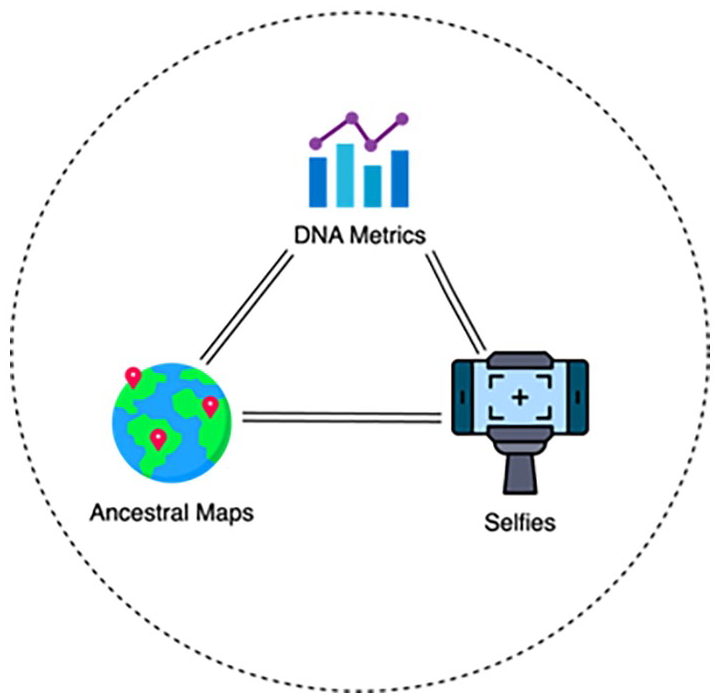
Trinity of ritualistic DTC GAT image sharing.
While the charts first quantified race and ethnicity vis-à-vis DNA test results, the ancestry maps shifted the focus from numbers—a one-dimensional representation of composition—to cubic and cartographic symbolism. The sense of space is usually necessitated by the assumption of movement and motion. Geographical and geospatial connotations, in this process, were elevated from the outlined shapes and continents. Spatial relations were emphasized because the ancestry maps were overlaid with the hotspots of ancestry spread in contours of different colors, implicitly implying the fluidity of ancestral groups’ migrant movements. Evoking geographical sensibility, the quantified race was appended to the racial meaning of the quantified DNA, eventually conjuring the “genographical” (Nash, 2015) project in such a ritual. Finally, selfies culminated in the creation of the spectacle as the final act of unification. Bodily visual representation, in this case, mostly human faces of the poster, brought one’s attention from unanimated objects like charts and maps to sentient and living beings: the biological traits like hair, nose, eyes, and skin color. Dovetailing with the idea of phrenology, new media revived this old racial science and further amplified this reverberation in the public echo chambers online. No more measurements of skull shape and sizes by physical anthropologists; social media digitalized voluntary craniometry. Thus, the trinity of symbols—pandering to the tenor of biologicalization of race and racialization of DNA—was sanctified in this ritualistic act and became relics. The racial relic draws attention and gaze.
Unified posting sequence
Extending on the idea of spatial relations in the ancestry map, the images themselves were oftentimes placed in a unified order. Multiple images, if shared within one post, would be presented as a slide show where each picture would be shown one by one. Charts full of terminologies, numbers, and bars appeared first as something arcane and mechanical; the style of expression in this stage was technical. Maps then slowly demystified the meaning behind the charts, adding geographical dimensions to this sense-making process. Eventually, the human face and body, evoking the spirits of phrenology, dispelled the mist of doubts and confusions, completing the audience’s cognitive process of race-making online. This was a renewal of the spirit of the consumption of the DTC GAT itself—the reveal of one’s face in the selfie was structured as a divine revelation from the ritual, breathing life into the seemingly uninteresting facts and numbers.
Ritualization of spectacle creation explains how three different symbols that otherwise do not neatly map onto one another are slipperily knitted together. The spectacle brought up in this process is mythical—not only were such acts performed unconsciously without a coordinated plan, but people also followed this ritual to create their version of the spectacle. The participatory nature of social media constantly fans the flames of the racialized genomics fever. Social media users, in such unconsciousness, were what Benjamin (2019) called the “unwitting constituents”; the participation by following the social media trends and online community norms in the spectacle eventually authorized the slippage to be wider and deeper, leading us to fall prey to the racist ideology.
The ritual’s mythical nature also glued the symbols together, akin to the idea of racecraft (Fields and Fields, 2012), in the sense that race is materialized in the superstitious belief of the biological dimension of race. It is the participatory nature of social media that facilitates race-making behaviors. When questions of how one could determine one’s racial and ethnic identities were posted online unchallenged, the answering from other users implicitly complied and conformed to such logic, lending weight to the formation of online racecraft. Furthermore, the symbolic interactions—such as upvotes and downvotes—sustained the vitality of DNA-racial talk online so that they never ran out of steam. When someone left a comment asking about your “Black DNA” (Figure 2), and such a comment got upvoted, the essentialized language was not only publicized for all others to further engage but also promoted to the front, prioritized.

A comment about “Black DNA.”
Unified idea of race and self
The most eye-catching feature of the spectacle is the selfie. Fascinating as it is, the self in such a process was unified with a race inferred from the GAT test. A selfie is a projection of the self in a digital format (Nguyen and Barbour, 2017). When one projected oneself in juxtaposition with DNA test results, what constituted that selfhood was to be latched onto what GAT results signify. On the one hand, the images of GAT test results were mapped onto one’s facial structure or bodily traits, and at the same time, one displayed their body to benchmark or match up the numbers and metrics in the charts (Figure 3). In addition, selfies, with their neoliberal individualist undertone as a social currency (Morelock and Narita, 2021), symbolically become the microcosm of the collective of ancestors. Such a unification resembles identity tourism, where one projects oneself as part of the ancestors, albeit the connection of ancestry and race is fuzzy, meandering along the maps provided by GAT. The ritual magically and mysteriously transformed data into the body, and at the same time, the body was channeled into metrics and maps. Complementary to each other, the union of self and the aloof but seductive idea of racial identities reflected each other in the dazzling shine of the spectacles.
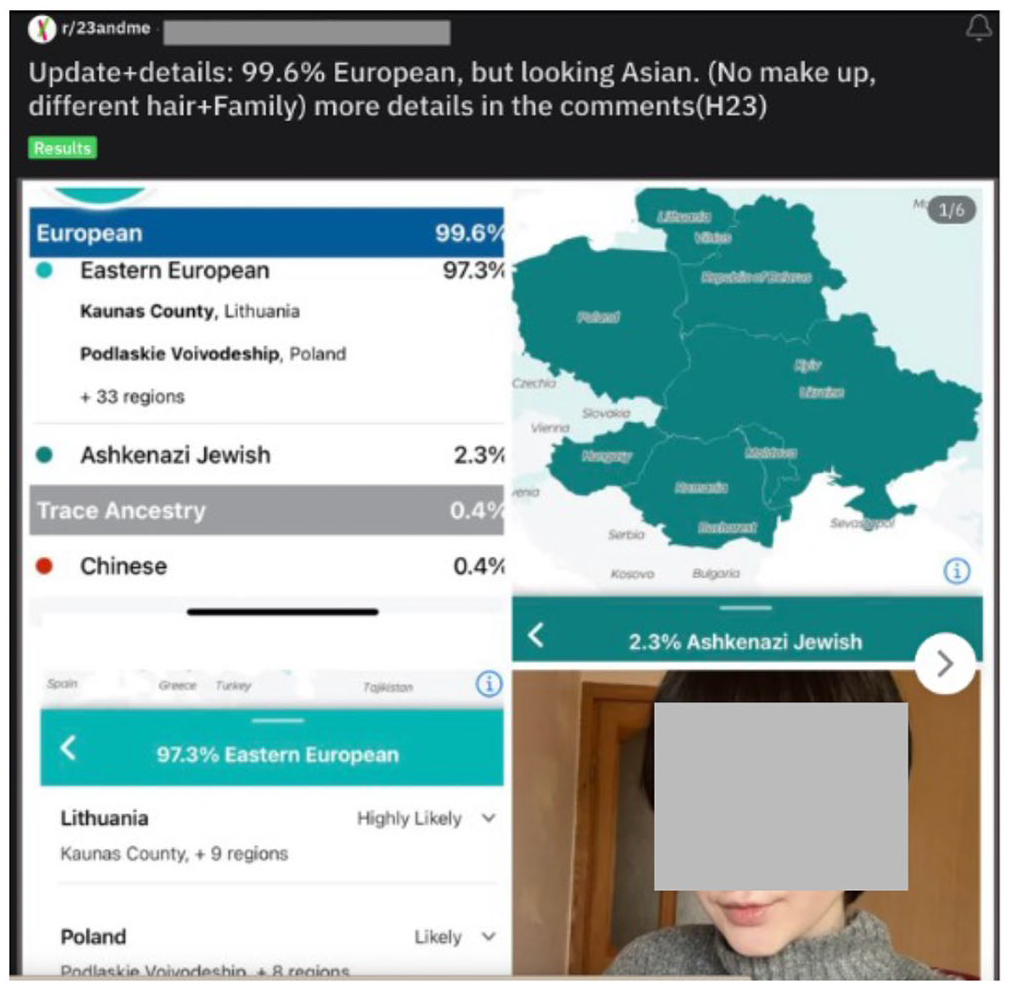
When face and DNA don’t match.
United audiences
Platformed on Reddit, the racial spectacle unifies an unwieldy amount of audience difficult to connect with in reality. The subreddit becomes a public for laymen who purchased DTC GAT; each post is an assembly where the personal genome becomes a public discourse through publicized interactions and socializations. Circling back to the theatricalization of selfies as social rituals of consumption (Jin Kwon and Kwon, 2014), all these visually explicit expressions in RPS are inherently invitations for the authentication of authenticity. They are by nature communicative, readily available for others’ consumption.
Marshaling public opinions, these discourses formed part of the effervescence that bubbled inside the “biodigital publics” (O’Riordan, 2013), generating not only publicity but also the spectacle’s influence of conformity and compliance. The collective practices brought together people who might not only be geographically distant but also socially and racially diverse. The spectacles coming out of the ritualist postings were the relics that attracted DNA believers to start their pilgrimage. Each comment was a digital amen to the credo that DNA is instrumental to their racial identity; each upvote was a virtual camera flash to make the spectacle more visible.
“What race would I be considered based on my DNA results?”: a spectacle that alters
PRS also alters; it distorts reality by creating “delusion and false consciousness.” (Debord, 1967: 24) The distortion of reality and the delusion of the unreal can be found in four ways. First, it enables the belief that race is countable and quantifiable, evident in the sharing of oddly precise ancestry compositions. It further alters the notion of race as outsource-worthy, showing from the questions of race validation, further projecting the notion of race as detachable and disposable. The third type of alteration reveals how the PRS transforms the understanding and perception of race as fragmented and commodified. The spectators, under the influence of the connectivity on social media platforms, are also altering their way of social interactions online—finally, the spectacle also reshapes human interactions and relationships.
Altering the perception of race as quantifiable and countable
The DTC GTA result is essentially one’s purported ancestry reported as numbers, more precisely, percentages. They constitute vehicles for inferring the objectivity of one’s race with numerical data (Putman and Cole, 2020). Race is thus datafied under the aegis of numerical equivalence. Such a numerical representation not only embalms old race science but also exposes its idiosyncrasy: a percentage is a normalization of raw data bounded by a maximum of 100. In this context, race is also tainted with the presumption of normalization that it can be sliced into neatly countable units, each digit assuming meaningful significance. Consequently, arithmetic operations become a natural response to one’s race, where race becomes additive, subtractable, multipliable, and dividable. In the current-day regime of big data, when data manipulation is commonplace, race is thus in peril of mutation and manipulation.
Ultimately, GAT results are just another biometrics. Biometrics is at the heart of scientific racism like phrenology, in which brain size, IQ, melanin, and other biological metrics undergird the making of a difference. Whenever one posted their GAT test results and asked what race they were if they were “60.4% White and 38.7% Mixed” (Figure 4), biological racism emerged, like a revenant, out of the ash of numeration, shrouded in the renewed cloak of advanced technology and science, making the end of biological racism now the new beginning of GAT in this racial spectacle’s smoke and mirrors.
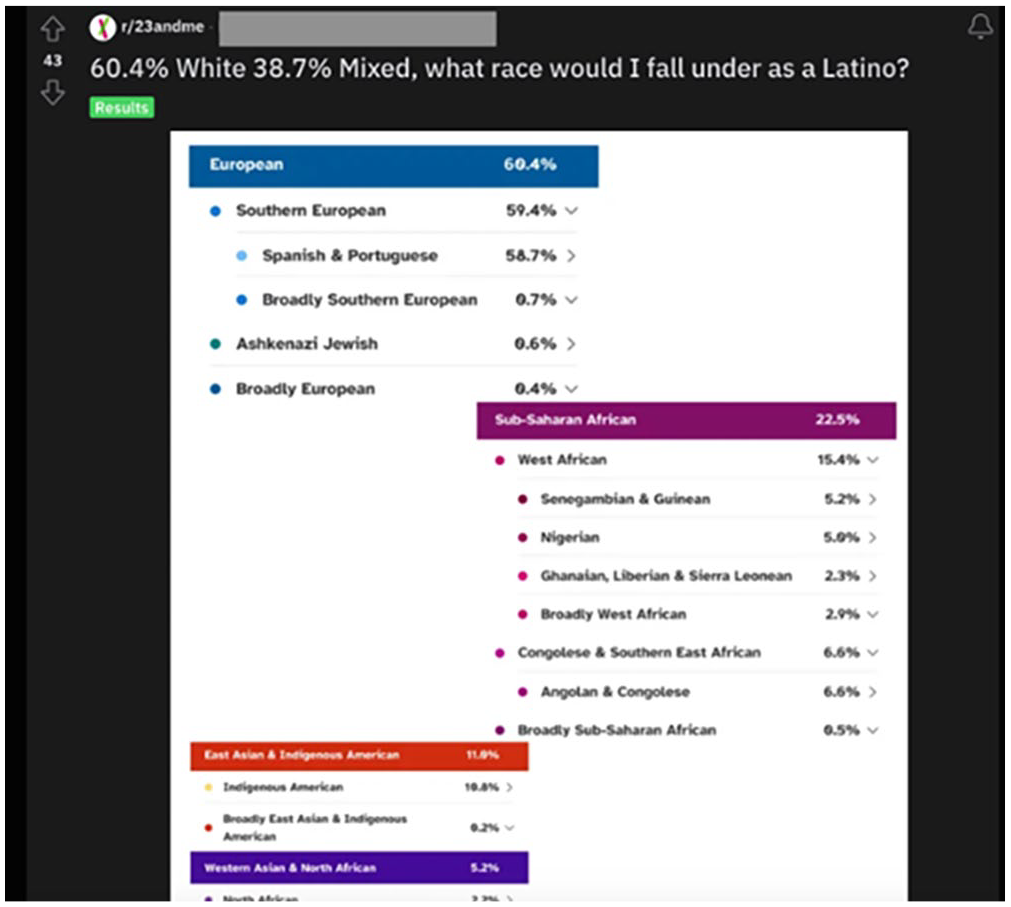
60.4% White Latino.
Such a posting shows that the lifecycle of these data does not just end at each customer; instead, they are further brought to the front stage of social media discussions for a secondary verification: community members are delegated with this task of race identification. The spectacle herein created not just delusions for one but more of a network of delusions that further merges as a matrix of simulation. Pertinent to what Thrift (2011) called “life inc.,” it broadens at best, ruptures at worst, the ontological imaginations for humanness by producing “calculable coordinates for descriptive regimes” (p. 9). If the coordinates of self were recalculated through DTC GAT services, the spectacle with a public visual display of GAT results then served as the map with new coordinates on the new horizon of life.
Altering the perception of race as outsourceable and disposable
The authoritative role of racial objectivity was also expanded into mass crowds on social media within this PRS. The alteration switched the logic from race as inborn and embodied to race as external and outsourced. The sharing of the DTC GAT results on social media is not just a display of publicity, but the question mark appended to every post sharing turns it into a participatory determinism of racial identity. Race is consensually understood as socially constructed, embedded in the racial structure coming from the totality of social relations (Bonilla-Silva, 2006). Racial socialization processes involve practices with our surrounding communities and families. However, when asking strangers online what their real race is, the communal and collective construction of race was sanitized. One was estranged from their community and lived experiences. Such alternation is perhaps the exemplar of the alienation effects of a spectacle where one is represented by others in a spectacle (Debord, 1967). Personal and racial identities were thus then what anonymous online strangers chose for a person, stripped out of one’s lived reality.
Outsourcing the question of racial identity, race was consequently perceived as something disposable. When people posted, “I am not as Native American” (Figure 5), what they unleashed online were images of “racial proofs” that served to negate their previous racial identification. The underlying assumption is one’s recognition that one’s past is droppable, detachable, and decouplable; the “old” self-identified racial identity was at stake. PRS’ reflection from image sharing has the potential to obscure one’s past lived experience in the previous race they had lived with.

“Not as Native Americans anymore.”
Altering the perception of race fragmented
While the spectacle unifies the racial symbolisms advertised by the GAT services—the charts, maps, and selfies—it ironically dismantles one’s perception of racial coherence, echoing a stark warning: “the unity of life can no longer be recovered” (Debord, 1967: 7). The usual sense-making of race is a continuity and continuum of lived experiences socializing with the in-group. The marginally relevant elements provided by DTC GAT and platformed on social media for collective race-making, however, now eclipsed such experiences. Such an experience summons a gulf in one’s subjective racial congruity: on one side lies an embodied racial identity nurtured through offline face-to-face experiences; on the other, a different racial narrative imposed by anonymous strangers online. One’s racial cognition is, therefore, fragmented into two, leaving the sense of self shattered and resistant to recovery.
Furthermore, online racial sense-making intensifies the inherent fragmentation of racial identities, especially for multiracial, multiethnic groups whose racial ambiguity never fits squarely within the box of prescribed racial norms in the United States. PRS does not simply fracture an imagined racial wholeness; it intensifies the fractures already embedded within the illusion of stable racial identities. Within PRS, haphazard comments replying to one’s question on race hardly reached a consensus (Figure 6); online race-making also provided too many racial options for users. The user, in turn, was bombarded with an assortment of answers from online strangers appointing their new race. The highly unstructured nature of social media comments—those answers are not normalized as in institutionalized racial categories in the Census—compounds confusion, creating entropy rather than clarity.

Replies to a post called “what race am I.”
Research supports the uneven impact of this fragmentation: self-identified multiracial individuals are not only more likely to take commercialized DNA tests (Roth and Ivemark, 2018) but also consequently adopt multiracial identities based on multi-ancestral results (Johfre et al., 2021). Other groups, however, might exhibit more agency, autonomy, and aspirations in such usage: Black GAT consumers, for example, as root-seekers, dispel “ancestral affiliation,” transcending biological to the biographical (Nelson, 2008).
Altering race as commodifiable
The spectacle is saturated with commodities, and PRS is no exception. It is not only the commodity of GAT being commercialized, striding into the market, and intruding into our sight, but also the fragmented, calculated, and commodified racial attributes. Race, reflecting through the prism of DTC GAT, was commodified, like a box of cereal—and was “packaged” like a box of cereal one could find in a grocery store, which has its nutrition labels, advertising packaging, and price tag. The commodity of GAT begets commodities of race (Figure 7).
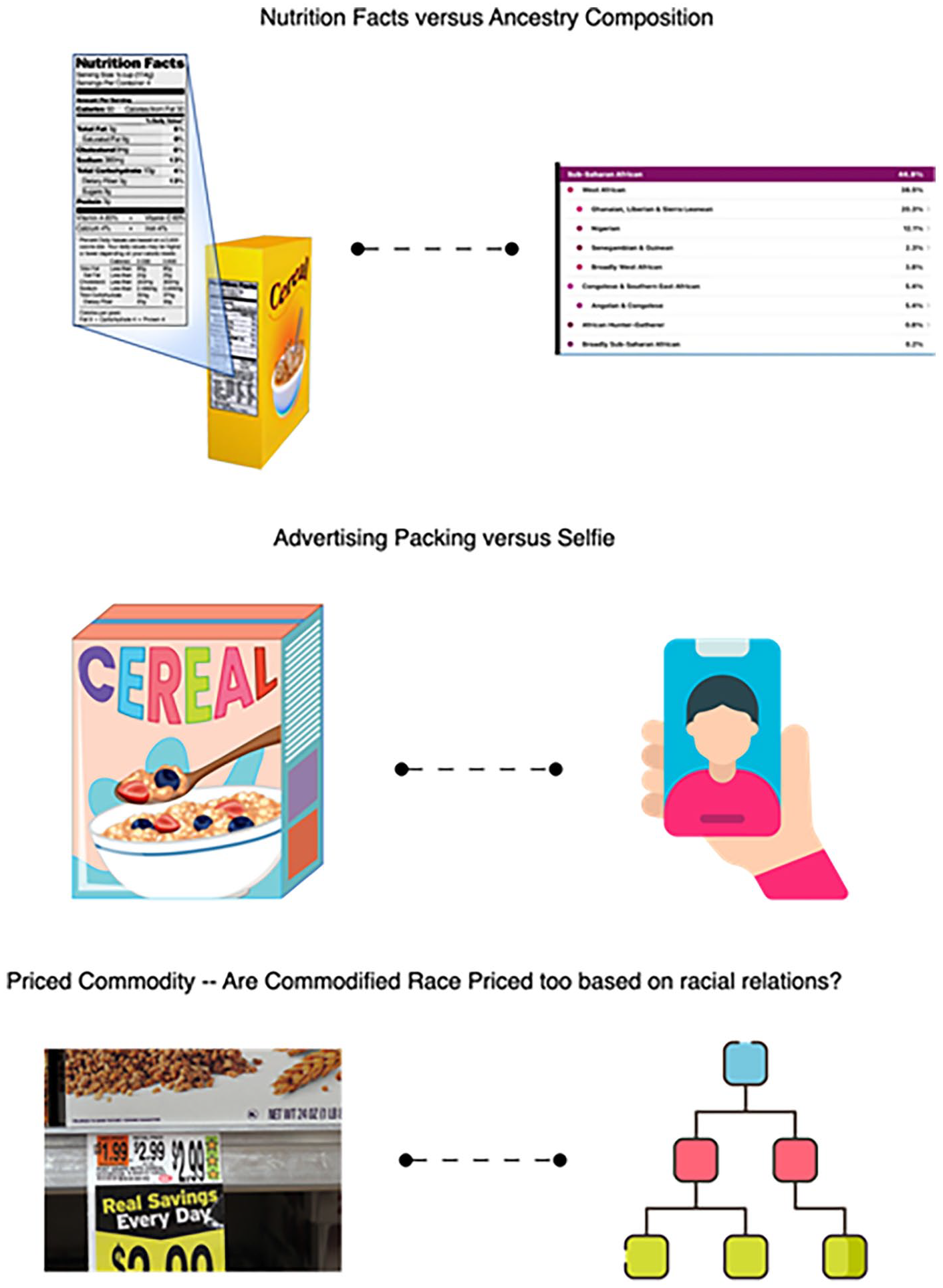
Commodification of race.
Race manifests itself in PRS as nutrition labels, where ethnic categories and their percentage compositions mirror nutritional breakdowns on food packaging. The same rhetoric of judging the value of a commodity was herein being rearticulated and regurgitated in the spectacular phenomenon on social media, evident when social media users lament “bland” ancestry results for being overwhelmingly European (Figure 8), resembling a user judging a box of cereal being too bland without any toppings. For these white testers, “blandness” is not merely an incidental adjective, but it exposes the critical underpinning of racial valuation. It is precisely the assignment of whiteness as bland that reinforces how whiteness oftentimes masks as invisible in spectacles (Dyer, 2013) or whiteness as a norm, a default background against which racial identities are comparatively measured (Benjamin, 2019).

“Boring” DNA test results of being too “European.”
If the DNA results chart functions as the nutritional label, then the selfie was akin to the advertisement of a commodity, the packaging of the box of cereal, designed to attract consumers’ attention. More than just an aesthetic ornament, the selfies also attracted and allured, functioning to captivate consumers’ attention. Swipe left or slide right, thirst for or disgusted by, tap to like, or scroll to ignore; the selfie is the spectacle that gives the visual thrill for others to see race—it makes race picturesque—racial imagery is ready to be consumed by the gaze of others.
A commodity on the shelf of a store is always priced, showing its market value. When race was commodified in PRS, it also came along with its “price tag.” While the price tag of a commodity is visible, the one for the commodified race in the spectacle could be camouflaged. The real price tag of commodified race is the racial relations and racial hierarchies. When one celebrated their findings of the race in these image-sharing posts, they were celebrating the “ingredients” of their commodified race—the racial traits on the nutrition-label-alike ancestry charts—and implicitly prizing certain racial traits. Under the disguise of DNA charts, the exoticization of one’s identity as the ethnic composition is rejoiced and ruminated. The sentiments, pouring from line to line in their posts and emanating on their selfie faces, were thereby a public value assessment for the commodified race.
Altering the mode of online social interactions
One should not be surprised when commodified racial signs snuck into the interactions of online users. The DNA charts transport the technical, scientific, and arcane code of haplotype groups into the everyday communicative terrain, transforming them into a linguistic currency for online interactions on r/23andMe. GAT jargon has become the lingua franca: casual exchanges like “What is your haplotype group?” epitomize the reality of the mode of interaction produced in the unreal mirage of PRS. Under this communicative mode, one sought to bond with others online through the simplistic and quantified racial attribute in the commodified racial product. The pervasion of this coded language was nothing but the triumph of commodity fetishism—the PRS created such fervor that users eagerly traded commodified racial indicators as conversational tokens.
The sharing of ancestry maps possesses racialization effects on space. Uploading maps from offline realities into online arenas bridges online space and offline territories, bringing mapping’s encoded racial meaning to the online world. While the maps racialize global geography, embedding deeply problematic racial logic into the supposedly objective geographical visuals, Reddit morphs into a distinctly racialized digital territory—a digital space defined and governed by racial and ethnic imaginaries from these images. When racial meanings embedded in maps were present in the digital world, every online user engaging in such acts was liable for its pathologizing touch. This is evident in the users’ linguistic metamorphosis.
“You look white. What is your haplotype group?”—facial structure and somatic signs presented in the selfies were further integrated into the textual communication online, enabled by the affordances of multimedia communication on social media. The corporeal dimension of race—the bodily traits read from the selfies—was interrogated and further benchmarked with the haplotype group codes. While race is fundamentally ocular, the use of selfies risks reducing race as physical without social construction. Selfies, combined with the genetic code of haplotypes, are prominent markers for online racial talk, becoming agents that dangerously re-biologize race within digital interactions.
Discussions and conclusions: resist or rearticulate?
The disentanglement of the PRS revealed how the entanglements of the real and the unreal are fortified through the design of the digital platform for visuality, the sociality of users’ online interactions, and the norm of Internet culture for authenticity and self-inquiry. Tiptoeing around the dangerous minefields of biological racism, race datafication, and other racial disillusions, social media users are victims of DTC GAT services’ misleading promotions and, unconsciously, perpetrators of such misconceptions. It evinces a circuitous pathway where offline and online, and creators and consumers, are messily and eclectically combined.
My conceptualization of PRS can be repackaged into scholarship in multiple registers. For digital media scholars, PRS urges a re-examination of the assumed stability of users’ racial identity on social media. While the racialized nature of social media is no stranger to the field, prior research often emphasizes algorithmic bias or overt racism (Senft and Noble, 2013). PRS, however, shows the innocuous racialization process instigated by the very consumers who suffered from the alteration effects. Such an online performance of race, instead, also deviates from previous scholarship positioning digital race-making as empowering or amplifying the user’s racial identity—we see much of the fragmentation and commodification in a destabilized fashion. Echoing Faucher’s (2018) critical stance on the manipulative nature of social media spectacle, PRS compels us to confront digital platforms as inherently racialized, orchestrating identity and community interactions through calculated affordances and visual allures.
Second, PRS also dismantles the illusion that digital spaces offer liberation from traditional racial logic. Instead, it illustrates how these platforms serve as fertile grounds for intensifying racialization, where visual culture and interactive rituals systematically encode and amplify entrenched racial ideologies (Noble, 2014). While the social construction of race has been widely accepted in race studies (Omi and Winant, 2014), ours introduces new dimensions for the traditional model of identity formation: anonymous online strangers replace familiar in-group peers, genetic languages displace lived experiences, and collective digital negotiations overshadow internalized racial socialization. This phenomenon is a self-negotiation of race at the very least, and it could be a collective racial formation at the largest scale.
Finally, PRS ventures into the underexplored territory of troubling synergy between digital media, racial identity politics, and genetic commodification, urging critical vigilance in unpacking the role of visuality in race-making in the digitally mediated world. The visual representations—DNA charts, ancestry maps, and personal images—are actively participating in producing and validating racial authenticity. Specifically, selfies have not been brought into conversations regarding genetic race, to the best of my knowledge. While previous research on maps touches on the visual aspects of such genetic racialization processes (Nash, 2015), PRS uniquely foregrounds the human body through selfies, explicitly connecting geneticized racial narratives to corporeal visual representations.
Whereas this paper explored PRS through the lens of DTC GAT, the concept is also promising for broader applicability. The subreddit r/23andme is not the only site that witnessed the fortification of PRS; other multimedia platforms, such as TikTok and Instagram, could be fruitful PRS research sites to examine sensationalized racial “revelation” videos. PRS could be used to examine other racialized spectacles mediated by digital media without direct intentions on racial discourses. Selfies also abound in other subreddits or social media; one example with profuse visuality is the r/amiugly and other selfie-sharing communities, where users voluntarily and strategically craft their visual digital self-representation. Such an online spectacle, though directly engaging with individualized attractiveness, possesses many racial meanings. PRS could also serve as a versatile tool in the theoretical arsenal in this context, capable of examining the unifying and altering effects of race and its imbrications with beauty standards. PRS could be applied in other contexts for interrogating the strategic commodification of racial identities by influencers and organizations on platforms like Instagram and TikTok, or how digital media platforms spectacle-driven political debates. Circling back to the start of this paper, PRS could be used to examine everyday people’s public discussions about Kamala Harris’ racial identity on social media. Other quotidian discourses on racial passing and authenticity demonstrate the continuous cultural significance and analytical power of PRS.
Insomuch as the PRS is problematized and criticized in my analysis, I also aim to initiate the discussion on what we can do with it. As the spectators were continuously bombarded with images and entranced by the spectacles unfolding before them, critics have depicted them as relatively passive; spectators are assumed to conform and comply. This is the epilogue of the original spectacle theory—the spectacle is something that we should recognize and resist, and eventually, we can rebuild sincere and transparent human connections. However, is the destruction of spectacle the only way out? We might imagine new possibilities outside the resisting narratives but on how we can reorganize them or redirect them toward new ends, as potential avenues for alterity and resistance in popular culture (Shugart and Waggoner, 2005).
Several works have pointed out the possibility of counter-spectacles (Woodworth, 2015), contrary to the pessimism stamped in the Debordian lineage of theory. Still using images, a counter-spectacle could be the appropriation of media to challenge and counter the dominant narratives, narrating alternative purposes for their usage (Woodworth, 2015). Instead of evading spectacles, social media could platform counter-spectacles that defy dominant racial structures and disenchant racial myths. Perhaps we could embrace the affordances of social media to jump over the hurdles of spectacles with a dash of elegance.
Footnotes
Acknowledgements
I thank Prof. Meredith D. Clark (University of North Carolina, Chapel Hill) for providing important conceptual and editing feedback on the early draft of the paper and Prof. Brooke Foucault Welles (Northeastern University) for providing useful comments on the draft.
Author contributions statement
Yukun Yang: Conceptualization, Methodology, Investigation, Formal analysis, Data Curation, Writing—Original Draft, Writing—Review & Editing.
Data availability statement
The data is publicly available from the Pushshift data dump.
Funding
The author received no financial support for the research, authorship, and/or publication of this article.
Ethical considerations
Formally, this research does not meet the criteria for human-subjects research since I did not contact and will not re-identify subjects, and the data are publicly available. I am, nonetheless, cautious about the issues around privacy, concerning that the publicized data contains selfies and DNA information, which is contentiously personal and owned by the users. As a theoretical work, I chose to intentionally abstract the online sharing behavior without directly referencing any specific users and the images or selfies they shared online. In general, I deliberately avoided any disclosure of Redditor’s IDs and other identifying information as much as possible.

Author biography
Yukun Yang is a Ph.D. student at Northeastern University. He is interested in the collective and communicative practices on social media and how these acts uphold or challenge the dominant narrative, power hierarchy, and hegemonic ideologies. He specifically focuses on discourses about race and racism online.