



Abstract
What drives a genuine sense of community in online spaces? This study examines the role of governance, autonomy, and control in fostering a sense of community online. Findings show that participatory governance and peer-enforced social norms are crucial for creating a strong sense of community, even after controlling for active, frequent community engagement. In contrast, merely enforcing rules through formal control mechanisms does not significantly enhance community strength. Inclusive governance also helps mitigate challenges posed by larger community sizes, supporting a strong sense of community at scale. However, the interaction between participatory governance and social control reveals a complex tension, where high member involvement may dilute the positive effects of peer-enforced norms. These insights underscore the necessity of a balanced, configurational governance approach, integrating both participatory processes and social control to bolster community cohesion. This study offers a more nuanced understanding of how online governance shapes community belonging and provides practical guidelines for designing more inclusive and cohesive digital spaces.
Keywords
Introduction
A sense of community is essential in distinguishing true communities from mere groups of individuals, encompassing influence, relatedness, need fulfillment, and emotional connection (McMillan and Chavis, 1986). The Internet has expanded this notion, giving rise to online communities that unite individuals around shared interests, goals, values, or needs. Previous work has provided evidence for the sense of community experienced in online contexts, demonstrating its essential role in fostering engaged, cohesive, and sustainable collectives (Blanchard and Markus, 2004). This importance is heightened by the alarming levels of decline in social connections (Bruce et al., 2019), and in traditional community engagement (Putnam, 2000), as online spaces compensate for the erosion of physical communities (Mitchell, 1995; van Dijck and Poell, 2015) and offer new modalities for social interaction and engagement (Bulat et al., 2024).
Research across various online platforms highlighted the factors fostering a sense of community online (Blanchard and Markus, 2004; Chen et al., 2013; Kairam et al., 2022; Naranjo-Zolotov et al., 2019; Trinkenreich et al., 2023). However, this body of work predominantly focuses on social interactions, assuming a horizontal social organization within communities, neglecting the role of governance-level engagement. Consequently, it remains unclear how different governance processes, such as participatory rule-making, formal or social control, interact to foster a sense of virtual community (SoVC). But, engagement in governance is important for online community experience (Kiesler et al., 2011; Kollock and Smith, 1996), and substantial involvement in governance can significantly impact the sense of community experienced online.
Foundational work on SoVC suggested that influence, one of the four core dimensions of sense of community, was minimal or non-existent in virtual settings (Blanchard, 2008; Blanchard and Markus, 2004). However, in the original theoretical framework, McMillan and Chavis (1986) conceptualized influence within physical communities as a bidirectional process, where “the influence of a member on the community and the influence of the community on a member occur concurrently” (p. 12), and sometimes indirectly, through power dynamics. From this perspective, community governance can be seen as a source of influence within online communities, where established rules, norms, and the processes through which they are formed and enforced shape member behavior. In return, members can also affect the community, by participating in its governance.
Over the last decade, the literature on online governance has made substantial strides in examining the role of moderation and governance practices across diverse platforms (Frey et al., 2022; Ivaturi and Chua, 2019; Kiesler et al., 2011; Matias, 2019; Seering et al., 2019). Though, significant limitations remain regarding how these elements interact to foster or undermine community cohesion. The diversity across platforms complicates efforts to define and measure governance (Weld, 2024), while the tendency to focus on a single dimension of governance, be it formal rules, informal norms, or moderation practices, fails to capture their interconnected nature. Additionally, previous work on online governance often measures community success in terms of audience size, engagement levels, or activity metrics (Cunha et al., 2019), overlooking nuanced psychological outcomes. Such metrics are important but do not provide a full picture of community well-being. Therefore, research has yet to adequately and systematically explore how governance structures affect the psychological well-being of community members.
To address these gaps, the current study bridges the literature on online governance and the sense of virtual community, by exploring how different governance mechanisms affect SoVC. Drawing on broader theories of commons governance (Janssen and Ostrom, 2006; Ostrom, 1990), collective action (Olson, 1971), self-determination (Deci and Ryan, 2000), and organizational control (Eisenhardt, 1985; Ouchi and Price, 1978), while integrating perspectives from Human Computer Interaction, Information Systems Management and Computer Supported Cooperative Work, this study argues that the way a community is managed and the degree and types of control exercised can impact the overall community experience, from the enforcement of rules and norms to the participation of members in regulatory processes.
Results show that social control, characterized by horizontal, peer-based norm enforcement, is the strongest predictor of SoVC, while hierarchical formal control exerts no significant influence. Findings also reveal that participatory governance positively affects SoVC, suggesting that democratic participation in decision-making enhance community cohesion in online spaces. In addition, there is a complex interplay between participatory governance and social control, where high levels of member involvement in governance diminish the effectiveness of peer-based normative control. Furthermore, community size and governance styles interact, with participatory governance mitigating the challenges of scaling community engagement in large groups.
By unraveling the relationship between participatory governance, formal and social forms of control, and the SoVC, findings challenge long-existing assumptions and offer new perspectives into online engagement. As such, this research contributes to a deeper understanding of online community dynamics, providing researchers, policymakers, community managers, and platform designers with evidence-based strategies for building vibrant, inclusive communities.
Literature review
A sense of community refers to the feelings of connectedness and belonging that individuals experience within a group (McMillan, 2011; McMillan and Chavis, 1986; Sarason, 1974). It includes dimensions of membership, influence, need fulfillment, and shared emotional bonds (McMillan and Chavis, 1986) involving meaningful connections, a perception of being valued, and a willingness to contribute to the collective well-being. In the literature, a sense of community is viewed as a sign of a healthy community (Chavis and Wandersman, 1990; Talò et al., 2014) and essential for successful cooperation (DeCaro et al., 2021). It enhances individuals’ satisfaction and commitment to their communities (Burroughs and Eby, 1998) and increases their motivation to continue participating (Chavis and Wandersman, 1990). Evidence suggests that a sense of community can also exist online (Blanchard and Markus, 2004; Koh et al., 2003). Just like their offline counterparts, not all virtual groups can instill this feeling among their members (Blanchard and Markus, 2004), but when they do, it seems to make a difference.
Online communities
Before the Internet, a community referred to territorial or relational social structures (Gusfield, 1975; McMillan and Chavis, 1986), bounded mostly by geographic limitations. Though there were a few notable exceptions such as fandom communities, which, as Jenkins (1988) and Obst et al. (2002) observed, often transcended physical boundaries through fanzines, or conventions. The advent of digital technologies democratized community formation, allowing anyone from any location to connect online and participate in a community. Today, the virtual space contains a multitude of online communities hosting millions of users on a daily basis, bound not by proximity, but by shared interests, goals, or values (Blanchard and Markus, 2004; Lazar and Preece, 2002). Online communities can be “slippery to define and tricky to measure” (Lazar and Preece, 2002: 3). But they can be described as collectives of individuals, who interact over digital means, around a common goal, interest, or need (Preece, 2000). Despite varying definitions, most online communities rely on continuous member engagement and contributions (Butler, 2001; Kollock and Smith, 1996), and the sense of community is essential for their sustainability (Preece, 2001).
SoVC
The sense of community experienced online has been explored in a number of studies across different settings. Foundational work by Blanchard and Markus (Blanchard, 2008, 2011; Blanchard and Markus, 2004) suggested that participants’ experiences mirrored those in physical communities but with limited individual influence. Emphasizing the roles of support exchange, identity development, and trust, the authors suggested an alternative process, where the exchange of support and identity creation both contribute to norm establishment, which influences the strength of SoVC (Blanchard, 2008; Welbourne et al., 2009), ultimately leading to trust (Blanchard et al., 2011; Ellonen et al., 2007). However, previous work primarily focused on social/individual influence and overlooked potential institutional influences, that is, participation in governance. Moreover, there was a lack of distinction between implicit norms and explicit, established rules, and the different types of control that can be exerted through these mechanisms were not fully explored.
Highlighting the importance of SoVC for community success, others have explored system-level factors, and how they influenced behaviors such as usage and involvement. For instance, Zhang (2009) found that information quality predicted SoVC on social networking platforms, which affected continued usage through user satisfaction. Similarly, Chen and Lin (2014) found that both system quality and information quality were positively linked with SoVC. Mamonov et al. (2016) reported that SoVC significantly influenced information consumption and contribution on Facebook, negatively affecting exit intentions. Others further explored how different engagement patterns affect SoVC. Tonteri et al. (2011) found that both active and passive participation positively impacted SoVC. Li and Chen (2022) observed that public and private interactions positively influenced SoVC in a Chinese interest-based community. In live-streaming communities like Twitch, Kairam et al. (2022) identified chat volume, tenure, and peripheral participation as significant predictors of SoVC. He et al. (2023) found that viewer interactions with broadcasters and other viewers on Twitch enhanced SoVC, increasing engagement.
While highlighting SoVC as a crucial ingredient for community success, previous work on the sense of community heavily emphasizes social interactions as the primary source of community influence, neglecting governance-level factors. Part of this lack of attention could be attributed to the long-standing view of online groups as horizontal collectives of individuals with rather fluid or leaderless structures (Castells, 2010; Shirky, 2008). This was indeed the case for the early days of the Internet (Chesebro, 1985; Hiltz and Turoff, 1978; Kerr, 1986). But as a growing number of recent work on online governance and moderation work shows, the Internet evolved, and so too did the nature and scale of online communities. Previous work has also often been constrained by limited sample sizes, typically focusing on a single community or a small number of participants, restricting their generalizability (Gallagher and Savage, 2013). These methodological limitations can lead to biased results, preventing comparisons of different governance practices across communities, which is important to understand the relationship between online governance and SoVC.
Online governance, autonomy, and control
Online communities thrive on quality interactions and continuous engagement, which necessitates some form of governance (Grimmelmann, 2015; Kiesler et al., 2011). Governance and control are fundamental concepts in the functioning of any organization (Sitkin et al., 2010), as they regulate behaviors and ensure collective goals are achieved. Rooted in organizational theory, control can be conceptualized as a dyadic relationship between a source and a target, where the former shapes the behaviors of the latter to align with the identified goals and needs (Ellickson, 1987; Jaworski, 1988; Ouchi and Price, 1978). Control can be broadly categorized as formal or informal, each playing an important role in organizational stability (Kirsch, 1997). Formal control refers to explicit rules, policies, and guidelines enforced by individuals with authority, while informal control involves unwritten norms and peer influence that govern behaviors horizontally (Ouchi, 1979). Traditional perspectives highlight that control mechanisms rarely operate in isolation; instead, it is the combination of control strategies that influence individual commitment levels (Ouchi, 1979). More recent work provides evidence for this configurational approach to control (Cardinal et al., 2010), showing that formal and informal control modes often complement each other, evolving based on organizational goals and needs (Jaworski et al., 1993; Kirsch, 1997; Kreutzer et al., 2016).
This configurational approach to governance and the distinction between formal and informal control aligns with governance mechanisms explored by Nobel laureate Elinor Ostrom (1990, 1999) in her research on resource management and commons governance. Ostrom also highlighted that successful governance systems rely on a configuration of elements depending on their unique goals and local needs (Janssen and Ostrom, 2006). These elements include clearly defined boundaries, locally adapted rules, monitoring systems, sanctions, and participatory decision-making (Ostrom, 1990). Importantly, Ostrom and colleagues emphasized that rules do not need to be formalized; both written formal rules and unwritten informal norms can shape behavior, and configurations of these governance elements should be dynamic to meet the evolving needs of the community (Janssen and Ostrom, 2006).
While Ostrom’s principles of commons governance were originally developed in the context of managing natural resources, the core insights have proven relevant far beyond physical settings (Frey et al., 2019; Kollock and Smith, 1996). In many ways, online communities increasingly mirror the dynamics of traditional commons, where shared digital spaces are collectively managed by community members. Early work on online communities suggested that rules, roles, norms, and participatory decision-making are essential for managing shared resources as these communities grow in complexity (Kiesler et al., 2011; Ren et al., 2012). Today, platforms like Facebook Groups, Reddit, Wikipedia, Twitch, and Discord increasingly depend on self-governance facilitated by volunteer moderators (Seering, 2020; Seering et al., 2022). Across different platforms, governance involves a combination of community management (establishing rules and processes, facilitating discussions), content moderation (removing posts that violate rules), and user moderation (sanctioning, banning, or silencing disruptive users) (Matias, 2019; Seering et al., 2019; Srinivasan et al., 2019).
The diversity of governance structures in online communities reflects the varied needs and purposes of these digital spaces. Their governance configurations vary significantly depending on the platform and the community’s specific objectives (Weld, 2024). Recent work has focused on two dominant aspects of online governance: the practices of moderators and the role of rules or norms in shaping behaviors. However, most of the work focuses on only one of these elements, leaving a gap in understanding how formal, informal, and participatory governance mechanisms interact and impact the sense of community. Moreover, many studies use rules and norms interchangeably when discussing governance online (Chandrasekharan et al., 2018; Fiesler and Bruckman, 2019; Frey et al., 2022; Jiang et al., 2019; Kiene et al., 2016). Though these are distinct means of control, with different sources, processes, and implications. Overall, more work is needed that takes an integrated approach to online governance and its relationship to the sense of community experienced online.
This study addresses these gaps by examining three key governance mechanisms: participatory governance, formal control, and social control within online communities. It explores how these institutional features relate to SoVC, using a representative sample of US Internet users who identify as members of online communities. Employing a measurement tool validated in both online and offline contexts across cultures, this study bridges the gap between the sense of community and online governance literature, to demonstrate that active involvement in community governance is important for fostering a sense of community online.
Current study
Despite the emphasis on leadership, governance, and participation in traditional perspectives (Kollock and Smith, 1996; Lazar and Preece, 2002; McMillan and Chavis, 1986; Ostrom, 1998), early work on SoVC had suggested that virtual groups differ from their offline counterparts in terms of influence, which was found to be weaker or non-existent (Blanchard, 2008; Blanchard and Markus, 2004). However, much of the literature at the time was focused on early online communities that did in fact lack formal governance (i.e. usenet and listserv). Today, online governance structures are diverse and vary across platforms (Frey and Schneider, 2023). And this study argues that the way a community is governed and the degree of control exercised can profoundly influence the quality of interactions, thereby affecting the SoVC experienced.
Governance processes
Control mechanisms such as rules and norms are needed in every community to ensure stability, and the substance of these rules, along with their creation and enforcement are critical in shaping the community experience (Butler et al., 2008; Kiesler et al., 2011; Ren et al., 2012; Shen and Khalifa, 2013). The extent to which community members participate in rule-making processes should carry a lot of weight for building cohesion, but the role of governance in shaping the SoVC can be rather multifaceted and complex. McMillan and Chavis (1986) highlight how power, control, and influence are crucial for community cohesion in physical settings, noting that member influence is key to any community’s appeal. However, this influence need not be limited to social interactions; member influence can also occur at the governance level. For instance, communities with a participatory governance structure are more adept at empowering their members and meeting their needs (Dosono and Semaan, 2019; Seering et al., 2017; Shen and Khalifa, 2013; Thach et al., 2022). Prior studies highlight the importance of policies and leadership that incorporate member input for successful communities (Frey et al., 2019; Kollock and Smith, 1996; Ostrom, 1998; Schneider et al., 2021; Seering et al., 2019; Strimling and Frey, 2020). Though, pluralist approaches to governance may also have their downsides in the online context.
Emotional safety is traditionally considered an important aspect of sense of community (McMillan and Chavis, 1986), but it can be threatened by online anonymity. Participatory governance promotes open debate in decision-making, which could also lead to a large number of competing viewpoints and disruptive behaviors, causing challenges (Gilbert, 2020; Juneja et al., 2020; Schöpke-Gonzalez et al., 2022; Squirrell, 2019). The openness in discussion may inadvertently facilitate the spread of harmful content (Massanari, 2017; Topinka, 2018), which may explain why some community leaders avoid democratic governance (Bulat et al., 2024; Weld et al., 2022). Previous work shows that participatory governance can reduce feelings of belonging and institutional acceptance among community moderators (Bulat et al., 2024). Such dynamics underscore the challenges of managing pluralistic online spaces effectively (Chakraborti et al., 2022; Frey et al., 2022; Frey and Schneider, 2023), where centralized governance may offer distinct advantages (Ho and Huang, 2009; McEwan and Gutwin, 2017).
The literature presents conflicting viewpoints on how community governance might affect members’ SoVC. Previous work explored factors such as perceptions of group norms (Blanchard, 2008), being sanctioned or sanctioning others (Blanchard et al., 2011), leader involvement in community activities (Ho and Huang, 2009) and leader withdrawal (McEwan and Gutwin, 2017). But it is still not clear how different forms of community governance, such as participatory governance or centralized governance, might affect members’ SoVC. Therefore, the question:
Research Question 1 (RQ1). How does participatory governance relate to SoVC?
Formal control
Whether participatory or centralized, any type of governance structure rests on a foundation of authority, granted by rules that limit and regulate behaviors (Gilliland and Manning, 2002). The traditional view in organizational control theory makes a distinction about how behaviors are regulated through different mechanisms (Kirsch, 1997; Ouchi, 1979). In this view, formal control refers to official tools that objectively guide behavior (i.e. written rules, procedures, and policies), and involves monitoring the extent to which individuals follow these practices (Eisenhardt, 1985; Kreutzer et al., 2016; Ouchi, 1979). Social control, on the other hand, refers to unofficial, unwritten, unobjective standards that arise from social interactions and guide behavior through socialization (Eisenhardt, 1985; Kreutzer et al., 2016; Ouchi, 1979).
Traditionally, rigid enforcement mechanisms are believed to negatively impact group cohesion (Deci and Ryan, 2000; Harrison and St. John, 1996; Markus et al., 2000; Thompson, 2005; Zuckerman et al., 1978). Previous work shows that sanctions or other disciplinary actions can lead to conflicts online, increasing feelings of frustration and burnout among moderators (Dosono and Semaan, 2019; Schöpke-Gonzalez et al., 2022; Squirrell, 2019). In a bulletin board for parents, Blanchard (2011) found that being sanctioned, or sanctioning others might decrease SoVC and called for additional research. But authors used a measuring tool that was not established in prior research, and neither specified the source of sanction (i.e. formal rules or informal norms) or the role of the sanctioning agent (i.e. moderator or peer) in their measuring items, which could affect the outcome.
The key difference between formal and informal control lies in their source; formal control is rule-based and hierarchically enforced by a legitimate authority, with immediate consequences for deviations (Gilliland and Manning, 2002). Community control measures like user bans or post removals often fall under formal control (Gilbert, 2020; Jhaver et al., 2019). Recent work on formal control shows that it can play an important role in managing tensions (Skousen et al., 2019), and positively influence performance (Ahlfänger et al., 2022). Clear and consistent rule enforcement from community leaders can also increase an individual’s perceived procedural fairness, which enhances rule compliance (Kiesler et al., 2011; Walters and Bolger, 2019), and cooperation (Tyler and Degoey, 1995). Therefore, it is predicted:
Hypothesis 1a (H1a). There is a positive significant relationship between formal control and SoVC.
One factor that could impact this relationship is the extent to which community members participate in rule-making processes. Aside from being inclusive, actively participating in shaping the direction and policies of the community could lead individuals to perceive the procedure as legitimate, which enhances compliance and cooperation with the group (DeCaro et al., 2021; Ryan and Deci, 2006). Transparency in governance promotes greater internalization, while the lack of it can cause skepticism or hostility (Kiesler et al., 2011; Lazar and Preece, 2002). A pluralist approach would also ensure that rules are reflective of collective interests (Weibel, 2007), further solidifying cohesion. Effectiveness of formal control in enhancing SoVC might therefore be contingent upon the involvement of community members in rule-making processes that lays the foundation for that control to be exercised. Therefore it is predicted:
Hypothesis 1b (H1b). The interaction between formal control and participatory governance will be significant and positive.
Social control
Different scholars refer to informal, horizontal control by various terms (Cardinal et al., 2010), including social control (Markus et al., 2000; O’Reilly and Chatman, 1996), clan control (Eisenhardt, 1985; Ouchi, 1979), community control (Gossett and Tompkins, 2000), peer control (De Jong et al., 2014), and concertive control (Barker, 1993; Tompkins and Cheney, 1985). The common theme in this framework is horizontal processes observed in organizational settings (Barker, 1993). The emphasis is on social connections and implicit normative standards (Tompkins and Cheney, 1985). While early work on SoVC suggests that peer influence is weaker in online settings compared to physical communities (Blanchard et al., 2011), recent work shows that horizontal enforcement of behavioral standards among peers can enhance SoVC (Gibbs et al., 2019). Though this study examined a single community that is characterized by its homogeneity, longevity, and tight relationships between members (Gibbs et al., 2019), while their model did not include other governance mechanisms (i.e. formal control, or participatory governance), which might affect findings. To build on this work and test the generalizability of authors’ findings across different settings, it is predicted:
Hypothesis 2a (H2a). There is a positive significant relationship between social control and SoVC.
The effectiveness of peer-based control on SoVC may also depend on the extent of member participation in governance processes. Traditional perspectives highlight the importance of mutually developed values and norms for effective control in groups with high autonomy (Barker, 1993; Ouchi and Price, 1978; Tompkins and Cheney, 1985). Participation in governance can also enhance the legitimacy and internalization of norms (Ryan and Deci, 2006), leading to greater compliance and positively impacting SoVC. This strengthens the alignment of individual and collective values, fostering a sense of collective identity, which is crucial for peer-based control. Therefore, it is predicted:
Hypothesis 2b (H2b). The interaction between social control and participatory governance will be significant and positive.
Community size and participatory governance
All communities rely on continuous user engagement, and the size of a community is important for their survival (Kraut and Resnick, 2012). It is therefore considered as an indicator of community success and employed as a success metric (Cunha et al., 2019; Kairam et al., 2012; Tan, 2018). But previous work presents a nuanced view on the impact of community size. While increased size leads to more resources and higher benefits for individuals, it can also make it more difficult for members to receive them (Butler, 2001; Kollock and Smith, 1996; Ren et al., 2012). Previous work highlights the challenges larger communities face, such as reduced personal interaction, unequal participation, and informational overload, which leads to low retention and high turnover (Butler, 2001; Cunha et al., 2019; Kollock and Smith, 1996; Panek et al., 2018; Ren et al., 2012). These findings suggest that as communities grow, the intensity of individual connections and sense of belonging diminish. In this light, it is predicted:
Hypothesis 3a (H3a). There is a significant negative relationship between community size and SoVC.
It could also be the case that the extent to which members participate in rule-making processes mitigates the negative impact of increasing size on SoVC. Specifically, while larger communities might experience challenges, effective governance can potentially counteract these issues. The question is, which approach would constitute an effective form of governance? On one hand, in large communities where governance encourages member participation, the dilution of SoVC could potentially be lessened (Kollock and Smith, 1996; Lazar and Preece, 2002), making members feel more connected and engaged despite the increase in size. On the other hand, a centralized governance approach could be especially beneficial for larger communities, balancing the need for member input with community harmony and stability.
Previous work indicates that larger community size can harm cohesion (Graddy and Wang, 2009), though its impact on the sense of community remains uncertain (Anderson, 2010). In contrast to their physical counterparts, online communities lower participation barriers, making engagement less costly (Boulianne, 2015), which can enhance participation. Furthermore, online communities can leverage technology to implement participatory governance at scale, using modern tools such as polls, forums, and real-time feedback systems (Auray, 2012; Goldberg and Schär, 2023; Zhang et al., 2020). These features can help maintain a sense of belonging by ensuring members feel heard and valued, regardless of the community size. Thus, it is hypothesized:
Hypothesis 3b (H3b). The interaction between community size and participatory governance will be significant and positive.
Methods
To investigate the proposed relationships we administered an online survey via Qualtrics to a demographically representative sample of US Internet users, totaling 4800 participants. Participants were recruited through Qualtrics survey panels, and were informed that the study aimed to explore Internet user’s online experiences. All participants were required to provide their consent before taking the survey. After excluding responses due to attention check failures, rapid completion, or lack of community membership, our refined sample consisted of 1080 individuals who identified themselves as members of an online community.
The average participant age was 40, with 52% aged between 18 and 44 (n = 561). Majority identified as female (70%, n = 753), with some or more college education (81.3%, n = 878). Most participants reported membership of either an interest-based community (24.8%, n = 267), a local neighborhood community (21.8%, n = 235), a professional community (20.5%, n = 221), or a support community that focus on health or individual well-being (19.4%, n = 209), and almost half of these communities were reported to have more than 500 participants (45%, n = 485). Most participants visited their communities a few times a week (22.2%, n = 240), spent an hour or less per visit (83.4%, n = 901) and had been members for over 2 years (47.9%, n = 517).
Measures
Construct items were measured with 7-point Likert-type scales that ranged from “strongly disagree” to “strongly agree” unless otherwise indicated. All measures were taken from prior literature, with slight adaptations as needed to emphasize the online community context (Appendix 1).
Our dependent variable, SoVC is defined as the extent to which users identify with an online community and feel a sense of belonging and togetherness (González-Anta et al., 2021). We measured this construct with eight items from the “Brief Sense of Community Scale” developed by Peterson et al. (2008) and validated in a number of community contexts (Cocco et al., 2024; Hilvert-Bruce et al., 2018; Mamonov et al., 2016; Peñarroja et al., 2019; Poor, 2014) (⍺ = 0.894, M = 4.64, SD = 1.14).
To identify the governance process, the respondents were asked to choose the option that best describes the procedure used to make community rules (Seering et al., 2019). Items ranged from most hierarchical, to most democratic (e.g. “Moderators work with the entire group of community members to enact new rules,” M = 2.93, SD = 1.42).
Formal control can be defined as the extent to which an online community has established mechanisms for monitoring rule compliance and for addressing rule violations, which may involve warnings, sanctions, or bans, based on explicit guidelines (Jaworski, 1988; Ouchi, 1979). Three items were used to measure formal control, slightly adapted to emphasize the online context (e.g. “Moderators actively monitor the extent to which other members follow the established rules and policies,” ⍺ = 0.852, M = 4.94, SD = 1.38).
Social control refers to the extent of horizontal peer regulation within a group, based on shared values and informal norms among members (Barker, 1993; Ellickson, 1987). We adopted four items from previous work to measure this construct (Lindblad et al., 2013; Wright and Barker, 2000) (e.g. “If a member uses abusive language or makes offensive comments, other members typically intervene,” ⍺ = 0.811, M = 4.14, SD = 1.04).
We also controlled for several constructs shown to be associated with SoVC in previous work, such as community participation, active engagement, social connectedness of the community and the number of strong ties. To address the previous gaps in the literature in terms of measuring participation (Malinen, 2015), and to capture community participation as accurately as possible, we measured the intensity, length and frequency of use separately. To measure frequency we asked participants how often they visited the community, answers ranging from “less than once a month” (1) to “more than 3 times a day” (7) (M = 4.52, SD = 1.87). To measure intensity, we asked participants how much time they spent in their community on average per visit, answers ranged from “less than 15 minutes” (1) to “more than 5 hours” (7) (M = 2.44, SD = 1.25). And to measure the length of use, we asked participants how long they have been members, with answers ranging from “less than six months” (1) to “more than five years” (5) (M = 3.09, SD = 1.65).
When measuring engagement, we made a distinction between active and passive forms of engagement to control for both (Tonteri et al., 2011). Active engagement was measured with two items: “I often post and share content in this community” and “I often like or comment on other’s posts and shares” (M = 4.36, SD = 1.45). Passive engagement was measured with three items (e.g. “I rarely interact with others in the community,” “I often browse the shared content but don’t share anything myself”) (M = 3.17, SD = 1.30). To measure community connectedness, we asked participants to select all the mediums through which they socialize with other members (i.e. in-person, sms/phone calls, social media, instant messaging applications, gaming platforms, or other). The responses were then combined into an index (M = 1.55, SD = 0.98). Finally, we controlled for the number of strong ties, by asking the number of people participants consider friends (M = 3.51, SD = 1.61).
Results
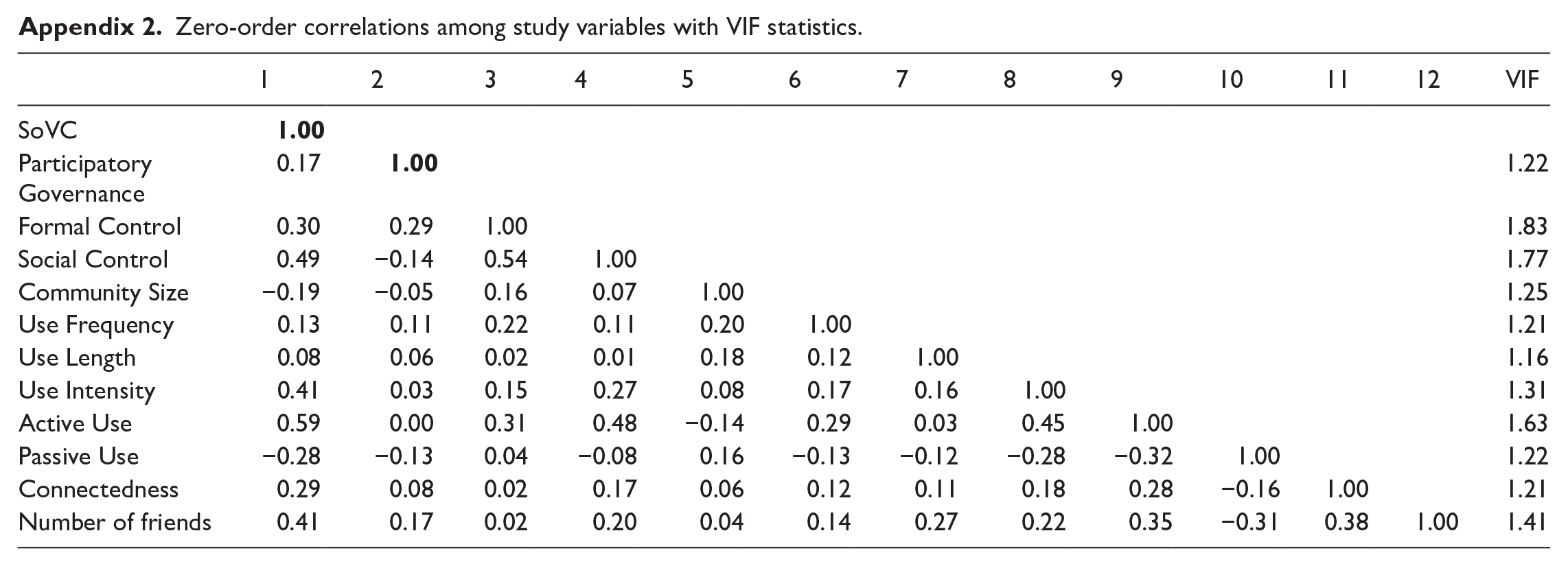
A hierarchical regression analysis was conducted to examine the relationship between participatory governance, formal and social control, community size and SoVC. All predictors were mean-centered before the analysis. We checked for multicollinearity between variables by examining their zero-order correlations and VIF statistics (Appendix 2). The accompanying statistics were all found to be acceptable (VIF < 5), indicating limited collinearity (Akinwande et al., 2015).
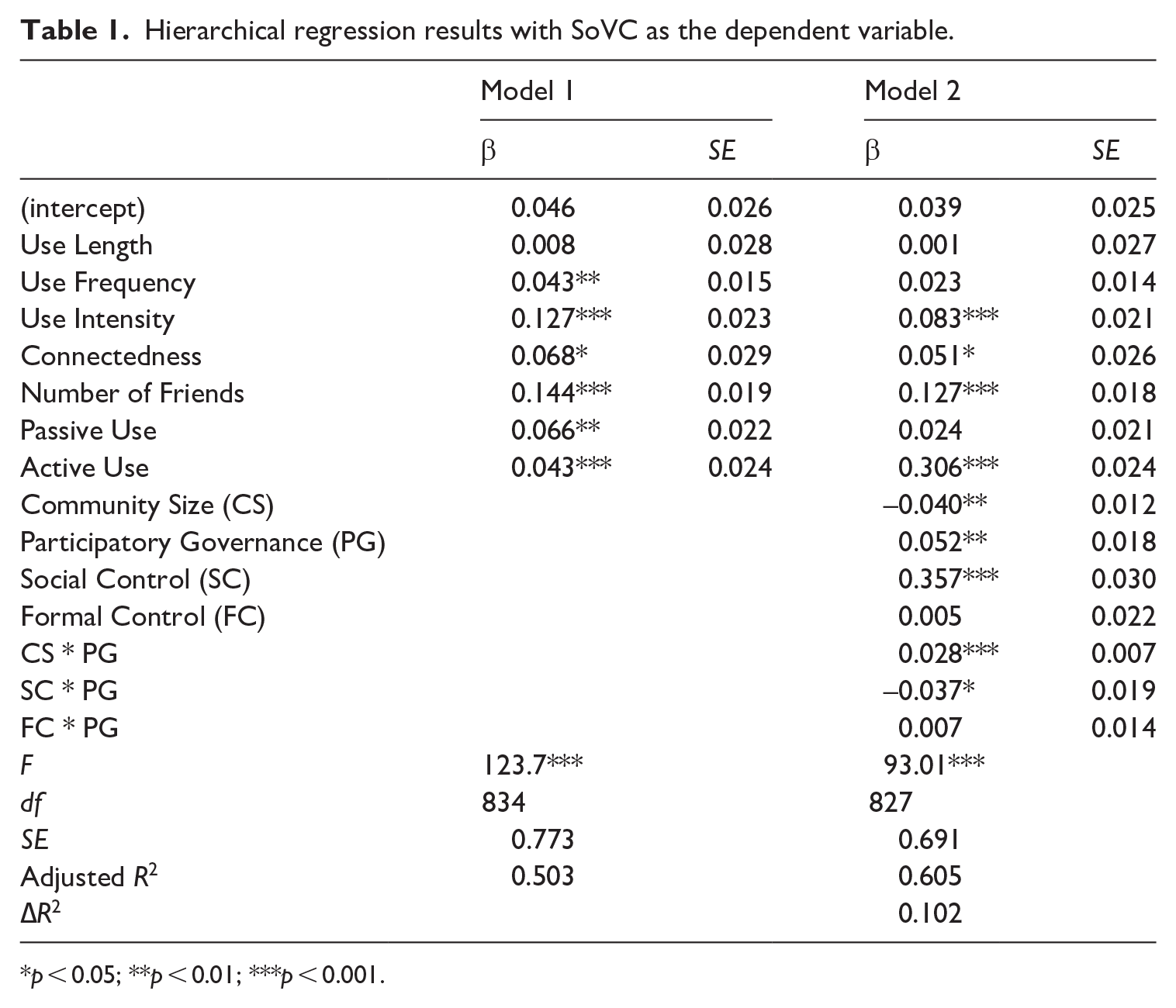
Results showed that, after controlling for use frequency, length, and intensity, together with active use, passive use, community connectedness and number of friends, SoVC is significantly associated with participatory governance, social control and community size, F(14, 827) = 93.01, p < 0.001, R2= 0.605. Compared to the baseline model that only includes control variables, the full model explained an additional 10.2% of the variance resulting in a total of 60% explained variance in SoVC (Table 1).
Hierarchical regression results with SoVC as the dependent variable.
p < 0.05; **p < 0.01; ***p < 0.001.
Results show that both the level of participatory governance (β = 0.052, p = 0.0049) and social control (β = 0.357, p < 0.001) have significant positive correlations with SoVC, independently. This suggests that communities that employ participatory governance can enhance the sense of community among their members. In addition, communities that employ social control, where actions are horizontally regulated through peer-interactions, can significantly enhance the sense of community among their members, supporting H2a. The negative interaction between participatory governance and social control (β = −0.037, p = 0.005) is an intriguing finding, rejecting H2b. This suggests that while both factors may independently strengthen SoVC, their combined influence may not be so straightforward and decrease cohesion among members.
Results also show a significantly negative relationship between community size and SoVC (β = −0.044, p < 0.001), suggesting that as communities grow in size, it becomes more challenging to maintain SoVC. H3a is therefore supported. In addition, we found the interaction between participatory governance and community size to be significantly positive (β = 0.026, p < 0.001), suggesting that inclusive approaches can mitigate some of the negative impacts of larger populations on the sense of community experienced online. H3b is supported.
Among the control variables, self-reported time spent in the community (β = 0.088, p < 0.001), community connectedness (β = 0.052, p = 0.048), number of friends (β = 0.126, p < 0.001), and active use (β = 0.306, p < 0.001) all positively predicted SoVC. The more time individuals spent with the community, the more they actively engaged and the stronger the relationships they form within it, the stronger was their sense of community. We found no significant associations between formal control and SoVC. Similarly, the remaining control variables, such as the length of membership, frequency of participation, or passive use did not exert a significant influence on SoVC.
Discussion
This study explored the complex interplay between different community governance modes and their relationship to sense of community experienced online. Findings reveal a nuanced landscape where governance can significantly shape perceptions of community cohesion. Participatory governance, social control and community size emerged as significant variables influencing SoVC, highlighting their important roles in shaping online community dynamics and member engagement. Moreover, the interaction effects between community size and participatory governance, as well as between participatory governance and social control, provided further insight into the complex governance dynamics at play in online communities.
Participatory processes, characterized by member involvement in shared decision-making, exhibited a significantly positive relationship with SoVC. The statistical effect size indicates that participation adds about 16% of the effect of active community involvement to participants’ sense of community. This finding not only supports the foundational framework of a sense of community as theorized by McMillan and Chavis (1986) but also expands earlier applications of this framework to online settings (Blanchard and Markus, 2004).
Notably, social control emerged as the most robust predictor of SoVC, underscoring the critical role of peer-enforced behavioral standards in fostering community unity. This supports and extends earlier findings from Gibbs et al. (2019), emphasizing the significant influence of horizontally enforced behavioral standards among members. The result highlights the primacy of shared values and peer enforcement in shaping community cohesion (Ryan and Deci, 2006), overshadowing more formal, structured forms of governance.
A surprising finding was the negative interaction between participatory governance and social control on SoVC, indicating that in communities with high participatory governance, the influence of peer-based control may be diminished. This finding contradicts earlier theories (Deci and Ryan, 1985; Gossett and Tompkins, 2000; Olson, 1971; Ostrom, 1990; Ouchi, 1979), implying a potential conflict between democratic engagement and peer enforced social norms. In physical organizations, social control emerges among self-managing groups where individuals have significant autonomy, facilitating the development of shared norms and values (Barker, 1993; Ostrom, 1990; Ouchi, 1979; Ryan and Deci, 2006). Study findings add nuance to this perspective, suggesting that too much emphasis on participatory processes might dilute the impact of peer-enforced social norms in online contexts, which is traditionally viewed as fundamental to maintaining community standards and cohesion.
Another interesting insight was that formal control mechanisms did not have any influence on SoVC, even when members participated in establishing the rules themselves, indicating that mere rule enforcement may not automatically translate into a stronger sense of community. This contrasts with previous work on SoVC that considered the role of sanctions and found negative associations (Blanchard et al., 2011). The finding also challenges prevalent assumptions in online governance literature (Frey and Sumner, 2019; Hwang and Shaw, 2022; Schweik, 2005), which often emphasizes the importance of formal rules and structured governance for community success. Moreover, it contradicts earlier theorizing on governance and autonomy (Ostrom, 1990; Ryan and Deci, 2006), which suggests that individuals’ engagement in rule-making processes may lead to higher motivation and satisfaction. Results suggest that this may not be the case for hierarchically enforced formal control in online contexts.
The study further uncovered that while community size and SoVC negatively correlate, which aligns with earlier research on online communities (Butler, 2001; Panek et al., 2018), the interaction between community size and participatory governance positively influences SoVC, suggesting that democratic governance can mitigate some of the challenges posed by larger audiences. This insight extends earlier work, by providing evidence that through strategic, inclusive governance practices, the negative impacts of scaling size on community ties can potentially be addressed, providing a practical approach for sustaining community cohesion as online platforms grow.
This study also controlled for the length, frequency, and intensity of engagement, revealing that only the intensity of community engagement significantly predicted SoVC, suggesting that the quality of interactions within the community is more crucial than the frequency or duration of participation. We also examined the effects of active and passive use separately. The significant positive effect of active use on SoVC highlights the critical role of active participation in fostering a sense of belonging and engagement, contrasting some earlier findings (Gibbs et al., 2019). In addition, the fact that passive use did not show a significant effect suggests that, in contrast to previous work (Edelmann, 2013; Gibbs et al., 2019; Tonteri et al., 2011), merely consuming content without active contribution may not be sufficient to enhance individuals’ sense of community.
Overall, findings highlight the complex nature of governance in online communities and underscore the importance of balancing different governance approaches based on local needs. By emphasizing the importance of a balanced, configurational approach to governance, findings suggest that the strategic design of governance structures and peer enforcement of norms can significantly shape the sense of belonging online, irrespective of community size. The nuanced interplay revealed by the findings offers valuable insights for all stakeholders seeking to enhance community cohesion and member satisfaction online.
Limitations and future work
This study’s cross-sectional design and reliance on self-reported data limit its ability to infer causality. Longitudinal studies could help determine causality and assess the stability of community outcomes over time. Furthermore, self-reports may introduce biases like social desirability, while using objective trace data could validate these insights and uncover additional patterns. In addition, this study did not account for the influence of platform affordances or individual motivations, which can significantly shape user experiences and therefore perceptions of the community. Future work could consider replicating this study in other contexts, across different platforms, which could help determine how context-specific factors, such as community type or topic, influence the effectiveness and outcomes of governance mechanisms. Future research should also consider the implications of emerging technologies, such as AI-driven bot moderation, which actively shape interaction dynamics and could significantly influence governance outcomes and SoVC. These technologies introduce new variables into the equation as online communities continue to grow and evolve, and they will likely play a critical role in shaping online governance dynamics.
Conclusion
This study highlights the significant impact of governance on the sense of virtual community experienced online. Findings reveal that member-driven decision-making and peer-enforced social control significantly enhance SoVC, above and beyond the effects of continued, active participation. However, a notable complexity arises with high levels of member involvement in decision-making potentially diminishing the effectiveness of peer-enforced control. In contrast, formal rule enforcement appears insufficient on its own to foster strong community bonds. Moreover, inclusive governance practices show promise in overcoming the challenges of larger community sizes, promoting cohesion, even in expansive online networks. These findings emphasize the need for a localized, configurational approach to governance in online communities, leveraging participatory processes and social control to enhance community cohesion and user engagement. Results offer important guidance for researchers, policymakers, community managers, and platform designers in developing effective online spaces. Future research should continue to explore these dynamics across different contexts to advance our understanding of effective governance approaches in online communities.
Footnotes
Appendix
Zero-order correlations among study variables with VIF statistics.
| 1 | 2 | 3 | 4 | 5 | 6 | 7 | 8 | 9 | 10 | 11 | 12 | VIF | |
|---|---|---|---|---|---|---|---|---|---|---|---|---|---|
| SoVC |
|
||||||||||||
| Participatory Governance | 0.17 |
|
1.22 | ||||||||||
| Formal Control | 0.30 | 0.29 | 1.00 | 1.83 | |||||||||
| Social Control | 0.49 | −0.14 | 0.54 | 1.00 | 1.77 | ||||||||
| Community Size | −0.19 | −0.05 | 0.16 | 0.07 | 1.00 | 1.25 | |||||||
| Use Frequency | 0.13 | 0.11 | 0.22 | 0.11 | 0.20 | 1.00 | 1.21 | ||||||
| Use Length | 0.08 | 0.06 | 0.02 | 0.01 | 0.18 | 0.12 | 1.00 | 1.16 | |||||
| Use Intensity | 0.41 | 0.03 | 0.15 | 0.27 | 0.08 | 0.17 | 0.16 | 1.00 | 1.31 | ||||
| Active Use | 0.59 | 0.00 | 0.31 | 0.48 | −0.14 | 0.29 | 0.03 | 0.45 | 1.00 | 1.63 | |||
| Passive Use | −0.28 | −0.13 | 0.04 | −0.08 | 0.16 | −0.13 | −0.12 | −0.28 | −0.32 | 1.00 | 1.22 | ||
| Connectedness | 0.29 | 0.08 | 0.02 | 0.17 | 0.06 | 0.12 | 0.11 | 0.18 | 0.28 | −0.16 | 1.00 | 1.21 | |
| Number of friends | 0.41 | 0.17 | 0.02 | 0.20 | 0.04 | 0.14 | 0.27 | 0.22 | 0.35 | −0.31 | 0.38 | 1.00 | 1.41 |
Funding
The author(s) received no financial support for the research, authorship, and/or publication of this article.
