




Abstract
Live video is often used by protesters and political activists while broadcasting from conflict arenas since it gives the viewers a sense of “how it feels to be here.” This qualitative study suggests that digital “broadcast” technologies such as livestreaming can construct new forms of place-bound media events which intertwine “liveness” and “emplacement.” The article examines 97 Facebook Live videos uploaded during the May 2021 escalation of the Israeli–Palestinian conflict from varied sites of struggle and detects three main practices among live streamers: constructing “on-location” presence, performing sensuous place-making, and producing connectivity. It proposes the concept of “networked emplacement”: a combination of social media connectivity with streamers’ techniques of embodied presence that “emplaces” viewers in a rolling event with political significance.
Keywords
Introduction
“Remember! This is how the war began!” announces an invisible woman as she points at the armed soldiers standing in front of her. We see her reach her hand forward as she holds the smartphone with her other hand, guiding us through an inflamed, protesting crowd as she films: “This is a live broadcast of how the war began! Share this video!”
The above describes a segment of a Facebook Live video titled “In Sheikh-Jarrah,” uploaded by an Israeli peace activist protesting against the eviction of Palestinian residents from the East Jerusalem neighborhood in May 2021. The video brings together time and place, compressing controversy, violence, and urgency and spreading them across the network. The time is now since the live video broadcasts what is happening at the moment. The place is here, right in front of you, the Facebook user. But the depicted place is also a place of conflict where forces align against each other, borders and boundaries are negotiated, and an explosion might occur at any time.
This article focuses on emplacement as a central phenomenon in livestreaming of political protest and conflict and proposes the concept of “networked emplacement” to explain how streamers combine techniques of embodied presence with the connectivity and urgency of social media to “emplace” viewers in a rolling event with political importance. Both emplacement and liveness are bound by digital media’s interactive responsiveness and constructed through human perception. Emplacement is the constitution of a place in human perception, including its cultural and social context, usually achieved by the sensing body (Casey, 1993). Liveness, which refers to the broadcasting of an event as it happens, does not, according to Auslander (2008) “inhere in a technological artifact, but is the result of our perception, engagement with it and our willingness to bring it into full presence for ourselves” (p. 102).
The concept of networked emplacement offers a new digital version of media events (Dayan and Katz, 1994), where the institutional festive and formal broadcast is replaced by a user-generated, subjective, and urgent call for action. As one of the streamers in my study declared, “This is what they won’t show you on TV!” This article draws on theories of mobile studies (Farman, 2020; Pink and Hjorth, 2012) and media witnessing (Mortensen, 2015; Pantti, 2013) to argue that live videos harness collective involvement and “raw” physicality, emplacing the viewer through the videographer’s embodied presence, voice, and ideology.
This article examines live videos from arenas of political struggle filmed by mobile phone cameras and uploaded to Facebook during the 2021 escalation in the Israeli–Palestinian conflict. This was not the first time Israel and Hamas battled or, as we all know, the last. However, this case was distinctive in the significant levels of aggression and violence within Israel in cities with substantial Jewish and Muslim populations, such as Lod, Acre, and Jerusalem, as well as in contested neighborhoods, such as Jaffa and Sheikh Jarrah. The riots included violence and casualties on both sides. Consequently, these conflict zones attracted organized protests by both left-wing and right-wing groups. The current focus on live videos in the context of the Israeli–Palestinian and internal Israeli conflicts was chosen to exemplify networked emplacement by marking the relevance of “place” to digitally mediated political struggles. The concept of networked emplacement and the streamers’ related practices may also apply to other conflicts.
I begin by discussing emplacement and liveness in the digital context, the implementations of smartphone camera use, and the interactive interface of live videos on social media. I then present the study design with the use of place names as keywords for forming the corpus and the theory-led analytical framework. The findings represent three main tactics used by Facebook Live political streamers: constructing “on-location” presence, performing sensuous place-making, and producing connectivity. Networked emplacement is proposed as a political digital practice that utilizes common technology, such as the smartphone camera, to mediate space and time and engage others in a subjective embodied experience.
Theoretical framework
Emplacement and digital media
Beyond their geographical definition or political attribution, places gather together experiences, histories, languages, thoughts, and animate and inanimate entities (Casey, 1996; Mitias, 2019). The perception of how a place looks, feels, or smells is performed through our bodies, and the perception of where we are is always relative to our bodies; for example, we perceive this as “here” and that as “there” (Mitias, 2019). But our perception is also affected by the places we inhabit as “we are ineluctably place-bound” (Casey, 1996: 19). Hence, the perception of place is as primary as the perception of ourselves, meaning that the perception of our body is fundamentally cultural and social. Each place we encounter is a gathering of space and time, of other places we have been to, and of social and cultural assumptions we might correlate with the place, simply because we perceive it through our own experience. Emplacement is constituted by the interplay between body (including self-identity) and place: the relations between them determine whether one feels “in-place” or “out-of-place.” Indeed, “understanding embodiment as emplacement encourages us not only to reconsider the value of our places but also to intentionally reorder our place and placements” (Mitias, 2019: 308).
Real-time broadcast media, such as radio and television, may play a role in how we perceive our emplacement, since they bring together our immediate location with the locations depicted in broadcast media. While Casey (1993) argues that full emplacement needs to be supported by the body and, thus, audio-visual media cannot truly emplace viewers, work by other phenomenologists, such as Merleau-Ponty (1968) and, later, Roald (2015), suggests that a sense of presence can be achieved by merely looking at works of art. Furthermore, media scholars have argued that electronic media has redefined time and space, creating novel emplacements (Moores, 2003; Scannell, 1996). Scannell (1996) asserts that media cause a “doubling of place,” namely, the broadcasted event happens in two places: where it is physically occurring and being filmed and where it is being watched. Viewers feel as if they are in their immediate surroundings but at the same time transferred, present in a remote happening. Katz and Dayan (1985) refer to an interesting aspect of media events, which they call the experience of “not being there”: the experience lived through television is often more engrossing than it would be if the viewer was at the site of the event. It should be noted that Scannell and Katz and Dayan were writing about produced programs or ceremonial, planned occasions in which the viewers can only be audiences and not active participants.
The Internet, social media, and mobile devices are interactive media which add more aspects of user engagement with emplacement. According to Farman (2020), while mobile technologies infuse physical locations with social media, the latter also produce the digital interface itself as a location for interactions in which embodiment is an essential component. Pink and Hjorth (2012) consider the mobile phone camera an interface where material and digital realities meet. They propose thinking of mobile camera images as lived experiences and thus emplaced rather than as mere “nodes in the network” (Pink and Hjorth, 2012: 150). Recent research on digital place-making has revealed the prominent role of online video. People use the mobile camera to “take place”; that is, to embody their presence and claim their rights to exist in a place (e.g. refugees’ videos in Labayen and Gutierrez (2021)); to share their deep connections to places (e.g. in “Airbnb experiences” during COVID-19 in Norum and Polson (2021)) or to generalize and even hide their location while connecting through digital media (Hardley and Richardson, 2021). Thus, emplacement as a matter of perception and embodied practice has become more layered yet no less tangible in the context of digital networks and social media video.
Livestreaming on social media further enhances digital emplacement because of its heightened interactivity and unpredictability. The interface affordances of live video, mainly the synchronous broadcast, view-counter, and real-time comments, create a collective viewing experience and a sense of being “a part of” the happening (Van Es, 2016). As a result, activists use live videos in arenas of political conflict to engage viewers with their struggles (Fang, 2023; Gerbaudo, 2017; Martini, 2018). This article suggests that streamers intentionally construct a perception of time and space for viewers. They mediate their emplacement by sharing their thoughts and feelings, letting viewers know when they feel “in-place” or “out-of-place,” but also by giving viewers a sense of how the place feels and what streamers can perceive through their senses (while the smartphone camera acts as an audio-visual proxy for the photographer’s body). In addition, the sense of liveness embedded in live video enhances the feeling of collective viewing (even belonging) and the sense of presence.
Emplacement and liveness
Liveness refers, essentially, to synchronically broadcasting an event as it happens, even though it is not a technical condition but a matter of perception. Therefore, liveness is also used to refer to a live broadcast of a soap-opera episode or a pre-recorded concert (Auslander, 2008; Bourdon, 2000). Couldry (2004) indicates more conceptual aspects of liveness. First, through a live broadcast, an individual gains access to something broader and worth attending to now and not later. Second, the live broadcast gathers a representative social group (including large scales, such as the nation), which was intentionally chosen by the broadcaster. Mobile media has created “group liveness,” in which mobile members of a social group are connected continuously and interactively to each other through digital technology (Couldry, 2004).
Social media have expanded the concept of liveness, since they have the power to attribute a sense of “freshness” and urgency which people share (Lupinacci, 2024). While the constantly updating “real-time” media stream is not synchronous (posts are not presented or read the moment they are uploaded), it is nevertheless associated with liveness (Lupinacci, 2024; Van Es, 2016). The temporality of the items as they are pushed into the ongoing flow of new content in the news feed creates a sense of a living, populated domain in which something big might happen anytime (Lupinacci, 2021). Facebook Live videos are, however, truly live in that they stream synchronically with physical reality, allowing viewers to comment as the event rolls, and amplifying real-time sensations in the process.
The relationship between social media liveness and real-time live broadcast has also shifted society’s perception of “live events.” Mobile and digital technologies have changed the way we perceive an event, ascribing continuous, aggregative, bottom-up characteristics to it (Frosh and Pinchevski, 2018). Disruptive media events, such as terror attacks or natural disasters, gain significant attention and are depicted through multiple angles, since in digital reality, anyone with a mobile camera and network connection can go live, disrupt the constant flow of data, and gain users’ attention (Valaskivi et al., 2022).
Foregrounding social media as a key player in hybrid disruptive media events, Valaskivi et al. (2022) have suggested that affect, amplification, and acceleration might explain how “belonging” is ritually created by the mediation of sudden violent events. Indeed, whether the videos were planned cultural events or spontaneous political displays, Facebook Live videos evoke feelings of pertinence among viewers and encourage discussion (Haimson and Tang, 2017; Martini, 2018).
Activists’ use of live video to mediate emplacement through embodiment, excitement, and presence also extends previous thinking about media witnessing. Live streams give viewers a sense of immediacy and a chance to observe an event that nobody else has witnessed or an already famous event from a different angle than that broadcasted on TV (Haimson and Tang, 2017). In addition, live videos are perceived by viewers as rich and authentic experiences (Zelenkauskaite and Loring-Albright, 2022), intensify and quicken affective impacts and establish a relationship between the viewers and transmitted events (Golan and Martini, 2019). As Mortensen (2015) argues, by using social media, videographers assume the role of witnessing, as the event unfolds and the mobile phone camera records. Mortensen suggests the term “connective witnessing” to describe the contemporary witnessing mode in which the footage recorded on-site is shared online, making the witness’ testimony a form of political participation meant to be experienced by a wide collective.
In addition to the mediation of the witness’ presence and participation, the mobile phone camera registers and signals the witness’ physicality. Videographers use their body to move the camera around, exposing the closest thing that can be seen through their eyes and occasionally inserting a limb into the frame or turning the camera on themselves (Pantti, 2013). Since phone live streams are aesthetically distinct from professional photography, citizen media testimonies create proximity, identification, and a sense of being there among viewers, especially when recorded from within a crowd (Pantti, 2013). Yet, they also reflect a chaotic, fragmented, and unconstructed narrative, which might complicate how viewers understand and engage with the event (Pantti, 2013). I suggest that streamers use techniques such as voice-over, selfies, and place-making to mediate their placement in the happening.
This article conceptualizes network emplacement: the mediation of emplacement through live videos on social media as a political and communicative practice. Live streams confront the challenge of explaining to viewers what is happening now in a distant place and its political meaning. Network emplacement is supported by the connectivity of social media, the streamer’s on-site presence, and the aesthetic norms of citizen journalism. I examine how streamers practice networked emplacement from arenas of political struggle where one’s geographic position has an urgent and crucial meaning.
Method
As the bond between livestreaming and emplacement is at the heart of this research, the case study and corpus formation were led by their connection to place. The escalation of the Israeli–Palestinian conflict in May 2021 was proceeded by several acts of violence throughout Jerusalem and a legal ruling in Sheikh Jarrah, part of an ongoing controversy over property ownership in this East Jerusalem neighborhood. On 6 May, Palestinians and Israelis skirmished in Sheikh Jarrah over Israel’s Supreme Court’s decision to evict six Palestinian families from the neighborhood. In the following days, violent riots occurred in the Old City of Jerusalem, as the observation of Ramadan and the Israeli national holiday of Jerusalem Day collided and the Israel Police and Muslim worshippers clashed at the Al-Aqsa Mosque. On 10 May, Hamas demanded that the Israeli government withdraw from the Temple Mount and Sheikh Jarrah. After the day passed with no response, Hamas and Palestinian Islamic Jihad fired rockets from the Gaza Strip into Israel, which was followed by multiple Israeli air strikes and more Palestinian rocket attacks.
Territorial struggle and hostility have always been part of Israeli reality and are an inescapable part of the Israeli–Palestinian conflict. However, in the 2021 escalation, place gained even more significance as many cities and neighborhoods (some symbols of coexistence) suddenly became arenas of struggle. So-called “mixed cities,” that is, Israeli cities with Jewish and Muslim populations, such as Acre, Jerusalem, and Lod, and contested neighborhoods, such as Sheikh Jarrah and Jaffa, were overtaken by violent riots and political activity, as left-wing groups, supporting the Palestinians’ stay in Sheikh Jarrah, and right-wing groups, supporting the eviction, were deliberately protesting on-site.
In the context of conflict, places hold a fluid tension between materiality and symbolism (Endres and Senda-Cook, 2011); being present in a place of conflict unleashes strong feelings and meanings. Accordingly, to build a corpus of live videos, I used Facebook’s search engine to search for live-streamed videos, using names of places in Hebrew and English that had served as flashpoints during the conflict as keywords: for example, Sheikh Jarrah, Jaffa, Jerusalem, Acre, Lod, Bat Yam, the Gaza Envelope and more (see Appendix 1). I included only videos uploaded between 9 May, when Hamas’ ultimatum expired, and 24 May, 2 days after the ceasefire between Israel and Hamas. Using places as keywords also provided diverse origins and political opinions, as opposed to network-based methods or focusing on certain Facebook pages. Focusing on Facebook, the most popular social network among adults in Israel in 2021 (Bezeq Group, 2022), made it possible to trace how a broad digital practice (such as smartphone-based livestreaming) is articulated within a particular platform culture and technical configuration (Rogers, 2017). In addition, unlike other social networks, Facebook allows watching and searching live streams long after they are broadcasted.
The final corpus contained 97 videos (approximately 42 hours). According to Facebook, the videos were viewed more than 804,000 times and gained more than 17,000 comments. Since this study aimed to examine how users mediate their emplacement to viewers, initial results were filtered and only videos filmed in conflict arenas by human streamers were chosen for analysis. Videos from closed-circuit cameras, fixed automatic cameras, or copies of TV broadcasts were removed from the corpus. Indoor videos or vlogs that only mention the name of a place but were not actually filmed there were also excluded. As this study is based on in-depth qualitative analysis, the corpus included videos in Hebrew and English, thus aligning with the author’s linguistic and cultural background. I hope that future studies will apply the framework developed here to study content in Arabic and other languages.
All the videos in the corpus were recorded and transcribed and commentators’ and streamers’ names were removed. The recordings include the videos and the real-time chat running by their side. In addition to the videos’ content, the transcriptions indicate when a streamer answered commentators or referred to something commentators wrote or when a significant discussion evolved in the chat. 1
The videos were initially categorized by place and political stance. “Place” was determined by the location from which the live video was uploaded. “Political stance” was determined by the streamers’ narration, other participants’ declarations (speaking straight to the camera or not), or protest signs and calls included in the videos. The videos’ titles and descriptions were also considered. “Stance” was categorized as “left,” “right,” or “non-aligned”: videos including calls for ceasefire, peace with Palestine and against Israeli occupation of Shiekh Jarrah and other settlements were classified as “left,” while videos including calls against Palestinians or Muslim residents of Israel, for intensifying the military operation in Gaza and increasing the Jewish population of Sheikh Jarrah, were classified as “right,” and videos that did not mention any of these statements were considered “non-aligned” (e.g. a video of a driver stopping on the side of a southern road to film burning fragments of an intercepted missile). In addition, I differentiated between organized demonstrations (big or small), in which the streamer is filming among a crowd of protesters, holding the spot to make a point, and, in contrast, individuals spontaneously filming themselves or their surroundings, sharing a critical event currently happening such as a sudden rocket attack on Tel Aviv.
After closer reading of the corpus, more categories were added to the overall coding: voice-over (does the streamer guide viewers through the course of things?), body position (is the streamer shown in the video? Can the viewers see his or her face or even a limb?), and sharing (does the streamer urge viewers to share the video?). These categories laid the basis for the analytical framework of the in-depth qualitative analysis (see Appendix 2).
The analysis was theory-led and included criteria based on the following key concepts outlined in the theoretical framework and their audio-visual and sensory markers in the video. First was place-making, namely, the use of technology to “make” or “take” place (Labayen and Gutierrez, 2021), thus marking and analyzing all camera movements (pan, tilt, zoom in, etc.) or vocal expressions that portray a place or the power relations within it. For example, in one of the videos, a protester in Sheikh Jarrah pans up the street, emphasizing that she is only protesting on the neighborhood border yet is still violently evacuated by the police. Second was sense-making and somatic work, namely, the construction of locations and sociocultural meaning through sensory perception (Rodaway, 1994; Waskul and Vannini, 2008). All instances in which streamers describe their sensory perception of the place were analyzed; for example, describing the sound of bombing as rockets are filmed from afar and asking the viewers, “Can you hear that?” Third was citizen camera-witnessing (Pantti, 2013) and gestural embodiment (Frosh, 2015), namely, the incorporation of the streamer’s body or body parts in the video. For example, as one of the streamers takes cover during a rocket attack, he turns the camera on himself bending down under a staircase and continues talking to the viewers, describing his whereabouts and thus embodying the danger he is exposed to and keeping a connection with his viewers.
After several in-depth readings, including identifying additional practices in a back-and-forward movement between theory and empirical analysis, all the relevant examples were marked and gathered. I subsequently classified all examples into three primary practices of streamers, as detailed in the following section.
Mediating emplacement in political Facebook live videos
The corpus contains diverse creators, and political agendas: 41 videos expressed a right-wing agenda, 19 expressed a left-wing agenda, 22 aligned with the “Jews & Arabs Refuse to Be Enemies” campaign (usually identified with the left), and 15 videos were non-aligned. Many videos (59) included broadcastings of planned demonstrations, to which streamers came ready to turn on their cameras and become the mediators of the event. Some videos (17) were filmed by residents of conflict areas who decided to share their feelings with viewers, taking them on tours through their neighborhood and showing them ruins from last night’s riots or an empty city after visitors were scared away. Others (7) were filmed by Jewish activists who walked through Palestinian neighborhoods, talking to Muslim residents, trying to show their perspective on the conflict. Finally, 14 videos were created spontaneously as an unexpected event caused the streamers to turn on their cameras and “let people know what is going on here.” These included rocket attacks over Tel Aviv, the Gaza Envelope, and others.
All the videos were initiated by the streamers to protest the situation they were currently in, using varied techniques to address viewers. The analysis revealed the use of the following three primary techniques: constructing an “on-location” presence, performing sensuous place-making, and producing connectivity.
Constructing “on-location” presence
Not every video reveals the streamer’s face, but a large majority (77%) are guided by the streamer’s voice. Whether they turn the camera on themselves or speak to the viewers from behind it, streamers describe the event as it rolls, even though they sometimes admit to having no idea what is happening. Sometimes, they talk throughout the whole video; at other times, they pick a moment to update viewers. In this corpus, it was common for streamers to declare where they were and why at the beginning of each video.
Live streamers rely on their voice to clarify the course of events and the images they capture. As Pantti (2013) wrote, “Citizen eyewitness images seem to simply grasp spontaneously what is happening, without any premeditation . . . The sense of unconstructedness is supported by the lack of narrative structure (having a beginning, middle and end)” (p. 206). This unconstructedness reflects the unmediated “truth telling” nature of the video, inviting attention and an emotional relationship (Pantti, 2013). Like citizen witnesses, streamers cannot tell what is going to happen next. However, since they expect viewers to follow them live, they seem to feel obligated to explain the scene and decipher the “unconstructedness.” The streamer’s voice-over has a dual function: to orient viewers in conditions of “rawness” and liveness (handheld aesthetic, unsteady visuals) and to produce and affirm the authority of the streamer as an embodied presence at a specific location (Bourdon, 2000). Since the Facebook Live interface presents a view-counter during live broadcasts, streamers can tell whether what they are doing keeps viewers tuned in. They even employ TV reporter’s tactics to update new viewers and recap or summarize previous events (Scannell, 2004) as they see the number of viewers increasing. In addition, live streamers are familiar with Facebook’s algorithm and know that a highly “liked” video will become viral and pop up on many users’ newsfeeds. The character of the “like economy” (Gerlitz and Helmond, 2013), along with the live video interface, create an aware and always-linked activist who is constantly multitasking.
In contrast to TV broadcast news, the footage is shot by amateur photographers using a mobile phone camera, which gives the video its unconstructed, shaky, authentic look and emphasizes the presence of the streamer. The video’s blurry, low resolution and sometimes darkened look constitutes what Sobchack (1984) calls the “endangered gaze.” The “endangered gaze” is inscribed by signs defining the videographer’s proximity to the event, embodying their presence behind the camera and indexically or reflectively pointing to the mortal danger they are facing. Sobchack (1984) asserts that viewers are fascinated by the endangered gaze because they cannot tell how things might end for the videographer. Similarly, Wigoder (2019) draws on Deleuze to say that the camera/citizen’s point of view creates a cinematic cogito that blurs the boundaries between an objective view and a subjective experience. This cinematic cogito is independent of the happenings and can stay put or turn the other way, let other characters go into or out of the frame, and so on. Once the camera is no longer a passive bystander but an active participant, it presents viewers with moral conflicts, according to Wigoder (2013), forcing them to think about their own stance.
In just over half the videos, the streamer’s “on-location” presence is anticipated through visual hints indicating their position relative to the scene and the camera: from a limb that might suddenly appear from behind the camera to a full, intended selfie. Since the streamers hold the phone, filming the happenings, and interacting with others they encounter, they tend to insert their arms into the frame, indicating something to viewers or interlocutors. They often point out essential places or draw a border with their finger; for example, the resident of Lod points out the invisible border between the Jewish and Muslim neighborhoods to explain to viewers how close they are (see Figure 1). The streamer’s finger ties together space, place, and territory, using the streamer’s subjective experience to reconstruct the social setting (Brenner and Elden, 2009). This deictic performance of pointing connects “here” and “there,” viewers and place, and invites the viewer to look, be with, and act (Frosh, 2015; Mortensen, 2015).
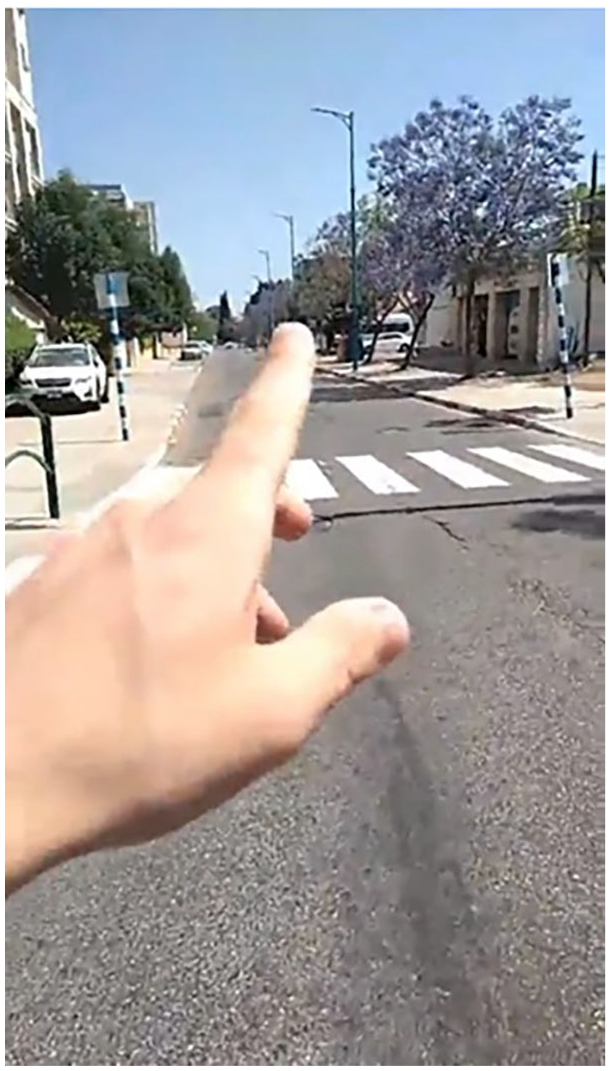
A streamer from Lod points out the invisible border between the neighborhoods: “this is the street that divides the Jewish and the Arab neighborhood.”
Of the total corpus, 28% of the streamers turn the camera on themselves at the video’s beginning or end or during the video and explain where they are and why. They use the selfie to indicate their relationship with the place and associate themselves with a meaningful event (Koliska and Roberts, 2021). This practice also borrows from TV broadcast news in which the anchor or news reporter looks directly at the viewer, thus individuating the viewer from the crowd and establishing connectivity between the viewer and the broadcaster (Bourdon, 2000).
Performing sensuous place-making
The mobile camera enables the streamers to practice place-making and take their place in a conflict territory. Digital place-making is defined by Halegoua and Polson (2021) as the use of digital media to create a sense of place for oneself or others while promoting a feeling of belonging to that place. In live videos, place-making is supported mainly by audio-visual utterances; streamers, however, move the camera along a place’s contour, mark key spots, and position themselves geographically, temporally, and politically in a wide shot or close-up. For example, an Israeli right-wing streamer focused the camera on a monument for the 1948 Arab–Israeli War Jewish victims and then took a wide shot of the surrounding Palestinian neighborhood of Sheikh Jarrah. He thus took place inside the Palestinian area, embodying his presence there. Similarly, a left-wing streamer used a wide shot to convey an opposite opinion as she panned the camera over the same neighborhood and declared, “What am I doing here? An Israeli citizen in the middle of a Palestinian neighborhood?”
An interesting practice of audio-visual place-making concerns how streamers refer to borders and boundaries, drawing on Casey’s (2017) distinction between the two. Casey (2017) sees borders as artificial, geometric, and stable, while boundaries “resist linearization; they are inherently indeterminate, porous, and often change configuration” (p. 7). Frontiers and borderlands, he writes, are intrinsically ambiguous entities and boundary-like by virtue: they are continuously relocated and tend to move outward since they are determined by the balance of power in the area. The current findings revealed that right-wing streamers tend to indicate borders and fix them using tangible human-made sites, such as historical buildings or graffiti writings in the public arena. Left-wing streamers were more focused on boundary-like frontiers and filmed the movement of crowds. They concentrated on the alignment of law enforcement and filmed rows of police or gatherings of protesters around their opponents (see Figure 2). One right-wing activist’s video is dedicated to his attempt to erase Palestinian graffiti from a building in Sheikh Jarrah and, in doing so, take his place. In a different left-wing Sheikh Jarrah video, the streamer climbs on a ramp so she can capture the noticeable line between the protesters and the police. She even declares as she films: “The line is about to be crossed” (see Figure 3). This distinction embodies the character of both struggles: one driven by historical justification and tradition, the other by morality and human rights.
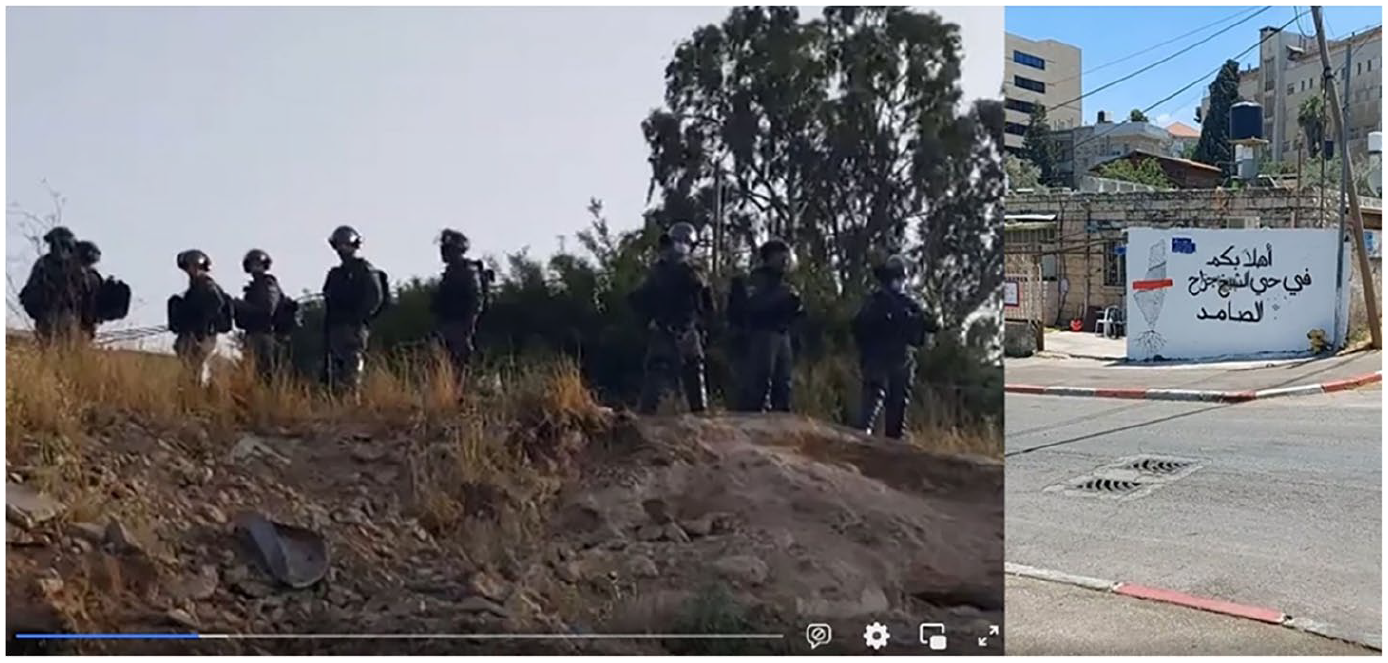
A left-wing streamer captures a line of soldiers on the hill (left); a right-wing streamer focuses on graffiti in Sheikh Jarrah (right).
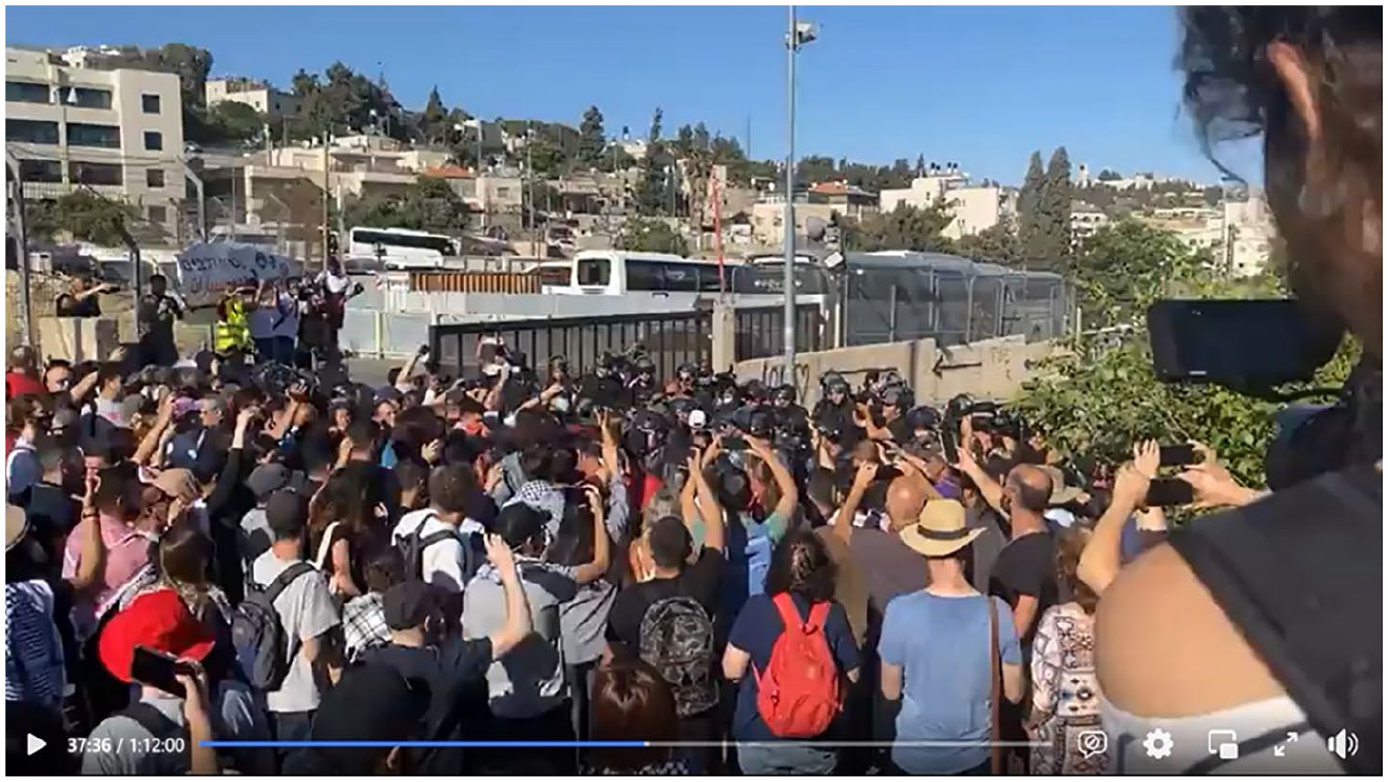
“Oh God, they are walking toward the cops . . . I’ll document standing here.” A Sheikh Jarrah streamer captures the line between the protesters and the police.
Although videos are audio-visual, streamers describe a whole sensory experience, harnessing senses like smell and touch to portray a place or its borders. In his book, Sensuous Geography, Rodaway (1994) explains, “The sensuous—the experience of the senses—is the ground base on which a wider geographical understanding can be constructed” (p. 3). According to Casey (1996) and Rodaway (1994), the senses actively structure orientation, geography, and a feeling of belonging. Indeed, streamers often use touch to point out where they are oriented and whether it feels “in-place” or “out-of-place.” For example, a protester in Sheikh Jarrah notifies viewers that a confrontation with the police has started by yelling: “The shoving’s begun! You should know that they are pushing now! Share!” A streamer who films the flickering sky while she bends down on the street during a rocket attack in Tel Aviv describes the sound of bombings and the touch of the pavement. It is important for a peace activist in Jerusalem’s Old City to let viewers know how hot and crowded the scene is: “My heart is not sweating, though,” she adds.
The streamers ascribe a special role to the sense of smell, which they used to testify to recent past events and as a practice of place-making and taking place. Smell is a “distanced sense” and can be used to attest to distant, hidden-from-the-eye events (Classen et al., 2002). References to smell appeared in several videos to indicate two regular, time-distanced events which characterized streamers’ videos: car torching during the riots by Muslim citizens of Israel and the police use of water cannons to disperse protesters.
Although live videos are meant to deliver synchronic events, the presence of smell allowed streamers to include events they could not capture directly. An activist protesting against the evacuation of Palestinian residents from Sheikh Jarrah films puddles of foul-smelling liquid fired from the water cannons, testifying, “If I could deliver the smell . . . preferably not, but the smell is still here of the . . . ‘skunk . . .’ the road is soaked with it.” An activist and resident of Lod tours the streets the morning after the riots and says to the camera: “The stench here last night was unbelievable, even in our neighborhood . . . my clothes still smell like ash . . . If I’d done this filming last night, from this spot, I’d have been murdered.” Smell is another way for streamers to negotiate place-making, borders, and boundaries. The foul smell determines where they allegedly should not be in the case of protesters scattered by the police or of the threatened residents of mixed cities. Both of these streamers demonstrate their controversial presence as they stand and film from where it still smells foul.
A smell can instantly determine an atmosphere or a mood. While memories aroused by language or visuals are often rational and frequently used to establish facts, memories aroused by senses are more tangible, involve emotions, and recreate presence in a specific event (Verbeek and Van Campen, 2013). Though they cannot deliver the actual smell, both streamers here set a mood by sharing their impressions of the smell, thus connecting their political agenda to palpable descriptions. They construct an emotional reaction among their viewers, expressing their disgust and not only at the smell.
Producing connectivity
One of the unique qualities of social media live streams is the real-time chat, which enables every viewer to engage with the video by commenting on it. The streamers examined did not, however, interact much with the chat. Many comments were directed at the streamers, some even requesting the streamer to turn the camera left or right or asking questions about the events. Some viewers praised or insulted streamers, and, in the case of a violent event, some expressed their fear for the streamers’ safety. Though the chat was constantly active, streamers did not engage with it most of the time, probably due to the technical challenge of streaming from a conflict arena and reading comments simultaneously. Some responded to the general gist of the comments, indicating a desire to see more Israeli flag emojis in the chat or declaring they would not answer insults. For instance, one streamer declared she would “block all the haters” after noticing many disrespectful comments. Some asked viewers to write whether they could hear them well or hear booming or shooting in the background. Still, many of the viewers’ questions remained unanswered or were answered by other commentators. As presented by Martini (2018), while the streamer was producing the video, the viewers talked to each other in the chat. The video generated discursive behavior and connective activity regardless of the streamer’s responses.
A surprising aspect of the Facebook Live videos found here was the use of the instant upload as an archive. Since the streamers were filming from conflict arenas with potential for violence, they acted in constant fear of something going wrong: they might be arrested or beaten, or their phone taken or broken. While talking to viewers or other activists, streamers often complained about their smartphones overheating in the sun, stopping working, or being taken away by police. Unlike regular videos, uploaded to social media only after being recorded, Facebook Live videos are uploaded in real-time and stay online afterwards. Aware of this difference, activists use livestreaming as an enduring testimony that will remain online no matter what happens to their phones or themselves while recording. Hence, some activists approached soldiers, letting them know they were “live” and that everything they did would be instantly online. This use of Facebook’s archival platform affordances aligns with Tenenboim-Weinblatt and Neiger’s (2014) “temporal affordances” since streamers are able to document on the spot yet are constrained by their unprofessional, breakable equipment. Facebook Live compensates for the mobile camera’s fragility, as one of the streamers declared from behind the camera: “This time it’s live. I learned my lesson—last time they broke my camera, so now I’m doing live.”
This enduring testimony is also a way of taking place in the digital media arena since the video will stay there and be watched and potentially shared by social media users. As Pink and Hjorth (2012) note, the video can be thought of as emplaced in digital space. But it is not only guaranteed a place of testimony in the digital world; it might also guarantee the streamer’s presence (and safety) in the physical environment and therefore demonstrate the significant “infusion” of digital and physical emplacement (Farman, 2020).
Finally, the Facebook feature the streamers most mentioned was the “share” button. The live streamers in the current corpus used the connective attributes of social media participation through their personal accounts, hoping that their video will be distributed and create a buzz or provide a different angle from what is reported in traditional media (Mortensen, 2015). While non-mobile political streamers use real-time engagement to mobilize their audiences across platforms promoting themselves (Harris et al., 2023), the streamers examined here emphasized the importance of being “here” physically. “If you are not here with us,” they turn to the viewers, “the least you can do is share this video!” Streamers turn to viewers as comrades, urging them to share the video. The “Share” button functions as the viewers’ means to contribute and extend the practice of place-making beyond the activists’ accounts by witnessing the event for themselves and reaching more witnesses who will potentially join the struggle physically or morally.
Conclusion: networked emplacement as an experiential political tool
This article has indicated the bond between liveness and emplacement by exploring Facebook Live videos from arenas of political struggle. Building on Casey’s (1993) theory, I suggest that emplacement includes social and perceptual aspects expressed in social media live videos. The structured specificity of the live broadcast’s location (Couldry, 1999; Scannell, 1996), with its spatial manifestation in digital media (Farman, 2020; Pink and Hjorth, 2012) and the interactive and connective character of live videos (Martini, 2018; Mortensen, 2015), gives streamers a powerful tool for portraying a heightened experience of emplacement. The article reveals three main practices used by streamers: the construction of “on-location” presence, the performance of sensuous place-making, and the production of connectivity on social media. Finally, I suggest the concept of networked emplacement: the combination of the connectivity and urgency of social media with the embodied nature of the mobile phone camera to emplace viewers in a rolling event with political importance.
Networked emplacement represents a development of media events (Dayan and Katz, 1994) in which the here and now still gives meaning to the events on our screen even though what we see is far from the formal, well-orchestrated experience described by Dayan and Katz. Facebook Live videos are an urgent chaos. They are shaky, rough, and unprofessional. Nobody, including the streamer, knows what will happen next or how the video will end. Each video represents only one personal viewpoint and agenda, as streamers mediate not only their political views but also their feelings and sensory impressions as the mobile camera embodies the streamer’s presence on-site. In contrast to broadcasted media events, streamers do not aim at a formal, objective report but at a mediated subjective lived experience that “they won’t show you on TV.” Yet, like media events, most of the videos in this study were initiated by the streamers who take it upon themselves to inform the public of the wrongs they witness. They also adopt broadcast media practices to make their video accessible and clear to viewers.
Networked emplacement might be regarded as a branch of media witnessing (Frosh and Pinchevski, 2018) which offers a contemporary configuration of media events. While continuing the tradition of “eye-witnessing,” whereby information about an event is given to those who were not present (Graham et al., 2024), it is also a manifestation of “flesh witnessing” which emphasizes witnesses’ corporeal presence and “visceral intensity of lived experience” (Chouliaraki and Mortensen, 2022: 593). In addition, as Frosh and Pinchevski (2018) explain, the social media live event is built from the bottom-up and videos gain meaning in the aggregate. One live video cannot present the whole picture, and any event might generate multiple versions and pieces of the same story (Mortensen, 2015; Valaskivi et al., 2022). Though live videos gather a tangible community that engages with streamers through the live chat and shares the video with others, it replaces the cohesive watching experience that characterizes national media events with a fragmented one, identified more with the mediation of politics, witnessing, and social movements (Mortensen, 2015; Strömbäck, 2008).
A particularly significant attribute of networked emplacement is the strong connection to physical place. Since the introduction of the Internet, technology has been blamed for disconnecting society from time and space. Castells (2011), for example, argues that digital media contributed to a new form of spatiality, “the space of flows,” which allows simultaneous social interaction regardless of participants’ location. He famously contrasted this to “the space of places,” in which particular locations retain their physical and narrative distinctiveness. For Castells, “the space of flows” increasingly dominates, reducing locations to points of convergence between social networks. They become infrastructures for social activity, which moves through them but does not reside in them (Castells et al., 2007). However, while mobile technology has made media ubiquitous and even pervasive, it has not made places lose their meaning, materiality, or specificity (Farman, 2020), nor has it numbed human sensory experience (Schlussel and Frosh, 2023). Instead, the material now has a digital manifestation that gives place additional meanings (Koliska and Roberts, 2021). When it comes to protest, it also emphasizes the tension between a place’s materiality and symbolism (Endres and Senda-Cook, 2011).
Previous research found that live video has a compelling ability of mediating “being there” and thus engages viewers and is used by streamers with political intentions. Livestreaming allows political supporters to participate from afar and connect to the struggle’s ideas and goals (Fang, 2023; Gerbaudo, 2017). However, this article reveals that streamers go beyond making viewers identify with their ideology or arguments and harness all their senses into making viewers feel emplaced in the very place of conflict. The streamers, dedicated citizens who use simple tools like smartphone cameras, aim at the same purpose for which advanced innovations such as 360° documentaries and immersive journalism were developed (Kukkakorpi and Pantti, 2021; Steinfeld, 2023); they believe that an engaged viewer will contribute to the struggle, if just by sharing the video. As a digital phenomenon, networked emplacement contributes to the contemporary discussion about immersive, reality-shaping technologies by demonstrating the everyday intersections between media, bodies, and the experience of space and time in conflict zones and elsewhere.
Supplemental Material
sj-docx-1-nms-10.1177_14614448241278709 – Supplemental material for Be there or share: Emplacement and embodied protest in Facebook Live videos
Supplemental material, sj-docx-1-nms-10.1177_14614448241278709 for Be there or share: Emplacement and embodied protest in Facebook Live videos by Hadas Schlussel in New Media & Society
Footnotes
Acknowledgments
The author is indebted to Paul Frosh for his valuable comments and assistance in various phases of this study, Limor Shifman and Blake Hallinan for their feedback on the earlier stages of this work, and the journal’s editors and reviewers for their helpful comments. The author also wishes to thank Mandel Scholion’s ‘The Evolution of Attention’ research group.
Funding
The author(s) disclosed receipt of the following financial support for the research, authorship, and/or publication of this article: Research for this article was funded by the Israel Science Foundation, grant number 1724/21.

Supplemental material
Supplemental material for this article is available online.
Notes
Author biography
Hadas Schlussel is a Ph.D. candidate in the Department of Communication and Journalism at the Hebrew University of Jerusalem and a member of “The Evolution of Attention in Modern and Contemporary Culture,” an interdisciplinary research group at the Mandel Scholion Research Center (2021–2024). Her research interests include visual communication, social media video, embodiment, and sensory engagement.
References
Supplementary Material
Please find the following supplemental material available below.
For Open Access articles published under a Creative Commons License, all supplemental material carries the same license as the article it is associated with.
For non-Open Access articles published, all supplemental material carries a non-exclusive license, and permission requests for re-use of supplemental material or any part of supplemental material shall be sent directly to the copyright owner as specified in the copyright notice associated with the article.
