



Abstract
The rapid adoption of digital technologies during COVID-19 lockdowns offers a unique perspective on differences in privacy cultures. In this study, we compare how cultural predisposition and identities relate to privacy during the transition to remote learning in higher education in Estonia, France, and Israel. We conducted 83 in-depth interviews with academics, who talked about their adoption of communication technologies and strategies for managing their self-presentation and relations with others. Patterns of tech adoption were most reflective of distinct privacy predispositions, with those coming from privacy-sensitive cultures conveying an individual and institutional resistance to privacy-invasive technologies. However, strategies for self-management in response to new patterns of visibility were similar across countries. Our findings make three contributions to privacy research: they (1) show how different identities (professional, national) underpin privacy attitudes and behaviors; (2) demonstrate the multidimensionality of privacy; and (3) point to institutional decision-making as the critical point for privacy-protecting interventions.
The question of privacy is mostly absent from the literature on higher education during COVID-19. In the context of the pandemic, privacy has been interrogated primarily in relation to the use of commercial solutions and government resources for contact tracing (e.g. Lewis, 2020; Sharon, 2021; Vitak and Zimmer, 2020). Yet, lockdowns and social distancing pushed many into conducting their daily routines online, leading to an increased generation of data, the sharing of personal information, exposure to surveillance by third parties online, and a renegotiation of interpersonal privacy norms and practices in domestic spaces (Fukumura et al., 2021; Newlands et al., 2020).
We aim to address the relative lack of scholarly attention to questions of privacy in remote learning during COVID-19. To do this, we adopt the comparative approach of Masur et al. (2024) in order to examine the role of privacy norms, attitudes, and practices in the shift to remote teaching in higher education in Estonia, France, and Israel during the COVID-19 pandemic. Following that approach—about which more below—we build on structural similarities among the three country cases, as well as similarities across higher education systems as a social context, in order to surface differences that can be explained through other variables, in this case, privacy culture.
This project captures the moment of rapid transition to emergency remote teaching (ERT) in higher education, focusing explicitly on the renegotiation of privacy as a multidimensional boundary condition vis-a-vis institutions, students, and peers. Based on 83 in-depth interviews, this article examines the shift to the institutionalization of distance learning in higher education in three countries—Estonia, France, and Israel—paying special attention to privacy considerations in the adoption of technologies and privacy practices in the service of online instruction. Our expectation is that privacy outcomes in the three cases will differ, manifesting different privacy cultures, with repercussions for technology adoption in higher education. After reviewing the relevant literature on privacy and disclosure in educational settings, as well as COVID-19–instigated changes, we describe the three cases and present our findings as they relate to technology adoption, the presentation of self, exposure to the domestic spaces of others, and relations with others.
Literature review
Since the canonical definition of privacy by Warren and Brandeis (1890) as the “right to be let alone,” conceptualizations of privacy have tended to focus on the protection of the intrinsic personality of an individual against potential intrusions, primarily by fellow peers, but also institutions, especially those with mediatizing power (the press, social media) and, of course, the state. As such, privacy is viewed as inherently social, based on the continuous negotiation of norms and rules for information disclosure and exchange (Petronio, 2002; Rey, 2012). Increasingly, there is a recognition that said norms and rules, as well as the processes through which they are set, challenged, and enacted, are context-dependent (Nissenbaum, 2010).
Studying privacy
From the vast literature on privacy in technologically-mediated, information-rich environments, we identify four main features of privacy that pertain to the current context. The first is that different imagined audiences may inhabit a single virtual space (Litt, 2012; Marwick and boyd, 2011), creating context collapse (Vitak, 2012), and thus a need for individuals to try and control flows of information about themselves. Second, and in tension with the previous point, the agency of the individual is limited by the vastness, interconnectedness, and opaqueness of data flows and their subsequent capture and analysis (Baruh and Popescu, 2017), a situation described by Marwick and boyd (2014) as networked privacy. Third, privacy is multidimensional, with scholars paying particular attention to the distinction between the vertical (institutional) and horizontal (social) orientations of privacy (Bazarova and Masur, 2020; Quinn and Epstein, 2023). Fourth, and finally, privacy is contextual, meaning that the extent to which something is considered private is dependent on perceived audiences and norms (Nissenbaum, 2010), situations (Masur, 2018), or broader aspects such as regulation (Wu et al., 2019).
Acknowledging that privacy is shaped through interactions between individual agents and socio-technical structures, Masur et al. (2024) argue that privacy as a multidimensional and context-dependent phenomenon can be better understood through comparison. They identify five interrelated meaningful categories of macro units of comparison (Esser and Hanitzsch, 2013) that can be used as a starting point for an interrogation of privacy-related variables and processes: cultural, social, political, economic, and technological. A systematic comparison, therefore, would be anchored in similarities across one or more such structural units of comparison at a given level of analysis. In this study, the relative similarity of macro political, economic, and technological contexts across our country cases, as well as the relative similarity of higher education as a social context, allow us to focus on the cultural differences in awareness, value, and sensitivity associated with privacy outcomes. The latter are particularly interesting in the context of privacy research as they may capture interactions between competing groups and the individual identities of the people involved (Masur et al., 2024).
Thus, we illustrate the contextuality of privacy from a comparative perspective. Specifically, we ask if and how considerations about privacy played a part in the process of technology adoption for remote teaching, in developing practices around its use during the pandemic, and whether there were differences across the cases we studied. At the same time, our focus on privacy within the context of teaching in higher education brings into play the multidimensionality of privacy among academics (Kayas et al., 2024), who are both embedded in their national and cultural contexts and share an academic habitus (see Delamont et al., 1997; Weinreb and Yemini, 2023).
Privacy, self-presentation, and self-disclosure in higher education settings
At multiple points in The Presentation of Self in Everyday Life, Goffman (1959) refers to teachers’ considerations regarding the impression they strive to make on their students (e.g. p. 5 and p. 56). Wishing to “sustain an impression of professional competence” (p. 56), they monitor their performance in front of their charges. Linking teaching to privacy considerations, a central aspect of their self-presentation relates to information about themselves that they share with their students.
These decisions are guided by social expectations of appropriate self-disclosure (Wang et al., 2017). Overall, scholars agree that most teachers are aware of what kind of information about themselves to disclose to their students (Fusani, 1994). For example, sharing information about one’s family (Zhang et al., 2009), telling stories and revealing personal beliefs (Nussbaum et al., 1987), or using humor and showing enthusiasm while teaching are not only considered to be appropriate means of self-disclosure but are effective ways for increasing students’ enjoyment of learning (Sorensen, 1989), leading to positive evaluations by students (Nussbaum et al., 1987). Inappropriate self-disclosure, however, such as offering information about intimate family matters (Hosek and Thompson, 2009), can lead to negative student outcomes and negative teacher evaluations (Coffelt et al., 2014).
The COVID-19 pandemic, though, casts this literature in a new light. To start, teachers in higher education settings had no choice but to reckon with the new fact of teaching from their homes. This required coping with unexpected interruptions from the people (and animals) with whom they shared their living spaces—an aspect of their personal lives typically obscured from students. In addition, they were often required to work with their personal computers, which, when screen sharing, for instance, could lead to the disclosure of personal information or browsing history. In other words, remote learning made it more likely for teachers to accidentally reveal “incidental information” (Hawkey and Inkpen, 2006) or, in Goffmanian terms, to “give off” information.
These issues, however, are not mentioned in the limited literature on privacy considerations in remote learning. Instead, that body of work focuses primarily on mundane uses of digital tools in education during routine times (Kularski and Martin, 2022). It touches on the legal responsibilities of institutions to protect students’ data (Rubel and Jones, 2016), on students’ attitudes toward data collection (e.g. Chang, 2021; Jones et al., 2020; Vu et al., 2020), and on the importance of privacy for marginalized and vulnerable populations (Croft and Brown, 2020; see Kularski and Martin, 2022, for a review). However, ERT represents a qualitatively different context for the examination of privacy: It is by definition a temporary solution developed under extreme conditions of scarcity of time, money, and other resources (Antobam-Ntekudzi, 2023). The few studies focused explicitly on ERT and privacy tend to bundle privacy and security, focus on mapping out concerns or solutions, and are typically bound to a single cultural, national, or even institutional context (e.g. Paris et al., 2022; Tazi et al., 2021). Our aspiration with this project, however, is different. We aim to study the particular moment of COVID-19 ERT as an opportunity that, when studied comparatively, reveals aspects of broader privacy cultures. It is in times of crisis, as we elaborate below, that individuals fall back on their default understandings of fuzzy concepts such as privacy.
A moment of turbulence
The rapid shift to technologically-mediated communication constituted a moment of privacy “turbulence,” defined by Petronio (2002) as a disturbance of “the harmony of boundary management of private information” (p. 177) through changes in technological repertoires, working conditions, and new informational needs. Most vividly, established norms and practices around privacy were challenged during COVID-19 through government-led and commercial attempts to harness information technology for contact tracing (Newlands et al., 2020; Suder and Siibak, 2022; Vitak and Zimmer, 2020). Less vividly, privacy norms and practices were challenged through changes in the mundane, as the reliance on digital technologies spiked, particularly in the early stages of the pandemic.
One aspect of the mundane that was particularly affected was work. Mandated remote work during lockdowns created a fundamentally new privacy situation for the majority of mostly new teleworkers (Fukumura et al., 2021). Institutionally, there were, and still are, growing concerns regarding employer surveillance of employees in their domestic spaces (Blumenfeld et al., 2020). Socially, working from home required making adjustments to shared family spaces and family relationships, potentially compromising the privacy of both workers and their families (Nurse et al., 2021). Fukumura et al. (2021), for example, observed that teleworkers struggled to maintain boundaries between their personal and professional lives. The rapid adoption of digitally-mediated communication created a situation of physical context collapse, where diverse audiences not only occupied the digital but also the physical and domestic spaces of individuals, thus requiring further realignment of privacy norms and practices. We are seeking both to capture this moment of turbulence and to leverage it to understand the diverse privacy cultures that it exposes.
Case selection
In keeping with the framework of Masur et al. (2024), this article comparatively studies privacy aspects of the rollout of distance learning in higher education in three countries: Estonia, France, and Israel. The framework highlights five interrelated categories of units of comparison that are meaningful for privacy: cultural, social, political, economic, and technological. It suggests that a systematic comparison needs to be rooted in a degree of similarity across some of those units, to allow for analysis of differences enabled by the comparison. As to establishing a basis for comparison, Estonia, France, and Israel are relatively similar in terms of their politics, economies, and technological aptitudes. All three are rather prosperous parliamentary democracies that belong to the Organization for Economic Cooperation and Development (OECD), with developed and fairly (even if not uniformly) accessible information infrastructures and a sense of pride in their technological prowess. Furthermore, focusing on higher education offers a comparable social context for our analysis. The higher education systems in all three countries enjoy autonomy in terms of teaching and research. This means that university and college teachers were, at least formally, free to implement distance learning as they saw fit, including the adoption of different technologies. Focusing on the adoption of information technology during the shift to ERT in higher education renders the ensuing privacy considerations and behaviors comparable in that the pandemic created a uniform context for considering those outcomes across geographies, cultures, and so forth.
Yet, the three countries arguably differ in their privacy cultures, which makes them a compelling case for comparison. First, while both France and Estonia are subject to the General Data Protection Regulation (GDPR), Israel is not. This creates different climates of privacy awareness in each country, while signaling its varying significance. Furthermore, Eurobarometer studies show that French respondents are relatively more concerned with their online privacy (Prince et al., 2023), particularly compared to Estonians (Murumaa-Mengel et al., 2014). Israelis, who have not been systematically compared with European Union (EU) citizens, have been shown to undervalue privacy compared to respondents in the United States (Ribak and Turow, 2003). Moreover, as argued by Haber and Tamò-Larrieux (2020), “[a]ll in all, with some similarities, Israel’s approach to Privacy and Security by Design generally differs from that of the EU” (p. 8). The two main explanations offered for this are the collectivism in Israeli society and the centrality of the military, such that many Israelis are willing to forgo privacy for the sake of security (Marciano, 2021). In other words, each country-case represents different levels of privacy awareness, sensitivity, and institutionalization, creating a continuum ranging from the most privacy-sensitive country (France) to the least (Israel), with a moderate case (Estonia) in the middle.
Methods
This project is based on 83 semi-structured interviews with faculty members conducted in Estonia, France, and Israel over a period of 9 months, starting in June 2020. We focused on educators working in higher education institutions as their need to rapidly adapt to remote teaching at the beginning of the pandemic foregrounds the renegotiation and adaptation processes under study. Moreover, all of us involved in the project were part of this transition, which gave us an insider perspective, instrumental for both the interview process and the interpretation of the results.
After receiving ethical approval, we recruited participants through professional listservs and social media groups using a purposive sampling approach. Participants were asked to fill out a screening questionnaire where we asked them about their demographics, disciplines, tenure in higher education, and initial feeling toward the rapid adaptation to remote teaching in the spring of 2020. Given the qualitative nature of this inquiry, we did not aspire to statistical representativeness, although we did aim to balance aspects of heterogeneity and homogeneity in our sample to allow for comparison in line with established practices in qualitative interview research (Robinson, 2014). On the one hand, our sample is heterogeneous across cases as described earlier. Beyond that, we strived for heterogeneity across factors discussed in the literature as affecting privacy attitudes and behaviors such as age and gender (e.g. Epstein and Quinn, 2020) or disciplinary affiliation (Kayas et al., 2024). On the other hand, by focusing on educators teaching in higher education during a shared crisis, we maintained homogeneity of institutional and situational contexts as a basis for comparison (Masur et al., 2024).
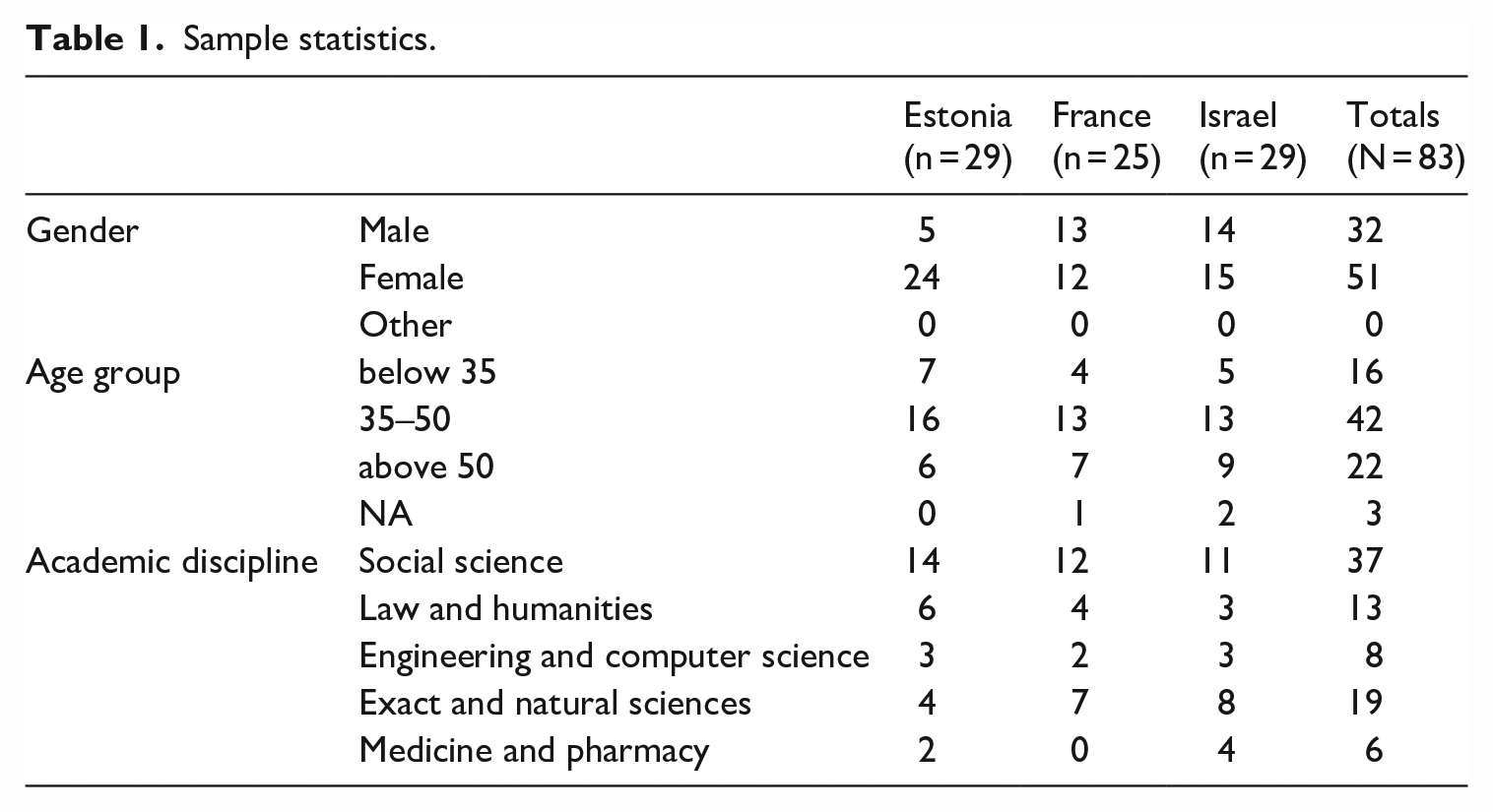
The samples in each country covered a range of age groups, academic ranks, and disciplines. The samples in France and Israel were balanced in terms of gender; the sample in Estonia contained more women than men. It is important to note that while the data in Israel were collected immediately following the first semester of remote teaching, the data in Estonia were collected during the second Corona semester, and the data in France toward the end of that semester, which might have offered participants a different perspective. Table 1 summarizes the sample composition in each country.
Sample statistics.
We conducted semi-structured interviews using a protocol developed collaboratively by the research team (see Supplemental Appendix 1). Upon obtaining consent and asking the interviewees to introduce themselves, we asked them about their typical use of information technologies and changes caused by COVID-19, recollections of adaptations they went through to start teaching remotely, and practices that evolved around professional remote interactions. During the first parts of the interview, we did not ask explicitly about privacy, preferring to see if and how it would be brought up spontaneously by the interviewees. Later in the interviews, we asked explicitly about interviewees’ considerations of privacy vis-a-vis students and colleagues. The interviews were conducted primarily in native languages in all the locations.
The analysis of interview transcripts proceeded in an inductive and iterative fashion (Hall et al., 2005). First, each national team read and openly coded their transcripts to establish initial themes. Second, we discussed the emerging themes and re-read the transcripts to refine our interpretations. Finally, we came back to the transcripts to verify the presence or absence of particular themes across national contexts (Strauss and Corbin, 1998). Throughout the process, we conducted regular consultations among the members of the collaboration, but each national context was examined primarily by the local team. We present the findings using pseudonyms, for the sake of our participants’ confidentiality.
Findings
We present our findings around two main themes. The first is technology adoption, where we describe the tech solutions that were adopted by our interviewees and how they came to adopt them. The second is the management of the collision between the private and the public, which focuses on participants’ considerations of how to appear before their students and colleagues (being seen) and the implications of seeing into others’ homes (seeing others). Finally, we discuss relations with others and how these were managed or changed during the first few months of lockdown in 2020.
Technology adoption: (almost) all roads lead to Zoom
Given the capacity of software packages and apps to collect personal data, and given that videoconferencing potentially exposes participants’ domestic settings to work colleagues, installing and using a new software program can have implications for both horizontal and vertical privacy (e.g. Brough and Martin, 2021). Once adopted, technologies and how they are used are slow to change (Humphreys, 2005), and with them the ways in which they allow for the protection or infringement of privacy. It is significant, then, that for the majority of interviewees, the shift to online teaching entailed the rapid adoption of new software programs with little time to consider its implications for privacy, or indeed the institutional leeway to make their own decisions about which tools to adopt. Most notably, Zoom became the standard across the countries we studied, although the pathways to this, and the degree of agency experienced by our participants in the process, differed by country. In Israel, interviewees reported that they were simply given instructions. For instance, when Gilad (M, social sciences, Israel) was asked how he made the choice to use Zoom, he replied, “It’s what the university told us to use.” There was no discussion or deliberation, neither about the affordances of the software, nor about potential privacy issues.
In Estonia, the pathway to Zoom adoption was different, but not necessarily because of privacy concerns. With a decentralized approach, some respondents were left to choose the package they preferred, sometimes even paying for it themselves. Pille (F, educational sciences) said: “There was no institution-initiated offering in that realm. The first fast adopters used it [and] they paid the monthly fee themselves.” Other interviewees explained that their universities bought licenses and recommended the use of Zoom. Nonetheless, other solutions remained in use, such as Skype, Microsoft Teams, and Big Blue Button. In Estonia, there was some awareness of privacy issues around Zoom. Kadri (F, economics) mentioned asking her university’s lawyer to examine privacy breaches in Zoom: We stopped using Zoom for a short while. We asked the lawyer of the university to check which possibilities there are and how to continue using it. When it appeared that the safety holes had been repaired we could continue [using it].
Generally, though, Estonian respondents who had heard of privacy problems with Zoom brushed them off as insignificant compared to the advantages of seemingly user-friendly software. Exhibiting the range of privacy resignation and cynicism (Draper and Turow, 2019; Hoffmann et al., 2016), Birgit (F, media studies, Estonia) declared that she “did not care at all” if someone could access her classes. She summed up: “I used Zoom because it was convenient and it was the best. The issue of privacy has been secondary for me.”
In France, the pathway to technology adoption was different yet again. Similarly to the situation in Estonia, French institutions did not impose the use of Zoom, and the CNRS (Le Center National de la Recherche Scientifique) even warned against using it because of problems with privacy, asking academics to instead use Tixeo, a videoconferencing software program made by a French company. 1 Relatedly, interviewees reported using Jitsi, Webex, and Big Blue Button, which are free and/or open-source solutions. They also used Microsoft Teams, bought by their university. Contrary to the Israeli and Estonian samples, although most of the French respondents eventually resorted to Zoom, a small number of interviewees resisted its adoption. For example, Eric (M, mathematics, France) explicitly conveyed his political opposition to Zoom’s commercialization of the data collected about him and his students and said he preferred to use open-source software programs instead. He did use Zoom “in emergency situations,” but did not install it, preferring the more privacy-friendly option of joining meetings from within the browser. Critics of Zoom shared a belief in the value of open-source software and, in some rare cases, eschewed video and used only audioconferencing instead.
Eventually, Zoom did become the dominant software in France too. The majority of interviewees justified its adoption by downplaying the sensitivity of information being exchanged. In Estonia, justifications revolved around the convenience and usability of Zoom. In Israel, justifications were not needed as the interviewees had no say in whether to use Zoom. Overall, only the interviewees in France gave thought to questions of privacy in their adoption of the software.
Zoom was not the only new technology adopted: Interviewees from all sites mentioned integrating commercial services into their online teaching, some of which required users to create accounts, such as Padlet, Slack, Viber, Mentimeter, Panopto, and a range of Google products. Participants expressed little or no concern or awareness about the implications of this for their own or their students’ digital footprints.
Managing the collision between the private and the public
Having discussed the privacy implications of technological choices during a period of crisis in terms of data collection, it is now important to address how our participants spoke about managing the unprecedented tension between the public and the private as a result of the rapid move to ERT. Here, our interviewees spoke about the tension inherent in being exposed to new audiences, as well as those linked to seeing others in new ways. Taken together, those observations suggest ways of thinking about and practicing privacy that are obscured in mundane situations.
Being seen
When required to teach from home, lecturers were in effect required to etch out a semi-public area within their domestic setting. Across research sites, interviewees talked of the necessity of creating a setting and a presentation of self that they considered professional or neutral. Neutral settings usually involved teaching in front of a blank wall. As Ilana (F, law, Israel) explained: “I try to make it as much of a blank canvas as I can, like meeting in a classroom, in a neutral place.” In another example, a French law lecturer, who would occasionally teach from his parents’ place, would remove their artwork from the wall behind him (Pierre, M, law, France). Karin (F, sociology, Estonia), who lives in a small apartment, would always make sure that her bed was out of the frame.
Despite the availability of virtual backgrounds to conceal one’s domestic space, only a few interviewees used them. Ilana (F, law, Israel) explained that using a virtual background “seemed unfriendly to the people I was speaking to,” while Nadav (M, musicology, Israel) said that “it feels weird to suddenly have a virtual background. It creates a sense of ‘don’t enter my private space’”; Miriam (F, information and communication sciences, Estonia) described virtual backgrounds as “corny, cheesy and cringe.” All of these interviewees convey a sense that there is something artificial about using a virtual background. Nonetheless, some interviewees did use virtual backgrounds: Birgit (F, media studies, Estonia) said that her outer space background meant she had “no stress about students seeing how messy my bookcase is.”
Other interviewees did not insist on a neutral setting and did not mind other people seeing certain possessions of theirs in their homes, be they books, artworks, or family photos. A number of French interviewees consciously chose to show their kitchen when teaching, seeking to convey to their students that they are all in this together—a phenomenon we call background bonding.
For interviewees with young children, the possibility of those children walking into classes while the parents were trying to teach posed an additional challenge, for which we offer the notion of reverse context collapse. In France, for instance, some interviewees repurposed spaces used by their children for play and video games, remaining aware of the possibility that their children may reappear in the background looking for their space. Commonly adopted tactics for carving out neutral or professional spaces were locking the door (when possible), putting signs up, issuing clear instructions about the need to leave the parent alone, dividing childcare duties around teaching obligations, and giving the children more time than they were usually allowed on digital devices (which itself has implications for the children’s privacy).
In Estonia and France, parents of young children reported feeling stressed and burnt out by the situation. Some hired babysitters for online teaching periods to keep the children occupied, but many, especially women, struggled with the situation. For Helina (F, social work, Estonia), “it was impossible to do the lecture via Zoom or via whatever when the two children in their underwear were screaming Mom.” Sylvie (F, information and communication sciences, France) also had to juggle her academic identity and her identity as a young mother. Living in a small apartment, she left the living room to her partner and baby and taught from her bedroom, which meant students could see her bed, which she found embarrassing.
Many of the interviewees from all three sites referenced the potential for sound to disrupt their considered presentation of self in ways that resisted control. For some interviewees, such as Sylvie, noise might be produced by little children, for others by family in general or even by pets. Maya (F, public health, Israel) said that her dog sometimes “started barking hysterically,” to the extent that she sometimes had to mute herself in her own lessons. Alon (M, economics, Israel) also described sounds that he was unable to hide: “You could hear my roommate yell at the other roommate in the background, you could hear the neighbor drilling.” These examples highlight an important challenge to interviewees who wished to control the impression they gave to their students: While doors can be closed, and backgrounds arranged, sounds are still able to penetrate this sphere.
In addition to sensory challenges to presentations of self, online teaching presented qualitatively new challenges to interviewees’ management of their privacy. One of these was the sense of always being available, or at least, during periods of lockdown, when everyone knows that you are at home. Madeleine (F, social sciences, Israel), who also held a senior management position, referred to the sense of crisis at the start of the pandemic, and the shared knowledge that everyone is at home, as producing uncompromising demands on her time. In France, Nathalie (F, linguistics) explained that she could no longer set boundaries, given the workload associated with distance learning, and that she could barely take a break from her professional life: “I don’t have a minute to myself, I try not to work on Saturdays, but I can’t. Yesterday I worked until 11:30 p.m., preparing classes, answering emails [. . .] As a mother, I am at a loss.”
Seeing others
Interviewees from all three countries had stories about exposure to sights and sounds that they would not be exposed to in the classroom. In France, Caroline (F, information and communication sciences) described seeing a student in his bed: “a student was slumped over on his bed, in a tank top, he was almost like just out of bed, he saw me come in, I felt the embarrassment, he said ‘oops.’” Asaf (M, social sciences, Israel) expressed feeling distinctly awkward at times. He said, “I had one female student who would lie down on her bed, wearing pajamas. I felt as though I was completely entering her private space. I felt very uncomfortable.”
Sometimes, interviewees felt awkward witnessing students’ interactions with roommates or family members, even when those interactions were perfectly routine. Nadav (M, humanities, Israel): “A student was on Zoom and someone, I guess her partner, came into the frame and they laughed or something like that. [. . .] It distracted me.” We mention this because infringements of privacy do not all necessarily involve seeing things that the lecturers were clearly not meant to see (drug paraphernalia, half-dressed students in bed) but also everyday routine interactions between people in what is normally experienced as the privacy of one’s home.
The need to adopt new technologies and practices around their use introduced new vectors for unintended exposure. Caroline also noticed that when her students were occasionally asked to share their screens, they sometimes unintentionally shared quite personal information. For example: “I read that they had entitled the document with a nickname for me: ‘matutu’ [. . .] Here too, it is private, the students’ interactions become public, including in the eyes of the teachers. Now I know my nickname [laughter].” She added that screen sharing is very private. We see the open tabs, we see what they are doing, I realize that I always have a look at it, I’m interested, some have their bank account open, their social media . . . it’s an entry into their intimacy.
While this could also happen in physical lecture settings at the university, when teachers project their screens, the online teaching situation extended this risk toward students. It also highlights an extension of the notion of space from material rooms and settings to virtual arrangements, which can be just as telling about our habits and practices as opening a camera onto our homes.
Relations with students
Across the research sites, our interviewees took different positions on the trade-off between exposing their personal lives and creating a meaningful relationship with their students. Reflecting privacy-relevant cultural differences, this complexity was exacerbated by the fact that lecturer/student relations start off in different places in the three countries. In Israel, the relationship is informal: From grade school to grad school, teachers/lecturers are addressed by their first names. In Estonia, the situation is similar, though some people insist on maintaining a degree of distance, most likely a function of the age gap between student and professor. In France, the language itself dictates a distance (tu/vous), and the students use Mr./Ms. when addressing their lecturers.
For some Israeli interviewees, the pivot to online instruction did not entail a substantive change in their relations with their students because those relations were already characterized by a high degree of openness and informality, thus reflecting their local privacy culture. For instance, some interviewees were already in the habit of providing their home and/or mobile phone numbers to their students; others had no qualms about letting their students know—in pre-COVID classroom settings—that they had children, for example. Yet others felt that the situation required them to be more open and available. Vincent (M, biology, France), for example, made a point of asking his students how they are doing at the start of lessons, which is not something he would usually do in physical classrooms.
The shift to ERT required new forms of communication from the lecturers. Participants in Estonia and Israel spoke of providing emotional support in ways they had not done before. For example, a lecturer in social sciences from Estonia described how she started to organize informal videochat meetings with students every two weeks to see how they were coping and to provide them with a platform for mutual peer support. Such informal gatherings, however, not only enabled the students to form closer bonds with each other but also helped to create a more personal and closer bond between the students and the lecturer. In France, Antoine (M, engineering) spoke of how he helped a third-year student who was struggling with depression during the lockdown, even though he felt like he was “walking on eggshells.”
Beyond privacy, a number of interviewees suggested that online teaching negatively impacted their relations with students. Kathy (F, occupational therapy, Israel) bemoaned the lack of post-class interaction, when students come and ask questions. “I guess they didn’t have that intimate feeling on a computer,” she suggested. Asaf (M, social sciences, Israel) noted that, paradoxically, even though his students saw his home, “they got to know me less as a person.”
Interestingly, the interviewees who felt that they established good, mutual relations with students during the period of online instruction were those who felt comfortable letting students into their domestic environments and who felt equally comfortable being exposed to their students’ domestic environments. Maya (F, public health, Israel) explained that she was happy for the boundaries between the personal and professional to be blurred: “It helps me create better connections with people,” she said. A French lecturer, Paul (M, information and communication sciences) talked about how he “took the bull by the horns” and “overloaded the personal side” in order to construct a more relaxed presentation of self. In Israel, Shomron (M, public health) spoke of the “familial atmosphere” created as a result of students seeing his home, and him seeing theirs: “Here and there a dog was in the background, a door opened, a child came in to sit on their laps. It didn’t bother me. It creates a more familial atmosphere.” As referred to earlier, of particular interest here is the way that it is precisely the mutual exposure of the domestic sphere that enables a connection to form.
Discussion
Our findings offer three main contributions to privacy research. First, they suggest an interplay of identities as underpinning privacy attitudes and behaviors. In our case, those included a tension between professional identity and national privacy culture. Second, they demonstrate the multidimensionality of privacy, describe new forms of privacy vulnerabilities (e.g. reverse context collapse), and emphasize the need for exposure in building and curating social relationships (e.g. background bonding). Finally, our findings highlight the centrality of institutional decision-making as the most vivid manifestation of national privacy cultures and as a critical point for privacy-protecting interventions.
In relation to an interplay of identities as underpinning privacy attitudes and behaviors, we observe how different layers of one’s identity factor differently into privacy concerns and behaviors. Despite differences between the three cases, and indeed the disciplinary diversity within our sample, the similarities in the experiences described by all the interviewees are striking. We propose accounting for this high degree of similarity through the notion of academic habitus or the idea that our interviewees’ professional identity trumped local forces that might shape horizontal privacy-related behavior. While there have been a number of debates around the notion of academic habitus (Matthies and Torka, 2019; Parker and Jary, 1995; Taksa and Kalfa, 2015), a key component is a sense of autonomy, expressed in the freedom to choose what to research and teach and how to carry out those tasks.
Furthermore, in both Estonia and France, despite the resistance expressed by some French interviewees to the widespread adoption of Zoom, the absence of references to the GDPR—a wide-ranging privacy protection for EU citizens—was notable. Israel is not a signatory to the GDPR, hence, it is not surprising that Israeli interviewees did not mention it. Estonia and France, however, are signatories, and yet our interviewees from those countries did not invoke it when discussing privacy and ERT.
In relation to the multidimensionality of privacy, we observed distinct dynamics in the horizontal and vertical privacy orientation. Perhaps not surprisingly, though with some notable exceptions, the interviewees tended to downplay privacy concerns, or to express them in terms of horizontal relationships alone (similarly to Kayas et al., 2024). Like many other people newly working from home (Allen et al., 2021; Fukumura et al., 2021), our interviewees struggled to manage a new form of context collapse. The original idea of context collapse referred to the blurring of audiences for social media users (Marwick and boyd, 2011; Vitak, 2012), and in our case, the contexts that collapse are all on the side of the user, and not the audience—hence, reverse context collapse. Especially for interviewees with young children at home, the professional and domestic contexts were liable to collapse at any given moment. At the same time, this created an opportunity for background bonding, where the sharing of a domestic situation between lecturers and students contributed to a sense of commonality and shared circumstance.
We do observe country-level variance in relation to vertical privacy relationships. Apart from one notable exception—a scholar who has herself written about privacy—Israeli interviewees accepted the rapid shift to Zoom with very little resistance. Even when prompted, they expressed no privacy concerns with the software beyond the possibility that the wrong people might be in the wrong class. Similarly, although the universities in Estonia were slower to lock in on Zoom, it was met with little bottom-up scrutiny. Only in France did we observe active resistance to the use of a service provided by an American commercial company. As such, these findings demonstrate the continuum of cultural sensitivity to privacy, as we discussed earlier.
Alongside the differences we observed, there was also one notable similarity. When talking about their vertical privacy relationships, a prevalent idea among our interviewees was that so much is already known about us that resistance is futile. Although we did not explicitly engage with this mechanism in the current study, this finding may signal vertical privacy fatigue (Choi et al., 2018).
Finally, in terms of the centrality of institutional decision-making, while there was variance between the countries, the key variable is the extent to which the relevant institutions had already entered into partnerships with big tech. In Israel, for example, a number of higher education institutions have partnerships with Google, which manages their email and provides cloud services. When these same institutions sign deals with Zoom and tell their teaching staff that this is the tech solution for distance teaching, the requirement to use a foreign commercial company’s services does not feel strange. The Estonian government is also strongly committed to private-public partnerships, including in the field of education. While Zoom was not adopted as quickly as in Israel, this was due more to ambiguous directives than a reluctance to depend on imported tech. In contrast, in France, with its strong and proud history of independent technology development (Mailland and Driscoll, 2017), we found resistance and attempts to encourage the adoption of French, open-source software programs.
Once the interviewees were teaching through videoconferencing software programs, participants explained their choices regarding self-exposure and degrees of comfort with the new situation using universal ideas pertaining to the academic habitus. However, various institutional and cultural preferences did come into play, thus still impacting the interviewees’ privacy. This suggests first that institution-level decision-making perhaps most clearly demonstrates country-specific privacy cultures, and second, that this same institutional decision-making is potentially an effective point for privacy-protecting interventions.
Limitations and future work
While this project captures a unique moment of renegotiation of privacy boundaries and offers observations about ways the academic community engaged with it, the study also carries some inherent weaknesses that need to be at least acknowledged. Beyond the traditionally limited generalizability of a qualitative inquiry based on purposive sampling, we are aware of the potential impact of our decisions to focus on a particular level of analysis for the purposes of comparison and the fact that the timing of the data collection (June 2020 to March 2021) may impact the transferability of our observations.
Our choice of country-level characteristics as the basis for comparison can be criticized as oversimplifying such a nuanced concept as privacy culture. It is possible that other factors at the national, disciplinary, or even individual level (e.g. attitudes toward risk) may better explain our observations. We offer just one interpretation of our intercultural team of researchers. Future research should further engage with other perspectives on comparison within the country units, across occupations, or even disciplines within academia.
Furthermore, as with the adoption of contact tracing apps (Andrejevic and Volcic, 2021), the fact that interviewees (and their employers) were dealing with an emergency situation might have impacted decisions regarding software adoption. It may be that the state of emergency flattened pre-existing differences in privacy cultures and perceptions between the three countries studied here, resulting in the almost universal adoption of Zoom. Future research should take a longer-term perspective to tease out potentially competing effects of the academic habitus and emergency context.
Supplemental Material
sj-docx-1-nms-10.1177_14614448241270406 – Supplemental material for A moment of turbulence: Privacy considerations in the pivot to distance learning during COVID-19 in higher education in Estonia, France, and Israel
Supplemental material, sj-docx-1-nms-10.1177_14614448241270406 for A moment of turbulence: Privacy considerations in the pivot to distance learning during COVID-19 in higher education in Estonia, France, and Israel by Dmitry Epstein, Nicholas John, Carsten Wilhelm, Andra Siibak and Christine Barats in New Media & Society
Footnotes
Acknowledgements
Andra Siibak is grateful to Merle Rüütel for the help with conducting and transcribing the interviews in Estonia.
Declaration of conflicting interests
The author(s) declared no potential conflicts of interest with respect to the research, authorship, and/or publication of this article.
Funding
The author(s) disclosed receipt of the following financial support for the research, authorship, and/or publication of this article: This work was supported by a grant from the Faculty of Social Sciences at the Hebrew University of Jerusalem.

Supplemental Material
Supplemental material for this article is available online.
Notes
Author Biographies
References
Supplementary Material
Please find the following supplemental material available below.
For Open Access articles published under a Creative Commons License, all supplemental material carries the same license as the article it is associated with.
For non-Open Access articles published, all supplemental material carries a non-exclusive license, and permission requests for re-use of supplemental material or any part of supplemental material shall be sent directly to the copyright owner as specified in the copyright notice associated with the article.
