



Abstract
How do workers conceptualize a platform’s algorithm and adjust their practices to its logic? To pursue this question, we draw on an ethnography of Grab, the leading rideshare platform in Southeast Asia, composed of 60+ trips talking to drivers on the back of bikes, and 10 in-depth interviews. We identify a distinct set of moves that workers perform to survive on the platform, a strategic cluster of practices we term “taming the algorithm.” These practices appear incompatible or contradictory—a bodily enactment of improvising, scrambling, and enduring that nevertheless is registered by the algorithm as routinized productivity. Even if done successfully, taming does not fundamentally disrupt platform logics, but rather makes exploitation more consistent and predictable. Workers adopt what we term “platform realism,” striving for a bleak but concrete agency that maintains their status. The aim is not to disrupt the system or hack the algorithm, but to live with it.
Keywords
Introduction
There has been much debate about the extent of workers’ autonomy in platform labor. Platform scholars argue that promises to work your own hours, make your own choices, and be your own boss are empty. Shibata (2020) asserts that any autonomy is merely a guise to create more flexible and precarious labor markets: this is a “fictitious freedom.” Umer (2021) sees freedom as sleight of hand, merely shifting the mechanisms of managerial control over labor: platform freedom is an “illusory freedom.”And Aloisi (2018) argues that court rulings upholding platform workers as freelancers are mistaken: their autonomy is not real but a kind of “virtual freedom.”
The problem with this dismissal of freedom is that it runs counter to worker’s own testimonies. “You are autonomous because you work the hours you want to work” declared one gig worker (Vieira, 2023). Tropes of freedom, autonomy, and flexibility recur whenever platform workers explain what drew them to the platform and why they keep engaging with it. Platform workers adopt an entrepreneurial mindset and speak about being their own boss (Barratt et al., 2020; Purcell and Brook, 2022). When asked about the meaning of their work, rideshare drivers in Brazil stressed self-management and the opportunities for autonomy and flexibility (Vaclavik and Pithan, 2018).
If we take worker statements at face value, they are free; if we accept platform scholars, they are merely duped. To explore this tension, we move out of the realm of the abstract and into the sociomaterial, diving into the concrete ways workers move, speak, and act on Grab, the leading rideshare platform in Southeast Asia. Our case study is based on 2 months of fieldwork in Hanoi comprising over 60 trips talking to drivers from the back of their bikes,10 in-depth interviews, and online ethnography within four different Facebook groups for Vietnamese rideshare workers. GrabBike Vietnam has an oversupply of labor and undersupply of jobs. To make a living in this intensely competitive environment, an understanding of the algorithm is crucial. Drawing on their hard-won experience, workers conceptualize in surprisingly sharp ways what must be done to survive on the platform. These are the everyday practices workers use to make algorithmic work work. Rather than theorize against workers by casting doubts on their claims, then, we theorize with them, joining other scholars (Chen and Sun, 2020; Qadri and D’Ignazio, 2022) who take seriously their ability to apprehend platform logics and respond to them in strategic ways.
Drawing on a recurring phrase used by workers, we term these strategies taming the algorithm (“rèn app”). To tame the algorithm, workers carry out three key moves: iteratively adapt their behaviors to algorithmic pressures (improvising), juggle competing demands to deliver a productive performance at bodily limits (scrambling), and repeat these activities over time until they become a baseline in the system (enduring). If done successfully, these moves establish routinized productivity, a pattern of algorithmically ideal labor that potentially rewards a worker by consistently delegating tasks to them.
These strategies do not passively accept algorithmic control, but neither do they overthrow it.
We capture this bleak agency and articulate our contribution to platform studies by introducing the concept of platform realism—workers’ grounded stance that seeks a modest but meaningful set of advantages while tolerating a chronic state of exploitation. This stance is “realistic” because instead of steering between the twin poles of Freedom and Unfreedom as if there are such “choices,” Grab workers’ primary struggle is to make platform exploitation more predictable and, hence, more endurable. Platform realism thus highlights the minor but valuable feat of finding ways to anticipate exploitation. Workers “tame” the app so it can exploit them in a more routinized way. The strategies of improvising, scrambling, and enduring are thus never meant to lessen inequality but to mitigate the radical uncertainty tied to algorithmic control. Put simply, the aim is not to hack the algorithm, or work around it, but to live with it.
Grappling with the platform: a literature review
Platform logics are powerful, significantly influencing the condition, distribution, remuneration, and acceleration of labor. Algorithms allow online labor platforms to monitor and control platform work, organizing how tasks are conducted (Möhlmann et al., 2021). These logics privilege certain practices and demote others, shaping the lived experience of platform labor (Munn, 2019). Written into code and operationalized via infrastructure, these logics are applied consistently and relentlessly. Indeed, these platform mechanisms may trump long-standing conventions and industry standards, leading workers to begin producing “what the algorithm wants” (Umejei, 2022). By mediating and objectifying relations, algorithms reproduce power asymmetries between platform operators and platform workers, constraining the agency of the latter (Curchod et al., 2020).
If platform logics are powerful, they are also inscrutable. Machine-learning algorithms are socially consequential in their ability to classify and rank but are characterized by opacity on multiple levels (Burrell, 2016). So while algorithms perform governmentality through organizing and ordering (Introna, 2016), these technical systems effectively operate as a black box (Pasquale, 2015). Inputs and outputs can be identified, but the actual process of decision-making remains obscured behind technical barriers and proprietary code. The result of this opacity is informational asymmetry. Workers are not told exactly how tasks are delegated, what practices are rewarded, or even how their own work is evaluated.
However, workers do not merely accept this form of opaque power, but perform strategies aimed at returning some knowledge and agency to their side. Jarrahi and Sutherland (2019) argue that workers carry out sensemaking, developing a more sophisticated understanding of algorithmic variables, values, and procedures. Muszyński et al. (2022) found that Polish platform workers adopted three coping strategies: staying loyal, a hybrid mixture of loyalty and complaining, or exiting the platform altogether. And Sariraei et al.’s (2022) radar map of coping strategies features terms ranging from self-reliance to accommodation, negotiation, opposition, and escape. While the desirability of these strategies is certainly debatable (“exit” seems hopeless rather than “strategic”), they show that workers are not merely pawns pushed by platform logics, but subjects who are aware of their conditions and who act in particular ways to alter them.
Yet, if workers are not passive puppets, some studies seem to overstate their ability to alter platform logics and counter algorithmic power. Scholars speak of workers leveraging their experience and knowledge toward “working around the algorithm” (Curchod et al., 2020) or “circumventing” and “manipulating” it to avoid penalties and boost earnings (Jarrahi and Sutherland, 2019). Grohmann et al. (2022) speak of workers “scamming” the platform while Jarrett (2022) discusses platform workers “hacking the master’s tools.” If such counter-power was once possible, it does not match the brutal reality of platform labor we witnessed in Vietnam, a crucible of intense competition. If “pacifying the algorithm” (Bucher et al., 2021) suggests rendering a child defenseless, taming the algorithm aims not to alter this ferocious power but to render it more predictable. Grab workers seek to smooth out this messiness: to be exploited consistently rather than unevenly.
We aim to grasp, then, in a clear-eyed way, how workers apprehend and negotiate contemporary platforms, where harsh conditions have only intensified in the wake of the pandemic. Methodologically, we find resonance with Qadri and D’Ignazio (2022), who engage closely with workers and seek to surface their language, ideas, and conceptualizations of the platform’s algorithmic vision. Analytically, we find resonance with Chen and Sun (2020), who show the hectic practices food delivery workers use to hit exacting delivery times: workers “successfully” match platform imperatives—while disenfranchising themselves and normalizing an unequal power structure. In the sections below, we go beyond speed to think about endurance while adopting this sober understanding of agency. Building on this insight, we suggest such agency is not “gaming the system” or even really gaining anything, but rather grasping and adapting (even to the point of self-exploitation) the platform’s logic in order to maintain one’s status: this is platform realism.
On the back of a bike: context and methodology
To understand how workers adapt to platform logics, we turn to a specific case study: GrabBike, a dominant Vietnam platform that held 70% of the on-demand motorcycle ride-sharing market in 2023 (Nguyen, 2023). In comparison to GrabCar’s heavy startup costs, GrabBike offers accessible work, thanks to cheap and ubiquitous motorbikes in Vietnam.
After its initial launch in 2014, Grab workers enjoyed several “golden years” with less intensive competition due to a relatively unexplored market. However, after its acquisition by Uber in early 2018, Grab’s near-monopoly of the Vietnamese market has been coupled with unconcealed exploitation, with commission rates increasing from 15% in 2016 to 23.6% in 2018 and 27.2% in 2020, while prices for customers steadily declined (Công, 2018). Before the pandemic, wildcat strikes by GrabBike workers occurred every time the company increased its commission rate. But the gloomy economy and soaring unemployment after the pandemic have turned Grab’s toughened policies into a new normal (Le, 2023). As one newspaper announced (Mai, 2020), “Grab’s honeymoon with its driver-partner has ended all too soon.”
In 2023, the number of gig drivers in Vietnam reached more than half a million (Tú, 2023) with intense competition between Grab and new players like GoJek and Be Group. In the context of oversupply of labor and harsher rivalry among major platforms, it is common to hear drivers venting their disappointment in Facebook groups about fewer trips, longer wait times, rocketing fuel costs, irregular income, arbitrary policies, and heavier punishment. Grab’s arc from early opportunity to increasing exploitation is one seen on other labor platforms, where scholars note growing evidence of work intensification and deteriorating labor conditions (Schor and Attwood-Charles, 2017).
This article draws from 2 months of fieldwork in Hanoi from December 2022 to January 2023 by one of the authors. Although the period was relatively brief, this was not “drop-in” ethnography: Hanoi has been the author’s long-standing field site, with over 3 years of ethnographic engagement since 2016 (Nguyen-Thu, 2018, 2020, 2022, 2023). During these years, the author has explored various case studies of local digital economies, an evolving landscape in which the Grab bikers have been an integral part.
To engage with workers, the author developed a “ride-through method,” booking trips on Grab and then using impromptu exchanges from the back of the bike (Figure 1). Traditional interviews in cafes had proven awkward and unproductive, with workers struggling to describe their working day without real-life prompts. More importantly, during their “running” hours, workers were reluctant to turn off the app for interviews, even with compensation, because interruptions could impact their daily and weekly bonuses. Workers conversed more comfortably on their own bikes and could also be tipped or rated 5 stars through the app (preferred over cash compensation as it enhanced their algorithmic ranking). These back-of-the-bike interviews thus provided a more natural and ethical entry point into the world of Grab bikers.
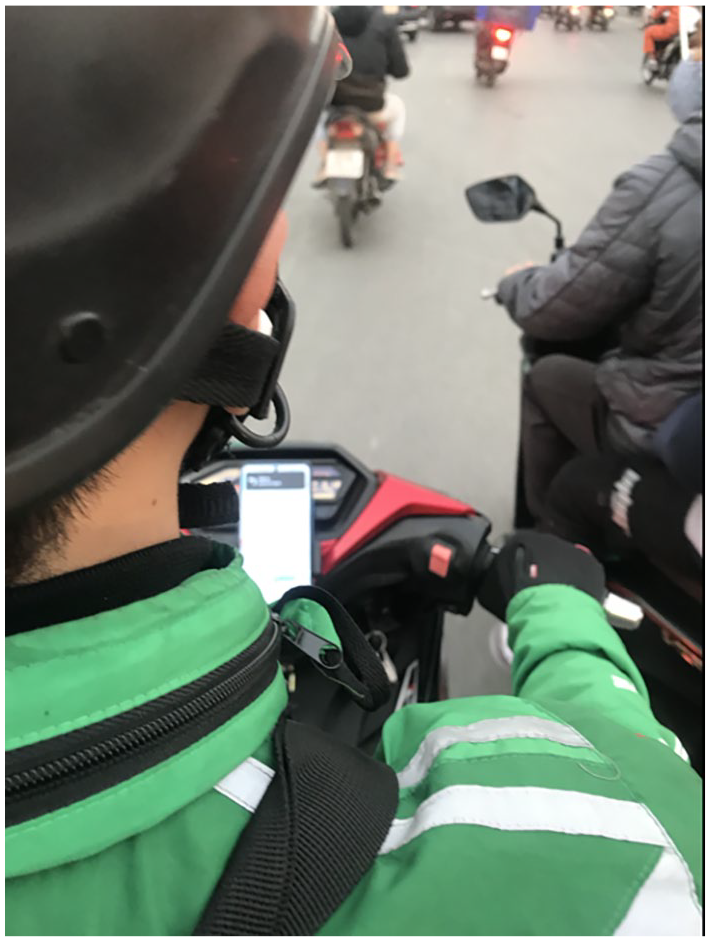
View from the back of the bike in Hanoi, 14 December 2022. Photo by Giang Nguyen.
Racing through the labyrinthine streetscape of Hanoi, ride-throughs enabled the author to learn how Grab workers dealt with real-life challenges and their algorithmic implications. Overall, 64 interviews were conducted, ranging from 10 to 60 minutes depending upon the distance traveled and traffic conditions. Conversations covered traffic jams, inclement weather, mealtimes, speed, distance, equipment, police evasion, and navigational strategies, among others. These interviews, conducted in different districts, and at different times and days, also revealed temporal and spatial variations in traffic patterns, night shifts, navigational skills, and resting and waiting. In its openness to daily surprises and willingness to embed in unfolding contexts, this ostensibly “unconventional” method upheld ethnography’s commitment to immersive, exploratory engagement with lived realities (Murchison, 2010).
Back-of-the-bike conversations were augmented by seven in-depth interviews when workers accepted the invitation to turn off their app. Data from these conversations were triangulated with workers’ online discussions in four highly active Facebook groups to confirm emerging patterns and derive new prompts for upcoming trips. Like other platform delivery workers (Bonini et al., 2024), Grab bikers rely on Facebook groups and instant messaging apps for peer support. The author befriended three workers through these platforms, who chatted with her several times a week, provided weekly summaries, and clarified her questions that arose during trips. All interviews were conducted in Vietnamese, the mother tongue of the author and bikers. Names were changed to ensure anonymity.
In the data analysis process, we employed an inductive approach to identify salient themes and patterns. We paid particular attention to drivers’ language, especially the ways they used different verbs to specify what “the app” did to them and how they reacted in response. The recurring actions of “training” and “taming the app” emerged as a significant analytical theme that ties workers’ stories together.
After engaging closely with Grab bikers in Vietnam, it become quite clear that in coping with growing economic pressures and harsher algorithmic control, gig workers have shifted from the optimism of grasping digital labor opportunities (ILO, 2021) or the opportunism of manipulating the app (Curchod et al., 2020; Jarrahi and Sutherland, 2019) to a realism focused on maintaining basic income while enduring precarity. Many of the workers encountered in Hanoi had effectively been driven off their land due to the devaluation of subsistence farming or other rural livelihoods. Forced into the city in search for a viable future, they compete with thousands of other precarious single men for a dwindling supply of rides. In 2023, it was also common to meet Grab bikers who fled to the capital city after being rendered redundant by industrial factories in the surrounding provinces due to the pandemic. For these heavily dispossessed migrants, taming the algorithm is not merely an optional extra, a “nice to have,” but rather absolutely core to their survival.
Taming the algorithm
How to tame the algorithm? Given Grab’s intense conditions and extreme competition, this is not an abstract question for workers, but key for survival. Every GrabBiker we encountered had their own “theory” of how to manage their relationship with the algorithms, derived from empirical trial-and-error testing in the field. Drivers would often say the app “will know,” “prioritize,” “rank,” “give,” “take into account,” and so on. Each biker brings into their “theorization” a set of personal goals, bodily habits, psychological limits, and adaptive capacity. GrabBike workers in Hanoi often used two specific verbs “tame” (rèn) and “train” (luyện) to capture this routinization of productivity aimed at attaining regular rides from the platform. The app is considered “tamed” when there is a sort of shared ground between the workers’ goal and the app’s daily operation. To attain this goal, a worker must grasp how the app “sees” the world and perform their tasks accordingly.
We identify three “moves” that drivers make in response to algorithmic logics. Each of these moves is in reality a mode of labor, a cluster of related approaches, practices, and strategies. These modes are distinct but overlapping, intertwined in complex ways. While these moves are chaotic or contradictory in the reality-of-the-streets, we show how workers manage to pull them together into a consistent pattern of productivity recognizable by the algorithm.
Improvising
First, taming the algorithm requires improvisation. When working for Grab, everything comes with a small reward (called “gems” or ngọc) but nothing can be earned too easily (i.e. if you want more “gems” you must navigate rush hour or risk waiting longer). The contradictory forces of rewarding and punishing, inherent in the platform’s design, capitalize on the driver’s capacity to improvise his way across algorithmic challenges. Given these tensions, drivers frame Grab as an augmented reality game that combines real-world traffic obstacles with virtual challenges via smartphones and Global Positioning System (GPS) technology. In this gig-working-as-game-playing framing, improvisation means being able to figure out the “rules” of the algorithmic game that works for you, that is, understanding how the app “thinks” while you are on the go. In other words, the driver must theorize their relationship with “the app” while simultaneously navigating through the busy streets of the capital city.
Consider how Tuấn, a highly confident GrabBike worker, extemporizes his way to “tame the app.” With great clarity, Tuấn explained the pros and cons of not only the four major services (passengers, food, parcel, and grocery) but also spelled out the intricate differences between two dozen subservices. “I mainly deliver food because my strategy is to get as many short trips as possible to collect the maximum amount of gems, and I don’t mind waiting at the restaurants.” Of course, food delivery improvisation differs from passenger improvisation. Similarly, grocery or parcel delivery would lead to different theorization and anticipation regarding how “the app thinks.” Hence, Tuấn’s conclusion is simple: “You must know what you want.”
As of June 2023, each completed food delivery gives Tuấn 25 gems, which is significantly higher than the 14 gems for a passenger trip. If he could collect over 950 gems a day (approx 38 food trips), he would receive the highest bonus level of about US$15 (350,000 VND) for that day. Attaining this bonus was a significant achievement because it accounted for roughly 30% of his expected daily earnings. The more Tuấn unpacked the deal, however, the more troubles it involved:
You must learn to avoid long trips because although you are still paid per kilometer, you will get fewer trips, thus fewer gems. You need to know the roads very well, too, because you must be as quick as possible during the prime hours. Otherwise, the app will prioritize someone else who is faster than you and won’t give you regular trips. So you must really know your area and should not venture too far out of it. Once you stay long enough within certain neighborhoods, the app will know your best zone and give you food trips within. I turn off my app when I can’t avoid a far-away delivery and turn it on when I return to my area. But you must be careful too, because if the app is turned off for too long, you might lose your daily bonus for not being active enough.
So if gems are visible and tangible, how to attain those gems through rides is far from clear. On one hand, Tuấn’s experiential knowledge from 5 years in the trade had taught him that ritualized movements and faster speed would increase his positive visibility under the algorithmic radar, thus “training” the GrabBike app to “know” his optimal zone and “prioritize” him over slower workers. On the other hand, he must learn to render himself invisible when his movements might be read unfavorably by the app.
Being able to anticipate the app’s “next move” and calibrate their working routine accordingly was central to rideshare workers’ labor of improvisation. In Tuấn’s experience, the algorithm would correlate his productivity with specific restaurants and give him more orders from the restaurants where he had the most high-yielding activities. To match this logic, he had to understand the restaurants’ fluctuating popularity at different mealtimes and tailor his movements to form a pattern the algorithm could pick up:
When there seem to be fewer trips and longer waiting times between trips, I often head toward my familiar restaurants [quán ruột]. In the morning or at noon, I usually wait next to the congee store on Trần Nhân Tông street. I almost always get at least two orders from there. [We have] fewer trips in the afternoon, but I might still have some orders from my favorite milk tea shop in Phố Huế. Each biker should have their stable stores, and the app will rank you among the best choices for those stores. These stores are like safe places to return to when I have to wait for too long between trips.
The improvisation described by Grab workers contrasts sharply with framings of platform work as tightly regimented. For Altenried (2022), for instance, platforms are a new kind of digital factory. In the drive toward control and maximum efficiency, automation aims for cookie-cutter labor. Work gets chopped up into standardized tasks, discrete units which can be consistently repeated. Testimonies of Grab workers instead align with a far more open-ended conceptualization of platform labor (Cameron, 2022). Platform work typically has no fixed building, no fixed schedule, and no fixed tasks. How do workers adapt to these fluid and unclear conditions? Based on 4 years of ethnographic research, Cameron (2022) suggests that workers treat it like a game. These games may have rules, but they cannot be “won” by rote formula or a mindless repetition. Instead, they require spontaneity and creativity, an aliveness to prevailing conditions.
So while platforms certainly impose core metrics (e.g. ratings, reviews), the way to achieve these metrics is left remarkably open-ended. Platforms provide no winning formula. Instead, workers must gradually come to grips with the work, the customers, and the marketplace, often discovering through trial-and-error what works and what does not. In a sense, each worker must construct their own “algorithm” for achieving success (Munn, 2019: 110). On Airbnb, this might mean strategically positioning a home as a weekend retreat. On Appen, this could be recognizing high-value tasks and remembering non-paying clients. And on Lyft, this might involve the affective labor of “reading” a customer and responding strategically.
One source of improvisation stems from changing rules. On GrabBike, rules are adjusted almost every few days without warning. Changes may include the number of gems given for each service, the number of accepted trips needed for rewards, a shift from daily to weekly productivity rankings, added tax deductions, and new “prime” hours. In various Facebook groups for GrabBike workers in Vietnam that we followed, changed rules were a significant conversation topic, accompanied by a mixture of confusion and improvised “tips” to address them.
While platform scholarship has stressed the power of algorithmic rules, rules are transient not static. Written into code, rules can be altered instantly with each software update. Platforms leverage this ability to constantly adjust metrics and add new requirements. As one worker stressed, the platform changed rules almost every single week, with over 70 updates since he started (Huws et al., 2018 [2017]). Such rules are disorienting, bringing chaos rather than order. Frequently changing rules are not a source of certainty but of uncertainty (Stark and Pais, 2020). As rules change, so must workers, improvising to account for the new conditions.
Scrambling
Second, taming the algorithm requires scrambling, a term that captures the subjective quality of frenetic activity demanded by platforms. Platform work is extremely performance-oriented work. The platform’s regime of sensors and data points allows this performance to be recorded in meticulous detail, with personalized targets and gamified elements, like Grab’s gems, all attempting to drive the worker to new levels of productivity.
Nothing testifies to the internalized imperative of speed more than the GrabBike workers’ language of emergency. Interviewed drivers in Hanoi almost always used the verb “run” [chạy] to describe their work. “Sometimes, it was extremely hot at noon. People don’t want to go out for lunch. (I had) so many food deliveries that I ran until 2 pm without a minute to eat.” In this statement, not having “a minute to eat” was a positive description of “a good day” because the interviewee had more orders than he could handle. Running was both intrinsic to the job and attached to extra suffering—“running” under the burning sun, “running” on the pavement to beat the estimated delivery time, and “running” with an empty stomach. For drivers, you were lucky if you were busy. Don’t complain. Just run.
The sense of urgency was further signaled in the way drivers used the specific verb “nổ” to depict how “the app” announced a new trip on their smartphones. Being a radically short and strong verb, “nổ” literally means “to explode,” as for grenades, bombs, and guns. In the context of rideshare work, “nổ” meant “to alert” or “to ring” in a forceful way. But the term also connotes the driver’s constant state of being vigilant or on-edge, alert to possible shock or danger, like stepping through a minefield. Or else, “nổ” highlights the startling reaction of the drivers when they must instantly switch between extreme boredom and extreme rush—a mind-draining contrast that defined the day for Grab drivers. You waited and waited, vigilantly, then suddenly it “exploded.” And you just “ran.”
The temporal pressures exerted by platforms are well documented. “When you’re working, you can’t even think of relaxing,” stressed one worker (Chen and Sun, 2020), “not even for a second.” For Chen and Sun (2020), platforms carry out temporal arbitrage, cultivating an expectation of on-demand service from customers which necessitates a hectic tempo from workers. Algorithmic management establishes the conditions for high work intensity—fast-paced work and effort with long or irregular hours and heavy emotional and time demands (Anwar and Graham, 2021). Highly competitive and fast-paced online labor markets require workers to perform intense technology-enabled work (Umair et al., 2023). These studies foreground the power of algorithmically driven platforms to determine the pace of labor.
Yet, if scrambling seems straightforward, it becomes multifaceted on closer inspection. From the platform’s perspective, scrambling is simple: a particular number is met or maintained. The driver meets the estimated delivery time. However, from the worker’s perspective, this performance is a negotiation of competing demands. To obtain the maximum rate, a driver must successfully beat estimated times during heavy rain or in rush hour. In other words, it is not enough to be fast; one must be fast despite conditions that require slowing down. These tensions between algorithmic pressures and real-world contingencies echo workers on other platforms, who describe temporal demands as “mission impossible at times” (Chen and Sun, 2020).
In Hanoi, GrabBike work meant being torn between competing demands. Consider, for example, how Hùng, a Grab grocery deliverer, explained the troubles involved in picking up a shopping list from the Lotte Center in Liễu Giai Street just half-kilometer away. From the platform’s perspective, all supermarkets were the same, and the half-kilometer was a short distance. Hence, the payment for this short trip was relatively low, and the estimated delivery time was negligible. But, as Hùng elaborated,
this Lotte Mart runs sales all the time, so online customers flood in, and the queue for Grab orders is so long that a 20-minute wait is considered quick already. Sometimes I have to wait for more than half an hour.
During this long wait, he could not risk leaving his motorbike unattended and had to pay 5000 VND for an underground parking space—a fee that was already 40% of his future earnings for this short delivery. To get the parking payment redeemed, the worker must take time to meet the supermarket’s receptionist to claim a parking pass. This meant more waiting, because “there was a long queue in front of the reception too.”
When asked why he still chose grocery service despite these troubles, Hùng highlighted benefits such as shorter trips, more gems, and relatively less competition. Most importantly, he could speed up without having to worry about bad reviews from passengers. “When the road is clear, I sometimes go up to 70 km per hour, and I run on the pavements in rush hours.” His emphasis on speeding up “when the road is clear” makes sense given that Hanoi streets, especially those in the Liễu Giai area, are notorious for prolonged traffic jams and rapid flooding in heavy rain. While the troubles of waiting, congestion, and flooding introduced an immanent sense of uncertainty to rideshare workers, the platform rendered these troubles invisible, leaving the workers with the task of maintaining quick delivery in an environment of chronic belatedness (Figure 2).
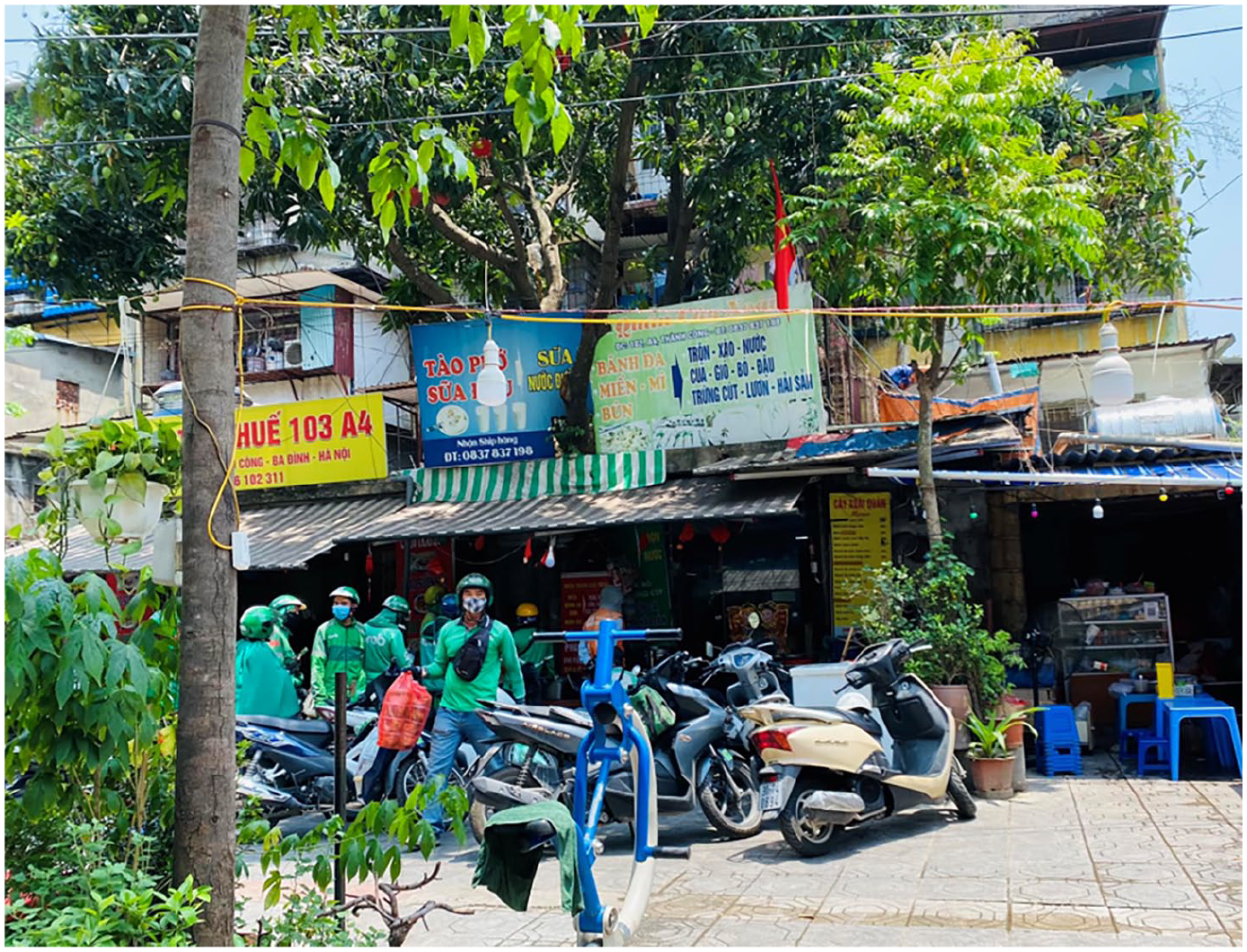
A food store at noon packed with waiting GrabBike workers, 25 December 2022, Photo by Giang Nguyen-Thu.
To wait now but sprint later, to chance flooding or fines—scrambling represents a multivalent intensity which pulls the worker in many directions. Disparate demands and the risk-reward of possible responses must be assessed in real time. Such “omni-directional” intensity cannot be solved through a singular muscular strategy, no matter how heroic. Instead, we see a cognitive and emotional load that requires evaluative judgment in a high-stakes situation. Scrambling demands a full-spectrum performance and draws from the full subjective field of the worker. This constant holistic demand, in a highly accelerated environment and with their livelihoods at stake, explains the physical, emotional, and mental toll reported by workers on platforms. The fast pace, isolation, and rule-based management of platform work lead to experiences of loneliness and powerlessness among workers (Glavin et al., 2021). Wang et al. (2022: 6) found that platform workers had lower mental health and life satisfaction—and that their results echoed platform studies from Germany, the United States, and China. For the algorithm, scrambling is optimal; for workers, scrambling is a multifaceted and accelerated exhaustion.
Enduring
Third, taming the algorithm requires enduring. It is not enough to carry out exemplary performances once or twice. Indeed, the platform is full of “new chickens” (gà mới) who pour out their energies and exert a superhuman effort—only to give up days or weeks later as the toll becomes too great. No, these high-level performances must be consistently achieved over an extended period. This is what separates the “successful” worker from the failed worker.
Endurance aims to register a worker’s labor as stable and legible so the platform grants them regular work. Endurance is a strategic pretense: despite endless improvisation and scrambling, one must keep on working as if there is no precarity. The rule of the game was clear to all workers: the platform only took productivity into account. In this sense, taming the app meant to let the platform know that you had managed to tame yourself. Managing the app was thus essentially about managing your working subjectivity.
Each Grab worker had their self-tested threshold of how long the taming process took, but the general rule was about 60 to 100 days—a significant time investment that not all newbies were prepared to suffer. Moreover, each day was extremely long, with durations of 12 to 14 hours echoing other studies of Grab in Indonesia (Novianto, 2023; Purnawan and Musliadi, 2019). An experienced worker explained,
If you first join Grab, you should run patiently for 12 to 14 hours a day. Ideally, the working hours must be the same every day, like when you turn the app on and off. Keep doing that for two or three months, and then you don’t have to worry about getting regular work. When the app already runs smoothly, you can reduce [working time] to 10 hours without a problem.
But even when the app already ran “smoothly,” the fear of losing this hard-won stability was imminent. As one worker said, “the app forgets quickly,” and the general perception of workers was that platform memory was notoriously short. When a worker had a couple of weeks off due to sickness or family business, the app would misbehave, and the worker would have to redo the training process again until everything was “smoothened” again.
While it was true that the Grab company adjusted their rules almost weekly, the core message was consistent: endurance and loyalty would be rewarded. Job priority and financial bonuses were always given to those who demonstrated their hard work for a long time. For example, a larger labor pool in the wake of COVID-induced unemployment led to a new policy that removed new workers’ ability to switch between services. Those joining after 1 June 2021 were forced to stick to a preselected “combo” of either passenger, food, or parcel service, or all, without being able to switch among these options (Grab, 2021). “Faithful” workers who joined early and stayed with the platform for a longer time thus gained a significant incentive over “newbies” for being able to choose the kind of service that suited different time windows along the day. This policy thus sent a clear message that loyalty was a desirable quality. As of June 2023, this policy had created a bitter rivalry between “old” and “new” workers, a feud frequently vented on many Facebook worker groups.
Enduring, like the other practices discussed above, has both a technical and an ontological dimension. In simple terms, it looks very different from algorithmic and worker perspectives. Technically, enduring is the construction of a pattern tied to a particular worker. A pattern, by definition, is not an isolated incident or a one-off anomaly. In the context of information systems particularly, patterns are “recurring sequences of data over time that can be used to predict trends” (Wigmore, 2023, emphasis ours). Patterns are not generated instantly but must be formed, a process of pattern formation that takes place across a particular duration. Technically then, pattern formation proceeds via a cold and rational logic: one data point is added to another and another, gradually forming a larger sequence which can be understood as a broader trend or consistent behavior.
However, while enduring is registered by the platform as pattern formation on a technical level, it is experienced by the worker as suffering on an ontological level. Endurance is a repetitive struggle over many days that takes its toll on the physical, mental, and emotional state of the worker. Endurance looks like water dripping off a soaked body as he drives through monsoon rains. Endurance plays out as heat exhaustion as drivers sweat in rising temperatures beneath stifling Grab jackets. And endurance takes the form of a wild oscillation between intense scrambling and long periods of bored waiting. To accrue a sequence of favorable numbers, drivers must undergo a sustained period of hardship and distress. Drivers are wide-eyed about endurance as a bitter but necessary element of the game. In this sense, endurance is actively embraced by workers as a key strategy for taming the algorithm.
Improvisation + scrambling + endurance = productivity
If the platform worker can successfully perform these three “moves”—mobilizing a mixture of physical performance, tacit knowledge, risk evaluation, psychological resilience, and dogged perseverance—then they establish routinized productivity. The driver has successfully “felt out” how the algorithm operates (improvisation), they have juggled competing demands to deliver a productive performance at bodily limits (scrambling), and they have managed to repeat this feat until it is recognized as a pattern (enduring).
Routinized productivity is an algorithmically ideal pattern of labor that has been made technically legible. This is the goal that Grab bikers strive for, the desired end-result of all their strategic activity. A worker registered as “routinely productive” is a worker who will be consistently chosen for tasks. While aspirational, this certainly does not guarantee comfort or affluence. Workers are only “assured” of a steady stream of low-paying tasks. Moreover, routinized productivity must be maintained in the system. According to workers, taking a holiday or a sick leave penalizes their statistics, disrupting this desirable pattern. Intense work must be resumed as quickly as possible if this desirable signature of labor is to be re-established.
Routinized productivity is technically simple and ontologically fraught. The platform privileges a certain combination of metrics, routines, and achievements that represent an ideal worker. Such workers can consistently deliver the platform’s product of a ride, professionally, and on-demand. According to the logic of the platform (and the broader logic of capital), the incentivization and creation of this figure make perfect sense. It is natural or even incontrovertible to extract the maximum labor-power from this worker for the maximum accumulation of capital.
However, the platform’s version of this worker is highly simplified, a skeletal array of integers over time, attached to a user ID. This algorithmic figure completely fails to account for the lived reality of the worker. Achieving and maintaining routinized productivity are an experience suffused with suffering, a barrage of extreme heat, angry customers, algorithmic pressure, emotional demands, and cognitive loads. This specificity matters because it represents the actually existing working conditions of the worker. By algorithmically bracketing out these conditions, companies can refuse to take responsibility for them. The risks, injuries, and abuse needed to actually achieve routinized productivity are borne silently by the worker; the platform only “sees” an optimal performer.
Tamed but still ferocious: conclusion
Taming the algorithm returns some control to workers without fundamentally disrupting the systemic inequalities maintained by platform logics. “You have to be realistic” is a regular refrain of Grab workers. We term this stance platform realism, a pragmatic posture adopted by workers situated halfway between hope and cynicism. Grab workers are cynical about their own power in the face of platform logics, asserting that they understand the game rather than necessarily being “on top” of it. Workers obtain some control, but this control is partially gained through adapting or acquiescing: the algorithm tames you as much as you tame the algorithm. This insight aligns with other studies that highlight the ability of platforms to cultivate forms of self-exploitation (Gajewski, 2022). Platform mechanisms shift exploitation from management to the worker’s inner self, compelling them to follow unstated imperatives due to their precarity (Vieira, 2023). Yet, if taming is limited, emerging from a clear-eyed realism, we suggest it bestows a set of modest but meaningful advantages.
First, it increases predictability. For new workers, the platform appears highly opaque, a typical black box (Pasquale, 2015) that cannot be unpacked or understood. In this framing, the algorithm is a decision-making agent whose decisions seem illogical or even random. Taming the algorithm, even if partial or inaccurate in some respects, alters this perception. The algorithm aims to carry out work in a certain way, it has a particular set of criteria, and, for this reason, it will reward some behaviors and punish others (Munn, 2018). In short, it operates on a particular logic. A logic can be grasped, adjusted for, and even anticipated to some degree. This transformation removes some of the chaos and contingency that pervades platform labor, especially for new recruits, and provides a basic sense of stability.
Second, it improves survivability. If the practices discussed above can be effectively carried out and the algorithm successfully “tamed,” then the platform will begin to reliably assign jobs to the worker. Certainly, working conditions remain bleak or even brutal, with 12+ hour days in difficult or even dangerous conditions. But a core issue of platform labor—not enough work (Graham and Anwar, 2019; Tubaro and Casilli, 2022)—is resolved adequately if not ideally, ensuring that drivers receive enough rides and a baseline level of remuneration that accompanies it. Every day, the worker will earn enough money to cover gasoline, food, and rent. These are the material requirements needed for labor reproduction (Burawoy, 1976), for sustaining oneself and continuing to endure.
Third, it cultivates futurability. Once the worker can reliably count on jobs and survive from day to day, they can begin to construct a future, to make plans and project themselves into them. Work remains bleak but the question of survival recedes (slightly) into the background, allowing workers to save a little, to dream a little, to build up rather than starting every day from zero. Berardi (2017) described futurability as a multiplicity of immanent futures; key to the concept is that the future is not foreclosed or entirely determined. By mastering and anticipating platform logics, workers can break open the future-on-rails that precarious platform work tends to produce. They can begin to envision an alternative life after the platform—a stepping stone allowing them to return to the countryside with savings or own their own food stall in the city.
Even these nominal benefits have limits. For instance, while taming may make platform work more viable from day to day, it still seems fundamentally unsustainable long-term. High levels of air pollutants in Hanoi pose a high health risk (Tang et al., 2020), joining stress, fatigue, musculoskeletal and urinary disorders as health risks for rideshare drivers (Bartel et al., 2019). All of this casts doubt on the ability of a worker to sustain 12+ hour days in harsh conditions for years on end. Indeed, Posada (2022) argues that platform work is inherently unsustainable because it consistently exposes workers to social and economic risks, undermines their ability to regenerate themselves, and negatively impacts their well-being. The result is high “churn” as large numbers of laborers find it intolerable and desert the platform (Van Doorn, 2017). If sustaining is one question, what exactly is being sustained is another. A worker who has tamed the algorithm can sustain a life, but it is a “bare life” (Kitiarsa, 2014), a stripped-back existence of working and sleeping with brief respites of eating, waiting, or occasionally visiting friends. Obtaining a more capacious life, with time for friends, family, and leisure, is really only possible by exiting the platform altogether.
So while the platform algorithm may be tamed, it is still ferocious. Workers are not empowered so much as enabled to simply keep working. Such agency does not reach the level desired by platform scholars, where workers seize the means of production, “hack the system,” or attain some pinnacle of autonomy. However, this does not make taming a naive projection or self-deception. Indeed, talking to workers highlights their deep awareness of their degree of agency. Based on this awareness, taming accepts and intervenes in actually existing platform conditions, weaving between the two poles of Freedom and Unfreedom or Control and Uncontrol in platform debates. Workers ratchet down their ambitions when theorizing and responding to platform logics, striving for an ability-to-endure that is both more bleak but more concrete. The aim is to live with the algorithm rather than overthrow or escape it.
Taming offers several contributions for several different disciplines. First, taming and the broader outlook of platform realism steer a path between the binary poles of freedom/unfreedom that tend to characterize debates around worker autonomy in platform studies. The modest but meaningful advantages attained by workers do not fundamentally alter the platform’s brutal conditions but simply unlock the ability to keep going. Second, taming, with its moves of improvisation, scrambling, and enduring, is an accessible but rich conceptualization, given in workers’ words, that captures key responses to platform logics while allowing room for tension and contradiction. While certainly acknowledging prior studies, we suggest this schema offers a useful tool to take up and apply to broader contexts.
Platform realism puts its finger on a condition that has slowly germinated and expanded. To be sure, maintaining a “realistic” attitude is not a new experience for industrial workers. Chinese electronics workers, for instance, have long embraced a survival mode in the face of assembly line speeds and exploitative conditions (Chan et al., 2020; Ngai, 2005)—a kind of factory realism. Platform realism continues but intensifies this trajectory. Workers seek concrete ways to endure conditions, but algorithmic models separate workers, actively (if incompletely) undermining previous practices of solidarity and collective resistance.
As platformization expands, becoming a blueprint for the future of work, we expect to see this stance of platform realism reappearing in care work, academic work, retail work, and countless other sectors. We can see the faint outlines of a novel subjectivity emerging around this digitally remade labor, a political subject that fails to be political in the conventional sense (Munn, 2024). Identifying this stance located between hope and cynicism, this “living with” subject advances our understanding of the politics of contemporary labor regimes. In taming the algorithm, we also shape ourselves.
Footnotes
Funding
The authors disclosed receipt of the following financial support for the research, authorship and/or publication of this article: Dr Giang Nguyen-Thu received funding from the Australian Government through the Australian Research Council’s Discovery Early Career Researcher Award funding scheme (project number DE240100202).
