




Abstract
Many of the world’s languages are endangered or vulnerable. For some of these languages, a presence in technological domains can illustrate vitality and demonstrate relevance to the lives of younger speakers. A presence on social media is often seen as particularly significant for younger speakers due to their high levels of social media use. This article explores the presence of Cymraeg (the Welsh language) on TikTok. Through the analysis of a corpus of 200 videos, the article reveals a complex and richly bilingual content space with considerable intermingling of Cymraeg and English. Commenting on videos and engaging in a text-based conversation with the content creator and other audience members is shown to be a significant activity. The corpus demonstrates that Cymraeg is being used, taught, discussed and promoted on TikTok. This article contributes to an ongoing assessment of the digital vitality of Cymraeg and extends our understanding of the role that social media can play in supporting the sustainability and vitality of minority languages.
Introduction
Research suggests that over 1500 of the world’s 7000 languages could be lost by the end of the century, due to a range of different factors (Bromham et al., 2022). While many languages are currently endangered, many more are vulnerable. These languages typically exist as minority languages in a bilingual or multilingual relationship with a dominant majority language which in many cases is a colonial language. In some contexts, there is also a strong cultural dimension to this relationship, particularly in the case of Indigenous language communities. Many of these languages have experienced historical oppression (Chiblow and Meighan, 2022) and continue to experience language shift, with speakers gradually giving up the use of their minority language in favour of the majority language (Fishman, 1991). As the language loses its functional domains over time, it loses prestige and ultimately speakers lose their competence in the language. This loss of language is often accompanied by a loss of Indigenous knowledge and ways of knowing. This loss will often include historical and cultural knowledge, knowledge of the land and places, and Traditional Ecological Knowledge (Chiblow and Meighan, 2022). For example, studies have shown that indigenous languages are linguistically unique repositories of plant-based medicinal knowledge – that is, the knowledge is held only in a single language (Cámara-Leret and Bascompte, 2021). Indigenous perspectives on the connection between language, land and people also provide insights into language sustainability and sustainable ways of living, which in turn have implications for the health and well-being of members of a language community (Ferguson and Weaselboy, 2020).
The use of a minority language across multiple domains (Fishman, 1991) and the extent to which a minority language is used in new domains and the media (UNESCO Ad Hoc Expert Group on Endangered Languages, 2003) are often seen as indicators of a language’s vitality and its ability to resist language shift. It has been argued (Eisenlohr, 2004) that the use of a minority language in new technological domains in particular can bring a number of additional benefits, including an association with modernity and relevance to modern lifestyles, which may be particularly important in maintaining language use among younger speakers.
However, minority languages are often excluded from emerging technologies, such as Artificial Intelligence, and typically lack the resources to develop these themselves. These technologies also embody a particular cultural perspective or knowledge system which may make them inappropriate for particular language communities (Meighan, 2021). For example, the idea of unrestricted information sharing through a social media platform may not be acceptable in a culture where information sharing was traditionally selective, based on gender, age or cultural status (Featherstone, 2013). This cultural and linguistic digital exclusion has led some to suggest that minority languages are facing a ‘digital time-bomb’ (Hicks et al., 2018) or ‘digital language death’ (Kornai, 2013). An assumption which underpins many of the notions of digital language death is that there is a single minimum level of digital service provision that all languages need to meet. A failure to meet this standard will inevitably result in digital language death. However, this asserted standard is typically based on what large, majority languages already have and does not take into account the context of the particular minority language, the needs and aspirations of its speaker community, the role and use of technology within that community or myriad other relevant factors. Indeed, notions of languages progressing if they use electronic technology (Crystal, 2000: 141), claims of the desirability of an association with modernity (Eisenlohr, 2004) and visions of ‘digital ascent’ (Kornai, 2013) are grounded in Western ideals of technological progress (Meighan, 2021). Work that seeks to define, measure and promote digital linguistic vitality (e.g. Ceberio et al., 2018; Gibson, 2015) needs to be contextualised in order to have value.
Indigenous and minority language communities should also not be viewed simply as passive recipients or victims of digital technology and there is increasing interest in decolonising these technologies (Meighan, 2021). There are many examples of what Meighan (2021) terms ‘Indigenous socio-technical self-determination’ in which communities develop or adapt digital technology to suit their own local needs (e.g. Dyson et al., 2006; Landzelius, 2006; Makalela and White, 2021). Computer-assisted language learning (CALL) is recognised as having particular potential (Galla, 2016), with benefits beyond just language learning, including the centring of cultural values and the building of relationships and identities (Chew and Tennell, 2023). CALL is also able to support diverse pedagogical approaches which better meet the needs of learners from Indigenous communities and promote wider learning of Indigenous worldviews and knowledge systems, leading to a decolonisation of language learning (Meighan, 2022).
Minority languages and social media
It is useful to consider social media in the broader context of three recent developments in the understanding of minority language media and minority language use. While these developments come with their own risks and challenges, they offer a powerful vision for the ongoing role of minority language media in supporting language sustainability and vitality.
The first of these is the decentralisation of minority language media production. Pietikäinen and Kelly-Holmes (2011) argue that there have been three key eras in the development of minority language media – the gifting era, the service era and, most recently, the performance era. The performance era is characterised by significant decentralisation of media production driven largely by technological advances, with resultant changes in media actors and agency. As a result of this decentralisation, ‘media products and processes are fragmented, individual, bottom-up, unpredictable and transient’ (Pietikäinen and Kelly-Holmes, 2011: 61). Audience members have wider choice and greater autonomy and are potentially empowered to become content producers themselves. Intertextuality and remediation of minority language media through sharing, uploading and linking is also prevalent (Kelly-Holmes and Atkinson, 2017).
The second is language hybridity. The performance era has seen a move away from ideals of linguistic purity and monolingual media, towards forms in which ‘the language forms part of a language and media repertoire which anyone can make use of or play with’ (Pietikäinen and Kelly-Holmes, 2011: 61). Hybridity and language mixing are accepted as normal and even limited language competences can be deployed and celebrated. Minority language media also drives meta-linguistic discourse (Kelly-Holmes and Atkinson, 2017). It can be argued that the performance era has led to the current state of hyperlingualism in digital communication (Kelly-Holmes, 2019).
The third is a network-centric perspective on language use. Due to increased personal mobility and technological developments, peoples’ social lives are now conducted across diverse physical and virtual spaces, challenging understandings of language use which are fixed only in notions of a territorial community (Jones, 2021; Lewis and McLeod, 2021). Understandings based on notions of communities of practice are seen as having more explanatory power than those based on traditional models of language communities (Grenoble and Whaley, 2021; Lewis and McLeod, 2021). There is a need to recognise the fluid and dynamic nature of speakers’ repertoires and language practices across time and across different networks and to consider language vitality in terms of these networks (Grenoble and Whaley, 2021). Social media provide a particularly powerful enabler of these networks (Cunliffe, 2021).
The potential of social media for minority languages has been discussed in a number of different language contexts (for an overview, see Cunliffe, 2019). It has been suggested that social media can also provide opportunities to foreground ‘indigenous interests, concerns, needs and languages in a way that differs from what traditional media can offer’ (Lindgren and Cocq, 2017: 135). It offers opportunities for both inreach (within the Indigenous community) and outreach (beyond the Indigenous community) communication. Among the possible benefits for Indigenous young people are performance of their Indigenous identity, a sense of empowerment and agency, and the strengthening of community and family connections (Rice et al., 2016).
It is, however, important to also recognise the potential for negative outcomes from social media. For Indigenous and minority language communities, this may include bullying, racism and hate speech (Rice et al., 2016). The use of a minority language may provoke bans, abuse, ridicule, requests for translations to be provided, or suggestions that other, separate spaces be created for using that language (Cunliffe, 2019: 457).
Minority languages and TikTok
The popularity of particular social media platforms waxes and wanes, platforms come and go and different platforms appeal to different demographics. The short form video sharing platform, TikTok, has achieved significant popularity since its launch in 2017, particularly among young people. In many ways, TikTok can be seen as an embodiment of the performance era. TikTok has been described by Zulli and Zulli (2022) as constructing ‘imitation publics’, due to its embodiment of mimetic principles of imitation and replication, which can been recognised as practices of remediation. Mimesis is observed as being the basis for sociality on the platform, distinguishing TikTok from other social media platforms.
Darvin (2022a) argues that while TikTok encourages mimicry and virality through the ‘mimetic logic’ inherent in its design and algorithms, there is a tension between this logic and the ‘agentive power of users’. Users are able to resist this logic, foregrounding local spaces and languages and developing ‘context-bound memes’ that enable them to present themselves as a unique self and from a specific context. Duffy and Meisner (2023) maintain that the governance of TikTok (and other social media platforms) – both formal and informal, human and algorithmic – systematically disadvantages marginalised creators and non-normative cultural expressions. Content creators are therefore forced to adapt strategies to circumvent platform policing or to adapt their content to conform.
In their examination of the #ThisIsMeChallenge hashtag, Vizcaíno-Verdú and Aguaded (2022) contend that TikTok is a platform that motivates activism and empowerment of marginalised groups. Fredericks et al. (2023) provide an example of this, involving the Aboriginal and Torres Islander peoples of Australia. Through empowering Indigenous agency and choice, community-led evidence-based messaging (including the use of TikTok) was used to refute misinformation around COVID-19 vaccinations. Another example is provided by Rétvári et al. (2022) who describe an arts-based intervention with young Hungarian Roma women, mentoring them in the use of social media platforms, including TikTok. The project aimed to empower the women so that they were able to use social media to express their cultural heritage and discuss contemporary issues, thereby challenging negative attitudes towards the Roma minority. The article suggests that these women are not just content providers, they are role models for their communities. Li and Kang (2021) seek to provide a framework for short form video production aimed at ethnic minority groups in China in order to protect cultural diversity and resist the loss of languages. Their analysis suggests that different cultural expressions will be effective for different cultures, depending on the cultural resources that are available and their specific appeal to audiences.
Lindgren and Cocq (2017) suggest that global social media might provide ‘a new dimension of multilingualism where several language groups interact, interplay and overlap’ (p. 148). Darvin (2022b) observes that multilingual users are able to provide different ‘layers of meaning’ on TikTok by moving between languages and language modalities. This hybridity and movement between languages is seen as a normal behaviour in a globalised world connected by social media.
As is often the case with minority languages, their use on TikTok is largely unstudied, and the few studies which do exist (including the study presented in this article) tend to focus on a small number of relatively well-studied languages.
Moshnikov (2022) conducted a survey into the online use of the Karelian language. While 40% of the 161 respondents used Karelian online on a daily basis, use on TikTok was relatively low compared with other social media platforms. Facebook was the most popular social media platform for consuming Karelian content (69% of respondents), with only 16% consuming Karelian content on TikTok. In terms of content production, Facebook was again the most popular at 54%, while only 2% of respondents produced Karelian content on TikTok. While use on TikTok is relatively low, Moshnikov reports that it represents part of a pattern of expanding Karelian language use across an increasing diversity of social media and other digital platforms and that the Internet is particularly important in supporting language vitality and sustainability in a community that is physically fragmented.
Ramati and Abeliovich (2022), through a study of Yiddish on TikTok, argue that the features of TikTok ‘build an infrastructure for language, heritage and cultural activism’ (p. 1) and that it ‘resonates and amplifies minority languages’ (p. 11). They report that Yiddish language presence is rapidly increasing on TikTok. They highlight the use of TikTok’s duet and stitch functions to combine existing content with new, to reuse sound from other people’s videos, facilitating what they term ‘network ventriloquism’, a form of remediation and intertextuality. They note complex linguistic intermingling, particularly between English and Yiddish, including learning, translating and explaining, as well as the interlayering of various languages in speech, graphics and text. There appears to be significant hybridity and language mixing in Yiddish content on TikTok.
Milà-Garcia and Tudela-Isanta present two studies of the use of Catalan on TikTok. One study (Milà-Garcia and Tudela-Isanta, 2022) explores the campaign for the creation of the #estiktokat hashtag on TikTok and its adoption as the reference hashtag for content in Catalan. They examine a corpus of 216 videos tagged with this hashtag, revealing details including content creators, audience engagement and languages used. The authors argue that the hashtag has created a space for Catalan on TikTok and that the use of Catalan on TikTok has become normalised. They also note that the increased use of Catalan on TikTok is in contrast to a general trend of decreased use of Catalan on the Internet in recent years. The other study (Tudela-Isanta and Milà-Garcia, 2022) examines the use of Catalan on TikTok and Twitch. The TikTok study adopts a similar approach, using several hashtags relating to the Catalan language to generate a corpus of 200 videos. The analysis includes language use and the variable representation of different varieties of Catalan. They note that the presence of Catalan on TikTok has been a bottom-up initiative by content creators rather than any top-down language policy, demonstrating the role of new actors in the Catalan media space.
The study presented in this article seeks to extend our understanding of the differing characteristics of minority language presence on TikTok and the opportunities that TikTok affords minority languages, through an examination of the presence of Cymraeg, the Welsh language.
Cymraeg
Cymraeg is a language spoken primarily in Wales (Cymru in Cymraeg), one of the constituent counties of the United Kingdom. Due to increased use of English, it became a minority language within Wales early in the 20th century, and UNESCO (2010) considers the language vulnerable. According to the most recent census in 2021, the language is spoken by 538,000 people (aged 3+ usually resident in Wales), representing 17.8% of the population of Wales (Welsh Government, 2022). Almost all Cymraeg speakers are also English speakers.
Following a referendum in 1997, certain secondary, and more recently primary, legislative powers were transferred from the UK Parliament to a devolved Senedd Cymru (Welsh Parliament). Among the devolved powers are those relating to education and Cymraeg. The language has had official status in Wales since 2011 and the Welsh Government (2015) has a strategy to increase the number of Cymraeg speakers to one million by 2050. There is a Welsh Language Commissioner who has a statutory duty to promote and facilitate the use of Cymraeg, to enforce standards and to investigate breaches of language rights where applicable. In the case of certain organisations (e.g. county councils), the Commissioner has powers to enforce legal compliance with a series of Welsh Language Standards, which include standards specifically relating to the use of Cymraeg on social media.
The language has broad support across the main political parties in Wales, including unionist parties as well as those campaigning for Welsh independence. Despite this, the activism that characterised Welsh language politics in the 1960s and 1970s continues to the present day. The language has a broad base of support among the population, including among non-speakers, and is generally regarded as an important element of Welsh culture.
The National Curriculum is followed by all state-maintained schools in Wales. Cymraeg is a compulsory subject in the National Curriculum until the end of key stage 4 (aged 16). This applies both to Cymraeg-medium and English-medium schools. Cymraeg provision in further and higher education in Wales is relatively limited.
The language has a degree of digital language vitality and its use is reported across a number of different social media applications, including YouTube (Cunliffe and ap Dyfrig, 2013), Facebook (Cunliffe et al., 2013b; Honeycutt and Cunliffe, 2010) and Twitter (Jones et al., 2013). The use of Cymraeg on social media is seen as particularly significant for younger speakers due to their high levels of social media use, though their use of the language online is often complex and influenced by a variety of factors (Cunliffe et al., 2013a; Johnson, 2013; Jones et al., 2022; Morris et al., 2012). The research suggests that the intended audience has a significant influence on a person’s choice to use Cymraeg or English in a particular social media post. Generally, where a post is aimed at a wide audience or an audience whose ability to speak Cymraeg is not known, English will typically be used. Cymraeg is typically used where a post is aimed at a known individual or specific audience that is known to be Cymraeg-speaking. This has led some researchers (e.g. Cunliffe et al., 2013a) to suggest that a person’s patterns of language use on social media broadly mirror their patterns of language use in their offline lives. According to Jones et al. (2013), after intended audience and topic, the factor that would most make a person more likely to tweet in Cymraeg was simply that it felt natural to do so.
However, there is also some indication that the particular social media application and the media formats it supports may also have an influence. Jones et al. (2013) reported that the perceived difficulty in using Cymraeg varied by social media application and a person’s frequency of Cymraeg use also varied by application. Noting that people uploading Cymraeg videos to YouTube appeared relatively unconcerned about their potential non-Cymraeg-speaking audience, Cunliffe and ap Dyfrig (2013) suggested this might in part be due to there being less need to understand language in video content as opposed to text content.
It has also been suggested that young Cymraeg speakers perceive English to be the language of information and communications technology (Cunliffe et al., 2013b). Social media may provide young people with one of the few digital spaces where they see Cymraeg being used.
A recent survey of primary school children (aged 7–11) in Wales found that 88% used electronic devices to watch videos a few times a week or every day (SHRN, 2023). Watching videos was more common than using electronic devices for playing computer games (72%), watching TV/films (71%), reading (62%), speaking to friends (62%) and speaking to family (51%). The survey also found that 48% of the children used a social media site or app a few times a week or every day. There was a large age gradient reported with this usage, rising from 31% in Year 3 (aged 7–8) to 65% in Year 6 (aged 10–11).
According to Ofcom (2022), 36% of adults (aged 15+) in Wales used TikTok, for an average of 34 minutes per day. However, TikTok is significantly more popular with those aged 15–24, with 79% of them using it for an average of 69 minutes per day. This age group spend more time on average per day on TikTok than on any other social media platform (with the possible exception of YouTube). 1
The SHRN and Ofcom data indicate that online videos generally, and online videos on TikTok specifically, are a significant medium for young people in Wales. It can therefore be argued that the presence or absence of Cymraeg in this medium may also be significant for young people in Wales and their ongoing use of the language.
Method
The method used in this study is similar to that used by Milà-Garcia and Tudela-Isanta (2022) and Tudela-Isanta and Milà-Garcia (2022). Their studies used hashtags and TikTok’s own search facility to generate a set of videos which were then sampled to form a corpus. This corpus was then examined in a bottom-up, data-driven fashion (Schellewald, 2021). Similar approaches have been used in studies of TikTok in different contexts (e.g. Lee, 2023; Vizcaíno-Verdú and Aguaded et al., 2022).
Sampling
A two-phase sampling approach was adopted in this study. The first phase involved using the search facility in TikTok to search for the hashtag #cymraeg. This hashtag was selected due to its apparent popularity, with some 82.2M views. This search produced a ranked set of videos associated with the hashtag. The basis on which videos are ranked by TikTok is not immediately apparent and does not appear to be based on a single criterion such as number of views. As the intention was simply to generate a corpus, the lack of clarity regarding TikTok’s internal search and ranking algorithms is not considered a significant limitation for this study. The 150 top-ranked videos were selected for the corpus.
In order to generate hashtags for phase 2 of the sample, the other hashtags used in those 150 videos were examined, focusing on those relating to Cymraeg generally, rather than those orientated specifically towards learning Cymraeg. This decision reflected the intention to study the wider experience of Cymraeg speakers (most speakers are not actively learning the language) and the observation that learning Cymraeg was already well represented within the phase 1 corpus. This examination identified several possible candidate hashtags: #tiktokcymraeg (3.7 M views), #tiktokcymru (226.3 K views), #siaradcymraeg (515 K views), #cymraegtok (2 M views) and #iaithcymraeg (130.8 K views). From these, #tiktokcymraeg and #cymraegtok were selected due to their relatively high number of views.
The search facility in TikTok was used to generate a ranked set of videos associated with each of the additional hashtags. The top-ranked 25 videos from each of the ranked sets were selected for the corpus, excluding any duplicates between the sets and videos which were already in the phase 1 corpus. These 50 videos were added to the 150 videos from phase 1, to form the final corpus of 200 unique videos. The corpus was collected in May 2023.
Data collection and coding
The videos in the corpus were then subject to data collection and coding.
For each video, the following data were collected: the account the video was posted by, the date it was posted, the number of views, the number of likes, the number of comments and the hashtags associated with the video in the Description.
The language used was coded for different elements of the videos; the language used for Speech, the language use for Text included in the video, the language used in any Music in the video and the language used in the video Description. Each element was coded Cymraeg, English, Mixed or Neither. Occasional use of English loan words in otherwise Cymraeg content was not coded as Mixed, but use of small quantities of Cymraeg in otherwise English language content (e.g. a greeting) was coded as Mixed, as the study was primarily interested in the use of Cymraeg. Even the use of a few words of Cymraeg in a video acknowledges the existence of the language, which demonstrates a degree of competence and use and enhances the presence of the language on TikTok. The deployment of even limited language competencies is normalised in the performance era. The occasional presence of languages other than Cymraeg and English was also recorded.
Following the approach used by Milà-Garcia and Tudela-Isanta (2022), the videos were coded using the communicative forms introduced by Schellewald (2021), which represent ‘platform-specific languages or memes, trends, and aesthetic styles that are specific to TikTok and the meaning-making practices of its users’ (p. 1439). The forms are Comedic, Documentary, Communal, Explanatory, Interactive and Meta.
In Schellewald’s original definition, the Meta form was intended to identify videos discussing TikTok itself. However, Milà-Garcia and Tudela-Isanta extended the definition to include videos with a meta-linguistic focus. This extended definition was considered useful given the nature of the study and was adopted.
Due to the significant presence of videos aimed at people learning Cymraeg, an additional Learning form was added.
As language-related forms, the Meta and Learning forms have particular significance, given the domain of study. In order to clearly identify the presence of the Meta and Learning forms and to better reflect overall the variety of video forms observed, a limited form of dual coding was introduced. Each video was coded with a maximum of two forms, one mandatory form (from Comedic, Documentary, Communal, Explanatory, Interactive, Meta or Learning) and, optionally, one additional form (from Meta or Learning).
Results and analysis
The results and analysis presented here attempt to give a sense of how Cymraeg is used on TikTok, how Cymraeg and English are intermingled and interlayered, and the meta-linguistic discourse that can occur when Cymraeg is used. While some of the dimensions of analysis were identified prior to the creation of the corpus, others, such as the discussion of meta-linguistic discourse, emerged during the exploration of the corpus.
Content creator accounts
The 200 videos in the corpus have been produced by 70 different accounts, representing a variety of media actors, including traditional media producers. In addition to personal accounts, there are accounts from organisations including small businesses, the traditional media, political parties and voluntary groups. Often these organisations have a specific connection to Cymraeg, for example, the Cymraeg broadcaster, S4C and Urdd Gobaith Cymru, a youth organisation which provides opportunities through Cymraeg.
In terms of the number of videos produced, two accounts dominate the corpus, @far.land.of.spareoom with 38 videos and @bfdavies with 23 videos. All other accounts have 10 or fewer videos in the corpus, with most accounts (45) only having one video in the corpus (Figure 1).
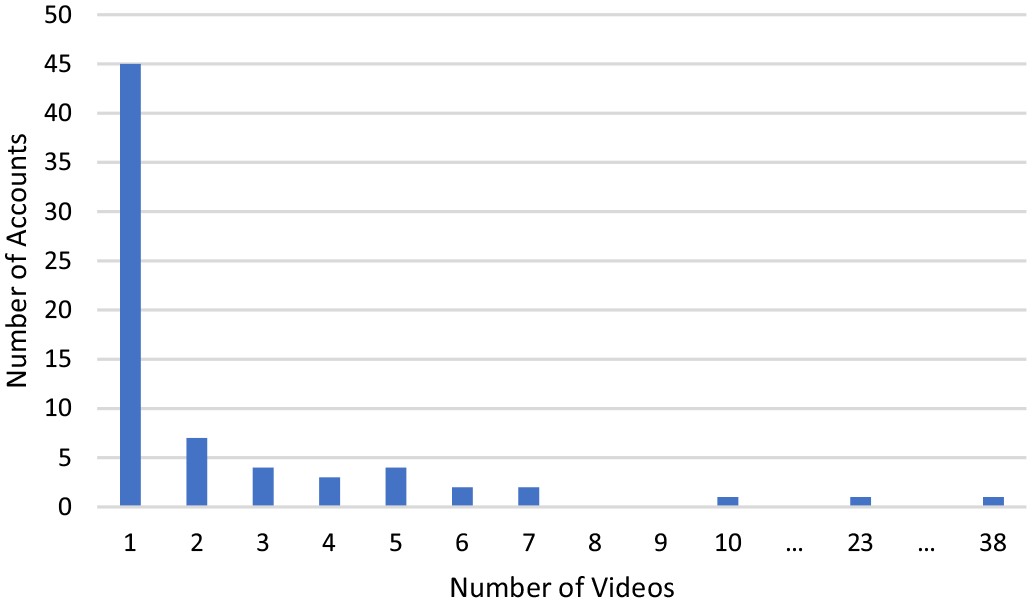
Number of videos per account (full corpus, n = 200).
The @far.land.of.spareoom and @bfdavies accounts have several characteristics in common. Both accounts are run by private individuals, exemplifying the opportunities available to non-traditional media actors. The accounts both have a focus on teaching Cymraeg and broader issues associated with the language, including its status and history. Both accounts feature a young female presenter and the videos typically involve the presenter directly addressing the audience, with a light-hearted and often humorous tone. The accounts both have significant following on TikTok, @far.land.of.spareoom has 82.5K followers and 3.2M likes and @bfdavies has 53.7K followers and 2.2M likes. 2
Accounts signalling Cymraeg affiliation
One of the challenges facing content creators producing TikTok content in Cymraeg is attracting an audience that wants to view such content. Content creators may therefore look for ways to signal to potential viewers that they produce Cymraeg content or have some other affiliation with the language as part of the expression of their online identity. In addition to using hashtags to tag specific videos, content creators may choose to signal an affiliation with Cymraeg in three other ways: in their account Username, in their account Name or in their account Bio.
Some account Usernames naturally demonstrate an affiliation with Cymraeg simply because the name of the organisation that owns the account reflects that affiliation. Examples include @colegcymraeg, @cymru (the Wales national football teams), @urddgobaithcymru and @hafanheulog (a small business). Accounts owned by individuals may also demonstrate an affiliation through their choice of Username, for example, @doctorcymraeg, @cymruluke (Cymru is the Cymraeg name for Wales) and @jack_cymraeg.
The second way an account may demonstrate an affiliation is through the Name. In personal accounts, this is often used as a strapline, rather than for giving the name of the person who owns the account. For example, the Name for the @far.land.of.spareoom account is ‘merchcymru <victory hand emoji>’ (Welsh girl), the Name for @welsh_videos is ‘dwi’n casau bobl saesneg’ (I hate English people). 3
The Bio provides a third opportunity for accounts to signal their affiliation. For example, the Bio of @basicallycatx includes ‘Welsh Speaker’, the Bio of @far.land.of.spareoom includes ‘I teach Cymraeg’ and ‘#NidFyNhywysog’ (Not My Prince) and @1miliwn includes ‘Cyflwyniadau a gweithgareddau Digwyddiadau ffair iaith Neud Cymraeg yn cŵl’ (Presentations and activities. Language fair events. Making Cymraeg cool).
While these practices can be interpreted as signalling an affiliation with Cymraeg, it is not clear what role, if any, they play in the day-to-day viewing decisions of audiences or the likelihood of them following a particular account.
Hashtags
Videos in the corpus were tagged with between 0 and 34 hashtags, with an arithmetic mean of 9.3 hashtags and a median of 8 hashtags. A total of 588 different hashtags appear in the corpus (treating text hashtags with an appended emoji as equivalent to the plain text hashtag). Three of the hashtags were composed solely of emojis.
Table 1 shows the number of videos using hashtags which occurred 10 or more times in the corpus. Those hashtags which were used as search terms to generate the corpus are indicated with an asterisk.
Number of videos using hashtags which occurred 10 or more times, by theme (full corpus, n = 200).
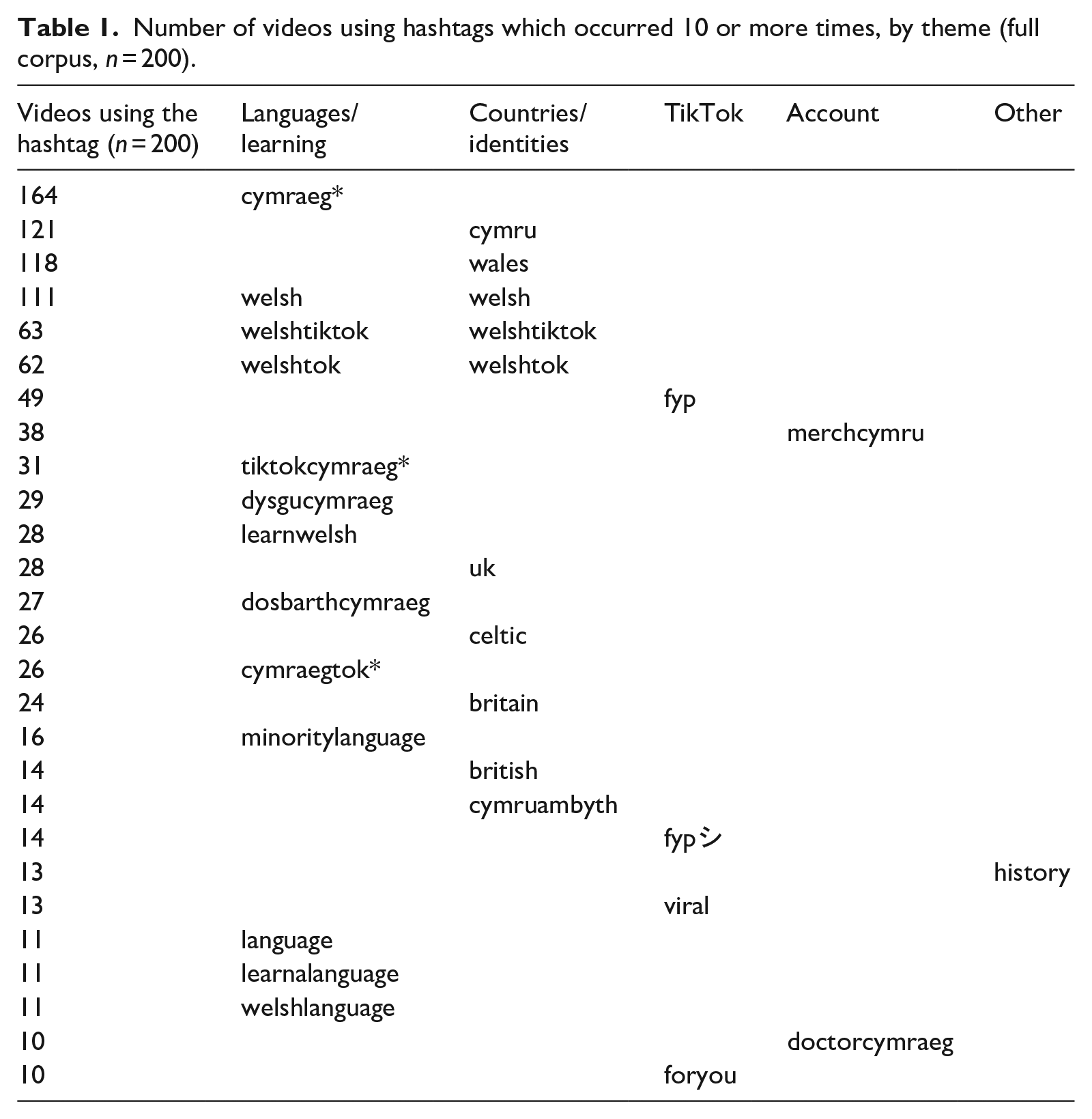
The use of hashtags can be considered a form of intertextuality and a mechanism for delineating communities of practice. The hashtags have been grouped by general theme. Languages/Learning contains those hashtags that appear to be related to languages or language learning. Countries/Identities contains those hashtags that refer to specific countries, national identities or ethic identities. When trying to determine whether a hashtag refers to a national identity or a language, there is a degree of ambiguity in the English language hashtags. For example, #welsh could be referring to Wales as a national origin, the Welsh language or the people of Wales. These ambiguous hashtags have been placed in both categories to reflect potential differences in intended meaning. The TikTok category contains hashtags that appear designed to influence TikTok’s selection algorithms. The Account category includes those cases where the name of the account producing the video is used as a hashtag for the video. The Other category contains the hashtags which do not belong in any of the previous categories.
The Languages/Learning and Countries/Identities categories account for most of the hashtags included in the table, presumably reflecting the intended communities to whom the content is primarily directed.
Leaving aside the TikTok and Accounts categories, the hashtags contain a number of different Cymraeg and English words and phrases (Table 2). The full set of hashtags from the corpus also contains a small number of hashtags in other languages. There appear to be pairs of Cymraeg/English hashtags, indicating a degree of bilingual hashtagging: cymru/wales; cymraeg/welsh (ambiguous)/welshlanguage; dysgucymraeg/learnwelsh; tiktokcymraeg/welshtiktok (ambiguous); cymraegtok/welshtok (ambiguous).
Hashtags by language (hashtags occurring 10 or more times, excluding TikTok and Account category, full corpus, n = 200).
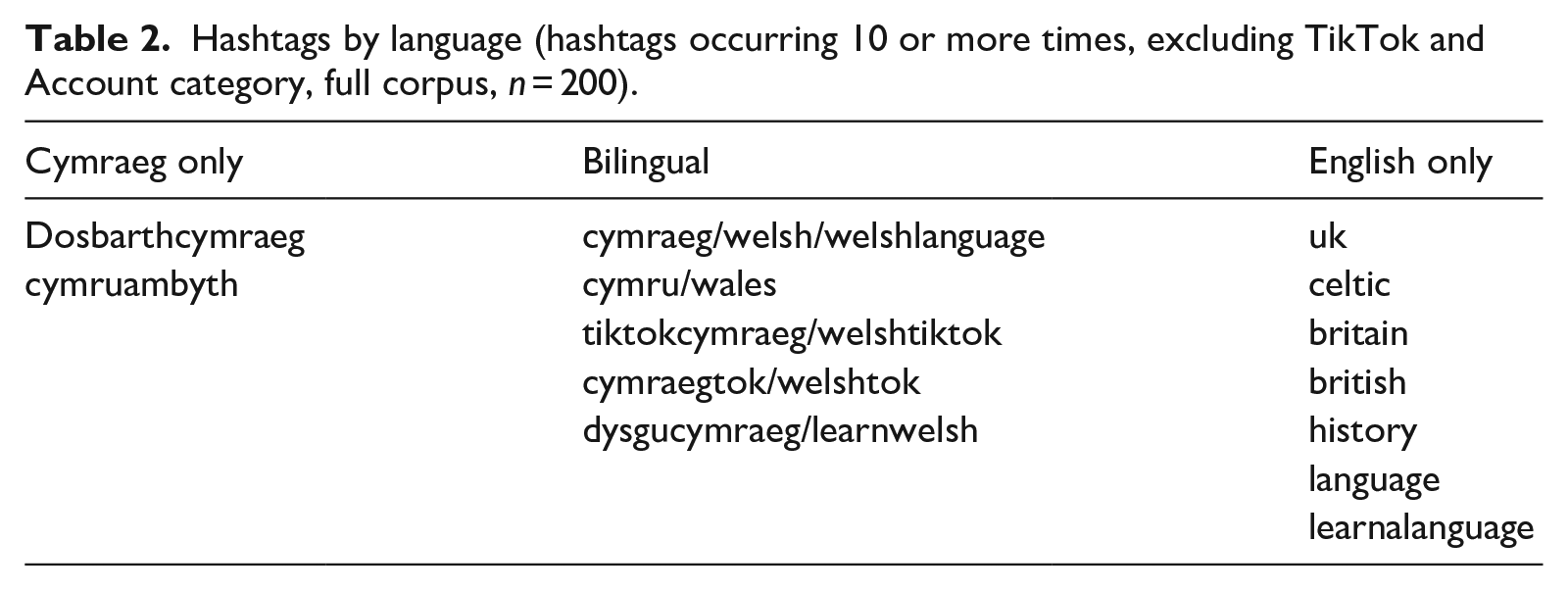
A number of the hashtags appear only in the English language: uk, celtic, britain, minoritylanguage, british, history, language, learnalanguage.
A few appear only in Cymraeg: Cymruambyth (Wales for ever), Dosbarthcymraeg (Welsh language class).
The #cymraeg hashtag was used for content language identification and meta-linguistic content identification, but there were also cases where #cymraeg was used even though Cymraeg was not used or discussed. The variable patterns of hashtag use are similar to those observed on Twitter by McMonagle et al. (2019).
The use of hashtags in English as well as Cymraeg appears to be aimed at attracting a non-Cymraeg-speaking audience but may also reflect the bilingual lives the content creators lead and the bilingual character of many of the videos they produce. There are examples of bilingual tagging in the corpus, some using directly equivalent phrases, for example, #welshhistory/#hanescymru and some using conceptually equivalent phrases, for example, #annibyniaeth/#indywales. Code switching between hashtags has been observed on other social media platforms, for example, on Twitter (Jurgens et al., 2014).
There was some use of English language meme hashtags, for example, #ootd, #dayinthelife, #grwm and #kissmarryk1ll and TikTok function hashtags #stitch and #duet, even when the Speech language of the video was Cymraeg. There were also a few examples of Cymraeg variants of these, for example, #grwmcymraeg. The hashtag #grwmcymraeg is interesting in that it consists of an English language acronym and the Cymraeg name for the language, effectively a code switch within the hashtag. Hybridity may exist even at the level of an individual hashtag.
Bilingual practices
The studies by Darvin (2022b) and Ramati and Abeliovich (2022) have described the complex intermingling and interlayering of languages and the layering of meaning that multilingual users engage in across different modalities on TikTok. TikTok evidently provides content producers and audiences with multiple opportunities to exploit their linguistic repertoire. In order to explore this, videos in the corpus were coded for language use in four modalities:
Speech – the languages used for spoken content in the video.
Text – the languages used for text overlay and subtitle content in the video.
Music – the languages used in sung content in the video, or in background music in the video.
Description – the languages used in the Description text associated with the video.
Language was coded as Cymraeg, English or Mixed (Table 3). The Mixed code was predominantly mixed Cymraeg/English, though a small number of videos mixed Cymraeg and/or English with other languages in Speech (Breton, Spanish, French, German) and Text (Breton).
Language use by modality (full corpus, n = 200).
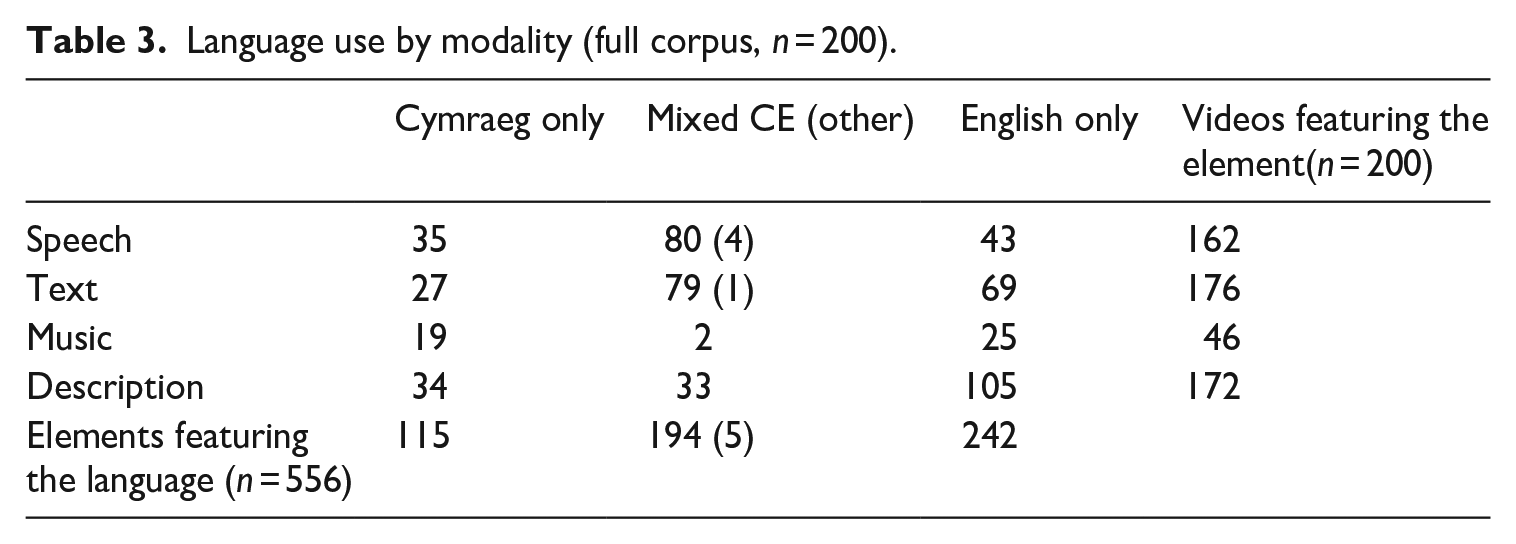
Of the 556 individual elements coded, 313 (56%) included Cymraeg and 439 (79%) included English. While English is still the dominant language by this measure, this is a highly bilingual content space. In terms of the content of the videos alone, very few are completely monolingual and the mixing and blending of languages is the norm. Approximately 10% of the videos in the corpus contained content coded only for Cymraeg and approximately 25% contained content coded only for English (Table 4).
Monolingual videos by modality (full corpus, n = 200).
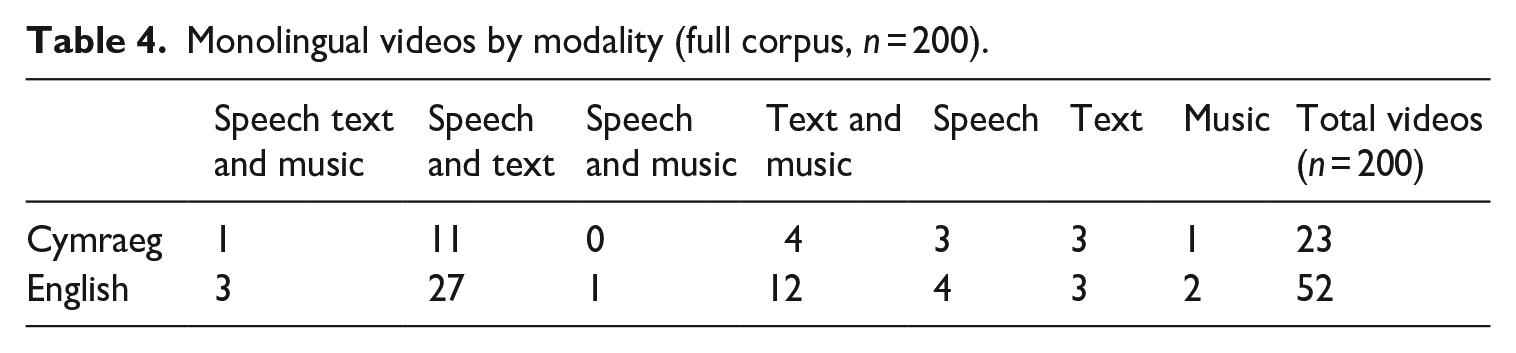
In common with previous studies, the hybridity observed is complex and multifaceted. The content of a particular video may be bilingual, but the languages are not necessarily used equally or equivalently. The mixture of elements and the potential for different elements being in different languages allows bilingual content creators the opportunity to exploit their bilingual repertoire. For example, combinations of Speech and Text in different languages can facilitate the use of Cymraeg without concerns about excluding non-Cymraeg-speaking audiences. In some cases, a particular language audience may be explicitly identified and addressed. For example, a video from @far.land.of.spareoom with Speech and Text in Cymraeg contains a single item of Text in English at the beginning of the video, ‘Not translating because this video is for Cymraeg speakers’. TikTok appears to provide bilingual content creators a higher degree of linguistic freedom than some other social media platforms.
Communicative forms
Videos corresponding to all of the communicative forms available in the coding were observed in the corpus (Table 5). Overall, there was a significant presence of videos coded as Meta or Learning, accounting for almost half of the corpus. Thus, the language itself is a significant topic focus within the corpus.
Number of videos per communicative form (full corpus, n = 200).
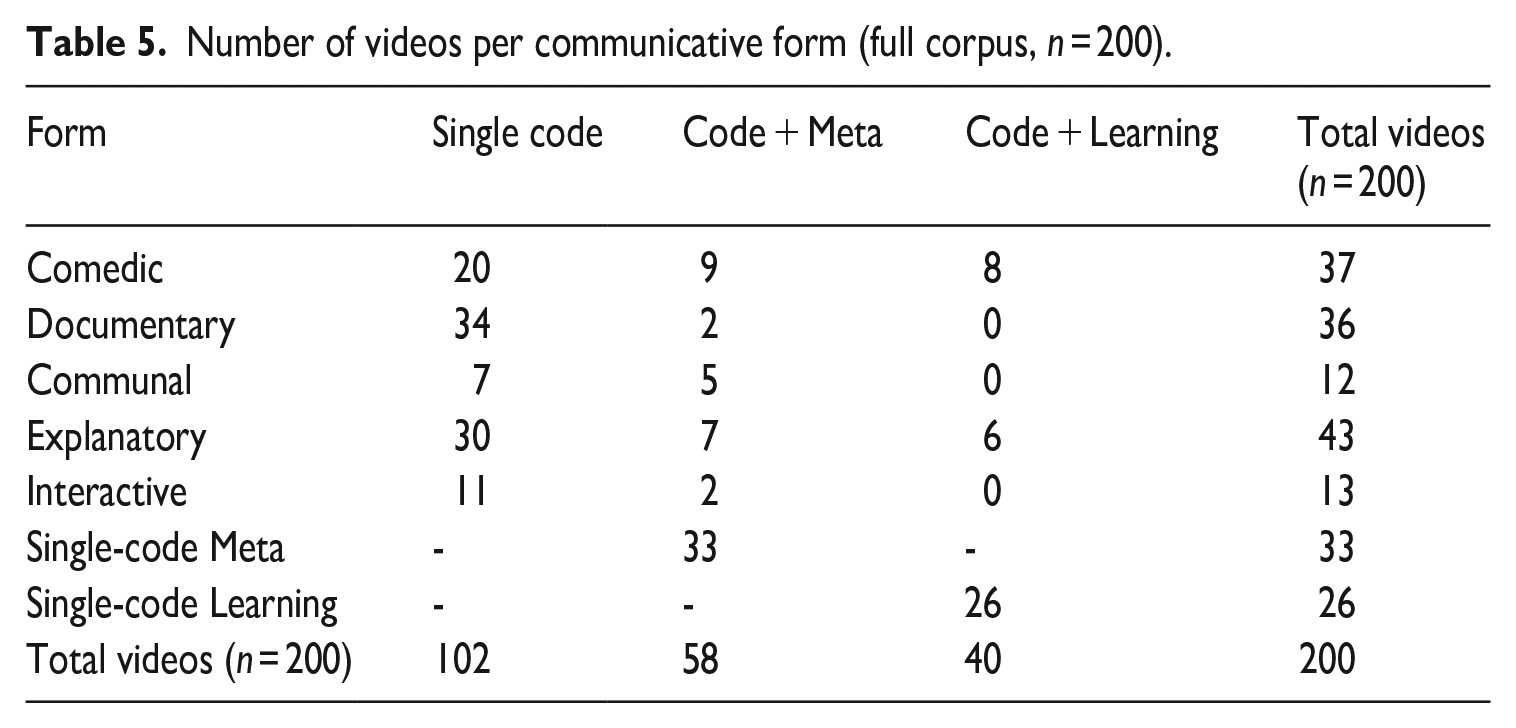
Explanatory, Comedic and Documentary forms videos occurred in broadly similar numbers. Interactive and Communal were less common. Meta form videos feature strongly as a single category but also in combination with other forms. This indicates that the meta-linguistic discussions on TikTok are taking many different forms, including Comedic and Interactive. Learning features by itself and in combination with two of the other forms, Explanatory and Comedic.
Example videos
Three videos are described below, using elements of the Visual-Verbal Video Analysis method (Fazeli et al., 2023). These videos illustrate some of the different communicative forms and provide examples of the complex hybridity present in the corpus.
My favourite native <Welsh flag emoji> names
Content creator: @bfdavies
Context: Bethan Davies’ @bfdavies account has significant presence on TikTok (53.7K followers and 2.2M likes) and in the corpus (23 videos). The account focuses on teaching Cymraeg, but also touches on broader issues associated with the language.
Video source: https://www.tiktok.com/@bfdavies/video/7226049543584959771
Video hashtags: #wales #welsh #cymraeg #cymru #welshtiktok #welshtok #dosbarthcymraeg
Video duration: 01:29
Video uploaded: 25 April 2023
Views: 16,700
Likes: 1995
Comments: 152
Communicative Forms: Comedic, Learning
Overview:
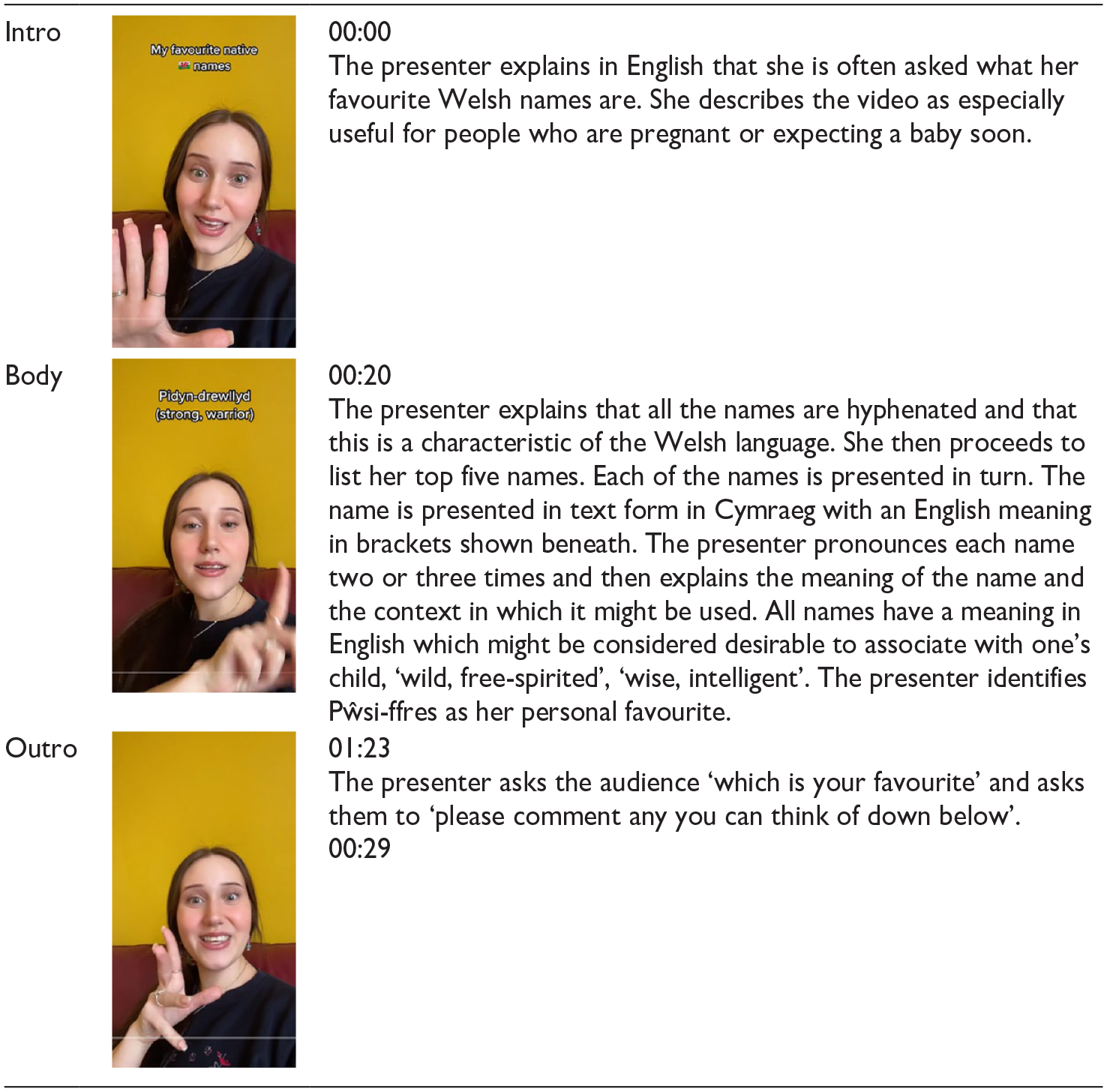
Main character: Bethan Davies
Setting: Interior. Appears to be her home
Camera: Single, front view, closeup
Objects: None
Background: Back of seat and wall behind.
Speech: The speech is predominantly in English. The intro includes a greeting in Cymraeg. The pronunciation of each name is in Cymraeg, and ‘second’ is enumerated in Cymraeg.
Gestures: There are general emphasis gestures throughout. Top five is accompanied by a splayed finger gesture. Points to the text for each name when pronouncing. Points down when asking audience to comment down below
Gaze: Directed at audience
Tone: Informal, animated and friendly, with a degree of intimacy
Dress: Appears casual
Images: Welsh flag emoji included in title text
Text: Text is used for two different purposes in the video, as a title for the video and to illustrate the spelling and meaning of each name.
The video is titled in text in English ‘My favourite native <Welsh flag emoji> names’. This text is visible from the start of the video and during the intro. It is displayed at the top of the frame. The text disappears without a transition.
As each name is discussed, it is shown in text form in Cymraeg, with the meaning in English shown below in brackets. It is displayed at the top of the frame. The text appears and disappears without transitions.
The same font and text style is used for both the title text and the names text. The sans-serif font and presentation are understated and formal. The text is white with a black outline. The text is overlaid directly on the video.
Soundtrack: None
Commentary
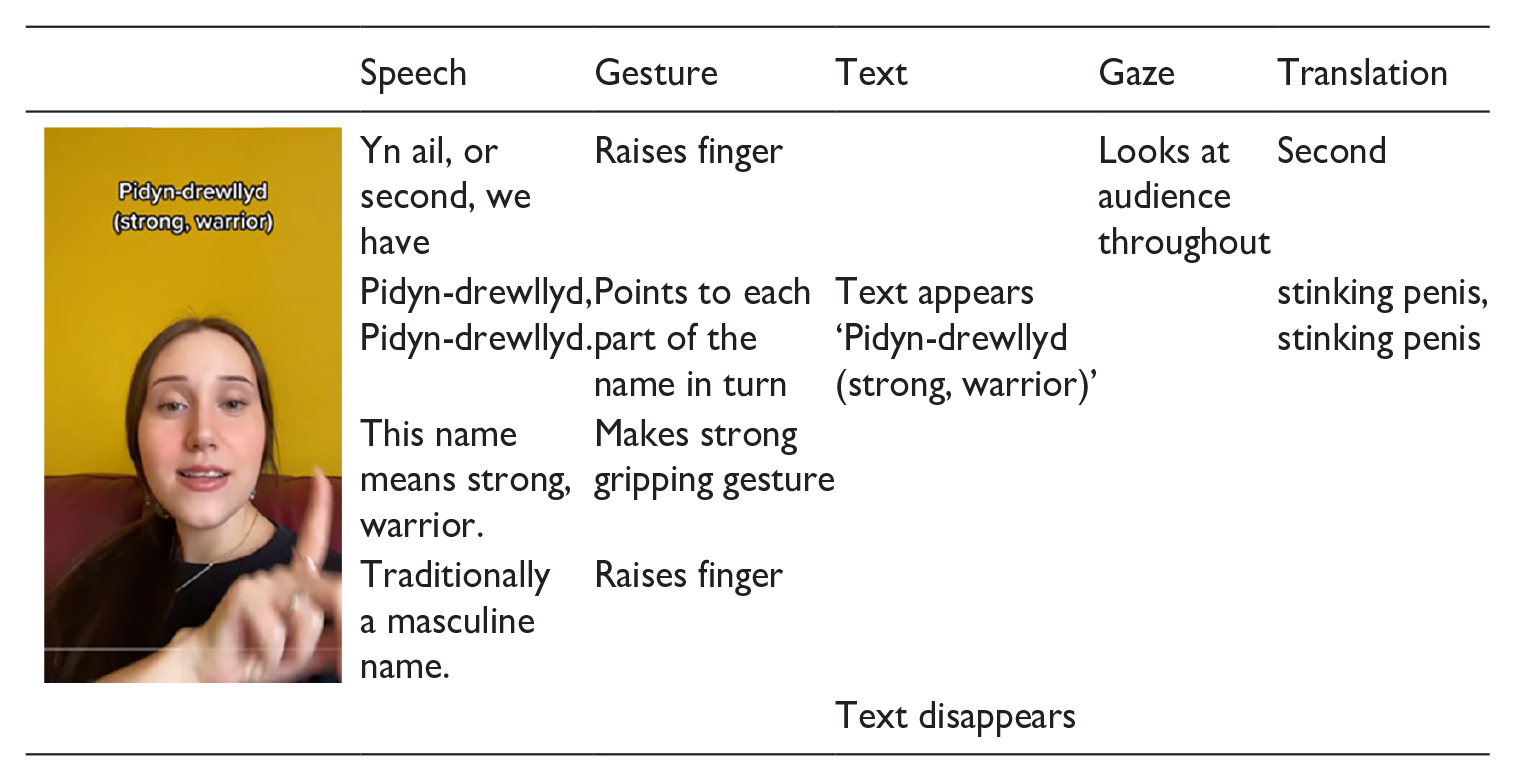
To the non-Cymraeg speaker, the video would appear to be an example of a fairly popular TikTok genre, favourite child names in a particular language. However, as shown above, the actual meaning of the ‘names’ is very different.
While the video can be seen as a playful application of a bilingual repertoire for humorous effect, or as a parody of the many Welsh names videos on TikTok, it also references wider issues of cultural appropriation, the Welsh names are described as ‘native’ and ‘indigenous’. It is interesting to note that @bfdavies has also uploaded a non-parody Welsh names video.
In the video, the presenter directly asks the audience to engage through the comments section, promoting intertextuality and remediation.
Sheg
Content creator: @sagetodz
Context: Sage Todz is a Welsh rapper who performs in both Cymraeg and English. In interviews 4 he has said that more Cymraeg music is needed in certain genres where it is underrepresented, in order to promote the language to young people.
Video source: https://www.tiktok.com/@sagetodz/video/7228530739577523502
Video hashtags: #welsh #welshrap #welshdrill #cymraeg #internationalrapper #fyp
Video duration: 00:39
Video uploaded: 2 May 2023
Views: 9271
Likes: 816
Comments: 60
Communicative Forms: Documentary
Overview:
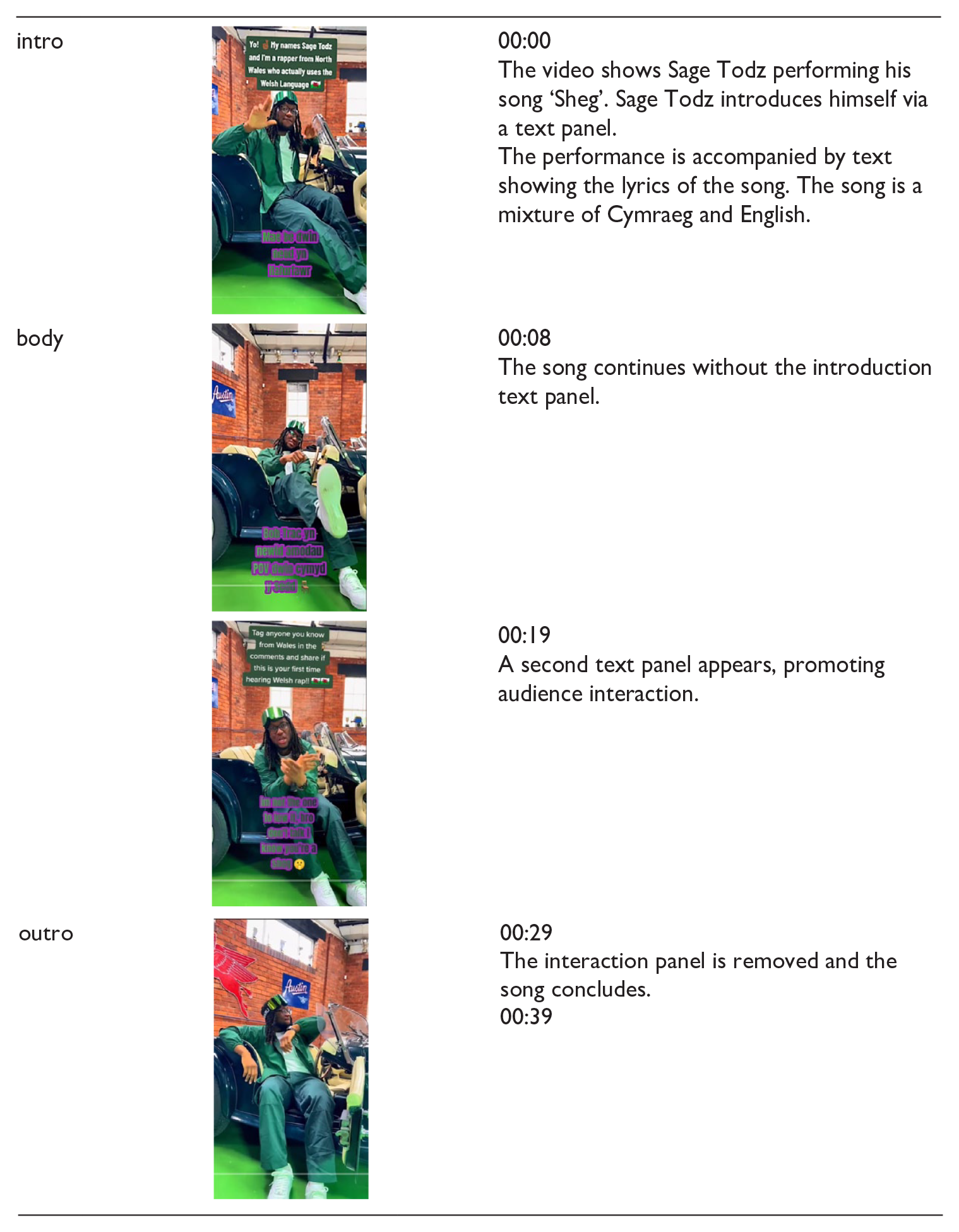
Main Character: Sage Todz
Setting: Interior. Seated in vintage sports car in a car sales room.
Camera: Single, front view, wide shot.
Objects: None
Background: Another vintage sports car and brick wall behind featuring motor-related signs and trophies.
Speech: The song is sung in a mixture of Cymraeg and English.
Gestures: Variety of gestures following the rhythm of the song, sometimes related to the lyrics, sometimes directed at the audience, steers the car.
Gaze: Generally directed at audience, sometimes looking away from audience.
Tone: Performative, cool and edgy
Dress: Casual, cool, including ski goggles
Images: Crossed fingers and Welsh flag emoji included in title text panel. Assorted emojis included with the text presentation of the lyrics. Two Welsh flag emojis in second text panel
Text: Text is used for three different purposes in the video, on an introductory panel, to display the song lyrics, and on a panel promoting audience interaction.
The introductory panel is displayed from the start of the video. The panel is displayed at the top of the frame. In the text, Sage Todz introduces himself in English, ‘Yo! <Fingers crossed emoji> My names Sage Todz and I’m a rapper from North Wales who actually uses the Welsh Language <Welsh flag emoji>’. The same font and text style is used for both the introductory text panel and the text panel promoting audience interaction. The sans-serif font and presentation are understated and formal. The text is white and is presented on a dark green background. The text panel disappears without a transition.
The song lyrics are displayed phrase by phase, synchronised with the performance. The lyrics are presented in the same language as the song. Emojis are included in some phrases. The lyrics appear and disappear without transition. They are displayed in the lower third of the frame. The sans-serif font is larger than that used on the text panels and is coloured with a green gradient and outlined in purple. The text is overlaid directly on the video.
The panel promoting audience interaction appears towards the middle of the video. It appears without transition at the top of the frame. ‘Tag anyone you know from Wales in the comments and share if this is your first time hearing Welsh rap!! <Welsh flag emoji><Welsh flag emoji>’. The text panel disappears without a transition.
Soundtrack: The song is performed to rap music.
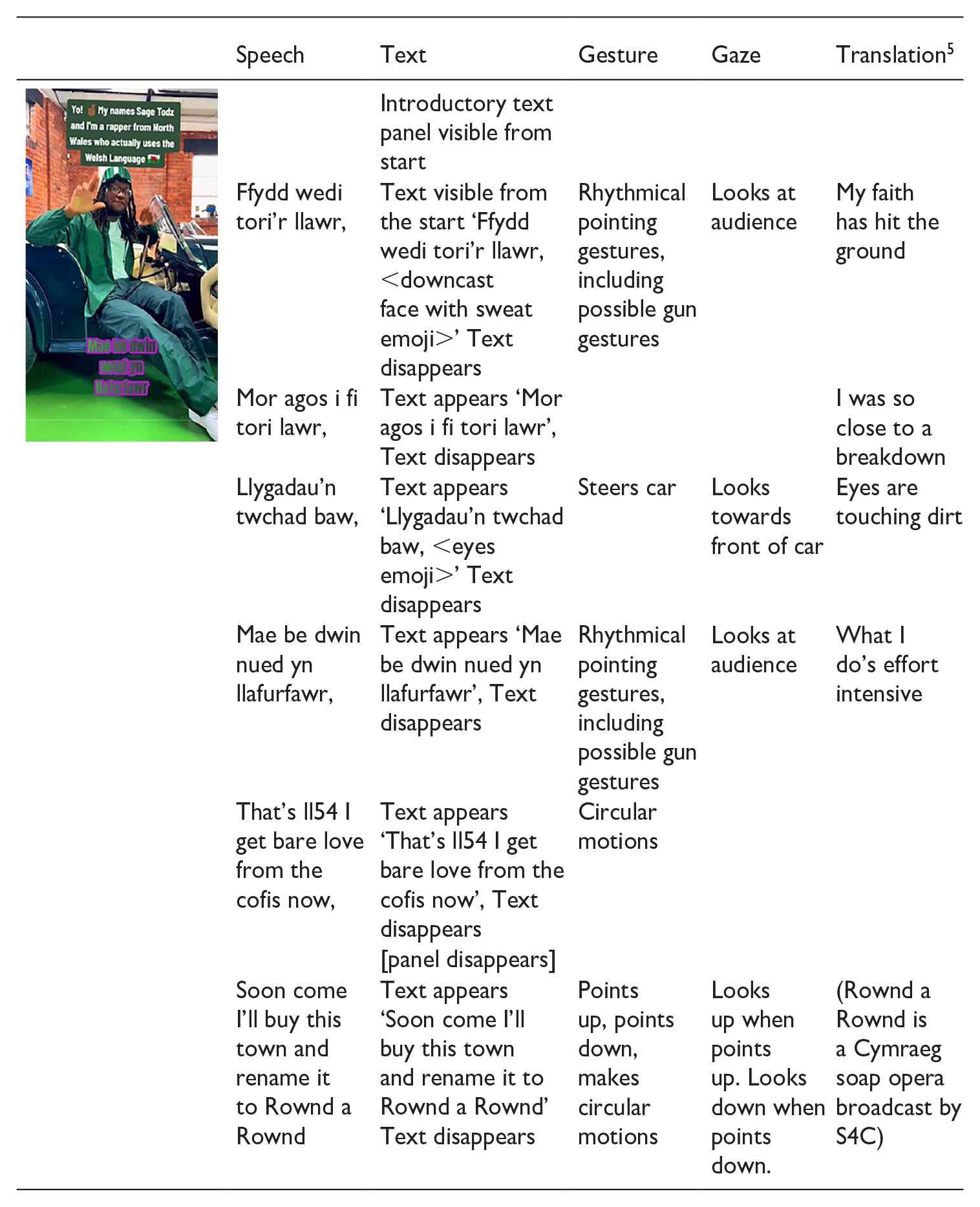
Commentary
The song mixes Cymraeg and English, but each contains different lyrics and the accompanying text is not used to provide translations. The song itself is hybrid; this can be seen as asserting equivalent value in the two languages and affirming the place of Cymraeg in rap culture and of rap as a valid expression of Cymraeg culture.
While the video is essentially a music video, it uses the two text panels to ‘break the third wall’ and engage more directly with the audience. Again the audience is invited to comment on the video, but also to share it through their networks.
The Official Video on YouTube is longer, with a wider range of shots and is more professionally produced. It also contains complete subtitles in English. It is not clear why there is this difference, it could be that the platform influences the content and presentation, or it may be due to different perceived audiences for YouTube and TikTok content.
Cymraeg versus Llydaweg
Content creator: @lwps4c
Context: @lwps4c is an account from the Cymraeg broadcaster S4C, associated with one of its series, Yn y Lŵp, which explores the music and cultural scene in Wales.
Video source: https://www.tiktok.com/@lwps4c/video/7131820920959683845
Video hashtags: #breton #welsh #cymraeg #llydaweg #lorient #interceltiquefestival #languages
Video duration: 01:06
Video uploaded: 14 August 2022
Views: 53,900
Likes: 4608
Comments: 155
Communicative Forms: Meta
Overview:
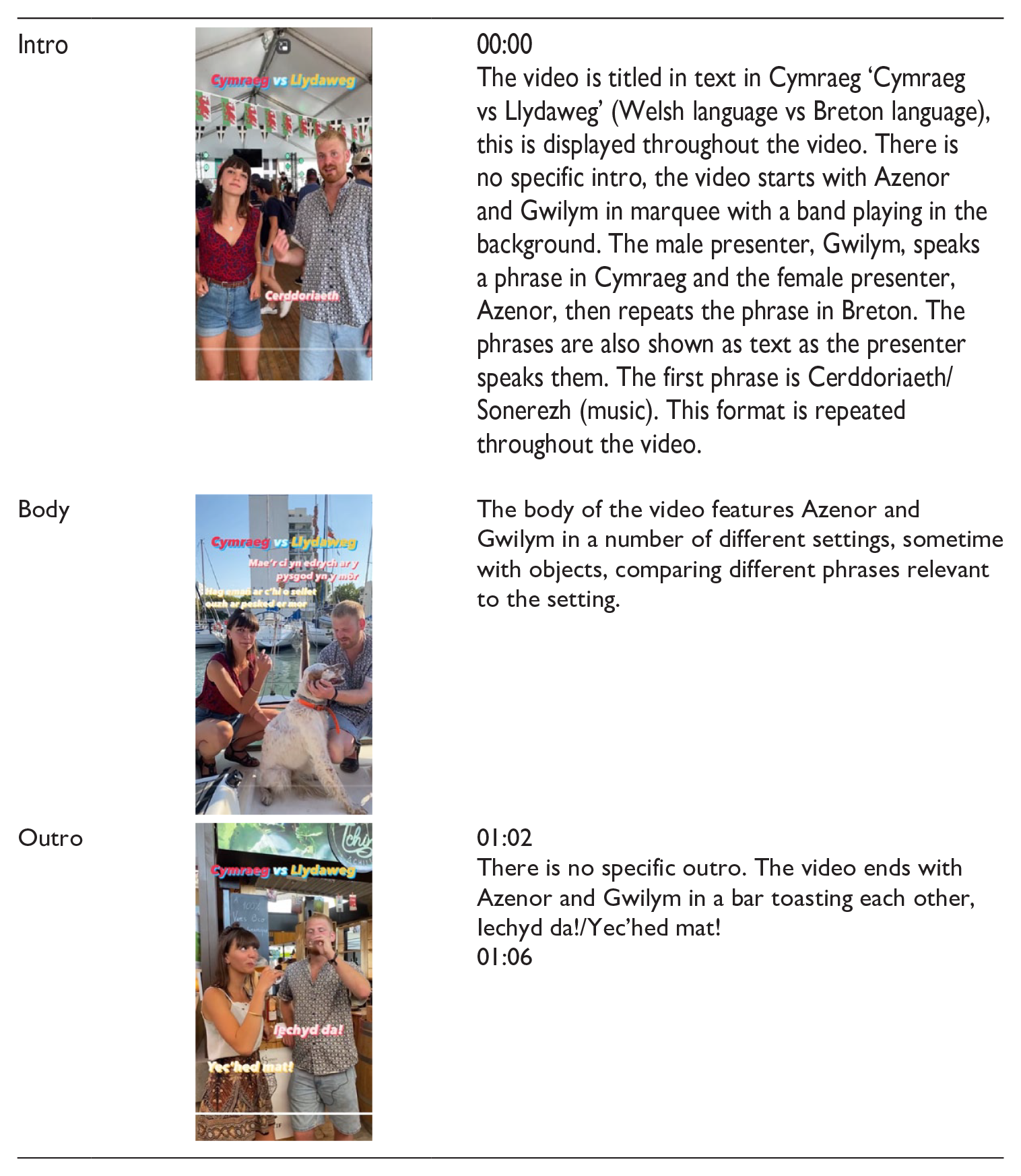
Main Character: Azenor and Gwilym
Setting: Various locations at Festival Interceltique de Lorient, including a marquee, a boat in the marina, several stalls and a café.
Camera: Single, generally front view, mid and wide shot.
Objects: Various, including a dog, drinks, food, a book and a table and chairs.
Background: Various depending on the scene, including a band performing, boats in a marina and crowds of people.
Multimodal characteristics
Speech: The speech is half in Cymraeg (Gwilym) and half in Breton (Azenor). The Breton speech mirrors the Cymraeg speech.
Gestures: Many gestures throughout, typically pointing, though also waving, and a high five.
Gaze: Often looking at each other, though interspersed with looking at the audience or at an object.
Tone: Relaxed and cordial, the presenters are clearly enjoying themselves, often smiling and occasionally laughing.
Dress: Casual/vacation.
Images: None, though some background images are referred to.
Text: A title ‘Cymraeg vs Llydaweg’ (Welsh language vs Breton language) is displayed throughout the video. The text is overlaid directly on the video, towards the top of the frame.
In each location when Gwilym speaks a phrase in Cymraeg, the phrase is also displayed in Cymraeg text. When Azenor then speaks the same phrase in Breton, the phrase is displayed in Breton text, so that both languages can be seen at once. The text is positioned near to the speaker, in different positions from scene to scene. The sans-serif font and style is fairly informal and the two languages are differentiated by colour. In the title, the text colour is Red for Cymraeg and yellow for Breton, with blue shadow. Text appears and disappears, there are no transitions. The main text uses pink with a darker pink shadow for Cymraeg, and yellow with a darker yellow shadow for Breton. Text is overlaid directly onto the video.
Soundtrack: Some incidental music and crowd noise.
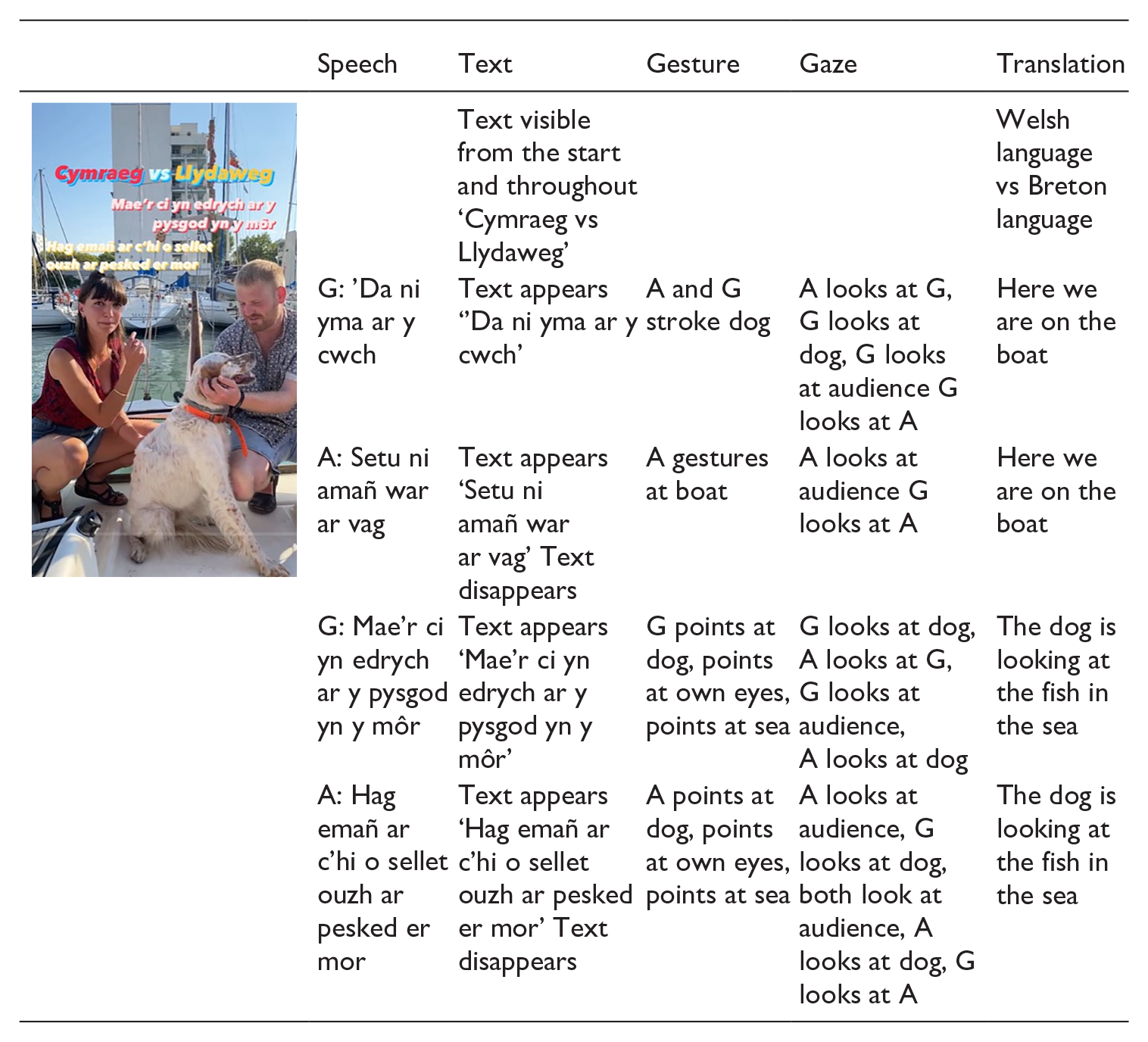
Commentary
The video alludes to a shared Celtic culture and an affinity between the Celtic language communities, as well as celebrating a common language family. It also demonstrates a vibrant Celtic social milieu featuring music, food and drink, poetry books and crowds of people.
Compared to the previous two videos, this one is more like a traditional television programme, and there is no direct reaching out to the audience or invitation for the audience to engage. It is also an example of a traditional media organisation adapting to the performance era.
The videos show content produced by a range of traditional and new content producers. All three videos demonstrate hybridity, with complex linguistic intermingling, interlayering (Ramati and Abeliovich, 2022) and movement between languages and the use of different modalities to provide different ‘layers of meaning’ (Darvin, 2022b). They also foreground a variety of local spaces, identities and languages which Darvin (2022a) argues the ‘agentive power of users’ in resisting the ‘mimetic logic’ of TikTok. Direct appeals to the audience invite remediation and intertextuality and seek exposure across different networks.
Audience engagement
The videos in the corpus were released between 2019 and 2023. The majority (104) were released in 2023, with 84 in 2022, 8 in 2021, 3 in 2020 and 1 in 2019. While the lack of clarity around TikTok’s selection algorithm makes it difficult to interpret these numbers, they do suggest that Cymraeg or Cymraeg-related content has been produced on TikTok for some time, and that TikTok continues to be a platform on which Cymraeg and Cymraeg-related content is being actively produced.
Several indicators of audience engagement are provided by TikTok, the number of Views, Likes and Comments. These may be influenced by the length of time a video has been released for, and the data is proprietary and not open to validation. These engagement measures are also likely to feature heavily in ranking videos returned by TikTok’s search and the corpus is therefore likely be made up of videos with particularly high engagement levels.
The number of Views for videos in the corpus ranged between 217 and 6 million, with an arithmetic mean of just over 167,000. The number of Likes ranged between 12 and 380,000, with an arithmetic mean of just over 17,000.
The video with the most Views was also the video with the most Likes. The video from 2022 is from @fxnetworks, an American television company. The company commissioned the television series ‘Welcome to Wrexham’ which documents the fortunes of Welsh football club Wrexham AFC following its takeover by Hollywood actors Rob McElhenney and Ryan Reynolds. The Comedic form (presumably staged) video features the two actors being mocked in the context of learning some Cymraeg. Its high View and Like numbers are likely to be due in part to the popularity of the television series and its associated audience.
The number of Comments ranged from 0 to 4728, with an arithmetic mean of just over 350. The video with the most Comments was a video from @far.land.of.spareoom. This Meta form video from 2022 presents a passionate discussion of the presenter’s choice to use the Cymraeg name (Cymru) when referring to Wales and of the history of the language.
Schellewald (2021) notes that short form video content on TikTok is characterised by its ‘ephemeral nature’ and the immediate impression given. Comments from the audience indicate a longer (though possibly still brief) and deeper engagement with the content. It is interesting to note that only 9 videos from the 200 had no comments and that 2 of the 3 videos discussed earlier featured direct calls to the audience to engage through comments. Thus, commenting on videos, and in many cases engaging in a text-based conversation with the content creator and other audience members, appears to be a significant activity for some users. Indeed, it was observed that there are accounts on TikTok that comment on videos, but do not upload videos themselves. The audience engaging through comments on a particular video, or across the output of a particular content creator, could be considered as a small, possibly transient, community of practice.
Many of these comments are a response to the topic of the video, but the use of Cymraeg in a video often elicits comments that relate to the language itself, regardless of the actual topic. This meta-linguistic discourse may have a positive or negative valence and similar reactions to minority language use have been reported in other online contexts and other language contexts on TikTok (e.g. Moshnikov, 2022; Ramati and Abeliovich, 2022).
Among the comments observed are Cymraeg-related memes. These are typically humorous and rely on some understanding of Cymraeg, providing examples of Darvin’s (2022a) ‘context-bound memes’. The following comments were made in response to the video from @fxnetworks discussed previously.
Big_vern: Anyone know what microwave is on Welsh? Samuel Morris: How do you say 100 in welsh
It is interesting to note that while these are memes relating to Cymraeg and which presuppose some understanding of the language, they are written in English – another example of hybridity.
A variation of the ‘say 100 in Welsh’ meme also appears as a video in the corpus, showing how TikTok can support the re-presentation of a meme in different forms and variations. Indeed, the ‘microwave in Welsh’ meme was observed on Facebook a number of years ago. It can be argued that the existence of these memes indicates a level of vitality and the continuity of an online Cymraeg culture.
It is also possible to observe a number of familiar tropes relating to Cymraeg. While most of these are observed in other minority language contexts, a few, such as Cymraeg as a fantasy language, are perhaps more unique. The following comments were also made in response to the video from @fxnetworks.
PercyKore: i love ! this sound like a fantasy language A-kay: Welsh sounds like what they speak in lotr Cassandra Wood: Derivatives of Tolkien’s elves also rely on Welsh. The elves in The Witcher call geralt ‘Gwynbleidd’ which means white wolf in Welsh
JRR Tolkien reportedly based the Elvish language used in Lord of the Rings and his other works, on Cymraeg. This association was then popularised further through the various films based on his books. Cymraeg continues to be used as the basis for exotic, often non-human, languages in fantasy settings.
As with the memes, these tropes have been observed across different social media platforms over a number of years.
Implications for Cymraeg
It is important to note that the corpus reflects spaces defined by specific hashtags and the TikTok search algorithm. It does not provide a representative sample across all Cymraeg videos and does not necessarily reflect the day-to-day lived experience of Cymraeg speakers on TikTok, which is likely to be significantly mediated by TikTok’s ‘For You’ page.
The corpus suggests there is diverse and vibrant Cymraeg content on TikTok, with a sizable audience for that content. This is particularly significant as TikTok is a platform favoured by young people. The willingness and desire of speakers to use the language on new digital platforms as they emerge demonstrates the continued digital vitality of Cymraeg.
The corpus also reveals a richly bilingual content space with a variety of different mixing, blending, intermingling and interlayering occurring not only in the videos but also other elements such as the hashtags and the audience comments. This profoundly hybrid space appears to offer a high degree of linguistic freedom of expression, with Cymraeg content creators, for example, not feeling they necessarily need to provide English translations to engage with non-Cymraeg-speaking audiences.
TikTok provides a platform which can support Cymraeg and its use in a variety of ways, including:
Learning Cymraeg – language learning videos make up a significant proportion of the corpus and the accounts producing them can attract large number of followers. The potential for using TikTok as a platform for informal language learning has been recognised previously (e.g. Lee, 2023), and social media have been identified as an important tool for informal language learning among Cymraeg learners (Jones, 2015a, 2015b).
Meta-linguistic discourse relating to Cymraeg – including video content on a range of different topics, but also audience comments. This meta-linguistic discourse explores both positive and negative attitudes towards Cymraeg. It gives the opportunity to amplify positive views and challenge negative views.
Expression and celebration of a range of identities associated with Cymraeg and Wales – these include linguistic, national, regional and cultural identities. It gives the opportunity to promote positive role models and demonstrate the value and role of Cymraeg in a variety of cultural settings.
Building visibility and enhancing the status of Cymraeg – the richly bilingual nature of much of the content and its associated hashtags means that videos featuring Cymraeg in some form may appear in the feeds of non-speakers, potentially raising interest, reinforcing the value of the language and so on. The use of Cymraeg on TikTok by organisations which have a broad appeal, such as the Wales national football teams, might be particularly significant. It gives the opportunity to promote the language both within Wales and beyond and to speakers and non-speakers.
Community creation around the above themes and others – for example, communities of Cymraeg learners, or communities of speakers of Celtic languages. This may play a role in strengthening identities, aiding social cohesion, or supporting communities of practice.
New content creation in Cymraeg and new content creators – the ease of creating videos on TikTok and its mimetic orientation promotes content creation and reuse. A visible and vibrant Cymraeg presence may encourage audience members in turn to produce content in Cymraeg.
Traditional Cymraeg media reaching new, younger audiences – traditional media organisations can reuse and repurpose their existing Cymraeg content for new audiences, or produce new content specifically for TikTok or social media more widely.
While the above discussion focuses on Cymraeg, the opportunities identified here and in the literature may be available to other minority languages in similar circumstances.
The use of Cymraeg on TikTok demonstrates its continuing digital linguistic vitality. For at least some speakers, its use on TikTok appears to have become normalised and any barriers to its use (real or perceived) have been overcome.
Conclusion
In the past, TikTok has been characterised as a largely frivolous space containing a ‘mix of viral dance crazes and lip-sync comedy sketches’ (Tidy, 2020); however this study, and those reported in the literature, shows that TikTok deserves to be taken seriously by those who study minority language use and by those who promote minority language use.
While the study reported here has provided a rich and detailed analysis of the presence of Cymraeg on TikTok, it is important and useful to reflect on its limitations and on other approaches that could be taken.
The creation of the corpus made use of TikTok’s search and ranking facilities, the algorithms underpinning these facilities and the data on which they are operating are not open to inspection. The corpus-based approach does not reflect a user’s lived experience of TikTok. While a corpus study facilitates the study of digital artefacts, it reveals little about the motivations that lead to their creation, the behaviours surrounding their consumption or any effect on users’ perceptions or use of a minority language.
Future studies might engage with content producers, content consumers, moderators and even platform providers in order to better understand their intentions, experiences, motivations and behaviours and to explore any relationships that may exist between digital and non-digital minority language use or non-use.
A variety of comparative studies could be undertaken, comparing, for example, different language contexts, different social media platforms, digital versus non-digital language use, or changes over time.
A more activist approach could involve action research, based around social media interventions designed to promote minority language use.
For those wishing to promote minority languages, production decentralisation, language hybridity and network-centrism offer a powerful vision for the ongoing development of minority language media in support of language sustainability and vitality. Social media provide an effective, accessible platform for putting that vision into action, as has been demonstrated through the study of Cymraeg on TikTok.
Production decentralisation means that minority language communities are no longer dependent on large, costly, state-funded media organisations. Instead, they can now own the means of production and manage distribution via social media. The cost of the technology required is relatively low and can achieve an appropriate production quality. TikTok is a relatively simple platform to use and content created on smartphones is commonplace. The 10-minute restriction on the maximum length of a video also helps to keep production effort low. Its mimetic logic and functions such as stitch and duet support content production and reuse.
Language hybridity empowers those with limited minority language competence to use what they have. Even those with only a few words of the language, or even no words at all, can engage with content in a way that supports content creators (Cunliffe, 2021: 80–81). There is no longer an assumption that the language used must be perfect or pure, or that media productions need to be monolingual. As TikTok’s primary content are videos, the main language content is likely to be oral rather than written. This supports content creators whose oral competence is greater than their written competence, and languages where there may be no written form. It also provides for a greater range of cultural expression, for instance, in the form of songs or dances. TikTok also facilitates rich intermingling and interlayering of two or more languages, as shown previously.
Network-centrism suggests a move from considering the minority language community as a homogeneous whole and a focus instead on specific networks or communities of practice as the site for interventions in support of language use. Rather than trying to provide media for the language community as a whole, content creators can focus on content for specific networks. Establishing new networks on social media platforms is not always easy, due to a lack of visibility and issues with findability. As TikTok is popular with young people, they are likely to already have established networks. It may be possible to introduce minority language content into these existing networks, but where majority language use is normalised, this may provoke negative reactions. The example of the #estiktokat hashtag (Milà-Garcia and Tudela-Isanta, 2022) and the direct appeals to the audience in the example videos described earlier suggest some possible approaches to network creation on TikTok.
This article has highlighted some of the positive opportunities that TikTok and other social media platforms can provide for promoting minority language use. However, it is worth reflecting on what the absence of a language on TikTok may signify, particularly to young speakers using the platform. While the absence, or apparent absence, might reasonably be explained by the overwhelming quantity of majority language content or by the vagaries of TikTok’s algorithms, there is perhaps a risk that these young people perceive the lack of content to be a result of a deliberate choice by speakers not to produce content in their minority language. This in turn may lead them to question the place and value of their minority language in the modern world. Where TikTok and other social media platforms play a significant role in the lives of young minority language speakers, they should be seen as a critical site for actions to promote the sustainability and vitality of those languages.
Footnotes
Funding
The author(s) received no financial support for the research, authorship and/or publication of this article.
