



Abstract
How should we understand alternative social media and open-source technologies that seek to challenge the dominance of Big Tech? Are these ethical substitutes for monopolistic platforms and technological infrastructures, or “alternative” in the sense we might talk of alternative forms of culture? Here we offer new perspective on these questions by conceptualizing alternative tech through Bourdieu’s theories of cultural production and distinctive consumption. Building on the work of Holm, Coleman and others, we explore the “techno-critical disposition” through a case study of A Traversal Network of Feminist Servers (ATNOFS), arguing this is manifested primarily as “critical craftiness,” or hacker aesthetics in a critical register. Finally, we consider how ATNOFS represents a “distinctive” path to the wider adoption of alternative platforms, as well as how the techno-critical disposition may be reconfiguring legitimacy in the broader field of technology production.
Introduction: what is the “alternative” in alternative tech?
In late October 2022, as Elon Musk completed his controversial purchase of Twitter (now X), news media began documenting an exodus of users. But where would they go? Several news outlets converged on the idea that it would be Mastodon, the open-source, alternative social media platform that serves as the latest high-profile case in a long line of alternative new media (Lievrouw, 2011). As quickly as expectations were raised, though, they were soon deflated: within a few more weeks, stories about Mastodon’s “failure” to meet expectations began to appear (Nicholas, 2023). For critics of the small group of companies whose platforms increasingly serve as gatekeepers in society—so-called “Big Tech” (Birch and Bronson, 2022)—this news cycle is now familiar. From the “Year of the Linux Desktop” meme to similar hype cycles around Diaspora, Ello, and others, there is no shortage of this kind of rupture-talk in the history of open source software and alternative social media. And as Zulli et al. (2020) argue, such “killer hype cycles” miss the point. These projects tend to exist long before the news cycles begin and continue to operate after they have ended. Moreover, focusing on market share can blind us to how such alternatives showcase potential correctives to mainstream technology—in Mastodon’s case, this includes socio-technical modes of sociality and platform governance that stand in stark contrast to the dominant logics of mainstream platforms (Gehl and Zulli, 2023; Zulli et al., 2020). As Gehl (2017) writes about alternative social media, such projects move “from critique to code,” as they are rooted in critical understandings of how dominant tech companies operate, seeking to redress the lack of individual autonomy, privacy, and transparency that characterize social media and, more generally, Big Tech as “techno-economic configuration” (Birch and Bronson, 2022).
Both in the “killer hype cycle” and in the critical academic response, a lingering question is thus how to define and evaluate these alternative tech initiatives. Are these alternatives in the sense we might use the term to talk about renewable energy sources, that is, as substitutes that fulfill the same function as an undesirable, yet entrenched, standard? Or are they alternative in the way we might we talk about alternative music, as something that is qualitatively different and derives social value from the very fact that it opposes mainstream convention? By untangling this issue of value in relation to alternatives to Big Tech, we stand to gain not just a deeper understanding of “alternative tech” as a socio-technical phenomenon, but also, perhaps, insight into what it would take for such alternatives to live up to the hype regularly bestowed upon them.
In this article we draw on Bourdieu’s theories of cultural production and distinctive consumption to reconceptualize alternative tech, arguing that it may be understood as a form of cultural production analogous to the artistic and literary fields theorized by Bourdieu (1993). In this view, the production and use of alternative tech is not only a matter of ethical substitution, but also of the display of cultural capital and the reproduction of social status. While recognizing that this approach can offer only a partial view of the nature and purpose of alternative tech initiatives, here we aim to demonstrate its use the theory and practice of alternative tech, and, as we discuss in the conclusion, broader questions about the cultures and ideologies of technological production.
We make our argument in three steps. First, we discuss alternative tech in relation to Bourieu’s field theory and the notion of “autonomous” cultural production. In doing so, we note that the articulation of autonomous values (for instance, decentralization or privacy) is bound up in questions of reputation or symbolic capital (such as when dark web projects compete for legitimacy as authentic expressions of hacker values—see Gehl, 2018).
Second, following Bourdieu’s (1984) arguments in Distinction as well as Holm’s (2020) notion of “critical capital,” we argue that both the production and consumption of open-source and alternative social media are grounded in naturalized forms of cultural capital, or dispositions. Both producers and consumers of alternative tech have internalized a “mode of appropriation” of technology that serves to distinguish them from heteronomous, mainstream technologies, and associated forms of “naïve” consumption. In making this case, we argue that Bourdieu’s “aesthetic disposition” may be helpfully compared with Coleman’s (2012) notion of hacker “craftiness” and Thomas’s (2003) analysis of performance and style in hacker subculture.
Third, we develop the notion of a “techno-critical disposition”—a synthesis of the aesthetic and critical dispositions in the context of technological production—through a case study on A Traversal Network of Feminist Servers (ATNOFS). ATNOFS was initiated by several cultural organizations across Europe, and is “a collaborative project that aims to explore alternative engagements with digital tools and platforms” (European Cultural Foundation, 2022). Although the project is not representative of all alternative tech and must also be understood as part of a lineage of cyberfeminism (Seu, 2023), several characteristics including its preoccupation with questions of licensing and consent in relation to social justice suggest strong resonances with contemporary debates in the wider field of open-source and alternative technology. Our analysis focuses on the project’s discursive and aesthetic features as revealed through textual analysis of project documentation, supplemented by in-depth interviews and participation in one of the network’s meetings. We argue that in ATNOFS, the aesthetic disposition is apparent in a do-it-yourself (DIY) aesthetic and DIY approach to digital infrastructure, as well as several examples of formal and linguistic “play.” Although this formal play is quite similar to that described by Coleman (2012) and Thomas (2003), we argue that in ATNOFS such an aesthetic disposition is enveloped in the practice of critically “reading” technology as an expression of power (Holm, 2020). The project’s defining features thus reflect hacker craftiness in a critical register, or critical craftiness, and it is through such practice that ATNOFS challenges the logics of smoothness, efficiency, and surveillance of mainstream digital technology.
We conclude by reflecting what our argument implies for the practice of alternative tech as well as how the approach might be incorporated into the study of tech production cultures more widely. As Gehl (2017) argues, elitism potentially serves as a barrier to entry for alternative tech, and in this sense our analysis raises the question of whether a critical mode of distinction is simply replacing an outmoded hacker masculinity. But the approach here suggests another potential path to wider adoption: rather than focus on creating better interfaces and on-ramps for alternative tech, this would focus on embedding these technologies in vanguard educational and cultural settings (as ATNOFS seeks to do). Finally, looking beyond sites of activist and alternative production, we suggest how the concept of the techno-critical disposition may be helpful in making sense of shifting regimes of legitimacy in the broader field of tech production.
Alternative tech and the field of restricted production
Beginning at least with Ted Nelson’s (1974) Computer Lib and continuing with efforts such as Richard Stallman’s Free Software Foundation (established in 1985), digital culture has long included discursive and activist resistance to dominant state and corporate actors in computing, in particular around issues of individual liberty and access to computing and information (Coleman, 2012, 2017; Kelty, 2008). With the establishment of Indymedia in 1999 (and earlier in magazines like Mondo 2000 and Wired), as well as participatory media sites like Slashdot (created in 1997) and Wikipedia (1999), this liberal opposition to mainstream, proprietary computing became discursively and materially linked to a similar opposition to corporate, mass media that took the form of more interactive, participatory, transparent, and accessible modes of publishing (Stevenson, 2016). This combination of tech- and media-related values and practices—openness, access, participation, transparency—were the hallmarks of discourse surrounding the rise of social media in the early 2000s and the spread of similar “platforms” in other domains (e.g. Airbnb and Lyft), as these startups took on establishment opponents. Arguably, a classic case of co-optation, platforms such as Facebook, Google, and others that would later be labeled Big Tech embraced values of openness and participation, as well as a corresponding air of rebelliousness (“move fast and break things”), as they worked to secure their place at the top of an emergent, hybrid tech-and-media industry (see, for example, Haupt, 2021). Even while corporations and reactionary politics have soured the utopian promise of digital technology (Turner, 2019), new pockets of “legit” (i.e. socially defined as “authentic”) resistance to corporate social media and their regimes of consumer surveillance and opaque governance appear regularly (Gehl, 2018).
Free software, alternative social media, Wikipedia and other manifestations of alternative tech culture, are helpfully conceptualized through the framework of Bourdieu’s field theory, especially when it comes to understanding how these actors express and perform oppositional values when compared with dominant actors (Stevenson, 2016; Gehl, 2018). Bourdieu (1993) argued that society comprises semi-autonomous fields, with cultural fields such as literature, art, and journalism emerging through a process of autonomization, as these producers resisted pressures of the dominant fields of state and economic power to establish domains of relative autonomy. Such resistance takes the form of pursuing socially defined autonomous values that feed into hierarchies of taste. In the field of art, this takes the form of “art for art’s sake,” or sets of conventions and attitudes that stand in opposition to vulgar, “heteronomous” genres steered by state or economic power (e.g. IKEA art and overtly political art), and in other fields, a similar pattern emerges (e.g. various definitions of independence and quality within journalism). In tech culture, those values and tastes are those that tie together the range of relatively autonomous digital cultures, including the liberal and libertarian ideals that typify various free software and free culture communities (Kelty, 2008; Tkacz, 2014) and alternative social media (Gehl and Zulli, 2023). Alternative tech might thus be defined as initiatives that articulate an opposition to mainstream actors through the enactment of field-specific values (openness, participation, transparency, privacy, etc.).
Although artists, journalists and hackers may resist various forms of state and economic power, they nonetheless participate in another game of hierarchy, competition, and struggle. When a cultural producer participates in the restricted field of production, they engage in local competitions to secure symbolic capital. This is particularly clear where market success is not an option, and the audience consists by and large of fellow producers or other individuals who have the necessary knowledge or literacy required to appreciate experimental or avant-garde cultural work (Bourdieu, 1993). The bohemian poet, the experimental artist, the independent “quality” journalist, the free software zealot . . . each acts out (to varying degrees) a rejection of the vulgar forms and genres that characterize mass cultural production, as well as a contempt for naïve modes of consumption that characterize the mass audience; doing so is a prerequisite for legitimacy or perceived authenticity among their respective peers in the field of restricted production. As a collective and in particular as individuals who achieve the highest levels of esteem in their respective fields, they embody the “marginal elite,” as those whose “sacrifice of an establishment is compensated by the privilege of exceptionality” (Heinich, 2016: 39).
The same field dynamics can be seen in tech culture, and recognizing this helps us to conceptualize the “Facebook-killer” conundrum facing alternative digital platforms and infrastructures. Producers of free software and other alternative tech culture all seek to distinguish their products from mass cultural forms. But while such distinctive technologies are often geared toward the field of restricted production (such as lower-stack free software projects aimed at fellow developers), what stands out when considering alternative social media platforms is that their identities are arguably caught between that of actors in the fields of restricted and mass-market cultural production. Asking what it would take for people to build their own servers or run alternative social media instances is—we want to suggest—akin to asking what it would take for the mass public to read experimental poetry or long-form narrative journalism: there is a tension between notions of quality among alternative platforms and infrastructures, and the expectation or hope that these could realistically compete with mass-market players.
Cultural capital and distinction in tech culture: the aesthetic and critical dispositions
The tension that tech projects face in maintaining a position in the restricted field of production and attempting to appeal to mainstream or mass audiences can be further understood in relation to Bourdieu’s notion of “disposition” as naturalized cultural capital. Producing and consuming alternative tech requires more than software downloads and user manuals: an individual’s habitual preference for free and open software—much less the devotion needed to produce such technology—depends on a different manner of perceiving and relating to information technology and digital culture, namely, a tendency to look beyond immediate uses and instead to appreciate formal composition (“is this decentralized?”) as well as how technology is shaped by economics, culture and politics (“what is the underlying business model?”). This is similar to the “mode of appropriation” that Bourdieu (1984: 251) termed the aesthetic disposition and theorized as (1) learned rather than naturally occurring and (2) a means to differentiate oneself from naïve consumption. By revisiting Bourdieu’s arguments regarding the aesthetic disposition as well as Holm’s recent discussion of the critical disposition, here we provide a conceptual basis for what we call a techno-critical disposition, which contains elements of both the aesthetic and critical dispositions as they manifest in the specific context of alternative tech culture.
For Bourdieu, dispositions are embodied knowledge that is manifested more-or-less unconsciously, a matter of habitual patterns of behavior and ways of thinking that, while authentically felt and expressed, serve to signal and solidify an individual’s status or cultural capital. Think, for example, of the various subtle and not-so-subtle signs of hacker masculinity that are both an artifact of history and a persistent (if evolving) feature in contemporary tech cultures that affirm belonging and status while serving to exclude others (Ensmenger, 2015).
Although the concept may certainly help bring to light the subtle ways in which participation is governed within specific contexts of cultural production (including hacker culture), Bourdieu’s best-known application is in the context of distinctive consumption, with his argument that the “aesthetic disposition” underlies conspicuous consumption by intellectual elites. Mirroring the status of the “marginal elite” in cultural fields like art and literature, elite audiences signal their cultural capital through the cultural products they consume and (more importantly) how they consume them.
Distinction is thus not necessarily gained through distaste for vulgar forms (in fact distinction is perhaps more clearly tied to “omnivorous” consumption), but rather through demonstrated resistance to a kind of unthinking, naïve mode of consumption (Lizardo and Skiles, 2012). While primarily associated with how we consume culture, this highly internalized aesthetic gaze and corresponding set of values is a necessary characteristic of producers of autonomous cultural forms: one has to have an embodied and seemingly intuitive sense (gained through socialization, education and experience) of what “works” and for the kinds of formal innovation that will be valued in the field (Bourdieu, 1993). To gain a prominent position among their peers, cultural producers must strategically make use of their knowledge and literacy, but the concept of “disposition” is a reminder that such strategy is not necessarily conscious or cynical: they act out authentic beliefs about the inherent value of art, for example, or sincerely felt experiences of creating culture they believe is worthwhile, even if these beliefs and feelings themselves are learned and cultivated.
In alternative tech cultures, the aesthetic disposition can be understood in similar terms: distinction is about resisting unthinking use, and deriving pleasure and meaning from the conscious experience of technological form (and by extension a pleasurable experience of one’s own formal knowledge and cultural capital). Regarding producers of alternative tech, Bourdieu’s notion bears strong resemblance to hacker style (Thomas, 2003) and “craftiness” as defined by Coleman (2012, 2017). Alongside finding clever technical solutions, craftiness refers to a general pleasure derived from formal play: hackers play with code through poetry and jokes, and play with form more generally including “language games” such as l33t (“elite”) speak, a typical example of distinction via “translation” or formal play (Thomas, 2003: 57). Coleman shows how such craftiness serves to indicate skill and status while resolving a tension between meritocracy (the belief that certain individuals contribute more and should be valued as such) and collectivism (borne from an inevitable reliance on the wider community of producers). What is remarkable about hacker craftiness in comparison to that of other kinds of cultural producers, Coleman (2017) argues, is “how an outward display of craftiness has surpassed mere instrumentality to take on its own, robust life; craftiness and its associated attributes, such as wit and guile, are revered as much for their form as for their function” (p. 92). This independent quality of craftiness—as a cultivated and socialized capacity to appreciate form for its own sake—is highly similar to what Bourdieu saw in those with high levels of cultural capital, whose aesthetic disposition allowed them to “read” any object aesthetically and formally, finding beauty in everyday objects which would hardly be noticed by those without the requisite cultural capital.
If hacker masculinity and craftiness may be understood in terms of cultural capital and the aesthetic disposition as theorized by Bourdieu, then recent contentious debates within free software and open-source communities might be helpfully theorized in relation to what Nicholas Holm (2020) terms “critical capital,” or critical reading as a form of cultural capital. Seen through the lens of cultural capital, debates about codes of conduct and “ethical source” software are not isolated political clashes but struggles to impose a logic of cultural capital and autonomous values on the sub-field more generally. This is not much of a stretch conceptually, given how often commentators put their arguments in terms of adherence to or departure from original aims and values in hacker culture (e.g. “The Post-Meritocracy Manifesto” by Ehmke, 2018). That critical capital plays a role in alternative tech cultures is also suggested by a case of a “tug-of-war” around gender bias in Wikipedia articles: researchers found that the highly educated and dedicated community of “core” Wikipedia contributors tends to overcorrect for the gender bias supplied by “periphery” users, pointing to the strong critical culture that drives activism among the core (Young et al., 2020).
Cultural capital becomes disposition as it diffuses into a general mode of interpreting events and objects in the world in a way that signals distinction, and Holm’s (2020) larger argument is that the aesthetic disposition’s role in establishing legitimacy is increasingly taken up by the “critical disposition..” As disposition, it is also naturalized and the strong ties to educational capital are erased or forgotten, but Holm is clear that the rise of the critical disposition should be understood as an unintended consequence of the success of cultural studies and critical theory: where elite higher education once instilled a capacity to perceive and appreciate culture through its formal composition, cultural studies and related approaches within the Humanities and Social Sciences have increasingly taught us to read culture as something shaped by invisible structures of power. Despite quite different emphases, the critical disposition is analogous to the aesthetic disposition because it interprets form, albeit in terms of how an object is shaped by power. As disposition, the pleasure and meaning derived from critical reading—like aesthetic pleasure—is arguably an “indirect experience” of one’s own cultural capital (Holm, 2020: 160). As an example of this, Holm points to various cultural intermediaries that turn critical reading of popular culture into a form of popular culture. As Holm (2020: 157) is careful to point out, to identify the role the critical disposition plays in generating and maintaining status today is not to say that this “mode of appropriation” is somehow corrupt or undesirable, nor does it take away from authentic desires to address injustice. Still, as a disposition reflecting high levels of cultural capital, critical reading is also a means of displaying status and defining the bounds legitimate and illegitimate culture.
Turning back to alternative tech, we would speculate that distinction and cultural capital within the production and consumption of technology are practices increasingly bound up with the critical disposition, even if a technological version of the aesthetic disposition (typified by hacker “craftiness”) remains important. To build on our original question, we now turn to a case study to ask how the “alternative” in alternative tech may be understood in relation to the aesthetic and critical forms of cultural capital.
ATNOFS: outlining features of a techno-critical disposition
To better understand how aesthetic and critical dispositions shape practices within alternative tech culture, we turn to a case study of ATNOFS. ATNOFS was initiated in the beginning of 2022 as a shared experiment between small cultural organizations across Europe. The various partners regularly develop exhibitions and events around topics such as hacking, feminism, media art, critical infrastructure, experimental publishing and free/open source software. ATNOFS extends this focus into a technological project, one that aims to promote and facilitate opposition to Big Tech among cultural institutions. One of the project’s defining features is thus the exclusive use of open source software and alternative infrastructures. Central to these tools is the server built by Varia called “Rosa.” Rosa, as a feminist server, follows a longer tradition of cyberfeminism (Plant, 1998) and feminist technology including systerserver (http://systerserver.net; created in 2005). Rosa hosts several applications including Etherpads (word-processing) and mailing-list software, and is the hub for documenting the project’s process. Perhaps its most unique feature is that Rosa literally traverses the network as it is physically moved from one member organization to another, each temporarily serving as its home (a decision we return to below). The technological goals of the project are, however, a means to an end: the main project outcome was a publication documenting its process by reflecting on the activities and discussions that took place in each of the places Rosa traveled to the various network locations (Strete et al., 2023). The publication has a “soft structure,” meaning “that a structure was proposed, but that each organising group could choose whether to keep it as it is, or alter it to whatever extent they preferred” (Strete et al., 2023: 4). This move, in itself, already displays the kind of critical-formal play that we argue is a characteristic techno-critical disposition: a performance of values like decentralization, diversity, and equality via aesthetic and formal means.
ATNOFS aims to be “a collaborative project formed around intersectional, feminist, ecological servers [. . .] beyond the current media oligopolies”(Strete et al., 2023: 3). The desired outcome is a set of ideas about technology and infrastructure that can spread through the audiences of the various member organizations, understood by the project coordinators as “multipliers” (European Cultural Foundation, 2022). In turn, such multipliers are expected to continue to disseminate ATNOFS’s tools—and while not a competitor to mainstream platforms, the members still aim to push at least cultural institutions to move away from a dependency on Big Tech. Similar to the cultural intermediaries studied by Bourdieu and Holm to understand the aesthetic and critical dispositions, then, ATNOFS arguably aims to advocate not just a set of cultural products (in this case, free and open source software) but a “taste” for such technology—among cultural institutions, if not necessarily among wider publics. Our question is thus how that taste is articulated in ways that reflect the aesthetic and critical dispositions, as well as how these dispositions are manifested in the “process” and organization of the network itself.
The emphasis on pedagogy, process and community helps substantiate an understanding of ATNOFS through a lens of cultural capital and disposition. The member-organizations already develop in their own work—often publicly funded, cultural or artistic projects—“critical understandings of the technologies that surround us” (Varia, n.d.). Despite the infrastructural and technical components of ATNOFS, members describe the value as a way of relating to technology: “this is more like [. . .] an attitude, a way of doing something” (ESC interview). 1 This “way of doing” is also a way of “thinking” or “talking,” meaning that the collective development and expression of particular values is more important than technical applications: “a community dinner is more than enough [. . .] to keep the community together. There is no pressing need to have a server, but there is a pressing need to be decentralised” (HYPHA interview).
Our case study comprised a textual analysis of the project’s semi-public web pages that served as the project’s documentation as well as the project’s published final report, paying close attention to formal elements including rhetorical and aesthetic choices that are used to generate meaning and steer audiences toward particular readings. This was complemented by interviews and participant observation: between March and May of 2022, we conducted three in-depth interviews with members from ESC, HYPHA, and Constant, and participated in one of the network’s “meet-ups,” events that were at the core of the process. During these meetings, members engaged in workshops including deep listening exercises and re-thinking the language of commands, as well as collective, open discussions to define the purpose and scope of the project. The meet-up attended was at the start of the project, giving access to several discussions about the perceived value of the project, and shedding light on the activities and concerns that the network members considered legitimate forms of organization and collective decision-making. The interviews that followed this first contact were conducted in a semi-structured manner, further uncovering key assumptions and values. By engaging with the project in multiple ways over time, we were able to develop a deep understanding of how the project members articulated their opposition to mainstream digital technology aesthetically, technically and discursively, allowing for our formulation of what we call the “techno-critical disposition.”
Aesthetics and form: disrupting “smoothness”
Both interview data and documentation for ATNOFS clearly point to a “mode of appropriation” of technology that opposes itself to mass consumption of technological culture. ATNOFS does not aim to simply reproduce the functionality and aesthetics of mass technology in a non-proprietary version, and instead encourages and perhaps even demands a different mode of consumption in which an appreciation of form overtakes a naive experience narrowly focused on functionality. In particular, the project’s participants emphasize how ATNOFS resists the kinds of surface “smoothness” and efficiency that characterizes mainstream social media and mainstream digital infrastructures. This opposition is reflected in various formal and aesthetic choices that foreground the contingent nature of infrastructure (theorized by project members through a feminist lens of embodiment). In doing so, the project thus encourages a certain formal literacy and an appreciation of the nuts and bolts of technology, tying it to a broader aesthetic disposition in autonomous tech cultures and hacker culture. At the same time, the aesthetic and technical choices highlight friction, contingency, and complexity in ways that go beyond a hacker aesthetic that values transparency and technical literacy.
In a purposefully low-tech approach, the project server Rosa mirrors other DIY initiatives “often using limited CPU, memory, disk space and bandwidth by choice, using simple protocols, formats and tools” (de Valk, 2021: 5). Low-tech solutions and experimental forms show how the project descends aesthetically from existing hacker culture, with various markers of the project’s DIY resistance to corporate social media and their regimes of consumer surveillance and opaque governance. The most prominent manifestation of this aesthetic is Rosa’s landing page, where the server “opens herself to expose” the different applications and files available in a text-based, no-frills interface. The green font on white background page is nostalgic, but in a way that echoes the utilitarian, textual aesthetics command line tools, a producer-oriented aesthetic. The one departure from utilitarianism is another nostalgic aesthetic, namely, the ASCII art at the top of the page (Figure 1). Although a vernacular aesthetic, it is telling that this vernacular is taken from early Bulletin Board Systems rather than, for example, the “barbarian” vernacular that Olia Lialina (2005) identified with the mass adoption of the web in the late 1990s. In addition to the transparent aesthetic of listing the server’s files in order of most recent changes, the page includes instructions for accessing server statistics via a command line interface. Both in terms of its utilitarian aesthetic and the hacker-friendly functionality it provides, the clued-in user will understand that the project embraces hacker values like openness and transparency.
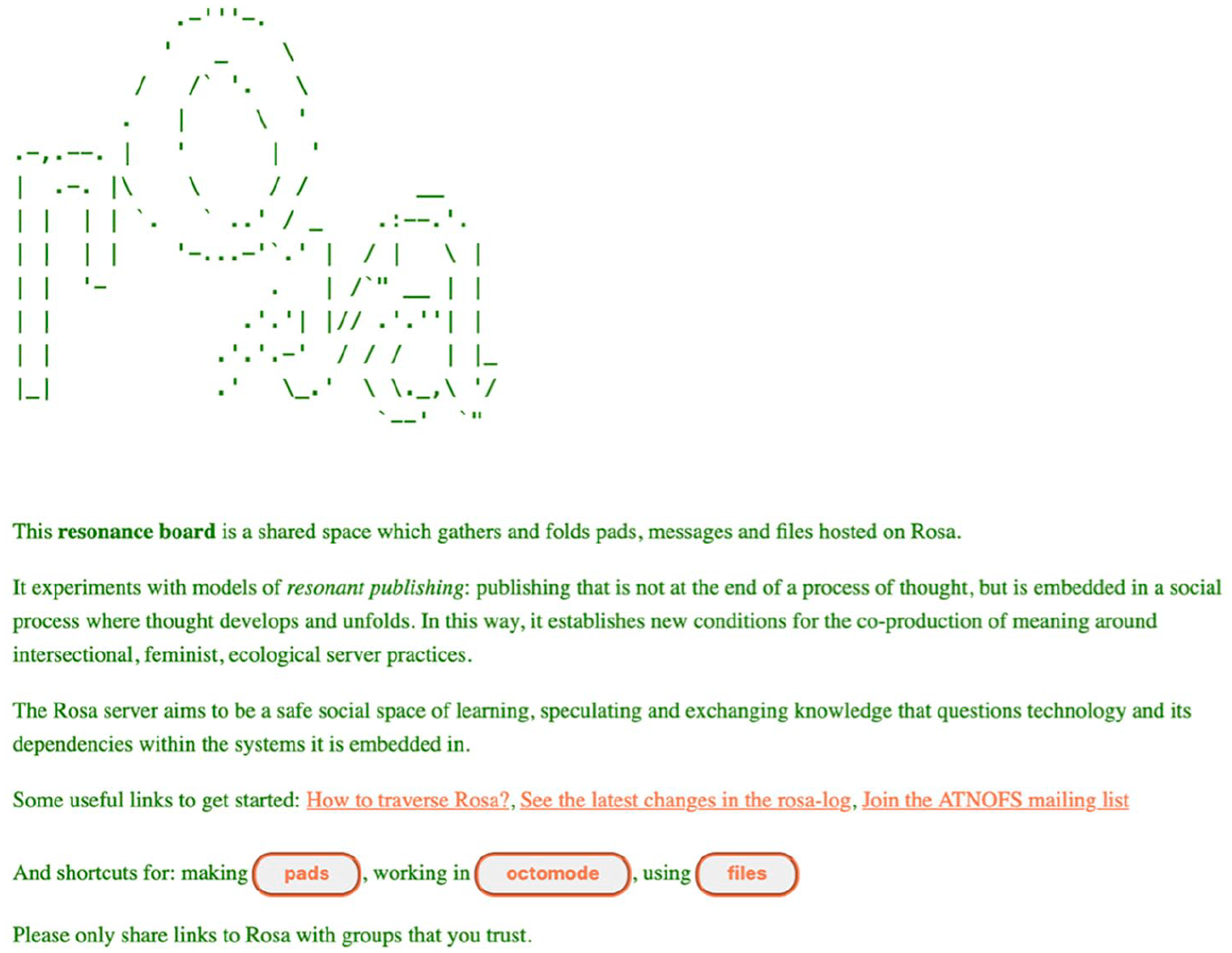
Rosa’s landing page.
There is, however, a purposeful distinction between ATNOFS and some of its predecessors in hacker culture. Opposition to “smooth” interfaces and operations is reflected in aesthetic and technical choices that emphasize technology’s material, economic and social infrastructures. By reframing technical literacy and DIY aesthetics in line with its critical aims, the project moves beyond a definition of alternative tech as a capacity to build “free” technology (Stallman, 1985) and well beyond a narrower ethic of technical excellence (Raymond, 2005). Instead the project identifies a link between the formal properties of mainstream tech culture and larger political issues: “Trans*feminist servers [. . .] reject generalized definitions of efficiency, efficacy, ease-of-use, transparency, scalability, accessibility, inclusion, optimization and immediacy because they are often traps” (ATNOFS, n.d.-a). The combination of efficiency, smoothness and the invisibility of mainstream technology is political, according to ATNOFS members, because of how it reinforces a dominant technological practice and identity: we see that it’s when those tools and those infrastructures blend in [. . .] they do their most violent work, cementing norms, making things possible for those who live according to the norm, making things hard for those who are not normative. (Mugrefya and Snelting, 2021, “From Feminist to Intersectional Infrastructures”)
Discursively, the project also straddles a line between a hacker-like technical preoccupation and displays of a critical disposition. In the network meeting attended at Varia (the first in the project), one of the activities explored was how the group could change the language of commands, adapting them to a new, critical context. Suggestions included adapting commands that suggested violence (“bash” and “kill”) and questioning whether hierarchical commands (“sudo”) would be necessary (Strete et al., 2023: 28). The final publication’s glossary is also telling with regards to this mix: the reader is educated on a range of technical terms and acronyms like ISP (Internet Service Provider) and hOCR (an open standard for Optical Character Recognition), but also several social justice terms including CoC (Code of Conduct) and FLINTA (Frauen, Lesben, intergeschlechtliche, nichtbinäre, trans, and agender).
At the same time that they embrace some of the aesthetics and ethics of hacker culture, ATNOFS’s members also critique alternative practices and the “maker” ideology that obscures how alternative, open-source tech might be less accessible or inaccessible depending on, for example, geographical location: I’m interested in this tension zone of, well, “you should run your own infrastructure.” What does that imply? And “[DIY infrastructure] is so easy.” It’s not. And then of course, you have all the geographical realities that go along with that. In certain countries, it’s very easy to have a fixed IP address and install your own infrastructure at home and in other countries—it’s super, super hard. Or in other countries you don’t have any companies providing server infrastructure and you rely on [a company in] France, for example. (Constant interview)
The critical understanding of inequality is tied to a broader sense of impossibility when it comes to producing fully autonomous technology, as that technology is always shaped by larger forces of capital: So I’m a bit skeptical about the ability of servers. [. . .] In the end, you still used an Internet infrastructure. You need an IP, you need the providers. You need electricity. You’re still in the same system. So it’s not like you are escaping anything by using [alternative servers]. (HYPHA interview)
ATNOFS thus partially extends a hacker DIY ethic and an accompanying aesthetic disposition, but at the same time engages in a critical reading of the ideology of DIY technology.
Technology and power: critical craftiness in language, organization, and software
As Coleman (2012, 2017) has shown, craftiness is a crucial feature of hacker culture, an aesthetic disposition through which hackers engage in formal play, demonstrate their field-specific technical and cultural literacies, and (by displaying distinction from mainstream technological production and consumption) help enact a relatively autonomous position within the wider field of tech culture. This tendency to be crafty is unquestioned yet crucial to securing symbolic capital within hacker communities, and thus, can be understood as disposition, or naturalized cultural capital accrued through education and socialization. In many ways, ATNOFS reflects this same kind of playful approach to technical and aesthetic form, and this craftiness is clearly valued within the network. For ATNOFS, though, formal play or craftiness is valued most when it is tied to critical readings of technology and when it exposes the power structures that shape mainstream technology and our engagement with it: it is not simply craftiness that is valued in ATNOFS (the way it may well be in some hacker communities), but critical craftiness.
A telling example is found in the origin story of “Rosa,” the server that hosts documentation and communication from the network. In documentation, one of the members describes celebrating the server’s first installation by eating raspberry pie after “we found moments of slowing down and installed Rosa together on a borrowed Raspberry Pi in the midst of a global chip shortage” (Strete et al., 2023: 8) Here, as in typical craftiness, value is placed on self-reliance and technical literacy for its own sake, as well as formal play as a source of pleasure (i.e. celebrating with raspberry pie). At the same time, the line emphasizes an awareness of how this act was positioned within and against modes of power (finding moments to “slow down,” using a borrowed computer “in the midst of a global chip shortage”).
More generally, ATNOFS demonstrates critical craftiness through contesting the language of technology in relation to the group’s feminist politics. This often takes the form of play, in particular the personification of the server; although naming servers is quite common in hacker cultures, the personification of Rosa goes much further to ask questions about what embodied technology might mean, as well as how demands for smoothness, efficiency and productivity in technology relate to similar demands on our own bodies. One member explains that the language of technology today reflects how power operates on our bodies as we are disciplined to be productive: Everything that’s political, that is technical, that is social [. . .] everything goes by the body [. . .] Think of all these things like availability, always functioning, always present [. . .] it’s as if we were machines. We treat ourselves as if we’re machines. (ESC interview)
Rosa’s documentation begins with a long list of unanswered questions (and thus playing with the form of the typical FAQ) that link technology and power through “playing” with the language of technology and computing: How is Rosa a feminist server? How does Rosa operate? What does operate mean? Does operate mean work? Does work mean labour? Is this labour paid? (ATNOFS, n.d.-b)
Most of all, ATNOFS’s critical craftiness is on display in the elegant hack at the center of the project, namely the decision to have Rosa “travel” from one member organization to another (Figure 2). The practice of moving the server physically from one place to another and thereby rendering the server inaccessible for intermittent periods, enacts the project’s critique of smoothness and encourages critical reflection on the infrastructures of power underlying technology as well as on our reliance on it (as opposed to the typical panic we might experience when digital infrastructures are down). Each of Rosa’s formal features—and in particular its inefficiencies—thus carry symbolic weight when read in accordance with a trained techno-critical eye.
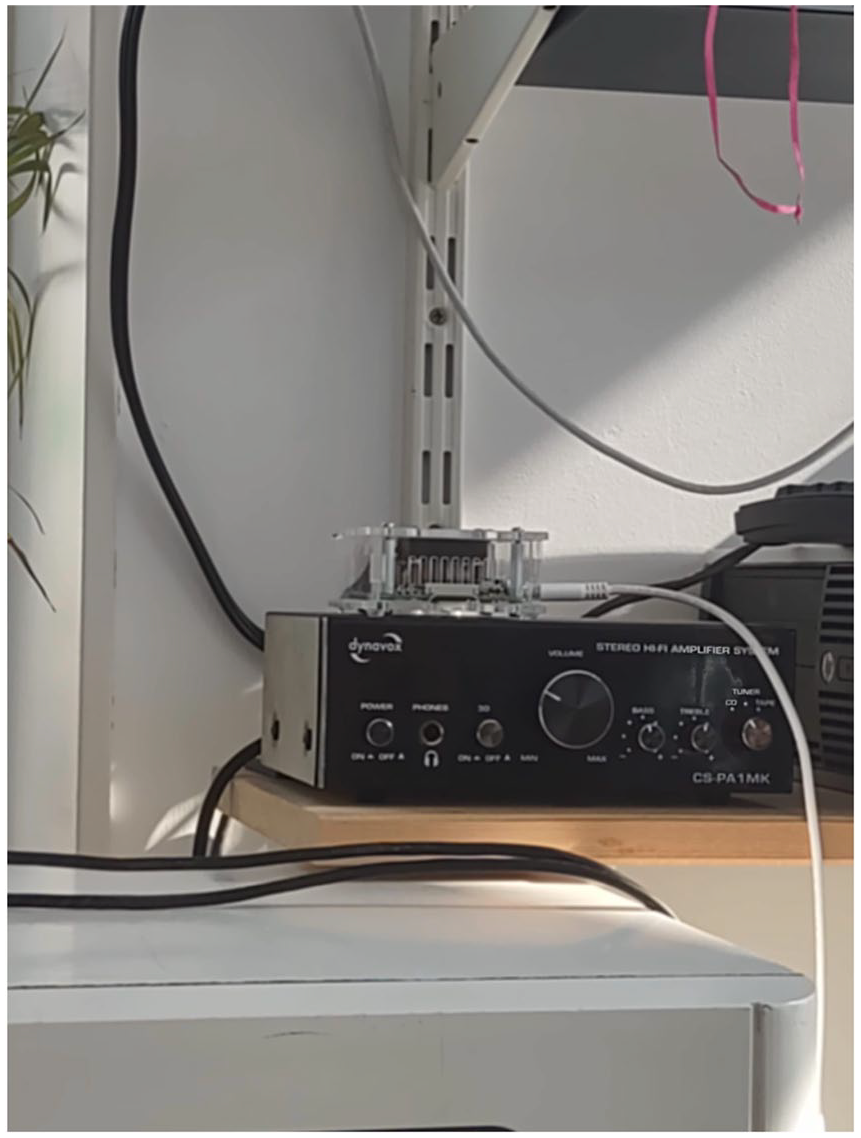
Rosa, the traveling server, at Varia in Rotterdam.
In addition to critical craftiness, the techno-critical disposition is revealed as cultural capital when analyzing the project members’ interactions and internal communications. Gestures of inclusion and diversity are political, and since a critical disposition is an essential element of the project, those gestures must become visible and are routinely performed. Members display belonging to the project by carefully writing and rewriting manifestos, codes of conduct, and licenses in ways that highlight accessibility needs or signal an awareness of economic imbalances among the member organizations. Through such practices, though, ATNOFS members arguably enact their own forms privilege and exclusion: members of the group adopt a common language and mode of “reading” technology that is both technical and critical, and this naturalized-yet-learned practice is what allows members to participate meaningfully and impact the direction of the project. To participate and contribute, one must know how to link intersectional feminist theories to technology; one must be technologically proficient but, more importantly, be able to engage in the intellectual and creative practice of exposing how technology facilitates various forms of oppression. Similar to tensions among techno-activists studied by Dunbar-Hester (2019) and Platon and Deuze (2003), then, various performances of cultural capital belie a rhetoric of egalitarianism and inclusivity. Finally, the link between a techno-critical disposition and cultural capital is expressed in the very establishment of ATNOFS as an EU-funded project: the project was funded by the “Culture of Solidarity Fund,” in a round specifically geared toward “projects that contribute to inclusive and democratic European media platforms, networks and infrastructure during and after the Corona infodemic” (European Cultural Foundation, 2021).
Conclusion: reconfiguring legitimacy for the virtual class
In this article we proposed rethinking the “alternative” in alternative tech by drawing on Bourdieu’s theories of cultural production and distinction, arguing for a stronger appreciation of how cultural capital is implicated in the production and consumption of alternative social media and open-source technology. Our argument is thus that there is a tension within larger alternative tech projects like Mastodon as well as our own case study of ATNOFS: on one hand, these are ostensibly geared toward non-experts and everyday users, while on the other, they are implicated in performances through which producers and users demonstrate cultural capital. A “taste” for alternative tech is thus something that must be acquired through acculturation, and we would suggest this is much more important for the adoption of alternative tech than any technological fix. As Bourdieu argued, such taste is rooted in a learned “mode of appropriation” that is attuned to the formal qualities of cultural objects, and—as demonstrated by Thomas (2003) and Coleman (2012)—such an aesthetic disposition has long animated hacker culture and open-source communities.
Distinction and taste are not static, and our case study of ATNOFS’s reformulation of hacker aesthetics reflects a broader shift in practices of cultural distinction captured in Holm’s notion of the “critical disposition.” Although ATNOFS can and should be seen to extend traditions of cyberfeminism and leftist, European hacker communities, our emphasis is on how specific technical and aesthetic choices serve to perform legitimacy in ways that align with “critical reading” as a pleasurable and distinctive practice (Holm, 2020). To participate in ATNOFS, in other words, requires a mix of technical and critical savvy—a naturalized form of cultural capital that we have termed a “techno-critical disposition.” The central performative element of the project demonstrates this mix: the project’s “traveling server” Rosa is recognizable within a long history of “crafty” hacker interventions, but is particularly aesthetically pleasing for how it exposes logics of scale, efficiency, and smoothness that are core to the power of large tech platforms and infrastructures, as well as how it plays with notions of subjugation and corporality.
Since hacker aesthetics and “craftiness” have long served to demonstrate expertise and hacker superiority over naïve technological practice, our critical note about ATNOFS is that it potentially leaves this dynamic undisturbed, instead rearticulating the bounds of expertise and naivete within it. Tellingly, this point is hinted at in ATNOFS’s documentation: Is this work around Rosa elitist or niche? Is it available for all? Is niche the same as elitist? Does getting to know Rosa involve commitment? What barriers are there in making that commitment? (ATNOFS, n.d.-b)
Simply raising these questions does not solve the issue, but their presence does signal the kind of self-awareness that Holm (2020: 160) argues is crucial for cultural critique to continue to serve its autonomous aims. At the same time, ATNOFS members insist that the real product of their efforts is to instill a way of relating to technology—what we would call disposition. Perhaps, then, the project’s real significance is that it models a different path to growing alternative tech initiatives, one that focuses less on user-friendly interfaces and more on cultivating a taste for these technologies among like-minded intellectuals. In this way, alternative tech projects might grow among the “dominated faction of the dominant class” (Bourdieu, 1984: 186) because of (and not in spite of) the logic of distinction. (To this point, we would also note that it was primarily journalists and academics who made high-profile moves to Mastodon in the wake of Musk’s purchase of Twitter, signaling at least the potential for this path to adoption.)
Finally, while we have focused on how cultural capital and distinction should figure into discussions of alternative technology, we believe the approach and concepts explored here are relevant to a broader set of questions around tech production cultures and current configurations of the “virtual class” and the “Californian Ideology” (Barbrook and Cameron, 1996). Moving from the relative periphery of ATNOFS to open-source technology conferences and the office campuses of Silicon Valley, we might ask whether legitimacy is being reconfigured around the techno-critical disposition, as a kind reformed hacker sensibility that blends technophilia and a DIY mind-set with rhetoric drawn from critical theory. Just as appeals to the hacker ethic once signaled tech’s relative autonomy and buttressed the reputation of Silicon Valley startups, tech companies now seek to patch up HR controversies and other reputational issues with diversity initiatives and speeches about technology’s role in addressing structural inequality (see, for example, Rosenberg, 2019). As Dunbar-Hester (2019: 239) argues, even the most well-meaning, emancipatory techno-politics are constrained by some of the doxa of open-source tech culture, and thus ultimately fail to upset the status quo. What we would add is that such critical techno-politics—understood as a form of cultural capital—may in fact be put in service of renewing that status quo, putting a friendlier face on a techno-elite in need of a makeover.
Footnotes
Funding
The author(s) received no financial support for the research, authorship, and/or publication of this article.
