




Abstract
Social media is a critical element of contemporary ecologies of violence, especially in countries with a long-standing history of armed conflicts – such as Colombia, the setting of this study. In this context, this article explores how violence is mediated through and within social media platforms among Colombian young adults. More specifically, by drawing on Jesús Martín-Barbero, this study explores how violence is mediated on digital platforms across time (temporalities), space (spatialities), technologies and techniques (technicities) and our senses (sensorialities). Methodologically, this case study draws from the experiences of young adults from Colombia who were invited to collaboratively discuss the violence they engage with in their everyday uses of social media platforms. The results show evidence of destabilization of meaning-making practices in the territories of violence that young adults inhabit on digital platforms, as well as processes of normalization of harm.
Keywords
Introduction
Encountering harmful content, such as gender or racial violence, is an increasingly common experience for social media users (Schoenebeck et al., 2023). The prevalence of such violence on social media emphasizes the role of digital platforms as critical elements of contemporary ecologies of violence (Morales, 2023), whereby social media platforms enable new ways of practising and representing harm that transform existing cultures of violence and reorganize how harmful behaviour is displayed and experienced. In this sense, the impact of the transformation in the ecologies of violence cannot be constrained to the technological sphere. Instead, they are both a reflection of and are reflected in the contexts in which the roots, forms and impacts of digital violence are experienced and understood. The need to contextualize discussions about digital violence is evidenced in Colombia, the setting of this study, where violence on social media is grounded and bound to its historical, socio-cultural and political context.
In Colombia, there has not been a single generation that has lived in peace since its founding (Comisión de la Verdad de Colombia, 2022: 133), and only between 1985 and 2018, armed conflicts over the last 40 years in the country took 450,664 lives (Comisión de la Verdad de Colombia, 2022: 140). Such scale of death and violence is both the result and the cause of a cultural environment in which the use of violence has become ‘easier, natural, and frequent’ (Melo, 2021: 11). Unsurprisingly, these cultures of violence have migrated and expanded to digital environments as social media platforms are increasingly adopted in Colombia (Kemp, 2023). This is especially evident among Colombian young adults, the population described in this study, who are particularly immersed in the country’s emergent and transformed ecologies of violence. Certainly, as social media continues to increasingly mediate the lives of young adults (Kemp, 2023), the way they routinely engage with cultures of violence and peace is transformed by the complex dynamics of our digital landscape. In this context, it is critical to explore how cultures and enactments of violence configure and are configured by social media – that is, questioning how violence is mediated through social media platforms.
This study explores the mediation of everyday violence through social media platforms among Colombian young adults. To map the mediation of violence on social media platforms, I first set the background of this case study, discussing Colombia’s historical context in the face of the end of a long-lasting internal armed conflict and how this has been reflected in the study and engagement of social media platforms. Second, I examine the theoretical lens of this study, exploring Jesús Martín-Barbero’s approach to mediation – a productive space to map how meaning-making processes are shaped by and through culture. Relying on this theoretical framework, I next focus on the mediation of violence in young adults’ engagement with social media, exploring four central components: spatialities, temporalities, technicities and sensorialities (Martín-Barbero and Rincón, 2019). Finally, I discuss the implications of these results in the Colombian context and the lives of young adults.
This article expands on research that has previously explored violence in digital environments by following the experiences and interpretations of those who engage with it. Overall, the findings of this chapter provide two additions to previous literature on violence in digital environments. First, this study is set in a country outside of the Global North with a history of armed conflict – an area that is underrepresented in studies about digital violence (Backe et al., 2018). In this regard, this article builds and expands on emergent scholarly discussions that critically examine the integration of digital technologies and peacebuilding (Hirblinger et al., 2023). Second, this study explores the meditation of violence to understand the interpretative possibilities that result from the appropriation of discourses by social media users. By drawing on mediation as a theoretical lens, this study provides novel insights into the production and interpretation of violence in socio-cultural contexts.
Background: Colombia, violence and social media
Even as there was hope of reimagining a country in peace in 2016 after a series of peace accords were signed between the Colombian government and Fuerzas Armadas Revolucionarias de Colombia, violence in the country has both continued some of its old forms and expanded to new ones (e.g. Albarracín et al., 2023). In this historical context, authors such as Waldmann (2007) have argued that there is an ingrained culture of violence in the country due to the long-standing presence of inequality and power abuses across Colombian history and territories. Similarly, Gutiérrez-Sanín (2020) notes that ‘in Colombia we have spent decades without finding good ways to stop killing ourselves (. . .). It is not that windows of opportunity have not opened; it is that we have not been able to prevent them from closing’ (p. 12). While this culture of violence is most notoriously evidenced by the resulting political violence and armed conflicts (Melo, 2021), it often takes mundane – yet not trivial – forms, as illustrated by the prevalence of gender violence emerging during the coronavirus disease-19 pandemic (Zulver et al., 2021). As such, it is of critical importance to better understand the everyday harmful experiences of citizens to address all kinds of lived violence and achieve sustainable peace cultures.
Unsurprisingly, acts of violence have replicated and expanded into the increasingly ubiquitous digital platforms used by Colombians. As noted by the Digital 2023: Colombia report (Kemp, 2023), there are over 36 million adult social media users, highlighting the widespread use of these digital platforms in the country. And, as social media continues to gain popularity among Colombian citizens, these spaces become increasingly important venues for seeing, discussing and enacting violence. Indeed, violent practices and antagonistic relationships are often translated to these digital spaces. For example, Barrios et al. (2019) explored how Twitter was used to threaten journalists covering the armed conflict, which increased polarization and further violence. Said-Hung and Luquetta-Cediel (2018) studied the use of social media to discuss and make sense of the peace talks, finding that Facebook groups were being used to reinforce prejudice and segregation against those with different political views. Cepeda (2018) discusses how social media reinforces the symbolic and material violence in Colombia, extending historical harms enacted against racialized and gendered bodies. Overall, these studies highlight that social media and violence in Colombia ought to be seen as intertwined with complex networks of interests and power.
Indeed, these tensions between platforms and existing power networks are present in everyday manifestations of violence on social media. By everyday violence on social media, I refer to the quotidian manifestations on digital platforms of direct, cultural or structural harm targeted towards specific individuals or communities. These acts of violence have been noted to be impactful on the lives of Colombian citizens and communities – as exemplified by the work of various scholars. For instance, Benavides-Vanegas (2020) explored how memes are used to disseminate hurtful words and symbols to women – thus replicating and expanding existing structures of gender violence in Colombia. Another example is seen in Colombian educational settings, where social media has transformed the forms and practices of bullying among and towards students (Contreras Álvarez, 2013). Certainly, to understand social media violence in a way that fully addresses its cultural prevalence, it is necessary to take a grounded approach that privileges the voices of those who experience it in their everyday lives.
Focusing on everyday violence on social media platforms is especially important when exploring Colombian young adults’ experiences. Markedly, Colombian young adults are the most common victims or perpetrators of the Colombian armed conflict (Centro Nacional de Memoria Histórica, 2017). Yet young adults are considered a vital age bracket when promoting a culture of peace due to their ability to demand and enact societal change – as demonstrated by their active participation in social mobilizations of 2021 in the country (BBC Mundo News, 2021). Furthermore, young adults in Colombia increasingly rely on digital platforms to make sense of society and connect to their communities (Telefónica, 2022). Finally, social media is now a critical medium used by young adults, such as to mobilize against social injustices of large-scale mining (Specht and Ros-Tonen, 2017). Combined, these aspects make young adults a population of particular interest when studying violence on social media, as they are well-positioned to be agents of change that promote a culture of peace.
A mediation approach towards the study of violence on social media
This article explores everyday violence on social media by focusing on the concept of mediation. Mediation, a lens that centres on how communication technologies enter into and shape human relations (Couldry, 2008), is a common keyword in media studies, as scholars across the world seek to explore how the ‘media mediates’ (Livingstone, 2009: 7). Wood et al. (2023) have argued that mediation is a valuable and necessary theoretical lens to explore manifestations of digital violence. In their work, they discussed how research on digital violence has traditionally followed two theoretical lenses: extension theory (focused on how media extends human capabilities) and actor-network theory (centred on the complex relationships between humans and non-humans). And while these two theories provide valuable insights into the topic, Wood et al. (2023) argue that both fail to address how technology shapes peoples’ perceptions, experiences and actions of violence – that is, how violence is mediated by digital technology.
To explore mediations of digital violence, I draw on Latin American scholar Jesús Martín-Barbero, who emphasized the role of culture on processes of technological mediation. For Martín-Barbero, mediations are productive spaces for studying media and communication, as it is here where researchers can better understand the ways in which meaning-making processes are shaped by and through culture (Martín Barbero, 1993). Martin Barbero’s approach to mediation implies, in brief, that there is ‘never a direct interface between people; it always passes through the medium of language, and of any number of technological media of communications, media that profoundly shape our possibilities for communicating and being’ (Couldry, 2023: 4). In this regard, mediation as a theoretical lens highlights the new modes of perception and language that surface through the communicative processes that configure and are configured by ongoing processes of cultural mutation (Martín-Barbero, 2002: 225). As noted by Siles et al. (2023), being sensible to the mediations means acknowledging ‘the conditions that make the prevalence of specific forms of algorithmic power and the enactment of knowledge, affect, and practice possible in the first place’ (p. 9). As such, following a Barberian approach to mediation has important implications for those studying digital phenomena, as it shifts the researcher’s focus: What is new and important about the study of technology is not the new machinery anymore. It is, instead, the new modes of symbolic processes that arise as we engage with media technologies, which have significant repercussions in the processes of cultural appropriation or transformation (Martín-Barbero, 2001: 359).
To explore mediations, Martín-Barbero proposed a series of conceptual devices to map the meaning-making processes that arise from the cultural, technological and political environments in which people live in specific temporal and spatial contexts. These maps are methodological guides for researchers to better understand and explore the mediation of culture and communication (Vasallo de Lopes, 2018), as it is here where the processes of meaning-making are concreted, expanded and diversified. Over time, Martín-Barbero outlined four different maps of mediation, each seeking to respond to specific moments of socio-cultural and political transformation, highlighting what he conceived to be the key tensions and articulations in situated processes of mediation (Rincón, 2019; Vasallo de Lopes, 2018). His first map, published in 1987, articulated the relationships between the logics of production and the competencies of consumption, and between the cultural matrices and the industrial formats (Martín-Barbero, 1993). These concepts were gradually updated and transformed, as illustrated by both the second and third iterations, published in 1988 and 2010 that provided further theoretical density to the study of mediations. 1 The last version of this conceptual mapping serves as a methodological guide for this study.
Martín-Barbero’s last map is named the contemporary sensorium (Martín-Barbero and Rincón, 2019), inspired by the work of Walter Benjamin, who noted that ‘during long periods of history, the mode of human sense perception changes with humanity’s entire mode of existence’ (Benjamin, 1969: 5). Accordingly, the contemporary sensorium mapping process seeks to apprehend the sensory, perceptional and interpretive responses of cultural experiences to understand processes of making meaning as part of our daily interactions (Rincón, 2019: 263). With this map, Martín-Barbero sought to respond to the complexities of digital environments (Martin-Barbero and Rincón, 2019; Reilly and Morales, 2023) through the lenses of time (temporalities), space (spatialities), technique and technologies (technicities) and the sensorial experiences (sensorialities). These four mediations are at the centre of this study and will be further explained in the following sections.
Methodology
This article reports on the findings of an exploratory case study where 18 young adults from Medellin (Colombia) were invited to collaboratively discuss the violence they experienced in their everyday engagements with social media platforms. Medellin is the second biggest city in Colombia and one of the epicentres of violence in the country during the past century (Riaño-Alcalá, 2006) due to the prevalence of drug trafficking and the expansion of guerilla and paramilitary warfare into the city (Centro Nacional de Memoria Histórica, 2017). In this context, Medellin is understood to be a microcosm of the larger national conflict (Giraldo-Ramírez, 2008), which has resulted in the destruction of the social fabric, weakening of social organizations, increased violence against women and – more relevantly for this study – negative impacts of violence on young people (Dávila, 2016).
The participants (12 women and 6 men, all between 19 and 24 years old) were undergraduate students taking peace education courses or doing related projects at universities across the city. To invite them to participate in this study, I first identified professors and instructors who were leading either peace or social media projects, contacted them and asked them to extend the invitations to students who might be interested in participating in this study. The participants were organized into five discussion groups, with three to four young adults per group. Over a month, each of these groups held 4-hour-long discussion sessions over the video conferencing platform, Zoom, where they all shared and reflected on the violence they experienced and interacted with while using social media. They also had a group chat on WhatsApp, where they discussed violence on social media as they experienced it. These discussions were transcribed and translated by the author.
To analyse the data, I relied on thematic analysis (Braun et al., 2019), exploring participants’ experiences and interpretations concerning violence on social media. The data was analysed through two phases of coding. First, I deductively coded all relevant data into four themes: temporalities, spatialities, technicities and sensorialities. Second, I reviewed all the data in each theme, inductively creating groupings of meaning that comprise the sub-themes of each element of the contemporary sensorium. This inductive process was iterative, with several rounds of developing, reviewing, refining and defining sub-themes. All transcripts were coded using the software NVivo 12.
The overall intention during the discussions was to avoid the imposition of a universalistic definition of what violence is and how to address it with participants. Indeed, Gur-Ze’ev (2001) noted how narrow definitions of peace and violence constrain reflection, resistance and transcendence. In this context, the goal was to generate collaborative scenarios to critically reflect on peace and violence (Kester and Cremin, 2017), eliciting participants’ own definitions and examples.
Spatialities and temporalities: inhabiting violence on social media platforms
Martín-Barbero and Rincón (2019) noted that one of the most notorious and complex aspects of the evolution of our contemporary digital landscape is how it has transformed how humans experience time and space. Certainly, media scholars have long discussed these transformations in how time and space are mediated. For example, Chambers (2021) discussed how digital technologies afford people to ‘actively engage with, challenge and subvert the temporal routines and demands of timekeeping, work, sleep, speed and immediacy associated with late modernity’ (p. 1192). Following Martín-Barbero (2002), spatiality and temporality are the two mediations that allow us to locate ourselves in the contemporary sensorium, as they describe the territories social media users inhabit in the mediation processes. Focusing on the mediation of both time and space highlights the need to actively and constantly contextualize the unstable and shifting terrains of violence (Martín-Barbero, 2000, 2002).
Spatialities
When engaging with social media content, users often inhabit multiple spaces of violence. Indeed, participants noted that social media enables them to easily access geographical territories of violence from across the world, including spaces that are far away from them (such as social media content showing missiles impacting buildings in Ukraine) or places that are closer to them (such as video of a robbery taking place down their street in Medellin). Each of these spaces of violence is represented by a myriad of perspectives provided by people and organizations uploading content with different points of view, creating an ‘endless series of representations’ (Hochman et al., 2014: 9). For example, participants noted that they were frequently seeing social media content depicting violence occurring in Ukraine from multiple perspectives, such as soldiers, civilians, journalists, politicians and others. Through these processes of spatial mediation – that include multiple perspectives and geographical locations – social media users in Colombia (intentionally or not) access territories of violence on or beyond their immediate surroundings.
Moreover, as digital platforms enable users to simultaneously access multiple spaces from multiple perspectives, the boundaries between local and remote contexts turn opaque (Gordon and De Souza e Silva, 2011). This opacity, at times, makes it difficult for participants to completely delimit violence that occurs over there and violence that occurs over here. And, as the boundaries between these different contexts are blurred, ‘people, information, and norms from one context seep into the bounds of another’ (Davis and Jurgenson, 2014: 477). For instance, one participant described how discussions on the Russo-Ukrainian war were connected with the ongoing political tensions between Colombia and Venezuela, stating that ‘as Russia supports Venezuela, then Venezuela has super good armament. Colombia has a great army, but its armament does not compare because Venezuela’s is that of Russia. So, we must prepare for a war between Colombia and Venezuela’. Because of this process of context collapse, the spaces of violence that participants inhabit on social media – that is, whatever terrains of violence are being depicted on specific platforms – are at times not the same as those which affect them directly. As noted by a participant, ‘you log in on Twitter and you think you see the world’s panorama. But no, you go out on the street, and nobody knows what they are talking about on Twitter’.
Another consequence of social media’s mediation of space is how Colombian young adults’ interaction with their surroundings is transformed. For example, a participant said that he thought it was best not to visit certain neighbourhoods in Medellin based on information he saw on TikTok videos, as he perceived them to be too dangerous: ‘I can’t go into these neighbourhoods’. Another participant said that he was afraid of walking around his university, as there had been threats on social media targeted to people in the lesbian, gay, bisexual, transgender/transsexual and queer or questioning (LGBTQ) + population: ‘I saw an image, an alleged audio, [telling people] to hide. It was a threat to their life and their integrity for the fact that they were homosexuals’. Manifestations of violence such as these effectively transform and limit Colombian young adults’ experiences of their surroundings and influence their perception of safety in certain parts of their city.
Finally, participants also noted how the spatial mediation by digital platforms made it harder for them to draw physical limits between themselves and harmful actions, as the prevalence of digital technologies made it nearly impossible to escape their reach. For example, a participant, talking about cyberbullying experiences in educational settings, said, ‘violence can haunt you anywhere in the world, literally at any time of the day, while you bathe, while you eat, while you rest’. These examples illustrate how physical proximity is even less of a requirement to enact violence due to the increasing prevalence of digital technologies.
Temporalities
The way we experience and make sense of time has also been profoundly transformed due to the proliferation of digital technologies. Indeed, Kaun (2015) argued that ‘the constant flow, immediacy and newness [foregrounded by digital technologies] have implications for our temporal experiences and meaning production’ (p. 222). In this case study, the mediation of time around violence was impacted primarily in two aspects – the emphasis on present violence and participants’ engagement with the past and its memory.
When users engage with social media content, the present (i.e. what is occurring now) is prioritized. This foregrounded liveness of digital platforms (Lupinacci, 2021) often results in users’ engagement with acts of harm and terror in real-time (Duncombe, 2020). For instance, participants encountered live transmissions of a massive brawl in a Mexican stadium without seeking to find this content, such as a participant who noted that ‘there are very strong images, even people shouting at others that they deserve to be killed’. Accordingly, violence occurring at their present time was often at the centre of participants’ attention, and events that occurred even in the recent past were often quickly forgotten. For example, a participant recounted that as legislation to sustain abortion rights in Colombia was discussed by the Supreme Court, there was a lot of resulting violence on social media platforms. However, she noted that ‘the abortion discussion was a week ago – and I was very active about it, like reading about it and everything – and now it feels super far away’.
And, while platforms foreground being in the moment, they also transform how users make sense of and interact with the past. In this sense, data shows that participants noted that they now can easily access past violent events, enabling new ways of engaging with the memory of their surroundings. For instance, a participant told a story about how she found a video of a massacre that happened 3 years ago near her house: I was watching a news story [on Facebook] that happened in 2019 in Itagüí and I had no idea. And I thought it was terrible when I read it (. . .) I mean, this horrible thing happened and I found out about it 3 years later.
This example shows not only the potentiality to connect and reconnect social media users to stories of the past, but also to enable spaces where hegemonic and anti-hegemonic narratives of historical memory are reconstructed and negotiated.
In addition, participants noted how issues of the past could more easily be brought to the present and turned into a source of harmful actions. For instance, a participant told the story of a famous athlete in Colombia who had a great following on Twitter. However, some posts with racist and classist undertones she had made in 2010 and 2011 resurfaced in 2020 – leading to various insults and threats against her. Through this example, participants noted the prevalence of time collapse, where past content is brought forward as an indivisible character of the person’s present identity by noting, for example, that at the time ‘she was just a child’. These temporal collapses between the past and the present, as noted by Brandtzaeg and Lüders (2018), highlight the tensions that underlie, on one hand, the construction and performance of users’ identities and, on the other hand, the archival nature of digital platforms – where past content is easily searchable and retrievable.
Technicities and sensorialities: exploring changes in our thinking, doing and feeling
Martín-Barbero’s contemporary sensorium maps more than the times and spaces users inhabit on digital platforms – it also highlights how users move and make sense of what they think, do and feel during these mediated experiences. Here, Martín-Barbero outlined two central mediations: technicities and sensorialities. These two mediations highlight our digital landscape’s cultural and political density by foregrounding what we do with it, how we narrate our inhabitation of these spaces and how we feel about it.
Technicities
Technicities refer to what people do and narrate with technology, which is conditioned by both the materiality of the medium and the socio-cultural contexts in which they are used (Martín-Barbero and Rincón, 2019). Overall, there are four technicities present in participants’ engagement with violence on social media: (1) enactment of harm, (2) entertainment, (3) expression of points of view and (4) obtainment of information about violent contexts.
The first technicity refers to the new possibilities to enact harm to others with and through social media. Indeed, violence can be enacted in emergent and transformed ways through social media, as illustrated by a wide range of previous studies that have documented how people create memetic videos to ridicule racialized others (Matamoros-Fernández et al., 2022) or use digital technologies to surveil, coerce and control women (Dragiewicz et al., 2018), to name a few examples. In this sense, participants’ experiences highlight how the potential to do harm on social media is transformed and amplified by the affordances of these digital platforms. For example, a participant recalled how ‘Instagram is now the place through which extortionists communicate’, telling a story of how he was threatened through this platform. Another participant narrated how Telegram was being used to leak and share photos of naked women without their consent. Overall, these examples illustrate how harms enacted on digital environments transcend online contexts and result in various mental, physical and affective impacts for victims.
But not only do participants see social media as mediating new possibilities to enact harm, they also see it as mediating violence into entertainment. Here, participants noted that violent actions are often turned into a source of entertainment on social media, including photos of traffic accidents or videos of shootings. Indeed, participants argued that violent content on social media is more likely to be sensationalized. The premier example of this conflation of violence and entertainment is seen in how often harm is disguised as humour, which has already been noted by scholars such as Jane (2014) and Matamoros-Fernández et al. (2023). Participants noted that there ‘are some very delicate topics and [some social media users] still make jokes about it. One laughs, but then you reflect and say, “oh no, what is this?”’ Indeed, they note the presence of users in their networks who enjoy violence: ‘there are people who also enjoy [it] . . . they laugh, they also make memes about it (. . .) as if they were condoning this violence’.
Participants also identify violence on social media as a means to express themselves or respond to others’ expressions. In this sense, a participant noted that ‘we all feel like we have the right to say what we want to say’ on social media. Such expressive possibilities do not limit to any specific topic, as participants mentioned how most people posted opinions about the armed conflict, animal violence, gender issues, soccer, singers and many others. These expressions of opinions often lead to various issues related to this study. First, as participants discussed social media content, they noted that in many cases people expressed their opinions in ways that were violent towards others. For instance, one participant recounted how discussions about abortion rights in Colombia were often held aggressively, where she saw messages of people arguing that those who did not think like them ‘are murders and deserve to die’. In addition, whether or not an initial comment was deemed violent, participants noted that any opinion on social media could easily be used to engender harm. For example, a participant recounted a story of a friend trying to engage in conversation about abortion rights in Colombia, and then she noted that people start to ‘attack you, they can even look at your profile, so they can insult you because of your physique, because of everything. And in the end, you basically lose the topic for which you were discussing’.
Finally, participants also found social media a productive space for informing themselves and learning about specific contexts of violence. In this context, participants note that through social media they learn about what is occurring related to the armed conflict in the country, as they find abundant sources of official and alternative information. For example, a participant said that when a criminal organization conducts an attack in Colombia, ‘they now go on social media to recognize [the attack], saying “we claim responsibility”’ – enabling him to better understand and respond to such violence. Indeed, participants note that seeing violence on social media platforms renders visible some abuses and injustices, ‘making [them] aware [that the violence is occurring], at least’. By shedding light on violence occurring in different spheres, they then emphasize the possibilities to more easily ‘denounce, be alert, accompany and protect those who may be more vulnerable’. These experiences illustrate the possibilities of using social media to promote scenarios of learning and mobilization that build and sustain cultures of peace in Colombia.
Sensorialities
Finally, sensorialities focus on how our senses and emotions, embedded in particular socio-cultural standings, mediate our processes and experiences of meaning-making(Valquíria et al., 2019). Sensorialities are especially relevant to this study because, as Duncombe (2019) noted, social media affords both the representation and the provocation of emotions, which can play critical roles in the escalation and de-escalation of violence. Certainly, emotional responses to social media content are built into the digital ecosystems as affective feedback loops that drive engagement, caused by how desires for recognition and reward are ‘entangled with emotions surrounding esteem, love, “like” and belonging’ (Boler and Davis, 2020: 19). In this context, Reilly and Morales (2023) highlight the opportunities of relying on sensorialities to consider the intertwined affective relations that compose our digital environments – both in users’ bodies and in the apparatus themselves.
In this regard, participants recognize the wide range of emotional responses that result from their experiences around violence on social media platforms. For instance, a participant reported sadness when exposed to violence against animals: ‘I see the little dog totally lacerated, wounded and . . . I want to cry’. They also reported feeling despair, such as when a participant recounted a case of discrimination against people who work cleaning their university in a Facebook group, saying that ‘it makes me lose hope in society’. Talking about this same discrimination case, participants discussed feeling enraged, noting that ‘I felt a lot of rage after I read those comments over Facebook’. Fear was also present in emotional responses to violence, such as a participant who recounted their experience after seeing threats against the LGBTQ + community: ‘As a member of the community, I am afraid that the person they found in the hotel, murdered, could be me’. Finally, in some cases, they noted feeling amusement due to violence enacted or represented on social media, such as the case of a participant who said that people were making funny memes about violence occurring on social mobilizations in Colombia, saying: ‘a lot of memes are making me laugh’.
Participants react in different ways to these various emotional responses. Some say that the emotional overload that accompanies violence on social media, especially when linked to rage or sadness, leads to a desire to escape from the platforms: ‘I deleted Facebook and Instagram for a while because I was physically contaminated . . . it made me angry and I started to be a person I wasn’t’. Others react with a desire to change things and improve societal issues, as illustrated by a participant who said that, when people in her social media circles shared violence related to kids or dogs, ‘everyone puts their hand on their heart and shares these kinds of things’.
Nevertheless, the most common response to these emotional states is the normalization of harmful behaviour. A participant, discussing seeing violent content on social media, recounted the following: ‘You saw a picture and you say “oh, how terrible”. But after an hour, you don’t even remember it’. Another participant said: ‘You play dumb, you don’t even realize how there are so many violent things on the internet’. These processes of normalization of violence have consequences beyond the digital platforms, as shown by De Choudhury et al. (2014), who explored how being exposed to violence on media could lead to ‘to possible signs of desensitization’ (p. 3570). Indeed, such a connection was made by a participant, who argued that If, for example, one sees violence in the street (fighting or something), one is so used to seeing that kind of thing on social media that I think it also generates an instinct for someone to record and share it with the rest of the world. And instead of helping, it’s like they start to record it.
As a result of these processes of violence normalization, young adults sense that there is not much they can do to address harmful behaviour on (and beyond) digital platforms: ‘It becomes such an automatic process, that there may be things that impact you, so you save and you share them (. . .) But that is as far as it goes. That’s the most you can do’.
Furthermore, it is important to note that these affective responses were not homogeneous among participants. For instance, women involved with this study noted that they were particularly affected by gender violence displayed or enacted on social media – as it easily connected to their own experiences. Others mentioned being particularly triggered by violence targeted at animals or minors, mentioning that ‘they are, as it were, the most defenseless’. And others mentioned that they only care about the violence that is enacted towards people that are closely connected to them, saying things as ‘the only violence that hits me is the violence that I see close to me, and when I say close to me it is my family, my little sister, my mom, my ex, my dad’. These examples emphasize the need for contextualized approaches towards violence on digital violence – as it is only through the consideration of the bodies, subjectivities and socio-cultural standings of those who experience and engage with it that it is possible to comprehend (and, thus, address) the impact, reach and scale of online harms.
Indeed, not only do their contexts reshape their emotional responses to violence – it also determines what they defined as violence. In this regard, participants note that violence for them is always connected to the contexts in which it is read. Participants argue that content on social media is often read according to their emotional state. For instance, a participant said: ‘what is a joke and what is violence in social media can be subjective’. Another participant illustrated this point, arguing the following: ‘I’m going through a bad moment, I don’t know, something happened to me and now I’m super angry with the world, and somebody sends me a message, I read it with a super horrible tone in my head’. Such subjectivity in defining what violence is and what it is not complicates knowing what is deemed as violent for the other, as participants highlighted that it is hard to know the emotional state of the other: ‘If I insulted another person because of his or her physique, well, I simply forgot about it in an hour, and it just happened. But that person may be affected and remember it for a long time’. Certainly, as noted by a participant, the subjective nature of violence on social media is the key challenge when identifying and addressing issues of the contemporary digital landscape: ‘I feel that sometimes in social media, it is not even so much the intention of the person who transmits the message, but how I am reading it as the person who is receiving it’.
Conclusion
This study explored how everyday violence can be mediated through social media platforms among Colombian young adults. Overall, the results of this study highlight how social media platforms profoundly transform processes of meaning-making of violence – summarized in Figure 1. One of the most significant findings of this study is the evidence of the destabilization of meaning-making practices of the violence young adults experience on social media platforms. These processes of destabilization are certainly present across the mediation of violence on time (e.g. the collapse of past and present violence), space (e.g. the expansion of terrains of violence accessible to users), technicities (e.g. the tensions between violence as entertainment, information, expression or harm) and sensoralities (e.g. the multiple emotional responses users have when interacting with violence). In this sense, while historically media has often articulated how people interact and make sense of violence well beyond their immediate surroundings (e.g. Bonilla Vélez and Tamayo Gómez, 2007), the scale, interactivity, speed, reach and visibility afforded by contemporary digital environments set it apart from its predecessors.
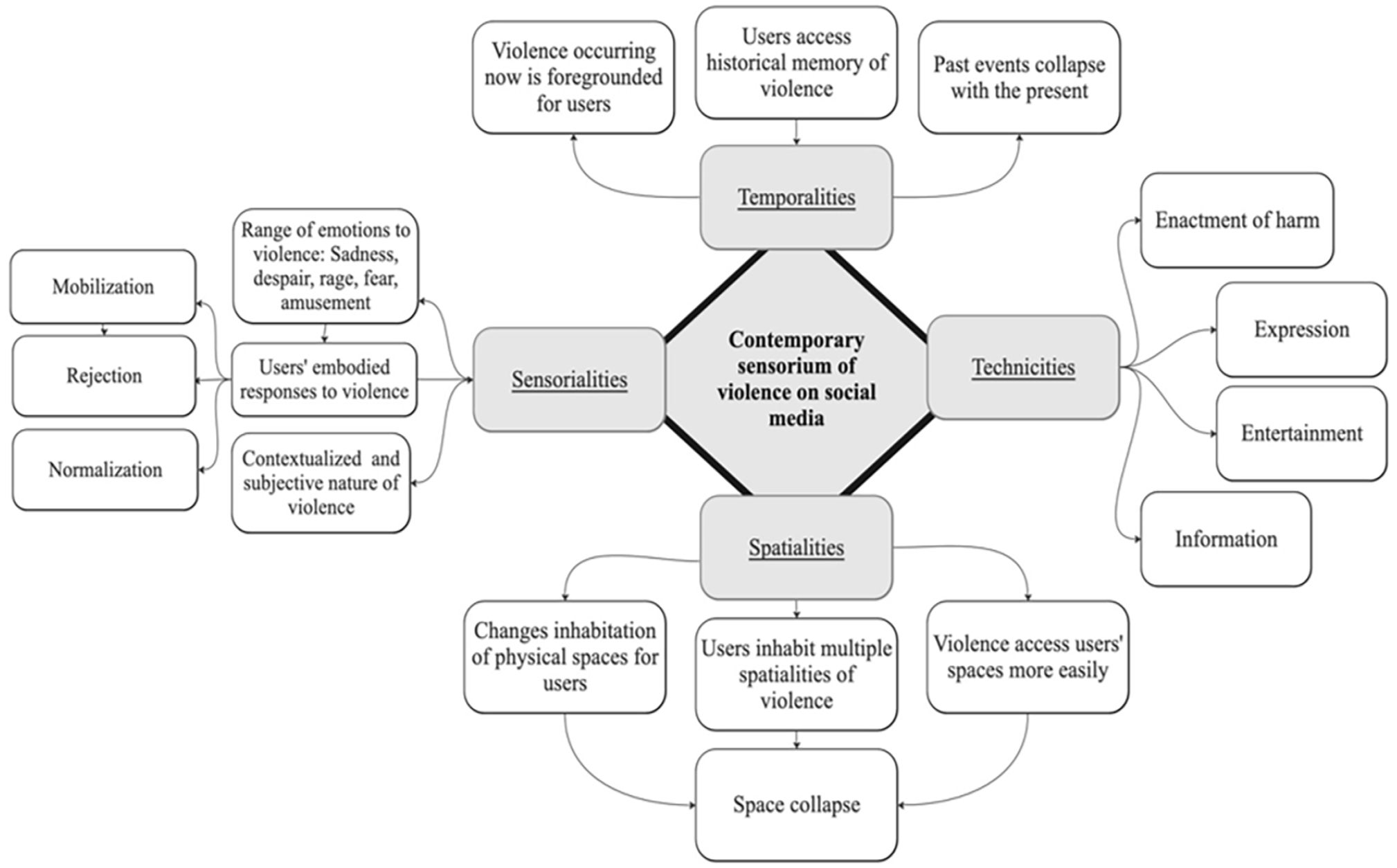
Contemporary sensorium of violence on social media among Colombian young adults.
The results of this study emphasize challenges and opportunities for researchers, educators, activists and policymakers to better understand and address violence on digital platforms. On one hand, findings illustrate the productive possibilities of engaging with digital platforms to address cultures of violence, as illustrated by the way these digital environments enable users to learn about harm well beyond their temporal and geographical surroundings. On the other hand, results also showcase the destructive potentials of social media, such as the emergent and transformed ways of enacting harm to others. Both the productive and destructive potentials illustrated by this study ought to be taken into consideration when designing strategies and policies to respond to the new ecologies of violence on digital platforms.
This study also showcases the critical role of social media in expanding the normalization of violence among Colombian young adults. In this regard, Reguillo (2021) notes that being overexposed to violence, especially when under the logic of spectacularization afforded by digital media, collapses our interpretative systems. As a consequence of this over exposition, violence becomes just another content that young adults encounter in their everyday engagements with social media. The normalization of violence in a country like Colombia has profound negative consequences, such as making it harder for citizens to recognize and address harm enacted towards others, whether in online or offline contexts. In Colombia, such symbolic process has proven to be a key way to dehumanize actors of the armed conflict, which in turn inhibits building and sustainment cultures of peace (Tutkal, 2023). In this context, a necessary response is to produce a device of estrangement in the face of violence, to make it emerge from its naturalization, to displace it from the territory in which it paralyzes and causes the systems of signification to collapse through the idea of its inevitability. (Reguillo, 2021: 68)
Such a device of estrangement towards violence would likely be an empowering tool for promoting cultures of peace in Colombia. Indeed, as noted by Judith Butler (2020), the power to recognize violence towards others and to deem that violence worth reacting to is to acknowledge that the lives of those affected by it are grievable lives – that is, to acknowledge that their lives matter. In the face of this potential of dehumanizing the other through the use of social media platforms (Harel et al., 2020; Tutkal, 2022), de-normalizing violence on social media is not a trivial act. It is, instead, a political act of reclaiming a relational bond that foregrounds solidarity and care within our communities, opening spaces to better address violent behaviour in and beyond digital environments.
In conclusion, this study emphasized the opportunities of following a mediation approach to study violence on digital platforms. Indeed, while this study provided valuable insights into understanding the meaning-making processes of young adults around violence on digital platforms, following a Barberian approach requires further exploration of articulations and tensions around social media users’ lived experiences. Future studies could then explore other aspects of the contemporary sensorium that Martín-Barbero, such as narratives, identities, citizenships and networks (Martin-Barbero and Rincón, 2019). For instance, future work could respond to a limitation of this study (where data collection took place over Zoom) and explore how violence is mediated on social media through face-to-face conversations, providing novel insights into the rituals at play in these mediation processes. As noted by Vasallo de Lopes (2018): ‘The map is open, connectable in all its dimensions, demountable, reversible, susceptible of receiving modifications constantly’ (p. 47). In navigating this map of mediations lies an opportunity for future researchers to continue to expand this lens in future studies of the emergent and transformed ecologies of violence in digital environments.
Footnotes
Funding
The author(s) received no financial support for the research, authorship and/or publication of this article.
