




Abstract
Political and socioeconomic factors contribute to the popularity of surveillance camera use at home in China. This study investigates how CCTV (closed-circuit television) technology shapes family communication practices. Drawing on interviews and observations of 12 migrant parents, four left-behind children and four proximal caregivers, this article explores why people use new surveillance technology in the private home sphere to help parenting, and how family members cope with such surveillance. Children’s coping tactics include participation, disregard, escape and resistance. Through the temporalities framework, this article uncovers nuanced immediate, archival and predictive time experiences. The temporality experience of CCTV use is not traditional linear time co-presence, but video-based concentric three-circle time experience. It shifts interpersonal trust in family life into surveillance trust and interpersonal distrust, which requires familial negotiation and trust reconstruction.
Keywords
Introduction
The convenience and affordability of transport within China today facilitate a hypermobile world (Xiang, 2021). There were 295.62 million rural migrant workers in 2022, representing 20.9% of the total population in mainland China (National Bureau of Statistics of China [NBS], 2023). They live in a socioeconomic environment that encourages them to migrate from rural homes to urban cities, but they are not able to enjoy the same social welfare as local residents in cities due to restrictions of the hukou (household registration) system (Pun and Qiu, 2020). Their children are not guaranteed to enjoy compulsory free schooling in urban cities. As a result, many migrant parents leave their children behind and authorise their family members to take care of the children. In 2020, 41.77 million Chinese children were left behind in rural areas, which means that ‘nearly 4 out of every 10 children in rural areas were left behind’ (NBS et al., 2023: 9). These children generally stay with their grandparents or relatives.
In the context of China’s hukou policy and the digital age, migrant parents use various media to distantly engage in their rural family life and co-conduct caregiving with their left-behind kins (Gan et al., 2020; Liang et al., 2022). Previous studies identified the role of polymedia in caregiving at a distance (Madianou, 2012; Parreñas, 2001). Co-presence can be established when family members engage in the digital world, but whether technologies help improve the quality of family relationships needs more justification. Scholarship identified asymmetrical reciprocity in the care circulation of migrant families (Baldassar, 2016). Age, gender and social class could produce asymmetrical mobile intimacy and cause digital unevenness among migrant families (Cabalquinto, 2018). The line between intimacy and privacy is blurring (Hjorth et al., 2020), in which case new forms of surveillance have emerged (Barassi, 2020).
Complex political, economic and cultural factors contribute to the popularity of home surveillance use (Barassi, 2017). In China’s case, such factors include the triggering of political security schemes, the push of surveillance capitalism and parents’ authoritarian desire to monitor children (Huang and Tsai, 2022). State-owned and private telecommunication enterprises have both promoted surveillance services since 2020, highlighting the link between surveillance and family love, such as watching left-behind children and elderly people (Pang, 2021). The use of CCTV (closed-circuit television) technology at home has evolved from security functions to broader motivations of familial communication, particularly for parents conducting distant childcare during migration. CCTV technology, like previous distance parenting using text, voice and video calls, has become inexpensive and can be purchased and used by ordinary people. The biggest difference between CCTV and previous technologies is that it is possible to connect at any time without a response at home, and the human actions within the monitored area are recorded as video materials automatically.
Surveillance technologies afford functions transcending time and space, providing new experiences of temporalities. Many studies focus on surveillance capitalism, data privacy and social impacts of surveillance technology use in family life (e.g. Barassi, 2017, 2020; Leaver, 2017; Simpson, 2014; Widmer and Albrechtslund, 2021). Besides analysing the causes and effects, nuanced experiences of familial surveillance practice also deserve investigation. Through the lens of temporalities (Barassi, 2020), this article explores people’s experience of CCTV technology use for parenting among Chinese internal migrant families. It addresses two questions: What motivations and experiences do migrant parents have with using CCTV technology at home? How do left-behind children and proximal caregivers respond to and negotiate the use of CCTV at home?
I first review the theoretical concept of temporalities and scholarships of surveillance in family life. Thereafter follows descriptions of observational interviews and data analyses with 12 migrant parents, four left-behind children and four proximal caregivers. In the three analytical sections, I depict how surveillance technology provides immediate timeliness to connect urban and rural family members; how parents utilise archival surveillance videos to enable companionship and add parental meanings and how parents predict children’s trustworthiness based on archival behaviours alongside how children embellish their performance based on predictive parental surveillance schedule. Children under CCTV surveillance have developed four coping tactics: participation, disregard, escape and resistance. I also discuss how CCTV at home triggers conflicts and affects family relationships. It shifts interpersonal trust into surveillance material trust, stimulating distrust and conflicts between parents and grandparents, parents and children. Finally, I further argue that temporality experience led by surveillance technologies is not a traditional linear time co-presence, but a video-based concentric three-circle time experience.
Literature review
Temporality experience at home
It is by monitoring individual behaviours in space and time that surveillance becomes effective (Lyon, 2001). The virtual mobilities of space in migrant family life facilitated by digital technologies have received attention in polymedia studies (Cabalquinto, 2018; Madianou, 2012), but temporality transcendence led by technologies also needs to be understood (Barassi, 2020). One way of understanding technology use is to see it as a ‘temporalising practice’ (Barassi, 2015). Giddens’ (1981) interpretation of industrialised time is that while in traditional societies prior to the development of digital technology, there was no separation of time and space because human interactions required authentic co-presence, but in modern society with digital media, physical presence is no longer a necessary prerequisite. Internet technologies continue to take social practices out of the physical and clock time scenes, for example, allowing people to do multiple works simultaneously on their smartphones at a fixed location. Such neoliberally self-regulating flexibility brought by technologies introduces a new type of temporal regime that erodes the boundaries between leisure time, work time and home time (Barassi, 2020).
Early broadcasting, later televisions and small screens have rescheduled daily household rhythms and emphasised the sense of time here and now. Chambers (2019) summarises the temporal dimensions of multiscreen use at home as a kind of ‘time dilation’ enabled by ‘polymediated timescapes’ (p. 1180), which emphasises the openness and extension of time. The concept of polymediated timescapes highlights various affordances of old and new media technologies, user agency in media practices, and the relational choices of individual media devices. The small screen use offers a new mode of co-presence, forming dilations of space and time within and between families, where intra- and trans-domestic time is reconfigured. Screens generate temporal zones, including family time, memory time, alone time, news time, community time and social time, supporting experiences of time dilation.
Barassi (2020) provides a framework for analysing technology use at home according to three different but interrelated hegemonic temporalities: immediate, archival and predictive time. Immediacy encompasses both the spatial sense of physical proximity and the temporal sense of instantaneity (Tomlinson, 2007). Family members can use Internet technologies to be constantly connected and reproduce the immediacy time (Barassi, 2020) and foster a ‘culture of instantaneity’ (Tomlinson, 2007: 132). The continuous storage of human digital imprints in databases makes archival time become another fundamental dimension of digital temporalities. Predictive time is the combination of past, present and future to define a person’s character and predict the person’s future based on related data traces (Barassi, 2020). Not only does surveillance capitalism promote the three-level temporalities logic, but also ‘temporalities are reproduced and experienced through everyday temporalizing practices’ (Barassi, 2020: 1545). In this sense, temporalities are not only seen as time experiences we possess, but also we constantly do and create in our daily digital practices.
Surveillance technologies in family life
Previous research on surveillance technologies in family life paid much attention to the use of location-tracking applications (Simpson, 2014; Sukk and Siibak, 2021; Widmer and Albrechtslund, 2021), digital games and toys (Chung and Grimes, 2006; Holloway, 2019), pregnancy and infancy applications (Barassi, 2017; Leaver, 2017), and various smart devices at home (Oulasvirta et al., 2012). Scholarship has also focussed on parents controlling their children’s daily screen time and monitoring their online activities (Hjorth et al., 2020; Livingstone and Blum-Ross, 2020). The research paths of these studies can be divided into two broad categories. One category discusses the privacy issues raised by surveillance, including the personal privacy of children and the privacy of family members’ data. The other category is discussion of whether parental surveillance should be rationalised at a societal level, focussing on ethics issues and debating the boundaries between care and control in terms of the motivations and effects of surveillance.
Some studies based on intra-family communication focus on parents monitoring children’s locations (Marciano, 2021) or online activities (Jeffery, 2021) aiming to understand the lived experience of parental surveillance but focus more on the possible detrimental effects of certain parenting styles on children’s resilience, independence, agency, rights and other development, such as trusting others and being trusted (Rooney, 2010). Despite widespread criticism of helicopter parenting, digital monitoring tools for child safety seem to be justifiable (Lim, 2020). Discussions on surveillance technologies and parenting tend to revolve around a simple dichotomous narrative of ‘good’ use versus ‘bad’ use (Simpson, 2014). In family life, ‘power and emotion may be central issues surrounding privacy management choices, boundary regulation, and shifts in privacy rules changes’ (Petronio, 2010: 192).
When analysing the data privacy of parents and children users, surveillance capitalism and commodification of dataveillance are often criticised (Barassi, 2017, 2020; Holloway, 2019; Leaver, 2017; Lupton and Williamson, 2017). Such scholarship criticises the networked infrastructure of surveillance capitalism that profits from the collection and monetisation of personal data and defines or predicts children according to the datafication of monitoring their daily practices, including health, education, family and social media. However, the narrowed analysis of technologies uncovering digital surveillance and commodification of personal data ‘prevents scholars from appreciating their social and cultural complexity’ (Barassi, 2017: 3). Barassi (2017) highlighted the cultural complexity of digital technologies, including the complex historically socio-technical environments, cultural discourses of apps, discussions and comments of users. Attention to cultural complexity and user experience further explains the popular use of surveillance technologies in family life rather than just the capitalism logic.
The complex and ambiguous relationships between surveillance, care and control trigger many debates. The tensions inherent in many surveillance practices exist between care and control (Lyon, 2001; Widmer and Albrechtslund, 2021), but the motivations of care and control cannot be easily separated (Nelson and Garey, 2009). The camera itself is not the only issue but rather the selective use of technology and the existing power structures (Johnson et al., 2020). Monitoring technologies can alleviate parental anxiety by allowing parents to know the situation of their children beyond distance. Parental monitoring and the Internet amplified intimate surveillance that has become a popularly normalised parental care practice (Leaver, 2015). Such normalisation received much criticism because surveillance capitalism exaggerates the risks and stigmatises non-surveillance use as irresponsible parenting to sell their products (Taylor and Rooney, 2017), increasingly associating surveillance with care, safety and protection (Rooney, 2010), and even directly with responsible and loving parenting (Marx and Steeves, 2010). In this economic and cultural context, parents use tracking software and other intimate surveillance technologies for two reasons: fear of external risks or accidents to their children and fear of being perceived as irresponsible parents (Leaver, 2015, 2017; Simpson, 2014).
An experimental study of the long-term effects of ubiquitous surveillance in homes reported that people gradually become accustomed to surveillance and do not think about or notice it anymore after 6 months although they opposed it at the beginning (Oulasvirta et al., 2012). But reactions to surveillance range from acceptance to resistance (Ball, 2009; Saulnier, 2017). Sukk and Siibak (2022) found three types of children’s responses to parents’ intimate surveillance: compliant, autonomous, and privacy-sensitive. In their research, compliant children do not question their parents’ authority and reasons for surveillance but tend to rationalise their understanding of parents’ surveillance. The latter two types of children have a desire to protect their privacy. Rather than being passive objects of surveillance, children develop strategies to resist parental surveillance, express their privacy concerns and demonstrate their autonomy (Barron, 2014; Clark, 2013).
Methods
Research on technology use in migrant families has shown the significance of conducting ethnography to understand people’s media life (e.g. Madianou, 2012) because it helps ‘identify and understand their uses of media in the context of their everyday situations and life histories’ (Lorenzana, 2016: 2194). This research is based on an ethnographic project in China’s Yangtze River Delta and a rural mountainous village in Sichuan. The fieldwork with all participants was reviewed and approved by the ethics committee of the author’s affiliation. The data in this article were mainly collected from two groups of participants between November 2021 and June 2022 (see Table 1). All participants’ names are pseudonyms to protect their confidentiality.
Profiles of participants.
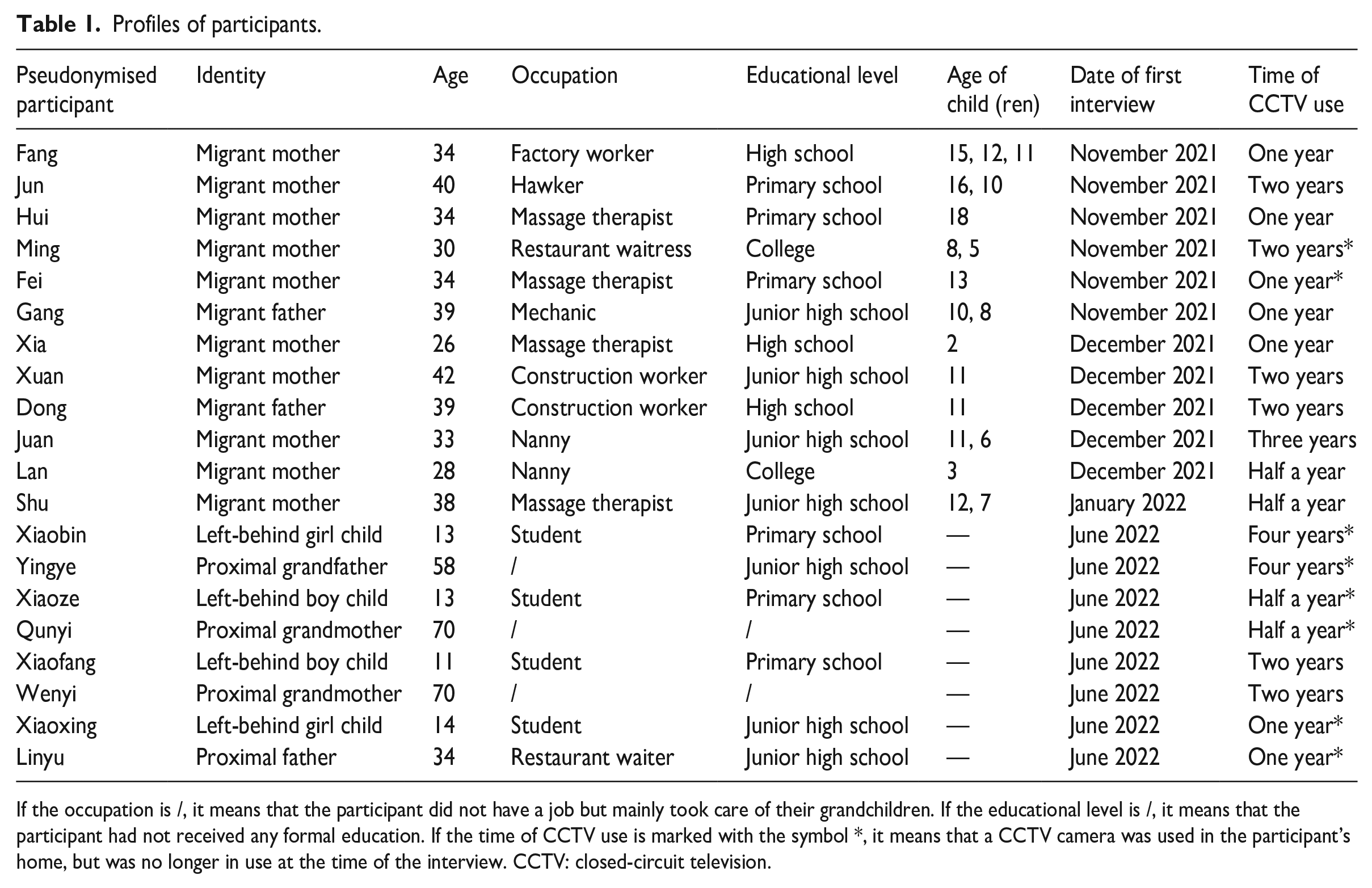
If the occupation is /, it means that the participant did not have a job but mainly took care of their grandchildren. If the educational level is /, it means that the participant had not received any formal education. If the time of CCTV use is marked with the symbol *, it means that a CCTV camera was used in the participant’s home, but was no longer in use at the time of the interview. CCTV: closed-circuit television.
In migrant family life, the fundamental relationship between family members is the caregiving triangle – migrant parents, left-behind children and substitute caregivers (Suarez-Orozco et al., 2002). Therefore, to explore the full spectrum of technology use at home, the perspectives of all family members are included in this research. Through snowball sampling based on my social network, the first group of participants consisted of 12 Chinese migrant parents who migrated from rural villages to urban cities over 6 months and left their children in hometown. The second group involves four left-behind children (with at least one parent working outside hometown for over 5 years) and four of these children’s proximal caregivers. In the rural homes of all 20 participants, parents had used CCTV cameras and applications for at least 6 months. Eight participants reported that their homes stopped using the cameras, with reasons, such as not using it after it broke down, or that surveillance fuelled tension in family relationships. Although the number of children and caregivers participants was small, because I also asked 12 parents about attitudes and reactions of their left-behind family members, the data showed a basic saturation of coding themes after the sixteenth sample in combinative and comparative analyses.
Each first interview of 20 participants lasted from 40 to 90 minutes. With permission, I went back through the relevant chats, posts and apps on their smartphones. To analyse the data, I used thematic analysis (Braun and Clarke, 2006), completing six steps: familiarise myself with the data, generate initial codes, search for themes answering the research questions, review themes, define and name themes under the temporalities framework, and produce a report. The initial main inductive codes include the purchases, motivations and instalments of CCTV devices, functions and effects of daily CCTV use, different family members’ attitudes and behaviours before and after the use. Informed by the temporalities framework, I reviewed the codes and coded the codes again under the three main themes: immediate, archival and predictive time experience to examine the data from a temporality perspective and explore structural relationships between the three themes. For instance, the codes ‘supervising children’s habits’ and ‘instant companionship’ were categorised as ‘immediate’; the codes ‘video evidence’ and ‘video memory’ as ‘archival’; the codes ‘parents’ predictive scheduling’ and ‘children’s performance under camera’ as ‘predictive’. The overall strategy for data analysis is a combination of bottom-up induction and top-down deduction.
Temporality experiences and coping tactics
The interplay of parenting duty and values, family norms and expectations, and the external socioeconomic environment is reflected in the contingent and popular use of surveillance technologies (Widmer and Albrechtslund, 2021). In the fieldwork, the parent informants purchased CCTV cameras and used surveillance applications on their smartphones through online shopping (from US$15 to US$25) or for free through phonecard packages as promoted by telecommunication suppliers. They first learned that CCTV use at home in two ways, either they knew some people in hometown who had installed one, or they had seen advertisements for the CCTV products somewhere. In the village I visited, CCTV advertisements were easily found in the shops of mobile phone suppliers (see Figure 1). The low cost of CCTV devices, cloud storage and application services facilitates the popularity of surveillance cameras at home across rural China. In practice, local people innovatively utilise this technology according to their family values and expectations. Cameras were installed in the yards or living rooms (see Figure 2) in all participants’ homes, as they considered these areas as ‘public spaces’ at home, while the bedrooms as ‘private zones’.

Examples of advertisements of CCTV camera services provided by Chinese state-owned telecommunication suppliers in the rural village. The left promotes that CCTV can watch home, children, and parents, ensuring property safety. The right offers three-person family mobile packages, with the second box saying ¥46 (approx. US$7) per person per month, including WiFi, mobile data, a CCTV camera and other digital services.
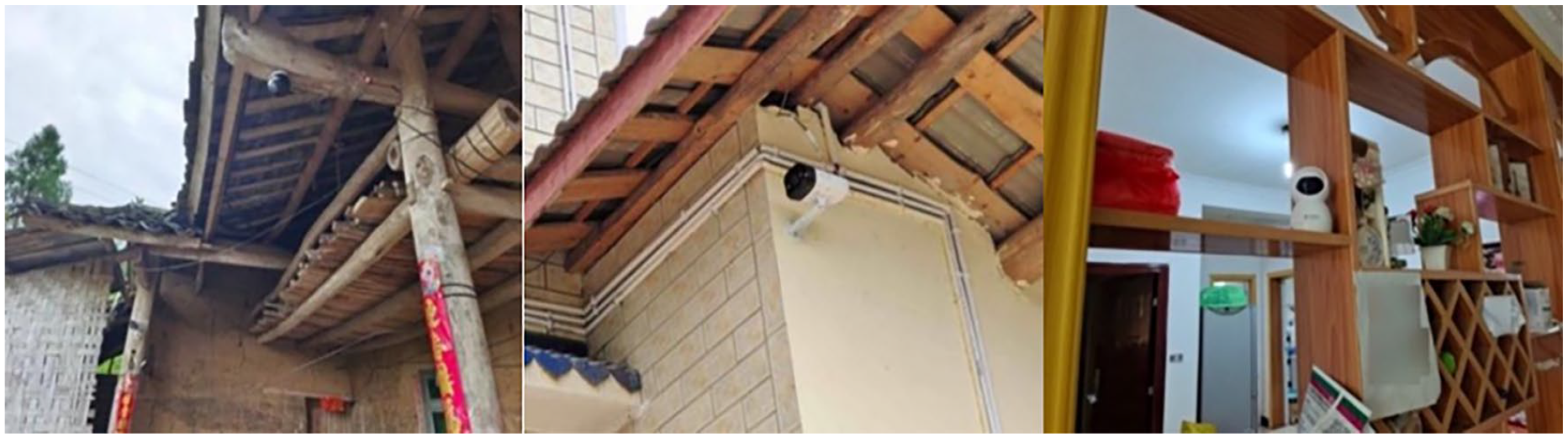
Examples of CCTV cameras setup at rural homes.
In the next sections, I follow Barassi’s (2020) temporalities framework to analyse the detailed immediate, archival and predictive time experiences of CCTV technologised family life, while discussing how CCTV at home affects familial relationships. I depict how live monitoring provides immediate timeliness, connecting parents’ urban leisure time and rural family time, and assisting with proximal grandparental care; how parents utilise monitoring archives to achieve companionship transcending past time and attach parenting values to archival time and how power dynamics among migrant parents and rural family members become intense when they adopt various time-predictive tactics.
Immediate and ubiquitous connectivity
Through mobile technologies, migrant parents seem to achieve the duty of caring for their children from a distance (Baldassar, 2016; Madianou, 2012). CCTV technology further affords migrants an immediate time experience of leaving their hometown but not leaving home. Xuan and Dong are a couple who have been working in several cities of Jiangsu from their hometown of Sichuan for more than 20 years. During my interactions with them, the couple worked on the same construction site, while their 11-year-old son was being looked after by his grandparents. Neither of the grandparents is able to use a smartphone, so that, they use elderly special phones with big buttons. Before the CCTVs were installed, the couple could only call back. Sometimes when Xuan’s brother went to their home, the couple and the child could video call through Xuan’s brother’s smartphone. The couple once left their old smartphone at rural home, but the child often used it to play games and spent money secretly, so that, the smartphone was later broken by Dong.
I visited the rural home of Xuan and Dong and interviewed their son Xiaofang and grandmother Wenyi. One CCTV camera is next to the front door and one facing the door, both of which could see the television area in the living room on the ground floor as long as the door is open. Another camera faces the main road where people inevitably pass if walking towards the house. Xuan explained, Sometimes I watch it (CCTV app) every day, sometimes I just open it basically on Saturday and Sunday or Friday afternoons. I can keep an eye on whether my son is playing or doing homework after school. I see when he gets home. The child lacks self-discipline. Often when I open the app and see him watching TV, I usually urge him to do his homework, shouting directly through the app (the camera transfers the voice meanwhile) and saying that if you don’t eat the bitterness of studying now, you’ll eat the pain of life when you grow up.
Polymediated timescapes support the time dilation experience in family life (Chambers, 2019). The immediate co-presence offered by CCTV surveillance is timeless, connecting homes without an answer. It connects parents’ leisure time in cities and family time in villages. But cameras in participants’ homes are generally fixed at a location, so that, the view is limited. In practice, surveillance technology use is often combined with social media, such as WeChat. Ming’s two children were left at hometown, but she felt that she is a responsible mother because through the monitoring camera, she could keep company with her children. Ming indicated, When I use the surveillance app to see the kids and their grandmother eating, I feel the camera is a bit far away because it is fixed on the top of the fridge (in the living room). Then I call the video back on WeChat and kids can use the phone to show me their meal. I can also see the kids’ faces up close. Sometimes when I see the kids doing their homework, I ask them to take photos of their homework and send them to me via WeChat, and I will check it.
Surveillance technologies serve as migrant parents’ companionship-based compensation for physical absence in a live-streaming manner while fuelling authoritarian parenting. Neoliberal parenting discourses in contemporary China emphasise individualisation and self-responsibility (Meng, 2020). The ubiquitous connectivity provided by fixed CCTV media coupled with mobile social media has paved the way for migrant parents to engage in their left-behind children’s lives. Fei, the mother who had worked outside hometown for 10 years, was delighted to see her daughter through the surveillance app to ease her nostalgia. With immediate co-presence in synchronised time with home (Baldassar, 2016), parents monitor their children’s safety out of protection and track children’s ‘bad’ habits (Simpson, 2014), in a way of mobile phone parenting (Liang et al., 2022). Such parental engagement fulfils the expectation of parents that children acknowledge them as parents (Gan et al., 2020).
Parental surveillance shares the parenting pressure of children’s safety and health that proximal caregivers would otherwise face alone. The grandparents in this study, who were also affected by the surveillance at home, shared an opinion of understanding parental surveillance. They understood that parents wanted to see their children from afar. Although three grandparents received living expenses from the children’s parents, they were still mainly engaged in agricultural work. Coupled with their lack of digital literacy, they were unable to take close care of grandchildren when they were busy with farm work and needed assistance from the children’s parents. They felt that the cameras were installed in the living room, not bedrooms, hence they supported CCTV use.
However, CCTV cameras in rural homes may suggest a distrust of substitute caregivers by children’s parents, increasing criticism of grandparental care. For instance, Shu was worried about her daughter’s and son’s eyesight, so that, she installed a CCTV camera through online shopping. Sometimes when she saw the children were watching TV late, she urged them to sleep, ‘It’s 10 pm and they still haven’t finished washing their feet and gone to bed. The children’s grandfather is just not careful with looking after the kids’. This triggers family conflicts and causes mutual incomprehension. Because the camera is placed in a fixed place with a limited view, it provides some space for children and the elderly to negotiate and resist surveillance, as I will explain later.
Archival companion, evidence and memory
Internet technologies tend to track and document everything in the database (Barassi, 2020). CCTV technology fundamentally amplifies the practice of archiving time, as the mundane details of everyday life are recorded in the cloud and made available for users to check back on. In migrant worker families, there is often a mismatch between children’s rural routine and parents’ urban schedules due to the parents’ jobs, such as extra-long hours of working. The automatic recording function of monitoring technology effectively coordinates the different schedules of the two sides. It allows migrant parents to psychologically relieve the guilt of being absent from their children’s lives as if they had mentally travelled back few hours earlier that day. When the children came home, they spent a few minutes with kids in the living room via the playback function. As Fang, a migrant mother, explained, The children are left at home. Their grandparents often work on the farm and return late, I want to see the kids, so I installed a monitor camera, through which I can watch and talk. I bought it on Taobao for about 100 yuan. If I have time, I (open the app) watch it. It is flexible so there is no fixed time. I also look at it during a break at work. When I get off work, it’s 8–9 pm, my kids are asleep (in the bedroom), so I look at what they’ve done at 6–7 pm. I don’t watch back for long, just for a few minutes. I’m already tired from work in the factory, but I feel closer to my children after watching it each time.
Similarly in Fei’s case, working as a massage therapist, she had much work on Saturdays and Sundays when her daughter had spare time, so that, she was often too busy to talk to her child. When she got off work and missed the kid, she watched the video recording. This archival time experience not only psychologically brings the users close to the monitored environment, but the recorded materials also allow migrant parents to confirm the safety status of their children. For example, Xuan and his son Xiaofang’s school teacher kept in regular contact. The teacher in the mountainous countryside was concerned about the safety of her students. When the teacher asked Xuan about Xiaofang’s safety, Xuan looked back at the video recorded, checked that the child had gone home and then replied to the teacher (see Figure 3).
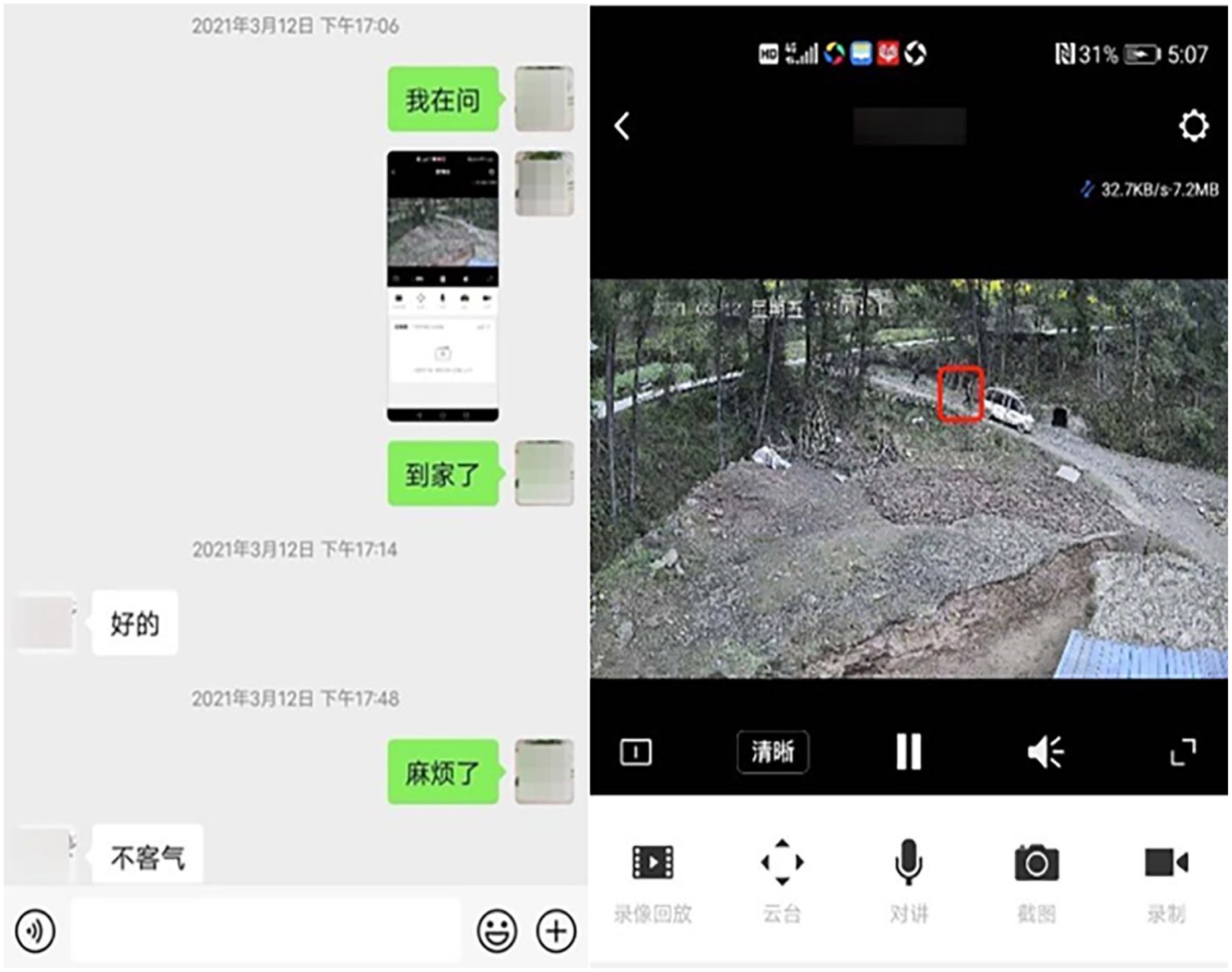
An example of Xiaofang’s teacher asking Xuan (Xiaofang’s mother) if the child was back home safely. Xuan checked the CCTV monitoring app and confirmed that the child was back through the playback function.
The digital archives of mundane live time also contain lots of growing-up moments of children. Children’s learning and playing behaviours are automatically networked and materially visible. Such archival digital imprints are innovatively used in practice as evidence for parents to judge the truth of kids’ conflicts, as well as being artificially imbued with emotion and made into album memories to share on social media, prompting family practice into social practice and culture. In Ming’s case, there were some conflicts between the sister and brother. Sometimes the siblings told different stories, in which case Ming went through the video recordings to see who started the fight and tried to treat both kids fairly. This behaviour implies that parents trust the surveillance archives more than they trust their children. Surveillance video is seen as a source of truth, as a fascination with total visibility and power.
Surveilled subjects’ reality display catalyses voyeurism and exhibitionism (Ball, 2009). Parents attach value and meaning to the children’s videos captured by CCTV technology. Juan sometimes saved the screenshots or clips of children’s videos on the monitoring app and edited them through another video clipping app with emotive text, such as ‘Mum would like to be with you every day, but if I don’t work, we don’t have money to live a life’. The sharenting behaviour of taking videos of children and posting them online is not new (Barassi, 2020), but the affordance of automatic recording of CCTV technology provides tremendous daily trivial sharenting materials. In this regard, archival videos in family life become part of the daily communication between families towards socialisation, which raises privacy boundary issues (Petronio, 2010). Questions remain prominent about where the boundary of children’s privacy is for public displays by their parents, and whether monitoring and sharing of children’s data faces data breaches (Barassi, 2020; Holloway, 2019).
Predictive tactics and resistance
Mothers tend to spend tremendous time and effort caring for their children and practice ‘intensive mothering at a distance’ (Madianou, 2012). In this study, migrant parents know their children’s daily routines, so that, they predict when the children will be eating and resting, and open the surveillance app to supervise. This input in distant parenting not only enhances communication between parents and children but also puts interpersonal pressure on children. As Madianou (2019) indicates, ‘teenagers felt that the synchronous temporality of calling was a way for their mothers to monitor them’ (p. 584). The use of surveillance technologies suggests that security or people in the home are not trustworthy, thus giving children information that they are not trusted (Rooney, 2010).
The children watched by CCTV cameras at home develop coping tactics, which I categorise into four types: participation, disregard, escape and resistance. The first participation type is featured by toddlers. The younger children were happy to talk with their parents through CCTV devices and felt like they had their parents around. As Ming described, ‘When my son was three years old, he would be a bit surprised at first because I could talk through the camera. But later, he got used to it. He also proactively showed the camera his toys to me’. As a 13-year-old teenager, Xiaoze’s attitude belongs to the disregard type, For me, it’s the same whether my mom and dad have this monitoring or not. I behave well enough. I do my homework on time. (. . .) Once, when my parents came home for Spring Festival but they left home when I was at school, so I didn’t even say goodbye. Later I took my older sister’s smartphone and looked back at the video recording of my parents leaving time.
In this disregard type, Xiaoze predicted and showed confidence that his behaviour would remain as disciplined as usual, so that, he presented an indifferent attitude towards CCTV surveillance and even made use of the surveillance app. Xiaoze’s self-discipline won his parents’ trust as he predicted. Qunyi explained that the CCTV was primarily due to concerns about the grandfather’s illness, then for the grandchild. Xiaobin’s parents also felt that the child’s performance was good, so that, they did not need a camera anymore after the device broke down. Parents believe that their children’s right to privacy is something to be earned (Sukk and Siibak, 2021). Stopping surveillance use seems to become a symbol of re-establishing trust-based parent-child relationships over the cumulative past time. Eleven-year-old Xiaofang seems not to be compliant or self-disciplined. The three surveillance cameras installed at home made him feel pressured, but he knew, During the weekdays, especially morning and earlier afternoon, Mum and Dad would not have time to monitor me, it is after evening dinner when they more possibly watch me. Yes, and when they are on holiday too. (. . .) Sometimes they make a sneak attack and catch me watching TV, then they’ll shout at me and teach me a lesson through the camera. (. . .) So during the time they often watch, I perform a bit under the camera but do what I want to do when I’m not watched.
It remains discernible whether children’s performances under cameras are authentic or merely performative displays to satisfy adult expectations. The surveilled performative exposure cannot substitute real human interactions and trust (Ball, 2009). Xiaofang also tries to stay out of the monitored living room, as he finds bedrooms have more freedom. Xiaofang’s coping strategy of escaping seems to be passive resistance, but he actively predicts the time schedule of being watched. The last resistance coping type is more radically active and counts as rightful resistance to surveillance. Xiaoxing’s home had a CCTV camera from 2019 to 2020. Although she knew her parents were concerned about her safety, Xiaoxing always felt uncomfortable under surveillance, so that, she directed the camera at the wall instead of the couch, I told my parents straight away that I didn’t want to be monitored. I resist it. I keep feeling like eyes are watching me and feeling depressed. It’s scary when I’m engrossed in watching TV and then suddenly my mum behind the monitor comes out and asks what you’re doing.
During that time, looking at small holes in the ceiling of the classroom made her feel frightened. She said the holes were like human eyes. Faced with the daughter’s strong emotional resistance, the parents did not use the camera anymore. As Ball (2009) argued, the surveilled subject is not entirely oppressed or ignorant. Workers use camera blind spots to avoid surveillance, and teenagers can disrupt the camera to resist (Lyon, 2001).
Through monitoring technologies, parents are competing in new ways with proximal caregivers for the children’s attention and dominance in the home (Johnson et al., 2020; Marciano, 2021). CCTV cameras in rural homes, on one hand, allow children’s parents to share some of the proximal childcare responsibilities, on the other hand, entangle the caregivers in the monitored living room. Qunyi hinted that she would be careful when exposed to cameras in the future, or at least go to bedrooms to gossip, We have a surveillance camera in the living room over there (directed towards the couch). The other day when my eldest granddaughter came home, I said something (criticising the daughter-in-law). My daughter-in-law heard my words on the surveillance app and she became upset. Our family had an unpleasant time then. Later my son said, just rip it (the cable of the camera) out. So this camera has not been used since then.
Conflicts between grandparents and parents may discourage parents from monitoring their left-behind children. Surveillance often involves power and subordination in relationships (Johnson et al., 2020; Saulnier, 2017). Uneven mobile power may lead to one-sided familial practices (Madianou, 2012) and mediated parental gaze (Chen, 2020; Sukk and Siibak, 2022). Here the time dilation caused by surveillance cameras is one-sided. Since private conversations in rural living rooms are live-streamed to the migrant parents, it disintegrates the trust and interpersonal time-space distance between family members. Although grandparents in this study initially understood parents’ motivations for CCTV use at home, the blurring of family privacy boundaries did create conflicts that needed negotiation in family practices.
Conclusion and discussion
This study has presented lived experiences of Chinese internal migrant families’ CCTV technology use at home, including three perspectives of migrant parents, left-behind children and proximal caregivers. Through the temporalities framework of technological life proposed by Barassi (2020), I uncover the immediate, archival and predictive time experience in nuanced daily practices of parental surveillance instead of Barassi’s focus on surveillance capitalism. I propose a concentric three-circle model that visualises the structure of three temporality elements (see Figure 4). The temporalities led by surveillance technology are not traditional linear time co-presence, but video-based three-circle time experience, including the immediate time where people can transcend distance; the archival time where people can retrace immediate records and attach values or meanings to them; and the predictive time where people can add anticipatory judgements and coping strategies based on the immediate and archival experience. The three temporal layers are in a progressively encompassing interrelationship. Each outward layer implies an expanding field of digital surveillance practice and a further interplay of power dynamics.
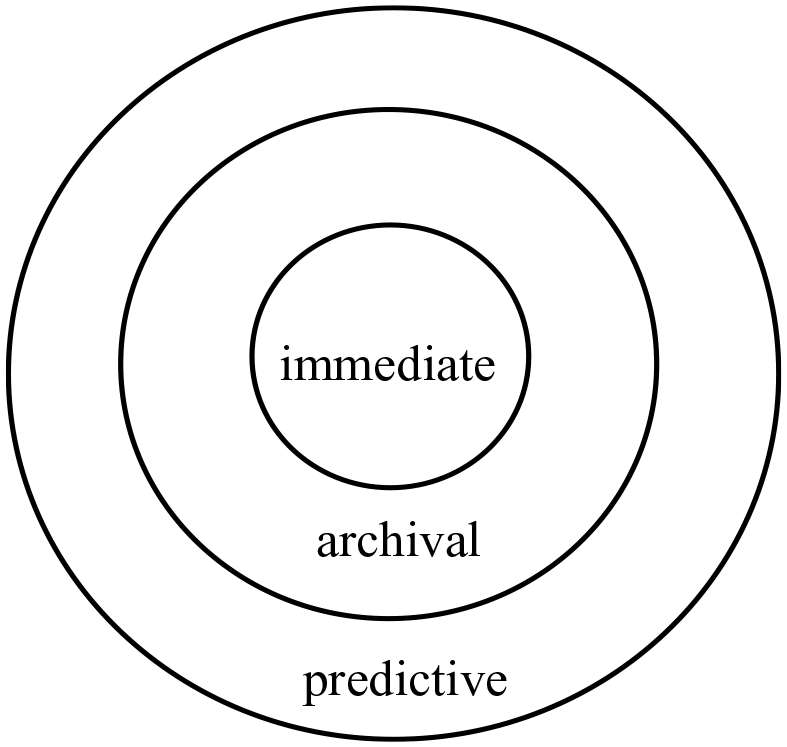
A concentric three-circle model of household members’ temporalities experience when using surveillance technology at home.
In the immediate time experience, surveillance technology first provides migrant parents with immediate and ubiquitous connectivity to engage in proximal childcare. Technology as mediator constitutes interaction between the surveiller and the surveilled. The unidirectional structure of gaze creates an imbalance in power as the surveiller dominates the access and timing of technology connections. In the archival time experience, the recording affordance of CCTV technology is innovatively used by parents as compensative companion to relieve homesickness, as evidence to resolve sibling quarrels, and as memory videos to express parenting sentiments on social media. After the surveilled’s actions are automatically recorded as mediatised content, the surveiller attaches subjective affective or value meanings to the records. The second layer of temporal experience highlights the subject position of the surveiller, with the surveilled and digital archives as gazed objects. The immediate and archival times are dominated by the surveiller party’s power.
In the predictive time experience, parents know their children’s daily routines so they can predict when to check monitoring apps, either in an immediate or archival manner. They also predict whether a child is trustworthy enough to remove surveillance based on archival behaviours. However, gazed children are not completely passive when they escape the limited camera sights or embellish their behaviours by forecasting the monitored time. Barassi (2020) argues that predictive time is the combination of past, present and future to define and predict a person based on data traces. I further argue that the most peripheral predictive time is the space of intense power play between the surveiller and the surveilled, where surveillance controllers’ predictive judgement and scrutiny confront surveilled subjects’ predictive performance and avoidance. Children’s predictive practice manifests their subjectivity to resist surveillance. A non-reductive multi-dimensional view to explore surveillance can identify new possibilities for resistance (Ball, 2009). Children’s coping tactics under CCTV surveillance were fourfold in this research, including participation, disregard, escape and resistance. Compared to the last obvious resistance, the first three tactics might be mingled with invisible predictive resistance, as they could all embellish behaviours in front of cameras. Children’s potential performative personality deserves vigilance.
Looking at CCTV use at home through a temporalities lens provides two insights. First, it helps understand human practical experience and technology popularity reasons, identifying unbalanced time dilation. Second, it helps analyse power dynamics among family members, identifying the tactics they predict and resist the surveillance. Meanwhile, it surfaces the trust crisis between family members. Children have the right to be trusted and learn to trust others. The balance between control and trustworthiness in parental surveillance needs consideration (Sukk and Siibak, 2021). CCTV use at home not only creates tensions in parent–child relationships but also affects mutual trust between migrant parents and proximal caregivers. It shifts previous interpersonal trust into surveillance material trust and stimulates distrust and conflicts, which requires re-establishing trust in familial negotiations.
Sociocultural changes in modernity and local people’s knowledge of CCTV technology have perpetuated surveillance practices (Ball, 2002; Lyon, 2001). In China’s case, factors contributing to the popularity of CCTV use in rural homes include the political reality of migrant workers leaving their children behind, the promotion of surveillance culture by the state and capitalism, and the Confucian tradition of intergenerational cooperative child-rearing and parental authoritarianism. Marciano (2021) demonstrated that parenting styles in surveillance use are diverse and that users care more about the practicality of the technology in daily practice rather than the ideology of surveillance in a symbolic sense. Therefore, people’s thinking, struggle, choice and negotiation in authentic life experiences matter (Xiang, 2021). This article is not attempting to rationalise parental surveillance but rather providing insights into why and how people use CCTV technology to address distance problems. Although surveillance technology can be positively used for distance care, it should be negotiated, debated and critiqued within family and society.
The population of interest in this study is closer to the working class than the middle class. Middle-class mothers have more anxious parenting expectations (Meng, 2020), so that, their CCTV use at home may lead to different findings. Previous research found that the age and gender of children differ in their perceptions of monitoring (Sukk and Siibak, 2021; Widmer and Albrechtslund, 2021), but this article is unable to discover further differences due to the limited sampling. Compared to parents and children, proximal caregivers’ feelings are still underdeveloped in this article, so that, their feelings about CCTV surveillance could be further explored in the future.
Footnotes
Acknowledgements
The author would like to thank Dr Alberto Cossu, Dr Jee Young Lee and reviewers from ICA for their suggestions on earlier versions of the manuscript. The author would like to thank Prof. Athina Karatzogianni for her early encouragement to explore this topic. The author would also like to thank the two anonymous reviewers for their professional comments.
Author’s Note
The author agrees to the submission. The article is not currently being considered for publication by any other print or electronic journal.
Funding
The author(s) disclosed receipt of the following financial support for the research, authorship, and/or publication of this article: This research received a grant from PGR Research Support Fund of the Doctoral College at the University of Leicester.
