




Abstract
We investigate the relationship between platform visibility and meaning making. Drawing on a quanti-quali investigation of hashtag practices in a cross-platform dataset, we explore how hereditary cancer is constructed, as an issue, on social media. Our findings provide strong evidence of significant variations across Instagram, TikTok and Twitter, with hashtag practices on these platforms tapping into platform-specific understandings of hereditary cancer: a pink ribbon issue on Instagram, the opportunity for non-normative exposures of bodies, pain and acceptance on TikTok and a scientific matter on Twitter. Platforms do not dictate choice, but their encounter with user interpretations, given similar material constraints (hashtag technology), lead to very different affordances. These affordances shape practices and, ultimately, meaning making. While raising concerns on the impact platform visibility might have on experiences and understandings of hereditary cancer, our work suggests broader implications for how we imagine and respond to the issues we care about.
Keywords
Introduction
In this article, we situate the encounter of platforms and users in the shaping of visibility, namely in the demarcation of what content can be seen and, perhaps most importantly, how this content should be seen on contemporary social media. We know that platforms moderate visibility by manipulating (amplifying or suppressing) the reach of user-generated content through algorithmic or regulatory means (Zeng and Kaye, 2022). We also know that users engage with these manipulations, for instance, circumventing hashtag moderation policies (Gerrard, 2018) or playing with algorithmic systems (Bucher, 2017) to make their content visible, in the sense of being publishable and able to attract views, replies, clicks, likes and/or boosts. But how does the ‘visibility game’ (Cotter, 2019) resulting from this constant interplay between platforms and users shape meaning making? How does an issue, event or controversy become visible to simultaneously fit with the norms embedded in platforms’ profit-driven technologies and respond to users’ needs? We argue that the answer to this question holds important information about how an issue becomes visible within and across platforms, about the ‘communities’ constructing and using this meaning and about the potential implications for those exposed to it.
In what follows, we draw on existing research on affordances and vernaculars to conceptualise platform visibility as meaning making. We then elaborate on the role of hashtags as vernacular ‘markers of visibility’, namely as ideational (Zappavigna, 2018) devices defining what an issue is about. Finally, we present a quanti-quali investigation of how hereditary cancer becomes social media-visible through hashtag practices on Facebook, Instagram, TikTok and Twitter.
The crafting of visibility: affordances, vernaculars and beyond
Affordances are the way
In 2001, sociologist Ian Hutchby carved a ‘third way’ between materialist and constructivist approaches to technology, one where technology itself—as an artefact—can both shape and be shaped by human action. Hutchby (2001: 444) suggests looking at technological objects neither in terms of their essential properties nor of their interpretive properties alone but in terms of their affordances, ‘functional and relational aspects which frame, while not determining, the possibility of agentic action in relation to an object’. This theorisation draws on Gibson’s (2015 [1979]) work on the psychology of perception, according to which different elements of an environment (e.g. objects, places, animals) offer different affordances for a given animal. ‘They offer benefit or injury, life or death. This is why they need to be perceived’ (Gibson, 2015 [1979]: 134). Animals orient to elements of their environment based on the possibility for action that they see in these elements: a rock is a shelter from the heat for a snake but is a hiding spot for an insect. This also implies that affordances vary ‘from species to species and from context to context’ (Hutchby, 2001: 447) and are relational, namely they relate to the animate and inanimate elements of a specific environment. In the third way delineated by Hutchby, technological objects constrain the possibility for action, namely they set limits on what it is possible to imagine doing with them. For instance, a telephone can be interpreted as affording a set of actions, but how likely is it that, say, a car can be open to exactly the same set of interpretations? In other words, there are some properties in a technology that cannot be ‘constructed’ through an infinite range of discursive representations; there are constraints to the way ‘that they can possibly be “written” or “read”’ (Hutchby, 2001: 447, emphasis in original). Hence, when humans interact with technology, they are faced with interpreting, and managing, these constraints.
Social media research has relied heavily on the concept of affordance, especially to stress the importance of understanding the way users ‘imagine’ (Bucher, 2017; Nagy and Neff, 2015) or produce ‘vernacular’ interpretations (Keller, 2019; McVeigh-Schultz and Baym, 2015; Nau et al., 2023) of technological objects. While leaning towards a constructionist approach centred on lived experiences of technology, these studies do not necessarily depart from or add much to Hutchby’s paradigm. What is, perhaps, the most intriguing feature of the social media approach to affordance theory is advanced by work depicting platforms as environments, namely as the very relational ‘surroundings’ where animals ‘perceive and behave’ in Gibson’s (2015 [1979]: 3) work. According to Bucher and Helmond (2017), social media platforms, while drawing on similar functionalities and features (e.g. comments, likes or hashtags), have distinct connotations (e.g. Application Programming Interfaces, regulatory frameworks). A key point is that these environmental connotations are very different from those of the natural world, primarily because a ‘technology is socially, rather than naturally, designed [. . .] What this ultimately means is that technological artefacts could arguably be ‘political’ unlike natural artefacts’ (Ditchfield, 2018: 25). The point Ditchfield (2018) is making here is that the ‘writing’ (Hutchby, 2001) of platforms, namely their design, cannot be taken as neutral.
Taking all the above into account, the affordances of most Western mainstream social media are relational aspects that originate from the encounter of profit-driven platforms (Gillespie, 2010), the material constraints foreseeable in these platforms (Hutchby, 2001) and users’ responsive interpretations. What we are interested in here is exactly the result of this encounter, namely the thriving (or dying) of specific vernacular practices on social media and the possible implications for the visibility of issues covered in these practices.
From affordances to vernaculars
The idea that platforms have their own vernaculars materialised with Gibbs et al.’s (2015) study of #funeral content on Instagram. In that work, platform vernaculars are defined as ‘genres of communication’ marked by specific ‘styles, grammars, and logics’ (Gibbs et al., 2015: 257) negotiated through platform affordances. Platform vernaculars are neither monolithic nor mutually exclusive: they consolidate and evolve over time while aspects of their grammars, especially technological objects (e.g. hashtag, like button), can become universally common in the overall platform ecosystem. These vernaculars, however, develop specificity to platforms. In their discussion of Instagram’s aesthetics, Leaver et al. (2020), for instance, focus on hashtags as elements of the platform’s vernacular: multiple hashtags are often used to make posts findable, but they are presented a few lines below the post’s caption or in a separate comment. This practice is meant to avoid disruption to the aesthetics of the post when visualised in a feed. ‘The workaround of hiding hashtags is a vernacular practice that then allows the user to maintain a cleaner profile, in keeping with the platform’s own promoted aesthetics’ (Leaver et al., 2020: 74).
While specific to platforms, vernaculars should be considered as broad templates that allow variability and subforms, ‘according to the different social formations (crowd, communities, or publics) inhabiting the platform and different topics around which they converge’ (Caliandro and Graham, 2020: 2). Brock’s (2020) work on African American cybercultures may help here. Brock (2020: 81) defines Black Twitter as a gathering of users who employ platform features to ‘perform Black discourses, share Black cultural commonplaces, and build social affinities’, therefore engaging with digital discursive practices with distinct cultural connotations. This is to say that in the affordance triad (corporate design – material constraints – user interpretations), users’ interpretations can be strongly defined by cultural belonging. Or, ultimately, that one platform can hide ‘a thousand worlds’ that are culturally connotated (Vicari and Murru, 2020).
All the above having been considered, it is the relatively limited cross-platform research that has drawn most attention to the implications of affordances and vernaculars for meaning making, namely for how an issue is constructed and known within and across social media. Drawing on the concept of ‘vernacular affordances’, for instance, Keller (2019) investigates how teenage girls choose to engage with feminist politics on social media based on their understanding of privacy, peer support and community practices specific to each platform. Her study shows that teenage girls make careful decisions about what to post and on what platform based on affordances. These strategic choices do not only manifest in different forms of participation (i.e. vernaculars); they also ‘shape the kinds of feminisms we see across various social media platforms’ (Keller, 2019: 2) and ‘the registers of meaning and affect that are produced within platform-based social networks’ (p. 5). In their study of digitised narratives of sexual violence, Mendes et al. (2019: 1293) similarly state: ‘we come to know sexual violence differently depending on the platform through which a narrative is mediated’. So, affordances and deriving vernaculars affect the way users participate but also what meaning becomes visible as the result of this participation.
To conclude, a focus on platform vernaculars allows us to investigate mundane social media practices and understand how these practices are negotiated through platform affordances, namely at the intersection of the politics of platform design, the material constraints of this design and users’ interpretive practices. In this article, we are interested in how these dynamics shape the way issues that have limited visibility outside social media become visible on these platforms. We are specifically focusing on rare, or rarely spoken of, health conditions, for which social media platforms are often a first port of call to find information (Hanchard, 2022; Vicari and Cappai, 2016).
Hereditary cancer and social media
We draw on findings from an ongoing Leverhulme Trust-funded project focused on social media uses relevant to hereditary cancer syndromes linked to BReast CAncer (BRCA) and Lynch syndrome gene mutations. BRCA gene mutations lead to increased risk of breast, ovarian and other types of cancer (Cancer Research UK, 2024). They became a topic of public interest when in May 2013 and March 2015 celebrity Angelina Jolie wrote in the New York Times about her choice to undergo preventive surgery due to being a carrier of a BRCA1 mutation (Vicari, 2017). Lynch syndrome gene mutations increase the risk of colon and other types of cancer (Cancer Research UK, 2024). Those who have tested positive for any of these gene mutations are recommended periodic screening to detect cancer in its early stages. Depending on age, family planning and the specific gene mutation, healthy female carriers can also be offered prophylactic surgeries to prevent cancer in organs at heightened risk, namely through prophylactic mastectomies (BRCA), hysterectomies (Lynch syndrome) or (salpingo-)oophorectomies (BRCA and Lynch syndrome).
As health conditions, these syndromes are invisible in at least two ways. Genetic cancer risk is not bodily visible: gene mutation carriers are healthy individuals until their first cancer diagnosis. The understanding of these syndromes, like that of genetic conditions more broadly, implies complex intersections of (often lacking) clinical, bioscientific and lay knowledge (Weiner et al., 2017). In fact, existing research provides clear evidence that individuals with these conditions turn to social media to seek, learn, produce and share information. Ross et al.’s (2018) work, for instance, evidences how mundane digital practices are integral to everyday experiences of hereditary cancer syndromes. The act of sharing information and connecting through these practices has been shown to derive from a complex combination of lay and expert sources, like personal storytelling and scientific publications (Allen et al., 2020). Existing research also seems to suggest that these combinations may depend on the platform of use. For instance, Wellman et al. (2023) investigation of Instagram and TikTok content about BRCA shows predominant production and sharing of personal narratives over facts and figures while Vicari’s (2021b) analysis of Twitter content provides strong evidence of the opposite. A common argument advanced in existing research is that digital practices around these conditions, especially BRCA, often aim to educate, advocate and support others, in what Finer (2016: 117) suggests may be directed ‘toward the main purpose of social action’.
We aim to contribute to this research by integrating a stronger ‘platform perspective’, namely, by adding situated evidence of how hereditary cancer is constructed, as an issue, across social media. We argue that this can provide insight into how specific platforms, as contexts, may foreground certain topics over others, about users creating and sharing content on these topics and about the potential implications for others exposed to them (e.g. users looking for information about hereditary cancer). Ultimately, this can help us explore if and how social media practices sharing centered on everyday experiences (Ross et al., 2018), knowledge (Vicari, 2021b), advocacy (Vicari, 2017; Wellman et al., 2023) and social change (Finer, 2016) nurture meaning (i.e. what hereditary cancer is about) that is platform-specific.
We operationalise this perspective in two ways. First, we apply a theoretical framework that conceptualises platform affordances as relational objects (Hutchby, 2001) built at the intersection of the politics of (corporate-driven) platform designs (Gillespie, 2010), the material constraints embedded in these designs and user interpretations of these constraints (Nagy and Neff, 2015). Second, by specifically focusing on hashtag practices, we produce empirical findings that shed light on how hereditary cancer is constructed, as an issue, through platform affordances. In fact, we take hashtag practices as deriving from affordances shaped by platforms’ local politics of hashtag use, the material technology of this politics and users’ vernacular tinkering with both politics and technology (Gerrard, 2018). We expand on this in the following section.
Data and methods
As mentioned earlier, hashtags are technological objects that have evolved to be commonly used, while not necessarily in exactly the same way, across social media. In being metadata, they incorporate a semiotic function: they mark meaning in the (multimodal) data next to them in a post and bundle (both physically and semantically) these data with other content on the same platform. Zappavigna (2018: 17) describes hashtags as holding an ideational function: they frame experience, while facilitating relationships and organising communication. Building a similar argument, in his work on Instagram and mental health, McCosker (2017: 35) highlights how hashtags ‘segment health experiences and shape the contours of their visibility’ (emphasis added). Speaking to this research, we focus on hashtags in their ideational function, namely as markers of visibility, and meaning, embedded in platform vernaculars. Hashtags’ ideational work happens in the context of two main practices. On one hand, content creators choose specific hashtags to make their content visible to specific ‘discursive communities’ (Zappavigna, 2011) and/or to as many users as possible, based on their expectations of how platform algorithms work (Bucher, 2017). On the other hand, users often rely on hashtags (and/or keywords) to retrieve content via platforms’ search (e.g. on Facebook, Instagram, TikTok and Twitter) or follow (e.g. on Instagram) functionalities. An analysis of hashtag practices is unable to produce a comprehensive interpretation of the multimodal aspects of platform vernaculars. It does, however, allow us to draw key considerations on if and how issue-relevant content produced through these vernaculars revolves around different forms of ‘aboutness’ (Kehoe and Gee, 2011), namely around different topics an issue is constructed to be about.
In the remainder of the article, we present a ‘quanti-quali investigation’ (Vicari and Kirby, 2023) that started in June 2022 with a live collection of content relevant to BRCA or Lynch syndrome posted by Instagram, TikTok or Twitter public accounts or on Facebook pages or public groups. Drawing on the ‘quali-quantitative oligopticon’ discussed by Venturini and Latour (2009), ‘quanti-quali’ practices exploit the potential of quantitative (i.e. automated) techniques for data access, collection, and handling and turn to qualitative practices to produce thick data analyses of digital traces. Given the exploratory intent of our study, and its focus on meaning making, these practices would allow us to map overall patterns and zoom in on nuances in meaning making.
To protect the privacy of individual users we are not disclosing account information relevant to the Instagram, TikTok and Twitter users authoring the posts collected for this study. We do, however, provide the list of Facebook public groups and pages (see Supplemental Appendix). As shown in Table 1, we used a range of tools to collect data (e.g. post content) and metadata (e.g. timestamp, user ID, engagement metrics, URL): Application Programming Interface (API)-based tools for Facebook and Twitter (Crowdtangle and TAGS, respectively) and scrapers for Instagram and TikTok (Apify and TikTok-Scraper, respectively).
Data collection.
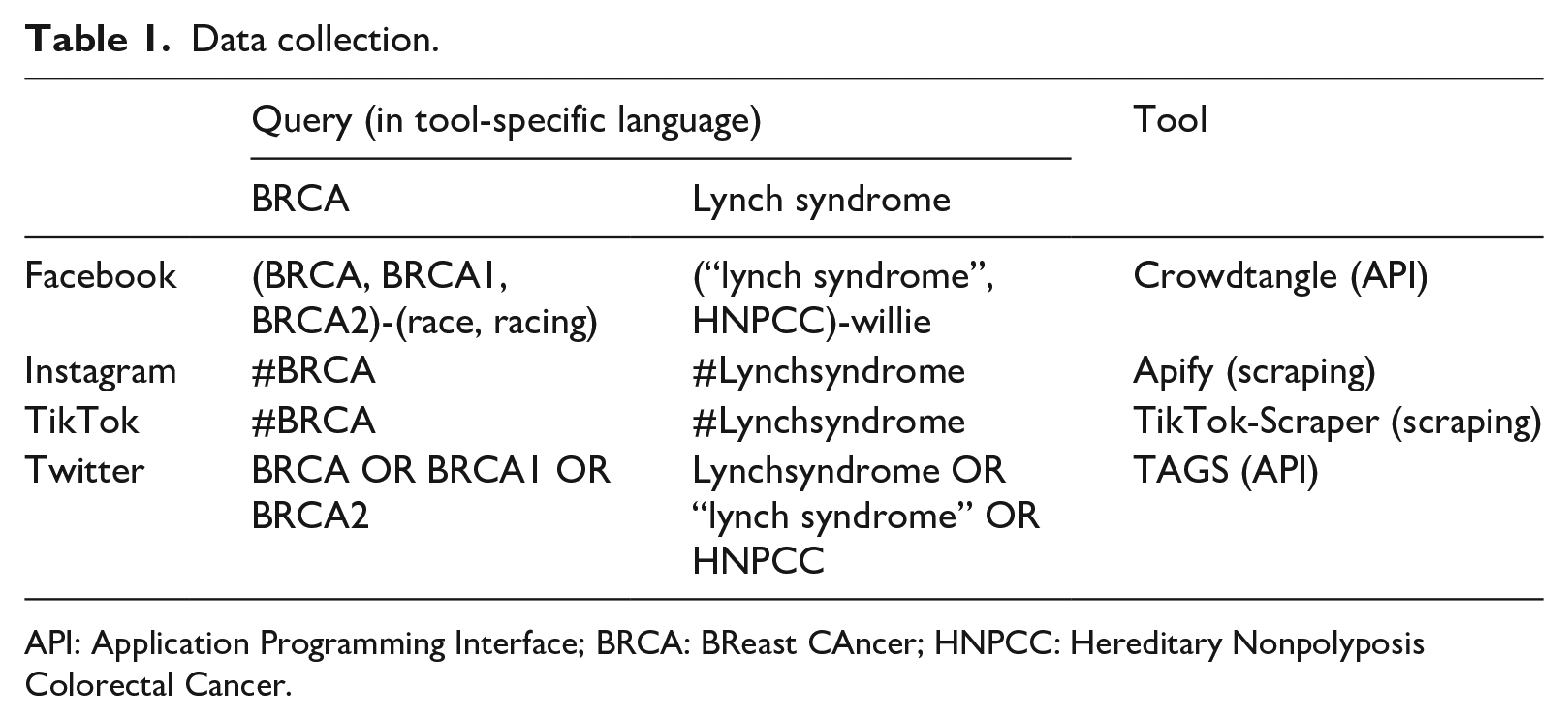
API: Application Programming Interface; BRCA: BReast CAncer; HNPCC: Hereditary Nonpolyposis Colorectal Cancer.
In designing our queries for data collection, we opted for a platform-sensitive approach, namely we used keywords for Facebook and Twitter and each condition’s primary hashtag for Instagram, TikTok and Twitter. To collect Facebook data, we also set up additional filters to exclude irrelevant content that came up as common in our pilot: car racing-related content in the BRCA dataset and ‘Willie Lynch’ content in the Lynch syndrome one. The study is part of a larger project that required a year-long collection of data (May 2022–April 2023). We only focus on June 2022 posts here for two main reasons. A key part of this study is about exploring how meaning is produced in context. For this reason, we valued the inclusion of a qualitative analytical phase that would not have been manageable with a larger dataset. Given our interest in content produced in mundane circumstances, namely in circumstances unrelated to exceptional events, like breast cancer month (October) or Lynch syndrome awareness day (in March), June 2022 represented a viable time frame (for a similar approach see Vicari, 2021b). For Facebook, Instagram and Twitter, we generated longitudinal datasets covering 1–30 June 2022. This was not possible for TikTok because a hashtag search on the platform only returns posts in order of ‘Top’ engagement, that is based on the platform’s engagement algorithm. Adapting to the platform’s design but also aiming at capturing as many posts produced in June as possible, we ran a data collection on the last day of the month. Finally, we only focused on posts in the English language.
Tables 2 and 3 report information about the study’s datasets. In particular, the last four columns detail the number of hashtags appearing more than once in each platform’s dataset (column 4), their cumulative frequency (column 5), the number of platform-specific unique hashtags appearing more than once in each dataset (column 6) and the unique hashtags appearing more than once across all datasets (column 7).
BRCA data.
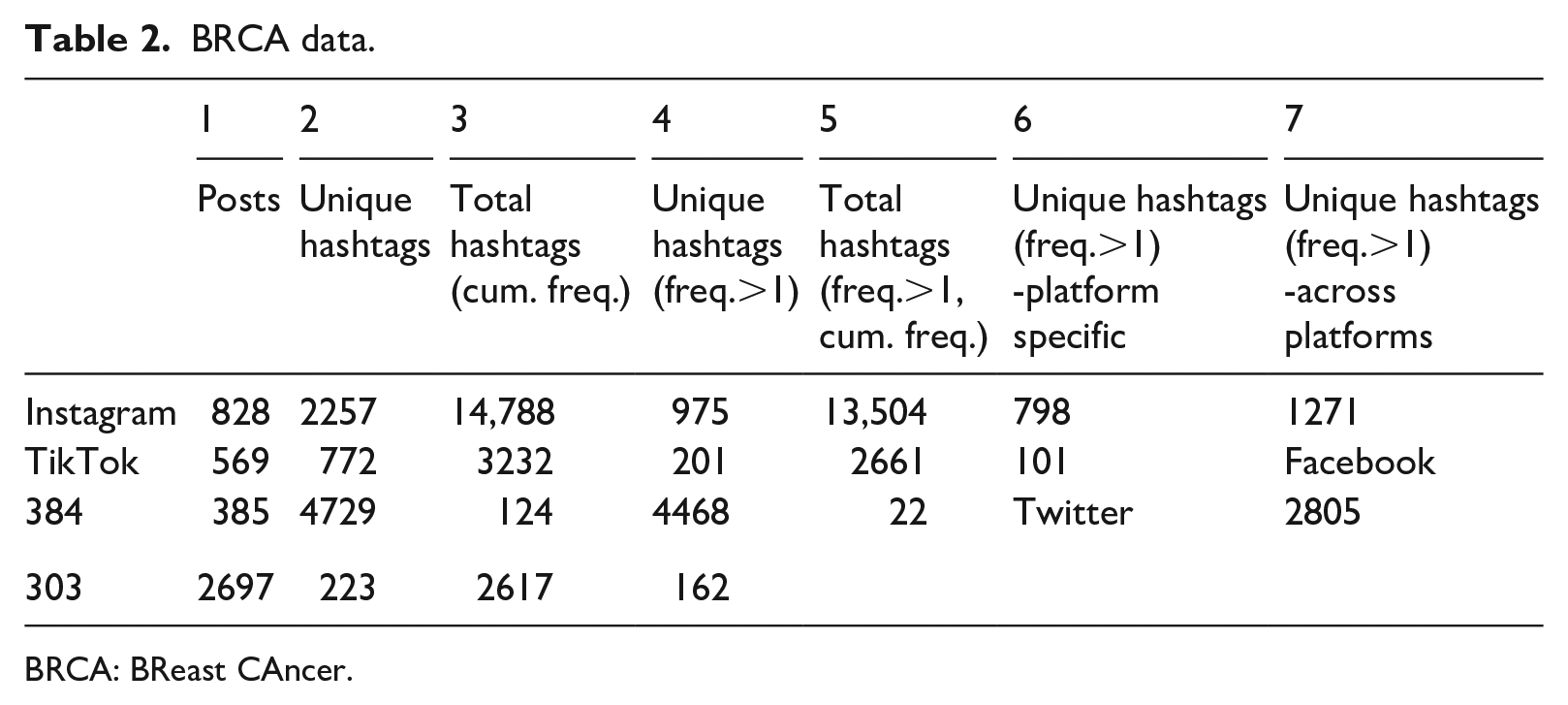
BRCA: BReast CAncer.
Lynch syndrome data.
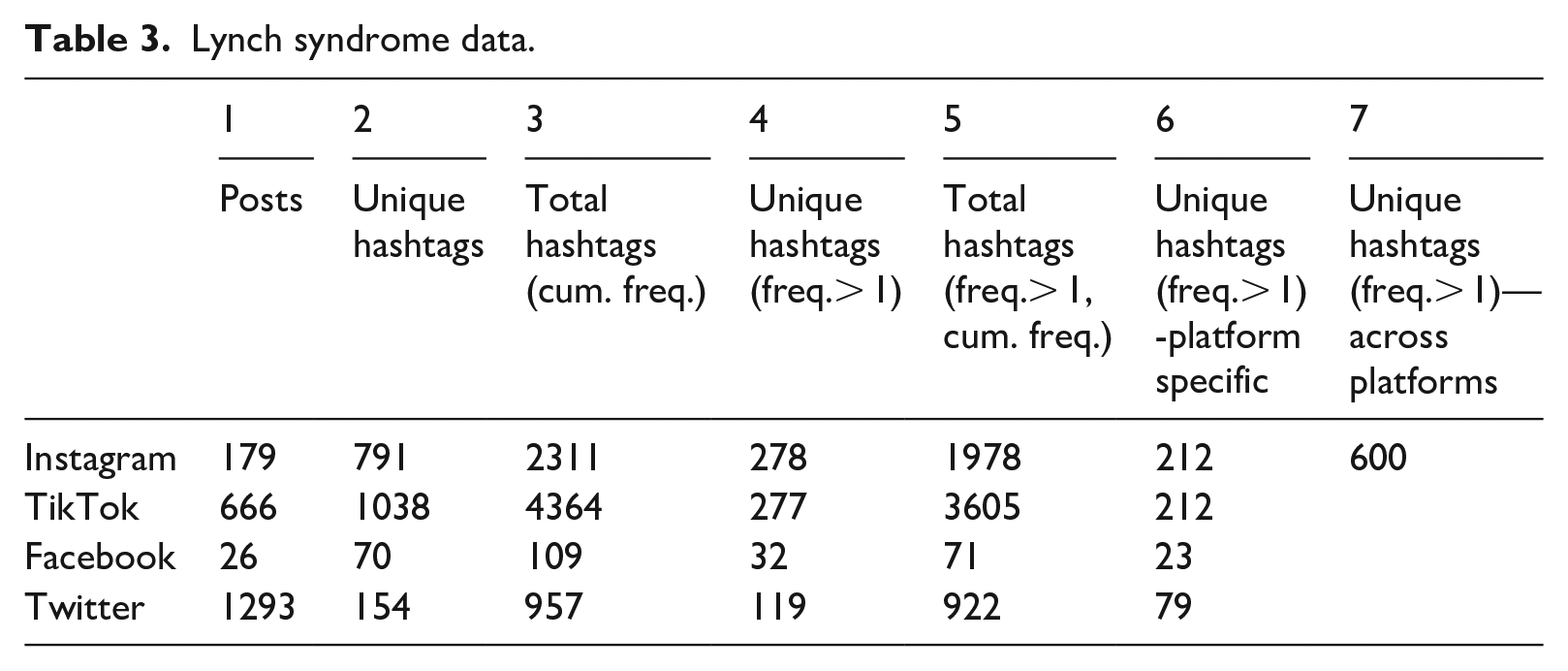
To explore how visibility is shaped through hashtag practices across social media, we used visual network analysis (VNA), ‘a technique for analysing networks by reading their visual features’ (Venturini and Munk, 2021: 193). VNA translates matrices of associations into representations that can be interpreted visually. For each condition, we built a (two-mode) hashtag-platform network using the data reported in column 4 of Tables 2 and 3, namely data relevant to hashtags used more than once, hence more visible, on each platform. The BRCA network resulted around twice the size of the Lynch syndrome one (see data in column 7 of Tables 2 and 3). This initial two-mode network mapped the relationships between hashtags and platforms, namely which hashtags are used on which platform(s). Then, we turned these networks into (one-mode) hashtag ones, namely in networks where nodes (i.e. hashtags) are linked (or not linked) with one another based on their being used (or not used) on the same platform(s). The rationale for transforming two-mode networks into one-mode ones was that of visualising platform-based hashtag relationships in the overall ecosystem of Facebook, Instagram, TikTok and Twitter (see the following section for more detail on this). Ultimately, VNA offers a visually accessible and statistically sound way to display associations, in this case between hashtag practices and platforms.
To explore in-depth if and how hereditary cancer is differently constructed, as an issue, across social media, we isolated platform-specific hashtags, that is those only appearing on one platform (column 6 of Tables 2 and 3), and built clouds based on their frequency of use in our datasets (see Supplemental Appendix). We used these clouds to visualise and weigh platform-specific trends in the way hereditary cancer is topically constructed and as entry points to qualitatively explore this signification in context. For this qualitative exploration, we drew on Vicari and Kirby’s (2023) three-step ethnographic protocol for digital methods research (i.e. tracing of prominent entities, reflective and circular reading, theme identification). This consisted of identifying the posts tagged with a prominent hashtag, checking their metadata (in our datasets), observing them on the platform, and coding and making notes about emerging patterns back in our datasets. While strictly focusing on hashtags, this observation allowed us to position their practices within their broader and multimodal micro (i.e. post) and macro (i.e. platform) context of use. While in our observation we considered all the constitutive elements of a post on its specific platform (i.e. visual, sound, any instances of word text), in the ‘Vernaculars of hereditary cancer’ section below we deliberately only report excerpts of word text embedded in a post’s visual content (e.g. written text in an Instagram image, spoken text in a TikTok video). This allows us to protect the identity of the authors and move within an ethical framework that does not require ‘fabrication’ (Markham, 2012), namely the paraphrasing of original content.
Tagging hereditary cancer
As mentioned above, we used VNA to map cross-platform hashtag practices and produce insight into the way the visibility of hereditary cancer is shaped through these practices. In the networks of Figure 1, nodes represent hashtags and edges stand for relationships between hashtags. The graphs map the hashtag networks resulting from each condition’s hashtag-platform networks: if two nodes are connected, the corresponding hashtags are used on the same platform(s).
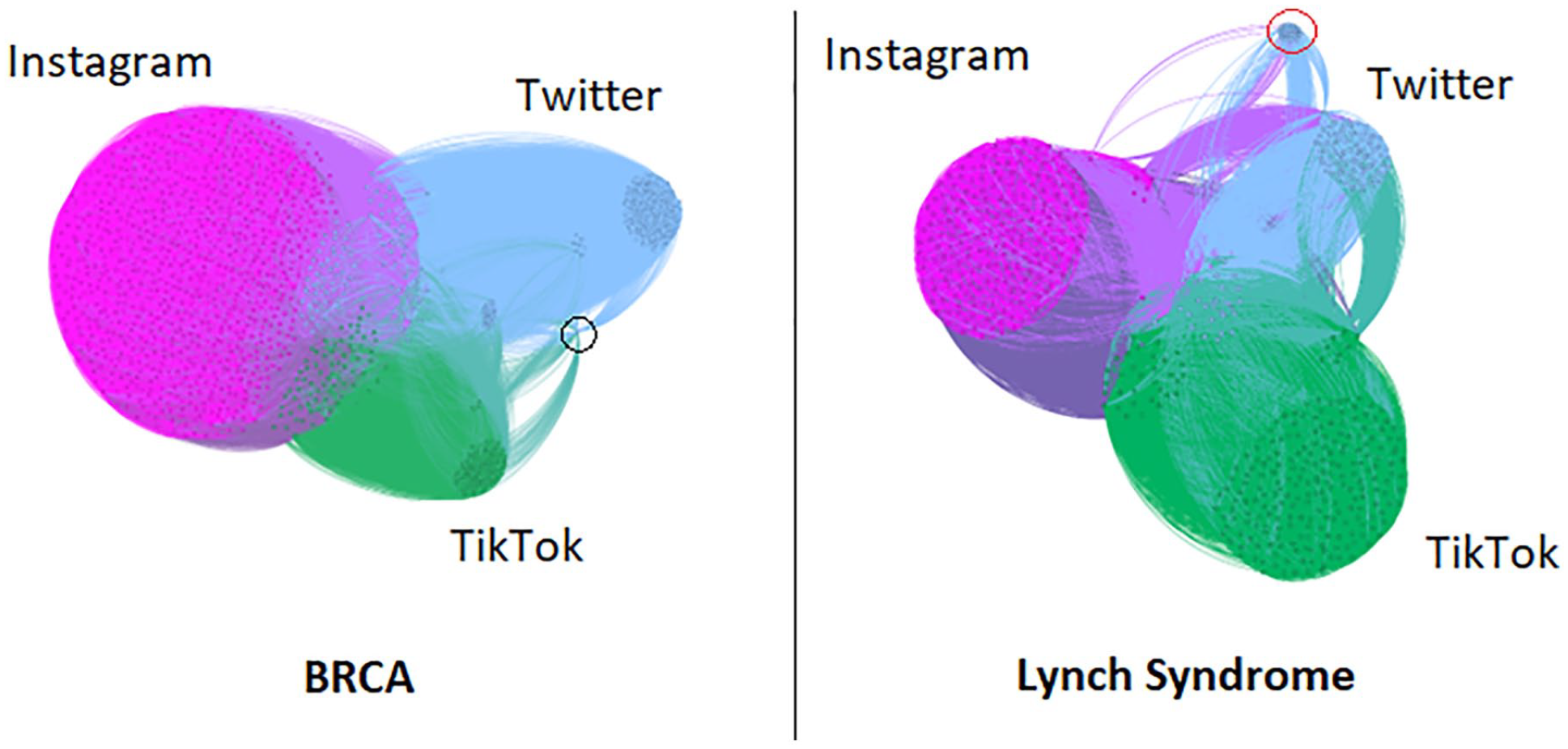
(One-mode) hashtag networks derived from (two-mode) hashtag-platform networks. Two-mode to one-mode transformation executed with Ucinet 6 (Borgatti et al., 2002). Layout rendered by ForceAtlas2 algorithm. Colours based on modularity measure (resolution 1.0). Visualisation produced with Gephi 0.10. (Bastian et al., 2009).
In the case all hashtags were used on all four platforms, these networks would be fully cohesive: each node would be connected to all the other nodes. In the opposite scenario, where each hashtag was only used on one platform, four distinct and separate subnetworks – one for each platform – would emerge for each condition. The graphs in Figure 1 show a half-way scenario that, for both conditions, polarises in three directions clearly marked by both the topography and the modularity colouring of the graphs. The topography of the graphs is rendered by the ForceAtlas2 layout: ‘nodes repulse each other like charged particles, while edges attract their nodes, like springs’ (Jacomy et al., 2014). The combination of these two forces leads to the final configuration, where nodes are close together when they share relations and far apart when they do not. Similarly, modularity measures the forming of communities or clusters, that is groups with denser structural relations within a network (Newman, 2006).
Looking at Figure 1, it becomes evident that for both conditions, three distinct clusters emerge and a closer look at the hashtags suggests that these clusters form around three platforms: Instagram, TikTok and Twitter. In other words, the closer a node is to the periphery of the graph, the more likely it is that the corresponding hashtag is only used on Instagram (pink), TikTok (green) or Twitter (blue). In fact, for both conditions, more than 85% of the overall unique hashtags in the VNA sample are platform-specific (see data in column 6 of Tables 2 and 3), that is, they are only used on one platform. 1 This suggests that, at least for Instagram, TikTok and Twitter, hashtag choice is highly influenced by the platform of use: depending on where you are, you will use and see different hashtags to talk about hereditary cancer. But given that hashtags have strong ideational (Zappavigna, 2018) and segmenting (McCosker, 2017) functions, what does this tell us in terms of how hereditary cancer is constructed and known on these platforms? We will explore this in more detail in the following section. For now, let us focus on the relational patterns evidenced by each graph in Figure 1.
BRCA. The pink cluster in this network is populated by (798) hashtags that are only used on Instagram. The green cluster is slightly more varied: all its (179) hashtags are used on TikTok, with over 50% of them (101) being only used on TikTok. The remaining ones, moving towards the centre of the graph, are used variably across the other platforms but never on Twitter. Finally, the blue cluster groups 294 hashtags including all the (223) hashtags used on Twitter. In fact, over 50% of this cluster (162) is only used on Twitter. The remaining hashtags are used either on Facebook alone (22) or (moving towards the centre of the graph) across platforms but never on TikTok and Twitter only, apart from ‘#cancerscreening’, which is bridging the green and blue clusters (see node circled in black in the left graph of Figure 1). Also, this cluster contains the 14 fully cross-platform hashtags (i.e. ‘#BRCA’, ‘#BRCA1’, ‘#BRCA2’, ‘#breastcancer’, ‘#breastcancerawareness’, ‘#cancer’, ‘#cancerawareness’, ‘#genetics’, ‘#genetictesting’, ‘#hereditarycancer’, ‘#mastectomy’, ‘#ovariancancer’, ‘#previvor’, ‘#tnbc’, ‘#womenshealth’).
Lynch syndrome. The pink cluster here groups (220) hashtags that are all used on Instagram, with only 4% of them (8) also being used on Twitter. The green cluster groups (253) hashtags used on TikTok with over 80% of them being only used on TikTok. The remaining ones (41) (moving towards the centre of the graph) are also used across one or two other platforms, with 6 being used exclusively on TikTok and Twitter. Finally, the blue cluster groups 127 hashtags, with more than 60% of them (79) being only used on Twitter. The remaining hashtags are used either on Facebook alone (23) (see nodes circled in red in the right graph of Figure 1) or, moving towards the centre of the graph, across Twitter and one or more other platforms. In fact, this cluster contains the 6 fully cross-platform hashtags (‘#cancer’, ‘#cancergenetics’, ‘#coloncancer’, ‘#genetictesting’, ‘#hereditarycancer’, ‘#lynchsyndrome’).
The patterns in the two networks suggest interesting dynamics in how hereditary cancer is made visible through hashtag practices across social media. First, it is worth noting that, for both conditions, the hashtags used across all four platforms are mainly either recalling common broader debates or marking condition-specific meaning. In other words, it is possible to detect a sort of user-generated taxonomy whereby content is tagged, and made searchable, according to specific meaning markers: both conditions are signified as related to cancer and genetics (i.e. ‘#cancer’, ‘#hereditarycancer’, ‘#genetictesting’), while each one has a few universally used specific markers. Through these specific markers, BRCA is mainly associated to its gene mutations (‘#BRCA1’ and ‘#BRCA2’), to breast and, to a lesser extent, ovarian cancer (‘#breastcancer’, ‘#breastcancerawareness’, ‘#tnbc’ 2 , ‘#mastectomy’, ‘#ovariancancer’), to women’s health (‘#womenshealth’) and to cancer risk, prevention or treatment (‘#previvor’, ‘#mastectomy’). Lynch syndrome only has one specific marker, beyond #lynchsyndrome, which associates the condition to colon cancer (‘#coloncancer’). A key point here is that this seems to suggest that the social media epistemic work about BRCA (Vicari, 2021b) is much more advanced than that about Lynch syndrome: those posting about BRCA classify their content through a wider range of relevant condition-specific aspects than those posting about Lynch syndrome. This may be due to a number of factors, among which, the strong history of the breast cancer movement, the long tradition of breast cancer advocacy and digital advocacy and the increased visibility BRCA has received following Angelina Jolie’s personal disclosure of having a BRCA1 gene mutation (Vicari, 2017).
For both BRCA and Lynch syndrome, Instagram, TikTok and Twitter users have developed platform-specific ideational norms to tag content, with Instagram in particular showing what we can define as a strong and unique (hashtag-based) vernacular of hereditary cancer. When it comes to TikTok, it is interesting to notice that users seem to have developed hashtag practices exclusionary to Twitter: it is extremely rare to come across hashtags of hereditary cancer that are used on both TikTok and Twitter and not on other platforms. These dynamics seem to suggest a rigid divide between the ideational work on the two platforms. Twitter, on the contrary, while showing clear evidence of local norms, also seems the most likely to attract hashtags that have cross-platform popularity. Finally, the VNA clustering shows limited evidence of localised practices for Facebook and only in the content of Lynch Syndrome content prodaction: overall, fewer unique hashtags, especially for BRCA, are used on the platform and these hashtags are often also commonly used on other platforms. This may be partially due to automated cross-posting (e.g. cross-posting content on Twitter and Facebook or on Instagram and Facebook), and to the later introduction of hashtags on the platform (The Guardian, 2013).
In sum, it is evident that hereditary cancer is tagged differently especially across Instagram, TikTok and Twitter. But what do these differences tell us in terms of meaning making? To address this question, in the following section, we will further explore the ideational (Zappavigna, 2018) and segmenting (McCosker, 2017) work of BRCA hashtags.
Vernaculars of hereditary cancer
To explore how hereditary cancer is constructed, as an issue, through platform-specific hashtag practices, we will zoom in the BRCA dataset. Figure 2 reports again the relevant hashtag network, but this time in combination with BRCA platform-specific hashtag clouds. These clouds visualise the hashtags only used on Instagram (pink), TikTok (green) and Twitter (green), namely, those standing at the very periphery of the network. Given that the VNA clustering showed very limited platform-specific hashtag practices for Facebook, this section is entirely focused on the other three platforms. Hashtag sizes are based on frequencies in the dataset and are relative to the cloud population. In sum, Figure 2 maps the semantic ecosystem of Facebook, Instagram, TikTok and Twitter, providing initial insight into the way hereditary cancer is differently constructed, as an issue, through platform (hashtag) affordances. In the following three sections, we will qualitatively explore this signification.
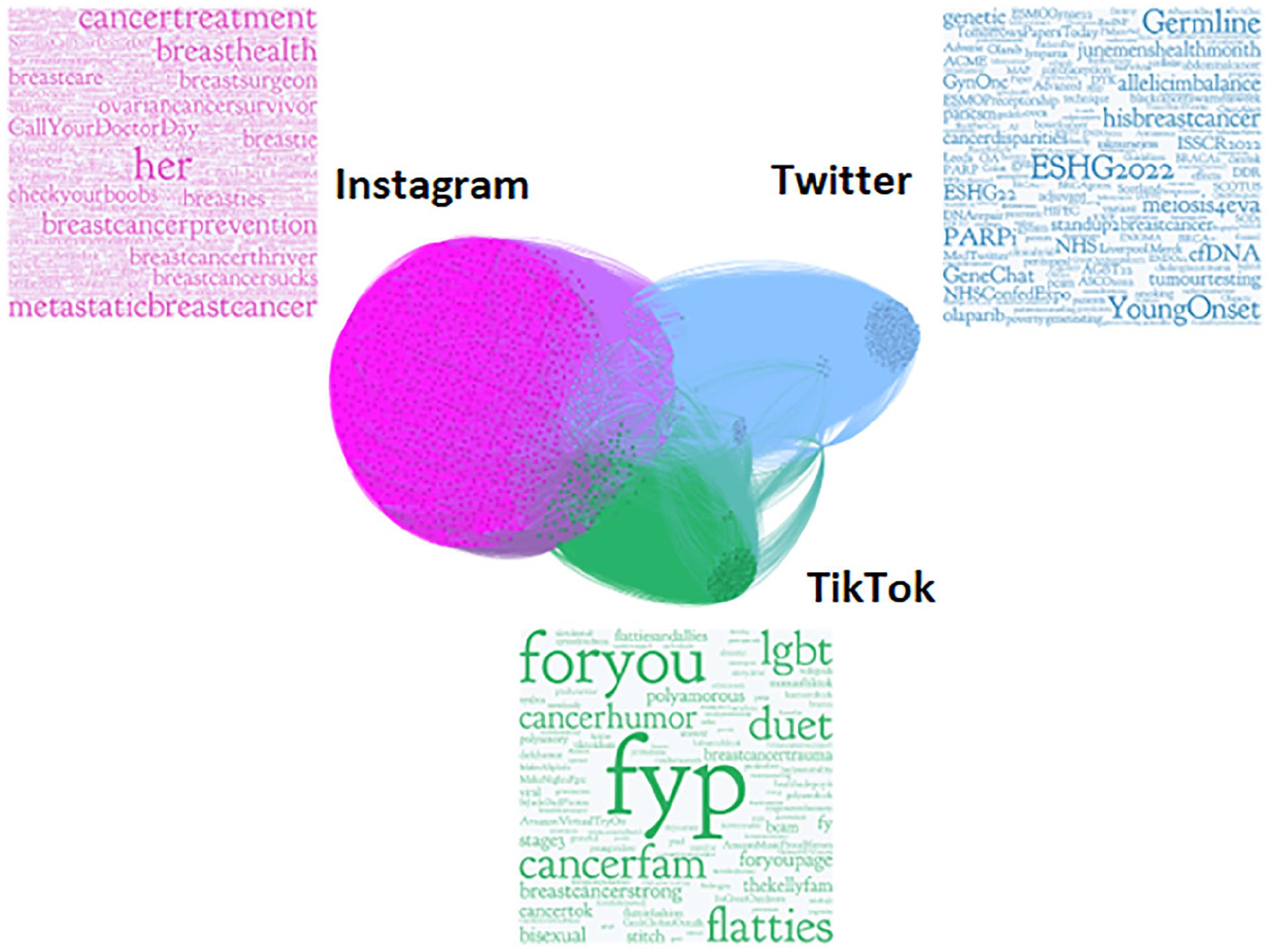
BRCA hashtag network with wordclouds visualising Instagram-, TikTok- and Twitter-specific hashtags. Visualisation produced with Word Art.
More than 80% of the unique BRCA Instagram hashtags in this study (column 6, Table 2) are platform specific. According to these hashtags, BRCA is predominantly about ‘#her’ and, often, about her breast (see Figure 3 and Supplemental Appendix).
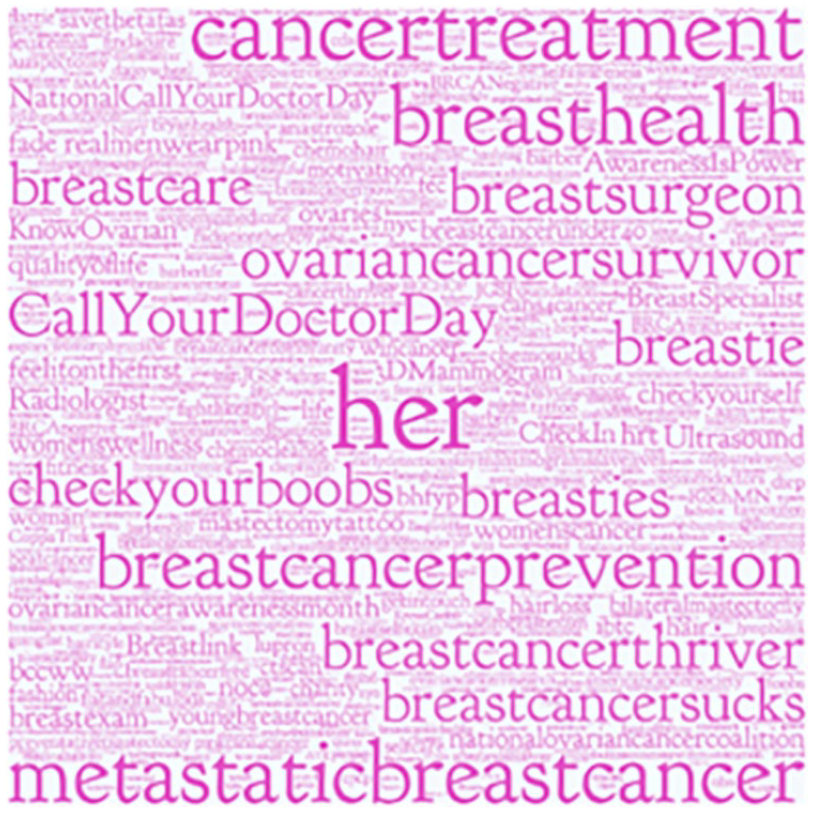
BRCA Instagram-specific hashtags.
As clearly indicated by the 10 most common hashtags (‘#her’, ‘#cancertreatment’, ‘#metastaticbreastcancer’, ‘#breasthealth’, ‘#breastcancerprevention’, ‘#breastsurgeon’, ‘#ovariancancersurvivor’, ‘#breastcancerthriver’, ‘#breastie’, ‘#breasties’; listed in descending order, n: 97-29), content is often tagged as relating to different aspects of cancer, from types to prevention, treatment and breast reconstruction. Many frequently used hashtags are tailored to advocate in the sense of educating (e.g. ‘#CallYourDoctorDay’, ‘#checkyourboobs’, ‘#checkyourself’, ‘#knowovarian’, listed in descending order, n: 28-24) and ‘empowering’ (e.g. ‘#breastcancerthriver’, ‘#awarenessispower’, ‘#motivation’, ‘#fightlikeagirl’; listed in descending order, n: 30-18). They, like the content they tag, align with Instagram aesthetics, in its ‘inspirational and affective appeal’ (Leaver et al., 2020: 72), with lived experiences of cancer prevention and treatment becoming aspirational. Because if cancer cannot be aspirational, lifestyle can (e.g. ‘#breastcare’, ‘#qualityoflife’, ‘#womenswellness’; listed in descending order, n. 28-24). Hashtags’ function of ‘enacting relationships’ (Zappavigna, 2018: 18) manifests here with the development of a communal language where ‘#breasties’ support and inspire each other through ‘demystification and accessibility’ (Leaver et al., 2020: 73), namely showing good, if not glamorous, ways of being, with, expecting or surviving cancer. In fact, even negative-sounding hashtags like ‘#breastcancersucks’ (n. 28) convey messages centred on positive ways of being (e.g. ‘Learn the mindset of the breast cancer warrior’, claim embedded in a post’s visual).
While adhering to Instagram norms, the aesthetics driving hashtag choice and use is here, however, also heavily informed by the tropes and motifs typical of mainstream breast cancer advocacy. Pink logos, claims, symbols and/or backgrounds appear in many of the posts, to the point that some of these hashtags physically incorporate the ‘pink ribbon culture’ (Sulik, 2014) (‘#realmenwearpink’, ‘#pinkcans4cancer’, ‘#pinkinkfund’, ‘#pinkribbonmentor’, ‘#pinkwig’; listed in descending order, n. 27-3). It is interesting to see how the politics of the platform intertwines here with that of mainstream breast cancer campaigning. Of the latter, Sulik (2014: 661) writes: ‘Pink ribbon culture relies on imagery of pretty, happy, optimistic survivors who wear their survivorship with pride, elegance, sensuality, and the perfect blend of cosmetic enhancements’. To partially challenge this dynamic is content that advances less mainstream images of self and femininity, exposing scars or deliberately non-reconstructed breasts (e.g. ‘#bilateralmastectomy’, ‘#flatandfaboulous’, ‘#flattie’, listed in descending order, n. 20-18). This content, while sticking to the empowering narrative typical across hashtags, seems to carve space for what Morena (2022) defines as ‘a broader (and more intersectional) range of women’s experiences of mastectomy and breast cancer’. A space that is, however, rather niche here. In fact, the ideational work emerging in Instagram-specific hashtag practices leaves little room for suffering and pain, in most cases constructing cancer survivorship and previvorship as thriving with optimism and personal empowerment and through (traditional) forms of femininity.
TikTok
Half of the unique BRCA TikTok hashtags in the study (column 6, Table 2) are platform specific. Like most content on the platform, BRCA TikToks are often tagged as ‘#fyp’, that is, ‘for you’ (see Figure 4 and Supplemental Appendix). For You-page hashtags (e.g. ‘#fyp’, ‘#foryou’, ‘#foryoupage’) are a widely common and platform-specific practice adopted in the attempt to get content featured on other users’ pages (see Eriksson Krutrök, 2021; Medina Serrano et al., 2020).
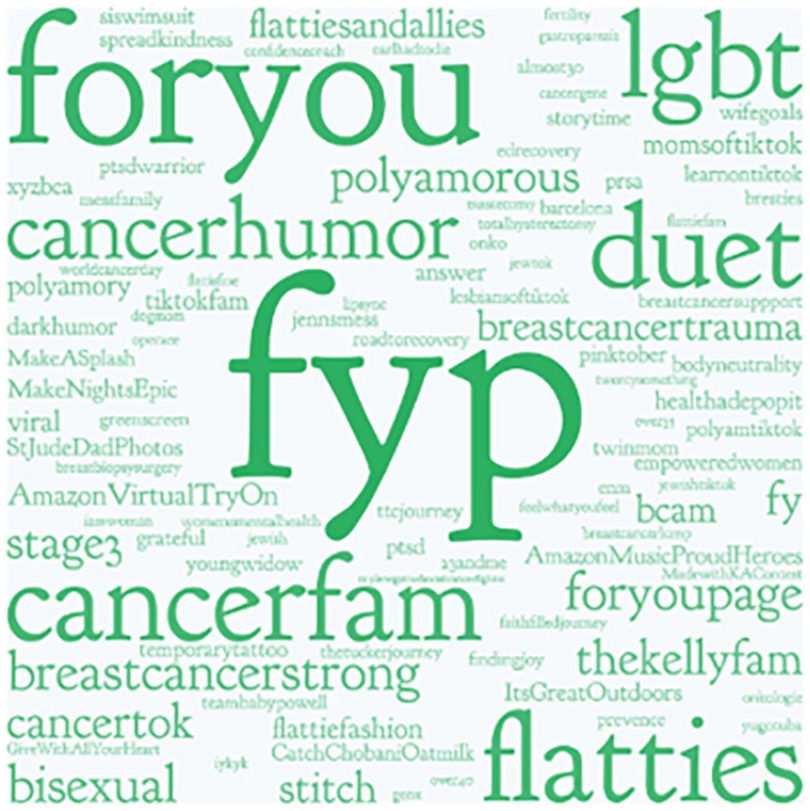
BRCA TikTok-specific hashtags.
Beyond pointing at user work to manipulate algorithmic ranking, the overall 10 most common TikTok-specific hashtags (‘#fyp’, ‘#foryou’, ‘#flatties’, ‘#cancerfam’, ‘#duet’, ‘#lgbt’, ‘#cancerhumor’, ‘#breastcancerstrong’, ‘#bisexual’, ‘#foryoupage’; listed in descending order, n. 88-13) also indicate a new ideational scenario. While often endorsing the same educational purpose seen in Instagram content, TikTok-specific hashtag practices suggest attempts to generate more unconventional or non-normative meaning making in relation to hereditary cancer. The niche, alternative side of Instagram takes more front stage here, with ‘#flatties’ surfacing over ‘#breasties’. Flattie hashtags (‘#flatties’, ‘#flattiesandallies’, ‘#flattiefashion’, ‘#flatisfine’, ‘#flattiefam’, listed in descending order, n. 17-2) mark content related to the choice of foregoing post-mastectomy breast reconstruction and opting for an aesthetic flat closure. This procedure is much less visible in mainstream coverage of breast cancer and mastectomy surgeries. It is also one that, in its non-normativity, in the sense of subverting the norms traditionally inscribed in the female body, can often be met with questions and judgement (e.g. Annis, 2021). In fact, the educational drive here, often communicated in ‘#duet format via a split video presenting questions and answers, is frequently crafted as in response to common assumptions about beauty or reconstructive surgery. The tone can be ironic, sometimes sarcastic. For instance, a TikTok tagged with top hashtags can explain a preventative double mastectomy by addressing ‘Karen’ to tell her that ‘getting my tits chopped off’ is not the same thing as her getting ‘a boob job’ (excerpt from spoken text in TikTok tagged as ‘#brca #doubelmastectomy #breastcancerawarness #previvor #lgbt #bisexual’). In fact, non-normative meaning making is also signalled by hashtags marking unconventional ways to talk about cancer, for instance, through humour (‘#cancerhumor’, ‘#darkhumor’, ‘#messfamily’; listed in descending order, n. 15-3).
Overall, this push towards the non-normative and the unconventional is reflected in the content marked by both meaning-neutral (e.g. ‘#fyp’) and meaning-charged (e.g. ‘#flatties’) hashtags, where pain is communicated and visualised through tears, scars, the telling of relatives’ passing, of early menopause and surgeries. This all resonates with Boffone’s (2022: 6) account of TikTok as a platform where ‘unfiltered, public social media activity lends itself to the vulnerability of being silly, honest, and real’. However, while the vernaculars presented in this section align with TikTok’s aesthetic of authenticity, as conceptualised by Boffone and others (e.g. Barta and Andalibi, 2021), and the ironic tone identified in previous research (e.g. Eriksson Krutrök, 2021), it is interesting to notice how BRCA content is produced by older users than the Gen Z usually described in those studies. Here, we are predominantly talking about millennials appropriating this aesthetic to visualise hereditary cancer through the lens of the non-normative and the unconventional, voicing acceptance, but also pain, irony and crude humour.
Close to 75% of the unique BRCA Twitter hashtags in this study (column 6, Table 2) are platform-specific. As a quick look at Figure 5 can easily suggest, these hashtags tend to predominantly mark scientific aspects of the BRCA gene mutations (Figure 5 and Supplemental Appendix).
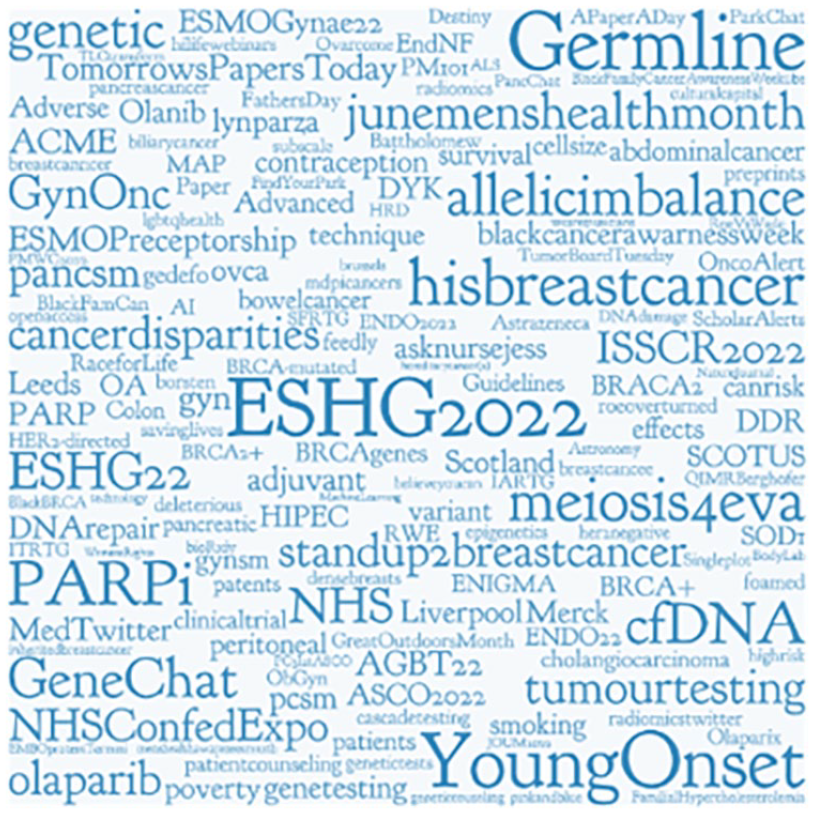
BRCA Twitter-specific hashtags.
As exemplified by the 10 most common entries in the Twitter cloud (‘#ESHG2022’ 3 , ‘#Germline’, ‘#YoungOnset’, ‘#hisbreastcancer’, ‘#meiosis4eva’ 4 , ‘#PARPi’ 5 , ‘#allelicimbalance’, ‘#cfDNA’ 6 , ‘#GeneChat’, ‘#genetic’; listed in descending order, n. 29-14), hashtag practices here mark a combination of academic (‘#ESHG2022’, ‘#meiosis4eva’) and collaborative (‘#GeneChat’) efforts to produce and share knowledge about BRCA, with a strong focus on genetic information (‘#allelicimbalance’, ‘#cfDNA’, ‘#genetic’) and innovative cancer treatment therapies (‘#PARPi’). It is also evident that due to Twitter’s microblogging architecture, these hashtags, differently from those on Instagram and TikTok, incorporate the possibility for live tweeting an event (‘#ESHG2022’) or hosting a community chat (‘#GeneChat’). This all seems to suggest an evident growth of BRCA-related hashtag practices for academic purposes and self-promotion, especially compared with what evidenced in previous research (Vicari, 2017, 2021a, 2021b). It is, however, still possible to trace some of the advocacy practices highlighted in that research – practices that resonate with those described earlier for Instagram. Advocacy hashtags are here used to mark different aspects of carrying a BRCA gene mutation, including those not necessarily covered in mainstream debates, like male breast cancer or extant ethnic disparities in hereditary cancer prevention, detection and treatment (e.g. ‘#hisbreastcancer’, ‘#junemenshealthmonth’, ‘#cancerdisparities’, ‘#standup2breastcancer’, ‘#blackcancerawarnessweek’; listed in descending order, n. 19-7).
In sum, the most evident trend in Twitter-specific hashtag practices is that these practices have been primarily appropriated by scientific and advocacy markers of meaning, with a shift from storytelling towards institutional – or institutionalised – meaning making.
Discussion and conclusion
Focusing on the Western mainstream social media ecosystem, we have investigated visibility in relation to meaning making. We have focused on the semantic outcome of the ‘visibility game’ (Cotter, 2019) typical of contemporary social media and interrogated its potential implications for the way we construct, see and understand issues through these media. To do so, we have studied platform affordances (leading to hashtag practices), as relational aspects (Hutchby, 2001) originating at the intersection of the politics of platform design (Gillespie, 2010), the material constraints of this design and users’ interpretive practices (Nagy and Neff, 2015).
The choice to focus on rarely spoken of health conditions, and hereditary cancer in particular, was inspired by evidence that online spaces are often key to finding information and community for those with or caring about these conditions (e.g. Vicari, 2021a). By no means do we assume here that all cancer gene mutation carriers, or rare disease patients more broadly, will be content creators on Facebook, Instagram, TikTok or Twitter; rather, we start from evidence indicating that a considerable proportion of them will be recommended (Vicari and Cappai, 2016) or simply exposed to social media content. In this study we have explored how hereditary cancer is constructed, as an issue, on these platforms.
Our empirical focus on hashtag practices precluded a comprehensive interpretation of the multimodal aspects of platform vernaculars. It did, however, allow us to centre our research on affordances and practices that form around a technology that has similar material constraints across these vernaculars, ensuring good cross-platform comparability. In fact, our findings suggest that given these constraints, the affordances for meaning making forming on each platform enhance very different ideational work: they foreground certain topics over others, shaping the way hereditary cancer, as an issue, is constructed (by content creators) and seen (by other users) on each platform.
Our study shows that most hashtags in the overall ecosystem of Facebook, Instagram, TikTok and Twitter are platform-specific and attending to different aspects of hereditary cancer. Instagram-only hashtags construct BRCA primarily as a women’s experience, an empowering one and one about which people must be educated. An ideational work that is closely aligned with traditional breast cancer campaigning, strongly imbued with ‘traditional femininity and a cancer-fighting aesthetic at its core’ with ‘pink visibility and symbolic gestures’ (Sulik, 2014: 664). This visibility is overturned on TikTok, where more unconventional or non-normative ideational work tells stories of BRCA survivorship (and previvorship) often misaligned from traditional assumptions about femininity, the female body and what is to be expected of it. This is a visibility exposing acceptance but also irony, uncertainty, pain, scars, loss and fear. Finally, ideational work on Twitter has shifted towards academic and institutional visibility, with BRCA being a scientific issue and an issue for professional(ised) advocacy.
These findings suggest that the mundanity (Ross et al., 2018), knowledge production (Vicari, 2021b), advocacy (Vicari, 2017; Wellman et al., 2023) and social change (Finer, 2016) previously identified in online discursive practices about hereditary cancer are likely to be shaped by the way affordances differently develop on each platform, based on specific corporate-driven designs (Gillespie, 2010) and the way content creators adapt to, exploit or tinker with these designs. We are therefore not suggesting that platforms dictate choice, but rather that, as contexts, they are certainly influential on how issues are constructed and known.
Ultimately, our findings lead to the follow up question: what impact do these dynamics have on those engaging with or being exposed to the content and meaning produced through them? While this is not something we are addressing here, our analysis suggests that not only does platform visibility have implications for creators and their industry (Cotter, 2019; Duffy and Meisner, 2023; Zeng and Kaye, 2022); it is also likely to contribute to shaping the way wider publics imagine and respond to the issues they care about.
Supplemental Material
sj-docx-1-nms-10.1177_14614448241229048 – Supplemental material for Platform visibility and the making of an issue: Vernaculars of hereditary cancer on Facebook, Instagram, TikTok and Twitter
Supplemental material, sj-docx-1-nms-10.1177_14614448241229048 for Platform visibility and the making of an issue: Vernaculars of hereditary cancer on Facebook, Instagram, TikTok and Twitter by Stefania Vicari and Hannah Ditchfield in New Media & Society
Footnotes
Funding
The author(s) disclosed receipt of the following financial support for the research, authorship, and/or publication of this article: This work was supported by the Leverhulme Trust [grant number: RPG-2021-152].

Supplemental material
Supplemental material for this article is available online.
Notes
Author biographies
References
Supplementary Material
Please find the following supplemental material available below.
For Open Access articles published under a Creative Commons License, all supplemental material carries the same license as the article it is associated with.
For non-Open Access articles published, all supplemental material carries a non-exclusive license, and permission requests for re-use of supplemental material or any part of supplemental material shall be sent directly to the copyright owner as specified in the copyright notice associated with the article.
