




Abstract
In this article, we explore Quick Response (QR) codes (machine-readable optical labels that link to information) and how, after a period of having fallen out of favor, they have been reactivated and have come to underpin COVID-19 automation and contact-tracing efforts. During the pandemic, they were used especially for “safe entry” and other kinds of check-in to locations to facilitate contact tracing. In this context, QR codes facilitate automated decision-making in relation to infectious disease surveillance and disease outbreak control. However, the use of QR codes for contact-tracing purposes has enjoyed mixed success and its implementation has encountered several challenges, as we illustrate through a case study that explores QR codes and COVID contact tracing in Singapore and Australia.
Introduction
For 2-plus years in 2020–2022, mobile phone apps were positioned as the public health linchpin of many societies’ efforts in managing the COVID-19 pandemic globally. This unprecedented and pervasive public health and population management effort pivoted on the use of Quick Response (QR) codes, in conjunction with mobile phone apps, to implement a new kind of automated decision-making (hereafter ADM)—the legacies of which are still being examined.
As the SARS-CoV-2 virus spread among populations from late 2019, and the incidence of COVID-19 accelerated to the extent that the situation was officially declared an international pandemic, governments and health authorities sought to deploy measures to slow and arrest the contagion. Such measures included containment, quarantine, identification of spread via contact tracing (Braithwaite et al., 2020), regulation of movement of individuals and groups, and testing and monitoring of health status. Digital health played a critical role in the COVID-19 response from the outset. An overarching challenge posed by a pandemic for authorities was how to quickly and accurately obtain health status information on individuals, and make risk, safety, and health care decisions (Lünich and Kieslich, 2022). Given the lethal nature of COVID-19, as well as the enormous health and impairment burden it rapidly entailed, the need to make such decisions as quickly as possible, if not in-near-real-time, and at scale (population-wide as well as for specific groups and locations) was evident. With ADM already (if unevenly) advanced across the world, governments, health agencies, practitioners, and technology developers turned to mobile phones as way to combine information, authentication, and regulation and modulation of everyday rhythms.
In fascinating and multifarious ways, QR code-based apps supported a range of decision-making, including:
What is the health status of an individual, based on an electronic certificate? Do they currently have COVID-19? Is the person using this mobile phone app a close contact of someone who has contracted the virus, or who has been potentially exposed? What was their proximity to an infectious person, and where? Should they self-isolate, or are they still within the designated period of necessary isolation?
Is the person safe and permitted to enter a workplace, shop, or other public place?
Has the person “checked-in” to a regulated place? Have they checked out?
Is the person allowed to travel on a plane?
These kinds of decisions relied on a range of information, held in different formats and databases, and were provided by different organizations, institutions, authorities, and “responders” (Nakamoto et al., 2020)—but also by a range of machines and digital networks—Bluetooth, Global Positioning System (GPS), smartphone devices, sensors, QR code readers, digital platforms such as Google, WeChat, AI and algorithms (Awotunde et al., 2021)—in a wide swathe of locations.
Manual approaches were also crucial to decision-making in the pandemic, as the deployment of and public fascination with contact tracing showed. However, automation was crucial to support, supplement, and often stand-in, for manual decision-making across many areas of COVID responses (Roberts, 2022). This is where ADM pivoted to and was underpinned by QR codes, with the latter playing an outsized and vital role. To take a common example, in many jurisdictions, a person could check-in to a location, such as a food hall or shopping center, using a mandated app, whereby information about their being in this location would be gathered, vaccine status displayed, and checking-in completed by a machine. This would bar entry or flag a person for review and checking if the app showed that they were not vaccinated, or sufficiently up to date with their COVID-19 vaccine.
QR-code based apps featured prominently in watchdog group AlgorithmWatch and Bertelsmann Stiftung’s (2020) landmark report exploring the “deployment of a plethora of automated-decision-making (ADM) systems all over Europe” (p. 3). This report discusses the “very different technological solutions” that apps entail. These include Bluetooth, based on proximity data, which attracted much attention early on as a way of automating proximity-based contact tracing, and, as in the case of the British NHS COVID-19 app, made decisions to send notification of self-isolation without human intervention (Dowthwaite et al., 2021). Apps using GPS, based on location data, were used for detection of concerning locations or clusters (AlgorithmWatch and Bertelsmann Stiftung, 2020: 3–5). As AlgorithmWatch and Bertelsmann Stiftung (2020) note, “different decision-making processes are entailed by different app architectures” (p. 11), as well as data kinds and systems. Our argument is that QR codes provided a tried-and-tested way for ensuring the functioning and efficacy of various forms of ADM crucial to COVID-19 management and governance when other potential technologies (such as Bluetooth, GPS, and near-field communication) were neither suitable, trusted, nor widely accepted.
In this article, we draw on Luke Munn’s work to explore actually existing automation as it developed in COVID-19. In particular, we reference three propositions that emerge from his 2022 Automation is a Myth: automation is political; automation begets automation; and automation is “seamful.” First, Munn (2022) makes the deceptively simple yet important point that “automation is not just technical but political” (p. 7). Second, he argues automation is plural rather than singular—“there are many automations” (p. 53)—and is worked through in very different ways in different contexts—“global technology is reworked, taking on the hues of its cultural surroundings” (p. 63). “Automation in China,” Munn writes, “unfolds very differently from its deployment in the United States” (pp. 52–53)—as, we shall argue, it does in Singapore and Australia. Third, he also contends that the implementation of automation has time and again “proven to consist of a range of non-trivial problems” and is “full of inconsistencies” (p. 6). As we shall establish, QR code-based COVID-19 apps help shore up a hastily assembled not-so-ADM supported approach to public health governance.
In the first part of this article, we develop a critical history of QR codes, exploring the origins of this technology, its consolidation through ISO standards, and various genealogies of take-up and use that have followed since. QR codes are machine-readable optical labels that link to information on the item they are associated with. These labels were used in the automotive industry as a form of “logistical media” (Rossiter, 2016) for automating a range of decisions (identification and tracking of products, time tracking, marketing, product authentication, etc.). In a consumer context, QR codes fed into other kinds of ADM—in information, media, entertainment (e.g. for calling up websites using an app), and so on—before subsequently falling out of favor somewhat in some markets prior to the pandemic.
In the second part of the article, we explore how QR codes have been reactivated in association with apps, and particularly how they have come to underpin COVID-19 public health automation, population surveillance and governance (Greenspan, 2021; McGuirk et al., 2021), and mobility regulation (Tai et al., 2021). We illustrate this reactivation via two case studies that explore QR codes and COVID contact tracing, check-in, and vaccine status differentiation in different national contexts: Singapore and Australia. During the pandemic, QR codes were used especially for “safe entry” (Singapore) and other kinds of check-in to locations to facilitate contact tracing (Australia). In this context, QR codes facilitated ADM in relation to infectious disease surveillance and disease outbreak control (AlgorithmWatch and Bertelsmann Stiftung, 2020). QR codes also enabled management of spaces (including densities) and mobility during the height of the pandemic (Goggin and Ellis, 2021). As the pandemic neared its “end-game” from late 2021 onward, marked by the onset of the Omicron variant of COVID-19, QR codes were deployed to address issues of evidence and obstacles to international travel digital certification (Vâlcu, 2021). Our analysis explores how the use of QR codes has enjoyed mixed success in different facets of the public health, social, and mobility response to the pandemic. Its implementation has also encountered notable challenges. Even the second (or third) coming of QR codes showed that the various myths of automation, especially in relation to new forms of ADM represented in COVID-19 apps and socio-technical public health governance were often ineffective, problematic, and resisted explicitly or via forms of non-use (Casemajor et al., 2015).
Automatic identification of people and disease: the pivotal role of QR codes in pandemic ADM
QR codes have their beginnings in the rise of supermarkets and retail industries from the 1960s onward, where automation was developed to support logistics and supply of goods, as well as the goals of smoother, “more efficient,” and labor-saving processes at point-of-sale. The invention of the barcode in 1970 (credited to Ted Williams) formed a watershed moment. Barcodes used different protocols to represent information via encoding and symbolization to be read by an optical laser scanner (Chabanne et al., 2013). The first kind of barcodes were one-dimensional (or linear) developed through various standards (Berry, 2013), and were later extended via “stacked linear” barcodes. First used in the retail sector in the United States in 1974, barcode scanning enabled “supermarkets to encode prices in machine-readable formats” (Basker, 2015: 340). The development of barcodes took advantage of the Universal Product Code—a code which assigned a unique number to each product—developed by the food industry in the 1970s (Basker and Simcoe, 2021; Brown, 1997; Haberman, 1999). In addition to 1D barcodes are 2D barcodes, which are able to encode more data because they can be read across and up/down. The QR (“quick response”) code is probably the best-known example of a 2D barcode.
Released in 1994, the QR code was devised by the Japanese automotive manufacturer Denso Wave (then part of Denso Corporation) for tracking parts in vehicle manufacturing (Denso, n.d.-a). Denso (n.d.-a) retained its patent rights to the code, but let it be known that it would not exercise these—this stance being a key factor behind its widespread use as a “public code.” The access to the specifications provided the basis for a series of industry, national, and international standards (Denso, n.d.-b). In the industrial realm, the QR code was used for traceability and control of products such as food, pharmaceutics, and health and medical goods, where there was growing consumer sensitivity about safety, especially in the wake of outbreaks of “mad cow” disease (bovine spongiform encephalopathy—BSE) from the mid-1980s onward (Denso, n.d.-a).
The major innovation that precipitated adoption of QR codes across many societies was the invention of the camera phone—also a Japanese invention (Ito et al., 2005)—which could support QR scanning software in the device. The Japanese mobile carrier NTT/DOCOMO provided a QR scanner for free in their mobile devices, easily accessible via the iMode system (the celebrated forerunner to mobile Internet services). The availability of the QR code in Japan saw it became widely adopted in 2002 (Denso, n.d.-a), with a range of uses across business, retail, travel, education, and so on in subsequent years. One important application for QR codes in Japan was for consumer communication via mobile information and marketing (Do and Li, 2008). Elsewhere QR code adoption grew, especially with the advent of smartphones from 2007 onward, and the embedding of QR code scanners as a “native” part of mobile operating systems from 2011. From 2012 onwards, a version of the QR code called GS1 QR Codes, for use with scanners and smartphone apps, became part of the standards within the GS1 system (a global organization for supply chain standards that commenced in 1974 and manages the barcode standard) (GS1, 2022). The GS1 QR Code barcode supports the representation of two specific GS1 “Application Identifiers,” including AI (8200)—an authorized uniform resource locator (URL) (GS1 Australia, 2012).
However, the international diffusion and growth of QR codes were quite uneven and shaped by interplay of specific dynamics. QR codes were developed and domesticated in Asia before spreading to Europe and North America (The Economist, 2017). With the rise of mobile messaging platforms such as WeChat in China and Kakao Talk in Japan and Korea, for instance, it became common to offer one’s messaging app QR code to a new business or personal acquaintance (The Economist, 2021). As Keane and Su (2019) note, QR codes become a key element of China’s “digital lifestyle.” The Chinese case is also significant because QR codes underpinned the popularity of mobile payment via apps, in the country’s belated and rapid transition from a largely cash-based economy. Greenspan (2021) explains that in China, “QR codes became so pervasive in the Chinese urban environment because they were incorporated in a mobile payment system, one of the most crucial features of which is the capacity for micropayments” (p. 3; see also Chen et al., 2018). This taken-for-grant use of QR codes in mobile technologies paved the way for adaptation of the system for China’s fast and colossal deployment of COVID tracking and tracing technologies (Greenspan, 2021; Guo et al., 2022; Tai et al., 2021). For its part, India had moved in 2016 to establish interoperability of QR codes for payments (Hota, 2017) and focused on QR codes as a key element of its sweeping demonetization policy (Athique, 2019; Kumar et al., 2021).
While significant investment continued to be put into QR codes along with ingenious visions of the technology’s role, QR and other barcodes were widely believed to soon be eclipsed by the development of a replacement for QR codes, Radio Frequency Identification (RFID) technology, with their new standards, device, and network infrastructure for object identification heralding the Internet of Things (IoT) (Chabanne et al., 2013: 94). Actually, it turns out that the trajectory of RFID and its “infrastructures of identification” (Frith, 2019) are recursive. RFID can be highly effective and fine-grained in managing and keeping track of objects, and are used in automated systems. Yet QR codes, which often need a human to help manage them, are easier and cheaper to produce, as are their readers, so have persisted, alongside the evolution of RFID systems.
At this point it is helpful to place these details of QR code evolution into their broader context—namely, that QR and other barcodes are a rich and generative part of the emergence of contemporary ADM. This is something emphasized in the conceptualization of barcodes as a crucial part of an ensemble of “thinking infrastructures,” characterized by their distinctive operations of valuing, tracing, and governing, as they have been developed over the past two centuries (Bowker et al., 2019; Kjellberg et al., 2019). Smith and Kollars (2015) have pointed to the ways in which QR codes have leveraged infrastructures of barcodes and extended these well beyond their initial envisaged uses tracking parts on factory assembly lines, supporting an “expansion of individual consumer surveillance” (p. 158), or, as it has been dubbed, “QR panopticism” (p. 157). This is enabled by a fascinating switch-back in the historical arc of QR codes where, converse to their original purpose that saw QR codes “attached to a physical good so that it might be tracked or inventoried,” the situation has since been reversed: “Now, it is not the code that moves but the scanners through user-downloaded mobile apps” (Smith and Kollars, 2015: 158).
A notable innovation of smartphone apps has been the innovative and systematic ways in which they facilitate extensive collection of the wide variety of data gathered by smartphones about their use (Goggin, 2021). Thus, QR code scanner apps relay data back to developers and others “regarding the content scanned, the time the item was scanned, and even the global positioning system (GPS) coordinates of the smartphone at the time, as well as numerous other data elements” (Smith and Kollars, 2015: 158). Infamously, the “leakiness” of apps has become a matter of considerable public concern because they often involve app owners and operators, with third parties collecting data with little or no control or regulation by the app store owners or device vendors. QR code apps are very much a part of this data economy of apps and smartphones, opening up additional vectors of surveillance and data privacy threats (Gotved, 2015; Wahsheh and Luccio, 2020).
Despite their shortcomings, QR codes have gained a new lease of life in the pandemic as a form of “everyday automation” (Pink et al., 2022). QR codes play a crucial role in shoring up ADM in public health: first and foremost, in the explicit measures of prevention, contact tracing, and population surveillance; second, in shaping the governing of consumption and participation in everyday life, to make “contactless” transactions and interactions a new social and health norm. There are precedents in the histories of QR codes for such work at the seams of different socio-technical domains. For instance, in their 2017 study of the shift from print to digital technologies in newspapers, O’Sullivan et al. (2017) argue that QR technology serves as a “boundary object” providing a “bridging strategy” that can “converge print and digital while keeping the physical characteristics of each mostly unchanged” (p. 89). Crucially, this flexibility of QR codes is also linked to its locations. “Technology and culture are deeply intertwined,” as Munn (2022: 53) observes, and thus technology—and automated systems—will always “be adopted differently in different places” (p. 50). If we are to understand automation in practice, he argues, “it pays to focus on particular instances of automation” (p. 50) and how it differs across places, cultures, and markets. For this article, we follow this prompt by undertaking a comparative study of the use of QR codes as a form of pandemic-related ADM in two countries: Singapore and Australia.
Singapore and Australia
These two countries are promising cases and comparators for several reasons. First, both countries have a reputation for early adoption of and innovation in technologies. In Singapore’s case, this is a reputation that has been burnished since declaring its independence in 1965—most notably with its 1992 Vision of an Intelligent Island report and with its current Smart Nation strategy launched in 2014 (Leong and Lee, 2021: 33). Like Singapore, Australia has a long, and checkered, history of technology innovation; Australia has also staked its prosperity and national character in a globalized world on digital technologies—for example, in its cherished part in the invention of Wi-Fi and in (vexed but) signature projects such as its National Broadband Network—while often submerging its histories of unexpected transformations (Bell, 2010). Second, both countries took different stances on population control and mobility in the pandemic. Singapore did not hesitate to close its borders or interdict its population; yet also, as a small island state dependent on maritime and aviation industries and international trade and visitors, sought to open up as early as possible, albeit with COVID-19 restrictions in place. For its part, Australia took a controversial “Fortress Australia” approach, sealing off its borders from inward and outward-bound travelers—with bans on Australian residents and citizens returning and leaving (Lowy Institute, 2021). Third, both countries had telling experiences with the deployment of pandemic ADM. Singapore’s TraceTogether app was first developed and championed for its Bluetooth-based proximity data collection aimed to provide a way to use ADM for contact tracing. As we note, this model is explicitly taken-up by Australia when it developed its ultimately ill-fated COVIDSafe app (Goggin, 2020). In both countries, QR codes became a focus of COVID apps, because of the shortcomings of other systems.
Before we embark on analysis of these two contexts, some anticipatory reflections arise. There is warrant for suggesting nations as a common unit of analysis; however, the relationships among technology, culture, and institutions are complex ones. There has been considerable international fascination in offering cultural and socially based analysis of why some societies were more “successful” in the COVID-19 responses and public health policy they adopted, including their technology innovations. Yet the places we discuss, like other places, are also crossroads for flows of culture, technology, capital, and people (though less so in this period). With QR codes, as with other sorts of digital technology and cultures, there may be a kind of porosity in terms of the mobility of data in ways not congruent with the nation. Data localization was certainly raised in privacy debates over design and roll-out of COVID-19 apps. Clearly there are notable limits to conventional comparative analysis across countries, despite being offset in COVID times by the striking reassertion of nations as independent actors able to exert control of their territories. With these issues in mind, in analyzing these experiences, we draw on our own situatedness, with one of us (Gerard Goggin) residing in Singapore and the other (Rowan Wilken) in Australia during the crucial January 2020–May 2022 height of the pandemic observing the use of QR as ADM first hand.
QR codes—Singapore
Like many other countries outside Japan and Korea, for the first few years in Singapore QR codes were slow to take off in consumer contexts (Davis, 2009). However, with perseverance, and due to technology advances as well as standards and regulation development, QR codes had already become widely used in everyday Singaporean life for the years prior to the pandemic. The acceptance and salience of QR codes across social settings and cultures in Singapore likely reflects the ways that QR codes have become embedded in the broader East Asia and South Asian region in the smartphone and mobile social media period.
As a global hub and crossroads for Asian flows of money, people, goods and services, and infrastructures, Singapore has long engaged with and been influenced by Japanese, Korean, Chinese, and Indian technologies and cultures. For some time QR codes have been taken-for-granted in the shopping and retail transactions and cultures of Singapore, especially in relation to advertising and brand engagement. Perhaps the most notable use of QR codes in Singapore is in cashless digital transactions, especially via payment apps (Global Data, 2021; Ng, 2018). The commonly used PayNow app—used in most shops and businesses, including those in the famous hawker food centers—allows consumers to scan a QR code and pay for purchases, drawing funds linked to a bank account. The PayNow app also allows easy payment of bills via QR codes as well as payments to individuals. And as well as PayNow and other digital payment and money apps, there is the widespread use in Singapore of social mobile payments, utilizing social media and messaging apps for payments (Nan et al., 2020), and other QR-based apps and mobile wallet options, revealing a move toward cashless payments despite frustration over slow adoption (Kurian et al., 2020). This veritable Babel of digital payment options posed a challenge to consumer undertaking and take-up, leading monetary and media regulators to join forces in 2018 to launch what they claimed was the world’s first unified QR code, combining multiple QR payment codes (Lee, 2018; Monetary Authority of Singapore, 2018). Singapore responded to the pandemic by driving digitization further, as no-contact, cashless payment became an important public health strategy in transactions.
Such familiarity with QR codes paved the way for the easy take-up and use of Singapore’s SafeEntry app, introduced in April 2020. SafeEntry was a check-in app based on a QR code unique to a particular location. Initially, SafeEntry generated a QR code via a generic barcode scanner app, or a SingPass mobile app (SingPass being the national digital ID system, widely used as a mobile app). By mid-2020, SafeEntry was integrated into another COVID app—Singapore’s Bluetooth-based COVID tracing app, TraceTogether. This meant that those living in or visiting Singapore only needed to run this one app. If for some reason—or for accessibility requirements (for some groups of people with disabilities, or older people), or for lack of a smartphone—a user did not have the app, they could be issued (including via a vending machine, eventually) a token to carry with them for scanning QR entry codes. TraceTogether became mandatory for entry into most public places. The government extended its digital inclusion and digital literacy efforts, with stories of the new digitally adept becoming commonplace, especially among senior citizens and those in small business such hawker stalls (Tham, 2022).
In August 2021, QR code-based TraceTogether was supplemented and to some extent displaced by SafeEntry Gateway check-in and check-out boxes, using a signal from a phone’s Bluetooth antenna. This meant that TraceTogether app or token users could by-pass the QR code and instead hold their device close to a Gateway (1–25 cm). If successful, the Gateway would emit a green light and beep, and confirmation—and later on, evidence of vaccine status—appearing on the TraceTogether app (SafeEntry, 2022). Larger businesses, shops, shopping centers, government offices, and other institutions also installed automated gates. These were opened via TraceTogether app QR codes or the Safe Entry gateway (Figures 1 and 2). Interestingly, the automated gates were typically much slower with the Safe Entry gateway than the more reliable and quick QR code method.
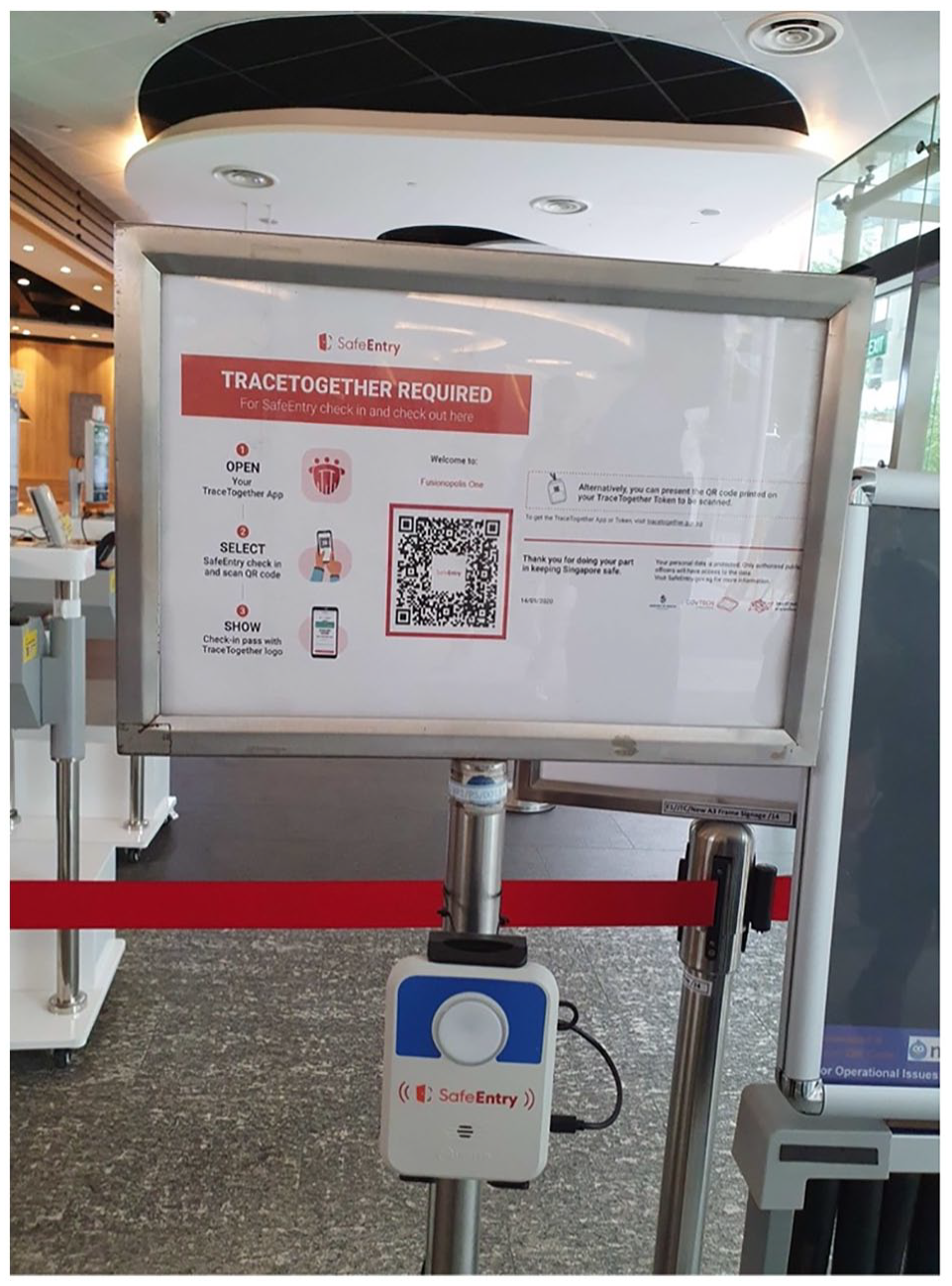
TraceTogether notice and SafeEntry gateway, one north building, Singapore.
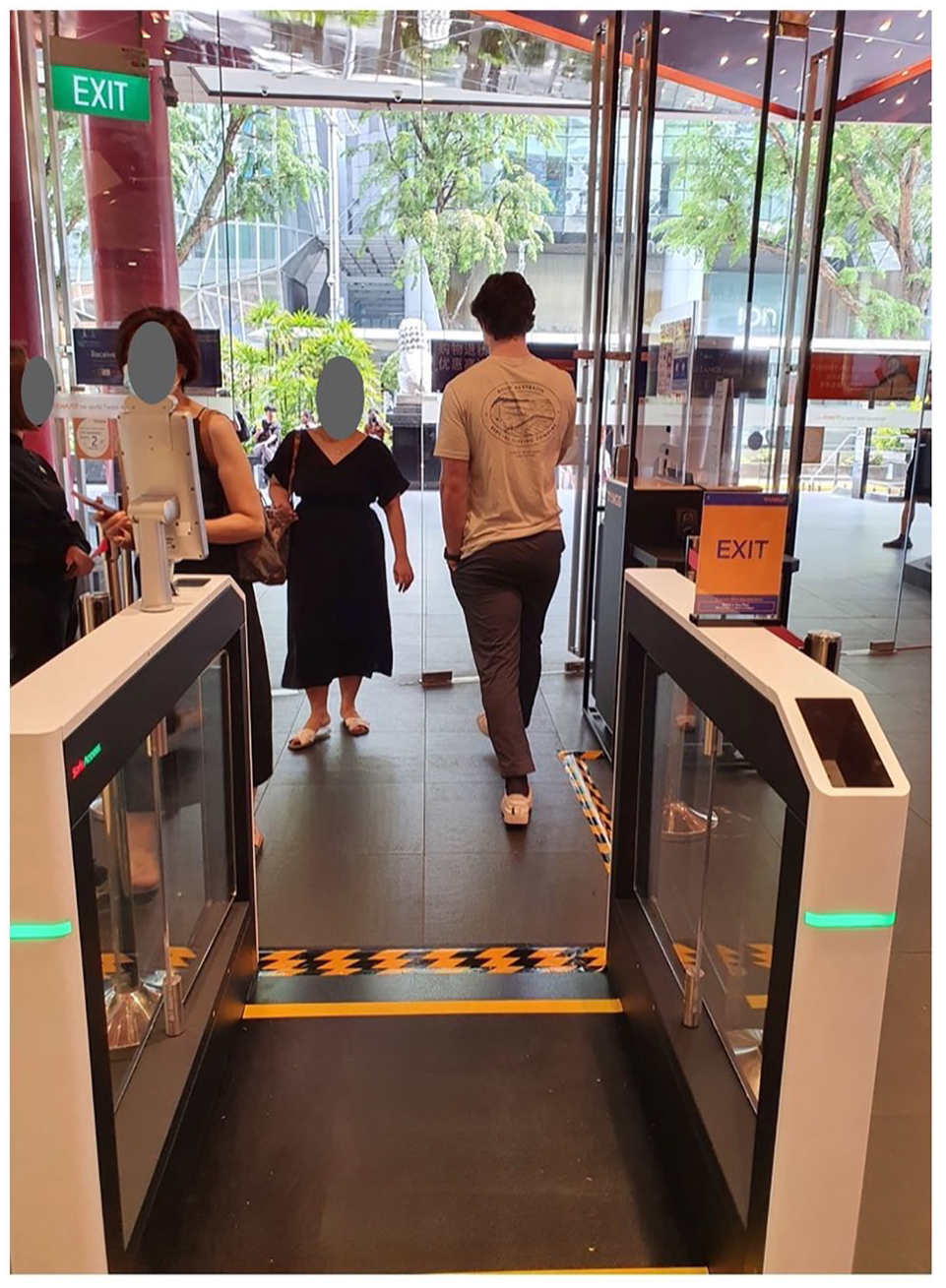
Automated gate in operation, Tangs department store, Orchard Road, Singapore.
Along with the highly visible and ubiquitous Safe Entry app, QR codes were also the linchpin of the apps directed at migrant workers—controlling their permissions (and virus and vaccine status) for leaving dormitories for personal visits, and gatekeeping their right to leave their dormitory for work and to enter their workplace (see Gan and Koh, 2021; Goggin and Zhuang, 2022; Ye, 2021).
As Singapore loosened restrictions and eventually stopped use of TraceTogether for SafeEntry, the app continued to be used to show vaccine status. This was especially the case in the brief, fraught period where national contact-tracing and check-in apps were required for use by international visitors and travelers. QR codes also, for a time, underpinned the presentation of vaccine certificates in international travel.
QR codes—Australia
In an Australian context, unlike elsewhere in the Asia-Pacific, QR codes have historically struggled to find a foothold. Broader social awareness, take-up and acceptance of the technology have been slow. Despite QR codes becoming an open standard in 2000, it took at least another 10 years, and the arrival of the smartphones, before QR codes began to be noticed and gained traction in Australia. Growing awareness of the QR code is captured in Rachel Botsman’s (2010) article for the Australian Financial Review, in which she retells her initial encounter with QR codes at a trade conference the previous year (“I saw the design was indeed not a Mondrian painting but a QR code”), before noting how they were rapidly beginning to catch on in Australia.
By the following year, QR codes were understood to be “creeping further and further into everyday lives” (The West Australian, 2012). “Those weird squares you scan with your smartphone” (The West Australian, 2012) were emerging as a versatile technology with a range of possible applications. They were employed extensively across a range of business sectors, including marketing, airline ticketing, agriculture (Brabazon et al., 2014) and supply chain management (McMichael et al., 2000), logistics, and package tracking. Education providers and libraries experimented with QR codes, especially as part of emerging mobile education (Law and So, 2010). QR codes have also been used in various civic notice and notify initiatives, a number of which have since become accepted as part-and-parcel of Australian everyday life.
Yet, despite Australia burnishing its reputation as an early adopter of new technologies, the QR code did not take off in Australia to the extent that might have been expected over the ensuing decade. Despite the myriad possible applications listed above, QR codes were perceived as something of a marketing gimmick (a fad that would likely pass), lacking a clear and compelling use case, and regarded as somewhat antiquated and cumbersome to use (as it needs a smartphone with a camera and a mobile Internet connection, and, for a long time, a third-party QR code reader app to capture and interpret the code and then take the user to a mobile website or webpage). This process was simplified in 2017–2018, when both Apple and Google introduced the ability to read QR codes through the native camera app in iOS and Android devices. Importantly, unlike in South-East Asia, QR codes did not become an integral part of mobile payment systems in Australia. This role was largely filled by credit cards and electronic funds transfer at point of sale (EFTPOS), and later by various touchless payment services, including Apple Wallet.
After COVID-19 reached Australia’s shores in early 2020, the Australian Federal Government announced the development of a contact-tracing app, COVIDSafe. The COVIDSafe app utilizes the BlueTrace open-source application protocol developed by the Singapore Government for its own TraceTogether app. COVIDSafe was launched on April 26, 2020.
COVIDSafe was controversial from the outset, with criticism of its high cost, and questions asked of the Federal Government given their political ties to the app’s developer (Stilgherrian, 2020); the COVIDSafe app also attracted strong privacy concern, with encryption experts calling for further discussion of what privacy protections were in place, as well as scrutiny of its source code (Australian Government, 2020; Bogle, 2020). In the months after launch, the app was dogged by technical issues (Stilgherrian, 2020) and an extremely low tracing success rate. Indeed, by the time of its decommissioning in 2022, COVIDSafe had identified only 17 cases in total in Australia (Minister for Health and Aged Care, 2022). The app was considered “a dud” (Coorey, 2021a). Interim, ad hoc measures, such as businesses recording customers’ details using pen and paper, were also understood to have been wholly inadequate. As New South Wales’s Customer Service Minister, Victor Dominello, put it: “We can’t respond to a pandemic with paper. [. . .] [D]igital is the best way forward” (quoted in Dettre, 2020). In lieu of an effective national automated detection system, QR codes were considered a vital (if imperfect) tool for contact tracers.
The failures of the government-initiated COVIDSafe app, and the lack of assistance it provided to state-based contact-tracing efforts, led Australian State and Territory governments to take the initiative and commission the creation of their own QR-based check-in services for contact tracing.
By early 2021, Australia hosted a patchwork landscape of different services, with each and every Australian state and territory announcing a QR-based check-in application. This assortment of QR check-in apps followed three distinct models. Apps developed in New South Wales (NSW) (Service NSW), Victoria (Service Victoria), and South Australia (my SA Gov) were built on and interfaced with an existing State Government service’s app that incorporated bill paying, registrations, and other government services and information (Coorey, 2021b). The Australian Capital Territory Government app (Check In CBR) was replicated in Queensland (Check In Qld), Tasmania (Check In TAS), and the Northern Territory (The Territory Check In). It was developed to scan QR codes and was said to only contain “the name and phone number of the person who owns the phone” (Coorey, 2021b). Meanwhile, the Western Australian Government launched their own app in November 2020 (SafeWA, later renamed ServiceWA), which was claimed to be more privacy preserving than those of the other states and territories (Bell, 2020). Here we focus specifically on the Service Victoria app, as the story of this app as a check-in service highlights the challenges presented to ADM systems during pandemic times.
Victoria’s Service Victoria QR-based check-in system was developed by local technology start-up Two Bulls (Waters, 2020) and was launched on November 30, 2020, almost 2 months after NSW’s equivalent system. Munn (2022) has observed that automated systems “require heavy amounts of development and maintenance” (p. 6). Facing criticism for the relative lag time of the Victorian app, Victoria’s Premier Daniel Andrews stated: “[I]t is not quite as simple as taking something from another state or something off the shelf” (quoted in White, 2020). The November 2020 launch of its QR Service Victoria app came during a brief reprieve between multiple lockdowns (six in total), when Melburnians had a short taste of freedom with some easing of restrictions on movement outside the home. The ambition of the QR check-in system was to permit a gradual easing of restrictions, and access to work and other venues, without compromising contact-tracing efforts.
The Service Victoria service consisted of a QR reader and check-in facility opened and operated from within the Service Victoria app. Scannable QR codes were produced by the Victorian State Government. Proof of vaccination status was later added to the app. While QR codes were initially placed outside sites at highest risk of exposure (e.g. hospitals, nursing homes), their use soon expanded to a wide range of venues, from workplaces and consumer outlets, and, later, everything from local parks and playgrounds to train station platforms and even specific train carriages (Figure 3).
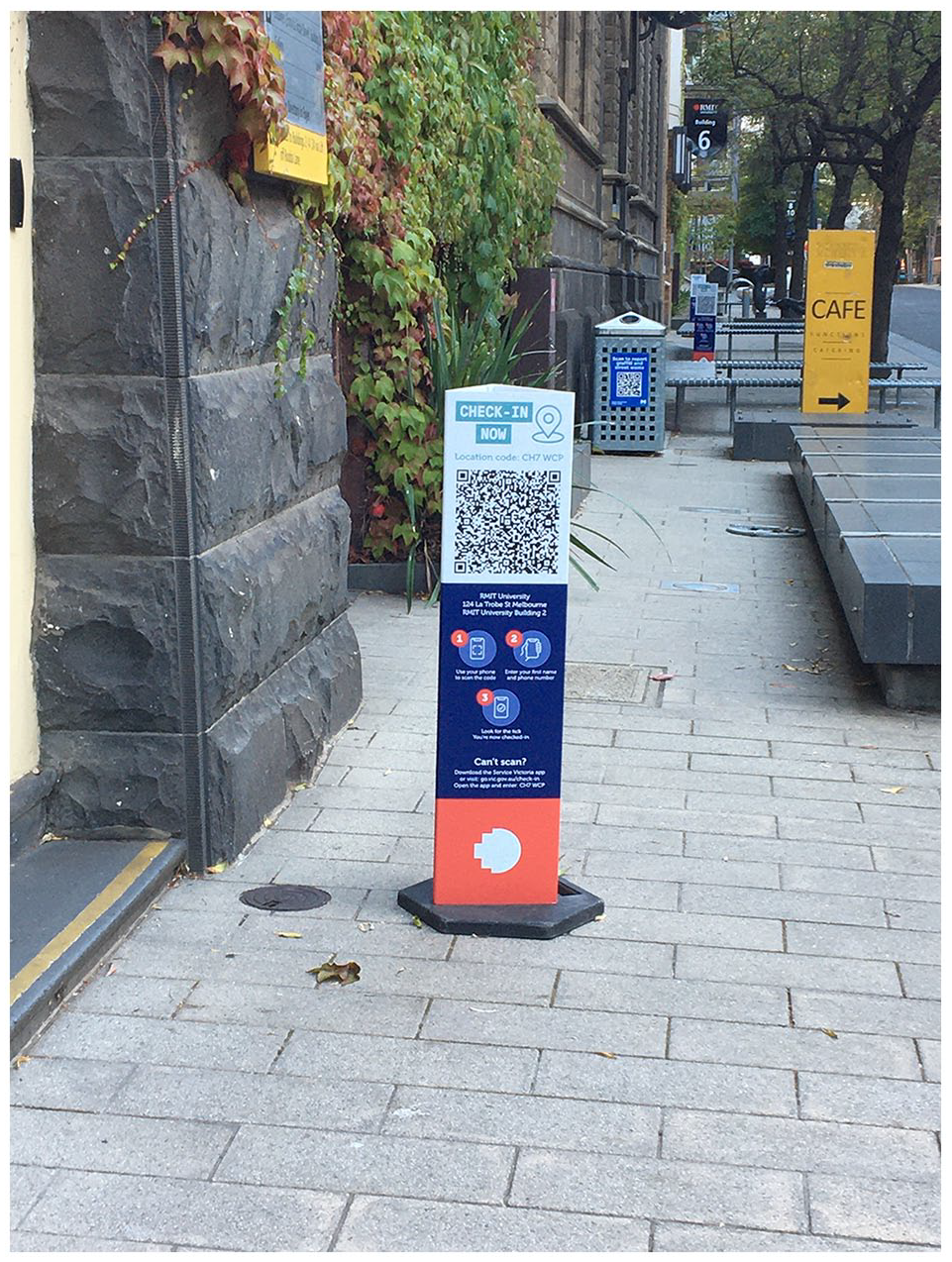
An example of QR code signage at the building entrance to a Melbourne workplace.
The Victorian check-in service was not without issues of its own. Consumer reports suggested that the launch version of the Service Victoria app, which housed the QR check-in facility, was not up to date enough to be compatible with late-generation Android devices (The Age, 2021). Criticism of the QR codes themselves included that they were “poorly designed” and “slower to scan” than their NSW counterparts; these criticisms were rejected by the Victorian Government who claimed that both states used the same QR code generation system (Mannix, 2021). A broader criticism was that QR codes “lack[ed] inclusivity by their very design” in that their development rests “on assumptions that people are privileged enough to own recent-model smartphones,” appropriate knowledge of their use, plus access to sufficient data and other infrastructure to check-in (Lupton 2022: 68).
Crucially, unlike Singapore’s SafeEntry, Victoria’s QR check-in system was not linked to automated venue entry. As Vertesi (2014: 273) notes, which infrastructures are aligned, and which are not, can prove consequential. In Victoria, the decision not to align QRs with automated entry did indeed prove consequential. All check-ins were based on good faith participation, or were manually verified by someone at the entrance to buildings. This led to manifold issues, from non-compliance, which increased as the pandemic progressed (Cook, 2021b), to aggression directed at hospitality and other staff whose job it was to confirm check-ins, or check vaccination status as a condition of entry (Cook, 2021a).
As the pandemic unfolded, a key goal for the Victorian Government was to achieve “infrastructural alignment” (Vertesi, 2014: 270) by connecting its Service Victoria app interface with the automated contact-tracing system, TraceTogether (developed by Salesforce in September 2020). Only by late April 2021 did it become mandatory for Victorian businesses to both install onsite QR codes, with significant fines for non-compliance (close to AUD$10,000), as well as link check-in records to the TraceTogether system (Herald Sun, 2021).
Additional to check-in use, it is worth noting that QR codes were also used in contact-tracing efforts in Victoria in a further, key, way. By late 2020, QR codes were integrated into Test Tracker, the Victorian Government’s digital system for tracking COVID-19 tests, from initial swab through to result notification. Test Tracker technology used QR codes to enable people to either self-register their test, or, more usually, allow testing staff to register on behalf of the person being tested (Parliament of Victoria, 2020: 39).
By late 2021, increased vaccination rates, and growing political and economic pressures to “reopen the economy,” signaled a shift in approaches to handling the pandemic. Changes included shortened home quarantine periods, revised definitions of close contacts, and greater reliance on QR codes and linked “vaccine passports” to gain entry to venues for contact-tracing records. Notably, discussed further below, QR code and vaccine passport use to gain entry to hospitality venues was accompanied by the increasing use of QR codes, linked to digital wallets, within these venues for ordering food and drinks, both as social distancing and efficiency and cost reduction measures.
With further easing of restrictions in early 2022, continued use of QR codes for checking-in, while still encouraged, was questioned, given that the data collected were no longer used in COVID-19 contact tracing (Waters, 2022). By April 2022, Victorians were no longer required to use QR check-ins or show vaccination status in order to enter most venues.
The politics and “seamfulness” of automation
Throughout the first 2 years of the pandemic, QR codes formed a new kind of ADM that underpinned major and pervasive public health and population efforts to respond to and manage the spread of COVID-19. To grasp how the socio-technical dynamics of this accomplishment have unfolded, we have found that attending to the particulars and contexts of such ADM is crucial, whereby “technologies emerge from a place’s unique ecosystem of institutions, innovations, and individuals, becoming cultural forms that reflect cultural values” (Munn, 2022: 131).
The specificities of ADM in the Singapore and Australian cases of COVID pandemic management “touch[ed] down at the local level” (p. 131). What is striking in an analysis of both places, with the admixture of our own experiences, is that ADM systems do not necessarily go to plan—and do not fit a global template or pattern (despite the many efforts during and after the pandemic to characterize the responses of countries, according to political, cultural, and other groupings). These two cases reveal how automation takes work, adaptation, and redirection—and involves a deal of “mess and mythology” (Dourish and Bell, 2011). Here we draw out and reflect on some of the implications of our comparative study by returning to Munn’s three propositional insights noted at the outset.
Automation is political
We see the politics of automation playing out in quite distinct ways during the pandemic in Singaporean and Australian contexts.
As the world moved into the “endemic,” on April 26, 2022, Singapore ceased safe entry checking-in most settings. Prime Minister Lee Hsien Loong reflected on the nation’s experience since the pandemic began (Lee, 2022). In particular, he listed “implementing contact tracing, TraceTogether and SafeEntry” as a key event in Singapore’s “journey.” Lee (2022) noted Singapore to be fortunate as “a high-trust society,” with citizens trusting that “every citizen will play his or her part” and that the “Government is competent and will make the right decisions.” Lee (2022) spoke of COVID-19 as a “baptism of fire for our nation,” and of “how we have written every chapter of our Singapore story.” In this national narrative, technology is center stage in Singapore, with its “smart nation” policies (Tan, 2022). ADM fits nicely into an official “Singapore story” narrative, because it promises to encapsulate and execute, via technology, the public health policy and management of the population through a government mandate, even by dint of a less-than-convincing mid-2020 COVID election (Stevens and Haines, 2020; Tan and Lee, 2021). The QR code played an important role in this. As shown in our analysis, QR codes fill in the cracks of ADM visions and technology implementation, providing a handy intermediate technology in a wider system (Willems and Graham, 2019). In Singapore, QR codes provided a series of “technology fixes” to underpin what became a nation-wide mandatory check-in system.
Meanwhile, Australia’s Senate Select Committee on COVID-19 Final Report of April 2022 presents a damning assessment of the Federal Government’s overall handling of the COVID-19 pandemic. The government was described as being “poorly prepared from the outset of the pandemic and failed to properly plan for the challenges that arose as the pandemic continued” (Senate, 2022: 9). The COVIDSafe contact-tracing app was “roundly criticised” for its “high cost and significant limitations as a practical measure for contact tracing” (p. 79). The National Cabinet coordinating Federal, State, and Territory responses to the pandemic was criticized for its secrecy, ineffectiveness in “securing agreement and consensus” to facilitate “information sharing between jurisdictions to inform and shape the response” (p. 73). The Senate Select Committee found that “the Australian Government was unable or unwilling to lead and foster consensus through the National Cabinet” (and was alleged, at times, to have “even fostered divisions, apparently for political gain”) with the result that “states and territories were left to implement highly-localised and often highly differentiated responses” (p. 73). Any sense, then, of Australia as functioning as a unified nation was problematized by a patchwork of State and Territory responses to the pandemic and their competing pandemic-related ADM applications. In this context, QR (like it did in Singapore) played an important role in shoring up against the social, policy, and technology missteps and failures of government. For Australian State and Territory leaders, QR codes provided a useful intermediate technology—a technology fix—in lieu of a nation-wide mandatory check-in system and a functioning national contact-tracing system.
Interestingly, in neither country did the drive to QR panopticism put issues for data protection and regulation on any serious agenda. QR codes have their custodians and champion organizations, but the data they use to gather seems to be regulated far from the locus of the QR bodies and actors. In COVID-19, the data scanned by QR codes travel via the apps to be deposited in mobile devices, networks, servers, and cloud storage, and from there be manipulated by computational technologies. There was an opportunity in COVID-19 for QR codes to be a focus of key governmental regulatory interventions to spur governance of app-based data economies (typically highly unregulated, due to their media ecology, political economy, and traditions of what media count as public concerns). Whether QR codes could constellate such actors in the service of tackling the conundrum of global data governance post-pandemic is unclear.
Automation is contextualized; automation begets automation
For Singaporeans, QR codes were a familiar technology prior to the pandemic due to their widespread use as a touchless payment method. For Australians, however, use of QR codes only rose as it was mandated during the pandemic. One outcome of the Australian pandemic experience has been that familiarity with QR codes for check-ins has since facilitated the adoption of other forms of QR-related automation. Thus, the pandemic has created the conditions of possibility for QR codes to finally obtain a foothold in Australia as a bona fide mobile payment option. Prior to the pandemic, it was noted that, despite their widespread use in Asia, QR codes were “unlikely to surpass contactless payments in Australia,” given the latter’s “high take-up and relatively low cost for merchants” (Turner, 2018). However, COVID-initiated structural shifts (such as the forced introduction of QR codes and click-and-collect services), generational shifts (where mobile payment methods are preferred), and “improved” digital literacy developed during the pandemic (including in the use of QR codes) (Williams, 2021) have now led to predictions that, in Australia, “digital wallets and QR codes will become a dominant payment type over the next five years” (Moullakis, 2022). For example, EFTPOS Australia is rolling out a national QR codes payments system, which, it is claimed, will create greater purchasing options for consumers and lift EFTPOS’ market share in online payments (Griffith, 2021). PayPal, too, has embraced QR codes in Australia to bolster their presence in physical stores and thereby compete with key point-of-sale payment providers, such as Afterpay and Apple Pay (Gluyas, 2021). In this instance, mandated pandemic-related automation has led Australia to now begin to catch up to other markets in South-East Asia in embracing mobile payment options as forms of financial ADM.
Automation is “seamful”
Implementation of automation, Munn (2022: 6) argues, has time and again “proven to consist of a range of non-trivial problems” and is “full of inconsistencies.” Early ADM responses to the pandemic tended to follow a not unfamiliar unrealistic vision of seamless automation. For instance, in announcing the COVIDSafe app, the then Australian Prime Minister Scott Morrison declared that downloading the app was like applying sunscreen for coronavirus and represented Australia’s “ticket” out of lockdown (SBS News, 2020). Contrary to such visions, in both Australia and Singapore, the reality has been a case of “infrastructural heterogeneity” (Vertesi, 2014: 267) where the “seamfulness” of these interacting systems and their implications (Hoffman et al., 2021) becomes evident. Not least because they are being developed on the fly during the pandemic, but public health responses to the pandemic tended to involve “multi-infrastructural work across heterogenous [seamful] systems” and became “a kind of ad hoc patchwork” (Vertesi, 2014: 269). In the Victorian Government’s response to COVID, a “shifting, heterogenous, multi-infrastructural environment” (p. 271) was very much how and where contact-tracing and related work was achieved and where decisions were made.
Streamlining these processes through “infrastructural alignment” (p. 270) thus became a key ambition in Singapore and, especially, in Australia. We see this in the Victorian Government’s attempts to connect the Service Victoria app check-in data to its TraceTogether automated contact-tracing system in 2021. The need for this had been highlighted in late 2020, when a Victorian parliamentary inquiry into the Victorian Government’s handling of the pandemic found that interoperability between separately developed components resulted in significant shortcomings as components were “supplied from several companies” and “were not fully integrated into one end-to-end system” (Parliament of Victoria, 2020: 85). The committee concluded, “system integration is a vital component of a fit for purpose contact tracing system as it enables the responsiveness and adaptability of that system” (p. 85). This assessment draws attention to the need for infrastructural alignment and system interoperability between pandemic management ADM systems, while also revealing the difficulties in achieving these things.
Conclusion
In this article, we have examined the use of QR codes as a form of ADM for managing the COVID-19 pandemic in Singapore and Australia. Taking a comparative approach is productive for understanding both similarities and differences in how ADM systems are envisioned, presented, implemented, and, ultimately, encountered by those intended to use them across these two contexts. The analysis draws attention to how “digging into” particular ADM case studies “quickly foregrounds differences that exist from country to country . . . and even city to city” (Munn, 2022: 131); it also reveals the differentiated ways that “automation is not just technical but political” (p. 7). Moreover, our comparative analysis offers something of a counter-vision to that of seamless automation, revealing how ADM implementation and use very much remains “seamful,” combining new technologies and established technologies (like QR codes) that tend to be born out of and remain embedded within “infrastructural heterogeneity.”
Footnotes
Funding
The author disclosed receipt of the following financial support for the research, authorship, and/or publication of this article: Gerard Goggin’s research was supported by a Singapore Ministry of Education, Academic Research Fund Tier 1 Grant, Social Laboratory of Apps project (2019-T1-002-106). The authors thank Tay Swee Hwee Jocelyn for her research assistance.
