




Abstract
How news media, such as newspapers and magazines, is consumed has dramatically changed due to technological developments, such as mobile and high-speed Internet technology. As a result, there has been a dramatic shift in consumer consumption of news from desktop and television to mobile platforms such as smartphones and tablets. Due to the shift of news consumption from desktop and television platforms to mobile, journalists have had to consider how news headlines and alerts must be tailored to match the distinctive characteristics of mobile platforms and consumers’ engagement patterns on such devices. Drawing on construal theory (CLT), this study will examine how mobile alerts should be framed to optimize engagement. Overall, it finds a combination of abstract construal through combination of a gain and other frames results in heightened levels of curiosity in readers leading to further engagement with news products.
Introduction
How news media is consumed has dramatically changed due to technological developments, such as mobile and high-speed Internet technology (Chyi and Chadha, 2011; Nelson, 2020; Van Damme et al., 2015). As a result, there has been a dramatic shift in consumption of news from desktop and television to mobile platforms such as smartphones and tablets (Nelson, 2020; Newman et al., 2022). These technological shifts and the resulting impacts on the traditional journalism business model highlight the inherent tensions between the craft of journalism and the business of journalism (Coddington, 2015). Scholars have highlighted that in an increasingly crowded digital landscape, developing loyal audiences has taken on a new urgency, given that sustained attention translates into highly profitable measures of engagement, such as clicks, time spent and shares (Gajardo and Costera Meijer, 2023; Hansen and Goligoski, 2018; Krebs and Lischka, 2019).
Considering these tensions, this study will examine mobile news and news consumer engagement through the lens of construal theory (CLT). CLT is a psychological theory that suggests that individuals mentally consider concepts or objects at different levels of abstraction or ‘construal’. It is commonly used by marketing scholars to examine how messages should be designed and their subsequent impact on consumer behaviour (Florence et al., 2022). However, while CLT is widely used in marketing communication studies, it has rarely been utilized to understand how journalism/news should be framed to enhance reader engagement. As the marketing communication literature suggests that how abstract or concrete construal is embedded into messages can significantly alter the behavioural outcomes of the receiver, this theoretical perspective sheds new light on how mobile news alerts should be framed to optimize engagement. This theoretical perspective, therefore, may provide insight into how mobile news alerts should be framed considering not just the journalistic need to fully inform (Eriksson and Östman, 2013) but also how framing news delivery can help to support viable news media through encouraging increased engagement with the news brand.
A method of increasing news engagement on mobile devices has been the introduction of the push notification, where news apps send alerts about breaking news to appear on the users’ locked screen. Push notifications provide an opportunity to bridge the traditional divide between purposeful and incidental news exposure, increase news app use and can have some impact on news knowledge (Stroud et al., 2020). Likewise, a news alert can serve as a gateway for further engagement with the news, inviting the consumer to click through to a full story or other forms of high news engagement. Therefore, framing a news alert for optimum engagement provides opportunities to increase news and civic knowledge.
Another related dilemma which journalists need to consider is what type of response are they trying to elicit from readers via mobile alerts and how does this contributes to engagement. For example, a journalist may consider that the framing of a mobile news alert needs to elicit strong positive or negative emotions. Indeed, research shows that emotional responses to news can improve desired outcomes (Wahl-Jorgensen, 2019). However, a less considered reader response in journalism is that of curiosity. Beyond journalism, curiosity has been shown to be an important explanatory mechanism in marketing for why individuals engage or behave (Park et al., 2015; C. Wang and Huang, 2018). Thinking about mobile news alerts, it is plausible to suggest that if a news alert was to pique the curiosity of the reader, they may be more likely to engage as they seek to satisfy their need for information. However, research is needed to confirm such assertions. As literature appears to support both emotions and curiosity as potentially important responses to mobile alerts and subsequent engagement, the current research also sets out to examine whether reader emotional or curiosity responses mediate the effect of mobile news alert frames on reader engagement.
This study, therefore, sits at the nexus of journalism and marketing, seeking to identify how mobile news alerts should be framed to enhance engagement, and how different reader responses may explain this relationship. To achieve this, the current study, underpinned by CLT, seeks to address the following two research questions:
RQ1. What news alert frames are most effective for increasing readership engagement on mobile platforms?
RQ2. Does emotion or curiosity explain reader responses to news alert frames and their likelihood of engagement?
To address the research questions and subsequent gap in practitioner and scholarly understanding relating to news alerts on mobile platforms, this research takes a multi-disciplinary approach which contributes to journalism knowledge in three ways. First, it contributes by demonstrating the utility of a CLT theoretical lens for framing mobile news alerts. Second, it provides empirical support in relation to Solutions-Based Journalism, which to date is scarce. Third, it demonstrates that curiosity as opposed to emotions is the key explanatory mechanism for consumer responses to mobile news alerts.
Mobile news consumption and engagement
Smartphones are the dominant way in which most people first access news in the day (Newman et al., 2022) and as such numerous studies have examined how the mobile platform’s technological affordances, including ubiquity of access, apps and push alerts, impact engagement with news (Costera Meijer and Groot Kormelink, 2015; Groot Kormelink and Costera Meijer, 2014; Van Damme et al., 2015). Overall, scholars argue that mobile users are more likely to check on news throughout the day, grazing on information without a conscious information-seeking goal (Molyneux, 2018). Brief grazing news sessions mean a user is exposed to less information than if they were engaged in longer sustained sessions. As a result, users have less knowledge about public affairs and are not as civically engaged (Bennett et al., 2008). Others have argued this has broader impacts on journalism, with user preferences for less information equating to less incentive for news organizations to produce high-quality news (Chyi and Yang, 2009). More recent studies, however, have suggested mobile news use can increase political knowledge but not participation in offline political activities (Ohme, 2020).
Apps and push alerts can help drive unplanned and incidental checking of news (Matsa and Lu, 2016; Newman et al., 2022), albeit in a brief manner. However, they can also be associated with purposeful or intentional news checking (Stroud et al., 2020). Both purposeful and incidental news exposure have been shown to increase civic knowledge (de Vreese and Boomgaarden, 2006; Feezell, 2018). Valeriani and Vaccari (2016) show that higher levels of accidental exposure to news are positively connected to online participation particularly for those with low political interest benefit. Push notifications are, therefore, potentially promising for news organizations; battling for user attention in a world of information overload and third-party distribution on social media platforms, as well as a method for enhancing greater civic engagement. However, despite these potential benefits, very little is known about the specific make-up of push notifications as they relate to user engagement.
Engagement in digital journalism is often equated to a participatory practice such as commenting or sharing (Kalogeropoulos et al., 2017) and has been referred to as a form of participatory journalism in which the audience interacts with the news (Domingo et al., 2008). Conceptualized as such, it is a two-way communication process where the audience can participate in the news creation process by providing feedback, sharing, commenting and reacting to the news content. Engagement behaviours include clicking on links to read full news stories or watching news videos, sharing with social networks on and offline, commenting on stories and blogs and other online discussion platforms, and seeking out other related news coverage (Chan-Olmsted and Wolter, 2018; Kalogeropoulos et al., 2017; Schivinski et al., 2016). Given the potential of push notifications to increase engagement, this study seeks to examine how they may enhance engagement with the news in these ways.
CLT applied to journalism: concrete versus abstract language for engagement
Framing theory has been used in journalism studies for decades to describe the way in which news stories are presented to audiences (Entman, 1993). It suggests that the way a story is framed can significantly impact the way audiences perceive and understand it. For marketing scholars, CLT has informed the study of message framing as it relates to the goals of influencing consumers’ attitudes and behaviour (Maheswaran and Meyers-Levy, 1990). From the perspective of CLT, different forms of construal can be operationalized in ways which are either high level (abstract) or low level (concrete). Abstract construal involves high-level, broad and overarching understanding of information (Adler and Sarstedt, 2021). When applying this to journalism and in particular mobile alerts, this can be considered when news focus on the ‘big picture’, general concepts or underlying principles. This information then subsequently emphasizes the overall meaning and implications of the information as opposed to offering detailed specificity. In contrast, concrete construal involves a low-level, detailed and specific understanding of information (Adler and Sarstedt, 2021). For journalism and mobile news alerts, this would translate to the content focusing on the specific facts, details and tangible aspects of the information of the story.
In the case of mobile news alerts, journalism may gain several benefits from considering and integrating CLT into framing. One benefit could be increasing enhanced message resonance, CLT allows for tailoring news alerts to align with the cognitive processes of the audience, such as abstract (high-level) or concrete (low-level) thinking (White et al., 2011), and therefore, news alerts can be framed to resonate more with audiences and their mental processing. This subsequently also leads to another potential benefit of optimizing audience processing of mobile news alerts (Fu and Gao, 2023), as CLT is a theory which emphasizes the role of cognitive processes and perceptions and how communication can be effectively designed (framed) (Chang et al., 2015). A third benefit relates to literature that provides evidence the CLT can provide a framework considering how framing can play a crucial role in influencing attitudes and subsequent behaviours of individuals (Adler and Sarstedt, 2021). By understanding how to strategically frame news alerts using CLT principles, it may also become possible for journalists to positively shape attitudes and behaviour to the message content.
Two common ways marketing has considered how messages can utilize abstract or concrete construal is via gain/loss and/or self-other framing, which theoretically bare similarities with prominent forms of journalism framing, which are considered next.
Gain versus loss
Gain versus loss framing emphasizes the positive or negative consequences of an event or behaviour (Levin et al., 1998). When considering journalism, this bares close similarities to solutions-based versus problem-based (AKA traditional) journalism (McIntyre, 2019). The problem-solution frame is a common frame identified in news framing literature (Cappella and Jamieson, 1996).
Traditional journalism is often characterized by its negativity and its focus on reporting on problems and the news value of conflict (Bantz, 1997). In contrast, a new paradigm, solutions journalism, also referred to as constructive journalism, is a form of reporting that focuses on the positive responses to social problems rather than just highlighting the problems themselves (McIntyre, 2019). Many argue that solutions journalism has the potential to stymie news avoidance or declining news audiences and to engage citizens with critical information (Newman et al., 2022).
Gain frames, which could be considered similar to solutions-based journalism, is suggested to be abstract as opposed to concrete because it emphasizes potential positive outcomes or benefits (White et al., 2011), which maybe more difficult for an individual to visualize. This is supported by the study of Chang et al. (2015) who explored the differences between gain and loss frames in green advertising. The authors suggest that gain frames may be more abstract and difficult for individuals to visualize because they focus on potential outcomes rather than present realities. Other studies also support the findings of Chang et al. (2015) often finding gain frames are paired with abstract thinking and/or high-level construal (Park and Morton, 2015; White et al., 2011). Considering an example in the current study setting, a message or story might promote the potential long-term environmental benefits of a new form of technology. In contrast, loss-framed messages emphasize the negative outcomes or risks associated, which is similar to traditional problem-based journalism or the focus on a conflict news value (Bantz, 1997). Loss frames are argued to be at a low-level construal (more concrete) because it focuses on individuals moving from an ideal state to a sub-optimal state (White et al., 2011), which is easier for individuals to process or consider.
Self versus other
Self versus other framing suggests that messages can be abstract or concrete based upon whom is impacted (Florence et al., 2022). For instance, new stories which utilize first-person language, such as ‘How will YOU be impacted?’, would demonstrate the use of a self-frame. When individuals focus on themselves, they tend to rely on concrete details and sensory experiences to describe a situation. Self-focused frames are, therefore, often concrete because they are centred around one’s own experiences, thoughts and feelings (White et al., 2011). Alternatively, other-focused frames utilize a higher level of construal by presenting how situations or events are likely to impact beyond the individual, inclusive of family, community and society (e.g. ‘How will SOCIETY be impacted?’). Other-focused frames are often more abstract because they involve taking into account the experiences, thoughts and feelings of others. When we focus on others, we need to rely on abstract concepts and generalizations to describe their experiences. This is because we are trying to understand and communicate someone else’s perspective, which may involve taking into account factors that are not immediately observable.
The distinction between self and other framing replicates the news media classification of tabloid and broadsheet. The tabloid and broadsheet terms drawn from newspapers, however, are applied to news media more broadly. One of the most significant differences between broadsheet and tabloid framing is the way they prioritize and select news stories. Tabloid journalism is driven by a profit orientation and personalized style. It is more likely to prioritize stories that have a direct impact on individuals’ lives, such as crime stories or human-interest pieces with appeal to emotions (Skovsgaard, 2014; Uribe and Gunter, 2004), aligning with the self-frame. In contrast, broadsheet newspapers are more likely to prioritize stories that have significant implications for society or politics, aligning with the other frame (Bastos, 2016).
Congruency of message frames construal
After considering the discussion on message frames and their relation to journalism approaches, one may wonder which frame(s) would be most effective for enhancing engagement in mobile news alerts. Drawing on previous literature, this study proposes that congruent framing (pairing between two concrete frames or two abstract frames) of gain versus loss and self-focused versus other-focused frames will lead to higher levels of engagement as a result of reading mobile news alerts. This is as previous research has shown that matching frame combinations with congruent levels of construal (abstract vs concrete) can enhance the effects for the behavioural outcomes of messages, as in the case of pairing gain frames with other-focused (two abstract frames) and loss frames with self-focused frames (two concrete frames) (Chang et al., 2015; Loebnitz et al., 2022). In support of congruency of construal levels, White et al. (2011) found that matching message frames (loss vs gain) with construal level (self vs other) led to more effective recycling behaviour. Additionally, Chang et al.’s (2015) study demonstrated that a congruency gain frame and high-level construal (such as other-focused in the current study), are likely to result in more positive attitudes and behavioural intentions. Based on the prior theorizing and discussion of prior literature and their empirical findings, the following hypotheses are proposed:
H1a. A Gain frame paired with an Other frame will significantly increase reader engagement.
H1b. A Loss frame paired with a Self frame will significantly increase reader engagement.
Make them feel or curious? What explains engagement?
If a particular combination of message frames in a mobile news alert were to lead to heightened levels of engagement, one may ask why? There appear to be two schools of thought relating to what types of responses may explain why readers are more likely to engage because of reading a mobile news alert. The first posits that emotional responses are likely to play a mediating role and assist in understanding why readers engage (Khalil et al., 2022; Wahl-Jorgensen, 2020). Indeed, literature from both journalism and marketing advocates for responses to messages being emotional and their ability to assist in understanding behavioural responses such as engagement. For instance, from a journalism perspective, Wahl-Jorgensen (2019) argues that studies on news audiences and emotions have shown that audiences who are emotionally engaged are more likely to recall and act. We thus draw on Wahl-Jorgensen’s (2020) definition of the use of emotion in journalism as a relational interpretation of affect that is a dynamic and interactive process. It is distinct from affect, or what Massumi (2002) refers to as an intense bodily sensation. While many use the terms emotion and affect interchangeably, we refer to emotion as we are focused on feelings evoked through the stimuli. From a marketing perspective, Khalil et al.’s (2022) investigation of marketing messages for sustainability demonstrates that a gain (positive) message as opposed to a loss (negative) message triggers an emotional response of hope, which increases the likelihood of reducing food waste. Thus, given that this research sits at the nexus of both journalism and marketing, it is plausible to suggest that positive emotional responses may explain why or why not a reader is likely to engage with a news story after reading a news alert.
H2. Emotional responses of news readers will mediate the effect of mobile news framing on reader engagement.
The second potential explanation for why an individual exposed to a news alert is likely to engage further with the news media is due to curiosity, defined as a natural human inclination to seek knowledge, information or new experiences (C. Wang and Huang, 2018). Again, considering the multidisciplinary foundation of the current research, both journalism and marketing lend support for considering how curiosity may be a potential mediator for the mobile news alert-engagement relation. Researchers have shown that journalistic mean-making requires curiosity in conjunction with story-telling frames (Grunwald and Rupar, 2009). As these researchers note, curiosity is not often the subject of journalism studies research; however, it is implicitly linked with journalism through the drive of the audience to consume news and of the journalist to find and report the news (Grunwald and Rupar, 2009: 394). Of those studies that have considered curiosity, Scacco and Muddiman (2020), demonstrate how ‘curious headlines’ impact information seeking and anticipated article engagement. In a more recent study of WeChat headlines (Golman and Qiu, 2022), it was identified that a headline that opened a salient information gap sparked curiosity about a particular news article, but might not generate long-term reader engagement. The study of Janét et al. (2022) also demonstrates the importance of curiosity, outlining people who are more science-curious are more likely to engage with environmental news stories (e.g. click, read, share, comment). When considering the marketing literature, there is more concrete evidence that curiosity mediates consumer responses to communication and behavioural outcomes. Park et al. (2015) demonstrate that sport advertisements that generate curiosity are more likely to increase the likelihood of people watching sports. C. Wang and Huang’s (2018) study also demonstrates curiosity to be important, particularly to mediate the effect of vague product announcements on word-of-mouth. Thus, given the support for the importance of curiosity in journalism and marketing literature, the following is hypothesized for the current study:
H3. Curiosity will mediate the effect of mobile news framing on reader engagement.
Conceptual model
Drawing together the previously proposed hypotheses and justifications, the conceptual model which guides this study is presented in Figure 1. The network of relationships suggests that mobile alert frames will interact to effect (a) reader emotional response and (b) curiosity of readerships, which in turn will increase the levels of engagement. This suggests that an indirect effect will occur as indicated by the dashed line in Figure 1 whereby reader emotional response and/or reader curiosity will function as mediators and explain why engagement is increased by certain combinations of different message frames in a mobile alert.
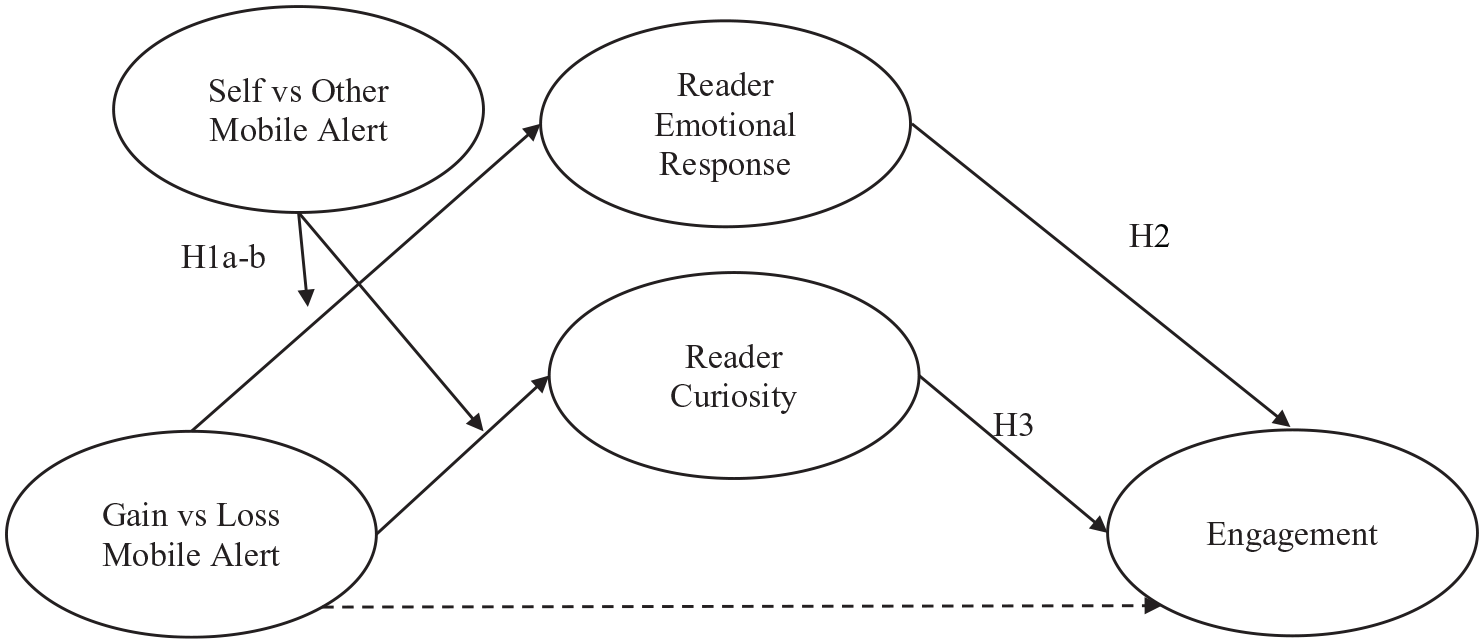
Conceptual model and hypotheses.
Overview of studies
Across two studies, the effect of mobile news frames on engagement is evaluated. Furthermore, both studies assess the mediating roles of emotional response and curiosity. In Study 1, the hypotheses are assessed with a national public service news broadcaster readership sample. Study 2 then replicates the method and approach of Study 1 with the variation of testing the hypotheses with a general population sample recruited through an online panel provider. We undertook two studies with different samples to enhance the generalizability and replicability of the findings to ensure the relationships remain consistent across different populations. In particular, the findings relate to those that may have higher interest in news, such as the public service news broadcaster readership sample (Study 1) and those which may have a more passive interest in news (Study 2), thus, ruling this out as a potential confounding factor explaining the observed relationships.
Study 1: news audience
Participants and experimental design
A total of 461 participants were recruited through a national public service news provider. Participants were recruited via a mobile notification within their mobile news feed. The alert contained a unique URL to complete an online survey, which was hosted on the survey platform, Qualtrics. Once participants clicked on the link to the survey, they were randomly assigned to one condition of the 2 (Gain vs Loss frame) × 2 (Self vs Other frame) experimental conditions. Prior to exposure to the experimental stimuli, participants were asked a range of demographic questions, including age, gender and occupation. As an overview, 46.6% of the sample were aged 45–54 years and 54.6% identified as male, and 46.7% were employed full time. In relation to news areas of interest, 30.7% indicated interest in international news, 18.7% were interested in political news and 26.7% were interested in local news.
Stimuli
The stimuli for the experiment included four variations of a mobile alert in relation to a snap Federal election, that is, a breaking political news story (see Appendix 1). This was deemed appropriate for several reasons. First, image-based stimuli enhance the external validity of stimuli by emulating a mobile alert. Second, the use of a political news story was deemed appropriate due to previous literature highlighting it as a fruitful area for understanding how mobile platforms enhance readers political knowledge (Ohme et al., 2022), mobile citizens (Ohme, 2020) and encourage participation in elections (Martin, 2015).
Measures
To measure curiosity, Hill et al.’s (2016) six-item scale was adapted for the current study and measured on a 9-point scale (1 = not at all/9 = extremely) and found to be reliable and valid (loadings = .778–.855, α = .908). To measure negative emotions, items were adapted from Northey et al. (2020), including mad, angry, disgusted, repulsed and guilty, measured on a 9-point semantic differential scale (1 = not at all/9 = extremely, loadings: .895–.925, α = .903). Positive emotions also drew items from Northey et al. (2020), including amused, happy, affectionate and love (1 = not at all/9 = extremely, loadings: .895–.925, α = .87). Engagement was measured via four items on a 5-point Likert-type scale (1 = strongly disagree, 7 = strongly agree) sourced from Schivinski et al. (2016) (loadings: .641–.814; α = .74).
Manipulation checks
Consistent with the recommendations of Thorson et al. (2012) for experimental methodology in Journalism, the validity of the stimuli was assessed via manipulation checks. To assess the Self versus Other news frames, the following item was used, ‘The news alert focused on the impact of the snap election on the community’ and assessed on a 7-point Likert-type scale. A one-way analysis of variance (ANOVA) was then conducted to confirm the manipulations with the results evidencing a significant difference based on the intended manipulation of the news alerts (F = 6.35, df = 1, p = .012).
To assess differences in the Gain versus Loss news frames, Chang et al. (2015) manipulation check items was adapted, ‘The news alert focused on the positives of a snap election’ and assessed on a 7-point Likert-type scale (1 = strongly disagree, 7 = strongly agree). A one-way ANOVA confirmed participants identified the news alerts as highlighting either the positive or negative consequences of the story as intended (F = 75.01, df = 1, p < .001).
As the manipulations were empirically supported and validated, they were subsequently taken forward for hypothesis testing.
Control variables
Further consistent with the experimental recommendations of Thorson et al. (2012), to reduce the potential for other variables and theoretical explanations within our results, variables pertaining to participant characteristics, such as age, sex, news avoidance, political ideology and involvement with news, were used as covariates within the analysis. In particular, this is due to literature demonstrating (1) males are more likely to consume news (Benesch, 2012), (2) age is known to moderate news consumption (Boulianne and Shehata, 2022), (3) recent trends in news avoidance are decreasing news consumption and interest (Bruin et al., 2021), (4) as involvement increases so too does the likelihood of engagement (Y. Wang et al., 2020) and (5) based on the political views of the participant their news engagement is likely to differ (Janét et al., 2022; Ohme et al., 2022). Thus, by placing these variables as covariates within the analysis software PROCESS MACRO 3.5, these can be used in the regression analysis to statistically control for the effects of these variables, isolating the relationship of interest, those hypothesized, and reducing potential bias.
Results
To test the proposed hypotheses, the data were analysed in PROCESS MACRO 3.5 utilizing Model 8 with 5000 bootstrap samples. For the analysis, Gain (coded as 2) versus Loss (coded as 1) frames were included as the independent variable, the Self (coded as 1) versus Other (coded as 2) frame was added as the moderator, and engagement was included as the dependent variable. News avoidance, political ideology, involvement with news, age and gender were all controlled for as covariates within the analysis. Three models were then assessed to determine the mediating roles of positive emotions, negative emotions or curiosity (see Table 1).
Study 1: model results.
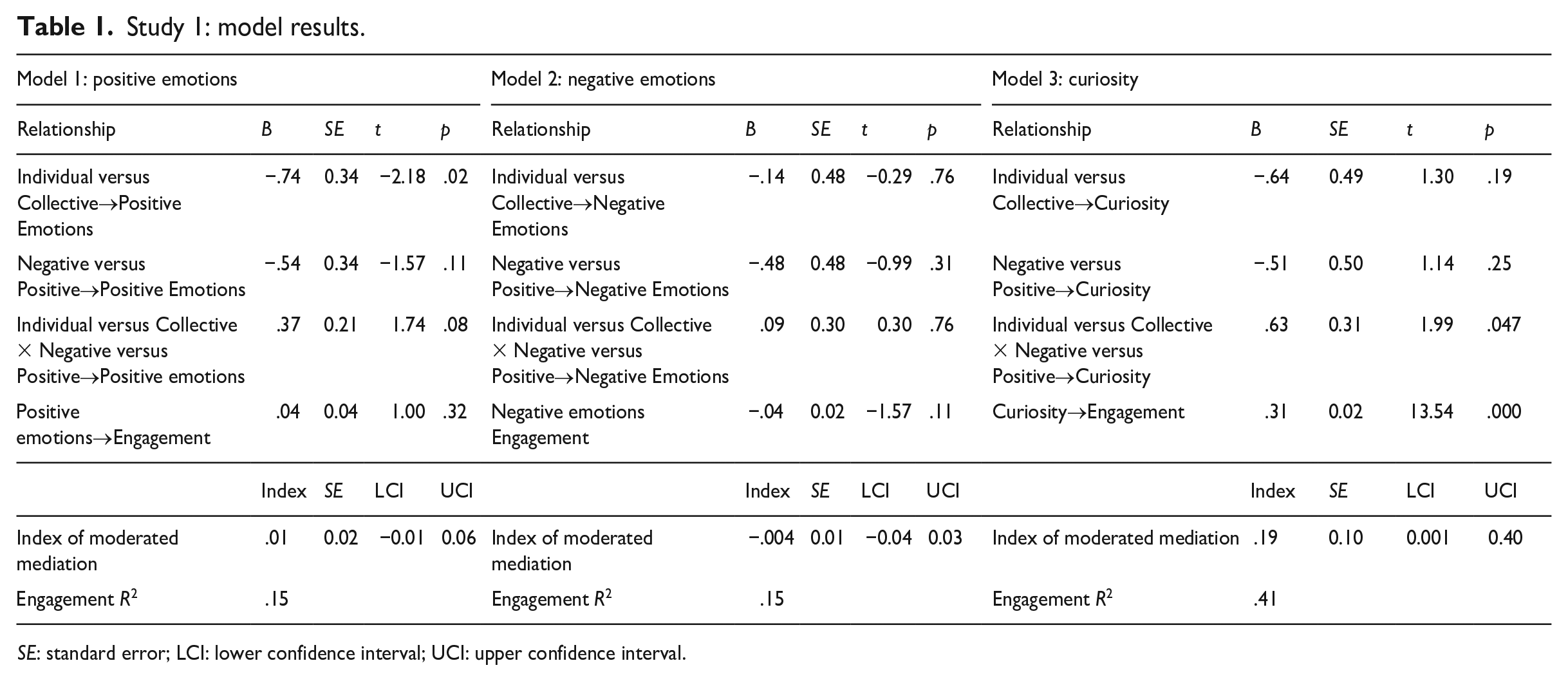
SE: standard error; LCI: lower confidence interval; UCI: upper confidence interval.
Model 1: positive emotions as a mediator of news engagement
A non-significant interaction between the two news frames was observed (B = .37, SE = 0.21, t = 1.74, p = .08). Positive emotions were also found to have a non-significant impact upon engagement (B = .04, SE = 0.04, t = 1.00, p = .32), rejecting H2.
Model 2: negative emotions as a mediator of news engagement
Negative emotions were then assessed. The results again revealed a non-significant impact of the news frames (p ⩾ .31) as well as a non-significant effect of their interaction (p = .76) and a non-significant effect of negative emotions on engagement (B = −.04, SE = 0.02, t = 1.57, p = .11), rejecting H2.
Model 3: curiosity as a mediator of news engagement
The results showed a significant interaction between the two news frames (B = .63, SE = 0.31, t = 1.99, p = .047). The conditional effects demonstrated that a combination of abstract frames, Gain and Other, within a news alert was likely to significantly increase curiosity (B = .69, SE = 0. 22, t = 3.06, p = .002), supporting H1a. Whereas, in the case of a combination of concrete frames, Self and Loss, there were non-significant combination effects on curiosity observed (B = .05, SE = 0.22, t = 0.25, p = .79), which rejects H1b. These results demonstrate that alone news frames are unlikely to lead to significant change in readers’ curiosity. Instead, a combination of abstract Other and Gain frames within a news mobile alert significantly enhances levels of curiosity. The results also revealed that curiosity was a significant predictor of news reader engagement (B = .31, SE = 0.02, t = 13.54, p < .001).
The index of moderated mediation was significant as demonstrated by the confidence intervals not passing zero (index = .19, SE = 0.10, lower confidence interval [LCI] = 0.001, upper confidence interval [UCI] = 0.40). In particular, the indirect effect of the congruent abstract Other news frame combined with the Gain news frame via the mediator of curiosity was found to be significant (B = .21, SE = 0.07, LCI = 0.07, UCI = 0.37). However, the indirect effect of the concrete Self news frame combined with either an abstract Gain or concrete Loss news frame was non-significant (B = .01, SE = 0.07, LCI = −0.12, UCI = 0.16). These results support the hypothesis that for news readers to engage, they must first become curious, supporting H3. Furthermore, for a news alert to elicit this sequence of responses, the news alert must first elicit curiosity using a congruent abstract level framing combination of Other and Gain.
Study 1: discussion
The results of Study 1 reveal that emotional responses do not mediate the effect of mobile news frames on engagement. In addition, the results show positive and negative emotions to have a non-significant direct effect on engagement (rejecting H2). In further evidence to rule out the explanatory power of emotions, the R2 of the positive (R2 = .15) and negative emotions (R2 = .15) were inferior to that of the curiosity model (R2 = .41). In Model 3, the congruent abstract combination of Gain × Other was shown to significantly enhance curiosity and indirectly influence engagement (supporting H1a and H3). Alternatively, the congruent combination of Loss × Self was found to have a non-significant effect (rejecting H1b). This thus lends support for the prior theorizing of congruency, but also suggests only one aspect of CLT (abstract congruency) is more pertinent to enhancing engagement for mobile news. Based on the results of Study 1, Study 2 will seek to test the generalizability of curiosity as a mediator, as well as the effect of Gain × Other congruent news frames in a general population sample.
Study 2: general population
A replication study was undertaken to ensure the robustness of the results as well as the theorizing underpinning the conceptual model. This was also to rule out potential arguments that the data and results observed for the main study could be attributed to the profile of news readers who subscribed to the news alerts from the public service news provider in Study 1. The replication study utilized the same research design and survey instrument (measures) with a general population.
Participants and experimental design
To recruit participants for Study 2, Prolific, an online crowdsourcing platform which recruits survey participants, was used. To recruit participants, the researchers posted an announcement asking participants to participate in a study about mobile news alerts to Australian prolific users. From this post, a total of 336 Australian consumers (25–34 years = 37.8%, SD = 17.64; female = 46%) were surveyed. 49.3% were employed full time, and 31% indicated interest in international news.
Stimuli and measures
To ensure consistency and comparability with Study 1, the same stimuli (Appendix 1) was used in Study 2. This was done to ensure the reliability and generalizability of the significant results observed in Study 1. To measure curiosity, Hill et al.’s (2016) six-item scale was again used on a 9-point-scale (1 = not at all/9 = extremely) and found to be reliable and valid (loadings = .715–.864, α = .881). Engagement was measured consistently with Study 1 via four items on a 5-point Likert-type scale (1 = strongly disagree, 7 = strongly agree) sourced from Schivinski et al. (2016) (loadings: .600–.843; α = .75).
Results
To test the proposed hypotheses, the data were analysed in PROCESS MACRO 3.5 utilizing Model 8 with 5000 bootstrap samples. Consistent with Study 1, for the analysis, Gain (coded as 2) versus Loss (coded as 1) frames were included as the independent variable, the Self-focused (coded as 1) versus Other (coded as 2) frame was added as the moderator, and engagement was included as the dependent variable. News avoidance, political ideology, involvement with news, age and gender were all again controlled for as covariates within the PROCESS MACRO 3.5 software to rule out their potential confounding effect and improve the precision of analysis.
The interaction between the news frames was found to be significant (B = .88, SE = 0.35, t = 2.48, p = .013). The conditional effects demonstrated that an abstract congruent mobile news value pairing of Other and Gain frames significantly increased curiosity of readers (B = .65, SE = 0.25, t = 2.61, p = .009), supporting H1a. However, concrete congruent mobile alert frames together, namely Loss and Self, were found to have a non-significant effect (B = −.22, SE = 0.25, t = −0.90, p = .36), therefore rejecting H1b.
Curiosity was shown to have a significant direct effect on engagement (B = .43, SE = 0.04, t = 9.17, p < .001). The index of moderated mediation was found to be significant (index = .38, SE = 0.16, LCI = 0.08, UCI = 0.71). Specifically, the indirect effect of the abstract congruent mobile news frame combination, Other-focused and Gain, on engagement was significant via the mediator of curiosity, supporting H3. Whereas the concrete congruent mobile news frame combination, Loss and Self-focused frames, had a non-significant indirect effect on engagement via the mediator of curiosity (B = −.09, SE = 0.10, LCI = −0.31, UCI = 0.10). The model produced an R2 of .37 for engagement. Overall, the results of Study 2 replicate those of Study 1. They also provide evidence that the results in Study 1, with the audience of a public service media organization, can be generalized to those with commercial imperatives.
General discussion
In addressing the two research questions – RQ1: What news alert frames are most effective for increasing readership engagement on mobile platforms? and RQ2: Does emotions or curiosity explain reader responses to news alert frames and their likelihood of engagement? – the results of the current study have shown that Gain and Other-focused frames contribute to greater engagement, and this is explained by readers’ heightened levels of curiosity. The theoretical and practical implications of these findings will now be discussed.
Theoretical implications
The current research makes three significant contributions. First, it introduces a new theoretical perspective on how news should be framed, particularly on mobile platforms. The study has shown that CLT can be a useful theoretical lens for journalists to guide their language and framing techniques to increase engagement and promote more informed thinking among their audience. Specifically, the study demonstrates how the facts within a mobile news alert should be framed using Other and Gain frames in combination to achieve abstract congruency. This finding suggests that mobile news alerts that use frames that recall both Other-focused and Gain frames are abstract as opposed to concrete and are likely to lead to enhanced engagement.
Second, this research challenges traditional negative or conflicted-based news frames and instead provides empirical support for movements such as Solutions-Based Journalism. This finding demonstrates that news stories with a positive (gain) frame, where ‘the solution (or how people are responding to a problem) should be the most salient information in the story’ (McIntyre, 2019: 21), have the potential to re-engage declining news audiences. This study is among the first to demonstrate through a new theoretical lens, CLT, and its empirical results, that being abstract and discussing the positives (gains) of a story for the broader community (other focused) should be the salient information to drive further engagement.
Third, the research has also shown that mobile news alert engagement is cognitive as opposed to an emotional process. The literature on tabloid journalism suggests the greatest audience share will be drawn to stories which appeal to high levels of emotion through sensationalism (Skovsgaard, 2014). However, our research shows an emotional appeal is not always necessarily the primary explanatory reason why people engage with news, we provide a complimentary alternative, curiosity. This also explains why abstract congruent combinations work as they are not providing ‘all the information’. This does not necessarily equate to click-bait and sensationalism often connected with digital news media engagement, but instead a combination of Gain and Other-focused frames are effective in driving curiosity.
Practical implications
The results of the study present a method of promoting engagement through a mobile platform. This study highlights the importance of framing news alerts in a way that captures the attention of mobile news consumers who tend to ‘snack’ or ‘graze’ on news. To effectively inform these audiences on complex issues, it is crucial for journalists to use framing techniques that incite curiosity to promote engagement. The study suggests that using both a Gain and Other-focused framing in news alerts can benefit journalism by helping drive audiences to heightened levels of curiosity which in turn leads them to engage with further news content, thereby increasing the likelihood that they will be further informed on complex issues. Therefore, a strategy for journalists writing mobile news alerts is to incorporate both a Gain and Other-focused frames. This would practically result in highlighting the positive aspects of a story or the solution to a problem and the potential benefits to the community or society. The results presented here suggest framing an alert in this way will increase engagement.
Traditionally, journalism has been viewed as a public service that aims to inform citizens about important events and issues. This normative assumption reflects the belief that journalistic integrity is based on informing individuals without framing news to encourage greater engagement (Bastos, 2016). In this way, journalism should aim to inform rather than drive curiosity. However, the rise of digital media has brought about a new business model for journalism, where online traffic and engagement are key factors for success. It has been argued that the highly visual and personalized nature of digital media, along with the increasing emphasis of commercial imperatives to maintain news media sustainability, privileges a tabloid approach to digital news (Bastos, 2016). However, the present study suggests to journalism practitioners, particularly those using mobile platforms, an approach more closely aligned with the broadsheet editorial decision making, an Other framing, or a focus on the impacts to the broader collective or society, are more effective for driving engagement. However, it should be noted that increased attention on driving click-through can have detrimental impacts on journalistic integrity. Some have argued that the drive for media brand loyalty and increased engagement has resulted in a blurring of the lines between journalism and entertainment, with many news outlets focusing on sensational and click-worthy stories to drive traffic and engagement (Bastos, 2016). This has created a tension for contemporary journalism as, while engagement is important for the sustainability of journalism, it must not come at the expense of journalistic integrity or the public interest. However, as noted above, when news is to be consumed on a mobile platform, framing to encourage engagement can provide an avenue for encouraging more detailed engagement with knowledge vital for civic engagement.
Limitations and future research directions
This study is not without limitations that should be acknowledged and that present opportunities for future research. While this is consistent with a growing body of literature, future research should seek to understand whether the effective message frame combination identified in the current study extends to other types of news stories and different news formats. For instance, considering whether such message frames are effective for mobile news alerts concerning topics, such as sports, entertainment and health, should be considered to assess the generalizability of the findings of the current study. Equally, future research could consider the impact of message frames on short digital formats, such as headlines on mobile news apps. Indeed, uncovering whether different frames are used across different topics will shed further insight as to how mobile news alerts can be designed.
Second, while outside of the scope, the current study did not thoroughly consider readers’ psychological traits or other factors which identify readers’ individual differences which may alter preferences for message frames and/or responses to them. For instance, readers’ level of neuroticism (people’s tendency to feel distressed) and ‘openness to change’ are just some examples that may be particularly interesting to explore to better understand responses to mobile news alerts. Research, for example, has shown that neuroticism can predict responses to health news (Weston and Jackson, 2016), whereas ‘openness to change’ by its definition captures individual’s willingness and ability to embrace new ideas, situations and behaviours (Tewari et al., 2023). This could therefore provide explanation of individuals’ positive or negative responses to news alerts particularly when they highlight a radical change such as cultural paradigm shifts, environmental milestones of technological disruptions.
A third limitation that offers opportunities for future research is that the current study was situated within one cultural context, Australia, and news on one particular platform. Caution should therefore be taken to generalizing the results to other cultural settings as well as other news platforms. Future research should seek to investigate whether potential cross-cultural differences exist for the relationships observed within the current study. Message framing research for instance suggests cultural differences may require different message frames to be used (Florence et al., 2022). When considering the news platform, future research should seek to understand whether consistent effects can be observed on other online platforms, such as websites or social media. An additional important consideration which is outside the scope of the current study’s focus on mobile news alerts is how imagery may also need to consider construal. Prior research shows that the use of colour, as well as objects of focus in images, such as the number of people, can also be altered to represent different levels of construal (Lee et al., 2014). This research found that for effective mobile news alerts, congruency in construal of frames was needed, and future research of news which can use imagery could thus extend to consider whether a matching construal of the image is also needed.
The current research also does not capture an important consideration: the optimal amount of information or facts to include in mobile alerts. In today’s fast-paced world, readers have limited attention spans, so it is crucial to capture their attention quickly. Examining the number of critical facts in mobile news alerts can help us understand whether a particular level of facts, in combination with message frames, is optimal. For example, there could be counterarguments to consider. On the one hand, providing fewer facts may generate greater curiosity. On the other hand, providing more facts may be needed to trigger greater interest. Future research should therefore consider this.
Footnotes
Appendix
Funding
The author(s) received no financial support for the research, authorship and/or publication of this article.
