



Abstract
This article demonstrates how applying the concept of audiencing allows us to better understand how the presence of different audiences online mediates the affective labour practices of content creators. The article focuses on one distinctive example of online content creators: British travel bloggers. First, the article argues that audiencing provides an important lens to witness the diversity of affective labour practices being undertaken by travel bloggers, contributing to the wider literature around affective work. Second, the article also demonstrates how travel bloggers are an important focus of study, as they utilise visual and narrative experiences of place as the key foci through which they tailor their affective work to different relationships of audiencing. This finding contributes to the labour on audiencing, by demonstrating how creative labourers use a stimulus (such as discussions of place) as a mechanism through which to tailor their affective work.
Introduction – the importance of understanding affective labour and audiencing within travel bloggers’ working lives
On 17 March 2020, Foreign Secretary Dominic Raab issued a statement in response to the Coronavirus pandemic. He advised British citizens against all non-essential overseas travel (Foreign and Commonwealth Office, 2020). In the weeks of lockdown which followed, the public actively began to question the working practices of those who made a living from travelling to different places. For example, British bloggers and influencers who continued to share content from locations beyond the United Kingdom during the pandemic faced huge backlash online and alienation from their followers (BBC News, 2020). This example of the reaction of their audiences to the working lives of travel bloggers demonstrates the importance of understanding the affective work which online content creators invest into creating and cultivating an online audience. Hardt and Negri (2004: 108) define affective labour broadly as ‘labour that produces or manipulates affects such as a feeling of ease, well-being, satisfaction, excitement or passion’. A key contribution of this article then, is demonstrating how applying the lens of audiencing allows us to witness how the presence of different audiences online mediates the affective labour practices of content creators. Crucially, using this lens of ‘audiencing’ evidences the diversity of practices of affective labour which travel bloggers undertake in direct consideration of these different audiences.
The example of the backlash faced by travel bloggers during the pandemic also demonstrates the importance of travel bloggers’ visual and narrative experiences of place in cultivating online audience relationships. The narrative and visual experiences of place, which travel bloggers share online, therefore function as the key stimulus through which travel bloggers tailor their affective work to the different relationships of ‘audiencing’ online. Developed in 1992, the concept of audiencing refers to the way in which we can begin to understand the social and cultural formation of individuals (the audience) who engage with a particular media product, such as a TV programme (Fiske, 1992). Although audiencing as a concept has been applied in much literature across creator studies, this article applies it to a new subsection of creative labourers: travel bloggers. The article uses the concept of ‘audiencing’ to show how travel bloggers employ a specific focus (namely their visual and narrative experiences of place shared online) as the key stimulus through which they can tailor their affective work to these different online audiences.
The article draws on analyses of interview and netnography data collected during research with 19 British travel bloggers just prior to the COVID-19 pandemic. Puhringer and Taylor (2008: 179) define travel blogs as ‘the equivalent of personal online diaries and are made up from one or more individual entries strung together by a common theme (for example, a trip itinerary)’. Travel blogs carry a variety of functions from identity construction and social networking, to the exchange of information about travel experiences. The labour of travel bloggers is centred around the continual creation and dissemination of (digital) travel content, which facilitates one or more of these functions (van Nuenen, 2016). As travel is the predominant theme of the blog, travel bloggers are (unsurprisingly) under pressure to visit different places – to move around producing diverse travel content and to simultaneously share this content with their online audiences.
The absence of a central registry for blogs means that it is impossible to estimate the number of travel blogs (and therefore travel bloggers) worldwide. However, on WordPress (a leading blogging site), there are roughly 70 million new blog posts each month (WordPress, 2022). Bosangit et al. (2012) found that travel blogs make up on average 28% of this total blogging market. The number of bloggers in the United States was projected to be around 31.7 million in 2020 (Statistica, 2020). In terms of bloggers’ financial incomes, as Walker-Rettberg (2013) highlights, there are no clear figures on how much money individual bloggers make. However, it is understood that there is large variation in economic success among individual bloggers. Turning to the United Kingdom specifically, 30% of UK travel bloggers stated that they had received between £101 and £250 in compensation for a blog post, with 8% stating they had received over £501 (Vuelio, 2019). Despite the widespread income disparity, the rapidly growing blogging industry means that individuals are increasingly seeing travel blogging as a viable form of digital work.
The research methodology involved completing two interviews (one semi-structured and one photo elicitation interview) with each participant, each lasting between 60 and 75 minutes. These interviews were audio-recorded and transcribed. The article also draws upon netnographic research. Netnography is a specific method of qualitative online research which adapts ethnographic research techniques, such as online observation, photographic methods and interviews, to explore the online communities and cultures which materialise, because of the computer-mediated contingencies of the online world (Kozinets, 2015). At the heart of the netnography method is a cultural focus on understanding social media and online data. It is this interpreting and understanding of cultural experiences through online data by the researcher, which makes netnography distinctive as a method, and particularly useful for examining the digital, affective realities of travel blogging work. The netnography element of the research involved collecting screenshots of content, broadly relating to ideas of ‘work’ from six randomly selected individuals from the 19 interview participants. This online data was captured from the participants’ publicly accessible blog and associated Twitter, Facebook, Instagram and Pinterest accounts and was supplemented with fieldnotes.
Introducing affective labour, audiencing and the applications of these concepts in accounts of content creation work
Affective work
Travel bloggers mobilise their affective labour in ways which demonstrate an awareness of the different relationships of audiencing which are present online. Reviewing the broader literature around affective labour is therefore useful, as it highlights the importance for these creative labourers in creating and maintaining connections with their varied online audiences, and the diverse forms this affective work takes. Drawing on Hardt and Negri’s (2000) seminal work on affective labour, workers within the creative economy (such as travel bloggers) are increasingly thinking like computers, whereas workers previously used to act like machines. The computer and communicative revolution of production we have seen in recent years has therefore resulted in a shift from material labour (within the era of industrialisation and the associated creation of tangible products) to the rise of ‘immaterial labour’ (and therefore the production of an immaterial good). Hardt (1999: 96) highlights the centrality of the affective in considerations of immaterial labour – expressing how affective labour is ‘immaterial, even if it is corporeal and affective, in the sense that its products are intangible: a feeling of ease, well-being, satisfaction, excitement, passion – even a sense of connectedness and community’.
Hardt and Negri’s (2000) work informed some of the earliest applications of the term ‘affective labour’, which occurred within fandom studies. In this context, affective labour was a concept used to describe the amount of time and energy fans dedicated to consecrating their passion for a particular application, brand or character (Deuze et al., 2007). Within these fandom examples, affective labour was a productive human activity, meaningful in the sense that it created a sense of community and/or belonging for those who shared a common interest, rather than being an activity undertaken for direct financial gain or profit (Gregg, 2009). However, because of our increasingly cultural economy, a large deal of scholarship has sought to explore how workplace cultures of the creative industries also involve a high degree of affective labour (Ross, 2003). The present era of rapid technological change and the associated expansion of the production of user-generated content has meant a focus on affective labour in the online economy has proliferated (Gregg, 2009).
This shift to understandings of affective work in relation to the cultural economy of digital labour has informed the work of many critical scholars, including that of Kylie Jarret. Within her 2016 book Feminism, Labour and Digital Media: The Digital Housewife, Jarrett (2016) explored the parallels between consumer labour and domestic labour, arguing that the framework of immaterial and affective work helps us to reconceptualise what is actually meant by labour, and ultimately to reconsider consumer activity as labour. In turning to the digital, she argued that it is through the presence of affective social ties – and the enactment of these affective social ties through labour undertaken online – which allows social media to exploit users as (affective) labourers. Although both bodies of work around affective labour as a community activity (Gregg, 2009) and affective labour as a consumer activity (Jarrett, 2016) are incredibly important, they do not fully consider activities (such as blogging) which are often simultaneously both economic and culturally productive.
Affective investments therefore remain central in the online sphere of social media production, as social media is fundamentally concerned with the creation and maintenance of online communications and social networks (Paasonen, 2010). Focusing specifically on the online context, Terranova (2000: 6) therefore expands the concept of affective labour to include both specific forms of production such as digital services, digital production and design, but also ‘forms of labour we do not immediately recognise as such; chat, real-life stories, mailing lists, amateur newsletters and so on’, which seek to produce and enhance these social bonds. In their analysis of affective labour online, Johnson and Woodcock (2019) move beyond Terranova’s conceptualisation of online affective work. They highlight how affective labour also includes the promotion of user-generated content, and other forms of social labour focused on the performance of identity and legitimacy within an individual’s (online) spaces of work. This identification of a relationship between affective work and the audiences present on social media has been further examined by Jarrett (2015). Jarrett (2015: 204) discusses the uses of social media technologies to perform acts of socially affective work. For example, she notes how the labour involved in hitting a ‘like’ button on Facebook is a ‘profound affective component of social interactions generated through digital networks’. However, these bodies of work neglect to recognise how content creators actively channel their affective work through a specific stimulus. A stimulus (such as narrative and visual experiences of place) is important, as it ultimately provides the content creator with a mechanism through which to mobilise and tailor their practices of affective work, including practices such as ‘likes’ and ‘chat’ which Jarrett (2015) and Terranova (2000) describe.
Within the literature on the creator economy, there has been a substantial amount of research which has sought to examine how digital content creators invest work into conceiving and curating audiences, as an example of socially affective labour. One key scholar working in this space is Brooke Erin Duffy, who examines the platform specific self-branding strategies being undertaken by online workers. Crucially, she examines how these self-branding practices are tailored to specific online audiences. Duffy (2017) finds that within the digital economy, her interviewees (like many other digital workers) felt compelled to constantly deploy affective work and skills, to carefully manage their presentation of self online. This careful management was in direct response to the constant pressure these online labourers faced from their online audiences to be unrelentingly visible and present. Affective work therefore had to be employed with a sense of urgency, so as not to displease the online audience, and to enable the worker to successfully build positive affective relationships. These affective relationships were of vital importance, playing a fundamental role in the delimitation between the few who ‘make it’ within the digital creator economy, and the rest who seemingly ‘never get paid to do what they love’. Although this work is incredibly important, it is limited in its discussion of how content creators may also use affective work as a form of labour which pushes back against the consent needed for presence and visibility online.
Whereas Duffy (2017) focuses on fashion and lifestyle influencers and bloggers, other research has examined the relationship between audiences and affective work, in relation to different sectors of the creator economy. Cummings (2019) discusses ‘mommy blogs’ (i.e. blogs which focus on mothers’ discussions of their reproductive work) as sites which make affective labour visible. Management of affective labour within these digital spaces of the blog emerges directly in conjunction with the development of the platform and its associated audiences. Cummings (2019) notes how for the corporate mommy blog, our understandings of affective labour (as labour which had previously been undertaken to provide social mobilisation of feelings such as companionship or community) has now been remanifested into a form of labour, which is managed and commodified by the blogger to sell sponsored products to specific audiences online.
Johnson and Woodcock (2019) further explore the intersection between affective labour, commodification and online audiences, through their examination of the live-streaming platform Twitch.tv. They argue that the affective dimensions of live-streaming labour are inherently focused on the audience. Live-streaming labour therefore involves affective work to be compelling to watch, to be friendly towards the audience, to engage the audience through means such as humour, to build intimacy with their audience and ultimately, to solicit donations from this audience. Twitch.tv as an online platform therefore affords content creators with new ways to mediate their affective performances, as the flow of affect is mobilised within the real-time spatio-temporal boundaries of the video game stream itself. The authors subsequently demonstrate the importance of streamers putting on ‘a performance’ within their stream, as this bounded affective performance is integral to the development of feelings of association and closeness between the streamer and their audience. Within this example, we see how audiencing is a decisive tool in streamers’ decisions of how they mediate their affective work. However, this example limits discussions of the deliberate tailoring of affective work to the spatio-temporal boundary of the live stream.
Audiencing
This wealth of literature on the creator economy (and on blogging in particular) has demonstrated the intersection between affective labour and audiences. It has demonstrated how affective labour is overwhelmingly a shared endeavour, which extends beyond the individual and instead relies on the collective engagement of an individual and their audience (Kolehmainen and Mäkinen, 2021). The article now turns to examinations of the literature on ‘audiencing’, using this literature to highlight how understanding different audiences which exist online can enable us to better understand the varied affective labour practices which creative workers undertake.
In 1992, Fiske (1992) coined the term ‘audiencing’ to begin to understand the audience group as a social formation, who formed around a specific medium such as a TV programme. He developed the concept to ‘advance the argument that culture is a continuous process of the social circulation of meanings and that “audiencing” is part of the process’ (345). At sites where this circulation of meaning became accessible, ‘glimpses of culture in practice’ were therefore subsequently revealed. Within her analysis of ‘exciting moments’ in audience research, Livingstone (2012: 269) discusses the unpredictability of new digital, convergent, and networked audiences, who are actively participating in the new media landscape. She discusses how audiencing as a concept, allows for the recognition of the ways in which networked media is allowing new possibilities for relationships and commonalities to be built between people online. ‘Audiencing’ as a concept therefore allows scholars to fundamentally consider ‘what roles or modes of participation are afforded to people by the particular cultural performance or media representation with which they engage’. In unveiling these roles, the concept of audiencing is useful as it allows scholars to witness how particular cultural performances (such as blogging) can become mediated by the participation of diverse, networked audiences and what influence these audiences have on those creating cultural media. The article will therefore use the concept of audiencing as a lens to showcase how two different relationships of audiencing, which exist for travel bloggers online, influence the practices and performances of their affective work. Here, audiencing is conceptualised as the role of the audience (both imagined and concrete) for the travel blogger.
The concept of ‘audiencing’ differs from other key terms in audience studies such as reception theory. Reception theory is based on the idea that the audience who watch or experience a form of media (such as a game or a film) actively create their own meanings from the text, often according to their own social context. This means that audiences play an active role in constructing often multiple meanings of the same media texts (Hall, 1973). The approach of this article is distinctive to the work of reception theory, as through a focus on ‘audiencing’ the article highlights the ultimate impact on the individual worker of the varied meanings which the audience might take (and decode) from the content itself, and the centrality of the role of affective labour in consideration of these varied meanings. It centralises ‘audiencing’ as an active phenomenon within the creator culture space, using it as a lens to understand the varied ways in which travel bloggers directly attune their affective work to the nuances of their audiences.
The concept of ‘audiencing’ is also distinct when compared with the concept of media as practice, developed by Couldry (2004). Within his work on the subject, Couldry (2004) implied a change in media studies from textual analysis to a practice-based focus on what people are ‘doing in relation to media across a wide range of situations and contexts’ (Couldry, 2012: 37). A focus on understanding media as a practice, rather than as a text, was useful as it ultimately allowed scholars to understand the social significance and distinctive types of social processes that were enacted through media practices (Stephanson and Trere, 2020). Although this concept is useful in allowing us to understand the social interconnections facilitated and enacted through media practices, Anderson (2020: 348) notes to employ the concept of media practice also encourages us to ‘turn away’ from media texts. Using the concept of ‘audiencing’ is distinct here, as the concept allows us to continue to recognise the importance of media texts themselves, and the central role these texts have in interpretation and meaning making, as it occurs between content creators and audiences.
Since 1992, the concept of audiencing has been applied to a variety of research, which seeks to better understand the influence of an audience (and their subjective experiences and ways of seeing) on particular phenomena. For example, Gillian Rose (2001: 25) used the concept of ‘audiencing’ to consider how all audiences bring with them their own ways of seeing in her work with visual methodologies. Drawing directly from Fiske (1994), she explains how she uses the concept of ‘audiencing’ to refer to the process by which a media object (such as a visual image) has ‘its meanings made, renegotiated, or rejected by particular audiences who are watching in particular circumstances’. She goes on to describe the importance of the compositionality of the image, the technological site used to make and display the image, the social practices which structure the viewing of the image and the social identities of those viewing the image as all having a direct impact in our understanding of the audiencing of images.
The concept of audiencing has also been used to examine how various audiences engage with artistic works and how this audiencing has a direct impact on the continual production of these works. Warren (2011) used the term ‘audiencing’ to understand how various audience groups interacted with site art installations at Yorkshire Sculpture Park. Through the audiencing of art by site workers who engage in practices of making and assembly, she demonstrated how the process of artistic production becomes entwined with audiencing. In doing so, she demonstrated how audiencing is ultimately enacted in a non-linear chain of processes from multiple positionalities within a distinctive place. Where this prior scholarship on audiencing is currently lacking, however, is that it does not consider the influence of an audience (including their ways of seeing and their subjective experiences and positionalities) on the creative labour practices of individuals.
More recently, the concept of audiencing has been applied within the literature focused on online spatialities, and examinations of the role of the audience within social and digital media communities. Woodford et al. (2017) note how audience participation through social media is indicative of a new form of active engagement of audiences, and therefore new practices of audiencing. Social media differs to previous examples of audiencing mainstream media, as now practices of audiencing are becoming unbounded. Audiencing is now visible beyond the living room, and the immediate personal contacts of the individual listener or viewer. As Woodford et al. (2017: 77) go on to explain, ‘social media in a narrower sense, simply makes the active audience described by television scholars for the past half-century considerably more visible and tangible’. Within their research into the Eurovision fandom on Twitter, for example, Highfield et al. (2013) demonstrate how Twitter can be a tool for ‘audiencing’. This is because Twitter facilitates the ‘public performance of belonging to the distributed audience for a shared media event’ (Highfield et al., 2013: 338). Highfield et al. (2013) highlight how this practice of audiencing on Twitter is primarily enacted through fans providing their own running Eurovision commentary, delivered using hashtags associated with the live event (such as #eurovision or #esc). The current scholarship around audiencing and social media has limited exploration of the blog itself (alongside its various linked social media) as a site of audiencing.
Recently, scholarship on creator culture, and particularly research around online influencers, has begun to critically assess the ways in which communities of audiences influence the labour practices of digital creators. Cunningham and Craig (2021) argue that the term ‘creator culture’ is constructed around the opportunities and challenges which have emerged from the rise of an industry and culture populated by social media entrepreneurs. They argue that the term marks a departure from an earlier phase of ‘user generated’ content. This has now been replaced by ‘creators’ who are actively commercialising and professionalising content in close consideration and engagement with their audiences on social media platforms. As also discussed by Duffy (2017), a content creators’ success is hinged on their ability to attract and maintain the affective interest of their audiences, with social media entertainment platforms operating as both ‘content delivery systems and communication technology . . . Creator culture is being developed and practiced [at] the intersection of the digital and the social, the interpersonal and the mass’ (Cunningham and Craig, 2021: 32). Although there has been much scholarship focused on the intersection between audiences and creator culture, a lot of this literature has not focused on the different relationships of audiencing (i.e. the different subsections of audiences) which exist for creators online.
This dual ability to produce and distribute content, alongside managing online audiences is a key consideration in the various affective work practices undertaken by online influencers and social media celebrities. Focusing on lifestyle influencers in Singapore, Abidin (2017) examined how these individuals used narratives of their personal lives to grow from ordinary Internet users into profitable digital celebrities (or ‘influencers’) with large followings of online audiences. Focusing on her more recent work with influencers during the COVID-19 pandemic, Abidin (2021) discusses the development of para-social intimacy, as an affective resource which relies on the influencer being perceived as relatable by their online audience. Influencers undertake many distinctive performances (such as performances of amateurism) as affective resources to help build para-social intimacy bonds with their followers.
The remainder of this article will focus on analysing this intersection between audiencing and affective labour as it occurs for a new subsection of content creators – travel bloggers. It discusses the varied labour practices which travel bloggers invest into their affective labour (i.e. into creating and curating connections with distinctive facets of their online audiences), understanding visual and textual experiences of place as the central stimulus through which this affective work occurs.
‘Ordinary followers’: examining how travel bloggers undertake affective work to mobilise affects of inspiration, intimacy and ordinariness among their non-blogger audience
Affective work is intrinsic to the creative work of travel bloggers, that is, the labour they invest into calibrating, performing and mobilising bodily affects of attention, excitement and interest for their online audience (Wissinger, 2007). This first analytical section will begin by exploring the affective labour travel bloggers undertake, in response to the audiencing of their blog by ‘ordinary followers’. ‘Ordinary followers’ are categorised as individuals who engage with the travel blogger and their content, but who are not themselves travel bloggers.
Inspiration
Before turning directly to explorations of the particular examples of affective work which travel bloggers undertake, it is important to recognise and acknowledge the centrality of social media as a centre for affectivity within travel bloggers’ working lives: I’m just sat here thinking about the expanse of social media, and what it means for bloggers and their followers. So many of these followers will feel like they really know the blogger and vice versa, because they know them from Twitter or Facebook. In reality, they might be in different countries, different time zones, whatever. Does that make the digital even more important for relationships and connections? I guess so! All this relationship building has to be done online, they [the bloggers] have to make sure they get what they want through online . . . (Netnography fieldnotes, 6 October 2018)
As both Woodford et al. (2017) and Highfield et al. (2013) note, the development of social media has meant that practices of audiencing have become unbounded. These newly unbounded practices of audiencing have a direct impact on the affective work of content creators, including travel bloggers. For travel bloggers and their ordinary followers in particular, relationship building is confined to online, social media spatialities and therefore needs to occur across ‘different countries and different time zones’. As such, the travel blogger invests affective work into visible manifestations of the social interactions with their ordinary followers, typically through means such as the likes, page views or other visible interactions such as comments, which Jarrett (2015) discusses.
Although social media offers opportunities for the ‘unbounded’ connections with different audiences which Woodford et al. (2017) and Highfield et al. (2013) discuss, the personal identity of travel bloggers continues to influence their understandings of the overall make up of their online audiences: Generally, my audience is women in the UK aged between about 35-44. That’s my main audience that views everything that I publish . . . (TBT)
As blogger TBT discusses, she understands her blog audience as embodying a similar (national) identity to her: being female, from the United Kingdom and of a similar age range. Beyond this example, all participants in this research produced their content exclusively in English, limiting the audience demographic of their blogs to English-speakers. Although now unrestrained by the potentials of social media, relationships of ‘audiencing’ for bloggers remain influenced by identity features, including national identity and language, and also a perceived synergy existing between the blogger and their audience in terms of age and/or gender.
The nuances of these relationships of audiencing which exist online also directly mediate and influence the travel bloggers affective work in the choice of which content to share, beyond simple manifestations of likes, views or comments (Jarrett, 2015). Travel bloggers often share content focused on locations far beyond the United Kingdom, which are particularly beautiful, remote, or evocative. This sharing of content, which is focused on remote, beautiful locations is also true for content depicting places within the United Kingdom.
The sharing of such content is deliberate, as travel bloggers may perceive that their blog is predominantly being ‘audienced’ by their ‘ordinary followers’ who are overwhelmingly British. As such, travel bloggers seek to share content of places which these ‘ordinary followers’ are unlikely to ever have experienced (either at home in the United Kingdom or abroad). As a result, written and visual experiences of place become a key stimulus through which the travel blogger can begin to build affective relationships with their ordinary followers. In Figure 1, we see professional blogger DFS actively using discussions of his experience of different places as a resource through which to illicit the affect of ‘inspiration’ among his ordinary followers. This mobilisation of affect is enacted through the dissemination of content, which allows travel bloggers to highlight the success of their ability to ‘travel’ as work.
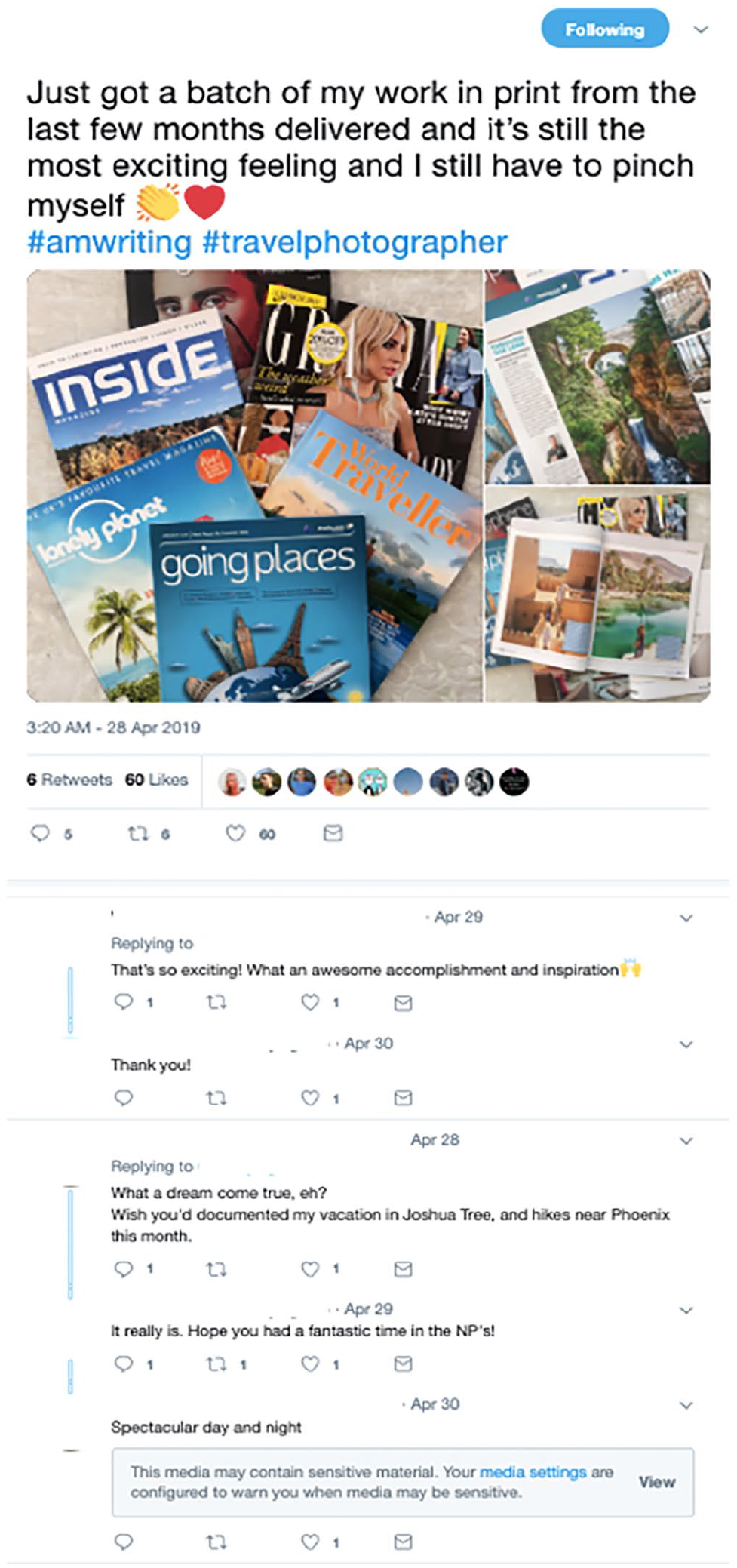
Screenshot of DFS’s ‘work in print’ Twitter post.
In direct response to DFS sharing this content, we see the mobilisation of affective bonds through commenting and ‘liking’, particularly from the subsection of DFS’s audience of ‘ordinary followers’ who aren’t other bloggers. Beyond this, many comments from ‘ordinary followers’ are discussing how travel blogging as a form of work is ‘inspirational’ or a ‘dream come true’. Sharing visual and textual examples of his personal experiences of different places is a key affective source for DFS, which he utilises as a resource to produce the affect of inspiration among his ordinary followers. This affect of inspiration is not solely for visiting and experiencing different places, but for visiting and experiencing these destinations as work – inspiring ‘ordinary followers’ to potentially seek to become a travel blogger and emulate these working practices. In a similar vein to how, for mommy bloggers affective labour has moved from the social mobilisation of community to a commodified form of work to sell specific products, for travel bloggers affective labour becomes a commodified form of work focused on selling a specific lifestyle (Cummings, 2019).
Travel bloggers also need to be aware of the nuances of ‘audiencing’ online, that is, the recognition of the heterogeneity of the audience group of ‘ordinary followers’ which they engage with. In building on Cunningham and Craig (2021), it is therefore evident that the affective work of content creators such as bloggers must extend to work to adapt their affective labour in response to audience reactions to individual content. This is what we see in this example of SD TTC: I get annoyed when I see the umpteenth pretty girl in a floaty dress and a straw hat looking at the Taj Mahal or whatever it is. I find it actually doesn’t inspire me. It has the opposite effect. It puts me off for a number of reasons. Firstly, because I wonder how authentic it is? Secondly, because there is aspiration, but it has to be attainable because, you know, I think it’s all very well saying ‘this is going to inspire you’ but if you think ‘Well what’s the point?’ I’m not going to be that person, I’m not going to be able to have that experience in the same way. It’s got to be tangible and attainable. (SD TTC)
Within this extract, blogger SD TTC highlights how creating affective relations of inspiration between the blogger and their ordinary followers is only facilitated when this ‘inspirational’ content is positioned as being attainable for others. In instances where this inspiration is deemed not be attainable, then the transmission of affect between the blogger and their ordinary followers will not occur. This failure to create affective bonds risks ordinary followers becoming alienated from a particular blogger and their content. Travel bloggers therefore must consider the relationship between creating and communicating ‘inspirational’ content and how this content (and by extension themselves) are received by those ‘ordinary followers’ audiencing their content.
SD TTC actively remarks on how an increasing amount of content available online is resulting in inspirational content being less effective in creating affective relationships between travel bloggers and their ordinary followers. Therefore, travel bloggers’ affective work must extend to the presentation of inspirational content in a way which is reactive to the broader social and cultural context within which the audiencing of their blog is taking place online (Rose, 2001). This affective work to produce and distribute inspirational content in a way which is still deemed attainable, could be considered as a form of ‘calibrated amateurism’. Calibrated amateurism is a deliberate mechanism of performance used to highlight a content creator’s own ordinariness and humility (Abidin, 2017). As a direct result of the distinctive audiencing of their content by ordinary followers, travel bloggers’ affective work extends to the negotiation of this relationship between inspiration and relatability. Travel bloggers no longer only must invest affective labour into creating affects of inspiration through their content. They also need to invest significant affective work into producing content which mobilises the affects of inspiration in a way which ‘ordinary followers’ audiencing the blog feel is attainable.
Ordinariness
Building on discussions of how audiencing directly influences travel bloggers’ affective labour negotiations between performances of inspiration and relatability, travel bloggers’ affective work also extends to wider presentation of ‘ordinariness’ within their blog and social media. In building on the work of Abidin (2017, 2021), we see that travel bloggers (like other bloggers and influencers) use narratives of their personal lives to facilitate a para-social intimacy between themselves and their audience of ‘ordinary followers’. For travel bloggers though, the creation and sharing of their own visual and textual narratives of place become the main stimulus through which travel bloggers can tailor their affective work to promote ideas of ordinariness among their ordinary followers: As soon as Instagram Stories came out that completely changed and suddenly you were having back and forth conversations with people that you’d known had been liking your photos for years but you never really spoke to them . . . I found a lot of my audience are very . . . they like the imperfect style. They like it when I drop something or pour coffee down myself or I missed the bus again because I always oversleep, like people like that because they can relate to it. (DFS)
Instagram Stories is one such online spatiality which functions as an important medium through which bloggers can perform their ‘ordinariness’. As highlighted by DFS, travel bloggers undertake this affective work through the sharing of their more mundane experiences of place with their ordinary followers. Instagram Stories offers a distinctive space to undertake this affective work, away from the more polished and curated engagements with place demonstrated on their Instagram grid or blog. As also articulated by Warren (2011) in her description of the ‘making’ of site art, Instagram Stories becomes a site of making and assembly, with ‘ordinary followers’ actively able to audience the process of making and assembly of content. The ability to see this making and assembly phase of content creation helps the ordinary followers to build affective bonds with the travel blogger. Beyond this, the medium of Instagram Stories, also allows the blogger to further cement these affective bonds through direct engagements with their audience of ‘ordinary followers’ through ‘back and forth’ conversations. These ‘back and forth’ conversations allow the blogger to learn whether their performances of ordinariness are having the desired effect in creating affective bonds with their audience. For DFS, this affective connection afforded through Instagram Stories, allows him to learn that his audience really likes and relates to his imperfect style. This knowledge provides the motivation for his continued performances of ‘ordinariness’ as an affective resource (Wissinger, 2007).
As Craig and Cunningham (2021) argue, a content creator’s ability to maintain the interest and attention of their audience hinges on both the development and dissemination of their content, but also crucially how that content is communicated, and how communities are managed. Travel bloggers are no exception here. They must actively create their content online in constant consideration and engagement with their audiences on social media platforms, with (financial) success ultimately hinged on their ability to attract and maintain the affective investment from their online audience. One fundamental way in which travel bloggers tailor their content to the audiencing of their blog online is through their narrative voice. Again, a specific stimulus such as narratives around experiences of place, become a crucial stimulus through which the blogger can refine and tailor this narrative voice: L: We just want it to be like a friend is speaking to you because that is it, in a lot of ways, it sounds so cheesy but you’re literally talking to friends because the people that read your blog [that] choose to interact with you are the people that like you usually [laughs] . . . Y: That are like you, but I think the main thing that for us and it’s just like having a chat with our followers . . . if you were to ask a friend for help on planning your travel or if the conversation would naturally happen that way. (LAY)
For bloggers LAY, they actively seek to cultivate an authorial voice on their blog, which mirrors ‘a friend speaking to you’, using discussions of their experiences of place as a stimulus through which to develop this friendly tone. In this way, the mode of address of the blog becomes a means of ‘talking to friends’, emulating the affective labour as online ‘chat’ which Terranova (2000) describes. The use of this mode of address is important affective work in ensuring a blog is deemed trustworthy, in part, because it is akin to talking to a friend, with the blogger’s observations about a place mobilised in a narrative of seemingly real experiences being discussed by another ‘ordinary’ person. This affective work is part of the performance of identity and legitimacy for the blogger, enacted through the stimulus of discussions of experiences of place (Johnson and Woodcock, 2019). This affective labour performance in relation to authorial voice, is centred around the audiencing of the blog, and crucially, the presentation of the blogger as an ‘ordinary’ like-minded individual or friend. This positioning enacted through affective work helps to form a community of belonging between the blogger and their ‘ordinary follower’ audience.
Intimacy
Within labour encounters between the travel blogger and their gazing audience of ‘ordinary followers’, the travel blogger’s own geographies are also increasingly becoming part of the cultural product being circulated and used as an affective resource (Crang, 1997). An example of this is demonstrated in Figure 2: I was doing a little boomerang for Instagram. . . . That photo I was with my husband and two friends and I do feel sometimes that they get a bit annoyed with me because I am always getting my camera out, I’m always getting my phone out and I’m always sort of taking pictures and doing this, that. (STB)
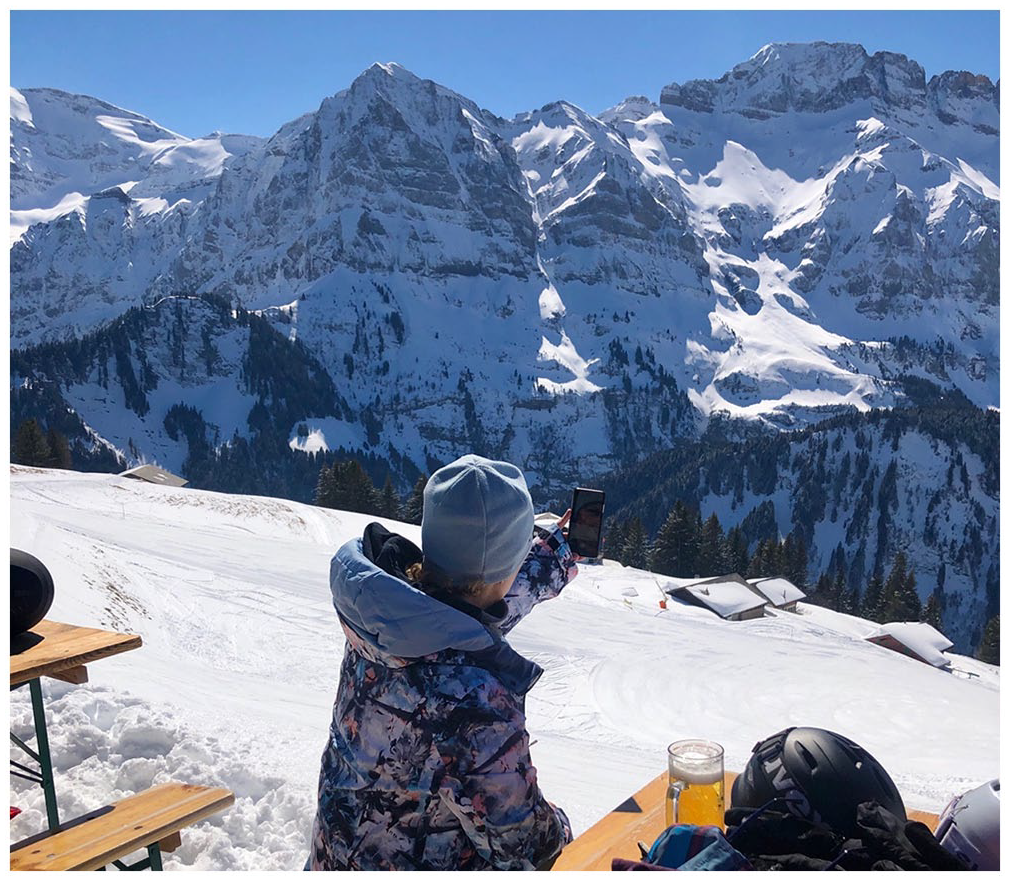
Instagram stories in the Alps.
In this example, blogger STB is instantaneously sharing her experience of a family skiing holiday with her audience of followers, at the same time as she is experiencing the holiday herself. Within this example, we see how travel bloggers are typical of a wider demographic of content creators who feel compelled to be constantly managing their presentations of self online because of the constant pressure they face from their online audiences to be present and engaging (Duffy, 2017). For travel bloggers, this pressure for continual self-presentation extends to places traditionally reserved for personal relaxation and a break from work (such as family holidays). Affective labour here is the work invested by the travel blogger to constantly share these intimate holiday spaces. Sharing these spaces and experiences of a family holiday is a mechanism to remain visible to their ordinary followers, and to ensure the affective bonds between them and their audiences are constantly refreshed and maintained. Following Duffy (2017), these affective relationships with online audiences remain a crucial element of success for travel bloggers. In practice, the affective work of travel bloggers therefore often becomes mediated by the relationship of audiencing between the blogger and their ‘ordinary followers’, and these ordinary followers perceived ‘expectation of intimacy’ (Marwick and boyd, 2011: 156). This is the notion that online audiences expect travel bloggers to be constantly available, and through this availability provide access to their lives as they exist within and beyond travel blogging labour. Sharing the intimacies of their lives functions as a value-adding means, which travel bloggers draw upon to maintain ‘ordinary follower’ attention. It is this value placed on intimacy within the affective labour encounter that subsequently feeds the blogger’s perceived need to share increasingly intimate moments of their working lives and beyond, with their online audiences.
As highlighted in the example of STB, relationships of audiencing therefore directly mediate the intimate affective labour encounter in ways which could be considered as exploitative for the individual labourer. In response to this, travel bloggers also actively use the affordances of digital technology to resist these all-encompassing affective labour demands totally cannibalising their private lives: It’s quite interesting because I don’t share everything but, what people see, they are assuming that is everything. So, in some people’s eyes they are possibly perceiving that I am sharing absolutely everything. Whereas it’s kind of like you don’t know what you don’t know . . . There are lots of little things that, you know, don’t get shared, when I go out or just chilling out or cooking or you know those sorts of things I don’t share. So, I think from a perspective point of view people do perceive that you are sharing everything whereas in reality I don’t think many people share everything. (BTT)
Although travel bloggers may appear to be offering up the true intimacies of their lives as an affective resource to their audience of ‘ordinary followers’, this is often not always the case. BTT discusses how she deliberately curates what she shares, and therefore what is seen by her ‘ordinary followers’. Although ‘ordinary followers’ may believe they are audiencing the unrestricted elements of a travel bloggers life, travel bloggers undertake affective work to negate some of the intimate realities of sharing their lives online. In a similar way to the spatio-temporal boundaries of the video game stream which Johnson and Woodcock (2019) describe, travel bloggers may cultivate distinctive times and spaces when they actively put on ‘the performance’ of being a blogger. Although the audience of ‘ordinary followers’ may believe they are given full access to the private and uncensored lives of the blogger, these moments may instead be deliberately engineered to facilitate feelings of association and intimacy between the blogger and their audience. Travel bloggers utilise the spatio-temporal boundaries provided by the screen, for example, to be able to mediate and contain their affective work, enabling them to break from the audience expectations of constant affective labour.
‘Other bloggers’: examining how travel bloggers invest affective work into fostering cultures of community and reciprocity with other bloggers
Within this second analytical section, the article will examine the intersection of audiencing and affective labour, as it pertains to a travel bloggers audience of ‘other bloggers’. ‘Other bloggers’ are understood as individuals who engage with the travel blogger and their content, and who are also themselves a travel blogger.
Community
As Jarrett (2014) argues, affective labour can function simultaneously as a capitalist commodity, and as an example of non-alienated affective agency. This tension really comes to the fore in the audiencing of the travel blog by other bloggers. Although contributing to the commodification of affective work in a similar way to ordinary followers (through actions such as the liking of content), the audiencing of the travel blog by ‘other bloggers’ also encourages travel bloggers to undertake affective work focused around the creation of bonds of community online: Y: So, for us I think, the blogging community when you do those trips with bloggers it’s always nice to have, because again most people would work in an office, or you study in a social kind of context with other classmates. Then when you finish and start working in an office with other people you have a team around you, but when you are a blogger . . . I mean we are lucky because there are two of us, but some people are just on their own. So, in a lot of ways having that community around us really does help and it's also a good resource so to speak. When you don’t know what to do, it’s nice to ask people ‘Right guys, I don’t know how to handle this thing, what should I do? How do I kind of have this conversation?’ and that stuff really helps. Then you speak to other people that have done it and a lot of people have that experience. They’re just like ‘Just do it this way or do it this way’ and you were like ‘Oh ok’. (LAY)
Investing affective labour into creating this sense of community with ‘other bloggers’ can be particularly useful affective work in mitigating some of the isolating realities which travel bloggers may face. As LAY describes, travel blogging can be understood as a relatively solitary form of working, and travel bloggers can be prone to feelings of isolation from a lacking social work environment. Affective labour is therefore invested into creating a sense of community and friendship online, through means such as simply chatting to others (Terranova, 2000). This affective work can function to fill a gap in emotional support and lacking social contact. As the individual blogger invests labour into developing affects of care and connection to build this community with ‘other bloggers’, the intangible affects of care and connection are transmitted back to the worker themselves, through means such as community advice and support.
This tension between affect as a commodity and affect as a function of community is also evident in how travel bloggers utilise their audiences of ‘other bloggers’ to understand and manage ideas of value and worth of their own online labour. As evidenced in LAY’s discussion, many travel bloggers typically struggle with negotiating their own labour encounters, particularly in relation to how much they should be charging for the creative work they undertake. This struggle to understand their own value may be linked to the fact that what is valued in a travel bloggers’ work is often the successful development of affective social ties, and the visible enactment and responsiveness to these social ties online (Duffy, 2017). These affective social ties often become exploited through social media platforms, alienating the blogger from their own labour (Jarrett, 2016). Here, affective labour investment in creating communities of ‘other bloggers’ is a useful resource in pushing back against this potential exploitation of travel bloggers as affective labourers. The audiencing of the blog by ‘other bloggers’ is a resource which individual bloggers can utilise to gain valuable insights for ways of working within the industry, and ultimately push back against this exploitation. Investing affective labour into building up good relationships of community with other bloggers is therefore crucial in facilitating the sharing of such tactic knowledge which can be extremely important in travel bloggers achieving professional success.
The dual importance of affective work as community building and as mitigation against exploitation means travel bloggers also invest affective work into developing affects of empathy and solidarity with ‘other bloggers’. Travel bloggers commonly attempt this through the sharing of some of the negative, lived realities of travel blogging or wider freelance labour.
In Figure 3, blogger and writer JH retweets a ‘bingo card’ depicting some of the negative truths associated with freelance working, which has been shared by a fellow blogger. This manifestation of affective bonds through retweeting is an affective performance, with the flow of affect being mobilised to demonstrate solidarity and the shared feelings of frustration around the working practices of freelancing. Retweeting functions in a similar vein to the practice of ‘liking’ on Facebook, as an affective manifestation of social interactions online (Jarrett, 2015). This humorous (re)presentation of the realities of travel blogging work demonstrates a non-discursive strategy of affective labour, which is undertaken specifically in response to the audiencing of content by ‘other bloggers’ who can relate to and emphasise with these shared experiences.
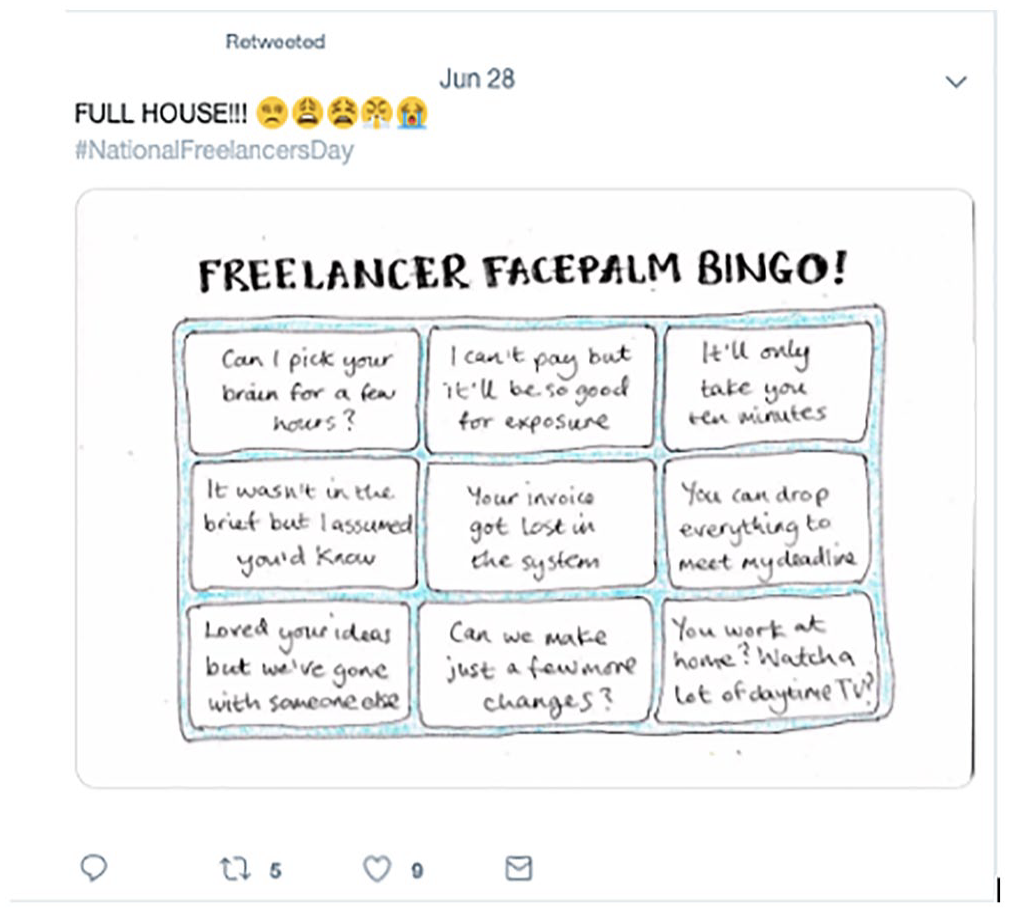
Screenshot of JH’s ‘Freelancer facepalm bingo’ Twitter retweet.
For travel bloggers, certain offline spatialities also exist which actively mobilise the flow of affect in direct response to the specific audiencing of ‘other bloggers’. Examples of these distinctive offline spatialities are travel trade shows or conferences. Figure 4 is an image of blogger SD TTC sharing a post on Twitter about her recent attendance at the World Travel Market (WTM) event. WTM is a UK travel exhibition and conference which seeks to bring together travel industry professionals, including bloggers and brands (World Travel Market, 2021).
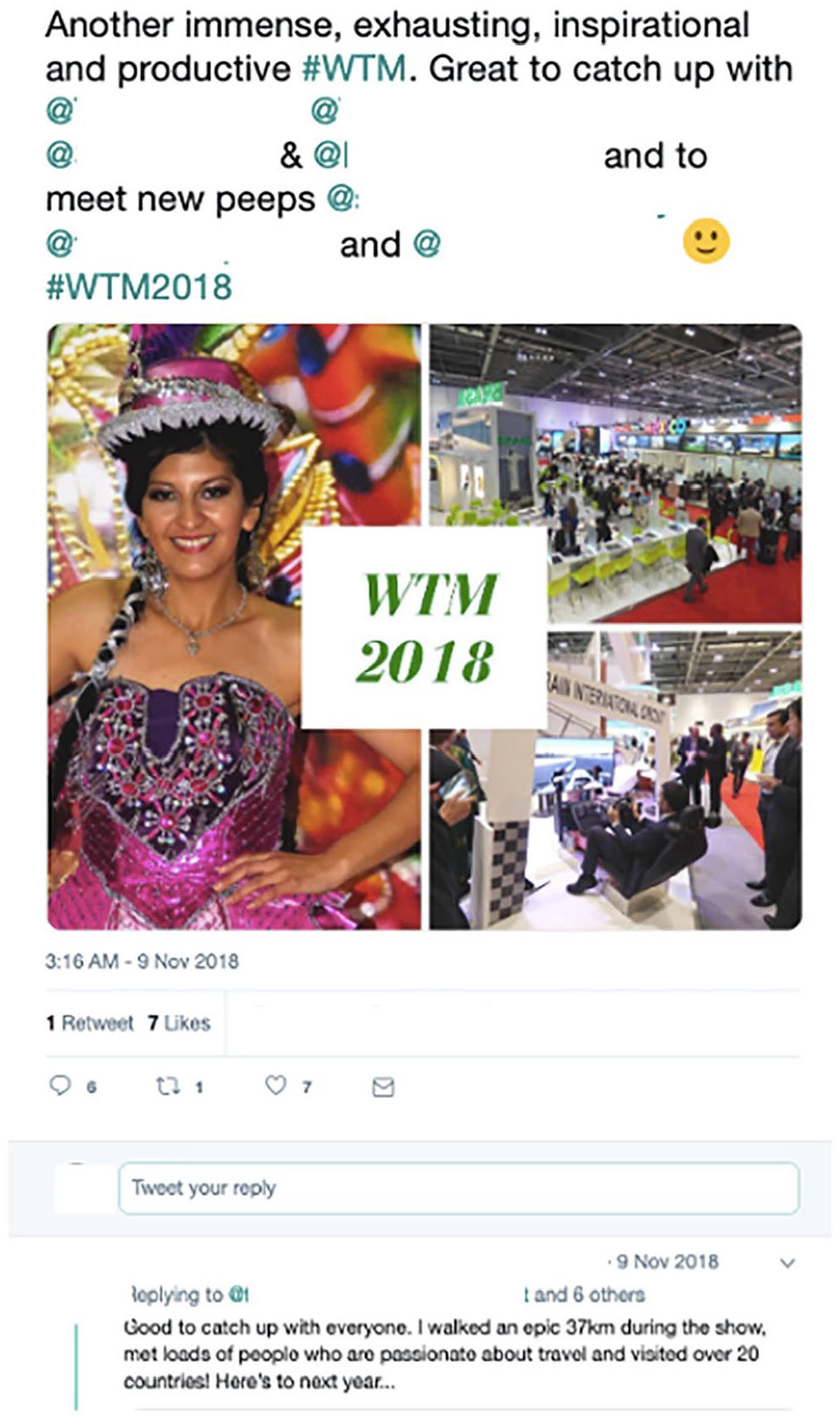
Screenshot of SD TTC’s ‘World Travel Market’ Twitter post.
Travel trade shows or conferences are primarily attended by either brands or bloggers, meaning these physical spatialities are particularly important for reaffirming and cementing affective bonds which travel bloggers have created online with ‘other bloggers’. This affective community building often flows back to the online spaces of social media, as travel bloggers regularly tag others bloggers, they have met at these events in social media posts, using the relevant hashtag(s) for the conferences. In SD TTC using the dedicated hashtag for the WTM event, her post becomes visible and discoverable to others within the travel blogging community using the same hashtag or who may be searching for WTM content. Building on the work of Highfield et al. (2013), for travel bloggers hashtags become an affective performance of belonging to a distributed community of ‘other bloggers’. Beyond this, SD TTC also @’s (or tags) other travel bloggers in her post. In tagging other bloggers, SD TTC is bringing the bloggers she has met offline into the affective community of bloggers she has built online. This practice reminds those audiencing her blog to be aware of the vastness of the affective community of ‘other bloggers’ she has developed both offline and online.
Reciprocity
Although not entirely recognised as a form of labour developed as a direct answer to the needs of capital, blogging remains a part of the process of economic experimentation (Jarrett, 2016). Through their relationships of audiencing with ‘other bloggers’, we see how travel bloggers’ affective community bonds become embroiled with ideas of commodification. This affective tension exists as it is important that travel bloggers’ affective work is returned by their fellow bloggers for economic, as well as emotional reciprocity: I do think in a way, it is a community like I talked about. So, there is a lot of collaboration going on. So, it’s in everyone’s interest to work together and the reason being search engine optimisation. I’m going back to the technical side of things, backlinks are important. To have authoritative websites linking back to your website is actually beneficial to both of you, that’s why collaborative posts are so prevalent. What I’m talking about is 30 best places to go in 2019 as described by 30 travel bloggers . . . You’ll see a post with travel bloggers listing where they think you should go and that is a very conscious effort from bloggers to include as much content as possible because that means you don’t do as much work, because you get someone else to write content for you, but you’ll get something out of it in return. So, there is a lot of collaboration going on. (LEX)
Affective labour payoffs between bloggers become visibly materialised online through ‘collaborations’ or collaborative posts, which blogger LEX describes. These collaborations make visible the bonds of community or friendship which exist between the collaborating bloggers. Yet, the materialisation of affective bonds through these ‘collaborations’ also has an economically productive impact, in raising the authority of each travel blog through backlinks (i.e. the sharing of links between one website or blog to another). In collaborating with other bloggers in this way, each travel blog is likely to be audienced by their collaborating bloggers’ ordinary followers. This ‘backlinking’ process improves blog readership and helps both blogs to increase their rankings within search engine optimisation (SEO). This increase in the audiencing of each blog is likely to have positive financial impacts as high levels of readership are often used as a metric for accessing financial renumeration for blog content (Hearn, 2010). Affective relationships therefore become enacted through practices of reciprocity and mobilised through collaborative posts. If developed correctly, these collaborations can be extremely meaningful economic (as well as social) resources within the blogging community.
This importance of reciprocity as an affective resource has led to travel bloggers creating dedicated online spaces through which to facilitate this reciprocity and attempt to best utilise it as an economic resource: Okay so HAH seem to do this thing every Friday where they use a hashtag (called Follow Friday) as an excuse to tag other bloggers to follow. They tag quite a few other bloggers in one of these posts, usually between 7 and 10 other bloggers, and then they usually get tagged in some tweets back in the Follow Friday hashtags. Or at least the other bloggers tagged ‘like’ HAH’s post . . . To me it seems like quite a clever way to help make sure your blog gets picked up by whole other audiences you might not have known about. (Netnography fieldnotes, 5 April 2019)
As is evident in Figure 5, and as subsequently discussed within the netnography fieldnotes, Twitter ‘pods’ or comment threads are examples of centres of affectivity which centralise practices of reciprocity. On these Twitter comment ‘pods’, travel bloggers post their own content, under the presumed assumption that they will subsequently form part of the audience for another bloggers content. Crucially, it is also presumed that beyond simply audiencing another bloggers content, each blogger will actively mobilise their affective bonds through means such as commenting. This affective labour practice is demonstrated in the example of HAH and their commitment to sharing other blogger’s profiles and content under the ‘Follow Friday’ hashtag. Promoting other travel blogger’s content typically elicits a positive reactive response from those who have been tweeted. This is evident in the reciprocal tagging, retweeting or liking of HAH’s Twitter posts and associated content. As highlighted in her work with Instagram engagement pods, O’Meara (2019) notes how the labour to be involved in these pods is a grassroots form of affective work, which is incredibly important in circumventing Instagram’s algorithmic ordering of content. This grassroots practice draws on the affective labour of bloggers as the crucial resource to circumvent the algorithmic ordering of platform content. Through their affective work, travel bloggers mobilise and visualise connections with their audiences of ‘other bloggers’ through these Twitter ‘pods’. In doing so, they demonstrate their embeddedness and belonging in the travel blogging community, while simultaneously increasing the commodification of their own content through the increased levels of audiencing that these Twitter ‘pods’ facilitate.
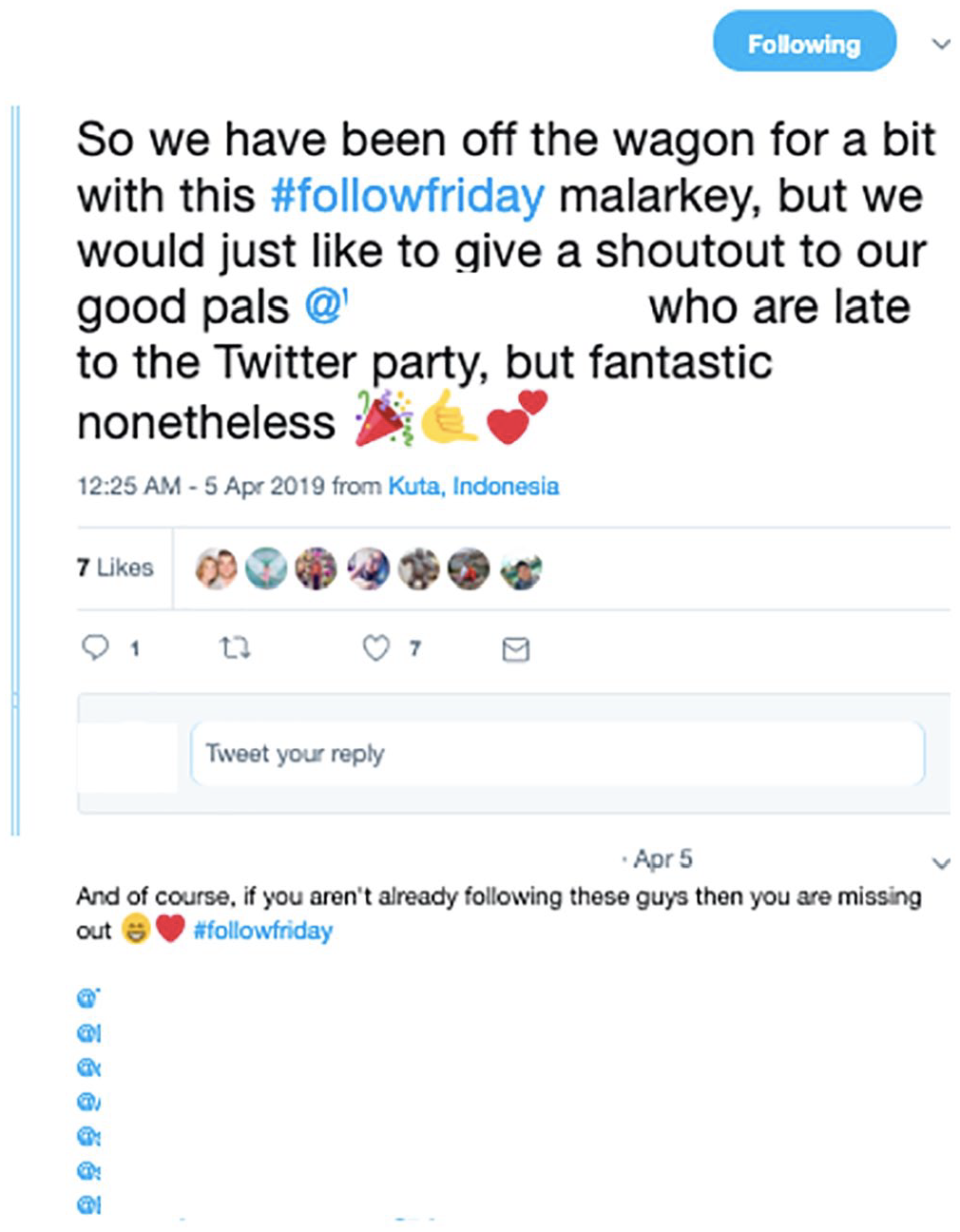
Screenshot of HAH’s ‘Follow Friday’ Twitter post.
Conclusion – demonstrating how audiencing influences the affective labour of travel bloggers online
This article has made a clear and original contribution to the field of creative labour, by using the theoretical framework of ‘audiencing’ to understand how travel bloggers’ specifically experience (and tailor) their affective labour. It does this through its analysis of travel bloggers labour in relation to the audiencing of the blog by ‘ordinary followers’ and ‘other bloggers’. The article makes two key theoretical interventions. First, it uses the theoretical framework of audiencing as a lens through which to better understand the affective labour of online content creators. It achieves this through exploration of how travel bloggers mediate and tailor their affective work to different subsections of their online audience, and in doing so, demonstrates the large variety of affective work which these bloggers undertake. The article highlights how the lens of audiencing allows us to see examples of the diversity in affective labour practices which are both culturally and economically productive. The article demonstrates examples of how audiences actively influence instances where affective labour is simultaneously a productive human activity (in creating bonds of community for negating feelings of isolation), but also as a productive consumer activity (in utilising these community bonds as an affective resource in practices of reciprocity). Travel bloggers are not unique in responding to ‘audiencing’ by undertaking labour to create affective bonds which function as both an economic and cultural resource. This means that the overall conclusions drawn from this article could be useful for better understanding the affective labour considerations which drive wider content creation work.
Using audiencing as a theoretical framework to better understand affective labour also enabled the article to demonstrate how travel bloggers may use affective work to push back against the varying demands of these different relationships of ‘audiencing’. This was evident in travel bloggers using the screen to provide protective distance between themselves and their ordinary followers, or as a mechanism to resist against potential alienation from their labour. The lens of audiencing also allowed the article to explore the varied online and offline spatialities where this diversity of affective work takes place, from Instagram Stories to travel conferences. This finding demonstrates how a continued awareness of different online audiences affects the affective labour decisions of travel bloggers across both their online and offline spaces of work. This conclusion of the article again contributes to a wider scholarship which explores the role of audiencing on the affective work of creative labourers.
The second theoretical contribution demonstrates how applying the lens of audiencing to travel bloggers’ work allows the article to highlight the importance of a stimulus (namely narrative and visual experiences of place) as the mechanism through which travel bloggers tailor their affective work in direct correlation to distinctive relationships of audiencing online. Applying the theoretical framework of audiencing to current understandings of affective work in this way enables the article to further uncover the nuances of affective work which occur in deliberate consideration of the subjectivities of different online audiences. For example, this was notable for ‘ordinary followers’ who build affective relationships of intimacy, ordinariness and inspiration with the blogger, namely through the bloggers’ sharing of their own personal narrative and visual experiences of place. Here, the theoretical intervention of the article demonstrates how a stimulus (such as place) is a central component in tailoring this affective work, helping the creative labourer to manipulate different affects resulting from a direct awareness of the lived subjectivities of those undertaking the audiencing (for ordinary followers who want attainable inspiration, to other bloggers who identify with the negative realities of freelance working). This key contribution of the article again has broader implications, as other creative labourers (such as fashion bloggers) will also likely use specific stimuli (such as discussion of particular outfits or fashion events) as the means through which they can tailor their affective work to different relationships of audiencing. Utilising audiencing as a lens to better understand the affective labour of content creators therefore has importance for future scholarship, which may want to further consider the influence of different audiences on the emerging forms of content creation work which are developing online.
Footnotes
Declaration of conflicting interests
The author(s) declared no potential conflicts of interest with respect to the research, authorship, and/or publication of this article.
Funding
The author(s) disclosed receipt of the following financial support for the research, authorship, and/or publication of this article: This work was supported by the Economic and Social Research Council (ESRC).
Author’s note
The author of this paper, N.W., has agreed to this submission and can confirm that the article is not currently being considered for publication by any other print or electronic journal.
