



Abstract
This article explores how web archiving impacts the online communication practices of individuals whose personal websites have been archived by major public libraries. Drawing on interviews with website creators and analysis of their written reflections on the archiving process, it demonstrates how web archiving alters the meanings people attach to their online activity. In most cases, the preservation of their website in a national web archive sees individuals perceive their communication practices as having wider cultural and historical significance. These meanings are shaped by the distinctive interaction between archiving and archived actors and propelled by imaginaries surrounding the culture and history of the collecting institution. Based on these findings, this article argues that web archiving can be productively understood as an intervention in the dynamics of online sociality and calls for reflexive archival and research practices that attend to the short- and long-term impacts of altering the visibility of online material.
Introduction
How do ordinary Internet users see their experiences of being archived? Consider the case of Michael. He has been keeping a blog since 2004, documenting his day-to-day life from his apartment in Melbourne, Australia. In 2007, he received an email from one of Australia’s state libraries, requesting to periodically archive his blog. Michael reflected on this request in a blog post:
While I guess it is somewhat of an honour, I immediately worry about what I have said about people and how identifiable . . . some people [are], especially family and friends. . . But the major thought is, will it make what I write a little more [circumspect]? What [do] you reckon? Should I accept?
For Michael, the potential inclusion of his blog in Australia’s web archives was cause for reflection and dialogue with readers of his blog. Responses from some readers and fellow bloggers expressed similar misgivings. One reflected:
What makes me more comfortable about blogging in a public domain is that I can always delete something later on or one day I might just go bye bye to the entire blog . . . But once it is archived what right do you have to access it or alter it if you choose to?
Others were more encouraging – ‘I think you should consider being archived. . . that way you sort of live on forever. Don’t worry about being self-conscious because you’ll forget about it and still say exactly what you think’. Moments like this reveal how people interpret and seek to manage changes to the visibility of digitally mediated content relating to their lives. While this topic has been widely examined in this journal (e.g. Duffy and Chan, 2019; Jaynes, 2020; Marwick and boyd, 2011, 2014; Uski and Lampinen, 2016), it has been less explored in relation to web archiving, which sees the visibility of online material extended indefinitely.
In this article, I explore the impact of web archiving on how people relate to their online communication practices. Drawing on interviews with, and posts by, people whose blogs and personal websites have been archived by Australia’s network of national and state libraries, I show how the preservation of their website sees them understand their communication practices as having wider cultural and historical significance. For the website creators I study, being included in Australia’s web archives saw them take to their websites or social media to reflect on being archived, describing being ‘blown away’, ‘proud’, ‘flattered’ and ‘honoured’. For most, these reflections are animated by an understanding of the archiving institution as a prestigious, exclusive site where the records of eminent individuals were housed. While the libraries were trying hard to counter these ideas through the very act of archiving online material, it nonetheless lends the process a sense of legitimacy for website creators, allowing them to put aside any ethical quandaries they have regarding the (indefinite) temporal extension of their online communication and relinquishing some control over its long-term circulation.
Based on these findings, this article demonstrates that web archiving can reshape the meanings people attach to their online communication and, in some cases, reshapes how and where they interact online. I argue that web archiving can be productively approached as an intervention in the dynamics of online sociality – that is, the archiving process can alter both the meanings people attach to their online traces and their imagined audience. Framing web archiving as an intervention allows makers and users of these burgeoning sources to understand that how, where and when the production of web archives takes place has consequences on both the contents and form of the very same materials held in these collections. As such, web archives should be seen not (just) for some current or future researcher, but the varied and multiple actors embroiled in the archiving process – not least their ‘subjects’. By reflecting on who web archiving impacts and who web archives are for, archivists and researchers can better address the ethics of producing and using archived web materials, with a specific focus on the far-reaching and differential effects of extending the life of online content.
Situating this study: the varied users and uses of web archives
Web archiving can be described very succinctly as ‘any form of deliberate and purposive collection and preservation of web material’ (Brügger, 2018: 79). The primary goal of this process is ‘to preserve a record of the Web in perpetuity, as closely as possible to its original form, for various academic, professional and private purposes’ (International Organization for Standardization, 2013). A key reason for web archiving (particularly large-scale endeavours) is to preserve the cultural heritage (Brügger, 2018). Along with dominant institutional actor the Internet Archive, web archiving sees national libraries around the world apply and adapt their legacies and techniques of developing comprehensive collections of published material to publicly available online material (Brügger, 2016; Hegarty, 2022). Particularly, legal deposit provisions – which have long compelled publishers to deposit any publication to the relevant national, state or regional library – have been steadily amended to allow libraries to collect any publicly available material on the web that falls within their collecting remit (Koerbin, 2021). A key ambition of web archiving by cultural heritage institutions is to preserve for future use a record of often ephemeral, publicly available content.
Research on web archives started to develop not long after the first efforts to archive the web in the mid-1990s but crystallised around a decade later with a series of publications that began to survey and critically assess techniques and strategies used to collect online material, along with the establishment of key professional networks (Webster, 2017). These endeavours were spurred on by the 2003 adoption of the UNESCO Charter on the Preservation of Digital Heritage, which provided additional impetus for libraries to push for extensions to legal deposit to include digital material (including online material). Since this time, the field has come a long way, led by the work of Niels Brügger, Ian Milligan, Valérie Schafer and Anat Ben-David, who have done much to advance the study of the archived web, including establishing a new journal, Internet Histories (Brügger et al., 2017), and important international networks of archivists and researchers to advance the development and use of web archives (Brügger, 2020; Ruest et al., 2020).
Yet, despite growing attention paid to the development and study of web archives, there has been relatively little attention to a group that is clearly integral to the formation of web archives – the ‘subjects’ of web archives. Winters (2017: 173) notes that
[T]he ease with which it is possible to write and post information online, the speed with which one can react to news and contribute to ensuing debates, has dramatically altered – in scale and type – the group of people whom we might now describe as creators, publishers or authors.
However, it is only very recently that attention has begun to be paid to how this group of people feel about having their content collected, preserved and redistributed years (or sometimes decades) after it was produced (Mackinnon, 2022).
Meanwhile, foundational work in internet studies has shown the importance of better understanding the perspectives of ‘everyday’ internet users and how people navigate changing norms and expectations of identity, visibility and privacy online (Baym and boyd, 2012; Marwick and boyd, 2011, 2014; Papacharissi, 2011). A key contribution of this work is to illustrate how, even when content is shared publicly (and therefore potentially available to a very wide audience), the user will have an ‘imagined audience’ in mind that will shape how, what and when they communicate online (Marwick and boyd, 2011). Meanwhile, given heightened expectations of visibility, the dissemination of content will be done in line with contextual norms around appropriate sharing and to maintain a sense of control over different aspects of one’s identity (Marwick and boyd, 2014). Given that web archives see people’s digital traces collected and disseminated in the very long term, and that these traces can be viewed by their authors as at once ‘fairly private’ yet ‘completely public’ (as one of my participants told me), understanding how different actors respond to their inclusion in these archives is a critical task.
Given quantitative and qualitative changes to the group of people who may find their content preserved by collecting institutions for future use, some have argued for a contextual, case-by-case approach to the use of archived web content (Lomborg, 2019; Milligan, 2019), with a shift in internet research from looking at the use of online information through the prism of law (particularly copyright) to ethics (particularly privacy) (Dougherty, 2013). This has meant recognising that the protocols surrounding the use of archived content depend on ‘the types of actors involved, the activities they perform, the methods used for data collection and analysis [and] the kinds of data sought’ (Lomborg, 2019: 110). It is therefore increasingly recognised that the meanings attached to online material are highly varied, and the conflation between ‘made available to the public’ and ‘published’ may need to be rethought in the context of online communication.
In this article, I extend existing scholarship on web archives, web history and internet research ethics by exploring the impact of web archiving on how people relate to their communication practices. I position my exploration of how web archiving impacts the archived over time as a way to understand the different meanings generated for different audiences when reconstructions of online material are created and distributed in the long term. This investigation is guided by the following questions: How do ‘subjects’ of web archives understand and respond to the capture, management, and dissemination of records relating to their lives? And how do these responses change over time?
Conceptual approach: web archival imaginaries
Recent work has recognised that digital archival practices are at once a (socio)technical and imaginative effort. Through these practices, certain ideas become mobilised and embedded in institutions and processes that orient (often mundane) practices towards a desired future (Ogden, 2020, 2021; Thylstrup, 2019; Woodall and Ringel, 2020). Ogden (2020: 187) notes that imaginaries of web archives are ‘intricately connected to the ways that archivists imagine the future of the Web and their role in it’. I expand on this work by drawing attention to the relational nature of these ‘web archival imaginaries’ – ways of thinking about what web archives are, could or should be, and the forms of knowledge they hope to enable – and how web archives involve a myriad of actors that go well beyond those that create them. Attending to these various meanings and uses sees me analyse web archives not as a conceptually stable entity with defined use cases but as a ‘relational property’ whose meanings are produced in specific contexts of use (Star and Ruhleder, 1996: 113).
In attending to the imaginaries of web archives, I examine not what these archives are, but the kinds of work they do in the world, and how they affect different actors in different ways. I take this relational approach to investigate how the ‘subjects’ of web archives respond to the archiving of their online material, examining the meanings that are produced in the encounter between archiving and archived actors. In many cases, the resultant imaginaries that emerge from this interaction help resolve the contradictions and tensions that emerge as different actors come together in the web archiving process. By interrogating the multiple and overlapping cultural worlds of actors circulating around web archives, my hope is for a mode of inquiry and a form of archival practice that critically attends to the differential short- and long-term effects of extending the life of ephemeral information.
After detailing the methods used to explore my research questions, three sections detail the different meanings that are activated as multiple people and things are brought together in the web archiving process. The first details what happens when there is a congruence in expectations between the archiving institution and the actor whose digital traces are being captured. The second section details how imaginaries are connected, even as they differ. That is, while the archiving institution and the subject of the record may have different expectations and understandings of web archiving, this does not necessarily result in conflict. Finally, I add a temporal dimension to my analysis, exploring how people’s perspectives on archiving change over time. This third section illustrates how web archival imaginaries can help resolve the tensions that exist as one of my participant’s relationship with their ageing digital traces changes over time. These findings show how the meanings of web archives are not innate nor singular but are defined by changing connections between people, artefacts and institutions, laying the ground for future work that responds to these connections and meanings across a range of settings.
Methodology
To explore how ‘subjects’ of web archives understand and respond to the capture and dissemination of their online traces, I draw on Mackinnon’s (2022: 8) notion of the ‘archival promenade’. This is a participatory approach to web archive research, where website creators are engaged in a process of storytelling and reflection on their place in the archive. Mackinnon builds on qualitative methods in internet studies research that co-investigate with participants the role of online platforms in producing an archive of the changing self (Lincoln and Robards, 2017). Along with her participants, she uses these ‘scroll-back’ methods (Robards and Lincoln, 2017) to explore participants’ archived websites years (and in some cases, decades) after they were created. The archival promenade method can be understood as part of a move in web archive research of problematising the ethics of collecting content using automated software without consent from content creators (Lin et al., 2020; Lomborg, 2019).
The findings from this article are based on a study of the Australian Web Archive (AWA), one of the longest-running web archives in the world (Koerbin, 2021). While distinctive in its initial formulation (Hegarty, 2022), the AWA in its current form is typical of national web archives around the world and is therefore a useful way to assess broader ethical issues that surround web archives. Like many web archives, the AWA uses several methods to try to represent the ‘Australian web’:
Selective captures, where individually selected websites are collected and routinely archived;
Bulk crawls, where a large list of websites provides the basis for larger, iterative crawls that extend for between one to two weeks;
Event collections, where an event – say an election or natural disaster – forms the basis for building a thematic collection; and
Domain harvests, where the entire country code top-level domain (.au) is captured on an annual basis, with the crawl running for between one to two months.
In this way, the AWA combines the three web archiving strategies defined by Brügger (2011: 28–29) as the ‘snapshot’, ‘selective’ and ‘event’ strategies that web archives around the world have used to develop their collections. The technologies and standards that undergird collecting, storage and playback in Australia also underpin web archiving initiatives around the world (Webster, 2017). The choice of the AWA, therefore, offers valuable perspectives that future research can apply to a range of other contexts.
Because the AWA (like most web archives) is very large (there are around 90,000 websites collected through the selective and event strategies and several million others captured via bulk and domain strategies), I had to make choices about what content to analyse and who to select to interview. I focused on people who had already responded to the archiving of their blog or website with a reflection on their website, whether this was a disclaimer to readers and contributors that the site was now being archived or a long blog post written – with varying degrees of irony – to future generations of readers (see Figure 1). The reason I focused on this group was that they were already aware of, had engaged with and agreed to, the archiving process and their online reflections provided a discussion point with which to recruit them into the study and orient the discussions I had with them. I contacted 15 of these individuals and interviewed the five who responded. Participants have had their content archived since 2007, 2008, 2010, 2015 and 2019, respectively, meaning that they could reflect on having their content archived between 3 and 15 years after this occurred. This temporal span offered various perspectives on the changing meanings that people attach to their online traces over several years. In the interviews, I asked about people’s first memories of using the internet, their initial impetus for starting their blog (and, if relevant, for ceasing to blog), who they imagine their audience to be, how this shapes what they post, if there were any ‘off limits’ topics and how these perspectives changed as their content was archived in the AWA. Where the participant felt comfortable (and had the skills and equipment required to do so), we also completed a walkthrough of the AWA to locate their archived website, and participants were encouraged to reflect on the process (Mackinnon, 2022). Given the small number of interviews, I also analysed all instances I could locate of people’s responses to having their content archived, usually through a blog post or social media post. These were located by searching the AWA using various combinations of relevant keywords (e.g. [(‘PANDORA’ OR ‘Australian Web Archive’) AND (‘National Library’ OR ‘State Library’]) and manually filtering results until all relevant material was located. Using Zotero, I collated 124 of these instances, written between 1997 and 2021, and then used qualitative data analysis software (NVivo) to thematically analyse their contents along with transcripts from the direct interactions I had with website creators.
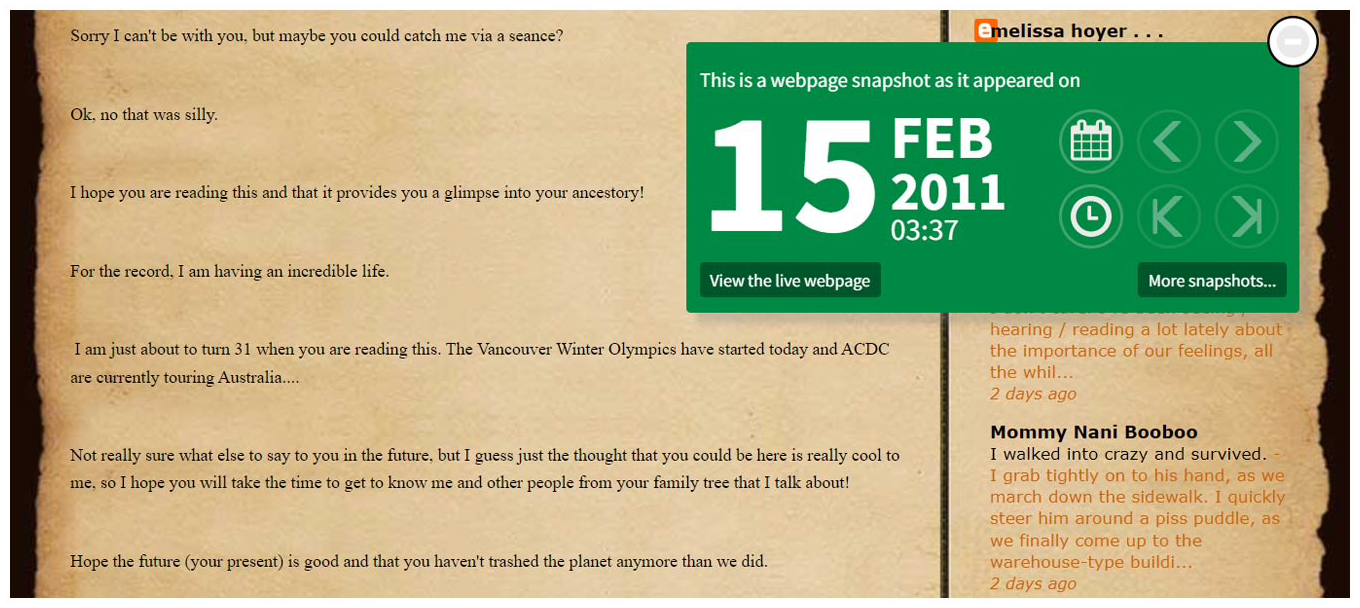
Screenshot of Chronicles of Sharnia on 15 February 2011 (http://chroniclesofsharnia-sharnanigans.blogspot.com). The author’s post, ‘I believe my readers are (in) the Future’ reflects on being archived by the National Library of Australia and includes a letter to her ‘great, great grandchildren’. Accessed via the Australian Web Archive (https://webarchive.nla.gov.au/).
It should be noted that all research participants that I interviewed engaged in a specific form of online expression – blogs. All participants used their blogs to present their thoughts and experiences from their everyday lives. As such, my findings are not generalisable to all modes of online expression. As Marshall and Shipman (2012: 9) found in their survey of people’s views on institutional archiving, different types of content evoke different responses to the idea of long-term preservation. Despite the limitations of my focus, paying attention to the meanings created in the encounter between archiving and archived actors may offer a framework for future research to explore how people respond to the inclusion of the variety of content types included in web archives and how these responses change over time.
Results
The key finding that emerged in exploring the perspective of website creators is that web archival imaginaries are produced through the interaction between institutional histories and processes and the online practices of ordinary internet users. In the case of Australia’s national and state libraries, ideas surrounding these libraries as storehouses for a selection of culturally significant historical artefacts allow many website creators to put aside any ethical dilemmas they have about their digital traces live on in an archive. In fact, many embraced the archiving process as a source of national belonging. Moreover, despite a desire from the library to not affect online expression through the archiving process (Crook, 2006), I found that changing the temporal orientation of one’s online material did result in changes to both the meanings and production of online content. My findings demonstrate how web archiving is animated and sustained by diverse imaginaries and these imaginaries can help resolve the contradictions and tensions that emerge as multiple cultural worlds come together in the web archiving process.
My findings echo a point made by Dourish and Bell (2011: 201) that, in thinking about sociotechnical systems, ‘messes challenge the myths and yet are shaped by them; mythologies bring order that messes resist’. In my investigation, mythologies surrounding the history and processes of web archiving institutions – their imaginaries – can help resolve the multiple meanings and contradictions that emerge in the messy process of bringing together various actors with distinct (but not necessarily conflicting) expectations surrounding the temporality of online material. While, in a few cases, there was conflict or disjuncture between expectations of what should happen to digital traces in both the long and short term, for the most part, the meanings produced in the encounter between archiving and archived actors helped to resolve conflicts or disjunctures between these actors. The dynamic relationship between how archiving and archived actors imagine and engage in web archiving is explored in three sections below, where I detail how the meanings of web archiving held by different actors converge, co-exist and – in some cases – produce feelings of discomfort or ambivalence.
Convergence
The first crucial point to make is that imaginaries differ according to the specific processes that underpin web archiving, as well as ideas that surround the history, politics and culture of the archiving institution. This is demonstrated by creators’ perception of Australia’s national and state libraries as places where cultural artefacts of national significance are housed. They were seen as elite institutions whose key role was to preserve the records of eminent national figures. Given these understandings, many creators responded to being included in such a collection with pride, surprise and bemusement. An example of this is a blog post shared after being contacted by one of the national or state libraries:
Never would have thought that this blog would be of ‘national significance’ but I’m pretty pleased about it anyway. This means that this humble blog will now be preserved for perpetuity. One can only imagine what future generations might make of it.
In my dataset, there were many examples written in this spirit. Website creators described being ‘blown away’, ‘proud’, ‘flattered’ or ‘honoured’ to have their content archived. Others felt inspired or motivated to keep their blog going given it was now included in what they saw as prestigious library collections. One reflected in a post that they wanted to ‘improve the quality and quantity of my posts’, and another felt ‘a little more pressure to write articles of substance’. One told me in an interview that after being archived:
I thought I had a bigger responsibility to do things that were more important – that would affect the world – rather than me just saying, ‘yesterday I saw a movie and it was pretty good’. That didn’t seem to me to be worthy of a blog post anymore. That’s something I would put [on] Facebook.
These perspectives illustrate how people experience and make sense of their emplacement within web archives. When web archiving becomes evident in people’s everyday lives, it affects their behaviour, the kinds of information they share and, finally, the kinds of content that are eventually included in the archive. Each encounter with web archiving (including participants’ encounters with me and my research) reanimate imaginaries that help shape the meanings people attach to their online traces.
Earlier, I mentioned that the meanings of web archives are associated with the current and former processes of archiving institutions. To underscore this point, I want to highlight a distinctive part of the archiving process – shaped by the prevailing legislative context – that had a profound influence on people’s understanding of Australia’s national and state libraries and their emplacement within their collections. For the first two decades of web archiving in Australia, library workers would contact the creator of a website via email to secure their explicit permission to routinely archive their site. This was because legal deposit provisions in Australia’s Copyright Act 1968 only explicitly covered print materials until a change in that legislation in 2016 extended the provisions to allow the NLA to ‘request a copy of material available online’ (Koerbin, 2021). The open wording of the library’s email seeking permission was crucial in shaping responses to being archived:
The National Library of Australia aims to build a comprehensive collection of Australian publications to ensure that Australians have access to their documentary heritage now and in the future. The Library has traditionally collected items in print, but it is also committed to preserving electronic publications of lasting cultural value . . . PANDORA, Australia’s Web Archive, was set up by the Library in 1996 to enable the archiving and provision of long-term access to online Australian publications. Since then we have been identifying online publications and archiving those that we consider have national significance. (NLA, n.d., emphasis added)
This process, specifically the phrases ‘lasting cultural value’ and ‘national significance’ shaped people’s responses to being archived over time – whether their response to the library’s email, a written reflection on their website (see Figure 1) or in my interviews. These understandings of library collections were strengthened by popular associations of these libraries as grandiose, imposing buildings or even modern ‘temples of history’ (Jones, 2021: 681).
The distinctiveness of imaginaries associated with a particular web archive – forged through ideas that circulate surrounding the history, processes (and even appearance) of the archiving institution – was clearly illustrated in a comparison one research participant (who I’ll call ‘Alex’) made between Australia’s web archives and the Internet Archive’s Wayback Machine (IAWM). I had asked Alex if the fact that their blog was included in the IAWM and the NLA’s web archives weighed on their mind at all when they were blogging. Alex replied, ‘not really . . . certainly not the Wayback Machine . . . [but] the National Library, the PANDORA Archive . . . yeah, it does. I’d like to raise my game’. Curious about the distinction between the two, I asked: ‘So how does being archived in . . . the Wayback Machine, feel different to being archived in the National Library?’. They replied:
Well, it’s the Australian National Library and that’s got a certain cachet. The Wayback Machine does not. The Wayback Machine will archive anything regardless of quality. The Australian National Library . . . it was designed as something that was . . . for things of . . . some significance. Important stuff.
Alex’s distinction between the IAWM and the NLA underscores a crucial point – it is not just having the content archived that shapes how people respond to the process, but who is doing the archiving and how the process itself is undertaken. As this section has illustrated, these responses are animated by imaginaries that help legitimise the process of web archiving for users and, more broadly, foster a sense of belonging to a larger, older (and, at many times, exclusionary) collective culture.
Co-existence
The imaginaries that surround Australia’s national and state libraries among website creators introduced above present a paradox for the institutions themselves. Alongside methods such as oral history (Boyd, 2022), Australia’s major collecting institutions are using web archiving as a key pillar in their efforts to produce a more representative and diverse picture of contemporary Australia, including the voices of groups usually excluded or misrepresented in library collections (National and State Libraries Australia, 2020). For example, a report on web collecting by the peak body for Australia’s national and state libraries recently suggested that ‘one of the principle advantages of collecting from the web is that it is a far more democratic medium for publishing than traditional print, and therefore has great potential to improve collection diversity’ (Lemon, 2020: 6). Here, the imaginaries of web archives are animated by ideas about what the web is (a more democratic medium for expression) and what its relation to the library could and should be (a means to create more representative collections). ‘Mike’, a librarian at one of Australia’s state libraries, told me in an interview in April 2021:
. . . you look back at collecting in previous centuries [and] a lot of collecting is effectively the records of rich people . . . to some extent, website collecting provides an opportunity for us to collect everybody . . . to get a sense of conversations through different tiers of society, not just the ruling body or the elite classes . . . it gives us a chance to . . . keep a record [for] future researchers of what folk in the street are talking about . . .
Comparing Mike and Alex’s ideas of what web archives are, could and should be, there is a co-existence of different ideas that both legitimise the same process (though for different reasons). That is, there can be different imaginaries between different actors, but this does not necessarily result in conflict, nor does the process fall apart. Comparing these ideas and what happens when they are brought into dialogue illustrates the inherently multiple and relational nature of web archives. This underscores how web archiving gains legitimacy as a practice by building on older, underlying knowledge infrastructures, even as these same infrastructures are in the process of undergoing radical transformation.
Ambivalence
Finally, I demonstrate how imaginaries can help resolve tensions that exist as one’s relationship with their ageing digital traces changes over time. Above, I highlighted co-existence and convergence among different actors’ ideas of web archiving. In this section, I add a temporal dimension to my analysis by highlighting these same dynamics at play for the same actor over time. To do this, I tell the story of one participant (who I’ll call ‘Paula’), her relationship with her blog as it was created and archived and the ambivalent relationship she has with her archived blog over time.
Paula grew up in a small regional town in Australia. In her 20s, she moved to a large city and then moved back to her hometown when she got married and had children. She told me in our interview:
I’d just become a mother [this is when she started blogging]. I found that writing was a way to help me feel connected during that time . . . There [were] heaps of other people in a similar situation that were writing their stories as well. We all supported each other and read each other’s stories. It [was] just a way of me expressing what was happening in my life and connecting with other people while I was living in a small town and nearly a new mother.
When Paula received the email from the NLA requesting permission to archive her blog in 2010, she responded with humour, but also pride. She wrote in a lengthy blog post:
Although I have already made that point boldly, I now intend to rewrite it in capslock . . . NATIONAL SIGNIFICANCE . . . nationally significant, eh? Who’d have thunk it?! Tell me, did any other Australian blogs receive this honour? Or am I really that special? Hope it is because I am special.
In my interview, I asked Paula how she feels about the blog posts she wrote a decade ago. She told me: ‘now I cringe. I think, “Oh, my God. My kids are going to hate me”, because I used to just write everything’. Paula laughed, ‘now, I feel a bit different. I didn’t really think about that when I did it’.
Despite ambivalent feelings towards her ageing digital traces today, Paula sees the value of having what she sees as a trusted public institution carry her online traces forward as part of a larger collection of material that reflects what life was like in contemporary Australia. She told me:
I can put my cringe aside when I think about the ability for someone to see that picture of how life was then . . . I hope someone in the future benefits from whatever they read on there . . . I felt honoured when [the Library] asked me [to include my blog in its collection]. I’ll stick with that over the cringe.
In this case, Paula could put aside her discomfort with having the digital traces of her younger self live on in the archive by leaning on ideas of the library as a trusted public institution. Throughout my analysis of website creators’ posts and my interviews with Paula and other research participants, a regular theme was the importance of having trust in the library and associating its function with the broader public good. These imaginaries enable different website creators, as well as the same people at different times, to – if not celebrate their inclusion in these library collections – put aside ambivalent personal feelings surrounding the ongoing distribution of their ageing digital traces for what they see as the greater good.
Conclusion
In this article, I demonstrated how web archiving is productive of new meanings, which I gave as an example of web archival imaginaries – a set of stories and ideas produced in the encounter between archiving institutions and archived actors that relate organisational and individual practices to ideas about what web archives are, could and should be, and the kinds of knowledge they hope to generate. Importantly, these imaginaries act as a resource for social action, shaping how individuals and groups mobilise around the creation, dissemination and authorisation of information on the web. In the case of the AWA, such meanings reflected the sense of belonging that website creators felt as their content was captured and republished by Australia’s national and state libraries. There were times when extending the temporal orientation of online material generated feelings of discomfort (as seen above in the case of Paula). However, intersecting imaginaries – positioning the archiving institution as an eminent and trusted repository and the archived actor as a figure of historical significance – allowed website creators to put aside ambivalent feelings they had about the archiving of their content for what they saw as both a personal (e.g. the development of new audiences) and collective benefit (e.g. the possibility of more inclusive contemporary histories).
The value of attending to web archival imaginaries is to highlight how meanings surrounding the circulation of information on the web are shaped by actors coming together with distinct (whether these are converging, conflicting or co-existing) ideas of what the web is, could or should be. As the ethical dimensions of developing and using web archives continue to be debated and new methods and techniques developed in response, the concept should spur critical interrogation of the inherently relational nature of information infrastructures such as web archives, whose meanings for various actors are generated in specific contexts of use. In short, focusing on the imaginaries that surround web archives encourages attention to what happens when different contexts of use come together, the meanings generated in such an encounter and the power relations that condition what happens as a result.
Changing the temporal orientation of online material – whether through redistribution, archiving or deletion – and the context in which this change occurs can profoundly change and multiply its meanings. These actions, I suggest, should therefore be seen as interventions in the dynamics of online sociality and are thus worthy of sustained and critical attention. Approaching web archiving in this way, I have explored some of the meanings that are produced through this process, contributing to recent work on the values and priorities that animate and sustain web archiving (Ogden, 2021; Schafer and Winters, 2021) and other forms of temporal reorientation online (Ringel and Davidson, 2022). This approach has implications for scholars using web archives as a proxy for the web of the past, who have thoroughly and critically examined how web archiving changes the technical attributes and epistemological character of online content (Brügger, 2018; Rogers, 2013) but have paid less attention to how web archiving may itself reshape how and what people share online in the first place.
Approaching web archiving as an intervention that reshapes people’s expectations and interpretations of online visibility may also raise ethical questions for those who wish to engage with web archives for research purposes. Participant consent is always an important consideration in internet research, and one that those using web archives are increasingly attuned to (Dougherty, 2013; Lomborg, 2019; Mackinnon, 2022). By asking how ‘subjects’ of web archives understand and respond to the capture, management and dissemination of records relating to their lives and how these responses change over time, I have argued how web archiving is undertaken, and by whom, is central in shaping how archived actors respond. With better knowledge of how web archiving has been undertaken at different times, and the nature of engagement between archiving and archived actors, researchers can make an informed decision on whether, for example, citing archived websites as sources is appropriate.
Issues of ethics, consent and data reuse are rarely straightforward; nor are people’s ideas on the copying and redistribution of their content static. For those creating and using the archived web, affording research participants the opportunity to reflect and respond to the archiving process on their terms can be an important ethical dimension of research and archival practice. This means taking seriously how ‘evidence of us’ contains within it many records that represent ‘evidence of me’ at a particular moment in time (McKemmish, 1996). This returns me to Michael’s question to his fellow bloggers introduced at the start of this article. Giving research participants time to ask Michael’s question, ‘what do you reckon, should I accept?’, may help us to approach web archives – and the various people involved in their creation – with care and respect.
Footnotes
Acknowledgements
Research for this article was made possible through a Digital Humanism Junior Visiting Fellowship at the Institute for Human Sciences (IWM) in Vienna in April to June 2022. Thank you to the IWM for giving me the time, resources and a collegial environment from which to conduct my research and to Emeritus Professor Hannes Werthner from TU Wien and Dr Anita Eichinger from the Vienna City Library for their generosity and encouragement during my time in Vienna. Finally, thank you to my research participants, who generously shared their time and experiences with me, and to staff I engaged with at Australia’s national and state libraries throughout 2020–2022.
Declaration of conflicting interests
The author(s) declared no potential conflicts of interest with respect to the research, authorship, and/or publication of this article.
Funding
The author(s) disclosed receipt of the following financial support for the research, authorship and/or publication of this article: Research for this article was supported by the Australian Research Council through grant LP170100222 and by the Austrian Federal Ministry for Climate Action, Environment, Energy, Mobility, Innovation and Technology through a Digital Humanism Junior Visiting Fellowship at the Institute for Human Sciences.
Author biography
 ).
).