



Abstract
This article adopts a feminist relational orientation to investigate the care practices that women develop when producing and engaging with body-focussed content online. We propose and argue for an embodied ethics of social media use to understand women’s enactments and exchanges as they relate to shared corporeal concerns. Drawing on qualitative interview data, and using Judith Butler’s understanding of corporeal vulnerability as the basis for mutual recognition, this article investigates social actors’ ethical orientations towards, and attempts at, improving the collective experiences of women in the context of Instagram use for physical activity. We identify several ways in which exercising women practice an embodied ethics of care on Instagram, including sharing unedited images of themselves, not judging others’ bodies, awareness-raising and supporting others. By conceptualising women’s everyday social media encounters as an embodied ethical practice, this study develops new theoretical insights to understand women’s sharing of body-focussed content online.
Keywords
This article rethinks women’s engagements with social media through a relational lens. In doing so it considers how an embodied ethics is practised by women who produce and engage with body-focused content on Instagram as part of their physical activity practices. By drawing on Judith Butler’s (2016) notion of mutual vulnerability, we attempt to move beyond interpretations of women’s Instagram use as individualised performances that foreground personal responsibility and strategies of online self-care (Hockin-Boyers et al., 2021; LaMarre and Rice, 2017; Toffoletti et al., 2021), to offer a counter-narrative and critique of individualistic framings. Our aim is to shift the conceptual focus towards women’s Instagram use as an example of a micro-political intervention with the intention of improving the collective experiences of women using social media platforms.
Our consideration of vulnerability is a collective and critical one, which troubles gendered assumptions about women’s bodies as physically weak and passive, and understands vulnerability as socially and culturally produced and potentially productive. It is from the shared social condition of persistent gendered body scrutiny and judgement (Gill, 2021; McRobbie, 2015) that we advocate for mutual vulnerability as the basis for women’s ethical online engagement. Moreover, participation in sport and exercise generates bodily vulnerabilities and concerns, and brings to the fore our mutual intercorporeal dependency (Olive, 2022). From how we navigate the institutional and cultural politics of athletic participation and body/health norms, to public loss in competition, to the pain and injury bodies are subject to, and the digital expressions and circulation of women’s moving bodies, we depend on each other to survive and thrive in these systems and being vulnerable is always at play (Pavlidis et al., 2022). In this article, we focus on women’s care practices towards others on social media. Our relational approach is distinct from those interested in the connections between bodies, technology and discourse where the emphasis is on the production of digital subjectivities (Reade, 2021; Shuilleabhain et al., 2021; Toll and Norman, 2021). Instead, we are interested in how women navigate the ethics of the effects of those subjectivities. In understanding women’s social media engagements as connected to embodied experiences of gendered systems and structures, this study contributes to feminist debates about the politics of online self-display and gendered body concerns by proposing an embodied ethics of social media use. Overall, we argue for an expanded understanding of women’s agency that looks beyond performative individual actions of self-representation to recognise the care with which many women are producing and sharing their social media content.
Social media is inherently about self-representation since it is mostly produced and managed by single or small groups of people with access to profiles. However, we suggest that current interpretations of women’s use of Instagram, as performative and centred on the self (promotion, care, protection), can be enhanced by acknowledging the politics of digital engagement as a practice of embodied, relational ethics based on recognition of mutual vulnerability and care. We do this using in-depth interviews and analysis of social media posts from women who use Instagram to share their physical activity and exercise practices. By bringing the literature on digital self-expression into conversation with feminist studies of embodied, relational ethics, we advocate for new terms for understanding online communities as based on shared recognition of vulnerability in online and offline spaces.
Literature
Women’s self-representation and bodies online
Social media have emerged as significant spaces for women’s self-representation in sport, physical activity and exercise cultures (Ahmad and Thorpe, 2020; Olive, 2015; Toffoletti et al., 2021). The self-produced and publicly available capacities of social media have allowed women to bypass historically male-controlled sport media that have excluded, trivialised and sexualised women’s participation across elite and recreational spheres and to represent themselves on their own terms (Bruce, 2016), while the interactive and archival features have allowed them to create online and offline communities and, in some cases, levels of broader cultural authority (Olive, 2015). For these reasons, social media, in particular Instagram, have been important in developments in women’s sport, physical activity and exercise.
Psycho-medical approaches to women’s engagements with social media have highlighted the individual risks and harms to women’s body image, mental health and self-esteem (Fardouly et al., 2018; Prichard et al., 2020), but are yet to account for the complex online and offline social arrangements informing women’s everyday social media practices. Feminist researchers of digital cultures have sought to address this gap by examining material and affective dimensions of women’s social media experiences, particularly in relation to body display. Within this literature, there has been considerable focus on performative online self-expressions of feminine bodies, which have been interpreted as liberatory acts of self-affirmation and freedom (Phillips, 2022; Tiidenberg and Gómez Cruz, 2015), while postfeminist critiques identify the social and algorithmic requirements for women to share corporeal, emotional and psychological intimacies as a means to be culturally legible and accrue digital currency in online spaces (Banet-Weiser, 2021; Dobson, 2015; Riley et al., 2022). Evolving from this work, it has been argued that heightened surveillance of, and access to, women’s bodies on social media perpetuates disciplinary regimes of gendered regulation (Gill, 2021; Kavasoğlu and Koca, 2022) and contributes to women’s self-surveillance of their bodies and the bodies of others (Camacho-Miñano et al., 2019; Rich, 2018; Riley et al., 2022; Toll and Norman, 2021). From this perspective, the circulation of images of exercising bodies on Instagram reproduces norms of gender embodiment predicated on unattainable ideals of slenderness and beauty for women. In approaching social media as a surveillant technology, feminist researchers have identified its significance for intensifying women’s adherence to new expectations of gender expression and affective modalities but are yet to consider the effects of social media scrutiny on cultivating ethical online engagement. The embodied perspective proposed in this article expands current thinking by considering women’s experiences of their bodies as they are lived and felt as the basis for an online embodied ethics.
Social media, such as Instagram, provides women space to make visible their relationship with their bodies as a dynamic and self-reflexive process (Toffoletti and Thorpe, 2021). Within this framing, online body work practices can be understood as a response to women’s everyday body concerns rather than their cause (Coffey, 2019, 2020; Riley et al., 2022), thereby challenging popular orthodoxies about women’s social media practices as narcissistic or harmful. Scholars point to the tensions and paradoxes women and girls encounter when using social media to present their bodies, which, in the context of health and fitness, include balancing demands to produce visually appealing images of oneself while keeping images ‘raw’ so as not to appear ‘fake’ (Reade, 2021); presenting an exercising body that is neither too skinny nor too fat to avoid being body-shamed (Goodyear et al., 2021); showing the body without showing off the body (Toll and Norman, 2021); and expectations to display positive feelings towards one’s body and desire for self-improvement through exercise and diet (Camacho-Miñano et al., 2022; Toffoletti and Thorpe, 2021).
In discussing women’s interactions with online exercise and health-related media, feminist approaches draw attention to users’ efforts when navigating the complexity of digital media worlds. For instance, Instagram’s platform affordances are used by exercising women to cultivate safe communities of practice by providing opportunities to support and encourage other women in the context of patriarchal (Olive, 2015) and imperialist (Ahmad and Thorpe, 2020) sport cultures, as a form of activism by socially marginalised groups (Stanley, 2019), and to minimise harms such as online misogyny (Toffoletti et al., 2021). In their study of Instagram use by female weightlifters recovering from eating disorders, Hockin-Boyers et al. (2021) document the personal strategies used by women to cope with potentially harmful body and food-related messaging on social media to highlight women’s practices of self-care on these platforms. Caring for oneself is also considered by Hendry (2020) in a case study of girls’ visualisations of their mental health struggles on social media, where the emphasis is on the platform affordances used by young women to mitigate anxiety and manage online interactions that they find overwhelming.
To date, much of the research on women’s negotiations of social media centres on the gendered social expectations shaping individual users’ performances of idealised feminine identities, and their efforts in navigating the complexities of digital cultures to keep themselves safe (Hendry, 2020; Hockin-Boyers et al., 2021; Toffoletti et al., 2021). What is yet to be accounted for is an embodied perspective of women’s Instagram use in understanding online relations of care towards others. In looking beyond interpretations of women’s self-display on Instagram as individualised performance and personal negotiation, our orientation towards embodied ethics as practice differs from other relational approaches. These include Reade’s (2021) examination of women’s self-presentations of their fitness bodies on Instagram, which explores the material-discursive assemblages of human and non-human forces that co-constitute gendered bodies. Others invite considerations of the relational production of women’s Instagram exercise and sport communities through embodied emplacement (Toffoletti et al., 2021), digital co-presence (Toffoletti et al., 2019) and affective assemblages (Nichols et al., 2021). Contributing to feminist explorations of the affective relationalities produced at the nexus of bodies, data and users (Rich, 2018), this study extends this view by arguing for an embodied ethics of social media use to understand how women’s online enactments and exchanges with others are informed by their online–offline experiences of their body and their attunements to gender discrimination based on bodily appearance.
Online ethics and digital care
Another relevant body of literature focusses on the ways various groups use social media to support and care for one another, including those with disabilities (Ellis and Kent, 2017), recovering from eating disorders (LaMarre and Rice, 2017), living with chronic illnesses and/or mental health (Byron, 2022; Fullagar et al., 2017) and reclaiming socially marginalised identities (Moran and Gatwiri, 2022; Stanley, 2019). Often brought together through shared social vulnerabilities, this scholarship highlights the complex ways that everyday activisms intersect with ethical practices of care and support among digital communities (Ellis and Kent, 2017), or what some have termed the rise of ‘therapeutic publics’ (Fullagar et al., 2017). Through the COVID-19 pandemic, researchers have also revealed the important role of social media and digital technologies for families, friends, colleagues, community groups and shared-interest groups (i.e. music, fitness, religion) for connecting and caring for others during times of uncertainty, fear, anxiety and loneliness (Cheded and Skandalis, 2021; McLean and Maalsen, 2021). For example, drawing on feminist materialist theory, Thorpe et al. (2022) described how women fitness instructors were moved by the shared vulnerabilities surfaced through the pandemic to offer free online classes for their communities, and thus engaged in an array of practices of care and responsibility.
Conceptual framework
In this project, feminist relational approaches have provided the conceptual scaffolding for making sense of the ethics enacted in these communities of care. Such approaches centre on relations of embodiment, mutual dependence and accountability between self and others as a basis for creating a more socially just society. Adopting a relational orientation to better understand how Instagram plays a role in women’s experiences and understandings of their sport, physical activity and exercise communities, we draw on Judith Butler’s (2016) notion of an embodied ethics of mutual recognition based on shared vulnerability and interdependency. Butler and Athanasiou (2013: 64), conceives mutual vulnerability as an ‘apparatus of recognition’, whereby the constitution of the self is understood as ‘a struggle within and against norms and being always open to alterity’. There is an affective dimension to recognition, as Athinasiou explains:
‘self’ here does not refer to an autological and self-contained individuality, but rather to responsive dispositions toward becoming-with-one-another, as they are manifested, for example, in the various affects that throw us ‘out of joint’ and ‘beside ourselves’, such as indignation, despair, desire, outrage, and hope. These are all affective dispositions that are ‘owned’ not only by ourselves. . .but by others as well (Butler and Athanasiou, 2013: 71–72).
In this respect, ‘vulnerability is not a subjective disposition. Rather, it characterizes a relation to a field of objects, forces, and passions that impinge on or affect us in some way’ (Butler, 2016: 25), inviting us to rethink ontological framings of the embodied subject as ‘discrete, singular, and self-sufficient’ (Butler, 2016: 21).
Butler mobilises vulnerability as a basis for group identification and political resistance: ‘struggles for food and shelter, protection from injury and destruction, the right to work, affordable health care, protection from police violence and imprisonment, from war, or illness, mobilizations against austerity and precarity, authoritarianism and inequality’ (Butler, 2016: 16). In this way, vulnerability is situationally experienced via regimes of power and can produce forms of resistance. To resist requires putting oneself in the way of harm, but in Butler’s conception, vulnerability, so usually associated with women’s weakness and fragility, is reimagined as a precondition for relating to others, and of recognising self and shared values in a community (Butler, 2015: 139). Vulnerability, then, is a position of possibility, openness and hope.
A feminist embodiment framework taken up in organisational studies of commoning (Mandalaki and Fotaki, 2020) and inclusion (Tyler, 2019) has further informed our thinking about the ethical forms that social processes can take when based on ‘recognition of actual corporeal vulnerabilities, which drives reciprocity and embodied relationality with the other’ (Mandalaki and Fotaki, 2020: 745). For instance, through the concept of mutual vulnerability, Tyler (2019) argues that it is possible to ‘find ways of embodying difference and of relating to one another’ (p. 55) beyond market-based positioning of inclusion as an organisational good. Similarly, Mandalaki and Fotaki (2020) propose that social organising based on ‘recognition of corporeal vulnerability, reciprocity, and embodied relationality’ (p. 746) is a necessary conceptual shift to address the re-appropriation of the commons by market interests. Departing from these accounts, we extend considerations of vulnerability to everyday relations among women whose corporal experiences may not be in direct service to a ‘social, political and ethical forms of organizing’ (Mandalaki and Fotaki, 2020: 745).
The online communities we investigate in this article have not developed around a political movement, public activism or collective organising, and we do not intend to conflate the online activism of exercising women with political movements based on genuine threats to marginalised women’s safety. Rather, we explore the utility of intercorporeal vulnerability for theorising the actions of subjects who may not be motivated to contest normative socio-political conditions under the banner of a political movement, such as feminism, but whose actions can be interpreted as a micropolitics of the everyday. In exploring this terrain, we are mindful of the limitations of the recognition of mutual vulnerability that is based on an assumed shared experience of womanhood (Moreton-Robinson, 2000; Stephens and Sellberg, 2019). We view any recognition of mutual vulnerability as emerging from an understanding of the uneven effects of social and cultural differences as they are felt and experienced across intersecting differentials of power. Recognising forms of vulnerability does not equate to an essentialisation of these experiences. As Butler (2015: 140) makes clear, social hierarchies of gender, race, sexuality, age, class and ability make certain bodies more vulnerable than others. This includes how exercising bodies circulate online, where the vulnerabilities experienced in person can be replicated and exacerbated.
Instagram offers exercising women ‘collective opportunities for mutual recognition’ (Tyler, 2019: 62) on the basis of gender norms that ‘both require and institute certain forms of corporeal vulnerability’ (Butler, 2016: 18). Visual platforms like Instagram constitute a public ‘site of bodily exposure’ and can be understood in Butlerian terms as a ‘space of appearance’ ‘that constitute, mediate, and monitor the public’ (Butler, 2016: 15). Media can function as part of
infrastructural support when it facilitates modes of solidarity and establishes new spatio-temporal dimensions of the public sphere, including not only those who can appear within the visual images of the public, but those who are, through coercion, fear, or necessity, living outside the reach of the visual frame (Butler, 2016: 15).
Distinct from Butler’s spaces of public assembly, social media are commercial platforms where users are afforded free access to express themselves and develop communities, in exchange for the data they generate (Cotter, 2019). Conceived as an infrastructural support for conditions of action, social media shapes the terms by which mobilisation is allowable and which actions are legible.
Method
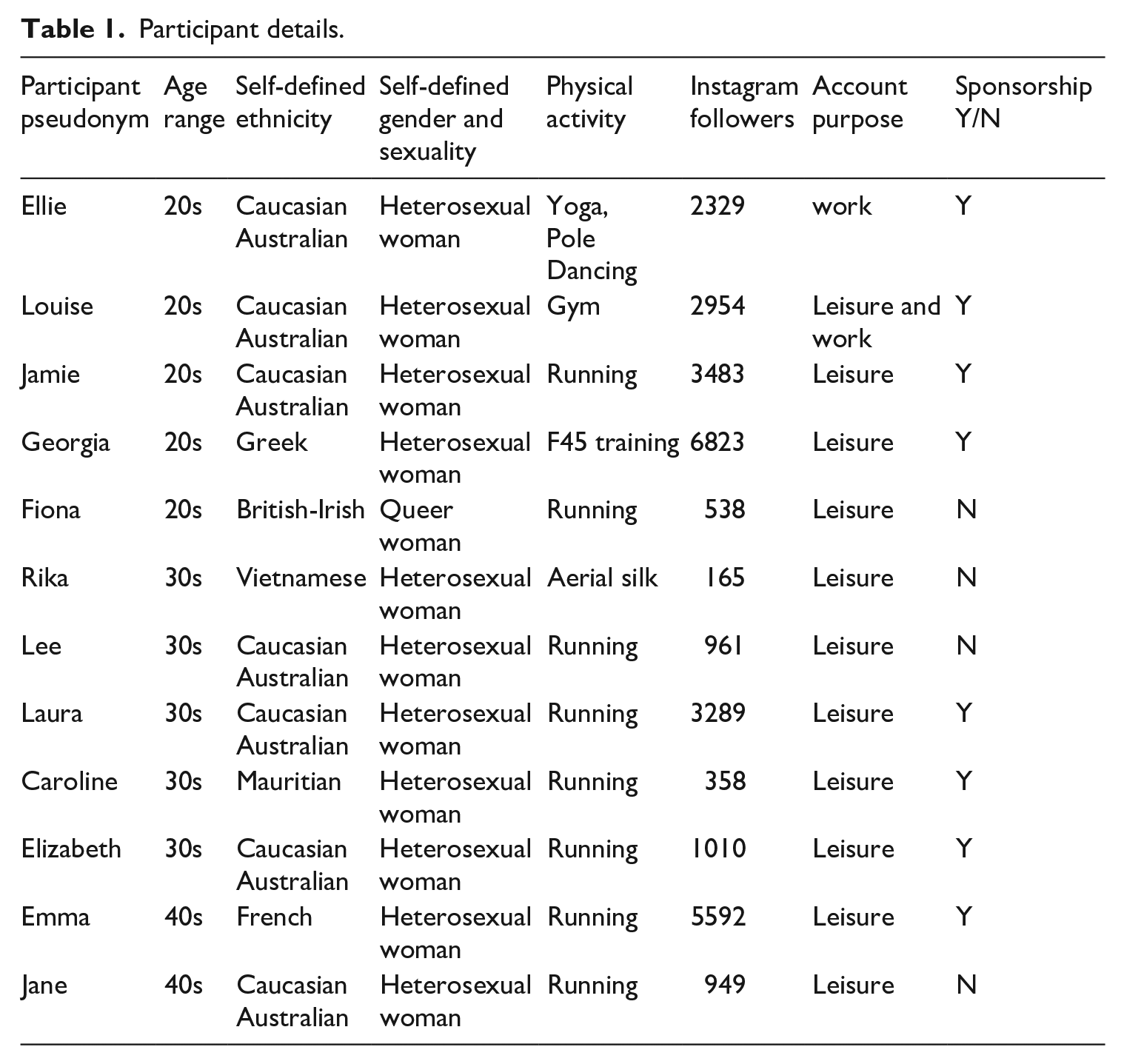
This article draws from a qualitative project examining 12 Australian women’s everyday engagements with Instagram for fitness purposes. We conducted in-person, semi-structured interviews and Instagram content analysis to understand how they were using social media as part of their social lives (see Table 1). In this article, we focus only on the interview responses, and their experiences of vulnerability and care in relation to their Instagram use. However, these interviews were conducted in relation to the women’s Instagram content, so the content itself remains central.
Participant details.
The project received institutional ethical approvals from author 1’s university. Informing our ethical considerations is a feminist commitment to representing the realities of the women producing this data and improving their digital experiences. Participants had the opportunity to view interview questions prior to discussion, review their interview transcript, receive copies of research publications, determine consent for use of their own social media images for publications or presentations by the investigators, and to withdraw from the project. To protect participant anonymity, names were replaced with participant chosen pseudonyms and we elected not to publish screenshots from user accounts. As our research straddles the boundaries between digital and physical embodied experiences, representations and practices, we practised a feminist ethical commitment to contextualising data in our analysis by approaching social media engagements as connected to embodied experience, and interpreting data relative to social practices and context (Leurs, 2017).
We engaged in a purposive recruitment strategy, seeking women living in Melbourne who use social media for fitness purposes. The research site was selected for convenience, as authors (1 and 5) leading the data-gathering process were based in Melbourne. We established research accounts on Instagram and Facebook to circulate a call for participants. With all researchers involved in a range of sport and fitness communities, we also recruited via our personal and institutional Twitter, Facebook and Instagram accounts. Other strategies involved: identifying Facebook pages of women’s online fitness communities and directly contacting account moderators to request they circulate the study details; locating participants by following popular fitness hashtags that women were using on social media and identifying women on Instagram with public accounts devoted to fit and active lifestyles, and inviting them to the study.
During interviews, we asked participants about their routines, practices and motivations for sharing their physical activity on Instagram; perceptions of their own and others’ active bodies; their decision-making when posting content; how they engaged with other users; what they enjoyed about the platform; and aspects that concerned them. Participants referred to their Instagram accounts, identifying and sharing posts, interactions, events and resources throughout their interview. This process of ‘shared looking’ allowed participants to highlight certain content to contextualise information for interviewers. Interviews lasted approximately 1 hour and were audio-recorded and professionally transcribed.
Our process of data analysis was multi-phased, starting with the use of Nvivo software to identify key themes. We undertook a process of individual and collective repeated reading/viewing, a coding process of nominating and discussing key themes, and a more detailed analysis identifying associations across dominant themes. All processes were in dialogue with relevant literature. This multi-phased method was our attempt at ‘empirically grappling’ with the ‘messiness of the digital mediation of everyday lives’ (Elwood and Leszczynski, 2018: 631), and as feminist scholars we paid close attention to what was spoken, as well as the silences, tensions and contradictions within the dialogue. We returned to the data repeatedly throughout the project, sitting with the tensions, staying with the trouble, reading the data through and with different theoretical concepts, ultimately coming back to Butler’s writings on bodies, vulnerability, care and everyday politics. Through this process of analysis, we identified a range of care practices the women enacted on Instagram:
Sharing unedited and imperfect images of themselves;
Avoiding judgement and scrutiny of other women’s bodies;
Raising awareness of body image and mental health issues;
Supporting others.
Through Butler’s (2015, 2016) theorising of bodily vulnerability we came to understand these diverse practices as forms of either mutual recognition (practices 1 and 2), or relational responsibility (practices 3 and 4). In the sections below, we extrapolate the ways these modes locate corporal vulnerability as central to providing the support for conditions of action. By considering the ways women ‘mobilize vulnerability’ (Butler, 2015: 140) to develop careful online/offline relations with and towards others, our analysis looks beyond the individual risks of bodily exposures for women on Instagram. In so doing, we position embodied ethics in women’s social media usage as complex, nuanced, relational and beyond binaries.
Results and analysis
Mutual recognition and corporeal vulnerability
Participants in the study were highly attuned to the potential harms of social media for their own and other women’s physical and psychological wellbeing. As research has indicated, many women experience online abuse and trolling (Australian Government, n.d.), as well as negative affects surrounding body image and self-worth (Coffey, 2020; Gill, 2021). Butler (2015: 125) reminds us that ‘bodily exposure can take different forms’ and social media has become a key site through which women make themselves visible via the self-presentations of their bodies (Dobson, 2015). Women’s Instagram encounters – sharing aspects of their everyday lifestyles and fitness practices – can therefore be considered a form of bodily vulnerability, in that their physically active bodies are posted, presented, shared for others to look at, judge and comment on.
Participants mobilised their bodily and embodied vulnerabilities, putting them into action by refusing to post altered images of themselves to enhance or filter their looks. They stressed it was important to keep photos of their bodies ‘real’, in this way embracing and owning their bodily vulnerability. For Georgia, this meant she ‘would never edit myself. Like I barely put a filter on me’. Georgia’s approach was indicative of most respondents who specifically chose not to use filters and editing tools to create ‘flawless’ images on Instagram, which they were concerned could negatively impact other users’ feelings towards their bodies.
Avoiding the stigma of being judged as ‘fake’ by women viewing their content was also a motivator for some women who avoided altering photos of themselves. As Laura details:
I want it to be me. I want it to display who I am. I don’t want to be airbrushed. I don’t want to be seen as fake or putting on a filter just for social media because, at the end of the day, what I’m putting on social media is me and the people I’m potentially trying to engage with—they’re my friends. They are actually my friends away from the screen. So, if I’m potentially going to lie on screen, does that mean I’m going to lie to them in person? I’m like, no.
As Reade (2021) has noted, exercising women’s expressions of being ‘real’ and not ‘fake’ manifest through visuals of the exercising body, and constitute a negotiation between users and their perceived audience with the aim to cultivate intimacy and accrue cultural capital. Our participants were not immune to this, and we observed a tension between women’s sense of social responsibility to post images of their unedited bodies, and their desire to post flattering shots of themselves. Women went to considerable effort to manage this tension between the reality of the images and desired aesthetic appeal by taking many photos from different angles and light conditions. As admitted by Georgia, ‘I’m definitely one of those people who’ll take a fair few photos before I find one that I like to post on there’. Generating realness was a process that exercising women actively practised within their online communities to foster connectivity, despite recognising the social demands to get the balance right between ‘aesthetically desirable’ and ‘real’ expressions of the self.
Yoga teacher Ellie communicated a different interpretation of representing a real body on Instagram, which involved purposely capturing imperfections rather than selecting the most normatively flattering shot: ‘I will post photos with tummy rolls. . .there’s one I posted not long ago where my neck looks horrendous. . . Like wrinkly neck. . .I’m not going to change that cos that’s how I look in the pose and yeah it’s just real’. Through existing in and sharing her flawed body, Ellie invites others to recognise the feminine self as an imperfect mode of being, rather than striving for perfection (McRobbie, 2015). Ellie’s attempts to navigate social imperatives to aesthetically represent ‘realness’ while role modelling a different kind of exercising woman’s body, signals a mutual recognition of women’s embodied difference and the normative conditions under which women are subject to aesthetic ideals. By posting, Ellie invites other women to recognise their collective vulnerability when everyday online presence becomes an act of ‘deliberately exposing the body to possible harm’ (Butler, 2016: 126), such as making oneself vulnerable to cruel comments and losing control of how one’s image may be reproduced or shared on other accounts.
The pressures for women to look a certain way and meet unrealistic expectations of femininity are exacerbated by platform infrastructures that encourage users to make oneself visible in ways that attract the most attention and engagement (Banet-Weiser, 2021; Dobson, 2015). Participants spoke about such pressures and the complex tensions and decisions they made about navigating these. Fiona, for instance, is under no illusions that Instagram can resolve these issues. Although she makes ‘a real effort to follow as many different sized people as possible’, she observes that ‘I’m also trying to emulate the very shapely, still muscular, but shapely women that I see. . .I can surround myself with as many different types of accounts as possible, but at the end of the day that isn’t necessary going to conquer the deep underlying fear of fatness that my brain has’. Past experiences of feeling inadequate when seeing Instagram posts of ‘perfect’ bodies motivated some women’s decisions to post ‘real’ images of themselves:
I don’t follow anyone that’s on there to look good. I know the effect it can have, because back in the day, yes I used to look at people and go ‘oh shit, I don’t look anything like that, therefore something’s wrong with me’ (Jamie).
Making ourselves vulnerable to others requires making ourselves vulnerable to our own self-reflections on what that vulnerability represents. Affective bodily feelings of fear or shame invite an understanding of what produces such feelings, and thus an awareness of our own culpability within and capacity to respond to those structures as an embodied ethical practice. For Butler (2015), recognising corporeal vulnerability generates alternative ways of doing and being that can form that basis for encounters based on care and respect.
Although Instagram can be used as a marketing tool to build brand awareness and popularity (Cotter, 2019), this was not the only, nor primary, reason for our participants’ engagement online. There were some participants who promoted their fitness work and were sponsored to endorse a range of products on their Instagram accounts. Others were not commercially motivated to use Instagram yet occasionally promoted products on their feed (see Table 1). Despite the potential perks and pathways to developing income streams, these benefits became less important than the ways Instagram allowed them to cultivate mutual recognition and interdependency among women seeking to reshape the contours of sporting bodies, belonging and empowerment. Caroline explained the shift she noticed:
I thought that’s what I wanted, I want to get free stuff kind of thing. . . now it’s more a lot of people saying to me ‘Oh I started running, how do you do this, what would you need?. . .Do you think maybe I can do it?’ Like, I can get good purpose out of this. Kind of like not to inspire—I don’t think I’m an inspiring person—but a lot of people said ‘I started running because of you and I can do 2 kilometres now’. I’m like ‘Maybe this is going to encourage people to use this’.
Caroline also used the hashtag #Littleeyesarewatching to remind herself and others of the impact that body image and relationship to exercise can have on how girls feel about themselves, thereby enacting a critical collective engagement with online body-focussed fitness cultures.
The women in our study expressed a commitment to role modelling ‘positive’ femininities, which they understood as imagery that represents women’s everyday lives and bodies. For our respondents, this involved not being overtly focused on conventional aesthetic ideals, representing sexuality as woman-centred, and expressing failures and uncertainty about their bodies, in an effort to build ‘collective togetherness’ (Butler, 2015: 197) around shared corporeal concerns. Ellie, who is training to be a schoolteacher, was mindful of not posting overly sexualised content for fear of potential employers and parents finding out. Yet, she also pushed back against moralising and judging of women’s self-presentations of their bodies, ultimately deciding to share images of her pole dancing:
there is a fair bit of stigma around pole dancing, like people just assume you’re a stripper. . .like my Mum was telling me ‘oh you probably shouldn’t post that on your public account, you’re going to be a primary school teacher like do you really want that out there?’ So I posted a couple of little bits of things I was really proud of but never really posted too much. But recently I was asked to start training to be an instructor and that was kind of like okay, I need to own this, I need to whether there’s stigma or not I know that what I’m doing is right and it’s a great form of fitness and it’s really a great community and good for my mental health.
It is through experiencing the gendered stigma of taking up an activity that ‘everyone views. . .as a kind of sexual thing’ that Ellie was motivated to post about her pole dancing. These feelings of being seen and judged shaped Ellie’s understanding of the uneven impacts of platformed engagement for women and illustrate how corporeal recognition of vulnerability activates Ellie’s online practices. In attempting to represent body confidence and female sexuality, Ellie is aware she must make herself vulnerable (by risking employment prospects and stigma) to challenge gendered and classed norms of feminine propriety (Phillips, 2022).
Having themselves experienced feelings of uncertainty and insecurity that arise from sharing images of their bodies on Instagram, participants were mindful of the impacts of publicly judging other women and purposefully avoided making comments on women’s physiques:
I never mention like, ‘your legs look so skinny or your arms look so taut’. Just try to keep it quite generalised. Like, ‘well done on making it to the gym today, that’s so great’. I would never mention their actual physique or their body in it (Laura).
In this way, Laura and other participants acknowledged not only their own but others’ vulnerability in posting images of their physically active selves – there was mutual recognition of vulnerability and concerted efforts to respect and support others in their vulnerability.
Relational responsibility: Instagram as infrastructural support
As active participants within their exercising communities, our respondents developed an awareness of the concerns of other women, which they also shared, including pressures around body image and mental health, desire for practical and emotional support, and finding ways to stay safe and well when training. Instagram provided a virtual social setting for exercising women to act on these concerns and practice being and becoming ethical actors. Fiona, for example, spoke frankly about body image and mental health struggles, viewing her Instagram account as a personal-political act of transforming her negative perception of her body, which she characterised as an ongoing process practised through her online engagements:
It’s posting about doing things, especially because I used to be so unwell and I used to have such a difficult relationship with myself and to be, ‘I did this thing [distance running] and I did it in a way where I didn’t flog myself and I’ve done it healthily, and I’m really happy’. That makes me really proud of myself because it’s overcoming adversity. . .
This embodied perspective allows Fiona to connect her online actions to wider social conditions, specifically gendered and racialised relations of power:
I’m very open about it [eating disorder recovery] because I think that the way that we police women’s bodies in our western context is, it’s really, really, problematic and really damaging. I say that as someone who’s very, very white and thin. I’m aware of that, but I’m also not immune to the influence of media and culture.
Fiona’s comments draw attention to the ways that exercising women put bodily vulnerabilities and negative affects, such as body hatred, to use in their networked communications to open up embodied relations and forge new attachments and identifications beyond dominant norms. Instagram enabled the exercising women in our study to practice empathy, care and concern for others with whom they shared struggles to meet gendered requirements of body expression and display and to expand the range of possibilities for fit feminine bodies, such as exercising for pleasure, a sense of achievement or mental health. Our findings diverge from Coffey’s (2020) study of young people’s body image concerns, where ‘ugly feelings’ of worry and despair about their bodies constrained girls’ capacity to forge relations with eating and exercise beyond restrictive and destructive patterns of behaviour. Instead, our research highlights the social significance of networked exchanges for understanding physically active women’s Instagram practices as mutually sustaining relations (Butler, 2015).
Echoing the sentiments of several respondents, Jamie expressed a strong sense of responsibility towards others when making decisions about what to post on her Instagram account. Having joined Instagram to document her recovery from an eating disorder, she subsequently ‘started using Instagram and other social media channels to try and build awareness on mental health and on how running helps mental health’. For Jamie, this was a process of sharing both positive and negative feelings – her achievements and struggles. In doing so, she hoped to make visible and legible the everyday struggles of surviving social systems designed to govern women’s bodies.
Performing vulnerability online was not simple for Jamie, who understood from personal experience the potential impacts of posting about ‘the darker side of life. . .whether that be mental health, whether that be body image’ for triggering bad feelings in others, by asking herself ‘is it going to help or is this post going to hinder someone else?’ It is from this embodied perspective that Jamie develops an ethics to guide her decision-making. Jamie’s sense of responsibility extended beyond making socially recognisable the pain of others by sharing her own. Instagram provided an ‘infrastructural support’ (Butler, 2016: 15) through which Jamie provided personal care:
I get a lot of direct messages, especially with the sort of content I put out which is to do with mental health. . .I’ll also get people who struggle with eating and struggle with body image, and they just ask advice on how to approach a certain situation or where to go for help. . .I actually love it, because sometimes people, they just need someone to talk chat to that understands what the hell they’re going through.
Messaging users privately suggests Jamie is not motivated to use Instagram to performatively display her struggles purely for personal gain. Rather, her actions can be understood as a process whereby ‘vulnerability implicates us in what is beyond us yet part of us, constituting one central dimension of what might tentatively be called our embodiment’ (Butler, 2015: 149). In making time to reply privately to those who reach out, Jamie affirmatively recognises the vulnerability of others and understands it as co-implicated with her own embodied feelings, explaining that these encounters ‘always helps me as well’.
Participants detailed other ways of supporting one another amid vast amounts of online information and advice available about bodies and exercise. For instance, before posting on Instagram, participants thought about whether they were qualified to provide advice. Emma was clear about the limits of what she could offer other women: ‘I’m not on Instagram to give any advice. But I would always celebrate their achievement’. In making decisions about what not to post and share, Emma was thinking beyond managing her own safety and wellbeing online by taking into consideration the potential harmful effects (e.g. injury) and affects (e.g. intimidation, confusion, judgement) of offering advice to others.
Respondents, like Elizabeth, actively sought advice from other women runners on Instagram:
. . .there is so much information out there that you can search for yourself but, actually, I do not know. I ask a lot of questions. . .‘what is your fuel plan and how many kms are you doing?’
Advice seeking formed the basis from which Elizabeth built a community of mutual support:
They [runners] are people that go out of their way, not to just check in on you, but they send you cards before your marathon. . .ask questions about how it has been going. . .they are really in tune with what is going on in your life.
From this experience, Elizabeth felt compelled to ‘pay it forward’ by ensuring her Instagram content is geared towards creating a supportive environment over promoting her own successes: ‘I try not to glamorise it too much that is for sure. I think there is almost a responsibility with Instagram now not to be that person’. Emma similarly describes what it felt to be looked out for and looked after:
I had no running community around me, I had no idea what I was doing and I had absolutely nobody around me who helped me. But Instagram put my running community together. I had people coming on my Instagram and saying ‘you’re doing amazing, just keep doing what you’re doing’. And I posted a few things like, ‘that was a very shit run today’, I don’t know, ‘I’m never going to be able to run’. And people just were so supportive and incredibly involved in my journey.
Emma and Elizabeth’s accounts are instructive for highlighting the affective dimensions of care communities, and situate their actions as a relational practice prompted by mutual recognition of shared vulnerabilities (bodily inadequacy, uncertainties and failures), which encouraged them to take responsibility in supporting others online. Having experienced others’ attunement to their needs, these Instagram users actively sought to co-implicate themselves in the production of conditions of liveability for other women (Butler, 2016).
Through their online contributions, Fiona, Jamie, Emma and Elizabeth attempted to transform Instagram into a place of community flourishing – in Butler’s terms, a site of infrastructural support and reciprocity – by critically reflecting on and responding to cultural demands on women to perform highly individualised, successful, athletic femininities (Pavlidis et al., 2022). While we would not go as far as to claim that our participants’ efforts to build collective social presence constitute a form of political assembly (Butler, 2015) or digital commoning (Mandalaki and Fotaki, 2020), through their Instagram encounters women sought to disrupt dominant gender norms informing how women’s bodies should feel, look and act. They did this by developing care practices directed at others they recognised as sharing corporeal vulnerabilities, insecurities and desires. Women’s attunement to social media harms therefore extended beyond acts of self-protection and the development of personal strategies to avoid content and users that they considered ‘unhealthy’ and ‘unsafe’ (Hockin-Boyers et al., 2021). Rather, they were motivated to generate a community of care on Instagram by fostering mutually supportive exchanges in their online practices.
Conclusion
This article proposed an embodied relational ethics of social media use for understanding women’s production of and engagement with body-focussed content in online spaces. Whereas existing studies have focussed attention on the ways in which women navigate the complexities of online visibility to take care of oneself (Hendry, 2020; Hockin-Boyers et al., 2021; LaMarre and Rice, 2017; Toffoletti et al., 2021), in this article, we looked to Judith Butler’s writings on corporeal vulnerability to theorise Instagram users’ actions beyond individual responsibility. Building on feminist debates about women’s social media use, fitness, body image and online care, our study has drawn attention to women’s cultivation of careful relations through their Instagram posts and exchanges by mobilising a shared vulnerability based in corporeal concerns. Women enacted care for others on Instagram based on an awareness of shared corporeal concerns within a larger social context where women’s bodies are subject to scrutiny and critique (Gill, 2021), and women are astutely aware of the kinds of feminine bodies, and feelings towards the body, which are socially rewarded and desirable (Pavlidis et al., 2022; Toffoletti and Thorpe, 2021). It is with an embodied understanding of the complex social demands on women to make themselves visible online that the women in our study developed an ethical orientation towards sharing Instagram content that would support and not harm other women.
In understanding the potential harmful effects of Instagram on women’s body image and mental health, the women saw themselves as leaders in many ways, and took this on as a responsibility and mode of service to others, rather than an authoritative mode of leadership. We identified a tension between a hopeful and positive feminist politics, and embracing failure, vulnerability and loss as generative potentialities for a different kind of future. Both are necessary for ethical action and the women we spoke to were tentatively trying to embody both – a practice that they recognised was difficult and risky. Even women who used Instagram for commercial reasons were mindful of their potential audiences and how they might ‘do things differently’ to support others’ wellbeing online, thereby troubling clear distinctions between market-centred logics of competition and community-oriented care practices. This points to the importance of understanding the meaning of Instagram use for specific groups of women that is context-specific and enmeshed with offline practices and communities. Although findings indicate that Instagram functions as a site for collective care and community building among women from a variety of physical activity backgrounds, we recognise that the women in our study are differently positioned according to a range of social and cultural conditions shaping their lives, such as occupation, age, ethnicity, desires and orientations towards their followers online. In doing so, we have sought to account for women’s attempts at improving collective online experiences in the context of body-focussed physical activity and wellbeing practices.
Footnotes
Funding
The author(s) received funding for the research from Deakin University’s School of Humanities and Social Sciences Research Support Scheme.
