




Abstract
Swipe-based dating apps characteristically provide quantitative social feedback in the form of matches. Surveys suggest a link between dating app success and well-being, but the nature of this correlation has yet to be examined. In an experiment with 125 undergraduate women, we manipulated dating app feedback: When accepting a profile, participants had either a high (27/31) or a low chance (3/31) of receiving matches. We found no effect of chance of matches on women’s loneliness or fear of being single. However, a higher chance of matches led to higher partner choice overload. Furthermore, in those who accepted seven or more profiles, women in the low chance of matches condition reported higher loneliness than women in the high chance of matches condition. This could mean that matches are rewarding for women with a high approach orientation. Manipulating social feedback in a dating app paradigm seems suitable to study the effects of social acceptance and ostracism.
Dating apps offer an abundance of profiles for users to accept or reject. When two users accept each other’s profile, they have a match. The opportunity to give and receive quantifiable social feedback in the form of matches makes profile browsing very tempting for dating app users. Therefore, browsing through and evaluating other users’ profiles (i.e. swiping) is the central activity of dating app use (Cummings and Mays, 2021; Finkel et al., 2012). From a Lacanian psychoanalytic perspective, scholars have even argued that the main function of dating apps is not facilitating offline encounters but exploiting users’ desire and turning it toward the app itself and its process of matches accumulation (Bandinelli and Bandinelli, 2021). In line with this, more than half of users report never go on in-person dates but solely remain in the online environment (Timmermans and Courtois, 2018). In addition, instant social gratification and self-worth validation are among the most common motives for dating app use (Licoppe et al., 2016; Sumter et al., 2017; Timmermans and De Caluwé, 2017; Timmermans et al., 2018; Wimark and Hedlund, 2021). Even after having found a partner, (intense) users find it difficult to quit dating app use (Orosz et al., 2016; Sharabi and Timmermans, 2020), which further underlines the importance of in-app gratifications, such as positive social feedback. Dating app users, especially women (Ranzini and Lutz, 2017), report accumulating matches to satisfy the need for belongingness, as well as relational or sexual intimacy (Sumter et al., 2017; Timmermans and De Caluwé, 2017). Receiving social feedback seems especially compelling for women as women are the gender socialized to seek reassurance (Nesi and Prinstein, 2015; Starr and Davila, 2008) and their self-construal is particularly based on social acceptance (Cross and Madson, 1997).
Whether mutual acceptance as a low-key form of digital communication (Hong et al., 2017) can foster social connection (Goldenberg, 2019) remains an open question. Although studies have found significant differences in psychological traits and well-being between users and non-users of dating apps (Erevik et al., 2020; Holtzhausen et al., 2020; Strubel and Petrie, 2017), there are important caveats in the literature. First, correlations between dating app use and psychological outcomes cannot answer which specific dating app experiences produce these changes. Scholarship must move beyond associating mere media use with decreased well-being to distinguishing which specific activities or experiences on dating apps may have undesired psychological effects (Clark et al., 2017; Lauckner et al., 2019). Second, a cross-sectional design cannot rule out the possibility of self-selection: That is, lonely individuals (Chin et al., 2019) and those high in fear of being single (Brubaker et al., 2016; Timmermans and De Caluwé, 2017) are more likely to choose using dating apps.
In the present experimental study, we manipulated social feedback in a dating app paradigm (i.e. high chance of matches vs low chance of matches) and examined influences on loneliness, fear of being single, and partner choice overload. In addition, we are the first to examine to what extent participants sought connection. That is, we examined the number of profiles that participants accept as a moderator because a match is only possible if a person accepts a profile in the first place.
Ostracism in a dating app paradigm
According to Williams (2007), two forms of social exclusion are rejection (i.e. explicit negative feedback or a declaration that one is unwanted) and ostracism. Ostracism is defined as being ignored without explanation after having sought connection (Williams, 2007), colloquially called the silent treatment. Being ignored, or the absence of positive feedback, hurts just as much as overt negative feedback (Van Beest and Williams, 2006). This is because humans have evolved to be extremely attentive to cues of social feedback (Spoor and Williams, 2007). Spoor and Williams (2007) theorized that the absence of positive feedback weighs just as heavily as explicit rejection because overlooking a sign of negative peer feedback poses a greater social risk than overperceiving negative feedback. In line with this theory, being ostracized in a virtual setting activates the same brain regions as physical pain (Eisenberger et al., 2003) and a meta-analysis of 120 studies concluded that ostracism in a virtual setting thwarts belongingness—even if the episode is brief and even if the ostracizers are strangers (Hartgerink et al., 2015).
The most commonly used experimental paradigm (i.e. contextual scenario in which the manipulation is implemented) of ostracism (Hartgerink et al., 2015) is a virtual nonverbal game called Cyberball (Williams et al., 2000). During Cyberball, participants play a game with two avatars who almost never toss the ball to them. Comparable to our dating app procedure, participants of Cyberball are not explicitly informed that (or why) they are ignored but can infer ostracism as they almost never receive the ball. However, during Cyberball, participants have no choice but to remain in the situation and watch the other players exclude them. If they once get the ball, they have to throw it back to another player. Other paradigms in which computer-generated avatars (or human confederates) ignore participants are conversation or chat room paradigms (Williams, 2009) or the social media paradigm (Lutz and Schneider, 2021; Wolf et al., 2015). In all these paradigms, participants cannot vary their approaches, that is, initiate or reject social interaction. Yet, for certain research purposes, it may be interesting to factor in to what extent participants actively sought connection themselves.
On dating apps, such as Tinder, users can browse through profiles of other users in their vicinity. To move from one profile to the next, users must decide whether they want to accept or reject a profile. On the smartphone, users can do so by swiping (i.e. thumb-brushing) right to accept and left to reject a profile. Based on the principles of speed dating, two users get notified if they have a “match,” that is, in case of mutual acceptance. In case of a match, they become a member of each other’s online network and can contact each other. If both rejected each other or only one of them accepted, users are not notified. Thereby, dating apps are designed such that only positive feedback in the form of matches is visible to users, while the rejections are invisible and can only be inferred from the absence of positive feedback. However, if users keep accepting profiles (i.e. seek connection) and still, positive feedback remains absent, they will be able to infer the preceding rejections. We are convinced that women will be able to infer the rejections because women usually get a lot of positive feedback in the form of matches or messages on dating apps (Anderson et al., 2020; Smith, 2022). It is irrelevant that rejection can only be deduced from the absence of positive feedback; any peer feedback will be consequential (Spoor and Williams, 2007). Williams (2009: 281) states that “what is needed to examine ostracism detection are paradigms that are subtle, distal, and ambiguous.” Therefore, using a dating app paradigm seems very suitable to study the effects of social acceptance versus ostracism.
Since ostracism is defined as a specific form of social exclusion meaning that the individual sought connection but is ignored (Williams, 2007), measuring to what extent individuals seek connection is of paramount importance. The dating app paradigm allows researchers to observe participants’ active social approach behaviors, namely how many profiles they accept themselves.
The psychological influence of dating app matches
In contrast to social media platforms, such as Facebook or Instagram, social feedback on dating apps has received little scientific attention. Findings from qualitative and cross-sectional research point to the relevance of online success or app satisfaction for well-being (Courtois and Timmermans, 2018; Her and Timmermans, 2020; LeFebvre, 2018). However, these studies only correlate general dating app use or success with well-being while unable to attribute effects to a specific platform experience. It is therefore unclear if decreased well-being is an effect of dating app use. The correlations could also stem from self-selection. Experimental studies are needed to confirm the effect of dating app feedback on well-being.
Researchers have experimentally manipulated profile attributes to investigate which profiles yield more or less matches (Evans and Vega, 2021; Lin and Lundquist, 2013; Neyt et al., 2019). However, experiments in which researchers manipulate social media feedback and measure psychological outcomes are very scarce (for exceptions, see Alba, 2021; Burrow and Rainone, 2017; Coulthard and Ogden, 2018; Lutz and Schneider, 2021; Schneider et al., 2017). With regard to online dating, Alba (2021) manipulated online dating feedback by presenting participants with three hypothetical scenarios, namely positive (social acceptance), negative (overt rejection), and no feedback (being ignored). Participants asked to imagine being ignored generated stronger intentions to revise one’s dating app profile than those who were asked to imagine overt rejection or acceptance. Thus, the absence of feedback during online dating even provokes stronger reactions than overt rejection (Alba, 2021).
However, since it is hard for people to accurately estimate how they would feel given a hypothetical scenario (Wilson and Gilbert, 2005), researchers need to put participants in situations in which they actually receive dating app feedback and examine how they feel shortly afterward. Therefore, we conducted an externally valid experiment with a live induction of ostracism (or social acceptance). We started from the categorization of user motives into relational, intrapersonal, and entertainment goals (Sumter and Vandenbosch, 2019). Similarly, others summarized user motivations as relationship seeking, ego-boost, and entertainment (Ward, 2016) or into connection and entertainment (Kallis, 2020). We tested the effects of receiving matches on a relational-, an intrapersonal-, and an entertainment-related goal, namely loneliness, fear of being single, and partner choice overload. We picked outcomes that are most salient on and unique to the context of dating apps (Coduto et al., 2019). Young adult women typically report to turn to dating apps “when feeling alone” or insecure (Bandinelli and Bandinelli, 2021: 189), to quench their fear of being single (Timmermans and De Caluwé, 2017), but then often withdraw again because the great number of (blatant) approaches overwhelms them (Anderson et al., 2020; Bandinelli and Bandinelli, 2021).
State loneliness
Loneliness is defined as the subjective experience of social isolation (Roddick and Chen, 2020). Although trait loneliness (or chronic loneliness) remains rather stable over the life course (Mund et al., 2020; Vanhalst et al., 2015), state loneliness is defined as the temporary and highly malleable affective state of lacking social connection (Roddick and Chen, 2020). The evolutionary theory of loneliness (Cacioppo and Cacioppo, 2018) proposes that belongingness was and is so vital for survival that humans and other herd animals developed the unpleasant feeling of loneliness to signal social danger. In evolutionary terms, social exclusion meant a death sentence, hence our sensitivity to signs of social approval or exclusion (Kross et al., 2011; Williams, 2007). When acceptance by the group is endangered, humans feel lonely and this alarming pain should motivate them to seek social connection (Spoor and Williams, 2007). This is also in line with the proposition that the need to belong is one of the fundamental human motivations (Baumeister and Leary, 1995).
In line with this theorizing, research has shown that individuals with bigger social networks are less lonely (Green et al., 2001). Moreover, many studies show social acceptance is associated with decreased feelings of loneliness over time (e.g. Eronen and Nurmi, 2001; Marshall et al., 2014; Vanhalst et al., 2015). While trait loneliness remains rather stable, state loneliness is malleable and can be experimentally induced (Roddick and Chen, 2020). In line with this, a meta-analysis concluded that social inclusion, compared to social exclusion, decreased sense of belonging in 39 experiments (Gerber and Wheeler, 2009). That is, individuals feel lonelier after a single occasion of being ignored or rejected compared to being socially accepted.
Social media provide quantifiable cues of social acceptance, which could be one reason why the lonely are generally drawn to the Internet and social media (O’Day and Heimberg, 2021; Song et al., 2014). The number of contacts on Facebook has, for example, been associated with decreased loneliness (Kim and Lee, 2011; Phu and Gow, 2019). Similarly, lonely individuals tend to turn to dating apps (Coduto et al., 2019), which have their historic origins in “lonely-hearts” columns. Dating app users list belongingness, social approval, and socializing—in addition to explicitly seeking for romantic or sexual relationships—as motivations for use (Timmermans and De Caluwé, 2017). Sumter and Vandenbosch (2019) also found user motivations mirroring a need for social connection (e.g. relationship seeking, loneliness); and users report to associate app deletion with loneliness (Wimark and Hedlund, 2021). Cross-sectional studies show that positive social media feedback is indeed associated with social connectedness (Bond and Miller, 2021).
However, experiments are lacking to confirm if social media cues of social approval decrease loneliness. To the best of our knowledge, only a handful of experiments (Deters and Mehl, 2013; Lutz and Schneider, 2021; Schneider et al., 2017; Wolf et al., 2015) manipulated ostracism in a social media paradigm, that is, by manipulating the number of Likes to participants’ status update. Lutz and Schneider (2021) found that participants reported less threat to belongingness in the inclusion than in the ostracism condition (Lutz and Schneider, 2021). However, the effects of social media feedback on loneliness are not straightforward. A vignette experiment found those in the scenario where they received more Likes than expected to report lower loneliness (but surprisingly also more negative affect) than those imagining to receive less Likes than expected (Wallace and Buil, 2021). Deters and Mehl (2013) found that posting status updates but not the social feedback received by friends influenced loneliness. While we lack experimental studies in a dating app setting, on the basis of the evolutionary theory of loneliness (Cacioppo and Cacioppo, 2018), we expected being socially accepted in a dating app paradigm to decrease loneliness compared to being ostracized.
H1: A high chance of matches decreases state loneliness compared to a low chance of matches.
Fear of being single
Sociometer theory posits that social feedback from others informs self-perceptions (Leary et al., 1995). Very similarly to the evolutionary theory of loneliness, sociometer theory asserts that self-perceptions developed as an affective warn system to detect cues for one’s declining relational value in the social environment (Leary and Acosta, 2018; Leary et al., 1995). In line with this theory, individuals think highly of themselves when accepted by peers, whereas rejected individuals feel that their relational value is low (Teachman and Allen, 2007). Sociometer theory would predict effects of social feedback on various outcomes (from self-esteem over mate value to even attachment insecurity).
A relational insecurity specifically focusing on romantic attachment figures is the fear of being single (Spielmann et al., 2013), which is defined “as concern, anxiety, or distress regarding the current or prospective experience of being without a romantic partner” (Spielmann et al., 2013: 1049). Fear of being single is first of all fear (of not having a romantic partner) but also entails the widely accepted normative belief that something is wrong if one is not romantically attached (DePaulo and Morris, 2005). High fear of being single can make one ready to settle for less satisfying relationships and partners to avoid singledom by all means (Spielmann et al., 2013, 2016).
Individuals high in fear of being single have an especially pronounced need to belong (Adamczyk et al., 2021; Spielmann et al., 2013), which makes them particularly sensitive to cues of social acceptance (or exclusion). Seeking cues of social approval may be a reason why dating apps attract individuals high in fear of being single (Brubaker et al., 2016; Timmermans and De Caluwé, 2017). Research has found an association between excessive swiping and the fear of being single (Thomas et al., 2023). Furthermore, single and nonsingle dating app users to swipe just as frequently (Orosz et al., 2016). This could indicate that (partnered) users turn to swiping to seek social approval about themselves as desired singles or seek a new partner before ending an unsatisfactory relationship to quench their prospective fear of being single. In line with sociometer theory, individuals should infer self-perceptions, such as fear of being single, from dating app feedback. However, it remains empirically unanswered whether positive dating app feedback is in fact successful in decreasing fear of being single.
In one experimental paradigm of social exclusion, researchers manipulate social exclusion by letting participants fill in a bogus personality test and then tell them that people with their profile typically end up alone in life as their friends and lovers will drift away (life-alone paradigm by Twenge et al., 2001). Social exclusion in this paradigm has undesired emotional and cognitive effects (Baumeister et al., 2002; Twenge et al., 2001). Although the authors did not consider fear of being single as an outcome, we theorize that social exclusion in the life-alone paradigm could have activated anxieties very similar to the construct fear of being single. Yet, experiments on the influence of social feedback on the fear of being single are lacking. Based on sociometer theory, we expected participants to use dating app feedback as information for their self-perceived fear of being single.
H2: A high chance of matches decreases fear of being single compared to a low chance of matches.
Partner choice overload
Online dating is the prototypical example of the transformation of courtship into a kind of entertainment (Bauman, 2003). Especially mobile dating apps are meant to be entertaining: They gamify interactions and users describe their behavior with discourses of play (Sobieraj and Humphreys, 2021). Dating apps are designed in a way to heavily engage users with in-app enjoyments, for example, being granted access to potentially intimate profile information and the pleasures of social approval (Bandinelli and Bandinelli, 2021).
Since a match represents only a very weak and impersonal signal of interest, it is likely insufficient in satisfying a need for social connection and users may want to fill this social lack by collecting more matches. At the same time, the gamified design in which matches are presented might lead users to feel inconsequential about which profiles to accept (Krüger and Spilde, 2020). App design further incentivizes the entertainment component of collecting a great number of matches (Zichermann and Cunningham, 2011). As a result, dating app users may be tempted to fulfill social needs by repetitively accumulating a great number of matches, that is, constantly increase the number of contacts in their social network, instead of investing in few connections.
As a consequence, dating app users find themselves confronted with excessive information and overwhelmed by the number of available profiles (Anderson et al., 2020; Thomas et al., 2022). Despite the fact that seeking social approval is one of the main motivators for dating app use, women list excessive signals of male interest as one of the reasons for their frustration with dating apps (Anderson et al., 2020). This can be described as a form of choice overload (Iyengar and Lepper, 2000). Since it takes cognitive resources to process information, too much information (albeit positive) or a high number of options can lead consumers to be overwhelmed, paralyzed, or dissatisfied (Iyengar and Lepper, 2000). Feelings of overload with regard to partner choice on dating apps have been reported by dating app users who swipe excessively (Thomas et al., 2023).
While researchers have observed partner choice overload in individuals after manipulating the number of available dating app profiles (Lenton and Fransesconi, 2010; Pronk and Denissen, 2020; Thomas et al., 2022), we lack experimental research on the effect of receiving matches on partner choice overload. Based on the reasoning that dating app users accumulate matches, and excessive information induces feelings of overload, we expected social feedback in the form of matches to induce partner choice overload as well.
H3: A high chance of matches increases partner choice overload compared to a low chance of matches.
The moderating role of the number of profiles accepted
According to reinforcement sensitivity theory (Corr, 2008; Gray, 1990), some individuals are more sensitive to rewarding experiences than others. The theory postulates, among others, the existence of a behavioral approach system (BAS) linked to dopaminergic brain systems which responds to rewarding stimuli. Individuals with high BAS sensitivity are more motivated than others to approach potentially rewarding (social) situations because they are particularly responsive to immediate or anticipated rewards (Randles et al., 2010). Differential sensitivity to reinforcement (Corr, 2008) asserts that due to their highly sensitive BAS, individuals with an approach orientation (e.g. extraverts) profit more from social feedback than more avoidant individuals with a less sensitive BAS. In line with this theory, social avoidance behavior correlates highly with social anxiety, which means that socially avoiding individuals may also perceive more risk and less reward from social situations than approaching individuals (Dapprich et al., 2021). Experimental research confirms that reward stimuli indeed have stronger reinforcing effects in sociable than in avoidant individuals (Gupta, 1990; Gupta and Nagpal, 1978).
On social media, research has shown that not only the input of others’ social feedback but importantly, one’s own output increases connectedness (Chen, 2011; Deters and Mehl, 2013). On dating apps, individual differences in activation of appetitive and aversive systems predicted in-app behavior in the way that more appetitive individuals browsed at the fastest rate (Cummings and Mays, 2021), possibly hoping to collect matches. Applied to a dating app paradigm, a behavioral measure of approach orientation is the number of profiles accepted. That is, accepting many profiles indicates an approach orientation. Users of dating apps have reported that non-selective swipers who apply a “shotgun approach” (LeFebvre, 2018: 1220) accept many profiles to get many matches. Following reinforcement sensitivity theory, individuals who accept many profiles should be more responsive to (social) rewards due to their highly sensitive behavioral approach system. Specifically, they should perceive matches as more rewarding and matches should have stronger effects on them than on individuals who accept few profiles. While dispositional avoidance orientation has been shown to moderate the processing of aversive stimuli (Van’t Riet et al., 2011), we lack research on how approach orientation moderates the effect of rewarding stimuli. Following reinforcement sensitivity theory (Corr, 2008), we expected individuals with a high approach orientation to be more responsive to the effects of (absent) matches than more avoidant individuals. Therefore, we expected stronger effects of social feedback in those who actively accepted many profiles themselves.
H4: A high chance of matches decreases (a) loneliness, (b) fear of being single, and increased (c) partner choice overload, especially for those who generously accept many profiles.
Method
Procedure
The study was approved by the Institutional Review Board of the Department of Communication, University of Vienna (ID 20201213_051). The study allegedly investigated how people evaluate profile pictures on dating apps. If someone wanted to participate, they were asked to send a picture of themselves that they (would) use on a dating app. After handing in the picture, participants received a link to the online experiment.
First, participants indicated their demographics including relationship status, sexual orientation, and dating app use. Second, in a trial block including two test profiles without a picture, participants familiarized themselves with the two options to rate a profile: They could either click on a red cross to reject or on a green heart to accept a profile. If participants clicked on the green heart, the two profiles in the trial block yielded matches (e.g. stimuli see https://osf.io/6pmqy/). Third, after deciding if participants want to evaluate male- or female-looking profiles, participants rated 31 profiles of others who had allegedly already evaluated their picture. When participants accepted a profile, one condition had the chance to get a match almost every time (in 27 out of 31 cases; n = 64), while the other condition almost never had the chance to get a match (only in 3 out of 31 cases; n = 60). As on existing dating apps, a match could only occur when a user accepted a profile. The effect of condition needed to be understood contingent on how many profiles participants accepted. The number of profiles accepted ranged from 0 to 18 (M = 5.73, SD = 3.51) and did not differ by condition, t(123) = −.136, p = .892. Fourth, after profile evaluations, participants answered questions on the dependent variables. The questionnaire ended with manipulation and credibility checks and a debriefing.
Stimuli
We presented the pictures in a dating app mock-up to increase external validity. Profiles and match notifications corresponded to the design of Tinder, the most popular dating app in Austria and globally (Statista, 2021). For the test profiles as well as the 31 male-looking and 31 female-looking dating app profiles, we took pictures from Pexels and the CRCV selfie data set (Kalayeh et al., 2015) and used tinderkit.com to turn them into profiles. All profiles indicated that they were students of communication science at the University of Vienna, age between 18 and 26 (women somewhat younger, men somewhat older), and a location in (or near) Vienna. For blinded examples, see https://osf.io/6pmqy/. The match notification said “It’s a match! You both have liked each other.”
Participants
We recruited participants in a large lecture where students could receive course credits for study participation. To increase data quality, we excluded those who failed both attention checks, that is, those who failed to (strongly) disagree with the item “I am the president of” (1 = “fully disagree” to 5 = “fully agree,” M = 1.18, SD = 1.00) from Dunn et al. (2018) and also those who failed to fully disagreed with the statement “I have been very focused during the study” (1 = “not at all” to 5 = “fully,” M = 4.47, SD = 0.74). None of the participants needed to be excluded.
The final sample consisted of N = 125 female university students with an age range from 18 to 37 years (M = 21.37, SD = 2.88). About half were single (50.4%), 48.8% were in a relationship and one person preferred not to answer. Most of them (84.8%) identified as heterosexual, 12.8% as bisexual, queer, or pansexual, 1.6% as homosexual, and one person chose not to disclose their sexual orientation. 1 Furthermore, more than half (56.7%) of the sample indicated that they never used dating apps, while 22.4% indicated that they use dating apps up to several times a month, and 20.8% used dating apps up to several times a day.
We conducted a sensitivity power analysis using the pwr-function (Champely, 2020) and found that with our two groups of 65 and 60 participants respectively (and the conventional standards of p = .05 and a power level of .80), we would have been able to detect a group difference of the size d = .45. According to Cohen (1988), effects between d = .2 and d = .5 are medium-sized. Therefore, d = .45 represents a medium effect. On the basis of 39 experiments, we expected a medium-to-large effect (i.e. d = .69) of rejection on belonging (Gerber and Wheeler, 2009). For our specific outcomes and in our dating app paradigm, we had no indications from earlier studies on which effect sizes to expect.
Measures
Dependent variables
State loneliness
We measured state loneliness with the validated short version (Hughes et al., 2004) of the UCLA Loneliness Scale (Russell, 1996) as translated to German by Döring and Bortz (1993). We asked participants to what extent they agreed, at this very moment, with the following three items: “I feel isolated from others,” “I have enough companionship,” and “I feel excluded.” Participants indicated their agreement by moving a slider on a horizontal line ranging from 0 = “not at all” to 100 = “very much” (Hughes et al., 2004). To avoid negation in the translation of “I lack companionship,” Döring and Bortz (1993) had reformulated it to “I have enough companionship.” Accordingly, this item needed to be reverse-coded before creating a loneliness index. Exploratory principal component analysis with oblimin rotation yielded one factor explaining 65.10% of the variance. Furthermore, the measurement was reliable (Cronbach’s α = .71, M = 30.43, SD = 23.03).
Fear of being single
To gauge participants’ fear of being single, we used the full scale by Spielmann et al. (2013). Participants indicated their agreement with six statements (e.g. “If I end up [had ended up] alone in life, I will [would] probably feel like there is something wrong with me”) on a scale ranging from 1 = “fully disagree” to 5 = “fully agree.” As in Thomas et al. (2022), we added the hypothetical formulation in parentheses for partnered individuals. Exploratory principal component analysis with oblimin rotation showed one factor explaining 49.58% of the variance. The measurement showed good reliability (Cronbach’s α = .80, M = 2.80, SD = 0.96).
Partner choice overload
We measured participants’ partner choice overload with three items (e.g. “I am distracted by the excessive number of potential partners available for me”) to be rated from 1 = “fully disagree” to 5 = “fully agree” (Thomas et al., 2022). We included the items in an explorative principal component analysis with oblimin rotation and arrived at one factor explaining 72.11% of the variance. Reliability was good (Cronbach’s α = .81, M = 2.08, SD = 1.06).
Moderator and control variables
We investigated the moderating role of how many profiles out of 31 participants accepted (M = 5.73, SD = 3.51). The moderator number of profiles accepted remained unaffected by the manipulation, t(123) = −.136, p = .892. Furthermore, we controlled for participants’ age and relationship status (1 = in a relationship; 0 = single; 48.8% of participants were in a relationship).
Manipulation check and credibility
To check if participants in the condition with a higher chance of matches also detected more positive feedback than the condition with a low chance of matches, we asked participants at the end of the study about their perception using three self-report items: “How many matches have you approximately received?” (0–3; 4–10; 11–20; 21–31); “How many matches did you get?” (1 = “very few”; 5 = “very many”); “How much positive feedback did you get?” (1 = “very little”; 5 = “very much”).
To check if participants believed the cover story, we asked participants to rate their agreement with three items: “I had in fact handed in a picture of myself,” “Other people have in fact evaluated my profile picture,” and “The profiles stem from other participants” (1 = “fully disagree”; 5 = “fully agree”).
Main analysis
Using the lm-function from the package stats (R Core Team, 2021), we calculated three separate linear regression analyses for each dependent variable (state loneliness, fear of being single, partner choice overload) always controlling for age and relationship status (Castro et al., 2020; Peter and Valkenburg, 2007; Timmermans et al., 2018). After mean-centering number of profiles accepted, we included this variable as a potential moderator. To further probe significant interactions, we used the function simple_slopes from the package reghelper (Hughes and Beiner, 2022). The data set and reproducible code are openly available under https://osf.io/6pmqy/.
Results
Randomization, credibility, and manipulation checks
The randomization check was successful with regard to age, t(123) = −1.25, p = .213, relationship status, X2(1, 124) = 0.03, p = .853, and sexual orientation X2(2, 124) = 1.66, p = .437.
With regard to credibility, we found no differences between the conditions: Participants in both conditions equally agreed that they had in fact handed in a picture of themselves (Mlow = 4.82, SDlow = 0.75; Mhigh = 4.88, SDhigh = 0.45; t(123) = –0.55, p = .590), that others had in fact evaluated their picture (Mlow = 3.23, SDlow = 1.58; Mhigh = 3.52, SDhigh = 1.35; t(123) = –1.11, p = .270), and that the profiles stemmed from other participants (Mlow = 3.53, SDlow = 1.44: Mhigh = 3.58, SDhigh = 1.31; t(123) = –0.21, p = .835).
Participants in the low chance of matches condition scored significantly lower on all three items of perceived positive feedback than the condition with a high chance of matches. Specifically, they reported to have received approximately less matches (M = 1.52, SD = .89) compared to the condition with a high chance of matches (M = 1.86, SD = .73, t(113.93) = –2.38, p = .020); they estimated to have gotten less matches (M = 2.22, SD = 1.56) compared to participants in the high chance of matches group (M = 3.91, SD = 1.52, t(123) = −6.09, p < .001), and they reported to have gotten less positive feedback (M = 2.30, SD = 1.54) than participants in the high chance of matches condition (M = 3.94, SD = 1.47; t(120.91) = −6.08, p < .001).
Effects on state loneliness
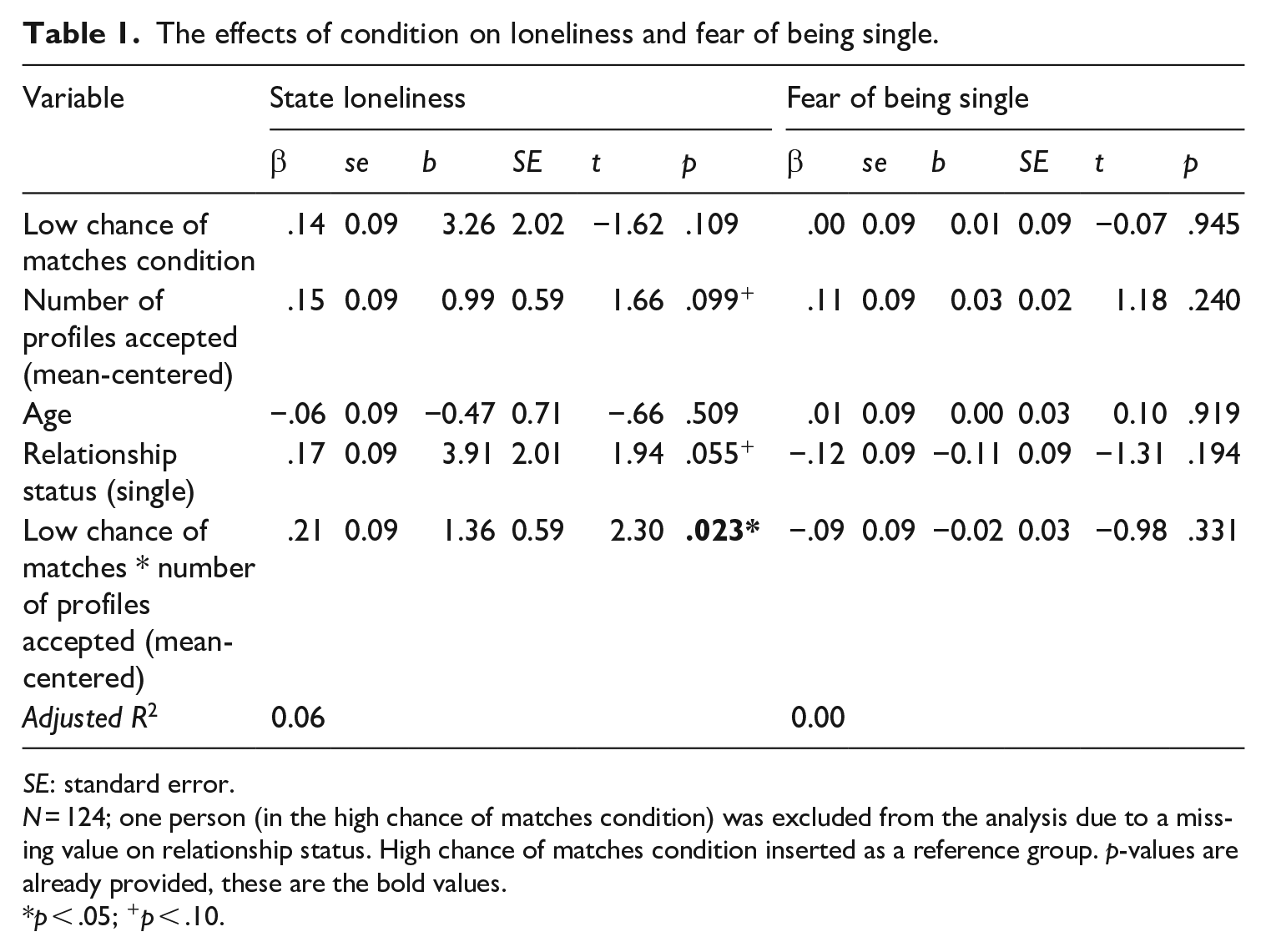
All coefficients can be found in Tables 1 and 2. One person was excluded from the analyses because she did not disclose her relationship status (N = 124). Against our expectations, we did not find a main effect of condition on participants’ state loneliness (b = 3.26, p = .109; H1). As predicted, the results revealed a positive interaction effect of condition and profiles accepted (b = 1.36, p = .023; H4a). For women who accepted many profiles, a lower chance of matches led to higher loneliness than a higher chance of matches.
The effects of condition on loneliness and fear of being single.
SE: standard error.
N = 124; one person (in the high chance of matches condition) was excluded from the analysis due to a missing value on relationship status. High chance of matches condition inserted as a reference group. p-values are already provided, these are the bold values.
p < .05; +p < .10.
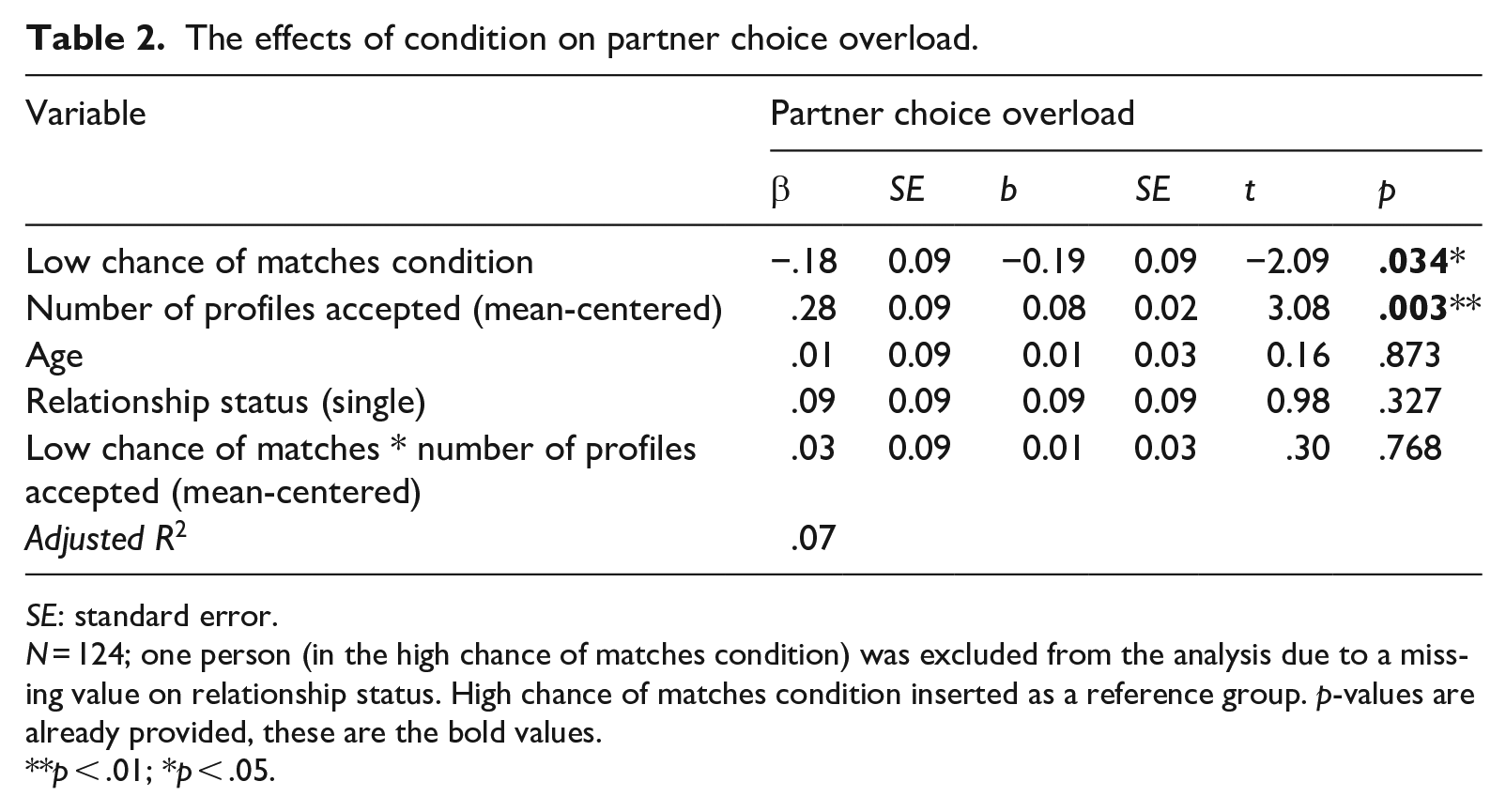
The effects of condition on partner choice overload.
SE: standard error.
N = 124; one person (in the high chance of matches condition) was excluded from the analysis due to a missing value on relationship status. High chance of matches condition inserted as a reference group. p-values are already provided, these are the bold values.
p < .01; *p < .05.
Simple slopes analyses revealed that the effect of the high chance of matches condition was significant at high levels of the moderator, that is, only for women who accepted many profiles. Precisely, the effect of the high chance of matches condition became significant for women who accepted seven or more profiles. The nature of the effect is presented in Figure 1. No other effect occurred.
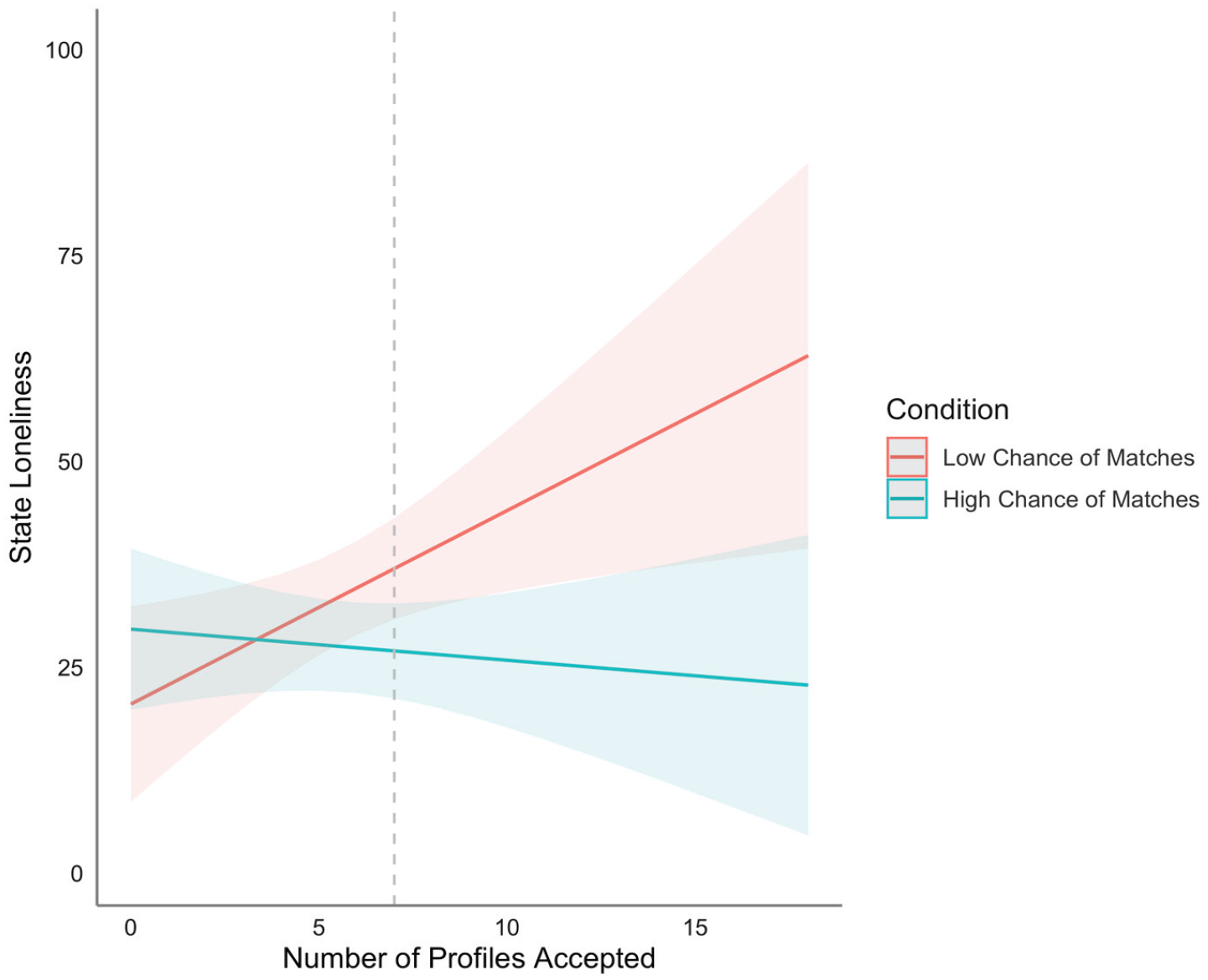
In women who accept seven or more profiles, a high chance of matches decreases state loneliness compared to a low chance of matches.
Effects on fear of being single
With regard to our second dependent variable fear of being single, we did not find any effects of the condition on this variable (b = 0.01, p = .945; H2) nor any interaction effect with the number of profiles accepted (b = −0.02, p = .331; H4b). No other effects were found.
Effects on partner choice overload
Testing H3, we found a direct effect of the condition on the experienced partner choice overload: Young women in the low chance of matches (i.e. ostracism) condition experienced a lower level of partner choice overload compared to young women in the high matches condition (b = −0.19, p = .034; H3). We observed no interaction effect of condition and number of profiles accepted (b = 0.01, p = .768; H4c). While H3 was supported, H4c has to be rejected.
In addition, we found a direct effect of the number of profiles accepted: Participants who accepted many profiles reported significantly more partner choice overload (b = 0.08, p = .003). No effects of the control variables emerged.
Discussion
Dating apps not only facilitate in-person encounters but also provide in-app gratifications, such as social feedback in the form of matches. After cross-sectional research has revealed associations between positive dating app feedback and well-being (Courtois and Timmermans, 2018) and a vignette-based experiment emphasized the influence of being ignored in a dating app context (Alba, 2021), we contribute the first experiment manipulating the amount of positive feedback in the form of matches as a manipulation of social acceptance versus ostracism.
Effects on loneliness
Our results showed that chance of matches failed to influence state loneliness overall. Practically, this implies that the lonely who turn to dating apps (Coduto et al., 2019) may find no relief simply by collecting matches. Explanations for this unexpected finding could lie in theory, manipulation implementation, or outcome assessment. Theoretically, the finding that an absence of matches did not increase loneliness is at odds with the evolutionary theory of loneliness (Cacioppo and Cacioppo, 2018) that humans will respond with painful feelings of social isolation to minor signals of social exclusion, even by strangers (Spoor and Williams, 2007). With regard to theory, it is debated whether social exclusion has noticeable negative effects on subjective emotions (Blackhart et al., 2009). Many findings also show that being excluded rather leads to emotional numbness (DeWall and Baumeister, 2006) or even to an increased accessibility of positivity (DeWall et al., 2011). Numbing was found especially in exclusion paradigms that induce severer pain such as the life-alone paradigm (Bernstein and Claypool, 2012). Experiments with a pretest-posttest design are needed to disentangle if positive dating app feedback can alleviate loneliness compared to a baseline measure or if the absence of feedback (as an operationalization for ostracism) can increase loneliness.
As regards manipulation implementation, not all kinds and doses of social feedback may be sufficiently powerful to affect loneliness. Weak mediated cues, such as Likes or matches, may be too weak and noncommittal a cue to trigger feelings of social connectedness—even if users accumulate greater numbers (Goldenberg, 2019). Matches could fail to decrease loneliness because their quantitative and rather empty character induces social comparison processes, which are associated with negative affective reactions (Her and Timmermans, 2020). To make matches feel more meaningful, researchers in future experiments could vary the preceding self-disclosure. Deters and Mehl (2013) found no effect of friends’ social feedback on loneliness, they did find, however, that increasing one’s number of status updates decreased loneliness (Deters and Mehl, 2013). This suggests that not social feedback but self-disclosure would be the main mechanism for decreasing loneliness. Thus, a hypothesis for future research could be that social feedback (e.g. Likes, matches) alleviates loneliness if preceded by sufficient self-disclosure (as in line with our significant interaction discussed below).
Future research using a dating app paradigm could also experiment with the dosage of matches. Since a single intervention could have been too weak to affect state loneliness, future research should repeatedly provide dating app feedback. Prolonged exposure would also allow researchers to observe how participants cope with peer feedback over time. One can imagine that ostracized individuals respond with hostile (fight) or avoidant (flight) coping (Kothgassner et al., 2017), that is, accepting less dating app profiles. However, one could also expect increased acceptance rates, due to excluded individuals increasingly tuning toward positivity (DeWall et al., 2011) or due to women’s tendency to tend and befriend, that is, increasing prosocial efforts toward ostracizers (Williams and Sommer, 1997).
An explanation related to outcome assessment could be that most researchers in the field (e.g. Gerber and Wheeler, 2009; Lutz and Schneider, 2021; Wallace and Buil, 2021) have measured loneliness or threatened belongingness with items specific to the preceding situation or scenario (e.g. “I felt I belonged to the group”). We, in contrast, measured generalized state loneliness (e.g. “I feel isolated from others” or “I have enough companionship”). Since these items pertain not directly to the preceding interaction but to others in general, this variable seems much harder to influence.
Yet, the results look differently for women who actively accepted many profiles themselves. For those willing to show above-average approach efforts, retrieving matches in return for their approaches decreased loneliness. Thus, under specific boundary conditions, matches can successfully fulfill a social function. It is the combination of actively accepting profiles and receiving matches that creates a social connection. An explanation for why matches influenced individuals who accepted many profiles could be that generously accepting profiles mirrors an approach orientation, which makes those individuals more open to social feedback than more avoidant individuals, according to reinforcement sensitivity theory (Corr, 2008; Gray, 1990). This is in line with prior research relating approach orientation to a higher reward sensitivity (Gupta, 1990) and with findings that self-disclosure on social media decreased loneliness (Deters and Mehl, 2013).
Future research should further query those who accept many dating app profiles on whether their approach orientation results from a chronically salient social need and desperate desire to receive match, or from a social richness. On the one hand, those who accept many profiles on dating apps could be more open to weak communicative cues due to their pronounced social needs. For example, lonely people overperceive others’ friendliness (Leary and Acosta, 2018). While those high in fear of being single show no such perceptual bias (Spielmann et al., 2013), prior research showed that fear of being single was still related to increased acceptances: Individuals high in fear of being single expressed greater romantic interest in unresponsive and unattractive profiles than those low in fear of being single (Spielmann et al., 2013). On the other hand, research shows that the socially rich and saturated initiate more social approaches than the lonely (Cacioppo and Hawkley, 2005; Eronen and Nurmi, 2001). Chronically lonely youth are hypersensitive to cues of both social inclusion and exclusion; therefore, they often seek out social situations and participate in ways that increase or maintain rather than decrease their loneliness (Vanhalst et al., 2015).
Research on distributing Likes on Facebook has found that those who reported more interpersonal generosity (e.g. time for others’ problems) and more public self-consciousness (e.g. care about appearance) distributed more Likes (Hong et al., 2017). It is unclear whether care for others and for public appearance stems from social anxiety or security. It could be a U-shape such that both very lonely and very connected individuals accept many profiles. While in our posttest-only design, generously accepting more profiles was unrelated to both fear of being single (at posttest) and loneliness (at posttest), future research should examine if prior loneliness and fear of being single affect the number of social approaches positively or negatively (if at all). In any case, we found in the present study that social rewards come to those who, for whatever reason, show above-average approach behaviors.
Note that these are correlational findings since we did not manipulate the number of profiles accepted. The findings still emphasize the importance of factoring in participants’ social approaches in the form of profile acceptances. Considering social approach behavior is a main advantage of manipulating social acceptance or ostracism in a dating app paradigm. Since the procedure proved successful in decreasing state loneliness in those who accepted many profiles, social psychologists can consider a dating app procedure to manipulate social exclusion.
Effects on fear of being single
As a second psychological outcome, we investigated fear of being single, that is, the worry of remaining or becoming single including the belief that there is something wrong when one is single. On the basis of sociometer theory (Leary et al., 1995), we had predicted that dating app feedback would inform participants’ fear of being single. However, social feedback in a dating app paradigm did not influence women’s fear of being single. Practically, this implies that although individuals high in fear of being single tend to turn to dating apps (Timmermans and De Caluwé, 2017), receiving matches seems not to yield the desired relief. The reasons are probably very similar to why matches could not decrease loneliness: Receiving many matches seems rewarding but does not suffice as a social signal to influence fear of being single. Perhaps strong signals from few profiles would be more effective. Positive feedback on dating apps has also been shown to reinforce swiping (Her and Timmermans, 2020) which has in turn been associated with higher fear of being single (Thomas et al., 2023). The construct fear of being single with its strong normative aspects (and connection to the attachment) is perhaps not as easily malleable. Sociometer theory would also predict effects on self-esteem or relational value (Leary and Acosta, 2018). So, future research could test if social feedback influences mate value.
Moreover, we did not find the number of profiles accepted to moderate an effect of matches on fear of being single. The effect remained nonsignificant independent of whether women accepted few or many profiles. It could either be that matches under no circumstances decrease fear of being single. Perhaps the entire dating app setting (with its profile abundance) rather maintains or increases fear of being single (Thomas et al., 2022), or the relevant boundary conditions have yet to be identified by future research.
Effects on partner choice overload
Third, with regard to partner choice overload, we found a main effect of dating app feedback: Participants in the condition with a high chance of matches reported significantly higher levels of partner choice overload, that is, being overwhelmed and distracted by the profiles. The finding is in line with users reporting feelings of overload due to excessive signals of male interest albeit polite (Anderson et al., 2020). The finding can be explained by the phenomenon of choice overload (Iyengar and Lepper, 2000), according to which excessive information and options cost cognitive resources and overwhelm decision-makers. Earlier studies have found partner choice overload to be related to excessive swiping (Thomas et al., 2023) and to depend on the mere number of profiles evaluated (Pronk and Denissen, 2020; Thomas et al., 2022, 2023). Although participants in both of our conditions had evaluated the same number of profiles, those with the higher chance of matches were more likely to agree that they had seen so many potential partners that they could barely process the information. It follows that if dating app users get positive feedback, evaluating profiles seems to cost more cognitive resources than if they do not receive positive feedback. Interestingly, this effect was already possible when using only 31 profiles. As a follow-up, future experiments could both manipulate the number of profiles as well as feedback.
With our findings, we extend findings of choice overload to the domain of social information processing. So far, researchers have examined the cognitive effects of social exclusion and found that negative feedback creates overload because it upregulates attention to social cues and thereby exhausts cognitive resources (Wong et al., 2022). It is interesting that in the present study’s dating app paradigm, positive social cues increased overload, showing that even processing purely positive information costs cognitive resources. Future research should further examine when exactly social acceptance becomes too much and which other adverse effects (excessive) social acceptance could have. Bandinelli and Bandinelli (2021) argued that dating apps craftily play with inducing feelings of lack and excess by turns. To investigate how long effects of dating app matches (e.g. on feelings of overload) last, future experiments could include several follow-up measures.
The direct effect of matches on partner choice overload was not moderated by the number of profiles accepted. Matches increased feelings of overload and distraction for all women, independent of how selectively they accepted profiles. Interestingly, the number of profiles accepted also relates positively to overload, so especially those with a high approach orientation also seem more likely to feel overwhelmed independent of the number of matches they receive.
Apart from the specific outcomes we studied, future research could also test effects on other relational, intrapersonal, and entertainment goals (Sumter and Vandenbosch, 2019) or on entirely different domains of well-being. Other researchers of social exclusion examined, for example, physiological outcomes, such as arousal, pain, or neural activation following social feedback (Chen et al., 2008; Eisenberger et al., 2003). Theoretically, prolonged ostracism could even affect generalized (cognitive) outcomes such as meaningful existence or life satisfaction (Williams, 2009).
Limitations
Our findings must be interpreted considering some methodological limitations. First, due to the rather limited sample size of 125 women, our power to detect group differences on loneliness and fear of being single smaller than d = .45 was lower than 80%. We had tried to recruit more participants but willingness to participate was low, most likely because participants needed to hand in a picture of themselves to participate. Luckily, this requirement seems not to have biased the sample in the way that very confident women were overrepresented. Mean levels of fear of being single (M = 2.80; SD = 0.96) were very similar to other undergraduate samples with high proportions of women (Spielmann et al., 2016; Thomas et al., 2022; Timmermans and De Caluwé, 2017). The requirement of handing in a picture did however result in a small sample size and replications are highly warranted. Future well-powered experiments should test if our findings are robust and could then also examine the effects of additional factors, such as profile gender.
Second, our sample consisted of undergraduate women. Manipulating social acceptance with a chance of matches as high as 27 out of 31 is realistic for women because men generously accept many profiles. Heterosexual men accept 46% of profiles on Tinder, according to company data, and therefore heterosexual women tend to get a lot of positive feedback (Anderson et al., 2020; Smith, 2022). However, women do not generously provide many matches and therefore men are rather used to the absence of positive feedback on dating apps (Courtois and Timmermans, 2018). Women accept only 14% of profiles, on average (Smith, 2022). Applied to our procedure with 31 profiles, this would be 4 out of 31. In our sample, women accepted M = 5.73 out of 31 profiles. When the mean acceptance rate by women lies between 4 out of 31 (on Tinder) and 6 out of 31 (in our study), it is extremely unrealistic to use the same manipulation of the present study (i.e. 27/31 vs 3/31) in a male sample. Men who get a lot of positive feedback on dating apps may be accepted by women twice (8–12/31) or three times the mean (12–18/31), so a realistic manipulation for high social acceptance would be somewhere between 8 to maximally 18 out of 31 profiles. For the present study, we could not use this weaker manipulation for men because then we would have introduced manipulation strength as a confounding factor. Yet, we highly recommend this for future experiments in men. Since we conducted the experiment in a female sample, we cannot generalize our findings to men, that is, dating app matches could have entirely different effects on men.
Due to our sample composition, we also cannot conclude that our findings in undergraduates will be valid in other educational groups. However, education is not a central variable with regard to peer feedback. The need to belong is a very basic, fundamental human motivation that remains unaffected by education; all humans, no matter if college-educated or working class, want to be accepted by their peers (Büttner and Rudert, 2022; Hartgerink et al., 2015).
Third, we manipulated matches because an experimental design allows testing the pure effect of dating app matches independent of potentially confounding individual differences (e.g. attractiveness). Therefore, our experimental findings have high internal validity and causal inference is possible. Yet, an experiment is an artificial reconstruction of a real-world setting, so conclusions have lower external validity than observations of naturally occurring events. Therefore, future research should also observe the effects of real users’ actual dating app matches using longitudinal designs with two or more waves or event-contingent experience sampling (i.e. every time participants receive matches).
We encourage researchers in future studies to extend our findings to more diverse samples and study other relevant outcomes of dating app social feedback, such as self-appraisals or hostility toward rejectors (Galbava et al., 2021; Twenge et al., 2001). One could also investigate how users interpret the ambiguous absence of matches because absence could mean that others are not attracted but could also be an issue connected to the opaque app algorithm. Future research could also use qualitative methods to more sensitively detect slight changes in state loneliness. Open questions would also allow participants to explain unexpected ways in which dating app matches influence diverse facets of loneliness. To refine the task as a lab manipulation of ostracism, it could be useful to compare the effects of Cyberball and dating app feedback. Finally, the present study made use of two conditions, namely high and low chance of matches. Future social exclusion research could add a third condition with explicit negative feedback, for example, by telling participants how many have dismissed them, comparable to the vignette-based experiment by Alba (2021).
Conclusion
Despite the aforementioned limitations, the contribution of the present study is threefold: First, we move beyond testing the influence of usage frequency by focusing on a specific experience on dating apps, namely receiving matches. Second, we provide much-needed experimental data on the relationship between dating app success and well-being, showing that matches do not decrease women’s state loneliness or fear of being single and increase overload. Third, we manipulated social acceptance versus ostracism using a dating app paradigm that allows researchers to consider to what extent participants sought connection. Confirming the importance of participants’ own approaches, we find that social approval on dating apps decreases loneliness in women who accepted many profiles.
Footnotes
Funding
The author(s) received no financial support for the research, authorship, and/or publication of this article.
