




Abstract
This article explores body–voice entanglements in TikTok through the prism of ventriloquism. It suggests that TikTok is an app of network ventriloquism, that is, an audiovisual technology–based web of dissociations and reconfigurations of users’ bodies and voices. Yiddish serves as a case study for how TikTok’s features build an infrastructure for language, heritage, and cultural activism. We analyze YiddishToks as an instantiation of the ways TikTokers embody actual technolinguistic and ventriloquistic interconnections as well as bond with past generations. YiddishTokers interlace times and spaces and recontextualize Yiddish media history. TikTok’s algorithm participates in this reanimation of Yiddish’s past; it is a transparent, audible director that prompts the network off-stage. TikTok is an algorithmic network ventriloquism app that mediates between human and non-human voices.
Keywords
A TikTok video posted by @c.o. bernstein on September 2020 presents Rukhl, a Yiddish-speaking “immigrant teen working @ the Triangle Shirtwaist Factory (1900s NYC sweatshop).” The video is tagged as #POV, which means that it presents Rukhl’s friend point of view, thus positioning the viewer in the role of this friend. Rukhl is wearing a headkerchief and the video is filtered black and white to evoke a dawn of the twentieth-century atmosphere. The backtrack tune, however, is a contemporary hip-hop beat by a TikTok user named Pr!d3, over which Bernstein raps in Yiddish. The sentences feature on the screen both in Yiddish and in English translation: Rukhl—we know from the video description and from her spoken text—is “getting testy” over her working hours in the factory, her boss and her salary, and she considers going on strike (see Figure 1). Fictionalizing a political moment grounded in Yiddish-American history, this video is a reminder that TikTok content may go beyond the silliness and fun attributed to this platform; it discloses theatricalized identity-building processes based upon lingual and cultural heritage (Boffone, 2022).
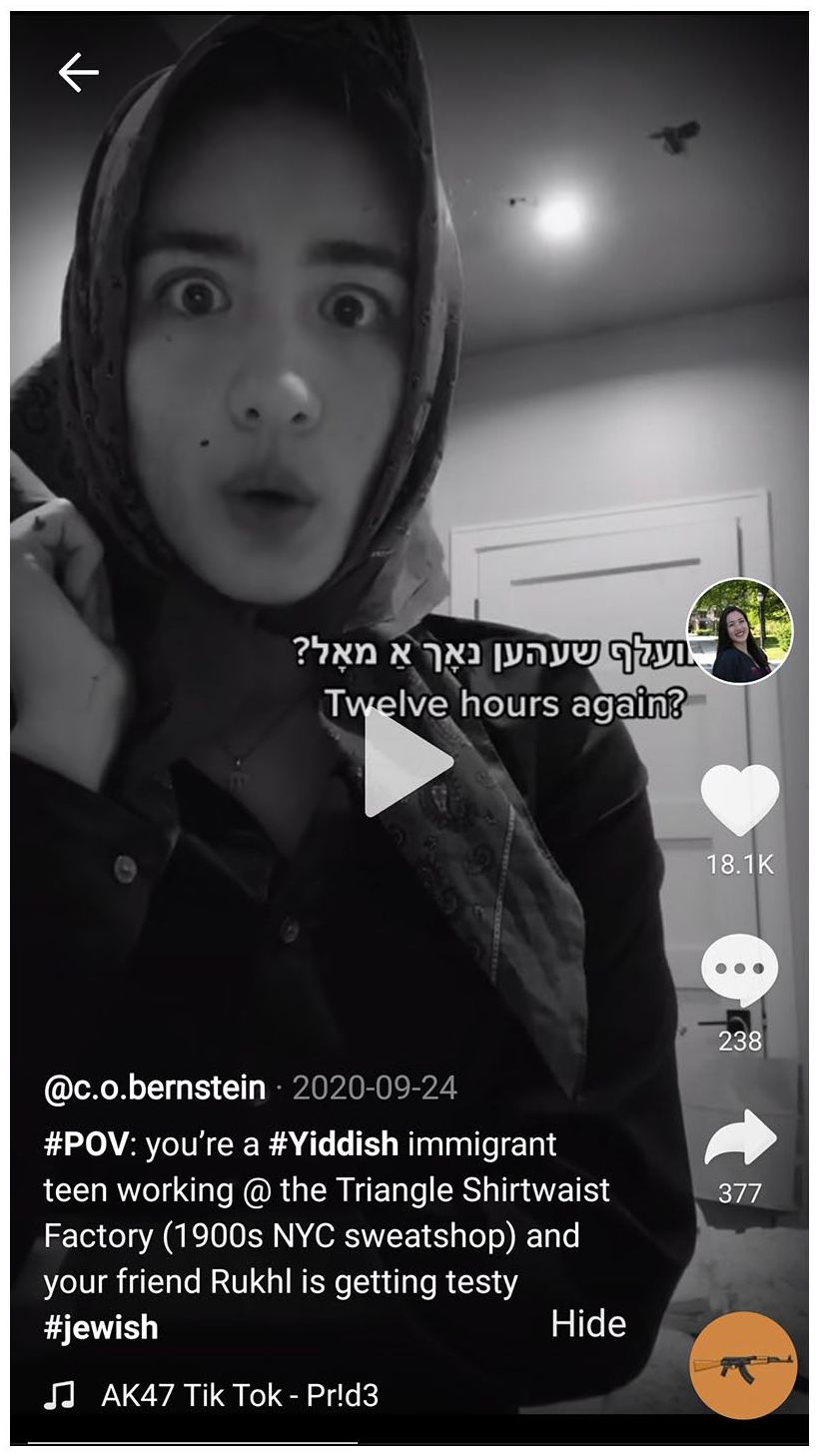
A screenshot from @c.o. bernstein’s Tok.
@c.o. bernstein’s TikTok account is almost entirely devoted to Yiddish: it is a platform for promoting Yiddish content, such as presentations of Yiddish books and archival material, or explanations of basic Yiddish words and Jewish customs. In some of the videos, @c.o. bernstein showcases Rukhl as a made-up persona; in others, she performs as an actual historical figure, and in the rest of the videos she appears as herself, a “23ǀ filipino/ashkenazi yiddish learner from chicagoǀ✡.” She shifts among these roles, embodying imagined and actual voices of the past. Many of her videos contain her own original soundtrack; others gear one of the key features TikTok is known for: miming, lip-synching, or just reappropriating sounds from other videos onto a new context (Zulli and Zulli, 2022).
TikTok urges users to create their own mimetic videos by affording them with sophisticated editing tools: the button Use this sound encourages users to detach the soundtrack from its original video and replace it with their own visuals; they may use the original soundtrack to reenact or parodize the body movements of the initial video or use this soundtrack to create new moves for the new one. Similarly, the Duet button allows juxtaposing the reaction video alongside the original one and Stitch serves to edit a video amalgamating both the original and the reaction video. Other editing tools enable TikTokers to add text and animation or manipulate the footage with filters and layers. These functions of editing, juxtaposing, and remixing of videos are the expressive means that shape TikTok as multivocal, encouraging communal creativity and participation within a social network of users. This article shows how Yiddish TikTokers gear these features to celebrate their heritage language, connect to cultural legacy, and create social bonds.
Lip-synching to someone else’s voice while mimetically reperforming a dance or reenacting gestures from another video is TikTok’s prominent attribute, which beckons us to explore it through the perspective of ventriloquism and, specifically, of media ventriloquism (Baron et al., 2021). The term “ventriloquism” refers to a vocal illusion forged by a person manipulating his or her voice so that it appears to emerge from elsewhere (Connor, 2000). Ventriloquism has become a contemporary theoretical lens for exploring the not-necessarily synchronic relations between body performances and media technologies (Cooren, 2010). It is a body technique that inherently involves a media complication, since it disrupts the assumed straightforward connection between body and sound, thus drawing attention to the materiality and mediation of both the human body and the voices it produces (Snell, 2020). With the advent of sound-recording and moving-image technologies, a new era of media ventriloquism emerged, further decoupling “voices from their originary bodies” and generating multiple displaced vocalic entities (Baron et al., 2021: 2). Ventriloquism became a ubiquitous, albeit technologically mediated phenomenon.
Further exploring media ventriloquism, we suggest that it is medium-dependent: each medium slightly differs in its competence, and in the ways it allows its users to reshape the relation between bodies and voices. To define the type of ventriloquism afforded by TikTok, we coin the term network ventriloquism—a technology-based web of connections between users who exchange, reuse, and recontextualize voices and body movements across time and space. This type of ventriloquism, we argue, stems from TikTok’s structure and unique features, which algorithmically network its users. Concomitantly, it also entails a contemporary development of previous ventriloquistic media, such as the phonograph, cinema, and the telephone, and of other social media platforms, such as YouTube. The propagation of Yiddish on TikTok provides an apt case study to unravel the virtues of network ventriloquism.
Exploring TikTok as a ventriloquistic platform allows concentrating on the materiality of the digital existence of bodies and sounds against the tendency to regard them as mere virtual representations. TikTok’s aesthetics of vertical narrow screen and focus on the human body derives from the shape and utilities of the smartphone and its photographic and videomatic conventions (Frosh, 2019). Similarly, in many Toks, the audio of the video depend upon the quality and range of the smartphone microphone. In addition, as a social media app, TikTok algorithmically regulates the bodies and sounds it mixes and distributes, submitting them to the techno-logic of algorithmic culture (Striphas, 2015). The materiality of bodies, sounds, and algorithm set the stage for the ventriloquistic show that is TikTok. The features of the smartphone and TikTok’s algorithm and means of expression, correspondingly, furnish users with possibilities to experiment with their bodies and voices in relation to other users’ performances.
To understand the particular media entanglements of TikTok as a network ventriloquist app, we examine Yiddish on TikTok as an ongoing manifestation of mediated body–voice creative practices. As a case study, Yiddish exemplifies and contextualizes the social and cultural significance of TikTok as a platform for language and cultural activism, and for linking users through heritage transmission. Our aim is to show how Yiddish TikTokers embody a technological and linguistic connection to one another and to the past, performing network ventriloquism as part of their identity and community-building processes.
Contemporary Yiddish is a particularly interesting prism to explore network ventriloquism since, like the ventriloquistic act, this language already embodies a chain of dualities: it is a minority language that, while some consider as “dead” or “frozen,” others emphasize its vitality and animation (Fishman, 2012; Shandler, 2020; Zaritt, 2017). Jewish ultraorthodox communities speak it as a vernacular, but for other communities it is a “post-vernacular,” devised for their cultural heritage (Shandler, 2005). In its mundane existence it is a transparent medium for everyday usage, but in its post-vernacular capacity it entails a means for linguistic and cultural exploration, activism, and self-awareness that involves younger generations in the politics of memory and identity. Inherently bifocal, contemporary Yiddish suggests a unique perspective that aligns with the body–voice decoupling that characterizes TikTok as a network ventriloquist platform.
In what follows, we first discuss ventriloquism as a media phenomenon and then as a framework to understand Yiddish TikTok. We submit that, as a techno-lingual and corporal complex, YiddishTok exacerbates an infrastructural body–voice split built into TikTok as a network ventriloquism app. To unpack YiddishTok as a contemporary lingual, cultural, and social compound, the analysis reverts to the beginning of the twentieth century, when sound-recording technologies and cinema first introduced media ventriloquism, and Yiddish theatrical performances were first recorded on shellac records.
If audiovisual media are inherently ventriloquistic (Connor, 2000), then TikTok’s ventriloquism may be clarified by harking back to that primal moment in media and Yiddish history. Taking inspiration from TikTok’s duet function, we juxtapose then and now, suggesting that this turning point in both the histories of Modern Yiddish and modern media technologies sheds light on Yiddish, on TikTok, and on Yiddish TikTok. This comparison fosters tracing the origins of the techno-acoustic complications manifested in TikTok and, while acknowledging the winding genealogy of media ventriloquism—from the phonograph and cinema to YouTube and Siri—it abstains from perusing all of its stages. Respectively, the discussion alights on one main example from the early recordings of Yiddish theatrical performances and examines it as a case of media ventriloquism; we suggest that such recordings were imperative to the later shaping of Yiddish as a post-vernacular. The discussion subsequently shifts onto an analysis of YiddishToks that exemplify how network ventriloquism prompts heritage exploration within the context of post-vernacular Yiddish. Acknowledging the role of TikTok’s algorithm in networking human users, we then probe the possibility of non-human Yiddish ventriloquists. The conclusion highlights the ways TikTok echoes mediated voices as memory and heritage work.
Media ventriloquism
Ventriloquism is a body technique for producing voices sounding as if they were issuing from somewhere else. Commonly perceived as a popular stage act that involves a performer (ventriloquist) and a puppet (a dummy), ventriloquism may trigger confusion and awe, but also incite curiosity and amusement. As an audiovisual phenomenon and a means of expression, it is widespread and deeply rooted in culture. It dates back to ancient times, and historically—from the Oracle of Delphi to the Dybbuk—it was closely connected to femininity, irrationality, and mysteriousness, stirring accusations of necromancy. The gap it opens between voices and their obscure origin invites speculations on the possibility that these voices came from other places and/or times. Channeling voices through the performer’s body, ventriloquism emphasizes the body’s features as a medium; it also undermines the alleged oneness and cohesion of the self, superseding them with multiplicity and openness (Connor, 2000; Goldblatt, 2006). As a theoretical perspective, ventriloquism implies that every voice encapsulates multiple iterations, each with its distinct features, rhythm, and “overall temporal range” (Altman, 1992: 19).
As an operative principle, ventriloquism may be detected in the function of audiovisual media technologies (Chion, 2016; Doane, 1980; Kane, 2014; Truax, 2001). These media dislocate the voice from its origin, and by offering themselves as alternative vessels for this voice, they stretch and obfuscate the time and space axes of sound–body relations (Altman, 1980; Zheng, n.d.). Some of these media, such as the telephone, channel voices through them, connecting one point to another on a network of users; others, such as gramophone records or film, also function as repositories, encapsulating various voices from different times and places, thus establishing a ventriloquism that is archival in its core (Baron et al., 2021). Audiovisual media are inherently ventriloquistic. They remediate sounds and bodies, archiving and mixing them in a chain of disconnections and reconnections, not necessarily realigning the sounds with their original sources. That a voice or body may appear on one medium and be remediated and mangled with on another has become especially evident since digitalization eased and expedited editing procedures (Drenten and Psarras, 2021). Positing the possibility of more than one medium repeatedly remediating the same sound and/or body, media ventriloquism is always already committed to a network structure, disseminating sounds and bodies via diachronic and synchronic media connections.
By way of metaphor, ventriloquism serves to describe the interdependency of an author drawing on the figurative voices of his or her predecessors (Cooren, 2010; Derrida, 1997). As an analytical framework, ventriloquism involves influence and imitation, but also assumes hermeneutics of disruption and relocation, as every act of ventriloquism makes others speak outside their original context. Its embedded network structure comes with ethical prices: ventriloquism is bound to misuse past voices, metaphoric or actual ones, and it generates appropriative power relations between the different actants (Baron, 2020). This codependency goes both ways; media ventriloquists might find that they have become dummies, and vice versa.
The different media vary in their respective ventriloquistic operations, further manipulating the chain of body–sound dissociations and realignments. Gramophone records multiply and disseminate disembodied voices fixed in their surface grooves, and manipulation of records on a turntable, or of digital samples, is the heart and soul of several musical genres. Cinema is based upon the synchronization between sounds and visuals, and out-of-synch scenes may cause confusion or, if intentional, may serve artistic expression. Text-to-speech algorithmic technologies, such as Alexa or Siri, employ non-human ventriloquism (Riszko, 2017).
The network structure integral to media ventriloquism—remediating, transforming, remixing and circulating voices and bodies across various media—associates human mediums with media technologies. TikTok, in particular, exploits the possibilities enfolded in this phenomenon, since it allows its users to cast themselves as ventriloquists or dummies, without leaving the app. It even entices them to do so, as this is its main operative logic, supported by the app’s interface: TikTokers have all the editing tools ready at hand and simple to use, a click button away. This further complicates the power relation between dummies and ventriloquists to include both humans (Tokers) and non-humans (the medium and its algorithmic infrastructure). TikTok is an app of network ventriloquism in and of itself, crystallizing the social and cultural phenomenon manifested by previous ventriloquistic media. It situates ventriloquism at the heart of a mimetic configurable culture (Shifman, 2013; Sinnreich, 2010), submitting the body and its voices to the logic of viral sharing of reprocessed content and to the participatory conventions that stand at the basis of social media (Boxman-Shabtai, 2019).
The Internet has long been fraught with various forms of ventriloquism. From bad lip-reading videos to deceitful deepfakes, ventriloquism on the Internet affords a source of entertainment but also of political activism, as well as fake news (Baron, 2020). Media ventriloquism may also encourage users to practice remembrance by resounding past voices and participate in identity-building processes on the basis of lingual heritage, enhancing a sense of belonging. Network ventriloquism on TikTok increases these characteristics, as it tightens the links between the members of its ventriloquistic community: all TikTokers know, and probably hope, that their videos will be replied to, reused, and abused for duet or stitch and generally serve the logic of network ventriloquism. Some users specifically ask others to use this sound or duet their Toks; others leave sound intermissions for other Tokers to fill in with their own voice, thus assuming an imaginary dialogue, like in repeat after me videos. Yiddish TikTokers rely upon the network ventriloquism of TikTok to perform Yiddish as a post-vernacular and to connect with other Yiddish TikTokers. In the next sections, we demonstrate how these connections create a multivocal Yiddish that is enhanced by the features of TikTok’s network ventriloquism.
Yiddish, ventriloquism, and media
Yiddish was the vernacular of eastern- and central-European (Ashkenazi) Jews. It is thought to have originated around the year 1000 CE, when Jews settled in the central Rhine valley, adopting linguistic features of the local German. The absorption of linguistic influences continued to structurally characterize its evolution, with the infusion of Slavic, Romanic, and German elements besides its Hebrew and Aramaic components. Its layered linguistic texture attests to the story of Jewish dispersion, decentralization, and deterritorialization. As the shared language of Ashkenazi Jews, Yiddish networked diasporic communities in everyday communication and cultural creation.
The role played by Yiddish in connecting communities was underscored by mass-Jewish migration movements at the turn of the twentieth century, mainly from Eastern Europe to America (Alroey, 2021; Soyer, 1997). Concomitantly, sound-reproduction technologies have disseminated copies of recorded Yiddish songs, mediating and interpreting, rather than merely documenting the recorded events. These Yiddish records reflected the multiplicity and fluidity of the contemporaneous migratory reality. But they did more than that. They entailed an ontological connection between the migration of actual bodies across continents and the distancing of singing bodies from their recorded voices. Yiddish sound records functioned as a cultural lifeline for migrants, echoing their origin communities while paradoxically emphasizing the ventriloquistic body–voice split as a manifestation of social fragmentation. Moreover, the dispersion and transgression of migratory bodies was reverberated not only in the new sound-recording media but also by playing with gender performances in theater. Many actresses of the popular Yiddish stage became famous for their cross-dressing roles; examples include Betha Kalich, Molly Picon, Freyde Oysher, and Pepi Littmann (Baker, 2021; Seidman, 2011; Shandler, 2006; Sicular, 1999).
As one of the most beloved stars of the Yiddish light-stage, Littmann was already recorded in 1904. In her recording of Die welt is meshuga (“the world is crazy”), Littmann performs in her role as Itsikl, a young male Hasid from Julius Adler’s Yiddish operetta Itsikl Wants to Marry (premiered in Warsaw, 1914). In her singing, Littmann gravitates between various vocalic techniques and genres—cantorial, operatic, Jewish folksongs and cabaret—summoning through her performance different cultural figures. According to historical witnesses, she “had a masculine voice, deep and hoarse” (Zylbercweig, 1934: 1054), but in this recording she sounds boyish and the low fidelity of the early recordings pushes the pitch of her voice even higher.
Sound recordings are always partial representations, interpretations of the recorded sound event (Altman, 1992). Listening to them within ever-changing technological, spatial, and temporal contexts generates different experiences and defines “sound” as inherently multiple and mediated. Littmann’s sound recordings cast her as a ventriloquistic medium, not only because they emphasize and tease out the multivocal quality of her singing, but also because they detach her voice from her body. This bodyless, record-dependent voice was duplicated in many copies and then disseminated across the Yiddish world. These recordings were replayed time and again, both in America and in Europe and, since then, could be repeatedly remediated in various media. Nowadays Littmann’s recordings may be heard on sound files in archives, as well as on YouTube. These records represent examples from a large corpus of commercial Yiddish theater sound recordings that remediated theater songs, giving them life beyond the theater stage. Such recordings demonstrate how the new media of that time embodied novel modes of ventriloquism, introducing new possibilities for the dissemination of disembodied voices across time and space. Littmann’s recordings showcase the journeys of disembodied voices from one medium to another, demonstrating how voices of the past are given expression in new, contemporary contexts. Remediated Yiddish voices echo through time, space, and media, connecting Yiddish diasporas across these axes.
Nevertheless, even when Littmann’s voice was detached from its corporeal source, her body was still presented in several photographic images. In many of them, Littmann’s media ventriloquism was enhanced by her cross-dressing performances, which added visual aspects to the already troubled gender associations ironically vocalized in her recordings (and in the content of some of her songs). In a historic photo from the same Adler operetta, she appears as Itsikl, wearing a manly velvet hat over her extended curly earlocks. Her feminine heeled sandals, however, hint at gender bending (see Figure 2). Another photo presents Littmann in masculine attire, with a bowler hat on her head, directing a cheeky gaze at the camera, nuancing a vexing roughness in her smile (see Figure 3). Multiplicity was, therefore, part and parcel of Littmann’s visual and vocalic performance; when she was recorded and photographed, these media ventriloquistically expanded her body and voice beyond their concrete presence.
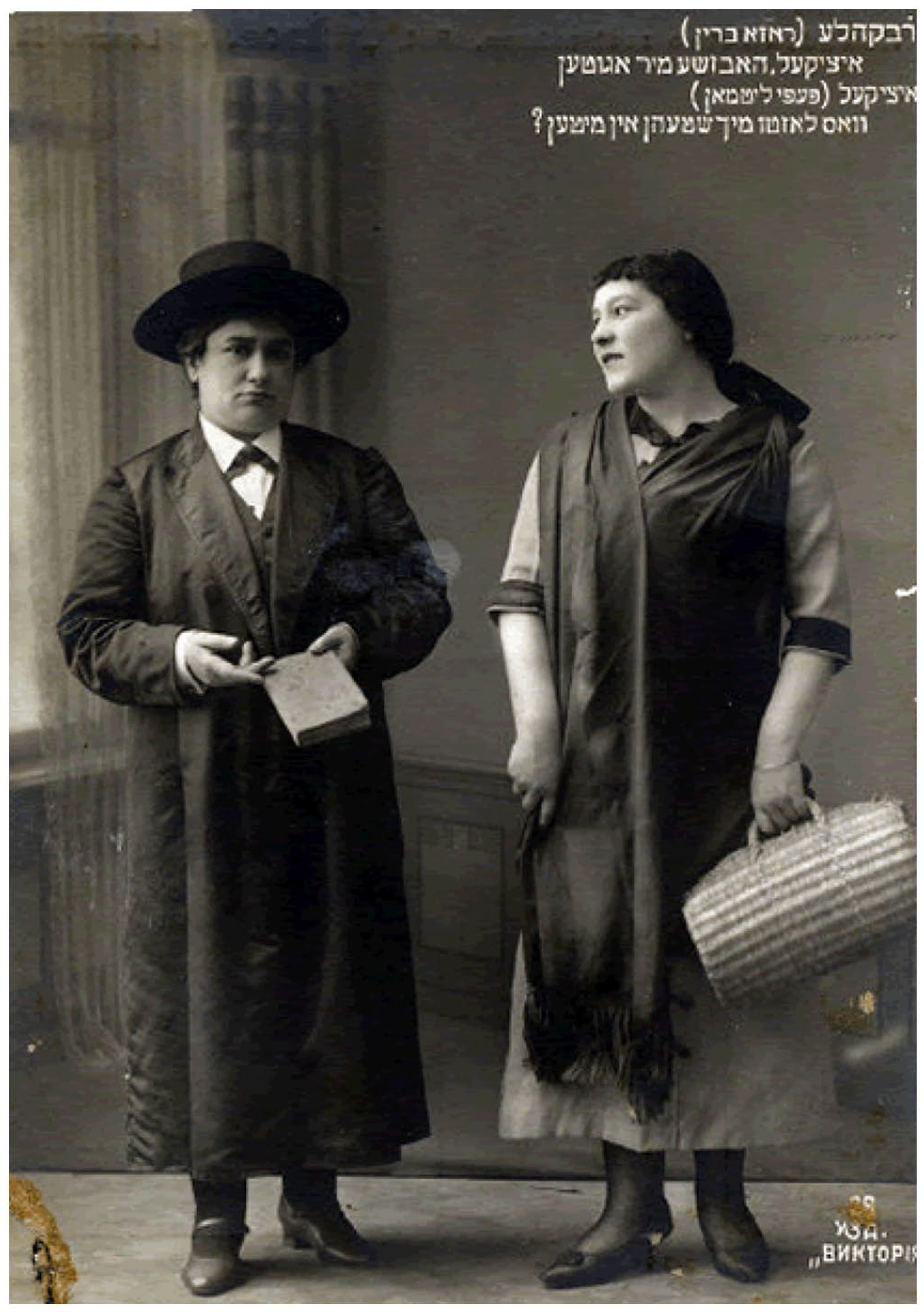
Pepi Littmann (left) as Itsikl.
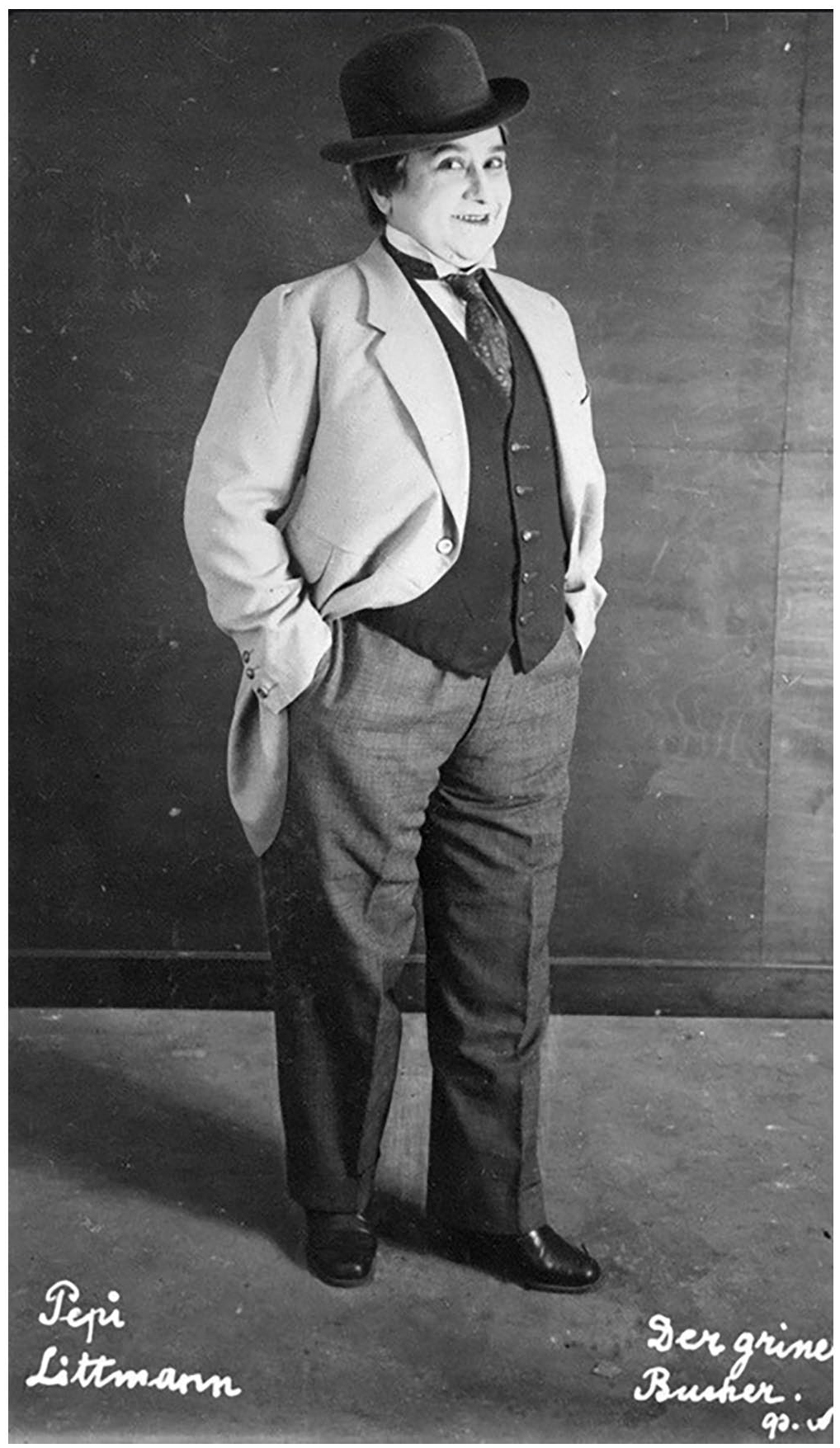
Pepi Littmann in a masculine attire.
Early commercial Yiddish sound recordings, like Littmann’s, opened a parallel time axis for Yiddish. The rise of audiovisual technologies introduced a new communication capacity to Yiddish, beyond its vernacular semiotic vocation. This was understood only in retrospect, when these recordings became relics from a perished culture. Before World War II, there were approximately 11 million Yiddish-speakers around the world, with the majority of them residing in Europe and the United States (Pasikowska-Schnass, 2022). Following the destruction of the European Jewry, and the assimilation of Jewish migrants into the American culture, Yiddish was marked as an “endangered language” (Pasikowska-Schnass, 2022: 5), often referred to as a “dead language” or, alternately, as the language of the dead. Prewar Yiddish sound recordings archived a cultural moment in the history of the language, whose content would later become a treasure trove for artists and scholars to explore and reenact. This archive of voices is reconceptualized through its contemporary TikTok use and it differs from its original assignment.
While Yiddish remained a vernacular for ultraorthodox communities, after WWII it has also acquired ideological and affective attributes of a “post-vernacular” among artistic, cultural, and academic circles (Shandler, 2005). Parallel to contemporary vernacular Yiddish, post-vernacular Yiddish functions in a meta-level of signification, prioritizing its symbolic value as a heritage language. Its speakers deploy communication platforms as means for connecting, offering them “a public forum for self-expression that obviates social protocols” (Shandler, 2005: 55). Moreover, we suggest, the existence of Yiddish as a post-vernacular is shaped by the media that, already since the beginning of the twentieth century, had begun to serve as its infrastructure, first in sound recordings and later in the talkies. This extant media life of Yiddish provides a retrospective outlook at the post-vernacular aspects of modern Yiddish, emerging along the development of audiovisual media technologies. Thus, the body–voice split that characterizes media ventriloquism has been structuring post-vernacular Yiddish.
Contemporary media and, especially, social media platforms and apps network Yiddishists who neither inherited it as a mother tongue nor do they speak it as their vernacular. Rather, their motivation is to reanimate the bygone Ashkenazi past as part of memory and identity-work processes. They are zealous devotees, activists of language instantiation, who reembody and revoice a rich cultural legacy, literally epitomizing the heritage of previous generations. Post-vernacular Yiddish is intrinsically ventriloquistic, for it channels the voices of the dead, metaphorically resounding them through contemporary speakers, who function as their mediators. Like all media, these mediators are not mere conduits, but are actively committed to the enactment of the language as a living, pliable material. Manipulating a chain of gaps inherent to TikTok—between body and voice, presence and absence, past and present—they redefine the connections between vernacular and post-vernacular Yiddish.
Post-vernacular Yiddish and network ventriloquism
Yiddish as post-vernacular may be manifested in a variety of cultural activities: language courses, summer camps, festivals, as well as its popularity on Duolingo app, or its trending representation on recent movies and series such as Netflix’s Shtissel and Unorthodox (Kutzik, 2021; Wood, 2013). Social media platforms are also key to post-vernacular Yiddish activities, and on TikTok, it is exponentially up and rising. For example, on 24 January 2022, the top hashtags connected to Yiddish were #yiddish, with 26.6M views, and #yiddishtiktok with 4.7M views; on 30 August, already 43.2M and 9.5M, respectively. These views are of hundreds of videos produced by numerous users and shared, reused, mixed, and reacted upon by many more. Yiddish TikTokers diverge in background categories, such as gender, age, country, religion, and Yiddish proficiency levels; some dedicate their TikTok account to documenting their journey in learning the language. In this sense, YiddishTok reflects a variety that goes beyond TikTok’s initial “spectacle of girls’ bedroom culture” (Kennedy, 2020: 1070).
Surely, like other TikTokers, YiddishTokers make use of the platform for identity- and community-building; for example, as part of #jewtok or #myjewishheritage (Divon and Ebbrecht-Hartmann, 2022), as well as signify various intersections, such as #gayyiddish. Drawing on the archival qualities of audiovisual media, YiddishTok engages historical materials, thus connecting contemporary post-vernacular Yiddishists with the vernacular past of the language. The contemporary content customizes historical materials, situating them within a new, mimetic environment. Within such contexts, Yiddishists are spreading knowledge about the language—teaching its alphabet, common words, idioms, pronunciations—dismantling preconceptions, or reacting to followers’ comments. YiddishTok is, initially, also part of a genre of language-focused videos, such as #languages or #languagelearning, whereby users utilize the various TikTok features to present a language. As a social media app, TikTok resonates and amplifies minority languages, Yiddish included.
Many of the YiddishTokers are primarily English speakers and they interweave Yiddish and English in their Toks, thus linguistically intermingling Yiddish with other languages. Gearing TikTok’s tools to superimpose supertitles, captions, and tags, they transliterate Yiddish speech and translate and explain Yiddish idioms and terms, thus rendering the language more accessible to non-Yiddish speakers. In accordance with the genre of language-focused Toks, YiddishTokers position themselves as transmitters of the language. In their emphasis on pronunciation and demonstration of everyday idioms, they present their bodies as linguistic mediums. For example, some Toks illustrate the proximity between Yiddish and German. One of them focuses on pronouncing German words that have an /oy/ diphthong sound in Yiddish. In tandem with the appearance of the caption “German words that have an oy in Yiddish,” a voiceover announces this rule of comparison. Then, a dialogue begins between two presenters pronouncing the German words, followed by their Yiddish counterparts (for example, Brot, and Broyt ברויט, the words for bread). Both German and Yiddish words appear on the screen as supertitles, distinguished by respective emojis—namely, the German flag and the Jewish star. This is only one example of the ways whereby numerous YiddishToks interlayer various languages both in speech and in graphics. This multilingual and multimodal intersection echoes the eclectic qualities of Yiddish, its reliance on cross-lingual contacts—reminiscent of its historical association with a migratory culture.
As a migration and diasporic language, Yiddish also emerges out of Toks that focus on connecting the present generation with previous ones. For example, a Toker who created a video in which he answers a follower’s comment, “why do you learn Yiddish no one speaks it anymore,” with the captioned text: “i do it for my family who made it, and to preserve the stories of those who didn’t.” The Toker mimes to a soundtrack borrowed from another user, which has no connection to Yiddish, using the tune as a backtrack to photos of his familial legacy. Relying on both the network structure and the editing tools of TikTok, this Tok utilizes the ventriloquistic gap between the visual and the audial to intersect the synchronic and diachronic axes. Posing a conversational Q&A format, the Toker creates the illusion of a dialogue in which he controls both the question and the answer. Like the ventriloquist and dummy show, in which a human performer fabricates a dialogue with an object, this Toker positions himself as part of a ventriloquistic chain: he mimes to another Toker’s singing (at the sound and visual tracks), and simultaneously animates a written monologue (as a textual caption). Cleverly playing with gaps between the visual, audial and textual, this Toker also converses with his familial past, making it part of his TikTok present.
This example reflects the personal engagement of Yiddish TikTokers, who summon the perished; they gear TikTok’s use this sound, duet and stitch, as well as its algorithmic network structure, to mediate cultural heritage. Post-vernacular Yiddish bridges the temporal and cultural divide from the dead, by reanimating the “language of the dead.” As a ventriloquistic act, this connection does not only conjure up the past, but also maintains the rupture, acknowledging the traumatic history and the inability to bridge this breach. It is a reminder of the hermeneutic gap which all media open and points at “the ease with which the living may mingle with the communicable traces of the dead, and the difficulty of distinguishing communication at a distance from communication with the dead” (Peters, 1999: 149). Yiddish TikTokers hold both sides of the conversation with the past when they resort to this platform to remediate temporal distances.
This particular Tok demonstrates a rather minimalistic approach to video editing on TikTok. It does not intervene in the vocalic level, but rather edits sound with still pictures. Backtracking historical family photos with a contemporary tune mixes times and contexts to connect to the past while maintaining a distance from it. Exploration of heritage is not unique to TikTok, and social network platforms are riddled with political expression, memory work, and linguistic activism (Literat and Kligler-Vilenchik, 2019). However, regarding TikTok as a network committed to ventriloquism suggests the power of body–sound disjuncture as the vehicle for heritage exploration across a network that stretches beyond temporal boundaries.
In other instances, the connection to Yiddish heritage is performed by ventriloquistically resounding actual voices of the past. Yiddish TikTokers unravel Yiddish’s sassy, vivacious, and audacious character when they sing Yiddish folk, popular, or political songs. For instance, the song Ale Gasn/Hey Hey Daloy Politsey, a Jewish socialist-communist song originating in the nineteenth-century uprisings against Tzar Nicolai, was recorded several times during the twentieth century. Its replicated remediation in audial media, from gramophone records to YouTube, exemplifies the transmigration of voices across sonic vehicles. On TikTok, its most popular version is sung by a chorus, lip-synched in or reused by, so far, hitherto 43 additional videos. Other videos present new versions or draw on other recorded versions of this song. Each of these Toks reclaims the song and its idiosyncratic political content for its own current agenda. In tandem, the song serves YiddishTokers to connect to an age-old legacy of Jewish socialism. TikTok’s algorithm gathers the Yiddish ventriloquists miming this song, echoing the original multivocal recording by networking young YiddishTokers into a collective voice. It fuses past with present, adding radical overtones to their youth-rebellion performance. This ventriloquistic “Chorality . . . of joint vocalization” (Connor, 2015) conjures archival voices, channeling them through the YiddishTokers’ bodies, who become mediums through this musical expression of political engagement.
YiddishTok ventriloquism also reenacts archival content, as Tokers embody iconic characters from canonical Yiddish theatrical pieces and films. For example, the fictional figure of Leah, the possessed bride from S. Ansky’s drama The Dybbuk—with her expressionistic makeup, long dark hair and embroidered white dress and veil—is a widespread reference for several, mainly female TikTokers (see Figure 4). One has posted a Tok in which she is dressed as Leah and her appearance is stitched to famous Yiddish theater and film images featuring Ansky’s protagonist. This Leah already emerges as a fashion icon from the heydays of pre-WWII Yiddish culture. Conjuring her image up on TikTok also denotes a ventriloquistic paragon: in the original play, Leah is the medium channeling the voice of her dead lover, manifesting his presence on stage while queering her own body (Seidman, 2003). The reappearance of Leah in such YiddishToks may be thus understood as a—witting or otherwise—self-reflective meta-gesture of Yiddish TikTokers vis-à-vis their own ventriloquistic performance on this platform. By doing so, these TikTokers underscore their mediated presence as a hybrid identity, interweaving genders, times, and cultural references. The resorting to archival footage and sound records, the revoicing of popular or forgotten songs, and impersonating historical figures—all popular social media techniques—become further complicated by the body–voice chain of dissociations and reassociations that TikTok revolves around.
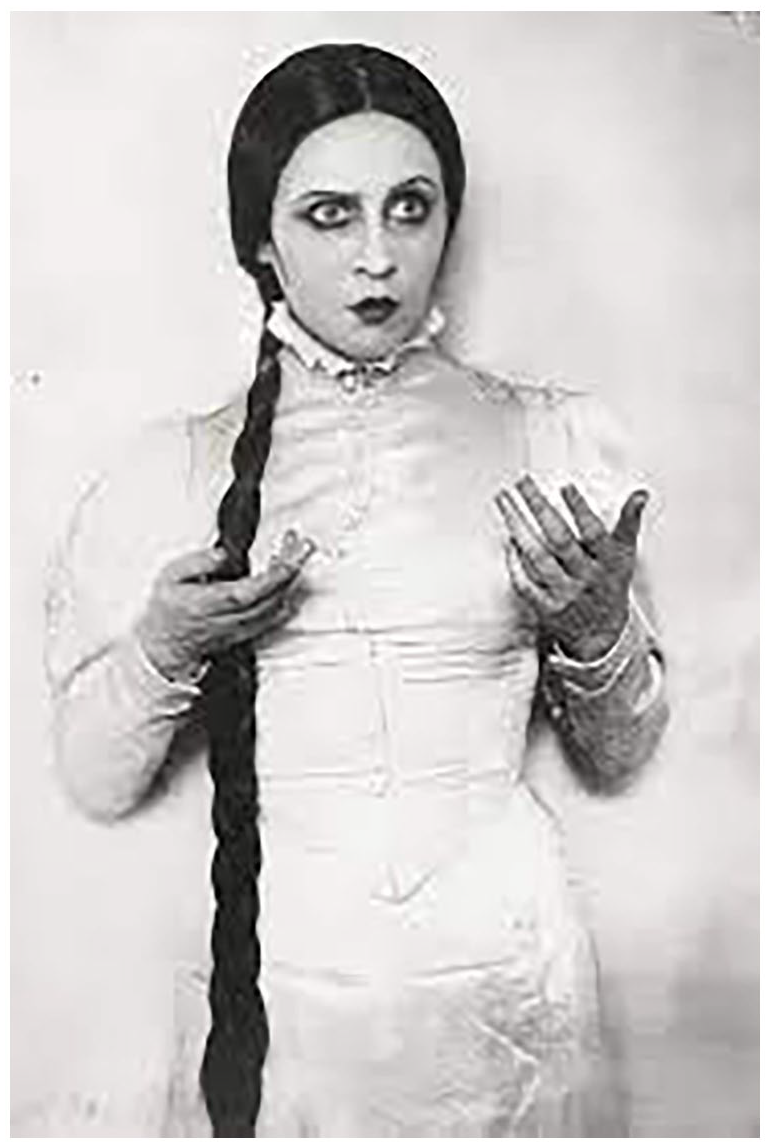
Hanna Rovina as Leah from the Dybbuk.
Gender-bending is frequent in YiddishTok, enacted by non-binary users or in drag performances. An example of how YiddishTokers entangle identities, bodies, and voices may be found in a clip by a Toker who identifies as “They > She,” in which she lip-synchs Yossel Yossel—a former Yiddish hit song. It was originally recorded in 1923 by Nellie Casman (1896–1984), actress and singer of Yiddish-American vaudeville, who played male and boy characters and was one of the first and most prominent recorded Yiddish actresses at the time (Zylbercweig, 1963: 3651). Its later English version, recorded by the Andrews Sisters, became widely popular, but this Tok borrows Mandy Patinkin’s Yiddish recording from 1990. Ventriloquistically miming Patinkin, she is dressed as his iconic character Inigo Montoya, the Basque fencer from The Princess Bride (1987). The lyrics of the song are visually superimposed on their theatrical performance, both in Yiddish transliterated into Latin letters and in English translation. This Tok mixes Yiddish, English, and Latin/o characters (both textual and human), past and present cultural references, and they are all performed by a queer body dressed as a fictional male character. This solo performance epitomizes multiple bodies and voices under a Yiddish plural–singular spectrum.
This spectrum is also central to a group of Toks playing with the renown Yiddish sigh “Oy Vey.” These Toks reuse and mime a soundtrack by an anonymous Toker, whose account is no longer active, but whose recorded voice was left behind for others to use. This unanchored voice plays with a cross-lingual homophonic proximity to generate a hyphenated statement, linking the graphic aspect of language with its pronunciation, and the speakers’ gender with their ethnicity: “I’m Jewish and non-binary so my pronouns are Oy They.” The Toks miming this disembodied voice present users identifying as non-binary, who channel this voice and project it onto their non-binary bodies. Some are cross-dressed in drag; others point to body markers that expressively externalize their non-binarism. Miming to a voice other than theirs, these users adopt this voice as an additional external indicator to point at their body performance. The linguistic pun between English (they) and Yiddish (vey) ties the textuality of the body with that of the soundtrack, interweaving Jewishness as a gender component. A network of plural-singulars plays with the possibilities afforded by the encounter between English and Yiddish, and with the opportunities to reembody a dislocated voice.
Being part of the ventriloquistic network means loaning your voice to others and playing with the voices of others. The voice on TikTok always already bears the potential to become communal via sharing, remixing or reappropriating. Any voice, even the one appearing in alignment with its original body, may travel and be ventriloquistically reused by other bodies on other Toks. TikTokers give new bodies to wandering voices which, in turn discipline these bodies to act in relation to the soundtrack. Diverse bodies share one reproduced voice and respond to it; this voice belongs to everyone and to no one. TikTok introduces a new level of engagement with the notions of “participatory culture” (Jenkins, 2009) and “configurable culture” (Sinnreich, 2010): a commitment entrenched in body–voice dissociation and reassociation. In this respect, TikTok demands a particularly open kind of participation that invites the “mashing up” of users’ bodies and voices as a communal resource. In the frame of YiddishTok, this allows Tokers without any knowledge of Yiddish to propagate Yiddish, get excited about it and become part of its post-vernacular creative dialogue.
TikTok’s unique sound–image structure facilitates the dissemination of Yiddish between users’ bodies, who, when connecting into a chain of body–voice configurations, transform the platform into a virtual space for the deterritorialized post-vernacular language. This dynamic network connects users beyond physical boundaries, projecting nomadic Yiddish voices onto new participants, who become its mediums through viral and mimetic embodiment. This complements the remediation of Yiddish voices along technological media—a process which originated with the first recordings of Yiddish voices at the turn of the nineteenth century. When these Yiddish voices possess TikTokers, media ventriloquism evolves into network ventriloquism. This implies that TikTok networks Yiddish not only synchronically but also diachronically. Yiddish time and space converge; bodies and voices continuously split and reconjoin: by adopting Leah, the possessed bride from The Dybbuk, Mandy Patinkin’s singing voice, or the disembodied anonymous “Oy They” phrase, YiddishTokers assemble a gallery of characters under their usernames as part of their tiktok identities. TikTok reminds us that sometimes it takes others’ voices to sound like yourself, to paraphrase Miles Davis’ famous quote. Through this fluctuating body–voice a-synchronicity, Tokers bond and constitute their intersectional self-definitions as part of a group of YiddishTokers.
However, to regard the act of a group formation as deriving from identity-building techniques addresses only part of the story, disregarding the algorithmic power of TikTok. TikTok’s algorithm generates infrastructures and controls the distribution of voices; it prioritizes the presentation of certain users’ bodies over others. The hashtag is the administrative signifying feature that sustains this operative logic: users adhere to and internalize this logic by tagging their Toks under new or existing tags and as means of defining their social affiliations and attracting other users. Tagging their Toks under hashtags such as #yiddish or #yiddishtok, they join a heterogeneous provisional network within the general crisscross that constitutes TikTok. Under tagged categories, the ventriloquistic channeling of multiple voices withholds a tension between the unifying algorithmic culture with its tagging tools and the multiplicity of characters and identities. TikTok’s algorithm renders the Yiddish network as comprising human and non-human agents. It is an invisible, yet audible director that prompts the network off-stage.
The voice of TikTok
One popular TikTok feature is the text-to-speech tool. It enables voicing out texts as part of the video: users type out a text and then it is read aloud over their videos in a somewhat robotic voice. In May 2021, it turned out that this feature adds a further ventriloquistic layer to TikTok. A lawsuit against ByteDance, TikTok’s parent company, revealed that the voice of professional voice actress Beverly Standing was used for the app without her permission. She claimed damages for “the emotional distress of having her likeness exploited without consent; loss of the ability to control the dissemination of her likeness; and loss of the ability to control the association of her likeness” (Smith, 2021). Standing’s claims reiterate the destabilizing aspects of network ventriloquism as well as its social, ethical, economic, and juristic ramifications. TikTok respectively replaced her voice with another, more robotic one, but this case uncovers TikTok’s algorithm as a ventriloquistic entity: behind the synthetic voice, a real person stands and her voice is appropriated to speak out whichever content TikTokers please.
Like other synthetic voice technologies (Iravantchi et al., 2020), TikTok’s algorithm does not simply borrow a human voice; it also dismantles the uttered words and sentences into their building blocks: phonemes, syllables, consonants, vowels, pitch, and intonation. It then recombines these digitized units into a stream that sounds like fluent speech, prescribed by its users. The synthetic voice is, therefore, composed by the algorithm and it is always in a state of becoming. It also means that various users may simultaneously resort to this sound according to their design. In a similar way to the modes that visuals of the Tok are filtered and edited, the synthetic voice may be transformed into various sound qualities—lower or higher pitch, more robotic or less, child-like, and so forth—thus adding layers of multivocality to the video. This text-to-speech feature injects the voice of TikTok’s algorithm into the video. This voice expresses multiplicity in several layers: it encapsulates numerous vocalic utterances and speech acts, decomposes, and recomposes sentences out of various sources, drawing and performing different vocalic figures. Network ventriloquism is algorithmic, therefore, not only in the ways it regulates the network structure and the content that is being remixed, shared and viewed, but also in the sense that it adds a synthetic (if human-sourced) voice to the particular type of ventriloquism facilitated by TikTok. TikTok is an algorithmic network ventriloquism app that avails itself of human and non-human voices.
Can TikTok speak Yiddish in its own voice? Currently, only if written in Latin characters and spelled in a way that aligns with the pronunciation the algorithm is tuned into. But, judging by the fast and increasing development of Natural Language Processing (NLP) algorithms, it is plausible that in the future, YiddishTok will not rely solely on human users’ originally recorded voices, but will also be able to incorporate the voice of the algorithm as part of the network ventriloquism of Yiddish. This will also expand YiddishTok’s ventriloquistic virtues. Since the algorithm of the app does not “know” Yiddish, the algorithmic Yiddish voice will comprise plenty of other simultaneous ventriloquistic utterances, adding yet another plane for body–voice–algorithm playfulness.
The participation of the algorithm in its “own” voice—ventriloquistic to its core—would then expand the YiddishTok community beyond the limits of human existence and tilt it toward the realm of posthumanism, aligning human beings and machines in the same network, both in bodies and in voices. The possibility of non-human Yiddish activists redraws the limits of Yiddish existence: the language without territory dwells in its capacity as post-vernacular through media. Media—be it human or nonhuman—and the networks they align provide a dynamic and flexible locus for post-vernacular Yiddish.
Media echoes of a post-vernacular
YiddishTok is one example of the ways in which media generates the infrastructure and the diasporic distribution of post-vernacular Yiddish. It enmeshes YiddishTokers in body–sound and human and non-human entanglements which connect them to each other, to past generations, and to preceding media. The reverberation of sounds and the reenactment of images—disseminated and remixed over a network of contemporary users—reveal an intersection of temporal and spatial axes. While the spatial axis algorithmically grids contemporaneous Yiddishists, the temporal axis summons voices from the bygone Yiddish culture that makes a claim in the present. By so doing, this intersection retrospectively exposes early-Yiddish sound recordings as part of a primary diasporic media-ventriloquistic network. YiddishTok capitalizes on the content of that network, by way of a feedback loop: it relishes upon sounds and images that it extracts from the past and reuses them as content for recreations. Its unique features are its algorithm and expressive devices, that further yoke Yiddish times, spaces, bodies, and sounds. YiddishTok transforms the past into an echo of the present by rendering post-vernacular Yiddish as multidirectional and cross-temporal. The echo intersects the diachronic and synchronic axes of TikTok.
The operative logic of network ventriloquism depends upon an echoic expression. Echoes reverberate partial and abated sounds, multiplying them in a way that also alters them (Pinchevski, 2022). Echo, therefore, is both similar and foreign to its origin and cannot coexist with it: “being the result of delay, it both refers back to its origin and simultaneously indicates its withdrawal. For echo to resound its origin must recede” (Pinchevski, 2022: 164). Inherently ventriloquistic, audiovisual media are, therefore, always already echoic in the ways they reuse, remediate, and reproduce sounds, distancing them from their origin. Echo is, thus, the natural phenomenon that cuts through the various media-ventriloquistic performances and dictates their aesthetics. Like ventriloquism, echo is medium-specific: it activates each medium in a different manner, in accordance with its particular features. Assessing TikTok in echoic terms may account for how it resounds past voices while maintaining a critical distance from them. TikTok not only accumulates echoic voices from preceding media but also changes, circulates, and recontextualizes them. In tandem, it also preserves the original sounds as they were. In its particular approach to audiovisual relations, TikTok enables the simultaneous presence of the origin with its echoes: every Tok has a caption linking to the original sound and original TikToker who produced it. As we have shown, traces of users who had left TikTok may still be present through the voices they have left behind for reuse. On TikTok, voices multiply rather than fade away and their echoes keep reverberating across the network. Every Toker serves as a vehicle for others while intervening in and adding to their input. TikTok’s algorithm is part and parcel of this network, adjoining a non-human component to this echoic mechanism. The echoic chain of YiddishTok shapes TikTok as a stage for memory and heritage work. Considering the media history of Yiddish, YiddishTok has become the echo chamber of post-vernacular Yiddish voices.
Footnotes
Funding
The author(s) disclosed receipt of the following financial support for the research, authorship, and/or publication of this article: This article is funded by the European Research Council (ERC) under the European Union’s Horizon 2020 research and innovation program. Grant agreement No. 948150.
