




Abstract
Social media have become essential for crisis communication. While past research has focused on their role in corporate communication, studies largely ignored how public organizations use social media. Among these, the police are a particularly relevant case due to their responsibilities in society. Using a sequential mixed-methods design that combines qualitative interviews with an automated content analysis, this study analyzes how the German police use social media during community (e.g. mass shootings) and organizational-level crises (e.g. misdemeanors within the police). The results demonstrate that Twitter and Facebook are the primary platforms for crisis communication, with their unique affordances shaping the communicative styles of the police. We also find police communication strategies to differ between the two crisis types. During community-level crises, the main goal of the police is to provide information in a largely unidirectional manner, while communication during organizational-level crises is more dialogue-oriented to prevent reputational damage.
Keywords
Social media have become important tools for crisis communication in organizations, enabling them to monitor citizens’ interactions and reactions, provide information to and communicate with relevant publics, or proactively manage their reputation during crises (e.g. Eriksson and Olsson, 2016; Valentini and Kruckeberg, 2016). While past crisis communication research has primarily focused on private corporations (Olsson, 2014), communication practices by public organizations and/or state authorities are of particular importance as well—not least due to their special responsibilities to disseminate reliable information and to coordinate the wider discussion during crisis situations (e.g. Amirkhanyan and Meinel, 2017; Eriksson and Olsson, 2016). Especially during emergencies and disasters, the police play a crucial role in that regard: not only does the public expect them to provide official information and to fill the information void created by crises (Fowler, 2017), but the public also commonly regards the police as particularly trustworthy sources of information (Steelman et al., 2015). Another reason why the police are a relevant and interesting case is that responding to crisis situations poses a severe challenge to police organizations that are characterized by strict hierarchies and the need to operate within the boundaries of strong legal regulations. Consequently, police organizations are often described as less flexible than corporate actors and as even more challenged by crisis situations (Dekker et al., 2020; Meijer and Torenvlied, 2016).
In an attempt to meet people “where they are,” police authorities are increasingly using social media platforms to communicate with the public—both in general and during unfolding crisis situations (Amirkhanyan and Meinel, 2017; Denef et al., 2013; Fowler, 2017). Extant research has put particular emphasis on how the police communicate during crises on the community level (i.e. communication about critical police operations during, for example, mass shootings or terrorist attacks), while crises on the organizational level (i.e. communication about crises that directly affect the reputation of the police) have received considerably less attention. Furthermore, while prior studies have mostly aimed their attention on either observable social media output or self-reports by police authorities, a combined investigation of perceptions and actual communication practices is lacking. Finally, past research on crisis communication has either treated social media as a “monolithic entity” or analyzed only one platform and generalized the findings across all social media (Eriksson and Olsson, 2016: 198), thus ignoring how unique platform affordances shape communicative styles.
Relying on an exploratory sequential mixed-methods design—combining qualitative expert interviews with 11 PR practitioners/social media managers of German police authorities with an automated content analysis of the crisis communication of the German police on Twitter and Facebook (n = 1011)—this research project seeks to comprehensively address how the police are using social media in crisis situations.
Literature review
Public crisis communication
When trying to define crisis communication, it is first necessary to focus on what constitutes a crisis. However, due to the plethora of phenomena addressed in crisis communication research, the field is characterized by an equally diverse set of crisis definitions. Most definitions explicitly focus on organizational crises, which have been defined “as a specific, unexpected, and nonroutine event or series of events that create high levels of uncertainty and threaten or are perceived to threaten an organization’s high-priority goals” (Seeger et al., 1998: 233; similarly Coombs, 2008: 1055; Fearn-Banks, 2016: 1–2). Particularly highlighted in these definitions is the notion of (potential) damages to an organization’s reputation and legitimacy. Yet, when focusing on public organizations or authorities such as the police, it seems necessary to broaden the crisis definition from the organizational to the community level. While the police may very well face “typical” organizational crises that can generate negative outcomes and threaten their reputation, they are also routinely involved in the handling of societal crisis situations such as terror attacks or active shooter incidents. Considering this unique situation, we follow Olsson (2014) and define crises as threats to either a community’s or an organization’s core values, which induce a sense of urgency and create uncertainties regarding the consequences of the event (p. 114). Building on this definition, crisis communication is understood as “the collection, processing, and dissemination of information required to address a crisis situation” (Coombs, 2010: 20), with a particular focus on what the organization—in our case: the police—communicates in response to the crisis. Importantly, our focus is on public crisis communication that is released openly and predominately directed toward external stakeholders (e.g. the public, media organizations) instead of members of the crisis team.
Crises on the community and organizational levels are clearly interwoven, as inadequately reacting to societal crises might also turn into a threat to the reputation of the police (Olsson, 2014; Waymer and Heath, 2007). Regardless of the type of crisis, researchers and practitioners alike have identified a number of “golden rules” for successful crisis communication (e.g. Coombs, 2010; Nikolaev et al., 2010; Ulmer and Pyle, 2016). Particularly relevant for public authorities in Germany is the “Leitfaden Krisenkommunikation” published by the Federal Ministry of the Interior (Bundesministerium des Innern, 2014), which highlights the importance of speed, truthfulness, comprehensibility, transparency/openness, consistency, credibility, and entering a dialogue with affected publics. Whereas different means of communication can be used to fulfill those demands, social media seems to be especially fruitful to broadcast critical information quickly, continuously provide updates, correct misinformation, provide guidance during critical situations, and foster the dialogue with relevant stakeholders (du Plessis, 2018; Ellis, 2021).
Social media crisis communication
As outlined in the beginning, public organizations increasingly include social media to directly engage with stakeholders as part of their communication strategies (Mergel and Bretschneider, 2013). In doing so, they respond to a growing public demand for transparency and dialogue (Ebert et al., 2015). Making use of social media, however, poses severe challenges to public organizations in general and the police in particular, as they have to adhere to federal legal regulations about data privacy and personal rights (Bilsdorfer, 2019; Krischok, 2018). Likewise, the structure of the police as a bureaucratic organization with strict hierarchies and a high level of formality shapes the implementation of social media in organizational communication routines (Dekker et al., 2020; Meijer and Torenvlied, 2016). Despite these barriers, social media also grant numerous opportunities to the police. They offer a way to bypass the media’s gatekeeping function, control the flow of information to various stakeholders, and directly communicate with the public (Colbran, 2020; Ellis and McGovern, 2016). They thus help the police to build and maintain their relation with the public or even enroll the public in police tasks, for instance, during manhunts (e.g. Heverin and Zach, 2010; Meijer and Torenvlied, 2016; Walsh and O’Connor, 2019).
Following Denef et al. (2013), there are two archetypical approaches for police communication during crises. First, police departments can rely on instrumental communication. In this, they use a formal and depersonalized communication style that highlights the gap between the police and the public. Instrumental communication mostly provides information, demonstrates police performance, and largely relies on unidirectional means of communication. Interactions with the public are only called for if the police need information to support their police work (e.g. with eyewitness reports). Second, the police can also use expressive communication. This communication strategy relies on direct interactions with the public, is highly personalized, and often tends to include a more informal style of communication. Expressive communication often emphasizes topics beyond direct police work, for instance, messages about social support, reassurances of the public, or meta-discussions about police communication. While an expressive communication strategy can help to create closer relations with the public and increase public support, it is also labor-intensive and poses the danger of polarizing public opinion if it is perceived as inauthentic or inappropriate (Denef et al., 2013). While these two communication strategies must be understood as binary ideal types, empirical work has repeatedly emphasized the relevance of proactive and responsive communication strategies as a key to successful crisis communication for police departments (e.g. Akkaya et al., 2019; Fowler, 2017). Consequently, incorporating elements of an expressive communication strategy, for instance, in the form of dialogue-oriented communication, appears to be a fruitful approach for police departments.
So far, we have demonstrated how social media as a whole pose specific challenges and opportunities during crisis situations, to which the police can respond with two archetypical communicative approaches. It is, however, important to emphasize that each social media platform has its own architecture and inherent logic. As such, social media should neither be treated as a “monolithic entity” nor should results from one specific platform be generalized across all social media (Eriksson and Olsson, 2016: 198). As different affordances, features, and characteristics shape how users can—and will—interact with encountered content (see also Yarchi et al., 2021), each platform attracts different user communities and has, over time, developed platform-specific norms and practices. We can thus assume that different social media platforms also shape the police’s crisis communication in unique ways and are differently suited to communicate about community-level and organizational-level crises.
These differences can be illustrated by looking at the two most-researched social media platforms: Twitter and Facebook. Twitter makes it possible to distribute information in real-time and has thus been described as an ideal tool for one-way crisis communication—even more so as there is evidence that the public tends to rely on Twitter to gather information during times of uncertainty (Lachlan et al., 2017). The function of including hashtags in a tweet enables reaching an audience beyond the immediate followers by linking tweets to specific issues, topics, or events (Bruns and Moe, 2014). Finally, Twitter has been described as the ideal channel to reach decision-makers, journalists, and politicians, as they are overrepresented among the platform’s user community (Eriksson and Olsson, 2016). Thus, Twitter might be especially relevant for community-level crises, as it affords to distribute information in real-time, connect content to event-based hashtags, and reach a more professional audience.
Facebook allows for longer posts than Twitter, making it a suitable venue for detailed explanations and justifications (Eriksson and Olsson, 2016). Its architecture is much more oriented toward fostering symmetrical two-way communication through the comment function and the chronological display of (responses to) user comments (White, 2012). Facebook has also been described as the ideal channel to reach the general public due to its user composition (Eriksson and Olsson, 2016). Consequentially, Facebook appears to be less suitable for disseminating real-time information on unfolding community-level crises, but better for fostering two-way communication and building trust during organizational-level crises.
The case of the German police
The case of Germany might be of specific interest for research on the implementation of social media in police communication strategies. First, the idea of the police as an authoritative arm of the state is particularly dominant in Germany, potentially shaping the relationship between the police and the public (Bayerl and Rüdiger, 2017). Second, proactive and transparent police communication is historically uncommon and something that was neither expected by the German population nor easily feasible prior to the age of social media. As such, research suggests that the implementation of social media strategies strongly affected the German police forces and their relationship with the public (Bayerl and Rüdiger, 2017). Furthermore, due to the limited amount of training as well as the lack of sufficient funding, the German police were in a particularly challenging position when starting their engagement on social media (Bayerl and Rüdiger, 2017; Rogus and Rüdiger, 2014).
Consequently, it comes as no surprise that—compared with other Western democracies—Germany was a late adopter of social media platforms (e.g. Bayerl and Rüdiger, 2017; Crump, 2011; Hu et al., 2018). Furthermore, unlike in the United Kingdom or the Netherlands where the initiatives of individual officers lead to the formation of social media accounts in a bottom-up process, Germany followed a top-down approach by starting accounts on the organizational level (Bayerl and Rüdiger, 2017; Crump, 2011; Meijer and Torenvlied, 2016). Despite these particularities, research on how the German police actually use social media is still rare. For the United States and Canada, scholars suggest that social media is primarily used to disseminate crime-related information, safety warnings, prevention messages, and information about the different police departments. To a lesser extent, social media are also used to enlist new recruits and to engage in discussions with the public (Heverin and Zach, 2010; O’Connor, 2017).
Extant research has also addressed the question of whether the police use social media primarily to distribute information unidirectionally or to enter into a dialogue. Studies from the United States and the United Kingdom suggest that the police do not exhaust the potential to foster dialogue (Brainard and Edlins, 2015; Bullock, 2018; Crump, 2011; Kudla and Parnaby, 2018). Instead, they engage in so-called “image work” that can be conceptualized as “activities in which police forces engage [. . .] [to] project meanings of policing” (Mawby, 2002: 1), thus seeking to establish and maintain police legitimacy (Walsh and O’Connor, 2019). For Germany, a recent study on Twitter suggests that different police accounts differ vastly in how dialogically they communicate, with accounts from areas with a larger population and those representing higher levels of police hierarchy applying dialogic communication more often (Jungblut and Jungblut, 2021). As such, no clear tendency emerges as to whether the German police mostly engage in “image work” or whether they try to foster open dialogue. Similarly, research so far has not focused on the question of whether the German police acknowledge and account for different platform affordances or simply apply a “one-size-fits-all” approach to their social media (crisis) communication.
Summary and purpose of the present research
Previous (social media) crisis communication research has primarily focused on private corporations and largely ignored communication practices by public organizations such as the police. Considering the special role of police authorities as being involved both in “typical” organizational-level and community-level crises, they constitute an interesting case study to investigate response strategies to both types of crises simultaneously. Moreover, while prior studies have aimed their attention on either observable social media output or self-reports by police authorities, it is advisable to take a combined look at perceptions and actual communication practices and consider more than one social media platform. Addressing the mentioned research gaps and focusing on the understudied case of Germany, the overall goal of our study is to investigate how the German police are using social media in crisis situations.
First, given that research so far largely neglected how the police use social media for crises communication or only focused on social media usage during specific isolated incidents (e.g. Akkaya et al., 2019; Denef et al., 2013; Fowler, 2017), we seek to investigate general social media usage patterns in police crisis communication. In doing so, we aim to unravel the goals pursued through the usage of social media during crises as well as the perceived opportunities and challenges connected to police crisis communication on these platforms. In addition, we seek to unravel if the police use different social media platforms for different purposes, based on (perceptions of) platform affordances and user communities. As such, our first study relies on data from qualitative interviews to examine how responsible communication practitioners describe their usage of social media platforms during crises as well as the perceived goals, opportunities, and challenges:
RQ1. How do German police authorities report using social media during crisis situations? Which goals do they pursue with their communicative measures, and what opportunities and challenges do they perceive?
Second, research so far has either not adequately analyzed the actual content of police crisis communication on social media or solely focused on posts during one specific event (e.g. Denef et al., 2013). As such, results on how the police actually communicate during crises are somewhat inconclusive and not generalizable. We thus aim to provide a general overview of patterns of social media usage during different types of crises on different platforms (Twitter and Facebook). Due to the potential impact of dialogic communication on public trust as well as the reputation of the police (Hung-Baesecke and Chen, 2020; Romenti et al., 2014), we also aim to determine if the police mainly rely on unidirectional or dialogic means of communication during (different types of) crises, thereby also considering differences in platform affordances and user communities. Given that self-reports might be distorted, we complement our interview-based approach with a second study that examines the actual content of the communication:
RQ2. How do German police authorities publicly communicate on social media during crisis situations, how dialogue-oriented is their communication, and how do communication practices differ between Twitter and Facebook?
Overview of the methodological approach
Our research project relies on an exploratory sequential mixed-methods design, “in which the researcher first begins by exploring with qualitative data and analysis and then uses the findings in a second quantitative phase” (Creswell, 2014: 226). Accordingly, we started our project with the collection and analysis of interview data (Study I, RQ1) and subsequently conducted an automated content analysis to complement the qualitative findings (Study II, RQ2).
Study I: Qualitative expert interviews with police authorities
Method
Study I was conducted between April and June 2020 and investigated which social media platforms the German police use (and why), which goals they pursue with communicating on social media during crisis situations, and what opportunities and challenges they perceive to result from their crisis-related social media activities (RQ1). This study was based on semi-structured qualitative expert interviews with PR practitioners, respectively, social media managers of German police authorities. To ensure comparability, an interview guide was prepared and used in all interviews. It was divided into six blocks consisting of 22 questions (plus possible follow-up questions) that focused on (1) general questions about the interviewee and their position, (2) crisis communication on social media, (3) used social media platforms, (4) principles and guidelines, (5) goals, and (6) opportunities and challenges. The interview guide—as well as additional material such as the category system used for analyzing the qualitative data—can be found in the project’s Open Science Framework (OSF) repository: https://osf.io/rnepk/.
Purposeful sampling was used for the identification of participants (Patton, 2015). Given our research interest and theoretical assumptions, prospective participants had to meet three criteria: (1) they had to be in charge of or otherwise responsible for the social media communication of their employing police authority, (2) their employing police authority had to come from one of the 16 German federal states, 1 and (3) had to show levels of social media engagement comparable to the previously selected police authorities. We recruited participants via contacting the press offices and/or communication departments of chosen police authorities of all 16 German federal states. Of the 16 police authorities that were contacted, 11 responded favorably and decided to participate in the study—an overview of all interviewees can be found in Table A-1 of the Supplemental Appendix at OSF, see: https://osf.io/rnepk/. Due to the ongoing COVID-19 pandemic, all interviews were conducted via telephone or video calls and lasted between 28 and 72 minutes.
After the pseudonymization of all identifying information, a qualitative content analysis approach was used to analyze the data (Mayring, 2014). This approach relies on selecting the units of analysis (in our case: statements in the interviews), developing a category system—based on both theoretical assumptions and the actual interview material—and coding the data in several cycles. All codings in the categories and subcategories (final category system available on OSF) were then compared within and between interviewees to assess similarities/differences and identify main themes. In this way, we were able to uncover overarching patterns and factors influencing differential social media use during crises. To maintain standards of data protection as well as the anonymity of our interviewees, the data were coded by the author who also conducted all of the interviews.
Results
Focusing first on used channels, Table 1 provides an overview of which social media platforms are utilized by the German police—in both everyday communication and during crises. All of the interviewed representatives of the police state that they use Twitter and Facebook to communicate in crisis situations, while Instagram, YouTube, and other platforms are of secondary importance. Overall, Twitter can be regarded as the main outlet for crisis communication, whereas Facebook is seen more as a complement, but perceived as better suited to reach specific publics, especially “the broad mass” (P5, p. 7). Reflecting this, the police authorities often rely on screenshotting tweets perceived as particularly important and (re-)publishing them on other platforms, for example, as part of a story on Instagram. Overall, however, Instagram is seen as “difficult for crises” (P10, p. 3): perceived as a “fair weather channel” (P4, p. 3) or “feel-good platform” (P1, p. 7), it is mainly used for police image promotion and recruitment purposes.
Overview of social media platforms used (everyday business vs crises).

In addition, the interviews suggest that the characteristics of a social media platform as well as the structure of a platform’s user community affect for which type of crises the police use which platform. Twitter is particularly important during community-level crises. The preference for Twitter during these types of crises stems from the perceived speed of information flows, the ability to (better) represent the chronology of events, and the knowledge about the “high density of media representatives, journalists, and functionaries from public life” (P7, p. 4) on the platform. In addition, the interviewees emphasize that tweets do not necessarily need to contain a picture, “the preparations for the texts are not as extensive” (P3, p. 4), and there is not as much need for community management compared with other platforms, which is why communicating on Twitter requires fewer resources. Facebook is used less during community-level crises, as its algorithm is perceived as impeding the distribution of real-time information, leading to “quite strong delays in the distribution [of content]” (P8, p. 4), thus being “not helpful at all” (P2, p. 4). The interviewees repeatedly emphasized that they are unsure about the order in which Facebook posts are displayed to the audience, making it harder to reach users with up-to-date information. Moreover, even though police Facebook accounts generally have a higher reach, the interviewees prefer to use Twitter, because Facebook usually demands more intense community management and “staying power” (P1, p. 6). Consequentially, the interviewees’ preference for specific social media during community-level crises clearly reflects the platform affordances described above. Interestingly, for organizational-level crises, the interviewees do not regard one social media platform as more suitable than others, as dealing with these types of crises seems to be primarily about reacting (“promptly, as quickly as possible and, of course, truthfully,” P1, p. 4) rather than proactively communicating.
Regardless of the social media platforms used, the interviews yielded five main goals of using social media during crisis situations (sorted by ascribed importance): (1) informing and warning the public (11 out of 11 interviewees mentioned this goal), (2) strengthening citizens’ sense of security and establishing/maintaining credibility (7 out of 11), (3) claiming the prerogative of interpretation (7 out of 11), and, to a lesser extent, (4) entering a dialogue with relevant target groups (5 out of 11), and (5) simply being present (5 out of 11). The responses in the interviews clearly show that the interviewees mainly had community-level crises in mind when asked about their goals. In this, the primary objective of action and, at the same time, the duty of the police is not only to provide the public with information as quickly and also as reliably as possible, to be transparent and open, but also to create a feeling of security. Expert P10 sums up:
We want to act as a secure partner in a crisis, as a reliable partner in a crisis. And we also want to show that we have the situation under control, that we have the operation under control, and we want to convey a certain degree of security. (P10, p. 3)
For organizational-level crises, the overriding goal is to (1) maintain one’s reputation and (2) uphold and/or restore the public’s trust in the police authority under scrutiny. Indeed, the main focus in these situations is on “containing reputational damage” (P11, p. 7), necessitating a carefully considered reaction to user commentary instead of continuously providing information in a unidirectional manner.
Direct access to target groups/the public, the speed of communication, opportunities for entering a dialogue with citizens, and continuously expanding one’s reach are mentioned as the main opportunities of using social media—both during crisis situations and in preparation for future crises. Notably, the interviewees particularly emphasize the bypassing of journalistic gatekeepers. Expert P8 explains: “The advantage is that we have no intermediary. In the past, we always had to rely on the information we give out actually being passed on through third parties. This is not necessary in the case of social media” (p. 5). Frequently mentioned disadvantages include managing the flood of information, reacting under time pressure, dealing with situations in which “the first rumors start spreading and the first false information comes” (P2, p. 7), and handling inappropriate user comments—all of which apply to both community- and organizational-level crises. In addition, internal and often highly hierarchical coordination processes within police authorities seem to limit the ability to quickly react, thus conflicting with social media users’ demands in crisis situations:
What characterizes such an authority is a kind of “signing loop.” [. . .] The person at the bottom starts, sends it to the next person, who signs it and then it somehow goes back down again. A huge amount of time passes. That doesn’t work in a crisis. (P2, p. 9)
According to our interviewees, the greatest difficulty lies in juggling the enormous time pressure and the necessity to provide accurate information, particularly during community-level crises. However, the experts agree that the mentioned opportunities clearly outweigh the challenges, resulting in social media being perceived as an integral part of the crisis communication of the police.
While entering a dialogue with the public is not the main objective of police crisis communication on social media (see above), the interviewees know about the public’s heightened need for dialogue, especially during community-level crises, and acknowledge that they have to be responsive. However, while questions from the public help the police authorities to assess whether the provided information is sufficient/comprehensible and to adjust their communication strategy accordingly, it is not feasible to respond to every comment. Expert P1 notes: “You will always reach the point where you can’t do it anymore. Then you just have to let it [the comments] rush through” (p. 6). The aspiration of the police to be always approachable—comparable to the police officer on the street—can thus rarely be realized in social media crisis communication.
Discussion
In line with previous interview studies (e.g. Bullock, 2018; Colbran, 2020; Ellis and McGovern, 2016; Lee and McGovern, 2014), Study I shows that social media platforms are perceived as an integral part of modern police work and an important foundation of crisis communication in particular. Reflecting prior research in other countries, the German police primarily rely on Twitter to communicate during crisis situations (e.g. Bullock, 2018; Lee and McGovern, 2014). Particularly during community-level crises, this decision is guided by the platform’s affordances, the perceived composition of the Twitter community, and considerations of necessary resources. Its speediness, the possibility to directly reach journalists and decision-makers, and the simple post creation make Twitter the ideal platform for communication on community-level crises. Interestingly, while Facebook is seen as the platform of the people, our interviewees do not perceive it as well suited for communicating on community-level crises, as “the algorithm” is understood as strongly interfering with the police’s crisis communication strategy and more extensive community management is needed. While the interviewees largely emphasized social media’s role in dealing with community-level crises, organizational-level crises only appear to play a minor role in daily police work. Nevertheless, the interviews suggest that during organizational-level crises communication becomes less proactive and more reactive, as the focus shifts from consistently providing information to carefully constructing messages that might help to keep reputational damages at bay. Accordingly, (perceived) platform affordances are less pertinent, as the primary concern is to respond to allegations and comments by users.
Study II: Automated content analysis of crisis communication practices
Method
Study II investigates the German police’s communication on social media during different types of crises. It thereby aims to analyze how dialogue-oriented the German police’s communication on social media during crisis situations is and how communication practices differ between platforms as well as between organizational- and community-level crises (RQ2).
To answer this research question, we analyzed crisis communication on two social media platforms: Twitter and Facebook. These platforms were selected for three reasons. First, this decision was guided by results from the qualitative interviews in Study I that showed that Twitter is perceived to be the most important platform for crisis communication, followed by Facebook. Second, the importance of Facebook and Twitter indicated in our interviews also corresponds to results from prior research on the German police’s social media communication (see Rogus and Rüdiger, 2014). Third, the platforms were also selected due to their general relevance in Germany. While Facebook is the most used social media platform for informational purposes (Hölig and Hasebrink, 2020), Twitter—although not used as widely—plays an important role in spreading information fast and wide, thus being central for communicating during crisis situations (Schultz et al., 2011).
As a first step, we identified all active social media accounts on these platforms that were run by the German police and distributed at least one post in 2019—which served as the period of our analysis. To do so, we first relied on the Twitter search function and the analysis provided by Reuter et al. (2018) and thereby identified 157 different police accounts on Twitter. Using Facepager (Jünger and Keyling, 2019), we then scraped all Tweets distributed by those accounts in 2019, resulting in a corpus of 138,627 Tweets (including retweets and replies). To identify relevant Facebook accounts, we used the composed list of Twitter accounts and looked for them in the search function of CrowdTangle. There, we also searched for the keyword “Polizei” (German for police). We identified 117 Facebook accounts from which we downloaded 52,618 Facebook posts.
We then generated search strings to identify social media posts that are potentially related to crises on the community and the organizational level. These search strings were identified within actual tweets through an annotated corpus. Posts about community-level crises were defined as referring to extraordinary, dangerous, and exceptional situations and police operations (e.g. terror attacks, shootings, hazardous situations, large-scale operations). Posts about organizational-level crises were conceptualized as communication about (potential) mistakes, indiscretions, crimes, or misdemeanors from within the police (see also Goldsmith, 2015). The final German search strings as well as the translation of the different search terms in English can be found in Table A-2 of the Supplemental Appendix (see OSF). Using these search strings, we identified 564 tweets about community-level crises and 79 tweets about organizational-level crises. Similarly, the search string identified 363 Facebook posts about community-level crises and only five posts about organizational-level crises. Thus, the overall “crisis communication sample” consists of 1011 social media posts.
From each tweet, we extracted information on whether it is an original message—and thus unidirectional in essence—or whether it is a reply, share, or quote of another tweet and thus a form of dialogic communication. To do so, we relied on the metadata provided by the Twitter Developer API. We were not able to use the same strategy for Facebook, as replies and comments are not available on CrowdTangle. Consequentially, we used the provided URLs to revisit each Facebook post and manually coded if the police entered a dialogue by commenting or replying to comments.
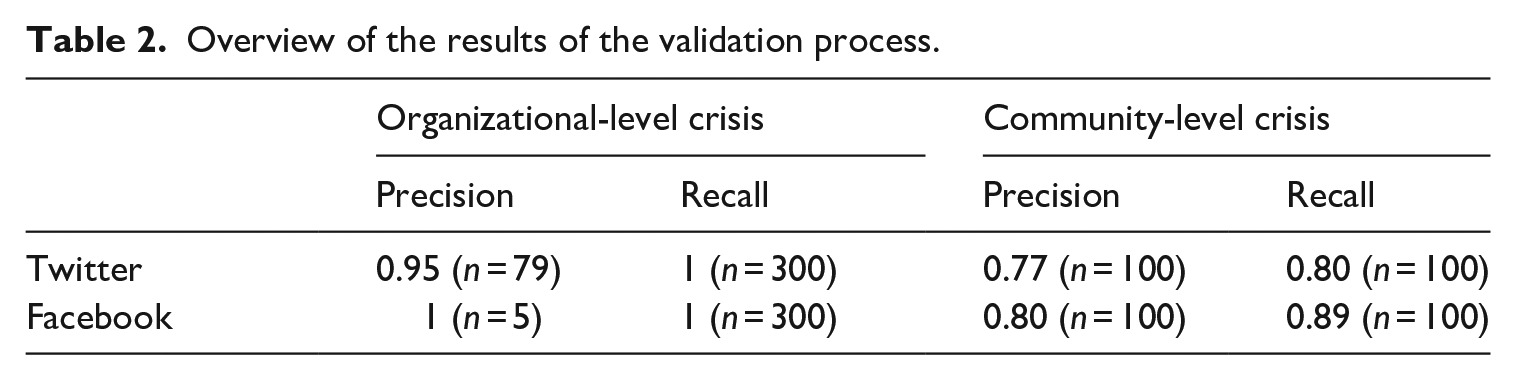
Next, we manually validated the used search strings for both social media platforms. For posts about community crises, we validated 100 posts marked as relevant and 100 posts marked as non-relevant for each platform, resulting in a validation sample of 400 posts. For each post, one of the authors then judged whether it is about a community-level crisis based on the definition provided above. To account for the overall low number of posts identified as relevant by the search string for organizational-level crises, we decided to increase the number of posts identified as non-relevant in our validation sample to 300 from each platform. In doing so, we seek to unravel if our search string misses a substantial share of posts on organizational-level crises. Accordingly, the validation process for organizational-level crises consisted of all posts that were identified as relevant—that is, 79 tweets and 5 Facebook posts—as well as 300 tweets and 300 Facebook posts that were marked as non-relevant. We then judged the relevance of all 684 texts in this validation sample based on the definition provided above. Hereafter, we calculated precision and recall measures to determine the overall performance of the search strings, showing that they performed satisfyingly (all values > 0.77) and that we were able to identify and correctly classify posts on both types of crises (see Table 2).
Overview of the results of the validation process.
Results
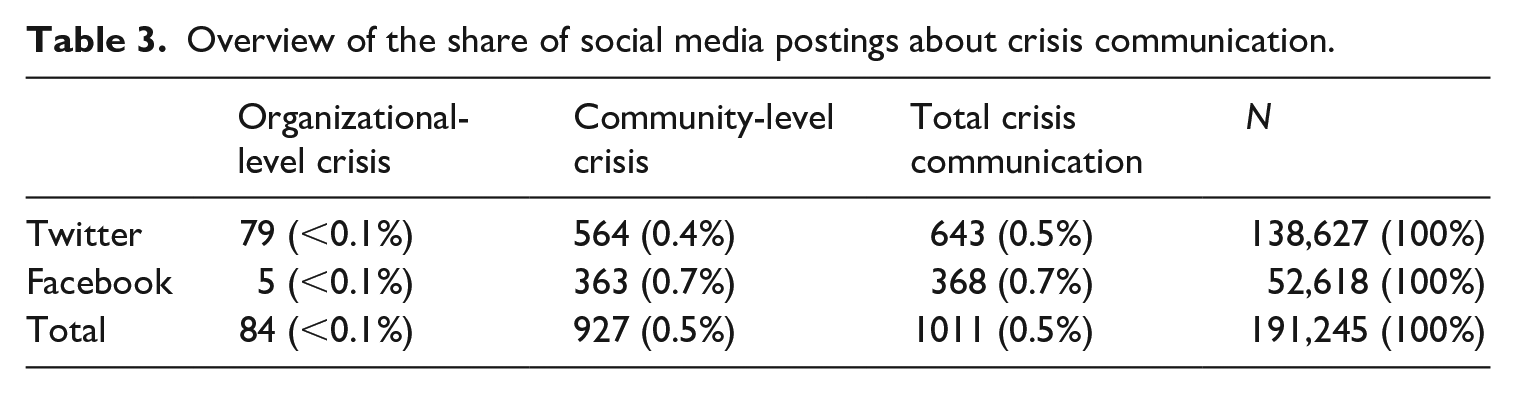
In the first analytical step, we compared the number of social media posts on crises with the overall amount of police communication on social media. Results indicate that crisis communication is not a daily task for the police as it adds up to less than 1% of all social media postings (see Table 3), with the overall volume of tweets (n = 643) being substantially larger than the number of Facebook posts (n = 368). Furthermore, the data indicate that—independent of the social media platform—the police more often communicate about community-level crises (n = 927) than organizational-level crises (n = 84).
Overview of the share of social media postings about crisis communication.
To get a deeper sense of what crises the police had to overcome during the analyzed time frame, we looked at the content of the messages in more detail. Messages on community-level crises focused largely on prevention, especially discussing how the police fight organized crime, prevent terror attacks, and act during other catastrophes. The community-level messages also discussed one specific event in detail: namely, the right-wing terror attack in Halle during which two innocents were killed. The Halle attack was mentioned in 16 tweets and 11 Facebook posts, making it the most discussed individual crisis in the corpus. Messages on organizational-level crises discussed potential wrong-doings by police officers ranging from violence against innocents to the support of unconstitutional ideologies. One example here is a Facebook post by the police in Upper Franconia from May 20, 2019, that discussed a video showing a policeman beating up a young woman. The post states that the prosecutor’s office is investigating the case and that additional video material from policemen’s body cams is being reviewed. Unlike messages on community-level crises, there is no individual event that stands out in the corpus on organizational-level crises.
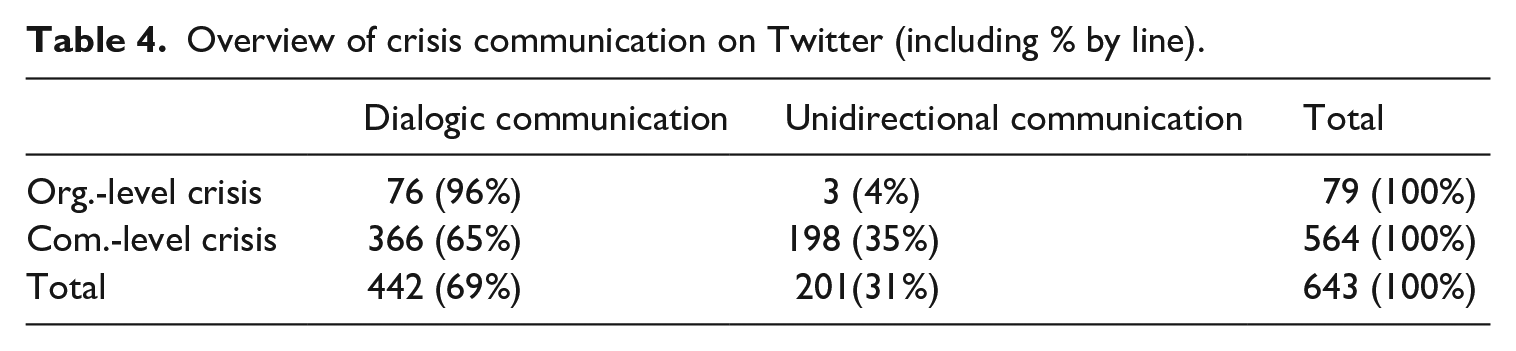
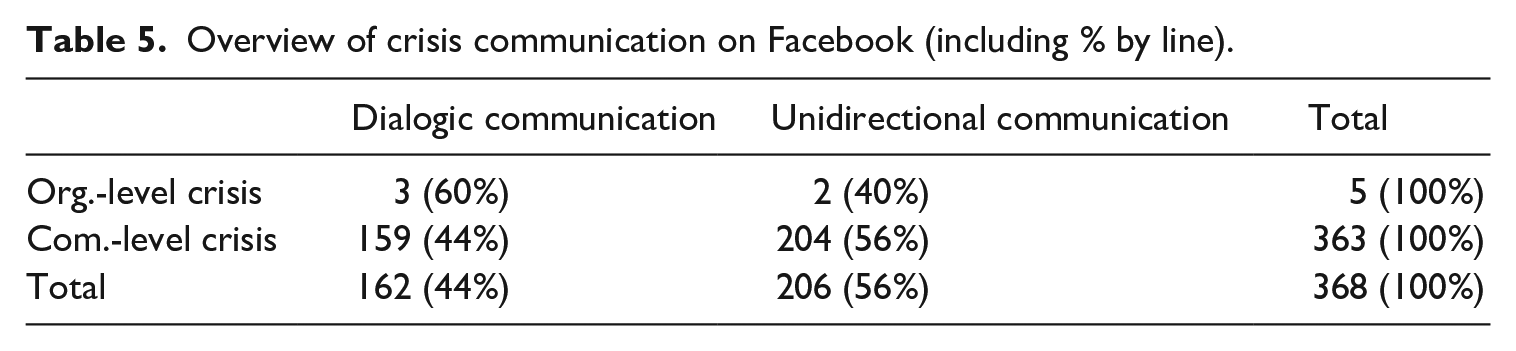
Next, we focus on how dialogic the crisis communication of the police is. A comparison of the share of unidirectional and dialogic social media postings shows that 60% of posts can be classified as dialogic. However, it is noteworthy that we had to operationalize dialogic communication differently for Facebook and Twitter (see above). As such, an analysis that looks at the share of dialogic communication on both platforms separately might be more comprehensive. Indeed, focusing on the usage of Twitter, the data indicate that Twitter is used differently for community- and organizational-level crises. Communication on organizational-level crises is nearly exclusively dialogic (96% of tweets), whereas communication on community-level crises also consists of a substantial share of unidirectional messages (35%, see Table 4). This difference is significant and of average effect size, χ2(1, N = 643) = 31.61, p < .001, φ = .22. Turning to the usage of Facebook, the data suggest the same overall tendency: the police participated in the discussion of 60% of the posts on organizational-level crises, but only entered into a dialogue in 44% of posts on community-level crises (see Table 5). Due to the low case number of posts on organizational crises, this difference did not reach statistical significance, χ2(1, N = 368) = 0.05, p(Fisher’s) = .66.
Overview of crisis communication on Twitter (including % by line).
Overview of crisis communication on Facebook (including % by line).
These numbers, however, do not account for differences in the quality of dialogue. Our data show very different approaches to dialogic communication, ranging from sophisticated in-depth explanations and justifications of why the police acted like they did (e.g. by outlining their legal obligations) to short and standardized replies (“Thank you for your feedback!”).
Discussion
Overall, Study II demonstrates that crisis communication is not a daily task for police departments as only a small fraction of social media posts published in 2019 deal with crises. This reflects the understanding of a crisis as an exceptional situation that is not common to everyday (organizational) life. The data also indicate that the police mostly communicate on community-level crises, whereas posts on organizational-level crises are comparatively rare. This might mean that the police highlight their primary societal role of preventing and fighting crime and misdemeanor or it means that they actively try to de-emphasize organizational mistakes. In doing so, the police might avoid bearing the accountability for the indiscretions and mistakes of individual officers (see Goldsmith, 2015; Lee and McGovern, 2014). Alternatively, this might also solely reflect the actual number of community-level and organizational-level crises that happened during 2019.
Furthermore, Study II shows that police crisis communication on social media is often dialogue-oriented. This result is unexpected given that previous research repeatedly suggested that the police mostly use social media for unidirectional communication (e.g. Brainard and Edlins, 2015; Bullock, 2018; Crump, 2011; Kudla and Parnaby, 2018). While the police traditionally rely on input from to public to solve crimes, for example, in form of eye-witness reports (e.g. Bayerl and Rüdiger, 2017), the used operationalization of dialogue resembles a different form of communication (i.e. engaging in dialogue to build trust and prevent potential damages to the organizational reputation). The comparison of both studied social media platforms also indicates that Twitter is used more often for police communication in general and, overall, to communicate on crises. This again might reflect the different logics and affordances of both platforms, with Twitter repeatedly being labeled the ideal venue for strategic (crisis) communication, especially during community-level crises (see Study I).
General discussion
Building on the increasing importance of social media as tools for public organizations’ crisis communication and the double role of the police as being involved in the handling of both “own” crises on the organizational-level and crises on the community-level, the present mixed-methods research project investigated communication practices of the German police in crisis situations. Focusing first on the perspective of the communicating organization, qualitative interviews with PR practitioners/social media managers of 11 of the 16 German federal states show that crisis communication on social media has become a key element of the police authorities’ external communication practices. Twitter is by far the most important outlet for crisis communication, reflecting previous findings on the social media presence of the German police (Reuter et al., 2018; Rogus and Rüdiger, 2014). Especially during community-level crises such as shooter incidents, Twitter is perceived as superior due to its speediness, better representation of the chronology of events/actions, and its linking function to the media—making it the ideal venue to address the demands of fast and transparent communication (see also Akkaya et al., 2019; Fowler, 2017). While Facebook is acknowledged as the platform of the general population—which is also reflected in the fact that the police Facebook accounts usually have much more followers than the respective Twitter accounts—it is not seen as the best outlet to communicate about community-level crises. This might seem counterintuitive at first, but can be explained by the assumptions and experiences the police representatives have with the platform: although algorithmic curation happens both on Twitter and Facebook, it is only noticed and negatively mentioned with regard to the latter platform. The control one has over when posts show up in people’s newsfeed is perceived as low, thus strongly interfering with the main goal of (community-level) crisis communication, that is, informing and warning people promptly. Similarly, Facebook simply makes more work: short texts are not enough, but posts ideally require a picture and users seem to want more information here. The interviewees also point out the need for more community management, for which there is simply no time during acute crisis situations. These findings offer several pointers for future research: first, they illustrate the importance of taking into account the unique affordances of social media platforms when studying (crisis) communication (see also Yarchi et al., 2021). Second, they tie in well with research on algorithmic folk theories: while these conceptions people hold about how algorithms work have been widely studied for ordinary users (e.g. Dogruel, 2021; Ytre-Arne and Moe, 2021), this could be advanced to public organizations: how do they perceive platform algorithms and to what extent does this guide their communicative practices?
In addition, our study shows that the police mostly communicate on community-level crises, whereas posts on organizational-level crises are comparatively rare. This result from the content analysis largely reflects the answers provided in the interviews, where the police representatives mostly elaborated on the role of social media during community-level crises. First, this imbalance might solely be a reflection of the actual occurrence of different types of crises within the German police. During our period of investigation, there was no highly salient or widely discussed organizational-level crisis in the German police. There was, however, a highly relevant community-level crisis—namely, the right-wing terror attack in Halle. This event accounts for a relevant share of all social media posts on community-level crises (27 posts), while it simultaneously is clearly not the sole driver of the perceived discrepancy in the number of posts on both types of crises. Alternatively, the difference in the overall number of posts on both types of crises might suggest how the police understand their primary societal role in preventing crime and misdemeanors (Heverin and Zach, 2010; Hu et al., 2018). As such, they focus more on community-level crises, which often relate to critical police operations with the potential to threaten or affect significant parts of the policed jurisdiction (Olsson, 2014). Finally, however, the police might also actively try to avoid communication on organizational-level crises and, thereby, aim to downplay potential wrongdoings.
The interviewed police authorities have clear goals in mind when using social media during crisis situations, with warning and informing the public being the most important ones during community-level crises. In these instances, the police authorities claim to focus on instrumental communication (Denef et al., 2013), predominantly providing information in a unidirectional manner. For organizational-level crises—in which the police are more culprits than problem solvers—the main goal switches to containing reputational damage and communication is becoming more reactive than proactive. Again, the content analysis echoes the interview data and shows that communication about organizational-level crises is more dialogue-oriented (96% of tweets and 60% of Facebook posts) than communication on community-level crises (65% of tweets and 44% of Facebook posts). There are at least two potential explanations for this finding. First, this might mean that the police see the necessity to enter into a dialogue if there are potential wrongdoings within the police. Alternatively, this might also indicate that the police are only responding if they are forced to do so through users. This perspective is in line with the idea of social media increasing the transparency of police work, enabling so-called “countersurveillance” (Walsh and O’Connor, 2019: 7), thereby posing the threat of unraveling misdemeanors within the police force (Denef et al., 2013; Walsh and O’Connor, 2019).
Despite the difference in the focus on dialogic means of communication between both types of crises, the overall crisis communication is still largely dialogue-oriented. As such, our results are not in line with much of the prior research that highly emphasized the use of social media for image work focusing on unidirectional information distribution (e.g. Kudla and Parnaby, 2018; Meijer and Torenvlied, 2016), especially during community-level crises (Walsh and O’Connor, 2019). Rather, our project ties in with research on how the police use dialogic communication to form networks with the public or at least to gather relevant information (see Huang et al., 2017; Meijer and Thaens, 2013). Huang et al. (2017), for instance, show that 66% of tweets and 45% of Facebook posts from 40 US police entities qualify either as pull communication, where the police request information from the public, or as networking communication, where the police try to form or strengthen ties with the public. This largely resembles the ratio from our study (69% of tweets and 44% of Facebook posts were categorized as dialogic). Our study thus extends existing knowledge by highlighting the overall increasing relevance of dialogue for police communication during crises, especially during organizational-level ones. However, one has to acknowledge that the discrepancy in existing study results might also stem from different operationalizations of what qualifies as “dialogue” (see below).
Albeit our analysis only focuses on police communication, the results also tie in with insights regarding other types of organizations. For instance, the police’s consideration of platform affordances and user communities for their communicative strategies largely reflects research on government institutions (Olsson and Eriksson, 2016). Moreover, the growing role of community management and the necessity to have sufficient resources and adequate training for effective crisis communication can also be found in research on other types of organizations, especially public organizations (White, 2012). Still, police organizations are in a somewhat unique place as they have to deal with community-level and organizational-level crises simultaneously. Consequentially, results cannot easily be generalized and might thus only relate to similar types of organizations such as fire departments or other emergency responders (e.g. Petersen et al., 2019; White, 2012).
In addition to this, our research has some further limitations that need to be acknowledged. First, as our study was focused on Germany, future studies might aim to compare the police crisis communication cross-nationally—to unravel similarities and to identify and explain national peculiarities. Second, we used an approximation to measure dialogic communication on Twitter that might come with some inaccuracies. Specifically, operationalizing all retweets as dialogic in nature neglects the possibility of amplifying own tweets or of retweeting posts by other police entities. Connected to this, our data also indicate that the quality of dialogic communication differed vastly across accounts and crisis types, ranging from sophisticated explanations and justifications to standardized answers. As such, future research should focus more closely on different forms of dialogic communication, extending the current practice of understanding dialogue as a binary category and relying on a more sophisticated, theory-driven, and content-focused operationalization. Third and relatedly, as with most research comparing content across social media, we encountered methodological challenges in the identical operationalization of constructs on the two studied platforms. Our measure for dialogic communication was not identical for Twitter and Facebook due to the idiosyncrasies and the architecture of the used social media platforms. Finally, our content analysis only offers a very broad and descriptive perspective on crisis communication. Future research should examine the actual content of communication as well as the public’s reaction to it in more detail. Studies, for instance, might examine the content of crisis communication with the help of topic modeling or conduct a sentiment analysis of user comments to unravel the potential effects of the police’s social media communication.
Despite these limitations, our research project offers some valuable insights into why and how the police use social media during crisis situations, how communication practices differ between different types of crises, and how (perceptions of) the affordances of different social media platforms influence their use in crisis communication. As social media continue to become entangled in public organizations’ communication routines, it is important to consistently monitor their use and investigate the implications for the organization and their publics.
Footnotes
Authors’ note
All authors have agreed to the submission. The article is not currently being considered for publication by any other print or electronic journal.
Funding
The author(s) received no financial support for the research, authorship and/or publication of this article.

Supplemental material
Supplemental material for this article is available online.