




Abstract
The current study examines the role of affective and cognitive attitude extremity on perceived exposure to diverse political viewpoints and investigates the possibility of a “primacy of affect.” Based on a multi-level analysis of panel survey data, we show that people with extreme attitudes toward immigrants experience less viewpoint diversity and that this tendency is especially pronounced for affective attitude extremity. However, even those holding extreme attitudes do not find themselves in issue-specific echo chambers, that is, they still encounter relatively diverse sets of viewpoints.
Viewpoint diversity is considered a central value in democratic societies. By taking into account different perspectives on political issues, citizens are expected to form more rational opinions and to reach more informed decisions (McQuail, 1992; Mutz, 2006). Against this background, modern media landscapes seem to provide ideal conditions: access to political information has never been easier and is offered by countless outlets with varying political orientations (Van Aelst et al., 2017). Moreover, citizens themselves have become “co-creators” of viewpoint diversity in that they express political opinions on social media platforms and in the comment sections of online media (Baden and Springer, 2014).
However, mere accessibility and abundance of political viewpoints do not guarantee actual exposure. The spectrum of viewpoints people encounter depends on various factors including media consumption, interpersonal communication, but also motivational variables, such as general political interest (Dubois and Blank, 2018; Napoli, 2011; Van der Wurff, 2011). One factor that has not received much empirical attention so far is attitude extremity, although its role in diversity exposure is not to be underestimated. Extremity is often inherent in polarized political debates, in which different camps and the views they hold diverge from each other (Westfall et al., 2015). Moreover, despite the fact that most citizens are exposed to diverse political views (e.g. Barberá, 2020; Bruns, 2019; Dubois and Blank, 2018), concerns have been raised that this might not apply to people with extreme political attitudes (Wojcieszak and Rojas, 2011). Such individuals might still end up in an environment where homogeneous views dominate since they face stronger pressure to avoid alternative opinions.
The current study, therefore, pursues two goals: (1) We will determine the overall degree of perceived viewpoint diversity exposure and its variation on the individual level in an issue-specific context (immigrants in Germany). (2) Regarding the role of issue-specific attitude extremity as a potential inhibitor of viewpoint diversity exposure, we contribute to existing research by distinguishing between cognitive and affective attitude extremity. In doing so, our study is also the first to test for a potential “primacy of affect” (Cassino and Lodge, 2007) in viewpoint diversity exposure. Drawing from psychological work on affective primacy, we assume that affective attitude extremity will show a stronger negative relationship with viewpoint diversity exposure than cognitive extremity.
Moreover, our study addresses two more recent calls in the field of diversity research: first, it offers a stronger inclusion of the demand-side of diversity by focusing on the viewpoints citizens actually experience (e.g. Helberger and Wojcieszak, 2018; Napoli, 2011). Second, by examining media and interpersonal communication through the use of name generators, we follow the suggestions of Bruns (2019) and Loecherbach et al. (2020), who argue for a more comprehensive examination of the various sources from which citizens can learn about diverse political viewpoints.
The results presented here are based on a three-wave online panel survey on immigrants in Germany which took place between August and December 2019 before the corona crisis. Viewpoint exposure was measured using name generators (Klofstad et al., 2009; Mutz and Martin, 2001), a survey technique that allows mapping communication patterns within social ego-networks (e.g. Huckfeldt et al., 2004; Mutz, 2006). To this end, respondents reported recent contacts with viewpoints on immigrants through mediated and interpersonal sources online and offline. Based on their encounters, we calculated diversity scores reflecting each respondent’s level of viewpoint diversity exposure (McDonald and Dimmick, 2003).
Conceptualization of viewpoint diversity
Although the general idea of viewpoint diversity is not hard to grasp, there still is no common definition of the concept, mainly because its meaning is so broad. Voakes et al. (1996), for example, define it as the “dispersion of representation of ideas, perspectives, attributions, opinions, or frames within a news product, and within the context of one particular issue” (p. 585). This multifaceted nature is also reflected by common operationalizations and measures. While most studies focus on the evaluative dimension of viewpoint diversity, by employing measures of balance or one-sidedness of opinion slant (Pritchard, 2002) or tone (Hayes and Guardino, 2010), others use proxies like, for example, the spectrum of actors occurring in the media or of editorial policies in a media market (e.g. Voltmer, 2000). Finally, viewpoint diversity can be operationalized via frames (Baden and Springer, 2017; Masini et al., 2017). However, although frames are relatively easy to determine using content-analytic approaches, survey-based measurement is much more difficult (i.e. demanding for the respondent). We therefore follow previous approaches and focus on the evaluative dimension of viewpoint diversity by looking at the variation in opinion valence (positive/negative) to which an individual is exposed.
Why focusing on exposure?
For a long time, diversity research focused mainly on the supply side, in that studies examined diversity as a feature of media markets and/or media content (see Helberger, 2012; Loecherbach et al., 2020; Napoli, 2011 for overviews). However more lately, the number of exposure-oriented studies started to increase (Loecherbach et al., 2020) for at least two reasons.
First, modern information environments are characterized by an extensive number of available sources and a great freedom to select from them (Van Aelst et al., 2017). In the political realm, for example, blogs, social media, and the comment sections of journalistic online media have added to the spectrum of political information (e.g. Geers, 2020), which citizens can access almost anywhere and anytime (Newman et al., 2020). As a potential result, people’s information diets become increasingly fragmented, causing differences in individual diversity exposure. Against this background, Napoli (2011: 246) concludes that, “focusing on source and content diversity is becoming less important than understanding the information that is actually consumed by media users.”
Second, the strong focus on media markets and content also resulted in a lack of integration of other potential sources of viewpoint diversity. The media are without doubt an important source of viewpoints in people’s everyday lives, but they are not the only one. Particularly interpersonal communication is highly relevant in this regard since it is a well-known source of political cross-cutting exposure 1 (e.g. Huckfeldt et al., 2004; Mutz, 2006). However, many forms of interpersonal communication offline and online still elude a content-analytic observation and are therefore often not part of supply-centered studies (exceptions are analyses of digital trace data, for example, Bakshy et al., 2015).
To address both points, the current study uses name generators embedded in a panel survey (Huckfeldt et al., 2002; Klofstad et al., 2009; Mutz and Martin, 2001) to collect information on participants’ encounters of viewpoints through mediated and interpersonal sources, thereby providing a more integrated perspective (Brundidge, 2010; Bruns, 2019). Hence, our first research question asks:
RQ1. How diverse are the viewpoints on immigrants that participants are exposed to in their everyday lives?
Attitude extremity and viewpoint diversity exposure
One of the most frequently discussed issues in current debates on viewpoint diversity is that citizens may increasingly find themselves in homogeneous information environments (Bruns, 2019). Given the opportunity to select from a broad array of information and sources, it is feared that they will choose whatever content matches their attitudes and interests (Sunstein, 2009). Adding to that, algorithmic filtering could intensify this tendency by recommending content based on users’ interests, attitudes, prior online behavior, or the structure of their online social networks (Pariser, 2011).
The idea that large parts of the population live in such “echo chambers” or “filter bubbles” seems quite popular, although empirical research offers little if any support for it (Bruns, 2019). Instead, studies show that the degree of homogeneity varies across individuals (Brundidge, 2010; Dubois and Blank, 2018; Garrett, 2009a; Vaccari et al., 2016). However, although widespread and perfect homogeneity does not exist, it is still worthwhile to ask why some people live in more homogeneous viewpoint environments than others. A variable of particular relevance in this regard is attitude extremity (Brundidge, 2010; Rodriguez et al., 2017). In the following, we argue that extreme political attitudes serve as an inhibitor of viewpoint diversity exposure in both mediated and interpersonal contexts.
Attitude extremity and media consumption
Humans strive for cognitive balance and therefore tend to turn to media sources and content that match their existing beliefs, values, and attitudes, especially when it comes to politics (Garrett and Stroud, 2014; Rodriguez et al., 2017; Stroud, 2008). Extreme political attitudes should intensify such patterns of selective exposure, because being confronted with non-likeminded views is expected to increase the cognitive dissonance experienced by the individual (Knobloch-Westerwick and Meng, 2009). Consequently, those with extreme political attitudes should encounter less viewpoint diversity, because they tend to avoid non-likeminded and prefer likeminded views more than the less extreme (Van der Wurff, 2011).
However, there are theoretical arguments suggesting that the effect of attitude extremity on exposure diversity could be exactly the other way around. First, people with extreme attitudes could tend to anticipate situations in which they would have to defend their opinion against others motivating them to actively seek alternative views with the intention to expose them as false (Canon, 1964; Garrett, 2009b). Second, as a sub-dimension of attitude strength, extremity is positively correlated with other strength dimensions, particularly with attitude importance (Krosnick et al., 1993; Wojcieszak, 2012). Attitude importance is a strong motivator to keep oneself informed about an issue (Boninger et al., 1995) and to elaborate more on issue-related messages (Petty and Cacioppo, 1990). Therefore, people with extreme political attitudes could be particularly well informed and aware of different political viewpoints.
Empirical research reflects the theoretical ambiguity described above. Brannon et al. (2007), for example, found that stronger attitudes increase interest in attitude consistent information (see also Stroud, 2010). In contrast, Knobloch-Westerwick and Meng (2009), who explicitly differentiated between extremity and other dimensions of attitude strength, could not find an effect of extremity on message selection or duration of exposure. Contrary to that, Winter et al. (2016), observed that participants with more extreme attitudes (toward government surveillance), who were told that they would have to defend their position after exposure, slightly preferred attitude consistent over non-consistent information. Wojcieszak (2012) found that respondents with more extreme attitudes do not experience higher levels of disagreement. Her results indicate that holding extreme political views is associated with holding a larger issue-specific argument repertoire (here: on sexual minority rights), but only regarding arguments supporting one’s prior opinion. Using longitudinal survey data from the United States between 2000 and 2012, Rodriguez et al. (2017) show that ideological extremity, that is, holding very strong liberal or conservative views, increased partisan selective exposure, but only for conservatives. Moderate and strong liberals did not differ in the strength of selective exposure.
Taken together, none of the empirical studies above suggest that attitude extremity increases viewpoint diversity exposure. If anything, they point in the opposite direction in that extremity leads to increased avoidance of counter attitudinal and / or exposure to attitude consistent information.
Attitude extremity and interpersonal communication
Political attitudes play a major role in the composure of people’s social surroundings and everyday interpersonal communication. Varying degrees of political homophily—the homogeneity of an individual’s social environment in terms of political attitudes—have been observed in offline (Mutz and Martin, 2001) and online social networks (Ackland and Shorish, 2014; Boutyline and Willer, 2017). According to McPherson et al. (2001), it limits “people’s social worlds in a way that has powerful implications for the information they receive, the attitudes they form, and the interactions they experience” (p. 415).
This notion is supported by studies on political cross-cutting showing that citizens with more extreme political leanings are less inclined to encounter political disagreement in everyday discussions (Morey et al., 2018; Mutz, 2006: 33). Adding to that, Boutyline and Willer (2017) observed that social online networks surrounding extreme politicians on Twitter show higher levels of political homophily. The authors also found that “more politically extreme individuals tend to exhibit greater orientations towards cognitive stability, clarity, and familiarity” (p. 551) and therefore tend to seek out the company of politically likeminded others who “reaffirm, rather than challenge, their views” (p. 551). Particularly in social online networks, extreme political attitudes also seem to foster like-minded message diffusion. For example, Barberá et al. (2015) showed that on Twitter, the major share of retweets on political issues concerning the 2012 US election came from extreme liberals and conservatives, although both groups accounted for only 16% of the overall sample. Summing up, research on media consumption and interpersonal communication suggests that attitude extremity should lead to less viewpoint diversity exposure.
H1. People with extreme attitudes toward immigrants will be exposed to less diverse viewpoints on the issue.
Affective and cognitive attitude extremity
Attitudes are informed by the feelings evoked by an attitude object, and the characteristics attributed to it. Both facets are also referred to as affective and cognitive attitude dimensions (Breckler and Wiggins, 1989). The object “immigrants,” for example, may arouse emotions such as fear, anger, joy, or pity and, at the same time, trigger thoughts about the negative or positive characteristics of immigrants (e.g. their effects on social security systems). Affective and cognitive facets of an attitude are often positively correlated and both contribute to the overall evaluation of the attitude object (Breckler and Wiggins, 1989).
However, research suggests that there might be a “primacy of affect” (Lodge and Taber, 2013: 214) in the formation of political attitudes as well as in the attitude-behavior link (Lavine, 2001). Abelson et al. (1982), for example, showed that people’s overall evaluations of political candidates were influenced more strongly by the emotional reactions toward the candidates than by the cognitive assessments of their qualities. Affective primacy has also been observed in political behavior. Based on data from four US elections (1972, 1976, 1980, and 1984), Granberg and Brown (1989) found that voting decisions were influenced to a larger degree by citizens’ affective than cognitive evaluations of the candidates (see Cassino and Lodge, 2007 for further evidence). A possible explanation for the primary role of affect is the “hot cognition hypothesis” (Lodge and Taber, 2005), which states that emotions are activated automatically when people are confronted with a political attitude object. Because the activation of affect is assumed to precede cognitive elaboration, it exerts a stronger influence on the overall evaluation of the attitude object. Interestingly, this tendency seems to be particularly pronounced when attitudes are extreme (Giner-Sorolla, 2001).
To the best of our knowledge, only one study so far differentiated between the cognitive and affective attitude dimensions in selective exposure to political information. In an experimental study, Tsang (2019) showed that experiencing a cognitive discrepancy prior to exposure encouraged participants’ search for attitude-consistent information, whereas avoidance of counter-attitudinal information was only observed when participants experienced negative emotions. Further support for a pronounced affective impact comes from research suggesting that people’s information choices are linked to their identities and, therefore, not purely cognitively based decisions. Hart et al. (2020), for example, showed that people interpret displays of selective exposure as conveyors of their identity and anticipate feeling uncomfortable when uncongenial information choices become visible to others. Against this background, we assume a primacy of affect in the relationship between attitude extremity and viewpoint diversity exposure.
H2. The negative relationship between attitudes and viewpoint diversity exposure will be more pronounced for affective than for cognitive attitude extremity.
Method
The study presented here is based on a three-wave online panel survey on immigrants in Germany. The sample was drawn by a professional survey institute (Dynata) applying quotas for age, education, region, and gender to reflect the general German online population. The three waves took place between August and December 2019 (NW1 = 1,364, NW2 = 886, NW3 = 527) at intervals of 8 weeks in between. The following analyses are based on N = 527 respondents who participated in all three waves. All measures presented below were part of each wave, except for age, gender, and level of education (only Wave 1). Germany was chosen as the country under study because immigration was—and still is—a major topic in public discourse (European Commission, 2019). Moreover, it was discussed in a controversial manner by political parties and other public actors resulting in an information environment where a wide spectrum of views was available. This variance in viewpoints is important to study the correlates of exposure, because if viewpoint diversity was absent on the supply side, variation on the demand side would be impossible.
Measures
Perceived viewpoint diversity exposure was measured using three name generators (Huckfeldt et al., 2002; Klofstad et al., 2009) aiming at three potential sources: (1) the personal social environment offline (e.g. face-to-face), (2) online (e.g. on social media), and (3) the media (e.g. newspapers online or offline). For each source, participants could indicate up to three contacts who had voiced an opinion about the topic of immigrants during the past month (see Supplemental Material for exact wordings). The responses were open-ended, for instance, responses to the offline name generator included, for example, “my neighbor”; to the online name generator, “some comment beneath a news article”; and to the media source generator, “in the latest edition of the Tagesthemen.” After providing the contacts, respondents were invited to reply to a follow-up question on their contacts’ viewpoints on immigrants, ranging from 1 to 5 (1 “very negative opinion” to 5 “very positive opinion”). Figure 1 visualizes how respondents could enter up to three contacts per name generator for each potential source (A) and how the contacts provided resulted in individual viewpoint environments (B).
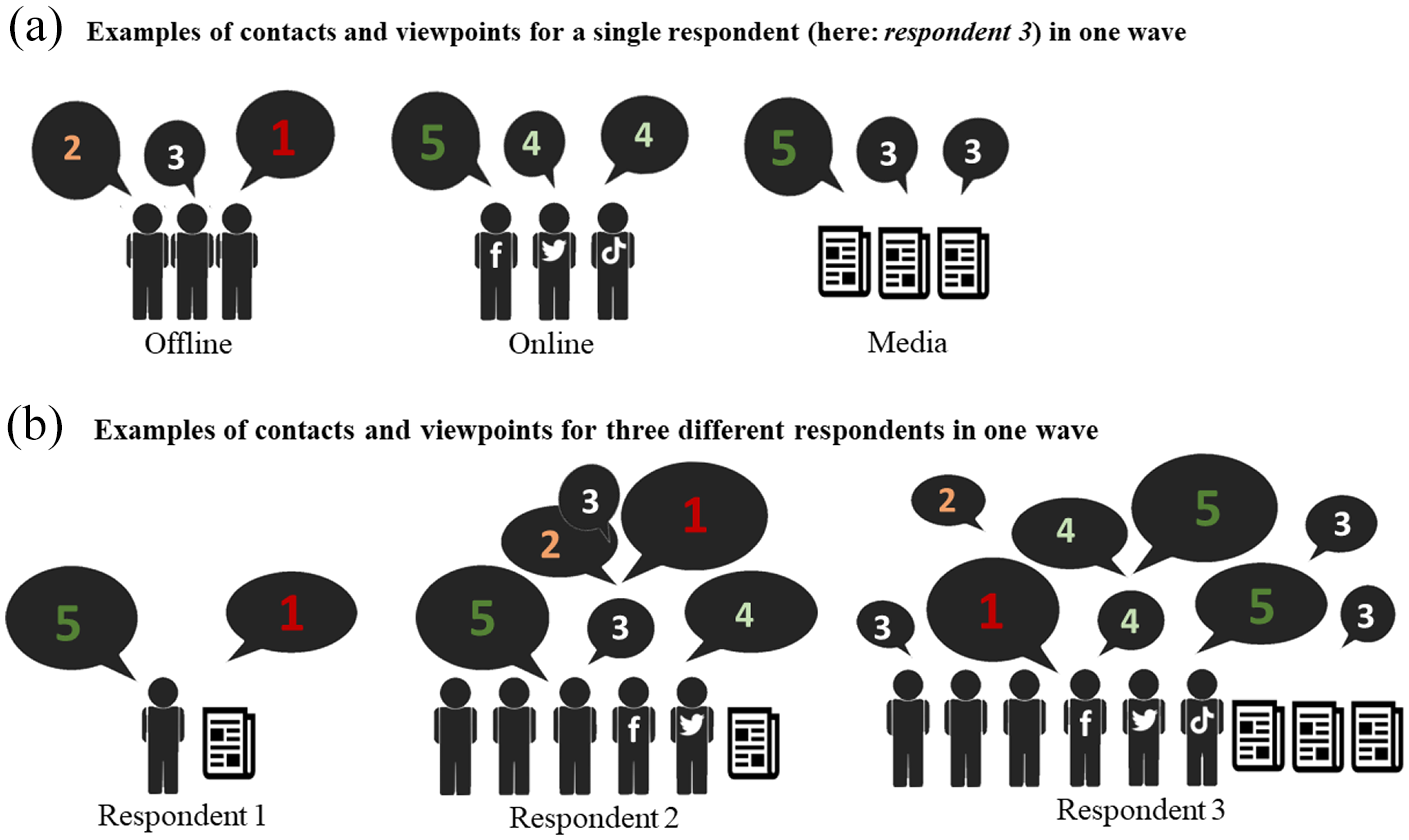
Visualization of how the name generators work.
One specific advantage of name generators is that respondents’ assessments of viewpoint exposure are less prone to perceptual biases (e.g. false consensus perceptions) (Sokhey and Djupe, 2014). This is because they are not asked to recollect contacts based on the contacts’ views, but on whether the contact mentioned the issue. However, despite the reduction of perceptual bias, name generators still measure perceived rather than actual exposure.
The diversity score is based on common diversity measures (see McDonald and Dimmick, 2003) and reflects the variety and balance of the viewpoint distribution. While variety represents the total number of different viewpoints an individual encountered, balance describes the evenness of the viewpoint distribution. High scores indicate that a person is exposed to both positive and negative opinions (high variety) and/or that no opinion is dominating (high balance). The score ranges between 0 (maximum homogeneity) and 1 (maximum diversity) (see Supplemental Material for a detailed description). Means and standard deviations were identical in each wave (MW1 = 0.90, SDW1 = 0.12, MW2 = 0.90, SDW2 = 0.12, MW3 = 0.90, SDW3 = 0.12).
Affective and cognitive attitude extremity
The cognitive attitude dimension was measured by five items reflecting various beliefs regarding immigrants (e.g. “Immigrants are responsible for many of the problems in our country,” “Immigrants make Germany a better place”). Respondents indicated their agreement using a Likert-type scale ranging from 1 (“totally disagree”) to 5 (“totally agree”). All items formed a mean index, with high scores indicating a positive attitude and low scores a negative attitude toward immigrants (negative items were reverse coded) (αW1 = .90, αW2 = .91, αW3 = .92). Cognitive attitude extremity was calculated as the absolute difference of each respondent’s score from the scale mean (3), resulting in an extremity score that ranged from 0 (no cognitive extremity) to 2 (maximum cognitive extremity), MW1 = 1.02, SDW1 = 0.64, MW2 = 1.00, SDW2 = 0.62, MW3 = 0.98, SDW3 = 0.64 (see also Wojcieszak, 2012). The affective attitude dimension was measured in a similar way, by asking respondents what positive or negative emotions they feel when thinking about immigrants (joy, pity, anger, sadness, fear) on a scale from 1 (“do not feel this emotion”) to (“strongly feel this emotion”). Again, the mean scale constructed from the items showed satisfactory reliability across all three waves (αW1 = .75, αW2 = .76, αW3 = .75), with higher scores indicating positive and lower scores negative emotions. Affective attitude extremity reflected the absolute difference from the scale mean (3) ranging from 0 (no affective extremity) to 2 (maximum affective extremity), MW1 = 0.80, SDW1 = 0.59, MW2 = 0.75, SDW2 = 0.58, MW3 = 0.75, SDW3 = 0.57.
Controls
A number of additional factors are potentially associated with encountering diverse political viewpoints. Van der Wurff (2011) as well as Dubois and Blank (2018), for example, show that a high overall level of media use increases viewpoint diversity exposure. Similarly, frequent interpersonal (online) communication promotes incidental cross-cutting exposure (Barnidge, 2017). In addition, the use of specific media outlets could lead to more diverse exposure, especially of those with a higher internal diversity, like, for example, public service news. The same should apply to media that are known to foster political knowledge in general (e.g. quality newspapers) (Van der Wurff, 2011). Finally, motivational variables can increase viewpoint exposure, particularly political and issue-specific interest (Brundidge, 2010: 687; Van der Wurff, 2011). Besides these factors, the current study also controls for standard sociodemographic variables (gender, age, education). Respondents’ frequency of media use was measured for eight types of media and online platforms (quality newspapers, tabloid newspapers, public service television news, commercial television news, online news, alternative media, podcasts, and search engines) as the number of days per week (1–7). The same scale was employed for three forms of interpersonal communication (face-to-face, on social media, on personal messengers). To measure issue involvement, respondents indicated their agreement 1 (“totally disagree”) to 5 (“totally agree”) with two statements (“I am interested in the topic of immigrants,” “I think the topic of immigrants is important”), which formed a mean index (αW1 = .84, αW2 = .87, αW3 = .88).
Results
RQ1 asked for respondents’ overall level of viewpoint diversity exposure. The aggregated diversity scores we observed across the three survey waves (MW1 = 0.90, SDW1 = 0.12, MW2 = 0.90, SDW2 = 0.12, MW3 = 0.90, SDW3 = 0.12) indicate that on average, respondents experienced a very high level of viewpoint diversity, that is, exposure to positive and negative viewpoints toward immigrants likewise. This result is in line with more recent research suggesting that homogeneous viewpoint environments are probably a very rare phenomenon in the general population (e.g. Barberá, 2020; Dubois and Blank, 2018). Our data further substantiate this conclusion, because it accounts for mediated and interpersonal channels as potential sources. However, the standard deviations also show that not all respondents experienced equally high levels of viewpoint diversity, but that there is some variation on the individual level. Hence, in the next step, we will answer the question why some respondents encounter more diverse views than others.
Our panel survey provides repeated observations of viewpoint diversity exposure and its potential correlates (see Table 1). These observations are nested within individuals, which is why we use a multilevel model to analyze the underlying relationships (Hayes, 2006). While multilevel models are not the only way to analyze panel data, they come with several advantages. Most importantly, they allow for the explicit modeling of unobserved heterogeneity and unit effects, that is, to turn individual deviations from the sample average into explained variance through the inclusion of third variables (Giesselmann and Windzio, 2012: 166–167). Therefore, they allow observed time-constant variables to be included in the model, enabling the investigation of between-person differences in viewpoint diversity exposure rather than only within-person differences. Additional information on the model selection and alternative modeling approaches is provided in the Supplemental Material.
Correlates of viewpoint diversity exposure (unstandardized coefficients).
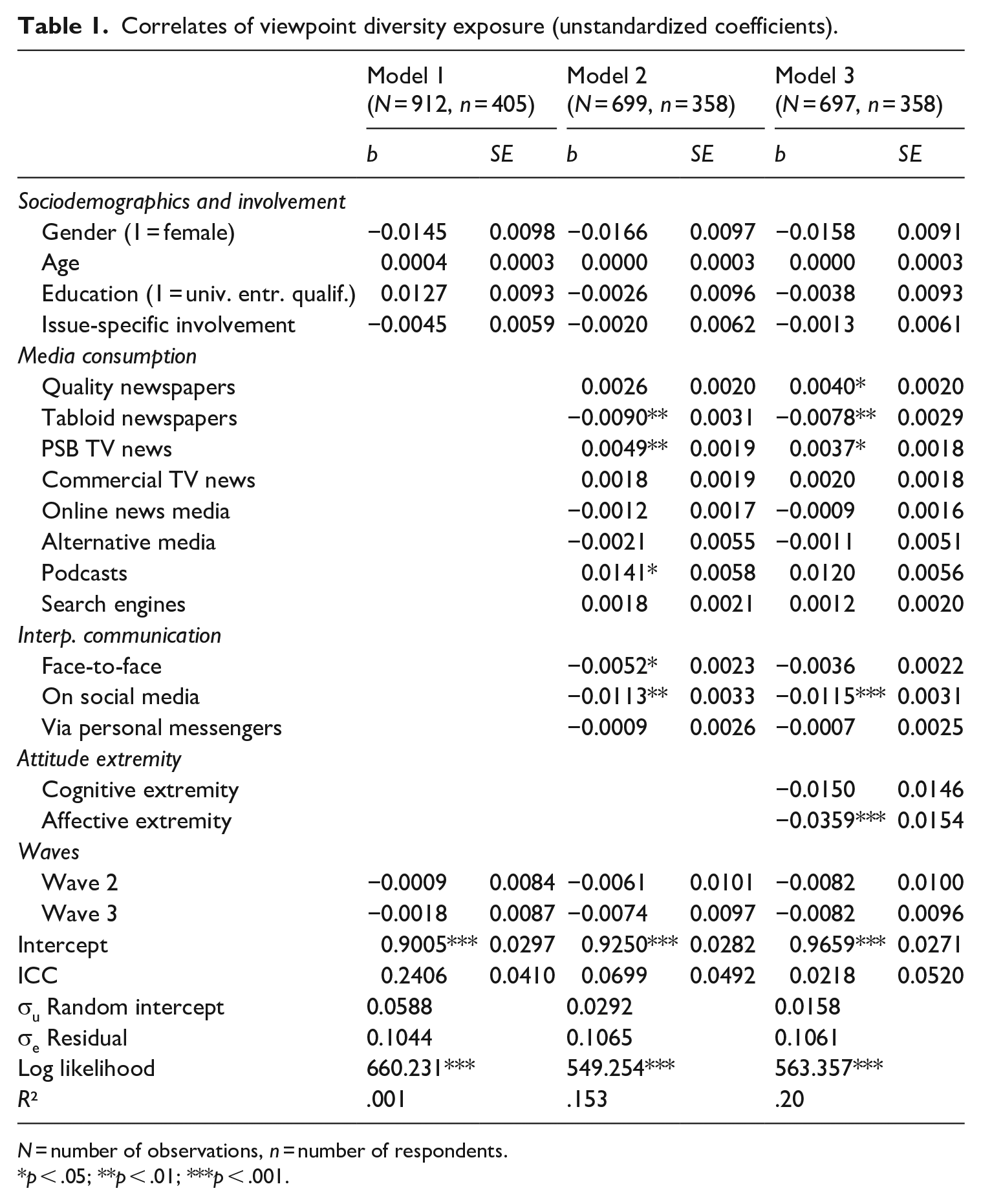
N = number of observations, n = number of respondents.
p < .05; **p < .01; ***p < .001.
To test our hypotheses, we proceed hierarchically by successively introducing three models which we extent stepwise, starting with sociodemographic characteristics and motivation (Model 1), followed by mediated and interpersonal communication (Model 2) as controls and finally cognitive and affective attitude extremity as our core independent variables (Model 3). Cluster robust standard errors were computed for possible heteroskedasticity and serial correlation within clusters (i.e. respondents) (Wooldridge, 2010). All analyses were performed with STATA 16.1.
As can be seen in Table 1, sociodemographic variables and issue-specific involvement were not associated with viewpoint diversity exposure in any of the three models. Whereas this might be less surprising in the case of gender and age, even the highly educated and those more involved in the issue of immigration do not experience more diverse viewpoints. Media use and interpersonal communication, however (Model 2), contribute substantially to the diversity of views our respondents experienced (∆R² = .15). Interestingly, these relationships are not unidirectional, in that some communicative behaviors increase viewpoint diversity while others seem to inhibit it. Tabloid newspapers readers, for example, experience less diverse viewpoints on immigrants, while an increased consumption of quality newspapers leads to the opposite (only Model 3). Regarding television use, especially participants using public service outlets experienced higher levels of viewpoint diversity. No significant relationships were observed for the other media outlets, with one exception: listening to podcasts was associated with more diverse viewpoint exposure. Regarding respondents’ interpersonal communication, a significant relationship could only be observed for social media use, in that respondents who stated that they frequently communicated with others on social media were less exposed to varying viewpoints on immigration.
We will now turn to cognitive and affective attitude extremity as our core independent variables. H1 predicted that people who hold extreme attitudes toward immigrants will be exposed to less diverse viewpoints regarding the issue. As can be seen in Model 3 and Figure 2, cognitive and affective attitude extremity were both negatively related to viewpoint diversity exposure, after controlling for all other variables. However, only in the case of affective extremity, this relationship was statistically significant (cognitive extremity: b = −0.0150, p = .072; affective extremity: b = −0.0359, p = .001). Both attitude dimensions accounted for an additional 5% of the overall variance explained by the full model. H1 is therefore supported only for affective extremity.
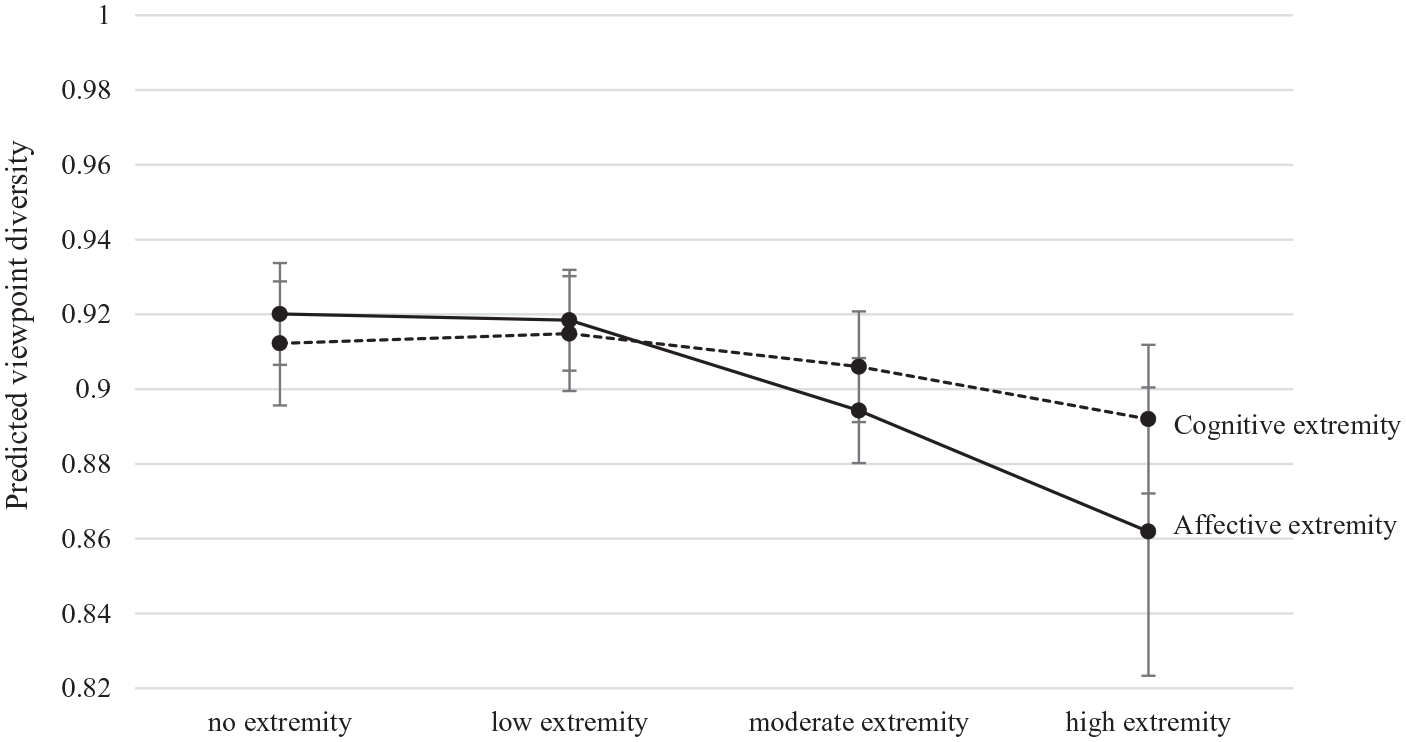
Predictive margins of attitude extremity with 95% confidence intervals.
This leads us to our final hypothesis, which assumed a primacy of affect in the relationship between viewpoint diversity exposure and extremity. Although a comparison of the respective regression coefficients in Model 3 already pointed in this direction, we further tested the assumption by comparing the predictive margins of the diversity score for both extremity dimensions (Figure 2).
Two interesting patterns can be observed: first, although the line reflecting the affective extremity dimension shows a greater steepness corresponding to the larger regression coefficient in Model 3, both lines are almost congruent on the first three extremity levels. A considerable difference between both occurs not before the level of highest extremity. This suggests that the most extreme participants are those experiencing a noteworthy reduction in viewpoint diversity exposure. However, as the overlapping confidence intervals show, the differences between those holding highly extreme affective and cognitive attitudes toward immigrants are not significant. Therefore, H2 must be rejected. Second, our results clearly show that even those with the most extreme attitudes (affective and cognitive) do not experience tremendous viewpoint homogeneity, but still encounter diverse views. This casts serious doubts on the notion that those at the far ends of the political attitude spectrum find themselves in issue-specific echo chambers.
Discussion
In the current study, we examined the role of attitude extremity as a potential inhibitor of viewpoint diversity exposure. Our results contribute to the existing knowledge in the field in two ways: (1) By taking an exposure perspective, we were able to draw a more comprehensive picture of the demand side of viewpoint diversity exposure. Previous studies often focused on the diversity of content and thereby were necessarily restricted to one or few specific outlets or sources. Our perspective complements these supply-centered studies in a fruitful way (Hoffmann et al., 2015; Loecherbach et al., 2020). (2) We focused specifically on attitude extremity as a potential inhibitor of viewpoint diversity exposure, since researchers have speculated that those holding extreme political attitudes might live in more homogeneous viewpoint environments (Bruns, 2019). To the best of our knowledge, our study is also the first to differentiate between affective and cognitive attitude extremity testing for a potential primacy of affect (Cassino and Lodge, 2007).
Our results strongly support recent work (Brundidge, 2010; Bruns, 2019; Dubois and Blank, 2018) showing that the prevalence of homogeneous viewpoint environments is heavily overstated—even more so, if one takes into account the broad spectrum of potential sources people use in their everyday lives. This conclusion is reflected not only by the high average diversity scores we obtained, but also by their moderate standard deviations, indicating that exceptionally low diversity scores were almost absent.
In line with our theoretical assumptions, respondents who held extreme attitudes toward immigrants (positive or negative) experienced less viewpoint diversity. However, this was only the case for affective attitude extremity. This in fact suggests a primacy of affect regarding attitude extremity and viewpoint diversity exposure, however, the differences between both attitude dimensions failed to reach a statistically significant level even between the most extreme respondents. Nevertheless, the fact that only affective attitude extremity was significantly correlated with viewpoint diversity exposure is worth further examination because it ultimately touches upon the question how the structure of political attitudes is linked to the political information people expose themselves to. If the affective dimension is more influential in terms of selective exposure to media content and / or interpersonal communication, two scenarios are particularly interesting for future research: the first are political debates in which emotions are a prevalent feature. This particularly includes discussions surrounding highly polarized and morally loaded issues, such as abortion, race, or immigration. Here, focusing on the causes and consequences of the affective attitude component could further strengthen our understanding of how partisans (especially at the extremes of the attitude spectrum) select and process issue specific information. Second, it is worthwhile to examine cases in which the cognitive and affective attitude dimensions diverge. Conner et al. (2021) have recently shown that such states of cognitive-affective inconsistency weaken the attitude-behavior relationship. Regarding viewpoint diversity exposure, one could assume that in highly polarized debates, creating cognitive-affective inconsistency (e.g. through political messages) could weaken patterns of selective exposure.
Although it was not the core focus of our study, because others already addressed the topic (Dubois and Blank, 2018; Van der Wurff, 2011), we observed that using specific media sources and forms of interpersonal communication was associated with higher or lower levels of viewpoint diversity exposure. Positive relationships were found for the use of public service news, quality newspapers, and podcasts, whereas using tabloid newspapers and social media for interpersonal communication resulted in lower diversity exposure. This, on one hand, points to the democratic importance of public service outlets and quality journalism, where the presentation of diverse views is regarded a central value or even represents a regulatory aspect (Karppinen, 2006). On the other hand, it underlines the role of sources that are more prone to viewpoint homogeneity caused by a stronger influence of social and/or algorithmic selection (Bakshy et al., 2015).
Of course, our study has some limitations, which we would like to stress to improve the interpretation of our results and to highlight potential paths for future research. First, our diversity measure relies exclusively on respondents’ self-assessments and is therefore prone to potential biases. Most importantly, individual recall of contacts with positive or negative viewpoints on immigrants could be incomplete or biased in terms of valence. While we cannot completely rule out this possibility, prior research has shown that name generators are a suitable tool to map ego-communication networks (Finnegan et al., 1989), especially when compared with more direct survey measures (e.g. asking directly for opinion distributions in personal surroundings). Another argument in favor of name generators refers to the importance of perceptions respectively top-of-mind awareness. Although there are probably differences between respondents’ actual viewpoint environments and what they recalled, their recollections are most certainly more relevant when it comes to opinion formation or behavior. Second, our measure is based on common diversity measures (see McDonald and Dimmick, 2003) that reflect both the variety and the balance of the viewpoint distributions. Although this represents a more differentiated measure of individual viewpoint distributions, it also has the idiosyncrasy that tendentious but even distributions will still achieve moderate to high viewpoint diversity scores. Thus, contact with viewpoints on different points of the attitude scale can partially compensate for the one-sidedness of these opinions. As intuition suggests, however, non-tendentious distributions will always lead to high values for viewpoint diversity. Third, we asked for the valence of the opinions respondents encountered. Although valence is an essential aspect of a viewpoint, the concept encompasses other facets as well such as attributions of responsibility, prospects, or recommendations. Moreover, opinions which take the form of general evaluations (e.g. support/opposition; positive/negative) are (often) based on arguments which justify a certain position. Future survey research could therefore try to develop more differentiated operationalizations of issue-specific viewpoints. Interesting possibilities would be to ask for exposure to specific pro and con arguments and to determine the diversity of the argument distribution. The same could be done with frames as more complex perspectives on an issue (see Baden and Springer, 2017).
Supplemental Material
sj-docx-1-nms-10.1177_14614448221117484 – Supplemental material for The role of affective and cognitive attitude extremity in perceived viewpoint diversity exposure
Supplemental material, sj-docx-1-nms-10.1177_14614448221117484 for The role of affective and cognitive attitude extremity in perceived viewpoint diversity exposure by Thomas Zerback and Lara Kobilke in New Media & Society
Footnotes
Declaration of conflicting interests
The author(s) declared no potential conflicts of interest with respect to the research, authorship, and/or publication of this article.
Funding
The author(s) disclosed receipt of the following financial support for the research, authorship, and/or publication of this article: This work was supported by the German Research Association (DFG) under Grant No. 396521619.

Supplemental material
Supplemental material for this article is available online.
Notes
Author biographies
References
Supplementary Material
Please find the following supplemental material available below.
For Open Access articles published under a Creative Commons License, all supplemental material carries the same license as the article it is associated with.
For non-Open Access articles published, all supplemental material carries a non-exclusive license, and permission requests for re-use of supplemental material or any part of supplemental material shall be sent directly to the copyright owner as specified in the copyright notice associated with the article.
