



Abstract
Following a burgeoning literature on private actors under digital authoritarianism, this study aims to understand the role played by social media users in sustaining authoritarian rule. It examines a subcultural community—the queer-fantasy community—on Chinese social media to expound how members of this community interpreted China’s censorship policy, interacted based on the interpretation, and participated in censorship. Integrating structural topic modeling and emergent coding, this study finds that a political environment of uncertainty fostered divergent imaginaries about censorship. These imaginaries encouraged participatory censorship within the online community, which strengthened the political control of the Internet in the absence of the state. This study illuminates how participatory censorship works, especially in non-professional and non-politically mobilized online communities. With a focus on social media users, it also offers a lens for future research to compare peer-based surveillance and content moderation in authoritarian and democratic contexts.
Keywords
Introduction
Authoritarianism is adapting to the digital age. Although many non-democratic regimes still use physical coercion to punish online dissenters, new tools of digital repression have been widely employed to enhance the state’s control over cyberspace (Boxell and Steinert-Threlkeld, 2021). But the adaptation is not smooth sailing. Automated censorship and blockage can be evaded by shrewd Internet users (Santos et al., 2021; Yang, 2016), while manually filtering online content, which remains a key censorship measure even in regimes known for digital surveillance technology like China (King et al., 2013), is laborious, expensive, and time-consuming. Indeed, in the era of new media and digital technology, authoritarian governments still face an old problem: how to maintain their rule at the very basic level of society, where state penetration is the weakest (Linz, 2000)?
This article examines authoritarian rule’s digital adaptation at the grassroots level by examining a non-political community on Douban, a Chinese social media site dedicated to cultural and entertainment discussions. Previous studies of politically motivated or professional groups have found that interpersonal networks can foster resilience against censorship and repression (Svensson, 2012; Xu, 2015). However, authoritarian states’ efforts at information and content control go beyond the political arena. Non-political aspects of social life, such as entertainment and sports that expand civic engagement, also face state scrutiny (Martin et al., 2016; Ren, 2020). Do community-based interactions strengthen or undermine the authoritarian control of information in non-political aspects? When compared to those in politically active communities, participants in non-political social interactions are less likely to be politically informed. This shortage of political knowledge is reinforced by the lack of transparency surrounding authoritarian policy and its implementation (Beazer et al., 2021; Stern and Hassid, 2012). In this environment of uncertainty, how do community members interpret and imagine censorship? Furthermore, what does their imaginary of censorship mean for authoritarian control?
To answer these questions, we took a mixed-methods approach to analyze discussions about censorship in a show’s fandom community. This show was adapted from a danmei (耽美; dān měi) fiction, which is a type of queer-fantasy under the cloud of the Chinese state’s scrutiny. We collected 323,777 posts and comments between January 2020 and October 2021. Combining computational and qualitative methods, our analysis generated three findings. First, it depicted an environment of uncertainty in the groups due to the lack of transparency in censorship. Second, this environment fostered divergent, sometimes conflicting, imaginaries about censorship, especially regarding its procedure, political motivation, and standards. Last, these imaginaries were associated with the practice of accusatory reporting, which strengthened the political authority’s practice and narrative.
Contributing to a burgeoning literature of private actors in censorship (e.g. Beazer et al., 2021), this study illustrates how ordinary users participate in censorship and surveillance and helps authoritarian control penetrate society in the absence of the state. By focusing on interactions in digital communities, it draws attention to how censorship, especially its uncertainty, is interpreted by individual users and embedded in community dynamics. It also highlights the importance of studying censorship in non-political areas, which has received limited scholarly attention.
In the remainder of the article, we first critically review the state-centered approach to censorship and explain the approach of censorship as collective work. Then, we introduce our case of study, the online community of a danmei-adapted show. Next, we detail the data and methods we used. This is followed by findings about how censorship operates at the community level and how ordinary users participate. The article closes with a discussion of implications, limitations, and future studies.
Participatory censorship in the big data era
Too big to control: challenges to state censorship in the big data era
Censorship is one of the major ways in which powerful people and organizations suppress and control information, especially in authoritarian regimes where the institutions of checks and balances are weak. Authoritarian states have widely imposed censorship on media content through official guidance, supervised by state apparatus, and strengthened by the states’ provision of infrastructure, information, and financial support (Richter, 2008). This strategy has been adapted to the digital age. For instance, the governments of the Commonwealth of Independent States collaborate to create Internet censorship lists for in-depth content filtering (Zittrain et al., 2017). In China, it is estimated that hundred thousands of police and agents were specialized in online information control (King et al., 2013). However, the big data era has posed new challenges to the conventional state-centered approach of censorship. With the exponential growth of data, the officials and their hired swords can hardly monitor the entire cyberspace. Individuals can use creative wordplay or virtual private networks to evade censorship and surveillance (Gu, 2014), dragging the state into a cat-and-mouse game.
Reacting to these challenges, authoritarian states have incorporated new actors into their information control actions. Digital platforms, media companies, and individual users are encouraged to participate in mass surveillance and directly or indirectly contribute to censorship (Gallagher and Miller, 2021; Hassid, 2020), for which extensive participation and collaborations of non-state actors are indispensable. Despite the importance of non-state actors (e.g. private companies, individual users) in the censorship system, the main body of literature still takes a state-centered approach, regarding the authority (e.g. government officials or contractors) as the default actor who sets rules for and execute censorship. This study aims to reveal how non-state actors, specifically social media users, joined the information control system and conducted participatory censorship.
Understand the uncertainty: non-state actors’ imaginary of censorship
The explosion of digital data cripples the state’s capacity to filter and remove all messages deemed problematic. By introducing non-state actors, the authoritarian regime passes on liability to content producers and Internet users. As a part of the authoritarian information control system, these actors also need to navigate the uncertainty of censorship.
Many factors contribute to the uncertainty faced by non-state actors. The state relies on uncertainty and post-sanctions to encourage self-censorship, because a clearly defined boundary will inevitably leave space for boundary-spanning messages (O’Brien, 2003). Also, censorship criterion within a regime may vary across jurisdictions and time-periods, and its implementations are usually heightened in politically sensitive moments, such as war (Simons and Strovsky, 2006), social unrest (Pavlova, 2022), and political scandal (Wang and Song, 2021). To make it even less predictable, censorship commonly takes place through a “black box” procedure, where the timeline, procedure, or even the result are mostly opaque to the public (Roberts, 2018).
This uncertainty has fostered a collective imaginary on censorship. Social actors, even those who have a close connection with the authority, do not know for sure what will be censored (Stern and Hassid, 2012). Instead, people rely on informal sources, such as political signals released by prior instances of state repressions (Beazer et al., 2021), information circulated in insiders’ networks (Schimpfössl and Yablokov, 2020), or even hearsay or folklore stories to estimate censorship. For instance, it is believed by many that the Chinese authority would ban cultural content that depicts mythological creatures (e.g. ghosts). Speculations like this, which have been rarely studied, are central to understanding how Internet users navigate the censorship system and its uncertainty. In this study, we ask the following:
RQ1. How does one group of Chinese Internet users, members of non-political digital communities, navigate the unknown censorship on social media?
RQ1.1. Are these members aware of censorship and its uncertainty?
RQ1.2. If so, how do they make sense of it?
To resist or to participate: the role of individual and online community in censorship
Many individuals turn to communities when facing uncertain censorship. For example, elites in post-socialist countries and China have built and relied on insider networks to exchange political rumors, clarify censorship standards, and develop strategies to evade censorship (Schimpfössl and Yablokov, 2020; Svensson, 2012; Xu, 2015). But is online community necessarily a base of resistance? A recent study by Zhu and Fu (2021) provides mixed evidence: although peer support could shield individuals from the fear sparked by censorship, it also reduces the negative feelings perceived by the censorship victim, reducing their propensity for resistance. Sometimes, the online community even contributes to censorship. Many authoritarian regimes crowdsourced surveillance through “accusatory reporting,” a system that rewards individuals for monitoring private interactions and reporting issues deemed suspicious. Widely used in Stalin’s Russia (Figes, 2007) and during China’s Cultural Revolution (Tan, 2016), this system finds a new life in the digital age. For instance, Russian authority has enabled “convenient” report channels powered by messaging apps and websites (Troianovski, 2022).
In this study, we conceptualize this kind of practice as participatory censorship, which refers to censorship that relies on the voluntary participation of actors who are simultaneously subject to being censored. In other words, actors are objects and subjects to censorship at the same time. This participation is voluntary in the sense that these actors are not coerced to report or surveil another actor. However, such voluntary behaviors take place in an institutional environment created to foster peer-to-peer censorship and surveillance. For instance, social media and online forums in China are required to build internal report systems for users to report “inappropriate content” (The State Council of the People’s Republic of China, 2022). Arguably, participatory censorship in authoritarian contexts shares similarity to the emerging institutions of social media content moderation in democratic societies, but a detailed comparison goes beyond the scope of this study.
Participatory censorship is not an individual behavior. It must be understood through the institutional environment and community in which it resides. Therefore, it can contribute to the emerging debate over individual and online community’s role in perpetuating censorship. The existing literature regarding online community as a base of resistance focuses on members of professional and politically active communities (for an exception, see Ren, 2020). Although these communities are important to explaining resistance to authoritarian control, this focus ignores a large population who use the Internet for leisure and entertainment, which arguably means the majority of Internet users in China. Understanding how people in the non-political digital communities operate under the uncertainty of censorship could expand the current debate. Therefore, we ask the following:
RQ2. In non-political communities, how do social media users adjust their behaviors according to their shared imaginary of censorship in community-based interactions? Do these interactions facilitate or alleviate authoritarian control of information?
Chinese Danmei and Danmei-adapted shows: objects of censorship and uncertainty
To examine how the online community engages in the censorship system and navigates its uncertainty, we introduce a case study of a danmei community. The Chinese term “danmei,” also called “boys’ love,” refers to a specific kind of queer-fantasy featuring male-to-male romance and eroticism. Unlike gay literature, danmei is primarily created by female authors for female readers (Yang and Xu, 2016). In the early years, the danmei community generated content mainly in the form of Internet fiction, because content featuring homosexual romance is a sensitive topic and unlikely to be disseminated through traditional media. But the rise of video websites in the late 2000s provided an opportunity. Unlike state-run TV stations, privately owned video websites allowed a higher degree of freedom and were subject to less strict regulations (Hu, 2014). Since 2016, dozens of danmei fictions have been adapted into drama shows and streamed on these video websites. A handful of them have achieved notable commercial success. One example is The Untamed (Chinese name: Chenqingling), which was streamed on Tencent in 2019 and had been viewed over 6.9 billion times by the end of the year (Chen, 2020). It also has been exported to several Asian countries and available on Netflix. Although danmei-adapted shows remain a fraction of China’s large and lucrative entertainment industry, their potential for commercial success has been noted.
Nevertheless, controversy emerged for danmei-adapted shows. Explicit depiction of homosexual romance, which is danmei’s defining feature, runs the risk of being censored. In China, for a show to be published, it must pass through several rounds of content-review, a standard procedure to censor content deemed inappropriate. This procedure is overseen by the National Radio and Television Administration (NRTA)—the supervising body of China’s television and radio industries under the State Council (Zhuang, 2016). However, the language in the NRTA’s regulations of content-review tends to be general and vague, which gives content-reviewers plenty of leeway in practice. Furthermore, content-review happens in a black box and can change suddenly in response to the political environment (Wu et al., 2019). This regulatory setup builds uncertainty into the censorship system of shows.
This uncertainty was exposed following a 2021 danmei-adapted show, Word of Honor (Chinese name: Shanheling; hereafter WoH). The WoH was phenomenal for the mainstream attention it drew to the danmei community. Compared to previous danmei-adapted shows with commercial success, the WoH presented sexual and romantic affections between the two leading male characters more boldly and explicitly, leaving less room for alternative interpretations as brotherhood or friendship. The WoH phenomenon injected a heavy dose of stimulant into China’s entertainment industry, but a voice from China’s official outlets soon dumped cold water on this new-found business. On 7 April 2021, Guangming Ribao, an official newspaper of China’s ruling party, published an article to criticize danmei for challenging the “mainstream aesthetic taste” (Meng, 2021). Five months later, the NRTA held a meeting at which officials pledged to direct the production of TV shows with “correct” value and crackdown on danmei-adapted content (Bai, 2021). 1
What lies in contrast to the harsh language is an absence of articulated policy, at least in public. Information from official outlets is vague and brief. Indeed, it can be better understood as a signal of policy direction than a policy. It is unclear how this direction will affect about-to-stream and future danmei-adapted shows. The lack of official elaboration and transparency exacerbated preexisting uncertainty for content-production, which is constantly under the pressure of censorship. Members of the danmei community online are aware of the risk of censorship but unsure about how it may come. Presumably, most of them are not politically active or informed, but they have to navigate this environment of political risk and uncertainty, entertaining all sorts of rumors and contributing to the collective imaginary of what happened or will happen to their beloved shows. Therefore, this online community constitutes an interesting case to examine censorship in non-political communities on social media.
Data and methods
Case selection and data
To examine how members of the danmei community deal with the uncertainty of censorship, we focused on a sub-community dedicated to one particular danmei-adapted show (hereafter, the Show). We anonymized the Show to protect the sub-community’s anonymity, given the sensitivity of the content under study, but the Show was adapted from a popular danmei fiction that features bold, erotic depictions of romance between two male characters, both of which are played by celebrity actors in the Show. Given the fiction’s popularity, the Show enjoyed a sizable fan base even when it was still in production. However, rumors began to circulate in late 2019 that the Show’s release was repeatedly delayed as danmei content drew increasing scrutiny from the Chinese state. Indeed, by May 2022, when this study concluded, we did not have an answer to basic facts such as whether the Show was delayed due to censorship and heightened restrictions, whether it was accusatorily reported, and whether it would ever be released. Although the risk of censorship is constant for any danmei content, the deteriorating external atmosphere makes it more tangible and immediate for fans of this show. Hence, it provides an opportunity to analyze how the power of censorship penetrates or infiltrates into digital communities and what it means for authoritarian rule in general.
We collected data from fandom groups on Douban, a popular social media site in China. As of 2019, Douban has about 100 million monthly active users (Yuan et al., 2021). Starting as a website for book and movie reviews, Douban remains central to discussions about cultural products (Herring, 2018). It provides an important venue for all sorts of fandoms to gather and share, thus constituting a key platform to observe the operation of censorship when it comes to non-political issues.
We focused on two main fandom groups dedicated to the Show. The groups were created in January 2020 and had over 24,000 members, respectively, by late 2021. We collected posts and comments (i.e. documents) published in the two groups by 14 October 2021. This was after the NRTA’s September meeting that signaled restrictions on danmei-adapted shows in 2021 but before an explicit regional ban was placed in January 2022. This time range enables us to scrutinize how group members make sense of implicit censorship-related policy. We got a total of 323,777 documents (226,239 from Group 1 and 97,538 from Group 2). These documents are public to all via Douban and therefore have a relatively low risk of violating user privacy. We also anonymized these documents to ensure anonymity and avoid undue harm. More discussions on data privacy and confidentiality are provided in Appendix 1.
Methods
In this study, we integrated computer-assisted and qualitative content analysis. The former was used to automatically analyze the complete dataset and draw a big picture of uncertainty in the field. Then, we filtered and sampled the complete dataset by keywords and used qualitative coding to gain in-depth knowledge of how censorship works at the community level. Below, we explain each part of the design, which is also illustrated in Figure 1.
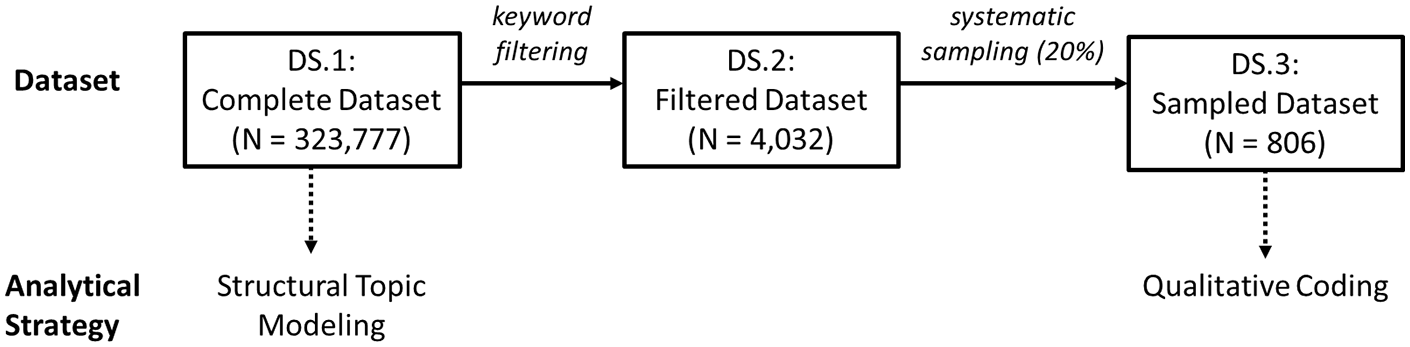
Analytical procedure.
Structural topic modeling
We used structural topic modeling (STM) to quantify content that reflects an environment of uncertainty in the complete dataset (DS.1 in Figure 1). STM is a topic modeling algorithm widely used by social scientists to identify latent themes in large corpora (Roberts et al., 2014). To preprocess our data for STM, we used the Lexical Analysis of Chinese model to segment each document and then used a dictionary to remove stop words. Then, we fit the preprocessed data to a 60-topic STM. The procedure for determining the number of topics is documented in Appendix 2. After getting 60 topics from the model, we tested the quality of each topic, following the steps recorded in Appendix 3. It gave us 34 topics. We manually labeled these topics and identified four topics related to the environment of uncertainty caused by potential censorship. These four topics are used in the first part of the analysis.
Qualitative coding
After presenting the big picture of uncertainty, we zoomed in to examine documents directly addressing the issue of censorship and policy. Due to the sensitivity of these discussions, many users used code words to circumvent censorship. Therefore, a qualitative analysis of a dataset filtered by keywords (including the code words) is more suitable than a computational analysis of the complete dataset.
We generated a customized dictionary of keywords indicating political environment and censorship based on our domain-specific knowledge and a close read of the documents. The dictionary is detailed in Appendix 4. In the filtered results, we identified and removed 283 documents with duplicated content as we suspected that they were coordinatedly posted for promotion purposes. This process gave us a filtered dataset of 4032 documents (DS.2). It is a small slice (about 1%) of the complete dataset (DS.1), and the dictionary approach may leave out relevant documents whose meaning is only interpretable in the context (e.g. as a comment on a post). Nevertheless, this approach generated a reliable sample of the discussions about policy and censorship in the danmei community, and this sample provides a valuable lens into what censorship means to people who are not politically incentivized.
We took a systematic sample of 20% (N = 806, DS.3) of the filtered dataset (DS.2) for qualitative coding. The first step is to develop a coding scheme. To do that, we randomly selected 200 documents from the sampled dataset, and the two authors developed their own coding scheme separately. We then discussed and refined our coding schemes and developed a two-stage coding procedure, which is illustrated in Figure 2.
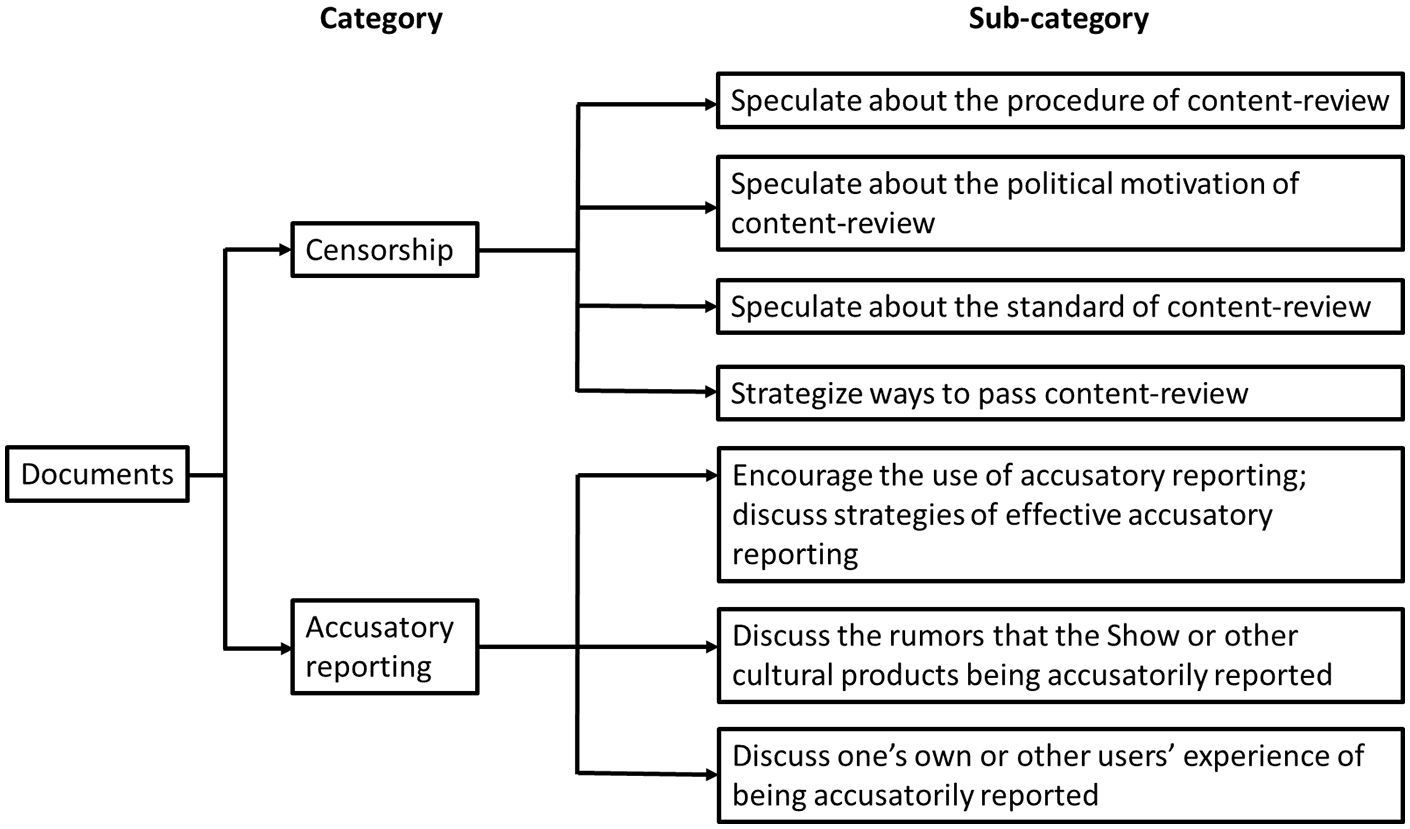
Qualitative coding procedure.
At the first stage of coding, we coded every document by whether it contains content about two main categories: (1) censorship and (2) accusatory reporting. For those identified as yes, we performed the next stage by coding whether the document fits into one or more sub-categories. The code for each category and subcategory is non-exclusive, which means we allowed one document to be fitted into more than one category and sub-category. Our coding scheme achieved a high degree of intercoder reliability (Krippendorff’s alpha = .89) (O’Connor and Joffe, 2020). Appendix 5 records further details about coding and verification.
Findings
Censorship’s uncertainty: were people aware?
Through the STM analysis, we identified four topics related to censorship and its uncertainty, among which three reflect fans’ negative affectivity, primarily anxiety and confusion, caused by uncertainty surrounding the Show’s prospect for release. For example, Topic 37 speculates about censorship regarding danmei content, as exemplified in one top-weighted document:
Let’s wait until the next year when policy restriction might be mitigated. I am certain that danmei has not been banned. [. . .] If [the government] really wants to ban danmei, there would have been a formal and written policy statement, just like [the ban on] talent shows . . . (Document ID: 117321)
The author of this document tried to figure out the Show’s status by interpreting the government’s intention. Reading tea leaves based on a past case (i.e. the ban on talent show), they established a correlation between signal (e.g. a note at a meeting versus an explicit ban) and intention (e.g. restrict or ban). These examples showcase the degree of uncertainty involved in the discussions of danmei-related restrictions, even for the simple fact of whether danmei content was the policy target or not.
As noted above, the two fandom groups under study are entertainment-focused rather than politically motivated. Censorship as a politically sensitive topic is not supposed to stir up discussions in these groups. The STM results demonstrate that these four topics account for 8% of the complete corpus (DS.1), and their proportion by month is presented in Figure 3. Longitudinally, the proportion of the four topics is on the rise, indicating a growing sense of uncertainty as clouds gather over the Show’s prospect for release. While ups and downs at the early stage mainly responded to announcements from the production team, two time points (TP) at the later stage are particularly noteworthy. TP 1 was April 2021, the month in which the Show was expected to be released by many fans. Speculations accumulated in this month’s discussions about whether the delay would be temporary or persistent. This was further muddied by the article criticizing danmei on Guangming Ribao this month (Meng, 2021), and community members engaged in debates about how “official” this official critique actually was. This constituted a contrast to what happened in September 2021 (TP 2), when the NRTA held a formal meeting declaring a crackdown on danmei content (Bai, 2021), which significantly reduced the room for speculation. As Figure 3 shows, there was a drop in TP 2, which arguably reflects a chilling effect within the online community. In short, even though most discussions under the four topics do not engage censorship directly, group members were aware of it and responding to it.
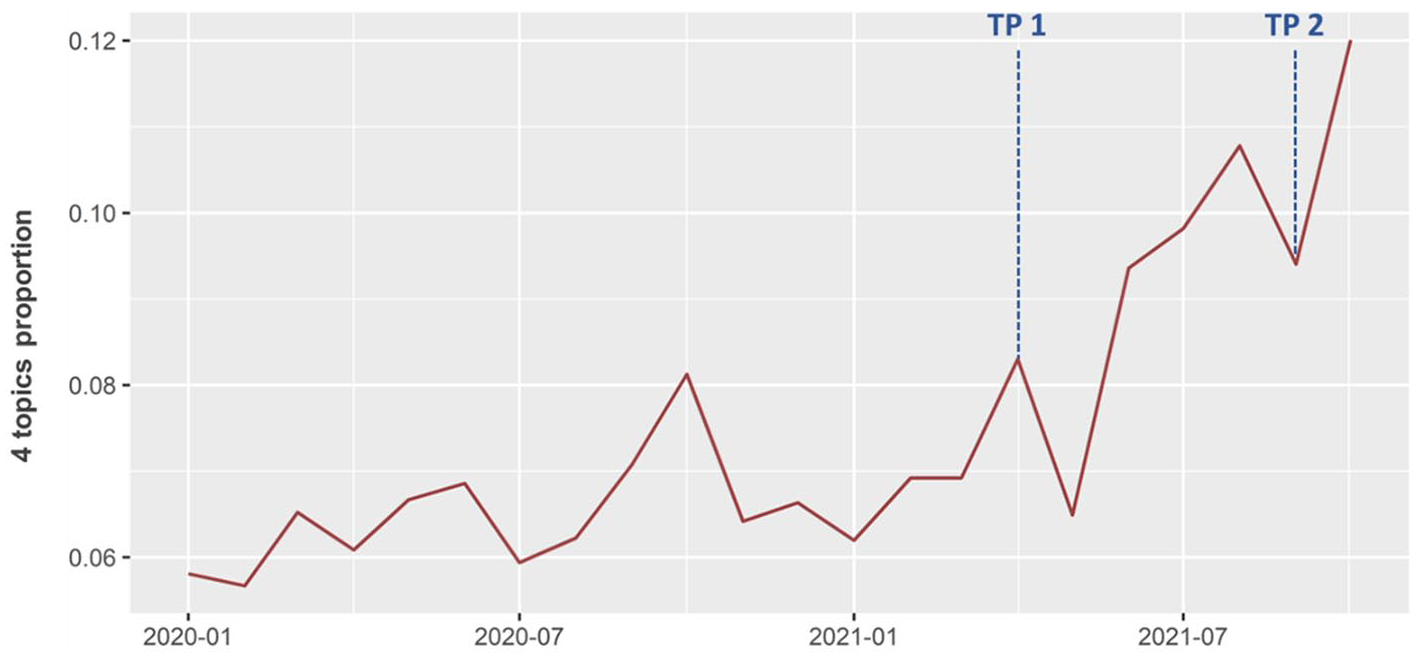
The proportion of content on uncertainty by month, 2020-2021.
A qualitative analysis of the sampled dataset (DS.3) further contextualizes the atmosphere of uncertainty. When discussing the Show’s status, many members demonstrated awareness that they were speaking on hearsay evidence. For instance, one Internet slang repeatedly came up in the discussions: “I spill the tea, but it does not mean we have to believe it.”
2
One exemplary document goes as follows:
Currently, no one can give you a definite answer. But based on hearsay evidence, the Show’s producing company holds the Show until the end of the year to avoid having to censor content (I spill the tea, but it does not mean we have to believe it). After all, nobody knows what the censorship policy may look like at the end of the year. (Document ID: 2160)
Occasionally, community members engaged in discussions about which sources, mostly social media influencers, of the “tea to spill” were more reliable. Members made one’s case either by highlighting the influencers’ (unverifiable) access to insider information or by citing their (similarly unverifiable) records of providing reliable information. In most cases, however, members just shared what they had heard without any claim of reliability, and uncertainty in the trustworthiness of any piece of information seems to be the default. In this environment, the reliability of information is such a constant question that it loses relevance to this community’s daily operation. Many community members are ready to embrace any unverifiable piece of information.
Imaginary of censorship: interpreting an opaque process
An environment of uncertainty fostered speculations and imaginaries about how censorship worked. In Table 1, over two-thirds of documents in the sampled dataset (DS.3) engage in discussing danmei-related censorship and content-review, speculating about censorship’s procedure, political motivation, standards, and strategies to pass content-review.
Discussions of danmei-related censorship in the sampled dataset.
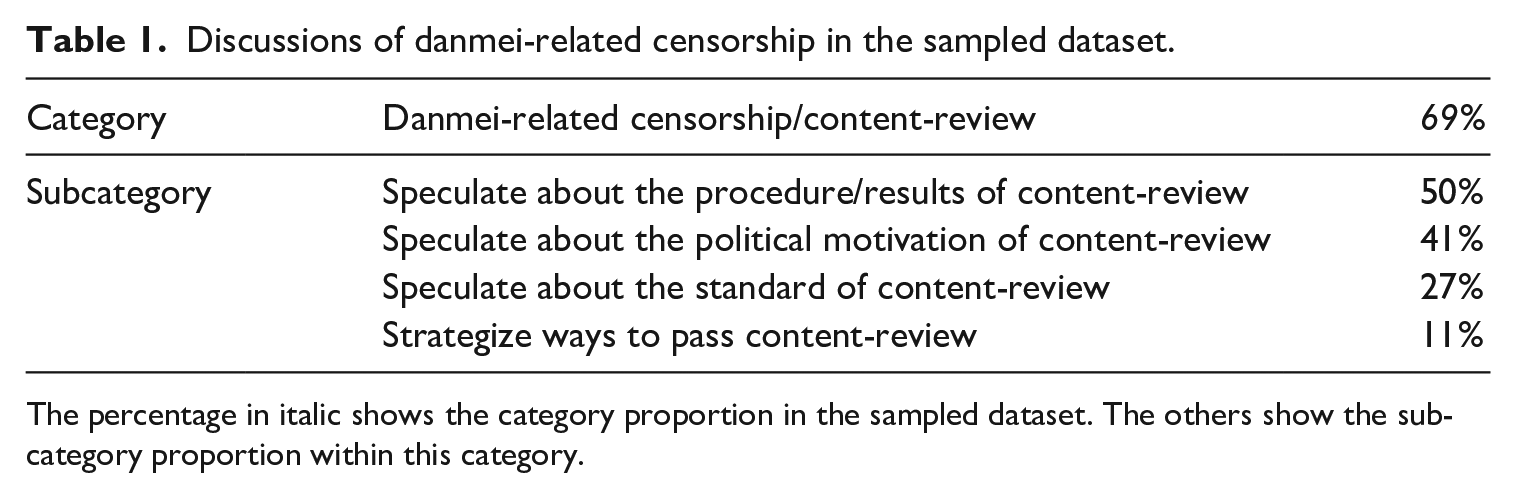
The percentage in italic shows the category proportion in the sampled dataset. The others show the subcategory proportion within this category.
Among these documents, half speculated about the procedures and results of content-review by the NRTA.
3
One key issue of debate is whether the Show was facing an extra round of review after, as the hearsay goes, obtaining permission for release. Individuals on one side shared what they heard from influencers that the Show was subject to an extra round of review, signaling the authority’s concerns with the content. Many of them went on to speculate about the cause of extra review: some attributed it to rumors that business rivals accusatorily reported the Show; others indicated that it was due to “intensified political atmosphere.” However, the majority of documents discredited the rumors and made the opposite case. One document makes inferences through a psychological lens:
. . . The idea of an extra review is absurd. [. . .] My major is psychology. [Psychologically speaking,] people are unlikely to overthrow their decisions within a short period of time. [. . .] If we put ourselves in the shoes of the content-review authority, someone came to us to accuse the Show right after we finished reviewing it. [. . .] [We would think:] are they blaming us for not doing our job right? . . . (Document ID: 88350)
Another document disputed the notion of extra review by interpreting the bureaucratic procedure:
. . . What I am posting is the NRTA’s Quarter 1 work summary. If the rumor is true, the extra review should happen in late March. [. . .] This work summary was published on 14 April, which means the NRTA is bonded to the result of the initial review. [. . .] This result is on an official document, with signatures from handling officials and stamped by the authority. Now it has been published in the quarterly summary. It’s not gonna change. (Document ID: 139874)
About two-fifths of the documents engaged in the speculations about how policy and political environment affected the Show’s prospect. Interestingly, participants held varying views on how sensitive the discussion itself is. The majority (i.e. three-fourths) of these documents directly mentioned ZhengCe, the Chinese word for policy, without regarding it as too sensitive. The other one-fourth instead used ZC, an abbreviation for the same word, which is a common practice to circumvent keyword-triggered censorship (Fu et al., 2013). Meanwhile, most participants seemed to agree upon the effect of the policy and political environment. This is summarized in one document:
. . . [The delay] indicates changes in the policy direction. This year is special as the 100th anniversary (of China’s ruling party). [. . .] The Show cannot fight against the government. (Document ID: 91313)
However, when it comes to what content may trigger an alarm in the review process, different takes on the censorship standards emerged. Although the obvious answer seems to be homosexuality, there are many other speculations: sex and violence, ethnic conflicts, sympathetic depiction of “bad guys,” or reincarnation and superstition, which go against the regime’s ideological root of Marxist materialism. Some even blame another popular danmei-adapted show for drawing regulatory attention. One exemplary document says that “the other show upset the NRTA by being too high-profiling, and our show becomes the casualty [. . .] If we do not keep our heads down, our show would never make it for release” (Document ID: 215269).
Indeed, “keeping heads down” to avoid regulatory attention is one of many discussed strategies to pass the review. Assuming that homosexual relationships would trigger censorship, the production team used an actress to play a male character involved in a homosexual love triangle. This strategy drew criticism from hardcore fans, but more came to its defense. One exemplary document argues that
I heard that, for this kind of show [i.e., danmei-adapted] to pass the content-review, you need to emphasize more on female characters. Changing the male character’s gender is the right choice . . . (Document ID: 12767)
In these documents, participants began to take on the authority’s perspective, strategizing based on assumptions about what content would be censored and what would not. Although identified only in one-tenth of the documents under this category, this discussion of strategies arises from the speculations about the standards of content-review. It just takes one further step to demonstrate a willingness to cooperate with censorship through preemptive self-censorship.
Accusatory reporting: censorship as collective work
Originating from an environment of uncertainty, the imaginary of censorship was reflected in the discussions of policy and political environment. But the effects of authoritarian control at the community level did not stop with speech. Accusatory reporting took it to the level of action.
Accusatory reporting relies on private actors, which can be an individual or organization, to inform the authority of the harmful information and misconduct they have encountered. In the context of danmei-related content, accusatory reporting is a practice whereby one private actor informs regulatory agencies of inappropriate language or content from another private actor or in a cultural product. Therefore, the subjects of accusatory reporting can be an ordinary user’s post or a danmei-adapted show with content deemed inappropriate. Here, a regulatory agency can be a forum’s administrator, a social media company’s content moderation team, or a political agency. It is any institution with the authority to impose some sort of punishment, ranging from removing the content, closing the user’s account, or even a legal penalty. From this perspective, accusatory reporting is a form of participatory censorship that complements state censorship.
As shown in Table 2, documents involving discussions of accusatory reporting account for over one-third of the sampled dataset. Among these documents, over half either encourage the use of accusatory reporting or discuss strategies for effective accusatory reporting (subcategory A). One common advice given here is “don’t engage with haters; use accusatory reporting to drive them out.” For instance, one document comments that: “Smart fans do not engage (with haters) and use accusatory reporting instead; only dum-dums try to persuade them” (ID: 285310).
Discussions of accusatory reporting in the sampled dataset.
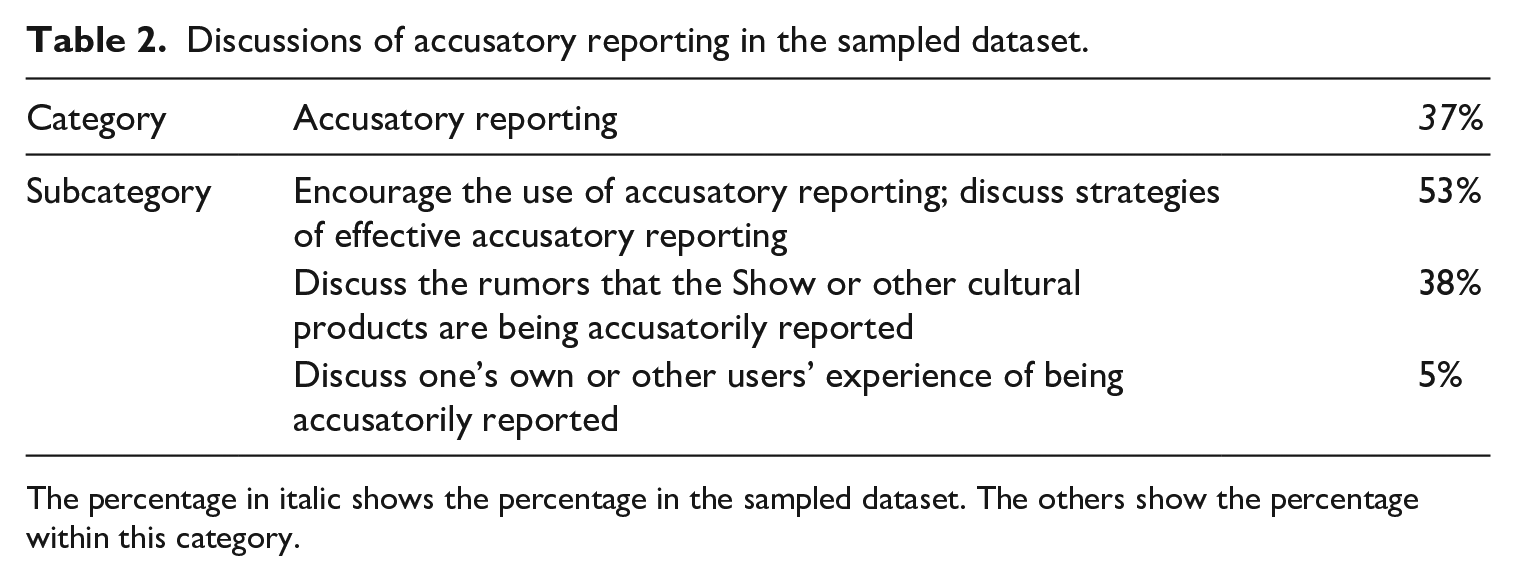
The percentage in italic shows the percentage in the sampled dataset. The others show the percentage within this category.
However, the boundary between “haters” and “fans” is blurry. Sometimes, “haters” are just fans with different opinions. As mentioned above, the Show used an actress to play a male character in its fiction. This choice, presumably to circumvent censorship of homosexuality, drew fire from the actress’s fans in the forum, since some others were unhappy with these fans’ advocating for the actress as the leading actress in a danmei-adapted show and discussed using accusatory reporting to punish this behavior.
No matter what motivated accusatory reporting, users can be strategic in framing the act in a way appealing to the regulatory agency in order to achieve one’s goal (e.g. driving one member out of the forum). One document shared a strategy: “I usually choose ‘irrelevant to the topic’ and ‘undermining the fairness of ratings’ as the reasons [for the accusatory report]. I think these reasons are likely to be accepted” (ID: 73083). Another document shared the sample text for collective accusatory reporting in an effort to request the removal of one video on a video website. The sample text goes as follows:
Category: Illegal/others. This video contains a spoiler from an unreleased TV show, hurting the interests of the production team and the cast. We ask [the video website] to take action and deal with this issue in order to foster a good cyber environment. Thanks. (ID: 2886, emphasis added)
This sample text is interesting for using the phrase “foster a good cyber environment.” 4 This phrase frequently appeared in official news articles and governmental documents about regulating the Internet. For instance, in early January 2020, when the Chinese government downplayed COVID-19, the police department warned the public to refrain from fabricating, believing, or distributing rumors and “work together to foster a good cyber environment” (Cyberspace Administration of Chongqing, 2020).
The case above demonstrates the strategic adoption of official language to boost the success rate of accusatory reporting, and the following documents reflect infiltration of official terms at a more subconscious level. Fans sometimes refer to the act of reviewing fellow fans’ online speech and punishing those deemed inappropriate as “policing” (chujing in Chinese) or “enforcing the law” (zhifa in Chinese), analogizing private citizens’ peer-to-peer censorship and surveillance to the law enforcement authority and incorporating it as a part of community operation.
Not all community members are accusatory reporters. Another two-fifths of the documents shared rumors and experiences about being subject to accusatory reporting. Most of these documents discussed the rumors that the Show had been accusatorily reported to the NRTA by business rivals, parents concerned about homosexual content, or rival fan groups. One example goes as follows:
I don’t think [the business rival] accusatorily reported the Show directly; instead, they reported the Show’s producing company for promoting homosexual content on the front page. In this way, the reporting would not affect their own shows [. . .]. Through this lens, every piece of evidence comes together, and the accusatory reporter must be Y [a business rival]. (ID: 242154)
To be clear, there was no consensus or known fact on whether the Show was accusatorily reported at all and, if so, who did it. Indeed, it is just another circumstance of uncertainty. What is noteworthy is the distrust of other private stakeholders (e.g. peer members and content producers) in the danmei community. Some fans even suggested “retaliation” against business rivals by accusatorily reporting their shows. Meanwhile, the fact that danmei and other content are subject to censorship with a high degree of uncertainty is taken for granted and immune from dispute.
Discussions
It is widely acknowledged that authoritarian regimes use censorship to filter information and perpetuate their rule. However, censorship is not simply a top-down process but also collective and participatory work. This study of an online community showcases how censorship can benefit from interactions at the community level, where state penetration is the weakest. We analyzed how members of a danmei community coped with uncertainty surrounding censorship through imaginary, self-censorship, and peer-to-peer censorship. With uncertainty infiltrating into daily discussions of the show, many basic facts looked obscure, which fostered members’ divergent, sometimes conflicting, imaginaries about the motivation, standard, and procedure of the content-reviewing process. In previous studies, sharing information within a community led to behaviors of censorship circumvention (Stern and Hassid, 2012; Svensson, 2012). In this case, however, the imaginaries are associated with the practice of accusatory reporting, a form of participatory censorship. Different factions of the community strategically borrowed language and practices from the political authority to discipline content they disliked, and every member could simultaneously be the subject and the object of accusatory reporting. This kind of community-based interaction facilitated state censorship in the absence of the state.
This article is limited as a case study of one subcultural community in one authoritarian regime. However, it offers three main insights into the study of censorship—and content moderation in a broader sense. First, it buttresses previous research on the importance of uncertainty in a regime of censorship (Stern and Hassid, 2012) but takes one step further to investigate how uncertainty fosters the imaginary of censorship. From a top-down perspective, how social actors interpret censorship and act upon the interpretation has little relevancy to the operation of the system. However, if we admit that censorship cannot work without some degree of cooperation or participation from social actors, including those subject to censorship, their efforts to act strategically in an uncertain environment become central to our knowledge of how this system is resisted, sustained, and reproduced. This article showcases these imaginaries as products of a meaning-making process based on rumors, hearsays, and (partial) reasonings. We call for more in-depth research to understand how private actors make sense of censorship with limited and imperfect information and how this process shapes their action.
Second, this study illustrates how censorship operates as collective work in non-professional and non-politically mobilized online communities. It sheds light on the depth of infiltration of authoritarian language and practices into virtual interactions at the grassroots level, which is hard for the state to penetrate. In this process of infiltration, community members were not merely objects of censorship. Like individuals in previous studies (Stern and Hassid, 2012; Zhu and Fu, 2021), they had agency and could act strategically. Meanwhile, fans in this case not only co-opted authoritarian control of content but also proactively participated in censoring and surveilling. These different patterns of interactions may be shaped by types of online community, digital platforms on which these interactions happen, or cultural and subcultural contexts in which community members are embedded. Further studies are needed to address distinctive ways of interaction between digital communities and the censorship system. In our case study, some members utilized the information control system to serve one’s own goal, removing content that they disliked rather than facilitating the state’s goal—at least not directly or intentionally. Nevertheless, one may argue that this practice still legitimizes the regime’s rationale and internalizes it into the fabric of society. Future studies may follow this line to investigate how participatory censorship works in different social contexts and how it affects the ways of community organization.
Third, if censorship scholars expand the scope of their focus, participatory disciplining of language and content is not peculiar to the authoritarian context. Main social media platforms in the West (e.g. YouTube) also developed internal reporting systems to meet the new social and legislative demands for content moderation (Crawford and Gillespie, 2016), and the trends of cancel culture and deplatforming pose new challenges to the conventional ideas about who should set the boundary for the digital public sphere (Luo, 2022). Indeed, the attention to a plurality of private actors in the digital communication and/or surveillance system could provide a way to transcend an over-simplified dichotomy between authoritarianism and democracy in researching new media. We call for more comparative studies to shed light on why individuals and private organizations participate in censorship and content moderation, how such participation changes the power dynamics between the state, private organizations, and citizens, and what it means for the future of mediated communication in the digital age.
Supplemental Material
sj-docx-1-nms-10.1177_14614448221113923 – Supplemental material for Participatory censorship: How online fandom community facilitates authoritarian rule
Supplemental material, sj-docx-1-nms-10.1177_14614448221113923 for Participatory censorship: How online fandom community facilitates authoritarian rule by Zhifan Luo and Muyang Li in New Media & Society
Footnotes
Acknowledgements
The authors would like to thank the participants of the Media Soc Symposium and the Beyond the “Wall(s)” workshop at the McLuhan Centre for Culture and Technology for insightful suggestions and engaging discussions. They are also grateful to the editor and the anonymous reviewers for their thoughtful and constructive feedback.
Funding
The author(s) received no financial support for the research, authorship, and/or publication of this article.

Supplemental material
Supplemental material for this article is available online.
Notes
Author biographies
References
Supplementary Material
Please find the following supplemental material available below.
For Open Access articles published under a Creative Commons License, all supplemental material carries the same license as the article it is associated with.
For non-Open Access articles published, all supplemental material carries a non-exclusive license, and permission requests for re-use of supplemental material or any part of supplemental material shall be sent directly to the copyright owner as specified in the copyright notice associated with the article.
