



Abstract
This article considers newspapers’ role in shaping the sociotechnical imaginaries of touch, and emerging technologies that digitally mediate touch. It examines the discourses of touch and personal relationships at a distance that circulated in major British broadsheet newspapers during the 2020 outbreak of coronavirus disease-19, alongside dominant narratives of touch and remote communication in the previous 5 years. In doing so, the article demonstrates how existing discourses of touch and remote communication intensified during the pandemic, while imaginations of remote touch narrowed. The sociotechnical imaginaries of digital touch matter because they illuminate the kinds of social relations touch technologies are perceived to forge, maintain or deny.
Keywords
Introduction
This article takes the British press context as a case study of how imaginations of emerging touch technologies are locally produced and negotiated during a global event, the coronavirus disease (COVID)-19 pandemic, and entangled in wider notions of digital communication, social relations, touch and the body. It does so by critically examining the discourses of touch and personal relationships at a distance that circulated in major British broadsheet newspapers during the 2020 outbreak of COVID-19, alongside dominant narratives of touch and remote communication in the previous 5 years.
On 11 March 2020, the World Health Organisation (WHO) declared COVID-19 a pandemic. Twelve days later, the British Prime Minister, Boris Johnson, announced a national lockdown, instructing the population to only leave home to shop for essentials or to exercise. Social distancing measures came to regulate social life in unprecedented ways and necessitated, for many, a new engagement with digital media to enable personal contact. They also newly foregrounded the significance of interpersonal touch. Newspaper headlines, such as ‘Affection deprivation: What happens to our bodies when we go without touch?’ (Coffey, 2020), underline what became for some a key dilemma of the pandemic; the inability to be physically close or to comfort each other through touch. Digital technologies were both celebrated for keeping people ‘in touch’, and dismissed for falling short of the connection associated with human, physical touch.
This article sketches this discursive landscape and considers newspapers’ role in shaping the sociotechnical imaginaries of emerging touch technologies (Jewitt et al., 2021) or technologies that digitally mediate touch (Jewitt et al., 2020). The concept of sociotechnical imaginaries is a way of understanding socially shared visions of technological futures (Jasanoff, 2015), and is pertinent to the study of emerging technologies (Jewitt et al., 2020). Sociotechnical imaginaries matter because they illuminate the kinds of social norms and relations touch technologies are perceived to forge, maintain or deny. Many of the socio-technical imaginaries we draw attention to in this article refer to non-technological means of touch(ing) and make the case that news representations of touch during before and during COVID did much to capture and shape imaginaries around touch. We argue that these discourses underpin and intersect with discourses of remote digital touch technologies, and that the imaginaries of touch and digital touch that they circulate are significant in shaping digital touch futures. Interrogating the ideas of touch inscribed in the dominant socio-technical imaginary through the news in any particular moment, helps to articulate what present imaginations reveal.
First, we contextualise the role of touch and COVID-19 in the news in the literature on touch, technology and remote personal communication.
Background
Touch is a ‘touchy’ subject. While crucial to our sense of self and wellbeing, touch can also be awkward, unwelcome and abusive (De Benedictis et al., 2019). Who touches whom or what, and how, is bound up with social and cultural norms (Classen, 2005), reflected, problematised or amplified through the media. Swart et al. (2017) describe news media as part of the ‘social fabric of everyday life’ (p. 905), pointing to both their ubiquity (Deuze, 2013) and the ways in which users insert their engagements with a variety of digital platforms into the rhythms of their lives.
While news consumption has arguably become fragmented, broadsheet newspapers and their online platforms continue to provide shared frames of reference, constructing narratives around socially (un)acceptable touch, and determining touch hot spots and sensitivities. They also play a role in constructing discourses around emerging technologies designed to digitally mediate touch or transform its sensory and communicative character (Jewitt et al., 2020). We argue that news discourses of touch underpin and intersect with discourses of remote digital touch technologies to suggest how touch technologies – ‘real’, fictional or imagined – articulate the body–technology relationships that structure people’s everyday practices, and provide insights into the values and conventions of the cultures that they emerge from (Manovich, 2001). In short, this discursive space helps to shape the social ‘landing pad’ for future digital technologies. Exploring these discourses enables us to interrogate the ‘social imaginary’ (Taylor, 2004) that they generate and circulate.
During 2020, COVID-19 reached a global scale as a health crisis and media event. Social research has highlighted the role of the media in constructing perceptions of risk and responsibility during disease outbreaks (cf. Lupton, 2021). This resonates with a small body of work that has begun to chart the discursive construction of COVID-19 in the news. Ogbodo et al. (2020) have pointed to scaremongering in international media coverage, and the ethnicisation and politicisation of the disease. Martikainen and Sakki (2021) have demonstrated how different age groups have been constructed as more or less empowered, controlled or isolated during the pandemic; noting that people’s ‘longing for touch’ (p. 26) is frequently highlighted in headlines and images. Touch is brought into focus by Döring (2020) who charts how dominant news narratives have constructed the pandemic’s impact on sexualities. Based on a 1-month snapshot of international media coverage, she identifies a range of partnered sex narratives which are also reflected in our materials (i.e. the reporting of more relationship sex and an anticipated baby boom, contrasted with less relationship sex, less casual sex, and a rise in divorces, telephone and online sex), plus apparent changes in social attitudes towards technologies, specifically the positive repositioning of online sex and sexting as ‘disease prevention behaviour’ (Döring, 2020: 2768).
The role of communication technologies in creating a sense of intimacy, co-presence or deep connection through remote personal communication is well established (Baym, 2015; Chambers, 2013; Christensen, 2009). Treré et al. (2020) note a general sense of ‘hyper-connectivity’ at the onset of COVID-19, while acknowledging some persistence of digital divides (p. 606). With many social interactions moving online, communication technologies became ever more important to maintain and nurture interpersonal relationships (Drouin et al., 2020; Watson et al., 2021).
COVID-19 shed new light on haptic and other touch-based communication devices that are emerging with a promise of a more tangible sense of staying ‘in touch’ (Jewitt et al., 2020). Examples include haptic garments for virtual environments, bespoke haptic devices that enable a form of remote touch (e.g. Hey bracelet, T-jacket, ‘tele-dildonics’, Hug Shirt), bio-sensing technologies that, for instance, shape parent–baby touch (Leder Mackley et al., 2020), and robotic touch (e.g. Barker and Jewitt, 2020). While the use of haptic feedback in smartphones, watches and fitness trackers is widespread, touch-based communication technologies are not yet part of the mainstream. Digital touch devices and environments remain limited, although digital (mediated) touch has been shown to be effective in communication, conveying affective support, valence and arousal, and a range of emotions (Price et al., 2022). Attempts to bring touch into the digital realm continue a-pace, with industry ideals of a working body (e.g. within the military or sex industry) that is ‘always on’, ‘hyper-attentive’ or ‘disciplined for tactile calls to attention, a body open to these calls to be productive at all times’ (Parisi and Farman, 2019: 3). Alongside this focus on the temporalities of touch, the ongoing process of digital dematerialisation is seen to have disengaged with and neglected the values of the physical world (bodies, artefacts and interactions) to reduce or remove touch from the communicational environment (Van Campenhout et al., 2016).
The social and cultural significance of touch technologies is being negotiated, notably through their treatment in the media. Indeed, as media historians have demonstrated (Parisi, 2018), there is a long history of haptics devices and environments, dating back to eighteenth-century electric shock experiments, which form the backdrop for current computational haptics developments. Throughout, individual touch technologies have been hyped by makers and the media as perpetually on the cusp of transforming bodily experience and social interaction. ‘[T]echnologies of perception’, Parisi argues elsewhere, ‘reform our senses not by our material interaction with them but rather through the discursive framing of this material interaction’.
Collectively, newspaper discourses contribute to sociotechnical imaginaries of digital touch (Jewitt et al., 2021), that is, ‘collectively held and performed visions of desirable futures [. . .] animated by shared understandings of forms of social life and social order attainable through, and supportive of, advances in science and technology’ (Jasanoff, 2015: 25). It is useful to note that sociotechnical imaginaries of digital touch resonate with previous moments of co-emerging communicative practices, and are shaped by the interconnectedness of developments in media and communication practices more generally (Jewitt et al., 2020). Touch-based technological innovation and associated sociotechnical imaginaries have a significant history. How touch technologies draw the body (often only the hand or forearm) into meaning making, and question human–digital boundaries is a key point of critique (Parisi, 2018). This points to the ways in which particular kinds of bodies (gendered, aged, sexual and racialised bodies) are considered, included or excluded, in emergent sociotechnical imaginaries of digital touch and the ethics and cultural etiquettes of touching, including power and control, concerns related to the digital sharing of touch, authenticity and fake-touch through the digital manipulation of touch (Jewitt et al., 2020). While, on one hand, these imaginaries of digital touch express fears of disillusion and disconnection, on the other, they share a desire for new possibilities for a richer bodily landscape for digital touch communication, new forms of connection and attachment, including changing boundaries between bodies, shareable touch-experiences. In other words, nuanced narratives of losses and gains cut across imaginaries of engagement with digital touch, and the continuities and changes of their experiences, memories, and histories of touch are key to, at least for the time being, setting digital touch communication apart from the contemporary mantra of ‘anytime, anywhere, anybody’ communication: in the sense that digital touch is imagined for a prepared special time, in a private domestic place, and within an existing intimate friendship, family relationship or partnership (Jewitt et al., 2020). Sociotechnical imaginaries offer lenses through which digitally mediated touch futures might be envisaged. It is against this backdrop that this article critically interrogates newspaper discourses of touch and (mediated) touch leading up to and during the pandemic – a moment of touch crisis where both touch and technologies were newly brought to the fore.
Methodology
This article is part of a wider study of the social and communicative implications of digital touch technologies (Jewitt et al., 2020). Since 2016, the study has engaged with discourses of ‘touch’ and touch technologies in the media. An apparent intensification of these discourses at the onset of the pandemic initiated a case study on newspaper touch discourses in COVID-19 times. With a focus on major broadsheets in the United Kingdom, the case study asked: what have been the news discourses of touch and remote personal communication during COVID-19? Have these changed since before the pandemic? What kinds of touch are included or missing? How, if at all, are emerging touch technologies situated within these discourses – with what impact on communication and social relationships?
Search strategy
The search strategy consisted of two phases. The first centred on LEXIS/NEXIS which provided a central, searchable database to test search terminology and delineate case study boundaries. The second phase, in response to the limitation of how LEXIS/NEXIS homogenised and de-contextualised articles, involved sourcing articles via newspapers online portals.
Phase 1
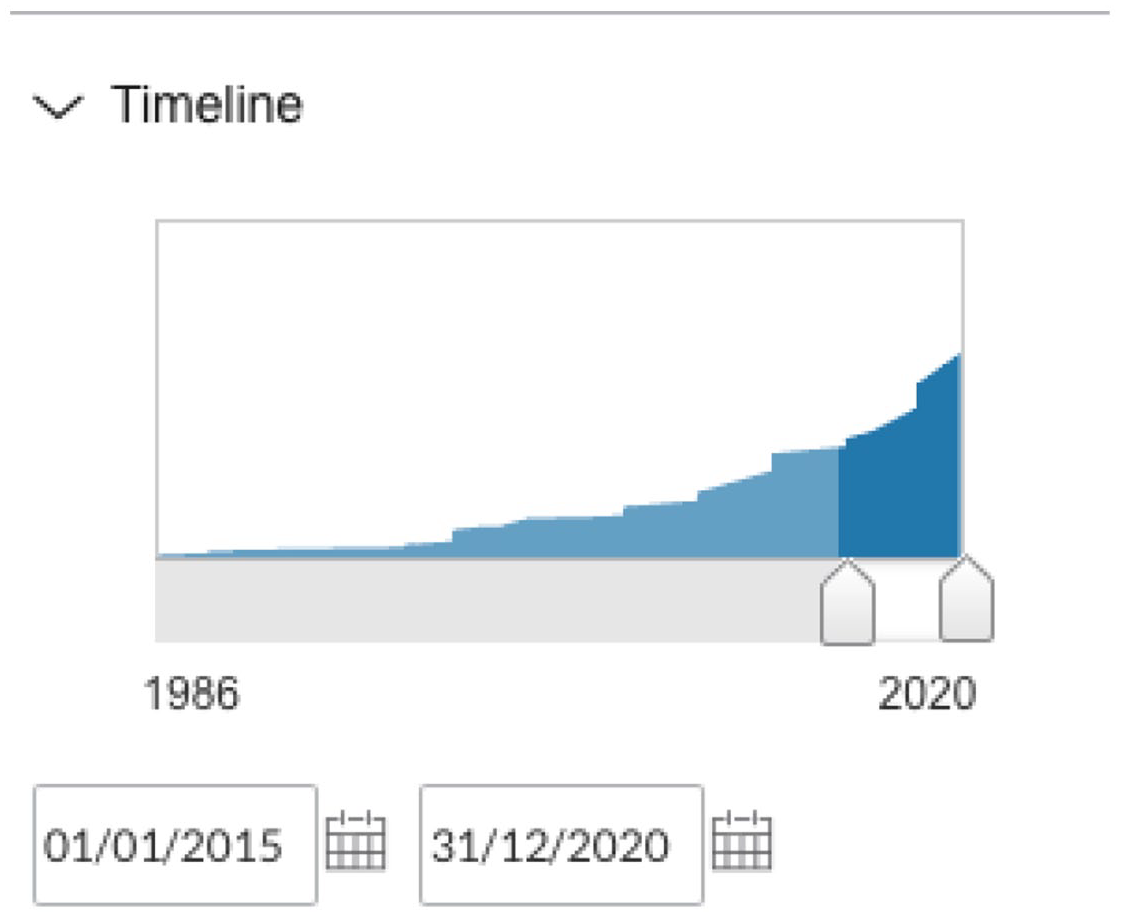
LEXIS/NEXIS searches from the start of 1986 to the end of 2020 showed an increase in mentions of touch, technology and personal relationships from 2015 with a marked rise in 2020. The search term combination ‘headline(touch) AND digital OR tech OR haptic OR tactile AND relationship OR friendship OR family’ created the graph shown in Figure 1.
Search results.
This graph functioned alongside other visual representations of search results to determine the relevant time frame for subsequent searches, 2015–2020. Taking a longitudinal view enabled us to follow narratives before and through the pandemic. We selected seven British newspapers on the basis of their prominence (readership) and representation of a range of political-ideological alignments: The Daily Mail, The Sun and The Mirror – all part of the tabloid press and known for a more sensational take on news stories (with The Mirror leaning towards the left of the UK political spectrum) – and The Telegraph, The Times, The Independent and The Guardian – traditionally, ranging from conservative to more liberal perspectives.
The search-term vocabulary was broad to ensure particular kinds of touch were not prioritised. Alongside common touch words (e.g. hold, stroke), touch terms such as pinch, poke, tickle were included, as well as haptic, tactile, tangible, remote, distant, separate, afar, mediated, relative, partner, loved one, parent, child, COVID, coronavirus and pandemic. The search highlighted the extent to which touch was often implied in ‘physicality’, ‘human relations’ or ‘human contact’ more generally, and also the high level of touch metaphors in news stories (e.g. politicians being ‘out of touch’). We assessed each terminology in context, filtering out irrelevant articles and focussing on discussions of touch as physical (or near physical) contact. With a focus on personal relationships, we excluded articles that addressed touch in work settings, between patients and health practitioners, in the context of shopping, or hygiene. We also excluded articles on sexual abuse and the #MeToo movement as these tended to concern face-to-face touch interactions, rather than remote personal relationships. Finally, where search combinations returned 10,000 + results, we sought to refine them or restricted our focus to the first 300 articles.
Phase 2
A second search strategy involved sourcing articles via newspapers online portals. Searching for article headlines via mainstream search engines and newspaper portals returned related articles that had not appeared via the LEXIS/NEXIS database, and made it possible to trace discourses across newspapers and time.
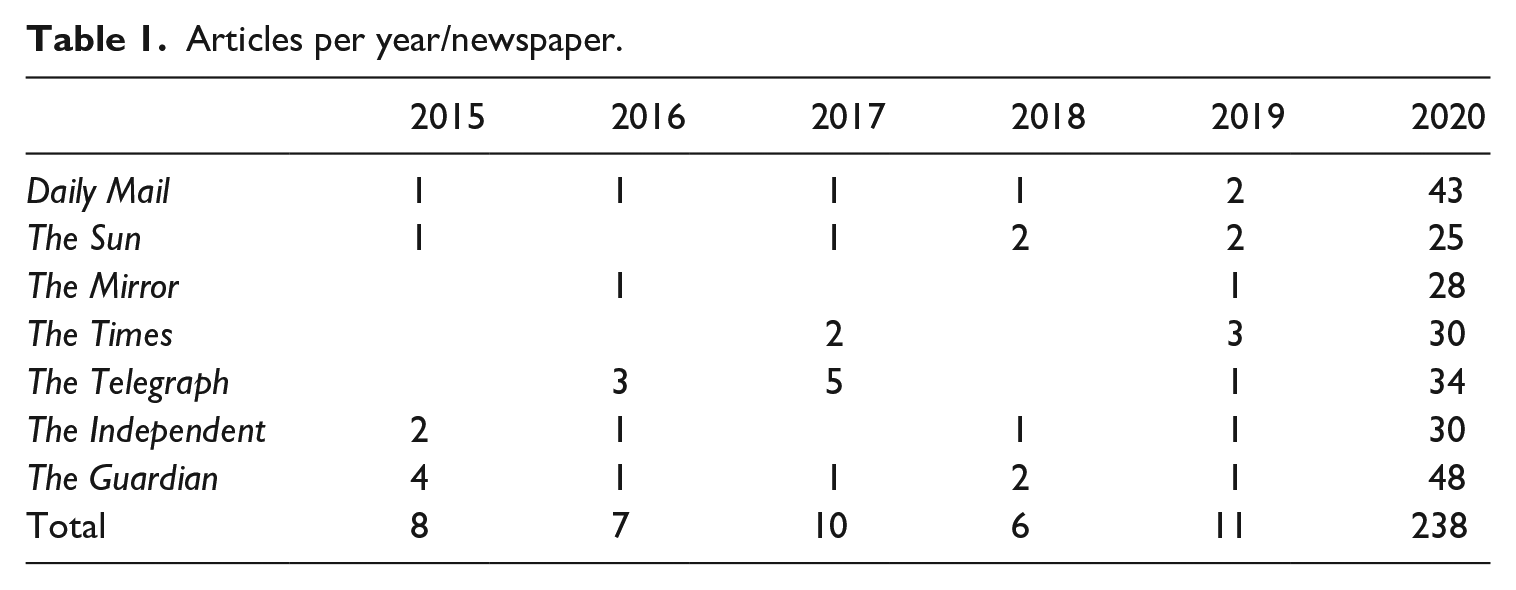
Our search produced a corpus of 280 articles. Of these, 42 were published pre-2020 and 238 between March 2020 (the first national lockdown) and November 2020 (the end of the second national lockdown). PDFs of newspaper articles were downloaded and organised by newspaper and publication date into a searchable format. Table 1 shows the distribution of items across newspapers and years. There are more articles in The Daily Mail and The Guardian. While the scale of the corpus means drawing firm conclusions on this difference is not possible, we suggest it may relate to their roles as (ideologically opposing) societal commentators on human/human–technological relations.
Articles per year/newspaper.
Developing themes
This case study primarily focusses on textual discourse, with an emphasis on how discourse is both representative and constitutive of wider processes, practices and social relations. Our analytical lens shares some commonalities with Foucauldian discourse analysis (cf. Carabine, 2001) in its focus on the historically situated relations between discourse, knowledge and power. Rather than looking at fine-grained detail in discrete linguistic units of analysis, we employed a thematic discourse analysis that attended to wider discursive objects and strategies, that is, patterns of meaning that functioned together to produce particular versions (or visions) of events, including touch/communication norms, or competing ideas around these. We iteratively and collectively mapped these into preliminary themes (e.g. touch as existential, as biological, as sex, touch in crisis) to bring analytical unity to repeated and related discourses. Based on these initial groupings, we developed a set of overarching themes under which preliminary themes could be presented and interrogated. There were three for the pre-COVID era – the power of human touch, the digital as non (human)-touch and remote digital touch as technological innovation. These persisted and intensified in COVID-19 times where we again hone in on three overarching themes to chart the overall discursive landscape: a new sense of remote, governing touch and unpacking the (virtual) hug.
The analysis was directed by the aforementioned research questions and sub-questions, including: how is touch talked about; in what sort of relation; what digital communication technologies are addressed, and how; what is ‘remote’ in each context? A further sensitising concept was that of sociotechnical imaginaries (discussed in Jewitt et al., 2021). We understand newspaper articles as contributing to such shared visions, as creating specific kinds of imagined futures of remote personal communication and digital touch and, in the process, shaping social responses to technological innovation.
We note that there were some differences of style and emphasis between newspapers, for instance, in terms of the kinds of touch and relationships made relevant, the (critical) engagement with government restrictions, and the general nature of headlines, article genres and imagery. For reasons of space, we attend to the overall discursive landscape while providing illustrative examples from across broadsheets and indicating their prevalence. While this is a qualitative-contextual exploration of discourses and their interrelations, we report some numbers to give a sense of the discursive landscape in line with Maxwell’s (2010) assertion that the inclusion of numbers can be meaningful in some qualitative studies (while seeking to avoid overstating numerical significance).
The pre-COVID news landscape of digital touch and personal relationships
Touch technology and remote personal communication in the pre-COVID sample were situated against three analytical discursive themes: the power of human touch; the digital as non (human)-touch and remote digital touch as technological innovation. We sketch each to reflect on the kinds of touch, relationship and remoteness made relevant across the news.
The power of touch
Touch, in the lead-up to COVID-19, was discussed in the selected newspapers as ‘primal’, as essential to human beings as ‘social animals’ (Salzman, 2020), as helping to ‘forge connections and construct a sense of self’, making us ‘aware of our own bodies’, and ‘relate to people’ (Reid, 2017). The benefits of human touch were considered to enhance physical and emotional wellbeing – heightening the immune system and reducing pain, stress, depression and feelings of loneliness. Touch as direct physical contact was situated against ‘mere’ presence or forms of (touchless) remote communication. For example, The Daily Mail referenced studies, which suggested a difference in pain reduction between a loved person’s presence and their touch (Hagan, 2019). Mentions of affective touch through the stimulation of c-tactile afferents (e.g. Reid, 2017) and the release of the ‘love hormone’ oxytocin (Tierney, 2016) underpinned discourses of touch as biological and reflexive, as well as socially relevant and necessary.
While touch was largely discussed as almost-uniform and positive, individual articles distinguished between affective, abusive and functional touch, as, for instance, experienced by people in care: ‘Many are only pushed, pulled, lifted, tightened, loosened, dabbed, wiped, changed, fed, scraped. Can you imagine anything worse than a lifetime of only ever being touched briskly and efficiently?’ (Reid, 2017). Touch was discussed in a quarter of pre-COVID articles as in crisis, with ‘skin hunger’ and ‘touch deprivation’ constituting expert descriptors for a society that does not touch enough, or not in the right way. These societal needs were seen as giving rise to an industry of professional touchers (e.g. massage therapists, cuddlers), and digital technologies, mainly apps, allowing people to ‘seek [. . .] touch from a stranger’; an article in The Independent (Mueller, 2015), on the location-based Cuddlr app (later Spoonr), highlighted the spectrum of ‘physical contact’ that technology companies accommodated. Touch was bound up with different notions of intimacy, connection and consent: ‘Cuddlr showed the fault line between dating and sex, which can surely be transactional, and the physical expression of intimacy, which turns out to be much more complicated’, involving feelings of ‘psychological or emotional closeness’ (Mueller, 2015). Cuddlr’s makers saw society as gaining a ‘maturity that allowed people to communicate what they really wanted from interaction, and what their boundaries were’ (Mueller, 2015). Digital technologies in the form of dating and cuddle apps, rather than constituting a ‘touch’ option in their own right, were considered a stepping stone towards particular kinds of physical face-to-face interaction and, optimistically, as addressing a societal need or generating new social norms around touch.
The above discourse is significant as it foregrounds the importance of face-to-face and skin-to-skin interaction, and impacts on the sociotechnical imaginaries of personal connections across distance. Technologies (in the form of apps) are constructed as enabling in-person touch encounters (albeit as a site of last resort), with touch becoming a commodity and tech companies positioning themselves as advancing and safeguarding touch practices.
The digital as non(human)-touch
Alternatively, digital technologies were accused of causing a ‘tech-driven disconnect’ and apportioned some blame for society’s skin hunger. Writing for The Sun, Salzman (2020) predicted a key trend for the year ahead of seeking out ‘physical contact’, through a ‘rise of hugging’ and non-digital attempts to feel ‘the comfort and security of being cradled’ with weighted blankets or adult swaddling. She expressed concerns that increased digital connection would risk ‘becoming disconnected emotionally and physically’. Likewise, The Times described weighted blankets as a ‘cuddly antidote to tech overload’ and virtual encounters (Hutton, 2019). The ‘digital’ is depicted in these examples as directly opposing or replacing the materiality and affect of interpersonal touch, as though digital encounters remove bodily experience from the experience of being in the world and being with others. It is also used almost interchangeably with the wider idea of ‘tech’ or ‘technology’, in its role as distractor from the experience of attending to, and by extension, actively touching bodies. Elsewhere (Jewitt et al., 2020, 2021) we have discussed the centrality of materiality to the sociotechnical imagination because it is a part of how technologies constrain and make possible what people can do (and mean) with them, and the ‘feel’ of the fabric of sociotechnical imaginaries are significant for how people might engage as well as the distinctions they make between human and non-human touch. This is part of a wider discourse of technology being a sign of increasingly busy, mediated times. In 2019, the micro-trend of micro-dating emerged (e.g. Garlick, 2019; Hope, 2019), seeking to replace mediated communication with more face-to-face interaction, including planned moments of touching: ‘when I got into bed, I cuddled into Adam. [. . .] We rarely touch each other these days. I [. . .] woke up feeling loved’ (Hope, 2019).
Even where the digital and material were not set out to oppose each other, digitally mediated communication was constructed in some articles (e.g. Cocozza, 2018; Hutton, 2019) as falling short of face-to-face interaction and direct physical contact. In 2015, The Daily Mail wrote of a ‘rapid rise in “Skype dads,” arguing that thousands of divorced fathers in the UK relied on video calls to keep in touch with their children’ (Rainey, 2015). Although Skype was considered a ‘life line’ for watching children grow up, the newspaper referred to (unspecified) experts worrying that ‘communication over digital devices [. . .] was no substitute for face-to-face contact’. Being able to see one’s children was deemed better than just hearing them on the phone but, especially with younger children, digitally mediated communication was seen as problematic. Quoting one ‘Skype dad’, the paper wrote ‘A relationship with a two-year-old is about physical contact, so [. . .] it was harder to be a father to him’ (Rainey, 2015).
In 2015, as part of an article on digital detox and happiness, Zoe Williams (2015) in The Guardian evoked a popular image of a ‘virtual hug’, of connecting at a distance through the idea of a hug, reflecting on its inferiority: ‘How many virtual hugs would it take to equal one meat hug? My instinct says an infinite amount . . . ’.
Here, the emphasis lies on the importance of encounters in the flesh – touch encapsulating physical-bodily-human and social – leaving little room for imaginations of digital technologies as bridging that gap. Instead, they are part of a narrative of technological development that negatively impacts social relations.
Fears and possibilities of digital touch
Digitally mediated touch was primarily part of the above touch discourses where articles focussed on moments of future technological innovation with the potential to transform tactile interaction. An article in The Times reimagined video calls in relation to the development of ‘wireless skin that transmits touch’: ‘A child calls her grandfather on Skype. She touches the screen, and the action is translated into a stroke on his arm’; such a scenario ‘may soon be possible’ (Whipple, 2019). Similarly, a Daily Mail headline imagined
A hug from the other side of the world: Artificial skin that can sense TOUCH could allow the wearer to pat a team mate on the back in an online game or embrace a loved one thousands of miles away (Curtis, 2019, original emphasis).
The Times wrote of the Telesar V robot as letting ‘humans feel remotely’ through sensations of warmth, cold and touch ‘opening up a world of virtual reality that could be used to save lives, empower the disabled or engage in remote cybersex’ (Parry, 2017). Indeed, beyond isolated platonic imaginations of digital touch, opportunities for mediated tactile interaction centred on sexual encounters with or through technologies. Arguably, especially tabloids’ depictions of extreme sex technologies or practices are part of an historical trend of attracting readership (and ‘clicks’) with salacious content.
The Sun’s ‘Summer Sex Survey’ from June 2019 suggested that more than one in ten would ‘romp with a robot’ or use a ‘remote-control sex toy’, whereas one in six would ‘try virtual reality porn to get their digital kicks’ (Culley, 2019, Figure 2). This covered the news’ three most anticipated ‘extreme’ sexual arenas of digital touch – sex robots, tele-dildonics and virtual sex: technology as responsible for a ‘sexual revolution’, constituting ‘the future of sex’ (McArthur and Twist, 2019) but also, at least in the case of robots and virtual reality, ‘bypassing the need for human intimacy’ and giving rise to the ‘digi-sexual’ (Knapton, 2017), a person who receives sexual gratification through the use of technology itself, at the expense of relating to humans.
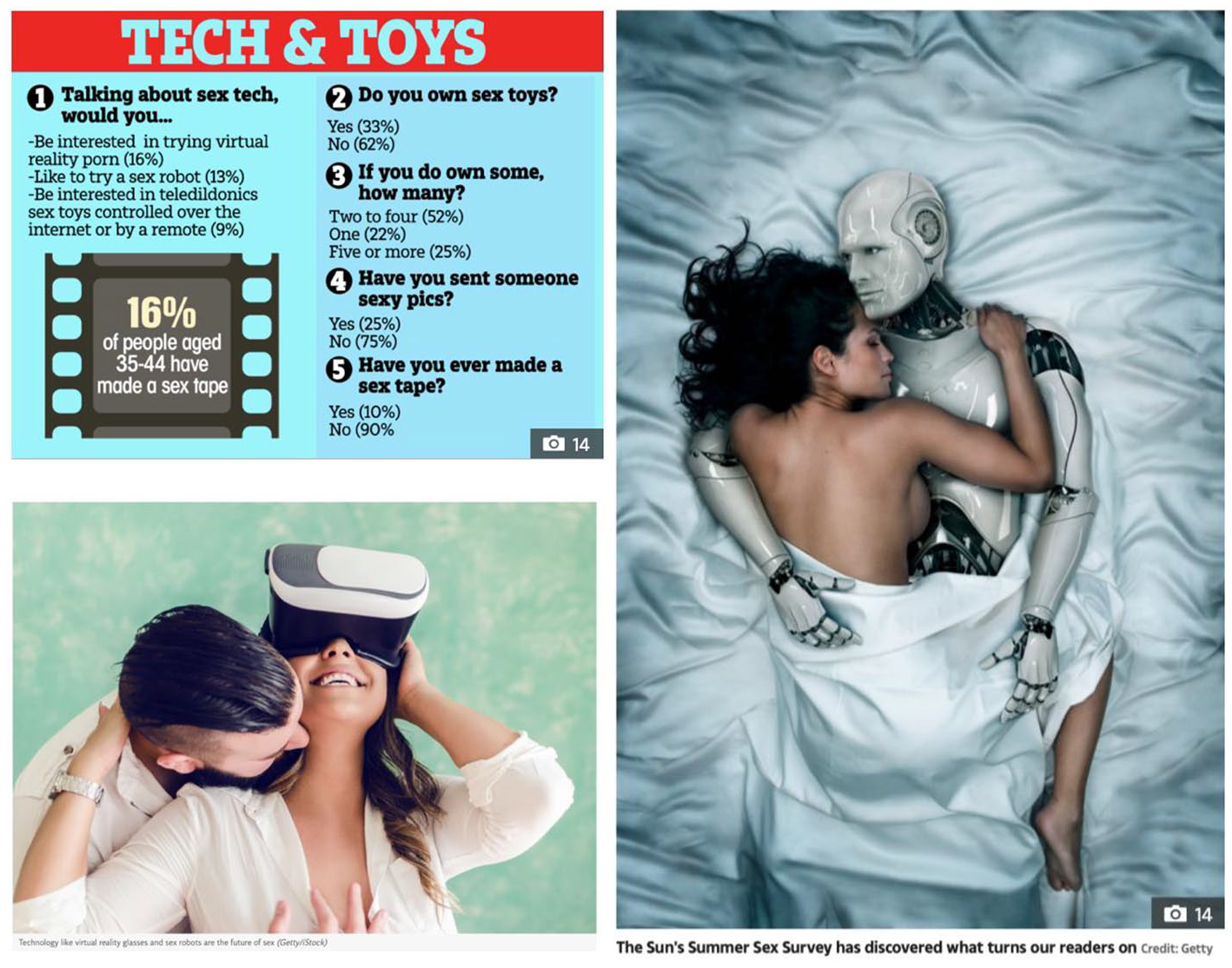
Top left and right, The Sun (Culley, 2019); bottom left, The Independent (McArthur and Twist, 2019).
Whether through haptic feedback or an (optical) ‘illusion of touch’, the goals presented in examples of mediated touch were to give humans a ‘new body’ to sense and move with (Parry, 2017) and, in the context of virtual reality porn, render them ‘participators’ rather than ‘spectators’ (Quine, 2015). Such active bodily involvement with technological devices were problematised across the spectrum of papers (Guardian, Telegraph, Daily Mail), engaging discourses of human–machine or human–technology relations as either too close or too far removed from human intimacy. Here, technology came to ‘mediate’ touch both in the sense of remote synchronous human-to-human tactile interactions and, symbolically, through their moral implications and wider representations.
In other words, in these newspaper articles, digital touch stood for, and was seen to forge, particular realities of human tactile interaction. For example, The Independent (Griffin, 2016) referred to humans feeling aroused when touching robots in ‘sensitive’ places, and there were mentions of sex robots as programmable and hence more satisfying sex partners (MailOnline, 2016). The Telegraph (Hawkes, 2017) voiced concerns on the ‘commodification of female bodies’, arguing that ‘the unrestricted use of humanoid robots as sex toys could perpetuate rape culture, misogyny and the idea that human beings [. . .] are little more than sexualised objects’. A blurring of human behaviour with objects and with other humans is particularly evident in this commentator’s quote in The Telegraph (Gee, 2017): ‘How would you feel about your ex-boyfriend getting a robot that looked exactly like you, just in order to beat it up every night?’ These examples provide important contexts within which mediated touch is situated. They contribute to sociotechnical imaginaries of digital touch that call for governance, not only relating to actual instances of (mediated) touch but also those that are ‘imagined’. Ultimately, these discourses express fears of machinic touch, and its potential to become more desirable (simpler and more readily available) than human touch, a fear with deep roots from the Greek myth of Laodamia who fell in love with a bronze likeness of her dead-husband (Devlin, 2018: 18) through to sex-robots.
More positively, remote touch was part of the popular imagination in non-technological ways, as illustrated by the example below of a ‘hug button’ (Figure 3), a drawn-on heart on a mother and son’s hands. Pressing the heart would make them feel connected. Striking for its simplicity, the hug button circulated on social media and was picked up as ‘adorable’ by The Mirror (Pochin, 2019). It demonstrates the emotional significance of imagining touch at a distance without its technological realisation (and yet formulated through its possibilities), which would, arguably, raise questions of authenticity and consent.
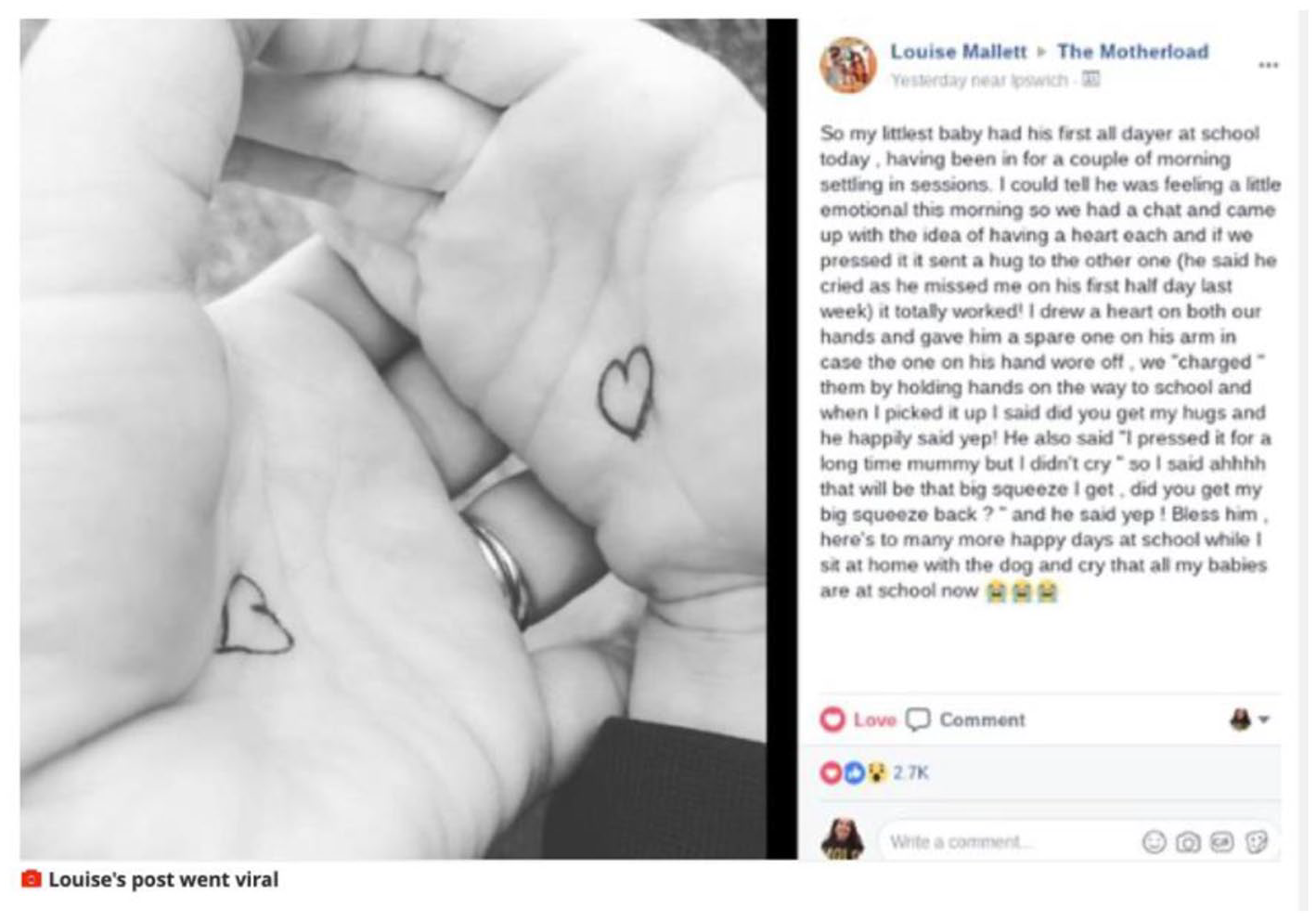
Hug button, Mirror, 08.09.19.
In the following section, we discuss how COVID-19 impacted on the discursive landscape of remote communication during the 2020 pandemic.
Continuities and change during COVID-19
The pre-COVID discourses outlined above persisted and intensified in 2020 in response to UK government restrictions on people’s movement and interaction, illustrated by the influx of related articles. There was a marked foregrounding of touch in interpersonal relationships, with a significant discourse of a loss of touch, reflected in wider discourses of loss that came to dominate the pandemic news. The following excerpt from The Guardian (V (formerly Eve Ensler), 2020) is emblematic of discursive themes of death and sex that can be traced through the papers from March 2020 onwards. Speaking of ‘unbearable skin hunger’ and a day spent in front of the screen, the author-artist V writes:
Thousands are disappearing without fanfare or acknowledgement, without family or ritual . . . death is moving so fast. [. . .] No touch, no closure, no body.
There were individual instances of counter-discourses, underlining the idea that not all touch is welcome (e.g. due to sensory issues or histories of abuse (Spechler, 2020)), or that we should not ‘get all hung up on hugging’ (Rantzen, 2020). However, the dominant discourses emerging from the newspapers included touch deprivation (specifically mentioned four times before COVID, 13 times during 2020), touch as existential, touch as sex and the general significance of touch in relation to the isolated, lonely or dying body. In short, touch in crisis.
Three discursive themes were central. First, articles made relevant a new sense of ‘distance’, even in co-located settings, with digital technologies – and particularly video-call interfaces – described as a ‘blessing and a curse’ in traversing remoteness (Spechler, 2020). Second, specific policy interventions translated into the discursive theme of the ‘governance of touch’, which primarily played out in relation to tactile intimacy. A third discourse is the significance of the hug as key tactile interaction denied by government restrictions. Significantly, technologies for remote touch were merely mentioned in passing, with emphasis on audio-visual communication technologies for moments of connection.
A ‘new’ sense of remote: touch as bodily and human
The Mirror (Shadwell, 2020) noted that the Oxford English Dictionary added 20 coronavirus words in April 2020, including ‘elbow bump’ and ‘social distancing’. Language around touch was changing, as were notions of what it meant to be remote. Unlike distance relationships due to migration and globalisation, papers made relevant a new felt distance between people who found themselves in relatively close proximity. There were references of being ‘plunged into a sudden “long distance” relationship [. . .] despite living within walking distance of one another’ (Greig, 2020). Newspaper articles, such as ‘If Covid doesn’t kill granny, loneliness will’, highlighted the blight of isolation, particularly that of the ‘incarcerated [. . .] vulnerable elderly [. . .] locked up’ in care homes (Thomson, 2020). Touch came to stand for physicality in general, the kind of interaction that was only possible in each other’s presence in ‘real-life interactions’ (Foges, 2020) – caring, human and unmediated touch. As The Times (Thomson, 2020) noted: ‘Many haven’t had a hug or kiss for months. They may not have felt any human touch except for a care worker who is probably rushed off their feet and dressed in full PPE’.
Physical contact was again described as inherently ‘social’, instinctual, necessary for survival. Social isolation itself was equated with the experience of ‘physical pain’; in addition to creating one’s own ‘nice physical sensations’ to ‘induce some positive chemical reactions’ (Van Terheyden, 2020), there were now calls to ‘embrace the various digital channels through which you can approximate intimacy’, with video chat considered ‘the closest thing [. . .] to face-to-face conversation’ (Greig, 2020; Figure 4).
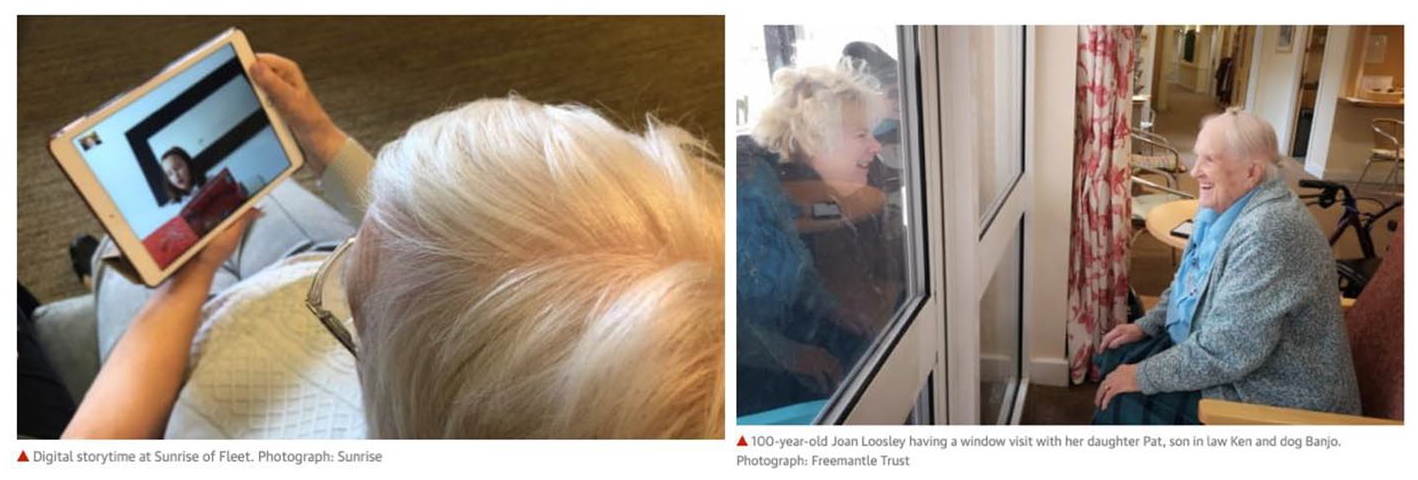
Guardian (Horton, 2020).
While there were (self-declared) ‘anxious Internet nerd[s]’ for whom physical proximity was less important and whose relationships were ‘thriving during lockdown’ (Penny, 2020), the historical discourse of virtual communication falling short of face-to-face interaction took on an alarmist and existential tone during COVID-19. The Guardian (Orbach, 2020) wrote of a ‘quasi-dematerialised life through the Zoom screen’, as:
The experience of the body on FaceTime or Zoom contrasts with the pulsing, breathing, weeping, sighing, tired, achy or indeed springy and enthusiastic bodies we inhabit. We no longer have social communion in the flesh, the handshake or the hug [. . .]. Afraid of infection, for our protection, we collapse our social space.
Likewise, The Times (Phillips, 2020) decried shutting away ‘the essence of humanity’, stripping us of our ‘unique qualities’, that is, bodily multisensorial experience:
We don’t just see or hear things. We also touch, taste, smell them, which we obviously can’t do in virtual encounters. Our senses, moreover, are all crucial to how we perceive ourselves. They help form the essential me-ness of being ‘me.’ And that isn’t reproducible.
When hospitals tightened restrictions to visitors at the end of March 2020, The Guardian reported that National Health Service (NHS) palliative care guidance urged ‘support for those close to the dying person, including the ability to keep in touch via phone or virtual communication’ (Booth and Pidd, 2020), even to say good bye. Video conferencing was reported to become part of funerals, maintaining ‘important rituals when the most human expressions of consolation and solace – physical touch and togetherness – have been forbidden’ (Segalov, 2020).
Also mentioned in the NHS palliative care guidance were mementos, including ‘handprints after the moment of death’ (Booth and Pidd, 2020). Physical touch was seen as crucial not only as the first sense, but also as the last sense to go: ‘The dying relax if their hands are held. Among the angels of the Covid-19 era are the nurses who offer that very service when families aren’t allowed near’ (Spechler, 2020). Alternative stories reported of people dying ‘robbed of a last loving hug’ (Hayward and Constable, 2020), or being given ‘“unauthorised” hugs’ (Evans and Boyd, 2020). Being able to touch and be touched during these existential moments was thus constructed as a human right.
In parallel to discourses of touch as essentially human, fears were expressed of a ‘touchless future’ made graspable through the pandemic experience and allegedly dreamed up by ‘technocrats and AI people and fascists’ (V (formerly Eve Ensler), 2020). A rebranding of technologies as ‘touchless’ was considered part of Silicon Valley’s ‘pre-existing agenda [. . .] that imagined replacing so many of our personal bodily experiences by inserting technology in the middle of them’ (Viner, 2020).
In the context of COVID-19, then, the meaning of touch was broadened to multisensorial bodily experience more generally, and emphasis placed on its necessity in contributing to what it means to be alive, to be human and convey humanity. Technologies bridged some losses through audio-visual gains but were ultimately not imagined to replace touch. Indeed, their very presence could put touch at risk. (This connects with questions for digital touch design directions, including whether to generate new forms of digital touch or to try to mimic aspects of ‘physical’ touch.)
Governing touch: tactile intimacy
Described by The Daily Mail as ‘draconian social-distancing rules’ (Weston, 2020), guidelines on how to interact with others in England changed throughout 2020 in line with wider national policy responses. To be ‘socially distanced’ initially meant keeping two metres apart from people outside one’s household, then changed to one metre with cautionary measures in early July 2020. Touch (or its governance) was implied in government regulations, with newspapers picking up guidelines to both explain new measures and to illustrate their social – and tactile – implications.
For instance, The Mirror (Randall, 2020) explained the legal definition of ‘gathering’ as two or more people being present in the same place ‘in order to engage in any form of social interaction [. . .], or to undertake any other activity with each other’. The latter tended to be interpreted as sex. A new law introduced in June 2020 prevented people from ‘gathering’ in private spaces with persons outside one’s household. What became known as the sex ban or, in reference to the Prime Minister, as ‘Boris’ bonking ban’ (Winter, 2020), was partially lifted by the introduction of ‘Boris bubbles’ (Groves, 2020), that is, single-household support bubbles in which social distancing was not required. ‘[S]ome people [were] finally allowed to hug some grandparents [. . .] for the first time in three months’, and ‘some separated couples [could] finally reunite for overnight stays and sex’ (Bloom, 2020, Figure 5).
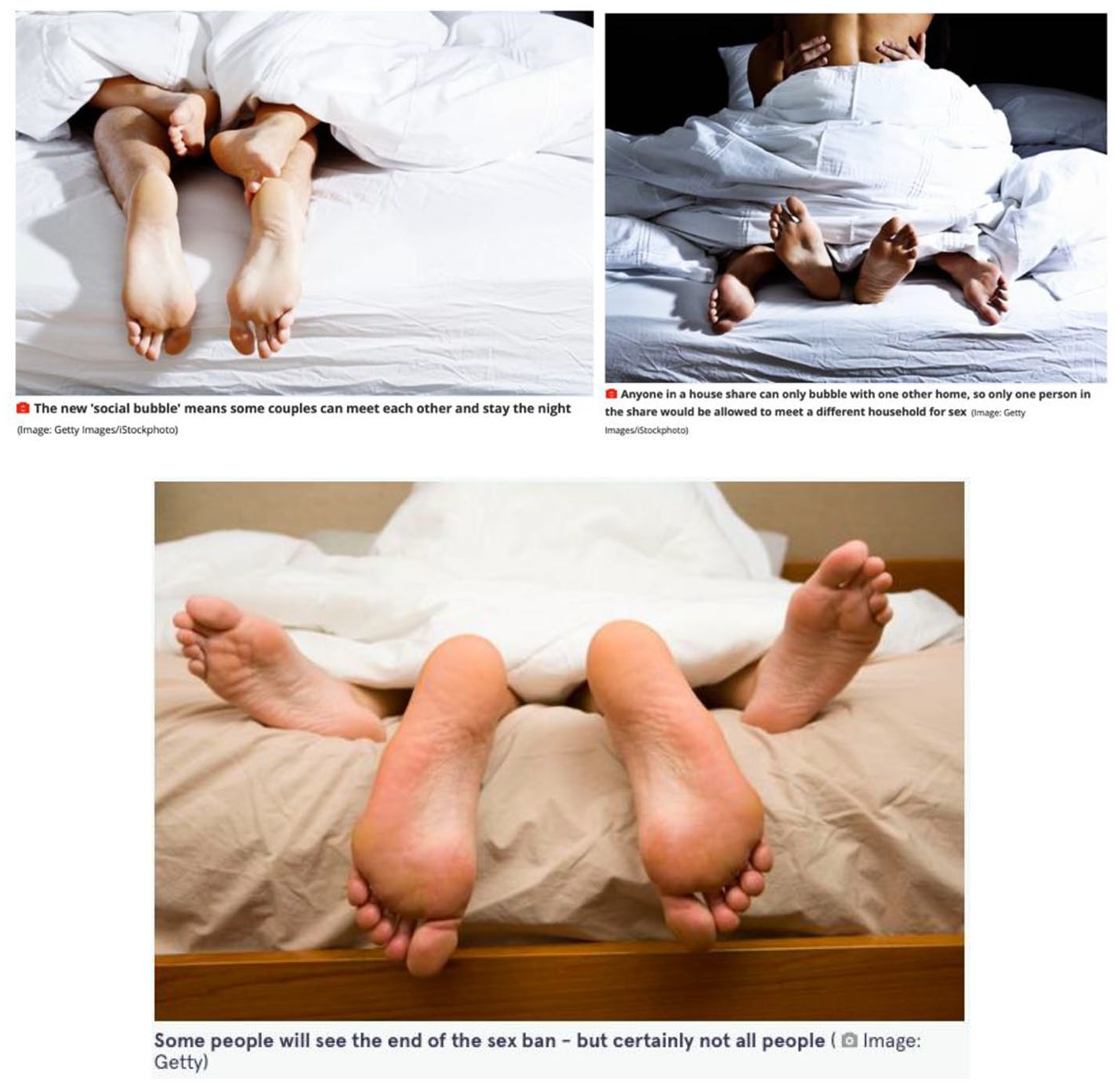
Stock images from three Mirror articles on 10.06.20 (Bloom, 2020; Hawkins, 2020; Smith, 2020).
These policy milestones were important reference points for newspapers, with hugs and kisses or sex (three touch forms central to the landscape of digital touch devices and environments) becoming key in how the governance of touch and notions of touch themselves were thematised. Each was bound up with wider politics of interpersonal relations, human ‘needs’ and questions of privacy and freedom. Regarding sexual intimacy, newspaper narratives suggested that COVID-19 might ‘mean a rise in more meaningful lovemaking and an outbreak of pregnancy’ (E Hill, 2020b), referring to added time spent together within households and the initially thriving online dating scene, which resulted in romantic notions of ‘“old-fashioned” courtship’ (Shadwell, 2020) – slower and socially distanced, or virtual. While the Mail Online (E Hill, 2020b) decried the death of the one-night stand, people were presented with ‘tough choices about who to be intimate with’, including who to quarantine with if involved with more than one partner (Paul, 2020). The Mirror (Shadwell, 2020) pointed out the focus of policies on families, rather than singles or those in flat shares, seemingly highlighting British ‘prudish attitude towards sex’. This was especially poignant, and now somewhat ironic, when the then Health Secretary, Matt Hancock, told people ‘to avoid casual sex and stick to ‘established’ partners’ (Kitching and Milne, 2020; Hancock later resigned for breaking social distancing rules through close intimate contact with a colleague). As the pandemic progressed, there were increased mentions of transgressions, examples of people whose ‘sex drive’ was too high to keep apart (Forsey, 2020).
The impact of lockdown restrictions led newspapers to reign in ‘sex-perts’ and health officials whose advice ranged from self-touch or ‘self-love’ (Delaney, 2020), becoming ‘more creative with sexual positions and physical barriers’ including ‘glory holes’ (King, 2020), to a rethinking of sex. ‘We’ve been taught there’s only one way to have sex’, one expert was cited, ‘and that that involves in-person penetration. In reality, sex exists on a spectrum’ (Pochin, 2020). COVID-19 restrictions were considered an opportunity ‘to educate yourself on what kinds of touch your body enjoys most’ (Pochin, 2020), with or without the help of technology.
Regarding the latter, The Times (Kelly, 2020) offered ‘virtual date ideas’, listing new COVID-related features in dating apps; ‘Feelds’ allowed users to join three virtual hubs: ‘quarantine, remote threesome and the sext bunker’. The paper reported of digitally enabled lockdown sex ‘from the joys of sexts to Zoom and House-party orgies’, while also speaking of screen fatigue and relationships being ‘subsumed by technology’ (Holden, 2020). Referencing dystopian visions of virtual sex as portrayed in the film Demolition Man (1993), one commentator wrote ‘I have no firm idea of how to generate intimacy in a digital world. Is it tone? Frequency? Is it phone sex?’ (Holden, 2020). Thus, while considered to enable sexual connections, digital options were also seen to interfere with physical intimacy. This connects with previous work on the sociotechnical imaginaries of digital touch related to the ethics and cultural etiquettes of touching, power and control (Jewitt et al., 2020).
While there were mentions of the rise of sales in sex toys, only three articles in our sample actively referenced tele-dildonics, framed as an exotic opportunity to experiment ‘from afar’:
Remote control couples devices and vibrators such as WeVibe’s wearable Moxie vibrator, which can be controlled via an app on your partner’s phone [. . .] are an incredible way to maintain a hot sex life while you’re separated. (Pochin, 2020)
In one context, tele-dildonics were grouped with virtual reality or hologram porn and sexbots as technologies that could ‘signal the end of regular sex’ or ‘make physical intimacy extinct’ (Billen, 2020), continuing the pre-COVID discourse of technology as transforming human-to-human sexual relations.
The above theme highlights how government restrictions were seen to interfere with everyday tactile intimacy, providing a context for papers to address the salience and nature of sex and personal relationships. Sex itself was being reimagined, distance allowed for increased experimentation, and tele-dildonics could inhabit a place for playfulness. How successful this was depended on the extent to which the ‘physical’ in sexual relations was equated with human essence.
Unpacking the (virtual) hug
In addition to the press focus on sex, ‘hugs’ stood out as the key manifestation of touch denied by social-distancing measures (with ‘hugs’, ‘hugging, ‘cuddles’ or ‘embracing’ mentioned by 61 of the 238 COVID times articles). They were routinely evoked for political purposes; discussing possible COVID test charges, Labour MP Alex Norris warned of a ‘“two-tier pay-to-hug” system’ (Stubley, 2020). Where, pre-COVID, a lack of hugs had been indicative of a crisis of touch, with people ‘giving fewer hugs and being less tactile than ever’ (Tierney, 2016), the quantified hug returned in 2020, with The Guardian (Spechler, 2020) suggesting a person should be hugged 10 times a day.
While hugs were linked to concerns over touch starvation, loneliness and mental health, not hugging also came to be implied as an act of care, with friends and family keeping each other safe. There were articles instructing people on ‘how to hug in lockdown’, expert advice to ‘hug with caution’ (Hill, 2020a), and celebrations of hugs during moments of lockdown easing: ‘[f]rom the pane [sic] of separation to the cuddle of a lifetime . . . ’, ‘one thing is certain: children [. . .] do not forget how to hug’ (Johnston, 2020, Figure 6).
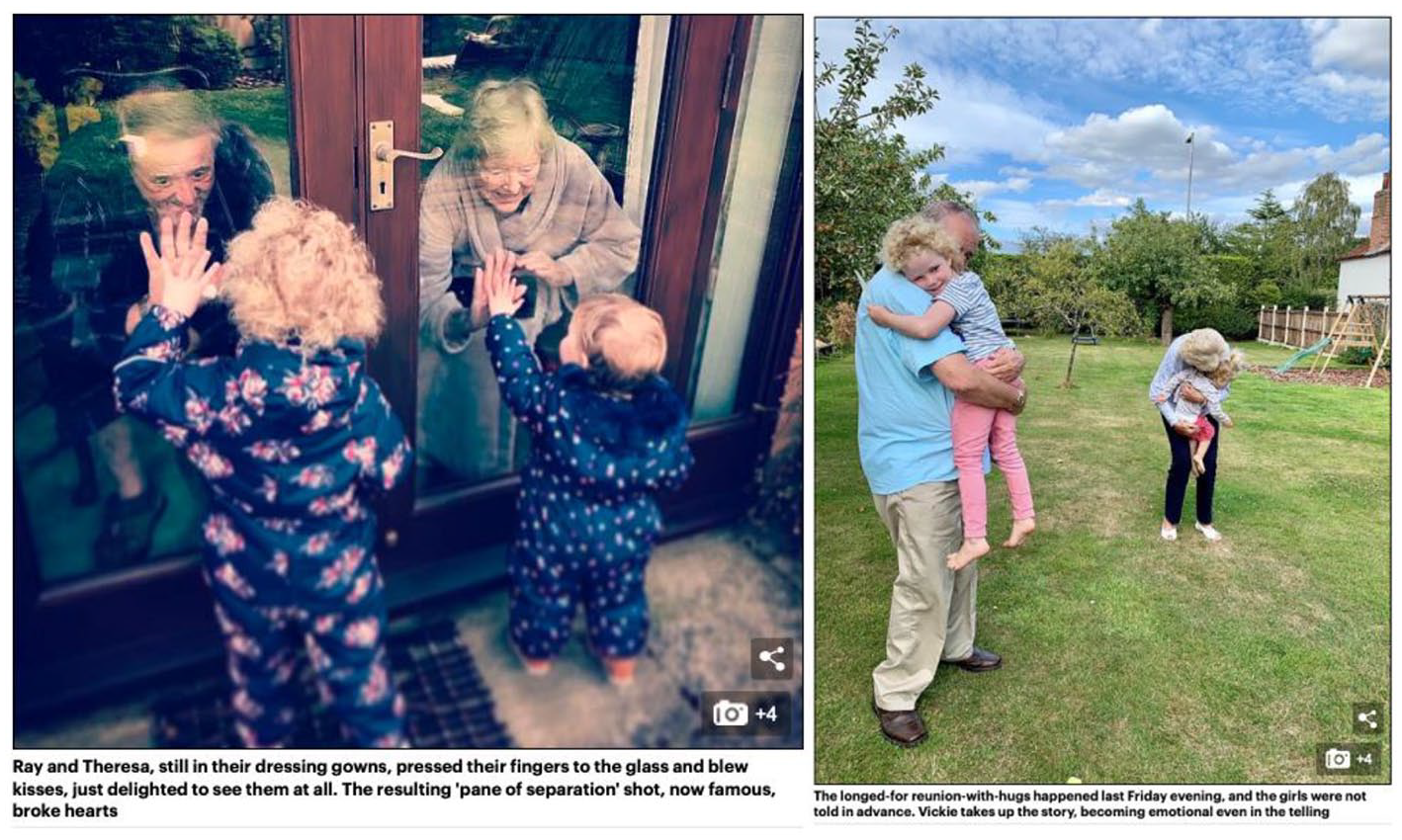
Mail Online (Johnston, 2020).
Moreover, hugs provided moments of rebellion or risk negotiation. As readers wrote, ‘[t]he virus has snatched enough from us already. I don’t want my grandchildren to remember the time that Gan Gan wouldn’t put her arms around them’; and ‘[a]fter lockdown was eased and I was finally allowed to hug my grandchildren again, we all cried buckets. None of us wanted to let go. If I catch something from them, so be it’ (Rantzen, 2020).
Hugs became highly symbolic of the kind of touch most needed in times of crisis, as universally recognised and socially acceptable (at least pre-COVID) across relationships and generations (although there was a gendered dimension, with references to women being more practised in hugging). They were also highly performative and conspicuous as illustrated by the images of staged reunions, of a grandmother hugging her grandson in full personal protective equipment, or hugs mediated by hug curtains (Figure 7).
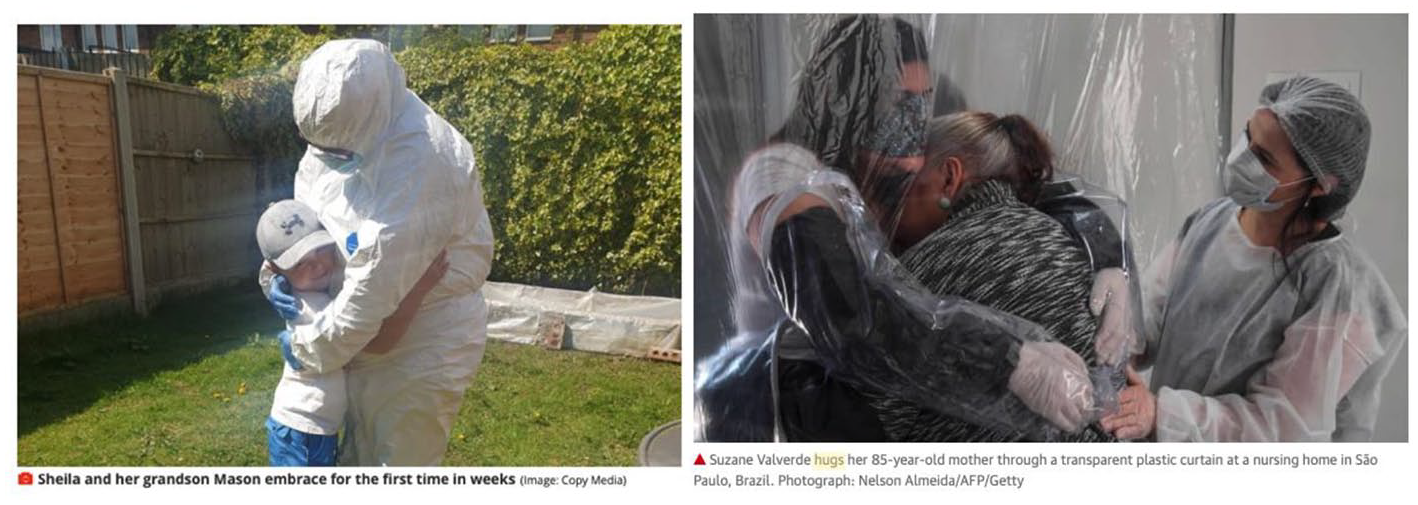
Mediated touch in Collinson (2020) and A Hill (2020a).
This non-digital form of mediated touch is noteworthy in how it was negotiated by the papers. In November 2020, at the start of the second national lockdown, the Mail Online (Carr, 2020) ran a story entitled ‘Our toxic future: Visitors are forced to touch their elderly care home relatives through a glass screen with bio-secure “hugging mitts”’. The article listed a range of government failings that had resulted in the death of thousands of residents, and drew attention to the isolation endured by many others. Despite the headline and despite their rubbery mediation, the ‘hugging mitts’ were actually portrayed as positive (Figure 8). As a care home manager put it, even with residents’ different forms of dementia, ‘they can still recognise or have some emotional reaction to touch, a cuddle or a handhold’ (Carr, 2020). This foregrounds the ways in which social responses to technologies change over time as they become incorporated into everyday practices, perhaps holding out possibilities for future digital touch.
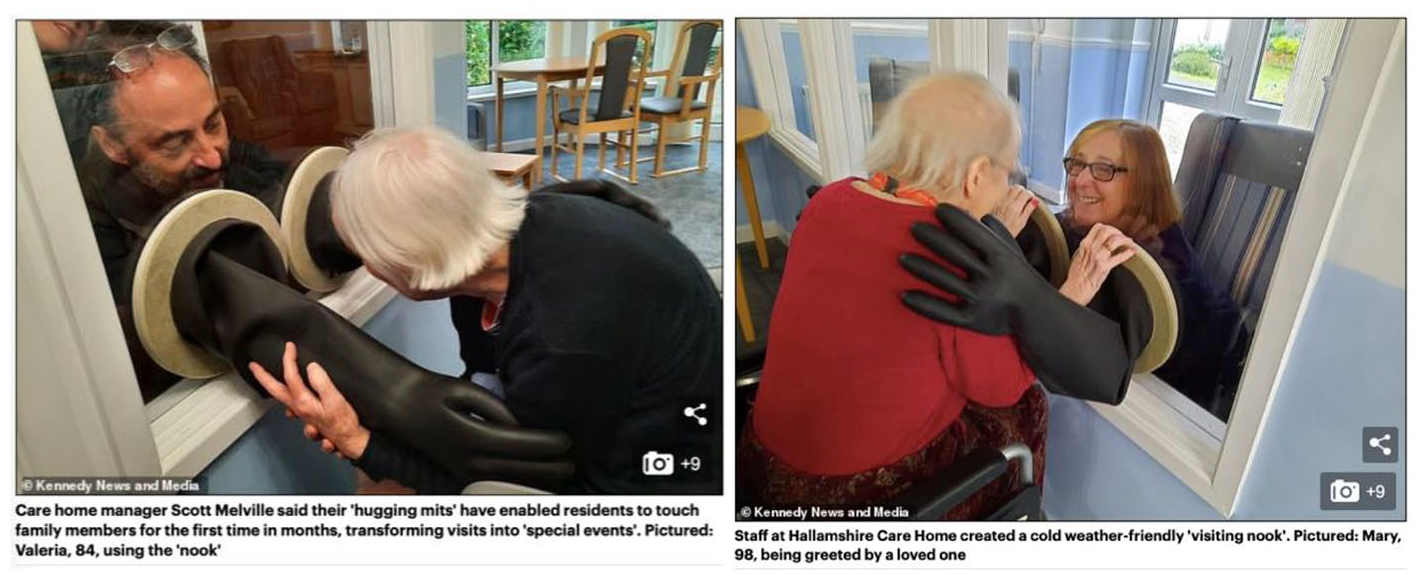
Hugging mitts (Carr, 2020).
Other ‘reworkings’ of the hug included the return of the ‘virtual’ hug, this time both referring to the imagined hug sent through the Internet and that gestured through air. In the piece headlined, ‘I’m still not allowed to see my grandchildren – virtual hugs are all I have’ (Corry, 2020), an interviewee said, ‘When they leave, they give me virtual hugs, with arms wrapped around the chest [. . .] For now, this will have to do’.
As indicated above, digital technology for the purposes of touch was not routinely referenced in these contexts. This is surprising because, historically, the hug has been one of the key tactile interactions entertained by tech designers and one of the few that has resulted in often hyped (though still only minimally deployed) commercially viable products, including CuteCircuit’s The Hug Shirt™ (https://cutecircuit.com/hugshirt/). One exception is The Independent’s mention of Japanese robots, consisting of a tablet on a stand and wheels, stepping in while the ‘pandemic rewrites the rules of human interaction’ (Denyer et al., 2020). Drawing on his family’s experience, the company chief describes the fact that the avatar can move alongside distant grandchildren as creating ‘human trust’, setting it apart from Webex or Zoom: ‘the grandson really hugs the robot’ (Figure 9).
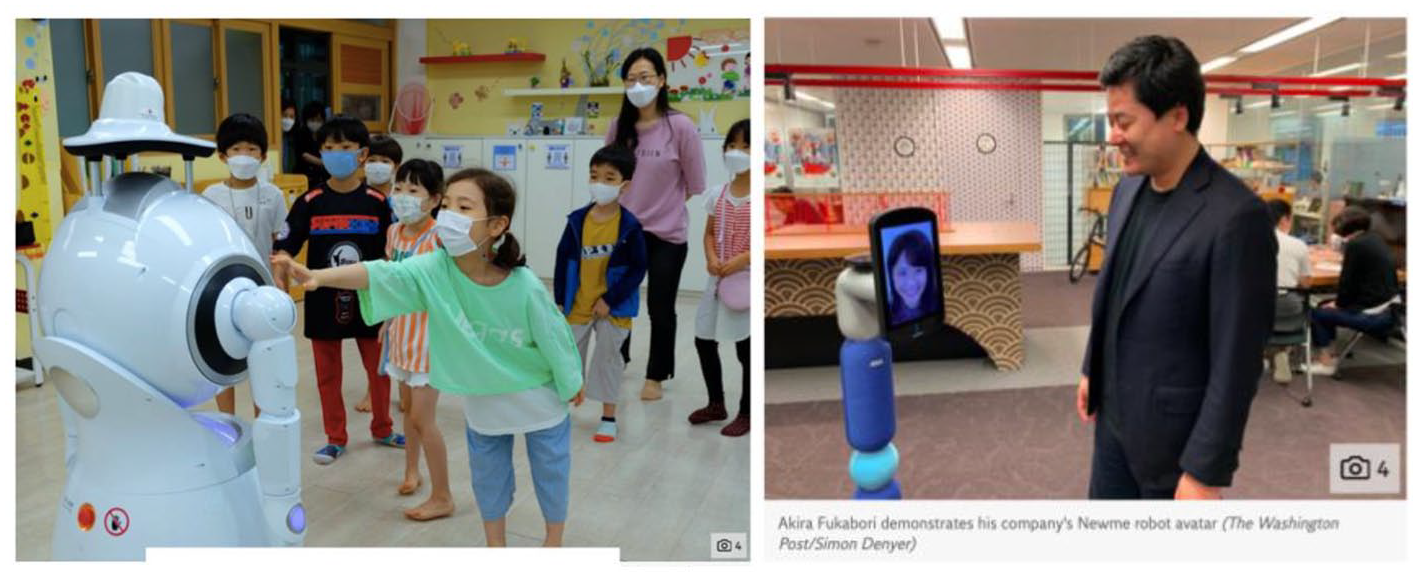
Children dancing with robot, and Avatarin’s Newme (Denyer et al., 2020).
The robotic hug was entertained by technologists as human connection at a distance. Elsewhere, drawing on the 2020 Touch Test, The Times (Rumbelow, 2020) stated that as the pandemic went on, people’s ‘craving for touch [. . .] grew alongside their anxiety’, while their interest in digitally mediated touch decreased: ‘It’s almost like the more they missed the real thing the more the robot-substitute appeared like a gimmick’. With some aspects of touch, such as the in-person hug, considered as biologically, socially, communicatively meaningful and necessary, technological substitutes were seen to fall short.
Conclusion
This article has mapped British newspaper discourses of touch and remote personal communication across the 5 years leading up to the COVID-19 pandemic and the period of the first and second UK national lockdowns (March-Nov 2020). It has drawn out thematic patterns and interrelations between key discourses, and examined their implications for how emerging touch technologies are entering this discursive landscape and, by extension, shaping the popular sociotechnical imagination. While many factors shape collective hopes and fears for sociotechnical futures, we have argued that newspapers play a central role in shaping their possibilities, and provide shared frames for their negotiation. With this in mind, we use the remainder of this article to critically examine the vision(s) of digitally mediated touch made possible by this discursive landscape.
The analysis of newspapers presented in this article makes evident the complexity of touch, personal relationships and remote communication. It shows touch in the press to be entangled with wider issues of intimacy, humanity, loneliness, wellbeing, personal freedom and politics. Touch is part of a multisensorial/-modal complex that comes with being in the presence of others, something which – according to the newspapers – the introduction of digital mediation can only fragment: touch reduced to sound and/or partial vision. This article demonstrates that discourses around touch and digital technologies for remote communication both intensified and persisted during COVID-19. COVID-19 brought touch to the fore as bodily, social, multisensorial, human and essential. Digital technologies were seen as needed in times of crisis, even though they only partially bridged the gap, and only in particular contexts. We see parallels here to Watson et al.’s (2021) study on Australian media users for whom remote communication technologies did not entail a ‘new normal’ but were a ‘contingent supplement born of necessity, different from and less “real” or “human” than proximate relationships, but nevertheless of central significance and meaningful in the crisis context’ (p. 13). Touch technologies raised ethical, social and cultural questions of how the body might be brought into new relationships with technology and what fears or desires that might realise.
Some of the discursive changes we identified at the onset of the pandemic concerned the definitions of what came to be experienced as remote, and what necessitated new and intense virtual connections. Moreover, we identified two main arenas in which the governance of touch – brought about by social distancing regulations – played out: sexual intimacy and platonic hugs. This is perhaps not surprising: sex sells (Döring, 2020), and the papers arguably perpetuate a type of modern discourse of sexuality (Foucault, 1990 [1978]) that brings sex to the forefront of adults’ needs and sense of identity, that is, adults of a certain age. The discussion of older people was bound up with issues of loneliness and isolation, rather than a lack of sex. The hug instead spanned across generations; its lack came to stand for a very particular kind of touch starvation between loved ones. Hugs became newly political. More broadly, this rethinking and expansion of what counts as touch, motivated communicational innovation that stretched non-technological means of touching towards remote mediated touch, moving beyond a notion of touch as direct human-to-human contact. That repositioning of touch may offer future potentials to inform the sociotechnical imaginaries of emerging touch technologies.
With regard to digital technologies, there is a thread of moral panic running through the papers. COVID-19 put into reach a world ‘where the default will be physical distance and technological “proximity”’ (Foges, 2020). Within this, there is a sense that ‘technology’ or ‘the digital’ came to stand for a whole range of communication technologies, regardless of their multimodal affordances. More nuanced articles indicated a difference, elevating the video call as particularly close to co-presence. The relative absence of touch technologies from the COVID period is striking. Where they were made relevant, in passing and chiefly in the context of sex, they were offered as primarily positive albeit experimental solutions for lockdown ‘urges’, as expanding the meanings and possibilities of sex. Anxious mentions of the end of sex as we know it persisted, representing a fear about the inevitability of reproduction without sex and the socio-technological futures of human reproduction (Greely, 2016).
The hug, however, appeared more complicated for imaginations of remote touch. Returning to the unease with which The Daily Mail portrayed our ‘toxic’ future of rubber-mittens mediated touch, there were other elements – co-presence, visual and auditory cues – that still rendered barriers of visitor screens and hug curtains as ‘touch’. Likewise, the virtual hug – imagined through the Internet or enacted as gesture in co-presence – was a less satisfactory hug replacement of the hug in flesh, but a replacement nonetheless. The papers allowed for emotional connection to travel across distance/barriers, yet not in the context of digital mediation. The narrative here provides a narrow view of what touch technology might achieve, falling short because it seeks to replace on the physical level, rather than honing in on emotion. Our findings suggest that the sociotechnical imaginary around remote touch technologies has shrunk, rather than expanded during the time of COVID. The discursive themes identified through our analysis of British newspapers suggest continuities with the sociotechnical imaginaries of communication technologies from the past more generally, including concerns of loss and lack, disconnection, troubled human–technology boundaries and relationships, ethics, problematic changing etiquettes, authenticity, control, power and governance, as well as a persistent desire for new possibilities of a richer bodily landscape for (digital touch) communication, and expanded forms of connection and attachment. This appears to suggest a stability of sociotechnical imaginaries around remote touch technologies, which we argue may reflect the current stasis of the field of haptics. While it is outside of the scope of this article to present a history of the sociotechnical imaginaries around remote touch technologies, this offers a direction for a future comparative historical study.
The discursive themes identified in this article are not quintessentially ‘British’, in that some overall narratives are reflected in media around the world. These include the pandemic’s impact on sexual relationships (Döring, 2020, cites examples from the United States, Germany, Austria and Switzerland), the tactile isolation of older generations and those in care (identified by Martikainen and Sakki, 2021, in Finnish media), and a new confrontation with the materiality of our bodies in death (in the context of Italy, Sigley, 2020). However, the concept of ‘Britishness’ was often utilised by newspapers in exploring touch sensitivities and political decision-making, not least in the government’s treatment of particular sections of society (e.g. singletons, the elderly, the North vs the South). Future comparative research may reveal some of the nuances of the local and the global discourses of touch and technology before and during COVID-19.
This article illustrates British newspapers’ grappling with touch and technology at a time of uncertainty and change. We have shown how the articles that circulated in this complex and contested discursive landscape are shaping sociotechnical imaginaries of emerging touch technologies in which physical distance is portrayed to ‘feel’ differently and, just as the human body is placed at risk by a virus, the essence of humanity and multisensoriality attributed to touch is foregrounded as in need of protection against technological infiltration.
Footnotes
Acknowledgements
Many thanks to Sara Price for commenting on a previous draft of this article.
Funding
The author(s) disclosed receipt of the following financial support for the research, authorship and/or publication of this article: This work was supported by the European Research Council (ERC) under the European Union’s Horizon 2020 research and innovation programme (grant agreement No. 681489).
Author biographies
 ). Carey is a founding Editor of the journal Visual Communication (Sage), and her recent publications include Interdisciplinary Insights for Digital Touch Communication (2020) with Price, Leder Mackley, Giannoutsou and Atkinson, and Introducing Multimodality (2016).