




Abstract
Self-branding is crucial for online freelancers as they must constantly differentiate themselves from competitors on online labor platforms to ensure a viable stream of income. By analyzing 39 interviews with freelancers and clients on the online labor platform Upwork, we identify five key self-branding strategies: boosting a profile, showcasing skills, expanding presence, maintaining relationships with clients, and individualizing brand. These self-branding strategies are contextualized within Goffman’s dramaturgical theory and through an affordances lens, showing immanent tensions. While online freelancers successfully leverage self-branding to improve their visibility on Upwork and beyond, the client perspective reveals a fine line between too little and too much self-branding. Online freelancers must brand themselves in visibility games when the game rules are largely opaque, riddled with uncertainty, and constantly evolving. We connect the findings to adjacent platform economy research and derive a self-branding as a performance framework.
Introduction
Searching for work in any context can be demanding, stressful and liable to fail—issues often exacerbated when enacted through social media or other online labor market intermediaries (Karaoglu et al., 2021; Wanberg et al., 2020). However, searching for work as an online freelancer can be especially precarious, presenting challenges such as continuously finding new clients, bearing the costs of inadequate demand, and having to navigate complex and constantly changing platform dynamics (Vallas and Schor, 2020). Over the last decade, many freelancers have thus turned to online labor platforms to find work, which mediate the relationship between clients and freelancers (Kässi and Lehdonvirta, 2018; Sutherland and Jarrahi, 2018; Ticona and Mateescu, 2018; Wood et al., 2018). Having emerged as a common business model for both creative knowledge work and low-skilled tasks (Howcroft and Bergvall-Kåreborn, 2019; Sutherland and Jarrahi, 2018), online labor platforms can not only be attractive for workers seeking more independence, but can also exacerbate existing forms of inequality, creating power asymmetries and devolving greater risks, responsibility, and costs onto freelancers (Newlands and Lutz, 2021; Shevchuk and Strebkov, 2018). Indeed, work through such platforms involves what Duffy et al. (2021) refer to as “nested precarities of visibility,” including market precarity, industry precarity, and platform precarity, itself referring to how workers have to continuously adapt to both transparent and opaque changes in the algorithmic systems. Yet, as Gandini (2016a) comments, online freelancers are often “more inclined to see themselves as entrepreneurs” (p. 137) rather than identifying solely as precarious workers. Such a focus on “algorithmic precarity” should also be contextualized as being not novel but “an amplification of the uncertainty of career sectors long marked by itinerant schedules, a lack of stable benefits, [and] few opportunities for paid training” (Duffy, 2020: 105).
Because of the competition facing online freelancers for both visibility and reputation, individualized self-branding has become a vital component of finding and securing work (Duffy and Hund, 2015; Gandini, 2016b; Moriset, 2017). As a form of impression management (Goffman, 1958), self-branding refers to the process of marketing oneself using proven techniques to exude a desired persona, which can be embodied using words, images, or behaviors. Also known as personal branding, this action of adopting marketing practices of larger organizations has found its way into the lives of freelancers as a form of free and invisible labor (Gandini, 2016a; Gershon, 2017). Online freelancers must go through great lengths to receive positive reviews and appear higher in search algorithms, to create the right digital impressions that are “formed in a millisecond as someone scrolls down a screen, viewing a dozen or more competitors” (Ravenelle, 2016: 28).
However, an individual freelancer’s capacity to self-brand on an online labor platform is shaped by their own skills, the affordances 1 of a specific platform, and their individual understanding of those affordances. Distinct platform affordances, moreover, warrant distinct self-branding strategies as well as distinct forms of platform-specific self-branding (Bucher and Helmond, 2017). Location-based gig workers, for instance, can combine both online and face-to-face self-branding strategies (Ravenelle, 2016, 2019), options not available for the vast majority online freelancers. It is thus essential to explore self-branding of online freelancers from a platform-specific perspective to capture the nuances, opportunities, and limitations each “stage” provides for an individual’s performance.
Founded from a merger of Elance and oDesk, Upwork is currently the largest online labor platform for freelancing, acting as a marketplace for freelancers and clients to match and undertake business. Upwork provides not only information about potential clients and freelancers as a form of managed directory, but it also acts as an active labor intermediary through offering payment services, dispute resolution, and fulfillment tracking in the form of surveilling freelancer’s working activity through screenshots and collecting timesheets. Upwork (2020) presents itself as a crucial one-stop platform “that brought visibility and trust to remote work” by providing “reliable access to a larger pool of proven talent.”
Although based in the United States, Upwork operates globally, enabling thousands of freelancers worldwide to work location-independently and provide their services and expertise to a global market. Upwork divides knowledge work into eight broad categories (web development, mobile development, design, writing, administrative support, customer service, marketing, and accounting) and has two distinct user groups as its main audience: freelancers and clients. However, financial success on the platform depends on freelancers securing a continuous and sufficient number of clients (Vallas and Schor, 2020), a demand that is intertwined with inequalities of access, demand, and visibility. On this point, D’Cruz and Noronha (2016) stress that Indian workers on Upwork have largely positive experiences compared to the local labor market. Yet, as Popiel (2017) explains, Upwork is a platform characterized by risks for both freelancers and clients.
As a result of Upwork’s rapid growth and its impact on the global creative economy, the platform and its impact on freelancers’ careers has been the target of an emerging academic literature. Seppänen et al. (2021), for instance, explore through a study of Finnish Upwork freelancers how the platform features create and shape opportunities for co-creation between freelancers and clients. Demirel et al. (2021) also interviewed freelancers on Upwork, finding that those with more and better quality reviews can receive better rates. While other research has been conducted, on topics ranging from how freelancers attempt to “pacify” the algorithm (Bucher et al., 2021) to the complexities of clients and freelancers communicating off-platform (Sutherland et al., 2019), limited research has focused explicitly on how freelancers self-brand in relation to the platform’s affordances. Specifically, there is little understanding on how online freelancers effectively choose to self-present themselves in entirely digital environments for clients, how they utilize resources provided to them by these online labor platforms, and how they work around constraints imposed by those platforms for effective self-branding.
The objectives of this article are to examine self-branding as an integrated series of actions for online freelancers and to define these practices. In doing so, we pursue the following research questions:
What self-branding strategies do online freelancers enact on Upwork?
What affordances and constraints does Upwork offer to online freelancers in the context of self-branding?
To address these research questions, we draw on data from 39 semi-structured interviews of online freelancers and clients registered on Upwork. Adopting a multi-focal perspective that considers both freelancer strategies and client perceptions, we identified that freelancers on Upwork engage in five distinct self-branding strategies to boost their visibility to clients and obtain more work: (1) boosting a profile, (2) showcasing skills, (3) expanding presence, (4) pursuing relationships with clients outside the platform, and (5) individualizing their brand. Furthermore, we demonstrate through a dramaturgical lens that self-branding practices have inherent tensions. As an active, instrumental, and co-created performance between freelancers and clients, freelancers have to actively negotiate the affordances of the specific stage (Upwork’s platform) while balancing off-platform social norms and communicative practices. Situated within a growing online labor platform ecosystem, where freelancers must compete globally against other workers and downward pressures on remuneration, self-branding thus becomes a challenge of visibility, in terms of both quantity and quality. We conclude by proposing a performance framework for self-branding on online labor platforms, which relates self-branding as a front-stage activity that makes use of setting, appearance, and manner while also requiring backstage behaviors.
Literature review
Self-branding
Self-branding is defined as “a form of affective, immaterial labor that is purposefully undertaken by individuals in order to garner attention, reputation and potentially profit” (Hearn, 2010: 427). Conceptualized as a strategic and self-instrumentalizing practice from the start during its emergence in the 1990s, self-branding has become a valuable, intangible form of social capital for aspiring workers, one which they can draw upon to obtain access to new work opportunities (Gandini, 2016b; Gorbatov et al., 2018). While individuals often partake in self-branding practices subconsciously as part of a modern occupational habitus, self-branding is not natural nor is it divorced from an individual’s skill level. As Vallas and Christin (2018) note, successful self-branding requires practice and training. Even so, self-branding does not necessarily relate to job security, operating primarily as an aspirational, future-focused practice the outcomes of which are always open to be determined.
In line with Erving Goffman’s (1958) focus on the self as a public object, the notion of self-branding can be viewed through a Goffmanian lens, whereby self-branding is a form of impression management within a dramaturgical setting (Cahill, 1998). Goffman’s dramaturgical perspective refers to an individual’s self-presentation as “behavior that attempts to convey some information about oneself or some image of oneself to other people” and uses theater as a metaphor for life (Baumeister and Hutton, 1987: 71). Goffman (1958) distinguishes between a “sincere” and a “cynical” self-presentation, whereby cynical performances are enacted as a means to an end while sincere performances reflect an inner reality. Critically, for the notion of self-branding, Whitmer (2021) claims that self-branding falls into the category of cynical self-presentation due to its instrumentalizing nature.
Goffman explored different features that make up a person’s “front-stage” performance, contending that every performance consists of three features: setting, appearance, and manner. Setting describes a person’s physical environment where an interaction takes place. As different settings may have different audiences, the interactions the actor has also change, depending on the audience. Appearance typically refers to the clothes an actor is wearing, which can portray their social status, occupation, and age. Finally, manner alludes to the types of behaviors an actor presents (Goffman, 1958). During this front-stage performance, performers conceal behaviors and emotions that could otherwise be expressed backstage. This idea of presenting oneself outwardly toward others stems from two primary causes. The first one is audience pleasing because when “an actor takes on an established social role, usually [they find] that a particular front has already been established for it” due to social interactions with and toward a certain audience (Goffman, 1958: 17). The second factor is that the actor can expect to gain some type of reward by doing so (Brown, 2014).
Goffman’s theory has been used in research on the Internet for more than 20 years, providing the theoretical basis for work on online identities, self-presentation, and impression management. The theory has proven particularly fruitful in the context of social media, showing how users invest substantial effort into profile work to maintain a favorable online appearance (Krämer and Winter, 2008; Uski and Lampinen, 2016). Such impression management in digital environments often involves presenting a socially desirable set of information and/or removing disadvantageous personal images online for favorable gain (Uski and Lampinen, 2016). Hogan (2010) argues that asynchronous self-presentation strategies, found on social media, are forms of impression management that have to predict how the audience might react to their actions.
Since single-identity social media platforms such as Facebook and LinkedIn have become widely used, “online self-expression seems to have lost some of its potential for identity experimentation” (Ranzini and Lutz, 2017: 83). Nevertheless, users try to optimize their online image by selectively sharing the right amount and type of content, engaging in audience management, and often portraying an ideal self rather than an actual self (Schlosser, 2020). For example, one self-branding strategy includes adding relevant buzzwords to a profile to bump up their profile on LinkedIn (Gandini, 2016a). Investigations of social media influencers (Abidin, 2016) and fashion bloggers (Duffy and Hund, 2015), for instance, show the usefulness of Goffman’s theory in an online context. Yet, self-branding practices discussed here are not necessarily an extra burden; they can be understood as “aspirational labor” (Duffy et al., 2017) or “visibility labor” (Abidin, 2016): implicitly or explicitly used as strategies to perform and signal expertise to seize future economic opportunities (Chan, 2019).
In its original formulation, self-branding was originally viewed as the curation of an authentic singular identity to be sold on the labor market; workers could leverage their “authentic self” to build a reputation and remain competitive (Whitmer, 2019). This necessitated a strong and consistent self-brand across all interactions and contexts. In Goffmanian terms, this would be a singular performance to variety of broad audiences. However, more recent research has argued that self-branders instead tailor their self-brand to the specific context and audiences. This is what Scolere et al. (2018) refer to as “platform-specific self-branding,” based on imaginaries of the platform’s affordances, audiences, and the individual’s own self-concept. On social media, for instance, research has shown that individuals tailor their presentation based on the platform (Choi et al., 2020; Van Dijck, 2013).
Affordances of online labor platforms
In the case of online labor platforms, such as Upwork, we aim to explore how freelancers tailor their self-brand according to the platform’s specific affordances. As argued by Bucher and Helmond (2017), affordances should be explored in a platform-sensitive way that tries to account for specific characteristics of platforms and how these characteristics shape action. As has been well established in research, the physical design features of a technology can shape affordances. Technologies have “high-level affordances,” referring to the “dynamics and conditions enabled by technical devices, platforms and media” (Bucher and Helmond, 2017: 12). This contrasts to “low-level affordances” that are focused more on materiality and design. High-level affordances are more abstract and general, including, for example, visibility, anonymity, availability, searchability, and persistence, while low-level affordances relate to the concrete materiality and design, looking at specific buttons, screens, and design choices. Both high-level and low-level affordances enable certain actions and outcomes and are frequently combined in platform research. Abstract assumptions about the features of a platform are also important. Indeed, affordances evolve as users gain access to new features, or their imaginary develops to accommodate novel affordances out of existing features. For example, users can share knowledge about affordances, which results in informal advice networks (Chan, 2019; Meisner and Ledbetter, 2020).
We are particularly interested in the communicative affordances of platforms as self-branding constitutes a communicative process. Communicative affordances are situated at the intersection of the users, their engagement with the platform, the audience of self-branding (both actual and imagined), and the platform’s features and image (Scolere, 2019). We follow Schrock’s (2015) definition of (communicative) affordances as “an interaction between subjective perceptions of utility and objective qualities of the technology that alter communicative practices or habits” (p. 1232). Specific temporal features, for instance, can impact self-branding depending on whether impressions are permanent or ephemeral (Choi et al., 2020) or whether they are synchronous or asynchronous (Meisner and Ledbetter, 2020). During face-to-face interactions, even mediated online, individuals can adjust their performances live and modify based on the immediate audience (Whitmer, 2019). With more static impressions, such as is found on profiles, individuals are less able to dynamically modify their brand.
Online labor platforms for freelancers also have distinct reputation-based affordances. Elements, such as ratings and written testimonials, have begun to appear as an industry standard to confirm a worker’s reputation, in addition to biography and skills sections that help paint a more holistic picture of a user’s identity (Jarrahi et al., 2020). These “reputation-signaling mechanisms” further “maximize the likelihood of a successful transaction,” which incentivizes platforms to provide such affordances (Abrate and Viglia, 2019). Demonstrating this, research showed that higher reputation scores on Elance correlated with higher earnings for contractors (Gandini et al., 2016; Leung, 2014).
Freelancers need to boost their visibility to increase the quantity of relevant profile views (Duffy and Hund, 2015; Scolere, 2019). The global spread of online freelancing platforms has meant that workers are exposed to heavy competition. Not only does this drive down average remuneration (Anwar and Graham, 2019; Tubaro, 2021), it also creates a competitive environment within which freelancers must play what Cotter (2019) terms the “visibility game” to get seen. However, freelancers also need to signal quality. Research by Tubaro (2021) has emphasized how quality assurance on such platforms can be expensive and sometimes results in several freelancers doing the same task, or having freelancers validating others’ work. Some clients even force workers to perform their own quality assurance tests, such as copying words from a job description to prove they read it (Sutherland et al., 2019). Clients are thus dependent on external measures of credibility for these economic transactions.
In the case of Upwork, material elements and low-level affordances of the platform include the rating system, the algorithms that govern access to the platform and user visibility (Kinder et al., 2019), and the in-house messaging service. Upwork profiles, for example, provide standardized items (such as reviews, badges, and education) and an open-ended biography that helps workers introduce themselves and their credentials more creatively (see Figure 1). Acting as both a facilitator and mediator, the main reputational affordance on Upwork is the Job Success Score (JSS), which is produced by Upwork’s algorithm based on client feedback, client complaints, project completion, and disputes (Popiel, 2017; Rahman, 2021). Schörpf et al. (2017), in their study of creative freelancers, found that they were bound to Elance and oDesk through reputational mechanisms that tied them to the platform. Sutherland et al. (2019) similarly argue with reference to Upwork that building a reputation is complicated, requiring quality work as well as the social and technical skills to handle clients. Here, we can observe Upwork’s front stage as including the visible elements that a worker has decided to make available or that are curated and displayed automatically by the platform, while the backstage captures the activities that go into managing the front stage (e.g. profile work, the actual execution of the projects that then lead to ratings, backchannel communication, billing).
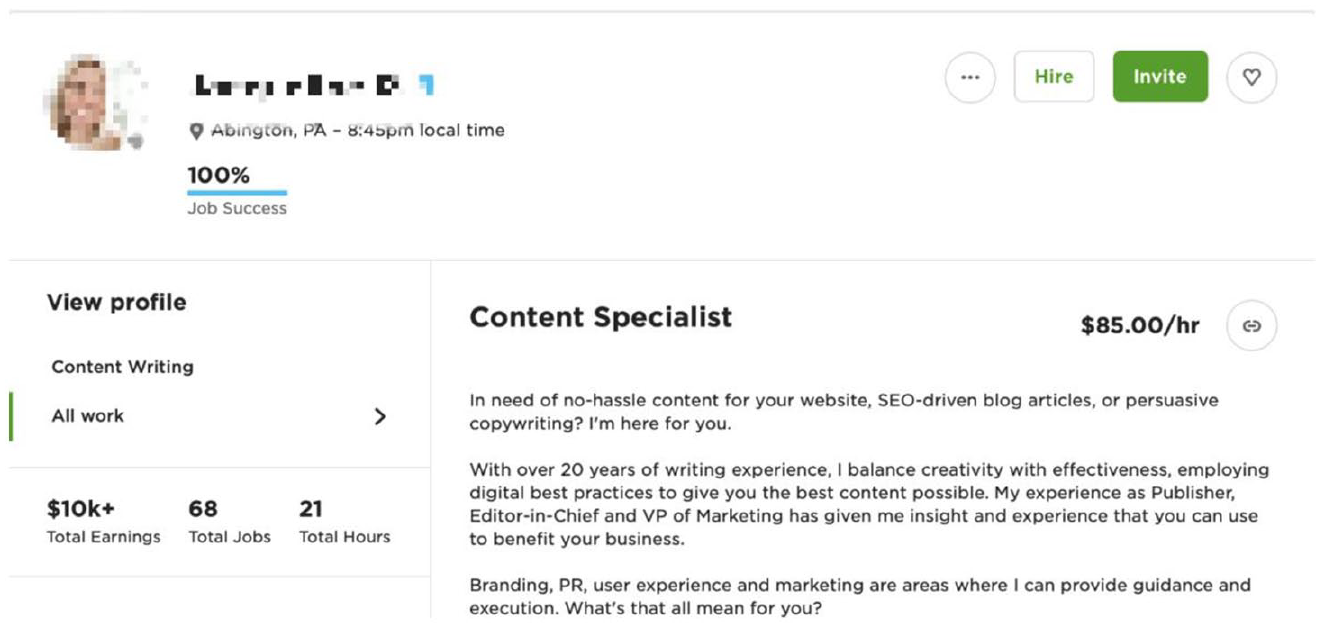
Sample Upwork profile.
Methods
Sampling and recruitment
To explore self-branding strategies on Upwork, we conducted semi-structured interviews with 39 participants, including both men (n = 26) and women (n = 13). Participants included both freelancers (n = 20) and clients (n = 19). Although 13 members of the client sample had a freelancer account on Upwork, these participants primarily identified as clients and exclusively used the platform to hire other freelancers at the time of the interviews. Respondents’ ages ranged from 20 to 59, although the median age of freelancers was slightly higher (33) than that of clients (30.5). In this article, we have given pseudonyms to the 20 freelancers and 19 clients to reflect the participants’ gender and background. Participants’ experience with Upwork varied, with 31 participants being long-term users of the platform and 8 relatively newer sign-ups. When asked about their reliance on Upwork, 28 participants reported that they mostly get hired and/or hire through the platform, 9 responded that they rely on the platform “some,” and 2 replied that they rely little on Upwork. Industry domains and professions ranged greatly and included fields, such as creative writing, marketing, web design, user experience design, information technology, three-dimensional (3D) art, voice acting, industrial design, ghost blogging, photography, and copywriting. Participants were recruited through Twitter, the Upwork subreddit (/r/Upwork), and personal or professional websites of the participants.
Data collection and analysis
A formal, semi-structured interview protocol was developed to allow participants to express their views and opinions on self-branding practices in their own terms. Interview questions differed depending on whether the participant was a freelancer or client on Upwork. The advantage of integrating client perspectives is that they could complement freelancers’ accounts about self-branding practices. Predefined questions asked to freelancers focused, among other topics, on motivations for freelancing, their perceptions of Upwork’s reputation systems, their working environment, and their strategies for finding work. Predefined questions asked to clients, by contrast, focused on their motivations for hiring on Upwork (compared to other platforms), their perceptions of Upwork’s rating systems, any obstacles they might have faced in hiring freelancers, and their overall relationships with freelancers. After recruitment, participants scheduled a meeting time for an interview. On average, interviews lasted between 30 and 60 minutes and were all conducted remotely using Skype or by telephone. Interviews were then recorded and transcribed verbatim. The interview data were qualitatively analyzed using an inductive schema, where we noted and grouped emerging themes. Through a dual process of open and axial coding, first- and second-order concepts were derived from these transcriptions (Corbin and Strauss, 1990).
Findings
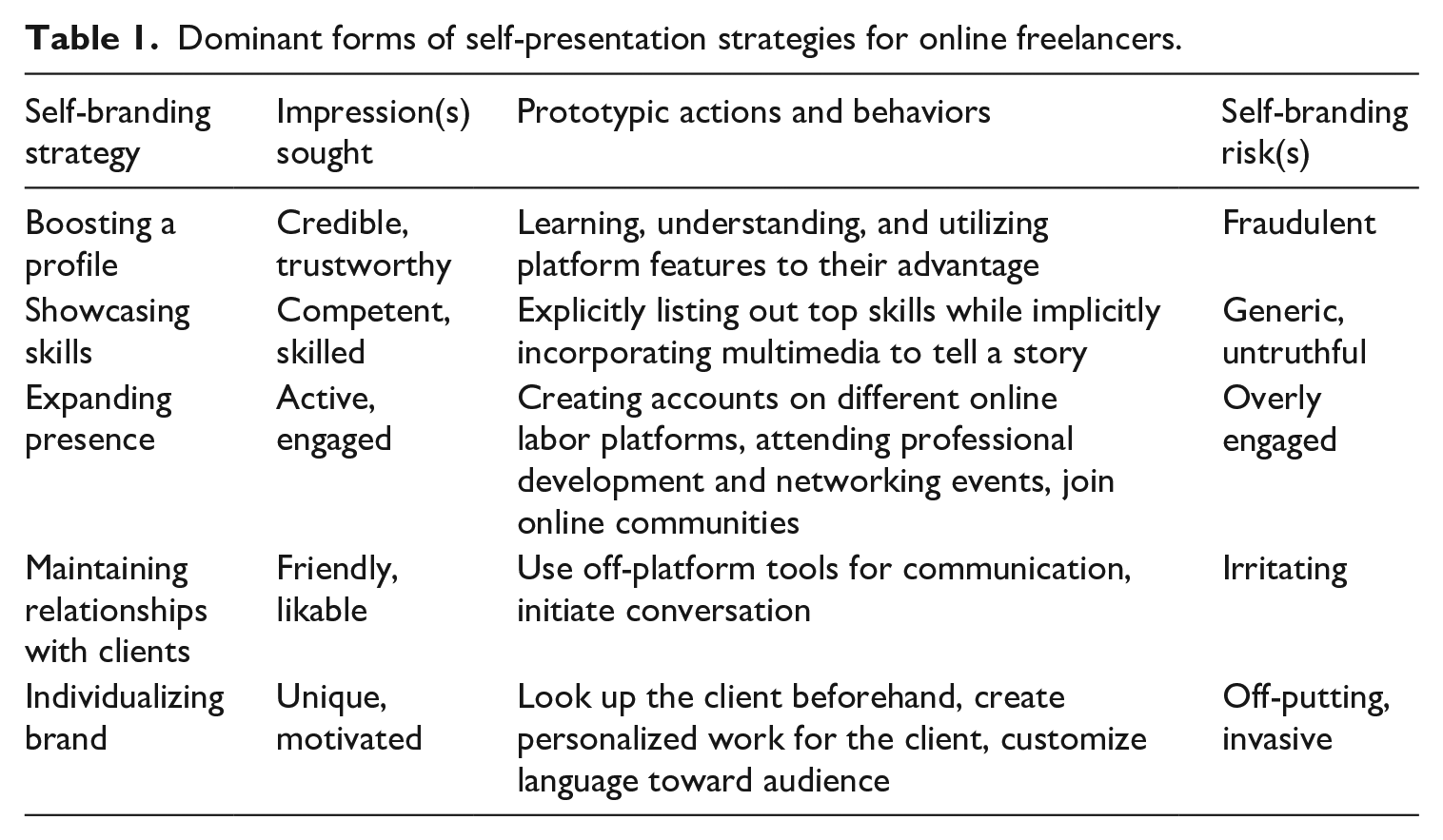
Through our data analysis, we identified that freelancers on Upwork engage in five distinct self-branding strategies to boost their visibility to clients and obtain work. These include (1) boosting a profile, (2) showcasing skills, (3) expanding presence, (4) pursuing relationships with clients outside the platform, and (5) individualizing brand. In outlining these self-branding strategies, we draw on Goffman’s impression management theory and describe the type of impression sought, relevant actions and behaviors, as well as corresponding risks in relation to each strategy (Jones and Pittman, 1982). Given our multi-focal sample, we also frame each strategy relating to both the client and freelancer, detailing how such self-branding strategies are both enacted and received. Table 1 summarizes the five strategies.
Dominant forms of self-presentation strategies for online freelancers.
Strategy 1: Boosting a profile
Freelancer perspective
One of the most common self-branding strategies mentioned by freelancers was their attempts to boost their profile, referring specifically to the act of building a positive reputation through navigating how Upwork’s algorithms aggregate data and manage rating systems. In this way, Upwork’s platform affordances act as the “stage” upon which freelancers can perform (Goffman, 1958). By attempting to understand and work within the platform’s functions, freelancers can adjust their self-branding and boost their visibility. Facing the “threat of invisibility” (Cotter, 2019), freelancers expressed an expectation that higher visibility would correspond to higher credibility and trustworthiness among clients. Freelancers want to be displayed to many prospective clients by showing up prominently, and repeatedly, in the recommended freelancers list (boosting profile quantity). Simultaneously, freelancers also want to stand out through positive scores (boosting profile quality). Michael, a marketing consultant, expressed this through his comment that ratings are “really important” to getting jobs, as they “help [his] profile get bumped up to the top.” Indeed, most freelancers noted that when first starting out, they performed various workarounds to quickly boost their profile visibility on Upwork. As such, while the freelancers were curious about client feedback, they were generally more concerned with getting top scores to maintain a competitive advantage, rather than truly wanting constructive comments.
One of the most common workarounds was accepting jobs that they felt confident to complete well, usually for lower rates but otherwise compensated through almost-guaranteed high ratings. Andrew, an experienced writer, gives an example of how he secured his first job and first five-star rating in a way that was mutually beneficial: A lot of people feel that they charge a really low rate to get started, but what I did was I went and set my rate higher, and then I went and I specifically looked for people who were new to the platform too who needed something short So, my first job was I [sic] wound up rewriting somebody’s about me page for the company that they were starting. I did it in one afternoon. I think I got paid like $25 or something ridiculously low, but it got me my first completed job and first five-star review.
Conversely, platform workarounds such as lowering rates reflected a larger problem within the freelance economy. Jasmine, an established industrial designer who uses Upwork for side projects, emphasized how “not charging enough for [a freelancer’s] service . . . devalues the rest of us and it devalues art and design . . . I see it all the time and it breaks my heart.”
Despite these strategies for boosting a profile, Upwork’s ranking algorithm, which suggests relevant freelancers given a specific search query, is more complicated than a high JSS and rating. When asked about their knowledge on what factors raise a profile to the top of the search algorithm, the majority of freelancers in our sample stated that they did not know. Common responses echoed that of Sergio, a marketing specialist, who said that he “[didn’t] know about the technicalities of [the algorithm] . . . These kinds of things, [he] finds out while doing” and that he “[doesn’t] know exactly how it works, but [he tries] to keep [his] profile in best shape.” This unfamiliarity could explain why we observed a large focus among freelancers on visible metrics, and why many freelancers had negative opinions of Upwork’s ranking algorithm. The frustration aligns with Rahman’s (2021) ethnographic study of Upwork, where he described the inherent opacity of the evaluation system as well as freelancers’ experience with it as an “invisible cage.” The specific visibility affordances of Upwork thus constrain and complicate freelancers’ self-branding performance, making it harder for them to engage in effective impression management (Foong, 2020).
A further action within this strategy included personally reaching out to clients after completing a job to ensure that they were rated. Multiple participants mentioned that they would periodically remind clients, with whom they felt they had a positive experience, to leave them a review. Understandably, freelancers would forego this action if they had a negative experience with a client. In fact, some freelancers explained that that if they feared a client would leave a bad review, they would turn to tactics such as negotiation. For instance, Lisa did not want a bad rating to risk her current top rating as a writer on Upwork. As she explained, “Instead of trying to fight with [the client], I just said ‘Fine, I’ll refund your money,’ because I don’t want to risk getting negative feedback on my profile.” This finding echo research by Wood and Lehdonvirta (2021), who identify how freelancers sometimes refund fees to avoid bad reviews.
With this negotiation over ratings, both high and low, freelancers are actively engaged in audience management. They are operating often on the “backstage” of private client communication to ensure a clean, impressive front stage to future audiences, in the form of potential clients. Such client-oriented self-branding strategies suggest that the audience is not merely passive but can also affect the self-branding of the freelancer in a process described by Meisner and Ledbetter (2020) as “participatory branding.”
Client perspective
While freelancers focused on boosting their profiles higher in Upwork’s ranking algorithms, utilizing multiple tactics, they also risked negative consequences if they pursued them too aggressively. Clients in our sample mentioned that over-active freelancers risked appearing like fraudulent accounts, scammers, or bots. Takuya, for instance, used the word “scammer” alongside other profanities when asked about the challenges of Upwork. Mary, who only uses Upwork infrequently as a client, also questioned whether she is “actually communicating with the person who’s doing the work” because she sometimes “get[s] the feeling [she’s] communicating through an intermediary.”
Similar to the freelancers’ perspectives, most clients did not understand how the Upwork ranking algorithm operated in relation to clients’ own positioning. However, it proved to be less of an issue as the majority of clients claimed not to care as much about reputation metrics, suggesting that it was more important for the freelancer than for them. For example, Tyler stated, “I don’t know how important it was for me to get good ratings . . . The ratings they give me doesn’t [sic] really matter.” At the same time, several clients also discussed the credibility of the review system. Santiago, for instance, was skeptical of the five-star rating and suggested that “factories” are “putting five stars . . . and it’s completely fake.”
Comparing the worker and client perspective shows how power asymmetries favor clients over freelancers (Kinder et al., 2019). While Goffman’s theory has been accused of neglecting power dynamics, some of his work contains important power-related conclusions that help understand this interplay (Jenkins, 2008). In particular, Goffman (1983) discusses “people-processing encounters” as situations where “the ‘impression’ subjects make during the interaction affects their life chances” (p. 3). These encounters may include court hearings, medical diagnosis meetings, or job interviews. Given the financial nature of transactions, particularly regarding long-term and highly remunerated projects, online labor platforms thus represent people-processing encounters. Since Upwork’s affordances, such as visibility, algorithmic matching, and persistence affect how these people-processing encounters unfold, a socio-technical resolution would include empowering solutions, such as online feedback systems that help freelancers improve their impression management practices (Foong, 2020).
Strategy 2: Showcasing skills
Freelancer perspective
The second self-branding strategy captures how freelancers showcase their skills to potential clients. Next to Upwork’s rating and JSS, skills were the primary way clients searched for freelancers on the platform. Typical behaviors of freelancers for showcasing their skills included listing their self-perceived top technical skills (e.g. programming, design) and soft skills (e.g. time management, work ethic) in their description. This was done both implicitly and explicitly as the workers attempted to give off an impression of being competent in specific areas. Workers also took advantage of Upwork’s “skills” section to showcase their technical skills, which is a section dedicated to test results and core competencies in different subject areas. Like the first strategy, boosting a profile, the showcasing skills strategy focuses strongly on the front-stage performance to a mass, unknown audience.
However, the freelancers we interviewed were somewhat skeptical of Upwork’s skills list on a user profile. Sarah, an established content producer, mentioned that “[tests] aren’t very important” and that she “get[s] a good amount of work without having to discuss taking tests.” However, Sarah’s position must be contextualized through her status as an established freelancer who is less dependent on such low-level markers. In most cases, freelancers who decided to showcase skills did so primarily to have a complete profile. Furthering this argument, Sergio suggested that he completed the sections when first joining Upwork as part of the profile-building process: “I started taking the Upwork tests—that was the first thing I did . . . to complete my profile as much as I can.”
We also found that many freelancers implicitly showcased their communication skills through using correct grammar, compelling storytelling, and showing skills rather than simply listing them out. For example, Emily decided to showcase her professional writing skills by incorporating them directly into her profile. By demonstrating her writing skills in her profile, she was attempting to monetize as a freelance writer, acting strategically. In addition to using Upwork to showcase skills, we found that most of the interviewed freelancers had personal portfolios of their work to explicitly showcase their technical skills, especially in creative fields like design and art. For example, Andrew, who takes on diverse types of work (copywriting, branding, and event planning), described how he strategically showcases writing on his portfolio. Instead of simply listing examples of work, he showed the impact they had on previous clients: I didn’t want to in my portfolio put in a bunch of 1,200-word articles that people had to read to figure out if I’m a good writer, because no one is going to do that. So instead, I went into the backend of WordPress on this guy’s blog and I took a screenshot of his traffic over the course of the year and I highlighted the month where I started writing for him where his traffic doubled—and it continued to stay higher for the next six months. I just [screenshotted] that and threw it in my portfolio and added a description, and now within two seconds someone can see that my writing is effective.
Such tactics for showcasing skills draw on the visibility affordances of Upwork. Freelancers such as Andrew and Emily use these affordances to create an appearance that stands out from the crowd, indicating a certain social status within the platform ecosystem that is characterized by (positive) uniqueness. Indeed, previous research on self-branding has stressed how uniqueness can be an important aspect of current job markets and the entrepreneurial self (Gershon, 2017).
Client perspective
Demonstrating the importance of showcasing skills as a strategy, numerous clients explained how they would begin by looking for specific skills when starting to search for workers, usually using keywords or Upwork’s filtering tool. However, too much showcasing could be perceived as untruthful and self-centered, which could minimize opportunities. Matthew, for instance, criticized freelancers for adding too many skills, stressing that it could be taken as a marker of dishonesty. As he expressed, “most freelancers online honestly don’t have anywhere near the skills that they say they do.” Revealing how skills can be demonstrated both implicitly and explicitly, Matthew further explained how one freelancer’s recurring grammatical error led him to believe that the freelancer was not detail-oriented. As he stressed, His writing is really decent but there’s one “i” in his profile that’s not capitalized, and he made the same mistake when he did his proposal, and it’s like in the first paragraph he sent. So, if I get to the first paragraph and I see an uncapitalized “i,” I’m going to say your attention to detail is not there you’re done.
Andrew similarly noted that portfolios might not always reflect someone’s skills, stating that he thinks that “a lot of portfolios are stolen; people just rip stuff . . . they’ll send you 50 sample websites and I mean some of the websites have obviously been done by different people.” As a result, some clients have become accustomed to actively look for subtle cues to reveal the freelancer’s actual, rather than stated, skill level. In Goffmanian terms, they are observing non-intentional impressions or the given off.
Strategy 3: Expanding presence
Freelancer perspective
The third self-branding strategy refers to how freelancers attempt to expand their presence, namely, trying to appear actively engaged both online and offline. To do this, freelancers relied on social networking, creating accounts on different online labor platforms, becoming engaged with communities of practice, and participating in professional development and experiences.
A large proportion of freelancers reported having accounts on other platforms, including online labor platforms (e.g. Fiverr, Guru, Thumbtack), social network sites (e.g. Twitter, LinkedIn, Facebook), and industry-specific work sites (e.g. 99 Designs, Skyword, Blogmutt). While these participants had a wide range of online accounts, the majority ended up not using all the platforms, forgetting all the accounts they created, or preferring one or two websites over others. For instance, several freelancers who had experience with Fiverr disclosed that they preferred using Upwork. Andrew, for instance, explained that Fiverr “didn’t seem as lucrative” and that he would “probably had to spend another year building up [his] stuff.” This argument further illuminated the time it took to build up a reputation on a specific platform, which had limited transferability to others.
Regarding social media, many freelancers strategically posted to raise awareness of their availability, skills, and work status. For example, Emily stated that she will use Twitter “for [her] own work outside of Upwork to tell people about [her] own freelancing work.” Sarah also mentioned how following people on social network sites like Instagram and Twitter helped her expand presence and find potential freelancing projects: “A lot of [people I follow] are freelance writers—some of them are just people who blog or do other types of artistic digital platforms—and so we’re all kind of connecting on social media.”
Freelancers also sought to join online communities of practice, usually found on Facebook and the Upwork community forum, to get support and advice from other workers. While some of these online discussions were public-facing, workers also assumed that they were mainly communicating with other freelancers and thus were able to share personal and honest stories. Online communities of practice were not limited to the Internet, as traditional networking events were also common. Gabriela, for example, who was a freelance photographer, explained why networking with others in her field helped establish community in a job which can feel otherwise professionally isolating: It’s nice to have colleagues so you don’t feel isolated if you’re just working from home all the time, or just talking to people digitally. But I do try to network with if there’s an opportunity in the photojournalism world. Last year I attended a workshop with a lot of the photojournalism world, and I went for a portfolio review at the New York Times and it was a pretty big networking event as well.
Using Goffman’s dramaturgical theory, we can understand this strategy of expanding presence as a multiplication of the setting. In other words, freelancers perform now on multiple stages, each with its own characteristics, opportunities, and challenges. Some of the platforms, such as the online communities of practice mentioned, allow for a more authentic backstage experience. However, the multiplicity of settings can complicate the management of appearance and manner, as each platform has specific requirements in that regard (Scolere et al., 2018). Moreover, the management of different profiles can become burdensome (Hsieh, 2012) and invisible audiences (boyd, 2011) could mean that freelancers’ authentic backstage experience is compromised, for example, if clients lurk in the same online communities of practice as the freelancers.
Client perspective
According to clients, networking events and conferences were not limited to freelancers. Mary explained that professional organizations are where she found and hired freelancers outside of Upwork, and Robert said that he secured several audiobook clients through writer’s conferences. The majority of clients we interviewed had positive reactions to this strategy, with Rajesh as a good example: “The most important thing is to find the people right . . . You have to network with people you know and then kind of get them.” Similarly, clients also mentioned social media as a way to find freelancers, suggesting that they look both on- and off-platform for potential workers.
However, one risk associated with expanding presence is that freelancers could come off as desperate if perceived to be overly engaged. Reinforcing this risk, Nikita noted that “presence of history in a worker’s profile doesn’t make them more reliable.” The blurring of front-stage and backstage boundaries during this strategy can become problematic. Clients and freelancers could potentially encounter each other outside of Upwork, for example, at events or on social media. This could lead to context collapse, a widely studied phenomenon in social media research. Context collapse describes how “people, information, and norms from one context seep into the bounds of another one” (Davis and Jurgenson, 2014: 477). Such context collapse can bring about a reinterpretation of the key pillars of appearance and manner, especially if they diverge from familiar on-platform impressions.
Strategy 4: Maintaining relationships with clients
Freelancer perspective
As a fourth strategy, freelancers maintained relationships with clients after the completion of a project. This self-branding strategy was used to instill a likable impression on clients, with the hope of future work from the same client. Robert, for example, described how he was able to get repeat work using this strategy: I try to maintain a working relationship with my clients. Very rarely will I just get the job, do the job, and here you go. Usually, I try to engage them in a little conversation and try to build a rapport and a little longer lasting relationship. I don’t know if that really helps my job success score stay the same, but it does get me repeat business.
These long-term client relationships were maintained off-platform and using other channels such as Skype or email. Although both freelancers and clients pointed out that this went against Upwork’s terms of agreement, most commented that Upwork could read all the messages in the in-house communication, raising surveillance concerns. While we did identify that some participants preferred to use Upwork’s communication system, this was usually chosen intentionally as a precautionary means when the client and freelancer had no previous relationship. Once both parties had an established relationship built around trust, communication frequently moved away from the platform.
The notion of working repeatedly with the same people might seem contrary to what online freelancers are looking for. However, this stability was welcomed when also paired with autonomy and flexibility. For example, Andrew explained why freelancers should consider aiming for repeat work: Just working with a smaller pool of ongoing clients is maybe something I would start recommending to people. If you can, rather than looking for the next gig, really try to follow up with previous clients and see if they can give you more work because you’re both going to get better results out of that.
In contrast to the more appearance-oriented strategies of boosting a profile and showcasing skills and the more setting-oriented strategy of expanding presence, maintaining relationships with clients’ taps into Goffman’s concept of manner. Thus, whether a freelancer can maintain long-term relationships with clients depends strongly on their relationship-building skills. Freelancers who successfully leverage this strategy must have good social skills, which places an additional burden on them and could disadvantage introverted freelancers. Blaising et al. (2021) identified “relational overhead” as a key challenge for online freelancers on Upwork, describing how maintaining client relationships can be stressful due to difficult clients and high expectations.
Upwork provides freelancers with specific material features to foster trust with their clients (e.g. payment escrow or dispute resolution services), with the rating system acting as a particularly important feature through which freelancers can build and exhibit trust. As demonstrated through our interviews, freelancers may take on smaller projects that are not as profitable or lucrative but will boost their ratings and impressions on Upwork. Andrew, for example, explained that Just logging a certain number of hours in jobs, getting my top-rated status, getting 5-star reviews from people—that’s all now part of my profile which wasn’t true when I started and that helps me to get a lot more work, to charge more, and to get a lot more income.
Yet, despite these trust-building features provided by the platform, our findings show that once a client and freelancer have developed trust and had a positive interaction with each other on the platform, both parties could be receptive to taking their communications and even financial transactions off-platform.
Client perspective
From our sample, clients were generally accepting of freelancers wanting to maintain a professional relationship outside of Upwork. For example, Daniel mentioned that he saved a freelancer’s contact information in their Skype and “hit them up in Skype any time I needed either design work.” Santiago also expressed considerably flexibility, in that he would use whatever technology the freelancer chose for long-term relationships: Because for example, sometimes they’re working with people around the globe, some people will use WeChat, some people will use WhatsApp, some people will use Skype and so you want to make, like I want to make it easy for them the way they communicate with most of their clients because I want them to be online on that platform and respond, so that’s why. That’s only with long term relationships.
While some clients went to Upwork specifically for smaller, short-term projects, successful work transactions and interactions helped freelancers overcome this preconceived perception. One client, Jessica, explains that usually “nothing happens” outside of the contract. However, their view changed based on a successful deliverable with one specific freelancer. In this case, Jessica actually went off-platform (and paid the freelancer off-platform): I had started a project with someone and it was meant to be a specific one-and-done project. When I closed and went to pay him, it had the option of closing the project or keeping the contract open, and because I had such a successful engagement, I was like I’ll probably use him for something right away so let’s keep this open . . . We did a bunch of different things.
One risk associated with pursuing relationships outside of Upwork is that the relationship can be one-sided. Several clients saw long-term relationships as more favorable for larger projects, rather than smaller ones. Takuya, for example, said that they would not be inclined to keep a relationship because “most of [their] projects are fairly small.” If the client is not interested in maintaining a relationship, but the freelancer continues to pursue it, then the client can develop negative impressions. For instance, Kyle noted that he specifically reached out to online freelancers because he “[doesn’t] need full-time help . . . it’s cheaper to hire in other countries and the quality is still good.” To mitigate this risk, maintaining relationships necessitates a mixture of social awareness, emotional intelligence, and interpersonal skills.
Strategy 5: Individualizing brand
Freelancer perspective
As a final self-branding strategy, freelancers customized their brand toward a specific audience, whether it was an individual client or a particular industry. Individualizing brand serves as a strategy for more direct, personalized and targeted interaction with the client. If done well, it is an important element of self-branding in a competitive labor market such as Upwork. Freelancers who used this strategy wanted to appear unique and motivated toward clients by taking initiative. Common activities were sending customized attachments (e.g. proposals, messages, cover letters, work samples) and looking up clients beforehand. Given that this strategy required significantly more effort on the freelancer’s side than the client’s, it was less prevalent than the other strategies. However, it was distinguishable enough as we found that the freelancers that individualized their brand did so strategically and intentionally. For instance, Tobias, who sought work in animation, mentioned that the personalization process left a better impression: I tried to woo those people who offer those jobs specifically by putting something in the portfolio . . . that specifically shows that I’m the one that is the right man they need—and actually go out of my way and do like a five-minute thing that would demonstrate that I can do it.
Michael likened this strategy toward branding best practices, signaling that he would customize a proposal “just if you were applying for a normal job in a cover letter, so it shows that you’ve actually read about the project.” Yet, Michael also had to remember to keep his profile within the brand he wanted to convey for a specific audience; in this case, he decided to focus his entire profile around digital marketing since he was looking only for marketing projects.
Although individualizing one’s brand has been a common strategy in creative industries, especially in recent years (Alacovska and Bissonnette, 2021; Duffy and Hund, 2015), our study shows that platform affordances and limitations are important in shaping how a freelancer can present—and individualize—oneself to clients. For example, one instance of a unique platform affordance is the ability to display badges and certifications on their profile. One of these badges is a “Diversity Certification”—a feature where freelancers can promote their business (or self) in terms of diversity (e.g. LGBT-owned business, diversity-owned business, the US veteran-owned). The platform itself promotes this feature as a way to “work with clients that value a diversity of perspectives.” Freelancers who choose to display a Diversity Certification badge on their profile may in turn look for clients who have similar backgrounds or views. Another example is Upwork certified badges, which is a verified badge. This also lines up with the strategy of individualizing brand (i.e. a freelancer has a Hubspot certification and is looking to cater toward clients who use, or are interested in, Hubspot).
In addition to affordances, we also observed that platform limitations play a factor in how freelancers are able to personalize their brand. Upwork was noted by freelancer Noah as being “both good and bad” because “you can’t personalize stuff as much,” although we noticed that this allowed for more creativity on the freelancer to make effort and stand out. Noah reiterated this, stating: “You really have to figure out how to do that just using your words . . . You have to strategize it differently and figure out how to do it within their parameters.”
Client perspective
Some clients greatly appreciated these customized gestures and were perceptive when workers did not customize their work. Santiago, for instance, explained, I interview a lot of people for these projects and I can tell who does what well and who’s lying and who’s just submitting a copy/paste proposal for all of the clients and when they do that you understand that they’re lazy and they don’t put in any effort.
However, in some extreme cases, freelancers risked appearing as off-putting when using this strategy, such as if freelancers tailored their work too much to one client or learned of sensitive client details. When asked about specific conflicts with freelancers, Andrew explained “I know [freelancers] would look me up and know what I do for fun, where I am when they’re working on the weekend and demand something . . . I just know it’s not going to end well.” Andrew specifically mentioned that he did not like when freelancers would look him up on social media. These observations align with literature on instrumental networking, a behavior that is often perceived as inauthentic, burdensome (Gershon, 2017), or even dirty (Casciaro et al., 2014). Andrew’s remarks suggest that freelancers who are too invasive in their impression management can be perceived negatively, particularly if it involves a privacy infringement and violation of work-life boundaries.
Concluding discussion
Discussion and model
Overall, our findings suggest that online freelancers use distinct self-branding strategies to portray themselves in their best light to clients. By analyzing 39 semi-structured interviews, we identified five self-branding strategies: boosting a profile, showcasing skills, expanding presence, maintaining personal relationships with clients, and individualizing brand. As a mechanism for contextualizing our findings, we present a performance framework that organizes these strategies alongside Goffman’s impression management theory (see Figure 2). The framework reveals how workers enact self-branding strategies on Upwork (setting) as a front-stage activity that makes use of appearance (e.g. through strategic displays of profile information, such as photo, biography, skills) and manner (e.g. when clients and freelancers follow each other on social media). At the same time, the figure shows the importance of backstage activities, allowing for the authentic discussion of self-presentational practices.
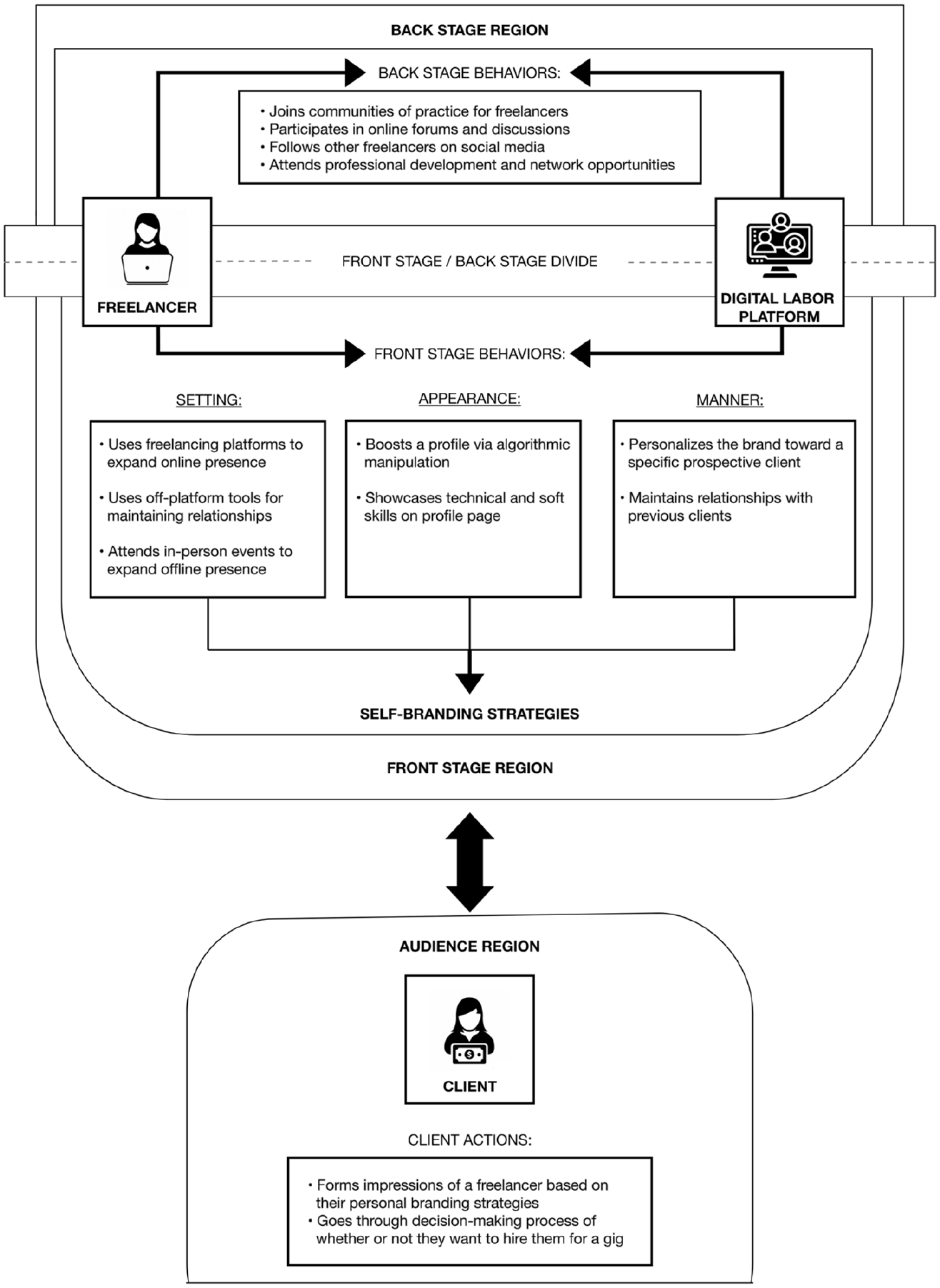
Self-branding as a performance framework.
Using Goffman’s theory to categorize our findings, we can identify self-branding as a performance, or “front,” that freelancers put on for current and prospective clients. The freelancer, as a performer, moves between the front stage and backstage depending on their situation and needs. For instance, sometimes they may need to get support or advice from other freelancers in the backstage before altering their performance. In the backstage, they may engage in behaviors, such as joining communities of practice, participating in online forums and discussions, following peers on social media, and attending professional development and networking opportunities. When returning to the front stage, freelancers become aware that they are in front of an audience and seek to present themselves by altering their setting, manner, and appearance using different impression management techniques. In both regions, online labor platforms influence the freelancer’s behaviors as they provide different affordances.
Through our findings, we have shown how Upwork’s affordances shape the self-branding practices of online freelancers. Visibility emerged as a particularly important affordance, mediating between the platform’s reputation system as a low-level affordance and freelancers’ perceived success on the platform as an outcome. Freelancers try to increase their visibility through strategies, such as boosting a profile and showcasing skills. However, since it remains unclear how Upwork’s algorithms use their ratings for visibility, freelancers have limited information on how successful their self-branding strategies actually are (Rahman, 2021).
The lack of transparency on the efficacy of different self-branding strategies means that workers rely on idiosyncratic folk theories for navigating the ecosystem (Bucher et al., 2021) and adopt creative but potentially risky strategies for self-branding, such as tagging clients on social media. Such ambiguities in interpretations and practices are reflected in more general literature on self-branding, which shows high levels of uncertainty among job seekers about best practices (Gershon, 2017). Many workers, also outside the creative industries, embrace self-branding as a seemingly necessary part of their working lives (Vallas and Christin, 2018) although it is often perceived as burdensome and riddled with mysteries.
Our findings reflect these tendencies and show the complex balance of self-branding on an online labor platform. These self-branding strategies are shaped in a reciprocal interaction between clients and freelancers, meaning both parties consume information provided by the other party and then take an appropriate course of action based on their evaluation. For that reason, self-branding strategies for workers can be damaging, thus also highlighting the importance of these strategies. For each of the five strategies, specific risks were discussed in the interviews, showing how too much self-branding can be detrimental. For example, while expanding presence is an essential self-branding strategy in the digital economy, sometimes discussed as “multi-homing” (Choi, 2010), we found that freelancers could come across as invasive if they were perceived as overly engaged. Digital work platforms generally try to prevent freelancers from taking client relationships off-platform through restrictive terms and conditions and potentially severe penalties (Kinder et al., 2019).
Implications
In terms of theoretical implications, our findings reinforced the position of Vallas and Christin (2018), who found that a majority of freelancers used a self-branding discourse, often bringing up reputational issues with little prompting by interviewers. It also resonates with Gershon’s (2017) in-depth ethnography of the job-seeking process among (mostly) white-collar workers in the Bay Area. Gershon’s research highlights several strategies that also apply to Upwork, for example profile curation on social media platforms such as LinkedIn, dedicated networking (which aligns with expanding presence and maintaining relationships with clients), and the showcasing of skills. Our study also shows self-presentational strategies and tensions in practice, highlighting worker agencies and constraints, suggesting self-branding as a form of “invisible labor” or “articulation work” for freelancers, which freelancers see as an investment for their career. In that sense, our findings add richness to discourses on new forms of work in the creative and digital industries, including venture labor (Neff, 2012), visibility labor (Abidin, 2016), and meta-work (Aroles et al., 2022).
Throughout this study, we stress the role of technology as an essential element in the self-branding process. We found that many freelancers preferred certain platforms over others, depending on their affordances and constraints. For instance, participants used words like “professional” to describe Upwork. In this sense, platforms, just like people, have different brands and different audiences. Our framework also shows how the social and technological aspects of self-branding are necessarily intertwined, aligning this work with previous research that has stressed how a thorough analysis of self-branding on digital platforms requires attention to platform features, audience assumptions, and worker’s own self-concept (Duffy et al., 2017; Scolere, 2019).
In practical terms, we noted that communication was taken off the platform for three main reasons: increasing privacy, maintaining relationships, and gaining money. Platforms are critical in establishing the infrastructure of trust between clients and workers; and once the trust is established the transacting parties may go off the platform. To add value not just in the early phases of the process, the platforms must look into how they can sustain their role as continuous trust-building infrastructures beyond the early phases of transactions. Platforms are additionally a critical actor in establishing trust between clients and freelancers; the more material features (e.g. projects, history, reviews, testimonials) on a digital labor platform, the more trust a client has with a freelancer. Backstage opportunities where freelancers can connect openly with other freelancers can also play an important role in the well-being of independent workers. Platforms, such as Upwork, can provide a forum for such discussions and should have effective freelancer and client support in place in case freelancers or clients want to issue a complaint directly. However, they should refrain from infiltrating backstage communities that the workers see as their own (e.g. the Upwork subreddit) and where they feel comfortable to connect with other freelancers.
Limitations and future research
This study comes with several limitations that point to avenues for future research. Importantly, the interviewees for this study make up one faction of the entire Upwork community and the results cannot be generalized across the entire platform, let alone all online freelancers. Future research could compare the self-branding strategies in different digital work contexts (e.g. by contrasting a typical platform for each quadrant in Howcroft and Bergvall-Kåreborn’s (2019) typology of crowdwork platforms) to account more closely for the role of affordances in shaping work experiences and outcomes.
Moreover, the study did not employ a triangulation methodology to cross-validate the qualitative analysis. We recommend that future research use quantitative approaches to assess personal branding strategies on online labor platforms. Quantitative data source suggestions for future studies include web-scraped data from online labor platforms and participant surveys which measure self-branding behavior.
Footnotes
Funding
The author(s) disclosed receipt of the following financial support for the research, authorship, and/or publication of this article: Christoph Lutz and Gemma Newlands received funding from the Research Council of Norway, under grant agreement 275347 Future Ways of Working in the Digital Economy.
