




Abstract
The article examines a ‘trinity’ of interconnected components by Mobileye, a company moving into autonomous driving. However, Mobileye is neither an automotive manufacturer, nor a nominal ‘big tech’ company, but an established maker of ‘bolt-on’ advanced driver assist systems (ADAS), able to draw on over 65 million vehicles. Through these devices, Mobileye is undertaking a ‘platformisation’, transforming from an automotive supplier into a provider of autonomous vehicle (AV) platforms. We characterise this as a ‘car-agnostic’ approach to autonomous driving. Mobileye represents the advancement, and modulation, of a platform logic into a different type of hardware: the car. To understand the implications of this, we argue that Mobileye acts parasitically in three ways: by inserting itself between driver and vehicle, vehicle manufacturer and vehicle data, and specific vehicles and the emerging AV industry.
Keywords
Introduction
During the 2021 Consumer Electronics Show (CES), Mobileye’s CEO Amnon Shashua offered a ‘deep dive’ into his company’s unique approach to autonomous vehicles (AVs). What makes Mobileye different from other AV instigators is that Mobileye is neither an automotive manufacturer nor a nominal ‘big tech’ company (in the shape of an Alphabet/Google, Amazon, Apple, Meta/Facebook or Microsoft), but an established maker of advanced driver assist systems (ADAS) and automotive chips. Through these interests, the company has amassed a significant userbase, claiming over 65 million vehicles are equipped with Mobileye (2021a) technology, worldwide. In its efforts to enter the world of AVs, Mobileye is undergoing ‘platformisation’ (Helmond, 2015), turning itself from an automotive supplier into an automotive platform provider. Along the way, it is employing similar techniques to social media companies, such as Facebook, argued to have undergone a similar transformation over the past decade. However, as we contend, Mobileye’s novel platformisation differs from, albeit is indebted to, a blueprint laid down by big tech. This is due to the company’s unique place in the automotive industry, including long-standing existing relationships it has with automotive manufacturers, as well as the unique aspects of developing, building, producing and selling motor vehicles. It is this we characterise as Mobileye’s ‘car-agnostic’ approach to delivering autonomous driving.
In this article, we examine what Mobileye’s car-agnostic approach consists of, exploring its transformation from supplier of under-the-hood, and bolt-on ADAS, to a possible provider of AV platforms. In the first section, we provide a brief overview of the key developments in automotive software/hardware over the last few years, specifically around the integration of external sensors, computer chips and data-based systems into consumer vehicles. While much of the prior focus has been on AV testing by big tech firms (from Uber to Waymo), other actors such as Mobileye have taken a different approach, propelled by their unique position as a historic provider of ADAS and automotive chips.
In the second section, we introduce theories around platforms and platformisation, describing how ‘web-only’ or ‘web-first’ enterprises embraced different kinds of technical ‘programmability’ (Helmond, 2015: 5), modularising and standardising the exchange of web data. Thus, we argue that a form of web platformisation is being imported into the automotive industry by Mobileye, to take advantage of the ‘data-gathering possibilities’ (Steinberg, 2021: 17) offered by becoming a platform that enable it to gain greater control over relationships with other actors in the automotive industry.
In the subsequent section, we detail the technical features of Mobileye’s car-agnostic approach and a so-called ‘trinity’ of interconnected components, True Redundancy, Road Experience Management (REM) and Responsibility-Sensitive Safety (RSS), showcased by Shashua at CES 2021. Emphasising modularity (True Redundancy), ‘plug-and-play’ use (REM) and operational standardisation (RSS), Mobileye’s approach to autonomous driving follows a web platformisation playbook, in which the generation and smooth flow of valuable user data is enabled through programmable components.
In the penultimate section of the article, to understand the implications of this platformisation, we turn to Michel Serres’ (1982) concept of the ‘parasite’. Through Serres and other works (Aradau et al., 2019; Gehl and McKelvey, 2019; Pasquinelli, 2008; Randerath, 2021), platforms can be understood as parasitic, for the way they extract value with nominal cost from users. In the final section, we apply Serres (1982) to argue that Mobileye acts parasitically in three ways: first, by inserting its ADAS devices between vehicle and driver; second, by inserting itself between vehicle manufacturer and vehicle data; and third, by inserting itself between vehicles and the emerging AV industry. While Mobileye’s car-agnostic approach to becoming a platform provider of AVs is somewhat unique, it is evidence of the significant technological, political and economic shifts occurring in the automotive industry at present.
Automotive software/hardware: sensors, chips, data
In recent years, the automotive world has experienced major upheaval, with the introduction of increasingly complex computational systems to augment the driving experience. Developments in sensor systems, machine vision, computer chip design and data processing, have led to greater capacities for cars to recognise objects in the world and act upon them (Hind, 2019; McCosker and Wilken, 2020; Stilgoe, 2017). Major corporate players, both traditional car manufacturers and newcomers from the technology sector, have tested experimental vehicles on the streets in different parts of the world, from London to Jerusalem. Evangelists claim the AV to be the imminent teleological end-point of contemporary automobility, despite the persistent errors, incidents and accidents that have placed significant doubt in their decision-making abilities (Bissell, 2018). As Tennant and Stilgoe (2021) showcase, different kinds of actors (such as software engineers, regulators, start-up CEOs, tech investors) see different ‘problems’, ‘limits’ or ‘solutions’, whether related to data collection, computer modelling or environmental complexity. In this, AVs can be positioned alongside similar wishful technological discourses around the Internet-of-Things (IoT) or smart cities more broadly (Ash, 2018; Sadowski and Bendor, 2019) that have likewise envisioned a seamless, automated, future with varying degrees of success.
Those investing in a fully autonomous future typically originate from the technology sector, such as Alphabet’s Waymo, Uber ATG (now Aurora) or Tesla. Traditional automakers have also invested in technology companies working on stand-alone AVs, such as with General Motors and Honda’s acquisition of Cruise (Thielman, 2016) or Ford and Volkswagen’s joint investment in Argo AI (Lawler, 2020). Dedicated start-ups offering autonomous driving for specialised purposes such as taxi fleets, long-haul lorries or urban delivery have also been founded primarily by ex-employees of major tech firms, including Aurora (co-founded by former Waymo CTO Chris Urmsom) or Kodiak (co-founded by former Google software lead, Don Burnette). In parallel, Chinese companies, such as AutoX, PonyAI or Didi Chuxing, follow similar trajectories, even competing in machine vision challenges organised by Western counterparts such as Waymo (Zhang et al., 2021).
While all the above differ in their specific approach, they nonetheless envisage the vehicle as a new class of mobile media platform (Alvarez León, 2019), able to collect and process data captured from external reality. In building (or significantly modifying) specialised vehicles, such data are used to train machine learning algorithms to recognise, and categorise, other road users. In concert with high-performance computer chips that enable real-time recognition, this entire software package ultimately becomes the ‘brains’ of the AV (Hawkins, 2018). This software-led approach is already in evidence in ordinary vehicles, with the likes of Tesla and BMW releasing periodic ‘over-the-air’ (OTA) updates that ‘unlock’ additional capacities for existing cars (BMW, 2021; Tesla, 2021).
A different approach is taken by the central case study for this article, the Intel-owned Mobileye company, founded in 1999 as an ADAS manufacturer. Typical features of ADAS include Lane Departure Warning (LDW) and Forward Collision Warning (FDW) systems able to alert drivers to imminent dangers. While similarly employing some purpose-built AVs, in collaboration with industry leaders such as Ford and Volkswagen (primarily as prototypes for future ‘Robotaxi’ deployment), Mobileye aims to achieve autonomous driving through its traditional business model of manufacturing ADAS that it claims are installed in over 65 million vehicles across 25 automaker partners (Mobileye, 2021b, 2022). The company’s approach is on hardware, designing cameras, sensors, silicon chips and consumer-facing interfaces that provide incremental assistance to drivers, intending to ‘substantially reduce fatalities and serious injuries, at a reasonable cost, while sustaining the usefulness and throughput of the road system’ (Shalev-Shwartz et al., 2018: 1).
It is this incremental approach that allows them to harness and operationalise huge amounts of driving data, further advancing their nascent platform position. Mobileye’s recently announced EyeQ ‘system-on-a-chip’, for example, is designed to provide the computational capacity required to process huge volumes of data generated by their ADAS devices (Hawkins, 2022a), striking deals with automotive original equipment manufacturers (OEMs) to access it (Korosec, 2022). Its recent partnership with Chinese automaker Geely is intended to offer the full package of Mobileye hardware in a fully AV, for the first time, from 2024 (Hawkins, 2022b). Combined, these technological developments in sensing, computation and data collection have the potential to significantly transform the automotive industry.
Beyond ‘web-only’ platformisation
In this article, we consider Mobileye, its ADAS products and its approach to developing AVs, through the lens of platform studies and platformisation. In this section, we begin by briefly recounting four platform perspectives offered by scholars: technical, discursive, economic and datafied. While overlapping and non-exclusive, these trajectories help to make sense of what platforms do and how platforms act. More specifically, to consider how ‘web-only’ or ‘web-first’ platformisation occurs through certain levels, or stages, of ‘programmability’ (Helmond, 2015: 5) and how these programmable techniques are being imported into the automotive industry in the case of Mobileye.
First, the technical meaning of platforms considers them as specific configurations of hardware and software that allow for external, or remote, modification. A key aspect of this meaning is that external contributors are able to write code on such a platform, usually without explicit consent of the platform owner. While this functionality was not new to platforms, per se, ‘Web 2.0’ technologies allowed platforms to gain momentum (O’Reilly, 2005). In such view, technical programmability is a critical feature of any platform.
However, with major Internet companies (YouTube and Facebook) adopting the nomenclature of platforms to indicate large-scale multi-user services, a more discursive meaning emerged, concerning the control of user activity. In this, such firms historically sought to elide responsibility for content as ‘neutral intermediaries’ (Katzenbach, 2021: 3), thus creating complicated – and often byzantine – governance structures to trap users (Caplan and Gillespie, 2020; Gillespie, 2010, 2017). This perspective cares less for the technical capacities of a platform to be programmed. YouTube is understood not to be a powerful actor because of how users are able to ‘modify’ it by uploading external videos (as per Web 2.0), but in how the platform can algorithmically boost or, conversely, demonetise and ‘de-platform’ online video content and content creators, controlling various aspects of people’s viewing experience (Van Dijk et al., 2021).
The economic perspective has considered the platform as a business model (Srnicek, 2016), with firms able to wield market power over third parties, such as developers and downstream suppliers. Here, platforms control supply and demand through their privileged status as monopoly actors, facilitating ‘multi-sided markets’ between users, advertisers, businesses and developers (Postigo, 2016; Rieder and Sire, 2014). Ultimately, this focus on data extraction as the organising logic of the platform has led to a datafied perspective. Here, the technical perspective on platforms returns, but with a greater focus on how specific features, such as application user interfaces (APIs), allow for the control and valuation of data enclosed within the platform ecosystem while limiting functionality (and power) to third parties (Helmond, 2015).
The datafied approach increasingly considers questions of governance, content moderation, data extraction and economic control, leading to a broader theory of platformisation (Helmond, 2015). Described as ‘the penetration of . . . digital platforms in different economic sectors and spheres of life, as well as the reorganisation of cultural practices and imaginations around these platforms’ (Poell et al., 2019: 1), platformisation can be understood as a meta-process (Krotz, 2007) offering a theory of continuous change in multiple spheres of life. Varied work on platformisation has considered how Facebook has subverted open web protocols (Gerlitz and Helmond, 2013; Helmond, 2015), how users have been locked into walled gardens (Zittrain, 2008) and how platforms impose ‘rentier’ strategies (Sadowski, 2020), resulting in shifts in cultural production (Duffy et al., 2019) and the provision of everyday services (Plantin et al., 2018).
Specifically, Helmond (2015) writes that the platformisation of the web was conditional on three kinds of ‘programmability’ enabling the ‘exchange of data, content, and functionality with third parties’ (p. 5): the separation of content and presentation, the modularisation of content and features, and interfacing with databases. The separation of content and presentation, as she explains, was made possible through the development of the Extensible Markup Language (XML), enabling both human and machine readability. Through so-called ‘data pours’ (Liu, 2004), websites could ‘pull in and display dynamic content from third parties’ (Helmond, 2015: 6) rather than exist as ‘self-contained’ HTML-dependent sites (Helmond, 2015: 6). XML also enabled the modularisation of web content and features, by turning each element into ‘small modules of data that can be reused’ (Helmond, 2015: 6). Web ‘plug-ins’ such as Facebook’s ‘Like’ button are likewise found across the web, embedded in websites beyond the Facebook platform itself (Gerlitz and Helmond, 2013). ‘By embedding a plug-in into their website’, Helmond (2015) suggests, ‘webmasters set up two-way data channels’ through which information can flow between respective databases (p. 7).
It is these technical, infrastructural developments that led ‘social network sites’ to develop into ‘social media platforms’ (Helmond, 2015: 3), or mapping websites into cartographic infrastructure (Plantin, 2018), with APIs critical to enabling this connective work, as firms desired to construct transactional environments. Together, content/presentation separation, content/feature modularisation and database interfacing enable web platformisation to occur. These conditions thus function as specific criteria against which identifiable technical operations, business plans or business/customer relationships that might be said to have been ‘platformised’ can be evaluated. While Helmond documents this process in relation to Facebook, follow-up work shows that other platforms, such as Uber or Deliveroo have used data rents extracted from their different types of users (riders/drivers and restaurants/customers) to gradually change how these other actors conduct themselves. Plantin (2018), likewise, has discussed how data aggregation, and the outsourcing of data work, has been integral to making Google Maps ‘platform-ready’ (Plantin, 2018: 493). That these decisions impose the platform on previously platform-independent spheres of social life is the essence of platformisation.
To date, however, most platformisation studies have focused only on the web, and to a lesser extent proprietary mobile ecosystems, such as the respective Apple and Google app stores. In this, the platformisation process has been characterised as a ‘web-only’ or ‘web-first’ phenomenon more-or-less exclusively experienced or enacted by (social) media companies or other firms who have used web architecture to mediate relationships between their businesses, third parties and customers. As we will show, Mobileye represents the advancement, and modulation, of a platform logic into a different type of hardware: the car. With it, we argue, some unique aspects of platformisation are emerging, as firms respond to, resolve, streamline or altogether transform inflexible production processes, long and deeply embedded supply chains, recent chip shortages, broad shifts in customer taste and new energy regulations within the automotive industry (Hind, 2021).
With these collective struggles, platformisation is seen as a more attractive option than traditional manufacturer–supplier agreements between those who supply physical parts, components and systems; and those that assemble and sell them. While the platformisation of the car is also itself nothing new, constituting a particular ‘pre-history’ of digital platforms as Marc Steinberg (2021) suggests, here we specify how web platformisation is being imported into the automotive industry, centred around the ‘data-gathering possibilities’ afforded by digital platforms (p. 17). To explicate what such possibilities are, we first examine the three central principles built into the emerging Mobileye platform.
Mobileye’s ‘car-agnostic’ approach
CES is a major industry event held every year in Las Vegas, USA by the Consumer Technology Association (CTA), where manufacturers showcase a range of new technologies. In the last few years, automotive manufacturers have also been present at CES, launching new vehicles and vehicle technologies into the consumer electronics market. In January 2021, amid the Covid-19 pandemic, Mobileye CEO Amnon Shashua gave a talk to attendees of an online-only CES 2021 entitled ‘Under the Hood’. In it, Shashua provided an insight into the company’s approach to autonomous driving, organised around three guiding principles: True Redundancy, REM and RSS. A subsequent series of talks at CES 2022 updated attendees on a new ‘chipset’ rollout and Mobileye’s Mobility as a Service (MaaS) strategy, beyond other topics. Based on these talks and additional reading of Mobileye’s corporate material, presentations and whitepapers, we analyse how the company’s strategy reflects their attempts at automotive platformisation. Here, we methodologically follow Egliston and Carter’s (2022) approach to Oculus Rift marketing material, to trace the sociotechnical imaginaries of emergent technologies as a roadmap to their potential implementation. In the following, we present the specifics of Mobileye’s ‘car-agnostic’ approach to the development of an AV platform, one that enables automotive ‘programmability’ (Helmond, 2015: 5).
True Redundancy
True Redundancy consists of two, parallel sensor systems: one reliant on ‘cameras alone’ and another dependent on lidar/radar ‘alone’ (Mobileye, 2021e: n.p.). Each of these systems can build its own, independent world model to inform an AV’s ‘driving policy’, 1 translating external data into actionable road behaviour. This, Shashua has said, is different from other dependent approaches common in the industry, in which each sensor system supports the other in the building of a ‘fused world model’ (Figure 1). Mobileye’s True Redundancy is thus named because each sensor system (camera and lidar/radar) makes the other ‘redundant’ when building its own world model.
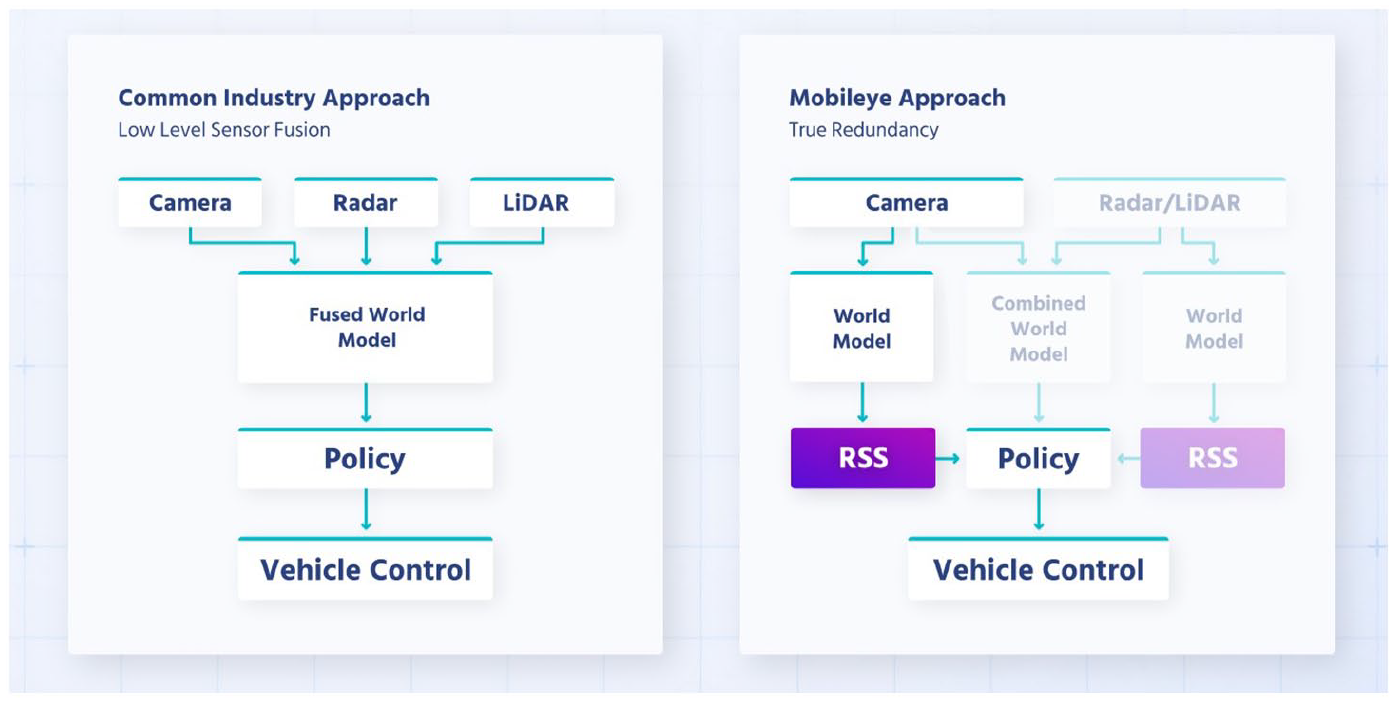
Mobileye’s True Redundancy approach to world model-building.
The concept of redundancies is used in aircraft fly-by-wire systems that are built with independent electrical and hydraulic supplies, through parallel ‘lanes’. Should one such lane fail, another lane can ensure sensor data (generated by different aircraft modules) can still be transmitted and aircraft control maintained. These parallel, or independent, lanes are clearly visible in the figure above. In essence, Mobileye’s approach is a modularisation of world model-building, which would otherwise be integrated, ensuring that sensor data captured by already modular sensing devices (camera and lidar/radar) are easily ‘poured’ into their own specific models, not unlike Helmond’s (2015) description of how XML enabled the exchange of data across the web.
To provide a comparison: in the aftermath of the Uber ATG crash in Tempe, Arizona in 2018, the first recorded case of a fatality caused by an AV (Levin and Carrie Wong, 2018), an independent review of the company’s safety culture recommended implementing a ‘safety management system’ (SMS) common in high safety risk industries like aviation (National Transportation Safety Board, 2019). While this organisational framework has been carried over to Aurora, it is not represented technically in the form of system redundancies. In other words, Uber/Aurora’s vehicles offer complimentary sensor systems, generating a ‘fused world model’. The advantage to Mobileye’s (2021e) approach being a ‘significantly lighter [data] validation burden’ (n.p.) compared to those requiring the fusion of sensor data derived from multiple sources. Thus, we can perhaps also suggest that Uber/Aurora’s fused model approach does not have the kind of platformised modularity as Mobileye.
Road experience management (REM)
The second of these principles is a high-definition mapping database called REM, able to collect granular data on everything from traffic lights and curb edges to typical vehicle speeds. Rather than relying on cartographic data derived from sensor-laden vehicles, or ‘dedicated mapping fleets’ (Mobileye, 2021d: n.p.) (such as the Google Street View vehicles), Mobileye crowdsources data from Mobileye device–equipped vehicles. With coverage across private and commercial fleet markets, Mobileye (2021a) claims over 65 million vehicles are equipped with Mobileye technology largely able to ‘automatically collect anonymous data from the road’ as users drive (Mobileye 2021d: n.p.). At CES 2022, Shashua further claimed that Mobileye holds the ‘largest driving database in the industry’ (Shashua, 2022: n.p.), with 200PB in total, receiving 25 km of data every day for a total of 4 billion kilometres in 2021 and an expected 9 billion in 2022.
Like with their sensor system, Mobileye aims to distinguish itself from other AV developers. Through its crowdsourcing of user data, REM is referred to as ‘scalable-by-design’ (Mobileye, 2021d: n.p.) as compared to the cost of maintaining and operating a dedicated mapping fleet. Although rivals, such as Waymo and Uber/Aurora, have access to both dedicated fleets and user-derived sources (i.e. from Android mobile devices or Uber trips), Mobileye contend a fleet-led approach will result in a ‘winter of autonomous driving’ (Shalev-Shwartz et al., 2017: 1), akin to earlier ‘AI winters’ defined by a lack of technological progress. Nonetheless, Mobileye’s (2021d) experience of building ADAS devices has enabled it to amass ‘millions of harvesting agents’ (n.p.) generating road data ‘in every relevant region’ (Shashua, 2021: n.p.). REM does not require full autonomy and is already built into the advanced version of Mobileye’s ADAS (known as ‘Level 2+’). As Shashua (2022) elaborates, REM is not a static system, instead employing OTA updates to upgrade existing functionalities and enable cloud-based uploads of REM data. In doing so, Mobileye has decentralised data collection necessary for training machine learning models, enrolling these third parties into ordinary business operations, separating data collection from data processing and enabling scalability.
It has also used REM data ‘to generalise traffic rules and driving culture’ (Shashua, 2021: n.p.) important to establish detailed semantic understanding of how people usually drive. This crowdsourcing allows Mobileye to make associations between vehicles and road elements (traffic lights, yield and stop signs and crosswalk locations), and also non-sign-based rules like lane priority. As Shashua (2021) argues (Figure 2), the REM database is not a ‘replacement of a navigation map’ but is the ‘high-resolution information that allows the car to interpret the road’ (n.p.). In this, the database does not merely contain data on road types, lane dimensions and junction layouts but – as the title implies – of road experiences generated on, along and through them.
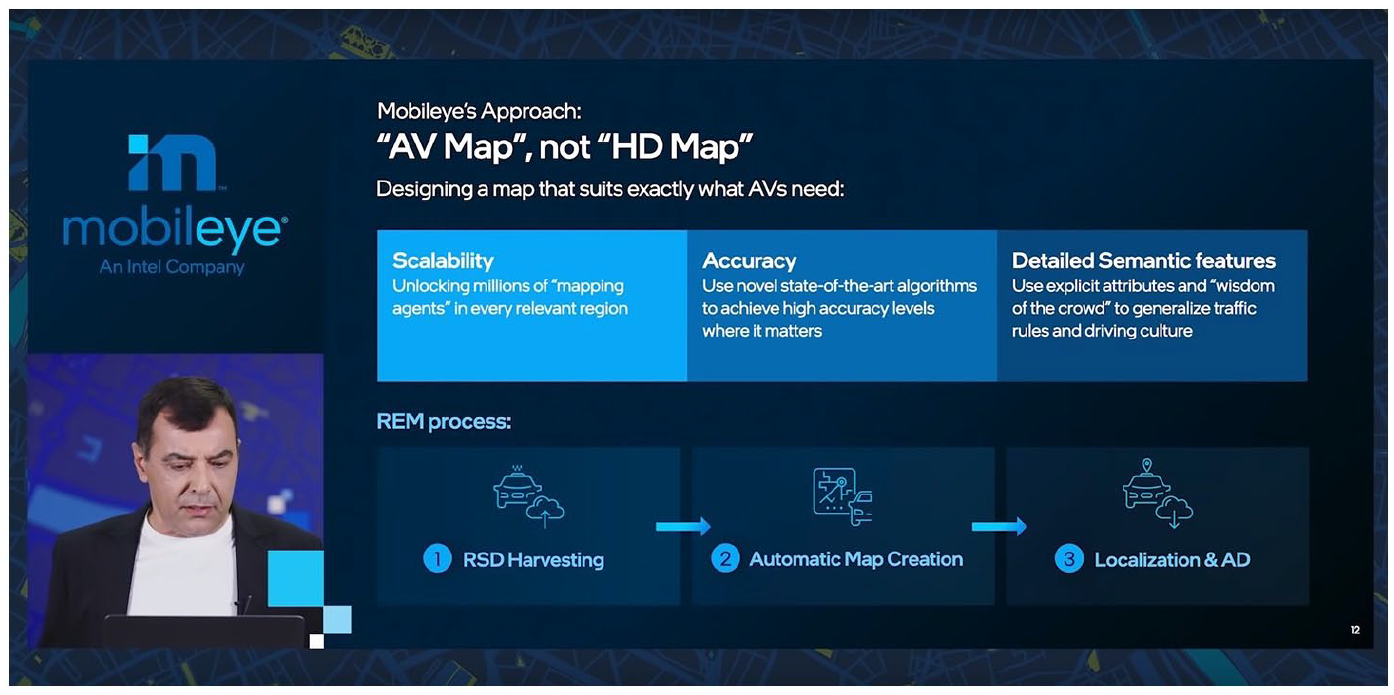
Mobileye’s REM mapping database capturing both traffic rules and driving behaviour.
Responsibility-sensitive safety
Returning to the issue of safety, Shashua offers a third system: RSS, intended as a mathematical ‘rule of the road’ (Tennant et al., 2021) for AVs. In a process, the company says ‘formalizes human common sense’ on how to drive (Mobileye, 2021c, n.p.), Mobileye (2021c) has codified five safety principles meant to provide a ‘common definition of what it means for an automated vehicle to drive safely’ (n.p.), concerning safe vehicle distances, cutting in, vehicle right of way, limited visibility and crash avoidance. Translated into mathematical formulae, they concretise what an infraction of each kind would entail.
According to the work of Shalev-Shwartz et al. (2017), this includes the calculation of ‘safe longitudinal distance’ (Figure 3), the establishment of a ‘longitudinal danger threshold’ and a codification of a ‘longitudinal proper response’ (pp. 10–11). In short, RSS offers a standard for how an AV should drive, ‘digitizing the social contract for safer roads’ (Dagan, 2019: n.p.). In Shashua’s (2021) words, RSS allows Mobileye to ‘reduce the experience of driving’ (n.p.) to a series of governing rules. The crystallisation of these five rules, therefore, is dependent upon the driving experiences captured in their REM database. In a later overview, Shashua (2022) contends that this allows Mobileye to compete on two separate trajectories, both with Robotaxi companies (e.g. Waymo or Argo) and consumer automotive rivals (e.g. Tesla). His business case thus relies on the scalability of combined REM and RSS approaches, alongside the robustness of True Redundancy’s dual sensor system.
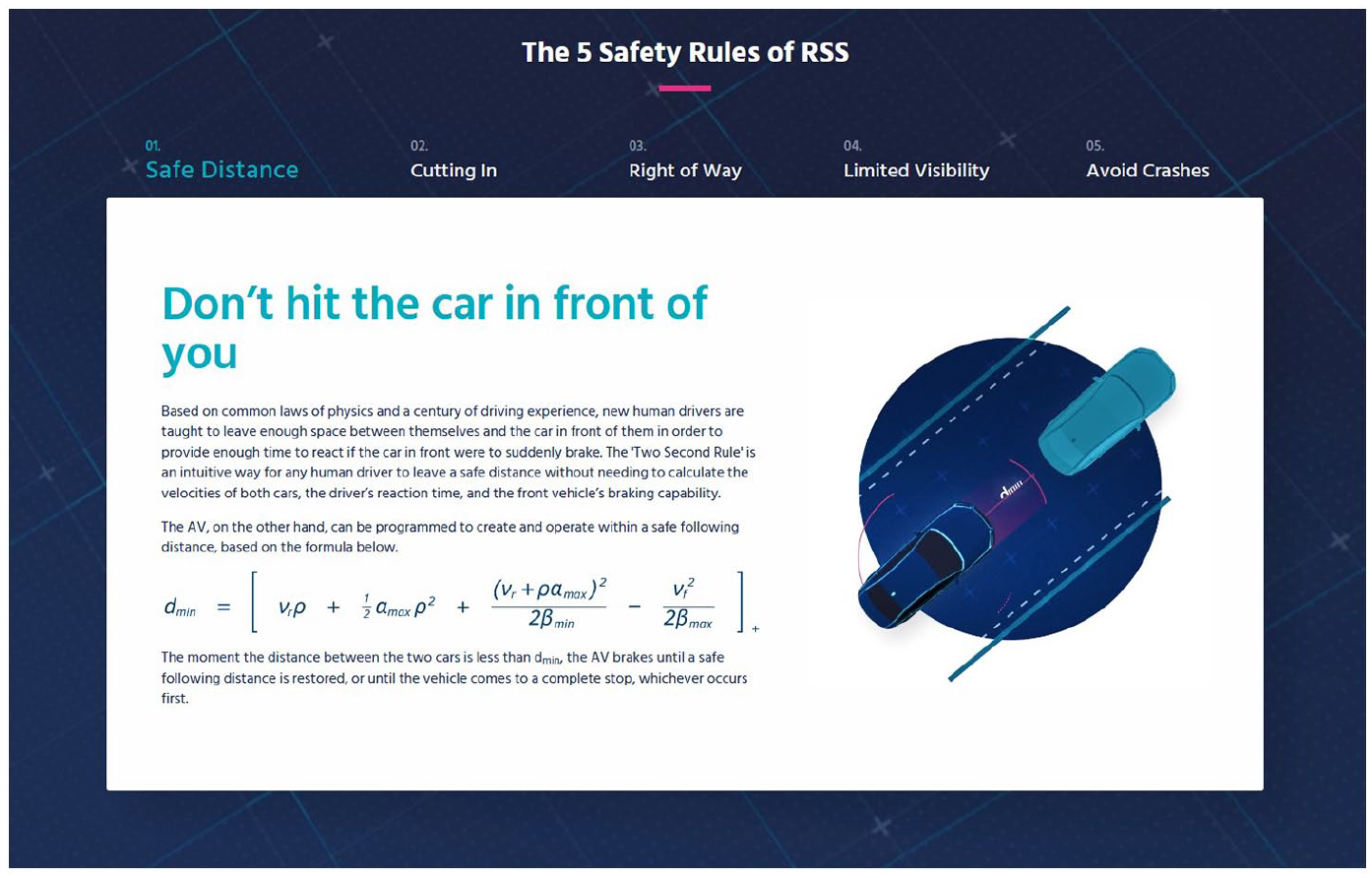
One of Mobileye’s five ‘safety rules’ contained within its autonomous vehicle driving policy, RSS.
Collectively, these components hint at Mobileye’s platformisation in which various kinds of separations, modularisations and interfaces are implemented to smooth the flow of operational, valuable data through programmable components. To understand how exactly this platformisation is being undertaken, we want to frame the relationship between Mobileye and other automotive actors as being ‘parasitic’. In short, if we consider Mobileye to be shifting towards a platform model, dependent upon the extraction of user data, then how does it acquire this data? How does it convince drivers as to the need for ADAS? How, in turn, are these devices tuned to the operation of the vehicles upon which they depend? How does it persuade automotive manufacturers or leasing firms of the need for Mobileye services?
These questions cannot simply be answered through reference to technical programmability, but instead, must concern the political economy of the automotive industry and Mobileye’s activities within it. In the next section, then, we explore the theoretical aspects of ‘parasitism’, to help us sketch out the diagrammatic relationships between parasites and ‘hosts’. In the section after, we return to Mobileye to consider how it forms different parasitic relationships with actors across the automotive industry, to transform itself into a nascent provider of automotive platforms.
Parasitic platforms
Capitalism has routinely been referred to as parasitic, whether in reference to the emergence of post-Soviet capitalist firms still reliant on the state (Clarke, 1992), the rise of global, speculative, financial capitalism (Bauman, 2011), digital technologies (Aradau et al., 2019), communicational monopolies (Pasquinelli, 2008), cryptocurrency mining using public subsidies (Lally et al., 2019), darknets (Gehl and McKelvey, 2019), TikTok (Matney, 2020), how capitalism depends on external(ised) ‘non-capitalist’ entities to function (Luxemburg, 1913) or, famously, how capital ‘vampire-like, lives only by sucking living labour’ (Marx, 1990 [1867]: 342). The main thread throughout these applications considers how parasitic capitalism accesses and extract value (from the state, other firms, users, nature and bodies) typically through ‘rentier’ accumulation strategies (Pasquinelli, 2008).
Concerning platforms specifically, Matteo Pasquinelli (2008) writes of Google’s AdSense and AdWords services as a ‘light infrastructure for advertising that infiltrates websites as a subtle and mono-dimensional parasite’ (p. 93) enabling it to extract profit ‘without producing any content’ (p. 93). Gehl and McKelvey (2019) suggest that digital platforms act as parasites for each other and the web at large, where ‘what comes after the parasite is always another parasite’ (p. 222). Sebastian Randerath (2021) understands the customer relationship management (CRM) service salesforce as multidimensional ‘parasitic medium’ (p. 5) entangling itself within host businesses, and Claudia Aradau et al. (2019) have considered how, through platformisation, APIs become ‘parasitic mediators of digital relations’ (p. 2557). In doing so, APIs offer a form of ‘asymmetric reciprocity’ (Aradau et al., 2019: 2557), like the parasite, in which the value of the information they receive exceeds the value (or kind) of the service they provide to users.
Like those above, our specific use of the metaphor is derived from the work of Michel Serres (1982). For Serres, a parasite can be defined in three ways. First, it can refer to a microbe, an ‘insidious infection that takes without giving and weakens without killing’ (Serres, 1982: X). Here, biological parasites rely on host organisms for sustenance. As Serres (1982) also explains, the ‘relation with a host presupposes a permanent or semipermanent contact’ (p. 6), such that the parasite is ‘[n]ot only living on but also living in’ (p. 6, author’s emphasis). As a result, a parasite must be small enough to attach oneself to, or entwine oneself with, a larger, host organism.
Second, it refers to a guest ‘who exchanges . . . talk, praise, and flattery for food’ (Serres, 1982: X). 2 Following this definition, the word parasite can be traced back to both Latin (parasitus) and Greek (parasitos), and its two individual parts, para meaning besides or next to, and site meaning ‘grain, bread, food’ (Nulman, 2021: 79). In this, ‘[t]o parasite means to eat next to’ (Serres, 1982: 7). However, as the translator of Serres (1982) notes, this second definition rests on the duality of the original French, hôte, which translates both to host and guest, inviting an ambiguity of relations not contained within the biological definition.
The third definition refers to noise, ‘the static in the system or the interference in a channel’ (Serres, 1982: X). In this cybernetic meaning, the parasite is a communicational ‘interrupter’ (Serres, 1982: 19), ‘nesting on the flow of the relation’ (Serres, 1982: 53), taking up a third position between (biological) host and parasite, and (culinary) host and guest. Despite the differences between these three definitional contexts the parasite serves ‘the same basic function in [every] system’ (Serres, 1982: X), capable of generating energy through its interactions with other actors. For Gehl and McKelvey (2019), these allow for a ‘triadic’ theory of media relations rather than a binary one, taking interruptions, noise and inconvenience as constitutive parts of platform relations, rather than an aberration. It is in all these senses that we consider Mobileye as parasitical.
Mobileye’s parasitism
In this final section, we examine how Mobileye can be considered parasitic. To recall, platformisation is a process, requiring the deployment of specific programmable techniques to facilitate this transformation. Mobileye’s platformisation requires a ‘retrospective activation’ of existing ADAS devices, using them to amass platform capital. While historically dependent on automotive OEMs to supply vehicle models with specific technologies or systems, platformisation is intended to flip this relationship, in which other firms become dependent on them instead.
There are three principal reasons we consider Mobileye to be parasitic. First, that it inserts its ADAS devices seamlessly into the existing driving assemblage between vehicle and driver. Second, that it extracts driving data surreptitiously without sharing it with vehicle manufacturers. Then third, that in the true sense of a parasite, rather than ‘kill’ the nascent AV industry, it endeavours to sustain it through the ongoing collection of data critical for its own survival as a new platform provider.
Between driver and vehicle
First, Mobileye acts parasitically by inserting their devices between driver and vehicle, to offer driving assistance. Mobileye devices are not meant to inhibit existing driving practices, only to cater to their operation. In Serres’ definition of the parasite as a guest, the user merely invites Mobileye to dinner. 3 However, this is not an exchange of equal value, a symbiotic relationship between two equal partners. Instead, it is a form of ‘asymmetric reciprocity’ (Aradau et al., 2019: 2557) in which Mobileye extracts the ‘data fumes’ (Thatcher, 2014) of the user in return for offering driving assistance in the form of auditory and visual information. Such devices are framed as bolt-on, plug-and-play devices offering seamless connection with, and into, existing practices without extra hassle, extra work or the need for expert knowledge on behalf of the customer. The devices (such as the 630 Pro) can be operated by ordinary users, attached easily to both windscreen and dashboard, and do not impose themselves on how the vehicle is driven. In this, the driver does not have to learn or re-learn key aspects of driving (Hind, 2021), only to learn how to respond to the auditory warnings, and visual indicators, offered to the driver by the special ‘EyeWatch’ display (Figure 4).

An example of a Mobileye ADAS device, the 630 Pro.
While other AV projects are reliant on generating training data from dedicated fleets engaged in driving specific routes, or through simulating possible encounters (Hawkins, 2020), Mobileye puts a greater emphasis on a retooling of existing devices already embedded within ordinary vehicles, both consumer (630, 630 Pro) and fleet (such as the Shield+). While other platforms have designed smart devices that capture user data with machine learning already in mind, Mobileye has retrospectively activated their own devices for this purpose.
In developing a platform that can ‘harvest’ Road Segment Data (RSD) from host vehicles (Figure 5), Mobileye is able to gain a greater understanding of driving culture or road experiences, as ‘every car with an EyeQ chip has the capability to send pertinent data, very sparse data, to the cloud’ (Shashua, 2022; our emphasis). Martens and Zhao (2021) give a similar example from the Shanghai New Energy Vehicle (NEV) platform, that collects ‘44 static data points’ and ‘80 dynamic data points’, including ‘vehicle status and speed, engine temperature, revolutions and torque. . .[and] any alarms and error codes produced by the vehicle’ (p. 5). The knowledge acquired through this data collection grants considerable power to Mobileye, rather than to any non-commercial or administrative entity.
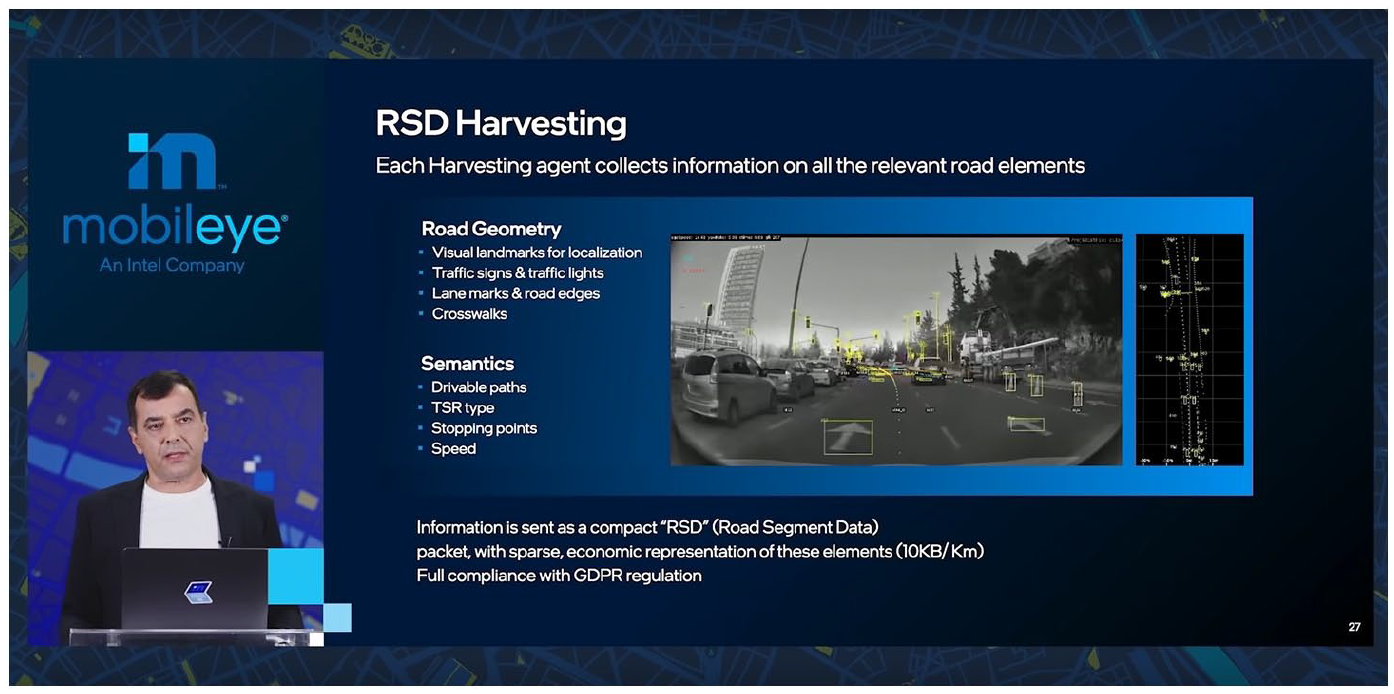
Road Segment Data (RSD) ‘harvesting’ by Mobileye devices.
Between vehicle manufacturer and vehicle data
Second, Mobileye acts parasitically by extracting data from host vehicles while circumventing the vehicle manufacturer. While Serres (1982) sometimes suggests that the parasite–host relationship is ‘unidirectional’ in favour of the parasite, his cybernetic definition considers it, more precisely, as a relationship of non-equivalence. Here, host vehicle manufacturers cannot draw on the capacities of a Mobileye device itself as Mobileye does. In another case of asymmetric reciprocity, this time between OEMs and Mobileye, the device is nonetheless able to draw on the vehicle as an automobile object. Here, like the figure of the paralytic in the work of Serres (1982), the device forms an alliance with the blindman (pp. 35–37). In this, the ‘parasite invents something new’ (Serres, 1982: 36) obtaining energy (in the form of a moving vehicle) in exchange for limited information related to its use.
Through this integration, various OEMs are able to offer superior automation functionalities to their drivers without the need to invest in research and development. Mobileye, thus, can funnel varied data from all kinds of vehicles into their AV operations. Moreover, that it can aggregate data from various manufacturers as well as different vehicle types (Plantin, 2018). While OEMs potentially have access to specific data streams generated by Mobileye devices (depending on individual agreements), only Mobileye can combine, aggregate and scale them across vehicle models and manufacturers. In platform terms, Mobileye’s ADAS devices are a hardware equivalent to Facebook’s Like button that enabled it to capture information on user activity from the wider web, beyond its own social media platform (Gerlitz and Helmond, 2013). Indeed, that following both Gehl and McKelvey (2019) and Aradau et al. (2019), digital parasitic behaviour begets digital parasitic behaviour, as OEMs nevertheless seek to extract their own, partial, value from Mobileye-generated data.
Furthermore, through its RSS driving policy, Mobileye has sought to standardise the decision-making of all AVs. Within the wider automotive industry, it is akin to HERE’s attempts to develop a standardised sensor interface and open universal data format for vehicle data exchange (Gekker and Hind, 2019). Mobileye (2021c) has proposed its own, allegedly ‘technology neutral safety model’ (n.p.) to ensure that other actors (rival firms, governments, transportation agencies, etc.) conform to standards set by themselves. In this, Mobileye chairs an Institute of Electrical and Electronic Engineers (IEE) working group on ‘AV Safety’, with Shashua (2021) also drawing attention to a recent ISO on AV driving policy standardisation (ISO/TR 4804:2020, 2020). Here, Mobileye is attempting what other platform firms have done before it, by setting the standards and specifications for data exchange through a broader ecosystem, to suit infrastructural interests (Helmond et al., 2019).
Between vehicles and the AV industry
Third, Mobileye acts parasitically by using crowdsourced data to build their REM mapping database. In this, Mobileye becomes a ‘thermal exciter’ (Serres, 1982: X) steering autonomous driving away from an unscalable, unfeasible, costly ‘winter’ (Shalev-Shwartz et al., 2018: 1). Without dramatically scaling up data collection, Mobileye argue, autonomous driving is fundamentally unrealisable, burdened by operational costs. In this, Mobileye maintains a ‘voracious appetite’ (Marx, 1990 [1867]: 344) for the collection, and generation, of even more user data, framing itself as valiantly and altruistically saving the AV industry from itself. Mobileye sees itself neither part of, nor necessarily wholly outside of, the ‘AV industry’, but draws on it according to ‘new logic’ (Serres, 1982: 36), akin to how Gehl and McKelvey (2018: 223) conceive darknets as ‘parasitizing’ the public web to build their own ‘private platforms’. As Serres (1982) writes, ‘that is the meaning of the prefix para- in the word parasite: it is on the side, next to, shifted; it is not on the thing, but on its relation’ (p. 38, author’s emphasis). Likewise, Mobileye sits on the relations between specific vehicles and the AV industry, following its own internal(ised) platform logic of how best to offer autonomous driving.
To do so, Mobileye encloses driving data within its own operating infrastructure. According to its Business Strategy Lead, Mobileye attempts to create a secondary ‘near-real time’ data market harvested from its drivers, to sell it to various entities, such as transport planners, road operators, utility companies or insurers (Weiss, 2022: n.p.). Similar to how Facebook’s multi-sided market serves content to ordinary users while matching audiences to publishers, Mobileye’s platform ambitions are to extract, package and re-package data for various actors in its own market. While this enclosure, and partitioning, is not unique to Mobileye, its crowdsourced component provides it with a unique dimension distinguishing it from rival AV firms.
Conclusion
Looking at Mobileye’s process of platformisation in the automotive industry, one might be tempted to describe it as ‘symbiotic’ rather than parasitic. After all, isn’t the firm sustained in reciprocal relations with OEMs and suppliers for mutual benefit? To us, the answer hinges on the asymmetry of the relationship, as data are extracted or ‘harvested’ from existing Mobileye customers, with little regard for individual vehicles and/ or manufacturers, characterised as its ‘car-agnosticism’. Indeed, one can argue that the traditional relationship between OEMs and suppliers has historically been skewed in favour of the former, with their ability to dictate developmental terms in relation to their own business priorities, product launches and developmental cycles. By seeking to install itself between multiple actors in the industry, however, the woes of any specific partner become irrelevant. Just as Facebook cares little for the success of concrete entities populating its newsfeeds, as Mobileye transforms into a platform provider, it will begin to dictate the terms of engagement with other firms reliant on their innovations.
What we have hopefully examined in this article is Mobileye’s car-agnostic approach to autonomous driving. In this, we have provided an example of what we believe is a unique platformisation process, specific to the automotive industry. What marks Mobileye out as distincitve within this emerging space, is its historic position as a supplier of under-the-hood, and bolt-on, ADAS products. In this, Mobileye has never been a manufacturer of vehicles, nor can be considered a big tech firm, two camps who have naturally led the development, or at least the testing, of AVs. Yet as a developer of automotive hardware, of computer chips and of ADAS devices and services, Mobileye has much of the technical know-how to become an AV platform provider.
Most importantly, we have narrated a platformisation process being witnessed far away from the world of the web and any ‘digitally-native’ or ‘web-first’ application. Instead, we are witnessing a platformisation process being undertaken within a traditionally complex, vertically integrated, industry typified by long-standing relationships between technology suppliers and automotive manufacturers. Mobileye’s transformation threatens these typical relationships, as the company seeks to move from being a trusted automotive supplier to a platform provider of AVs. While we are hesitant to suggest Mobileye is ‘disrupting’ the automotive industry, its transformation from humble supplier of ADAS devices to possible foundational provider of critical AV services and systems represents a significant challenge to both traditional car manufacturers and big tech actors.
The generation, capture, storage and sharing of data is critical to understanding how Mobileye can be seen as parasitic. While the critical approaches to data are now well established (Dalton and Thatcher, 2014; Iliadis and Russo, 2016), critical approaches to automotive data are only in their infancy (Hind, 2021). Martens and Zhao’s (2021) analysis of electric vehicle data platforms in China shows how such work might proceed. As they contend, the EU’s General Data Protection Regulation (GPDR) requires automotive manufacturers to seek express consent for personal data collection, as well as mandating anonymisation. However, this also ‘makes it easier for EU car manufacturers to push back against major data sharing initiatives’ (Martens and Zhao, 2021: 3) if they inhibit the extraction of data for commercial profit. In the Mobileye case, as well as others, the concept of data ‘sharing’ is not anathema to their own aims, so long as the sharing of data is enabled through a platform architecture owned, operated and managed by them. These global differences in platform operation, within and across the automotive industry, should be of continued interest to platform scholars.
What this article has also hoped to do, therefore, is to draw attention to the underexplored, and undervalued, actors within the automotive industry, who have the potential to wield huge power in the upcoming decades, as various connected, autonomous, electric futures are sought. While we have focused on a supplier of ADAS devices, one could equally examine emergent sensor firms (Velodyne), mapping companies (HERE) or commercial vehicle start-ups (Arrival) all of whom do not strictly fit within these two aforementioned camps. While it is inevitable that some of these enterprises might not actualise their speculative valuation by major investors (Rivian) or may simply be bought by larger players (like Mobileye was by Intel or HERE by Daimler), the automotive industry comprises many niches, and niche operators, each with a latent possibility to scale operations. Mobileye’s transformation into a platform provider of AVs is arguably a unique one, as we have contended here, but there are many more to examine besides, to document the technological, political and economic shifts in the automotive industry at large.
Supplemental Material
sj-docx-1-nms-10.1177_14614448221104209 – Supplemental material for Automotive parasitism: Examining Mobileye’s ‘car-agnostic’ platformisation
Supplemental material, sj-docx-1-nms-10.1177_14614448221104209 for Automotive parasitism: Examining Mobileye’s ‘car-agnostic’ platformisation by Sam Hind and Alex Gekker in New Media & Society
Footnotes
Funding
The author(s) disclosed receipt of the following financial support for the research, authorship, and/or publication of this article: The author(s) disclosed receipt of the following financial support for the research, authorship, and/or publication of this article: Funded by the Deutsche Forschungsgemeinschaft (DFG, German Research Foundation) - Project-ID 262513311 - SFB 1187.

Supplemental material
Supplemental material for this article is available online.
Notes
Author biographies
References
Supplementary Material
Please find the following supplemental material available below.
For Open Access articles published under a Creative Commons License, all supplemental material carries the same license as the article it is associated with.
For non-Open Access articles published, all supplemental material carries a non-exclusive license, and permission requests for re-use of supplemental material or any part of supplemental material shall be sent directly to the copyright owner as specified in the copyright notice associated with the article.
