




Abstract
Communication research is increasingly concerned with the relationship between epistemological fragmentation and polarization. Even so, explanations for why partisans take up fringe beliefs are limited. This article examines the right-wing conspiracy QAnon, which posits that the anonymous poster “Q” is a Trump administration insider who encourages followers (“Bakers”) to research hidden truths behind current events. Drawing on qualitative fieldwork on the 8chan imageboard, we position baking as a collective, knowledge-making activity built on the affordances of social media designed to construct specific facts and theories that maintain QAnon’s cohesion over time. Bakers demonstrate populist expertise, the rejection of legacy media accounts of current events in favor of the “alternative facts” constructed through their systematic research programs. We emphasize the politically ambivalent nature of participatory culture and argue that baking casts doubt on critical thinking or media literacy as solutions to “post-truth” dilemmas like hyperpartisan media and disinformation.
Keywords
Introduction
In 2018, the moderator of a 13,000-member Facebook group pinned a post titled “CLICKBAIT & NEWS EXPLOITATION SITES EXPLAINED & WHY WE DON’T SUPPORT THEM.” The post explained that clickbait “[plays] on your emotions” and “[gets] advertising revenue for the number of visits, shares, and likes.” He listed several “Fake News” sites banned from the page for “masquerading as legitimate news sources” to generate “unethical revenue.” The post included screenshots of offending sites, including a Facebook group called “Just Say No to Liberals” showing a photoshopped CNN headline, “Weather Channel Co-Founder: Climate Change is Baloney.” The post ended with a plea to group members to avoid “inadvertently promoting a News Exploitation, clickbait, or Fake-News site.” The group was called “QAnon News and Updates: Intel drops, breadcrumbs, & the war against the Cabal.”
QAnon is a conservative conspiracy theory that posits that former president Trump is fighting the “deep state” to bring down a ring of elite pedophiles, as revealed by an anonymous message board poster called “Q.” The public and journalistic consensus on QAnon and similar conspiracies is that their adherents are gullible dupes, immune to “facts” and “reason.” For instance, Adrienne LaFrance, author of a feature story on QAnon in The Atlantic, tweeted that “[QAnon] is premised on a search for truth, [but] adherence requires the total abandonment of empiricism. This is a mass rejection of reason” (2020). The clickbait-warning post quoted above, however, seems to counter the common frame of QAnons as easily hoodwinked cultural dupes. What explains this contradiction?
This article examines how one group of QAnon participants, called “Bakers” or “Anons,” draws upon the participatory affordances of the social web to collectively construct knowledge that maintains the social and political cohesion of the conspiracy across time. Bakers are QAnon believers who actively work to interpret “crumbs” of information from Q’s posts to create insights or “bread.” Rather than dismissing Q researchers as gullible, paranoid, ignorant, or irrational, we take seriously the tools and techniques they use to arrive at those conclusions as situated forms of knowledge production that seek to create and maintain “alternative facts.” Following Mark Fenster’s call to analyze the interpretive practices of conspiracy communities (2008), our point is not that the “facts” that Bakers produce are secretly accurate—they are not—but that they emerge from a systematic, participatory process that forges an epistemology in which Bakers’ seemingly outlandish claims become not only thinkable but functionally unimpeachable. In particular, we see Francesca Tripodi’s notion of scriptural inference—a form of literacy popular among conservative partisans premised on close engagement with primary texts—as a key interpretative practice in the QAnon researchers we observed. Using source claims, archives, and textual interpretation, QAnons systematically (and rather literally) construct alternative facts.
We refer to QAnon’s interpretative practices as populist expertise, the rejection of legacy media accounts, scientific consensus, or elite knowledge in favor of a body of “home-grown” forms of expertise and meaning-making generated by those who may feel disenfranchised from mainstream political participation. Populist expertise builds upon the work of Henry Jenkins, whose popular expertise is an element of his theories of participatory culture. In the last few years, a small piece of literature around “dark participation” has emerged, claiming that participatory culture has been corrupted by trolls, conspiracy theorists, and hate groups (Frischlich et al., 2019; Quandt, 2018). However, “dark participation” is only “dark” if one believes that unmodified participation is inherently democratic and egalitarian. By looking closely at QAnon, a community that exemplifies virtually every tenet of participatory culture, we see that political or cultural participation is not intrinsically positive, and perhaps never was. As liberal democracies are forced to contend with forms of political participation that seek to curtail voting rights, diminish the rights of minoritized communities, and establish authoritarian forms of government, critically examining such participation is increasingly necessary.
Literature review
Conspiracy
A conspiracy theory claims that a concealed group of powerful people are responsible for some social phenomenon (Sunstein and Vermeule, 2009). Although conspiracy theories may seem to be uniquely modern, they have existed throughout human history, some for hundreds of years, as in speculation about Jewish control over Christian culture (Bronner 2003; van Prooijen and Douglas, 2017). While topics of conspiracy theories range widely, they commonly reflect anxiety about the loss of individualism within a complex social order (Melley, 2000). Thus, conspiracy theories constitute a discursive framework that shares narrative styles, tropes, logics, and myths (Byford, 2011). This is particularly true with the rise of “big tent” conspiracy theories like QAnon, which weave multiple theories together and morph as current events change (Zuckerman and McQuade, 2019).
Because conspiracy theories are so prevalent, a variety of disciplines have taken up their study. Social psychologists, for instance, attempt to identify attributes common to conspiracy believers, such as a perceived lack of political efficacy or openness to experience (Douglas et al., 2017; Goreis and Voracek, 2019). Scholars in anthropology, cultural studies, and sociology instead consider conspiracy theories as social phenomena (Bratich, 2008; Harambam and Aupers, 2015). Rather than constructing a personality type of the “conspiracy theorist,” such research finds that conspiracy believers see themselves as critical freethinkers and are loosely arranged in interlinked networks (Ellefritz, 2014; Harambam and Aupers, 2017; Mahl et al., 2021; Toseland, 2019). This suggests that participants in conspiratorial communities, like other fringe groups, are socialized into a way of knowledge-making and understanding over time (Olshansky et al., 2020; Proctor, 2018). While people may come to believe conspiracy theories without direct interaction with others, this process is exacerbated by the Internet, where conspiratorial communities flourish (Enders et al., 2021; Mahl et al., 2021).
Many such communities are skeptical of traditional knowledge-making institutions like academia and journalism (Lewandowsky et al., 2015). Instead, they are open to various alternative knowledge claims, including the validity of personal experience, mysticism and the occult, and the Bible (Olshansky et al., 2020; Toseland, 2019; Ward and Voas, 2011). The ability to evaluate and read these knowledge claims is a hallmark of conspiratorial communities. As Mark Fenster writes, conspiracy theory demands continual interpretation. There is always something more to know about an alleged conspiracy . . . conspiracy theory works as a form of hyperactive semiosis in which history and politics serve as reservoirs of signs that demand (over) interpretation, and that signify, for the interpreter, far more than their conventional meaning. (2008: 94–95)
Drawing on this literature, we conceptualize QAnon as a conspiratorial community of practice in which ways of creating knowledge and interpreting texts are learned from other participants (Lave and Wenger, 1991). Specifically, we build upon the findings of media sociologist Francesca Tripodi, who argues that conservative Americans use techniques learned in Bible study to read media texts (2018). This practice, which she calls scriptural inference, involves scrutinizing primary sources line-by-line to “unpack” their meaning. Tripodi frames this as a form of media literacy. QAnon participants engage in this type of close reading within online communities, combining scriptural inference with elements of collective interpretation characteristic of participatory culture. In placing these two together, this article considers how an interpretative practice associated with conservative partisans has been remediated by the social affordances of the Internet, giving rise to a powerful community of believers who become and remain committed to a conspiracy despite its (frequently) counterfactual claims.
Participatory culture
The media scholar Henry Jenkins imagined a participatory culture in which the Internet facilitated active participation in media rather than passive consumption, through both fannish interpretive practices and the creation of cultural products (Jenkins, 1992; Jenkins et al., 2006). He wrote that participatory cultures, unlike cultures of media consumption, demonstrate “low barriers to artistic expression and civic engagement, strong support for creating and sharing one’s creations, and some type of informal mentorship . . . members believe their contributions matter, and feel some degree of social connection with one another” (Jenkins et al., 2006). Jenkins drew heavily from fan studies, arguing that participatory culture was a mode of textual interpretation and engagement with a text that extended beyond the individual into communities of practice, organized around fannish interests (1992). He wrote, “Organized fandom is, perhaps first and foremost, an institution of theory and criticism, a semi-structured space where competing interpretations and evaluations of common texts are proposed, debated, and negotiated” (1992: 86). In contrast to scholarly accounts, fan knowledge about television or comics constitutes a popular expertise that, despite its lack of credentials, may “put academic critics to shame” (1992: 86).
Participatory culture was widely taken up by scholars of the Internet (Delwiche and Henderson, 2013) and participation was used to analyze social media sites like YouTube and Reddit (Burgess and Green, 2009; Massanari, 2015), practices like writing fan fiction and blogging (Pole, 2010; Turk, 2014), activism (Rotman et al., 2011), and education (Buckingham, 2015). Most of this scholarship implicitly positioned cultural participation as intrinsically positive (Lutz et al., 2014), in keeping with more general concepts of political participation as a fundamental part of democracy (Carpentier, 2011; Dalton, 2017). In political science, for instance, “participation” means “sharing power” (Carpentier et al., 2019). Critiques of participation have primarily focused on a “participation gap” in which more educated, skilled, or wealthier people participate more, politically or culturally (Dalton, 2017; Hargittai and Walejko, 2008). In contrast, Christoph Lutz and Christian Hoffmann’s typology of online participation included a social valence axis. They defined negative action participation as “users [who] actively choose to engage for a purpose widely considered harmful or undesirable” such as extremism or child pornography (2017).
In 2018, journalism scholar Thorsten Quandt wrote an incendiary piece criticizing the project of participatory journalism, arguing that “citizen journalism” relied on unrealistic conceptions of the “user” as a willing altruist (2018: 37). Instead, Quandt described a new breed of highly motivated “wicked actors,” such as trolls, conspiracy theorists, and hate groups, with “sinister” ideological, political, or religious reasons for participation. Other journalism and political communication scholars have since adopted Quandt’s normative concept of dark participation to describe “deviant” behaviors like trolling in online news comment sections, with an entire special issue devoted to the topic (Anderson and Revers, 2018; Westlund, 2021). By differentiating “dark participation” from “participation,” Quandt and those who draw on his work position “participation” as positive and suggest that the types of participation that the author dislikes should be framed as “dark.”
While we applaud the impetus to study forms of participation that are not considered intrinsically democratic, we believe the normative conception of participation as positive is misguided. Not only is it troublingly subjective, intent is notoriously difficult to determine on the Internet, where pieces of content are frequently removed from their original context and deployed across networks (Phillips and Milner, 2017). Our view is that QAnon is not a corruption of participatory culture, but instead exemplifies its tenets as originally documented by Jenkins. Specifically, we return to Jenkins’ discussions of fan communities that share a common textual interpretive strategy and development of expertise. For example, in his ethnography of a Twin Peaks Usenet group (Jenkins, 1995), he argued that the combination of mystery and Internet community created “a scriptural culture” centered on “circulation and interpretation” (p. 55). Twin Peaks presented viewers with a central puzzle—who killed Laura Palmer—which prompted audience members to scrutinize the text for “clues” and work together to solve the show’s many mysteries. Our research shows that QAnon shares much with the communities Jenkins studied: it has a relatively low barrier to entry; 1 strong support for participants’ contributions and creations; belief by Anons that their contributions matter; and forms of social connection between participants.
Populism and expertise
Though research on populism has a long history, the concept has received considerable attention in the last 20 years (Gidron and Bonikowski, 2013), doubly so following the election of Donald Trump (Mudde, 2019). While the definition of populism is highly contested, political scientist Jan Wenner Muller defines it as an “exclusionary form of identity politics” that is critical of elites, anti-pluralist, and moralistic, and thus poses “a danger to democracy” (2016: 1–4). Populism exists across the ideological spectrum and is perceived differently by different political theorists, who variously express concern or support for populism in its many forms. Chantel Mouffe (2018) views the current “populist moment” as an opportunity for left-wing politicians to leverage crises in neoliberalism, while others like Cynthia Miller-Idriss (2020) see populism as a vector for mainstreaming right-wing extremist positions.
Rather than valorizing one definition or making a normative claim, we merely want to emphasize that it is difficult to assign populism a single ideological telos. Instead, we draw from this literature a constellation of qualities associated with populism: that is, populism is anti-elite, anti-pluralist, and anti-expertise. Anti-elitism and anti-pluralism are central to the QAnon mythology (Hannah, 2021), while anti-expertise occupies a more complex position. Populism is often associated with “anti-intellectualism,” the generalized mistrust of intellectuals and experts, which often opposes expertise in, for instance, vaccination, climate change, and nuclear power (Merkley, 2020). This has posed a considerable challenge to the role of scientific expertise in policymaking (Collins et al., 2020), as well as engendering a broader hostility toward institutions that, historically, produce “legitimate” knowledge.
We want to complicate the notion that populism is inherently anti-expertise. Instead, we ask whose expertise matters and how expertise is defined. Scholars in science and technology studies (STSs) have long shown that what counts as expertise is not natural but normative: the status of expert is not a given but conferred through knowledge-making institutions like universities, news media, and government (Collins and Evans, 2008). The assumption that “expertise” is politically neutral or self-evident is ahistorical and discounts the long history of “boundary work” in knowledge-making fields that validates some people and organizations, but not others, as experts (Gieryn, 1983). To be clear, we are certainly not opposed to scholars mobilizing discourses of expertise nor do we believe that all claims to expertise should be treated equally. Still, we are wary of how declarations of expertise are sometimes wielded as barely veiled claims to authority over epistemology, which may obscure how expertise is defined and negotiated outside mainstream contexts.
In sum, while many adherents of populism are skeptical of mainstream knowledge-making institutions, we do not believe that populism is opposed to expertise as such, but specific understandings of expertise. Populist movements offer alternative structures of expertise aligned with their own ideological commitments, and scholars ought to consider how these are constructed and gain currency. Akin to “mainstream” understandings of expertise that are shared by journalists, academics, and policymakers, populist expertise is not self-evident but produced and maintained within communities of practice like QAnon.
Methods and research site
This study uses qualitative methods for data collection and analysis. Though this article is not directly about media effects, we took inspiration from Alice Marwick’s (2018) sociotechnical model of media effects, which encourages researchers to think holistically about the complex interrelationships between audiences’ own meaning-making practices, online content, and the social affordances of digital media, and the multiple methodologies one might use to analyze these empirical phenomena. Between August 2019 and January 2020, we conducted non-participant observation on 20 Facebook groups dedicated to QAnon, 9 public and 11 private, ranging from 276 to 22,186 members. We also monitored several QAnon research boards on platforms such as o-chan, Endchan, and 8kun. In contrast to formal ethnography, we understood our presence in these spaces to be a form of what Clifford Geertz (1998) called “deep hanging out,” in which researcher(s) spend extended periods of time in a group under study. Though generally silent observers, we also utilized a pseudonymous Facebook account to ask about specific practices, interpretations, and meanings of posts. 2
We also frequently consulted the extensive archives established by Bakers. Because transparency was a strong community value, Bakers developed and continuously updated enormous archives of their message board discussions, analyses of Q’s posts, and community-produced media such as videos and instructions for new participants. These archives included links to publicly available materials hosted by governments, foundations, and news media (including the NTSB and FAA’s list of in-flight incidents, patent databases, military procurement documents, Wikileaks archives, and highly publicized leaks like the Panama Papers), as well as purpose-built Google Drive databases that aggregated information about “relevant” activities (such as Jeffrey Epstein’s flight logs, timelines of resignations of government officials, and lists of mass shootings in the United States). We downloaded archives of 8chan’s/q/research board, all of Q’s drops, and books of proofs in PDF form. Many of these vernacular databases were highly organized and clearly designed with ongoing research in mind.
While a comprehensive review of this massive corpus is beyond this article’s scope, we selected a case study to demonstrate the process of baking. We believe that our selection is representative of the QAnon research community as it existed during our fieldwork. However, we did not conduct interviews with Bakers and cannot confirm the identities or motivations of participants. In general, these motivations appear to go beyond the typical pleasures of participation, such as camaraderie and recognition. Like many conspiracy theorists, Bakers map coherent patterns onto the chaos of current events, produce damning critiques of their ideological opponents, and, by “aiding” President Trump through research, may see themselves as players on the world stage (Lantian et al., 2017; Moulding et al., 2016).
Though this study runs the risk of amplifying harmful theories (Phillips, 2018), we believe it is justified for two reasons. First, as of 2021, 61% of American adults report being aware of QAnon (Pew Research Center, 2021). In this sense, there is little concern about elevating an obscure conspiracy to public consciousness when QAnon is part of mainstream political life in the United States. Second, we believe that sustained ethnographic analysis of how QAnon’s knowledge claims are made, validated, and circulated is vital for understanding the spread of this and other online conspiracies, as well as honestly evaluating existing or proposed solutions.
The dataset that informs this article ends in January 2020. Since then, QAnon has changed considerably, spreading into a wide range of other, more general topics including wellness (Ong, 2021) and COVID vaccines (Drinkwater et al., 2021). Though often branded “QAnon,” many new adherents show little interest in the kinds of close reading and knowledge-making practices we observed in our data collection. 3 This shift coincided with a growing awareness of QAnon in the leadup to the 2020 American Elections, where multiple “pro-QAnon” candidates ran for state and national seats. In this sense, the dispersal of QAnon into political discourse was accompanied by a dilution of some of the QAnon tenets upheld by the Bakers we observed. Our dataset thus reflects a specific moment in the history of a conspiracy but is not necessarily representative of the various (after)lives of QAnon.
Findings: “The biggest problem is people use every word Q says to try to completely invent fantastic assumptions”
In this section, we trace how Q adherents work together to construct “proofs” to demonstrate how Bakers construct “alternative facts.” A “proof” is a document that decodes Q’s obscure and vague posts, known as “drops,” and links them to real-world events that happen days, months, or even years before or after. To Q devotees, these linkages prove that Q is who they claim to be—a government official with access to Trump and high-level security clearance—and that their drops, like the conspiracy as a whole, are nigh infallible.
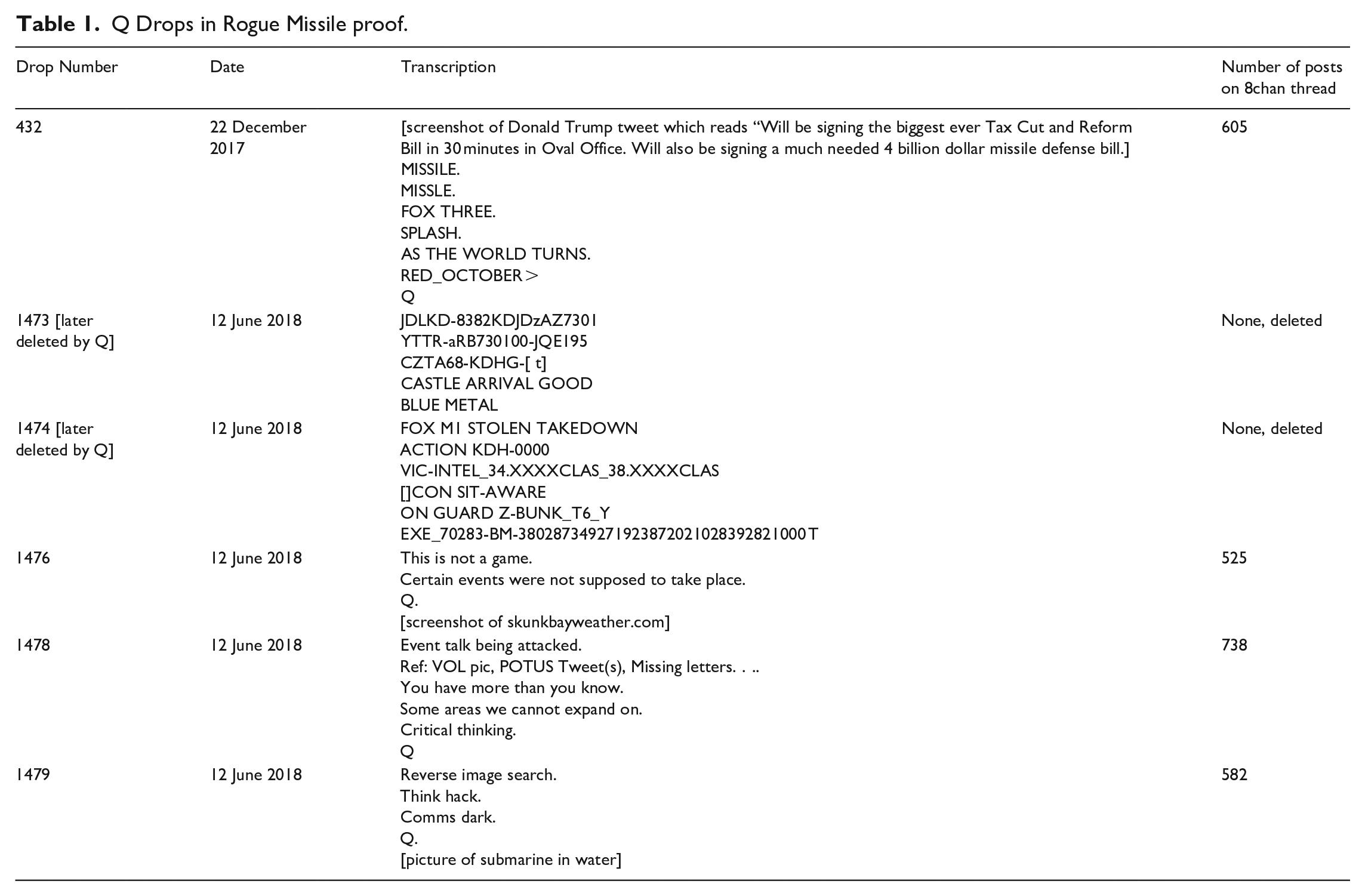
Proofs take several forms. The most common are evidence collages, which Joan Donovan and Brian Friedberg define as “compiling information from multiple sources into a single, shareable document, usually as an image” (2019: 8). Proofs also take the forms of YouTube videos and PDF documents. They are used to refute claims that the Q conspiracy is counter-evidentiary and to demonstrate the accuracy of Q’s predictions to both insiders and outsiders. The proof we analyze in-depth is an evidence collage titled “Rogue Missile Attack Intercepted” (Figure 1), which includes screenshots of six Q drops posted to 8chan (Table 1), five of which were posted on 12 June 2018, and one of which was posted on 22 December 2017.
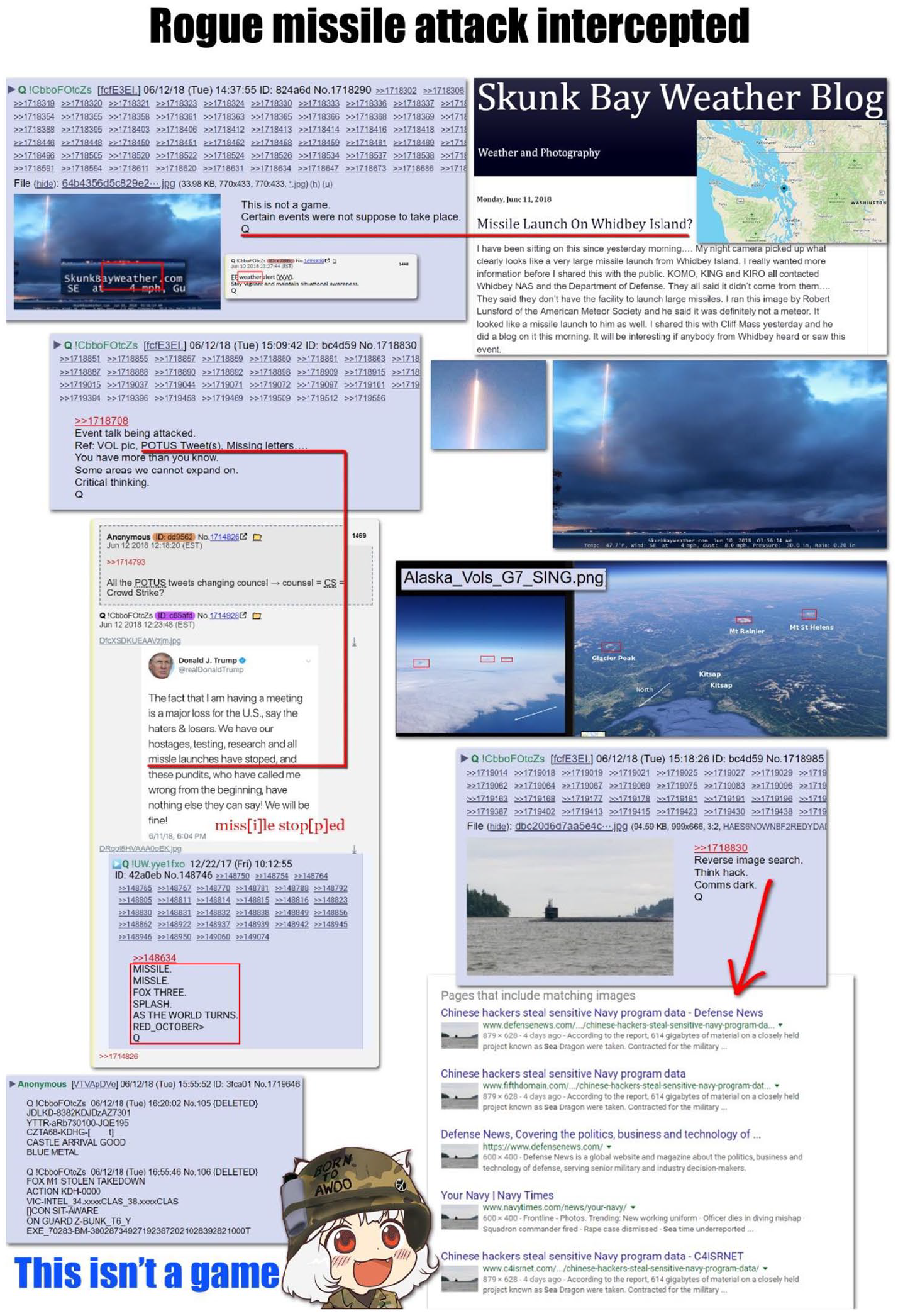
Rogue Missile attack proof.
Q Drops in Rogue Missile proof.
When Q drops a new post, Bakers immediately begin discussing and attempting to decode it. While several 8chan boards were considered the home of QResearch at the time of our fieldwork, this takes place across the social web including Twitter, YouTube, Trello, Reddit, and private Discord servers. 4 We focused on 8chan threads because they are the origin of Q drops and are meticulously archived by QAnon researchers.
Following archived discussions on 8chan can be difficult. Because 8chan allows anyone to post anonymously, the boards are full of mischief-makers who frequently derail conversations, purposefully or not. Moreover, conversations are not “threaded” in the traditional sense, with a top-level comment under which responses are organized, as on Reddit, for example. When participants respond to a post, their response appears chronologically in the thread and is linked to the original only by a numerical referent; as a result, multiple conversations exist in every forum thread and can be very difficult for untrained eyes to follow. For this proof, we analyzed 8chan threads for drops 432 and 1476–1479 for a total of 2450 posts. Q deleted drops 1473 and 1474 quickly after posting, so the community removed them from the baking archives. One Anon explained, “Since Q deleted them so fast and they even magically deleted off of Qpub 5 I think we should not spread these 2 crumbs. Clearly they were comm’d to certain people and need to not be seen by others.” 6 We use these 8chan threads to demonstrate the basic processes of baking and source evaluation in the QAnon conspiracy.
Baking, from crumbs to bread
How does a drop become a proof? Baking is an intertextual, interpretive practice and drops are intended to be decoded, implying that each proof has a hidden meaning that Bakers must work out for themselves. To understand crumbs, Bakers must consider the body of Q drops and proofs, the textual corpus of Donald Trump (tweets, speeches, and interviews, taken by the QAnon community to be inerrant), current events, and other information sources. Bakers pay close attention to the text of the drop, focusing on missing letters, alternate meanings, patterns of capitalization, and other potential clues—similar to the practices of Bible study chronicled by Tripodi (2018). Drops often include questions and unlabeled images or tell readers to “think critically,” which encourage Bakers to assemble a theory that transforms the knowable into the known.
On 8chan, whenever Q posts in an existing thread, participants drop the previous discussion and begin baking, brainstorming the post’s meaning. For example, when decoding Drop 432 (Table 1), Bakers suggested several explanations for the unusual spelling of “missle”: Could the missing “i” in missle mean “Miss Lee” the reporter/hostage “rescued” by Bill Clinton from NK? Maybe a “missle” is a “missile” that’s been taken over in-flight by an unintended party.
This early interpretive process of a drop involves brainstorming and wild guesses, so suggestions that seem particularly unlikely are often met with skepticism. As one Anon rants, The biggest problem is people use every word Q says to try to completely invent fantastic assumptions. Most of the Q map is set up as a relational database, made up of data sets that are tied together by key words and signatures. If you want to figure something that Q says out, look BACKWARD to all of Q’s previous posts. This has a much higher likelihood of finding value than random guesses pulled from your imagination.
To gain support for their interpretations, Bakers frequently substantiate their theories with images, links to videos or news articles, or intertextual references.
Bakers have constructed various best practices for interpreting drops, available in documents and ebooks written and distributed by the community. In the ebook Q: The Basics: An Introduction to Q and the Great Awakening, the anonymous author explains that Q’s “cryptically worded statements and questions” are intended to “lead anons and the public to question and research insider information about presidential strategies, policies, and events.” They explain that Q’s drops are obscure by design, as Q cannot be crystal clear for fear of violating their security clearance. Instead, readers are encouraged to engage in “open-source reporting” to “research and learn for themselves.” Similarly, The Book of Q Proofs notes that “Q’s posts are often arranged as a series of questions, where one question answers the question that was just asked before it; the questions are set up so that they imply the answer” (Anon, 2018: 19). In The QAnon Phenomenon ebook, Jay Jericho identifies four decoding methods he has witnessed on 8chan: reading Q’s drops literally; synchronization or attempting to link Q drops to real-world events; the Twitter coordination method, which compares Q drops to tweets by Trump and other political actors; and the errors method, which focuses on missing letters and numbers (2019: 24–31). As we will see, these different methods sometimes result in competing interpretations that become objects of contestation themselves.
Interpretive closure
How does this process of wild speculation coalesce into a coherent narrative? We observed several different processes by which an interpretation becomes a proof. None of these are definitive, as multiple interpretations of crumbs can and do still exist. Together, these processes shed light on how interpretive practices between Bakers transform cryptic posts into truth-claims whose facticity is (mostly) accepted.
The first and most authoritative form of interpretive closure is Q’s own verification of an explanation. For example, drop 432 (Table 1) contains the word “splash,” which also appeared in drop 365, posted just a few days prior on 18 December 2017. Shortly after Q posted drop 365, Bakers brainstormed explanations for the word’s repetition, such as “the movie Splash has that actor Tom Hanks in it,” which did not garner much support. Another participant, seemingly copying and pasting from an Air Force glossary page, replied, Splash = Missile time of flight is expired or missile destroyed; target or bomb impact. Fox Three = Simulated/actual launch of active radar-guided missile
Q replied to this post, verifying it, and thus superseding other proposals and making “splash” and “Fox Three” definitive. 7 This is evident since it is referenced not only in the thread for drop 432, but in innumerable future proofs, on Twitter, and in several Medium posts translating the drop. More commonly, though, Q offers no clarification. When Bakers asked if the missing “D” in drop 1476’s “suppose[d]” (Table 1) was significant, Q replied that it was but did not explain further. Anons suggest that D might stand for Democrats, Defense, the programming language D, or “D-Day,” but no single interpretation was confirmed by Q.
Another form of interpretive closure exists within each 8chan thread, as certain posts are called out as “notable” (Figure 2). These posts are picked by the thread moderator, who posts prospective notables to the thread for community feedback. 8 Notables are supposedly a way to separate the wheat from the chaff and call out useful, informative, or interesting posts. In practice, notables range widely in quality, from posted news articles and new evidence collages to unsubstantiated theories. Notables are then archived in a variety of places, and recent notables appear at the top of each new 8chan thread. 9 When formulating theories, Bakers frequently draw from notables rather than returning to the crowded, confusing original 8chan threads. By being selected for inclusion in notables, one interpretation is valued over another and is more likely to be taken up in future interpretive work.
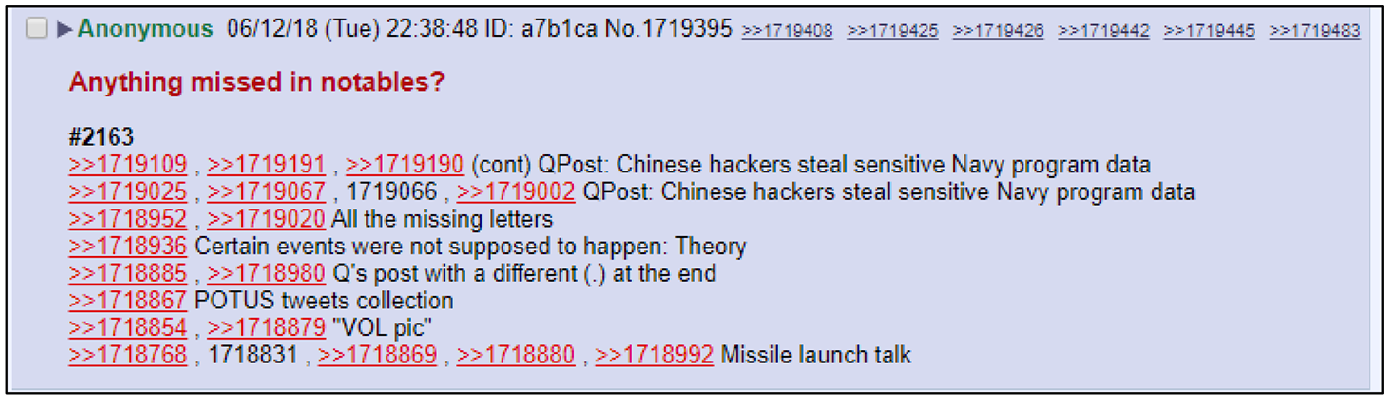
Notables.
Finally, interpretive closure takes place when a Baker creates a proof, YouTube video, Twitter thread, or evidence collage. Such authors have a great deal of leeway in selecting and combining evidence. For example, although Q confirmed the meaning of “splash,” this discussion is missing from the evidence collage for the Rogue Missile attack (Figure 1), although drops 1473 and 1474—deleted by Q and removed from many other archives—remain. As Donovan and Friedberg explain, the evidence collage format allows conspiracy theorists to combine “verified and unverified information,” choosing “which sources to highlight or obscure” and leading “audiences through guided pathways of information,” encouraging viewers to adopt the author’s point of view and experience interpretation for themselves (2019: 26). Evidence collages thus allow Anons to freeze the interpretive process and privilege their preferred reading. In other cases, YouTube channels like the “Citizen’s Investigative Report” or “Patriot’s Soapbox” will walk viewers through each drop, drawing from 8chan to highlight particular explanations. Multiple interpretations of each drop can and do exist in the world of Q. This is recognized by Bakers, one of whom noted that “Many Q posts have several correct interpretations that fit.”
This is supported when comparing interpretations of drop 432 from three sources: the Book of Q Proofs, a previously mentioned 609-page PDF which decodes each drop; the QAnon.pub proof database; and a spreadsheet we found linked on 8chan. All use the Q-verified interpretation of drop 432 (“fox three” as missile launch and “splash” for a destroyed missile) but otherwise disagree on its significance. The Book of Q Proofs suggests that 432 refers to a ballistic missile launched from Seattle to Singapore during a meeting between Trump and Kim Jong Un, while the spreadsheet argues that it refers to an unsuccessful North Korean attack on an Argentine sub. Moreover, because 432 was posted 6 months before the other drops in Figure 1, it appears in earlier proofs, such as an evidence collage found at Qproofs.com which speculates that the NSA prevented the deep state from launching a missile attack on Hawaii. While all these proofs appear on community archives, they do not demonstrate consensus. Interpretations also change as Q provides new information or the political situation shifts. Theories are never considered fully “closed” unless they are confirmed by Q.
Discussion: “if you’re not going to do the research, then shut the f#(k up”
While conspiracy theorists are often imagined as gullible people who will accept anything, our findings complicate this assessment. Rather, Q adherents demonstrated wide-ranging knowledge about current and past events, questioned the legitimacy of sources or the conclusions that other participants came to, and, above all, admonished others to “do the research” or “think critically”—messages that frequently appear in appeals to media literacy. (As one meme shared in a QAnon Facebook group put it, “if you’re not going to do the research, then shut the f#(k up.”)) Although Bakers’ research often led them to outlandish and counterfactual conclusions, their knowledge-making practices lend systematicity and, ultimately, authority to their findings, if only to other Bakers. Our point is not to legitimate these as equally valid ways of knowing, but to establish that there is an internal logic to QAnon that runs in parallel to many knowledge-making practices in more “legitimate” institutions, like universities and thinktanks. We focus on three: archiving, source evaluation, and expertise.
Archiving and canon-building
Bakers facilitated knowledge-making using a wide range of documentary and archival practices. They expended considerable effort in creating searchable and accessible databases of information deemed to be relevant. This included relational databases of primary evidence (posts by Q and tweets by Trump), such as QProofs.com, Qanon.pub, and QMap.pub, which neatly organized thousands of pieces of “evidence” for Bakers’ use. We also found carefully curated Google Drives, Dropbox folders, and spreadsheets of pertinent reference material, such as FAA incident logs, S1 filings, and noteworthy deaths. Such collections were intended for Bakers to explore the broader context around a specific drop or Tweet, enabling easy linkages between otherwise disparate events. Bakers methodically archived many of their completed proofs, from downloadable pdfs and eBooks to meticulously edited YouTube videos.
By and large, the Bakers who created such documents were fastidious in their citational approach and exhibited great dedication to maintaining these sites, updating existing databases, and adding new ones. Although some Bakers attempted to turn a profit on their creations, most materials were freely accessible. That said, some archives were better resourced and maintained than others and Bakers did not consider any single archive to be authoritative. This material not only facilitated the smooth functioning of baking but enabled Bakers to position their knowledge-making practices as “research.” By echoing more formal research techniques even as they adapted them to sensational ends, Bakers not only constructed a social reality in which their most lurid conspiracies were plausible, but granted themselves epistemic authority due to the systematicity of their approach to knowledge-making.
Bakers have constructed what fans and fan studies scholars alike call a “canon,” a term that nods to both the “great books” of high culture (the “Western Canon”) and the Christian term for definitive New Testament texts. While posts by Q and Trump were treated as unimpeachable primary texts, many other texts were considered relevant to the interlocking textual and interpretive architecture of QAnon, such as S1 filings that could reveal the financial interests of the wealthy or FAA incident logs that might contain “unexplained” deaths. Likewise, as discussed, a few interpretations could be canonized by a direct acknowledgment from Q. Thus, the textual basis for QAnon contains official interpretations and considerable supplementary materials that represent competing but nonauthoritative interpretations of the primary evidence.
Between their archival work and the construction of a canon, we argue that Bakers exhibit strong parallels to the kinds of literacy that emerge in fan communities, especially those that primarily exist online. Like fan theories about what television episodes mean, such practices are both a performance of knowledge about a given franchise and a collective-act of sense-making built around shared readings of primary texts that enable a community to cohere across space and time. Unlike most fan communities, QAnon is primarily concerned not just with American partisan politics, but actively shaping their direction. QAnon also demonstrates “scriptural inference” (Tripodi, 2018), both in its close engagement with primary sources and acceptance of Q and Trump texts as scripture-like: inerrant and requiring scrutiny to reveal a hidden meaning. Because QAnon communities are conservative and frequently reference Christianity, it is likely that their media literacy practices are rooted in the Bible study practices documented by Tripodi.
Source evaluation
Bakers engage in complex forms of source evaluation on primary and secondary texts. In addition to canon, proofs mostly cite right-leaning sources, such as Breitbart and The Gateway Pundit, although we also noticed mainstream media sources like ABC News, Bloomberg, CNBC, The Atlantic, and USA Today. The four threads we analyzed included links to the Daily Mail, Business Insider, the Daily Caller, Wikipedia, TruePundit.com, The Japan Times, and others; tweets from political actors such as former CIA director John Brennan; links to Google Maps; Google search results; and Bible verses. This is in line with Bakers’ best practice. As an 8chan meme featuring a still from the Will Ferrell movie “Anchorman” reads, “Anons: If your post is not fact based and it does not include sources, it is just a DISTRACTION!!!!”
In some cases, Bakers rejected a source as outrageous or unreliable. For example, drop 1476 includes a picture taken from skunkbayweather.com. Several Bakers point out that the same picture was tweeted earlier in the day by @kabamur_taygeta, whose bio identifies him as a “Patriot, Light Warrior, Sharing News And Information From The Pleiadian Collective.” (Belief in Pleiadians, a humanoid alien race, is associated with various new-age communities online.) Kabamur explains that the light source is “a beam projector that is isolating the exact location of a massive underground crystal base transmitter . . . It is being shot from beneath the ground and straight to a Pleiadian Craft where it is being controlled.” 10 Others are quick to discredit this theory, labeling him a “disinfo operative” and stating “Kabamur puts out fake disinfo narrative on behalf of clowns.” 11 In other cases, a source is criticized for being too liberal (Vice) or too fringe (a link to ITCCS, a blog maintained by conspiracy theorist Kevin Annett, is dismissed with “the article didn’t provide any evidence for its claims. When did things automatically become true just because they are posted here?”).
Expertise
The interpretive and archival practices exhibited by Bakers in their discussions, proofs, and archives illustrate not only the systematicity of knowledge-making among Anons, but the skills that Bakers use during these processes. We label such practices populist expertise: the rejection of legacy media accounts, scientific consensus, or knowledge decried as “elite” in favor of a “home-grown” body of information generated and validated by those who may feel disenfranchised from mainstream political participation.
This seemingly paradoxical concept is intended to resolve a contradiction in how current understandings of populism address expertise. Although populism is sometimes thought to be defined in part by its hostility to experts, our findings suggest that this is only partially true. Rather, QAnon Bakers build their own form of populist expertise that is more amenable to the sensational conspiracies the group is known for. In this sense, what Anons oppose is not expertise as such, but the normative version of expertise identified with academia, civil society, and the “Deep State.” Bakers illustrate an acute hostility to this normative view of expertise that may present itself as ideologically neutral but is (fairly or not) thought to be a thin scrim for globalist and progressive claims.
These competing understandings of expertise demonstrate an important lesson about its ideological ambivalence. Expertise does not have an ideological telos but is negotiated ideologically. When populism is described as “anti-expertise,” it relies on a normative definition of expertise associated with science, the academy, and government. Yet this elision hides a normative claim behind a specious, natural one. Our findings show that expertise can be made, performed, and legitimated in a community of practice bound by its adherence to QAnon as a political project. Rather than rejecting expertise, Bakers attempt to claim the imprimatur of expertise by defining and performing it in such a way that it aligns with their broader ideological goals.
Conclusion: QAnon as participatory culture
As university-based researchers, we are in many ways aligned with the normative view of expertise decried by QAnon Bakers. However, we see expertise not as self-evident but defined and conceptualized within communities of practice. Indeed, many of the terms that appear throughout our analysis, from source evaluation to archiving to literacy, are highly ambivalent, and we should be wary of associating them with specific political purposes. Rather than positioning such terms as inherently good (perhaps with “dark” counterparts) or natural, we encourage researchers to consider how such terms are themselves subject to ideological negotiation. Media literacy, for example, cannot be used to distinguish between “progressive” and “conservative” mainstream media when conservative forms of media literacy draw on fundamentally different epistemological assumptions than elite forms of expertise (boyd, 2018).
We return to Jenkins’ definition of a participatory culture as one that exhibits “low barriers to artistic expression and civic engagement,” provides “strong support for creating and sharing one’s creations” and “some type of informal mentorship,” and creates social connections and meaning for its participants (2006). These are all present in QAnon. In addition to the shared interpretive practices that guide Bakers’ knowledge-making activities, Bakers encouraged each other to create their own media, including evidence collages, books, and videos. The community welcomes newcomers and maintains introductory documents to orient newbies to the dense conspiracy. Forms of “legitimate peripheral participation,” such as volunteering to moderate threads, curate notables, or post interpretations of crumbs, enable potentially interested individuals to be socialized into QAnon as a community of practice. And while most of the discussion on 8chan is political in nature, Anons do support each other. For instance, in one 8chan thread, an Anon posted that they are newly sober, miserable, and thinking of killing themselves. This post garnered 33 responses, including personal experiences with sobriety, prayers, and supportive messages. More frequently, Anons will praise each other’s contributions or build on information provided by others. Collectively, QAnon can be understood as a participatory culture that demonstrates the creative and supportive aspects of participatory communities while espousing anti-democratic and anti-institutional ideals. This calls into question the unerringly positive framing of participation, and its counterpart of dark participation.
Our research also shows the centrality of “doing your own research” to QAnon, a quality it has in common with other fringe cultures, from antivaxxers to flat earthers. Bakers prize research and close textual interpretation, or “scriptural inference” (Tripodi, 2018), undermining assumptions that media literacy or fact-checking are effective counters to the spread of misinformation. Rather, in drawing on scriptural inference, we emphasize that these practices, along with the knowledge they produce, legitimize and make rational what might otherwise seem counterfactual. This has significant implications for understanding not only conspiracy theories, but partisan “echo chambers” in which consensus and even truth-claims themselves are increasingly polarized.
Footnotes
Acknowledgements
The authors would like to thank the participants of Data & Society’s Contested Data Academic Workshop, the QAnonference, the Association of Internet Researchers Annual Conference, Adrienne Shaw, Torin Monahan, and the anonymous reviewers for for valuable feedback on earlier versions of this paper.
Funding
The author(s) disclosed receipt of the following financial support for the research, authorship, and/or publication of this article: This research was supported with monies from the John S. and James L. Knight Foundation, the Andrew Carnegie Fellows Program, and the Institute for Arts and Humanities at University of North Carolina at Chapel Hill.
