




Abstract
This article explores strategies and practices of approximation to cope with needs of pregnancy and maternity in the locked-down home at a distinct point in time – the earliest lockdown in the course of the COVID-19 pandemic in the United Kingdom, where, disruption of in-person support, both formally and informally, had implications for new mothers, babies and families. Amid a turn to digital for mental health and related support, it appears, unsurprisingly from the fieldwork, that despite many benefits, the role of technology in this context has been complex, as contexts of use, maternal practices, literacies and the nature of perinatal support required deeply shaped the role technology played amid blanket lockdown restrictions. I explore attempts to ‘approximate’ in-person ties within the confines of mandatorily digitally mediated interactions by paying attention to the fatigue, materialities and unsettlement of approximation.
This paper explores strategies and practises of approximation to cope with needs of pregnancy and maternity in the locked-down home at a distinct point in time – the earliest lockdown in the course of the pandemic in the UK, where, disruption of in-person support, both formally and informally, had implications for new mothers, babies and families (Edwards and Timmons, 2009; Knight, 2020). Amidst a turn to digital for mental health and related support, it appears, unsurprisingly from the fieldwork, that despite many benefits, the role of technology in this context has been complex, as contexts of use, maternal practices, literacies, and the nature of perinatal support required deeply shaped the role technology played amidst blanket lockdown restrictions.
In the context of the United Kingdom – where this research was based – even outside of the pandemic – many new mothers do not find support (Taylor et al., 2019) when Health Visiting services are struggling owing to public funding cuts. COVID-19 stood to impact perinatal mental health significantly as the pandemic heightened pressures across the board during pregnancy and maternity by bringing higher socio-economic risks for women, exacerbated psycho-social risks, maternal isolation, halted routine contact with health care professionals and familial/peer networks, relationship stresses, and heightened maternal anxiety (cf. Das, 2021). COVID-19 and its broader socio-economic impacts, social distancing measures and changes to ante-natal and post-natal support services looked likely to impact maternal mental health perinatally (before and after childbirth) with short and long-term risks for women, babies and families. In addition, such impacts in pregnancy and maternity was always likely to be experienced differently across communities, as evidence already exists that mothers from vulnerable groups and minority communities are at greater risk of poor mental health perinatally (Afolabi et al., 2020; Das and Beszlag, 2021; Firth and Haith-Cooper, 2018). During the first UK lockdown, a rapid digital pivot began, with numerous perinatal services moving ante-natal classes and parent and baby groups fully online at speed. These became a much-needed lifeline for many, who, under conditions of COVID-19, were impacted disproportionately by social distancing measures. Key sources of social support perinatally – including parent and baby groups, feeding support groups, sling libraries, playgroups, drop-in clinics, as well as opportunities to meet friends and families to find practical and emotional support in the post-natal period – suddenly halted under COVID-19 and then continued to face local and national, longer- and shorter-term disruptions as the pandemic progressed. At the time of fieldwork, during the first and strictest lockdown in the United Kingdom, the vast majority of perinatal support services began to either halt or move online in some form. These joined an array of existing digital connections for those new mothers and pregnant women who were usually digitally connected to various friend and family networks anyway. A combination of online forums, online support and discussion groups, phone-call support and a variety of online drop-ins began emerging as part of the response to COVID-19 impacts perinatally.
Conceptualising approximation
While this article considers the case study of a specific moment in time, for a specific sub-set of experiences – that is – pregnancy, birth and maternity during the pandemic – the focus lies here on the textures, work and outcomes of the mandatory digital turn within the locked-down home, and how women worked to approximate in-person connections through the digital pivot. Despite its temporal and substantial specificities, the notion of approximation draws our attention to a key and fundamental facet of the digital default – an imperative to replicate and approximate the offline, and the production and maintenance of a range of strategies to do so. In what follows, I address approximation by paying attention to the plethora of recent, multi-disciplinary scholarship (cf. Dempsey, 2021; Grozman, 2021; Yoon and Leem, 2021), where scholars have researched the mimicking, approximating, or replicating of offline and in-person experiences and interaction with the unexpected and default turn to the digital that the pandemic brought about. I note that this work has productive roots within communications scholarship about technology use and non-use (cf. Syvertsen, 2020) in the home and mediated interpersonal relationships (cf. Baym, 2010; Miller and Madianou, 2012 among others) as a productive arena to engage when thinking about these attempts to approximate.
Over the unfolding course of the pandemic, scholars (cf. Dempsey, 2021; Grozman, 2021; Yoon and Leem, 2021) have considered the ‘replicating’ and ‘mimicking’ aspects of the unanticipated swivel to digital under conditions of lockdown. Dempsey (2021) notes, for instance, the variety of ways in which offline activities were reproduced online, during lockdown, in an attempt to maintain intimacies and connections. Grozman’s (2021) digital ethnographic work on the pandemic outlines, similarly, how video-streaming and online activities were made use of, to replace offline meet-ups and activities which were prohibited under conditions of lockdown. Likewise, recent work (cf. Mpungose, 2021), extending research on digital disconnection (cf. Syvertsen, 2020), is considering the pandemic articulations of digital fatigue, as the migration of the offline into the online continues to a heightened degree. These sit against the backdrop of prior strands of scholarship (cf. Wagler and Hanus, 2018) which have looked at platforms and their affordances, and the ways in which these shape, allow, or restrain the mimicking or replicating of offline interactions and experiences. In digital education studies, for instance, scholarship on virtual learning platforms and environments has considered these facets (cf. Jones and Cooke, 2006), as also within religion studies (see Hutchings, 2012, on online churches, for instance) or studies of online communities (Hjorth, 2007). Often across these fields, the focus lies on the design of the platform itself and the social functions these might seek to emulate and reproduce in their interfaces with users, or within the discursive practices arising within communities meeting primarily online. Long histories of research in cyberculture and digital literacies (Dudfield, 1999), and in gamification (Lampe, 2014), have often also considered the replicability between offline and online, with granular attention to the user-technology interface, going beyond replicability in numerous instances, and looking at how these interactions broaden people’s repertories and practice (Byron, 2017).
This attention to replication or mimicking between the online and offline, both during and before the pandemic, stands against a long-standing background within communication studies. Early sociological studies of the Internet, for instance (cf. Haythornthwaite, 2002; Wellman et al., 1996), showed discussions of computer-mediated communications in terms of its cues (whether reduced or decreased, for instance, in comparison to in-person communication), or whether these reduced-cues communicative exchanges might be interpreted or considered (see Baym, 2015), to be inferior to face-to-face communication. Over time, scholarship has split between finding that digitally mediated ties bring positive or negative consequences (White and Dorman, 2001), while significant evidence has accumulated on a variety of productive and warm friendships, trust, mutual support and intimacy derived from online interactions (Amichai-Hamburger and Furnham, 2007; Wellman and Giulia, 1999), including the production and reception of emotional support and empathy (cf. Caplan and Turner, 2007).
But fundamentally, scholarship in communications (cf. Baym, 2015; boyd, 2014; Mendelson and Papacharissi, 2010) has now long evidenced that online ties and interpersonal interactions do not replace, or become a like-for-like replacement for offline interactions and neither is tenable to consider these to be distinct, watertight categories. While this is doubtless the case, the specific social conditions of the pandemic lockdown erected trackable and traceable watertight divides between the offline and the online. Suddenly, and unexpectedly, boundaries between the offline and online – which are widely evidenced to be fluid and inseparable – were demarcated, in 24/7 news, formats, services and interpersonal interactions to be separate, and needing to be kept separate with very high stakes attached to such separation, both at the individual and at the communal and public level. We then need to consider the nuance of this mediated social moment, where, despite the fluidity and the inseparability of the offline and the online, the distinction accorded to the online at this specific point in time, in terms of the near-absolute absence of the tracked-and-traced offline, and the conversion of near everything to digital pathways, meant that a degree of separability and non-fluid rigidity between the offline and the online emerged within the locked-down home, which beckoned attention to people’s social ties and interactions at this specific moment.
Scholarship has shown us how seamlessly, for instance, online social ties often migrate offline (Baym, 2015) and how components of relationships largely maintained in-person show significant amounts of online facets. And yet, at the specific social moment of the pandemic, such migrations were forbidden. Miller and Madianou’s (2012) conceptualisation of polymedia is instructive in this context, as they beckon our attention to the broad array of mediated interactions and relationships, including the ethical, emotional and moral choices made in sustaining communication across an entire mediasphere as a connected whole, bringing our focus on to, for instance, familial relationship maintenance, over distance and time. Research on mediated intimacies (Andreassen et al., 2017), in this context, provides instructive insights on kinship (Andreassen, 2017) and friendship ties, and the blending of the offline and the online in people’s negotiations of support provision and reception, or in disclosing themselves (Chambers, 2013). I suggest that the very specific conditions of the unexpectedly locked-down home, and the mandatorily digital nature of interpersonal sustenance during the pandemic, beckons both attention towards the sub-fields I have indicated here and yet, also, attention towards the unprecedented rigidity and traceable boundary-erection between the in-person and the digital which occurred at this specific mediated moment. My attention in this article, to approximation, considers the space between the in-person and the digital, in their suddenly and obligatorily kept-apart new forms.
Methods
This article speaks from a qualitative project with 14 pregnant women and new mothers, conducted during May 2020. The project investigated the disproportionate impacts of the pandemic and resultant social distancing and lockdown measures on perinatal mental health, and the role, efficacy and nuances of formal and informal digital support at such a time. I set out by asking, In what ways was this mandatorily digital turn altering the texture of life in the locked-down home as these women went through the turbulence of birth and beyond? What were the unseen costs of this digital turn and where these the same for everybody? What approximation of usually offline formal and informal connections emerged in the obligatory turn to online and what sort of work did this approximation beckon ? This article considers some of these questions by turning its attention to the lived realities of the unexpectedly mandatory digital turn in the locked-down home, paying attention to mundane, everyday and perhaps even banal attempts by participants to approximate offline and in-person connections within the parameters of the digital default.
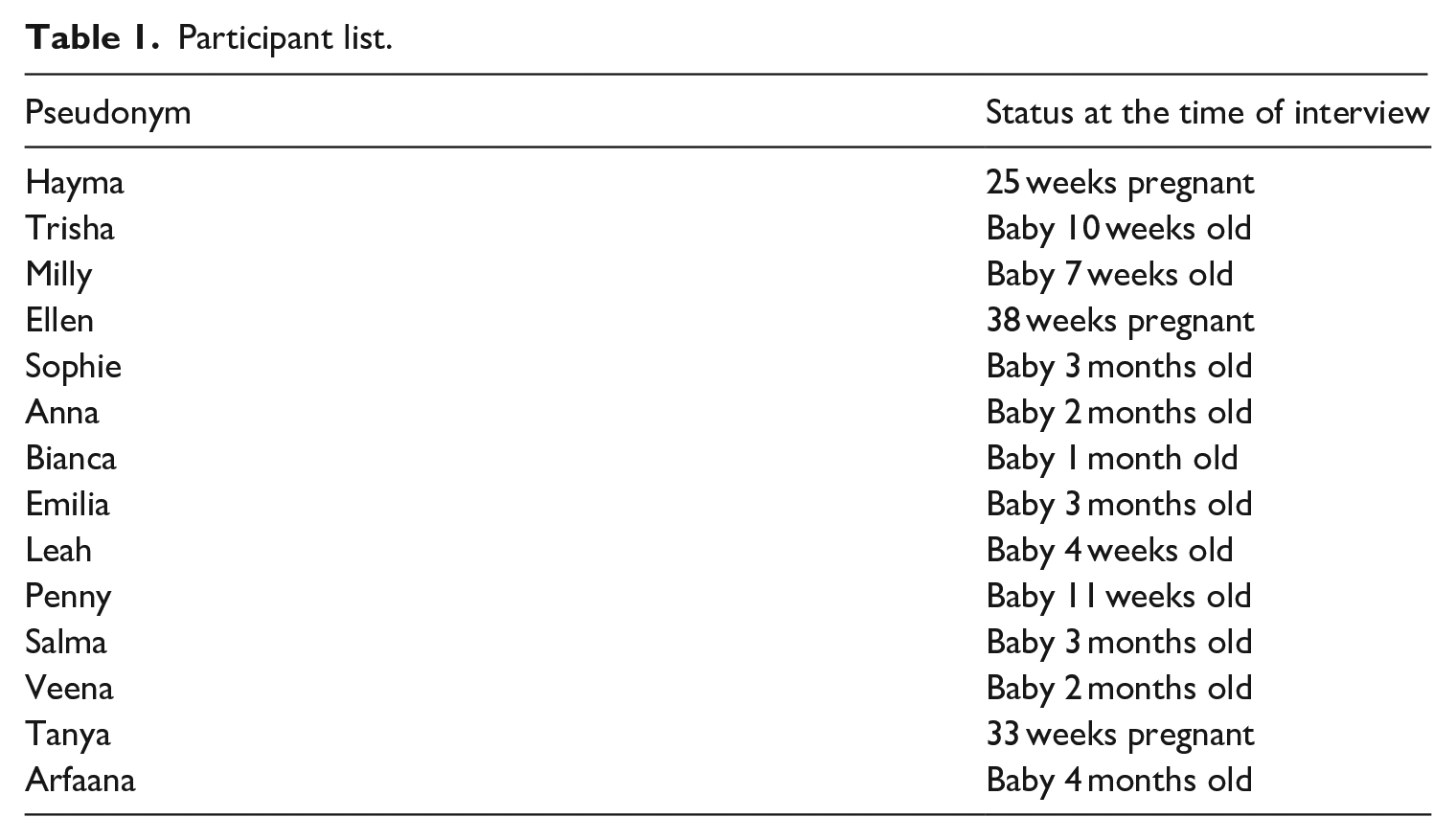
Participants were recruited by advertising the project on social media, and the definition of perinatal mental health difficulties was on purpose left open, so as to not exclude those without formal diagnoses. At a time when many fall through the net in terms of receiving formal diagnosis, but particularly at a time when a pandemic had stretched the health services to the hilt leading to perinatal women not being able to access even routine support without significant changes, keeping this fluidity built into the recruitment made space for women to volunteer to participate freely. The response to the recruitment call on social media was notably high, and close to three times an amount of interest was received compared to the spaces available, within just a few days of launching the call. This facet of recruitment deserves specific note, as a high number of perinatal women identified with the call for recruitment and felt that their experiences aligned enough with the call, to speak to the researcher while caring for very small infants amid a pandemic. Three of the 14 participants were in their third trimester of pregnancy, 11 had a very small baby, with babies aged between 4 weeks and 4 months. Four participants came from South Asian backgrounds and all 14 came across a wide diversity of regions in England. Six of the 14 had diagnosed mental health difficulties. There was wide variation in accessing digital support – some were significantly unaware of sources of online support, others using informal connections, some being supported extensively, remotely, by perinatal mental health services.
Participants were interviewed online using a semi-structured interview guide and conversations involved free-flowing discussions with the interviewer who was herself open about the fact that she too had a small baby during the pandemic and lockdown and on occasion, identified with the challenges these women were facing. All participants were assigned pseudonyms, the data transcribed professionally and coded using a combination of qualitative data analysis software and pen-and-paper coding. Participants were given a small token of thanks using an online shopping voucher. The study received the clearance of a Favourable Ethical Opinion (EGA Ref No: FASS 19-20 036 EGA) from the University of Surrey ethics committee. A list of participants and their perinatal status at the time of the interviews is given in Table 1. Analysis was thematic and immersive – the researcher used pen and paper, and read the transcripts repeatedly to identify themes arising in an iterative manner. While qualitative data analyses software (NVivo) was used for the purposes of recording and coding data into broad categories, the pen-and-paper immersion was the primary method of analysis.
Participant list.
Findings
In what follows, I step away from any attempt to understand whether the sudden pivot to the digital was either positive or negative for my participants who were about to give birth or were coping with the turbulence of a new birth within their household, but rather shift my focus to the contexts, nature and consequences of the digital interactions that did emerge within the contexts of their locked-down home. My focus, particularly, is on an overarching desire I noted during the fieldwork, amongst participants, for this sudden pivot to online interactions, to somehow approximate the offline. In my findings, I pay attention to what this meant in practice, in terms of the textures of these women’s daily lives, the labour it involved and the unsettlement that run through these attempts to approximate.
The textures of approximation
In this section, I reflect on the everyday, practical alterations which had occurred to the textures of life with a new baby or an upcoming birth to not only accommodate a default and sudden turn towards the digital but also to normalise this default to become as close as possible to in-person experiences. The texture terminology here is significant – for it draws attention to the granularity of some of these changes, and the coarseness and roughness of how these alterations felt in the journey to approximate in-person contact through digital means.
A few spoke of material alterations to the way their home space is configured to embrace the digital in a way which satisfies that need for contact. Some had installed webcams in their lounges as opposed to using phone or laptop cameras for family and friend chats, to enable a feeling of ‘hanging out’ (Ito, 2013) and having coffee during video calls. Not having to hold a phone, and enabling a wide angle view of their whole room and walking around rocking a baby, or getting a cup of tea added, for them, degrees of authenticity to a digitally mediated video call in a way that enabled that additional modicum of human contact. Sophie, who has modified her lounge in such a way, speaks of the value of ‘hanging out’ in such a way with her Church group (see also Hutchings, 2012) and became a lifeline of support during the lockdown: We have . . . we’re part of a church community, so we have obviously a church kind of Zoom call on a Sunday morning, and then one evening a week we sort of Zoom in with people. And I find that quite useful because we have I think lots of doctors in the group, lots of . . . lots of key workers, and so actually in that group, we’re some of the most vulnerable people, and so there’s lots of people there who it’s really refreshing for us to hear . . . hear what they’re going through as well, so it doesn’t trap us in a little bubble.
Quite a few participants, like Sophie above, alluded to the metaphor of hanging out to describe these default digital interactions replicating suddenly and in an unexpected and unprecedented way, mother and baby coffee mornings or mother and baby yoga sessions, for example. But hanging out, digitally, necessitated a range of alterations to the ways in which a screen was used or held or positioned close to a baby’s cot or near mother in her living room that bore testimony to how the texture of everyday life around the screen had needed altering for this hanging out to occur.
But, hanging out – in its approximated version – was also something keenly sought in relationships where forced distance had kept families apart. Ellen, who like many mothers, found herself separated from her family of origin, in this case on a different continent, found the desire for approximating in-personness located thousands of miles away, where grandparents had never met their new grandchild, and conversations began about positioning of a webcam and the introduction of a live webcam feed for extended family to be able to experience their newborn grandchild’s everyday routines in close proximity. Ellen said, we’ve talked about sort of setting up like a webcam where my parents and my sister can just sort of check in and out, you know see what the baby’s up to . . . It’s just . . . no, I don’t actually know . . . I guess there are some . . . there are some . . . what are they called . . . baby monitors, and you obviously have to be very careful about the privacy issues . . . I mean I don’t know, I’m not sure I’m 100% comfortable with that . . . Well it’s sort of . . . I’m not sure how . . . I’d have to think more carefully about how much my parents would get out of that, just you know is it really worth it for probably just checking in to see a sleeping infant most of the time!
For Ellen, who, at the time of the interview, was heavily pregnant, this planned textural alteration of the material spaces around the baby’s cot, to mimic and approximate in-personness, appeared to put her in a bind. On one hand, she did not want this textural adjustment because it would entail a sense of being watched for extensive periods of time, bringing with it an array of privacy concerns. On the other hand, she deeply missed her parents and her family and longed to go back and see them, and in such a context, she wanted to cultivate through digital means the relationships between grandparents and their new and unknown grandchild. So textural alterations to the materiality of the home in lockdown to create and maintain mediated relationships were not always smooth alterations and brought with them a degree of roughness and coarseness as people negotiated the new norms of relationship maintenance through digital means.
The imperative for in-personness also meant a sudden, pivotal set of changes to the textures of time and routine in the locked-down home. For Arfaana, this meant a heightened relationship with her smart phone, where receiving funny TikTok videos from her partner working at a supermarket meant a significant amount, as she was isolated at home all day. But the importance of and the always-on nature of the TikTok video exchange emerged within the context of a highly isolated and cut-off life with an infant, where a broader and surveillant set of extended family members had warned her against taking even a daily walk with her baby in a pram, to protect the infant from the virus (see also Afolabi et al., 2020; Das and Beszlag, 2021; Firth and Haith-Cooper, 2018). But even in less intense contexts of isolation, online versions of offline activities such as coffee mornings, baby massage classes or yoga, were, in some cases, increasingly punctuating the flow of time and routine in the locked-down home (see Dempsey, 2021; Grozman, 2021). Anna noted, We just ended up saying, oh is anyone free to do a coffee morning, it would be really good to see you all and it just . . . someone posted a link and we all just went on there and we talked about the babies and about what they were doing and they’re all . . . all the babies were on the screen and it was so lovely just to see people, different people . . . And again, that has kind of boosted, it kind of set me up for the day, kind of like, OK, now I’ve seen people I can do this, I’ve got . . . they’re doing well, I’m doing well. And you know that’s made a really big difference? . . .
It is worth noting that these replicated online connections existed in this case because the offline rapports underneath them pre-dated the online replications. In another case – even with the aid of a People Nearby Application designed to bring local mothers together – Trisha avoided online activities like coffee mornings because she did not wish to invest in connections which might not be local, and accommodating of walks or coffees together in the local area. The importance of local ties thus emerged to be really key – Trisha cited the example of MUSH to argue that digital contacts were only worth establishing if these would also become offline contacts suitable to have coffees with, once things returned to normal.
At a social moment, when offline contact was traced, tracked, ceased and suspended, online contact, in order to approximate the feel, quantity and quality of these suspended interactions, increased and heightened to an extent that the texture of the day, and the night, became more digitally punctuated than ever before. Milly noticed, This whole Zoom thing that’s whizzed into our lives is generally what’s happening is just lots of touching base as and when we can, and just trying to arrange things. To start with I think that an odd Whatsapp was satisfactory and worked quite well, and I think now that we’re all really craving human contact, I think that more things are happening on a . . . let’s plan to do something tonight, let’s have a drink and you know have a chat over Skype or whatever.
In the following section, I pick up on this heightening and compulsory digital punctuation of time and routine in the locked-down home, to consider the fatigue, labour and exhaustion involved in this textural shift necessitated by the need to approximate the offline, in online pursuits (see here Mpungose, 2021).
The exhaustion of approximation
Picking up from the findings around textural shifts within the locked-down home, not only in terms of routines and time, but also in terms of spaces within the home, in this section, I consider findings around the consequences of these textural shifts and reflect on the fatigue labour and exhaustion that this shift demanded from women who were either about to give birth or had just been through the ordeal of giving birth, without a support network around them, unexpectedly, at an unprecedented social moment. For Bianca, it meant that her everyday life was punctuated with numerous online contacts across diverse platforms with family (cf. Miller and Madianou, 2012), so much that she often ended up missing a few calls: I speak to my mum every day, I text my dad quite a lot and speak to him and Facetime and stuff. I speak to my husband’s . . . my in-laws on Whatsapp and Facetime if every day, if not every other day . . . just to try and keep up with everybody and trying to make sure that nobody misses out on [baby] but obviously ? . . . So videos, yeah, so I’ll take like videos of her all the time and lots of photographs.
The emotion work that lies behind this constant digital maintenance of rapports and relationships came up not just for Bianca, but for numerous others, and they partly beckon our attention to the obligatory turn to the digital, and the textural alterations I have discussed till now, but they also draw to our attention the gendered nature of much of this work, where the onus of maintaining the practicalities of long-distance communication and relationship maintenance between compulsorily kept-apart relatives was on Bianca herself. Ellen, who was surprised that she is enjoying her informal online group contact, draws attention to how the relentless uncertainty of the pandemic might be manufacturing conditions where such avenues of support might be becoming more useful than in usual times: I do and I find that I suppose a little bit surprising just because I don’t normally participate in a lot of these groups with you know, with people I don’t know, but there’s so much uncertainty . . . the thing is there’s so much uncertainty at the moment, and I feel like I’ve got just very little concrete to hold on to, in terms of you know we just don’t know how anything is going to go!
Bianca, who spoke of the inability to fill up a baby book, has been using her phone to generate a timeline of photos to make up for missed memories for wider family, taking upon herself an added task of ensuring wider family are okay and do not feel too on the outside of life with a newborn. She said, I’ll Facetime her to like parents and things like that. And . . . yeah, those sorts of things really and just, yeah, trying to document as much as I can so that at least people have got something to look at as well, because I think grandparents are really upset as well.
In some senses here, the digital is both a boon in that she is able to keep up contact thus, and make these memories, but on the other, many spoke of the expectation of constant contact and streams of photos to manage and support the emotions of families now distanced (see again, Miller and Madianou’s, 2012, account of distanced families) as an added task. The imperative to do more online, by default now, is felt as exhaustion and fatigue (cf. Syvertsen, 2020) by Sophie, particularly when forcefully aiming to replicate offline activities like quizzes, in an online version. Under conditions of lockdown, she also felt she had no excuses to give to not take part in such things. She said, a lot of my friends’ groups are doing lots of like quizzes, like pub quizzes . . . I hate quizzes, they’ve(?) become the social norm and I’m like . . . I’m just sat there going, oh I’ll join in, my husband likes quizzes, so we join together. We’ve actually found it . . . so the first week of lockdown, we found utterly exhausting because everyone’s like, oh everyone’s at home, no one’s doing anything, let’s just organise lots of Zoom calls. And we were the busiest we had been in so long because it’s not going out, both of us could be there. So normally if we went to an event, one of us would go and one of us would stay home with my toddler. Or the newborn. But now there’s no excuse not to go to something . . .
Intensive mothering cultures (see Das, 2019, for a detailed exposition) – where an imperative to provide heightened, consistent degrees of nurturing and care for children exists within gendered frameworks and structures, led to maternal guilt exacerbated in lockdown (see Das, 2019; Hays, 1996), for existing older children and for new babies, particularly, and unsurprisingly, around the matter of infant feeding. Hayma noted a weariness with guilt around not stimulating her older child enough, which showed up in numerous interviews. Hayma speaks in the below, of her attempts with digital remote-learning and home-schooling to approximate the quantity and quality of her older child’s interactions to become as nourishing and close as possible to the perfect, offline normal, at a time when she was struggling to manage a complex and advanced second pregnancy: I wanted her to have the full attention of her teachers and her friends and be able to run around because I can’t run around, my hips are really bad, I can’t cope with her as much and it’s just a lot of mum guilt that is rolled into one because there’s so much that I can’t do because of my hips, because of how much everything hurts.
And yet, Hayma positioned her exhaustion as ‘more the logistics rather than the emotional side of the pregnancy’. In this section, I have argued that the efforts and labour, in practical and emotional terms – which needed to go into producing and maintaining approximation of digital ties and experiences to be as close to the offline ‘normal’ – were a complex interplay of both sudden and mandatory digital heightening and gendered patterns within the home. In the final section which follows, I consider how these approximations were ultimately unfinished attempts, and the site of unsettlement and often dissatisfaction.
The unsettlement of approximation
The fact that digital contact heightened and was maintained with fervour in many cases did not mean that finding supportive ears through it was a guarantee. Quite a few spoke about not being able to communicate openly with family for worries that they would get stressed themselves, manufacturing cycles of anxiety and stress and needing to keep up mediated communication, often to a heightened degree, but also needing to avoid discussions of any depth or difficulty for fear of burdening others (see here Rafaeli and Gleason, 2009, on support within intimate ties), also caught within the turmoils of the pandemic. Arfaana noted that her family would possibly not understand, and get stressed themselves, so she keeps her video calls relatively free of stressful conversations: Because I just . . . like the life here is totally different from there, so they can’t really understand the situation, I can’t really express my feelings, how I’m feeling and stuff like that . . . so I just tell them everything’s OK here . . . they are really nice, my mum’s really nice. I have kind of this feeling as well, I don’t want to be sad(?) you know, I don’t want to sound depressing in front of my mum, yeah.
This imperative to protect close others from the full blast of despair and depression was voiced by Trisha, who in the depths of her struggles, decided to cut down on online contact with her mother, for her depression was impacting her mother in significant ways. Trisha said, It was getting to a point where I was ringing her . . . I mean sometimes I’ll ring her four or five times a day, but I was ringing her when I was like really distressed and crying a lot and genuinely upset, or the baby was crying a lot, and it was sort of stressing my mum out as well because she couldn’t do anything to come as well, she’s shielding as well, like she . . . So I’m trying to sort of cut back on ringing her when I’m in that sort of state because I don’t think it’s fair to like put her through that as well. But then at the same time, there’s nobody else that I can really ring.
Obligatorily digital contacts were not the site of turmoil or unsettlement, or additional labour solely for informal or familial ties. Digitally delivered professional support was not straightforward in the vast majority of cases, with many feeling forgotten, or not supported enough, and some recognising that this had impacted their feeding decisions, physical health and emotional well-being. There was significant unevenness in terms of support available, with some reporting not having knowledge of very much support at all and others reporting significantly supportive contact with health care teams. It is difficult to make assumptions about efficacies of digitally delivered professional support, given reported inadequacies of Internet connections and the impacts of this on video conversations which needed precision in conducting any physical checks or offering advice on feeding or any physical query for either mother or infant. Ellen describes her ante-natal mental health conversation as too impersonal and not giving her the space she needed to speak about her health anxiety which was worsening amid COVID-19: You know it wasn’t really a dialogue, it was just like . . . you know . . . and at times she, you know, she literally was reading off a list. So it was quite impersonal . . . you know I did ask her a few questions but it was very sort of perfunctory answers and no, we’re just going to get through this information. So I don’t know if I will be assigned her again for a postnatal check, but yeah, I have to say that . . . yeah, it’s really unfortunate that those are on-line because I think especially for first time parents, you want some in person reassurance, and you want someone to you know physically assess and look at the baby.
In another case, for instance, with Bianca, the same decision-making processes, seemed to have left an emotional impact, which, on one hand, might appear to be about a lack of support, but equally, on the other hand, about the damaging impacts, in this case, of any pressures or imperatives felt to breastfeed and a sense of failure felt as a consequence of such imperatives. For Milly, she says ‘luckily, it isn’t my first rodeo’, so she felt more able to cope, but for her too, the absence of face-to-face support was deeply felt. She pointed out, we didn’t see anybody, we didn’t see anybody from . . . until she got weighed in at six weeks, where I phoned the health visiting team and said, I need to see somebody physically, I need to get her weighed, I need you to check her latch, I’ve had loads of trouble with feeding and I just haven’t had that physical support.
Milly astutely notes the value, beyond practical support of just having ‘human contact’ and describes the eventual visit in person thus: And it’s only because . . . and this woman, bless her, was clearly quite nervous when I asked her to come round, but she came decked out in full PPE and she didn’t touch the baby and she sat there and you know . . . and she had like all of her gear on and stuff but . . . all that(?) made such a difference to how my day went, just having that human contact . . .
This point about the importance of in-person, face-to-face contact was voiced across the board by new mothers. Many, therefore, tried very hard, to approximate the in-personness of these support services fully, with their digitally mediated attempts (see Baym et al., 2007; boyd, 2014; Mendelson and Papacharissi, 2010, on mediated interpersonal ties and the nature of cues). Yet, in many cases, for instance with Anna, these attempts did not quite deliver what was sought. Anna noted, If he’s got something wrong with him, the doctors are very quick and they’ll send a prescription, but if I wanted to get him weighed at the GP, the health visitor’s not there because half the health visitors have been put onto the wards in hospital. . . . I think also it’s that having a person to come and reassure you in person as well . . . Like over the phone it’s not quite the same. But having someone there physically having a look at them and saying, yeah, actually you’re doing a really good job, that would be huge . . .
The value of in-person support was starkly evidenced when it came to infant feeding processes, where 7 out of 14 mothers said remote support just was not enough and impacted infant feeding decisions. Anna noted this specifically in relation to help with positioning a baby and checking a feed: It was a video for when it worked, and then we had to change it to an audio . . . that time like she was able to see him feed and not . . . not very well but . . . and things like that. But it wasn’t quite the same as her . . . because she couldn’t like me adjust him or say, oh I don’t think that’s quite working. And that’s kind of contributed to us not being able to breastfeed anymore . . . even trying to adjust the camera and things for them to see it’s . . . it’s not right(?) because then you’re kind of cack-handed, so what you’d normally do isn’t how it should . . .
As Anna’s experiences demonstrate above, sometimes, the clearest finding about the limits of approximating digital interactions to mimic or become as close as possible to offline normalcies was quite simply that offline interactions were, in certain instances, the best and most-needed form of support, where remote/digital alternatives just would not suffice (cf. Baym et al., 2007; Mendelson and Papacharissi, 2010). But even within a broad spectrum, ranging from offline to diverse varieties of online interactions, Anna’s example above contributes to a wider finding that mode continued to matter. In Trisha’s case, she wanted to have her ‘face seen’, in her words, and the inadequacy of a phone-call was stark to her.
One of the overarching reflections from this fieldwork was that the informal avenues of digital support and connection, where the work going into the production and maintenance of the approximated in-personness of these ties seemed to work, did so best for those women who already had supportive friend and family connections, and who were connected, more broadly, to the digital in their everyday lives and practices, prior to the sudden arrival of the pandemic. Those who were not well-supported offline, through a wide friend and family network, did not seem to benefit from technology as much, drawing our attention to the need to modulate and modify any euphoria around technological ‘solutions’ at moments of pressing need and to bear in mind long-standing lessons from communications scholarship which inform us that the benefits of the digital are always contextual and always conditional on numerous other, often offline factors. In the next and final section of this article, I reflect on these findings more broadly and draw out a few conclusions specific to pregnancy and maternity as well.
Discussion
In this article, I have considered carefully, evidence from a small and contained qualitative project which explored the dynamics, potentials and boundaries of digitally mediated interpersonal interactions in the mandatorily digital, social moment of the earliest lockdown during the coronavirus pandemic. The contexts of this particular case study within pregnancy and maternity or within the broader public health contexts of the United Kingdom are of course important to reflect on, and the article will provide some constructive reflections on the implications of these findings for supporting the needs of pregnancy and maternity in an increasingly digital world. But more fundamentally, I suggest that the broad themes in this article, around the materialities, relationalities and labour involved in the mandatory digital turn of the social moment of the pandemic offers useful shaping to our hopes and expectations of an increasingly digital everyday life in a post-pandemic world. My conclusions reflect on a few of these aspects.
The key empirical findings I have highlighted in this article revolve around the notion of approximation which I have approached as an incessant desire, demonstrated by a variety of material practices and strategies, to approximate in-person and offline interactions within the contexts of a mandatorily digital locked-down home. My findings have considered the materialities of approximation, the labour and attended fatigue and exhaustion of approximation, and the unsettlement of approximation. I noted, for instance, the many tangible, material practices of approximation that punctuated day-to-day life in the locked-down home where digital devices were used to produce 360° views of each other akin to sitting in a cafe, or where timelines of photo and video exchanges in almost real time were created to replace and replicate the relationships which emerge around a physically maintained and exchanged baby book. But related to these tangible and material approximating endeavours is of course the often unnoticed and unarticulated and largely gendered emotional labour needed to produce and maintain approximation at a certain level. The timeline replacing a baby book as a relational device of maintaining close to real-time interactions between grandparents who had never met their new grandchild demanded, for instance, a heightened degree of practical and emotional labour on the part of a new mother which was a tussle for her, between the promises it brought and the burdens it placed on her.
This brought me to the unsettlement of approximation, where an element of never being enough or never quite approximating enough persisted through the vast majority of the mandatorily digital interactions my participants spoke about. For instance, needing to lean on others for emotional support existed in an unsettled relationship with the need to spare others of one’s own burdens leaving obligatorily audio or video but never in-person calls and meetings in a permanent state of unsettlement, where neither speaking openly nor remaining silent offered what was needed. Unsettlement persisted even in professional interactions in their compulsorily mediated rather than offline formats, where both a desire to find support and inherent knowledge that the specific kinds of physical support needed were impossible to replicate online coexisted, and the labour my participants invested in accessing remote and digital provision was apparent. Without recapitulating all these findings, the overarching conclusion has been not just that approximating the offline was a fundamental priority of the mandatorily online social moment considered in this article, but that this approximation itself was never experienced as a finished product, an achieved target or a straight forward translation of like for like, but rather an unsettled and labour-intensive set of practices both embedded within and producing new digital materialities in the locked-down home.
In conclusion, I have argued in this article that some clearly benefitted, during the pandemic, from the widespread use of digital technology, but that it is critical to remember here that these benefits were possible not because of the sudden default to digital, but because of existing, offline strengths and capital, along numerous intersecting axes, and that these benefits emerged in certain areas of life, for some people and not others. I have argued for the significance of in-personness – demonstrated in the data through the material alterations of the everyday but the inadequacies where technology itself did not suffice. This does not mean, of course, that in-personness can be exclusively and only delivered in person, but rather that the uses of technology in this context must strive to as far as possible fill the gaps expressed by these participants in terms of what might truly help. At the level of the case at hand – that of pregnancy and maternity – I have argued that the retreat, in the United Kingdom, of institutional support, and a non-tailored, non-finessed arbitrary reliance on digital, stands to widen rather than close gaps. So, in order to make use of the digital better in these cases, what is needed is less blanket approaches, more tailoring, more training and a sustenance of institutional, in-person provision, amid which, the digital can be embedded. Fundamentally, it is most important that we read the struggles that these women express not as individual struggles, to be resolved through technology beyond a point, but rather, broader, societally shaped and sustained struggles, which extend in their applicability beyond the specific realms of perinatal mental health alone.
More broadly, like any relatively unexpected, unprecedented and to an extent time-bound mediated event such as the pandemic, historicising research conducted during such a specific social moment is particularly important. For instance, one might ask what pandemics might have looked like in terms of interpersonal relationships within and outside of a locked-down home, in times less digital. One might equally ponder what new norms and new normalcies might emerge and come to be expected after the mandatorily digital turn as one goes into a post-pandemic world. It is in this broader context, I argue, that the social conditions of the locked-down home, and the practices developed around the mandatorily digital everyday within the locked-down home, offer us potential that might go beyond what might be considered to be a temporarily captivating but ultimately time-bound moment of the pandemic, towards the post-pandemic world.
Footnotes
Acknowledgements
I acknowledge the University of Surrey’s funding for this study, the women who participated in this project amid incredibly trying conditions, the Institute of Health Visiting for inviting me to present this work as it developed and anonymous reviewers for their comments on the submission. I thank Paul Hodkinson for his thoughtful critique and commentary in revising this paper from an earlier iteration.
Funding
The author(s) disclosed receipt of the following financial support for the research, authorship and/or publication of this article: I acknowledge the University of Surrey’s funding for this study.
