




Abstract
Non-fungible tokens (NFTs) exist today as a component of a broader, ever-evolving financial environment in which questions of value, ownership, and intention are characterized by their ambiguity. This article considers Dapper Labs “NBA Top Shot,” a blockchain-backed website inviting NBA fans to join in “a new era in fandom” wherein they may acquire NFTs of NBA highlights by opening “packs,” which are functionally similar to trading cards. NFTs reflect the pressures of market forces, as well as increased cultural and economic emphasis on marketization, financialization, commodification, and the ubiquity of gambling-like designs and interactions. Furthermore, this study explores tensions present in differing intentions for the NBA Top Shot platform and Discord server, the diffuse nature of user conversations (a nature that disregards topical boundaries), and audience attention toward marketization and investment interests. The commodification of the NBA fan experience illustrates a shared social pressure to more readily think of one’s life, interactions, and consumptive behaviors through the lens of the investor, fostering financial attitudes that normalize instability and encourage risk-taking beyond the scope of a platform where purchase-dependent interactions serve as a source of joy and social experience in a venue representing a perceived electronic gold rush.
Keywords
Introduction
Non-fungible tokens (NFTs) exist today as a component of a broader, ever-evolving financial environment wherein questions of value, ownership, and intention are characterized by their ambiguity. This study examines Dapper Labs “NBA Top Shot,” a blockchain-backed website inviting NBA fans and speculators to join in “a new era in fandom” wherein fans may own NBA highlights by opening “packs” (NBA Top Shot, 2021), which are functionally similar to trading cards, and derive their value through limited quantities and external valuations (Cohen, 2021). These packs represent growing interest in NFTs, which are the product of a unique string of characters logged on a blockchain. Unlike fungible cryptocurrencies or conventional, fiat currencies, NFTs cannot be traded in a like-for-like fashion despite what their visible, nearly identical aesthetic characteristics suggest (Dowling, 2022). In such trading interactions, market forces inform a sociocultural context that prioritizes consumption that mimics a casino in the feedback it affords its participants but is made distinct by its ubiquity and demand for action (Martin, 2002), and the involuntary nature of its engagements (Strange and Waston, 1986). The ever-expanding reach of these interactions fosters pervasive distrust and uncertainty, with the acknowledgment that an environment of trust and stability was thought to be at odds with fiat currencies (Simmel et al., 2004; Strange and Waston, 1986). Fiat currencies (e.g. US dollar) are fungible in the sense that units of the currency are interchangeable and are maintained by governments and through a social understanding of their agreed upon value and utility (Goldberg, 2005). This study echoes Strange’s (1986) sentiments in its exploration of NFTs, which forgo the presumed trust and stability of fiat currencies and are defined by instability, a lack of governmental control, and their nonfungibility, and are representative of an interest in gambling-like financial and technological interactions.
With prominent NFTs being put on sale for US$7 million (Salmon, 2021), The New York Times selling an NFT of an article about NFTs for US$500,000 (Roose, 2021), NBA Top Shot’s Dapper Labs being valued at US$2.6 billion (Bumbaca, 2021), and recent investments by high-profile NBA figures including Michael Jordan and Kevin Durant (The Athletic Staff, 2021), interest in NFTs is defined by volatility and curiosity. Consistent with this connection between NFTs and marketization are the backgrounds of the most vocal NFT advocates—venture capitalists, celebrities, artists—who claim that NFTs can “democratize art” (Nguyen, 2021). The market for NFTs relates closely to cryptocurrency markets, as indicated by the accepted forms of payment for NFTs, as well as public support for NFTs by cryptocurrency advocates visible on social media and in the press. Much like cryptocurrency markets, the market for NFTs is a speculative one where prices are determined by investors’ opinions related to the present and future of their perceived value and where the behavioral mechanisms of investor activity present in digital financial markets are similar to those in stock markets (Grobys and Junttila, 2021).
As NFTs are often positioned as art, Sebastian Smee’s (2021) criticism of the format and the value of its artistic depictions helps to further illustrate the issues apparent in suggestions that NFTs are a vehicle for artistry. Smee notes that upon applying economic standards to assessments of artistic value, the objects’ lack of utility renders them useless, but that monetary value of artistic works may suggest an appreciation for those fleeting, aesthetic cultural objects. This is not what is occurring within the context of much of the artwork driving an interest in NFTs, which is born of a “profoundly backward” interest in financial gains. Beyond this, cryptocurrency markets are thought to be “rife with fraud, scams, and abuse” as articulated by the Chair of the US Securities and Exchange Commission, Gary Gensler (The Economist, 2021). Ultimately, the bright-eyed visions of NFT advocates may fail to address, or even engage with, the myriad issues present in the discourse upon which their continued success and proliferation are based.
What follows is an analysis of user messages occurring in the NBA Top Shot Discord server. These messages speak to a commodification of fandom wherein financial hopes, systems, and complexities engender the adoption and performance of marketized or financialized thinking. These attitudes develop in an oftentimes fast-paced financial context wherein heightened risk and instability are the norm. These pressures are exacerbated by differing intentions in the platform’s purposes and those of its users. In this environment, the burdens of precarity are taken on by users who, in efforts to succeed, navigate NBA Top Shot’s systems through a public sharing of information. This mixture of financial and cultural features exemplifies the pervasiveness of market thinking and contradictorily frivolous approaches to finance.
The following section builds toward an overarching set of research questions with an understanding that the described literature serves as a lens through which to interpret this study’s findings and discussion. To further explore aspects including marketization, financialization, commodification, and the ubiquity of gambling-like designs and interactions, this literature review will begin first with a brief contextual understanding of fandom in the context of sport (this informs the expressed purpose of audience engagement with NBA Top Shot), which will be considered with attention toward the ways in which sport and NBA Top Shot fit comfortably with this work’s primary thematic interests. This will be followed by an exploration of overlapping emphases on marketization, financialization, and commodification, with an interest in establishing the sociocultural context that informs NBA Top Shot’s existence, and positioning NBA Top Shot as a representative outcome of the continued proliferation of these concepts. As this study’s ultimate interest rests with beliefs and attitudes of the NBA Top Shot community, this literature will establish the relevance of casino capitalism, gambling, and gamble-play with the suggestion that features present on the NBA Top Shot website and audience texts exemplify such thematic interests.
Literature review
Fandom in the context of sport and markets
Fan communities within the context of sport exist within the realm of the “imagined community,” but are influenced by environmental changes including the proliferation of mass media, and the increased commodification of fan experiences (Crawford, 2004). Baym (2018) describes fan communities within the context of the music industry as consumerist, and acknowledges that interested individuals may strategically convert affinity for one entity into revenue for another. Although the increased democratization of a fan experience facilitated by digital technologies may alleviate some elements of branded control or occur beyond official culture (Fiske, 1992), official sites or platforms represent opportunities to reshape fan organization through strategic, controlling actions that position audiences as markets (Baym, 2018).
It is common for athletes and their respective teams to be subjects of commodification, with audiences developing an understanding of the individuals through engagement with media properties including, but not limited to, social media, press interactions, or on-court actions. Athletes often garner sponsorships as additional means of income in a competitive and image-driven marketplace. This competitive marketplace necessitates the establishment and articulation of an individual athlete’s brand that aids in attracting fans or investors (Billings and Brown, 2017). In the traditional context of card collecting, a player’s success or brand may translate to market valuation of cards featuring their likeness. Beyond NFTs, the same can be said of numerous objects and artworks whose visible forms, utilities, or aesthetic characteristics may fail to fully explain value perceived by actual or would-be owners.
As such, collecting might be understood as an opportunity for financial investment, with participants building collections that aid in the pursuit of financial gains while enabling future reinvestments (Fillitz and Van der Grijp, 2018). Efforts to collect may also be understood as serious forms of play involving immersion in a process of research and evaluation (Heljakka, 2017). In contrast to this, collecting may be thought of as a joyful activity (Danet and Katriel, 1994; Heljakka, 2017). Whether utilitarian or joyful, collectibles represent an experience without actually being the experience (Rinehart, 1998; Sturm, 2020), positioning collecting as a consumptive activity and an expression of fandom (Giulianotti and Klauser, 2012; Sturm, 2020). The relevance of these descriptions is at the core of NBA Top Shot, which is dependent upon ownership and positioned on its website as a place for collecting.
Marketization, financialization, and commodification
Chaudhuri and Belk (2020) define marketization as “the increasing ordering of culture and society according to the ideology, goals, and principles of the modern market,” noting that such shifts in societal organization have become increasingly commonplace (p. 21). Marketization is described as the promotion of market ideologies and the expansion of markets into domains where such forces were previously absent. In the context of NBA Top Shot, expressions of sports fandom are made into markets. Consistent with Chaudhuri and Belk (2020), these practices of consumer culture exemplify the adoption or acceptance of market-based consumption as a priority in one’s life. This renders a pervasive pressure to think of life and culture in market terminology, representing the imposition of transactional thinking onto any and all social relationships (Gilbert, 2008) and contributing to the restriction of thought and action beyond market-oriented guidelines (Fisher, 2009). This requires an ability to navigate instability or precarity driven by market forces that are beyond an individual’s control or purview (Fisher, 2009).
Alongside marketization, financialization aims to make one’s mode of living similar to their approach to business (Martin, 2002). Martin positions the Internet as an intersection of work, leisure, freedom, and commerce, making it an ideal venue for the financialization of daily life. Martin describes day trading as the “poster child for financialization of daily life” (p. 46) as it suggests the ability for the average person to reach beyond institutional and occupational limitations in the interest of making money in “an electronic gold rush” (p. 46). In the context of a cultural environment replete with financial engagements, Martin (2002) details the priming of risk-taking by individuals who are raised with the understanding that they are expected to make mistakes, with systems such as the Stock Market Game allowing individuals to try their hand at investing in an environment free of risk, normalizing the financialization of daily life and interaction with markets.
As a component of marketization and financialization, commodification is a process wherein nonmarket goods become market goods in an environment that fosters competition (Beer, 2016; Chaudhuri and Belk, 2020). History shows the commodification of free or public entities thought to be inaccessible to commodifying forces including people, love, and more. This “commodification of everything” serves as a feature of neoliberal culture (Gilbert, 2008; Rifkin, 2000). NBA Top Shot, despite its novelty, represents commonplace cultural understandings of what can be commodified. These factors represent the increased blurring of markets, personhood, play, and gambling and are present in the designs and sensibilities of modern consumptive and economic engagements.
Casino capitalism, gambling, and gamble-play
As aspects of everyday life have come to resemble markets, they take on certain characteristics of a casino. On a macroeconomic level, casino capitalism involves an acceleration of technical, policy, and attitudinal changes that lend themselves to heightened levels of economic volatility (Strange and Waston, 1986). On a more granular level, convergence has contributed to the repositioning of gambling as an increasingly acceptable form of interactive entertainment (Albarrán-Torres, 2018). This ubiquity allows for gambling opportunities to be dispersed both in and around the activities of one’s daily life, fostering a systemic erosion of discipline (Raymen and Smith, 2020b). This dissolution of boundaries is captured by Albarrán-Torres’ (2014) concept of gamble-play, which describes a blurring of interactive media and gambling. Gamble-play involves a negotiation of user agency and industry calculation, where audience interests in enjoyment meet industry interests in profit, and where emphasis shifts to compulsive interaction and consumption. These encouragements to consume invite the pursuit of self-fulfillment but are met with increased pressure to exercise restraint in environments tinged by features of gambling and finance that seek to foster the opposite effect (Reith, 2018). Nicoll (2019) describes gambling as a ritual of products and services wherein chance is inadvertently or deliberately a mechanism through which wealth is redistributed. These tensions, and gambling overall, represent a dematerialization of consumption wherein gambling exists for the circulation of money, with Reith (2018) asserting that this circulation exemplifies a logic of modern capitalist societies wherein public and private lives converge in a system of 24/7 capitalism (Fisher, 2009; Raymen and Smith, 2020a) and where opportunities to take part in gambling or gamble-play engagements exist in the interruptions in daily life. These ludic economies represent an ambiguous form of capitalism where disarming, game-like characteristics exist in increasingly complex environments (Giddings and Harvey, 2018).
NBA Top Shot represents a continuation of gamble-play, and the platformization of chance-based mechanics beyond casinos and traditional gaming contexts (Ross and Nieborg, 2021). The site’s use of opaque algorithms places audiences at greater risk than they would otherwise be in environments of exchange where the outcomes are known (Napoli, 2014) due in part to differences in participant purposes, as participants seek affect while organizations seek revenue (Schüll, 2012). Given the tendency for NBA Top Shot to be viewed by some as an investment platform, engagement with lottery-like stocks or assets has previously been correlated with a propensity to gamble (Kumar et al., 2016), further suggesting the blurring of gambling, gaming, and markets. This connection is made more apparent by the adoption of fantasy sports (Cohen, 2021), which position sport as an environment where athletes’ potential to bring monetary returns is assessed.
In describing speculative behavior, Martin (2002) details a need for the day trader to buy and sell assets and to tell others of their successes and failures, noting that feelings of solidarity can be found in financial loss. NBA Top Shot participants gain feelings of community and solidarity in an environment where people share stories and advice, talk about basketball, seek answers, and sometimes show off. It is this feeling of solidarity, in addition to the possibility of financial gains, the joy that can be found in collecting (Danet and Katriel, 1994; Heljakka, 2017), and the ability to make sense of oneself through consumptive acts and expression of fandom (Giulianotti and Klauser, 2012; Sturm, 2020) that serve as primary appeals for the NBA Top Shot user. These discussions reflect a danger and decay espoused by Strange and Waston (1986), who reflects seriously upon the reality of a casino-like approach to financial investment wherein those who participate, as well as those who do not, are impacted. This research explores the swirling and cumulative nature of financial and cultural changes exemplified by NBA Top Shot’s platform, as well as its community members’ interactions with and understandings of the platform and one another.
Although NBA Top Shot is positioned as a place for collecting and fandom, there is an ever-present need for its platform to align with the priorities and interests of marketplace actors, with language related to its marketplace featured across its website. The NBA Top Shot platform seeks to engage with expressions of fandom and of financial gain. As a result, users of NBA Top Shot are made to grapple with tensions present in its platform’s expressed vision. With that in mind, it is worth considering how the interests and expressed purposes of controlling bodies such as Dapper Labs may be similar to or different from those of NBA Top Shot users, with this consideration informing research question 1:
RQ1. How is NBA Top Shot’s purpose understood and expressed by Dapper Labs and by members of the NBA Top Shot Discord server?
This analysis has focused on the literature related to marketization, financialization, gamble-play, and fandom to contextualize the actions and rationale of participants. Although similar to more conventional markets, the elusive nature of NFTs and their agreed upon value lends itself to an exploration of the overall nature of the user experience, with interest in the language employed by market actors who leverage voices of the fan and investor in contextually appropriate ways while engaging with platform attributes that can be likened to gambling experiences. This informs research questions 2 and 3:
RQ2. What defines the nature or character of the NBA Top Shot user experience?
RQ3. How do users frame and discuss investment opportunities within the context of NBA Top Shot?
Overall, these research questions and their relevance to the discussed literature are meant to capture the swirling, cumulative nature of attributes present in the NBA Top Shot platform, as this study is unable to cover all elements to the extent that is necessary to fully elucidate their presence in major and minor aspects of the NBA Top Shot platform and in the user messages analyzed for this study.
Methods
Overview and background
The methodological approach for this research is a qualitative textual analysis of messages occurring in the NBA Top Shot Discord server. As an application, the Discord brand positions itself as a communication platform and a place for communities small and large (referred to on its site as “from a few to a fandom”) (Discord, 2021). Each Discord server can be segmented into topic-specific channels, with the potential to offer voice or text options to users.
As some readers may be unfamiliar with the NBA Top Shot platform, the NBA itself, or the mechanics of NBA Top Shot, it is beneficial to provide a brief overview of the platform, reiterating some of what was covered in the introduction of this work in the process. Developed by Dapper Labs, the NBA Top Shot website describes the platform as “the first-ever fully-licensed digital collectibles and blockchain gaming platform built in partnership with the NBA and NBPA” (NBA Top Shot, 2021). The site invites users to “Collect your way into basketball greatness by buying, selling, trading and playing.” and emphasizes the historic nature of its collectibles, describing them as “a new era in fandom” wherein fans may acquire through the opening of “packs” (similar to collectible trading cards) NBA highlights referred to as “Moments.” These Moments include a video highlight, the player’s stats (for that game and season), the player’s measurables and extensive background information (similar to what could be found on a traditional trading card), a description of the highlight, information regarding the rarity of the collectible, the series of releases the moment relates to, and a serial number. Moments can be understood as the items that are bought and sold, with the depicted player action being a memorable or entertaining play that occurred in an NBA game.
As products of blockchain technology, each NFT available from NBA Top Shot is unique, with a finite number of each available. Users are encouraged to acquire Moments by purchasing packs or using the NBA Top Shot marketplace. The opening of packs is similar in many ways to the opening of loot boxes present in video games, wherein players engage with probabilistically determined items with one’s hopes and anticipations framing the experience, further connecting the platform to gaming, gamification, and discussions of gamble-play. NBA Top Shot’s connection to video games is furthered by Dapper Labs’ plans for “NBA Top Shot Hardcourt,” a mobile video game that allows players to ‘play against friends and other competitors and prove you’re the GOAT’ and features one’s collectible moments as central to the gameplay experience. On its company website, Dapper Labs (2021) describes itself as being in the “serious business of fun and games on the blockchain.”
Elements of marketization, gaming, gambling, financialization, fandom, and collecting are all present on the platform and across messaging present on the brand’s website and in its Discord community, representing a blurring of lines. This research examines how NBA Top Shot is viewed by its community, with the acknowledgment that the brand’s positioning as a platform for collecting, play, and expressions of fandom is oftentimes at odds with its communities’ interests in, and attitudes toward, the investment opportunities present on the NBA Top Shot platform. NBA Top Shot represents a tension between the lighthearted nature of its described purposes and the serious, extravagant, volatile, and flippant nature of its financial environment.
Methodological approach
The analysis time frame for this study begins on 1 March 2021 and ends on 7 March 2021, representing a total of seven full days. These dates coincide with the week of the NBA All-Star Game, which serves as a celebration of the league, its culture, and its most renowned players. Although typically announced by the NBA and communicated through traditional media, 2021’s Rising Stars were announced through the NBA Top Shot platform. Alongside this, Dapper Labs communicated that it would be releasing its “Seeing Stars” packs, which include Moments from the 2020–2021 All Stars’ regular-season games. Heightened interest in the Top Shot platform and increased integration of Top Shot into the NBA brand made this week an ideal time frame to examine users’ experiences and “marketplace thinking” in the Top Shot marketplace. Alongside this, a lack of nightly regular-season games is likely to lend itself to increased idle time for NBA fans who might still wish to engage with the league and its players in ways other than television viewership. Thus, All-Star Week is a significant “media moment” for the NBA, and this year, the Top Shot platform has served as a centerpiece for digital engagement.
The texts included in this analysis were acquired through the use of a free-to-use Discord Chat Exporter. The decision to leverage this tool is consistent with arguments present in Badke’s (2012) work, which describe the need to employ proper extraction tools in an effort to avoid further complicating one’s research endeavors. This exporter provided channel-specific exports, pulling all messages present in a channel since its creation. The list of channels included in the analysis was acquired from the “#channel-info” Discord server, as were the channel descriptions. The selected channels are as follows:
These channels were chosen for their ability to capture the breadth and depth of the NBA Top Shot Discord server experience. Channels such as #announcements, #channel-info, #leadership, and #resources establish an understanding of the server, its purposes, and culture. The #general and #help channels provide an understanding of common user interactions and concerns while #talking-hoops provides a venue for expressions of fandom, and #talking-moments captures the market interests of NBA Top Shot’s users. Although these are guiding descriptions, the nature of interactions in this mediated context is often diffuse, with expressed channel purposes disregarded by users.
Sampling was an essential component of the research process due to the increasing number of messages present in online spaces (Webb and Wang, 2014). These samples were calculated using a sample size calculator and reflect a 95% confidence level and 3% margin of error (MoE), with both figures serving as commonplace measures in quantitative research endeavors. Probability sampling was necessary to address the 136,009 messages that were shared in analysis-relevant Discord channels during the analysis window. Samples were taken for the following channels: #announcements, #general, #help, #talking-hoops, and #talking-moments. Although #channel-info, #leadership, and #resources channels were included in the analysis, post volumes related to each were not sampled due to small lifetime population figures and the introductory nature of the messages, with all messages shared in those channels included in the analysis. All other samples were the product of simple random sampling (without replacement), with the decision to do so informed by the fixed analysis window (Webb and Wang, 2014). All sampled texts included in this analysis are the result of a sampling process without replacement.
All populations exceeding 500 items were sampled after items that fell below the population’s median word count were removed. This approach was taken to address the inability to fully capture the contextual and chronological nature of the texts, as texts needed to be independently understood and analyzed. As a result, shorter messages (such as single emojis, greetings, or spam) are not included in the samples. Ultimately, the decision to remove these messages was born of an interest in emphasizing the rich descriptions provided by users. To be certain of this action, population messages above and below the median threshold of the general channel (which had the largest population overall and during the analysis time frame) were analyzed with an interest in understanding what would be lost with the exclusion of short-form replies. To do this, we spot-checked terms that could be represented with similar effectiveness in short- and long-form messages, such as “buy,” “sell,” or “scam.” These terms accounted for small percentages (e.g. each term appears in no more than 2.6% of all short messages) of communication in the general channel. Our finding is that these terms, which might seem intuitive in a market-based discussion, represent a small fraction of the excluded messages, suggesting that our approach succeeded in capturing a dataset that was representative of the conversation while avoiding the pitfalls of excluding relevant messages. Qualitatively, messages that fell below the median word count threshold in the general channel including short greetings, positive and negative exclamations, and expressions of desirable actions were present in the samples included in this analysis to varying degrees. Overall, this approach exemplifies two-stage sampling as articulated by Thompson (2012) while furthering Webb and Wang’s (2014) suggestion that future research would benefit from the development of new and innovative sampling techniques.
The sampled messages were analyzed in chronological order to capture some of the temporal nature of the week’s events and conversations. Messages were analyzed in a channel-by-channel context, with detailed thoughts and observations recorded. To ascertain the scope of this research, the total number of analyzed items (3172 texts) and words (88,512) was recorded.
Analysis population and sampling statistics.
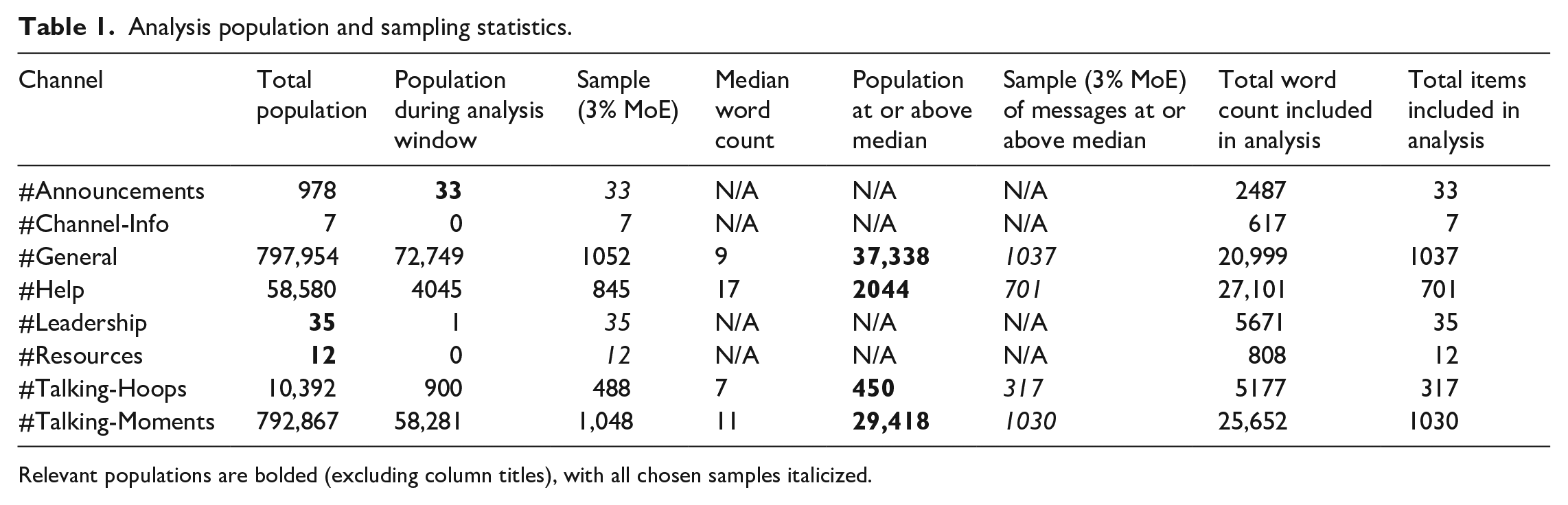
Relevant populations are bolded (excluding column titles), with all chosen samples italicized.
Webpages linked to in the #resources channel and available on the NBA Top Shot website were analyzed to establish how Dapper Labs positions NBA Top Shot to audiences. This understanding of Dapper Labs’ expressed intentions highlights tensions in its positioning as a place for fandom and expression and its reality as an environment defined by volatility, financial investment, and the continued prevalence of gamble-play, marketization, financialization, and the commodification of fandom.
As a method, the textual analysis offers a means to understand how members of cultures and subcultures conceptualize who they are and how they fit into the world and communities they inhabit, with the approach concerning itself with practices of sense-making (McKee, 2003). It is necessary for this study’s findings to adhere to the context afforded by this work’s literature review, as doing so will lend itself to the conclusion that the interpretations present in this study are reasonable. Textual analysis broadly concerns itself with the layout and structural organization of a group; the objects related to the group; the group’s actors; the language, grammar, and rhetoric its members employ; and discursive strategies and ideological standpoints present in the texts (Carvalho, 2008). Overall, this work considers how users conceive of an environment they are actively engaged in with attention toward the ways in which members’ words and expressed actions do or do not exemplify the core thematic interests detailed in this work’s literature review. To properly showcase conversations present in the NBA Top Shot community, we have not corrected users’ provided language.
Findings
Summary
Despite NBA Top Shot being described as a place for collection, fun, and fandom, it is more often an environment defined by financial interests and strategic calculations. This speaks to the dichotomous nature of NBA Top Shot, where play and financial gain are intertwined, and where the pursuit of one more often than not comes at the cost of the pursuit of the other. The NBA Top Shot Discord is defined by volatility, precarity, and the consistent presence of those who believe their strategies and speculations are correct, with these perspectives backed by messaging that relays a level of certainty in contrast to the established uncertainty of the NBA Top Shot platform and its marketplace.
The nature of the Top Shot platform and Discord server is such that the burdens of precarity are taken on by users, who collaborate and discuss the nature of its evolving market with some mention of the subject matter that is foundational to its existence and the valuation of its collectible Moments. NBA Top Shot exemplifies the pervasiveness of market thinking and the ability for such thinking to alter and inform users’ interactions in meaningful ways.
Ultimately, user actions in the NBA Top Shot Discord server exemplify marked differences between the stated intentions of the platform and those of its users. While the expressed intentions of NBA Top Shot are those of fun, collection, and community, with allusions to market activity, and a foundational, less public interest in the adoption of the FLOW blockchain, user interests are largely geared toward marketization. This difference is exemplified by the permeable boundaries of the various discursive contexts included in this analysis, where topic channels that are meant to relate to fan experiences quickly turn to conversations of a purposeful, marketized nature. This marketized reality is furthered by a language and culture of markets present throughout the NBA Top Shot Discord server and indicated by the use of terms often found in an investment context, speculative writings, and analysis as to the state of the broader market and impacts related to the actions of its many users.
Differing intentions, pervasive marketization, and ill-defined boundaries
The NBA Top Shot website and its official Discord server show marked differences in the intentions of those who interact with the platform’s collectible NFTs and those responsible for the platform’s creation, maintenance, and messaging. The NBA Top Shot website emphasizes the sort of style and dynamism one might see watching a basketball game, providing audiences with the opportunity to be closer to the experience through a system of commodification and ownership: High flying dunks. No look dimes. Game saving blocks. The level of drama and skill in NBA basketball is simply unmatched in the sports world. Now you can own a piece of that action.
The platform is described as being for collectors 18 years of age or older. Members of its Discord community are described on the NBA Top Shot website as possessing a wealth of knowledge about valuations and brand history. The promise of NBA Top Shot espoused by its creators is multifaceted, involving gamification, interaction, communication, and appreciation for the NBA and its players. Users are invited to “wheel and deal with other fans,” to show off their collected Moments, to “win new Moments every day,” and to “build your dream team, beat your friends” in a currently in-development companion application and gaming experience. These details acknowledge the market interests and capabilities present in the Top Shot platform, but suggest a greater interest in the joy one might find in social experiences dependent upon purchasing.
The barrier to entry is seemingly low, but is defined by market forces. Pack drops—releases of the brand’s collectible NFTs—require users to own one or more Moments, likely to deter those who wish not to collect but to flip for quick returns. Acquisition of these Moments is, as a result, dependent upon interaction with its user-driven Marketplace. After users acquire Moments, they can then participate in pack drops, with packs ranging from US$9 in price to US$999, with two higher tiers featuring even smaller release quantities determined by open auctions. Active participation in, and enjoyment of, the NBA Top Shot platform is predicated upon financial expenditure, and although this is clear from the platform’s core interest in collecting, less clear is the platform’s interests in furthering the success of Dapper’s FLOW Blockchain, which is largely glossed over on its website (Dapper Labs, 2021): Flow is an upcoming decentralized blockchain designed to be the foundation for a new generation of games, apps, and the digital assets that power them. The goal for the MVP of Dapper on Flow was to make it easy for mainstream consumers to participate in the blockchain economy. If there was ever a question, we erred on the side of mainstream consumers being able to join and easily access Top Shot content.
In addition to goals specific to NBA Top Shot, the brand’s overall success may be understood as being foundational to the proliferation and adoption of Dapper Labs’ FLOW blockchain. Users of NBA Top Shot are meant to build familiarity with crypto for the purposes of collecting NFTs but may find themselves leaning on the same introductory platform for future crypto endeavors. The expressed intentions of NBA Top Shot are those of fun, collection, and community, with allusions to market activity, and a foundational, less public interest in the adoption of the FLOW blockchain.
The lighthearted nature of the platform’s messaging is exemplified by Discord moderators and Dapper Labs’ employees active in the leadership channel, who speak of favorite teams, players, basketball video games, and Top Shot Moments with attention toward authenticity and fandom, with users expressing histories of love for the game and parallels to childhood collecting endeavors. Although some mention investments, economics, or financial expenditure, the leadership channel was markedly different from other channels due in part to its lessened emphasis on market activity. This user message from a moderator communicates the blending of fan and investor experiences: Wanted to get some early adopters pack only just to get exposure here, but been hooked since then and this has became my money pit. Keep putting more and more money into this. I followed NBA like 10 years ago when Duncan was still playing and Nash was still in Suns but then stopped. Have been catching up with current NBA since got into Topshot to help me understand the market more.
In this excerpt we see a user—now a moderator—describe expenditure high enough that they felt “hooked.” This exemplifies gamble-play and the platform’s gamified and gambling-like qualities, as well as heightened fan engagement with the NBA driven by the interest in market success.
Enthusiastic users can be seen discussing their favorite teams and players throughout the NBA Top Short Discord server, but such statements appear to comprise a minority portion of the broader discussion. Collectors and investors, as well as pursuits of fun and investment, might best be understood in this context as dichotomous:
Opening packs is for fun, the serious gains are from marketplace though.
Facts Machine. Our collections have a good amount of overlap. Can’t go wrong with collecting things that make you happy first and foremost. Chances are if a moment resonates with you as a fan, there are other people out there who could feel the same.
A few users held a harmonious belief in NBA Top Shot as a place for investment and for fun, with most active Discord users discussing NBA Top Shot in language familiar to market and investment contexts.
This dichotomous relationship is furthered by the diffuse nature of the NBA Top Shot Discord, and a pervasive sense of marketization exemplified by its users’ messages. Conversations related to buying and selling often bled into other channels. In casual, fun channels such as #talkings-hoops, users often discussed their investments, strategies, or other market-based concerns related to the NBA Top Shot platform, to the point that some users took issue with discussions that were contextually incorrect: I thought this channel was to strictly talk about basketball like the actual games and players lmao I guess i was wrong, top shot pack discussion should go in the marketplace chat.
These occurrences were such that NBA Top Shot moderators needed to lock the #Help channel in an effort to reduce off-topic conversation: Hey all, locking this channel for a bit since we’re seeing a large amount of traffic that isn’t help related. Please use the resources available on the support page for more information <https://support.nbatopshot.com/hc/en-us> :THANKS:
Community members believed that these issues represented shifts in the overall culture of the NBA Top Shot Discord community, with the understanding that many users were driven by marketplace interests: People here only care about pack drops. These droughts are the reason the market is dying. the energy in here is a total 180 from 1 week ago
These statements reflect the increased pressure and discursive influence market interests exert on the broader NBA Top Shot community. Discord participants and other NBA Top Shot users are impacted by practices and actions beyond their knowledge or control that ultimately impact the value of one’s purchases regardless of whether such purchases were made from the perspective of the investor or collector.
The ambiguity of NBA Top Shot is exemplified by the platform itself, which is described as being in beta, has the backing of a legitimate and well-known organization in the NBA, and experiences technical issues that upend user confidence in market participation: This is such a bad idea. It’s being sponsored by the NBA, does million in sales per day, and is pushed by pro athletes. This isn’t a beta anymore.
Details on the NBA Top Shot website and in user messages suggest that burdens of precarity, volatility, and uncertainty are pushed to users. With the ability to assert that the product is in beta, its failings are excusable while its successes are left unchecked. Technical precarity is exemplified by platform inaccessibility, system errors, or the inability of users to withdraw the funds they have accumulated. As a result, users engage with systems they believe to be sound, despite what the platform’s beta status suggests. These tensions represent the indeterminable nature of a product defined by tensions present in its expressed purposes and those of its market-inclined users, whose interests exemplify the pervasiveness of marketization in an environment positioned as lighthearted, expressive, and representative of fandom.
A language and culture of markets
NBA Top Shot’s Discord server is home to a language and culture of markets, investments, and financial interests. User approaches to NBA Top Shot were reminiscent of language present in other online communities, with mentions of more standard terms like “portfolio,” “bubble,” “spikes,” “crashes,” “volatility,” “risk,” and “trading” joined by slang terms such as “HODL” (meaning “hold on for dear life”), “whales” (describing individuals whose participation in digital, monetary environments is defined by substantial financial expenditure) (Dreier et al., 2017), and mentions of something “mooning,” referring to a spike in value. To make sense of this language, users often considered similarities between NBA Top Shot and topics such as day trading or gambling: Top Shot has pretty much turned into playing the lottery at this point. You might as well go buy $199 worth of lottery tickets if your just here to try to make money. Lol at the 2 hour lag. What an absolute joke. Yes I absolutely think the stock market is a safer place to invest than the NBA Top Shot marketplace, have you completely lost your mind? Higher risk/reward? No. Safer? My god.
Mindfulness of the stock market was reflected in the ways users leveraged investment language, sharing some previously mentioned terms while providing one another a sense of their approaches or predictions: HODL your moments and buy more guys! Market is about to FLY with all this allstar marketing going into the allstar weekend and after it! your crazy to sell now and not buy more at these low prices! I have made around 700% in gains the past month so not really worried. I reinvest alot to get better moments, so my current ROI is around 160%. Just worried for the folks who get burned, not for myself As I said Im quite happy with my moments. Just want to have more active participants in the market, so this could become a functional sustainable market. I love the nba, so keeping my money in moments would be a damn dream.
These messages demonstrate market interest, as well as attention toward the NFTs’ NBA context. As moments derive their value from players, events, and storylines occurring in the league, it is beneficial to be mindful of the context that informs their value.
Adhering to a culture of marketization, users speak in strategies or speculation, sharing thoughts on marketplace trends with predictions of future events. There was a sense of confidence or direction present in speculative user messages. Users speaking semianonymously (through online aliases) speak with certainty and authority. Anyone can speak and act as though they are an expert (although some users acknowledged they were not) and that their rationale reflects a precise understanding of the market, its history, and the behavior of its many participants: For new users, this market is very reminiscent of the dip after the first big boom in January . . . I hope you understand that if a deal looks too good to be true, jump on it and buy the moment. This market will recover and grow even greater than before. Be prepared and take advantage. I’ve noticed an intraday trend line where prices tend to peak around 10am EST and opportunities are created until tip-off which is where you start seeing prices creep up. Quit complaining, get grinding, land them momes and get that loot! Ya everything just became a long hold. Will be very interested to see if standard market psychology will apply on the next trip up. A lot of bag holders from the last rip now down 55%. If this were stonks those guys would be very likely to sell it all and walk away when they got back to even.
Practices of speculation translated to the valuation of individual player Moments, which could derive increased value from their serial number, the significance of the moment, or any element that might make the moments unique or memorable: Imagine the value of pandemic bubble moments with “black lives matter” on the jerseys. Huge historical value
This approach to valuation seeks to establish an edge in the marketplace. Users communicated the rationale for their investments and tried to predict how others might value a given Moment: I put my money where my mouth is. Current holdings: 348x Coby White, 343x Kendrick Nunn, 87x Keldon Johnson, 73x Jordan clarkson, 62x Dennis Schroeder, 42x Deandre Ayton. All good young players on playoff teams without new moments. In the end . . . all that matters is what people are paying for. So if it’s low serial numbers they want, then that’s the gold. But to me . . . it makes no sense. Number 1 should be worth more, their jersey number should be worth more . . . and that’s the only ones that make sense to me.
Messages related to valuation stressed users’ seriousness and focus. Emotional expressions such as anxiety, excitement, frustration, happiness, fear, or belief were present across various Discord channels observed for this analysis. These expressions were sometimes accompanied by details of wins and losses, echoing Martin’s (2002) suggestion that day traders need to buy and sell but also to tell others of their successes and failures: Damn thanks for the advice bro I made a grand! I “lost” $2m today. Not listing anything :rocket: credit card payments can wait
Successes and failures related to the quickness of the market and users’ interests in quick earnings. “Flippers”—users who buy and sell with an interest in quick profits—were viewed as market disruptors and a perversion to the collector interests espoused by Dapper Labs. Some members favored collecting, holding, and engaging with NBA Top Shot’s marketplace in an intentional and patient way, while disparaging the short-sighted behavior of flippers as detrimental to the community and its marketplace: People aren’t looking that far into the future. They hear they can turn $14 into $400 and they’re content with that. They have no interest in the grind, though many will be in for a rude awakening when they realize they won’t be able to get their money out for months
Discussions of flippers were similar to broader speculative and investment-oriented messaging. Users grappled with the ways their collective and individual actions change the nature of an environment positioned as a place for fun and fandom. This highlighted differences in user and brand intentions, as well as the pervasiveness of marketization in an environment that is not intended to resemble day trading or gambling as closely as it does in reality.
Ambiguity, liminality, and fandom
Conceptually, these findings further discussions of fandom in the context of sport and markets, providing another instance of collecting as a form of investment, furthering an exploration of sport (and its participating athletes) as entities impacted and influenced by commodifying forces. Alongside this, user language and the ambiguities of the NBA Top Shot platform indicate within a broad cultural context a pervasiveness of marketization and financialization. The ambiguities of this platform and its users’ experiences reflect practices of casino capitalism and gamble-play, wherein user activities are gamified, risk and instability are encouraged, and user cultural and discursive interactions reflect an understanding of the precarity present in a commodified and game-like environment that is positioned as a place for fun and fandom but functions as one of financial, speculative interests.
Conclusion
Tensions present in differing intentions (of fun and of financial gains), and the adoption and performance of market language and thinking speak to a blurring of boundaries that once allowed the individual to maintain a greater distance from the pressures and consequences of markets. These findings reveal how the expressed intentions of Dapper Labs and the NBA Top Shot platform are markedly different than those of its users, who often view the platform as another investment opportunity. Recognition of these possibilities defines the culture of the NBA Top Shot Discord server, an environment where topical boundaries (especially those related to the NBA and to fandom) are often disregarded, with users’ attentions focused on the challenge of understanding a volatile market driven by the valuation of products that may be difficult to calculate. NBA Top Shot further commodifies the actions of NBA players and the experiences of fans. Commodifying forces, and the platform’s design and priorities, present a need for users to operate strategically via market language.
The pervasiveness of NBA Top Shot’s financial engagements and the volatility and instability inherent in them is compartmentalized within the context of its platform and associated Discord server. The foundation for these practices is an intangible good, an NFT, a collectible “Moment,” that the passage of time may show to have had fleeting value and relevance. The actions of NBA Top Shot’s flippers and investors contribute to a financial culture predicated on chance and quick action in ways one would traditionally associate with a visit to the casino. Fandom functions as one of many commodified objects, demonstrating the pervasiveness of commodification and marketization. Chaudhuri and Belk (2020) speak to the ability for seemingly anything to be the subject of commodification, and although NBA Top Shot and its collectible Moments are a comparatively mild product of commodification, the commodification of the NBA fan experience illustrates increased pressure to more readily think of one’s life, interactions, and consumptive behaviors through the lens of the investor, with an implied de-emphasis of lenses related to artistry, fandom, or emotionality.
With regard to fandom, NBA Top Shot represents a departure from commodification in the context of sport that entails the purchasing of jerseys, shoes, cards, and more for the purposes of expression and community building toward an investment-driven accumulation of digital commodities. NBA Top Shot’s Moments exist in close proximity to the designs of its Marketplace at all times. In a way, the ability to view others’ moments is arguably closer to viewing sports memorabilia in the context of a store than it is on the walls of your average fan’s household or the backs of fans entering their favorite team’s stadium for a highly-anticipated playoff series. There is a coldness to these moments and the speculative nature of their purchasing that represents both a continuation of commodified fandom and an acceleration wherein market forces and gambling-like characteristics transcend their position as contextualizing factors to become, for many users, the purpose of the provided experience.
Why do users participate in NBA Top Shot? Possible benefits include: community, solidarity, the promise and possibility of financial rewards, mastery of a skill (in this case, the development of investment savvy), the establishment and expression of one’s identity, and collecting as a joyful act of consumption. Alongside this, organizations such as Dapper Labs seize upon these emotional forces in their pursuit of financial gains, the adoption of their FLOW Blockchain, and the general mainstreaming of blockchain technology. Dapper Labs passes the risk to users in ways consistent with the volatile global economy detailed in Susan Strange’s work on the basis that they are knowledgeable, capable, and passionate. NBA Top Shot advances a connection between emotional, game-like approaches present in collecting to those of investment, and in doing so further normalizes a perception of finance that is gamified, unclear in its stability, and predicated upon an allure of fan expression that is ultimately supplanted by the pervasiveness of marketized interactions.
Future research might seek to interview purchasers of NFTs or participants in the NBA Top Shot marketplace to better understand the reasoning for their participation in, and understanding of, NBA Top Shot’s users. NBA Top Shot exemplifies a blurring of conceptual interests necessitating the need for future studies to examine its components and users at even smaller scales, building upon the broad, cumulative approach taken by this work.
Footnotes
Acknowledgements
The authors of this article would like to acknowledge contributions made by Matt Carlson and Rowan McMullen Cheng.
Authors’ note
All authors have agreed to the submission of this article. The submitted article is not currently being considered for publication by any other print or electronic journal.
Funding
The author(s) received no financial support for the research, authorship, and/or publication of this article.
