




Abstract
We present an experimental study conducted in the context of the Israeli–Palestinian conflict that examined the effect of immersive 360° video on inducing a more critical perception of the ingroup’s actions in the conflict. An immersive experience of a simulated conflict scenario filmed from the outgroup’s point of view led to the judgment of the ingroup actors’ behavior as less moral and less justified compared to watching the same scenario as a two-dimensional video. This effect was not mediated through increased outgroup perspective-taking and empathy but through higher levels of hostile emotions toward the ingroup actors, which in turn were influenced by an increased sense of presence and engagement in the immersive experience. These findings provide initial evidence for the still widely unexplored potential of virtual reality as a new method for conflict resolution.
Keywords
Introduction
Violent conflicts between different national, ethnic, or religious groups remain one of the greatest challenges for humanity. They not only pose a severe threat to the involved individuals’ security and well-being, but also have wide-ranging consequences for the international stability and global economy (HIIK, 2018; IISS, 2018). Some of these intergroup conflicts are considered intractable as they persist over a long period of time and are perceived as irresolvable (Bar-Tal, 2007, 2013; Kriesberg, 1993). This does not imply that intractable conflicts are impossible to solve but that a peaceful resolution is extremely difficult to achieve due to socio-psychological barriers (Halperin and Bar-Tal, 2011).
Societies involved in intractable conflict develop unique collective mechanisms over time based on shared societal beliefs that enable them to cope with the challenges of the conflict but at the same time perpetuate the conflict (Bar-Tal, 2007). This includes beliefs about the justness of the goals of one’s own group (i.e. the ingroup) over which the conflict is fought and the legitimization of the means to achieve them while delegitimizing the opponent’s goals and actions, and dehumanizing the members of the opposing group (i.e. the outgroup). Consequently, harmful actions that would be severely condemned as moral violations under other circumstances tend to be perceived as justified and moral when they are directed toward the opponent in the conflict. Such moral disengagement mechanisms (Bandura, 1999) allow societies involved in intractable conflict to maintain a positive self-image and to avoid unpleasant feelings of guilt and shame when being confronted with moral transgressions of their ingroup (Halperin et al., 2010; Sharvit et al., 2015). Developing a more self-critical view on the ingroup’s harmful behavior in the conflict is a critical step toward breaking the cycle of violence and preparing the ground for a peaceful resolution of the conflict (Nets-Zehngut, Bar-Tal, 2007; Sharvit, 2016).
This article addresses this challenge by proposing a new media-based intervention using virtual reality (VR) that exposes individuals involved in intractable conflict to their opponents’ point of view (POV) in an attempt to create a more critical perception and judgment of the ingroup’s actions in violent confrontations with the opposing group. Specifically, we investigated whether VR is more effective than traditional media in creating this change.
Traditional versus VR-based interventions
Previous research conducted in the context of the Israeli–Palestinian conflict has shown that interactive media, such as simulation games, can be an effective tool to increase understanding of the different perspectives and complexity of intractable conflicts (Cuhadar and Kampf, 2014; Kampf and Stolero, 2018). In recent years, VR has been promoted as a new potential method for conflict resolution due to its unique properties that differentiate it from any other medium and that may be particularly suitable to induce peace-promoting attitudes (Makin, 2017; Rubin and Hasler, 2018). However, to our knowledge, this is the first study that empirically tests the presumed advantage of VR over traditional media-based interventions for social change in the context of intractable conflicts.
Interventions that confront participants with harmful actions of their ingroup in a conflict typically refer to conflict events in which participants were not personally involved themselves (e.g. Čehajić-Clancy et al., 2009; Leidner et al., 2010; Roccas et al., 2006; Sharvit et al., 2015). Moreover, these interventions typically rely on materials, including texts and images that lack the realism and emotional intensity of real-life events, such as wars and terror attacks, and real-life experiences, including mental and physical suffering, and engage participants only to a limited extent. VR may potentially overcome these limitations due to its immersive nature and perceived realism. Immersive VR experiences have been shown to have a profound psychological impact and can lead to changes in attitudes regarding a range of social issues (for a review, see Slater and Sanchez-Vives, 2016). Most of this previous research is based on computer-generated virtual environments that create a perceptually surrounding, immersive experience, and allow for interactions with virtual objects and characters that can closely simulate real-life interactions. While such VR experiences create a high level of behavioral realism, the virtual elements participants encounter and interact with are still qualitatively different from physical elements, despite vast advancements in computer graphics. In recent years, a new form of VR has emerged that uses 360° video (i.e. spherical videos recorded by cameras with omnidirectional lenses) to create a photorealistic experience of real-world scenes, which can be viewed by wearing a VR headset (Aitamurto et al., 2018; MacQuarrie and Steed, 2017). As in computer-generated virtual environments, participants can look in any direction inside an immersive 360° video by moving their head in a natural way to see what happens above or beneath them and to their right and left; that is, supporting sensorimotor contingencies that follow the principles of how we perceive the real world (Slater, 2009). The technical qualities of immersive 360° video to put participants inside a photorealistic scene offer a unique potential for factual and fictive story-telling. However, immersive 360° video experiences are limited regarding their interaction capabilities as the viewer’s movements within the experience are limited to head rotation (i.e. it is not possible to navigate within a 360° video or interact with elements in the environment in a natural way). Nevertheless, the ability of generating a photorealistic experience using 360° video offers an interesting alternative for scenarios that are situated in a specific real-word location which may be difficult to reconstruct using computer-generated imagery, and when the experience aims to provide participants with the opportunity to observe realistic simulations of real-life events. Immersing participants in real-life simulations in VR has been claimed to lead to a fundamentally different understanding and judgment of the situation (De la Peña et al., 2010). This leads to our main hypothesis that we tested in this study.
H1. Experiencing the ingroup’s harmful actions in a simulated conflict scenario in VR reduces the moral justification of the actions to a greater extent than watching the same scenario as a two-dimensional video on a screen.
Besides testing this main hypothesis, we explored the psychological mechanisms that can be activated through VR that may lead to altered moral judgments of the ingroup’s actions in the conflict.
Emotions in moral judgment and their activation in VR
Previous research has highlighted the importance of emotions in moral judgment and decision-making (Greene et al., 2001; Haidt, 2001). One of the most widely studied emotions that influence moral judgment is empathy; specifically, empathy for the victim of a harmful action (Eslinger et al., 2002; Hoffman, 1987; Pizarro, 2000). Witnessing another’s suffering may lead observers to vicariously experience the other’s emotions and sensations (Lazarus, 1991); also termed affective empathy. Alternatively, it may arise feelings of compassion or sympathy (often used synonymously; Batson et al., 1987), defined as empathic concern for the other’s well-being that motivates the desire to help (Goetz et al., 2010). While the emotional resonance with the other’s pain and compassion are functionally different and rely on different neural substrates (Ashar et al., 2017), both require the ability to take the other’s perspective (i.e. imagining oneself in the other’s position) and have been found to predict pro-social behavior (Batson, 1991; Batson et al., 1981; Eisenberg et al., 1989). Accordingly, taking a victim’s perspective and empathizing with the suffering of the victim is assumed to increase the perceived wrongness of the perpetrator’s action (Aderman et al., 1974). Indeed, a study by Zebel et al. (2009) found that taking the perspective of an outgroup that has been mistreated in the past by one’s national ingroup led to the acknowledgment of the ingroup’s wrongdoing. However, this finding was limited to those who weakly identified with their ingroup. For those who highly identified with their ingroup, outgroup perspective-taking even had negative consequences.
Although perspective-taking has been widely applied as a method for conflict resolution (see Čehajić-Clancy et al., 2016, for a review), it is difficult to implement in the context of violent intergroup conflicts. Perspective-taking is an extensive cognitive effort (Davis et al., 1996) that requires both ability and motivation, and individuals involved in intergroup conflict are often unable or unwilling to take the other side’s perspective (Berndsen et al., 2018; Cikara et al., 2011). Instead of imagining the situation of another person, VR makes it possible to create a first-person experience of that person’s reality. VR can put people in someone else’s shoes and visualize the otherwise mentally simulated perspective of the other. Due to its assumed ability to facilitate perspective-taking (Herrera et al., 2018), VR has been claimed to be the “ultimate empathy machine” (Milk, 2015). This leads to our second hypothesis.
H2. Exposure to a conflict scenario in VR from the POV of the victimized outgroup leads to higher levels of perspective-taking and empathy than an equivalent 2D video, which mediates the effect on moral judgment of the ingroup’s actions.
However, empirical evidence supporting the claim that immersive 360° video enhances empathy is limited. We are aware of only one empirical study to date in which immersive 360° video was found to result in higher levels of empathy compared to watching the same video on a flat screen (Schutte and Stilinović, 2017). Other studies found no statistically significant difference regarding induced empathy between immersive 360° video (viewed using a VR headset) and non-immersive 360° video (viewed on screen and using mouse movements to rotate the viewing angle) or 2D video (viewed on screen without possibility to control the viewing angle; Archer and Finger, 2018; Bang and Yildirim, 2018; Sundar et al., 2017; Weinel et al., 2018). Shin (2018) provides a more differentiated account showing that the extent to which VR creates empathy may depend on characteristics of the participant, such as empathetic disposition, and not on the medium per se. As (add cross-reference here) show in the current issue, the empathy-enhancing capacity of VR experiences may also depend on how these experiences are designed; particularly, whether or not head movements are required in order to follow the scenario.
While the ways in which empathy influences moral judgments of harm remains debated (Decety and Cowell, 2014), alternative models have been suggested that focus on hostile emotions toward the perpetrator, including anger, disgust, and contempt (Hutcherson and Gross, 2011; Salerno and Peter-Hagene, 2013). This does not necessarily require to take the victim’s perspective (Mallett et al., 2008). Although anger toward a perpetrator can be experienced on behalf of the victim, research has shown that this is usually only the case when the victim is part of one’s ingroup (Yzerbyt et al., 2003). When being confronted with harmful acts committed by the ingroup toward the opposing group in conflict, ingroup glorification prevents individuals from feeling negative emotions toward their ingroup (Leidner et al., 2010; Roccas et al., 2006). Nevertheless, we also tested this alternative path to changes in moral judgment as our third hypothesis.
H3. VR leads to stronger hostile emotions toward the ingroup aggressor in a simulated conflict scenario than an equivalent 2D video, which mediates the effect on moral judgment of the ingroup’s actions.
While hypotheses 2 and 3 assume a direct causal effect of VR on emotional arousal, we further explored potential mediators of this relation in this study with the goal of adding another layer of understanding to the hypothesized effect.
Factors influencing emotional responses to VR
What differentiates VR from non-immersive media experiences, such as watching a 2D video on a screen, is its ability to create a sense of presence; that is, the feeling of “being there” (Heeter, 1992) in the virtual (rather than the physical) environment (Schubert et al., 2001; Slater and Wilbur, 1997). Presence has been identified as a key factor that influences emotional responses to VR experiences (Price and Anderson, 2007; Riva et al., 2007). It has been argued that physiological arousal mediates the effect of VR on presence and emotions (Freeman et al., 2005; Visch et al., 2010), at least for strongly arousing emotions, such as fear and anxiety (Juan and Pérez, 2009), and potentially also anger (Diemer et al., 2015). Indeed, immersive 360° video has been found to lead to higher levels of presence (Bindman et al., 2018; Shu et al., 2018; Vettehen et al., 2019), and to evoke stronger physiological responses than traditional 2D video (Chirico et al., 2017) and of similar intensity as responses elicited in real environments (Higuera-Trujillo et al., 2017).
In addition to the concept of presence, engagement has been considered as another important variable that can mediate the effect of immersive 360° video on emotional responses, particularly empathy (Schutte and Stilinović, 2017). Since engagement is defined as the involvement of the participant in a media experience (Wiebe et al., 2014), it is likely to depend on the narrative rather than technical properties of VR (Gorini et al., 2011). Therefore, it may not be surprising that the findings regarding the effect of immersive 360° video on engagement are less consistent; with several studies showing that immersive 360° video did not lead to greater engagement than 2D video (Bindman et al., 2018; Wang et al., 2018).
As most previous studies were based on correlative findings and did not test all three variables in combination, it remains unclear whether there is a causal relationship between physiological arousal, presence, and engagement, and to what extent each of these variables influence emotional responses to immersive 360° video experiences. This leads to our fourth hypothesis.
H4. Exposure to a conflict scenario in immersive 360° video elicits stronger physiological arousal and a higher sense of presence and engagement than watching the same scenario as a 2D video, which mediate the emotional responses to the VR experience.
We tested these four hypotheses in an experimental study conducted in the context of the intractable Israeli–Palestinian conflict that is characterized by deep-rooted hostility and violence.
Method
Participants
One hundred Jewish Israeli participants (71 women, 29 men) between the age of 21 and 45 (M = 24.33, SD = 4.11) were recruited at the (authors’ institution) and participated in the study for credits or payment (40 Israeli Shekels). All participants were born and raised in Israel, and the majority (96%) served in the Israeli military. Participants were pre-screened for depression, post-traumatic stress disorder, and epilepsy in an online self-assessment survey prior to their participation in the experiment as exposure to conflict-related materials or VR, respectively, bears a potential risk to these individuals. None of the participants met the criteria for exclusion. The study received ethics approval from the Institutional Review Board.
Materials and design
Video material
We produced a 1-minute 360° video 1 for the purpose of this study showing an interaction between Israeli soldiers and a Palestinian couple at a military checkpoint (see Figure 1). The scripted scene reflects the realities of the ongoing Israeli–Palestinian conflict and the tensions that often culminate at military checkpoints between soldiers and civilians. The second author directed and shot the scene in March 2016, in the West Bank near the Israeli settlement Mevo Horon using a GOPRO 360 HEROS 10-CAMERA VR RIG and stitched the footage using Autopano Video. An art director and costume designer were present on the set to make sure the scene would look as close as possible to a real temporary checkpoint.
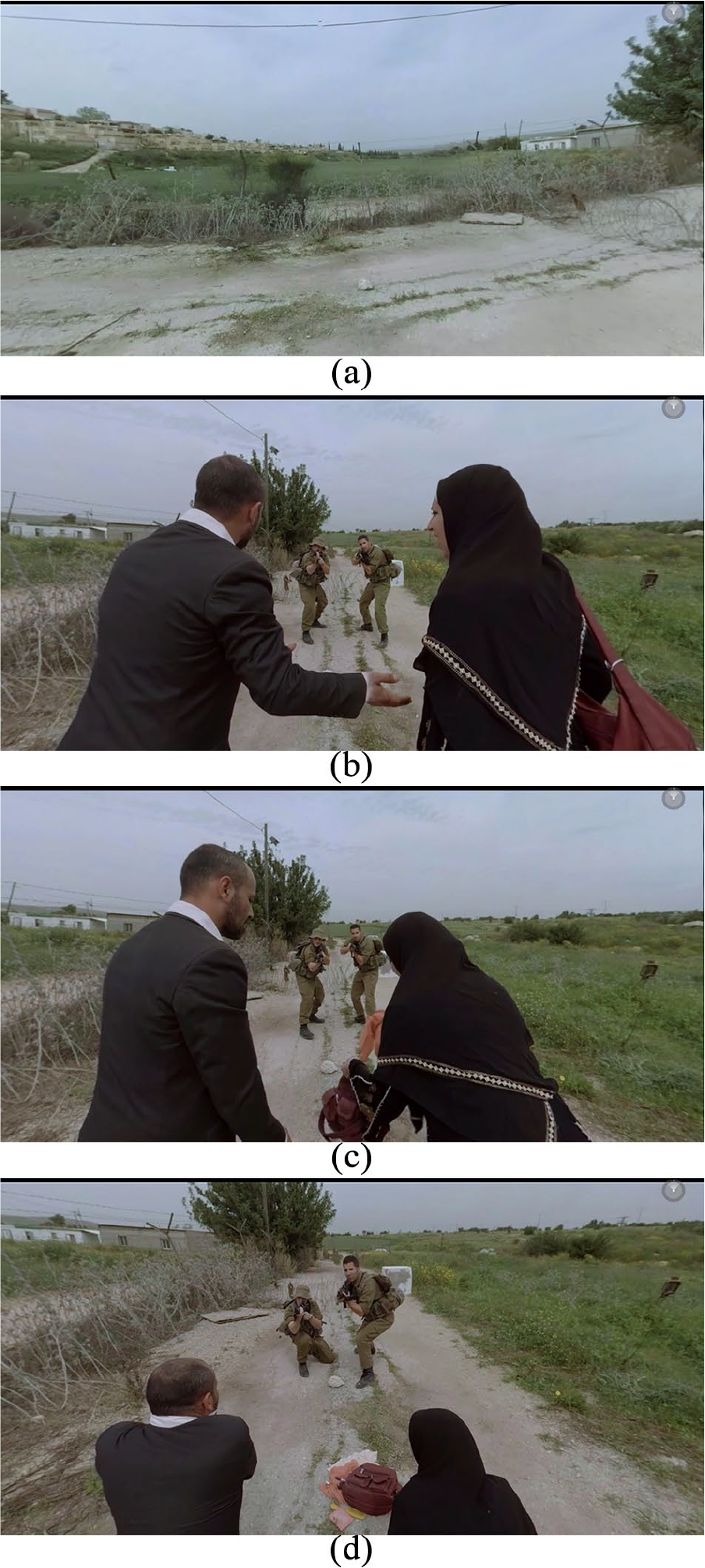
Screenshots of the checkpoint scenario: (a) orientation phase, (b) Palestinian couple approaching the military checkpoint, (c) soldiers inspecting the Palestinian couple, (d) ambiguous ending of the scene (last frame).
In the scene, a Palestinian man and a seemingly pregnant Palestinian woman approach two Israeli soldiers at a military checkpoint. The alerted soldiers instruct them to halt and begin inspecting them while pointing their rifles at the couple. After the Palestinian woman hastily unpacks her handbag, the couple follows the soldiers’ instructions to kneel down. The Palestinian man repeatedly claims to have permission to cross the checkpoint in order to get to the hospital and refuses to take off his shirt as instructed by the soldiers. The scene ends ambiguously when the Palestinian man reaches into his jacket supposedly to take out his travel permit, and in response the soldiers aim their rifles closer at the couple indicating that they are ready to shoot. The script was developed by the authors with the goal of setting both sides of the scene in a stressful situation: the soldiers fearing a suicide bomber, possibly hiding explosives on their body, and the Palestinian couple rushing to the hospital to treat the woman’s medical emergency.
The scenario is filmed from the POV of the Palestinian couple with the camera placed right behind them (“looking over their shoulders”) and facing the soldiers—a cinematographic technique intended to facilitate perspective-taking (Andringa et al., 2001). By presenting the scenario to Jewish Israeli participants from the outgroup’s POV, the video potentially allows for both empathizing with the victimized outgroup and for developing a self-critical view of the ingroup’s actions by experiencing them from a POV that participants do not usually adopt in real life (i.e. standing on the “other side” and becoming the target of the ingroup’s actions). The choice of shooting the scene from an over-the-shoulder angle was to clearly emphasize the identity of each perspective. It is technically possible to create the illusion of first-person embodiment using 360° video techniques by placing the camera at an actor’s eye level (Aitamurto et al., 2018; Landau et al., 2020). If the scene was filmed from a first-person perspective, that is, “virtually embodying” participants in the actors’ body, they would not have known whom they represent. In virtual embodiment experiments, this issue is typically resolved by placing a virtual mirror in the scene that reflects the participants’ virtual body (Spanlang et al., 2014). However, placing a mirror in this outdoor scene was not appropriate.
Presentation modes (experimental conditions)
Participants were randomly assigned to one of two media conditions: VR versus 2D video (n = 50 in each condition). In both conditions, participants watched the checkpoint scenario by wearing an HTC Vive VR headset and standard HTC Vive earbuds. In the 2D video condition, participants were immersed in a void virtual environment and watched the same scenario as a two-dimensional video displayed on a screen of eight by 4.5 m placed at a distance of 6 m in front of them; resulting in an effective resolution per eye of 700 × 400 pixels in the 2D video condition, and 1080 × 1200 pixels in the VR condition. This methodological procedure has also been used in previous media comparison studies (Schutte and Stilinović, 2017; Vettehen et al., 2019). It allows to isolate the feature that distinguishes watching a 360° video in VR from watching a 2D video on a screen (i.e. the immersion in a panoramic 360° view of the scene with corresponding directional sound) while keeping most other factors constant. In contrast to the immersive experience of the scenario, the non-immersive viewing of a screen placed in front of the participant in a void virtual environment does not support sensorimotor contingencies (i.e. participants’ head movements do not change the image). Otherwise, the stimulus and presentation were deliberately kept the same (i.e. both were monoscopic and experienced using an HTC VIVE headset).
As the identical video (filmed from the Palestinian POV) was presented in both conditions, they technically both allowed for the adoption of the outgroup perspective and experiencing the soldiers’ actions directed at the viewer. Prior to the start of the acted scene (orientation phase), the environment of the military checkpoint was displayed for 30 seconds in both conditions in order to familiarize participants with the environment.
Measures
Manipulation check
In order to test whether participants adopted the intended Palestinians’ POV, they were asked to indicate from which POV they watched the scenario: 1 = Soldiers’ POV, 2 = Bystander POV (external view of the event), 3 = Palestinians’ POV.
Outcome variable
Moral justification of the soldiers’ actions was measured using three items (α = .80), rated on a seven-point scale ranging from 1 (Not at all) to 7 (Very much). One item referred to the soldiers’ actions in the scenario (“The soldiers’ behavior was justified”), and two items referred to the potential outcome of the scenario (“Assuming that the soldiers would shoot and injure the Palestinians, how much do you think this action is 1) justified, and 2) moral?”).
Subjective mediator variables
Engagement in active perspective-taking (defined as willingness to imagine oneself in the Palestinians’ position, see the world through their eyes and imagine their inner states) was measured using three items (α = .90): (1) “I tried to understand the feelings of the Palestinians by imagining how things look from their point of view.” (2) “I tried to put myself in the place of the Palestinians.” (3) “I tried to imagine how I would feel if I were in the Palestinians’ place.” Empathetic emotions were measured by explicitly asking participants to rate their level of empathy toward the Palestinian couple, in addition to ratings of sympathy and compassion as related concepts (adapted from Batson et al. (1997); α = .90). Hostile emotions were measured using ratings of anger, disgust, and contempt toward the soldiers (α = .86). The question prompting the ratings of empathetic and hostile emotions was phrased as the following: “Following the viewing of the situation, to what extent are you currently feeling any of the following emotions for the Palestinians/soldiers?” Engagement was measured using the six-item Engagement scale (α = .89) of the Temple Presence Inventory (TPI; Lombard et al., 2009). Sample items are the following: “How involving was the experience?” and “How completely were your senses engaged?” Social presence was measured using four items of the TPI scale “Social Presence—Actor within Medium” (α = .64); excluding three items that deal with interactivity and control over the interaction that do not apply to the 360° video format used in this study. The included items are the following: (1) “How often did you have the sensation that people you saw could also see you?” (2) “How much did it seem as if you and the people you saw were together in the same place?” (3) “How often did it feel as if someone you saw in the environment was talking directly to you?” and (4) “How often did you want to or did you make eye-contact with someone you saw?” A fifth item (“How much did it seem as if you and the people you saw both left the places where you were and went to a new place?”) was later removed due to the difficulties that participants expressed in understanding this question in the Hebrew translation. All items were rated on a seven-point scale ranging from 1 (not at all/never) to 7 (very much/always).
All questionnaire items were presented in Hebrew and have been validated in a previous study (Hasson et al., 2019) using the same material.
Physiological mediator variable
Physiological measurements were recorded using a g.USBamp amplifier and g.GSR box (g.Tec, Austria) prior to and during exposure to the video material. Recording electrodes were placed on the participant’s non-dominant hand. Skin conductance (SC) was sampled at 256 Hz and down-sampled to 8 Hz. A continuous decomposition analysis was applied to the signal using the Ledalab software, resulting in separate phasic (driver) and tonic components. The first component is aimed at retrieving the signal characteristics of the underlying sudomotor nerve activity. SC data are deconvolved by the general response shape, which results in a large increase of temporal precision. Then the data were decomposed into continuous phasic and tonic components (Benedek and Kaernbach, 2010). Baseline normalization was performed on the raw values for mean comparison by subtracting the mean SC values during the video by the mean SC values during the baseline.
Procedure
After signing an informed consent form assuring the anonymity of their responses, participants were briefed about the physiology measures and VR equipment. Then finger electrodes for physiological measurement were placed, followed by placing the VR headset. Participants were asked to close their eyes for about a minute in order to record a baseline of the physiology measurement. After the baseline recording, they were informed that they will be watching a short video with political content, and that they will be required to answer questions about it later. Depending on their assigned condition, participants either watched the immersive 360° video (VR condition) or the equivalent 2D video displayed on a screen in a void virtual environment (2D video condition). In both conditions, participants were told that the scenario will start in 30 seconds. In the VR condition, participants were encouraged to look around by moving their head during the orientation phase in order to familiarize themselves with the environment. After watching the scenario, the finger electrodes were removed, and participants completed a questionnaire on their subjective responses to the video clip. The demographic variables as well as political ideology and level of religiosity were measured at the end of the questionnaire in order to prevent potential priming effects. After completion of the questionnaire, participants were debriefed about the purpose of the experiment and compensated with payment or credits for their participation.
Results
Test of randomization
There were no statistically significant differences between the two conditions regarding participants’ prior experience with VR, LHR(4) = 7.44, p = .11; gender, χ2(1) = .05, p = .83; age, LHR(12) = 13.40, p = .34; level of religiosity, LHR(3) = 2.95, p = .40; combat experience, χ2(1) = 3.05, p = .08; and political ideology, LHR(5) = 7.77, p = .17. However, since political ideology was strongly correlated with the dependent variable and most of the mediator variables, we included political ideology as a covariate in the subsequent analyzes (one-way analysis of covariance). The pattern of results remains the same when not controlling for political ideology. Although more participants with combat experience were in the 2D video condition (n = 19) than in the VR condition (n = 11), combat experience did not have a significant influence on the mediator or dependent variables. There were no statistically significant interactions with the independent variable (i.e. condition).
Moral justification of the ingroup’s actions
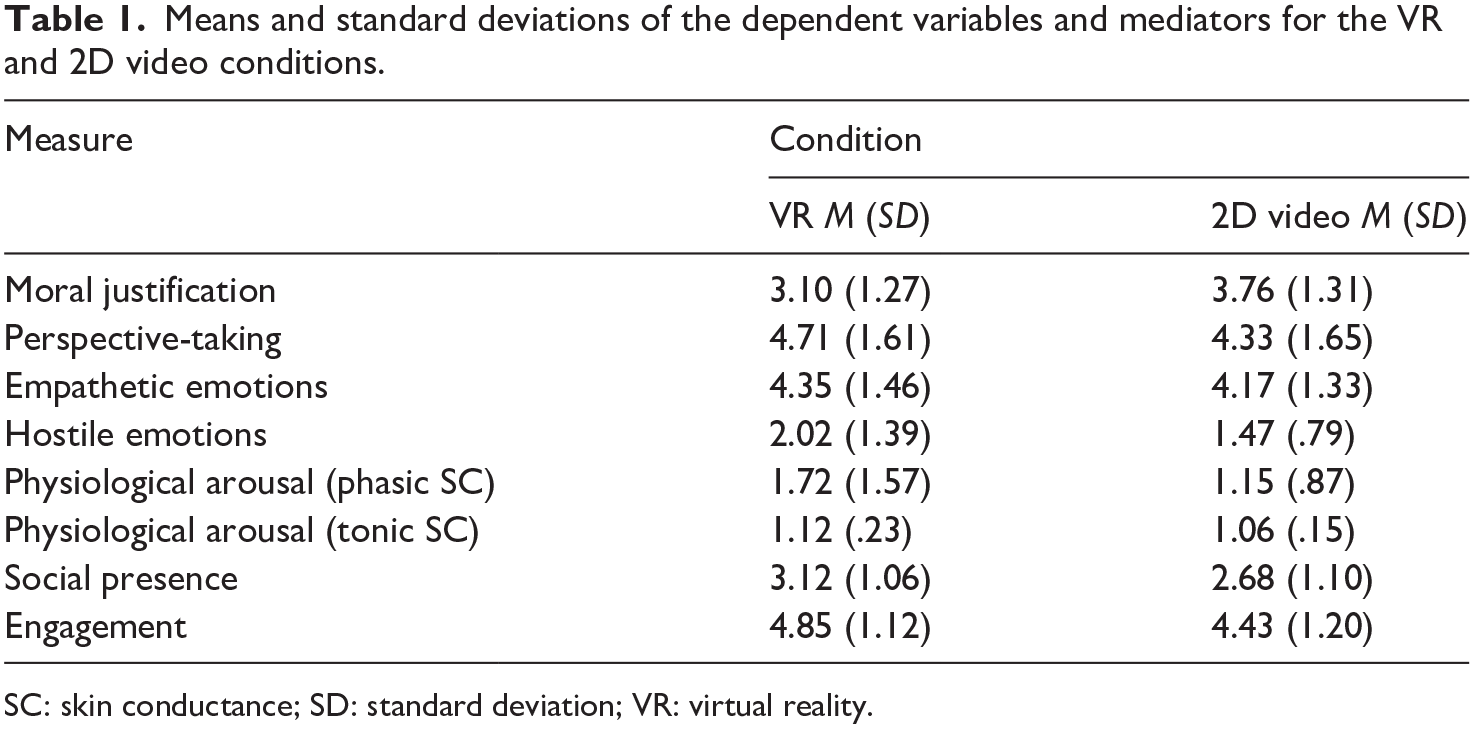
As predicted, participants in the VR condition judged the soldiers’ actions as significantly less justified and less moral than participants in the 2D video condition, F(1, 97) = 7.40, p = .01, η2 = .07 (see Table 1). In order to examine the underlying psychological mechanisms behind this effect, we tested the following two alternative paths: (1) through perspective-taking and empathy toward the victimized outgroup (i.e. the Palestinian couple) and (2) through hostile emotions toward the ingroup aggressors (i.e. the Israeli soldiers). In addition, we examined whether potentially stronger emotional responses in the VR condition were mediated by physiological arousal, self-reported presence, and engagement.
Means and standard deviations of the dependent variables and mediators for the VR and 2D video conditions.
SC: skin conductance; SD: standard deviation; VR: virtual reality.
The perspective-taking and empathy path to moral justification
In order to test whether participants indeed perceived the scenario from the POV of the Palestinian couple (i.e. the POV from which the scene was filmed), we compared the counts of the indicated POV for each condition (see Figure 2). Significantly, more participants in the VR condition reported that they watched the scenario from the Palestinian POV than in the 2D video condition, while significantly more participants in the 2D video condition felt like a bystander than in the VR condition, χ2(1) = 4.65, p = .03.
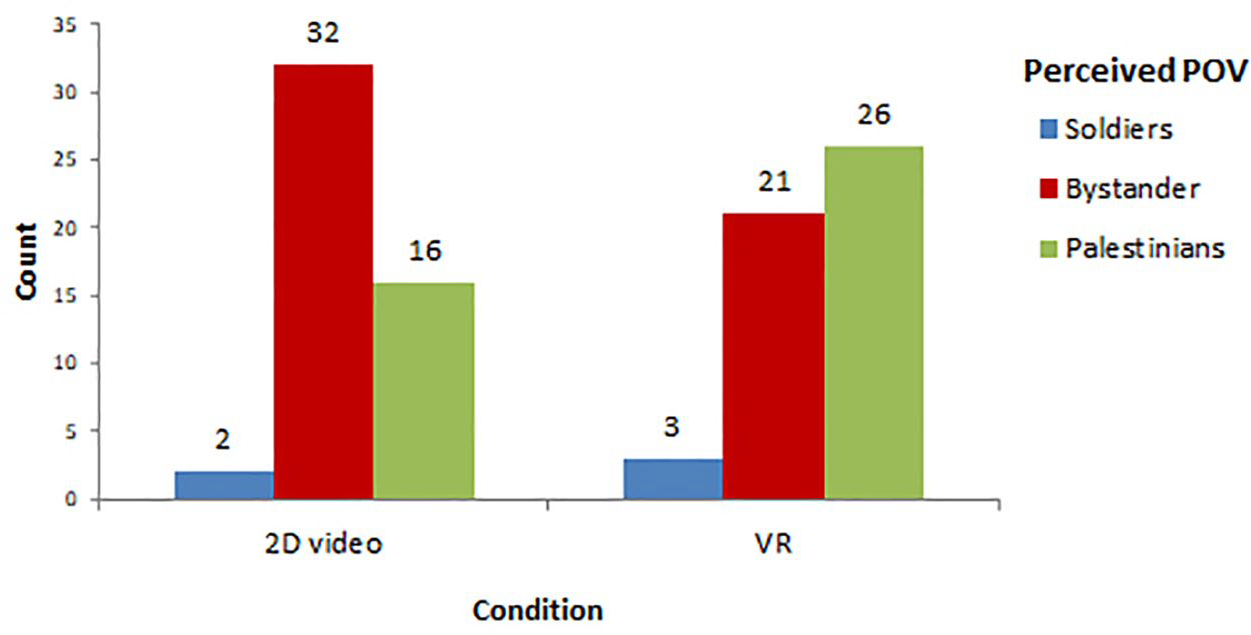
Counts of Perceived POV in the VR and 2D video conditions.
Although VR facilitated the adoption of the intended (Palestinian) POV, there was no statistically significant difference between the two conditions regarding the extent to which participants actively engaged in perspective-taking, F(1, 97) = 1.55, p = .22. The two conditions also did not significantly differ regarding the extent to which participants felt empathy toward the Palestinian couple, F(1, 97) = .60, p = .45. As expected, perspective-taking and empathy were highly correlated, r = .57, p < .001.
The hostile emotions path to moral justification
The VR condition led to significantly higher levels of hostile emotions toward the soldiers than the 2D video condition, F(1, 97) = 6.06, p = .02, η2 = .06. In order to test whether hostile emotions toward the soldiers mediate the effect of VR on moral justification of the soldiers’ actions, we conducted a mediation analysis using Hayes’ (2013) PROCESS macro for SPSS (version 3.0, model 4; with 5000 bootstrap iterations and 95% bias-corrected confidence intervals). The model was specified with condition as the independent variable, hostile emotions as the mediator variable, moral justification as the outcome variable, and political ideology as a covariate (see Figure 3). As expected, the total effect (b = –.66, CI = [–1.14, –.18], t = –2.72, p = .008) was reduced when the mediator variable was added (b = –.43, CI = [–.89, .03], t = –1.86, p = .07). The indirect effect did not include zero (b = –.23, CI = [–.45, –.05]), indicating a significant mediation of condition on moral justification through hostile emotions.
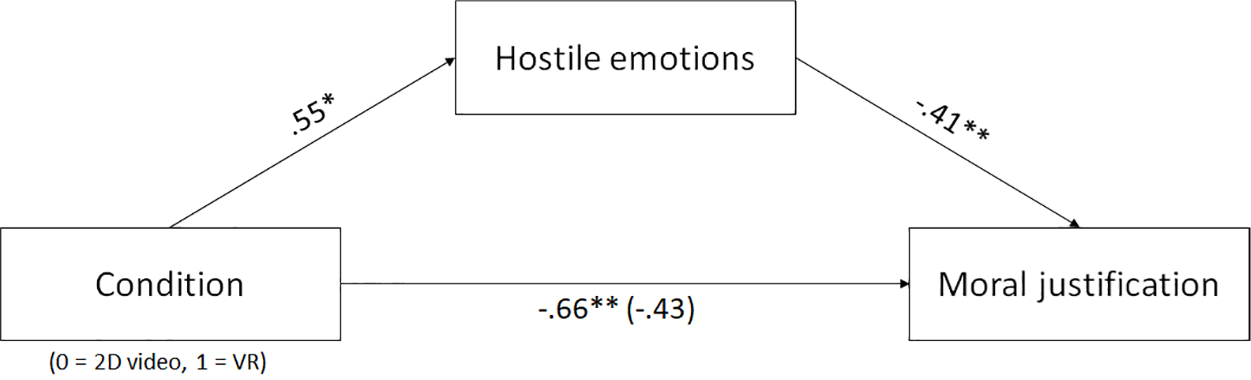
VR reduces moral justification of the ingroup’s actions through increased hostile emotions toward the ingroup actors.
Physiological arousal, presence, and engagement as potential mediators of the VR effect on hostile emotions
Physiology data of two participants were missing due to an error in the recording, and data of 12 participants were removed due to noisy signals. In the remaining sample, the VR condition (n = 43) resulted in significantly higher levels of physiological arousal than the 2D video condition (n = 43) as measured using mean phasic SC, F(1, 83) = 4.08, p = .047, η2 = .05 (see Figure 4). No significant difference was found between the conditions regarding mean tonic SC, F(1, 83) = 2.34, p = .13, which has low temporal resolution and is slow to respond.
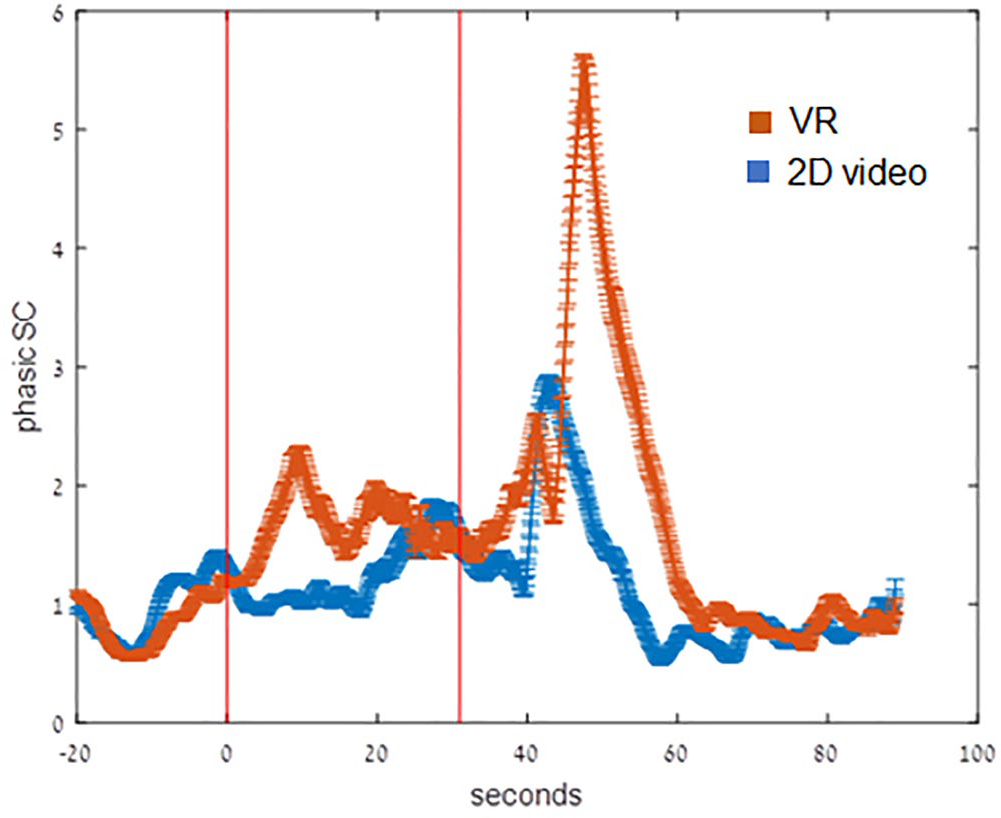
Physiological arousal (phasic SC) for the VR and the 2D video conditions (baseline: –20–0; orientation phase: 0–30; clip: 30–90). Error bars indicate the standard error of the mean.
Participants in the VR condition reported significantly higher levels of social presence, F(1, 97) = 4.35, p = .04, η2 = .04, and engagement, F(1, 96) = 4.15, p = .04, η2 = .04, than those in the 2D video condition. Since women reported significantly higher levels of engagement than men, t(98) = 3.73, p < .001, we also controlled for gender in these analyzes in addition to political ideology. Intercorrelations between the subjective and physiological measures are presented in Table 2.
Intercorrelations between hostile emotions, presence, engagement, and physiological arousal (phasic SC), controlled for political ideology and gender.
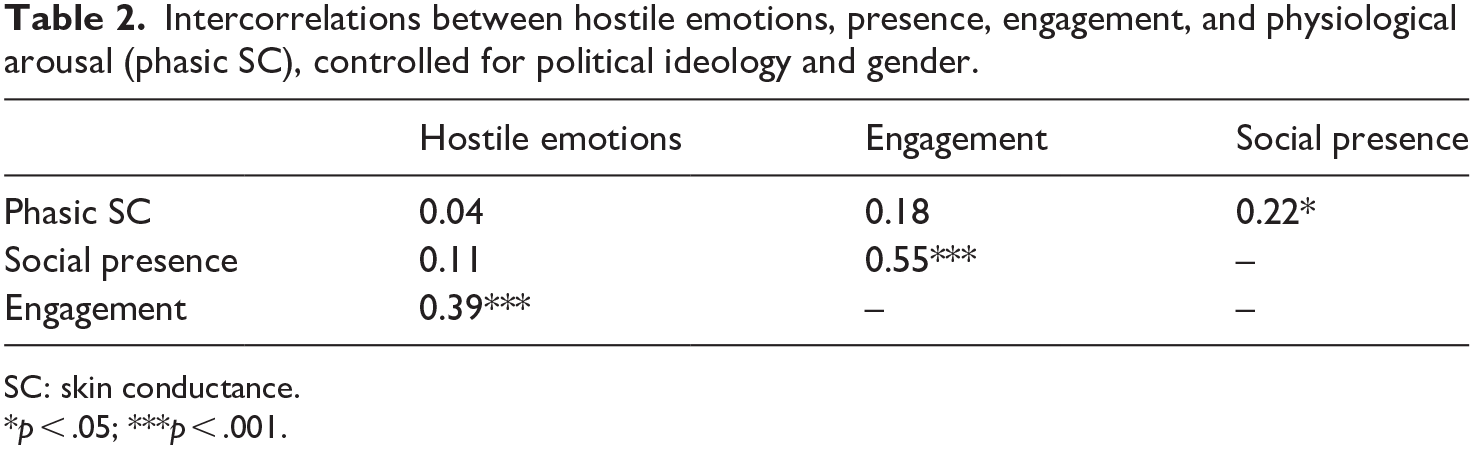
SC: skin conductance.
p < .05; ***p < .001.
Physiological arousal did not mediate the effect of condition on hostile emotions, but we found a significant mediation of condition on hostile emotions through social presence and engagement (see Figure 5). The mediation analysis was performed using Hayes’ (2013) PROCESS macro for SPSS (version 3.0, model 6; 5000 iterations). We specified condition as the independent variable, hostile emotions as the outcome variable, social presence and engagement as two serial mediators, and political ideology and gender as covariates. As expected, the total effect of condition on hostile emotions (b = .55, t = 2.45, p = .02, CI = [.10, 1.00]) was reduced when the mediators were added (b = .47, t = 2.14, p = .04, CI = [.04, .91]). The indirect effect was statistically different from zero (b = .11, CI = [.01, .25]), indicating a significant mediation.
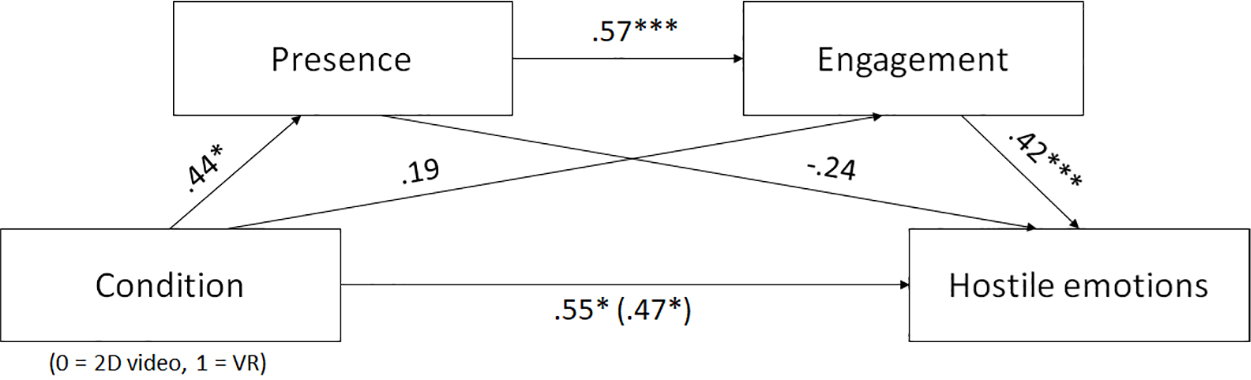
VR induces higher levels of hostile emotions toward the ingroup actors through increased social presence and engagement.
Discussion
This study examined the potential of VR as a new method to induce a more critical perception of the ingroup’s actions in violent confrontations with the outgroup in intractable conflicts as a crucial first step toward their peaceful resolution. We exposed Jewish Israeli participants to a simulated conflict scenario showing the treatment of a Palestinian couple by Israeli soldiers at a military checkpoint. Experiencing this scenario in VR resulted in the judgment of the soldiers’ actions as significantly less moral and less justified compared to watching the same scenario as a 2D video. This effect was not mediated through perspective-taking and empathy with the victimized outgroup (i.e. the Palestinian couple) but through hostile emotions toward the ingroup actors (i.e. the Israeli soldiers).
Challenging the (ultimate) empathy-enhancement capacity of VR
Although participants watched the same scenario in both conditions, the strategic placement of the camera intended to present the Palestinians’ POV was more effective in the VR condition. Participants in the 2D video condition more often felt like a bystander rather than seeing the scene from the Palestinians’ POV. This finding reflects the unique characteristic of VR to immerse participants in a scene, which appears to facilitate the adoption of the intended POV. Watching a video on a screen, however, appears to induce a sense of distance, leading to the feeling of being an outside observer. Despite this advantage, the VR experience did not result in more engagement in active perspective-taking and did not lead to higher levels of empathy toward the outgroup compared to watching a 2D video of the same scenario. As engagement in active perspective-taking and empathy were strongly correlated, the non-significant effect of VR on active perspective-taking may explain why VR did not enhance empathy compared to the 2D video condition. This finding challenges the common assumption of VR being an “empathy machine” (Milk, 2015) that creates effortless perspective-taking, and provides empirical support for a recent critique by Kors et al. (2018). They argue that arousing empathy requires more than simulating the other’s POV using VR techniques. While VR may facilitate perspective-taking ability, it does not replace the complex psychological process of perspective-taking, which requires understanding of another person’s inner experiences and feelings. Hence, immersing participants in the POV of another appears to be a mere technical capability of VR that does not automatically lead to greater psychological perspective-taking, which is needed to evoke empathy.
An alternative reason for the non-significant empathy path to changes in moral judgment of the soldiers’ actions is based on recent findings showing that VR experiences that require head movements to follow a scenario are more likely to lead to emotional arousal (Li et al., 2017), and particularly, enhance empathy (add cross-reference to the article in the special issue that presents these findings). Although head movements were encouraged during the orientation phase in the VR condition, they were not necessary in order to follow the acted scene—as the scenario unfolded in front of the participants’ field of view rather than happening around them. However, the particular scenario presented in this study (i.e. approaching a temporary military checkpoint and confrontation with the soldiers) required that the action takes place in front of the participant. This directorial choice put participants into the situation of becoming the target of the ingroup’s actions and let them experience the soldiers’ aggression directed toward them. Hence, the way in which this particular scene was filmed was more likely to lead to hostile emotions toward the soldiers than triggering empathy toward the Palestinians.
Alternative path to altered moral judgment through hostile emotions
Although experiencing the scenario from the target’s POV did not increase perspective-taking and empathy in the VR condition, it allowed participants to experience a conflict situation from a POV that they do not usually adopt in real life. The immersive experience of becoming a target of the ingroup’s actions led to higher levels of hostile emotions toward the ingroup actors and reduced moral justification of their actions. This effect may be due to a more self-directed perception of the situation. Self-relevance has been found to be a critical factor in moral judgment. Previous studies on moral dilemmas have shown that harmful actions in personal scenarios are judged as less justified than in impersonal scenarios (Greene et al., 2001). Likewise, self-relevance may explain the stronger hostile emotions toward the ingroup actors in the VR condition as indicated by stronger physiological arousal. Having a gun pointed at you in VR is likely to be perceived as more personally threatening than observing the same scenario in a 2D video due to a stronger sense of presence. The positive correlation between physiological arousal and social presence partially supports the arousal theory of presence (Freeman et al., 2005) that claims that physiological arousal leads to a higher sense of presence, although we cannot infer a causal relationship based on our findings. In contrast to previous research that found a positive correlation between self-reported anger and physiological arousal in panoramic video-based VR (Macedonio et al., 2007), physiological arousal was not related to self-reported hostile emotions in this study. Instead, presence and engagement explained the higher levels of hostile emotions in the VR condition. Social presence did not directly influence the emotional response but led to greater levels of engagement (i.e. involvement of the self in the experience), which in turn led to stronger emotional arousal. These findings are consistent with previous research in non-conflictual settings that has identified self-involvement as the key factor of successful interventions for the reduction of racial bias (see Lai et al., 2014).
Potential limitations of this research
Choice of camera position
This study did not present the scenario from an actual first-person POV as the camera was placed right behind the Palestinian couple. This leaves room for interpretation about the role of the self in the interaction, leading to a substantial number of participants (particularly in the 2D video condition) to perceive themselves as a bystander. First-person embodiment in the actors may have led to a less ambiguous interpretation of the participant’s role in the scenario and possibly greater identification with the outgroup actors. Previous research has shown positive effects of virtual outgroup embodiment, for example, regarding the reduction of racial bias (e.g. Hasler et al., 2017), and has demonstrated how embodied perspective-taking can induce greater sensitivity toward victims in other violent contexts, such as domestic violence (Seinfeld et al., 2018). However, it has yet to be investigated how participants would respond to first-person embodiment of an outgroup member in the context of violent intergroup conflict. On one hand, outgroup embodiment may increase people’s ability to take the opponent’s perspective as it visualizes the otherwise mentally simulated self-other overlap and may lead to more positive outgroup evaluations through an increased self-association of the outgroup (see Farmer and Maister, 2017; Maister et al., 2015). On the other hand, embodying “the enemy” in a violent intergroup conflict may activate stereotypes or could be perceived as a threat to the self-concept (see Sassenrath et al., 2016) and lead to negative consequences; especially for participants who hold strong negative attitudes and emotions toward the outgroup.
Real-life transfer and long-term impact
As this study only measured emotions toward the actors in the video and judgment of their (actual and hypothetical) actions, it remains unclear to what extent these findings generalize to perceptions of real-life conflict events. We have initial evidence for the potential of VR to create a long-lasting change in moral judgments of real-life conflict events from another recent study (Hasson et al., 2019) that used the same video material as in this study. Even 5 months after experiencing the checkpoint scenario in VR from the Palestinians’ POV, Jewish Israeli participants condemned the actions of an Israeli soldier in a real-life conflict event (i.e. killing an incapacitated Palestinian militant) more severely compared to those who watched the same scenario in VR filmed from the Israeli soldiers’ POV. Since we did not include 2D video conditions in that study, it remains unclear to what extent VR influenced these effects and whether the same results would have been obtained using 2D videos. However, a recent study by Herrera et al. (2018) conducted in a non-conflictual context has identified behavioral impact and long-term effects as the main advantages of VR-based interventions over non-immersive techniques.
Conclusions and future research directions
Although more research is needed to understand the true potential of VR as a new method for conflict resolution, these findings point into a promising direction. If VR can create a greater impact than traditional media, as demonstrated in this study, it may indeed become a powerful tool for peace-building. However, the benefits of VR over traditional formats may largely depend on how the VR experience is designed. While this study focused on changing perceptions of the ingroup, future research may also explore the potential of VR to induce outgroup-directed changes, such as reducing negative attitudes and emotions toward the adversary, or changing perceptions of the conflict itself. Such research may benefit from including implicit measures to circumvent potential resistance in participants to report positive emotions and attitudes toward outgroup, and initial changes in this direction may also be beyond participants’ awareness. Future research should particularly focus on investigating the underlying mechanisms and facilitating conditions of VR-based interventions for conflict resolution. Understanding when and how VR can lead to positive change in the context of intergroup conflict along with its limitations and potential risks will not only advance theoretical knowledge but is critical for building effective peace-promoting interventions.
Footnotes
Acknowledgements
We thank Joseph Waldman for his dedicated and invaluable assistance in collecting the data.
Funding
The author(s) disclosed receipt of the following financial support for the research, authorship, and/or publication of this article: This research, including media production, was funded by a grant from the European Research Council [335607] to Eran Halperin and a grant from the Israeli Science Foundation [1585-2016] to Noa Schori-Eyal.
Supplemental material
Supplemental material for this article is available online.
