




Abstract
We examine the position of five online-only ‘countermedia’ publications often publicly labelled as ‘fake media’ and use them to indicate how the ‘post-truth era’ takes place. Both academic and public discussions perceive countermedia as separate and distinct from the established, professionally produced journalist media outlets. We argue that the studied outlets are an integral part of the hybrid media environment. Our data show countermedia mainly remediate content initially published by professional Finnish media. We also suggest that media references are used strategically to explicate a relationship with mainstream media, as there are different ways of remediating the mainstream media content. This evidence contributes to the growing body of work criticising the usage of the ‘fake media’ concept and attempts to create a more nuanced understanding of countermedia’s role in its contexts. Furthermore, we suggest remediation as a lens may help scholars understand the integrated hybrid media environment.
Keywords
Introduction
Digital technologies have accelerated intertwining ‘old’ and ‘new’ media logics, forming a hybrid media environment. In response, traditional political news cycles turn into ‘political information cycles’ combining traditional journalism and online interaction of different actors (Chadwick, 2013; Ojala et al., 2018). Beyond changes in the news cycle, hybridisation has had various profound impacts on the media environment. For example, it has become increasingly easy to establish media outlets in the digital domain. Similarly, the role of professional journalistic media as a gatekeeper of public discourse has decreased. Hybridisation of the media environment changes how we perceive and analyse media events (Sumiala et al., 2018; Valaskivi et al., 2019) and understand the relationship of affectivity and media (Papacharissi, 2015). Combined, the transforming media formats and genres and the decrease of gatekeeping have contributed to increased content confusion and resulted in a difficulty of separating editorial content from advertisements or from made-up stories (Einstein, 2016). These changes have been examined under the broad label of ‘the post-truth era’, where ‘fake news’ is seen as a disturbance in democracy. The concept of fake news is also rhetorically used to legitimise professional journalism as the gatekeeper (among many others, Carlson, 2018; Lazer et al., 2018).
Extensive interdisciplinary scholarly efforts have been put into defining fake news and discussing the definitions (Farkas and Schou, 2018; Habgood-Coote, 2018; Tandoc et al., 2018) and methods to detect fake news and mitigate them (Ciampaglia, 2017; Kirchner and Reuter, 2020; Lazer et al., 2018), examining specific cases where fake news is prominent (Nelson and Taneja, 2018; Pyrhönen and Bauvois, 2019) and understanding contextual and media system factors in relation to fake news (Humprecht, 2018). Some attention is also paid to contextualise the post-truth era in relation to the transformations in the media environment and various forms of hybridisation taking place in said media environment. According to Bennett and Livingston (2018), the news articles that seem to be completely false can appeal to deeper emotions in some population groups supporting anti-democratic development. Waisbord (2018) argues that the key challenge of misinformation is not its falsehood but the resulting transformation of the public sphere, leading to more multi-layered and chaotic communication. Because of this, several media and communication scholars have requested more nuanced perceptions on the post-truth era, countermedia and fake news (e.g. Bennett and Livingston 2018; Farkas and Schou, 2018; Habgood-Coote, 2018; Tandoc et al., 2018). Beyond these debates, in other disciplines and public discussions, it is nevertheless common to consider the issue with a clear-cut true-false dichotomy. Therefore, mitigation of the issue is mostly attempted assuming a binary classification (e.g. Kirchner and Reuter, 2020; Lazer et al., 2018).
Responding to the need for more versatile methods to analyse the ‘fake news’ phenomenon, our study asks, How do online-only news outlets that counter mainstream media interact with mainstream media? 1 In order to shed light on the complex relationship between ‘mainstream media’ and ‘countermedia’, we draw on the concept of remediation, the idea that all media builds on other media (Bolter and Grusin, 1998, p. 55), which is important in the early era of new media research. In other words, any form of mediation depends on earlier acts of mediation. This is also true for countermedia outlets – even if unwittingly – as they claim to be the harbinger of the ‘truth’ concealed by mainstream media. Therefore, they actively work along with mainstream media to shape issue agenda (Guo and Vargo, 2018). Thus, in this article, we use the concept of remediation to illustrate the reproduction and alternations of media genres in circulation from context to context. We also demonstrate how content production practises evolve in the hybrid interaction of different ‘news’ outlets.
Our work is based on the analysis of content published in five Finnish online-only countermedia. Given the scale of data, we analyse content using computational techniques: supervised machine learning and network analysis. Our analysis illustrates how remediation can be examined in terms of circulation of media content. We choose to analyse Finnish media to contribute to a perspective of countermedia beyond the Anglo-American setting. Many characteristics of the Finnish media environment make the publication of fabricated facts and content containing disinformation more difficult than in the United States (Humprecht, 2018). Based on our analysis, we observe that remediation is a common strategy for all studied Finnish online-only countermedia outlets. Furthermore, we identify different styles of how the content is remediated and observe differences in the origins of the content remediated across styles and countermedia outlets. Based on these results, we discuss the benefits of using remediation as a framework for examining hybrid media environments.
The article is structured as follows. First, we present how the hybrid media environment has been conceptualised and how these formulations highlight the importance of examining remediation as a feature of the hybrid media environment. We then connect remediation with the research of countermedia and explicate our research questions. Next, we move onto describing the research context, our data set and the mixed-methods analysis strategy. In our results, we demonstrate how countermedia remediates mainstream media content and which media outlets are being remediated. Based on our findings, we discuss how our work continues to criticise the idea of the post-truth era and highlights the importance of understanding countermedia in context. Finally, we discuss the benefits of using remediation as an overarching concept to examine the hybrid media environment.
Hybrid media environment and remediation
In recent years, hybridity has become one of the most widespread concepts in media and communication studies for discussing our contemporary media environment. The versatile uses of hybridity include intertwined development of practises and formats between social media and legacy media (Chadwick, 2013), convergence of producing and consuming media (Jenkins, 2006), globality of media circulation (Kraidy, 2005; Sumiala et al., 2018), co-agency of human and technological actors in the media environment (Latour et al., 1993; Sumiala et al., 2018) and even in new roles of platform companies as the gatekeepers for publicity (e.g. Bro and Wallberg, 2015; Nelimarkka et al., 2019).
Hybridity also impacts how we understand different types of content or genres in media. To illustrate these, Einstein (2016) speaks about content confusion, describing how advertising disguises itself in forms that are indistinguishable from news formats (or fictional genres). There is similar content confusion in the field of news, where fact and fabrication might seem alike in form. Tandoc et al. (2018) suggest that beyond disinformation or propaganda, legitimate genres, such as satire and fabrication, contribute to the publication of false news stories and might cause further confusion. Countermedia utilise this confusion by reframing mainstream media stories (Boyd-Barrett, 2007).
Studies of countermedia have focused on conceptual investigations on the phenomena (Boyd-Barrett, 2007; Farkas and Schou, 2018; Tandoc et al., 2018), audiences and circulation of countermedia stories (Allcott and Gentzkow, 2017; Lazer et al., 2018; Nelson and Taneja, 2018; Pyrhönen and Bauvois, 2019), the impact of these stories on citizens’ behaviour (Lazer et al., 2018; Silverman, 2016) and conditions that have enabled countermedia to emerge (Humprecht, 2018). Computer-science-oriented scholars have also put significant emphasis on detecting countermedia stories (Ciampaglia, 2017; Lazer et al., 2018). These lines of research examine countermedia separately, without the context of the wider hybrid media environment. We argue that countermedia outlets actively imitate and simultaneously challenge the perceived mainstream media through adapting practises, formats and even content from the latter.
To examine countermedia in the context of the hybrid media environment, we expand on the remediation theory. This theory suggests that ‘the media [is] constantly commenting on, reproducing and replacing each other’; thus, media content is dependent on previous mediation (Bolter and Grusin, 1998: 55). Bolter and Grusin point out that remediation has been considered a means of reform, indicating that a new medium is always better than the older one and will bring different, better forms of participation and democracy. We will next elaborate on how remediation serves as an umbrella concept for studying the hybrid media environment.
Remediation styles: How is content remediated?
The flow of content and ideas between different media are studied under intermedia agenda-setting research. This research highlights that media co-exist and influence each other. Classical studies in this field have examined how news topics in one media outlet are influenced by topics discussed in other media outlets or how the agenda of a medium is set in the context of other media. Nowadays the framework is also used to study the relationship between social media and mainstream media (Rogstad, 2016; Su and Borah, 2019). Intermedia agenda setting has rarely been used to study countermedia; we have found two examples demonstrating that there are flows of ideas and content between countermedia and mainstream media. Guo and Vargo (2018) show that countermedia react to content on other media sites. This suggests that intermedia agenda setting occurs at least to some extent between countermedia and mainstream media. These results, however, suggest selectivity. For instance, news stories on Trump were more prominent on countermedia sites than those related to Clinton in the 2016 US presidential election coverage (Guo and Vargo 2018). However, it is unclear whether countermedia can influence the agenda of mainstream media. Vargo et al. (2018) showed circulation of misinformation content between countermedia and partisan media sites, while this was not observed to take place between countermedia and mainstream news media. From these findings, the role of countermedia on influencing mainstream media or vice versa is unclear. Based on these results, it is inconclusive whether countermedia had an impact on affective dimensions of mainstream media reporting rather than the media agenda (Guo and Vargo 2018) or whether there was no clear effect whatsoever (Vargo et al. 2018).
The mixed results can be explained by different focus on the content. Guo and Vargo (2018) examined both content and its affective dimensions, while Vargo et al. (2018) examined content only. Focusing on content seems to be more aligned with traditional intermedia agenda-setting studies. However, in the case of countermedia, more nuances may be required to understand the flow between media outlets. Evidently, only focusing on content alone does not capture what countermedia do.
Instead of focusing only on the flow of content (like intermedia agenda setting), we examine how content is remediated. We recognise that there are different styles that media can use when doing remediation. One remediation style available for countermedia is to adapt mainstream media content and transform its salient aspects to fit countermedia’s perceived reality. Such reframing has been observed as one style in previous research: the news story is presented in a different perspective (Boyd-Barrett, 2007). In an online media environment, resources are limited for original content production. This remediation style may therefore be useful (see Castells, 2011; Meraz and Papacharissi, 2016, among others). However, this type of remediation style would not be detected by observing flows of content between mainstream media and countermedia. Reframing is not only about content flow but more importantly about how countermedia use and change mainstream media content. Remediation styles highlight that countermedia make choices about how to present the content being remediated. This is true for all media. Media stories – even if they have unique frames – are an assemblage of other media stories (Bell, 1991). The assemblage creation is an active choice where various styles can be envisioned, including direct remediation without any distortions. Reframing content demonstrated one style of remediation, where the remediation process distorts the original content. However, as researchers have not focused on remediation, we do not know about the inventory of different styles available during remediation choices.
Origins of remediation: Whose content is remediated?
To understand remediation, we must also examine which actors are involved in it: Who is remediating whose content? For example, Mallapragada (2010) shows how remediated content was consciously chosen from a political perspective to support certain established actors. Moving forward, Chouliaraki (2015) highlights how amateur content was remediated to emphasise authenticity. In other words, politically important aspects such as authenticity and affective reactions drove the origin of the content chosen for remediation. To understand actors, it is important to remember that remediation takes place in a network of media outlets (Bolter and Grusin, 1998).
Hyperlinks are a tangible demonstration of remediation. They allow users to move from one website to another and from a news story to a source or another news site. This is how hyperlinks create an affordance in websites (Hutchby, 2001), which allows creators of websites to establish connections between different content, actors and organisations. There is a long tradition of studying hyperlinks (e.g. Maier et al., 2018; Rogers, 2017) because of the affordances hyperlinks provide in connecting organisations and actors, understanding structures and identifying alliances. Sometimes a hyperlink is seen to indicate an endorsement of content (Rogers, 2017), and given how links are used in search engines to create relationships between two sites, this interpretation has some validity. Furthermore, a hyperlink is a strategic and explicated relationship: remediation is made visible when content is linked or named. This is how following hyperlinks contributes to understanding relationships between actors in remediation activities.
Hyperlinks are rarely used by journalists and media sites (Himelboim, 2010; Karlsson et al., 2015). When they are used, they are used for specific purposes, such as to provide access to background information on the discussed matter (De Maeyer, 2012; De Maeyer and Holton, 2016), to increase transparency of the writing process (De Maeyer and Holton, 2016), to cite information from other sites or stories (Ryfe et al., 2016), to give credit for the content to other journalists (De Maeyer and Holton, 2016) or to increase the piece’s legitimacy and credibility (De Maeyer and Holton, 2016; Duffy et al., 2017). According to Duffy et al. (2017), linking is also used as a way to introduce illustrative additions, such as user-generated content. These usages suggest that in mainstream media journalism, linking is utilised to increase the trustworthiness of a news story and perhaps also to increase the transparency of journalistic practises.
Summary and research questions
We argue that research on countermedia has focused on countermedia in a void. This approach is not sufficient in the hybrid media environment in which different media forms, genres and outlets have an impact on each other and take part in the circulation of meanings and content (for these ideas of hybridity, see Bro and Wallberg, 2015; Chadwick, 2013; Jenkins, 2006; Kraidy, 2005; Latour et al., 1993; Sumiala et al., 2018). We contribute to this field by exploring the idea of remediation across different media as a guiding concept of the analysis. To illustrate countermedia through remediation lenses and address challenges in countermedia studies, we emphasise two dimensions.
First, although scholars have been interested in the circulation of content and ideas between countermedia and mainstream media, results have been mixed (Guo and Vargo, 2018; Vargo et al., 2018). As it appears, the reason for mixed results is in differences of focus – either on content or its representation. We argue that the latter, more extensive focus, is in order. Therefore, from traditional analysis of content flows, as we shift our focus to the representation of content, the question widens into styles of remediation. For example, one can envision that remediation can be supporting, derisory or even challenging the mainstream media and their agenda. To understand the styles further, we acknowledge that media stories in the hybrid environment often actually are assemblages of other media stories (Bell, 1991). In the context of countermedia and remediation, the style repertoire is nevertheless still unclear. To examine this, we pose the following questions:
Second, while hyperlink analysis is often used to study relationships between organisations (e.g. Maier et al., 2018; Rogers, 2017), we are not aware of studies that would have utilised hyperlinks when examining the relationship between countermedia and mainstream media. This approach, however, would seem pertinent as links are used to build trust between journalists and their audiences in journalistic media (De Maeyer, 2012; De Maeyer and Holton, 2016; Duffy et al., 2017). The issue of whose content is remediated is also a political question (Chouliaraki, 2015). An analysis of organisational relationships and the politics of remediation processes is feasible in increasing the understanding of the hybrid media environment. To understand these relationships and move to discuss the politics, we ask the following questions:
Data and method
Study context
Finland has a strong media sector with a high media circulation and trust in mainstream media (Newman et al., 2017). While political polarisation has been increasing, the level is still low in cross-national studies (Palonen, 2017). Furthermore, the media ecosystem is not extensively market-driven and is supported by the state in various ways such as laws for protecting press freedom, press subsidies and a strong public-service broadcasting system (Hallin et al., 2004).
In other words, our overall question about remediation and countermedia sites is in a context where professional mainstream media have high legitimacy and social relevance. These features can limit the operations of countermedia sites. For example, the significant role of tax-funded public broadcasting has been posited to mitigate the impact of non-factual or biased news reporting (Humprecht, 2018). Similarly, high subscription rates of newspapers and trust in news media as well as lower political polarisation limit the expansion for countermedia sites. Therefore, this study widens perspectives on countermedia, which are currently predominantly studied in the context of the United States. Cross-national studies have suggested that the modus operandi of countermedia sites is highly contextual (Farkas and Schou, 2019; Humprecht, 2018; Pyrhönen and Bauvois, 2019). Our work contributes to this increasing body of knowledge.
Despite media environmental features potentially limiting countermedia, Finland has had its fair share of countermedia outlets. Studies on these countermedia sites have demonstrated how they act as politically charged alternative knowledge authorities in the Finnish media environment (Ylä-Anttila, 2018). Motives for people reading and circulating content produced by countermedia have also been studied (Noppari and Hiltunen, 2017; Noppari et al., 2020). Findings contribute to the international field on countermedia research but do not answer how countermedia are positioned in the wider media environment.
Data collection and pre-processing
We applied a two-source process to choose the countermedia outlets for our study. First, we used previous academic research that identified MV-media as a countermedia site (Noppari and Hiltunen, 2017; Ylä-Anttila et al., 2019; Ylä-Anttila, 2018). To increase the sample, we included sites recognised as countermedia by mainstream media. We used listings by Vehkoo (2016), which identifies populist ‘fake news’ sites in Finland. Vehkoo is an award-winning freelance journalist specialising on topics related to disinformation, fact-checking and the post-truth era. We ended up excluding some of the outlets on Vehkoo’s list, as they were no longer online. One was excluded because it operated only in tabloid format with no online presence. Based on this process, we chose to explore MV-media (translated in English: WTF-media), Nykysuomi (‘Contemporary Finland’), Uutismaailma (‘News of the World’), Finnleaks and Kansalainen (‘Citizen’). None of these sites were part of the Council for Mass Media (CMM), the self-regulation body for professional journalistic media in Finland. MV-media is clearly the largest of these outlets (see Table 1 for distribution).
Articles per year, by medium.
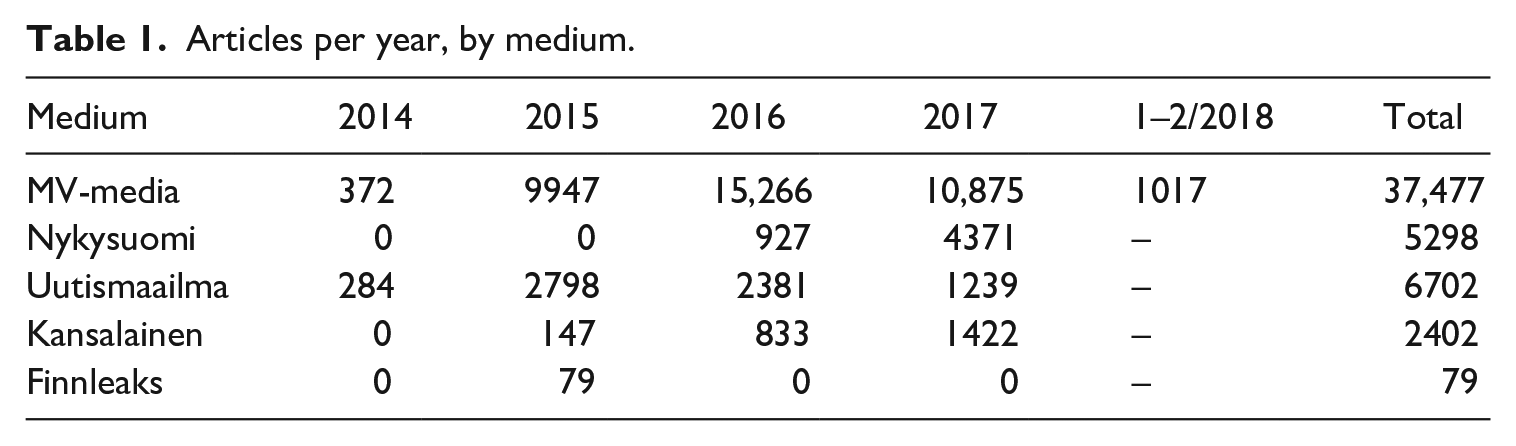
The data were collected via web scraping, with 52,003 articles collected in total. The data consist of content from August 2014 through 1 March 2018 and were collected during January, February and March 2018. The web-scraping approach allowed us to collect both the textual content and the structured mark-up (HTML). This mark-up exposed factors related to the layout, such as image position and the use of stylistic features (e.g. quotations, subheadings and use of boldface).
Given that these are online publications, we were concerned about missing data, that is, articles removed after initial publication. To verify our data set, we checked that the overall volume and shape of distribution over time for MV-media were similar to previously documented findings (Nieminen, 2018). Furthermore, we verified that when there was a year without data from a medium, the medium in question was not in operation in those years. These checks assured us that missing data were not a major concern with the data set.
To address RQ1, the reframing processes of Finnish countermedia sites, we explored a single case only, MV-media. 2 The single-case-study approach addresses validity concerns and provides us with findings on the most active countermedia site.
To answer RQ2, we needed information on the sources of the articles. These were extracted in the pre-processing stage with computational tools. We identified URLs and hyperlinks as well as other identifiable sources (such as those listed under ‘Sources’ at the end of an article) from the article data. To simplify comparison between these sources, we manually edited the identifiable sources into hyperlink form. For example, ‘Source: Daily Mail’ was transformed into ‘http://www.dailymail.co.uk/’. There is a difference between an outlet referring to a general source this way and giving a direct link. Nevertheless, an indirect reference indicates countermedia’s attempt to identify how other media sites have published content about the topic. Finally, we cleaned the data set of hyperlinks related to advertising. Importantly, to avoid misrepresenting the number of sources in the article, we focused only on unique sources cited – not on the number of citations in each article. Otherwise artificial inflation could occur when the same source would be indicated both with a hyperlink in the text and at the end of the text. Via this approach, we identified 7650 unique sources in total.
Analysis methods
To answer RQ1a, we conducted an analysis in two stages (see Figure 1 for an overview). First, we performed traditional qualitative analysis, identifying the remediation phenomenon. The process was similar to frame analysis, where scholars analyse which aspects of perceived reality are made more salient than others (Entman, 1993). The approach has mainly been used to study framing of issues in news, examining how a particular topic is framed in news stories (classic topic is the different issues related to nuclear power; Gamson, 1989). Our focus was different as we did not study the framing of an issue but focused on understanding how each article related to the mainstream media source discussed and how the article remediated mainstream media content. To systemise our approach, we iteratively developed a classification framework to form a codebook. After this, the coding was tested by two researchers. Disagreements were discussed, and the codebook was further clarified. Finally, we carried out validation of these models and computed the intercoder reliability on the classification, achieving a good intercoder reliability (Cohen’s κ $$ 0.59, seen good by Fleiss et al., 2013). Finally, a random sample of 1000 articles containing references to mainstream media (9.9% of all such articles) was classified in accordance with the final codebook, shown in Table 3.
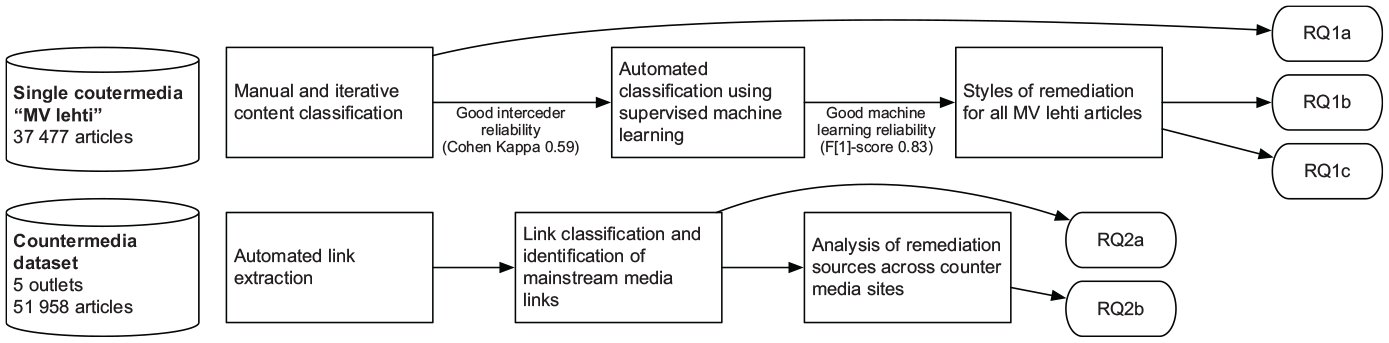
Steps in the data analysis process.
Other research questions (RQ1b and RQ1c) required classification of all articles that made a media reference. Because the total number of remediated links in MV-media was 10,085, computational analysis was suitable for the classification task. In terms of methodology, computational frame analysis can be approached via either supervised (Burscher et al., 2014) or unsupervised (Greussing and Boomgaarden, 2017; Hellsten et al., 2010; Miller, 1997; Nicholls and Culpepper, 2020; Pashakhin, 2016) machine-learning methods. The latter does not produce theory-motivated categorisations; their outputs (such as the topics of Pashakhin, 2016) then need to be interpreted as frames (Carragee and Roefs, 2004). We used supervised machine-learning methods for this task to avoid the ex-post theorisation of categories produced by unsupervised machine learning. This ensured that our computational frame analysis corresponded to the qualitative work we conducted to understand the phenomenon and the idea of remediation analysis.
We used best practises from supervised machine-learning methods. We used the Tree-based Pipeline Optimization Tool (TPOT; see Olson et al. [2016] for details) to explore several models and hyperparameters to find the model with the greatest overall accuracy. The machine-learning models consider random forest models, linear models and support vector machines (SVMs), among others, and their suitability for the problem (Olson, 2018). Working on the basis of the model optimisation, we used a random forest model (Breiman, 2001; Ho, 1995), which is an extensively used model capable of both regression and classification (Liaw and Wiener, 2002; Lichtenwalter et al., 2010; Weng et al., 2013). The strengths of the random forest model for this task are its robustness for overfitting to the minor features and ease of using it (Liaw and Wiener, 2002).
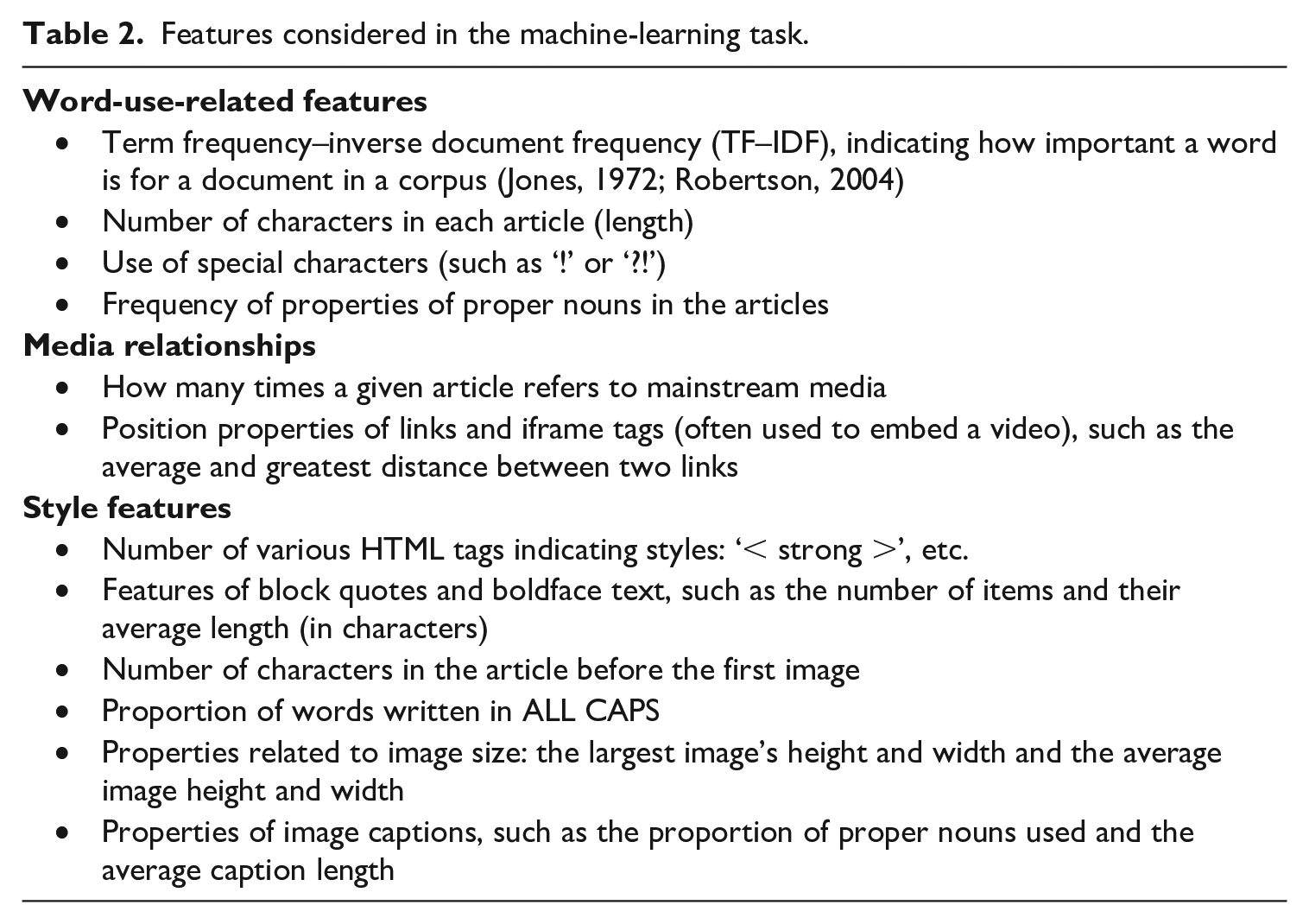
We used features focused on word counts, the media relationship and the style (see Table 2 for details) and achieved accuracy of 85% for the test data. For the F[1]-score, we achieved a weighted average of 0.83 and unweighted average of 0.63. These were good enough to warrant further analysis. The final proportions described in the article have been adjusted to minimise classification errors (Hopkins and King, 2010).
Features considered in the machine-learning task.
To answer RQ2a and RQ2b, we used network analysis (see Figure 1 for an overview). The two-mode network consists of countermedia sites and their sources. To better understand the role of sources in the media environment, we further grouped them into categories that reflect the type of information source. We used previous classification by Nelimarkka et al. (2018) to examine different publishers based on their scope (national media, local media, international media) or publisher (media published by political parties, organisation-published media) (see Table 4 Panel A for summary). Overall, the classification framework covered 73% of the domain occurrences in the countermedia articles, which was enough in light of the power-law nature of domain occurrences (i.e. sites not classified had a small number of occurrences).
To describe the media environment perspective, we drew a force-directed network map of media sites and sources used, and then conducted basic network analysis of degree in the network. Furthermore, we examined whether the countermedia sites differed in profile (i.e. whether they diverged from each other in the kinds of sources used). For this purpose, we utilised χ2 testing to check for differences.
Findings
RQ1: Ways of remediation
Our first dimension of remediation focused on content and the ways countermedia remediates mainstream media content. We analysed only articles that included a reference to a mainstream media outlet. This meant that we analysed 31.5% of the articles published by MV-media (we conducted a single-case study; see Note 2 for further details). This proportion already indicates that remediation is not a rare occurrence. Over 10,000 articles remediated mainstream media content. We return to this later for RQ2, where we examine several countermedia sites.
Next, we conducted a manual classification to understand what kinds of styles of remediation are used in the countermedia site. We iteratively classified a random sample of 100 MV-media articles. During this process, we observed three distinct styles of remediating content. These styles were not media frames in the traditional sense, but rather they emphasised how the countermedia sites refashion content from mainstream media (see Table 3 for details). The styles show that the remediation process is not a one-to-one replication of the content, but rather countermedia sites edit the content so that it fits into their perceived reality or the media frames they seek to deliver to their audiences. After the iterative process, we conducted a validation using intercoder analysis. A good Cohen’s κ (0.59) was achieved in the final stage, suggesting that the classification was solid for further analysis (Fleiss et al., 2013). Based on this, a total of 1000 articles were classified for machine-learning analysis.
Three remediation styles used in countermedia sites.
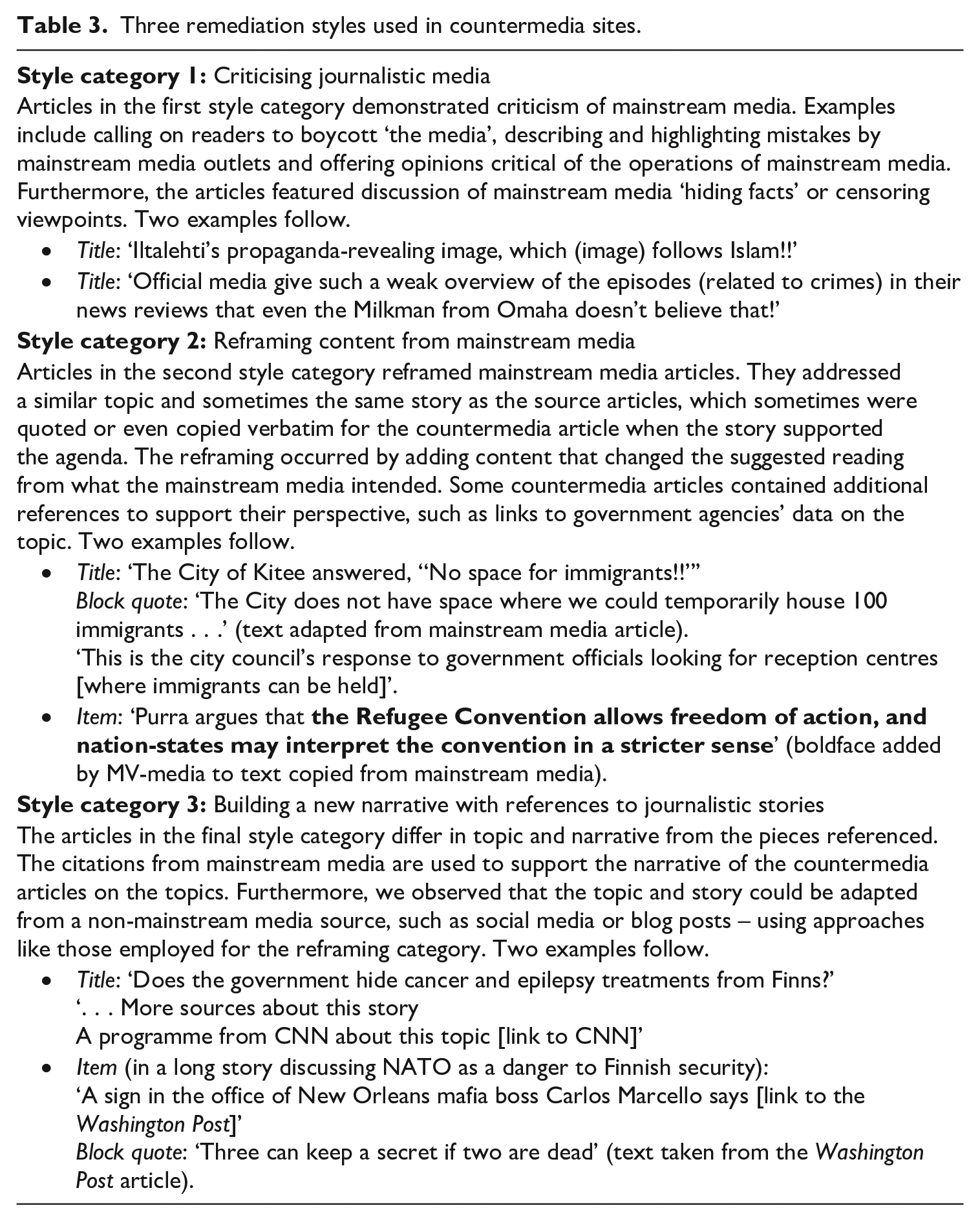
When examining remediation on a countermedia site (see Table 3), we observed that there are differences in the degree of original content produced by the countermedia site in these news stories. Category 3, original narrative, showed that countermedia sites can produce original content but still remediate mainstream media sites. The content remediated from mainstream media is surrounded in a novel narrative, and mainstream media ideas are used to supplement their content and provide additional evidence.
Categories 1 and 2 demonstrated more similarities with the mainstream media content, indicating a lower degree of original content production. Because of this, one might even argue that a strong intermedia agenda-setting effect is taking place. When a topic such as refugees is discussed in the mainstream media, the countermedia react by publishing a story about refugees. However, closer inspection showed that such thematic similarities did not capture the complexity of the remediation process. Instead, the stories seemed to challenge mainstream media while remediating the stories.
We observed how countermedia remediated mainstream media content with the only purpose of criticising the mainstream media and challenging their trustworthiness (Category 2). An alternative approach to challenge mainstream media was to copy content at the story level but reframe the story to highlight countermedia’s perspectives, opinions and challenges (Category 1). This shows an advanced model of remediation. The content being remediated is transformed significantly to communicate a different media frame and political stance. Our inspection showed that this was achieved through small changes in the story, such as adding a few sentences of additional text or using stylistic features. In our analysis, these stories did not criticise the media outlets that published the story. Their aim was instead to give an alternative interpretation of these stories based on novel framing – the only original contribution to the story.
To quantify how much of these three different ways of mediation were used, we scaled the classification to cover all the over 10,000 articles that made a reference to mainstream media sources using machine-learning approaches. We observed that most remediated content was copied at story level and then reframed by the countermedia (81% of articles). The criticism frame was the second-most popular, with 10% of these articles belonging to that category, and the remaining 9% developed their own narrative and explicitly used mainstream media for background information and sources. While these numbers were within our sample, it is worth mentioning that from all content published in MV-media, remediation through story-level copying forms was present in 26% of all articles. This signifies the importance of remediation as a mechanism for content production in countermedia.
Furthermore, the analysis on all content showed that the ways each mainstream media outlet are remediated differs for media outlets. This is the case when examining high-level classification of media sources (see Table 4 Panel A, χ2 = 72.6, df = 18, p < .001) and individual high-circulation Finnish mainstream outlets (see Table 4 Panel B, χ2 = 79.587, df = 8, p < .001).
Types of framing processes.
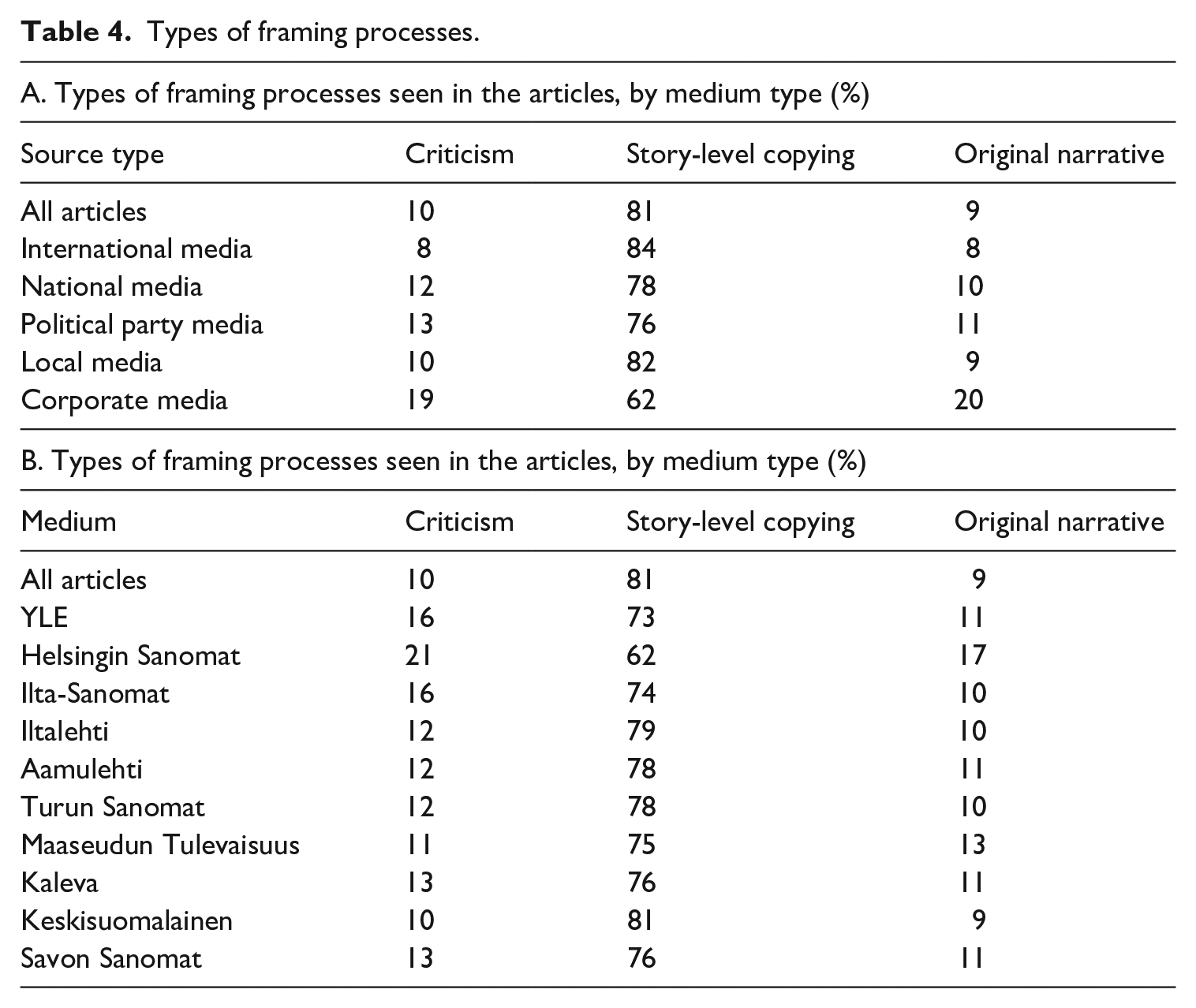
At the high-level media genre classification, we show that, instead of writing all stories using the same pattern, different media categories as well as individual media outlets are subjected to specific remediation processes. For example, international and local media sources are used more extensively for story-level copying and reframing, potentially as they are less familiar to nationwide readers and therefore have fewer potential targets for criticism. Instead, nationwide high-circulation mainstream media and political party media, which have explicit political affiliations, seem to be more criticised by the countermedia outlet, potentially seeking to challenge the national mainstream media or rivalling political approaches. The situation with corporation, union and interest group media is mixed. They are highly criticised but also used extensively for original narratives – potentially because of the specialist nature of these publications.
The detailed analysis per the 10 most popular media outlets (see Table 4 Panel B) illustrates the general observation further. The analysis reveals three outliers: YLE, Helsingin Sanomat and Ilta-Sanomat. These outlets are those most severely criticised in MV-media. YLE is the tax-funded national broadcasting company; Helsingin Sanomat has the highest circulation of news stories and is also considered ‘quality’ press, setting national media agendas; and Ilta-Sanomat is a sister magazine with a bit more yellow press focus. The rest of the media outlets are regional newspapers, where it seems that more focus is put to conduct story-level copying than towards criticism. Thus, differences observed could present how examination of ways of remediation demonstrate how the countermedia position themselves in the Finnish media environment and how they ally or challenge specific media outlets.
Finally, we observe no temporal developments in remediation. As Figure 2 shows, our analysis did not reveal clear trends or evolution on the use of different ways of remediation during the observed timeframe. This suggests that the different styles of remediation appeared early in the existence of the outlet and seemed rather stable. This could be interpreted as indicating several things: it could be that the editors had strategic discussions on how they could counter the mainstream media via remediation, the production resources would strongly favour specific forms of remediation or different authors have different styles of remediation. The strength of the copy-level story as remediation includes its easy production but may also describe the preferred styles these outlets have to engage with the wider media environment.
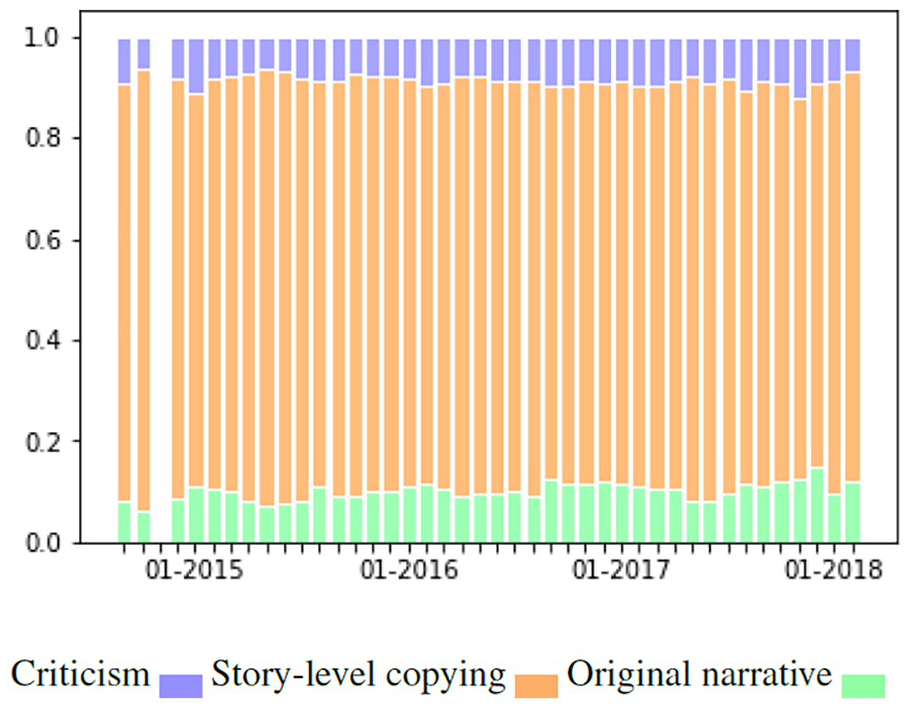
Distribution of MV-media’s framing processes over time.
RQ2: Origins of remediation
Our second research question was about the sources: How do countermedia websites explicate used sources and sources that are used? Overall, our results say that countermedia sites actively use sources. Most of the articles published (75.9%) indicated a source, either a reference or a link to external information that contributed to the content of the article. Three of the outlets, MV-media (85.3%), Nykysuomi (84.7%) and Finnleaks (84.8%), had high numbers in this regard, while Kansalainen (69.7%) and Uutismaailma (19.9%) seemed to be outliers wherein this practise is less common. To understand remediation, we again focused on what appear to be media sources.
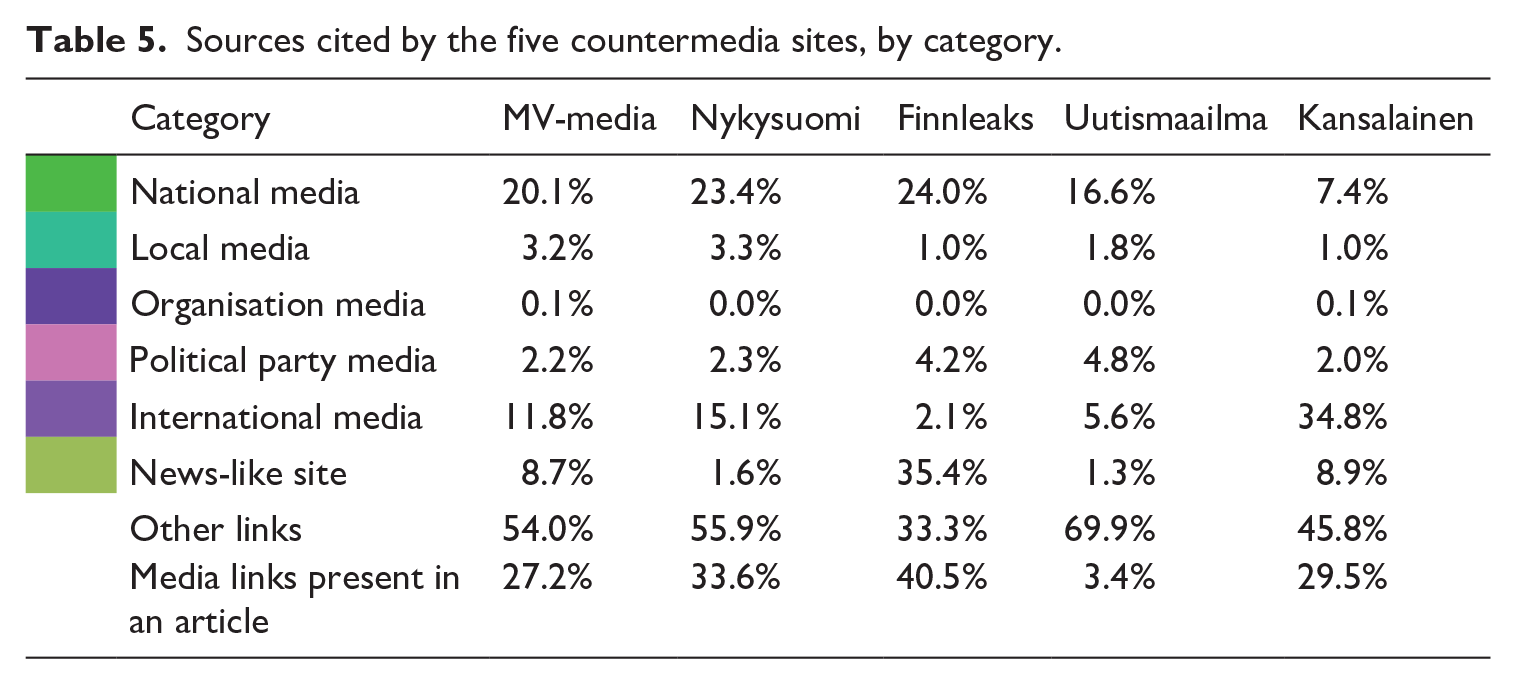
Our results indicate that referenced media sources are common in all five studied countermedia sites, being present in over one-quarter of all articles published by the media outlets. Table 5 shows the distributions of different media outlet types per countermedia sites, indicating that countermedia differ in sources they use (χ2 = 103.19, df = 20, p < .001). MV-media, Nykysuomi and Finnleaks actively remediate national media sources, while Uutismaailma and Kansalainen are less active in remediating them. Instead, Kansalainen is actively remediating international media outlets, and Uutismaailma is particularly active in remediating political media. There seems to be overall less interest in remediating local media or organisational media. As the topics in focus of countermedia sites (such as immigration) are less local and more national, this is not surprising. Furthermore, we observed that countermedia sites are less active in remediating other news-like sites that share similarities with themselves. The cases of countermedia remediation mostly relate to using previous publications in the same countermedia site as sources. These characteristics indicate that countermedia are actively engaged with the national media landscape.
Sources cited by the five countermedia sites, by category.
A more detailed analysis shows that each countermedia site remediates various media sites (see Figure 3). There are a few central international, national and local media sources that are remediated across most of the countermedia sites. Each countermedia site has a large pool of unique local and international sources that are not remediated by other actors. These differences demonstrate how remediation is not only from a selected few core sources but seeks to engage a spectrum of different media sites.
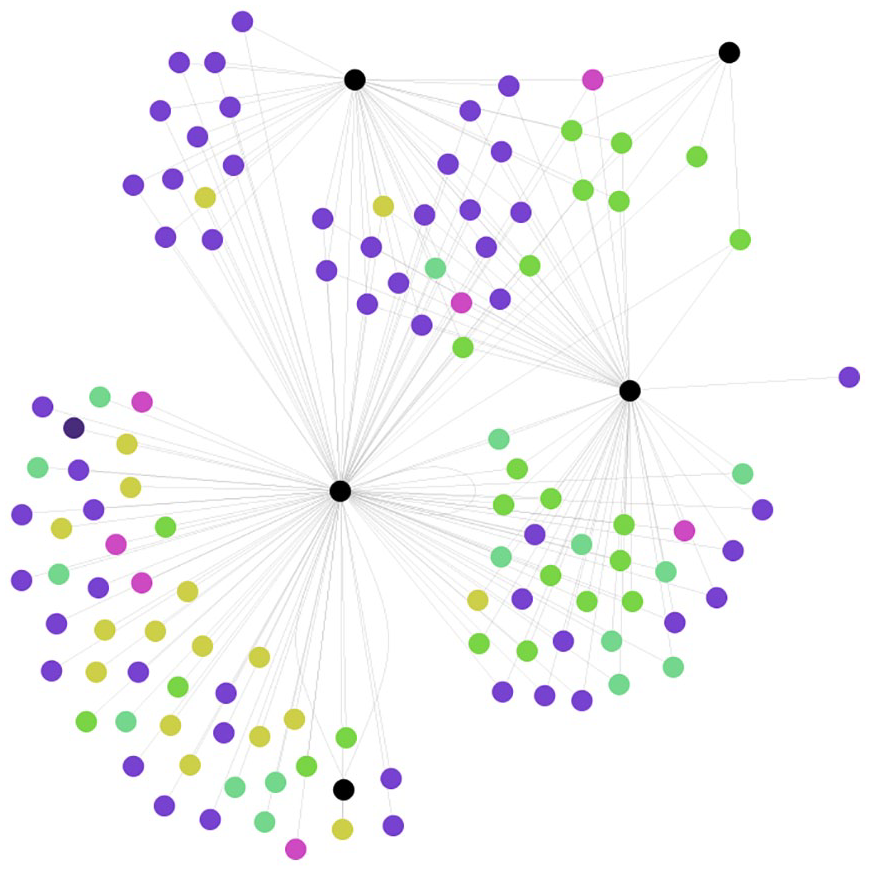
Map of the five countermedia sites (in black) and what media sources they remediate. For a colour legend, see Table 5.
Therefore, we conclude that media sources are an important form of remediation for all countermedia sites. Furthermore, the origins of remediation are a versatile group of media sources, mostly from national or international media outlets. We observed differences between countermedia sites, which suggest remediation may be a more strategic choice than all countermedia sites reacting to breaking news of a few selected important media outlets. Based on these, we consider that countermedia sites may have a rich perspective of media narratives that they seek to remediate and challenge. They also take part in remediating international media debates in Finland.
Discussion
Our work shows that various styles of remediation take place in the hybrid media environment, providing a nuanced description about the relationship between countermedia and mainstream media. Our analysis shows that in the case of MV-lehti, approximately one-quarter of all content published in the countermedia is remediated from mainstream media through reframing the narrative. Beyond reframing, remediation took place through media criticism and using media as a source to support original media production. Based on the significant content adapted and reframed from mainstream media, our work provides empirical support to the increasing discussion on the challenges of the post-truth era or fake news (Bennett and Livingston, 2018; Farkas and Schou, 2018; Habgood-Coote, 2018; Tandoc et al., 2018). We observed that a significant proportion of countermedia articles are highly opinionated pieces that comment on current events.
Based on these results, we argue that countermedia should be examined as an integral part of the hybrid media environment. In the hybrid media environment, traditional media and new media practices intertwine and co-develop (Chadwick, 2013), the roles of consumers and producers become blurred and intention behind content is hard or impossible to detect. Therefore, countermedia are not in an isolated world. Countermedia are a part of this hybridisation process, and they make use of the affordances of digital technology in developing their practices. In the context of Finland, rather than producing their own content or simply fabricating lies, the countermedia circulate and remediate mainstream content in different ways, criticising and reframing their content in the process. There are differences between different countermedia outlets in how these practices are implemented. For example, we found that 35% of references in countermedia outlet Kansalainen were to international media, while the same number was 2% in Finnleaks. Similarly, we showed that MV-media applies different remediation styles for different national media outlets.
Beyond observations on countermedia, we suggest that thinking about remediation, understood broadly as a process where media build on existing media, supports the analysis of the hybrid media environment. Our experiences show that focus on remediation provides a clearer perspective on the relationship between different media outlets as well as similarities and differences between them. Using remediation as a lens allowed us to discuss actors, sources and content involved and thus position the countermedia into the hybrid media environment.
Countermedia in context
Our analysis highlights three contextualisations for countermedia. First, countermedia are a part of the wider media context and acts within it; second, countermedia take different operational approaches depending on contextual factors; and finally, understanding audiences and their perceptions of the hybrid media environment may help to move the research field further.
Our work suggests that studying countermedia practices in relation to other media outlets increases understanding of the processes at play in the hybrid media environment. We showed that countermedia outlets remediate mainstream media outlets differently. We demonstrated a clear division: the national broadcaster YLE and the largest national daily Helsingin Sanomat gain most attention and are criticised more heavily than other outlets in countermedia. Evening papers – the yellow press in Finland – get more lenient treatment. We believe that this finding relates to the populist communication strategies (de Vreese et al., 2018) that the yellow press typically employs. These strategies include invoking elite criticism, claiming to be the voice of ‘the people’ and stirring up affective reactions towards ‘outsiders’ – usually immigrants. These strategies align with the interests of the countermedia observed here, which may explain the unison between countermedia and the yellow press.
Our research cannot explicate why countermedia use specific remediation styles. Why do these outlets depend on the mainstream media that they seek to critique? All five studied countermedia sites significantly utilised links to mainstream media in their content. Based on this, we are drawn to suggest that the remediation of mainstream media content is a shared structural issue. Obviously, remediating media content is a resource-effective solution. Previous research has indicated that a lack of resources can lead to this kind of media commentary (Boyd-Barrett, 2007). However, this does not explain why countermedia sites directly reference their sources, sometimes as explicitly as writing ‘Sources’ at the end of the stories. Considering journalism studies (Ballinger, 2011; De Maeyer, 2012; De Maeyer and Holton, 2016; Mourão and Robertson, 2019; Ryfe et al., 2016), this mechanism might be used to increase legitimacy and credibility. One of the reasons why this referencing was visible in our data could be the high-level trust that Finns have for mainstream media (Newman et al., 2017), making the professional journalist media an important point of reference and legitimating force. Beyond such media environmental characteristics, affordances available on the Internet make it easier to explicate relationships between countermedia and mainstream media. Affordances of hyperlinks, for instance, allow drawing connections between content and organisations and can strengthen transparency and contribute to building trust in what is being presented. Hyperlinks are not novel, but their use in journalistic media is rare for commercial reasons: Hyperlinks can direct users away from the site to potential competitors’ pages. In the case of countermedia, usually produced by volunteers, enthusiasts or activists, such concerns are not as prominent. To clarify these assumptions, more cross-national research is required into the operation and remediation practices of countermedia.
Finally, countermedia outlets can be interpreted as kind of parasites in the hybrid media environment, living on mainstream media and their outputs. This interpretation gains support from the fact that some of these countermedia outlets have been sentenced in court for infringements of mainstream media copyrights. However, this interpretation also needs some caution as countermedia in Finland focus mainly on challenging the mainstream media through reframing the mainstream media discourse or directly criticising them rather than simply plagiarising the news pieces as such. To increase the understanding of the impacts of countermedia, we would need more research on how well users of countermedia recognise the political drivers of countermedia reporting.
Based on our qualitative work, we argue that the agenda is hardly hidden and instead often in bold in the first paragraph of the story. Thus, traditional audience research can help to further contextualise countermedia. Examining how audiences process countermedia stories in relation to the development of their opinions would seem to be a beneficial research direction. This line of thought highlights the critical role that media literacy has in the hybrid media environment, where various actors and motives can easily publish content that may appear like journalistic news. There is also a grave need for increasing understanding of the overall functioning logics of the hybrid media environment and the relationship between mainstream media, countermedia and social media, where provocative and affective content gain wide circulation and remediation with known societal ramifications. Issues of potential manipulation should also be recognised by all media users.
Remediation as a perspective
Using remediation as a guiding lens, we showed that countermedia are a very integral part of the hybrid media environment and a part of an evolving ecosystem where different actors are in constant interaction.
Historically, the concept of remediation has been used to understand how new media formats replicate and build on more traditional media formats, explicating the materiality of media: looking at a photo of the Mona Lisa through digital display means that the screen remediates the photo of the painting (Bolter and Grusin, 1998). More significantly, these ideas have been used to understand and examine how digital media formats could imitate their non-digital counterparts. We expand the concept significantly to focus not on format (‘how’) but on content (‘what’) and actors (‘who’) to make remediation relevant for the study of the hybrid media environment.
Various theories exist on how we should study the relationship between a medium in relation to the wider media ecosystem. There are also various methodological approaches to explain how media use content and ideas produced and published by other media. These theories, however, are limited in their scope. For example, intermedia agenda-setting research focuses on the flow of agendas between different media. Thus, the intermedia agenda-setting theory does not capture the idea of reframing, which provides a more relevant contribution in the context of the hybrid media environment than observing a flow of salient agenda issues. The challenge that media and communication research face relates to the diversity of changes ongoing in the hybrid media environment (which are characterised differently across scholarship, for example, Chadwick, 2013; Jenkins, 2006; Kraidy, 2005; Latour et al., 1993; Peterson, 2005; Sumiala et al., 2018). In these cases, the umbrella term of remediation may provide freedom for sociological imagination in what is studied and how most relevant observations can be described. We used remediation to provide a unified perspective to versatile methodological concepts, such as intermedia agenda setting, framing processes and hyperlink networks.
One motivation for such conceptual work was to ensure theoretical alignment of our work, which is often missing from emerging communication technology research (Borah, 2017). Revisiting older conceptualisations such as remediation can help to improve how we approach novel media phenomena. The benefit of these types of conceptualisations is their openness to different research directions within the larger framework. This can help to reflect and study current translations taking place but also position the changes in a historical and theoretical context.
Limitations and future work
There are factors that limit the generalisation and reliability of this work. Most importantly, this study focuses on a single country. Therefore, the empirical results may not be directly applicable to other countries. They do provide opportunities for comparison. Second, this research uses many computational analysis techniques. While we have used rigour with the analysis and can report sufficient reliability, the best practises of using these methods are still emerging within our communities.
We suggest two themes that may offer fertile ground for future research. First, our analysis of remediation opens a fresh perspective for intermedia agenda-setting research: the analysis of reframing. Detailed analysis of this sort from the standpoint of reframing the stories should provide more detailed understanding of the relationships among different media outlets. Second, while we have studied the citation practises, we do not yet know why such practises have emerged on these sites. Further qualitative research (e.g. involving interviews with writers) may help us understand the reasoning behind such practises. The answers to these questions will tell us more about the position of countermedia in the hybrid media environment.
Conclusion
Our work suggests remediation as a lens into the hybrid media environment. Remediation refers to mediating content that has already been mediated once. During remediation, choices on how the content is remediated and whose content was remediated can be made. We applied the concept of remediation into examining countermedia content in Finland. With this focus, we have highlighted how the concept of remediation helps to examine various forms of hybridity and how research on various alternative media formats (such as countermedia) has in many ways taken place in a void. We have expanded analysis of countermedia to a non-American context, where trust in traditional media outlets has been and still is relatively high.
We show that countermedia do not exist in a void, but through remediation, they interact with mainstream media sources and are an integral part of the hybrid media environment. Our analysis shows that for most studied sites, over one-quarter of published articles were remediated from mainstream media sources, such as public broadcasting news or commercial media outlets. Qualitative analysis observed three different styles of remediation: media criticism, where the original story was supplemented with a media critical frame; story-level copying, where the remediation aimed to reframe the news story; and development of an alternative narrative using traditional media sources as references. Of these, the most common strategy was story-level copying. Furthermore, we observed variety across the countermedia sites on the mainstream media sources they remediated. These results demonstrate how hybridity takes place not only in the intertwined development of practises and formats between social media and legacy media but also through remediation where media production includes how media are consumed and circulated.
Through the concept of remediation, we analysed both the content and the sources being circulated without aligning to a specific conceptualisation about interactions between media, such as the intermedia agenda-setting theory. This may provide further scholarship a starting point for additional investigation, where the core idea is that one medium is presenting content that has already been mediated by another medium. This approach contributes to further increasing the understanding on the dynamics of the hybrid media environment.
Our results contribute to the wider debate of the post-truth era by challenging some of its assumptions. Politically oriented countermedia are an important component of challenging legitimate epistemic institutions such as journalism, but our results show this challenge takes place mainly as remediation of mainstream media outlets. It seems that in Finland, the operation of countermedia is not based on making up dis- or misinformative content but rather on reframing existing media discussions. Therefore, instead of seeking to categorise individual stories as ‘true’ or ‘untrue’ (as done e.g. Lazer et al., 2018), it would seem appropriate to improve media literacy skills to help readers understand various motivations behind framing and reframing processes on different platforms and increasing the ability to understand the wider context of the hybrid media environment.
Footnotes
Funding
The author(s) disclosed receipt of the following financial support for the research, authorship, and/or publication of this article: This article has been supported by Academy of Finland projects 326642 and 329343 and the Media Industry Research Foundation of Finland.
