



Abstract
In this article, I aim to contribute to existing literature on counterpublics by analysing the extent to which competing counterpublics regarding Islam appear in mainstream news outlets’ comment sections on Facebook. By utilising, and slightly modifying, Toepfl and Piwoni’s pioneering theoretical framework for analysing (counter)publics, I identify an Islam-hostile counterpublic and an Islam-sympathetic counterpublic that operate in the examined comment sections. I conducted a quantitative content analysis of Facebook posts (and associated articles) published by 15 established Scandinavian news outlets in 2018 (N = 599) and the comments written by ordinary Facebook users in response (N = 6797). I found the majority of the comments mirrored the views presented in the established media posts, but a substantial minority of the comments engaged in counterpublic discourses, contesting the bounds of established discourse around Islam in the Scandinavian public spheres.
Introduction
In line with an international trend, researchers have noted that Scandinavians’ trust in the established news media is low in relation to the topic of immigration (Andersson and Weibull, 2017; Moe et al., 2019). This lack of trust is likely primarily related to coverage of non-Western immigrants, particularly Muslims, whom Scandinavians are more sceptical towards than they are towards other immigrant and religious groups (Brekke et al., 2020; Lövheim et al., 2018a). Citizens who believe that the established news media have severe information gaps around Islam, immigration and other issues they deem vital can become ‘alarmed citizens’ (Moe et al., 2019: 153), who are deeply concerned with how society is evolving and who have a low degree of trust in democratic institutions’ ability to find adequate solutions. Because alarmed citizens perceive that established news media fail to live up to their watchdog role around vital issues, they may seek information and express their views in channels with less extensive gatekeeping, such as alternative news sites and blogs. These platforms provide substantial affordances for radical movements to engage in counterdiscourses that challenge the (perceived) marginalising and excluding mainstream, represented especially by the political establishment and the mainstream media.
Not all oppositional individuals are content to stay within their own echo chambers (Enjolras et al., 2013), where they only hear the opinions of like-minded individuals (Sunstein, 2017). They also seek platforms that allow them to formulate their ideas in proximity to mainstream publics, where they have more influence. Unlike more secluded online spaces, comment sections below mass media content offer counterpublics substantial affordances in this regard (Toepfl and Piwoni, 2015). As I demonstrate in this article, comment sections are also arenas where competing counterpublics are present. For this article, I used quantitative content analysis to examine the extent to which counterpublic discourses permeate Norwegian, Swedish and Danish mainstream news outlets’ Facebook comment sections around the topic of Islam. To do this, I juxtapose an analysis of opinion-leading mass media Facebook posts and their associated articles (N = 599) with an analysis of user comments to these posts (N = 6797).
The research question is: To what extent do Islam-hostile and Islam-sympathetic counterpublic discourses permeate the Facebook pages of established Scandinavian news outlets? A significant number of studies have analysed counterpublics emanating from progressive ideology (e.g. Eckert et al., 2021; Elsheikh and Lilleker, 2021; Ghosh, 2020; Kim, 2021; Thakur, 2020), but fewer studies have analysed counterpublics emanating from the radical right (cf. Kaiser and Rauchfleisch, 2019; Toepfl and Piwoni, 2015, 2018; Törnberg and Wahlström, 2018). Even fewer studies have considered online counterpublics emanating from competing ideologies (cf. Freudenthaler, 2020; Neumayer, 2013; Xu, 2020). Some of the most contentious international issues, such as climate change and migration, are highly polarised issues in several societies, with groups on different sides of the debate who feel that the public sphere does not adequately reflect their views. This study utilises and modifies a framework established by Toepfl and Piwoni (2015) to quantitatively measure the prevalence of such competing counterpublics.
This article is structured as follows. First, I describe the existing research relevant to the study at hand, focussing on studies of Scandinavian media discourse on Islam. Second, I describe the theoretical literature on counterpublics. I give particular attention to theoretical framework developed by Toepfl and Piwoni (2015) and how I modified the framework in this study to measure the prevalence of competing counterpublics. Third, I explain the data selection process and the quantitative content analyses that I conducted of Facebook posts and comments. Fourth, I present and discuss the analysis results in light of previous research on Scandinavian discourse on Islam and Muslims and writings on counterpublic theory. Finally, I address limitations and some promising paths for future research.
Literature on the Scandinavian media coverage of Islam and Muslims
In line with the voluminous academic literature that has studied how Western news media depict Muslims (and non-Western immigrants, e.g. Ahmed and Matthes, 2017; Baker et al., 2013; Said, 1997), most studies of Scandinavian media have found that the coverage is negative and serves to (re)produce stereotypes about Muslims (e.g. Axner, 2015; Horsti, 2008; Hussain, 2000; Lindstad and Fjeldstad, 1999, 2005; Yilmaz, 2016). Furthermore, studies have found that the media has systemically underrepresented (religious and ethnic) minorities as sources (Hognestad and Lamark, 2017; Madsen, 2005). However, researchers have also found tendencies towards more complex media representations of minorities (Eide and Nikunen, 2011; Lindstad and Fjeldstad, 2010; Thorbjørnsrud and Figenschou, 2016) and that the media has represented minority voices to a substantial extent (Figenschou and Beyer, 2014; Hovden and Mjelde, 2019).
Despite the considerable number of studies documenting negative and mixed media representations of Islam and Muslims in Scandinavian mass media, researchers have also reported that one particularly fierce criticism of the Scandinavian discourse around Islam (and immigration) is that ‘politically correct elites’, who promote immigration and multiculturalism as a societal good and act to suppress all critique and debate, curb the discussion (Hagelund, 2004; Törnberg and Wahlström, 2018). Among the most prominent proponents of this view are anti-Islamic alternative news media (e.g. Figenschou and Ihlebæk, 2019; Holt, 2018) and radical right-populist parties (e.g. Aalberg et al., 2017). However, some researchers have described this view as a relatively mainstream position in Scandinavian debates surrounding Islam and immigration (e.g. Eide et al., 2013).
The Scandinavian countries share central traits, such as long histories of cultural homogeneity and Lutheran state churches, as well as similar civil society development, welfare systems and media systems (Esping-Andersen, 1990; Gripsrud, 2019; Syvertsen et al., 2014), yet scholars who have carried out comparative analyses of Scandinavian media discourse on Islam and non-Western immigration have found that the Danish press tends be harsher and more negative in its coverage than the Norwegian and, especially, the Swedish press (Hovden and Mjelde, 2019; Lundby et al., 2018). Researchers have also observed these differences in social media discourse (Andersen, 2019; Moe, 2019a, 2019b) and political and public discourses (Brochmann and Hagelund, 2012; Lövheim et al., 2018b).
Brochmann (2018), however, described a convergence during the last few years, with Sweden becoming more similar to its neighbours, as Islam- and immigrant-critical viewpoints and actors, previously considered deviant, have become more legitimate. In this article, I carry out my own analysis of mass media content to identify the current dominant discourses around Islam in Scandinavia. Based on previous research, I expect that the mass media discourse may vary somewhat between the three countries. However, given that the analysed data are from 2018 and that scholars have observed a convergence in the debate climate during the last few years, the differences may not be substantial.
Counterpublic theory
Counterpublic theory informs the quantitative content analyses in this article. Writings on counterpublics (Felski, 1989; Fraser, 1990; Negt and Kluge, 1993 [1972]) rose in response to Habermas’ (1989 [1962]) pivotal work The Structural Transformation of the Public Sphere: An Inquiry into a Category of Bourgeois Society. These writings criticised Habermas’ understanding of a singular, overarching public sphere in which individuals bracket and neutralise status differentials and deliberate rationally ‘as if’ they were social equals. Negt and Kluge (1993 [1972]) were the first to use the term counterpublic (Gegenöffentlichkeit) in their book Public Sphere and Experience (Öffentlichket und Erfahrung). They described a ‘proletarian public sphere’, a distinct and oppositional public to the ‘bourgeois public sphere’ that Habermas considered the normative model.
Focussing on the feminist public, Felski (1989: 167) argued, ‘The experience of discrimination, oppression, and cultural dislocation provides the impetus for the development of a self-consciously oppositional identity’, namely, a feminist counterpublic sphere. Similarly, Nancy Fraser (1990) in a pivotal essay, ‘Rethinking the Public Sphere: A Contribution to the Critique of Actually Existing Democracy’, argued that the Habermasian bourgeois public sphere excluded and marginalised groups such as women, ethnic minorities, workers, and LGBTQ+ people and that they had to form their own publics to be free from (formal and informal) constraints. In an oft-cited definition, Fraser (1990) called such publics who contest dominant publics ‘subaltern counterpublics’ and described them as ‘parallel discursive arenas where members of subordinated social groups invent and circulate counterdiscourses, which in turn permit them to formulate oppositional interpretations of their identities, interests, and needs’ (p. 67). Counterpublics have turned issues that had long been ignored by dominant publics into important matters of public debate. Fraser (1990) gave the example of feminist women who, in the late 20th century, invented new terms for describing social reality, including sexism, the double shift, sexual harassment, and marital, date and acquaintance rape: ‘Armed with such language, we have recast our needs and identities, thereby reducing, although not eliminating, the extent of our disadvantage in official public spheres’ (p. 67).
As indicated by Negt and Kluge (1993 [1972]), Felski (1989), and Fraser (1990), the scholarly literature on counterpublics has traditionally focussed on progressive and left-wing collectives, constituted, for instance, by workers, women, LGBTQ people and ethnic minorities. This focus is likely due to the normative vantage point of counterpublic theory and its association with the struggle for equality, representation and liberty of historically disadvantaged groups. Simultaneously, important contributions to the theoretical literature on counterpublics have endorsed a more subjective understanding of what constitutes counterpublics (Asen, 2000; Brouwer, 2006; Warner, 2002). These authors argue that counterpublics are best understood as self-perceived correctives to dominant, exclusionary public spheres. From this viewpoint, counterpublics can emerge from groups of participants who are not objectively excluded or marginalised by the wider public. As Brouwer (2006) explained, ‘Counterpublics emerge when social actors perceive [emphasis added] themselves to be excluded from or marginalized within mainstream or dominant publics and communicate about that marginality or exclusion’ (p. 197). Similarly, Asen’s (2000) focus was not exclusion per se but on the recognition of exclusion because this avoided ‘essentialist understandings of difference and situates counter as a constructed relationship’ (p. 427).
In other words, counterpublic members are not necessarily subaltern in a traditional sense (cf. Fraser, 1990). In fact, they may be among the more well-off people in society. Moreover, although women and workers are historically marginalised groups, members of feminist and worker counterpublic collectives such as academics can have high social status. As such, participation in counterpublics is not necessarily dependent on a subaltern social status and identity and may just as well be based on issue-specific political solidarity (Breese, 2011: 141). In some cases, the only reason the public considers participants as subaltern is their engagement in the counterpublic discourse. As argued by Warner (2002: 87), subordinate status of participants in a counterpublic does not simply reflect identities formed elsewhere; participation in such a public contributes to forming and transforming members’ identity.
The understanding of counterpublics as collectives who perceive themselves as marginalised or excluded from larger public spheres (Asen, 2000; Brouwer, 2006; Warner, 2002) provides a useful vantage point for studying counterpublics emanating from different ideologies. This has enabled studies that used counterpublic theory to analyse the activity of actors associated with the radical right (Kaiser and Rauchfleisch, 2019; Toepfl and Piwoni, 2015, 2018; Törnberg and Wahlström, 2018), who often attack the ‘politically correct’ and ‘leftist’ mainstream media (Holt, 2018). Furthermore, as I attempt to demonstrate, this understanding enables the analysis of competing counterpublics, which may include diametrically opposed viewpoints, needs, and interests.
A framework for analysing competing counterpublics
In this study, I considered Toepfl and Piwoni’s (2015) pioneering theoretical framework for analysing counterpublics particularly useful, actively applying it in the analysis. Similar to the majority of recent theoretical public sphere accounts (e.g. Asen, 2000; Breese, 2011; Dahlberg, 2011; Fraser, 1990), they argued a multiplicity of unequal (sub)public spheres comprise a polity’s overarching public sphere. Toepfl and Piwoni (2015) suggested that researchers can delimit each subpublic sphere for heuristic purposes by evaluating three criteria: (1) the communicative spaces within which a public sphere operates (e.g. the mass media, social networks, salons, parliament, and online forums), (2) the shared discursive patterns that distinguish a public sphere (e.g. deliberative discursive norms in the Habermasian tradition or the perception of exclusion in counterpublic theory) and (3) the participants who constitute a public sphere (e.g. journalists, activists, politicians, and ordinary citizens), both those actively contributing and the audience (Toepfl and Piwoni 2015: 469–470). In addition, I included ideology as a fourth criterion in this study to account for participants in the same communicative space who may engage in similar discursive patterns and still have diametrically opposed worldviews.
The heuristically delimited counterpublic subspheres in this study
operate within the comment sections on Facebook (i.e. communicative space);
express a perception of exclusion or marginalisation, and often use informal and emotional language – although some comments are removed due to moderation rules against hate speech and other uncivil talk (i.e. discursive patterns);
comprise politically interested citizens who express their opinions about news on Islam on Facebook, where journalists function as moderators and, sometimes, as interveners (i.e. the participants);
exhibit fringe opinions on Islam, Muslims, and/or (Muslim) immigration, which are in opposition to the worldviews typically presented in the mass media (i.e. ideology).
These two subpublic spheres, which I identified as analytically separate based on the criterion of ideology, have further separation from a third subpublic sphere. This subpublic sphere is in the same communicative space (i.e. the Facebook comment sections) and has, at least superficially, similar participants (i.e. politically interested readers who express their views on Islam). The third subpublic is, however, different with respect to discursive patterns and ideology, in that it does not presume marginalisation or exclusion and is noted for an ideology that typically mirrors the one found in the established media coverage of Islam. As such, the theoretical framework led to the identification of three distinct subpublic spheres operating in the studied comment sections: (1) an Islam-hostile/anti-Islamist counterpublic sphere, 1 (2) an Islam-sympathetic counterpublic sphere and (3) a mainstream public sphere. 2
I identified the abovementioned subpublics operating within the comment sections as separate from a substantially more powerful subpublic sphere. This subpublic sphere is in the established news outlets’ Facebook posts, which typically link to a longer news item on the established news media’s website (i.e. communicative space). The language is typically more formal, and established norms for press coverage and journalism are central (i.e. discursive patterns). Media professionals function as gatekeepers and primarily present the voices of elite sources such as politicians and civil servants. The audience is, as with the readers of comment sections, politically interested citizens (i.e. participants). The viewpoints on Islam found in this subpublic sphere (re)produce the dominant perspectives towards Islam circulating in the national public sphere at large (i.e. ideology).
To be able to measure the prevalence of the different subpublics, Toepfl and Piwoni (2015: 471) identified three characteristics of counterpublic discursive patterns (i.e. counterpublic discourses). They described counterpublic discourses as talk that
sets itself off from a superordinate public sphere, which it explicitly deconstructs as mainstream and dominant (deconstructing power relations, see Asen, 2000; Downey and Fenton, 2003);
puts forward arguments that challenge the superordinate public sphere’s consensus (argumentative countering, see Fraser, 1990; Warner, 2002); or
seeks to strengthen a sense of collective identity among the subordinate public sphere’s supporters (strengthening identity, see Dahlberg, 2011; Fraser, 1990).
To measure the extent to which ideologically contrasting counterpublics expressed their opinions around Islam in the comment sections, I conducted a quantitative content analysis informed by the abovementioned characteristics. I will describe the process further after explaining how I selected the data.
Methodology
Data selection
This study juxtaposes an analysis of established Scandinavian news media’s Facebook posts and the associated articles (N = 599) with an analysis of readers’ comments to these posts (N = 6797). I selected the five news outlets from each country with the highest number of ‘followers’ and ‘likes’ on their Facebook pages for analysis: Aftenposten, Dagbladet, Norsk rikskringkasting (NRK), TV2 and Verdens Gang (VG) from Norway; Aftonbladet, Expressen, Nyheter24, Sveriges Television (SVT) and TV4 from Sweden; and B.T., Danmarks Radio (DR), Ekstra Bladet, Politiken and TV2 from Denmark. The number of page likes (see Table 1) that these news media had indicates that a substantial part of the relatively small Scandinavian populations followed what these outlets posted on Facebook.
Overview of the data and its reach.
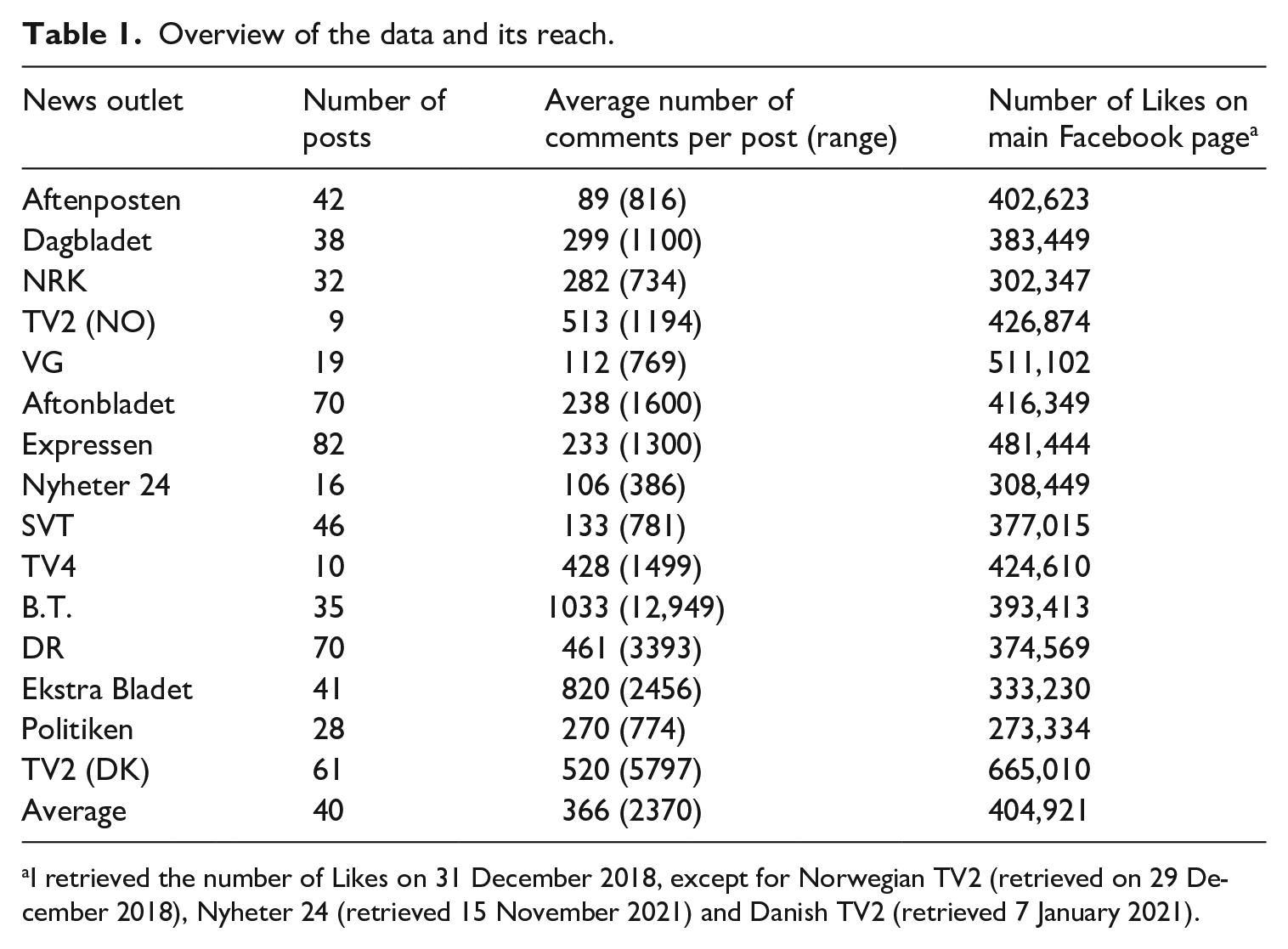
I retrieved the number of Likes on 31 December 2018, except for Norwegian TV2 (retrieved on 29 December 2018), Nyheter 24 (retrieved 15 November 2021) and Danish TV2 (retrieved 7 January 2021).
To identify relevant posts, I included all public Facebook pages administered by the selected media outlets in the study except those focussed on geographical regions within the countries because the emphasis was on national, rather than regional and local, discussions. I selected posts published on the 15 news media’s Facebook pages from 1 June to 31 December 2018 that included at least one of the following search words in their titles or introductory descriptions: 3 ‘allah’, ‘burka’, ‘burqa’, ‘fatwa’, ‘hijab’, ‘imam’, ‘islam’, ‘koran’, ‘mekka’, ‘medina’, ‘mohammed’, ‘muhammed’, ‘mohammad’, ‘muhammad’, ‘muslim’, ‘moske’, ‘moské’, ‘mufti’, ‘mujahedin’, ‘mullah’, ‘nikab’, ‘niqab’, ‘quran’, ‘sharia’, ‘slør’, ‘slöj’, ‘tørklæde’. 4 I based the search words on those used by Baker et al. (2013: 28), who studied the representation of Islam in the British press, albeit I adjusted the words to the Scandinavian languages and contexts. To confirm that the posts dealt with Islam or Muslims, I read all that matched the search criteria. Except for some items that mentioned the name Muhammed or Medina in nonrelevant contexts, I considered the identified posts relevant. During the analysis process, I found three posts with dead links, leaving 599 posts selected for analysis.
Although I analysed all 599 posts and the associated articles, I made the decision to focus on a selection of the several hundred thousand comments responding to the posts. I selected only original comments; comments replying directly to the posts published by the news outlets rather than comments replying to comments written by other readers. My rationale was that original comments are typically those that engage most clearly with the content in the posts and the wider public sphere. Therefore, original comments were the most relevant for analysing the relationship between the counterpublic subspheres operating within the comment sections and the more powerful subpublic operating in the posts. For analysis, I selected 10% of the original comments replying to each post based on chronology: I selected the comments published first. I discarded comments that I could not code, such as those that were off-topic or too brief for me to interpret their meaning. The criteria returned 6797 comments for analysis. Thus, I analysed 599 Facebook posts (and associated articles) published by established news outlets and 6797 Facebook comments written in response.
Method
By juxtaposing a quantitative content analysis of established news media posts with a quantitative content analysis of user comments written in response, I aimed to measure the extent to which two competing counterpublics engage in counterpublic discourses around Islam. Therefore, although I analysed discourses, I did not employ a typical discourse analysis. Instead, I used Toepfl and Piwoni’s (2015) definition of counterpublic discursive patterns as a vantage point for a quantitative content analysis, aiming to measure the prevalence of the Islam-hostile and Islam-sympathetic counterpublics. I describe the methodology in more detail in the following subsections.
Quantitative content analysis of established news media posts
By analysing the Facebook posts (N = 599) published by the established news outlets I aimed to determine the mainstream discourse on Islam. I coded each post according to the viewpoint it conveyed in relation to seven topics because (1) they were relatively frequent in the material (one or more of the topics was touched upon in 94% of posts and associated articles) and (2) repeated read-throughs of the comments suggested that the topics potentially incurred counterpublic discourses in the comment sections. The topics were (1) Islamic practices or traits associated with Islam, (2) championing of other countries, (3) general evaluation of Islam and/or Muslims, (4) conversion to Islam, (5) Islamists and Jihadists, (6) harassment of political opponents and (7) Muslim immigration. The topics functioned as variables in the coding scheme used in the quantitative content analysis. The number of values related to each variable varied depending on the range of standpoints that the posts conveyed towards the topics. For instance, with the first topic, I could code the following values: a practice/trait associated with Islam should be banned; it should be banned in certain areas; it should be criticised but not banned; it should be accepted or tolerated; and neutral (i.e. the post equally represented conflicting opinions). 5
Quantitative content analysis of comments
As I had the posts, I coded each comment in the data set for the viewpoint expressed regarding the seven topics, allowing a comparison of the mass media’s portrayal of Islam with the commenter’s arguments. I considered comments that featured arguments that challenged those presented in the established news media posts as argumentative countering, one of the three characteristics of counterpublic discursive patterns (Toepfl and Piwoni, 2015). To be considered a counterpublic argument, the commenter’s argument had to be (nearly) absent from the established news media’s posts and associated articles.
In addition, I used the two other characteristics of counterpublic discursive patterns – deconstructing power relations and strengthening identity (Toepfl and Piwoni, 2015) – in the analysis of the comments. This analysis revealed that deconstructing power relations manifested through five types of criticism: (1) criticism of the political establishment; (2) criticism of the mainstream media; (3) criticism of the criminal justice system; (4) criticism of other powerful publics or actors, such as powerful technology companies and the academic elite; and (5) criticism of unspecified power relations, such as comments lamenting ‘political correctness’ or structural racism. Comments were coded as strengthening a sense of collective identity if they engaged in alarmist rhetoric – which was the only coded subcategory related to strengthening identity. The subcategories associated with deconstructing power relations and strengthening identity were binary (i.e. only two values: ‘yes’ and ‘no’) and indicated whether a counterpublic element was present in a comment.
I could code all (sub)categories in relation to Islam-sympathetic and Islam-hostile commenters. For instance, although Islam-sympathetic counterpublic commenters argued that the political establishment and established news media were responsible for marginalising Muslim-friendly voices, Islam-hostile counterpublic commenters claimed that politicians and mass media were unwilling to shine a critical light on Islam. Similarly, in the strengthening identity category, Islam-sympathetic counterpublic commenters engaged in alarmist rhetoric by comparing today’s treatment of Muslims with the demonisation of Jews in the 1930s, but Islam-hostile counterpublic commenters considered Muslim immigration and Islamic practices grave threats to the future of Scandinavian society.
To distinguish between Islam-hostile and Islam-sympathetic comments for the variables with binary values, I coded each comment for the general sentiment it expressed towards Islam and associated topics, such as Muslims and (Muslim) immigration. The values here were positive, negative, neutral and anti-Islamist (see Supplemental Appendix A for a detailed description on how I coded the sentiment of the comments). If a comment conveyed a positive representation of Islam and it featured at least one counterpublic element, I considered it part of the Islam-sympathetic counterpublic. If a comment expressed a negative attitude towards Islam and featured at least one counterpublic element, I considered it part of the Islam-hostile counterpublic. 6
Reliability
To test inter-coder reliability in this study, a doctoral student and an undergraduate student analysed a random selection of 5% of the comments (n = 340), and I tested the students’ comment analyses against my analyses, using Cohen’s kappa (1960) as a coefficient. The coders had limited knowledge about the project and received training in the coding scheme before carrying out the analysis. I used the software package SPSS to calculate the kappa coefficients.
Following general recommendations in the methodological literature (e.g. Neuendorf, 2009; Neuendorf, 2016), I set acceptable variable reliability in this study at ⩾.60. All variables reached satisfactory intercoder agreement, ranging from .61 to .95. 7 Within the deconstruction of power relations category, I could not calculate criticism of other actors for the deconstruction of power relations category because the comments randomly selected for the reliability test included none that I had coded as that subcategory.
Findings
Established media discourse and counterarguments
Overall, I found that the posts and associated articles conveyed a broad range of viewpoints in relation to Islam. This was the case for all three Scandinavian countries and applied to most of the topics on which the analysis focussed. Still, the analysis identified potential for the engagement of argumentative countering in six of the seven examined topics.
Islamic practices or traits associated with Islam (375 of 599 posts)
In relation with the first, and most prevalent, topic discussed in the posts and their associated articles (see Figure 1), I determined that comments engaged in counterarguments if they argued for banning mosques, the Quran, the hijab or Islam altogether. Although the mass media discourse featured criticism of these aspects and frequent calls to ban face veils, no posts conveyed the standpoint that mosques, the Quran, the hijab or Islam altogether should be completely banned from Norway, Sweden or Denmark.
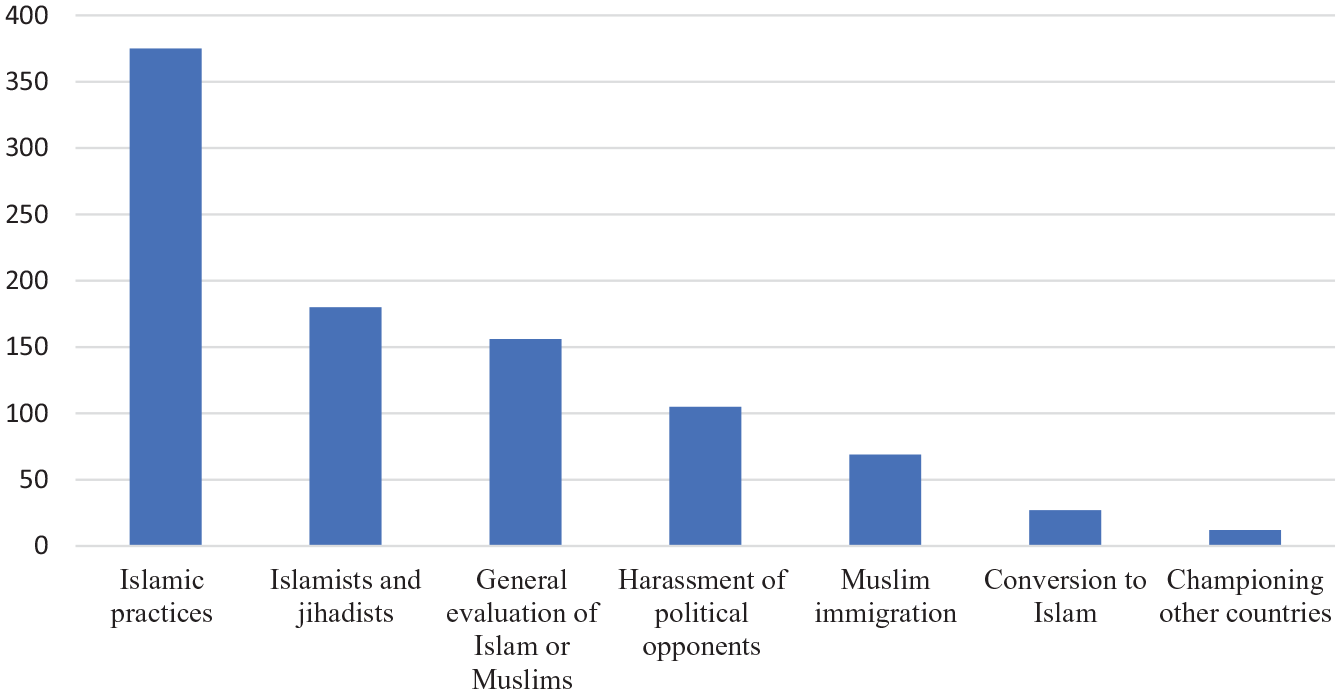
Frequency of topics in the Facebook posts.
Islamists and/or jihadists (180 posts)
Islamists and jihadists were largely met with condemnation in all three countries’ mainstream media discourse. Simultaneously, some media outlets interviewed these actors and their attorneys. Consequently, posts also argued that Islamists and jihadists should not be punished for their actions (6% of posts discussing Islamists and/or jihadists) and that the authorities should help people who had travelled to Syria in support of ISIS to return to their Scandinavian home countries to stand trial (6%). Therefore, the only comments I thought engaged in argumentative countering were those that argued for giving Islamists or jihadists the death penalty or stated that they should be extrajudicially killed.
General evaluation of Islam and/or Muslims (156 posts)
Among the posts that gave a general evaluation of Islam and/or Muslims, the most common discourse was that Islam and Muslims cannot be described in an essentialist manner and that there are many ways of practising Islam (59% of posts that gave a general evaluation of Islam or Muslims were neutral or nuanced). Twenty-six percent of posts conveyed a clearly positive view of Islam or Muslims, and 16% described Islam or Muslims in an essentially negative manner. The Swedish media discourse had the fewest negative viewpoints (11%), but the Norwegian media discourse portrayed this viewpoint to the largest degree (24%), with Denmark in between (17%). As such, the study indicates that such a discourse is less common in Swedish media coverage than in the other Scandinavian countries. However, negative descriptions of Islam and Muslims do not appear to be illegitimate in any of the countries’ mass media discourses. Therefore, I coded no comments as engaging with counterargumentation in this subcategory.
Harassment of political opponents (105 posts)
Not surprisingly, physical and verbal harassment of political opponents were unacceptable in the established media discourse. For instance, the media outlets focussed on the threat posed to religious freedom when mosques were attacked and presented the experiences of women who had been victim of hate crimes because they wore Islamic clothing. Comments engaging in counterargumentation around this topic accepted or endorsed such harassment.
Muslim immigration (69 posts)
The mass media coverage of Muslim immigration represented a wide range of viewpoints, from arguments that Muslim immigration to Scandinavia and the West should be completely stopped to claims that such a policy would be highly discriminatory. The anti-immigration standpoint was particularly influential in the Danish media discourse but was also found in Norwegian and Swedish coverage. Given the wide representation of viewpoints, I considered few comments discussing this subcategory that engaged in argumentative countering. An exception, however, was if a comment argued that there should be no immigration restrictions, given that I found no argument akin to the idea of open borders in the mass media discourse.
Conversion to Islam (27 posts)
The mass media discourse on conversion to Islam conveyed an overwhelmingly positive view of conversion. With the exception of one Danish post that focussed on potential challenges associated with converting to Islam, all three countries’ mass media posts and articles described conversion as an enriching process. Consequently, comments that described conversion to Islam in a highly negative manner countered the arguments presented in the mass media coverage.
Championing other countries (12 posts)
Describing other countries as role models or championing their policies regarding Islam was rare in all three countries’ mass media (identified in 2% of the posts). Given how marginal this type of discourse was in the mass media coverage, I decided to classify comments that championed other countries as engaging in counterargumentation.
Counterpublic discourses in the comment sections
Although the established news media’s Facebook posts generally represented a broad range of arguments, the analysis still identified areas in which the Facebook commenters might challenge the media coverage by engaging in arguments either absent from or highly marginal in this superordinate public sphere. Table 2 shows how frequently the two identified counterpublics operating in the comment sections, one Islam-hostile and one Islam-sympathetic, engaged in argumentative countering around the presented topics. Furthermore, it shows the extent to which the counterpublics engaged in the deconstruction of power relations and strengthening identity, as well as the prevalence of the subcategories of argumentative countering, deconstructing power relations, and strengthening identity. The total number of counterpublic comments, found at the bottom of Table 2, demonstrates that the Islam-hostile counterpublic generally was much more prevalent than the Islam-sympathetic counterpublic. Moreover, Table 2 reveals national differences; as shown, Swedish Facebook users engaged in Islam-hostile counterpublic discourses more often than Norwegian and Danish Facebook users did.
Percentage of comments in each country engaging in Islam-hostile and Islam-sympathetic counterpublic discourses (N = 6797) a .
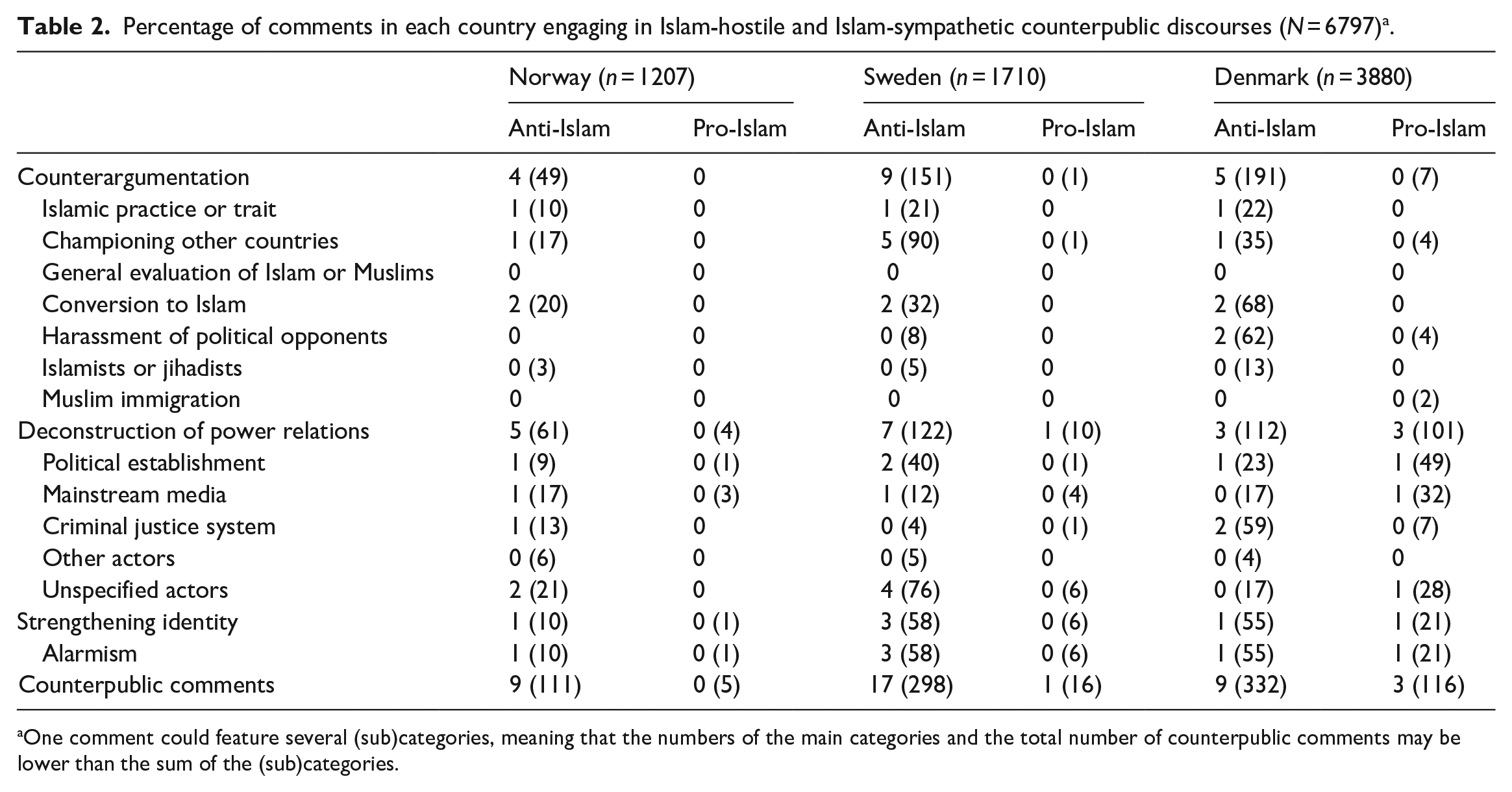
One comment could feature several (sub)categories, meaning that the numbers of the main categories and the total number of counterpublic comments may be lower than the sum of the (sub)categories.
As illustrated in Table 2, 17% of Swedish comments featured at least one subcategory of Islam-hostile counterpublic discourses, compared with 9% in the Norwegian and Danish comments. Compared with its Norwegian and Danish counterparts, the Swedish Islam-hostile counterpublic more frequently engaged in all three main characteristics of counterpublic discourses identified by Toepfl and Piwoni (2015). Looking closer at the subcategories, the Swedish commenters particularly stood out by frequently championing other countries for their approaches to Islam. The most extreme comments within this subcategory supported China for their internment of Uighurs, but, more commonly, these comments deemed other Western European countries as role models, such as Austria and Denmark. The Swedish Islam-hostile counterpublic also stood out with its relatively high percentage of comments that targeted unspecified power relations – for example, blaming political correctness for hampering important debates around problems associated with Islam and Islamist extremism. Furthermore, the Swedish commenters were more often alarmist in their rhetoric, warning that immediate action was necessary to deal with the spread of certain Islamic practices or the country’s radical Islamist movement.
Although marginal compared with the Islam-hostile counterpublic in all three countries, the Islam-sympathetic counterpublic was more noticeable in the Danish comment sections (3%) than in the Norwegian and Swedish comment sections (0% and 1%, respectively). This was due to the 3% of Danish comments that deconstructed power relations from an Islam-sympathetic viewpoint. These comments expressed, for instance, that the Danish political establishment and mainstream media contributed to silencing Muslim-sympathetic voices and to spreading anti-Muslim sentiment in Danish society. In addition, the comments targeted anti-Muslim and racist structures in Danish society without specifying which actors were responsible for this racism.
Discussion
Inhibitors and drivers of online counterpublics
The analysis of comment sections found an almost opposite pattern from scholars who have carried out longitudinal comparative analyses of Scandinavian media discourse on Islam and immigration. Previous studies have found that the Danish press tends to be harsher and more negative in its coverage than the Norwegian and, especially, the Swedish press (Hovden and Mjelde, 2019; Lundby et al., 2018). Researchers have also observed these differences in social media discourse (Andersen, 2019; Moe, 2019a, 2019b) and political and public discourses (Brochmann and Hagelund, 2012; Lövheim et al., 2018b). In light of previous research, the results presented in this study may indicate that a fundamental driver of online counterpublics’ popularity is that dominant public spheres do not satisfactorily represent their interests and needs. In the general Swedish public sphere, in which negative attitudes towards Islam have the lowest influence, there is a relatively large Islam-hostile counterpublic in the comment sections. In the general Danish public sphere, in which negative attitudes towards Islam have the highest influence, we find the largest Islam-sympathetic counterpublic in the comment sections. In this sense, counterpublics seem to engage in a type of corrective action. On one hand, where there is substantial discursive space left to challenge a superordinate public sphere, online counterpublics can fill the gap. On the other hand, in a national public sphere with a vast array of viewpoints expressed, there is less room for counterpublics to manoeuvre.
Simultaneously, though I in this study have focussed on how counterpublics emerge and communicate within the national context, it is clear that (online) counterpublics may operate on several levels. For instance, #MeToo and Black Lives Matter are prominent, recent examples of movements that have gained international, if not global, magnitude (Mundt et al., 2018; Trott, 2020). Moreover, counterpublics may challenge subnational power structures (e.g. de Velasco, 2019), including the editorial position of individual media outlets. For instance, among the comments I analysed in this study, some commenters condemned moderators for removing oppositional comments, criticising outlets for having low tolerance for disagreement and for violating the principle of freedom of expression.
Although I considered two battling counterpublics in this study, the Islam-hostile counterpublic is much more influential in the Scandinavian mass media’s comment sections than the Islam-sympathetic counterpublic is. This finding illustrates that the national debate climate is not the only influence for online counterpublics’ popularity because, if it were, the Danish comment sections would exhibit a significantly more prevalent Islam-sympathetic counterpublic than this study found. Consequently, it seems that, at least around certain topics and communicative spaces, a far-right ideology is a driver for online counterpublics.
It is challenging to identify exact explanations for the relatively substantial proliferation of the Islam-hostile compared with the Islam-sympathetic counterpublic. If we consider Sweden, where I found the most prevalent Islam-hostile counterpublic sphere, it is particularly the championing of other countries that makes the Islam-hostile counterpublic more prevalent than its contrasting counterpublic (see Table 2). The relatively frequent calls to follow countries with stricter policies and discourses around Islam indicate that the Scandinavian, or at least the Swedish, Islam-hostile counterpublic may proliferate due to the presence of anti-Islam discourses elsewhere. In other words, ideas emanating elsewhere seem to inspire Islam-hostile counterpublic discourses, whereas such ideological inspiration is non-existent for the Islam-sympathetic counterpublic.
Privileged and excluded
The results in this study indicate a gap from Frasers’ (1990) influential description of ‘subaltern counterpublics’, constituted by members of historically subordinated social groups: ‘women, workers, peoples of color, and gays and lesbians’ (p. 67). In light of the finding of a prominent Islam-hostile counterpublic sphere operating in the comment sections, it is worth considering the implications that the existence of far-right, anti-immigrant and anti-Islam collectives have on the counterpublic literature, which a normative focus on progressive and left-wing collectives has marked.
Importantly, research has already made significant contributions to account for such phenomena. Rather than focussing on exclusion per se, scholars have emphasised the perception of exclusion from the wider public sphere (Asen, 2000; Brouwer, 2006; Warner, 2002). This opens the potential for viewing groups, from the far left to the far right, to engage in counterdiscourses, as long as these consider themselves as correctives to an excluding mainstream public sphere. Maintaining that counterpublics are self-perceived correctives that may emanate from any ideology, rather than assuming that they always have a progressive agenda, may broaden the scope of research on counterpublics.
Fraser (1990) specified that counterpublics are not ‘necessarily virtuous; some of them, alas, are explicitly anti-democratic and anti-egalitarian; and even those with democratic and egalitarian intentions are not always above practicing their own modes of informal exclusion and marginalization’ (p. 67). Although she seemingly did not have radical right-wing groups in mind – as she referred to women, workers, peoples of colour, and LGBTQ people – she noted that ‘insofar as subaltern counterpublics emerge in response to exclusions within dominant publics, they help expand discursive space’ (p. 67). As this study has indicated, far-right counterpublic-minded individuals may, similarly to progressive collectives, contribute to expanding discursive space, at least for like-minded individuals. Particularly, this was true after the advent of Web 2.0, which increased the interactive potential of new media and online technologies. Promisingly, scholars have paid more attention to far-right counterpublics in recent years. Given the continued success of far-right parties and issues such as migration and climate change being high on the international political agenda, such research remains important. For researchers, this may entail the need to consider competing counterpublics, who are in opposition to dominant public spheres and other counterpublics.
Conclusion
In this article, I employed a quantitative content analysis to analyse content about Islam on the Facebook pages of Scandinavian established news media. By adding the criterion ideology to Toepfl and Piwoni’s (2015) pioneering theoretical framework to analyse (counter)publics, I found that Islam-hostile and Islam-sympathetic counterpublics operated in the comment sections of the established news media’s Facebook pages. The Islam-hostile counterpublic proved clearly more prevalent than the Islam-sympathetic counterpublic in the comment sections of all Scandinavian countries. There were, however, national differences. Islam-hostile counterpublic discourses permeated the Swedish comment sections to the largest extent, but the Islam-sympathetic counterpublic was more visible in the Danish comment sections. Variations in how the general public spheres in the countries have handled Islam likely have contributed to these differences to some extent, but the national contexts alone cannot explain the results.
Limitations and future research
This study is not without its limitations. Data focussed on a 7-month period influenced by some period-specific events, particularly the Danish ban of face-covering clothing. Future research should aim to study longer or multiple periods to examine how news outlets and ordinary citizens discuss Islam on Facebook, as well as in other arenas.
Furthermore, the analysis of the comment sections in this study focussed on original comments (i.e. commenters’ replies to news media posts rather than commenters’ replies to other commenters). Future research should take into consideration these comments to determine whether this affects the prevalence of counterpublic discourses. Moreover, future research might examine more qualitatively how counterpublic-minded individuals articulate their counterpublicity in direct confrontation with mainstream-minded individuals or counterpublic-minded individuals from a competing ideology. Another limitation is that I did not map who wrote the comments, so there is a chance that some highly active commenters have impacted the results to a certain extent.
Finally, this study analysed counterpublics as they operate in three similar national contexts. Future research should aim to conduct more comparative studies of conflicting counterpublics to see how these permeate the online realm in relation to various themes and international events. Such research could benefit from the insights of researchers from different countries and, ideally, a collaborative, cross-national team of scholars.
Supplemental Material
sj-docx-1-nms-10.1177_14614448211068436 – Supplemental material for A battle for truth: Islam-related counterpublic discourse on Scandinavian news media Facebook pages
Supplemental material, sj-docx-1-nms-10.1177_14614448211068436 for A battle for truth: Islam-related counterpublic discourse on Scandinavian news media Facebook pages by Anders NJ Lien in New Media & Society
Footnotes
Funding
The author received no financial support for the research, authorship and/or publication of this article.

Supplemental material
Supplemental material for this article is available online.
Notes
Author biography
References
Supplementary Material
Please find the following supplemental material available below.
For Open Access articles published under a Creative Commons License, all supplemental material carries the same license as the article it is associated with.
For non-Open Access articles published, all supplemental material carries a non-exclusive license, and permission requests for re-use of supplemental material or any part of supplemental material shall be sent directly to the copyright owner as specified in the copyright notice associated with the article.
