



Abstract
The COVID-19 pandemic shifted many activities online. However, there is little research on the digital inclusion of undocumented immigrants and their experience of the pandemic in the United States. We conducted 32 interviews with undocumented Latino immigrants in the United States to examine how digital technologies mediated their experiences of the pandemic. We find that undocumented immigrants (1) face barriers to telehealth services, (2) are at high risk of COVID-19 misinformation, (3) experience difficulties in assessing privacy risks, and (4) experienced heterogeneous outcomes of technology use during the pandemic. Our analysis shows that digital technologies both supported and further marginalized undocumented immigrants during the pandemic. Future research on the digital inclusion of vulnerable populations should pay particular attention to the interaction between their underlying vulnerabilities, on one hand, and attitudes, uses, and outcomes associated with technology, on the other.
Keywords
Introduction
Oscar’s journey to the United States’ border took 3 days through a desert that scorched his feet during the day and froze his fingers during the night. It was a voyage during which he felt uncertainty and danger—marked by moments of distress and hopelessness, such as hiding in a ravine for a full day and night with no water. “We wanted to get out; people were desperate,” he told us, “You find the bodies of people who tried crossing before you; it is very tough.” In his previous life in rural Mexico, Oscar rarely used the Internet. Perhaps because of this, while browsing social media, he was unable to identify a post as misinformation during the novel coronavirus (COVID-19) pandemic, and he waited in his California apartment for fear that seeking medical attention for his worsening COVID-19 symptoms would lead to him being deported back to Mexico. Approaching the point of being unable to breathe, he dialed 911 and awoke the next morning in the hospital, on a ventilator, with doctors telling him that he should have sought medical attention sooner. Today, he associates the Internet with regret and frustration, and has abandoned social media. “It makes me scared,” he told us, “I don’t look online anymore.”
Oscar was 1 of 32 undocumented Latino immigrants that we interviewed to understand the ways in which technology has mediated their experiences of the pandemic. Latinos have been particularly hard hit by the pandemic. While they represent 18% of the United States population (Noe-Bustamante et al., 2020), they account for 30% of COVID-19 cases for which ethnicity is recorded, and more than 40% of cases in the under-18 age group (Centers for Disease Control, 2020). Studies have attributed this disparity to social determinants of health that include more exposed occupations and barriers to social distancing (Bibbins-Domingo, 2020). While the causes of this disproportionate health burden on Latinos is disputed, and population-level studies focusing on ethnicity are only starting to emerge (McLaren, 2020), little is known of the experiences of Latino immigrants with undocumented status—such as those who crossed the border illegally, overstayed a tourist visa, or were brought to the United States illegally as children by their parents. These immigrants face distinct vulnerabilities due to their status—including limited employment prospects, disparate health coverage, and fear of deportation—which, in turn, have downstream effects on income, security, and digital inclusion.
The reliance on digital technology to mitigate the COVID-19 pandemic has partly overlooked the circumstances of undocumented immigrants. There is little research on the effects of the intersectional vulnerabilities associated with undocumented status on digital inclusion. Globally, vulnerable groups may have reduced access to digitized education systems and official information on COVID-19 (Porumbescu, 2020). Exposure alerting apps often assume ownership of recent smartphones to which financially precarious migrants may have reduced access. Nonmaterial risks to undocumented immigrants are often also left unmitigated, such as their vulnerability to misinformation (Dekker et al., 2018), and the privacy risks (real and perceived) of digital contact tracing apps (Kahn, 2020)—which might reveal immigrants’ vulnerable networks. In these instances, reliance on digital solutions risks further hindering the circumstances of vulnerable immigrants—especially when faced with shelter-in-place orders and social distancing requirements that disconnect them from their offline support networks.
Researchers have called for collecting Latino-specific data on COVID-19 (Bibbins-Domingo, 2020; Rodriguez-Diaz et al., 2020). However, data on the distinct situation of undocumented Latino immigrants are needed given this group’s vulnerability, digital exclusion, and avoidance of monitoring owing to fears of deportation. To address this need, we conducted in-depth interviews with 32 undocumented Latino immigrants in the United States. We investigated the following research question: in what ways have the attitudes of undocumented Latino immigrants toward digital technologies (and their uses of these technologies) affected their experiences of the COVID-19 pandemic? Our analysis provides rare and rich firsthand evidence of how their experiences of the pandemic were mediated by digital technology. This contributes to the larger agenda—in research, policy, and design—of protecting vulnerable populations in an increasingly digitized world.
Research framework
Intersectional vulnerabilities of undocumented Latino immigrants during COVID-19
Undocumented Latino immigrants face distinct intersectional vulnerabilities that have led them to be disproportionately affected by the coronavirus pandemic. Occupational hazards largely account for this burden (McLaren, 2020). Undocumented immigrants are disproportionately categorized as “essential workers”—requiring them to work during the pandemic—while often being unable to work from home, relying on public transportation, and lacking sick leave (Bibbins-Domingo, 2020). They are disproportionately represented in industries most impacted by emergency public health regulations, including hospitality and personal services (Page et al., 2020). This has increased the exposure of undocumented migrants to the health, wellbeing, and financial consequences of the pandemic (Gonzalez et al., 2020).
Immigrant families are also more likely than natives to suffer from food insecurity (Clark et al., 2020)—which pandemic-related income loss can exacerbate. Latinos are also more likely to reside in high-density and multigenerational housing—hampering social distancing, increasing the exposure of the elderly to COVID-19, generating mental stressors (Bibbins-Domingo, 2020; Rodriguez-Diaz et al., 2020), and challenging the “implicit presumption of a safe place in shelter-in-place and social distancing directives” (Cholera et al., 2020: 1). At the community level, low-income areas are less likely to have adequate COVID-19 testing and care (Rodriguez-Diaz et al., 2020) and the higher prevalence of uncontrolled chronic diseases, such as diabetes, make Latinos more susceptible to severe forms of COVID-19 (Lee et al., 2018).
Undocumented immigrants face barriers to healthcare access, with nearly two-third of undocumented Latinos being uninsured (van Dorn et al., 2020). The Affordable Care Act excludes undocumented individuals and 14 states have refused to extend Medicare to undocumented immigrants (van Dorn et al., 2020). As such, undocumented immigrants often handle COVID-19 independently of a primary care physician (Greenaway et al., 2020). In parallel, they are generally excluded from pandemic relief programs such as the Coronavirus Aid, Relief, and Economic Security Act (CARES) (Wilson and Stimpson, 2020).
In addition, lack of awareness of their rights and eligibility for services amid heightened fears of deportation, coupled with linguistic barriers, reduces the likelihood that undocumented Latinos will access care (Cholera et al., 2020; Hacker et al., 2015). In February 2020, the United States Citizenship and Immigration Services (USCIS) began enforcing an expanded Public Charge rule that permits denying legal residency to immigrants who receive public benefits, including Supplemental Nutrition Assistance Program (SNAP) and Medicaid. This may have a chilling effect on access to COVID-19 aid programs, including California’s first-of-its-kind cash aid to undocumented workers (Penaloza, 2020). It also complicates efforts to monitor this group even in localities where free access to treatment is granted.
Thus, while undocumented Latino immigrants are sometimes described as living “in the shadows,” this emphasizes only one dimension of their marginalization. Von Braun and Gatzweiler (2014) define marginalization as the exclusion of individuals and groups in relation to the mainstream and frame this as affecting autonomy and access to resources. Marginalization can be multidimensional, meaning that it can simultaneously occur across different systems (such as social, religious, and political) (Dunne, 2005). Undocumented Latino immigrants need to negotiate this marginalization and the interplay of their vulnerabilities, both of which extend far beyond their legal status alone (Fernández-Esquer et al., 2017) and can have distinct consequences in public health emergencies (Méndez et al., 2020). Consequently, we framed this study around multidimensional marginalization and intersectionality to elucidate the nuances of the relationship of undocumented Latinos with technology during the pandemic.
Digital exclusion and marginalization
Digital exclusion is typically framed through technology access, literacy, and use. The characterization of being digitally excluded as being on the “wrong side” of the digital divide is increasingly criticized as a false dichotomy that hides the gradations of digital exclusion and flattens its dynamics (Helsper, 2021). Just as offline inequalities can foster digital exclusion, digital exclusion can exacerbate offline inequalities, producing a “digital vicious cycle” (Baum et al., 2014). Conversely, it has been suggested that digital spaces themselves can exacerbate inequalities (Gangadharan, 2012). Studies of digital exclusion increasingly emphasize the differential outcomes of digital activities, or the “collateral benefits of Internet use” (Van Deursen and Helsper, 2018). For example, Tsatsou (2020, 2021) has found that ethnic minorities, people with disabilities, and elderly Internet users each find benefits and disadvantages to Internet use that interact with various dimensions of their existing vulnerabilities. This emerging focus highlights the complexities of the interaction between digital exclusion, digital outcomes, and underlying vulnerabilities.
Likewise, the relationship between immigrants and technologies is multifaceted. On one hand, immigrants use technologies to facilitate migration (Gillespie et al., 2018; Newell et al., 2016; Tsatsou and Boursinou, 2017) and aid their integration (Aléncar and Tsagkroni, 2019). On the other hand, technology can surveil their activities (Nedelcu and Soysüren, 2020) and reinforce power relations with the state (Garcia, 2011). These outcomes are tied to the affordances and modalities of Internet use. For instance, Latino immigrants rely heavily on smartphones and Spanish-language social media for contact with their home countries (Adkins and Sandy, 2020; Baron and Gomez, 2017). These can produce digital footprints that increase the risks of discrimination and deportation for undocumented immigrants. There is a paucity of research on how undocumented immigrants perceive and navigate online privacy risks, but initial evidence suggests that this vulnerable group struggles to judge these risks and does little to address them (Guberek et al., 2018).
Limited English proficiency may also compound digital exclusion among Latino immigrants (Adkins and Sandy, 2020; Mitchell et al., 2019). This can reinforce what Kaufmann (2018) refers to as the “information disjuncture” of adapting to the digital life of a host country. More generally, Wall et al. (2017) write of “information precarity” to refer to the instability of digital information access by migrants. Yet theorization in this area relies heavily on refugee migration to Europe, and the digital exclusion of undocumented Latino immigrants remains understudied.
The pandemic may have exacerbated the digital exclusion of Latino immigrants—a group with already reduced Internet access (Beaunoyer et al., 2020; Mitchell et al., 2019). Income loss from the pandemic may make Internet access unaffordable, and lockdowns in high-density households may result in sharing devices, interference from family members, and reduced Internet speeds. Lockdowns may also prevent individuals from accessing community support networks for developing digital literacy (Pina et al., 2018). Outside of the home, the pandemic shuttered public libraries, on which a quarter of Latino immigrants report relying for Internet access (Perrin and Turner, 2019). Shifts toward telemedicine may exclude many Latino immigrants, a group less likely to use the Internet as a health resource (Katzow et al., 2020). Likewise, the closure of public offices for digital services may complicate their enrollment in aid programs (Page et al., 2020). The pandemic may consequently have emphasized existing characteristics of their digital exclusion and highlighted new ones.
In parallel, there is a renewed interest in aligning communication studies with marginalization theory. Digital technologies have been framed as a means for marginalized groups to establish new social connections and gain access to new resources, such as information and services (Gonzales, 2017; Mesch, 2012). However, marginalized communities often have unique needs and vulnerabilities and so must become “navigators of the interstitial space between risk and opportunity” (Pearce et al., 2020: 1). Likewise, recent studies have found that social media can both attenuate and exacerbate dimensions of marginality—such as increasing both information access and isolation among people with disabilities (Trevisan, 2020) or increasing both opportunities for social connection and risks of identification among LGBTQ+ individuals (Birnholtz et al., 2020). Hence, it is important to explore the uses of technology by marginalized groups and the effects of this on their marginalization. Through this combined framework on digital exclusion, intersectional vulnerability, and marginalization in communication, we analyzed the relationship between undocumented Latino immigrants and technology during the pandemic.
Method
Sample
We conducted semi-structured interviews with 32 Latino immigrants with undocumented status to investigate the impact of digital technologies on their experiences of the pandemic. We selected undocumented adult Latino immigrants because this group is particularly vulnerable, yet it has been largely overlooked by studies on digital exclusion. These immigrants resided in California, New York, and Texas. They were principally female (n = 25), ranged in age between 22 and 57 years, lived in the United States between 1 and 32 years, and originated in Mexico, Guatemala, and Peru (see Appendix 1). Immigrants were recruited by text or WhatsApp message, by direct contact with several initial contacts that we had already established within the Latino community, and by asking each interviewee to refer up to three additional contacts who fit the sampling criteria. This snowball sampling allowed us to gather a sample of hard-to-reach immigrants with undocumented status through their own networks until data saturation was achieved. Each respondent was compensated with US$20 for the interview and US$5 for each referral by their choice of gift card, check, or bank wire transfer. Six respondents were removed from the sample as it was determined during the interview that they had permanent residence status or citizenship in the United States, and only respondents with undocumented status were retained.
Procedure
Interviews were conducted between June and August 2020. A priority was to protect the interviewees and interviewers from risks associated with the pandemic, especially those related to health and income. As such, we selected to schedule interviews by phone based on times selected by the interviewees while emphasizing our own flexibility. Evidence suggests that the lack of visual cues and the perceived distance of phone interviews may facilitate data gathering on sensitive topics (Mealer and Jones, 2014). We built trust over multiple weeks prior to the interview, using text messages and short phone calls to account for the substantial perceived risks taken by the immigrants in talking to us—notably regarding the potential that the interview may lead to law enforcement action including deportation. To ensure confidentiality, randomly selected gender-matched pseudonyms, followed by identifiers corresponding to Appendix 1, are used in place of the real names of the immigrants throughout this article. 1
Following guidelines from Charmaz (2014), we employed both informational and intensive interviewing, allowing rich responses while ensuring consistency between the themes covered. Echoing the recommendations of Mealer and Jones (2014) on sensitive interviewing, we built rapport through paralinguistics, employed extended moments of silence to ensure that the interviewees could finish their thoughts, and acknowledged difficulties expressed by the interviewees. Some immigrants reported finding the interviews therapeutic, while a few others responded with curt answers, which we understood as attempts to maintain their guard. This resulted in interviews spanning between 36 minutes and 2 hours, and 11 minutes.
The interview guide explored four aspects based on the research framework: (1) their demographics, journey to the United States, and life status, (2) their baseline use of, literacy, and attitudes toward digital technology, (3) their experience of the COVID-19 pandemic, and (4) their attitudes toward digital technology and uses of digital technology during the pandemic. The interviews were transcribed and then analyzed following a constructivist grounded theory approach (Charmaz, 2014). We conducted initial coding, focused coding, and theoretical coding. This aimed to develop theory through data and to “give a voice” to these hard-to-reach immigrants. Our findings were comprehensively grouped into four categories based on both emerging subtopics and those engaged by the interview guide: (1) telehealth, (2) social media and COVID-19 misinformation, (3) contact tracing apps and digital surveillance, and (4) reconfiguring relationships with technology during the pandemic.
Findings
Telehealth
The interviewees had little knowledge of telehealth services offered during the pandemic. We found this to be consistent with their general exclusion from the US health system. For example, only nine interviewees reported being covered for COVID-19-related emergency treatment. Some only became aware of their coverage after interacting with healthcare services. The majority of the interviewees told us that they had no insurance, and some reported financial barriers to accessing COVID-19 testing or treatment, as well as concerns that seeking medical attention might hinder the legalization of their status. Some participants reported not accessing COVID testing due to costs, despite likely being eligible for free testing. This was the case for Pablo (3), who had not seen a doctor in 5 years for lack of medical insurance. Like other interviewees, he reported this to be a stressor: The pandemic generates a lot of fear . . . for example, if I get sick, where can I go? How do I get medical insurance? I don’t know how to go to a hospital. I don’t know if they are going to treat me, or if I am going to die and leave my children fatherless.
Others reported avoiding emergency rooms due to discrimination and pandemic conditions. This was exemplified by Luis (2), who told us that he spends his scarce resources on private care to mitigate these concerns: Well [if I had COVID-19], I would go to the hospital, but sometimes since you are illegal, they don’t treat you like natives. So, you need a private doctor. The consultations are expensive but faster, and they take care of you. But the price is high . . . Now with the pandemic, many people are infected in the hospitals and many are going to die because they do not have enough respirators. It’s better to go to a private doctor. You have to pay a little more, but they treat you better and faster.
While all participants reported using search engines to find health information, only ten were aware that online consultations were being used during the pandemic. Only three had used these services. Among these was Juan (31), who believed that the online doctor he had consulted through Zoom misjudged his symptoms: The online doctor said, “if you don’t feel too bad, then don’t go to the hospital, because of coronavirus.” But online, doctors can see you but not know how you feel. So, it’s best to just go. I told the online doctor “I feel like this” and he said, “yes, those are [COVID] symptoms, but don’t worry.” And I said, “but my chest hurts” and he said, “don’t go to the hospital because they won’t treat you.” I tried to get better at home but [when it got worse, I went to the hospital and there] the doctors who saw me told me “why did you wait so long to come, you already have strong pneumonia, you have inflammation in your lungs.”
When the interviewees were asked about their attitudes toward telehealth services, three themes emerged: (1) the benefits of avoiding visits to the emergency room due to minimized threats of discrimination and infection; (2) the perception that telehealth is for nonserious conditions; and (3) the importance of having Spanish-language consultations. In addition to the lack of awareness of telehealth services, their perception that in-person consultations provide more accurate diagnoses, and financial barriers, dissuaded their usage of, and tainted their attitudes toward, these online health services.
Social media and COVID-19 misinformation
Facebook was presented as central to the digital experiences of these immigrants. All the interviewees told us that they accessed Facebook daily, and most told us that they used Facebook continuously throughout the day. Facebook was used principally to stay in contact with family members who remained in their home countries. Facebook’s instant messaging app, WhatsApp, was also used by every immigrant that we interviewed as it bypasses fees for sending text messages. Others also used Messenger and Instagram—both of which are owned by Facebook. These digital tools are central to the contemporary experience of undocumented migrants in the United States, as they enable migrants to remain connected to their home countries and transnational families. As Sofia (23) told us, “Messenger and WhatsApp are a great help, really. Whoever invented these should be thanked because they allow me to see my children every day.”
Social media was the principal source of news for these immigrants. While some interviewees actively sought out authoritative sources of online information, maintained several Spanish-language newspaper subscriptions, consulted websites of local news agencies in their countries of origin, and regularly listened to podcasts in Spanish, most cited Facebook as a source of news. Similarly, while most interviewees reported relying on Spanish-language news, including Telemundo and Univision, they cited Facebook when asked how they accessed this content. YouTube and Google searches were less frequently mentioned news sources. Facebook was seen as an accessible source of Spanish-language news—an important linguistic preference—and was seen as trustworthy.
This reliance on, and trust in, social media likely heightens exposure to misinformation. However, none of the interviewees mentioned misinformation without being prompted. When prompted, they were largely uncertain of their self-efficacy in accurately classifying the veracity of news stories. Angela (14), for example, relayed not knowing “if it will work or not, but they tell you that you have to take vitamins, there is a lot of information on YouTube.” Others reported believing COVID-19 denial videos posted on social media showing empty hospitals. Conversely, they sometimes misidentified real news as fake. Two interviewees believed that genuine financial aid to undocumented families in California and New York was misinformation, and so they did not apply.
Importantly, a common strategy for identifying misinformation was to confront news from online social networks with their offline social networks. For example, Sergio (4) admitted having difficulty distinguishing fake news from real news. He told us that he places his trust in the natives at his workplace: “The people born here in the United States, they know more, and while talking to them I get an idea [of what is true]. I will not understand much, but the little I do understand gives me an idea of whether news is real or fake.” Others relied on their families to verify online news. For example, Angela (14) recounted the trials of obtaining accurate information from a Google search: I asked my niece. I said, “I got this information and these websites. Which one can I check? ‘And she told me: ‘What I always do is go to the first three at the top. Those are the ones that I think are the most accurate.” So that’s what I do. Because once I opened a news site and they sent a lot of advertisements. I gave her my phone to remove the advertisements, but it didn’t work. And so, I opened the phone and took the battery out. That must have been a fake news site.
Digital contact tracing and surveillance
Most interviewees had not heard of initiatives to develop or deploy contact tracing apps and all others had only a tentative understanding of the aims and functions of such apps. For instance, Daniela (13) told us that contact tracing is “a scan that they do to know where you are and what you are doing.” When we explained the Apple and Google implementation of contact tracing, most of our interviewees said they would not use it. This was because they did not see the utility while already social distancing or because it would be an added stressor as a reminder of the pandemic. Regarding the COVID-19 screening tool developed by Apple in partnership with the CDC, some told us that they would only use it if their personal information and data were not shared with the government. Others expressed concern that they would be located and forced to go to the hospital. Others expressed that they would not trust the diagnosis from this website, and seven explicitly said they would only trust a doctor that is consulted offline.
Despite threats of disclosure, the interviewees were not substantially concerned about their privacy. None of the interviewees mentioned the topic of online privacy and security without first being prompted. Concerns revolved principally around personal photos posted to social media being stolen and the risks that this might produce for children. Some of the privacy protection strategies that they mentioned were using pseudonyms, alternative spellings of their names, and setting the visibility settings for their online posts.
Importantly, none of the interviewees mentioned surveillance risks within the context of their undocumented status until prompted. We understood this as a form of resignation. Many told us that they believe that the government and social media platforms spy on their online activities and smartphones anyway. When prompted, most told us that they believe that contact tracing apps could be used to identify or track undocumented immigrants, but these concerns were minimized by the idea that undocumented immigrants can also be identified or tracked through other means. This is illustrated by Miguel (1), who told us: Sometimes I am concerned about ICE [tracking me on social media] . . . I worry that they might come and grab me and send me back to my country . . . But I say, they can track you with your phone, they can track you with everything, so why be afraid of just one thing? If it happens, it happens. But, yes, I am afraid. We as illegals always have that fear, that anything can make us lose it all.
Reconfiguring relationships with digital technology
The pandemic altered the relationship of many interviewees with technology. Many reported spending more time-consuming online entertainment and messaging family members. Expensive data plans and having multiple members of a household at home, at the same time, decreased Internet speeds for some of the interviewees, who had to negotiate limits on individual Internet use. For instance, Rosa (15) told us that “we had to limit ourselves to not use all our data, to not to go overboard. Above all, now that the children have online classes, sometimes there are days when the internet works slower because it has been used so much.” For 11 of the most digitally excluded interviewees in our sample, school district policies to provide laptops to school children enabled access to computers for the first time. While some were provided with Internet hotspots, others were incentivized to promptly subscribe to an Internet connection. Others purchased additional laptops to supplement the laptops provided by school districts. Some interviewees raised the challenges of aiding their children when they themselves are unfamiliar with technology, as well as needing to care for children who are now at home. For example, Gabriella (7) shared that she would leave her office job with the city to check on her children who had to attend school online: Online classes have affected me because they are at home . . . in their virtual classes. As I mentioned, they are teenagers, they can do it alone, but there is always the concern that they are home. In fact, at lunch I come home to see that they are well, because they are here at home alone, with their online classes.
The most digitally included interviewees in our sample were able to use the Internet to overcome the financial difficulties of the pandemic. Four were able to sell products online or teach others to do so. For instance, Martin (9) lost his job as a bartender in New York when the bar he worked at closed. He had purchased stock to start a side business when the pandemic hit and, although lockdowns meant he lost his job and struggled to sell his stock, he managed to turn a profit within a week of moving his business online. He told us: Had it not been for social media, I think I would not have survived as a business or a person. I need to work, and so it was very difficult to have no income, and the bar where I worked had to close. But since people contacted us on the internet, we were able to grow and survive all these months. . . Although the world is suffering a lot, and the economy is teetering, if social media didn’t exist, it would be five or ten times worse.
Conversely, many reported detrimental mental health effects of online news and social media posts about COVID-19. The quantity of news available online made some feel unable to remain informed. Others felt that exposure to foreign news unnecessarily affected them. A common strategy for mitigating this was to reduce the time they spent online. For example, Alicia (6) told us “What can I do about videos of the situation in France? Now I ask my friends what they know, and I don’t check the internet.” Others told us that they no longer consult Facebook and rarely use their smartphone. Those most personally affected by the lasting symptoms of COVID-19 saw social media as an additional burden on their mental health. For instance, following developing COVD-19 symptoms, Mario (32) was unable to find the strength to seek out a new construction job for 2 months, and consequently was unable to pay his rent and relied on families and friends for groceries. He shared that seeing updates on his social media was heavily burdensome, and so he stopped using social media: I would go on Facebook and see the death toll, so many people died, all these sick people, there were so many, it traumatized me. I couldn’t sleep after seeing that so I told myself, “better to stop using it.” I hardly even touched the phone after that because that disease gives you a fever and when you sleep it gives you dreams that are so traumatizing that you do not fall back asleep all night.
Others who had to continue working felt particularly uneasy about seeing the daily death toll and progressively stopped using their phone in an attempt to shield themselves from the negative effect it would have on their mental health. This is exemplified by Georgina (28) who explains that: I think that the news on the internet, they are making it sound worse than it is. [. . .] I am trying to not look at it because I don’t want to be thinking about that virus out there and the people dying. I get depressed if I think like that. We get too much terrifying news [. . .] Now I try to avoid it. I don’t check my phone as often [. . .] I don’t touch it anymore, to avoid seeing this.
Undocumented immigrants who were digital natives or had higher digital literacy reported more nuanced negotiations with technology. For example, Adriana (10), who overstayed a tourist visa to reside in Texas with her husband, told us that she consulted with a psychologist as social media plunged her into depression. In her interview, she grappled with her introspective reevaluation of her relationship with digital technology: I started to hate it. It caused me a lot of anguish. I got depressed from online news [. . .] I no longer wanted to be glued to the phone or the computer for so long. [. . .] But the internet also generated other very beautiful things for me. Thanks to the internet, I am connected with my family; Thanks to the internet I can get up in the morning and think that I am having coffee with my dad; . . . It has given me the opportunity to learn English without having to pay . . . I feel that I have been able to adapt, and use technology less; able to connect a little more with myself than with this device, without ceasing to be connected . . . I’m still learning but I am now a little more patient, more proactive, more connected with other things—not to the internet, but with nature—more connected with love . . . COVID has opened my eyes to the idea that “less is more.” It’s positive and negative, and if you find balance online the internet can work out.
Mirroring this, digital connections within transnational families were sources of both support and burden. This echoes previous findings among Syrian refugees that transnational family communication provides support but that deciding which information to withhold can be “draining” (Udwan et al., 2020). Digital communication allowed celebrating family milestones or virtually visiting one’s hometown. Some interviewees reported turning to family abroad (and their local medical connections) for updates and advice on the pandemic, while others saw their smartphones as lifelines while recovering from COVID-19. Simultaneously, some cited digital communication as distancing. Their virtual practices were reminders of the missing physical experiences with family members and, as Victoria (20) stated, they brought to them the realization that “I can see my family but not be with them.” Juggling these externalities of technology was a key experience of the pandemic for these undocumented immigrants.
Discussion and conclusion
This article elucidated the impact of digital technologies on the experiences of undocumented immigrants during the COVID-19 pandemic. All the interviewees had either personally developed COVID-19 or had family members who had developed COVID-19, and all had used digital technologies to mitigate the effects of the pandemic. For some, the pandemic exacerbated digital exclusion (e.g. needing to share bandwidth) while for others it facilitated digital inclusion (e.g. obtaining laptops through school districts). We found that undocumented immigrants: (1) face distinct barriers to accessing telehealth services that include a distrust of online services; (2) rely on social media for news and information on pandemic relief, exacerbating their susceptibility to online misinformation and disengaging these immigrants from public health communication; (3) express difficulty in assessing risks to online privacy, despite the threats of surveillance and targeting that they face; and (4) experience diverging outcomes of technology and manage such outcomes differently.
Undocumented immigrants are a vulnerable population that are deliberately hard to reach. To the best of our knowledge—this is the first interview-based study of the experiences of undocumented Latino immigrants during COVID-19, and one of only a few studies that shed light on the digital inclusion of this category of immigrants. Despite their vulnerability to surveillance, we found that undocumented immigrants are heavy social media users. They rely heavily on social media to connect with local groups and other undocumented immigrants. They are particularly invested in the digital ecosystem controlled by Facebook, which also includes WhatsApp, Messenger, and Instagram. This study confirms the sparse and tentative evidence that undocumented Latino immigrants struggle with online privacy (Guberek et al., 2018). We also found that there was little concern over the data held by Facebook, and there was a sense of resignation in being unable to counter digital state surveillance. These findings contrast with the risks of disclosure associated with their legal status.
Parallels can be drawn to the more heavily researched digital practices of Syrian and Iraqi refugees in Europe. First, our results do not reveal a digital disjuncture or the strong focus on integrating native populations that was identified among Syrian refugees in Europe (Kaufmann, 2018). Instant messaging was important for the interviewees, largely for sustaining their transnational family practices. In this respect, whereas Udwan et al. (2020) found that Syrian immigrants in Europe struggle with selecting the information to withhold from family abroad, our findings suggest that the immaterialism of digital communication can further isolate undocumented immigrants—that is, while digital technology allowed immigrants to be both in the United States and at “home,” it emphasized that they are neither fully here nor there. We found that undocumented Latino immigrants depend upon their offline social networks and natives to verify online information to a greater degree than previously identified among Syrian refugees (Dekker et al., 2018). We found that undocumented Latino immigrants mirror trust in social media engagement (likes, comments) from peers as a gauge of veracity, as per Dekker et al. (2018), however, in this study, this extends further to include non-peers (Internet users generally) and algorithmic outcomes (e.g. relevance rankings in search engines). Generally, it is pertinent to speak of a form of the information precarity found among Syrian migrants (Wall et al., 2017). At the same time, though, we emphasize that the circumstances of undocumented Latino immigrants in the United States differ from those of asylum seekers in Europe. Our findings are novel for undocumented Latino immigrants and must be contextualized by their specific intersectional vulnerabilities and dynamics of marginalization.
Previous studies have noted that digital inclusion introduces “dialectical dynamics of opportunity and vulnerability” (Gillespie et al., 2018: 1), and that these interplay with marginalization (Pearce et al., 2020). Our findings align with this but also highlight that these dynamics can strongly differ even within individual marginalized groups. In our study, some immigrants leveraged technology to address their vulnerabilities while others saw their vulnerabilities emphasized by technology. Second, we add that the extent of further digital exclusion is associated with the capacity to manage these dynamics. Undocumented immigrants who were already more digitally included were able to reconfigure their relationships with technology in more granular ways than those who were less digitally included. This included limiting the time they spent online or even reframing their relationships with technology. The least digitally included rejected digital technology altogether along with the opportunities it presents. This suggests that digital exclusion can be self-reinforcing. It also suggests that digital inclusion by itself is not always desirable.
These findings are relevant to vulnerable migrants in general, who have disproportionately suffered from the pandemic. They point to the need to digitally include marginalized groups but also to empower them to successfully manage their digital inclusion during moments of crisis. For undocumented immigrants in particular, there is a need for simple, clear, concise, and accurate information provision from authoritative sources through social media that supports these immigrants’ specific needs. Community organizations should be leveraged for their ability to communicate this information both online and offline. Marginalized immigrants should be trained to use digital technology safely and healthily in their lives, with an emphasis on ways to control their online experience and address their vulnerabilities through it. Scholars can support this by further exploring the relationships between the digital exclusion of specific marginalized groups and their intersectional vulnerabilities. Engineers, policymakers, and community organizers should remain attentive to the ways in which the technologies that they develop, regulate, and deploy might further marginalize, especially in moments where technology and crisis can produce a double lockdown for the most vulnerable members of our society.
Footnotes
Appendix
Demographic profile of the interviewees.
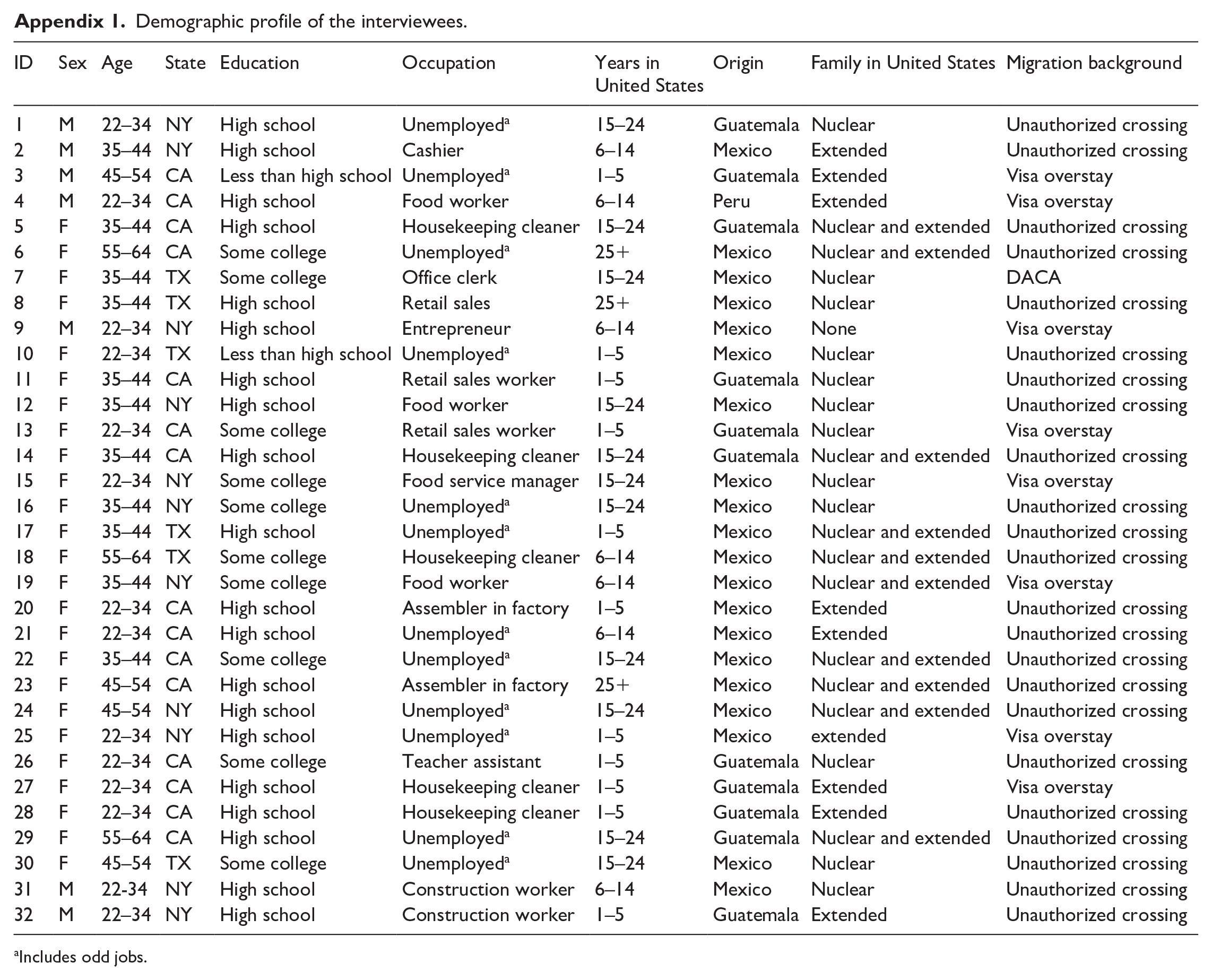
| ID | Sex | Age | State | Education | Occupation | Years in United States | Origin | Family in United States | Migration background |
|---|---|---|---|---|---|---|---|---|---|
| 1 | M | 22–34 | NY | High school | Unemployed a | 15–24 | Guatemala | Nuclear | Unauthorized crossing |
| 2 | M | 35–44 | NY | High school | Cashier | 6–14 | Mexico | Extended | Unauthorized crossing |
| 3 | M | 45–54 | CA | Less than high school | Unemployed a | 1–5 | Guatemala | Extended | Visa overstay |
| 4 | M | 22–34 | CA | High school | Food worker | 6–14 | Peru | Extended | Visa overstay |
| 5 | F | 35–44 | CA | High school | Housekeeping cleaner | 15–24 | Guatemala | Nuclear and extended | Unauthorized crossing |
| 6 | F | 55–64 | CA | Some college | Unemployed a | 25+ | Mexico | Nuclear and extended | Unauthorized crossing |
| 7 | F | 35–44 | TX | Some college | Office clerk | 15–24 | Mexico | Nuclear | DACA |
| 8 | F | 35–44 | TX | High school | Retail sales | 25+ | Mexico | Nuclear | Unauthorized crossing |
| 9 | M | 22–34 | NY | High school | Entrepreneur | 6–14 | Mexico | None | Visa overstay |
| 10 | F | 22–34 | TX | Less than high school | Unemployed a | 1–5 | Mexico | Nuclear | Unauthorized crossing |
| 11 | F | 35–44 | CA | High school | Retail sales worker | 1–5 | Guatemala | Nuclear | Unauthorized crossing |
| 12 | F | 35–44 | NY | High school | Food worker | 15–24 | Mexico | Nuclear | Unauthorized crossing |
| 13 | F | 22–34 | CA | Some college | Retail sales worker | 1–5 | Guatemala | Nuclear | Visa overstay |
| 14 | F | 35–44 | CA | High school | Housekeeping cleaner | 15–24 | Guatemala | Nuclear and extended | Unauthorized crossing |
| 15 | F | 22–34 | NY | Some college | Food service manager | 15–24 | Mexico | Nuclear | Visa overstay |
| 16 | F | 35–44 | NY | Some college | Unemployed a | 15–24 | Mexico | Nuclear | Unauthorized crossing |
| 17 | F | 35–44 | TX | High school | Unemployed a | 1–5 | Mexico | Nuclear and extended | Unauthorized crossing |
| 18 | F | 55–64 | TX | Some college | Housekeeping cleaner | 6–14 | Mexico | Nuclear and extended | Unauthorized crossing |
| 19 | F | 35–44 | NY | Some college | Food worker | 6–14 | Mexico | Nuclear and extended | Visa overstay |
| 20 | F | 22–34 | CA | High school | Assembler in factory | 1–5 | Mexico | Extended | Unauthorized crossing |
| 21 | F | 22–34 | CA | High school | Unemployed a | 6–14 | Mexico | Extended | Unauthorized crossing |
| 22 | F | 35–44 | CA | Some college | Unemployed a | 15–24 | Mexico | Nuclear and extended | Unauthorized crossing |
| 23 | F | 45–54 | CA | High school | Assembler in factory | 25+ | Mexico | Nuclear and extended | Unauthorized crossing |
| 24 | F | 45–54 | NY | High school | Unemployed a | 15–24 | Mexico | Nuclear and extended | Unauthorized crossing |
| 25 | F | 22–34 | NY | High school | Unemployed a | 1–5 | Mexico | extended | Visa overstay |
| 26 | F | 22–34 | CA | Some college | Teacher assistant | 1–5 | Guatemala | Nuclear | Unauthorized crossing |
| 27 | F | 22–34 | CA | High school | Housekeeping cleaner | 1–5 | Guatemala | Extended | Visa overstay |
| 28 | F | 22–34 | CA | High school | Housekeeping cleaner | 1–5 | Guatemala | Extended | Unauthorized crossing |
| 29 | F | 55–64 | CA | High school | Unemployed a | 15–24 | Guatemala | Nuclear and extended | Unauthorized crossing |
| 30 | F | 45–54 | TX | Some college | Unemployed a | 15–24 | Mexico | Nuclear | Unauthorized crossing |
| 31 | M | 22-34 | NY | High school | Construction worker | 6–14 | Mexico | Nuclear | Unauthorized crossing |
| 32 | M | 22–34 | NY | High school | Construction worker | 1–5 | Guatemala | Extended | Unauthorized crossing |
Includes odd jobs.
Acknowledgements
We are deeply grateful to the interviewees and thank them for their time and contributions. We would also like to thank Carolina Aguiar for contributing to the fieldwork and interviews, as well as Panayiota Tsatsou for her comments on the manuscript. We would also like to thank the three anonymous reviewers for their valuable comments.
Author note
Zach Bastick is now affiliated to University of Oxford, UK.
Funding
The authors disclosed receipt of the following financial support for the research, authorship, and/or publication of this article: This work received support from the John Fell Fund, University of Oxford (project number 0009771), and from COST Action 16111 (ETHMIGSURVEYDATA) of the Horizon 2020 Framework Program of the European Union.
