




Abstract
Digital microwork consists of remote and highly decontextualized labor that is increasingly governed by algorithms. The anonymity and granularity of such work is likely to cause alienation among workers. To date, we know little about how workers reconcile such potential feelings of alienation with their simultaneous commitment to the platform. Based on a longitudinal survey of 460 workers on a large microworking platform and a combination of quantitative and qualitative analyses, we show that (1) alienation is present in digital microwork. However, our study also finds that (2) workers’ commitment to the platform over time may alter their subjective perceptions of alienation. Drawing from qualitative statements, we show (3) how workers perform identity work that might help reconcile feelings of alienation with simultaneous platform commitment. Our findings contribute to solving the paradox of worker commitment to precarious platform labor, which is an issue frequently raised in the digital labor literature.
Introduction
The emergence of digital work platforms facilitates new work modalities, where large projects can be broken down into series of small tasks that are then distributed digitally to an anonymous global workforce before they are re-assembled to a final work product (Benkler, 2016; Duggan et al., 2020; Kittur et al., 2013). Such tasks (microtasks) typically include transcribing a snippet of hand-written text, classifying an image or categorizing the sentiment expressed in a comment (Lehdonvirta and Mezier, 2013). This form of digital work is termed microwork or crowdwork (e.g. Duggan et al., 2020; Howe, 2009) and is facilitated by a growing number of online platforms, such as Amazon Mechanical Turk and Clickworker. Work within such arrangements takes place outside of organizational holding environments (Petriglieri et al., 2019) and is performed remotely, anonymously, and largely without human oversight or interaction. This means that key decisions, such as hiring, monitoring, and reviewing are governed by algorithms (automated decision-making mechanisms) (Duggan et al., 2020; Lehdonvirta et al., 2019; Meijerink and Keegan, 2019; Wood et al., 2019). Previous work argues that such algorithmically governed microwork platforms contribute to an “extreme commodification” of labor (Prassl, 2018) and to the emergence of “humans-as-a-service” work-modes (Irani, 2015), not least as arrangements consist of very short-term interactions—sometimes only lasting seconds (Brawley and Pury, 2016). This has lead Duggan et al. (2020) to question the extent to which workers can develop a working relationship within such platform arrangements. Similarly, Meijerink and Keegan (2019) observe that the emergence of digital platforms may challenge or even eradicate the standard employer-employee relationship.
While microwork arrangements offer high degrees of autonomy and flexibility, scholars have expressed concern regarding its “worker friendliness” (Prassl and Risak, 2016; Spreitzer et al., 2017; Wood and Lehdonvirta, 2019). For one, microwork may be undervalued as workers receive low wages and are lacking basic employment protection and benefits (Bucher et al., 2019; Prassl, 2018; Sheehan and Pittman, 2019; Spreitzer et al., 2017). In addition, recent work has stressed the highly decontextualized, anonymous, 1 and remote nature of microwork, which may be distancing workers from the larger context and meaning of their work (e.g. Bucher et al., 2019; Gandini, 2019). The high level of anonymity and virtuality of microwork, combined with a lack of direct human contact or oversight, may leave workers feeling isolated or estranged (e.g. Wood et al., 2018).
Consequently, given the conditions of algorithmic management, absent organizational holding environments, and doubtful working relationships with the platform, we would expect microworkers to experience alienation as a state of estrangement or disenfranchisement, leading them to dissociate from their work (Bergvall-Kåreborn and Howcroft, 2014; Fuchs, 2015; Wood et al., 2019). To date, however, there has been a lack of empirical exploration into individual perceptions of alienation in microwork. While the literature stresses the presence of alienating factors within microwork, we know little about (1) how workers themselves perceive these factors, (2) how different levels of platform commitment affect perceptions of alienation, or (3) how workers reconcile alienation and commitment through strategies such as identity work. In particular, due to the dearth of longitudinal studies, current research fails to explain the paradox that workers choose to remain in potentially alienating and often precarious platform environments for extended periods of time.
This article applies an understanding of alienation rooted in the social-psychological tradition (e.g. Clark, 1959; Dean, 1961; Seeman, 1959, 1975), where alienation is treated as a subjective construct that is “perceivable” and “describable” by individuals. Empirically, we employ an abductive and mixed-methods approach, combining a cross-lagged panel survey (quantitative data analysis) with open text statements (qualitative data analysis). Based on a longitudinal survey of 460 microworkers, we first present evidence of perceived alienation among microworkers—operationalized as powerlessness, normlessness, meaninglessness, social isolation, and self-estrangement. Second, we argue that workers’ subjective perception of alienation over time depends on their commitment to the platform. Our data reveal that with platform commitment, perceived alienation seems to diminish over time. Third, providing further contextualization on these findings, we draw from qualitative statements to show that workers’ construction of identity frames may be key in explaining how microworkers reconcile feelings of alienation with their continued commitment to the platform. Here, different worker identities seem to entail different kinds of commitment as workers want to, need to, or feel that they ought to remain on the platform.
Our contribution hopes to complement current scholarship on digital labor and the gig economy (e.g. Kuhn and Maleki, 2017; Panteli et al., 2020; Petriglieri et al., 2019; Wood et al., 2019), showing implications for future research. In particular, we offer suggestions on how micoworkers reconcile the co-occurrence of alienation and commitment through identity work, thus providing a possible explanation for the paradox of workers staying in alienating environments even in the absence of immediate external pressures.
Literature: platform (micro-)work and alienation
Microwork
Microwork is an open mode of productive digital participation where large numbers of—often anonymous—workers employ their skill and knowledge to complete digital tasks (or microtasks, work badges) in exchange for various forms of compensation (Kittur et al., 2013; Lehdonvirta and Ernkvist, 2011). For the purpose of this article, in line with (Bucher et al., 2019), we generally understand microwork as an umbrella-term, encompassing productive practices pertaining to the completion of (1) digital tasks which are (2) predefined by requesters (individuals, groups or organizations) and (3) distributed through an online platform (4) to a large undefined number of workers (4) for some form of compensation. This definition builds on Howe (2009), Estellés-Arolas and González-Ladrón-de-Guevara (2012) as well as Kittur et al. (2013) and encompasses organizational, individual, and technological aspects.
A critical perspective on digital work in general, and microwork in particular, argues that these setups may be alienating workers by disconnecting them intellectually and physically from the larger product which they help to create (Aytes, 2012). In the same vein, digital labor has been deemed exploitative in the sense that digital workers often earn below minimum wage and are left without worker protection (Fuchs and Sevignani, 2013; Paolacci et al., 2010; Scholz, 2012). Also, digital labor platforms which distribute digital tasks to the workforce have been criticized for putting workers systematically at a disadvantage by supporting power imbalances between requester/employer and worker (e.g. Scholz, 2012). In turn, digital labor critics identify various themes of exploitation and alienation as key mechanisms in digital labor (e.g. Fuchs and Sevignani, 2013).
Alienation
The conceptual notion of alienation itself has a long and fruitful history as a concept in multiple disciplines (for an extensive overview, see Kalekin-Fishman and Langman, 2015). Depending on the school of thought, alienation may refer to a disconnect of a person from: (1) themselves (Kierkegaard, 1959; Sartre, 2001 [1973]), their true nature (Rousseau, 1968), their rightful role (Clark, 1959), their human potential (Marx, 1978 [1844]), or their spirit (Hegel, 1931), referred to as self-alienation; (2) from others such as fellow workers (Marx, 1978 [1844]), society (Dean, 1961; Durkheim, 1984 [1893]; Seeman, 1959), or social organizations (Barakat, 1969), referred to as social alienation; (3) from the act of working, from the means of production or from the product of their work (Marx, 1978 [1844]), referred to as work alienation; or (4) from god (e.g. Scott et al., 1998), referred to as spiritual alienation. In line with a social-psychological approach to alienation (Clark, 1959; Dean, 1961) and specifically Seeman’s (1959, 1972) seminal contributions, we define alienation as an individual’s perceived state of detachment from (1) themselves, (2) their work, or (3) other workers, which occurs in the form of perceived meaninglessness, normlessness, powerlessness, social isolation, and self-estrangement. The latter operationalization of alienation originally stems from Seeman (1959, 1972) and has been empirically validated (e.g. Golden et al., 2008; Mottaz, 1981; Shepard, 1972).
Social-psychological research into alienation includes explorations by Blauner (1964) that point toward different levels of technology resulting in different levels of alienation (e.g. lower levels of technology such as craft industries may entail lower levels of alienation while higher levels of technology such as in mass-production may entail higher levels of alienation)—a claim that has since been disputed, for instance, in the context of blue-collar labor (Aiken and Hage, 1966; Goldthorpe, 1966; Vallas and Yarrow, 1982).
Alienation has been associated with various antecedents, such as poor job conditions (Banai and Reisel, 2007), unsupportive leadership (Sarros et al., 2003), structural injustice (Sulu et al., 2010), lack of power to make decisions (Fedi et al., 2016), as well as with individual factors such as work ethic (Hirschfeld and Field, 2000) and individual psychological states (Seeman, 1959). Commonly assessed outcomes of alienation include employee performance and job performance (Chiaburu et al., 2014; Suraez-Mendoza and Zoghbi-Manrique-de-Lara, 2007), as well as attitudinal outcomes such as job satisfaction or job involvement (e.g. Fedi et al., 2016).
A lesser-studied relationship to date is that between alienation and organizational commitment (sometimes referred to as organizational identification or employee-organization linkages). The few studies that have explored the correlation between these two constructs (often as part of a larger model) have considered organizational commitment both as an antecedent (e.g. Agarwal, 1993; Podsakoff et al., 1986) and as an outcome (e.g. Efraty et al., 1991; Hirschfeld and Field, 2000; Sulu et al., 2010) of alienation. On the one hand, Agarwal assumes that organizational commitment as an antecedent reduces alienation since workers who “perceive an attachment to the organization [. . .] will perceive the work to be more important and conducive to increased involvement” (Agarwal, 1993: 724). On the other hand, Sulu et al. (2010) found that work alienation—measured as perceptions of powerlessness and social isolation—may have a negative impact on organizational commitment as an outcome. In this view, workers who are unable to exert control in their environment may experience diminished attachment to their organization (Sulu et al., 2010). While this essentially suggests a “spiral effect” in which alienation and organizational commitment may propel each other either upward or downward over time, neither of the previous studies explored these effects longitudinally (see Figure 1).
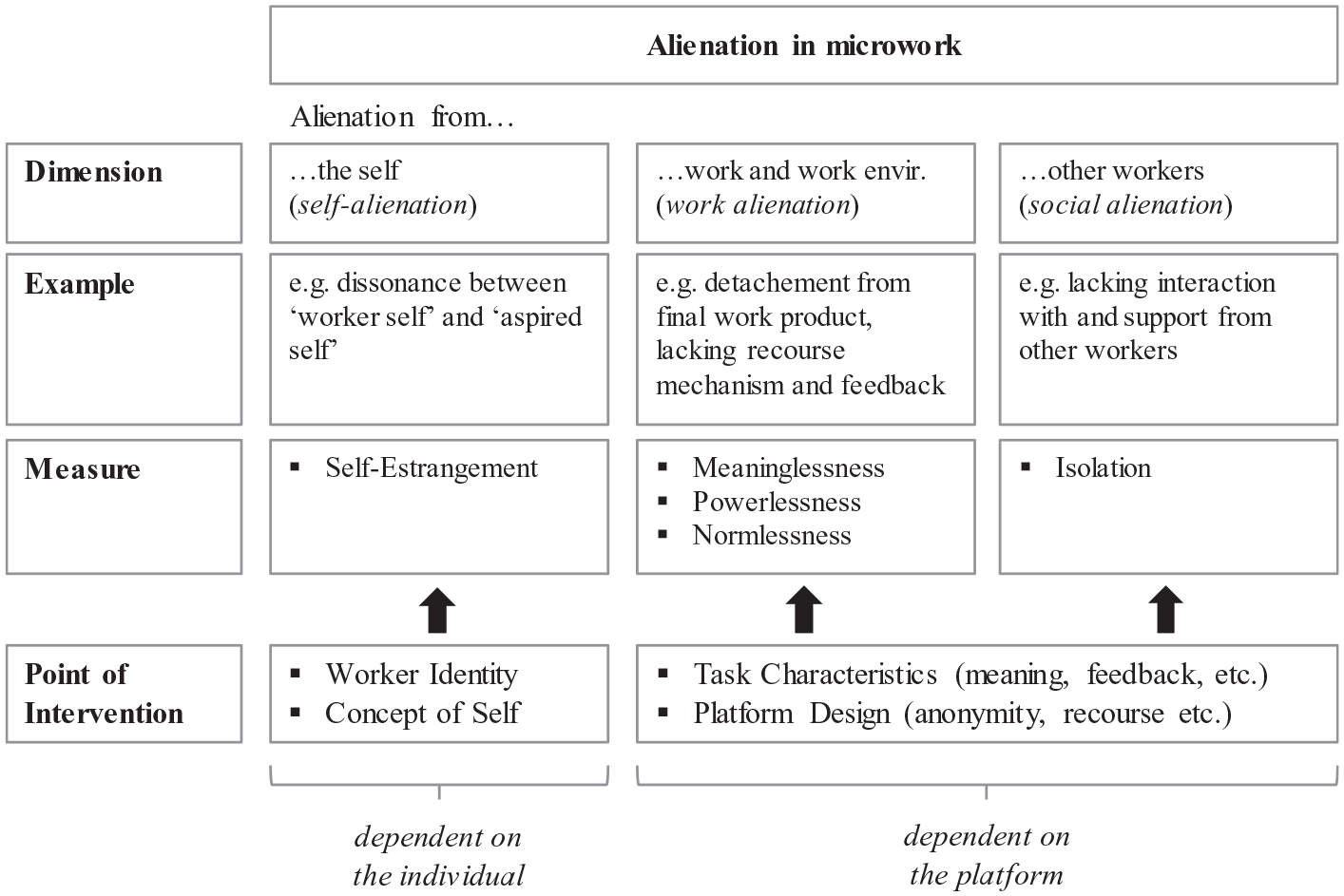
Dimensions of alienation.
Organizational commitment
Organizational commitment has, to date, mainly been studied in the context of traditional organizations (Meyer et al., 1993; Mowday et al., 1979; Porter et al., 1976) and is strongly linked to meaningfulness of work (Allan et al., 2019). Following Mowday et al. (1979: 4), organizational commitment is defined as the “relative strength of an individual’s identification with and involvement in a particular organization.” Allen and Meyer (1990) put forth three kinds of commitment: Employees may remain committed in an organization because they want to (affective commitment), because they need to (continuance commitment), or because they feel they ought to (normative commitment). We posit that this notion of organizational commitment can be transferred to the context of digital platforms, and that commitment matters to platforms as it creates a more stable workforce and lower turn-over, respectively, which reduces onboarding costs and entails higher productivity (Brawley and Pury, 2016). Since digital platforms do not have a formal employment relationship typical in standard work (Meijerink and Keegan, 2019) and have comparatively low entry and exit thresholds, it is conceivable that commitment (i.e. workers staying on the platform because they want to, need to, or feel they ought to) is a particularly useful avenue to explain continued engagement.
We argue that organizational commitment in microwork is lower than in traditional work, be it in employed or self-employed work. The individualistic, technologically mediated, distributed, and decontextualized nature of microwork should complicate the development of organizational commitment. Bos-Nehles and Meijerink (2018) imply that, with a comparative lack of social relationships between actors in platforms, there may be an according lack of commitment from both parties. With such lowered commitment, different forms of alienation are more likely to occur. However, one could argue, that even in the absence of a social relationship, there may still exist a rudimentary exchange relationship as workers in the form of payments and ratings (e.g. Bos-Nehles and Meijerink, 2018; Panteli et al., 2020). Given the interplay of alienation and platform commitment, an important question emerges: How do microworkers cope with the doubly challenging situation of increased potential for alienation with lowered opportunities for organizational commitment? We think that identity work offers an important factor in the equation and thus proceed to discuss it.
Identity work
Scrutinizing workers’ identity construction may contribute to a better understanding of the paradoxical phenomenon that workers choose to remain in alienating or even exploitative platform environments (Fish and Srinivasan, 2012; Postigo, 2016). For example, it is likely that workers, whose identities strongly align with their work on the platform, will be less prone to feel alienated. This is in line with Ashforth and Schinoff (2016) who argue that workers’ identities fundamentally shape how they perceive their work and work environments. For example, a worker who sees themselves as an aspiring manager may be more willing to incur challenging aspects of the job than a worker who does not share this identity (Ashforth and Schinoff, 2016). Similarly, a digital worker who identifies strongly with their work on the platform might be more willing to incur alienating aspects of microwork than a worker who identifies less strongly with the platform.
Workers’ identities can change over time and can be actively constructed and managed through “identity work” which Snow and Anderson, (1987: 1348) define as “the range of activities individuals engage in to create, present, and sustain personal identities that are congruent with and supportive of [their] self- concept.” More to the point, individuals may perform identity work by embracing or distancing themselves from a particular work role (Costas and Fleming, 2009; Goffman, 1961; Kunda, 1992) or through storytelling (Snow and Anderson, 1987). Identity work refers to the internalization of a given identity as a (partial) definition of the “self” (Ashforth and Schinoff, 2016). Identity work can be enacted through physical settings and props; personal appearances, association with others as well as through verbal construction of personal identities or “identity talk” (Snow and Anderson, 1987: 1348).
The latter is illustrated impressively in Snow and Anderson’s (1987) seminal study of identity work among homeless people who employ “identity talk”—verbally constructing personal identities—to generate and maintain a sense of meaning and self-worth. This study found that homeless people employed distancing (e.g. I am not like the other homeless people), embracing (e.g. I am an expert dumpster diver), and storytelling (e.g. I will be rich and successful one day) to cope with an arguably difficult life situation. Identity work is an active process in which individuals seek to align their current identity (e.g. worker) with a desired identity (e.g. top manager) or to move away from a feared identity (e.g. workaholic) (Ashforth and Schinoff, 2016). Individuals may construct their identity vis-à-vis multiple desired or feared identities, both in the short and long term. Rooted in social identity theory (Ashforth and Mael, 1989; Turner, 2010), identity work is a powerful way to construct and spell out desired identities and to reconcile incongruences between current and desired “selves.” The alignment of an individual’s work with their own identity and values is associated with organizational commitment as well as job satisfaction (Beech, 2008; Cable and Kay, 2012; Swann et al., 2009). At the same time, working toward a congruence of one’s work identity with one’s identity as a worker may reduce “self-estrangement” and thus further reduce alienation. In the context of microwork, we would expect workers’ identity construction over time to affect both alienation (negatively) and platform commitment (positively) (see Figure 2: theorized impact of identity work and platform commitment and alienation over time).
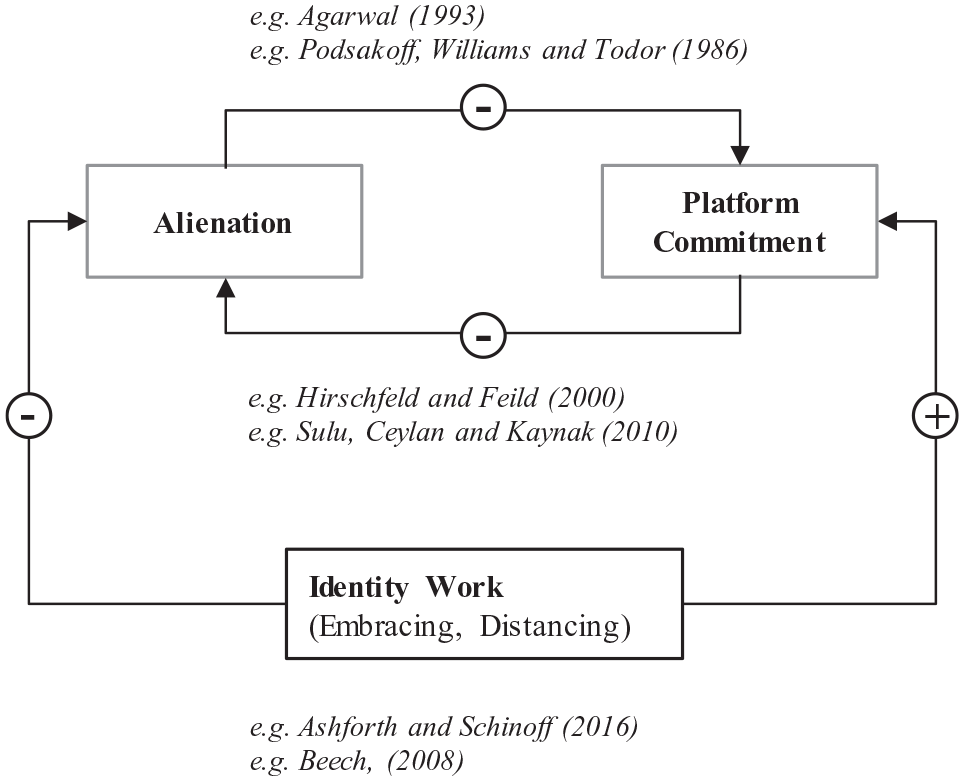
Theorized impact of identity work.
In order to investigate the relationship between alienation and commitment on a microwork platform over time, we combine quantitative and qualitative data analyses, following a mixed-methods research philosophy (Venkatesh et al., 2013). Specifically, within Venkatesh et al.’s (2013) typology of purposes of mixed-methods research, our analyses focus on complementarity and completeness. Mixed-methods studies that aim for complementarity use qualitative analyses to provide additional insights beyond quantitative data. Those that aim for completeness use qualitative data to source explanations and mechanisms for quantitative results. Our approach does both, as our qualitative analyses provide interpretations and findings that go beyond the quantitative analyses but also help understand the quantitative findings better. Given the lack of previous research on the interplay of alienation, platform commitment, and identity work in the context of microwork, our research follows an exploratory and abductive approach, rather than a deductive one. Thus, we abstained from formulating explicit hypotheses. However, we bring in our assumptions about potential mutual dependencies between alienation and platform commitment in the quantitative analyses, in pre-theoretical or proto-theoretical fashion.
In practical terms, we first report a quantitative cross-lagged panel analysis. We then complement our discussion of findings with qualitative statements that help contextualize the results from the panel survey and provide further insight into how microworkers reconcile tensions between alienation and platform commitment; that is, through different identity frames which may justify their affective, continuance, or cognitive commitment to the platform.
Quantitative analysis of alienation and platform commitment
Investigated relationships
To operationalize alienation, we apply the core components of alienation originally identified by Seeman (1959) to the context of microwork. In particular, we argue that due to the increasingly granular and decontextualized nature of microwork, alienation may occur in the form of perceived powerlessness, meaninglessness, and normlessness. Furthermore, we posit that the remoteness and anonymity of microwork may prompt social isolation and self-estrangement as further distinct dimensions of alienation. Against this background, we consider platform commitment as key to explaining workers’ decisions to stay active on a platform—especially considering that digital platforms generally have lower entry and exit thresholds than traditional work arrangements. In line with our theoretical framework, we consider platform commitment both as a potential antecedent as well as a potential outcome of alienation. As an antecedent, platform commitment might reduce alienation. When microworkers are committed to a platform and feel inspired and encouraged by its practices, they will perceive their work as more meaningful and empowering rather than as normless, self-estranging, or isolating. A positive relationship is also conceivable: If microworkers are locked in the platform ecosystem and strongly invested due to a long history of activity on the platform, they might feel trapped and constrained, which could reflect alienation. However, we think that a negative effect of platform commitment on alienation is more likely than a positive one. Therefore, we tentatively suggest a negative association. Conversely, alienation might also act as an antecedent of organizational commitment in the sense that increased alienation is likely to lower organizational commitment. A positive influence is conceivable, in a way that certain dimensions of alienation might constrain a worker to a platform and increase their commitment to that platform, in the sense of a trap, Stockholm syndrome-like effect, or a feeling of desperation that prevents the worker from acting on the situation. However, we think that a negative effect of alienation on platform commitment is more likely than a positive one. Again, we draw a tentative negative association. Furthermore, it is possible that alienation and organizational commitment may mutually reinforce each other, without a clear causal path from either component to the other. Since both perceptions of alienation as well as organizational commitment are expected to develop gradually with increased platform experience, we opted for a longitudinal study design that measures levels of alienation across two periods 1 year apart. Figure 3 shows the investigated relationships and the most plausible directionality.
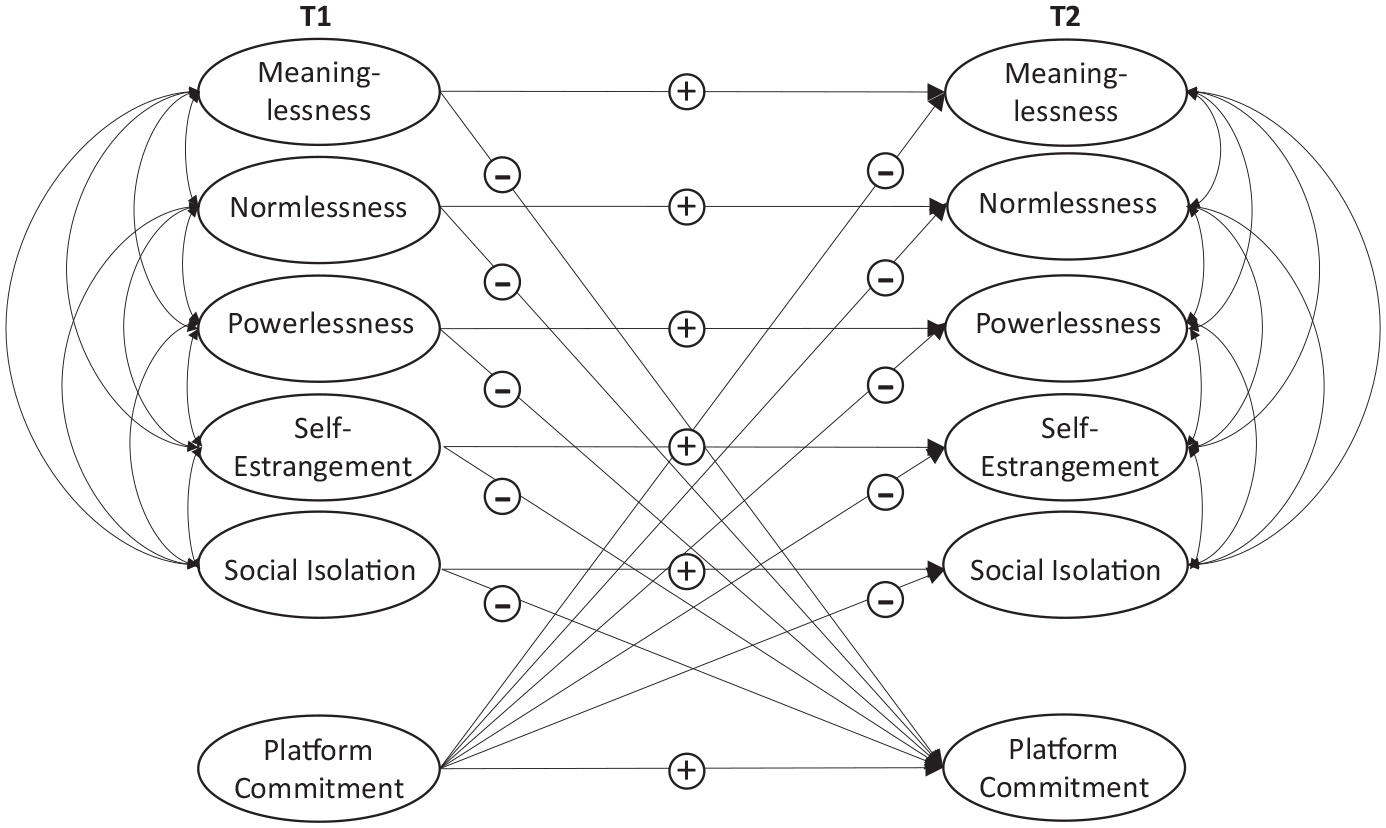
Research model.
Methods
Questionnaire and sample
To test the research model, we conducted a two-wave online survey among microworkers on Amazon Mechanical Turk. The survey administration was handled through the TurkPrime interface. We defined a threshold of at least 100 completed “human intelligence tasks” (HITs) on Amazon Mechanical Turk to exclude participants without substantial work experience on the platform. The first wave of the survey was undertaken by 805 individuals, the vast majority of whom completed the survey. The survey was programmed in Qualtrics and the survey link was posted on Amazon Mechanical Turk in mid-October 2016. The second wave of data collection took place in October 2017, 1 year after the first wave. This temporal separation allows to reduce the risk of common method variance and creates more robust causal inference than a cross-sectional survey could do (Rindfleisch et al., 2008). Only those respondents who had completed the first wave were invited to participate in the second wave, which was undertaken by 466 individuals, with six drop-outs. Thus, 460 participants completed both survey waves, amounting to an attrition rate of 42%. Given that the turnover on Amazon Mechanical Turk tends to be relatively high due to the flexibility of the work (Brawley and Pury, 2016), we deem this attrition rate to be acceptable. The survey took on average 19 minutes to complete. The respondents received a monetary reward of US$2 with an additional US$1 bonus for completion. The average age of the 460 participants was 37.5 years (SD = 11.6), with a range of 19–86 years. Of the participants, 52.5% reported being male, 46.5% female, and the remaining did not disclose their gender. The sample is relatively educated, with more than half of all respondents (51.5%) having a college degree and a further 24% reporting some time spent in college/toward a degree.
Measures
The survey consisted of a series of closed questions (used for “Quantitative analysis of alienation and platform commitment” section and the quantitative analyses) as well as two open text questions (used for “Qualitative analysis of coping through identity work”section and the qualitative analyses). In the closed questions, respondents were asked to state the extent of their agreement to a statement on a 5-point Likert-type scale. Respondents were instructed to answer these questions in the context of Amazon Mechanical Turk. The conceptualization of alienation is rooted in Seeman (1959, 1975) as well as Dean (1961). The scales of the individual alienation dimensions were adapted from Mottaz (1981) (powerlessness, meaninglessness, self-estrangement) as well as Shepard (1972) (normlessness) and Golden et al. (2008) (social isolation). The measurement of organizational commitment included six items based on Mowday et al. (1979). The items capture workers willingness to maintain membership in the platform and to exert effort. Throughout the process of scale development, we slightly adapted the wording of existing scales to fit the context of digital work environments. For example, we used the terms “platform” or “Amazon Mechanical Turk” instead of “workplace” or “company” as well as “requester” instead of “supervisor” or “employer” (see all items in Supplementary Material 1).
A comparison of different factor models revealed that five-factor measurement had the best goodness-of-fit values, while one-factor measurement had the worst. There was a substantial increase in goodness-of-fit from the two-factor model, where powerlessness as the most distinct sub-construct builds its own factor, to the three-factor model. In fact, allowing social isolation to be a separate construct in addition to powerlessness brings the goodness-of-fit values close to acceptable values. Isolating normlessness in a subsequent step (comparing the three-factor with the four-factor solution) does not substantially change the goodness-of-fit, whereas allowing self-estrangement and meaninglessness to be separate (i.e. a five-factor solution) leads to a significant improvement in goodness-of-fit. We therefore suggest that the five-factor solution is the most appropriate solution, not least as it aligns with Seeman’s (1972) theoretical conviction that alienation is constituted of these conceptually distinct dimensions (see Supplementary Material 2 for a comparison of factor solutions).
Data analysis
We analyzed the data within a structural equation modeling (SEM) framework, relying on a cross-lagged panel design with the latent variables described above (Newsom, 2015). We used MPlus (Version 7) to carry out the analyses, relying on robust Maximum Likelihood Estimation (MLR), so as to account for non-normality and other sources of distortion, such as heteroscedasticity and non-normal distribution of error terms (Byrne, 2013). Before reporting the structural model, we tested the measurement model for convergent and discriminant validity (see Supplementary Material 3; Fornell and Larcker, 1981). As seen in Supplementary Material 4, all scales reveal sufficient values in this regard. To assess measurement invariance between the two measurement times, in a first step, we tested the model for configural invariance. In this model, only the factor structure is constrained to be equal across groups, whereas all other parameters can be estimated freely (Bollen, 1989). The configural model thus uses identical items to measure identical constructs in all groups. As shown in Table 1, the configural model (M1) fits well. In a second step, we tested the model for metric invariance, in which both the factor structure and the factor loadings are held equal between the groups. The M2 model fit indices are very similar to those of M1 (see Table 1 for model fit indices).
Model fit indices.
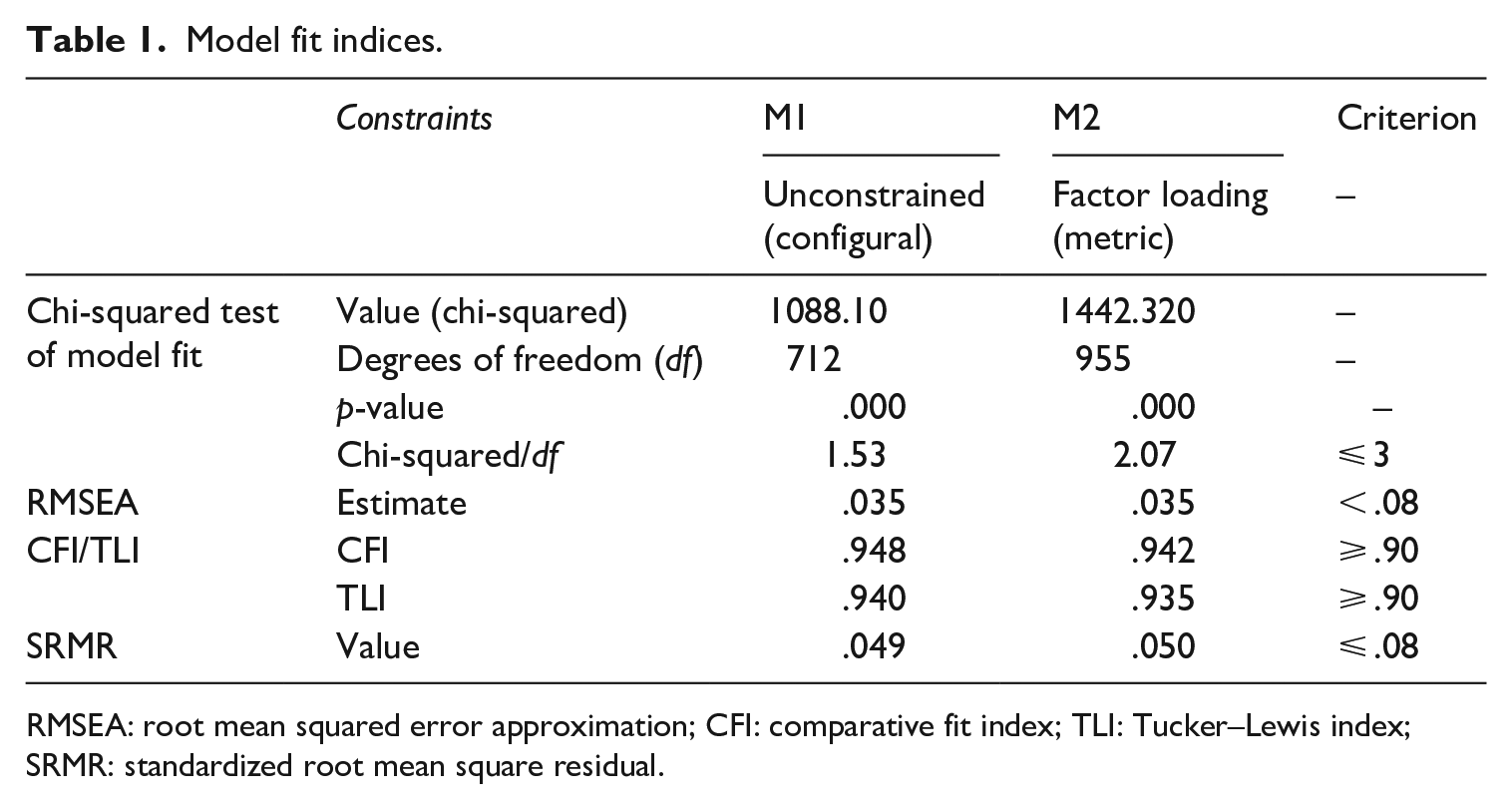
RMSEA: root mean squared error approximation; CFI: comparative fit index; TLI: Tucker–Lewis index; SRMR: standardized root mean square residual.
The Comparative Fit Index (CFI) difference test was used to carry out a formal assessment of measurement invariance. Cheung and Rensvold (2002) propose that a difference in CFI of ⩽ .01 between the models supports measurement invariance. This condition is satisfied in our case, allowing us to interpret the structural model. To control for possible demographic effects, we included education, gender, and age as control variables for all the dependent constructs in wave 2 of the survey. Except for a very small effect of education on organizational commitment (r = –.053, p = .036), all the demographic effects were insignificant. For the ease of interpretability, we will therefore not report the demographic effects.
Results
The results of the quantitative survey (means for wave 1/wave 2) suggest that alienation is present in digital workplaces mainly in the form of self-estrangement (2.63/2.75), meaninglessness (2.18/2.27), and social isolation (2.21/2.29). Normlessness (2.04/2.14) and powerlessness (1.93/1.98) are less pronounced, which suggests that workers not only feel they have a degree of control and agency within their work but that they also possess the knowledge and skills to understand and navigate the platform successfully. There is a slight increase across all alienation dimensions from wave 1 to wave 2. However, this difference is small and statistically significant at the 5% level only for normlessness and self-estrangement (i.e. for mean differences of .10 or larger). For meaninglessness, powerlessness, and self-estrangement, the differences across time are not statistically significant, meaning they are stable over time. Overall, self-estrangement is the most pronounced of the five alienation dimensions. This indicates that individuals do not identify strongly with the digital work environment and that they perceive a dissonance between their own identity and values and the platform’s identity and values. Participants agreed particularly strongly with the statement “My salary is the most rewarding aspect of my job,” which highlights the absence of a strong identification with the platform. Finally, we find that platform commitment (3.38/3.24) is quite pronounced across all items used for this construct in the SEM (see Supplementary Material 1: Questionnaire).
In the cross-lagged panel model (Table 2), we find that only one of the five alienation dimensions, namely meaninglessness, has a significant effect on platform commitment, though not in the expected direction: instead of a negative effect, we find that higher levels of meaninglessness result in higher platform commitment. However, the remaining four dimensions of alienation do not have a significant effect on platform commitment, indicating weak evidence overall for alienation as an antecedent of platform commitment in this specific context. Instead, the paths in the reverse direction are more in line with the theoretical model. Indeed, platform commitment reduces meaninglessness, powerlessness, and self-estrangement, while it has no significant effect, however, on normlessness and social isolation. Given that three out of five alienation dimensions are significantly affected by platform commitment, it seems that platform commitment can act as a powerful antecedent to alienation. This is especially true for the alienation dimension of self-estrangement, where the effect is strongest.
Results of the SEM.
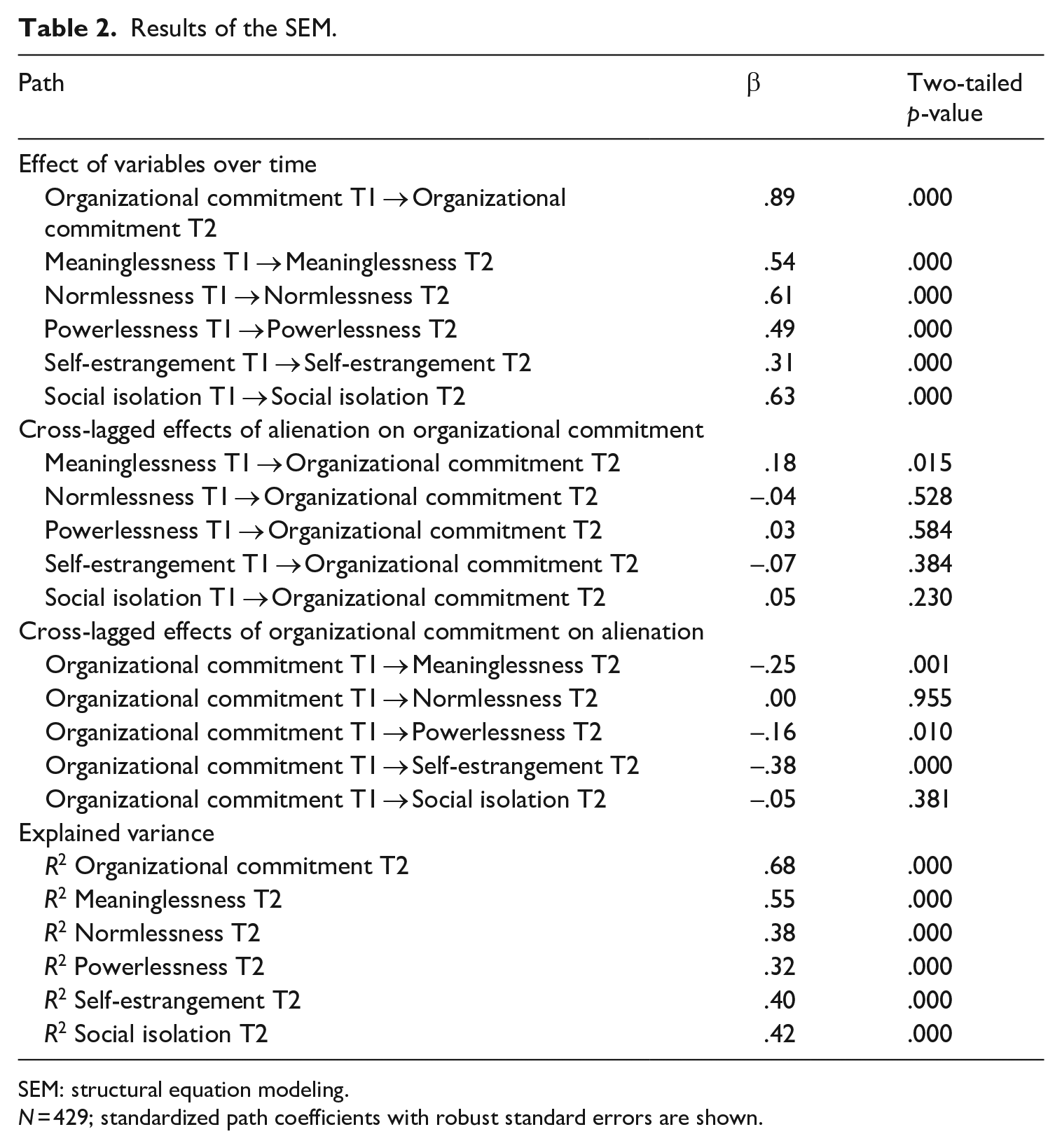
SEM: structural equation modeling.
N = 429; standardized path coefficients with robust standard errors are shown.
We also tested the model with a control variable for full-time versus part-time workers, but the effects did not change. The results of the cross-lagged panel model are displayed in Figure 4 (model graph) as well as in Table 2 (SEM Results).
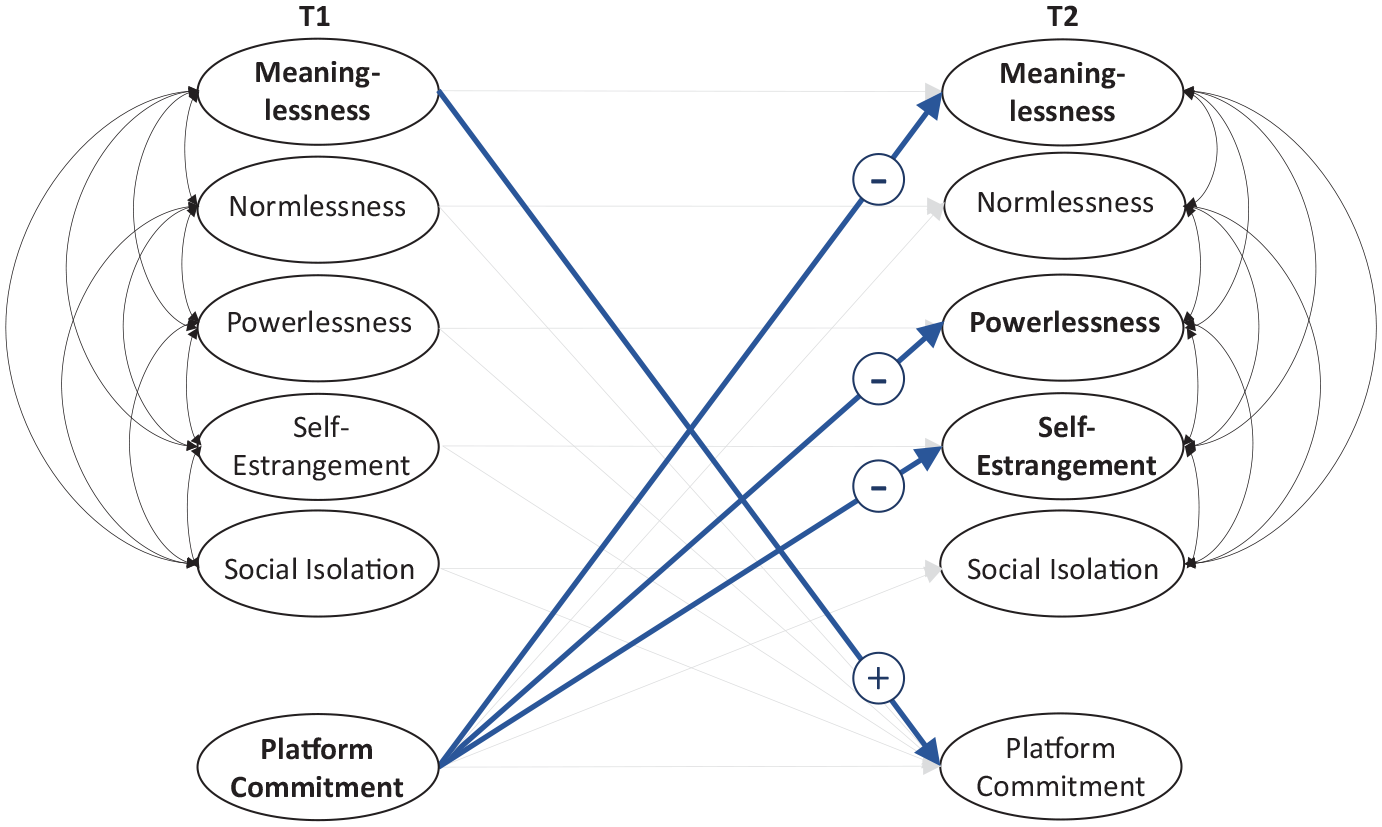
Structural model.
Qualitative analysis of coping through identity work
Methods
Building on the findings from the quantitative analysis, and to gain a deeper understanding of microworkers’ commitment to the platform—even in the face of alienating circumstances—we asked participants two open-ended survey questions within the first wave of the online survey. Here, we followed Kreiner et al. (2006), who used open-ended survey questions to gain insight into emerging identity themes among priests. Our first question invited participants to reflect on their own personal journey as microworkers. This question also served as an icebreaker at the beginning of the questionnaire. The wording was as follows: “Tell us your story. Why do you work on Mechanical Turk and how did you start?” In encouraging respondents to reflect back to when they first started, we sought to learn more about how their experiences and expectations of microwork changed over time. The second open question encouraged workers to describe their self-concepts. Here, we employed the technique of “interviewing by comment” suggested by Snow and Anderson (1987) as a means of eliciting “information from a respondent or informant by making an intentional statement rather than by asking a direct question” (p. 1343). The intentional and somewhat provocative statement in this case referred to microworkers as being “anonymous cogs in a machine.” This statement was derived from Fieseler et al. (2019), which showed that workers’ perceptions of the platform depend heavily on their conceptualization of the microworker-platform relationship. This second open-ended question was placed mid-way through the questionnaire.
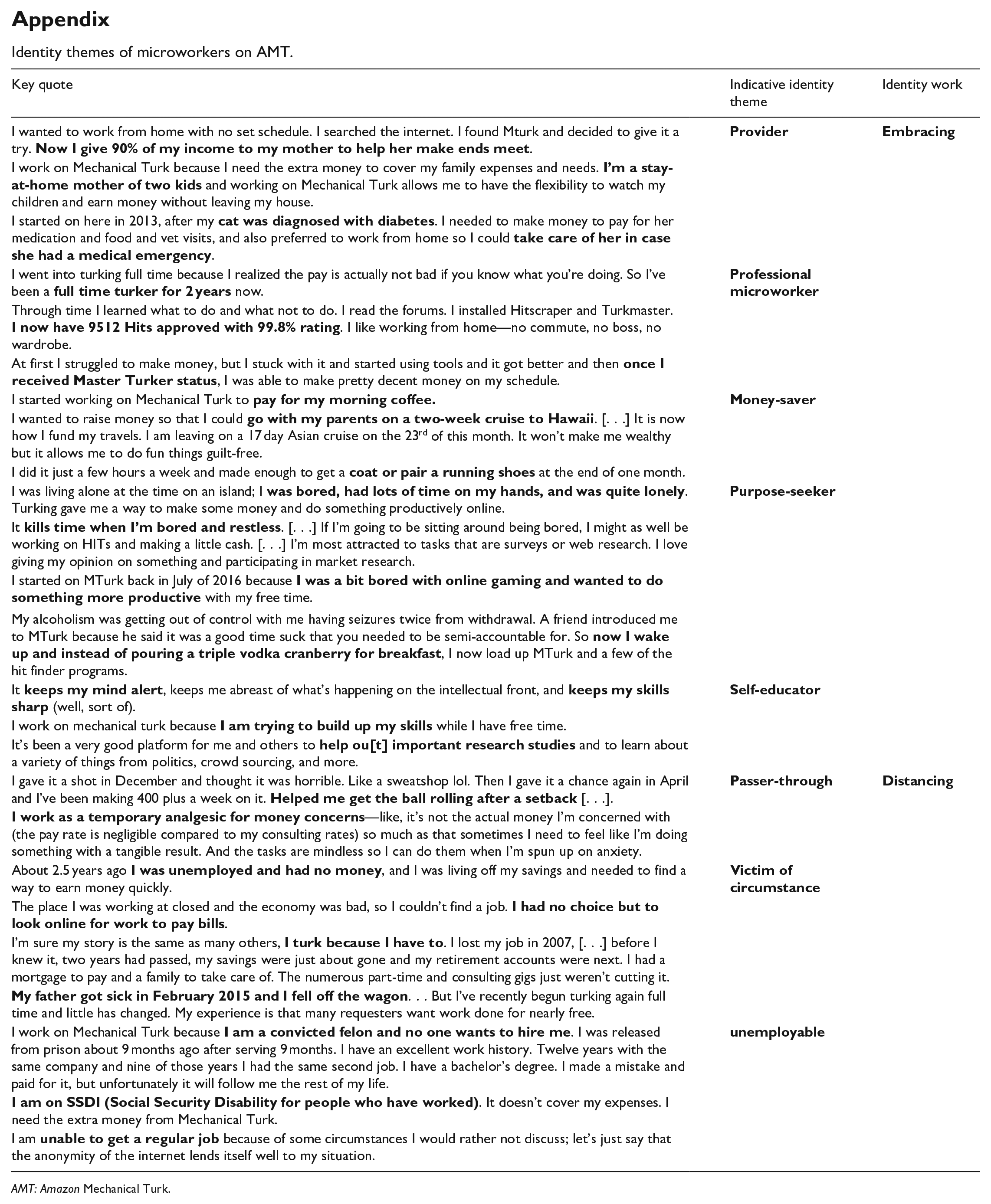
Scrutinizing the statements against this background, the two open text questions yielded a total of 641 statements. Of these, 202 responses were excluded because they were too short and did not convey sufficient insight into identity themes. Coding was performed in accordance with what Hsieh and Shannon (2005) have termed “conventional content analysis” in which codes are derived directly from the data. First, two researchers independently reviewed the comments, labeling emerging themes of personal identity construction with short descriptive codes such as “stay-at-home mom,” “life-long learner,” “savvy hustler,” or “outcast.” In a second step, these descriptive codes were reviewed, discussed, and refined into unified wordings (Yin, 2015). Finally, we distinguished eight emerging identity work themes that were suggested by our data based on prevalent narratives of embracing or distancing (Costas and Fleming, 2009; Goffman, 1961; Kunda, 1992). The qualitative content analysis was conducted with the goal of creating categories that represent similar meanings as well as identifying themes or patterns of reported behaviors within these categories (Hsieh and Shannon, 2005; Weber, 1990). The results show that participants either embrace microwork as part of their own identity (embracing) or construct a separate identity which they can reconcile with their engagement in digital microwork (distancing) (see Appendix for an overview of identity themes and sample quotes).
Results
Embracing identity themes
Participants who embrace microwork as part of their identity construct self-concepts around several categories of emergent identity themes. In the first category—professional microworkers—workers stress the expertise they have accumulated during their tenure as microworkers, as well as the numerical representations of their high performance: “Through time I learned what to do and what not to do. I read the forums. I installed Hitscraper and Turkmaster. I now have 9512 Hits approved with 99.8% rating.” In the second category, workers see themselves as self-educators as they see the platform as a learning environment where they can “build up their skills” or “stay abreast of what’s happening” and “keep the mind alert.” The third pattern of identity themes, the purpose-seeker, sees their engagement on the platform as a productive and purposeful way to pass the time or to avoid destructive behaviors. A former alcoholic, for instance, discloses that they use the platform as a way of holding themselves “semi-accountable” and of abstaining from falling back into problematic habits. The fourth and fifth categories encompass the money-saver and the provider. In both emergent themes, respondents embrace their microwork as a way of supplementing their income. Money-savers see their activity on the platform as a way of affording small luxuries and non-essentials such as “paying for my morning coffee” or being able to “do fun things guilt-free.” Providers, however, see their digital work as a way of providing and caring for loved ones, both in the financial and in the physical sense: “I'm a stay-at-home mother of two kids and [microwork] allows me to have the flexibility to watch my children and earn money without leaving my house.”
Distancing identity themes
Workers who construct their identity by distancing themselves from microwork clustered around three prevalent narratives. The passers-through are mainly workers who see their microwork as a “temporary analgesic” to bridge a changing life situation or to “get the ball rolling after a setback.” However, there are also workers whose self-concepts are not so much rooted in the platform as in an inability to participate in other arenas or work life. The second category, victims of circumstance, stress that they engage in microwork only because they “have no choice” due to circumstances out of their control, including family issues, job loss, or economic downturn. A typical theme in this category is a convergence of several external factors that lead individuals to see no other option than to turn to microworking. Finally, and in contrast, the unemployables find themselves forced into microwork due to personal circumstances such as chronic health issues or criminal records: “I work on [the platform] because I am a convicted felon and no one wants to hire me.” Those evincing self-concepts as victims of circumstance and/or unemployable generally lack a sense of agency and choice.
Identity work as a coping mechanism for alienation?
Over time, both embracing and distancing identity themes seem to result in workers being more or less “at peace” with their engagement in digital microwork, which may explain reduced self-estrangement and increased platform commitment over time. More to the point, when asked to comment on the provocative statement that co-workers may be “cogs in a machine,” the vast majority of workers—even those sharing distancing identity themes—emphasized their humanness, individual value, and personal mattering within the anonymous, remote, and granular work environment of the microwork platform. One user summarizes this sentiment as follows: “I am a human being. I have a distinct personality. I have thoughts, feelings and opinions.” Similarly, another worker stresses their conviction that they are valuable to and appreciated by both platform and the clients (“requesters”): “I am highly skilled, educated, and knowledgeable. The work I do helps requesters [. . .]. They depend on us!”
Although the majority of respondents reconcile their self-concepts with their work on the platform, some workers still struggle with the dissonance between their self-concept and their platform work, as expressed by their responses in agreement with the “cog in the machine” metaphor:
We are just cogs—scraping up pennies to make ends meet no matter how bad it feels. We give requestors decent work and they reject it all—mostly free work. [. . .] Amazon doesn’t care. Many requestors don’t care. I’m just a cog.
Summary: indicative identity themes and commitment
Taken together, our findings indicate that workers perceive both the platform environment as well as their own role and agency within the platform in a nuanced manner. These perceptions in turn translate into different kinds of commitment or “reasons to stay” on the platform. For some workers, commitment is voluntary and based on intrinsic motivation: Professional microworkers, money-savers, and self-educators indicate that they not only enjoy the work on the platform but also see it as a source of personal purpose and meaning. These groups of workers seem to remain on the platform because they want to (affective commitment). In contrast, providers, passers-through, victims of circumstances as well as unemployables may stay on the platform primarily due to external pressures which prevent them from finding suitable work, income, or ways to pass the time elsewhere. These workers seem to remain on the platform because they have to (continuance commitment). Finally, the purpose-seekers project identity themes which convey a perceived obligation to remain active, productive, and valuable. This last group of workers seems to remain on the platform because they feel that they ought to, lest they might lose their structure and sense of purpose. Consequently, interpreting the indicative identity themes derived in study 2 in light of Allen and Meyers’s (1990) components of commitment, our findings indicate that despite the challenging and potentially alienating setup microwork takes place in, individual workers manage to construct identity themes which may allow them to remain committed to the microwork environment (see Figure 5).
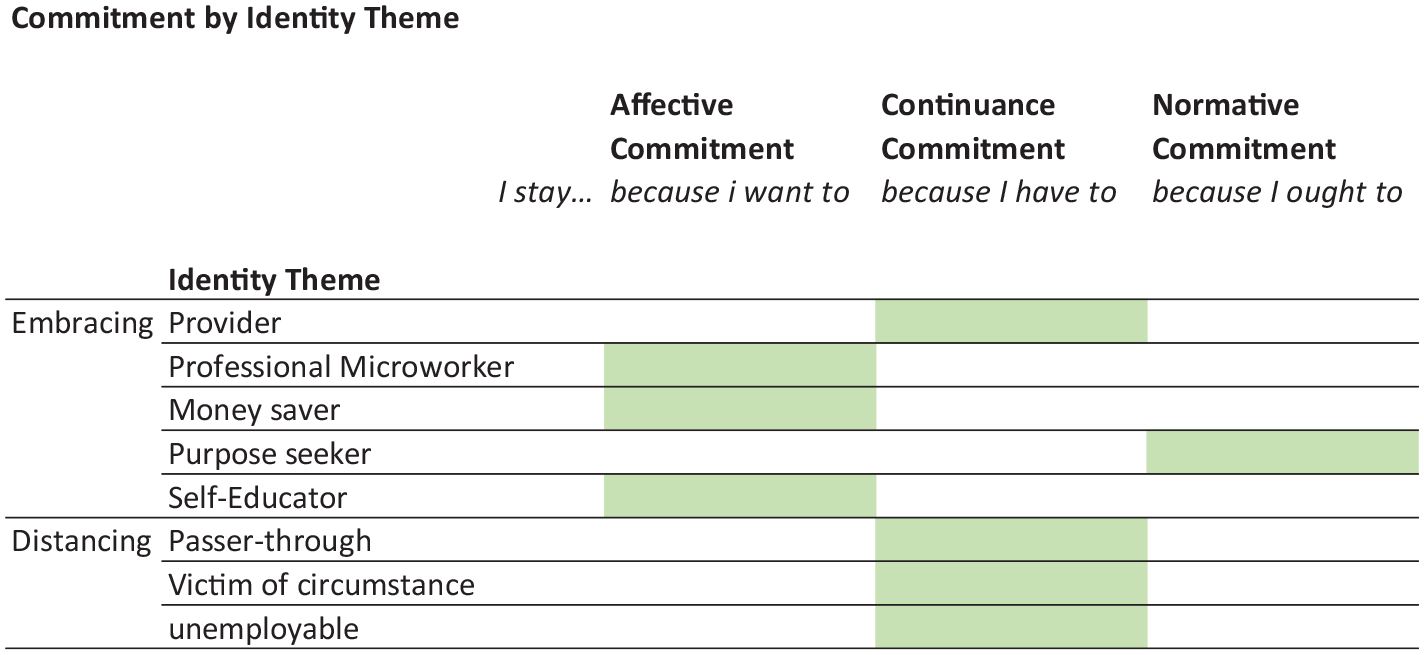
Interpretation of identity themes in light of platform commitment.
Discussion
This article tried to foray into the phenomenon of alienation among microworkers on Amazon Mechanical Turk on the basis of a cross-lagged panel survey (study 1) and qualitative statements focused on identity talk and personal identity construction to identify indicative identity themes among microworkers (study 2). While the quantitative results consistently suggest that alienating factors are present in digital microwork environments, albeit not equally pronounced, the qualitative statements afford insights into indicative identity themes as workers either embrace or distance themselves from their microwork. We argue that individually constructed identity themes may explain commitment to forms of labor that unfold outside of organizational holding environments, are algorithmically managed, and are marked by a lack of traditional employment relationships. Such commitment may be less determined by the meaningfulness of single tasks or through an identification with organizational goals and more by contextually derived affective, normative, and continuance commitment toward a mode of working (cf. Allen and Meyer, 1990). This perspective puts a stronger emphasis on worker agency than previous work and might help explain the uptake of (and loyalty to) this kind of labor, beyond purely socio-economic context factors.
Attaining a better understanding of the role of emergent identity themes, such as “provider” or “purpose-seeker” or “passer through,” is an important step to explaining different facets of the relationship between workers and platform—and a starting ground to further probe into practices of identity work in platform labor. We posit that adopting such a psychological and subjective approach can help explain the paradox in the digital labor debate described by Fish and Srinivasan (2012) and Postigo (2016) of people continuing to work in exploitative conditions. For instance, the indicative identity themes we have related here to the dimension of “distancing” could be further theorized in relation to organizational scholarship on workers’ disidentification practices. Such disidentification practices are described in the literature as means of coping with alienation through cynicism, humor, skepticism, or irony (Brown and Humphreys, 2006; Elsbach and Bhattacharya, 2001; Pratt, 2000). Another coping mechanism that might be called for especially in emotional forms of labor may be shielding a perceived “real self” from outward impressions (Ashford et al., 2007). The gratification of disidentification lies in the belief that the integrity of one’s real self can be protected (Kosmala and Herrbach, 2006). Authenticity is deemed an ideal state of being true to oneself and, as such, as freeing employees from identity regimes (Costas and Fleming, 2009).
While in our interpretation the “distancing” happened in the form of workers’ framing their practices as either temporary (“passers-through”) or not their choice (“victims of circumstance” or otherwise “unemployable”), disidentification practices go beyond this in the sense that the self is more radically protected or “shielded.” We can assume that workers who feel a strong sense of alienation would not only be those with more drastic (e.g. cynical, skeptic, or ironic) ways of disassociating themselves from the platform and its work but also those most likely to have opted out of the platform and thus were not part of our wave 2 sample—that is, our sample tendentially contains those cases that are relatively “successful” in coping with alienation while bolstering platform commitment. Compared to “temporary” or “choice” frames of distancing, more radical forms of distancing may not “square” as well as with relatively high platform commitment. This may also explain the relatively small difference in levels of alienation between waves 1 and 2. Based on our findings, we assume that in the low-threshold conditions of digital work in general and microwork in particular, workers will readily move out of potentially alienating conditions unless they align with an identity theme which prompts them to either want to remain on the platform or to feel like they have to or ought to stay committed to the platform.
Here, we should also point to a related methodological limitation in our study, which is that we only asked current users of Amazon Mechanical Turk and could not reach ex-users, which may have resulted in the responses being positively biased. The picture might be different if derived also from a sample of ex-users, particularly of those who have only very recently left the platform. Here, we would expect more severe instances of alienation and less organizational commitment. The fact that our results indicate that alienation might not be as widespread or pervasive among active workers on the platform as critical scholarship implies, together with the above considerations about the fluid conditions of the platform economy, suggests that current critical scholarship may underemphasize worker mobility.
One particularly intriguing finding—which countered the assumed relationship derived from our model—was a positive relationship between meaninglessness and platform commitment. However, this might be due to the particular design features of the online environment, where workers face relatively high costs for switching platforms (e.g. through a loss or reputation in the form of established ratings, or the need to familiarize with the new software functionalities). On the other hand, workers perceiving high degrees of meaninglessness might effectively lack other employment options, thus having to rely on this form of remote work for personal reasons, as outlined in our qualitative analysis (i.e. considering themselves “unemployable” or “victims of circumstances”). Finally, there may be coping mechanisms such as dissonance reduction at play that we have not yet understood with our research setup. Here, more expansive and ideally ethnographic modes of data collection may be most fruitful (see Van Doorn, 2017).
Conclusion
Critical scholarship has stressed the detrimental effects of the platform economy for workers, particularly for microworkers, who operate in a remote and often algorithmically managed manner outside of organizational holding environments to perform small and highly decontextualized human intelligence tasks. As such work unfolds outside of traditional employment relations, digital workers often lack basic employment benefits such as promotion prospects, skills training, and career development. These conditions are thought to present a manifest challenge to the sustainability of the digital gig economy, since the hardships that microworkers face are likely to be detrimental to their subjective well-being and eventually to affect their participation (Deng et al., 2016). However, modern workers may feel less “alone in the crowd” than is often suspected. Here, workers’ subjective identity frames may become key as they provide a basis for either embracing the unique conditions of microwork in the context of particular life—or self-circumstances, or simply an effective way of distancing and disassociating themselves from particular work contexts up until deciding to opt out of a task or platform altogether.
Supplemental Material
sj-docx-1-nms-10.1177_14614448211056863 – Supplemental material for Professionals, purpose-seekers, and passers-through: How microworkers reconcile alienation and platform commitment through identity work
Supplemental material, sj-docx-1-nms-10.1177_14614448211056863 for Professionals, purpose-seekers, and passers-through: How microworkers reconcile alienation and platform commitment through identity work by Eliane Bucher, Christian Fieseler, Christoph Lutz and Alexander Buhmann in New Media & Society
Footnotes
Appendix
Identity themes of microworkers on AMT.
| Key quote | Indicative identity theme | Identity work |
|---|---|---|
| I wanted to work from home with no set schedule. I searched the internet. I found Mturk and decided to give it a try. |
|
|
| I work on Mechanical Turk because I need the extra money to cover my family expenses and needs. |
||
| I started on here in 2013, after my |
||
| I went into turking full time because I realized the pay is actually not bad if you know what you’re doing. So I’ve been a |
|
|
| Through time I learned what to do and what not to do. I read the forums. I installed Hitscraper and Turkmaster. |
||
| At first I struggled to make money, but I stuck with it and started using tools and it got better and then |
||
| I started working on Mechanical Turk to |
|
|
| I wanted to raise money so that I could |
||
| I did it just a few hours a week and made enough to get a |
||
| I was living alone at the time on an island; I |
|
|
| It |
||
| I started on MTurk back in July of 2016 because |
||
| Key quote | Indicative identity theme | Identity work |
| My alcoholism was getting out of control with me having seizures twice from withdrawal. A friend introduced me to MTurk because he said it was a good time suck that you needed to be semi-accountable for. So |
||
| It |
|
|
| I work on mechanical turk because |
||
| It’s been a very good platform for me and others to |
||
| I gave it a shot in December and thought it was horrible. Like a sweatshop lol. Then I gave it a chance again in April and I’ve been making 400 plus a week on it. |
|
|
| About 2.5 years ago |
|
|
| The place I was working at closed and the economy was bad, so I couldn’t find a job. |
||
| I’m sure my story is the same as many others, |
||
| I work on Mechanical Turk because |
|
|
| I am |
AMT: Amazon Mechanical Turk.
Funding
The author(s) disclosed receipt of the following financial support for the research, authorship, and/or publication of this article: Norwegian Research Council grant number 275347—Future Ways of Working in the Digital Economy.

Supplemental material
Supplemental material for this article is available online.
Notes
Author biographies
References
Supplementary Material
Please find the following supplemental material available below.
For Open Access articles published under a Creative Commons License, all supplemental material carries the same license as the article it is associated with.
For non-Open Access articles published, all supplemental material carries a non-exclusive license, and permission requests for re-use of supplemental material or any part of supplemental material shall be sent directly to the copyright owner as specified in the copyright notice associated with the article.
