




Abstract
The cyberbullying field has quickly expanded in the past 20 years and especially includes strong emphases on diverse and marginal youth groups. However, the field’s literature defines cyberbullying in widely diverging ways while lacking consideration of how diverse youth groups themselves define and apply the term cyberbullying. This article aimed to consider how culturally, sexuality and gender-diverse youth understandings, experiences and interpretations of cyberbullying can be used to redress gaps in current academic notions of cyberbullying. Semi-structured interviews were conducted with 19 young people exploring their understandings, interpretations and experiences of cyberbullying. Participants were aged 18–25 years and self-identified as from a culturally and linguistically diverse (CALD) background and/or part of the LGBTQIA+ community. Interview question themes explored participants’ social media engagement, online communities and cyberbullying experiences. NVivo was used to perform thematic analyses. Findings largely suggested that the confusion regarding the term and definition of cyberbullying among researchers is also reflected in the population of diverse young people’s understandings and interpretations of cyberbullying. Whether these conflicted definitions were due to the confusion among youth populations or because academics and policymakers have failed to communicate a clear cyberbullying definition to the public was unclear. Considerations and future directions around the language and behaviours that should be included in a definition of cyberbullying are suggested to more clearly communicate the concept to future respondents and to the wider community.
Highlights
Critique of current definitions of cyberbullying;
Diverse young people’s descriptions of cyberbullying and interpretation of the current cyberbullying definition;
Novel and unique themes of cyberbullying involving personal and anonymous elements emerged from young people’s descriptions;
Implications for measurement and communication with young people are discussed.
The area of cyberbullying has been growing rapidly over the past two decades, particularly as it pertains to diverse and marginal youth groups (Hillier et al., 2010; Ranney et al., 2020; Smith et al., 2014). However, there still is disagreement in the literature regarding the definition of cyberbullying, and a lack of studies on what diverse youth groups themselves consider the term to cover (Menesini et al., 2012; Menesini and Nocentini, 2009). This article, first, considers the literature defining cyberbullying; second, reports on the methods and results of a study which explores how cyberbullying is defined by culturally diverse sexuality and gender-diverse youth themselves; and finally, discusses how youth’s understandings can be used to redress academic notions of cyberbullying. The aim of this study is to reflect on how cyberbullying is defined by considering diverse young people’s understanding, experiences and interpretations of cyberbullying.
Defining cyberbullying
While a number of definitions are utilised, the most common way of defining cyberbullying is as an aggressive act carried out by electronic means between two or more parties that is intentional, repetitive and involves an imbalance of power (Smith et al., 2008). This definition is based on the original definition of bullying developed by Olweus (1994), which was formed from the observations of peer aggression in a school environment and was adapted by Smith and colleagues to encompass bullying that occurs through technology (Smith et al., 2008). A number of researchers have taken issue with this definition of cyberbullying; in particular, with two of the three criteria outlined in the definition (Menesini and Nocentini, 2009). It has been argued that the aspects of repetition and a power imbalance are not as easily transferrable to an online environment as they are in face-to-face interactions, and as a result, various definitions of cyberbullying are utilised in the literature (Dooley et al., 2009).
A study by Peter and Petermann (2018) reviewed definitions of cyberbullying that were developed between 2012 and 2017 to test the durability and longevity of the characteristics of cyberbullying developed in older definitions (mainly that by Smith et al., 2008). The review found that the most common elements included in a definition were intention to bully and cyberbullying being carried out through electronic means, while the least common attributes included were repetition, aggression and the presence of a power imbalance. Most notably, the review found that there was not a single attribute that was included in 75% or more of the reviewed definitions, further highlighting the lack of consistency and agreement among researchers (Peter and Petermann, 2018).
The outcome of having no agreed upon definition is highly problematic. First, differing interpretations of cyberbullying mean that results cannot be compared, as it is possible researchers are measuring concepts that do not align. This results in perhaps the greatest direct impact of a lack of definition – the high variability in reported cyberbullying prevalence. A review by Selkie et al. (2016) found reports of cyberbullying victimisation to vary from 3% to 72%. If researchers cannot understand which (or even if) young people are impacted by cyberbullying, how are we to begin proposing intervention and support mechanisms for this phenomenon? Therefore, it is essential to ensure that the definitions of cyberbullying are accurate, consistent and robust.
One method of addressing these disagreements is consulting with young people directly to gain their perspectives of cyberbullying. It has been acknowledged that the majority of cyberbullying research is not informed by the ‘lived experience’ of young people involved in cyberbullying (Ranney et al., 2020). Despite the ongoing disagreement between researchers regarding the definition and conceptualisation of cyberbullying, very few researchers have elected to ask young people directly to contribute to this understanding, and even fewer have sought out the voices of minority/underrepresented young people. There are some exceptions to this; for example, Menesini and Nocentini have done a great deal of both quantitative and qualitative work regarding adolescents’ perspectives on cyberbullying and have used these perspectives in their own critiques of the cyberbullying definition (Menesini et al., 2012; Menesini and Nocentini, 2009). Furthermore, focus groups conducted with young adults in Australia revealed that young people view cyberbullying as an extension of face-to-face bullying, but like researchers there is a lack of agreement regarding the operationalisation of several aspects of the Smith et al. (2008) definition (Alipan et al., 2020).
While these studies have shed light on the perspectives and experiences of young people, a number of demographic groups have been excluded from this research, risking the ecological validity of these perspectives. Specifically, gender-diverse, culturally diverse and sexuality diverse young people are not included in these studies. The importance of including these young people – apart from the importance of ensuring the wider applicability of these findings – is that there is evidence that these young people experience cyberbullying in a different way to their heterosexual, cisgender and White counterparts. Specifically, LGBTQIA+ have been shown to experience higher levels of cybervictimisation than their heterosexual/cisgender peers (Abreu and Kenny, 2018; Hillier et al., 2010; Smith et al., 2014; UNESCO, 2016) and are also more likely to experience other forms of online aggression, such as sexually charged bullying (Ballard and Welch, 2017). Among culturally diverse young people, there is mixed evidence regarding how frequently they experience cyberbullying compared to their Caucasian counterparts, with some studies finding no differences between groups, others finding increased levels among ethnic minorities and others finding increased levels among Caucasian groups (Kowalski et al., 2019; Ranney et al., 2020).
Some researchers have attempted to rectify this gap. Ranney et al. (2020) carried out a qualitative study based on hearing about the lived experiences of cyberbullied adolescents from minority ethnic backgrounds to answer some of the questions plaguing the field of cyberbullying, including how to define it and what terms are most appropriate to use. As with researchers, participants in this study struggled to develop a fixed definition of cyberbullying. Instead, participants defined cyberbullying in terms of its impact on the victim, rather than specific acts or features that constitute cyberbullying. In addition, a qualitative study with high school-aged sexuality diverse young people explored their understanding of bullying, including cyberbullying, and it was found there were three modes of cybervictimisation: verbal cybervictimisation (e.g. sending hurtful messages), relational cybervictimisation (e.g. exclusion from groups) and electronic actions (e.g. sending a virus, stealing another person’s pictures; Varjas et al., 2013). These findings are illuminating and align with some previous studies; however, there remains a lack of certainty and consistency in findings, and this requires further investigation. While there has been some incorporation of sexuality diverse young people’s views, there is a paucity of incorporation of insights from culturally and/or gender-diverse young people.
As technology continues to evolve, language develops and the forms in which people interact with one another change, researchers must be adaptable and flexible to be responsive to these developments. If academic interpretations of cyberbullying do not align with the reality of what is occurring among young people or the understanding that young people have of the phenomenon of cyberbullying, then both the validity and reliability of academic measures of cyberbullying will be challenged. Furthermore, an intersectional approach needs to be utilised to ensure that a wide range of unique youth perspectives are captured in an effort to produce as accurate, encompassing and ecologically valid a definition as possible.
Aim of this study
The purpose of this study is to explore diverse young people’s understanding, experiences and interpretations of cyberbullying. This study will utilise qualitative methods to hear, in their own words, how culturally, sexuality and gender-diverse youth view cyberbullying, and explore to what extent these young people agree with the most commonly used definition of cyberbullying, which is the definition developed by Smith et al. (2008). This research is vital, as the voices of these young people are typically not heard in traditional psychological/scientific research, but research suggests that these young people are either more likely to experience online victimisation or more likely to be negatively impacted by this behaviour (Abreu and Kenny, 2018; Carlson and Frazer, 2018; Hinduja and Patchin, 2010; Mereish et al., 2017). It is not until we understand what diverse young people are experiencing online that we can determine whether our academic definitions of cyberbullying align with the reality of what is occurring.
To ensure that the definition and consequently the measurement of cyberbullying are relevant to the LGBTQIA+ and culturally diverse young people, it is necessary to speak directly with these young people and give them the opportunity to share their perspectives and understanding so that the academic definitions realign to fit within their experiences. Therefore, the aim of this study is to use qualitative methods to understand how culturally diverse and LGBTQIA+ young people interpret and understand cyberbullying. This study thus took an exploratory approach with the purpose of learning from participants and remove researcher biases and preconceived academic ideas regarding cyberbullying as much as possible.
Methods
Participants
Australians aged 18–25 years, who identified as from a culturally and linguistically diverse (CALD) background, as part of the LGBTQIA+ community or both, were targeted for participation in the study. A number of strategies were used to recruit these participants. Relevant community organisations (such as Twenty10, ACON, MYAN and the Gender Centre) were contacted and encouraged to share the opportunity to participate with their consumers. A flyer for the study was also shared in a number of social media groups. Undergraduate psychology students were also invited to participate provided they met the required age (aged 18–25 years) and demographic criteria (identifying as LGBTQIA+ or culturally/linguistically diverse). Participants who were recruited from the community received a reimbursement of US$20. Participants recruited through an undergraduate psychology cohort were reimbursed with course credit for their participation. From the final pool of participants, 5 had been recruited from the community, and the remaining 14 were recruited from the undergraduate psychology pool.
Interview procedure
Ethics approval was obtained from the research team’s university ethics committee. Prior to the interview, participants signed a consent form and provided basic demographic information, including their age, gender identity, sexual identity and ethnicity in open textboxes. Semi-structured interviews were conducted by a single researcher who has previous experience with youth engagement and participation. Purposeful sampling was utilised to ensure participants were representative of the identified gaps in cyberbullying research, focusing on recruiting young people with culturally, sexuality and/or gender-diverse identities.
Interviews were conducted in-person through video conferencing and through email/instant messaging. The interview structure was formatted to cover three main topic areas – social media engagement, online communities and cyberbullying. Within the topic area of cyberbullying, participants were first asked to define cyberbullying in their own words and then presented with the Smith et al. (2008) definition and criterion on cyberbullying and asked about their interpretation of (and agreement with) this definition. The interview was carried out in this order so as to avoid priming or influencing participants when they were asked to define cyberbullying in their own words. A semi-structured interview style was selected to allow further probing and flexibility in the interview structure where required. All in-person and video interviews were audio-recorded, transcribed and integrity-checked by the researcher. In-person and video interviews lasted from 22 minutes to 2 hours and 7 minutes (M = 50 minutes).
Analysis
For the purposes of this study, only the content within the cyberbullying section of transcripts was analysed. Analysis was conducted in NVivo. Transcriptions were imported in NVivo, and coding was completed by the primary researcher according to the six phases of thematic analysis outlined by Braun and Clarke (2006).
Results
Demographics
A total of 19 young people were interviewed in the study. Participants were aged 18–25 years (M = 20.5) and identified as either from a culturally and linguistically diverse (CALD) background, as part of the LGBTQIA+ community, or both. Overall, 79% (n = 15) participants identified as CALD, 53% (n = 10) identified as LGBTQIA+ and 16% (n = 3) of participants did not identify with the gender assigned at birth. In total, 32% (n = 6) participants identified as being part of more than one diversity category. The demographics of the participants are presented in Table 1.
Participant demographics relating to gender, sexuality and cultural identity.
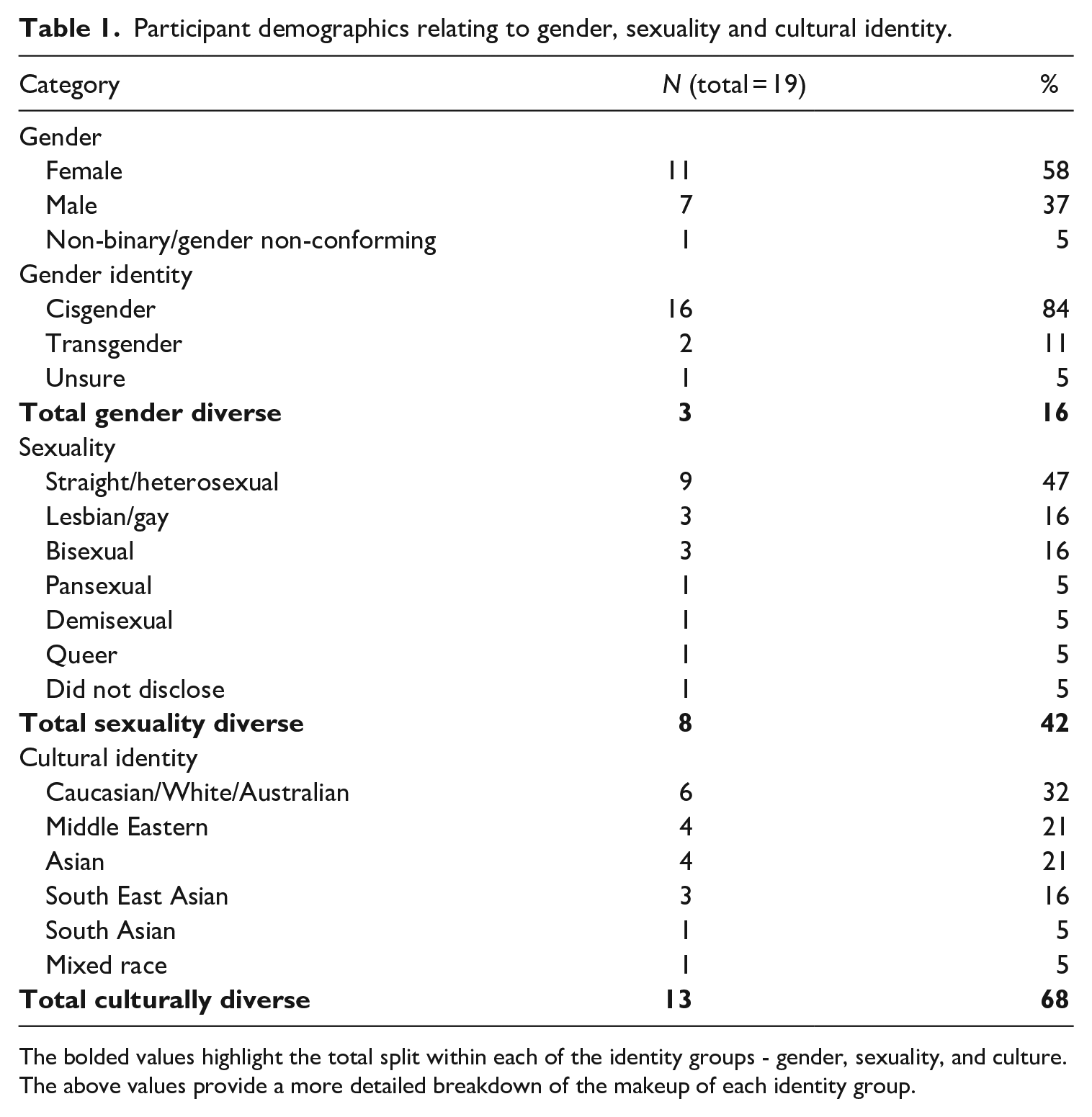
The bolded values highlight the total split within each of the identity groups - gender, sexuality, and culture. The above values provide a more detailed breakdown of the makeup of each identity group.
Participants’ interpretation of the academic cyberbullying definition
Participants were asked to define cyberbullying in their own words and provide examples of cyberbullying. Following this, participants were asked to reflect on the Smith et al. (2008) definition of cyberbullying and provide their thoughts and opinions on the definition. When asked to define cyberbullying in their own words, the most common terms used were ‘bullying’, ‘attacking’ and ‘comments’. Most participants labelled cyberbullying as being something that occurs online or on social media. There was little reference to apps, text messaging or other technology. The most referenced platforms where cyberbullying was observed were Facebook and Instagram, which may be attributed to the fact that the majority of participants (84%, n = 16) referenced using both platforms.
The results are divided into two parts, with this first section exploring the participants’ thoughts of the Smith et al. (2008) definition and the second exploring a thematic analysis of the participants’ own definitions of cyberbullying. When presented with the Smith et al. (2008) definition of cyberbullying, the responses from participants were extremely variable; 11 out of the 19 (58%) participants expressed disagreement with some aspect of the definition. The remaining 8 participants agreed that the definition fits their ideas around cyberbullying. One participant described the definition in the following way: ‘. . . it’s based on a very specific kind of cyberbullying and not what happens on most websites’ (female, 18 years, lesbian).
In many cases, the participants felt that the definition of cyberbullying is not reflective of the reality of the online spaces they utilise. Of those that initially disagreed with some aspect of the definition, 4 (36%) of 11 stated they disagreed with the aspect of a power imbalance, 5 out of 11 (45%) disagreed with the criteria of intention and 6 (54%) of 11 disagreed with the criteria of repetition. One participant stated that the presence of criteria is too restrictive and serves to protect perpetrators instead of being malleable enough to support victims, as they felt perpetrators could avoid prosecution through a ‘technicality’, such as not repeating the incident.
To investigate in further detail the participants’ feelings of the criteria, they were questioned about four specific terms in the cyberbullying definition – aggression, intentional, repetitive and power imbalance. Some common conceptualisations and opinions emerged and are explored below.
Aggression
Participants often referenced aggression as being something harmful to someone. Some participants (4 of 19) struggled to conceptualise aggression outside of being a physical, violent act and struggled to find a way that aggression can be observed or experienced online. Some participants said that the term seems to disregard online harmful acts that are passive but still harmful, such as ghosting or excluding someone online.
Intention
It was frequently mentioned that it is easier to understand a person’s intention when you know them, such as if they are a friend or relative. Several participants described intention as knowingly or purposefully causing harm to another person, with the phrase ‘on purpose’ used by multiple participants. One participant went further to describe intention in the following way:
I guess they’ve purposely tried to hurt someone. That would be intentional. Sometimes you say things and if you don’t know the other person’s context you don’t know that you could be offending them. That would be by accident but the important thing is that you can backtrack that and apologize or something along those lines. (Female, 19 years, CALD)
Repetition
There was wide agreement among the participants that ‘repetition’ means that the victim experiences multiple attacks, either in the same form (e.g. multiple online messages) or in changing forms (e.g. face-to-face bullying moving to online bullying). There was also mention that this does not necessarily mean the bullying was carried out by a single perpetrator, but rather that the victim experienced bullying repeatedly. Furthermore, two participants highlighted that repeated instances of bullying increase the harm experienced by the victim as it reinforces the attacks and ‘really embeds the message’.
Several participants (6 of 19) shared concerns with the inclusion of ‘repetition’ as one of the criteria in cyberbullying and felt that a single instance can cause enough harm to a person to be considered bullying. It became clear that multiple participants did not consider a ‘one-off’ instance to be covered by the definition of cyberbullying.
Power imbalance
Five participants disagreed with the inclusion of ‘power imbalance’ in the definition. Some participants also referenced that celebrities or those considered to have greater power can often be targets of cyberbullying. Other participants described a power imbalance as the perpetrator having greater social power over the victim, such as greater popularity or status. Participants also described a power imbalance as when a group targets an individual.
There were multiple references to a target as being ‘unable to defend themselves’ (5 of 19) or feeling powerless. Three participants also referred to cyberbullying as taking advantage of structural power, such as the power of a majority over a minority, or the power of men over women, and other structures that are in place that are indicative of systemic power differentials.
The overall impressions of cyberbullying and the Smith et al. (2008) definition may be best illustrated by the following quote, demonstrating the persistent confusion regarding the term ‘bullying’ more broadly:
Because like in high school there were people, especially guys, who would say really mean and like derogatory about other girls. I never really thought of that as bullying. I would just think ‘Oh he’s a dickhead’. You know, but I wouldn’t really think ‘he’s a bully’. Because I guess it is bullying but I’ve never really thought about that. So I guess I’ve been more aware of cyberbullying, but maybe bullying is more like insidious and present in face to face as well. (Female, bisexual, 18 years)
Participants’ own defining of cyberbullying
From the data, there was a common trend where participants viewed cyberbullying as a both a behaviour and a reaction paired with the behaviour. Frequently, participants outlined both as being essential to cyberbullying – it is a negative behaviour that causes a negative reaction. We will outline these ideas in three main categories: the general nature of cyberbullying, the behaviours performed in cyberbullying and how the cyberbullying behaviours are experienced.
The general nature of cyberbullying
Participants used a number of terms to characterise and describe the nature of cyberbullying behaviour. There are four dominant themes that emerged to describe what cyberbullying is; mean and negative, persistent and ongoing, anonymous, personal and directed. Two further themes which were not as dominant are intentional and manipulative. They will also be described briefly.
Mean and negative
The most common theme that emerged regarding how participants characterised cyberbullying was an act performed against a person that is ‘mean’, negative or offensive – illustrated by the typical quote: ‘I guess like in simple terms: people being mean online’ (gender non-conforming, pansexual, CALD, 22 years). Concepts, such as ‘making fun of someone’ (female, bisexual, CALD, 20 years), saying something ‘hurtful’ (female, CALD, 23 years) and people saying ‘aggressive or upsetting or rude things’ (male, CALD, gay, 22 years) were referenced. Of the 19 participants, 13 of them (68%) referenced this theme as a characteristic of cyberbullying and cyberbullying behaviours.
Persistent and ongoing
The persistence of cyberbullying was discussed by 8 (42%) of the 19 participants. The term ‘constant’ was used by several participants, and other terms, such as ‘consistent’, ‘repetitive’ and ‘continuous’. In one instance, a participant described hurtful or persistent messages as ‘a gateway to constantly poke into someone’s life’ (female, bisexual, 18 years). Participants also described that the nature of the repetition does not have to be inherently negative, but the very act of persistently receiving comments, messages or content from one or multiple perpetrators is an act of cyberbullying.
One participant referred to the ongoing nature of her cyberbullying experience: ‘If I ever block them, they’ll just like, send more texts. And I would kind of just like ignore them too and eventually, it would just kind of go . . .’ (female, lesbian, 18 years). One participant highlighted that repeated attacks did not necessarily mean it was repeated by a single perpetrator, but rather it was the experience of cyberbullying being the persistent aspect: ‘These things are repeated, either by multiple people or it just happened for a long time . . . it happens repetitively. I think that’s what cyberbullying might be’ (male, gay, CALD, 23 years).
Anonymous
Six participants referenced anonymity when defining cyberbullying. It was highlighted that cyberbullying is not always performed anonymously, but anonymity is a frequent and common characteristic. Participants described the lack of responsibility associated with anonymous perpetration, how anonymous perpetrators are free to share what they want without fear of consequences or retaliation and that this can empower a perpetrator to repeat the behaviour. The term ‘behind a computer’ was used frequently.
One participant commented on how anonymity can add to the distress associated with cyberbullying:
Well when it’s anonymous you’re kind of like reading it as yourself and not as the other person, which I think can make it a bit more difficult to be like, ‘Oh, it doesn’t matter’, you know? And like you don’t know who it’s coming from, you don’t -like it sort of places a bit of doubt in your mind, rather than: it’s this person from this place, I know them this way. Like knowing about that person and like even like just knowing the circumstances of that person comes from what might have driven them to say that sort of thing can sometimes help. But if it’s anonymous, you don’t really have any background. (Female, bisexual, 19 years)
While anonymity was a common quality of cyberbullying, participants stressed that it does not need to be present.
Personal and directed
There were several responses explaining that cyberbullying is a targeted and direct attack on an individual. The content of the cyberbullying is about the person, not a group they are a part of or an opinion they hold. One example a participant provided was the following:
I think it has to be a personal thing where that comment is personally directed to the individual. And not just to gay people in general, for example, if someone’s saying something that’s homophobic. So yeah, that definitely has to be personal. (Male, gay, CALD, 23 years)
Comparisons were also made regarding online discussions and arguments, and it was highlighted that these are not instances of cyberbullying as long as those involved are not attacking the individual, but the ideas and the opinions they are sharing. Furthermore, there were several references to an ‘individual’ or ‘a person’ being the target of cyberbullying. Participants highlighted that there is a single victim of cyberbullying acts, and these acts of cyberbullying are directed, targeted and personal to this victim.
Intentional
The themes of intentional and manipulative were less dominant than the initial themes outlined in the following example: ‘It’s about manipulating someone, it’s about gaslighting someone, it’s about sort of taking advantage of a person’s emotional and mental state both online and offline’ (male, gay, CALD, 22 years). Four participants referenced an act of cyberbullying as being intentional, and four participants referenced cyberbullying as being a manipulative action.
Participants described cyberbullying as when a person intentionally or purposefully causes harm to a victim. One participant referenced that knowing a person’s intention can help delineate between cyberbullying and a conversation between friends:
Cyberbullying, you have the intention to hurt someone. But obviously like you can see cyberbullying when you like just want to play around have fun, especially close friends . . . just want to have banter and stuff. People might see that as bullying. But then your intentions weren’t to hurt them. Just to like have fun and like joke around. (Male, CALD, 19 years)
Manipulative
Participants described manipulative behaviour, such as pressuring, taking advantage of a relationship or power a person has over another, as cyberbullying. One participant referenced how manipulation can prevent a person from recognising that they are being cyberbullied:
So for me, it’s people who manipulate the victim or target to think a certain way so they view it as not cyberbullying, they can view it as a conversation. While I still count it as subtle bullying, people might not see that it’s cyberbullying that they might counter it. Therefore, if someone was to ask ‘hey are you getting bullied?’, they’re more likely to say no because they don’t count that. (Trans female, demisexual, 21 years)
The behaviours performed in cyberbullying
Participants referred to a number of behaviours and acts in their own definitions of cyberbullying; for example, one said ‘Cyberbullying in general has gone from you know saying bad things to doing bad things’ (male, gay, CALD, 22 years). The most frequent behaviours mentioned were making comments (12), name calling/hate speech (11), sending messages (7), sharing photos/videos (5), sexual violence (5) and spreading rumours (4). The less frequent behaviours referenced were making threats (3), swearing (2), exclusion (2) and content removal (1). These are briefly explored below.
Making comments
The majority of participants described cyberbullying as ‘making comments’ about a person (12 out of 19). Many participants said they had observed this as the most common form of cyberbullying, and two participants commented on the lack of privacy associated with this act: ‘Like everyone who has access to that post can see that comment . . . I feel like cyberbullying can be extended to just commenting to a mass of people’ (female, bisexual, 18 years).
Name calling and hate speech
Name calling and references to hate speech were frequently mentioned as examples of cyberbullying. Participants referenced language that was homophobic, Islamophobic, racist and fatphobic. There were numerous mentions of ‘slut shaming’ and other observations of general name calling and hate speech; for example, ‘Like if it’s like a guy being more feminine and he’ll get like a f*g or like stuff like that’ (trans male, 20 years).
Sending messages
As with making comments, participants cited sending messages as a common cyberbullying behaviour, although one participant noted that this has become less common as social media has transformed and technologies have expanded:
But I just don’t think that is as common anymore. I don’t know. I could be wrong. I’ve never experienced that myself. I don’t know anyone who has but I know it’s like a real thing. But I feel like just from what I’ve perceived is that when social media was becoming big that’s what cyberbullying looked like. (Female, bisexual, 18 years)
There were references to the former social media website ask.fm being used as a platform where people send hurtful, anonymous direct messages. Tumblr was also named as a platform where people have received hurtful messages.
Sharing photos/videos
Participants often spoke of videos or images of a person being shared online without the individual’s consent. The content of the images shared were called ‘embarrassing’, ‘incriminating’ or something that ‘someone might not want to see or might not want you to share’ (female, CALD, 23 years). There were numerous references to sexual content being shared – such as nude photos or intimate videos. This is explored further below.
Sexual violence
Alongside the sharing of intimate photos online, and the concept of ‘revenge porn’ and ‘leaking nudes’ being explored by participants, there was also reference to pressuring – particularly young women – to share intimate photos of themselves. One participant shared her experience: ‘I have experienced a lot of like being pressured into like sending nudes and like that kind of harassment . . . I have experienced a lot of that. And that’s like the more of the cyberbullying that I’ve experienced’ (female, bisexual, 18 years). While there is an initial perpetrator who shares these images, the consequent resharing, commenting and public criticism of these images (and the subject of these images) was cited as a form of cyberbullying by participants.
Rumours
Only four participants named rumours as being a form of cyberbullying. Most of these participants mentioned rumours as a passing example and did not provide many details, though one participant noted that rumours can be either true or false, and it is the non-consensual sharing of the information that is the act of bullying.
Threats, swearing, exclusion and content removal
The idea of ‘extortion’, ‘threats’ and ‘intimidating someone’ was mentioned by three participants. The use of profanity was referenced by two participants. Deliberating blocking or excluding someone was also mentioned by two participants; one noted, ‘I guess, just thinking about like, if somebody is blocked from a group, even though it’s not a repetitive thing, I feel like that’s kind of cyberbullying in a way because they just ignored’ (male, gay, CALD, 23 years). One participant referenced content removal as a form of cyberbullying; that is, deliberately removing posts or working to have someone else’s posts removed.
How cyberbullying behaviours are experienced
Participants consistently highlighted that for an act to be deemed cyberbullying, it needs to cause harm, offence or be hurtful to the victim. The most common terms used were ‘hurtful’, ‘emotional’ and ‘offensive’. Eleven participants (57%) defined cyberbullying as something that impacts or causes harm to the victim. Eight of these participants (73%) were CALD, and six (55%) were sexuality diverse. For example, participants defined cyberbullying as: ‘Just any negative comments with the intentions of making a person feel like less than what they have achieved or less than what they are’ (male, CALD, 19 years), and ‘when someone feels attacked, or personally attacked in any way, by comments that people leave’ (male, gay, CALD, 23 years). Many participants highlighted that cyberbullying is about the effect on the individual, and that this is the way cyberbullying can be identified.
Discussion
From the above findings, it is clear that the confusion regarding the term and definition of cyberbullying among researchers is also reflected in the population of diverse young people. What is less clear is whether the academic literature is focused on this area of conflicted definitions due to the confusion among the population, or whether the confusion in the population exists because academics, researchers and policymakers have failed to communicate a clear definition to the public. From the responses to the Smith et al. (2008) definition, it became clear that young people have mixed feelings regarding the language and criteria for cyberbullying used in academic literature. Participants often felt confused about the aspects of the definition or would conceptualise the criteria in different ways. More than half the participants expressed some level of disagreement with the definition presented to them, strongly demonstrating that this definition is controversial among diverse youth.
Interestingly, many of the organic conceptualisations established by participants have parallels to the Smith et al. (2008) cyberbullying definition. This is important to note, particularly given that a majority of participants expressed some disagreement with the definition when it was later presented to them. While not a dominant theme, the concept of ‘intention’ was referenced by a number of participants. Similarly, the two dominant themes of negativity/being mean and persistence can be likened to the concept of cyberbullying being an ‘aggressive act’ that is ‘repeated’. The cyberbullying criteria of ‘repetition’ have especially received criticism in the literature (as well as from the participants of this study) and have been a source of confusion regarding operationalisation (Dooley et al., 2009). From the findings above, it may be that the language of ‘repetitive’ needs to be adjusted to ‘persistent’ and focuses more on the consistency of the experience, rather than the act of cyberbullying itself being a number of repeated incidents. Similarly, manipulation was a theme discussed by participants, which is comparable to the cyberbullying criteria of a ‘power imbalance’. Participants described manipulative cyberbullying behaviour as taking advantage of having power in a relationship and engaging in behaviour, such as gaslighting and pressuring. This research may provide more relevant language to allow a power imbalance to be relatable and transferrable to online interactions.
Moreover, the results also reflect areas that have been debated in the literature. The theme of anonymity was discussed by several participants as a potential factor in cyberbullying, its perpetration, and the resulting severity and impact of cyberbullying victimisation. While participants stressed that it is not necessary or core to the definition of cyberbullying, it is a common factor that they felt should be considered. This finding is not unexpected; given that past literature has found LGBTQIA+ people are more likely to be a victim of anonymous bullying (Abreu and Kenny, 2018). There should be further consideration among researchers about whether anonymity should be included in measures of cyberbullying, particularly given it is so prevalent among specific minority populations.
A unique theme that was discussed by the participants was the personal and targeted nature of cyberbullying. It was described as being directed at a single victim, and the bullying being specifically about the victim, rather than generic aggressive phrases that are directed to a large group and not related to the victim’s identity. Given the prominence of this theme in the current study, it is important for researchers to consider this when communicating with participants and when adapting definitions and measures to be more relevant for respondents. It is also an important factor to consider when considering the ability for people to recognise when cyberbullying is occurring to others – when it is clear, there is a ‘victim’ at the centre of the experience, young people may be able to more easily identify that what is occurring is bullying, and may be more knowledgeable about appropriate steps to take to intervene.
Participants also defined cyberbullying in terms of behaviours that are carried out. The behaviours described by the participants closely align with behaviours included in a number of cyberbullying measures. The validated measure developed by Patchin and Hinduja (2015) outlines seven cyberbullying behaviours (commenting, sharing photos, sharing videos, creating web pages, spreading rumours, sending threatening messages and online identity theft) – with the exception of identity theft, all these behaviours were outlined by our participants. Similarly, the Cyberbullying Questionnaire (Gámez-Guadix et al., 2014) includes nine behaviours (threatening/insulting messages, sharing images, rumours/comments, hacking, embarrassing videos and images, sharing personal information, deliberate exclusion and recording sexual images) which align with a number of themes established in this study. However, a dominant theme that is consistently poorly captured in cyberbullying measures is the online sexual exploitation described by participants, despite its prominence particularly among minority groups (Ballard and Welch, 2017). The findings of this study clearly highlight this startling gap in research practices, and it is possible that a number of particularly harmful cyberbullying experiences are not being captured by current cyberbullying measures.
Finally, aligning with previous qualitative research findings, this study found that the experience of the victim is a prominent factor that needs to be considered as it assists victims, perpetrators and bystanders in recognising when cyberbullying is occurring (Dennehy et al., 2020). Harm and impact on the victim is not often included in measures of cyberbullying, and paired with the aforementioned dominant theme of cyberbullying being mean and ‘hurtful’, it may be essential to begin to include this language in measures.
Strengths
This study has a number of strengths. First, giving voice to a number of underrepresented populations ensures that diverse and minority views are represented in the cyberbullying literature. The exploratory approach of this study also allowed for an unbiased and open exploration of young people’s perspectives of cyberbullying. Furthermore, this study utilised a university student-aged sample, which is rarely represented in cyberbullying research, as the literature mainly focuses on the experiences of high school-aged or primary school-aged young people. A further advantage of working with this population is their ability to be reflective on high school experiences while also incorporating experiences beyond high school. The contexts of high school and university/post high school environments are vastly different, often coming with increased independence and rapid personal growth, and it is important to consider how cyberbullying can operate in this environment among this population.
Limitations
With the above strengths, come a number of limitations. First, a small sample size of 19 was used, which limited the strength of the conclusions this research is able to draw. Moreover, a number of participants had never experienced cyberbullying before, and it may have been more appropriate to consult with young people that had lived experiences of being victims or perpetrators of cyberbullying. Future research should endeavour to further explore these themes with young people who have been victims of cyberbullying to explore if the concepts raised in this study align with their experiences of victimisation.
Importantly, this article does not resolve the long-standing and complicated theoretical disagreements relating to defining cyberbullying, as notably discussed by Tokunaga (2010). However, this research does demonstrate an important point for future researchers, policymakers and educators in the field regarding the language used to communicate with young people (regardless of the context) and does highlight the areas where research and current definitions have persisted and aligned with young people’s experiences, and where they diverge. Future research should attempt to address the significant theoretical complications related to cyberbullying by further incorporating the voices of diverse populations, as their experiences provide an important and often unrepresented view.
Conclusion
Overall, these findings have captured the perspective of a population that is often excluded from cyberbullying research and has further illuminated how conceptualisations of cyberbullying among young people align with (or divert from) the understanding that exists among researchers. It was found that, while appraisals of the Smith et al. (2008) definition of cyberbullying were highly mixed among participants, the concepts and themes raised by participants as aspects of cyberbullying can be likened to many of the concepts used in the literature. Specifically, many of the behaviours participants provided as examples of cyberbullying behaviour are used by numerous researchers in cyberbullying measures (Peter and Petermann, 2018; UNESCO, 2016). The cyberbullying criteria of repetition and aggression used in the Smith et al. (2008) definition have similarities to the concepts of persistence and negativity which were discussed by the participants. Furthermore, while a poor victim experience is not included in the Smith et al. (2008) definition, it is widely agreed among researchers that cyberbullying is an experience that causes harm to a person (Peter and Petermann, 2018). The findings of the current study demonstrate that researchers indeed have a fairly accurate conceptualisation of what cyberbullying is and how it manifests itself among young people, and particularly among young people of a diverse cross-section, but that the language and form of communicating these conceptualisations may be missing the mark among certain populations. These findings highlight what areas of cyberbullying need to be emphasised and what language can be used to better communicate experiences of cyberbullying. For example, the use of ‘persistent/consistent’ instead of ‘repeated’ may be more accessible and can assist victims in recognising their experiences as cyberbullying, rather than dismissing their experiences because they have interpreted the definition as being too stringent. Another example is the use of ‘power imbalance’ which a number of participants struggled to define and explain in this study. The use of language, such as ‘manipulation’ or providing examples, such as ‘gaslighting’ or being ignored may be more appropriate for the participants we are working with.
This study is an important step towards validating and re-evaluating the definition of cyberbullying to ensure it is relevant and applicable to all populations. While there has been vast discussion among academics about the relevance of different criteria, the findings of this study are promising in that a number of the ways diverse young people conceptualise cyberbullying are already being discussed and measured by researchers. This reveals that it is likely that current definitions of cyberbullying provide a good foundation for conceptualisation and operationalisation, but factors, such as language, need to be considered to ensure the definition of cyberbullying is communicated in a way that is clear to participants and aligns with their own ideas of cyberbullying, rather than confusing them as the current definition has been shown to do. Similarly, many of the behaviours young people categorise as cyberbullying behaviours are being captured in current widely used measures of cyberbullying. The choice of most participants to describe cyberbullying through the behaviours involved in the phenomena also suggests that using behavioural lists for measurement may be an effective way to capture cyberbullying experiences.
Footnotes
Funding
The author(s) received no financial support for the research, authorship and/or publication of this article.
