



Abstract
Adults’ digital self-tracking practices are relatively well studied, but these pre-existing models of digital self-tracking do not fit for how adolescents use these technologies. We apply the mechanisms-and-conditions framework of affordance theory to examine adolescents’ imagined affordances of self-tracking apps and devices. Based on qualitative data from an online survey of 16- to 18-year-olds in the United Kingdom, we find the following three key themes in how adolescents imagine the affordances of digital self-tracking: (1) the variability of use across adolescents and with adults, (2) the role of the social control of data in school settings, and (3) the salience of social comparisons among their peers. Using these findings, we show how social and institutional configurations come to matter for technological affordances. By examining adolescents’ imagined affordances for self-tracking, we suggest self-tracking research move away from a “one size fits all approach” and begin to highlight the differences in practices from adults and across adolescents.
Keywords
Introduction
Digital technology is ubiquitous in adolescents’ networked lives, shaping their experiences of social interactions, self-identity, group memberships, games-playing, and skill-learning (Davies and Eynon, 2013). As highly engaged technology-users, adolescents are often early adopters of new technologies (Rideout et al., 2010). However, regarding digital self-tracking tools—such as Fitbit, Apple Watch, and digital sports and fitness watches and devices or smartphone apps—the scholarly literature and technology marketing alike try to fit adolescents’ patterns of use into adult molds. Exploring how adolescents imagine, negotiate, and use self-tracking technologies may help researchers better understand technology practices and behaviors at this developmental life stage and expand our knowledge about digital self-tracking in general.
Our aim in this article is to unsettle the idea of adolescents as “mini-adults” and suggest that the models for self-tracking based on adult practices do not fit for adolescents. Digital self-tracking tools are designed to allow individuals to monitor, control, and analyze personal data, including health and wellness data (Ridgers et al., 2018), and many are designed with adults in mind (Schaefer et al., 2016; Wartella et al., 2016). These same tools, we find, afford adolescents quite different uses.
Adolescence is an important life stage because of “rapid physical and cognitive changes, expanding social relationships, and additional rights and responsibilities” (Zimmer-Gembeck and Collins, 2003: 175), and it is when lifelong health-related knowledge and behavior patterns are established (Kumar et al., 2015; Patton et al., 2016). It is also a time when agency functions differently due to the constraints of school. Young people spend over 7800 hours of their lives in school (YoungMinds, 2017), constrained by the particular norms, structures, and routines of schooling. Digital self-tracking practices are now moving “into areas beyond personal choice” (Gorm and Shklovski, 2019: 2508) for many people, but the stakes are particularly high for adolescents within the institution of formal education.
As we will see below, the current self-tracking scholarship has serious limits in explaining adolescents’ practices with these technologies. We look at how adolescents approach self-tracking tools. Do they show elements of the same kind of “soft resistance” that some adult users show (Nafus and Sherman, 2014)? Are adolescents using these devices to reformulate or reimagine their identities through the data or are they rejecting quantification? We use the concept of “imagined affordances” (Nagy and Neff, 2015) to understand how adolescents might be afforded different things from the same material tools that adults use. Drawing on a survey of 16- to18-year-olds, we show that adolescents’ imagined affordances for self-tracking in school-based Health and Physical Education offerings are shaped by the outsized importance of social comparisons for their life stage, how schools highly circumscribe their roles and agencies, and their wide variety of experiences and practices with self-tracking. Our findings about adolescent self-tracking suggest that other digital scholars should both take care with their assumptions about adolescents’ abilities to reconfigure digital technologies and reexamine the roles that social institutions play in shaping people’s engagements with new technologies.
Adolescents as self-trackers
Adolescents use digital self-tracking tools, despite the fact that these tools are neither designed for them, nor fit their needs. A recent survey in the United Kingdom found that 52% of adolescents use digital self-tracking tools (Rich et al., 2020). Adolescents value the content, personalized information, and social features of apps and wearables (Goodyear et al., 2019a). Adolescents’ use of these tools is often within highly institutionalized contexts. Schools increasingly use digital self-tracking tools to help educate young people about the benefits of physical activity (Casey et al., 2017; Gard, 2014; Lupton, 2016; Williamson, 2015) and interventions for increasing physical activity aimed at young people often use these devices (e.g. Drehlich et al., 2020; Tymms et al., 2016).
There are many reasons for caution. The same motivational “nudges” (Thaler and Sunstein, 2009) encoded into digital self-tracking tools designed for adults may not work for adolescents and may even be harmful. After using self-tracking tools, adolescents report increased feelings of competition, guilt, and internal pressure (Kerner and Goodyear, 2017). They are also skeptical of the educational value of self-tracking, experience negative feelings about themselves after using them, and are left with narrow conceptions of health and fitness through peer-surveillance, self-surveillance, and normative physical activity standards (Depper and Howe, 2017; Goodyear et al., 2019b; Kerner and Goodyear, 2017). Lupton (2021) found that relatively few studies have been conducted on young people’s use of wearable tools for health and fitness and most of the work to date has centered on intervention-based studies. For example, a recent UK-based study found 16- to 18-year-olds appreciated instantaneously reviewing their data, competing against others, and reaching for goals, but they struggled with how to engage their data, found data interpretation hard, and often forgot to use the device (Rich et al., 2020).
We are eager to make it clear from the outset that this does not mean that adolescents are incapable of sophisticated self-tracking practices, nor that the risks of adolescents’ self-tracking data work are insurmountable. Quite the contrary, adolescents’ unique skills and expertise in navigating both new technologies and the social and institutional contexts in which they live mean that the imagined affordances of these tools look different to those imagined by adults. As such, it is important to consider these imagined affordances to help us recognize the opportunities that may exist for adolescents’ positive use and enjoyment of these tools.
Thinking through affordances
New approaches to affordances show how social and institutional positionality come to matter for technological affordances. It is this lens we adopt to analyze our qualitative survey responses in this study. Davis and Chouinard (2016) define affordances as “the range of functions and constraints that an object provides for, and places upon, structurally situated subjects” (p. 1). Thinking through affordances allows us to see for whom technologies may prompt and dissuade and under what circumstances (Davis and Chouinard, 2016). This approach can highlight the “politics and values in technical systems” and lay “the groundwork for intentional (re)design” (Davis, 2020: 20).
We apply “imagined affordances” (Nagy and Neff, 2015) to show how “expectations for technology that are not fully realized in conscious, rational knowledge but are nonetheless concretized or materialized in socio-technical systems” (Nagy and Neff, 2015: 1). By using this framework, we ask explicitly how adolescents articulate their expectations and beliefs about self-tracking tools, rather than focus solely on what users do with these tools. “Imagined affordances” arise between the experiences of the users, designers, and materiality of the digital tools (Nagy and Neff, 2015). Using imagined affordances in this way allows scholars to look beyond the design and material features of digital self-tracking tools to contemplate how adolescents engage with the often complex social and psychological aspects of them. Our approach suggests that scholars should study the difference between the affordances of self-tracking tools for adolescents and the assumptions of the designers of those tools based on an idealized adult user.
Of course, affordances are not fixed. Technological tools afford uses and actions along a “porous continuum” (Davis, 2020: 22) of interrelated mechanisms: request, demand, encourage, discourage, refuse, and allow. These mechanisms are conditioned by perception, dexterity, and cultural and institutional legitimacy (Davis, 2020; Davis and Chouinard, 2016). This means how technologies afford is based in part a subject’s socialized awareness of and ability to use available features within user’s social contexts. Both awareness and ability are shaped by “cultural and institutional legitimacy”: “[t]he push and pull of an artifact rests partially on the structural position of the subject with whom it relates” (Davis and Chouinard, 2016: 6).
Schools dominate the institutional legitimacy of adolescence, shaping and constraining young people’s practices with digital technologies in key ways. In schools, “contested affordances” between teachers and students show the importance of power and resistance in affordances (Dinsmore, 2019). Adolescents often engage in creative use of technology, for example, by finding workarounds to institutional restrictions on technology, such as using virtual private networks (VPNs) to bypass schools’ firewalls (Dinsmore, 2019). However, the broader cultural logics of an institution—in Dinsmore’s case and ours, the school—can shape the affordances of technological tools. Thus, user agency comes to matter differently in different institutional contexts based on cultural and institutional legitimacy.
How does the adolescent context shape affordances for digital self-tracking tools?
Our aim here is not to compare adults’ and adolescents’ self-tracking practices. Previous literature has documented how complex and nuanced adults’ self-tracking practices can be, varying considerably within and across individuals and groups (e.g. Chung et al., 2017; Gorm and Shklovski, 2016; Nafus and Sherman, 2014). Instead, we show how thinking through the social context for adolescent practices might shape different affordances for digital self-tracking tools from those afforded adult users. Specifically, we look at the following three challenges that adolescents contend with: institutional constraints, a rapidly changing bodily laboratory, and social pressures.
Institutional constraints
While off-the-shelf self-tracking tools are often marketed for data-driven behavior modification, working for this purpose depends on people’s ability to make changes based on their access to and negotiations around their data (Neff and Nafus, 2016). For instance, Apple describes the prompting actions of the Apple Watch as “A tap on the wrist. A kick in the butt” (Apple, 2020), a reminder for users to engage periodically in health-promoting behaviors. Consumers of these products are often positioned as projects to be shaped (Schüll, 2016). Such activity and behavior modification may not be the appropriate frameworks for understanding adolescents’ digital self-tracking practices.
Behavioral “nudges,” such as reminders to “stand” or “move,” will not work if one’s schedule is outside one’s control, as several have found for adults in the workplace (e.g. Saukko and Weedon, 2020). These agency constraints may be even more apparent for adolescents who may not be in the position to negotiate or reconfigure the boundaries of so-called appropriate digital behavior both within and outside of the classroom (Potapov et al., 2021), where digital self-tracking tools may be banned from certain spaces.
While models of use of self-tracking tools based on adult practices are messy, varied, and complex, they still may not be realistic for adolescents. The practices afforded by these tools for adolescents might differ from the affordances imagined by the designers of these products, or indeed the practices afforded for individuals in other contexts. Self-tracking tools are “everywear,” so ubiquitous that they infiltrate everyday spaces (Gilmore, 2016). This is likely not the case in adolescents’ more highly circumscribed digital media use. Similarly, for models of sense-making that happen around self-tracking tools and data, adolescents’ positions within nested sets of institutional relationships come to matter. Such data in adult models of self-tracking “define from a distance but assess us with incredible intimacy” (Cheney- Lippold, 2018: 144). How adolescents come to understand the self in relation to others is particularly important for thinking about the implications of their technology use (boyd, 2014).
A rapidly changing bodily laboratory
Adolescents also may differ in their perception and dexterity in using self-tracking tools for self-optimization or experimentation. Within the “laboratory of the self,” the self-tracker becomes an experimenting “everyday scientist,” discovering more about the self as they co-evolve with these technologies (Kristensen and Ruckenstein, 2018), and engage in self-tracking as a process of self-optimization (Ruckenstein and Pantzar, 2017; Sharon and Zandbergen, 2017). Self-trackers are urged to interpret data, and ask and answer questions, such as, “What do I want to find out?” “How can I answer that question?” “What does this mean?” The problem is that many tools, “sold through appeals to ‘empowerment’, do not actually help people figure out which questions they should be asking, much less how to ask the next question, test ideas, or make discoveries” (Neff and Nafus, 2016: 11). Adolescents juggle this, too, but in a time of marked biological, social, and emotional growth (Archibald et al., 2003). Adolescents’ tracked bodies are neither child nor adult and are rapidly changing. Thus, adolescents may struggle to make sense of and act on their own data in expected ways, especially when the baselines and standards for measures of steps, heart rate, and calories are based on adult bodies.
Nor should we assume that how adolescents take action mirrors adults. For example, notions of governmentality and control, like Lupton (2013) and others suggest, are challenged by how adolescents imagine different affordances to suit their own purposes within their own contexts.
Social pressures
One possible lens through which to consider adolescents’ social relationships is Festinger’s (1954) Social Comparison Theory. Social Comparison Theory suggests that individuals possess an innate drive for accurate self-evaluation. However, in contrast to Festinger’s (1954) emphasis on self-evaluation as the purpose of social comparisons, subsequent research has suggested that individuals might engage in biased social comparisons for the purposes of self-improvement or self-enhancement (Wood, 1989). Social Comparison Theory has been recently applied to social media (e.g. De Vries and Kühne, 2015; Yang et al., 2018) and digital self-tracking tools (Zhu et al., 2017).
Social relationships and peer comparisons play a powerful role in adolescents’ identity development (Ragelienė, 2016). As adolescents struggle with how others perceive them, these processes take on even greater complexity when considering the comparison of intimate self-tracked biomedical data allowed or encouraged by digital self-tracking tools. Scholars know that social comparisons with friends play an important role in adolescents’ body image dissatisfaction (Ho et al., 2016) and this can have harmful consequences for adolescents’ health and wellbeing outcomes (e.g. Neumark-Sztainer et al., 2006). Conversely, such comparisons are also important for motivation and helping young people to navigate their social worlds (Goodyear and Armour, 2019). Consequently, this context of peer comparison in adolescence points to important areas for research concerned with the unique affordances of technological tools for this population.
There are significant limitations to scholars’ current models of self-tracking for explaining the complexities of adolescent self-tracking. This leads us to the following two questions: (1) how do social institutions and relationships enable or constrain how and when adolescents create, access, and control data about themselves and others? (2) how do adolescents imagine, make sense of, and negotiate self-tracking practices within their institutional boundaries?
Method
In this mixed-methods study, we used an online, school-based questionnaire with both closed and open-ended questions. We focus here primarily on the qualitative data.
Participants and procedure
Before any schools were approached and any data were collected, ethical approval was obtained from the Faculty of Education, University of Cambridge. Our sample was students aged 16–18 in the United Kingdom, drawn from two schools in Greater London and the South East of England. School A is a selective independent day school in South-West London. School B is a selective independent day and boarding school in Surrey. Students at both schools were predominately White British and came from professional family backgrounds.
The survey contained both closed questions for quantitative analysis and open-ended questions for qualitative analysis. Examples of the closed questions in the survey included demographics questions (age, gender), self-reported number of days engaged in physical activity, and the use of digital self-tracking tools. The open-ended questions in this survey included “What do you think people can learn from self-tracked health and physical activity data?” “Can you explain some [benefits/problems] you can see in the use of devices or apps that track data about health and physical activity being used as part of Physical Education classes in schools?” “Do you have any other comments on the use of digital devices and apps to track health and physical activity data?” The quantitative data collected were concerned with the use of digital self-tracking tools. The qualitative data primarily focused on imagined use, beliefs, and expectations of these tools within the context of Health and Physical Education, in line with our use of the lens of “imagined affordances” (Nagy and Neff, 2015). The quantitative results will be touched on briefly; however, the insights offered by the qualitative data will be the focus of this article.
All qualitative data were coded following Braun and Clarke’s (2006) Thematic Analysis framework. This approach drew out adolescents’ insights and perspectives on the affordances of digital self-tracking tools in the school institution. Students’ responses were coded phrase-wise. This means if a student referenced more than one theme within their answer, each phrase was allocated to the relevant code. Students’ responses are presented verbatim below to retain participants’ voices in data reporting. The three key themes that emerged in how adolescents imagine the affordances of digital self-tracking tools were as follows: (1) the variability of use across adolescents and with adults (One size fits . . . Some), (2) the role of the social control of data in school settings (Who is in control?), and (3) the salience of social comparisons between peers (Social comparisons: the good, the bad, and the ugly).
Results
Demographics
The link to the online survey was distributed by the school and as such we do not have the number of students who did not participate. In School A, 159 students commenced the questionnaire; 38 of these did not reach the final debrief page and were removed from the analysis. Thirty-two students from School B commenced the questionnaire; seven of these did not click through to the end and thus their data were removed. We include 166 participants’ responses in our study. Participant demographics are available in Table 1.
Participant demographics.
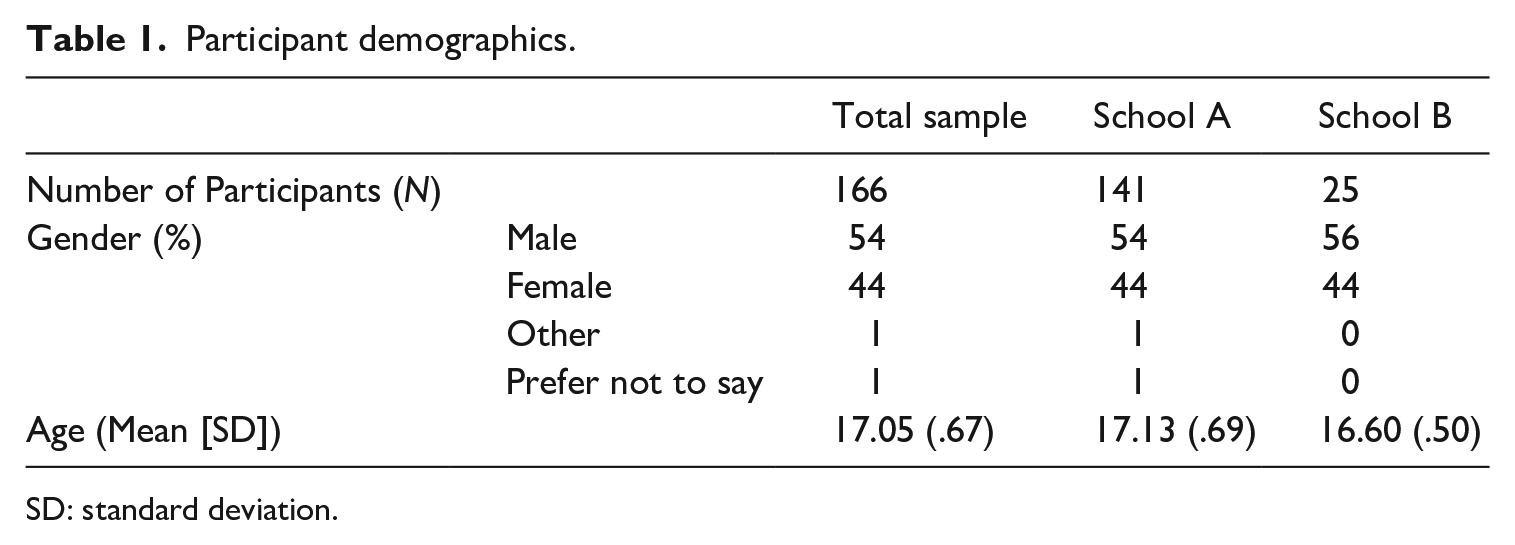
SD: standard deviation.
The use of self-tracking tools
Almost half (46%) of the students had never used self-tracking tools, 54% of students were either current users (27%) or had previously used digital self-tracking tools but had stopped (27%).
Of the students with experience using digital self-tracking tools, 52 had used a self-tracking app and 65 students had used a self-tracking device. The most popular apps were Apple Health (16), My Fitness Pal (13), and Strava (6). The most popular devices were Fitbit devices (18), Apple Watch (9), and Garmin devices (6).
In total, 94.6% of the students surveyed said that their school does not currently provide or encourage them to use digital self-tracking tools as part of their Physical Education.
One size fits . . . Some
The adolescents we surveyed showed that they understood that the same tools can offer different, even contradictory, affordances in the school context. On one hand, some adolescents perceived that self-tracking devices might encourage health-promoting behaviors, but that the tools are flexible in their use. They “Can help with ur calorie intake compared to amount of calories burnt” (Male, 17 years, Year 12, School B) or can “Help you to improve and be healthier” (Female, 17 years, Year 13, School A). Adolescents also articulated a keen awareness of the fragility of their own and their peers’ psychological wellbeing with regard to these data. For example, one observed, “I’ve seen people with eating disorders obsess over tracking this data” (Female, 18 years, Year 13, School A), and another, “Health tracking apps can instigate false ideals such as weight loss which is especially damaging to pupils mental health” (Female, 17 years, Year 12, School B). Echoing Morris’ (2018) argument that built into these tools is the often wrong and sometimes dangerous assumption that “all users need to be pushed into exercising more” (p. 41), those in our survey recognized that being “nudged” to exercise more is sometimes problematic.
Given that this was a school-based study, and that we asked them to imagine how these tools will be used within schools, adolescents also described a pressure to perform to a certain standard in their data. One participant shared that self-tracking practices “Could introduce unnecessary pressure to achieve certain stats or goals when it’s not necessary” (Male, 17 years, Year 12, School A). They were aware that this “pressure” could have negative impacts, as “People could become obsessed with the data and develop unhealthy obsessive habits” (Female, 18 years, Year 13, School A). Adolescents shared concerns that the requests of these tools “Can cause unhealthy obsession—calory [sic] counting etc . . .” (Female, 17 years, Year 12, School A). Adolescents saw how healthy requests from self-tracking tools could turn into “unhealthy” habits: “People can become addicted to their apps/devices” (Male, 17 years, Year 12, School A) or that “People may become too reliant on the numbers” (Male, 17 years, Year 13, School A).
Adolescents also identified possible educational, playful, and personalization affordances encouraged or allowed by these tools. For some, the use of these tools was seen to offer value because it “actually gives data to work on instead of playing games” (Male, 17 years, Year 13, School A) or “Engages the students more” (Male, 17 years, Year 13, School A) than traditional Health and Physical Education classes.
In fact, some imagined that engaging with these tools might provide “Relief from stress” (Female, 17 years, Year 12, School A) and might be “fun” (Male, 17 years, Year 12, School A). Adolescents saw that the tools encouraged them to access and analyze personalized data; allowing the collection of data that is “tailored to you” (Female, 17 years, Year 13, School A). From adolescents’ diverging narratives of the opportunities and challenges offered by digital self-tracking tools, we can begin to see how a “one size fits all” approach to the design and implementation of these tools may be inappropriate.
Who is in control?
We asked adolescents to elaborate on the challenges of digital self-tracking, and they clearly saw how the powerful intersection between the institution and their data could bring them harm, particularly in terms of who has control of the data, its provision, and its distribution. Nearly half (46%) of the adolescents we surveyed did not believe that digital self-tracking tools should be used as part of their school’s Health and Physical Education classes.
Some adolescents were keen for these tools to be introduced into Health and Physical Education; however, 12 adolescents (32%) stated that use in these settings must be voluntary, not compulsory; it “Should be encouraged but not compulsory as not everyone would want to” (Male, 16 years, Year 12, School A). Adolescents’ concern over imposed tracking parallels Sharon and Zandbergen’s (2017) work with ethnographic work with members of the Quantified Self community where one of their participants noted, “tracking your weight yourself and having a doctor put you on a scale are not the same” (p. 1702). As such, adolescents distinguished between institutionally imposed self-tracking practices outside of their control and “voluntary,” individually directed use, where adolescents maintained some level of agency over their participation.
Adolescents understood that, in the context of the school, the same data perform different functions depending on who has control. They felt that the institutional use of digital self-tracking tools could serve different educational purposes for staff and students with distinct perceptions and dexterities. On one hand, these tools could be involved in “Teaching children what benefits a fitness tracker can provide and how to use them” (Female, 18 years, Year 13, School A). On the other hand, adolescents articulated that the institutional use of digital self-tracking tools in Health and Physical Education “allows for teachers to cater education to an extent” (Male, 17 years, Year 12, School A). Supporting this, another adolescent shared, “It can measure the effectiveness of the lesson in terms of how much students gain from it” (Female, 17 years, Year 12, School A).
Some adolescents expressed how the infiltration of self-tracking practices into the context of Health and Physical Education classes changed the space from one of enjoyment, or a break from the “routine” of formal classes, to yet another space where they felt a quantified pressure to perform: “Use technology slightly goes against being ‘unplugged’ and outside” (Male, 18 years, Year 13, School A) and “Over complicates PE, as people generally use it to unwind and have fun” (Male, 17 years, Year 12, School A). Therefore, adolescents were aware of the different affordances and opportunities offered by these tools to those in different structural positions of power and control, whether over their data or over their time.
Sanders (2017) describes digital self-tracking tools as an “institutionally unbound element” (p. 44) of a public health surveillant assemblage. It is interesting here that, while these tools might be “unbound,” adolescents certainly are not. Adolescents in our study articulated a clear difference between imaginings of individual and institutional uses of self-tracking tools, showing how there is a shift in affordances when the setting, social circumstances, or mechanisms of control change. Thus, there appears to be some blurring of the boundary between “school” and “out-of-school” self-tracking practices. For example, adolescents shared that “They are for independent exercise rather than a group” (Female, 17 years, Year 12, School A) and are “not necessarily relevant to school sport more recreational” (Female, 16 years, Year 12, School B). Nonetheless, not all adolescents were concerned by the permeability of the borders between school and out-of-school spaces, and some saw this as a valuable opportunity: “It could get people more used to them and how they work, so that they could use the app or devices effectively outside of school” (Male, 17 years, Year 12, School A). Here, we see the institutional use of self-tracking tools breaking out of the borders of the school to spaces outside of the institution where adolescents might have more control and the mechanisms of affordance might look very different.
Social comparisons: the good, the bad, and the ugly
boyd (2014) explains that “[t]eens continue to occupy an awkward position between childhood and adulthood, dependence and independence. They are struggling to carve out an identity that is not defined solely by family ties” (p. 17). The body and its data are critical for understanding one’s identity and there is a performative aspect to using and owning digital self-tracking tools that can play into this concept of identity formation (Lupton, 2016). One of our respondents said that these tools could be used to help adolescents “understand their bodies and how they work” (Female, 17 years, Year 12, School A). However, the social nature of self-tracking data was also particularly clear. One participant discussed the processes by which “Students may compare themselves to other friends” (Female, 16 years, Year 12, School B). These social comparisons serve an important role as a psychological mechanism that influences individuals’ judgments, behavior, and experiences (Corcoran et al., 2011). These comparisons may be particularly important during the adolescent period as this is a critical time for identity formation (boyd, 2014; Erikson, 1968).
Existing work on social comparisons on social media has paid great attention to associations between upward social comparisons and reduced psychological wellbeing (Fardouly et al., 2017; Ho et al., 2016; Reer et al., 2019). This observation parallels our findings where adolescents linked comparisons of self-tracked data to negative impacts on the user. For instance, one adolescent explained, “I feel the pupil with the lowest data will feel bad about themselves” (Male, 18 years, Year 13, School A). Another adolescent was concerned about the impact of upward social comparisons, suggesting that they “could cause mental health problems (e.g. they share their data with a friends who’s results show them to be a lot fitter . . . this may damage them mentally from a younger age)” (Female, 16 years, Year 12, School A).
Adolescents in our study, however, considered both the risks and benefits of the encouragement of social comparisons through digital self-tracking tools. Self-tracking can encourage healthy competition that motivates adolescents, but for some, like those with eating disorders or already low self-esteem, the same technology may request obsessive behavior, or an antagonistic relationship with peers. Adolescents articulated some concept of a “threshold” of social comparisons, such that, with the right amount, there were motivational effects of “healthy competition” (Female, 18 years, Year 13, School A). For example, one adolescent reported, “You can use the data available as a form of competition between pupils, and this will help the more competitive pupils work harder to beat their friends” (Male, 18 years, Year 13, School A). However, if the balance was tipped, this competition could become more worrisome, with adolescents sharing concerns about “People comparing heart rates and steps taken too much” (Female, 17 years, Year 12, School A) and fearing that “Students may get too competitive about it” (Male, 16 years, Year 12, School A). Adolescents were concerned about the institutional space in which self-tracking might take place, sharing that the use of these tools “Potentially makes it into a more competitive environment if everyone of looking at them” (Female, 17 years, Year 13, School A).
The on- and offline implications of these social comparisons were real to our respondents. Self-tracked data have the potential to infiltrate peer conversations and relationships (Lomborg et al., 2018), encouraging processes of both upward and downward social comparisons. As such, adolescents imagined that self-tracking practices could contribute to “self-esteem issues or bullying” (Female, 17 years, Year 12, School A). Lupton (2016) argues that, within self-tracking, bodies that cannot be contained or controlled are objects of “pity” while those that are lean and fit are “portrayed and regarded as morally just” (p. 51). Nevertheless, the division here is not just based on the perceived quality of one’s data but also between those who are excluded from these practices of self-tracking. Adolescents were aware that the high “buy in” cost of many digital self-tracking tools could create ingroup or outgroup divisions between those that have the dexterity and financial means to participate and those who cannot as “Not everyone can afford it” (Male, 17 years, Year 12, School A). Thus, the social comparison processes encouraged by self-tracking tools might allow for the sorting of bodies into categories such as “good”, “bad”, or even “ugly”. At a time where concerns surrounding body image and identity are paramount, these comparison processes might be of great importance to the ways in which the self is presented to and appraised by peers in this social institutional context.
What is interesting here is that none of the adolescents in our study imagined a situation where their data were not shared with teachers (and in some cases, peers). To some extent, adolescents assumed data-sharing as part of having self-tracking tools in schools. As adults, we might imagine the privacy practices differently, but these adolescents did not imagine any such alternative. Adolescents expressed concerns that by engaging in these data-sharing practices, “it becomes a competition instead of a personal thing” (Female, 17 years, Year 12, School A). Morris (2018) argues that “even though we typically have little control over the distribution of our personal data, sharing within our relationships and communities is something we can thoughtfully determine” (p. 37). However, the cultural logics within educational settings may refuse adolescents the opportunity to control their sharing practices or even to figure out how they would negotiate for control. Our respondents were also much more concerned about the consequences of peer-surveillance than they were by possible top-down surveillance from their teachers, showing that gamification rampant for practices in adult models of self-tracking might be deeply problematic for adolescents. If adolescents lose control of the data that they share and the data that they keep private from their teachers and peers, this could have profound implications for the communicative and narrative affordances of adolescents’ self-tracking practices.
Discussion
Looking critically at adolescents’ self-tracking practices shows important theoretical and empirical work that scholars have to do. Through the lens of the mechanisms and conditions framework of affordances (Davis, 2020; Davis and Chouinard, 2016), we focused on how the affordances of digital self-tracking tools come to matter for adolescents. We see the complexities, challenges, and opportunities when young people try to incorporate extremely personal practices into the social institution of education. Gilmore (2016) highlights the importance of acknowledging how digital self-tracking tools are embedded in everyday life, arguing that research should consider the institutional, political, and cultural forces at work in shaping engagement with these tools. By foregrounding adolescents’ experience here, we offer insight into the complexity and nuances in the individual, social, and institutional implications of these tools that are increasingly ubiquitous in young people’s lives.
In line with Rich et al. (2020), we found that playful and creative opportunities for the use of these tools exist alongside adolescents’ concerns that the use of these tools could be stressful or too competitive. Adopting an affordance approach allows us to theorize how different groups of users imagine and negotiate technologies differently and helps us capture the complexity of adolescents’ perspectives into narratives of self-tracking.
To be fair, there has been much written about young people, technologies, and power. What remains particularly interesting to us is adolescents’ “imagined affordances” (Nagy and Neff, 2015) of self-tracking: their expectations, fears, and uses of these tools. While over half of our respondents reported firsthand experience with self-tracking tools, almost all of them reported that their school did not provide them or encourage their use for Health and Physical education. Thus, while they were in a good position to imagine this institutional use from their own experience, our respondents could not report what school-based use might look like in practice. Instead, our survey allowed them to build their own vision of self-tracking from their own perspectives and experiences. These adolescent imaginings of digital self-tracking differ considerably from adults’ and they point to important considerations when thinking about the unique affordances of self-tracking tools for adolescents.
We suggest that other scholars of technology take on board the following three key considerations when examining how adolescents use digital technologies that were designed for adults: boundedness, embracing variation, and the complex social world of adolescents.
Boundedness
Adolescents spend a tremendous amount of their time in a school space bound by institutional rules, regulations, and rituals, with deep implications for their control and agency with technological affordances. In our case, adolescent self-trackers may not be free to move, making the affordances of these tools different in different spaces and depending on the context of the individual user, their structural position, and the cultural logics governing their social spaces. Adolescents also perceived stark and dark differences between individual and institution-directed digital tracking practices. They were wary of the use of digital self-tracking in schools. They articulated concerns schools might give data undue control over a range of behaviors and activities. And as a group, they stressed the importance of voluntary use and consideration of individuals, and groups, where these tools might offer varying affordances.
Embracing variation
The mechanisms and conditions framework of affordances “centralizes variability, otherness, and difference” (Davis, 2020: 124). Adolescents’ digital self-tracking practices vary from adults,’ and there are also differences across adolescents. Much like the variation seen in adolescents’ approaches to online health tools (e.g. Freeman et al., 2020), the heterogeneity in adolescents’ imagined affordances in our study was apparent. Our respondents suggested affordances of self-tracking that were both intensely personal and social. Thus, a “one size fits all” approach does not fit adolescents’ self-tracking practices and in fact does a disservice to adolescents’ creative capacity, individual experiences, behaviors, and knowledge.
Asking, or allowing, adolescents to track a constantly changing body is both a challenge and an opportunity with very real implications for the stories adolescents might tell about themselves and their data. A better understanding of how self-tracking practices might feed into, or out of, such identity-forming and -affirming processes should be a priority for design, policy, and education. Technology designers could embrace variation across the users of their products and to think creatively about how to design the most appropriate tools for different users, with particular attention paid to adolescent users.
The complex social world of adolescents
Self-tracking practices are inherently social. That means adolescents try to understand what their data means within their social context. Our participants framed their concerns about surveillance in relational terms—they were unsettled by the possibility of social comparison and what this might mean for their status within their peer groups. While scholars question the “highly normative and normalizing ideals of what ‘fitter’ and ‘happier’ mean” (Sharon and Zandbergen, 2017: 1698), how adolescents understand their own bodies in relation to their peers calls into question some of the fundamental principles of gamification and social comparison hard-wired into digital self-tracking tools. Our findings caution against the use of self-tracking tools in school settings without critical education on making sense of one’s own data. Educators could, perhaps, help adolescents work through the challenge of how to “move away from asking what is normal toward ‘what is normal for me?’” (Neff and Nafus, 2016: 43).
Conclusion
Adolescents’ own understandings of digital self-tracking practices shape how they might come to use these technologies. They also show us how social and institutional configurations come to matter for technological affordances. Adolescents in our study saw the affordances of digital self-tracking as flexible and shifting across different users and contexts, rather than intrinsic to any particular device. Examining the affordances that adolescents imagine for self-tracking, we begin to see how designers could create tools that are appropriate for how—and where—adolescents might use them.
One limitation of our study is the student composition in the two schools involved. Owing to our constraints on access to young people, the students who participated in our study were relatively homogeneous in their socioeconomic and demographic background. Future research could highlight the adolescent voice further and in more diverse contexts. Focus groups or semi-structured interviews might be important to gain a deeper understanding of the nuances and commonalities in how digital tools work in practice for adolescents.
Adolescence is an important time when body image considerations, social pressures, psychological wellbeing, and concerns about identity become particularly salient. The need for critical analyses of adolescents’ digital self-tracking practices is pressing. Adult models for self-tracking simply will not work for understanding how adolescents might use, modify, or resist these tools. Adolescents themselves are uniquely equipped to offer insights into their own imaginings, and the oftentimes complex and even contradictory behaviors, about the technologies they use. We think that this presents an exciting opportunity for future researchers to engage with and learn from young people’s expertise and experience. By listening to the adolescent voice, we hope our findings might help lay the groundwork for educators, psychologists, and policymakers to think through the design of digital self-tracking tools for adolescents, and the serious implications of their use. We hope that our findings will help scholars critically approach adolescent self-tracking and extend research on how the mechanisms and conditions of affordances come to matter in the relationship between technologies and their users.
Footnotes
Acknowledgements
We would like to thank all of the adolescent participants in this project for their time and valuable insights, and the schools for generously opening their doors to this work. Thank you to the anonymous reviewers for their thoughtful comments and reflections. We would also like to gratefully acknowledge all of those at the Faculty of Education, University of Cambridge and the Oxford Internet Institute, University of Oxford who offered their support in this project.
Author’s note
We declare that all authors have agreed to the submission. This article is not currently being considered for publication by any other print or electronic journal.
Funding
The author(s) received no financial support for the research, authorship, and/or publication of this article.
