



Abstract
This article examines how digital games on Sami culture can draw attention to Indigenous issues when produced in collaboration with Sami community members. Through a case study that probes the design, game mechanics, and user experience of Gufihtara eallu (2018), this article frames Indigenous digital games and game development as a form of digital storytelling that is able to educate players on Indigenous knowledge systems and intangble cultural heritage. By looking at the way Gufihtara eallu engages Sami oral traditions in particular, this article demonstrates how digital games are capable of embodying Indigenous methodologies in such a way as to not flatten understandings of Indigenous traditions to a mythologized historical moment; instead, games produced by and for Indigenous people are capable of presenting storytelling traditions as contemporary, interactive, and constantly evolving, incorporating traditional themes as much as contemporary issues that are being perpetually redefined by modern Sami experience and new technologies.
Keywords
My work for this article took place on the traditional, ancestral, and unceded territories of the St’át’imc, also known as the Lillooet, the Interior Salish people located in the southern Coast Mountains and Fraser Canyon region of British Columbia, and at the University of British Columbia’s Point Grey Campus, which is located on the traditional, ancestral, and unceded territory of the Musqueam people. The land upon which UBC is situated has always been a place of learning for the Musqueam people, who for millennia have passed on their culture, history, and traditions from one generation to the next on this site. As a white settler, it is an honor to work and live on these lands while learning from the history of these places.
Introduction
Gufihtara eallu (2018)
The virtual reality (VR) game Gufihtara eallu (2018) 1 opens with the player’s gaze cast downward at the footwear of the player character (Figure 1). 2 The Finneskoe or Skaller, a type of boot used for cold climate travel, is the only evidence of the player’s role in this short indie serious game, which was designed by a team of Sami, Finnish, and international game developers and scholars, consultants, and community members for the 2018 Sami Game Jam. However, even while disembodied, the unique style of footwear tells the player something important about the identity politics of the interactive narrative experience they are about to embark on, both marking the player character as Sami and framing the game’s engagement with the Sami Indigenous cultures of what is now considered northern Europe through a first-person perspective.
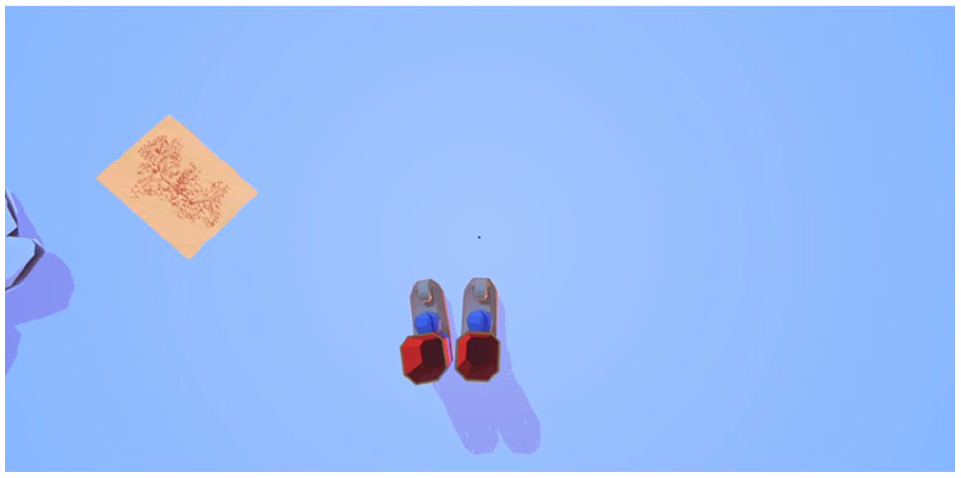
Gufihtara eallu (2018).
Produced by Mihkkal Karpoff, Mihkku Laiti, Hanna Helander, Aku Seppälä, Laura Horton, Krista Erkkilä, and Miikka Harjuntausta in Utsjoki, Finland, a small Sami village close to the border of Norway, between 21 and 25 February 2018, Gufihtara eallu is one of six games created during the 5-day game development event. The 2018 Sami Game Jam, which hosted a group of 44 jammers, featured a combination of experienced game developers, game design students, game studies scholars, and individuals with Sami background tasked in creating games on Sami culture and experience. Consisting of local, national, and international participants, the Sami Game Jam provided an unprecedented arena for Sami game development and local game education as well as an important platform for the development of innovative Sami pedagogies (Kultima and Laiti, 2019: 1). 3
While game jams in general are a significant part of the development culture around indie games, this particular game jam also sought to advance a specific kind of social-justice-oriented program. By designing digital games that explicitly thematized contemporary and historic Sami culture, this event endeavored to draw attention to Sami issues, create awareness about Sami history and traditions, and advocate for the role of Sami cultural production in digital media more broadly. Moreover, the collaborative nature of the game development invited non-Indigenous creators to learn about Sami issues, while considering how the mechanics of digital games could speak to and represent Indigenous experience. These games thereby emerge as emblematic of the kind of survivance 4 enabled by digital media, revealing the power of game cultures in resisting dominant paradigms and simulations of Indigenous experience by asserting Indigenous presence through digital innovation. In communicating Sami cultural issues and representing Sami experience through a type of digital storytelling that integrates Indigenous methodologies at the very core of game design, this collection of Sami digital games also functioned to embody the Indigenous oral traditions they were modeled after, while simultaneously facilitating a digital experience of them. The games developed at the 2018 Sami Game Jam thereby reveal how Indigenous digital media can function as survivance as “a continuation of stories” (Vizenor, 2009: 1) as well as on an aesthetic level through a gameplay experience that is grounded in Indigenous epistemologies.
Looking at one particular game developed during the 2018 Sami Game Jam, Gufihtara eallu, as a case study and examining how it engages Sami oral traditions in a particularly remarkable way through its game mechanics, interactive narration, and player experience, this article assesses the potential affordances of digital games more broadly in continuing and revitalizing Sami storytelling practices. Moreover, by framing Indigenous digital games and game development as a form of digital storytelling itself that presents players with access to Indigenous traditions and ways of knowing, this article demonstrates how digital games are capable of embodying Indigenous sytsems of knowledge in such a way as to not flatten understandings of Indigenous traditions to a mythologized historical moment; instead, Indigenous games produced by and for Indigenous players present storytelling traditions as contemporary, participatory, and constantly evolving, incorporating traditional themes as much as contemporary issues that are perpetually redefined through the real existing relations between the Sami people and their land both inside and outside of the Sápmi. This article thus reveals how digital games that engage Indigenous traditions resist the cultural hegemony of settler colonialism through digital means by embodying Indigenous epistemologies in their game design and modeling Indigenous methodologies in the interactive nature of the medium, coding Indigeneity into the very foundation of their game mechanics.
The Sami people of Northern Europe
With an estimated population of over 75,000 people inhabiting the northern Fenno-Scandia and the Kola Peninsula, the Sami (also written Sámi or Saami) people are the only officially recognized Indigenous group in the European Union (Valkonen and Valkonen, 2014: 27). The Sami territories span four countries, Norway, Sweden, Finland, and Russia; yet, not all Sami live in the Sápmi or Samiland, with, for example, more than 60% of the 9000 Finnish Sami living outside of the Sami homeland (Valkonen and Valkonen, 2014: 27). In addition to the 10 or more Sami languages, Sami cultural expression takes the form of traditional clothing, song (yoik, joik, or joiku), art and crafts (duodji), folklore, and traditional forms of subsistence (Valkonen and Valkonen, 2014: 27). Historically, these subsistence economies included fishing as a main activity among the Coastal and River Sámi and hunting and reindeer herding among the Mountain Sámi as well as small-scale farming (Blix et al., 2013: 265; Mathisen, 2010: 55). However, as of 2010, only 10% of the Sami in Norway, for example, worked within these traditional subsistence economies (Blix et al., 2013: 265), while the rest of the Sami population has generally been integrated into the modern economy and are employed in all sectors of contemporary society (Mathisen, 2010: 55). Yet, despite the urban existence of many Sami, the most distinctive feature of Sami culture remains the Sami’s close connection with nature (Valkonen and Valkonen, 2014: 27), with reindeer herding maintaining the symbolic albeit problematic position of representing an “authentic” Sámi way of life (Mathisen, 2010: 55). This relationship with nature has been described as “a combination of spirituality, philosophy and wisdom of life” (Valkonen and Valkonen, 2014: 27) and is an important element of Sami identity both inside and outside of the traditional Sami territories. In particular, it is an essential feature in Sami storytelling traditions, which connect Sami to ancestral and contemporary ways of living, pass on Sami knowledge and history, and form the foundation of the Sami epistemology (Kuokkanen, 2000: 419).
Researcher positionality, acknowledgements, and relational accountability
However, before I embark on my analysis, I want to acknowledge my privilege and position as a white settler with relationship to the Indigenous people of my own place of birth in what is now called British Columbia, Canada, where I continue to live on the unceded territories of the Northwest Coast. An essential element of Indigenous research methodologies is the practice of “relational accountability” (Wilson, 2008), which acknowledges the critical role of relationships and their contribution to our work. In Research is Ceremony, Shawn Wilson (2008) describes this premise through an Indigenous lens: Identity for Indigenous peoples is grounded in their relationships with the land, with their ancestors who have returned to the land, and with future generations who will come into being on the land. Rather than viewing ourselves as being in relationship with other people or things, we are the relationships that we hold and are part of. (p. 80)
Working on Indigenous content as a non-Indigenous person makes it even more important that I practice relational accountability, articulating my relationship to the work I am doing and making my intentions and approach transparent.
As a white settler living on the unceded territory of the Musqueam people, my interest in Indigenous studies arises from my relationship to the land upon which I grew up and the important Indigenous cultures that exist here as well as the work of truth and reconciliation that has become increasingly important in all of the scholarly and professional endeavors we pursue in Canada. Moreover, working in a Central, Eastern, and Northern European studies department that continues to struggle to find intersections between Indigenous studies methodologies and European content beyond its nations’ colonialist histories has revealed many gaps in the teaching and scholarship of the fields in which I work, which all too often focus on national contexts without regard for the impact of these histories, cultures, and traditions on the Aboriginal peoples of those same places or the ways in which European settler colonialism has enacted physical and cultural violence on Indigenous peoples around the globe that continues today. Thus, this project seeks to both lift up the work of Indigenous creators in the northern European context, while also providing an intervention in the broader category of North American European cultural studies to demonstrate one way in which European studies scholars can incorporate Indigenous content into their research and teaching material, while adopting Indigenous studies methodologies in pursuing that work. As Angel M. Hinzo and Lynn Schofield Clark (2019) note, “the decolonizing turn in the humanities and social sciences calls for scholarship that analyzes social media practices through the lens of Indigenous epistemologies” (p. 791). Joining their work to analyze Indigenous traditions and cultural production through an Indigenous studies perspective in order to not further colonize these texts (Hinzo and Schofield Clark, 2019: 791), my research similarly frames Indigenous digital media as a form of digital survivance, while simultaneously seeking to illuminate the Indigeneity of new media work in terms that move beyond the biography of the producers and the content of the narratives presented, identifying Indigeneity on the level of form as well.
At the same time, however, I also recognize how approaching Indigenous media through research methodologies codified by Western systems of knowledge is a bit of a contradiction. But as a teacher-scholar invested in decolonialist pedagogies, diversity, and inclusivity in higher education and social-justice-oriented research, part of my work as an ally seeks to draw attention to the agency and “acts of survivance” (Vizenor) of Indigenous cultures around the globe, lifting up and citing BIPOC scholars. So, while research is a “dirty word” in many Indigenous communities (Smith, 1999), teaching and scholarship are my activism. Following Jasmin Winter and Justine Boudreau (2018), in prioritizing Indigenous voices and drawing from concepts of self-determination and sovereignty, my analysis of digital games “reorients discourse surrounding the ‘digital divide’ towards a strength-based approach that positions Indigenous peoples as innovators and creators, not just consumers, of digital technologies” (p. 38).
Finally, I want to acknowledge that my research draws heavily upon scholarship that focuses on a variety of Indigenous peoples to understand the importance of storytelling traditions in global Indigenous cultures more broadly while theorizing the power of digital games in Sami communities in particular. I do this while recognizing that the Sami are unique and, as both a people and a society, do not unequivocally operate in the same terms as other Indigenous groups around the world. However, like the Sami people themselves, who identify as part of the global Indigenous community for political and social justice reasons, so that they may contribute to the conversation on Indigenous rights worldwide as well as advocate for international recognition as a unified group, 5 my research applies theory from Indigenous studies writ large in order to interpret the pedagogical and affective work produced by digital games on Sami culture. 6 Furthermore, with the game jam in question specifically drawing upon other Indigenous-led game jams and explicitly those organized by Elizabeth LaPensée, incorporating theories of Indigenous studies and Indigenous games studies more broadly illuminates the ways in which the 2018 Sami Game Jam sought to set itself in dialogue with transnational discourses in Indigenous studies, while also working within local and regional communities.
So, despite the problems posed by the very nature of this research, my sincere hope is that this scholarship does justice to the perspectives and intentions of the Sami Game Design organizers and participants to draw attention to the important work being done in digital spaces by Sami academics, artists, and activists, while exemplifying how to approach Indigenous new media through the lens of Indigenous studies. While the decolonialist work of academia will not happen swiftly, turning our attention to texts created by Indigenous artists and engaging media produced for Indigenous audiences is an important step in demonstrating the shortcomings and gaps in white settler systems of learning and knowledge by recentering Indigenous practices and ways of knowing in Western education systems to learn from the historical and contemporary caretakers and teachers of and on this land and in other parts of the world.
Gufihtara eallu and Sami digital storytelling
Gameplay experience of Gufihtara eallu
Returning to the opening scene of the Gufihtara eallu, after this initial moment of contextualization through the player character’s costume, the game progresses with the player casting their gaze upward and examining the immediate vicinity: a fire crackles next to their feet and a beige piece of canvas or animal hide with a decorative print upon it rests on the snow (Figure 2). Then the game prompts the player to choose a language, English, Sami, or Finnish (Figure 3), before the voice of a young woman begins to recount the story of the Kufittar: There is a story the old people tell. It’s about the Kufittar, an ancient and rich nation of elves who live in their underground kingdom. Under there, all is inverted and the night has switched with the day. As the folk walk in the darkness, upside down, their feet reach towards the surface of the earth.
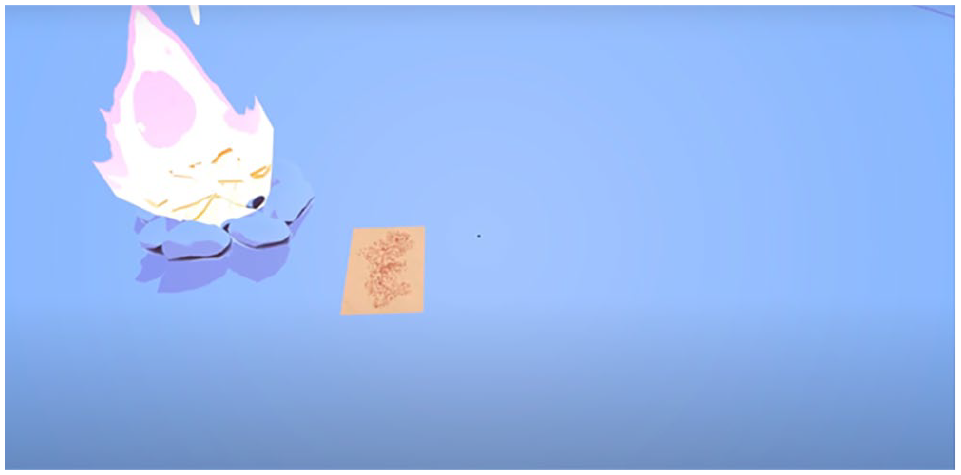
(Left) Gufihtara eallu (2018).
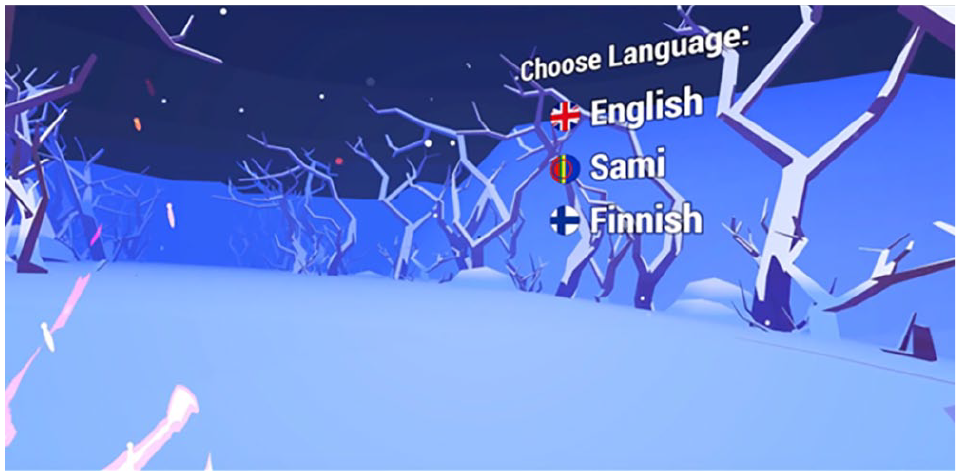
(Right) Gufihtara eallu (2018).
As the voice continues, the player begins to wander through a wintery forest landscape to the soft sound of a simple piano melody. The game’s primary focal point is the solving of a puzzle based on Sami folklore, clues to which are embedded within the voiceover narration (Horton, 2019: 69). However, to accomplish this task, the player character must first locate an iron dagger, before moving to the site of a reindeer heard, which forms the final location and theme for the game’s puzzle. Traveling from point to point through the assistance of glowing spots in the snow, either representing the fire’s flame, around which such stories are typically told, or as if the polar lights themselves rested upon the snow to guide them, the player clicks upon the hovering text “Move Here,” while the voice of the young woman continues her story: Kufittars live their lives in the shadow world below the fells, hidden from the eyes of humans. But if you make the mistake of disturbing their peace, the Kufitar will raise like the frost. During the darkest days of polar night, when the tidal waves of northern lights silently crash against the sky, you might hear the faint echoes of Kufitars singing beneath the snow. And by listening to these songs, the ancient Sami learned the skills of Joiku.
As the prologue to the puzzle game concludes, the play character arrives at a stump with an iron dagger awaiting their claim (Figure 4). The story, however, continues, containing important clues on how to complete the in-game task required of the player: Some nights, Kuffitars raise above the ground to herd their cattle. First, you only hear the eerie sounds of reindeers walking, bells tingling, and distant Joiku. And then a vast heard of reindeers appears from the mist. The old story tells that by throwing an iron knife far over the heard, you gain control of these reindeers, and the Kuffitars will let you pass.
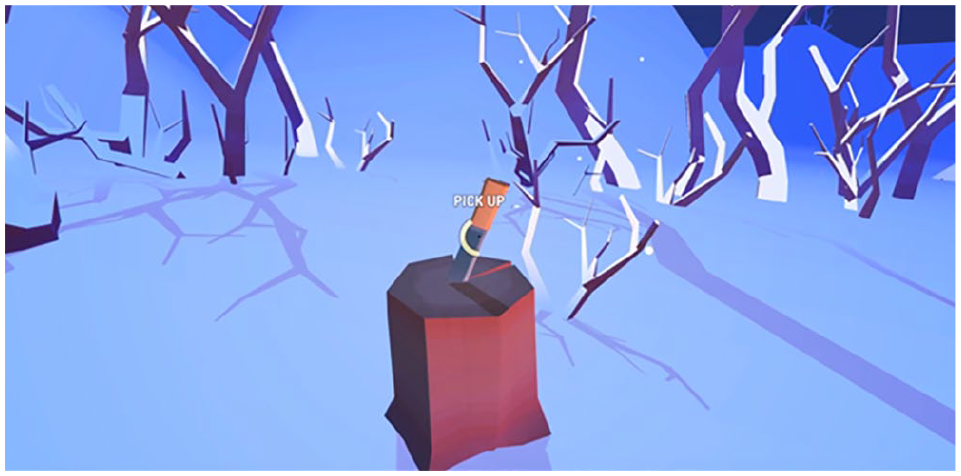
(Left) Gufihtara eallu (2018).
According to the instruction of the voiceover narration, the player picks up the dagger to return to the reindeer and throw it over the herd, at which point the player may continue on their journey, having gained control of the reindeer (Figure 5). Immediately, a crackling fire is heard, as the player approaches a Laavu (a temporary Sami dwelling). Here, the important images of the story we just heard rest upon the snow, awaiting the player as two-dimensional cards to the backdrop of the three-dimensional concluding scene of the game, as if the concept art itself were integrated into the setting (Figure 6).
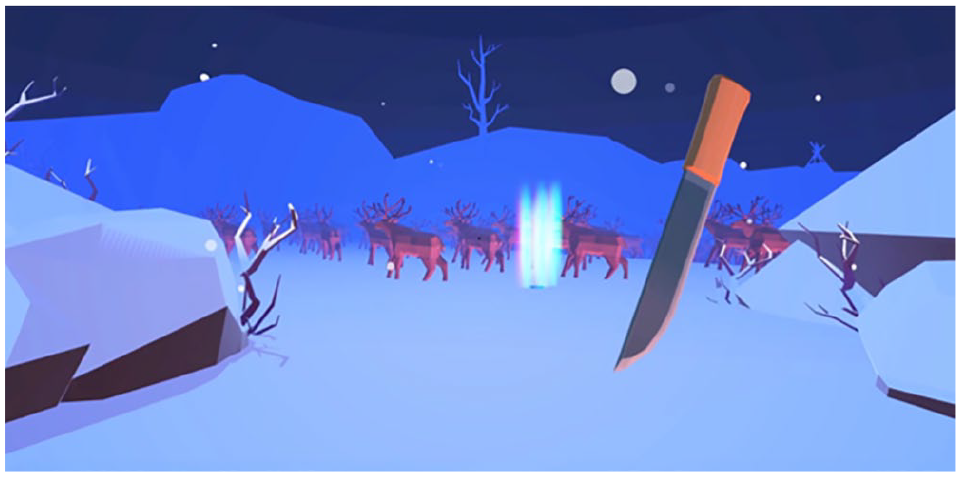
(Right) Gufihtara eallu (2018).
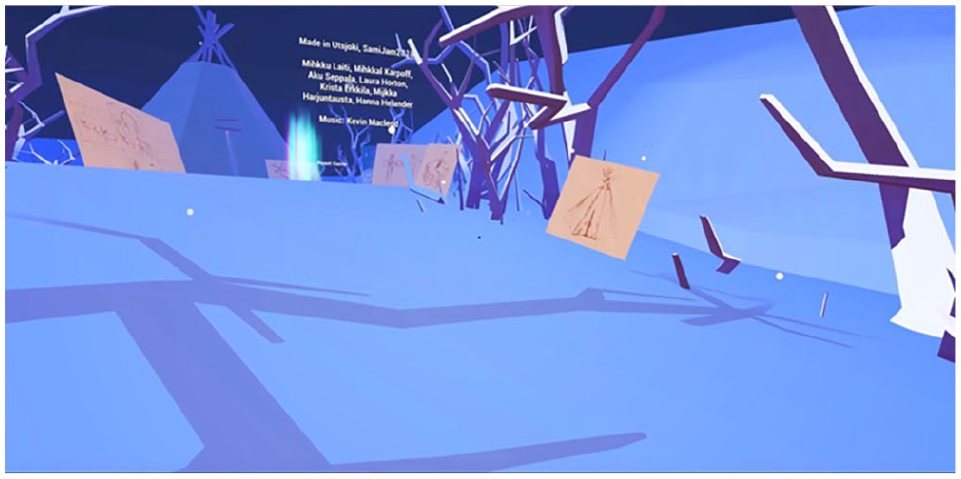
Gufihtara eallu (2018).
The game play video then concludes with a consideration of Sami storytelling traditions more broadly: Stories like these are often told by the campfire. Through them, the Sami people have tried to explain the strange world they inhabit—how someone gained their riches, where the animals got their names, and how the world began.
Finally, the interactive narrative ends with the mention of several other Sami stories and an emphasis on the important role generational story-telling plays in Sami life (Horton, 2019: 69).
Sami storytelling traditions
Gufihtara eallu’s emphasis on storytelling through content and meta-commentary exemplifies how this essential process of passing on knowledge is an important element of many of the games developed during the Sami Game Jam as well as an important element of Indigenous games more generally. 7 Both in Sami communities and in Aboriginal cultures worldwide, storytelling is the dominant form of communication (Barrett and Cocq, 2019: 92): “Through the spoken word, storytelling is an artistic mode of communication and a vehicle for transmission of culture, knowledge and languages” (Barrett and Cocq, 2019: 92). Furthermore, oral traditions in Sami society are essential in establishing Sami epistemological truth, which is created, fostered, and restored through storytelling acts that include discussions, the evaluation of previous activities, memorized experiences and phenomena, and codified forms of intuition (Kuokkanen, 2000: 421–422). Sami storytelling traditions therefore form the foundation of Sami cultural expression and transmission of knowledge, shaping norms, values, and discourses in the Sami community (Barrett and Cocq, 2019: 93). In light of these kinds of oral traditions also playing a vital role of Aboriginal cultures around the globe, Indigenous storytelling practices have oft been positioned as the non-Western counterpart to Western Science, particularly in the Sami context (Kailo, 1998: n.p.; Kuokkanen, 2000: 418), which in turn renders its mobilization in digital media contexts already an intervention in Western knowledge–keeping traditions.
At the same time, however, solidifying a binary between science and Indigenous forms of metaphysics is problematic, since these two fields have been discursively constructed. Setting them in opposition would therefore itself be a colonialist move. Moreover, the intrinsic hierarchy embedded in fields of “scientific knowledge” has been used as a colonial tool in the process of Indigenous elimination. So, following Vine Deloria, instead of talking about Indigenous knowledge-keeping traditions as a form of “Indigenous science” (Deloria, 2001: 1–2), this article looks to Gufihtara eallu to demonstrate the way Sami Indigenous games can illuminate Sami metaphysics in both content and form. As such, digital games on Sami traditions, culture, and systems of knowledge offer insight into the Sami “Indigenous paradigm” (Kuokkanen, 2000) that structures and makes sense of the world from a Sami perspective and is quintessentially revealed through the praxis of storytelling (Kuokkanen, 2000: 421).
In this context, the particular story told in Gufihtara eallu holds a significant place in the folklore tradition of the Sami, referencing the origin of many other Sami stories through the legends of the Kufittar, the mythic people who dwell “in the Saivo world” or the “inverse” land beneath the ground (Horton, 2019: 69). Smaller than the average person (Koskimies et al., 2019: 98), the Kufittarare also sometimes regarded as gnomes (Koskimies et al., 2019: 97). More commonly spelled as Gufihtar (Gufihtarat, plural) in the north and east (cf. Swedish goveiter) and referred to as the ulldat further west (cf. Norwegian huldra) the kanji in Lule Sami, and even the saajve (sáiva being a common Sami adjective for the supernatural, holy or spiritual force), these magical beings provide the very foundation of Sami history, culture, and traditions (Koskimies et al., 2019: 97). In particular, the Gufihtar and their ancient songs are believed to be how early Sami learned the essential Sami singing tradition of yoik.
Beyond the important traditional content and oral transmission of this narrative of the Kuffitar’s reindeer, however, the temporality implied by this particular storytelling experience is also an essential contribution to the work accomplished by Gufihtara eallu. The preservation of oral histories is one important element of processes of truth and reconciliation, but acknowledging contemporary Indigenous narrative knowledge and praxis is equally essential in the work of decolonization taking place within Indigenous peoples’ societies (Kuokkanen, 2000: 421). Here, digital games, such as Gufihtara eallu, reveal how Indigenous knowledge-keeping systems are evolving and adapting to the new media landscape to impart the oral traditions of Indigenous peoples, thereby rendering these kinds of digital texts also emblematic of contemporary Indigenous storytelling practices.
So, while tales about the Kufittar are foundational in many Sami oral traditions that reach back to the origins of the Sami people, Gufihtara eallu’s engagement with these same traditions importantly does not frame this story as being told at the time of its inception. The player is not reenacting this story of the Kufittar or witnessing its origin; instead, the VR game embodies the oral tradition itself, focusing on the practice of telling this particular story as much as on the story itself. It thereby imparts both the content of this legend of the Kufittar and, through its concluding comments on transgenerational storytelling traditions, the processes of telling it in the present tense.
This model of Indigenous oral history traditions is then reflected in Gufihtara eallu’s game design, which functions as a mode of storytelling in its own right that is also about the praxis of storytelling, imparting the kind of knowledge to emerge from oral history traditions as much as revealing the processes of Indigenous knowledge-keeping and dissemination through stories more generally. By mobilizing storytelling traditions at the very core of the game mechanics, while also sharing a foundational narrative in Sami oral history, Gufihtara eallu passes on the knowledge embodied by this story, while simultaneously positioning Sami oral traditions as an important element of contemporary Sami digital media. Moreover, with the game’s framing of the story in the present tense, Gufihtara eallu demonstrates how these storytelling traditions persist today, signaling the historic importance of Sami oral histories as much as their modern-day significance.
Sami digital storytelling
Yet, digital games do more than simply provide a new conduit through which to impart the substance of Sami systems of knowledge. As a medium that embodies storytelling in both content and design, digital games that thematize Sami oral history traditions not only offer a digital platform for storytelling; as gestured toward above, they also model the participatory nature of Indigenous storytelling practices at the very core of their game mechanics. Furthermore, with regard to the workshop nature of their production, their connection to the lived experience, and the innovative deployment of the digital format, the digitization of Indigenous oral history traditions can be positioned in dialogue with another category of storytelling that has emerged through the affordances of new media, digital storytelling. 8
While the term itself has been generically used to describe “the uses or affordances of new media for new or innovative narrative forms” (Burgess, 2006: 207) or simply to identify modes of “telling stories with digital technologies” (Alexander, 2011: 3), scholars, artists, and activists invested in digital storytelling methodologies as a community media movement use a more precise definition. This particular characterization refers to the creation of short films that rely on specific modes of production, technological apparatuses, and textual characteristics (Burgess, 2006: 207). Yet, as a workshop-based collaborative process, in which “ordinary people” produce their own autobiographical short films, which are then later accessible on the Internet or broadcast on television (Burgess, 2006: 207), even this definition of digital storytelling has a lot in common with events such as the Sami Game Jam. Furthermore, Alexander (2011) advocates for even this specific understanding of digital storytelling to include other forms of storytelling “born digital” and published in the digital format, such as blogs, Web video, digital and computer games, and mobile apps (p. 15). So, while scholars often frame their interest in Indigenous digital storytelling in terms of conventional cinematic modes of inquiry, many observations on the power of digital storytelling apply to game design as well. As a comparable collaborative field of cultural practice, game jams and the digital games that emerge from these processes likewise embody storytelling’s “dynamic site of relations between textual arrangements and symbolic conventions” (Burgess, 2006: 207) as well as facilitate the collaborative social interactions that help heal trauma, foster dialogue, and develop awareness. Moreover, like conventional forms of digital storytelling, as Timothy Powell, William Weems, and Freeman Owle describe, digital games on Indigenous experience also have “the potential to integrate indigenous artifacts, sacred places, and stories in innovative new ways undreamt of between the margins of the white page” (as quoted by Iseke and Moore, 2011: 20–21).
Thus, with digital storytelling a movement explicitly designed to amplify ordinary voices (Burgess, 2006: 207) at the intersection of new media and lived experience, setting game jams and social-justice-oriented digital game culture in dialogue with other movements in digital storytelling reveals the important interventions being made through digital games. With their similarly collaborative production, combination of image, text, and sound, and dissemination via the Internet, Indigenous digital games as a form of digital storytelling present stories that connect to personal experience through game content and design to reveal the way Indigenous worldviews do not map onto Western ways of knowing and understanding. Moreover, framing digital game design as a kind of digital storytelling reveals the ways in which digital games on Indigenous experience embody storytelling traditions, while also acknowledging digital media as an important format through which to work through trauma and historic injustice as well as showcase Indigenous ways of knowing and experiencing the world, demonstrating how Indigenous creators are seeking to reinvigorate Indigenous storytelling traditions through the adoption of and adaptation to new media frameworks.
However, with the addition of the fundamentally interactive component of games—where narrative meets play—digital games on Indigenous experience also model important Indigenous storytelling methodologies beyond the content and orality of their storytelling practices. Importantly, digital games offer a form of participatory experience, and one that is difficult to emulate through the processes of cinematic forms of digital storytelling. The interactive character of digital games thus develops a new layer for the interpretation of their power as platforms for Indigenous storytelling. The next section of this article, therefore, examines the way in which Indigenous games incorporate the affordances of their digital format to produce a participatory experience of storytelling traditions that thereby replicates as much as reinvents traditional storytelling practices through new media, embodying Indigenous storytelling methodologies at the very core of game design.
Interactive nature of Indigenous storytelling traditions
With game engines and new media technologies in the field of cultural heritage expanding, digital platforms have already become important tools for recording and representing historically, culturally, and sociologically significant places, infrastructure, and artifacts, as well as the stories associated with them (Leavy, 2007: 261). Moreover, game and app development for the purposes of language learning has been an important element of Indigenous language revitalization for over a decade. 9 Today, however, digital games developed by Aboriginal creators are reshaping how games function more broadly both inside and outside of Indigenous contexts, changing discourses on the intersection of technology and Indigeneity, which “continues to focus far too heavily on what technology can do for Indigenous peoples—not what Indigenous peoples have and can do with technology” (Winter and Boudreau, 2018: 41). As Lameman et al. (2010) contend, the video game format’s “unique combination of story, design, code, architecture, art, animation, and sound” is particularly adept at both reflecting and embodying oral history traditions (Winter and Boudreau, 2018: 41). 10 Digital games on Indigenous themes therefore enable game designers and players to explore different strategies in cultural preservation and revitalization (Winter and Boudreau, 2018: 41), revealing the role of digital technologies could play in the work of truth and reconciliation. Ultimately, Indigenous digital games such as those developed in the Sami Game Jam, invert the hierarchy embedded in conventional notions of the intersection of media studies and Indigenous studies to reveal the power of digital games as both “an extension of traditional storytelling and as acts of survivance” (LaPensée, 2016: 180).
At the very core of this issue is how digital games are capable of both communicating Indigenous oral histories and embodying the experience of Indigenous oral traditions, modeling the kind of participatory and interactive engagement traditional storytelling practices foster. In The Truth About Stories, King T (2003), for example, Thomas King writes about the ever-shifting character of Indigenous stories: There is a story I know. It’s about the earth and how it floats in space on the back of a turtle. I’ve heard this story many times, and each time someone tells the story, it changes. Sometimes the change is simply in the voice of the storyteller. Sometimes the change is in the details. Sometimes in the order of events. Other times it’s the dialogue or the response of the audience. But in all the tellings of all the tellers, the world never leaves the turtle’s back. And the turtle never swims away. (p. 2)
Here, King acknowledges both the participatory nature of storytelling and the ever-changing character of Indigenous stories. While he identifies these shifts in the retelling of one particular story about Turtle Island 11 as a reaction to many factors, importantly, he notes that one aspect of these alterations is through the dialogic character of the storytelling practice and the role of the audience in shaping the narrative. King’s reframing of Indigenous storytelling as a praxis that emerges in conversation with listeners demonstrates how even while the core meaning of many Indigenous stories does not fundamentally change, the priorities of the storytelling process is always in dialogue with the people in the audience. This in turn reveals how the listener is also a participant in the construction of the story, rending Indigenous storytelling practices both interactive and responsive.
This dialogic nature in Indigenous storytelling is then also apparent on a second level in King’s account of this story about the story of Turtle Island. Having reshaped the telling of this narrative to be both about the origin of the North American continent and about the practice of storytelling itself in the context of his book manuscript, it is clear that the evolution of this particular story also came about as a reaction to the kind of audience he anticipated for this project.
Conceptualizing Indigenous stories as in constant flux is an important way of understanding Indigenous oral traditions, as it is oft acknowledged that they shift and change with every retelling. With Indigenous stories fluid and multivalent understandings of the world, natural phenomena, and Indigenous culture, history, and tradition, they are gathered over time from various sources and perspectives (Butet-Roch, 2016: 7), while also changing over time, as the needs of the community shift. Reshaped and refitted for the different contexts in which they are told, Indigenous stories change slightly from one telling to the next, since what is important one year may change the in the next, given situated differences in the sociopolitical and cultural climate (Palacios, 2012: 45).
However, as King also demonstrates, an important part of this evolution has to do with the participation of the audience, with the cooperation between teller and listener partly explaining the dynamic and continually adaptive nature of Indigenous stories (Fernandez-Llamazares and Cabeza, 2018: 3). The responses of the listeners therefore guide and influence the telling of a story, which emerges as a collaboration between the storyteller and the audience (Fernandez-Llamazares and Cabeza, 2018: 3). Moreover, repeated tellings of the same story, irrelevant of modifications, result in different levels of comprehension and interpretation from individual listeners, reflecting different levels of readiness and understanding in audience members in heeding the messages (Palacios, 2012, 45). Both storyteller and listener are therefore essential in cultivating the significance of the story, with the interaction between the storyteller and listener being a shared experience that invokes inspiration, empathy, and understanding (Palacios, 2012: 45). Indigenous storytelling practices can thus be interpreted as agentic, participatory, and fundamentally interactive (Sium and Ritskes, 2013: v).
In contrast to other forms of oral history, scholars have noted that this interactive nature is a common feature of Indigenous storytelling practices globally (Fernandez-Llamazares and Cabeza, 2018: 3). In Navajo oral traditions, for example, storytelling often includes direct interaction with the natural world (Eder, 2007: 286). Then, in the oral traditions of the Puebloans or Pueblo peoples, storytelling always includes its listeners (Silko, 1981: 56). In fact, according to Leslie Marmon Silko (1981), “a great deal of the story is believed to be inside the listener; the storyteller’s role is to draw the story out of the listeners” (p. 56). Sami epistemologies are similarly participatory and engaged, emphasizing process in the construction of meaning over the end result (Kuokkanen, 2000: 419). Thus, Sami knowledge is, as with many Indigenous forms of knowledge, reflected in the dialogic nature of Sami storytelling (Kuokkanen, 2000: 419). The holistic and interactive element of Indigenous storytelling practices therefore connects Indigenous traditions around the globe and form part of Aboriginal people’s ability to conceptualize an “Indigenous worldview” (Kawagley and Barnhardt, 1998) through storytelling and narrative (Castellano, 2000). As opposed to Western ideas of progress, which is preoccupied with results that in turn can be rendered profitable, “Indigenous creativity springs from ideas and implementations that belong to the process,” in which “Indigenous innovation and creativity are about adaptation and improvisation, and the process itself can be seen as innovation or renewal” (Outakoski et al., 2018: 24).
Digital games as models for Indigenous storytelling
With games also requiring the explicit participation of the player to produce the interactive narrative, digital games that take Indigenous oral traditions at their foundation model the participatory nature of those storytelling practices. This is also true to a certain extent in cinematic forms of digital storytelling. Janelle Palacios (2012) writes, For both the individual and community, digital storytelling allows the story to unfold in such a way that the audience is drawn into the story. The story-maker, using their lived experience to demonstrate a point or share a meaning, calls upon a shared understanding to demonstrate their point to their audience. The audience in turn has the potential to connect with the story. This delicate dance between the storyteller and the listener demonstrates how digital storytelling draws upon a relational and interconnected sense of understanding and being, reflective of the American Indian philosophical worldview. (p. 49)
However, in digital games modeled after Indigenous storytelling practices, this is even more palpable. In the same sense that listeners play an important role in shaping Indigenous storytelling, the player-listener becomes cocreator of the interactive narrative. Framing both games and storytelling as “participatory media,” to borrow language from Henry Jenkins, therefore reveals how their “active audiences” position digital games on Indigenous oral traditions alongside the methods of the storytelling practices they seek to reinvent in the digital sphere, demonstrating, as Porter (2009) argues, how the “true revolution” of using interactive gaming technology its ability to involve audiences in the production of the text (p. 218). Moreover, in light of the very nature of digital storytelling, this factor in Indigenous storytelling traditions is emphasized in the use of digital media, which lends itself well to provoking deep reflection that may in turn lead to a transformative action (Palacios, 2012: 47).
This element of play, in which the player-listener cocreates of the story, therefore, has important implications in terms of the fundamental principles embedded in the game design when it comes to the development of Indigenous games, rendering them Indigenous in terms of both content and methodology. So, while the scholarly debate on games as play (ludology) or games as narrative (narratology) does not carry as much weight as it once did, looking at digital games at the intersection of play and narrative reveals important parallels between the gaming experience and the embodied, participatory, and experiential systems of knowledge in global Indigenous cultures.
For example, in Gufihtara eallu there is more to the gameplay experience than the simple telling of the story and the following of a set of instructions. After all, the story, in fact, provides no explicit directions. Here, the dialogic nature of Sami and other Indigenous storytelling traditions becomes manifest. The voiceover narrative recounts the story of the Kuffitar and their reindeer; however, in order to solve the puzzle, the player-listener must extrapolate their next move from the message embedded within the narrative, applying the knowledge shared within the story of the Kuffitar to the situation with which they are confronted. As the player-listener first approaches the reindeer herd, the story maintains its attention to legend the legends of the Kuffitar, but without referencing the cattle that quietly graze to the left of the player character. The voiceover narration describes the world of the Kuffitar, before cautioning the listener not to disturb the Kuffitar’s peace. Upon hearing this element of danger with relationship with the Kuffitar, this warning feels equally likely to form the foundation of the gameplay experience as the task to come, neither of which are articulated explicitly.
Yet, as the player-listener continues to explore the virtual terrain, the voiceover begins to recount the role of throwing an iron knife to gain control of the Kuffitar’s herd of cattle. With the dagger now in sight, the player-listener concludes that they must pick upon the knife, before returning to the site of the reindeer herd to perform their task. However, in the sense that the voiceover narration never directly names the game’s puzzle, while it articulates several possible themes to be explored in the virtual world navigated by player, the story being told in Gufihtara eallu is simultaneously both about and not about the solution to the gamer’s task.
This further models Sami traditional storytelling and cultural practices, which are largely based on observations (Kailo, 1998, n.p.). For example, Sami child-rearing is grounded in the principle that children are also capable of making observations and drawing their own conclusions and is therefore premised on the kind of critical thinking this observation elicits (Kailo, 1998, n.p.). Similarly, the dialogic character of Sami storytelling, which is characterized by digressions, indirect hints, and narrative meandering, does not approach subjects directly (Kailo, 1998, n.p.). With lessons embedded in Indigenous storytelling not explicitly articulated nor necessarily learned directly through the narratives themselves (Palacios, 2012: 47), it is also not customary in traditional Sami systems of knowledge dissemination to reveal all aspects of the topic under discussion (Kailo, 1998, n.p.). Sami storytelling, like many forms of Indigenous storytelling, is therefore a kind of pedagogy that fundamentally fosters critical thinking skills. Discussed in the important places pertaining to the situation, such as in the lavvu tent we see at the conclusion of Gufihtara eallu or in mountain huts set up beside the reindeer herding grounds, the listener applies information gained through observation, dialogue, and storytelling to make decisions (Kailo, 1998, n.p.).
Consistent with these processes in Sami storytelling traditions and Indigenous oral histories more broadly, Gufihtara eallu contains messages to be considered in the decision-making of its player-listener, but their purpose and function are not explicitly identified. With many stories of the Kuffitar embedded in Gufihtara eallu’s voiceover narration and told to the player-listener over the course of gameplay, the player-listener must adopt the information contained within the narrative to complete the game’s puzzle. Importantly, however, we never see the Kuffitar while playing, nor does the temporality implied by the game’s narrative situate the telling of this story in ancient history, as one may associate with a story of the Kuffitar that cites the origin of yoik. Instead, Gufihtara eallu reveals how oral history traditions and Indigenous metaphysics maintain contemporary relevance, while demonstrating how digital games can embody the orality, agency, and interactive nature of traditional storytelling practices.
Conclusion
Indigenous media and cultural work are always already inherently political (Bessant and Watts, 2017: 307). Even the endeavor of teaching and learning about Indigenous histories and cultures is an act of political resistance for many Indigenous peoples (Dei et al., 2000: 4). Appropriating and transforming new media technologies to meet the cultural and political needs of Indigenous communities therefore creates opportunities to understand and participate in political activism in terms that reflect the cultural priorities and mandates of Indigenous peoples (Iseke and Moore, 2011: 32). Moreover, Indigenous new media present new possibilities for engaging in Indigenous identity politics, asserting Indigenous self-determination, sovereignty, survivance, and self-representation by embedding Indigenous systems of knowledge at the very core of media texts. Indigenous oral traditions, in particular, are taking on new forms by adopting new technologies to maintain and reassert their continued relevance. It is therefore crucial that scholars, policymakers, activists, and artists look elsewhere to recalibrate a modern understanding of contemporary Indigenous storytelling cultures by turning to Indigenous new media as an important site of oral traditions digitally reimagined.
While in some sense, traditional forms of storytelling in Sami culture may be decreasing as a consequence of the prevalence of new media platforms in our everyday lives, over the past decade, there has been numerous efforts to revitalize elements of eradicated Sami culture (Kultima and Laiti, 2019: 2) and the affordances of digital technologies are playing a significant role in reviving Sami storytelling traditions in particular. 12 Moreover, as this case study of Gufihtara eallu demonstrates, by placing Indigenous systems of knowledge at the very foundation of the design and analysis of Indigenous new media to explore linkages between these cultural practices and Sami epistemologies, Sami digital games emerge as a form of Sami digital storytelling. New media and digital technologies are thereby offering important opportunities for Sami cultural revitalization and empowerment, with new media manifestations of folklore culture opening up new modes for the production of knowledge, while participatory media is also contributing to the continuity of Indigenous expressive culture (Cocq, 2015: 274). And considering that Indigenous media has become a significant source for mobilizing cultural citizenship (Pietikäinen, 2008: 29), the turn to the digital sphere by Sami scholars, artists, and activists emerges as part of a global movement in the revitalization of Indigenous cultures (Cocq, 2015: 274).
At the same time, however, there are consequences if Sami survivance materializes exclusively in digital spaces. The digital realm has been identified as a place of symbolic violence as much as a space of sovereignty and self-determination: “a space where artifacts of settler imagination are simply rehearsed and (re)distributed in newly monetized ways using powerfully intensified infrastructures” (Hearne, 2017: 17). As Métis filmmaker Loretta Todd cautions in her inquiry on the future of Aboriginal narratives, histories, languages, and knowledge in digital spaces, cyberspace is equally likely to be “a clever guise for neocolonialism,” as it is to “rupture the power relations of colonizer and the colonized” (Todd, 1996: 180).
Moreover, the representation of marginalized demographics in digital media is not inherently altruistic. Dependent upon economic notions of production and dissemination, some projects that strive to privilege Indigenous and marginalized voices simultaneously seek to capitalize on emerging movements in new media for profit. Indigenous new media is therefore still in the vulnerable position of possibly being deployed to support the capitalist system and nation-state models that oppress the populations these digital modes also give the illusion of supporting. For example, Chickasaw scholar and game theorist Jodi Byrd describes mainstream videogames as iterations of late colonial proceduralism, dependent upon conventions such as enclosure and capture (Hearne, 2017: 7). In this context, Byrd argues that video games embed frontier violence into the very foundation of play through stories connected with space through mechanisms of territorial acquisition (Hearne, 2017: 19). Indigeneity thereby functions as a “method” for “bundling” or “consolidating” narratives and “normative discourses of racism, colonialism, capitalism and imperialism together to understand their concomitant ends” (Hearne, 2017: 19).
Counter to mainstream gaming culture, however, indie and serious games designed by and for Indigenous players are emerging as forms of activism and are becoming increasingly important in discourses of survivance: “. . . digital games are a path for self-determined Indigenous representations by passing on teachings, telling our stories, and expressing our ways of knowing through code, design, art, music, and audio” (LaPensée, 2018: 129). In this sense, digital storytelling affords opportunities for helping communities and individuals transform by employing traditional ways of knowing (Palacios, 2012: 46) and embedding Indigenous methodologies into the very foundation of game design. Narrative sharing through digital means is thereby a powerful and explicit means of engaging in the process of decolonization for both producers and consumers (Adelson and Olding, 2013: n.p.), fostering “liberation from the dominant socio-cultural world that continues to marginalize the marginalized” (Palacios, 2012: 47): “By creating the digital story, the storyteller has control over what is important to tell” (Palacios, 2012: 47).
Furthermore, while digital storytelling more generally affords storytellers the ability to express their subjectivity, while imparting knowledge and inspiring and generating problem solving, Palacios frames one capacity of digital storytelling as foundational: in which the listener metaphorically, “[f]or a brief moment . . . walks in the shoes of the storyteller” (Palacios, 2012: 46). Turning to Gufihtara eallu’s gameplay experience, however, through the game design’s VR platform, Gufihtara eallu does this quite literally. Gazing down at the traditional footwear of the Sami player character makes manifest that which Todd observed: that cyberspace may become a place where storytelling flourishes, while VR might, in fact, facilitate a return to oral tradition (LaPensée, 2016: 180). Similarly, to lift language from Vizenor, while “Native survivance is an active sense of presence over historical absence, the dominance of cultural simulations, and manifest manners” (Vizenor, 2009: 1), VR takes this one step further: Indigenous new media thereby challenges and deconstructs false representations of Indigenous experience, while virtual simulations of Indigenous experience supplant cultural simulations of absence and manifest manners.
To put it bluntly, when not “anchored to reenactments of western cultural consciousness” (Todd, 1996: 192), it is not difficult to envision Indigenous peoples at the forefront of video game development, considering the longstanding traditions of storytelling that have helped Indigenous communities sustain themselves over the course of history (Winter and Boudreau, 2018: 42). Because, as Marlene Bandt Castellano writes, the knowledge that will continue to support the survival of Indigenous peoples’ futures will not take the form of an artifact from their past; instead, “[i]t will be a living fire, rekindled from surviving embers and fuelled [sic] with the materials of the twenty-first century” (Castellano, 2000: 34).
Footnotes
Authors’ note
A portion of this research was presented at the 16th International Conference on the Foundations of Digital Games (FDG), Montreal, Canada, 3–6 August 2021 (Nijdam, 2021).
Funding
The author(s) received no financial support for the research, authorship, and/or publication of this article.
