



Abstract
Research on music streaming has so far tended to normalize a view of streaming as an individual activity solely oriented towards the platform. However, as streaming media have become integral to everyday life and a key metaphor for digital society, we should pay attention to how streaming activities are embedded into social power relations. Furthermore, due to the complexity of streaming infrastructures, we should consider the social implications of ordinary expertise pertaining to the handling of digital streams. To this end, this article advances a theoretical view of music streaming as a form of logistical labour and a part of dwelling. Based on a focus-group study on music streaming, the analysis moves beyond the platform to explore social dominance in a cultural landscape where logistical expertise is increasingly important. The analysis shows how the handling of everyday infrastructures underpins complicit forms of logistical dominance and translates into symbolic violence.
Keywords
Learning how to live with media does not always come easy, especially not if changes are imposed from the outside and one lacks the skills or resources to appropriate new technology. We should thus be sceptical to theories that underplay the human efforts and everyday struggles involved in digitalization. While people have indeed incorporated a steadily growing number of media within their lives, especially during the digital era, there is no rule stating that every new device or software will become a natural life companion and eventually ‘disappear’ (cf. Deuze, 2011). On the contrary, people often feel frustrated with the labour it takes to make things work.
Here, streaming media constitute a particularly ambivalent case. As Morris and Powers (2015: 107) put it, ‘streaming is not just a technical form of transmission, but a key metaphor for the flow of information in the digital age’. Streaming alters the appearance of connective media, with examples like TikTok, as much as it affects music, film and broadcasting distribution. The normalization of streaming has affected consumption practices and the ‘lore’ of the industry (Burroughs, 2019). For example, as Netflix championed a new ‘matrix era’ of television, audiences became ‘cord cutters’ who left cable networks in favour of ‘the perceived wireless minimalism of a streaming culture’ (p. 13). Similarly, audio-streaming services like Spotify and various ‘Play’ services linked to traditional broadcasting corporations have set a new norm for music consumption – a norm, as well as a discourse, that bespeaks immediate, unlimited and seamless access to culture (cf. McQuire, 2017; Fast, 2018).
In light of such discourses, the following episode taken from a focus-group interview with women in a Swedish countryside village is funny but also quite disturbing: Most things [with digital technology] are difficult. I recently replaced my smartphone and I think it’s boring too. I can’t stand it, ‘oh well, I have to get a new app and . . .’ I use Spotify, but there one doesn’t have to choose. Perhaps updating it, but anyhow. I was home alone for a couple of days and we have a Chrome Cast that we got to ourselves and then I thought that ‘now I will sit down and I’ll watch a film from my phone to the computer’, and the kids had to write an instruction to me before they left. (F5) [laughter in the group] And so, I looked for that instruction and then it was time to sit down in the sofa. And when I had made all the choices among all the choices, then I went to Netflix and ‘oops, which film should I chose?’, and it took me an hour and then I gave up and went straight to bed. (F5) [laughter in the group]
What we encounter here, I argue, is more than a laconic description of digital helplessness, disorientation and, finally, resignation (or is it victory?) (cf. Draper and Turow, 2019). As much as the anecdote reveals the irony in people’s general endeavours to stay afloat in the maelstrom of new digital technology, it provides an insight into the logistical struggles accompanying streaming media. It shows how the utopia of logistics, that is, managing the movement and emplacement of people, things and other matters as efficiently as possible (e. g., Chua et al., 2018; Hepworth, 2014; Hesse, 2020; Rossiter, 2016), which increasingly defines also the business of cultural circulation, collides with various social and material restraints. The fact that streaming platforms in comparison with older distribution technologies both enable and necessitate improved forms of flow management (e. g., adapting digital infrastructures and streams to daily rhythms, places and movements) accentuates the contrast between lived realities and imposed conventions.
Obviously, there is a need to scrutinize the social consequences of not being able to navigate or handle digital streams and feeling out of sync in relation to the stipulations of a seamless future. In this article, I explore the mundane power differentials evolving in relation to streaming media, with a particular focus on music and audio-streaming. Based on a theoretical intervention combined with findings from a focus-group study, I problematize the notion of seamless media environments and the commonplace approach to music streaming as an individual and strictly media-oriented activity. Without denying that streaming technology enables people to develop sophisticated and customized soundscapes, I draw the contours of a streaming culture marked by frictions, failures and accentuated divides between those who are able to master this new infrastructure and those who are not.
The argument is developed in four steps. The first two steps are mainly theoretical and present a perspective of music streaming as (1) a form of logistical labour and (2) a part of everyday dwelling. Labour is understood here in the way Hannah Arendt ([1958] 1998) once defined it, as the toil and trouble of making ends meet and keeping a life going; ‘the result of its effort is almost as quickly consumed as the effort is spent’ (p. 87). As so conceived, logistical labour is basically a matter of keeping streams alive, and especially about maintaining the infrastructures that enable circulation and thus economic value extraction, which in our case points to activities both within and beyond digital platforms. Tim Ingold’s (2011) dwelling perspective is used here as a theoretical vehicle for moving beyond the platform to grasp how logistical labour, the handling of digital streams, is entangled with people’s ways of inhabiting the environment (at the same time producing and being part of that environment). Approaching streaming activities as part of dwelling means that we can make sense of how they play into the seaming and texturing of everyday environments (including symbolic and material boundaries), which make them fit certain interests rather than others (see also Nansen et al., 2011). 1
The subsequent steps are based on focus-group interviews and demonstrate (3) how the logistical labour of music streaming (re)produces domestic power relations and (4) how ordinary logistical expertise translates into symbolic power (Bourdieu, [1979] 1984). While the very handling of digital streams is by definition a matter of logistics, especially due to the algorithmic power that forms the basis of these services, social communication also turns such practices into a symbolic battlefield. Those who hold the expertise to skilfully handle streams, that is, to master not just the algorithmic tools and services provided by online platforms but also to set up, manage and maintain everyday infrastructures (notably digital hardware), are also able to steer the activities of others (sometimes unintentionally) and formulate the stakes of streaming culture.
Music streaming as logistical labour
The point of departure for my analysis is that music streaming is largely a matter of logistical labour, which sometimes, among some users, is accompanied by what I call ordinary logistical expertise. Following Arendt’s ([1958] 1998) classical work on the ‘active life’, the trajectory from labour to expertise can be understood as one from merely pursuing activities that keep things going (ultimately life itself) to being skilled enough to produce more durable products and arrangements (what Arendt understands as ‘work’) and also problematize or critique the systems that make up the very conditions of human life (Arendt’s ‘action’). To clarify how this perspective applies to the logistics of music streaming (and streaming in general), we must first specify what is meant by ‘stream’ and why streams take centre stage in society and culture today.
Simply put, there are two kinds of digital streams to consider: streams of content and streams of data. Both streams are constituted by some kind of information in motion (Berry, 2011), but while the former refers to the type of carefully organized information media users encounter or seek out, the latter refers to encrypted information about digitally detected activities that does not make any sense until the data streams have been aggregated into larger datasets and strategically computed. It is the growing prominence of these streams and the expanding efforts among various actors to manage their composition, direction and intensity that turn music streaming into a logistical battlefield.
The distinction between content and data is closely linked to what some theorists refer to as front-end and back-end streams (Weltevrede et al., 2014). Front-end streams are the streams we consume and interact with as users – content exposed to the public eye. Back-end streams refer to the data that are sorted and processed by corporate actors and, if we think of a media business, inform the ways new front-end streams are organized. While the gathering of user information to chart and sell the audience commodity and strategically fine-tune programming (and other cultural products) has a long history in the cultural industries, the automation and normalization of these circuits is one of the things that distinguish the era of connective, streaming media from the era of broadcasting and cable networks (see, for example, McGuigan and Manzerolle, 2014). In the front-end, streams come in two principal shapes. One is the transmission of audio and video content over the Internet, which replaces various types of stored or downloaded information like CDs and DVDs, as well as live broadcasting over analogue systems (Murray, 2003). The other type of front-end streams consists of so-called real-time streams that deliver updated packages of information at regular intervals via, for example, social networking platforms or online news channels. As outlined by Weltevrede et al. (2014), the roots of real-time streams go back to the ‘push’ technologies developed for the Internet in the 1990s to help users find and sort information in the expanding online environment. Today, this is how most people encounter the web on a day-to-day basis, whether they follow a newspaper, the stock market or updates on social media.
However, as platforms converge and older formats are remediated and recontextualized, the division between streaming content and real-time streams seems more and more like a continuum with various in-between hybrid forms. For example, music streaming services like Spotify include increasingly refined forms of real-time feeds through which they promote new releases and customized playlists to their subscribers. On the interface, this is expressed by a welcoming greeting like ‘Good morning’, which is then followed by a stream of updates such as ‘New episodes’ of popular podcasts, ‘New releases for you’ and music ‘Recommended for the day’. Even the ‘radio’ function on Spotify can be understood as a real-time feed as it pushes particular tracks to the users according to algorithmic processing of user data. Similarly, the principal distinction between content and data, front-end and back-end, deserves some problematization. As Weltevrede et al. (2014) show, the real-time stream is a curated matter and its pace and composition depend on the interplay between platform logics and the agency of users. As such, everyday users are woven into the production of streams, both deliberately (through the active adjustment of settings, etc.) and less deliberately (as with automated activity tracking via cookies, sensors, etc.). As they engage in various forms of self-surveillance and keep track of their activities, like music they listened to, users turn their lives into a ‘quasi-back-end’ where they harvest the data of their own activities and achievements and govern further streaming activities.
This is where we encounter the core logistical implication of digital streaming media. As stated earlier, logistics is about handling the movement and emplacement of various matters as efficiently as possible while also trying to eliminate sources of unpredictability. This basic principle holds for immaterial as well as material matters, for digital data streams as well as container traffic: to ‘control the mobility of labour, data, and commodities as they traverse urban, rural, atmospheric, and oceanic spaces and traffic through the circuits of databases, mobile devices, and algorithmic architectures’ (Rossiter, 2016: 211). As software theorist David M. Berry (2017: 79) argues, ‘the computer sees the world as streams’, and the function of users within such a circulatory system is to generate streams of data in exchange for streams of content. ‘One of the most interesting aspects to these systems’, he argues, ‘is that humans in many cases become the vectors that enable data transfer, while also becoming the vectors that carry the data that fuel the computational economy’ (Berry, 2012: 391). Basically, this is to conceive of people as logistical devices. For corporations to control this logistical device, in turn, they need to learn as much as possible about human behaviours and how to steer those behaviours via various front-end streams (or by other means) to generate as big and valuable harvests of data as possible. The ideal situation would entail users that were fully and continuously captivated by digital information streams, moving about in an environment full of sensors, as implicitly suggested by Pigni et al. (2016). Such a situation would imply the seamless integration of the digital into our bodies and lived spaces (cf. Iveson and Maalsen, 2019).
This is why music streaming can be conceived of as a paramount example of digital logistical labour, whose general purpose is to keep the platform economy going and thus to generate economic growth. In principle, logistical labour refers to practices conducted as a matter of maintenance and reproduction of the circulatory system, including interactions ‘within’ the platform (e.g. liking, storing and sharing songs, or updating a user profile), as well as ‘beyond’ it (upgrading the system, coordinating devices, even adapting other elements of the life environment to streaming). While logistical labour was carried out also in relation to older formats (e.g. adjusting sound systems and environments, or cataloguing records), the platform economy has turned it into its central means of accumulation that must not reach completion (if an activity reaches completion and results in a distinct end-product, it should rather be understood as ‘work’). Does this mean that people are about to be absorbed into a system of data logistics, where the paramount meaning of their day-to-day activities is to fuel the algorithms that predict and steer their behaviours? While this may be the logistical utopia of the platform economy (cf. Chua et al., 2018), I argue for a dialectical perspective. The algorithmic exploitation of people’s lives does not happen without friction – as little as the dream of seamlessness. Music streaming services cannot be conceived of plainly as ‘logistical media’ (Peters, 2015; Rossiter, 2016) in the sense that they organize, or steer, people and their activities in time and space. Rather, people’s lives are turned into a logistical battlefield. The techniques developed by the industry to manage streams are bound to be more or less imperfect and sometimes contested by external actors, including those intended to be captivated or steered.
The edited playlist is a good example. As Eriksson (2020) argues in a study of Spotify, algorithmically edited playlists (as well as virtual ‘radio stations’ based on given preferences) can be seen as a logistical device. More specifically, Eriksson sees Spotify playlists as a container technology, a way of packaging and delivering content as efficiently as possible in order to grab the attention of users and monitor their streaming practices. However, the ability of corporations like Spotify to steer users is circumscribed in several ways. Playlists are not just vulnerable to the bugs of machine learning. Eriksson also discusses other types of ‘noise’, or, friction, that hamper the logistical perfection of playlists. For example, playlists may just like other container technologies be hijacked by pirates and smugglers, in this case ‘fake artists’, who fill containers with misplaced cargo. Furthermore, we should not overlook the fact that there is human agency involved in the back-end processes of data extraction and calculation. The industrial ambition to fully automate music editing, for example, is combatted by representatives of the music industry who want to get their artists and tunes into circulation (Maasø and Hagen, 2020). As Chua et al. (2018) suggest, it would be wrong to accept the commonplace (and industrially endorsed) view of logistics as a neutral science or skillset. Rather, we should approach logistics as an inherently turbulent business.
The place where logistical turbulence, or struggle, is most obviously exposed is in the context of everyday media use, that is, where logistical labour is supposed to take place. Basically, these struggles concern the ambivalence of steering vs being steered, that is, managing streams vs being managed by streams. Along these lines, some people develop sophisticated skills, or expertise, to handle streams, even to counter the power of algorithms, that go beyond non-reflexive logistical labour. Yet others, as we saw in the opening example, fail even to get the basic technologies up and running and thus fall prey to the expertise and goodwill of others. This is how logistical struggles gradually translate into symbolic struggles, as we will see in the empirical sections of the article.
Understanding music streaming beyond the platform
Research on music streaming has increased exponentially since the mid-2010s. An overview of the research shows that there is a dominance of studies that focus on how platforms and their services work. Many of these studies are industry- and market-oriented and explore, for example, power relations between music streaming platforms, music producers and artists (e.g. Hesmondhalgh, 2020; Maasø and Hagen, 2020; Prey, 2020), but there are also critical inquiries into how these platforms monitor their users and thus reproduce cultural trends and social biases (e.g. gender) through automated curation (e.g. Eriksson, 2020; Maasø and Hagen, 2020; Morris and Powers, 2015; Werner, 2020). Considerably less research has focussed on the users. If we zoom in on user-oriented studies, we can also detect an ontological undercurrent that normalizes a view of streaming as an individual matter solely oriented towards the platform. There is an over-representation of avid music streamers, people with enough skills to use platform tools for creative and/or critical purposes (i.e. as ‘work’ or ‘action’, according to Arendt’s terminology), beyond the type of logistical labour outlined above. Such users are often relatively young, well-educated and ‘digitally literate’ (Gran et al., 2020: 13). They are what we shall call ordinary logistical experts.
A number of recent studies can be mentioned here to illustrate the point. Webster (2019, 2020) provides an account of how cultural intermediaries counter industrial forces through making and sharing playlists online in strategic ways. These (prod)users strive to turn music listening into a more creative activity that escapes algorithmic standardization. Along the same lines, Nag (2018) describes mobile streaming technologies in Foucauldian terms, as ‘technologies of the self’. Based on focus-group interviews with individuals with an ‘above average’ interest in music (p. 33), she argues that today’s easy access to streaming music generates a craving for scarcity among those who consider music an important part of their identity. They thus develop distinctive streaming practices and re-actualize older media formats. Hagen (2016), in turn, analyses how different users organize their music (especially playlists) and imagine the very nature of music streaming. She identifies variations in how people relate to streaming platforms: as a tool, as a place, as a way of being, or as a ‘lifeworld mediation’. The latter two views resonate with the utopia of seamless integration (see also Hagen, 2015).
The degree to which users reflect on the algorithmic steering mechanisms involved in streaming varies, however, as Lüders (2020) shows in a study of which values music listeners ascribe to streaming services. While most participants in her study did not see much value in algorithmic customization (compared to other features of streaming services) or did not even take notice of it, there was a small group of skilled users who interacted strategically with the system to optimize their listening experience. Similarly, Hagen and Lüders (2017) looked at the social aspects of streaming and found a continuum between users sharing frequently and users never sharing anything. In the latter group, technology was often seen as a hassle and people were worried that they might lose control over privacy. Still, Hagen and Lüder’s study was limited to ‘music enthusiasts and users of streaming services’ (p. 658).
I agree with Lüders (2020) that ‘for critical scholarship, the elusive yet action-steering potentials of streaming services as infrastructure warrant continued efforts to understand just how these services work’ (p. 15). To meet this critical challenge, however, we must also look beyond the platform to see how algorithmic power and the potential countering of such power are also constituted through human activities within the wider domains of day-to-day life and how these activities feed into social power relations that also include non-users. Such matters have so far been little explored in research on music streaming (and streaming media at large), one reason being, it seems, the dominant view of streaming as an individual practice tied to individual preferences and lifestyles. While some researchers have looked at social phenomena like online sharing and joint editing of playlists (e.g. Hagen, 2016; Hagen and Lüders, 2017), they have omitted the wider social and material contexts that these activities are embedded in.
In this article, I propose a perspective that sees music streaming as part of dwelling, that is, people’s ordinary ways of inhabiting and orienting themselves in the world. Following Ingold (2011), I take the notion of dwelling as a useful frame for grasping how people carry on their lives both with and in environments that they are also part of producing. As such, the dwelling perspective can help shifting the study of material culture ‘away from the fixation with objects and images, and towards a better appreciation of the material flows and currents of sensory awareness within which both ideas and things reciprocally take shape’ (p. 10). Along these lines, music streaming is not just a matter of individual consumption and cultural preferences but also ordinary social and material undertakings that make up the textures of everyday life (Jansson, 2018; Moores, 2012). It is a matter of enabling and making certain streams fit everyday life, and vice versa, while resisting other potential streams. This also means that the logistical labour of music streaming is a tethered affair that extends well beyond the platform and its interface.
Basically, this weaving and seaming of everyday textures with and through media is not a new thing, of course. To some degree, the handling of streaming technologies extends a well-trodden path of domestication – the moral, cultural and functional endeavour among humans to master (new) media technology (e.g. Bengtsson, 2018; Berker et al., 2005; Hartmann, 2013; Kennedy et al., 2020; Matassi et al., 2019; Silverstone and Hirsch, 1992). What is new is that people’s ordinary lives have become the epicentre of cybernetic value extraction based on multi-directional streams and automated surveillance (Andrejevic, 2019). Streaming services, as a case in point, rely upon networked infrastructures and devices that demand more perpetual adjustments, notably upgrading and synchronization, than traditional mass media. They also obey more fluid temporal and spatial logics that largely dissolve the fixed rhythms of broadcasting and absorb people into their own, mobile streaming bubbles. For example, Nansen et al. (2009) found in ethnographic studies of Australian households that networked, streaming media fostered expectations, even compulsions, pertaining to the open-ended flow of information, as well as frustration with sudden interruptions and a sense of growing disorder in the home (p. 192). This unruly, fragmented condition called for active management, or orchestration, through everyday dwelling. It is thus more important than ever to consider, also in music streaming research, the power differentials related to logistical, infrastructural mastery, besides cultural and aesthetic distinctions.
Methods and research context
This article is part of the research project Music Ecosystems Inner Scandinavia funded by the European Union Interreg funding programme. The project entails several sources of data, among which this article mainly rests on six focus-group interviews conducted in Sweden in 2019. The interviews dealt with people’s everyday music listening habits and how these are related to media and lifestyle habits at large. A special focus was the handling of new digital media platforms. The focus groups gathered altogether 48 interviewees. Each interview was conducted in a specific geographical setting (provincial village, regional centre, etc.) and gathered a specific constellation of people in terms of age and gender. While some groups were demographically mixed, others were more homogeneous. The interviews were conducted in municipal, semi-public venues and lasted for approximately 2 hours each.
Before we turn to the findings from the focus-group interviews, it is worthwhile to provide a general picture of the uses of streaming services in Sweden. The above-mentioned project also gathered data via a national survey, conducted by Kantar-Sifo in February–March 2019. The survey covered a representative sample of Swedish citizens in the age span of 18–90 years. The online questionnaire was sent to 12,481 individuals, out of which 3904 answered, leaving the response rate at 31%.
The survey results underscore some of the above critiques of previous research. While mobile music streaming services have indeed overtaken other distribution platforms (like compact discs and vinyl records) by far, we must be aware that not everyone uses them. The most common way of listening to music in Sweden in 2019 was actually via FM radio, which 30% of the population did on a daily basis. The corresponding figure for using streaming services via smartphone was 26% (Table 1). Streaming services were used more frequently among younger people, and especially those with somewhat higher education, than among older people with lower education. However, these results do not rule out the possibility that people may be exposed to the streaming activities of others. The normalization of streaming services, as we will see, affects also those who are not concerned with or able to use such services.
Uses of music streaming services via smartphone in Sweden 2019 – depending on gender, age and education level (row percentages).
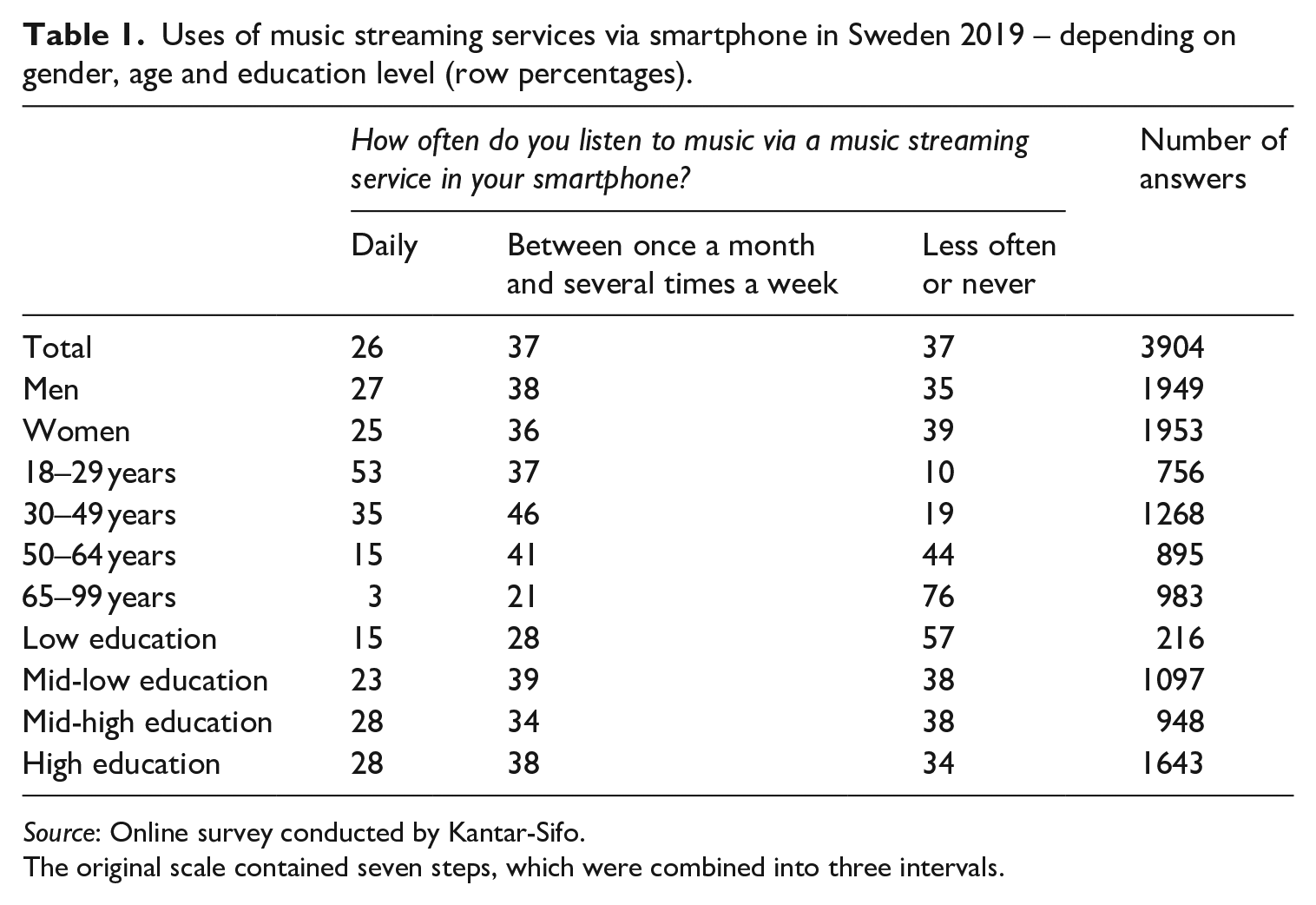
Source: Online survey conducted by Kantar-Sifo.
The original scale contained seven steps, which were combined into three intervals.
Additional results shed light on the social consequences of the digitalization of music listening. Through factor analysis, it is possible to extract three dimensions in music listening, where the first dimension seems to reflect an orientation in music listening where people are deeply engaged in music and weave music into their lives; the second dimension suggests an orientation where people are more moderately interested in music and also less independent, encountering music largely through social media; and the third dimension suggests an orientation where people would like to listen more to music but find it technically difficult and expensive to do so (Table 2). Obviously, not all people would agree that audio-technologies have become ‘ever easier to use’ (Hagen, 2016). Additional analyses (based on a procedure where the factor scores were computed into new variables; not displayed here) reveal that while the first and second dimensions correlate with younger age and higher education, the former with an aesthetic/cultural inclination, the third dimension correlates with higher age. While the first two dimensions also correlate with avid music streaming, the third exposes the opposite pattern.
Three orientations in music listening in Sweden 2019 (factor analysis).
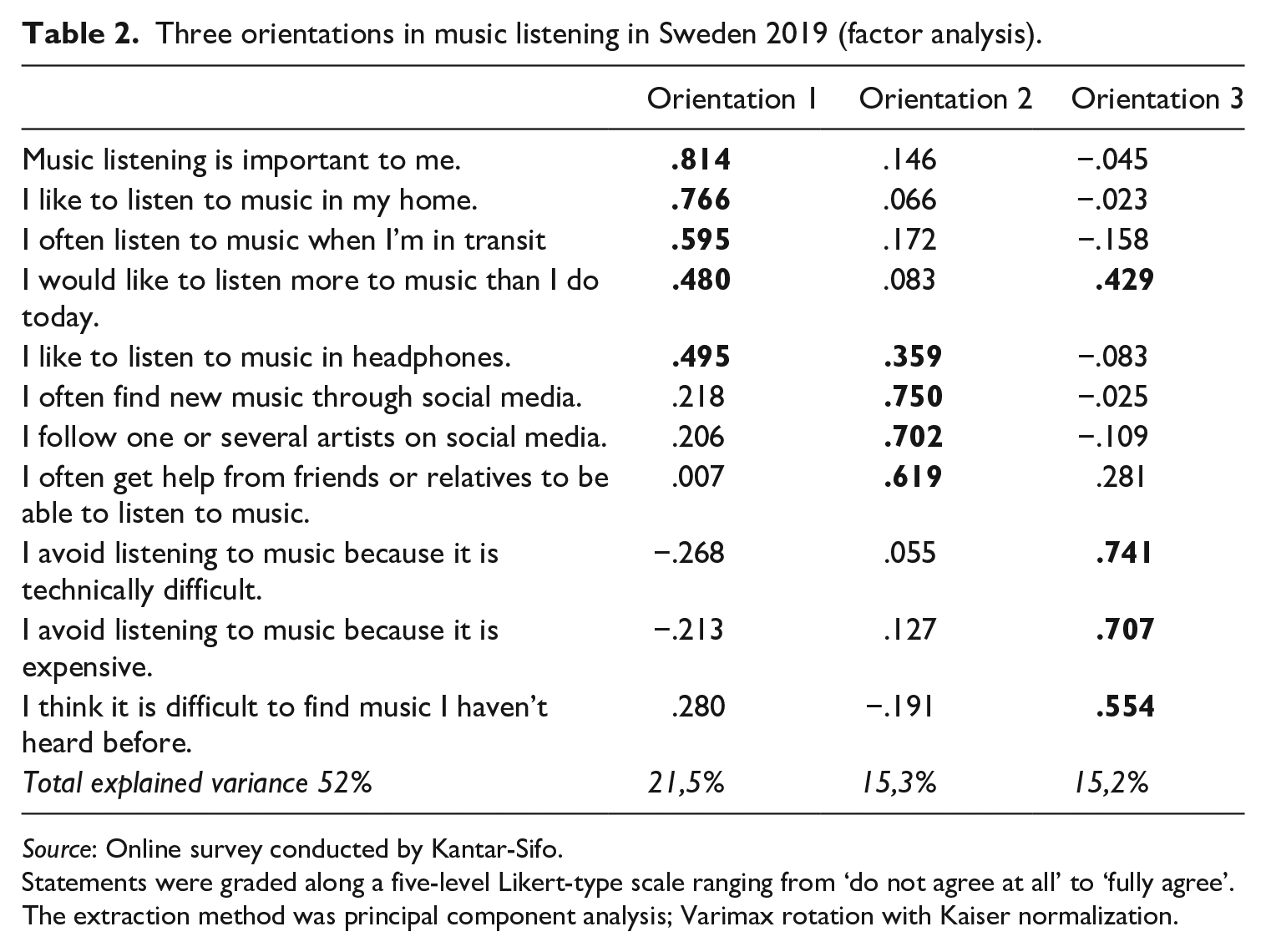
Source: Online survey conducted by Kantar-Sifo.
Statements were graded along a five-level Likert-type scale ranging from ‘do not agree at all’ to ‘fully agree’. The extraction method was principal component analysis; Varimax rotation with Kaiser normalization.
In all, the survey shows that social divisions pertain not just to how different users navigate in and manage digital streams online but also to how people, including non-users, relate to streaming media as part of their life environment. This prompts us to address how streaming is embedded into social and material contexts, and who controls such processes.
Complicit logistical dominance in domestic environments
While it is true that ‘each new medium breeds a cadre of specialists who figure out how to manipulate and programme its special carrying capacities and standards’ and that ‘brokers and intermediaries – those who control the files, stand at the switch, or speak two languages – are the ones who earn the fortunes and make or break empires’ (Peters, 2015: 21), it is just as important to observe how new technological regimes foster a cadre of ordinary experts whose activities are formative to the wider population. Today, those who want to make good use of streaming media, and especially those interested in realizing the vision of ‘seamlessness’, are implicitly requested to acquire logistical expertise. Such expertise is not based on formalized knowledge but rather constitutes lay, ordinary skills that translate into symbolic resources pertaining to the power relations of everyday culture.
Let us turn to the focus groups to see more concretely what ordinary logistical expertise may look like in relation to music streaming and how it extends beyond the platform per se. The following is from a conversation between younger music listeners who live in a small town. They are very interested in music, and one of them (D6) is also a music student:
There’s always some music with me and if it’s not through media it’s in my head. Often, it’s music at work and often it’s in the kitchen and then I have speakers. Then I have separate speakers by the TV set and then I’m casting music from Spotify to that system if I want to sit by the desk or read. Otherwise, I sit by the piano and listen to music and play at the same time in my earphones. There I listen to music a lot. When I’m out walking too, but it varies. So, these are the places, I guess.
And you?
I listen when I’m in motion you could say. If I’m working or walking or moving about. Quite a lot when I’m at home too. I turn on Google Home and it goes on and play in the background most of the time.
Google Home, is that the one you can talk to?
Yes, speakers. It’s linked to Spotify. So, I can tell it ‘I want to hear this song’ and it plays it.
Here, streaming technologies underpin the vision of being able not just to access music at all times and all places but also to create an environment that is adaptable to various needs and circumstances. They ways in which D6 has planned and uses the domestic environment and D7 has integrated different platforms to make the soundscape more interactive bear witness of logistical mastery. At the same time, their weaving of music into dwelling has wider logistical implications, since almost anything they do, or plan to do, is adapted to their handling of audio-streaming. Their relationship to new media is akin to what Nansen et al. (2011) call ‘rational idealism’, where users actively manage and even customize how new technology should work in relation to the demands of a household. This can be contrasted to what the same scholars call ‘naturalization’, where ‘dwelling evolves over time based on the inheritance of cultural norms’ (p. 694), and new waves of ‘media stuff’ are accepted more or less casually. The fact that D6 and D7 are both single dwellers further explains why their visions of logistical control can be realized without much friction.
The above example shows how dwelling with streaming media, compared to traditional mass media, creates more volatile environments where media are entangled, even fused, with other materials as well as with human bodies. The spaces produced are akin to what Ingold (2008) describes as a meshwork (as opposed to network) – a woven texture, or a ‘zone of entanglement’, where different ‘lines of becoming’ intersect (p. 1807). If there ever were any clear surfaces between things, these become increasingly permeable and transient. As such, audio-streaming brings out and accentuates the elemental nature of all media (cf. Peters, 2015).
However, this also accentuates the demand on people to be more adaptive, to steadily learn how to orient themselves comfortably in the environment. As wireless streaming technologies open up for sophisticated ways of designing space, there will also be differences between those in command of the infrastructures and those having trouble to adapt or lack the resources to maintain the systems (cf. Table 2). The domestic household context is probably the site par excellence where such discrepancies unfold and where we can identify the nature of logistical dominance. Let us consider another example to illustrate this point:
If we’re eating out on the terrace, we have loudspeakers, which I don’t quite understand. Sometimes the sound comes from everywhere, the music follows you, sometimes there is different music in the different speakers. But it’s Spotify. And in the evening before going to bed, it’s not like we play games or any such things, but more Facebook, Instagram or email. Whatever blips by in the moment. Nothing structured, but it’s structured that I do it but not what I do. During the weekends these Sonos speakers are on from morning to evening, mixed Spotify lists, no active listening, they are just there.
Are you choosing the music?
Sometimes, but I find it really non-interesting but my partner is more like ‘change this, change that’ and I just want to listen through. It doesn’t matter. I also think vinyl is great, to just have the same . . .
The person speaking here is a middle-aged woman in a typical middle-class setting. On the one hand, her story casts light on the relatively seamless environment produced via the wireless sound system, exposing the open-ended distinction between dwelling with and dwelling in streams. Notably, the interviewee describes her evening media routines as a matter of seizing whatever ‘blips by in the moment’, as ‘nothing structured, but it’s structured that I do it but not what I do’. This shows how various digital streams form the basis for her environmental experience and how she largely dwells in this environment without much reflection while still keeping a certain readiness to turn her focus onto something in particular.
On the other hand, when it comes to the domestic audio-system, A10 clearly states that she does not understand it and that she is not particularly interested. It is an infrastructure that has quite literally been built by somebody else, that is, her partner, whose expertise and ongoing logistical labour she relies upon. As such, her description shows that the mastery of shared media environments is often asymmetrical. A10 dwells on a daily basis with and in an environment that is less comprehensible to her than to her partner. It is also less meaningful, since she is not the one making the choices as to what will be streamed through the system. Her dwelling is torn between a sense of moving through a soundscape that is unproblematic, ‘just there’, to situations where the same environment appears as something alien that she does not understand but nonetheless must attend to. While this type of discrepancy may also depend on whether different individuals are more or less interested in music and thus willing to put in the efforts needed to make things work, the above example shows that logistical labour (or, the mere thought of it) may be a factor that hinders also someone with a moderate interest in music from taking command over the system.
It is important to note the complicit character of logistical dominance. As we saw in the opening example too, if somebody feels frustrated with the hassle surrounding new technology, it may be a convenient solution to accept somebody else’s help in making things work. It means that ‘digital resignation’ (cf. Draper and Turow, 2019) is disguised as a domestic transaction where the support from so-called warm experts (Bakardjieva, 2005; Hänninen et al., 2020; Klausen and Møller, 2018) actually reinforces logistical dominance. This may not even be a deliberate move by those with expertise. We may link this condition to Bourdieu’s ([1980] 1990) understanding of gifts as a potential means of symbolic power. Even immaterial gifts like the kind of help offered by warm experts can be seen as a way to dominate the other person. A warm gesture puts the receiver in a subordinated position since the inability to offer a similar gift in return, or return a favour, implies a ‘lasting obligation’ (p. 126).
Furthermore, even if logistical dominance evolves complicitly within the household – and the expert may even be taken as a form of ‘hostage’ – it reproduces a sense of alienation in relation to digitalization at large. In a Danish study on mediatization, for example, Givskov (2017) identified a sense of urgency among the older citizens she interviewed. They described how ‘the imperative to adapt to media change’ was combined with a cultural imperative ‘to remain in control, autonomous and active, as part of the cultural mainstream’ (p. 62). Thus, while new media could provide solutions to certain limitations that come with older age, lack of media skills reinforced the feeling of being out of sync and losing control over one’s life. As a consequence, other forms of dependence were likely to increase, for example, on family and close friends who could assist in practical matters (see also Givskov and Deuze, 2018; Hänninen et al., 2020). What emerges is a vicious circle where warm expertise widens the gaps it is supposed to bridge.
The symbolic violence of ordinary logistical experts
Media-related skills are not just related to the practical side of dwelling. They are also symbolic and as such translatable across a variety of social realms where they take on normative meanings. While ordinary logistical experts show through their media use, and sometimes everyday support, which technologies are to be regarded as indispensable and which skills count as favourable to master volatile media ecologies, they also communicate about media and their everyday meanings. Thus, they normalize a material culture and (re)produce discourses that legitimize their own expertise while exposing the lack of expertise among others. As given by the interview extract with D6 and D7, they articulate a type of ‘smartness’ that mirrors and endorses the ‘smartness’ encoded into new technology, which means that they not only place themselves at the forefront of the ‘development’ but also channel corporate visions of streaming media infrastructures as culturally indispensable (Fast, 2018).
What happens in language is that an objectifying distance is created between people and their things, and between people and people. The following conversation about audio-streaming, taken from a focus-group interview with senior citizens in a mid-size city, reveals how logistical struggles translate into symbolic struggles:
I’ve been thinking about buying an Internet radio for the last two years, but I just haven’t gotten to it. I know all that about Spotify and blah blah blah . . . But I know someone who has an Internet radio and it’s so amazingly easy to access all kinds of foreign stations and tune into one’s favourites and carry it with you and put it in the bathroom if you are there. So, an Internet radio, that’s actually something I might buy.
You don’t have one of these [pointing to a smartphone]?
Well, yes . . .
I’m thinking, how do you mean, because you’re using your smartphone and there you have all the channels.
I know, but then I need a loudspeaker.
With Wi-Fi?
Yes, exactly, and they run out of battery all the time.
You could use Bluetooth – then you don’t need to . . .
Yes, but still the same, the battery in this [the phone] would run out. I can plug it in too of course, but I recall that the Internet radio . . .
That needs electricity too [laughter]?!
Yes, absolutely, but what the heck . . . it was . . .
I just have an ordinary table radio.
And if you say you’ll take the Internet radio with you into the bathroom then it won’t be connected to the network but has better sound in it.
I have such a small apartment so I’ll place it in the doorway, but well . . .
[. . .]
But I just want to tell you that there are a lot of good apps precisely for world radio.
Yes, I have them all, or most of them [laughter], thank you!
I have a kitchen radio with all digital, international channels. You can buy those.
In this conversation, E10 takes the role of a warm expert (albeit a stranger) who tries to guide E2 to the most convenient way of streaming international radio channels. There are, however, passages in the conversation that widen the gap between the two persons and gradually undermine the self-confidence of E2. Instead of trying to understand why E2 thinks an Internet radio would be a good solution, E10 insists (through a seemingly helpful gesture) on a solution that implicitly disqualifies the perspective of E2. There is even a humorous way of suggesting that E10 lacks the most common knowledge, that a radio ‘needs electricity too’. The social significance of ordinary logistical expertise becomes obvious as the ability to assess and articulate which forms of streaming work where and under which premises. It is exercised as a form of symbolic violence.
Pierre Bourdieu developed the notions of symbolic struggle and symbolic violence in relation to his theory of how cultural practices and taste play into social reproduction (Bourdieu, [1979] 1984, [1980] 1990). Bourdieu’s point is that the ideas, preferences and forms of knowledge that are associated with the dominant classes in society – based on economic and/or cultural capital – hold a normative function that saturates also how other groups judge ‘good’ or ‘bad’ taste, ‘valid’ or ‘invalid’ knowledge. Those who have acquired sufficient amounts of capital can have their worldviews legitimized and accepted by others through symbolic misrecognition. The interesting thing about symbolic violence, then, is that it is implicit; it is a ‘gentle, invisible violence, unrecognized as such’ (Bourdieu, [1980] 1990: 127). The person who is in a dominant position does not have to attack or even specify illegitimate knowledge but can (re)produce subordination through ignoring certain utterances or, as above, through well-meaning expertise and what Bourdieu ([1979] 1984: 255) calls ‘linguistic ease’. In other words, the illusion of ‘natural distinction’ is ‘based on the power of the dominant to impose, by their very existence, a definition of excellence’ (p. 255).
In a society spearheaded by elite figures like Mark Zuckerberg, Jeff Bezos and Elon Musk, it is not surprising that skills pertaining to the logistics of streaming media are difficult to ignore or put into question. These skills point out in what direction society is going and where the power lies. Those who lack relevant skills are not just hindered from managing and claiming autonomy in relation to streaming technology per se; they are also increasingly disqualified from speaking about their own everyday environments and how to navigate in them. Since speech is the key to human life and a precondition for political action, as Arendt ([1958] 1998) argues (see also Topper, 2001), the inability to describe the lifeworld leads to a sense of alienation and resignation in the face of incomprehensible and (what seems like) inevitable social facts.
In the above interview, this tendency is further exposed as the conversation continues. The interview is not only replete with misunderstandings concerning technological matters. It also contains misunderstandings between the participants who expose how difficult it is to communicate about unfamiliar things, especially with people one has not met before. As such, the focus-group format proves an efficient way of exposing the confusions surrounding new media infrastructures – confusions that the dominant discourse around streaming media both produces and denies. There must be a certain level of confusion and disorientation (among dominated groups) for symbolic power to prevail; at the same time, there must not be any doubt as to which forms of expertise are to be taken as socially valid and ‘normal’. As such, the only person in the group who exposes some degree of logistical expertise, E10, attains a central yet somehow detached position in the discussion. While E10 tries to solve some of the misconceptions that flourish in the group, some of the other participants are too alienated from the issues at stake to have anything to lose (or win) in the discussion. In other words, for ordinary logistical expertise to fully work as a symbolic asset, it has to be recognized as valid knowledge aligned with dominant interests in society.
Concluding remarks
To fully grasp the nature of symbolic power in a digitalized culture, we need to consider not just traditional divisions of cultural taste but also ordinary forms of expertise pertaining to the handling of digital streams. Similarly, as streaming media have become a normalized part of everyday life and integrated into the environment, we should pay closer attention to how power relations unfold not just between users and platform industries, but also among people as part of their everyday dwelling. To meet these challenges and to compensate for certain limitations in previous research, this article has advanced a theoretical view of music streaming as a form of logistical labour. Through such an approach, it is possible to move ‘beyond the platform’ to explore social dominance in a culture where logistical, infrastructural expertise is increasingly important. The approach was applied in a focus-group study, which revealed how the handling of everyday infrastructures underpins complicit forms of logistical dominance and translates into symbolic violence in everyday conversations.
While the focus in this article was on music streaming, many of the arguments may be applicable to streaming culture at large. The study has shown that even though people may lack the skill to contribute in an adequate way to conversations around streaming media, such technology has become so commonplace that people feel obliged to at least express some vague understanding of how they work. Streams have become an ordinary thing to dwell with, and imagine, regardless of whether literally understood as ‘streams’ or not and regardless of whether they are actively or passively enacted. Against this background, logistical expertise emerges as an increasingly important asset for getting around and feeling at home in the world, as well as for expressing opinions about what our digitalized society is and perhaps should be in the future. Here, I argue, future studies should delve deeper into how ordinary logistical expertise is articulated in different social contexts, even different societies, and try to assess whether such skills also constitute a political asset. The Arendtian legacy informing this article may be deployed to trace the progression from ‘logistical labour’ to ‘logistical action’, where the latter is to be thought of as logistical interventions (within and beyond platforms) aiming to reimagine streams and subvert the system of accumulation.
Some limitations of the study should also be mentioned. The limited size of the sample makes it difficult to go deeper into power relations pertaining to gender and class structures. Logistical dominance, as described here, is certainly affected by gender structures that define which skills are considered valuable, and which not, and how domestic media technologies are coded (e.g. Keightley, 2003). As such, the findings may say something about male dominance. Furthermore, logistical expertise probably works differently across social space. For example, certain cultural class fractions are disposed to maintain a sense of independence from technology and may take pride in being partially disconnected from digital media (e.g. Fast et al., 2021). There is even a new business sector emerging to help people (those who can afford) to disentangle from streams. Future research should thus try to unpack the intersectional power relations underpinning the conditions identified here.
Footnotes
Acknowledgements
The author wishes to thank the three anonymous reviewers for very constructive comments on previous versions of the manuscript.
Funding
The author(s) disclosed receipt of the following financial support for the research, authorship, and/or publication of this article: This study was funded by the European Union Interreg rersearch programme, project ID 20201630.
