




Abstract
Digital platforms, such as Google and Facebook, are under increased scrutiny as regards their impact on society. Having prompted concerns about their capacity to spread misinformation, contribute to filter bubbles and facilitate hate speech, much attention has been paid to the threat platforms pose to democracy. In contrast to existing interventions considering the threats posed by interactions between platforms and users, in this article, I examine platforms’ impact on the democratic work of other bodies. Considering the relationship between platforms and the media, I reveal how platforms affect journalists’ ability to advance their democratic goals. Using a case study of journalistic coverage of digital campaigning at the 2019 UK general election, I show how platforms have hindered journalistic efforts to inform citizens and provide a watchdog function. These findings are significant for our understanding of platforms’ democratic impact and suggest policy makers may wish to regulate platforms’ inter-institutional impact upon democracy.
Introduction
Digital platforms play a dominant role in contemporary society. As Van Dijck et al. (2018) have argued, today ‘social and economic traffic is increasingly channelled by an (overwhelmingly corporate) global online platform ecosystem that is driven by algorithms and fuelled by data’ (p. 4). These platforms have ‘leveraged their position to take on an ever-greater number of quasi-public functions, exercising new forms of unaccountable, transnational authority’ (Cobbe and Bietti, 2020). As their position in society has grown, increased attention has been paid to platforms’ impact upon democracy. In the realm of news media, particular focus has been paid to mis- and disinformation, filter bubbles, echo chambers, hate speech, junk news and the abuse of market power (Deibert, 2019; Kuehn and Salter, 2020; Omidyar, 2018; Tenove, 2020). Faced with these trends, governments around the globe have begun to pursue regulation and oversight (Rochefort, 2020), and yet, there are unanswered questions about what precisely should be regulated and how regulation should be designed.
In this article, I engage with current debates about platforms’ impact on democracy to argue there is a need to consider what I describe as platforms’ inter-institutional impact upon democracy. In contrast to existing interventions which have pointed to the democratic harms arising from interactions between users and platforms (Miller and Vaccari, 2020), I focus on the impact platforms have on other institutions’ democratic activities. Building on the idea that platforms occupy an intermediary role that shapes society, I examine the ways in which platforms affect other actors’ ability to pursue favoured democratic ideals. This analysis offers important insights into the expansive impact of platforms on societal manifestations of democracy and suggests policy makers may wish to regulate platforms’ inter-institutional impact upon democracy.
To make this intervention, I employ a case study approach. Dissecting relations between platforms and the media, I consider the democratic ideals pursued by journalists, and the impact platforms have on journalists’ ability to enact these ideals. Presenting evidence from interviews exploring journalists’ experience of covering the United Kingdom’s 2019 digital election campaign, I show that while some platform practices enabled journalists to pursue their democratic objectives, others fundamentally inhibited their efforts to inform citizens and provide a watchdog function. Pointing specifically to issues around data availability and quality, I show how platforms’ status as intermediary bodies shapes the democratic activities of other bodies. On this basis, I argue that policy makers may wish to consider regulating such effects and, drawing specific insights from this case, propose particular interventions.
Platforms, democracy and inter-institutional impacts
Digital platforms or, as Gillespie (2010) defines them, intermediary bodies that offer ‘storage, navigation and delivery of the digital content of others’ (p. 348) have been the subject of extensive study (Gillespie, 2018; Helmond, 2015). While it is widely recognised that platforms such as Facebook, Airbnb, YouTube, Google and Amazon play a role within ‘virtually all aspects of contemporary life’ (Gorwa, 2019: 854; Poell et al., 2019: 1–2; Van Dijck et al., 2018), in recent years, there has been concern about the impact of these organisations on democracy (Deibert, 2019; Persily, 2017). The charges levelled at platforms have been numerous and diverse. It has been argued that platforms create filter bubbles (Pfetsch, 2018), polarise communities (Butcher, 2018), disseminate mis- and disinformation (Tucker et al., 2018), and much besides.
In the context of debates around news media, platforms have been shown to have particular disruptive force. Tambini and Labo (2016) have, for example, described platforms as ‘the new power brokers, usurping dominance of multiple media markets, grabbing control of complex ecologies of advertising and personal information and potentially even undermining democracy’ (p. 34). To date, efforts to understand and respond to the democratic threats platforms pose to society have focused on the relationship between platform practices and users (Miller and Vaccari, 2020; Van Dijck, 2013: 20), highlighting negative democratic outcomes. Studies showing how, for example, platforms are changing patterns of news consumption among citizens (Bakshy et al., 2015) and platform algorithms are filtering news content to different audiences (DeVito, 2017; Thorson et al., 2021) have been cited as evidence of platforms threat to democracy (Andersen and Strömbäck, 2021; Vaidhyanathan, 2018). Others have explored platforms role in disseminating news, highlighting their capacity to expose citizens to hate speech (Whitten-Woodring et al., 2020) or junk news (Howard, 2020), and to undermine journalists’ ability to protect citizens from misinformation (Pickard, 2020). In the face of such evidence, governments have begun to take steps to mitigate these outcomes, proposing and implementing regulation intended to ‘make them [platforms] more responsible’ (Loutrel, 2019: 11; Deibert, 2019: 25–26; Rahman, 2018) and to mitigate harmful effects (Flew et al., 2019; Taddeo and Floridi, 2016).
While making important strides in developing our understanding and informing regulatory response, in this article, I argue there is value in expanding inquiry to spotlight platforms’ impact on other institutions within democratic systems. This approach draws insights from institutional theory and platform studies to foreground the interconnections and power relations that exist between institutions and their significance for democracy. Within institutional theory, it is commonly asserted that institutions as both organisations (such as platforms or governments) and rules, norms and strategies (Ostrom, 1986) give meaning to social practices and ideals by defining expectations for behaviour (Streek and Thelen, 2005: 12–13). Institutions therefore play a pivotal role in shaping the ‘political values which prevail at a given time in a society’ (Johnson, 1975: 282), rendering their activities key to the meaning of ideas such as democracy. In understanding how such ideas are defined, it is important to recognise that ‘no institution stands alone, but is interconnected with a range of other institutions which reinforce its effects, or complement them’ (Lowndes and Roberts, 2013: 42). 1 To understand an ideal such as democracy, it is therefore necessary to consider the interactions between institutions and the shared ideals they promote (DiMaggio and Powell, 1983; Napoli, 2014).
Aligned with this approach, scholars of platform studies have also focused on institutional interconnections, but in this field, attention has tended to focus on the disruptive power of platforms. Highlighting platforms’ status as intermediary bodies that ‘shape cultural worlds’ (Bourdieu, 1984; Lobato, 2016), it has been argued that platforms ‘have now acquired a scale and indispensability . . . such that living without them shackles social and cultural life’ (Plantin and Punathambekar, 2019: 164). Platforms are seen to occupy a dominant position, with scholars highlighting how ‘informational asymmetry’ between platforms and other actors within society makes it possible for platforms to ‘leverage their position as powerful intermediaries to engage in practices likely to reduce economic and social welfare’ (Tessier et al., 2017: 180–181).
Applying these insights to study the impact of platforms on news media, scholars have tended to focus on platforms’ structural rather than democratic impacts, arguing that platforms are ‘profoundly changing our media environment’ (Bell and Owen, 2017; Nielsen and Ganter, 2018: 1600). Caplan and boyd (2018) have therefore demonstrated how platforms are upending ‘how both the newsroom and individual journalists operate’ (p. 2) when producing and disseminating news. Similarly, Messe and Hurcombe (2020) have highlighted ‘platform dependency’ by showing news media organisations to be ‘dependent on platforms (and their algorithms) for audience traffic’ (p. 2). These examples suggest that platforms are ‘the new dominant actors’ (Siapera, 2013: 2) and can exert ‘both formal and in-formal pressures’ (DiMaggio and Powell, 1983: 150) on dependent bodies within society. Indeed, for some scholars, platforms have the capacity to ‘capture’ the media by rendering them ‘incapable of operating sustainably without [platforms’] physical or digital resources’ (Nechushtai, 2018: 1052).
Entwining these analytical traditions, in this article, I spotlight the significance of institutions for our understanding of democracy and, noting the dominant position platforms can occupy vis-à-vis other institutions, consider their potential impact on democratic ideals and practices. Pointing to the significance of collective institutional practices for our understanding of democracy, I ask whether and how platforms are disrupting other institutions’ ability to enact their democratic goals. To do so, I offer a case study of relations between platforms and the media. While not allowing analysis of platforms’ impact upon the multitude of institutions that shape ideas of democracy within a particular society, this approach facilitates fine-grained inquiry that makes it possible to investigate precisely how platforms frustrate or enable the media’s democratic goals. This study therefore offers insights for those interested in platform or media relations, while more broadly seeking to contribute a new perspective to debates about platforms, democracy and regulation.
Case study and method
The relationship between democracy and the media is a long-standing topic of interest within academia. Acting as the ‘fourth estate’ of democratic politics (Schultz, 1998), scholars have argued that the media play a vital role in advancing democratic ideals, and have offered a number of different classifications of their activities (Christians et al., 2009: 116; Gurevitch and Blumler, 1990). Rather than selecting one pre-existing schema, within this article, I follow a well-established tradition of self-declaration (Rollwagen et al., 2019), asking journalists to articulate their own understanding of their democratic role.
Adopting this approach, it is important to note that a study of this type confronts challenges. Previous scholarship has shown that while journalistic ideals can be easily identified, they are often divorced from actual practices (Schudson, 2008). Indeed, Anderson (2020) has argued that the economic and social conditions surrounding news make it problematic to ‘hold up grand expectations for the news profession’ (p. 2). This makes it important not to create the illusion that the media enacted democratic ideals in the pre-platform era. The process of realising democratic objectives has always confronted a range of challenges, but these ideals nevertheless provide an important guide for journalistic behaviour. In studying the impact of platforms upon the media’s democratic goals, this analysis does not therefore claim that these ideals have always been enacted, or that they would be secured if platforms did not exist (or changed), rather I isolate the particular barriers that platforms create and in so doing, highlight the power platforms have to enable or frustrate journalists’ efforts.
To facilitate analysis, I present a case study focused on the media’s experience of covering the digital election campaign at the 2019 UK general election. This narrow lens allows me to unpick the particular interactions between platforms and journalists, allowing discussion to move beyond generalised observations. While a range of scenarios could have been examined, a focus on digital campaigning is of particular interest as to date attention has focused on the need to mitigate democratically harmful practices enabled by platforms. There is accordingly a high degree of consensus about the need to regulate platforms to tackle digital misinformation, foreign interference and voter suppression in order to defend democracy (Tenove, 2020). Less attention has, however, been paid to the significance of platform behaviour for the democratic activity of other institutions. Indeed, there has been limited focus on why platform practices matter for other institutions’ democratic activities and what regulatory interventions might be required. This case study offers such insights, spotlighting the significance of platforms’ inter-institutional impact on the media and the significance of these trends for democracy.
The analysis below is based on interviews conducted with 16 journalists in the immediate aftermath of the UK general election (December 2019/January 2020). Interviews explored views and experiences from a range of different outlets, with participants selected from three national broadcasters, three newspapers and three online only news outlets (Table 1). As the BBC invested particularly heavily in digital across its online, radio and television coverage, a number of interviews were conducted in this organisation. Participants were identified as senior reporters or data journalists with responsibility for leading an outlet’s coverage. In some cases, chain referral was used to speak to an additional specialist within the organisation with particular expertise.
Interview distribution.
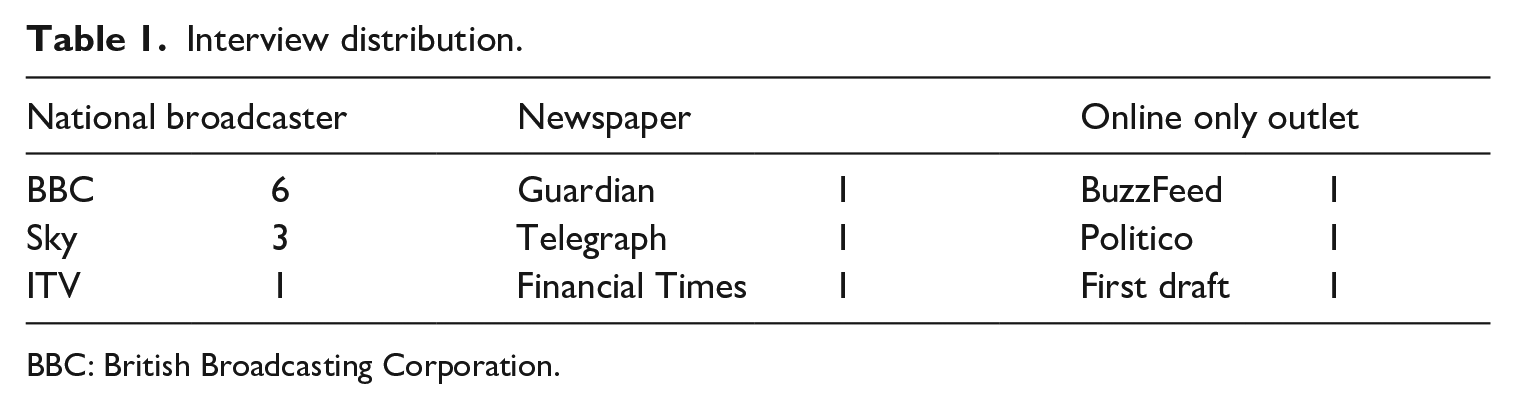
BBC: British Broadcasting Corporation.
Interviews focused on each outlets’ approach to covering the digital campaign, and explored the type of coverage they sought to offer citizens, the precise mechanics and focus of their coverage, gaps, barriers and strengths within their approach. Questions were exploratory in nature and answers have subsequently been recoded and analysed to explore the ideas raised above using an iterative, reductive coding process. The findings presented here do not aim to compare and contrast different reporting strategies, but rather highlight common experiences around platform influence. Interviews were conducted on the record in all but one case; hence, the names and affiliations of the majority of participants are given in the discussion below (and listed in Supplemental Appendix 1). It should be noted that these affiliations reflect positions interviewees held during the election, and that a number of participants have since gone onto other jobs. Quotes also reflect platform behaviour in the election period, but clarifications have been offered to highlight policy changes made after December 2019. Interviews were conducted by phone and lasted between 30 minutes to an hour, they were transcribed and quotes have been approved by interviewees.
Journalistic coverage of digital campaigning at the 2019 general election
At the 2019 UK general election, digital campaigning was given unprecedented levels of coverage. All but one of the outlets studied had reporters devoted to digital campaigning, and many had multi-person teams composed of reporters and data scientists. When interviewees were asked about the motivation behind their reporting nearly all expressed a desire to inform citizens and hold powerful actors to account (Dahl, 1991).
Many journalists articulated their intent to inform citizens about what was happening online. Interviewees made comments such as a ‘really important goal was to inform people’, recognising that it is easy to ‘assume the general public know about things like targeting of ads, but actually the fact is they don’t’ (Joe Tidy, BBC). This activity involved working to promote citizens’ understanding of digital activity. Rory Cellan-Jones at the BBC therefore described his desire to draw ‘back the veil on this mysterious and allegedly incredibly powerful form of campaigning, just to tell people how it’s done’, while Rowland Manthorpe at Sky talked about conveying ‘what is really going on in the digital campaign’. Michael Wendling, also of the BBC, reflected that journalists’ ‘job is to try and describe [what is happening on digital], try and analyse it and provide some sort of clear thinking about it, but also try to humanise it a bit’. These comments reflect the well-established idea that journalists ‘play an important democratic role in informing citizens’ (Gans, 1998: 6, 2003; Lippman, 1922; McNair, 2000; Nielsen, 2017; Schultz, 1998), but they also show journalists to be advancing a specific conception of democracy that promotes the idea of knowledgeable citizens.
In addition to informing citizens, a number of interviewees also cited a desire to hold powerful actors to account by performing a ‘watchdog’ function (Norris, 2014). Joe Tidy at the BBC reflected on the importance of ‘the investigative side of it as well: “Let’s make sure that we don’t miss some nasty scandal happening here that the public aren’t aware of”’. These ideas were reflected by Rupert Evelyn at ITV and Alex Spence at BuzzFeed who commented on their desire to uncover concerning practices and hold campaigners to account. Such motivations reflect Deuze’s (2008) assertion that the media play an important democratic role in monitoring the ‘bureaucracy, industries, and the state . . . from a slightly elevated or professionally distant vantage point’ (p. 850; Jacobs and Schillemans, 2016: 23), establishing ‘an additional layer of protection against potential detriments of injustices against citizens’ (Lohmann and Riedl, 2019: 219). In the remainder of the article, I analyse interview data to consider whether and how platforms affected journalists’ ability to enact these goals.
In reviewing interview findings, it appeared that platforms were key to journalistic coverage. Speaking about their desire to report on ‘paid for’ and ‘organic’ content, 2 journalists reflected that while some content could be studied on digital campaigners’ own websites and blogs, for the most part, content was placed on intermediary platforms such as Facebook, Instagram, Twitter, YouTube, WhatsApp, Reddit, TikTok, Snapchat, messaging apps, Google, Telegraph and Gab. Pointing initially to the positive role that platforms could play, interviewees explained how tools provided by platforms facilitated their work.
In terms of paid content, journalists routinely mentioned the value of the online advertising archives provided by some platforms. They explained how the decision by Google and Facebook to create these resources in 2018 provided previously unavailable insight into advertising spend, content and targeting (Leerssen et al., 2019: 2). Facebook, in particular, was seen ‘to their credit, to have made it very easy for people and journalists to access’ information (Jim Waterson, Guardian). Indeed, Joe Tidy at the BBC described how across these two forms of content, ‘[t]he Facebook Ad Library, coupled with the Google Ad Library, Snapchat’s new ad policy tracker and transparency . . . gave us pretty good insight into what was happening’. Meanwhile, for organic content, journalists cited the significance of platform tools such as CrowdTangle which provide metrics on organic activity such as account likes, shares and comments on different platforms. Describing the use of these tools, Joe Tidy at the BBC explained how BBC Monitoring used CrowdTangle to identify ‘the most politically engaged people in the population’, while Alex Spence at BuzzFeed similarly noted that the tool allowed him to gain a ‘sense of the ecosystem around British politics’. The availability of these tools is particularly notable because of the insight they provide into previously opaque aspects of campaign activity. In comparison to the challenge of studying offline campaigning (where archives of campaigning materials are not available), platform tools allowed journalists unprecedented insight into campaigns. In many ways, platforms therefore enabled rather than frustrated journalists’ ability to enact their democratic goals, and yet, when talking in more detail about their experiences, interviewees highlighted numerous ways in which the decisions made by platforms around disclosure had a detrimental impact on their ability to inform citizens and hold powerful actors to account.
Assessing platforms’ inter-institutional impact: limitations in information disclosure
Discussing their experiences, interviewees revealed considerable evidence of ‘informational asymmetry’ between platforms and journalists (Tessier et al., 2017: 180). Two primary concerns were voiced, first pertaining to data availability, and second to data quality; with specific concerns about the scope, functionality, precision and accuracy of data that were provided.
Data availability limitations
First, reflecting on paid for and organic activity, journalists reported many aspects of digital campaigning that could not be covered because of a lack of available data. As companies motivated by commercial objectives, most platforms have not been designed to facilitate external observation and analysis. Indeed, much of the architecture of platform services makes it exceedingly difficult for an external observer to determine what is being done where (Kuehn and Salter, 2020: 2595). While platforms vary in their degree of transparency, and some have provided tools to enable external study, there were many types of digital campaigning that journalists found it challenging to cover. Thinking about paid content, interviewees reflected that while payments could be used to place adverts, promote posts and stories, or to purchase endorsements from influencers, data were only available on advertising content (and even this was provided by only certain platforms in inconsistent forms). This led to narrowly focused reporting. As one interviewee explained, ‘Part of the reason why I was only really looking at Facebook ads is because the other platforms don’t really offer as much transparency as Facebook’. Although the platforms providing archives (i.e. Facebook and Google) do dominate the digital advertising landscape (Barrett, 2020), the availability of advertising data heavily skewed coverage towards certain platforms (and kinds of paid for content). Indeed, speaking about Instagram, Mark Scott at Politico noted that ‘Instagram was significantly under-covered. So, it was very difficult to see the specific Instagram ad spend on Facebook, because they don’t provide granularity on that’. Other platforms without public archives also received less coverage, and few stories were published on other types of paid content. Platforms’ ability to provide these resources to journalists does vary in accordance with their size and the particular challenges of identifying and disclosing certain types of content (such as details of influencer payment). However, developments since these interviews show that platforms do have discretion to make more information available as, for example, Facebook made changes to allow advertising spend on Instagram to be disaggregated.
It was not only paid content where data availability affected coverage, journalistic insights on organic campaigning were also impacted. Interviewees cited many areas where data were simply not available. While some tools such as CrowdTangle exist for studying the size and reach of online groups and profiles on certain platforms, interviewees lamented a general lack of systematic access to information about organic content. It was widely recognised that, as Alex Spence at BuzzFeed noted, ‘the availability of good data . . . is a big problem with covering this area . . . it’s quite hard to get a holistic view’. Because platform companies facilitate activity in encrypted or closed forums, and do not provide external access to these forums, much organic activity was ‘completely off limits’ (Mark Scott, Politico). As Shayan Saradarizadeh at the BBC reflected, ‘messaging apps are obviously end-to-end encrypted, and we have no way of monitoring that and checking that’. While some journalists did develop their own data gathering strategies – such as signing up to email lists, making donations and joining local groups – interviewees acknowledged that these methods were not systematic. Indeed, Mark Scott at Politico noted how trying to ‘pick out what’s trending or what’s going viral is impossible, because you don’t know what you can’t see’. Others noted ethical problems, explaining how ‘it’s hard to look at private groups . . . Unless you say, “I’m a journalist can I come into your group?” then it’s subterfuge . . . you are on ethically shaky ground’. 3 It was therefore seen to be challenging for journalists to access and verify organic campaigning activity because of the way platforms were designed. These challenges were particularly acute on marginal platforms ‘like Gab, Discord, Telegram just because they’re not as accessible. Because the tools to monitor them aren’t available in the same way’ (Alastair Reid, First Draft). As Alex Spence at BuzzFeed noted, ‘there’s this whole world of WhatsApp and what we call “dark social,” who knows what impact that had or the prevalence of sharing on those platforms’. The architecture of platforms and other digital media therefore created barriers to studying organic campaigning, leading Jim Waterson at the Guardian to reflect that ‘journalists missed loads of stuff . . . I think everyone did too much on paid-for ads and not enough on organic material’.
Journalists reliance on platforms’ voluntary disclosure of information therefore impacted on reporting. While it was possible for interviewees to report on certain aspects of the digital campaign using platform provided insights (such as online advertising archives), many topics were inaccessible. Although platforms were therefore providing some previously unavailable insight into campaigning, their decision not to disclose all information impacted journalists’ ability to inform citizens about the breadth of digital campaigning activity and hindered attempts to detect problematic activities and hold them to account. A complex picture therefore emerges in which platforms both extend previous capacities, but fail to fully realise their potential value.
Data quality limitations
Journalists also highlighted limitations with the quality of information platforms did provide. Speaking about available data, interviewees reflected that while valuable, there were limitations in data quality. Specific concerns were raised around the scope, functionality, precision and accuracy of disclosed information. For the most part, concerns were voiced about Facebook and Google’s advertising archives, however some comments relate to other social media metrics.
Scope
First, in relation to scope, many interviewees indicated that while some insight could be gathered through online advertising archives in particular, available information was by no means comprehensive. While Facebook and Snapchat were seen to provide more detail, there was a little consistency in the information disclosed, making it hard to develop a complete picture of what was happening online. Indeed, comparing Facebook and Google’s advertising archives, the latter was reported to contain far fewer insights because of Google’s narrower definition of a ‘political advert’ (Sosnovik and Goga, 2021). As Carmen Aguilar Garcia at Sky explained, ‘there is no great consistency between providers in terms of how they actually provide the data, which could help data journalists’. Similarly, Rupert Evelyn at ITV reflected on his ‘frustration . . . in the difference between various social media organisations’, noting that ‘[s]ome sort of uniformity would be helpful’.
In addition to inconsistent scope across platforms, journalists also cited areas where the more extensive archives fell down. Expanding on critiques made elsewhere (Mozilla, 2019), at the BBC Michael Wendling noted, ‘it was a frustration for a lot of journalists that we do not know how people are being targeted on Facebook – or any of the other platforms . . . We can only guess or try and piece together evidence’. Others noted the absence of constituency level ‘geographical information about where the ads were running’, or flagged a lack of topic labelling (Carmen Aguilar Garcia, Sky). For Mike Wright advertising archives were seen to provide, just the barest amount of information. So, compared to what’s actually going on, take Facebook, they have this . . . The amount of data, and their whole business model is on the data, the intel, and what they can offer advertisers. We still have absolutely no idea what’s going on at Facebook, putting it bluntly. We have no idea what’s going on on Snapchat, we’ve no idea what’s going on on Google or YouTube, how these things are being used. There is absolutely no transparency, really, in any meaningful sense
For Mark Scott at Politico the limited scope of available data meant that while, we should give the tech companies credit for at least providing some level of transparency . . . The fact that it’s still a black box in terms of all that private Facebook data and also the YouTube videos and the inability to check what actually is being said in those videos then, that’s a concern for me.
While advances were seen to have been made through the creation of advertising archives, the scope and consistency of available data did not reflect the full range of information platforms possessed. Although platforms were therefore making some new information available (e.g. around targeting, which is not available about offline campaigning), companies were exerting discretion about the degree of information conveyed.
Functionality
Interviews also highlighted problems with the functionality of available resources. In regards to advertising archives, journalists recalled particular challenges in gaining access to the Facebook Application Programming Interface (API) – a tool that allows users to ‘perform customized keyword searches of ads stored in the Ad Library’. As Przemyslaw Pluta at Sky explained, if you want to use an API, you have to provide quite a lot of details, especially if you’re a company, you actually have to give quite a lot of details in terms of who you are, where you are, what you intend to use the API for, etc.
In a few cases, access was not granted. Indeed, Carmen Aguilar Garcia at Sky explained how she did not get approval, noting ‘I uploaded a Spanish document, but then I was trying to get information from the UK. So, probably that causes some, I don’t know, mistakes or something in their system, so I didn’t get the approval’. This presented considerable barriers to journalistic coverage, and in many cases, resulted in a lag in reporting as outlets had to apply to be given access before reporting could begin (a process that, for Facebook, took several weeks).
Once having gained access, further challenges were reported around journalists’ ability to extract information from archives in desired formats. Mark Scott at Politico described how the access to YouTube’s transparency tool is very difficult, because although you can download the data from the API, it doesn’t provide you with the metadata on what’s in the videos. So, you have to individually go through video by video to figure out what’s being said. And I just don’t have time for that.
Reflecting on the actual process of gathering data from the API at Facebook, Alastair Reid at First Draft explained how he needed to use scripts and that while, there are public ones available that certain organisations have made. None of them are perfect and there are . . . some of them are gappy. Some of them return different results depending on when . . . you might think you’re accessing the same data but then you get the results. So it’s not perfect.
Similarly, Przemyslaw Pluta at Sky noted that the ‘amount of API requests you’re allowed to make is heavily limited which makes it difficult to build the full picture of available data and connections between moving parts’. These comments reveal that journalists faced a range of challenges in being able to access and query resources to produce informative insights (for more, see Edelson et al., 2018). For Rowland Manthorpe at Sky, they meant that ‘a normal, rational person trying to interact with it, you know, without years of experience, almost doesn’t stand a chance’. For some, these challenges reflected companies’ lack of interest in facilitating journalists’ democratic goals. Indeed, Mike Wright at the Telegraph described the archives as, set up, basically, as PR exercises, to be blunt . . . They’re not set up to make it easy to find things . . . It does give us access to some data, but we have to try to chisel out from whatever medium the insight you can get from them.
Precision
Interviewees also highlighted concerns about data precision. In regards to advertising archives, peculiarities with Facebook and Google’s systems were seen to inhibit reporting. David Blood at the Financial Times recalled how ‘ad level data from the API, stuff like spending and the number of impressions per ad is banded. It’s not given in exact figures. So that makes it almost impossible for us to report on it’. Elsewhere, Joe Tidy at the BBC noted that Google’s Ad Library is bad. It’s very unhelpful. It’s very out of date . . . It doesn’t give you any accurate numbers on how much money is being spent or how many people are seeing it. The category bands they use are really wide and varied.
Similarly, Carmen Aguilar Garcia at Sky reflected that imprecise bands made ‘it difficult to precisely estimate the amount spent per sponsor. The workaround was using the daily report, but small spending was published as “<100” and this report was available for only 24 hours’. While providing some insight, these data sources made it hard to report on trends with certainty.
These limitations were not just perceived with advertising archives, reflecting on social media metrics, such as data on the number of shares for particular YouTube and Twitter posts, Joey d’Urso at the BBC explained how ‘video metrics are by my understanding just broken. No one knows anything. The Twitter videos have 5 million views, what does that actually mean? It means someone’s just scrolled past it for a second?’ Such dynamics made it challenging to report on organic campaigning activity with confidence as journalists were unable to verify whether reported statistics were reliable.
Inaccuracy
Journalists also reflected on the impact of inaccurate data. Reflecting on his experiences of working with advertising archives, Shayan Saradarizadeh at the BBC recalled how midway through the campaign, we figured out that the information that Google’s transparency report gave us about digital ads was not entirely accurate. And they said, ‘Yeah, that is the case’. And then, a week later we find out that the Snapchat ad library has some inaccurate information. And we were like, ‘Okay, hang on a minute’. So, most of the stuff that we were seeing on those two are either completely inaccurate or the picture that we were starting to make for ourselves, now we have to scrap that.
Similarly, Alastair Reid at First Draft recalled how ‘days before polling day in the UK something like 70,000 ads just disappeared from the ad library, 40% of the whole UK archive just went with no communication from Facebook’. Interviewees repeatedly reflected that platform systems were ‘very patchy and buggy’ (Mark Scott, Politico), making it challenging to rely on this data for coverage. These ambiguities made working with archive data, as Rowland Manthorpe (Sky) described, ‘incredibly, incredibly, incredibly hard’. While some of these challenges may reflect an inherent difficulty in providing information in an accurate form, changes made by Snapchat post-election indicate that platforms are not powerless.
Highlighting these four limitations, it appears that while platforms have, in some areas, made information available to journalists that has facilitated their democratic goals, this is not uniformly the case. The limited scope, poor functionality, lack of precision and inaccuracies found within platform provided data mean, as Jim Waterson at the Guardian explained, that the data were viewed to be ‘just so bad’. These dynamics have direct implications for journalistic coverage, making it hard to evidence and verify stories, or to report on items with precision. In certain instances, reporters such as Rowland Manthorpe at Sky, described instances in which they had to abandon coverage ‘because the Facebook ad archive broke’ and stories could not be verified. Journalists’ ability to use platform data to inform citizens and/or hold powerful actors to account is therefore dependent to a significant extent on platform discretion.
Discussion and conclusion
The rise of digital platforms has posed a range of challenges to democracy and, in recent years, policy makers have taken steps to mitigate platforms’ democratic harms. In this article, I sought to spotlight a particular way in which platforms can impact upon democracy, focusing on their impact on the democratic work of other institutions. Drawing insights from institutional scholarship and platform studies, I examined the significance of platforms’ intermediary status for debates around democracy, focusing not on their impact on users, but on other bodies. Spotlighting the relationship between platforms and the media, this article used interviews with journalists to not only show that platforms are exerting an impact on journalists’ ability to advance their democratic objectives when reporting on digital campaigning, but also how this is being done. Highlighting the significance of platform decisions around information disclosure I have shown how platform practices in regards to data availability and quality constrain journalistic work. While in some areas, platforms have extended the range of information available to journalists, this analysis demonstrates that they have also made choices that limit journalists’ access to available data. Platform behaviour has therefore affected journalists’ ability to advance their democratic objectives of informing citizens and performing a watchdog function. This study therefore extends earlier analyses revealing platforms’ impact upon the media to show that platforms are not only affecting the media’s news production and dissemination strategies (Nielsen and Ganter, 2018), but also their ability to promote self-identified democratic goals. This study accordingly supports Nechushtai’s (2018) notion of ‘infrastructural capture’ by showing how journalists are reliant on digital platform infrastructure to enact their democratic goals.
In focusing on journalists’ experience, in this article, I considered relations between platforms and the media as an illustrative example of the way in which platforms could influence a range of institutions active within democracies. While it is important not to draw conclusions about the experience of other institutions from this case study, there are reasons to suggest that others have encountered similar constraints. In reflecting on their experience of monitoring digital campaigning, for example, academics (Dommett and Power, 2019), civil society organisations (Mozilla, 2019) and regulators (Ofcom, 2021) have expressed similar frustrations about the impact of platform practices on their activity. Indeed, Ofcom, the United Kingdom’s communications regulator, has reported similar issues with advertising archives, outlining ‘differences in datasets provided by the same platform, including observations in one dataset which do not appear in another from the same platform, and different totals of active ads on the same day for the same platform’ (Ofcom, 2021: 5). While further study is needed to explore the relationship between these frustrations and such actors’ democratic goals, these findings suggest that platforms exert similar influence over the democratic activity of a range of institutions, not just the media.
The analysis offered in this article provides further evidence that platforms are powerful intermediary bodies that are ‘shaping cultural worlds’, but it also reveals important nuances in how platform power is being wielded. Far from acting in ways that are uniformly antithetical to journalists’ democratic goals, platforms do facilitate some of their activity, and they do show signs of being willing to update and alter their practice. To give just one example, in January 2020, Facebook (2020) outlined steps to update the advertising library to ‘increase the level of transparency’ by allowing audience size to be viewed and enabling better search and filtering. This raises the possibility that platform practices can be aligned with other institutions’ democratic objectives, but this kind of synergy should not be presumed. Given the potential for platform systems to be developed in a range of different democratic contexts and to promote alternative democratic ideals, a reliance on platform discretion appears problematic. Accordingly, there appears to be a need for democratic actors to develop mechanisms through which platform behaviour can be aligned with prevailing democratic ideals.
Advancing this logic, this article suggests that policy makers considering social media regulation need to not only address the democratic impact of platforms upon users (Van Dijck, 2013: 20), but also their impact on other institutions, such as the media. While it was not the objective of this article to outline specific policy responses, this case study offers some insight into how such regulation could be designed. In the case of digital campaigning, regulation could promote information disclosure to ensure that platforms’ power to decide what is or is not disclosed is minimised. Reflecting existing research that has identified a need for precision in calls for increased transparency (Dommett, 2020), there appears to be a need for clear and precise standards around the availability and quality of data, particularly with regard to the scope, functionality, precision and accuracy of data. Such standards could specify not only what information is disclosed, but also how it is provided in order to actively facilitate journalistic activity.
Entwining a study of platforms, the media and democracy this article has made the case for thinking more expansively about platforms’ democratic impact. Pointing to the significance of platforms’ intermediary status, I have argued that these bodies have an important and yet often overlooked inter-institutional impact on democracy. By showing how platforms can affect other bodies and offering specific insights for regulation, this article has attempted to expand the scope of current discussions around platforms’ democratic significance. It is hoped that future research can build on this article by exploring how the democratic goals of other institutions are affected by platform behaviour, and by monitoring whether (and how) democratic objectives change in response to platform practices. It is also hoped that future research can identify and trace the impact of regulatory interventions designed to mitigate these kinds of impact to determine whether it is possible for policy makers to counter these effects.
Supplemental Material
sj-docx-1-nms-10.1177_14614448211028546 – Supplemental material for The inter-institutional impact of digital platform companies on democracy: A case study of the UK media’s digital campaigning coverage
Supplemental material, sj-docx-1-nms-10.1177_14614448211028546 for The inter-institutional impact of digital platform companies on democracy: A case study of the UK media’s digital campaigning coverage by Katharine Dommett in New Media & Society
Footnotes
Acknowledgements
The author would like to thank Chris Anderson, Sam Power and Luke Temple for their invaluable comments on earlier versions of this draft. In addition, I’d like to thank the thoughtful reflections recieved from attendees of the IJPP conference in 2020. I’d also like to thank the anonymous journal reviewers for their particularly valuable insights in revising and improving this piece.
Funding
The author(s) received no financial support for the research, authorship and/or publication of this article.

Supplemental material
Supplemental material for this article is available online.
Notes
Author biography
References
Supplementary Material
Please find the following supplemental material available below.
For Open Access articles published under a Creative Commons License, all supplemental material carries the same license as the article it is associated with.
For non-Open Access articles published, all supplemental material carries a non-exclusive license, and permission requests for re-use of supplemental material or any part of supplemental material shall be sent directly to the copyright owner as specified in the copyright notice associated with the article.
