



Abstract
Social movement organizations (SMOs) increasingly rely on Twitter to create new and viral communication spaces alongside newsworthy protest events and communicate their grievance directly to the public. When the COVID-19 pandemic impeded street protests in spring 2020, SMOs had to adapt their strategies to online-only formats. We analyze the German-language Twitter communication of the climate movement Fridays for Future (FFF) before and during the lockdown to explain how SMOs adapted their strategy under online-only conditions. We collected (re-)tweets containing the hashtag #fridaysforfuture (N = 46,881 tweets, N = 225,562 retweets) and analyzed Twitter activity, use of hashtags, and predominant topics. Results show that although the number of tweets was already steadily declining before, it sharply dropped during the lockdown. Moreover, the use of hashtags changed substantially and tweets focused increasingly on thematic discourses and debates around the legitimacy of FFF, while tweets about protests and calls for mobilization decreased.
Keywords
Introduction
As advocates for societal change, social movement organizations (SMOs) have been a key concern of the social sciences at least since the 1960s (e.g. Smelser, 1962). SMOs can be understood as “associations of persons making idealistic and moralistic claims about how human, personal or group life” (Lofland, 2017: 1–2) should be organized in contemporary societies. As such, they act as challengers of the political, cultural, societal, or economic status quo and engage in various forms of conflict or protest that usually transgress the limits of political routines (Jungblut, 2020).
To create the necessary awareness, mobilize potential adherents, and thus reach their normative goals, SMOs have traditionally required media visibility (Gamson and Wolfsfeld, 1993). As such, the relationship between movements and journalists has been one of the main foci of SMO research. During this first phase of social movement research, scholars have emphasized movements’ struggle to gain media visibility and receive positive news coverage (e.g. Gamson and Wolfsfeld, 1993). In our contemporary hybrid media system (cf. Chadwick, 2017), the rules that seemed to have been set in stone for several decades have changed drastically, leading to a reassessment of the role(s) of communication in social movement theory (Lupia and Sin, 2003).
As a result, the past 10 years have created a vast body of research on SMOs that extensively discusses how new modes of communication, like social media, created new forms of protests, new ways of engaging with potential adherents, and ways to potentially bypass the media as gatekeeper (cf. Bennett and Segerberg, 2012). Simultaneously, however, SMOs can also use social media to target elite audiences, such as journalists and politicians, and convince them of their grievances. Scholars have repeatedly indicated that Twitter might be one of the most central social media platforms to fulfill these purposes as it is said to draw an elite audience while allowing movements to disseminate real-time information about protest events (Leong et al., 2019). Moreover, Twitter enables so-called “hashtag activism.” Through the strategic use of hashtags, the platform offers the means to create “ad hoc publics” (Bruns and Burgess, 2015: 3) to enter dialogue and mobilize users for their protest events. As a result, online and offline protests can no longer be separated, as offline protests, for instance, are announced online and reported live on social media (Baringhorst, 2019).
This study deals with the question of what happens to social movements and their communication if physical protest—the main cornerstone of advocacy—is not possible anymore. In spring 2020, contact restrictions in the course of the COVID-19 pandemic changed social life. Street protests became impossible and social movements had to reconsider their strategies and develop “online-only” formats. In this study, we analyze the potential of these online-only formats in an isolated condition by comparing the Twitter communication using the hashtag #fridaysforfuture before and during the lockdown. We decided to focus on Fridays for Future (FFF) because the global climate movement is well established and during 2019 regularly mobilized thousands of protesters (Wahlström et al., 2019). We thereby seek to answer the questions of how social movements use Twitter for protest communication and how their communication changed through the COVID-19 pandemic.
To answer our research questions, we collected all available tweets and retweets in German language that contain the hashtag #fridaysforfuture and were published on all Fridays from June 2019 to May 2020 (N = 46,881 tweets, N = 225,562 retweets) before and during the lockdown. For our analysis, we conducted frequency counts, a hashtag analysis, and topic modeling.
The remainder of this article is organized as follows. First, we identify conditions that increase SMOs’ chances of entering the public agenda even in a world without physical protest. Second, we will discuss how the emergence of digital communication and social media changed the modus operandi of SMOs and conceptualize social movement theory in a hybrid media system. Third, we will describe the situation of FFF in Germany and the impact of the COVID-19 pandemic on their activities. After this, the main research questions and hypotheses will be derived, and the applied methodological approach will be outlined. Finally, the study’s results will be presented and thereafter discussed.
SMOs and public attention
To reach their normative goals, SMOs heavily depend on public attention. At least until the emergence of digital media, gaining media attention was an essential precondition to convince the general public of their grievances, validate their legitimacy, and mobilize potential adherents. Thus, SMOs aimed to directly address journalists, who, in turn, are generally interested in covering protest events, since they seek newsworthy issues and events to cover (Gamson and Wolfsfeld, 1993). Scholars have repeatedly indicated that SMOs dissolve if they are ignored by the news media (Wolfsfeld, 1997).
Still, research has identified several conditions that can increase SMOs’ public visibility. First, carefully crafted protest events that are in line with media logic can significantly increase an SMO’s impact on the news. The more deviant and transgressive their behavior is, the more their events will be covered, as deviance, conflict, and negativity increase an event’s news value (Wolfsfeld, 1997). This visibility, however, might come at the cost of legitimacy since transgressive actors “must remain in costume” (Wolfsfeld, 1997: 21), meaning that they will be portrayed as deviant rather than legitimate challengers of societal norms. Second, strategic communication can also increase a movement’s impact on the news. In this, the more media-savvy and professional an SMO communicates, the higher its potential impact on the news (Gamson and Wolfsfeld, 1993).
While much of this classic research on the relationship between media and movements seems outdated, the aforementioned conditions can be translated to the situation that this article seeks to investigate, that is, a situation in which offline protest is no longer possible. First, since movements cannot create newsworthy events in the offline world during a lockdown, they need to orchestrate media-savvy and transgressive events online to draw the media’s attention and attempt to recalibrate the weighting of general issue attention. Simultaneously, as with offline protest events as well, SMOs need to create events that are not too deviant, otherwise, they will lose their status as a legitimate actor in the political environment (Wolfsfeld, 1997). Second, these virtual events need to be accompanied by a professional communication strategy that encompasses the logic of online and social media. With online events, thus, SMOs can form collective action online and facilitate newsworthiness to increase their public visibility.
Social media and SMOs
The opportunity to use social media as a complement to a traditional media strategy has broadened the potential spatial-temporal and social reach of SMOs. While traditional media mostly tend to report on (protest) events retrospectively, social media sites are instead becoming a practical tool when it comes to announcing and disseminating information about events in real time. As such, there are several advantages of social media that are particularly suited to SMOs (Baringhorst, 2019) like virality and acceleration. Consequently, social media can empower SMOs to mobilize for protest events, build issue networks, and establish long-term articulation of thematic discourses (Poell and van Dijck, 2018). In terms of reaching public attention, SMOs can use social media with two different objectives. First, social media can serve as platforms to bypass traditional gatekeepers since they allow SMOs to communicate directly with their followers (Lobera and Portos, 2020), and second, activities on social media can generate traditional media attention to an extent similar to street protests or comparable offline events. For example, a tweet of FFF about the behavior of the older generation came into the focus of various traditional media and thus gained broad attention far beyond Twitter (ZDF, 2020).
Among social media platforms, Twitter is prominent and extraordinarily useful, especially for citizen-led movements (Leong et al., 2019). In addition to disseminating information, Twitter is also used to involve users in social discussions. Previous studies on SMOs show that Twitter can certainly help to increase the popularity of a topic, spread calls for public engagement, and discuss suitable action strategies, like media strategies or mobilization strategies (e.g. Theocharis, 2013). A special feature of Twitter are hashtags—expressions with the symbol # at the beginning—which can be added by any user to their own posts. These hashtags function as a topical index and make it possible to display all posts that include a particular hashtag, allowing access to all posts on a single topic without having to follow every concerned Twitter user. Thus, it is possible to increase the virality of topics through hashtags (Jeppesen, 2018), build hashtags publics, and thereby create long-lasting attention to these topics. At the same time, hashtags can be used to create unique communication spaces and mobilize users (Bruns and Burgess, 2015). This hashtag activism is defined as the “act of fighting for or supporting a cause with the use of hashtags as the primary channel to raise awareness of an issue and encourage debate via social media” (Tombleson and Wolf, 2017: 15). Hashtag activism, as one part of digital activism, is not only bound to Twitter itself but functions as a “transmedial mobilisation tactic” (Jeppesen, 2018: 8), as it may spill over into other social media platforms and traditional news coverage.
Examples of this strategic use of hashtags are the #BlackLivesMatter movement, which stands up to fight violence against black people (e.g. Bonilla and Rosa, 2015) and the #MeToo movement against sexual abuse and harassment (e.g. Brünker et al., 2020). Both movements were created by shocking events and their hashtags spread internationally within a very short period, thus attracting worldwide attention (Brünker et al., 2020). These examples show that hashtags cannot only promote public attention but also help to connect individual members of movements and enable them to act collectively. Altogether, the above-described strategies provide a strong counterargument to the accusation of online activism being pure “slacktivism,” which suggests that although online participation is easy to perform through a simple click, actual identification with the particular movement might still be low (Brünker et al., 2020). The question underlying this article is, therefore, how SMOs adjust to an online-only environment and use hashtag activism to facilitate collective action. As an ideal exemplary case, the following chapter is dedicated to the presentation of FFF as our case study.
Social movements in lockdown: the case of FFF during the COVID-19 pandemic
FFF is a social movement that goes back to the commitment of Greta Thunberg, who had organized school strikes (“skolstrejk för klimatet”) every Friday since 20 August 2018, to protest for more effective political measures to mitigate climate change. Soon after the foundation of the movement, affiliations were founded around the globe, adapting the strategy of Thunberg to organize weekly protests.
At the international level, FFF entered the public stage on 15 March 2019, organizing its first “Global Climate Strike” in 125 countries with 1.6 million protesters participating, according to the organizers (Wahlström et al., 2019: 6). Since this date, FFF has relied on a two-step strategy by complementing the weekly protests on Fridays with Global Climate Strikes, taking place in various cities around the world. To date, these Global Climate Strikes have taken place on seven separate Fridays: 15 March 2019, 24 May 2019, 21 June 2019, 29 November 2019, 24 April 2020 (as a Digital Strike), 25 September 2020, and 19 March 2021. In addition, from 5 to 9 August 2019 and from 20 to 27 September 2019, two separate weeklong events took place culminating in big protest events on the respective Fridays, when FFF met for an international conference in Lausanne, Switzerland, in August and when the 2019 UN Climate Action Summit took place in New York City in September.
Germany is a key country for the success of FFF for at least two reasons: First, Germany is of strategic importance because the movement regularly manages to mobilize large numbers of protesters and has built a solid working organization there. Second, Germany constantly ranks among the top five biggest greenhouse gas emitting countries worldwide (Ritchie and Roser, 2020). Thus, a successful significant reduction of greenhouse gas emissions in the country—one key goal of FFF Germany—would have a worldwide impact. As seminal work on the success of SMOs has shown, “[t]he most effective change makers realize they need to change hearts and minds, and they need to change policies and laws” (Crutchfield, 2018: 99). Consequently, due to the high numbers of protesters, the strong organizational foundation, and the presumed impact on one of the biggest greenhouse gas emitters, Germany can be viewed as a cornerstone for the overall success of FFF considering the potential to induce change at all necessary levels: hearts and minds, as well as policies and laws. Nonetheless, according to its self-description, “the climate strike movement is . . . international, non-partisan, independent and decentralized.” (Fridays For Future, 2021b). As such, FFF’s political demands as well as its’ overarching strategy are not to be seen as necessarily tied to individual countries.
One of the central communication instruments of FFF is Twitter. Twitter is useful for FFF because the followers of the movement are generally young, and young people tend to make greater use of social media to obtain information (Beisch and Schäfer, 2020). Survey results show that participants in protests organized by FFF in the week from 20 to 27 September 2019 were informed about the protests largely from social media (de Moor et al., 2020).
The weekly activity of FFF Germany came to an abrupt halt when the ongoing COVID-19 pandemic led Germany’s regional and federal governments to announce a “lockdown” on 23 March 2020, including measures like a ban on leaving one’s home in the company of more than one person from a different household or the instruction to keep at least 1.5 m distant from other persons (NDR, 2020). FFF activists in Germany tried to maintain public attention on climate change by continuing to be active every Friday in online events instead of street protests (Fuchs, 2020). On 24 April 2020, the activists attempted to organize a large all-online protest event in the form of a Digital Strike (“Netzstreik fürs Klima”). Supporters could send in creative posters that were displayed in the public square in front of the Bundestag in Berlin, and a YouTube live event was broadcast, covering the event and showing previously submitted videos. Supporters were asked to make particularly intensive use of social media (especially Twitter) to put the current agenda on Twitter, at least in the form of the “trending topics.”
FFF’s strategy of organizing weekly protests, together with the unpredictable impact of the COVID-19 pandemic, offers us unique research opportunities. First, we are able to study the mobilization efforts of an SMO on a regular basis over time, without having to refer to more or less arbitrary protest events. Second, the twofold strategy to combine weekly decentral events with occasional Global Climate Strikes allows us to compare major protest events with the “everyday activity” of the SMO. Third, the rare case of a pandemic lockdown allows us to observe the digital mobilization of an SMO almost under laboratory conditions. Of course, we are aware that the pandemic is such an extraordinary event that neither the common (social) media logic nor the logic of public attention fully apply to the current situation. Nonetheless, the lockdown situation allowed us to gain insights into whether and how FFF managed to mobilize its supporters and inform the public about their issues, and how FFF searched for alternatives to traditional street protests.
Owing to the uniqueness of the pandemic-related lockdowns, there is no direct scientific work we can build upon to derive directed hypotheses in a strict sense. But, of course, assumptions can be articulated that might guide how we discuss the empirical results against the light of the proposed research questions in the present study. On the one hand, it could be argued that the COVID-19 pandemic is such an impactful key event (Kepplinger and Habermeier, 1995) that not only news media but also Twitter is dominated by pandemic-related topics so that the discussion around FFF is simply overwhelmed. This assumption is supported by data from Finland, showing that newspaper coverage about climate change sharply declined at the time of the pandemic outbreak in spring 2020 (Lyytimäki et al., 2020). On the other hand, one could also assume that when FFF activists realized that COVID-19 was a long-term and ongoing crisis, strategies were immediately developed to use digital channels to draw attention to the fact that climate change is also a long-term and ongoing crisis that must be overcome. This could have led to increased activity on Twitter using resources no longer needed for the organization of street protests. Following from this, our first research question is as follows:
RQ1. How has the number of tweets published with the hashtag #fridaysforfuture been affected by the lockdowns?
To analyze the Twitter activity in the context of FFF in greater detail, we then focused on the concrete impact of major protest events on the number of tweets. Previous research shows that Twitter has become an essential tool for organizing street protests (Tufekci, 2013). As such, it allows to provide information, enables conversations, and further provides a platform for organization and calls for action (Theocharis et al., 2015). As a result, the interdependencies between SMOs and news media have changed. Owing to the longitudinal approach of FFF activists organizing protests every Friday, we were able to compare the impact of major protest events—that is, the Global Climate Strikes and comparable high-impact events—on the activity on Twitter or vice versa. Furthermore, the Twitter activity during protest events can serve as an important baseline to measure the impact of the lockdown on the Twitter activity. It is especially interesting to compare the activity during the Digital Strike to the offline street protest events since it provides insights into whether FFF manages to uphold activity even in times of multiple crises. We thus ask the following question:
RQ2. How is the number of tweets with the hashtag #fridaysforfuture affected by the occurrence or absence of major protest events?
Besides the sheer amount of tweets, the consistent use of certain hashtags is a key to establishing and configuring “ad hoc publics” that help bring a pressing issue onto the public agenda and that might consequently—when established continuously—form more stable counterpublics (Bruns and Burgess, 2015: 3). Moreover, consistent use of hashtags helps to define the element of hashtag activism—as a form of online-only activism that enables raising awareness of an issue and encouraging debate—and, following from this, is the foundation of a successful campaign to instigate policy change (Wonneberger et al., 2020). We sought to investigate, whether and how the use of hashtags associated with the hashtag #fridaysforfuture changed in the aftermath of the pandemic lockdown. Therefore, we ask the following question:
RQ3. How is the use of different hashtags co-occurring with the hashtag #fridaysforfuture affected by the lockdowns?
Because hashtags consist only of a single word or a short phrase, they provide only limited information about the content of the debate on Twitter. To gain insights into whether and how the debate around FFF changed both during major protest events and during the lockdown, we analyzed the topics emphasized in the tweets containing the hashtag #fridaysforfuture over time. We thus ask the following question:
RQ4. How have the proposed topics in tweets with the hashtag #fridaysforfuture been affected by the lockdowns?
Method
Data collection
We collected tweets and retweets in German language 1 containing the hashtag #fridaysforfuture every Friday over the course of 1 year from June 2019 to May 2020, as tweets containing this hashtag are assumed to be directly related to FFF and its protest actions. We are aware that not all relevant tweets about FFF include the hashtag #fridaysforfuture as users can discuss topics and opinions related to FFF without using the respective hashtag. Still, a consistent use of hashtags on Twitter is well established as a means of acting collectively and relating a post to a specific subject.
For data collection, the tool Facepager (Jünger and Keyling, 2019) was used to scrape all available tweets and retweets from the Twitter Standard Search API, which “behaves similarly to, but not exactly like the Search UI feature available in Twitter mobile or web clients” (Twitter, 2020). 2 From 7 June 2019 to 29 May 2020, on 52 Fridays a total of 272,443 tweets and retweets were stored (NTweets = 46,881; NRetweets = 225,562).
Facepager allows obtaining different attributes, which comprise, for example, the text of the tweet, its URL, the date and time the tweet was created, and the username who published the post. Unfortunately, some texts in our data sample are truncated. Twitter extended the maximum length of tweets in 2017 from 140 to 280 characters. While the existent API variable (text) stores texts of maximum 140 characters and truncates longer texts, the complete text that can be longer than 140 characters is stored in a new variable (full_text). When collecting the data, we have used the new variable consistently only as of 14 February 2020. To complete the truncated texts, we scraped all tweets of our data set with the help of their unique ID once again (on June 30, 2020), but unfortunately, some tweets had been deleted in the meantime. We kept the deleted tweets with truncated texts (NTruncated_Tweets = 2224) in our data set.
Data preprocessing
Compared with news articles and other longer forms of comprehensive text, posts in social networking services (SNS), and especially in Twitter, exhibit specific characteristics. They are, for instance, limited in the number of characters, which is explicitly restricted to 280 on Twitter, therefore, providing space for only a few sentences. Other characteristics are the frequent use of hashtags and emojis as well as providing links (URLs) directly in the text. Hashtags are either used as meaningful words within a sentence (as in Heute sind in #Thüringen wieder mehrere Hundert Menschen auf die Straße gegangen—“Today a few hundred protesters were on the streets in #Thuringia”) or as additional tweet elements added after the text. These textual characteristics might influence the calculation of the topic model that we applied on the tweets.
For the first preprocessing step, the Python package Somajo (Proisl and Uhrig, 2016) was used to exclude URLs from the text and to identify hashtags and emojis. Second, white space that was omitted by users to save space was integrated again to separate the words. Third, multiple consecutive appearances of the same special character or punctuation mark were reduced to one appearance of this character. Fourth, words with a leading @ sign (references to other users) and most of the special characters were removed (like different types of quotation marks), but punctuation marks were kept as they would be helpful for the subsequent part-of-speech tagging (POS tagging) and lemmatization. Fifth, POS tagging was performed with the tool TreeTagger (Schmid, 1995), which provides a model trained on the German language. After processing the text, TreeTagger provides not only the POS tags but also the lemmas of the words.
For the subsequent steps of topic modeling, only the lemmas were used. To keep mainly meaningful words, we excluded all lemmas of articles and clitics of articles and prepositions (e.g. am resulting from an + dem), as well as stop words from the NLTK (Natural Language Toolkit) stop word list, and numerical terms. All lemmas were lowercased. Using only the lemmas reduced the vocabulary size from 84,995 to 73,708 tokens, and excluding the user mentions (“@mention”) and stop words reduced the vocabulary to a size of 64,477 tokens.
Topic model calculation
To further prepare the preprocessed data and to calculate the topic model, the Python tool gensim was used (Řehůřek and Sojka, 2010). First, trigrams were built, where tokens that often occur next to each other (e.g. fridays for future) are combined and treated as one word by connecting the individual words with an underscore (e.g. fridays_for_future). Second, words that occur too rarely or too often in the corpus are excluded from the vocabulary. For the minimum threshold, two values were tested when calculating the topic models: 5 and 10 occurrences. For the maximum value, we found no significant difference in the vocabulary size for different reasonable values, since in general, only a few words occur very frequently in texts. Therefore, we set this parameter to 70% (thus, a word should not appear in more than 70% of the texts). This excludes very frequent words, which do not provide discriminative information for the calculation of the topic models.
In the last step before calculating the topic models, tweets shorter than the minimum length of five words were excluded from the corpus, because of the sparsity problem of shorter texts containing fewer words that could co-occur, resulting in 37,950 tweets used for the calculation of the topic model, with a vocabulary of 5911 tokens (min = 10) or 39,358 tweets and 10,861 tokens (min = 5), respectively. 3
Different topic models were calculated with gensim’s latent Dirichlet allocation (LDA) algorithm based on different parameter settings 4 and then evaluated. Different thresholds of the minimum occurrences (min ∈ {5; 10}) and different numbers of resulting topics (k ∈ {10; 20; . . . 100}) were tested by considering the coherence scores as a quality measure of the models (Maier et al., 2018). We chose the model with min = 5 and k = 60, as the coherence value is highest for this parameter combination (see Figure 1).
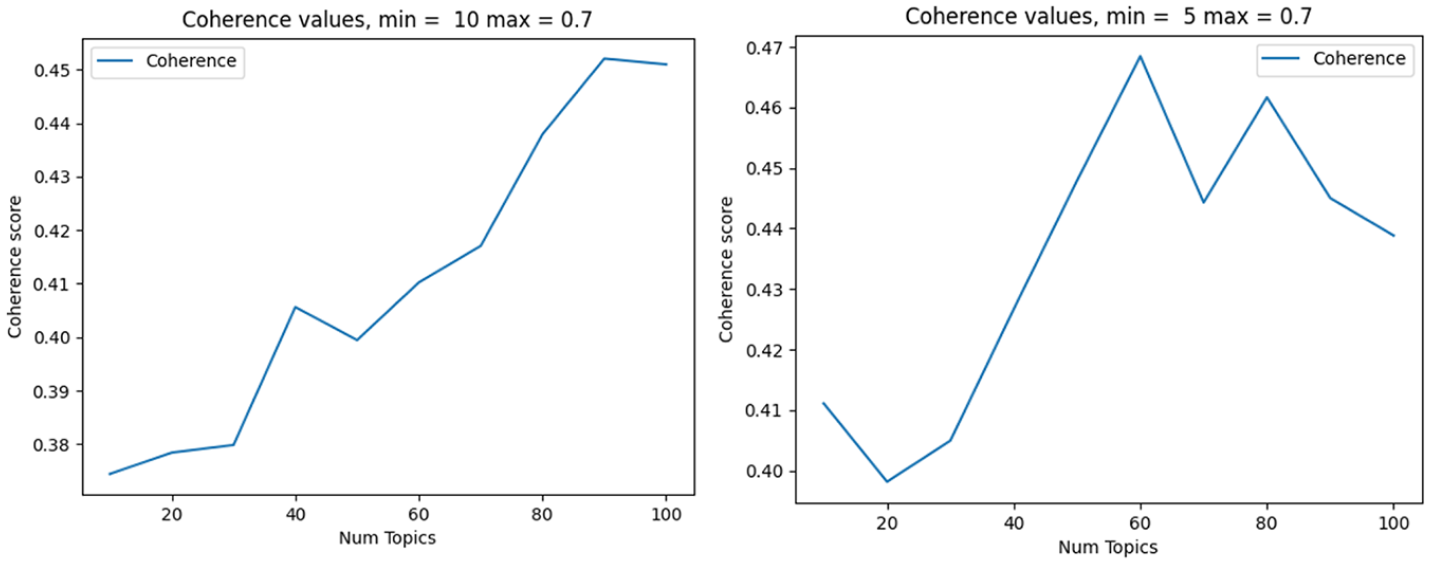
Coherence values for different thresholds of minimum word occurrences.
Having investigated the topics of this model 5 and the tweets with the highest probability value for each topic, we identified three different umbrella topics to which the individual topics can be assigned. These main topics are as follows:
Protest events and mobilization calls: Tweets of this umbrella topic describe protest actions, provide information about the number of protest participants, or call for participation in protests.
Thematic discourse: Tweets of this umbrella topic discuss the goals, measures, or demands of the supporters or opponents of FFF and contain an exchange of arguments for or against climate protection.
Meta-discourse on legitimacy: Tweets of this umbrella topic consist of opinions or statements about the (de)legitimacy of FFF. They are not argument-based discussions of the issue of climate change, but rather deal with laudatory or defamatory comments.
For each tweet, the umbrella topic with the highest probability value was determined by adding up the probabilities of all single topics referring to one of the three umbrella topics. To validate the topic model and the manual categorization into the three main topics, we conducted a brief content analysis 6 of a sample of 600 tweets where two human coders had to determine the dominant main topic of a tweet. Studies validating automated topic generation to coding decisions by human coders are still rare. Our results reflect the usual results of human–computer validations of topic models and show that human coders reliably categorized tweets emphasizing umbrella topic 1 but had difficulties differentiating between umbrella topic 2 and umbrella topic 3 (Hagen, 2018: 1302) (see Table 1).
Reliability values of human–computer validation.
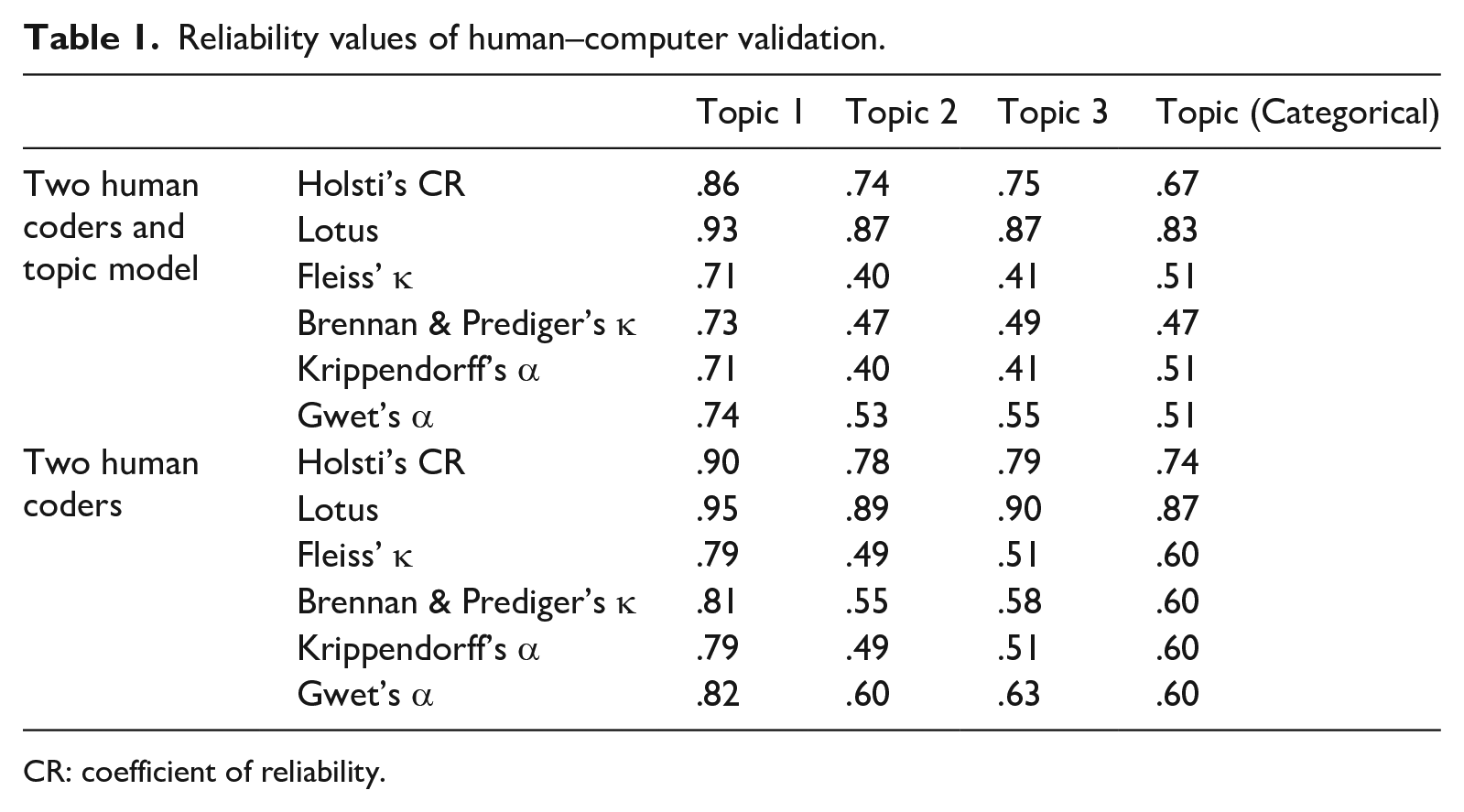
CR: coefficient of reliability.
Results
Overview of the sample
Over the course of 1 year—from June 2019 to May 2020—a total of 272,443 tweets and retweets using the hashtag #fridaysforfuture were published in the German-speaking Twittersphere. Overall, 46,881 original tweets and 225,562 retweets were published by 82,455 unique users. Altogether, the number of published tweets dropped sharply during the lockdown (before: Mdn = 675 tweets per day, Mdn = 3099 retweets per day; after: Mdn = 137 tweets per day, 675 retweets per day) to approximately a quarter of the number before the lockdown (RQ1).
Focusing on the tweets in detail shows that of the 52 Fridays under investigation, on 26 days before the lockdown more than 500 tweets were published, while after the lockdown only on one day more than 500 tweets were published (see Figures 2 and 3).
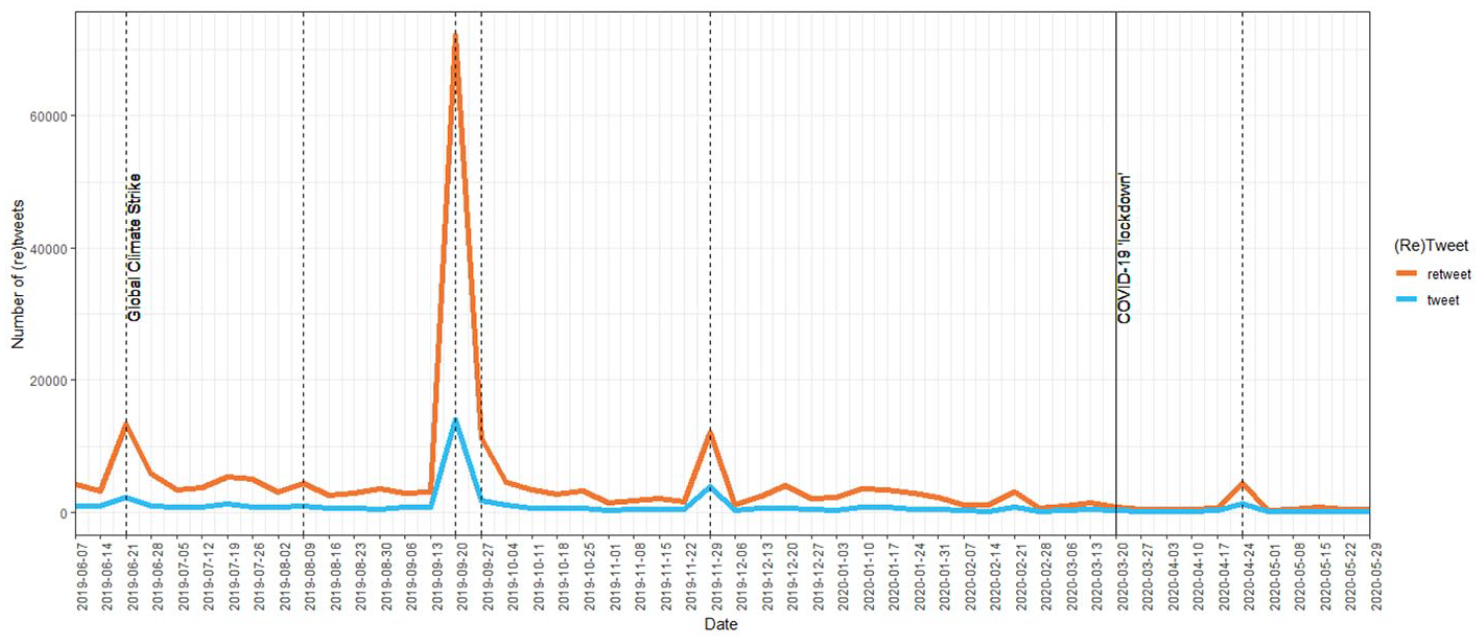
Number of tweets and retweets over time.
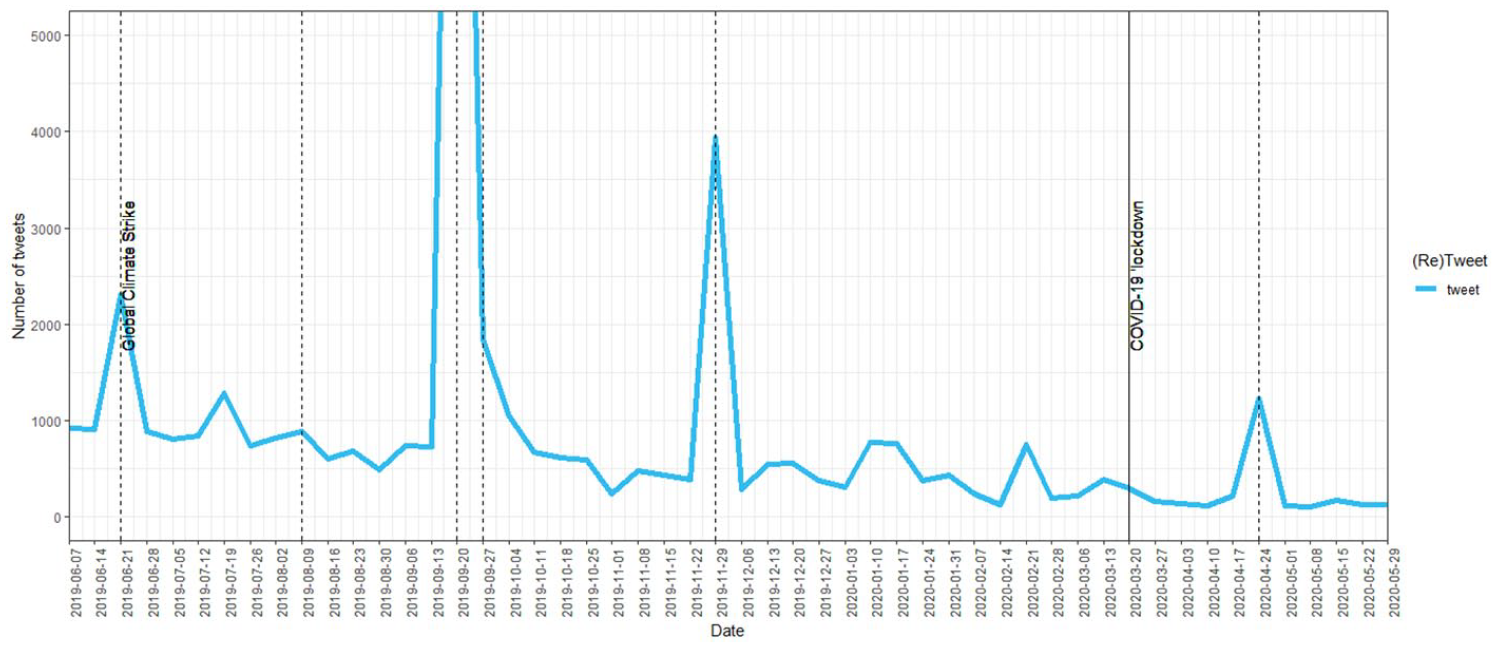
Number of tweets over time (detail).
The figures displaying the time series of #fridaysforfuture-tweets indicate three overall trends: First, there is a decrease in the volume of activity during and after the lockdown. Second, there appears to be an overall steady decline of activity over time. Third, the data suggest that the activity is mainly driven by offline protest events like the Global Climate Strikes (RQ2). The event that generated by far the most activity during our investigation period was the Global Climate Strike on Friday, 20 September 2019. On this day, 13,934 tweets and 72,111 retweets were published accounting for almost one third of the overall number of tweets and retweets in our sample. This high volume of activity corresponds to the high number of participants in the street protests—reportedly 1.4 million participants in Germany (ZDF, 2019). Although on a much lower level, activity also increased during the lockdown when FFF organized a Digital Strike (“Netzstreik fürs Klima”) on 24 April 2020. With 1225 tweets (4388 retweets) on this day, the activity on this major protest event date accounted for more than 40% of the total activity in our sample after the lockdown. This finding corresponds closely with the overall distribution of Twitter activity during major protest events, and apart from protest events. Adding up the number of tweets and retweets during all major protest events and comparing this number to the total number of tweets and retweets in our sample, shows that more than 47% of all tweets and retweets during the 52 weeks under investigation were published on the six major protest event days. To analyze the respective influence of the seemingly overall decline of activity, the protest events and the pandemic lockdown, we used negative binomial regression modeling to predict the number of tweets. As can be seen in Table 2, the strongest statistical influence can be accounted to the occurrence of protest events (incidence rate ratios (IRR) = 7.31 in model 4). Furthermore, including the occurrence of the lockdown as dummy variable accounts for a sharp decline of tweets (IRR = 0.52 in model 4). Finally, the model shows a small overall declining trend over time, showing that week-by-week the attention to FFF slightly fades (IRR = 0.98). This last effect is smaller than the effect of the pandemic lockdown, as a comparison of the CIs shows. In response to our second research question, it can thus be concluded, that the major protest events both before and after the lockdown are the main drivers of attention toward FFF on Twitter, although the attention toward FFF appears to decline slightly over time.
Negative binomial regression predicting the number of tweets.
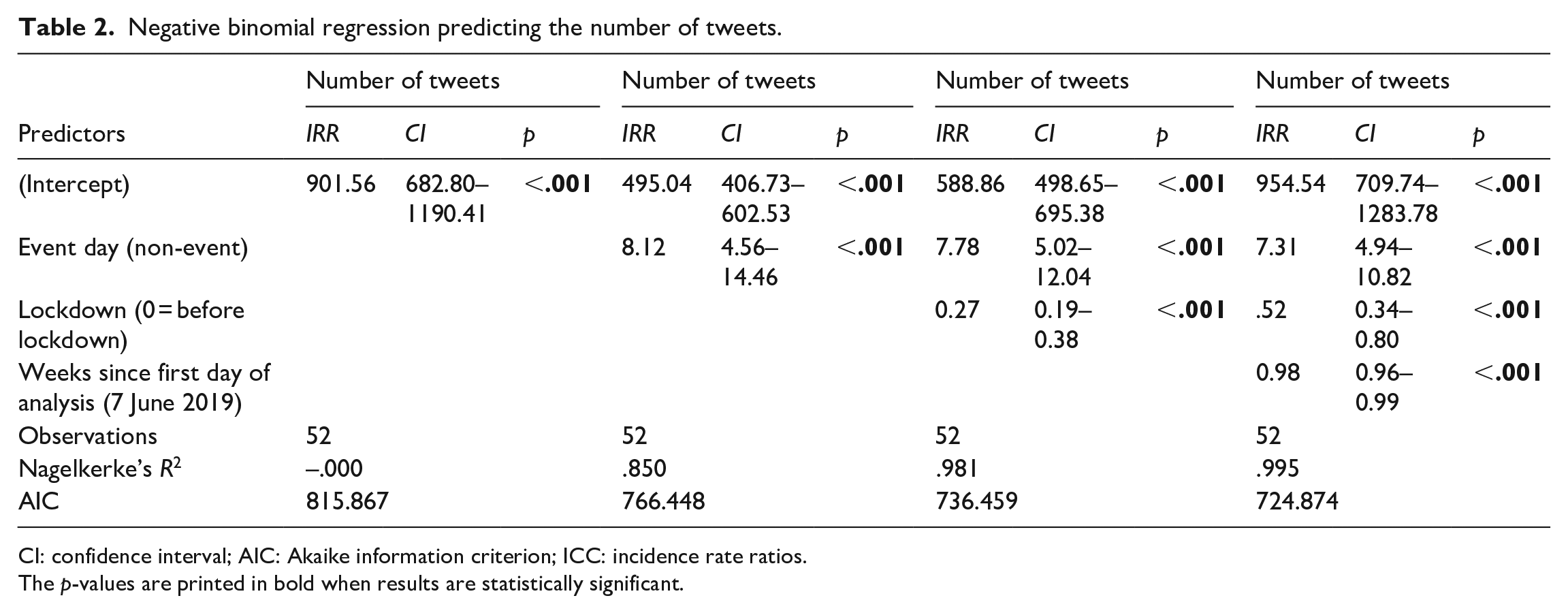
CI: confidence interval; AIC: Akaike information criterion; ICC: incidence rate ratios.
The p-values are printed in bold when results are statistically significant.
Content of Twitter communication
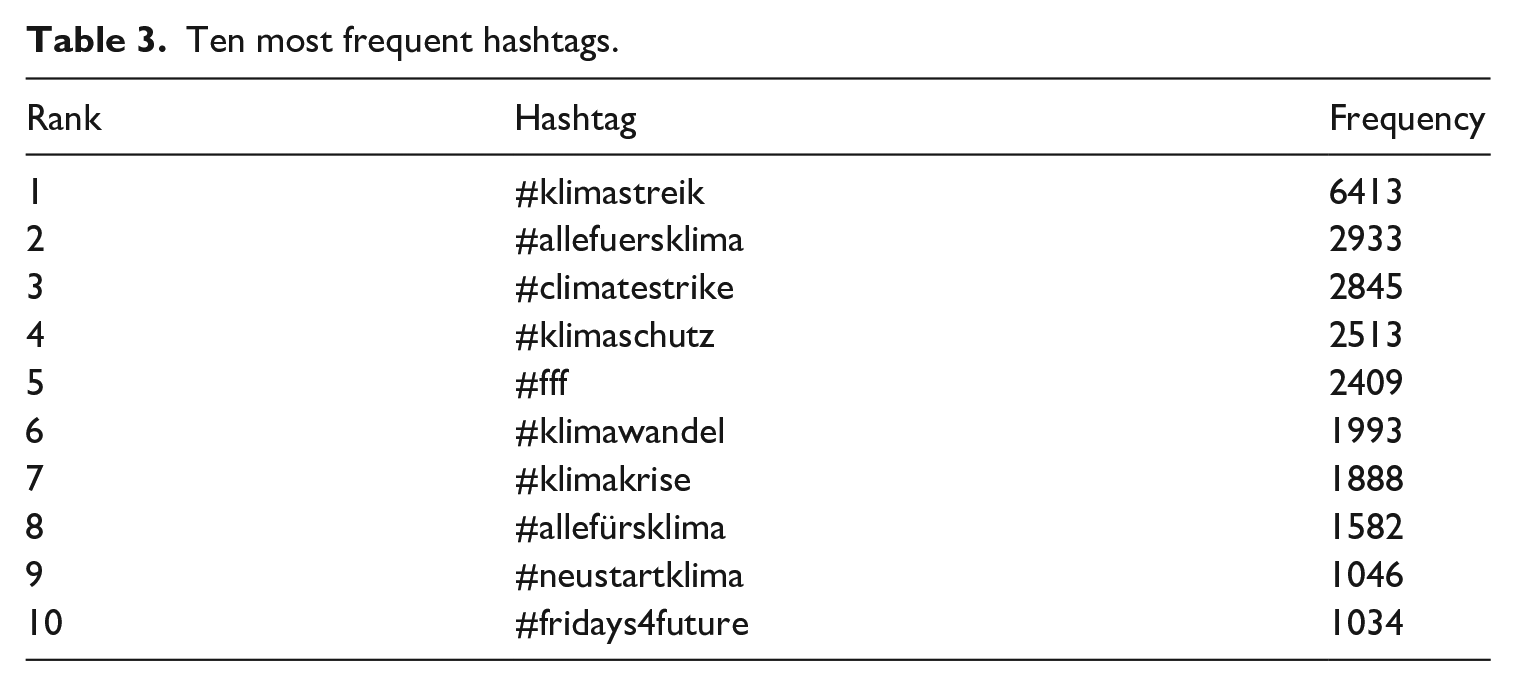
Turning to tweet content, the hashtag analysis suggests a change of hashtag use before and during the lockdown, as logistic regression analysis demonstrates that information about which of the 10 most used hashtags can be found in a tweet is a significant predictor for when a tweet was posted (see Table 3 and Table 4, RQ3). Controlling for protest events, tweets posted before the lockdown more often contained hashtags referring to an activity that was broadly connected to protests like #klimastreik/#climatestrike and mobilizing hashtags like #allefuersklima/#allefürsklima (everybody for climate). But it can also be observed that hashtags like #klimawandel (climate change), #neustartklima (restart climate), or #Fridays4future, addressing the broader issue of climate change instead of concrete events were posted more often before the lockdown. At the same time, the hashtag #klimakrise (climate crisis)—directly referring to the crisis character of climate change—was used more often after the lockdown. Thus, beginning at the onset of the COVID-19 crisis, the crisis character of climate change was also addressed more often.
Ten most frequent hashtags.
Logistic regression model predicting when a tweet was posted.
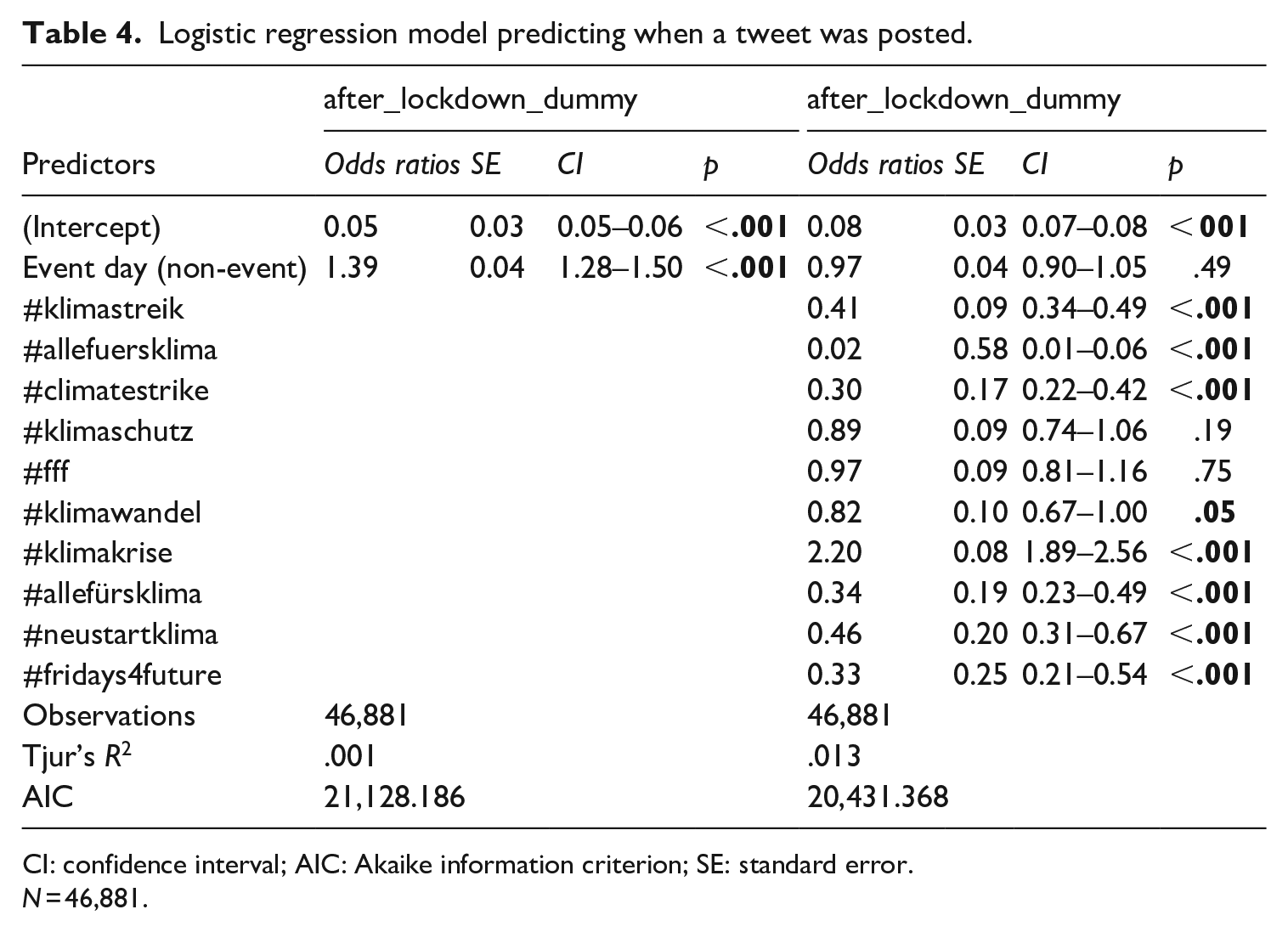
CI: confidence interval; AIC: Akaike information criterion; SE: standard error.
N = 46,881.
In response to our third research question, an in-depth inspection of the use of hashtags (Figures 4 and 5) indicates that the protest-related hashtags were also relatively frequently used (apart from the Global Climate Strikes) because smaller or local protests also took place on Fridays apart from the big protest events. The “real-world” protests came to a halt during the lockdown and, thus, the use of these hashtags declined. Although the total activity declined during the lockdown, hashtags like #klimakrise and #klimawandel were used relatively frequently. While for #klimakrise the relative share during the lockdown was higher than before the lockdown, #klimawandel was used to a comparatively higher amount before the lockdown.
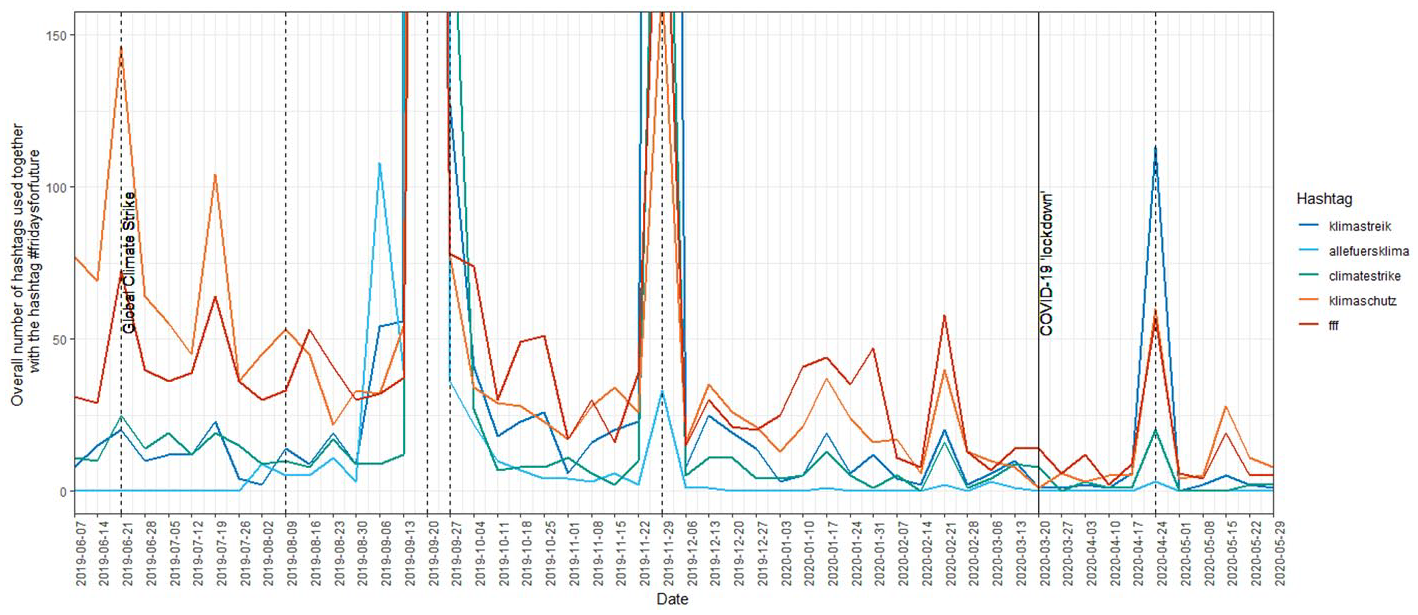
Number of tweets with certain hashtags (detail).
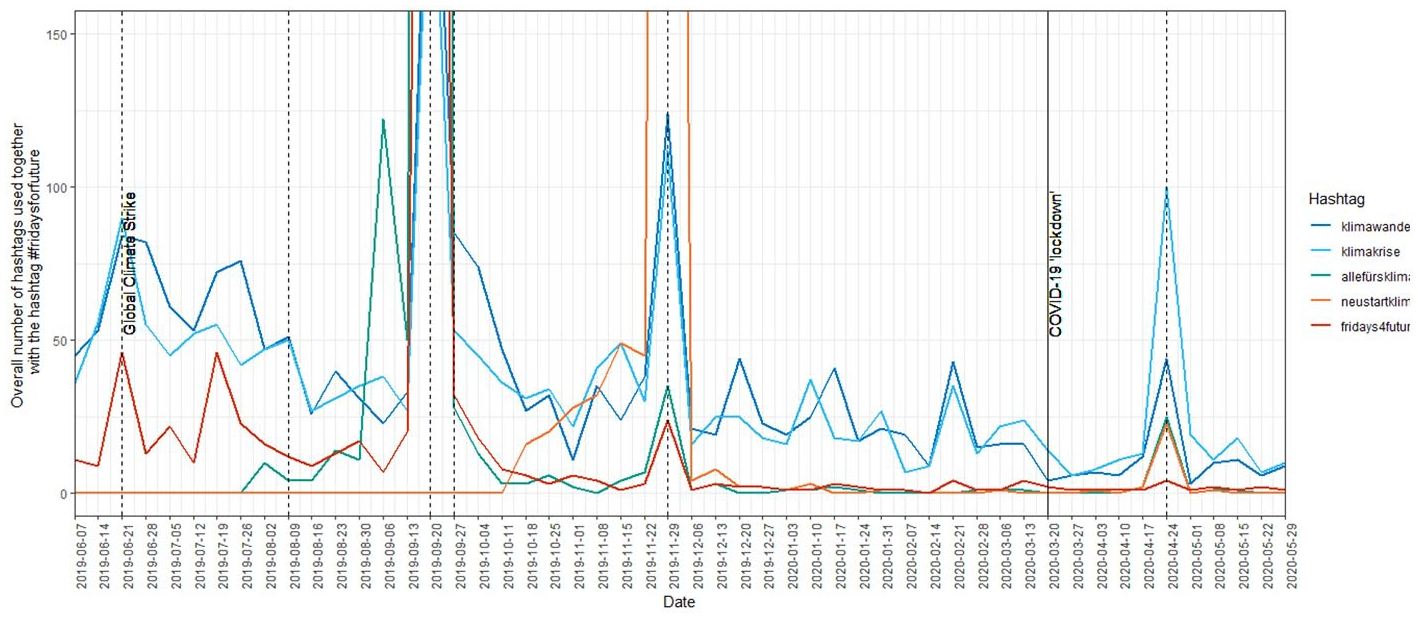
Number of tweets with certain hashtags (detail).
To analyze the communication around the hashtag #fridaysforfuture in greater detail, we analyzed the mean values of the topic loadings of the identified umbrella topics that resulted from our topic model over time (RQ4). Umbrella topic 1 “protest events and mobilization calls” contains tweets providing information about the number of protest participants or calls for participation, umbrella topic 2 “thematic discourse” contains tweets discussing goals, measures, or demands of the supporters or opponents of FFF, and umbrella topic 3 “meta-discourse on legitimacy” contains tweets with statements or opinions about the (de)legitimacy of FFF, which are rather laudatory or defamatory instead of argument-based. Figure 6 shows the relative frequency of these three identified umbrella topics, which we use as indicators of the relative relevance of the topics. In accordance with our previous results, the relative relevance of topics related to protest events peaked during the Global Climate Strikes. Except for the Global Climate Strike on 9 August 2019, the umbrella topic “protest events and mobilization calls” proved to be most relevant during protest event days. At the same time, the umbrella topic “meta-discourse on legitimacy,” which most clearly includes words carrying criticism toward FFF and the climate movement, is rather marginalized on days of Global Climate Strikes. The relative unimportance of the topic “protest events and mobilization calls” on 9 August 2019, can be explained by the context of this Global Climate Strike. The protest on 9 August 2019, took place after a weeklong conference of FFF in Lausanne, Switzerland, which is why it can be assumed that in the aftermath of the conference it was the conference issues that were discussed in the tweets. A hint that this could have been the case could also be the relatively high score of the umbrella topics “thematic discourse” and “meta-discourse on legitimacy” on this day.
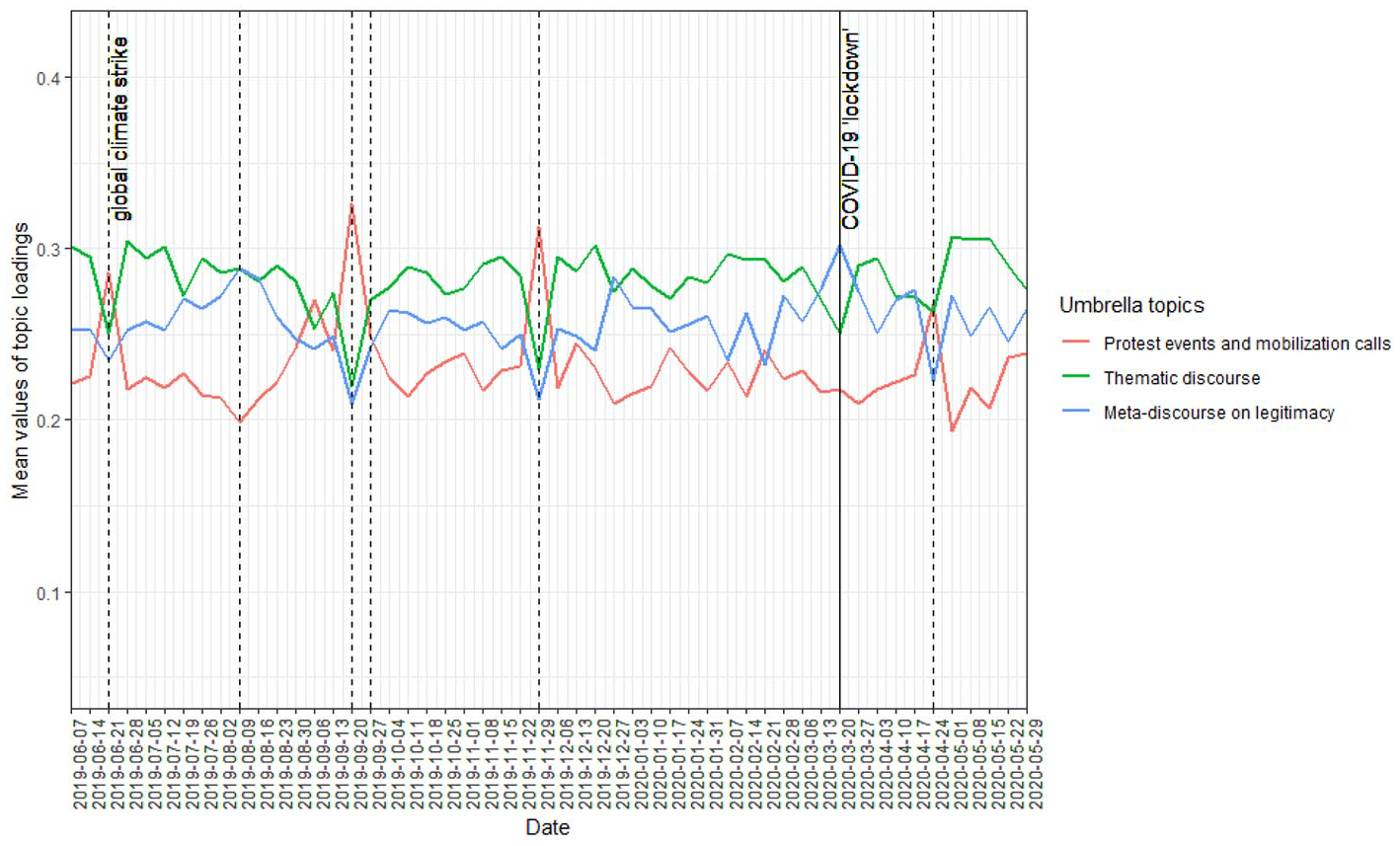
Relative relevance of umbrella topics across time.
During the lockdown, the relative share of the topic “protest events and mobilization calls” decreased. On 1 May 2020, this umbrella topic decreased to its all-time low. At the same time, the topic “thematic discourse” reached an all-time high, while the topic “meta-discourse on legitimacy” remained at a comparable level to the period before the lockdown. From these findings, it can be cautiously interpreted that FFF and the users using the hashtag #fridaysforfuture tried to keep the issue of climate change on the weekly Twitter agenda.
The umbrella topic “meta-discourse on legitimacy,” which also includes a greater amount of criticism than the other two umbrella topics, scored highest on the Friday after the lockdowns were effective in the German-speaking countries under investigation. On this day it became clear that the weekly smaller and larger street protests of FFF would not be possible in the following weeks (and months). The high score of this topic could thus be an indicator of a broader strategy debate, with increased criticism and questioning of the legitimacy of the movement in times of a second pressing crisis.
The assumption of a qualitative change in the debate around the hashtag #fridaysforfuture after the lockdown is also backed by a more detailed analysis of the five subtopics with the highest mean topic loadings within the “thematic discourse” umbrella topic. The data thereby show that while before the lockdown the discourse is more diverse with the five subtopics having a nearly equal share of the debate, after the lockdown the discourse is focused more closely on only two of these subtopics. The first subtopic that dominates the debate during the lockdown focuses on deliberation as indicated by a relative high relevance of terms that translate to “instead,” “against,” “decide,” or “certain.” The second subtopic that gains relevance during the lockdown consists of tweets that emphasize that the Corona crisis might also offer a window of opportunity to FFF. These tweets often use terms that translate to “benefit,” “left,” “opportunity,” “serious,” and “stuck.” In reverse, the subtopics that lose relevance during the lockdown mostly deal with questions of party politics, climate science, and the global perspective of the climate crisis. 7
Overall, the study demonstrates that FFF managed to create attention using new forms of online-only protests. Apart from the street protests, they tried keeping up the debate about climate change itself, albeit at a lower volume, since the debate shifted from a discussion about protest events to debates about thematic issues.
Discussion
Building on the manifold research on SMOs’ activity to bring pressing issues onto the public agenda to implement social and/or political change, this study investigates how SMOs can use Twitter to build hashtag publics, create long-lasting attention to certain issues, and thereby, facilitate collective action. Under almost laboratory conditions, we analyze how the SMO FFF—a youth movement fighting for more effective political measures against climate change—adapted its communication strategy to an online-only format during the COVID-19 lockdowns in German-speaking countries. As such, our study is likely to be informative for conclusions about the level of public attention being paid to the climate crisis in the investigated period.
Our results show that the COVID-19 lockdown had a strong impact on the communication activity around the hashtag #fridaysforfuture on Twitter, both concerning the sheer volume of activity and the content of the tweets. The weekly number of tweets during the lockdown declined to approximately a quarter of the number of tweets before the lockdown. Conversely, our data also indicate that there was already a weekly decline in the number of tweets before the lockdown. This decline thereby is independent of the COVID-19 pandemic and partly reflects the decline in protest participation outside of major protest events (Fridays For Future, 2021a). As such, it remains to be seen whether the lockdown further accelerated a lasting trend of declining hashtag activism around #fridaysforfuture or whether the sharp drop in the volume of tweets is just a temporary phenomenon. In this, the impact and significance of the COVID crisis might have put concerns about climate change temporarily in the backseat. Attention, which is one of the key resources of SMOs (Tufekci, 2013), was almost exclusively focused on overcoming this health crisis, while the climate crisis nearly disappeared from the media and thus the public agenda (Lyytimäki et al., 2020). Consequently, FFF will have to face the Herculean task of increasing public attention to their grievances once the pandemic is under control.
Moreover, the study also demonstrates that protest events—offline as well as online—are significant drivers of hashtag activism. The volume of tweets was substantially larger during big protest events as compared to non-event days. The data thereby indicate that online protest events—like the Digital Strike that took place on 24 April 2020—can be a fruitful substitute for physical protest. Even though the number of tweets was much lower than during comparable offline protest events, it was still substantially larger than during the rest of the lockdown phase. Consequently, and in line with our initial theoretical assumptions, creative, attention-grabbing, and newsworthy forms of online protest might be a helpful supplement for the repertoire of SMOs due to their virality (see Poell and van Dijck, 2018) and since movements can bypass traditional mass media and directly reach potential followers (Lobera and Portos, 2020).
Furthermore, the lockdown caused FFF to change their strategy from weekly local street protests complemented by Global Climate Strikes mobilizing hundreds of thousands of participants worldwide to use Twitter more as a platform for thematic discourse. An analysis of the hashtags used together with the central hashtag of the movement, #fridaysforfuture, shows that the use of protest-related hashtags declined during the lockdown, but a hashtag emphasizing the crisis character of climate change was frequently used during the pandemic—#klimakrise (climate crisis). In doing so, FFF might have aimed to hinder the ongoing decline of the volume of hashtag activism. By highlighting the crisis character of climate change, FFF might have aimed to underline the news value of their activism, emphasize the urgency of the current situation. As such, the movement might have tried to demonstrate that there is not only an ongoing immediate health crisis but also a less visible but nonetheless equally important and pressing climate crisis that continues to require public attention and collective action.
Results of an LDA-based topic modeling show that this change in the use of hashtags goes hand-in-hand with a change in the thematic focus of the tweets. In this, the umbrella topic “thematic discourse” gained relatively more importance at the cost of the umbrella topic “protest events and mobilization calls.” At first sight, this is a desirable development for an SMO as this form of discourse highlights their grievances and places them in the sphere of political legitimate actors (see Wolfsfeld, 1997). By focusing on thematic discourses instead of deviance and protest, FFF, at first sight, might have been portrayed as a relevant platform for social change. Nevertheless, the simultaneous increase in the third umbrella topic “meta-discourse on legitimacy” puts this into perspective as the critical discourse on the movement itself gained traction even though FFF did not engage in deviant behavior. Consequently, the lasting effects of this change in the dynamic of the discourse remain to be seen in future research endeavors.
It can be concluded from our results that, despite the potential of Twitter to create a space for counterpublics and hashtag activism (Bruns and Burgess, 2015; Wonneberger et al., 2020), SMOs that rely heavily on the creation of exceptional events cannot necessarily sustain attention on Twitter when offline protest actions are not possible. To spark media visibility and public attention SMOs must set up very elaborate and well-organized action formats—either online or offline. Consequently, our results again highlight the important connection of online and offline forms of protest implying that taking to the streets—as one of the most proven formats to generate public attention—is still an essential component of advocacy (see Wolfsfeld et al., 2013). Still, if SMOs succeed in developing attention-grabbing online-only action formats, as the #MeToo movement has done, SMOs could also attract attention and advocate policy change in times of multiple crises, such as during the COVID-19 pandemic.
Of course, there are also some limitations to our approach that need to be addressed. First, we used the Twitter Standard Search API to access the tweets containing the hashtag #fridaysforfuture, which aims for relevance instead of completeness. Thus, we cannot account for a full sample of all tweets, which needs to be kept in mind when interpreting our results. Second, the LDA-based topic modeling used in this article only provides limited information about the content of the tweets themselves and thus can only be understood as an overview of the hashtag-related debate we focused on. In this regard, especially the empirically observed differences regarding umbrella topics 2 and 3 must be interpreted cautiously, as there were no perfect matches between human coders and the statistical probabilities of topic modeling when the identification of these topics was examined. Nonetheless, the approach used in this article provides a first insight into the communication of SMOs under online-only conditions. These insights may help us to understand how SMOs can advocate social change in times of multiple crises and provide a starting point for further research in the field of social scientific analysis of modern SMOs and online protests.
Footnotes
Funding
The author(s) disclosed receipt of the following financial support for the research, authorship, and/or publication of this article: This publication is part of the work of the junior research group “DigiDeMo” which is funded by the Bavarian State Ministry of Science and the Arts and coordinated by the Bavarian Research Institute for Digital Transformation (bidt).
