



Abstract
Many online media platforms currently utilise algorithmically driven content moderation to prevent copyright infringement. This article explores content moderation’s effect on mashup music – a form of remix which relies primarily on the unauthorised combining of pre-existing, recognisable recordings. Drawing on interviews (n = 30) and an online survey (n = 92) with mashup producers, we show that content moderation affects producers’ creative decisions and distribution strategies, and has a strong negative effect on their overall motivation to create mashups. The objections that producers hold to this state of affairs often strongly resonate with current copyright exceptions. However, we argue that these exceptions, which form a legal ‘grey zone’, are currently unsatisfactorily accommodated for by platforms. Platforms’ political-economic power allows them, in effect, to ‘occupy’ and control this zone. Consequently, the practical efficacy of copyright law’s exceptions in this setting is significantly reduced.
Mashup music has often been presented as an exemplar of the participatory cultural environment that many expected the Internet to foster. It is a musical practice that is primarily based on the combination of unauthorised samples from existing popular music recordings, and as such – like much of the ‘remix culture’ of which it is a part – it holds an ambiguous legal status. Around the turn of the twenty-first century, the Internet’s role in bringing mashup music to large audiences was taken as evidence of a major shift which would reduce the commercial and cultural power of ‘old’ media industries (such as major record labels and publishing companies), partly through diminishing the efficacy of copyright. Mashup music remains a popular phenomenon today, but the contemporary Internet is a substantially different environment from that of the early 2000s. Tolerance towards the unauthorised use of copyrighted material has decreased, and during the last decade, the dominant online platforms (especially those hosting ‘user-generated’ content) have implemented substantial content moderation systems to mitigate copyright infringement. Current copyright-oriented content moderation relies on algorithms that scan millions of content uploads each day, leading to outcomes – including blocking and taking down material – which are often enacted without direct human approval.
This article explores the effect of content moderation on mashup music, with a particular focus on the algorithmic and automated aspects of such processes. Drawing on recent empirical research on mashup producers including 30 semi-structured interviews and an online survey (n = 92), we conclude that current content moderation has significant stifling effects on this kind of remix creativity. We report substantial impacts in three areas: on where and how mashup producers distribute their music, on the music itself and – most pertinently – on producers’ overall motivation to create mashups.
Our key findings resonate with previous research which argues that corporate interests have taken advantage of legal vagueness and ambiguity around copyright exceptions, thus expanding copyright monopoly to the detriment of cultural expression (Aufderheide et al., 2016; Gallagher, 2018; McLeod and DiCola, 2011; Sinnreich, 2013). We further these debates by situating them in the context of online content moderation, focusing on the role that platforms currently play in practically determining how copyright is enforced.
Copyright laws that protect owners’ interests in intellectual property are balanced by limitations and exceptions intended to prevent copyright from excessively impinging on freedom of expression. The limitations and exceptions carved out in law are country specific, but rarely specify precisely what kind of appropriation of copyrighted material is permitted. Accordingly, borderline uses require careful assessment on a case-by-case basis before a legal decision can be made. Since most uses of copyrighted material are untested in court, including mashups, they reside in the so-called ‘grey zone’ of copyright law, in which their legal status remains unclear (Urban et al., 2016). We argue that platforms’ use of content moderation effectively allows them to ‘occupy’ this grey zone and to exploit this position to enact decisions which override legal ambiguity in the interests of operational efficiency. Platforms’ implementation of algorithmically driven content moderation has significantly reduced the efficacy of copyright law’s exceptions. This in turn threatens the capacity of remix to engender valuable and diverse cultural participation.
We start by giving an overview of mashup music, the mashup scene and Internet platforms’ implementation of copyright-oriented content moderation. Next, after outlining our methods, we present interview and survey data that demonstrate the consequences of this content moderation for mashup producers and elucidate the tactics by which producers mitigate these impacts. We report mashup producers’ own objections to the current situation, and demonstrate that existing copyright exceptions overlap considerably with these concerns. Our findings show that platforms’ content moderation currently supersedes, in practice, the legal exceptions intended to allow for particular uses. Our analysis contributes to a growing literature highlighting the consequences of the immense power held by platforms to monitor, amend and remove content, and the central role of algorithmically driven content moderation in enacting this power (Gillespie, 2018; Roberts, 2019; Urban et al., 2016).
Mashups, copyright and platform regulation
Mashup music is a form of remix which primarily relies on the editing and combining of pre-existing music recordings. A common type is the ‘A plus B’ mashup, which combines vocal tracks from one recording with an instrumental version of another. DJ Cummerbund’s ‘I Will Jump’ (2020), for example, layers the vocals of Van Halen’s synth-rock hit ‘Jump’ (1983) over the music of Gloria Gaynor’s disco anthem ‘I Will Survive’ (1978). Another common type is the ‘megamix’ mashup, which combines shorter vocals and instrumental clips from several recordings – such as DJ Earworm’s ‘United State of Pop 2017’ (2017). Like many other forms of user-generated remix, mashups are often audio-visual, combining music and music video footage. Samples are often taken from very different genres of music, allowing mashup’s recontextualisation of samples to mock and subvert normative expectations of sociocultural identity categories. This intention to comment on prior works is communicated both via contextual cues (i.e. titles, source lists) and from within the text (i.e. sampling from widely known sources which are retained in a recognisable state). 1
Mashup music began to coalesce into a scene at the turn of the 21st century and soon developed from a niche, UK-based phenomenon into a international remix practice and an integral part of online culture, with mashup view counts regularly numbering in the millions. In the 2000s, some prominent mashup producers made inroads into the ‘mainstream’, but today’s scene has fewer connections to the recording industries proper. There is an offline, physically proximate aspect to the mashup scene, which manifests primarily in specific club nights (and live DJing remains an important source of income for some producers). However, the majority of mashup producers participate in the scene entirely through online means, by conversing across social media platforms, including Twitter, Facebook, Reddit and Discord, as well as commenting on mashups shared via YouTube, SoundCloud and mashup-specific sites. This scene, while physically dispersed, has meaningful similarities with theorisations of offline music scenes, acting as a space where relatively stable networks of participants generate a kind of ‘affective surplus’ through practices of creative production, exchange and curation (see Straw, 2015). Importantly, discussion and activity in the mashup scene also leads to the collective development and articulation of ethical norms.
At the turn of the twenty-first century, when mashup emerged, the Internet was understood as offering a means by which to bypass these strong copyright restrictions and circulate sample-based music outside of traditional cultural industries’ infrastructures via message boards, file-hosting sites, early social networking sites and peer-to-peer filesharing services. More generally, ‘Web 2.0’ was widely celebrated for democratising cultural participation (Jenkins, 2006; Sinnreich, 2010) and offering a space supposedly free of commercialism and market dynamics (see van Dijck, 2013). As today’s platforms emerged in this context, they initially relied on community-led manual detection and surveillance (van Dijck, 2013: 15). This changed following legal pressure from copyright holders and media corporations (Meyers, 2009), in tandem with a growing recognition that potential advertising partners valued professional, rationalised media content rather than unpredictable, potentially offensive ‘user-generated’ content (Kim, 2012). Several platforms began implementing more robust content moderation to reduce circulation of copyright infringing content. 2 This sustained effort at developing content moderation systems touched on a wide variety of areas besides copyright, including age restrictions, hate speech, abuse and bullying, and more (Gillespie, 2018). However, in this article, we use ‘content moderation’ to refer specifically to the copyright-oriented content moderation processes that are of primary concern to us and our research participants.
Major platforms using algorithmically driven content moderation today include Facebook, Spotify, SoundCloud and Twitter. However, YouTube’s ‘Content ID’ is the best known. It is programmed to recognise sound duplicates of copyrighted material via content identification technology (so-called digital fingerprints). Upon detection, copyright holders can choose to ignore the use, to monetise it by running ads against it and collecting the revenue, to track its viewership statistics or to block the use. A key aspect of YouTube’s procedure is that copyright holders can automate their response – that is, they ‘can set Content ID to block material from YouTube when a claim is made [or] can allow the video to remain live on YouTube with ads’ (Google, n.d.-c). This means that, as with the detection process, the copyright holders’ response also moves forward automatically in many cases. Copyright owners can also submit a legal takedown request based on assumed infringement of their content. If this is deemed to be valid then the content will be removed, and the uploader will also receive a ‘strike’ on their account. A set number of strikes (usually three, as on YouTube) will close the account and remove its content (see Google, n.d.-b). Platforms, including YouTube, usually also offer options for contesting the blocking or removal of content.
Although such algorithmically driven content moderation systems help to remedy the problem of copyright infringement on platforms, they have also been criticised for their lack of transparency and fair treatment (Urban et al., 2016), and for classifying any detected use of unauthorised samples as copyright infringement, ignoring copyright’s exceptions and offering insufficient options for contestation and appeal (Jacque, 2019; Nunziato, 2014; Zimmerman, 2014).
The copying of an artwork without authorisation from its copyright holder(s) generally represents an infringement of copyright law and, as such, mashup challenges copyright’s aim of granting exclusive rights to the copyright holder of an artwork. 3 Yet, various countries’ copyright laws are softened by exceptions, including ‘fair use’ (in the United States) and parody (in the European Union [EU] and elsewhere), which are intended to balance the rights of intellectual property with fundamental rights of freedom of expression; together, they are intended to foster diverse cultural production (Jacque, 2019). Decisions regarding what uses fulfil those specific expectations are made on a case-by-case basis with careful legal analysis, which allows for some flexibility and also unpredictability with regard to these legal exceptions.
As mentioned, scholars have argued that corporate interests have used this legal vagueness to their advantage. For example, in their discussion of the ‘sampling quandary’, McLeod and DiCola (2011) state that ‘the default setting’ within the music business ‘is total protection for samples. [. . .] [T]he mainstream music industry typically ignores the existence of fair use, the de minimus threshold, and other exceptions to copyright protection’ (p. 259). McLeod and DiCola are referring specifically to the ways in which copyright holders’ legal enforcements and high licensing fees in the 1990s led hip-hop musicians to adjust their sampling practices, either by obscuring the samples beyond recognition or by ceasing to sample altogether (see also Demers, 2006 and Lena, 2004). Along similar lines, this article addresses the more current way in which private entities exploit legal vagueness, namely platforms’ occupation or deletion of the ‘grey zone’ of copyright exceptions.
Method
The mashup producers (n = 30) with whom we conducted semi-structured qualitative interviews in 2019 were identified via social media platforms as well as dedicated mashup forums. They were selected partly in an effort to capture diversity in terms of location, background, age and gender, as well as their choice of distribution platforms, their mashup style, their level of popularity and the extent of their current involvement in mashups. The majority of interviews were conducted via online video calls, so as to reach mashup producers spread across 15 countries (mainly European countries and the United States), with around a third of the interviews being face-to-face. Through the informed consent process, our interviewees had the choice to be quoted anonymously or using their artist pseudonym – the vast majority chose the latter. When coding the interview transcriptions, we combined our pre-established codes with unanticipated ones which emerged through thematic analysis of the data.
The same year, we also surveyed 92 mashup producers via an online form (see Supplemental Material). Respondents were recruited via social media posts (primarily Twitter), personal messages to mashup producers, mashup and remix online forums and word-of-mouth. The survey included a mix of open and closed scaled questions which were analysed using SPSS (Statistical Package for the Social Sciences). These survey responses were anonymous, partly due to European data protection regulations. It is likely that there is some overlap between interviewees and survey respondents, but in general, our survey captured wider international diversity (with respondents from North and South America, Europe, Asia and Oceania).
Mashup producers’ experiences with platforms’ detection procedures
Our empirical material shows that encounters with platforms’ copyright-related content moderation are an ‘everyday’ reality for mashup producers. Almost every respondent to our survey – 96% of them – had experienced the detection of copyrighted material in their mashups by platforms. More than three-quarters of respondents had experienced the removal of their mashups from platforms (82%), and 53% of them had had accounts permanently deleted as a direct consequence of uploading mashups (see Figure 1). 4 Although there is usually some recourse to contest blocks and takedowns on platforms, less than half of the survey respondents (41%) had ever explored this option. Our interview material suggests that this reticence to appeal is often due to fear that this might draw further attention to their account and therefore result in more severe consequences (e.g. not just a track deletion, but also an account deletion).
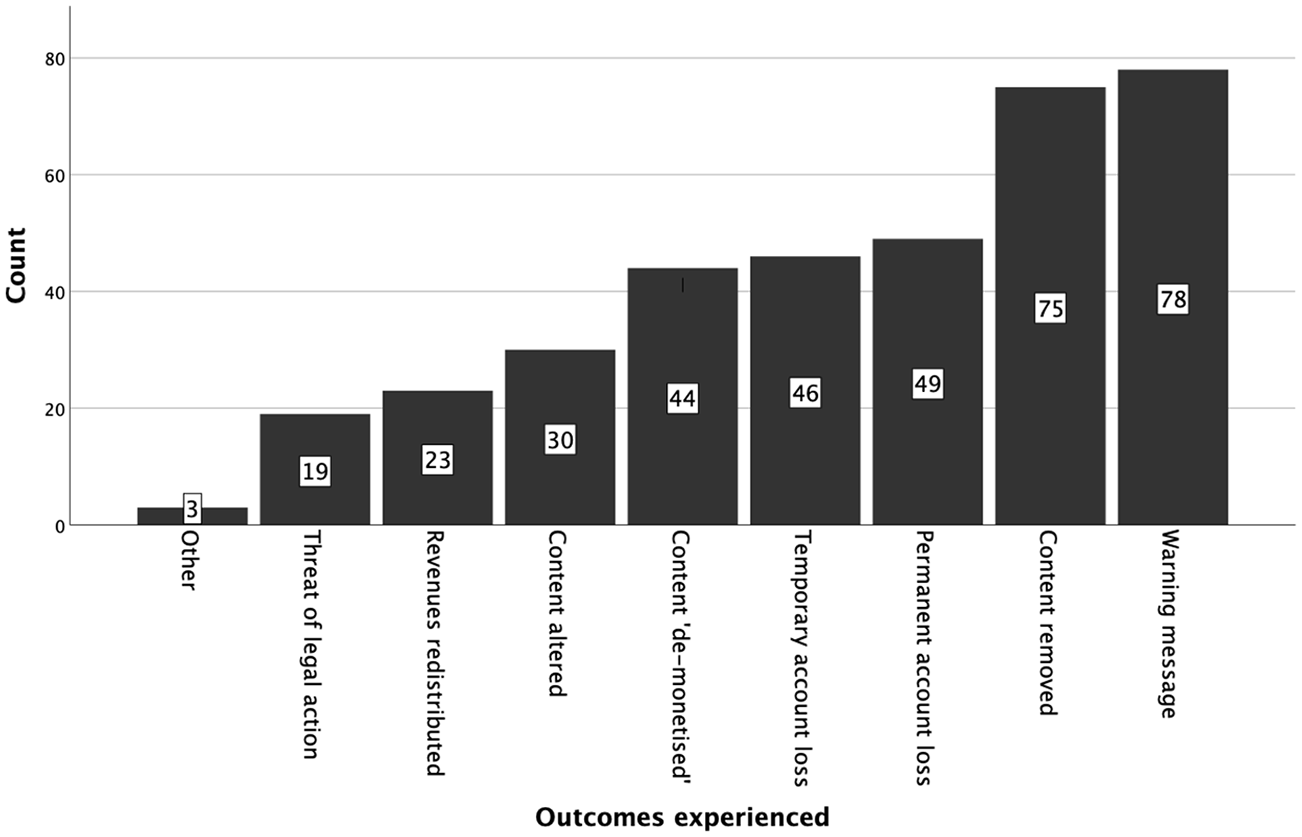
Outcomes of detection procedures experienced by mashup producers. 5
Several interviewees said that these blocks and takedowns had significantly impacted their overall motivation to create mashups. Moreover, platforms’ detection procedures also have an indirect impact on the mashup producers, who utilise a wide variety of workarounds to bypass detection, which in turn significantly affects their creative decisions and distribution strategies. Drawing on terminology from Michel de Certeau’s (1984) The Practice of Everyday Life, we understand these workarounds as ‘tactics’ which attempt to limit and mitigate the broader effects of the ‘strategies’ pursued by multinational information and communication technology (ICT) and music corporations. In de Certeau’s presentation, tactics tend to be mutable, improvised and short-lived, in contrast to the more stable strategies deployed by actors with greater control over spatial formations. This is certainly an accurate characterisation of the activity of these producers and platforms today, as we explore in the following three sections.
Impact on producers’ motivation
Our survey clearly shows that mashup producers experience platforms’ content moderation as a hindrance to their activity. Of the surveyed producers, 56% reported that outcomes of content moderation made them less motivated, compared with just 2% who felt more motivated. This finding is particularly striking given that mashups have sometimes been presented as resistant or rebellious (see McGranahan, 2010; Shiga, 2007), and therefore such industry-induced obstacles might have represented a potential catalyst for activity. There was also a strong consensus among our interviewees that platforms’ content moderation greatly diminished their motivation. As mashup producer CFLO explains, There’s no real outlet . . . So I make [mashups], but I don’t put them out anywhere. If I do I give them directly to other DJs, but I don’t put them where, like, you could find it. And that’s only because I risk losing my account. Not that I’m worried about any legal repercussions, it’s just the hassle . . . The [other mashup producers] that I know, everyone sort of stopped. I know guys who still make them, but no one posts them . . . And I feel like it’s sad that these algorithms have limited the platforms, have discouraged access to the artists.
Another source of frustration is that what is lost after a takedown is not only the music, but also the play counts, comments and, in the case of account deletion, the follower count and access to those followers, which might be hard to recover. Several producers told us about sudden losses of up to 50,000 followers and millions of play counts. These losses can be really significant, demotivating experiences and can happen at any time – even mashups which have been online for years can disappear ‘overnight’. For example, when we asked DJ Schmolli whether takedowns impacted his motivation to produce, he said, Usually not. But it affected my motivation [. . ..] around one and a half, two years ago, when I lost [my] Facebook [page]. But the motivation, I mean, that was like a couple of things that distracted me from producing mashups. And I even quit producing mashups one year ago, because I felt that, especially with social media, it was really getting hard to get your stuff [out].
Producers’ demotivation results not only from the blocks and takedowns themselves, but also from the ambiguity around whether (and how) content moderation will be enforced: I have made attempts. I’ve tried pitching the whole song up or down, or whatever, and telling people that if they want the real version, they can download it at this link. I’m not sure if I’ve ever tried it, but I’ve seen other people add things to the beginning of the track or the video to try and throw off the detection. I think I have personally maybe tried pitching things, once. I think it still got taken down. And it’s like, it just wasn’t worth the effort. Going through all this effort trying to subvert this system to like . . . Yeah, why bother? (Tom Boates Everybody)
The mashup producers reported that they utilise different tactics to bypass detection and mitigate losses. These tactics include (but are not limited to) substantial adjustments and alterations to their creative decisions and distribution strategies, and these must therefore also be understood as indirect impacts of platforms’ content moderation.
Impact on producers’ distribution choices
Our survey results indicate that content moderation has a significant impact on where producers distribute their mashups (with 81% answering that it impacts their distribution choices either ‘somewhat’ or ‘to a great extent’). Adriana A insisted that ‘there’s literally almost no safe platform for mashups in 2019’, and most producers we talked to seemed to agree, indicating SoundCloud, YouTube, Vimeo, Facebook, Twitter and Instagram as platforms whose content moderation made them ‘unsafe’ for mashups. Producers were particularly frustrated with SoundCloud, which had a strong history of supporting user-generated content before financial and legal difficulties led it to seek partnerships with major labels and, consequently, to more stringently restrict the use of copyrighted material (Hesmondhalgh et al., 2019: 5–6). Accordingly, our survey shows it to be the platform with the highest ratio of self-declared ‘former users’ to ‘current users’ (see Figure 2), and it was described by Happy Cat Disco, for example, as ‘really toxic’. While YouTube was experienced as particularly prone to blocks and takedowns, its uniquely large audience meant that it was usually considered worth the effort to try and upload mashups there. The market-leading music streaming platforms, such as Spotify and Apple Music, were generally understood to be infeasible due to their especially strict copyright regulation – also, unlike SoundCloud and YouTube, they are not free to upload to.
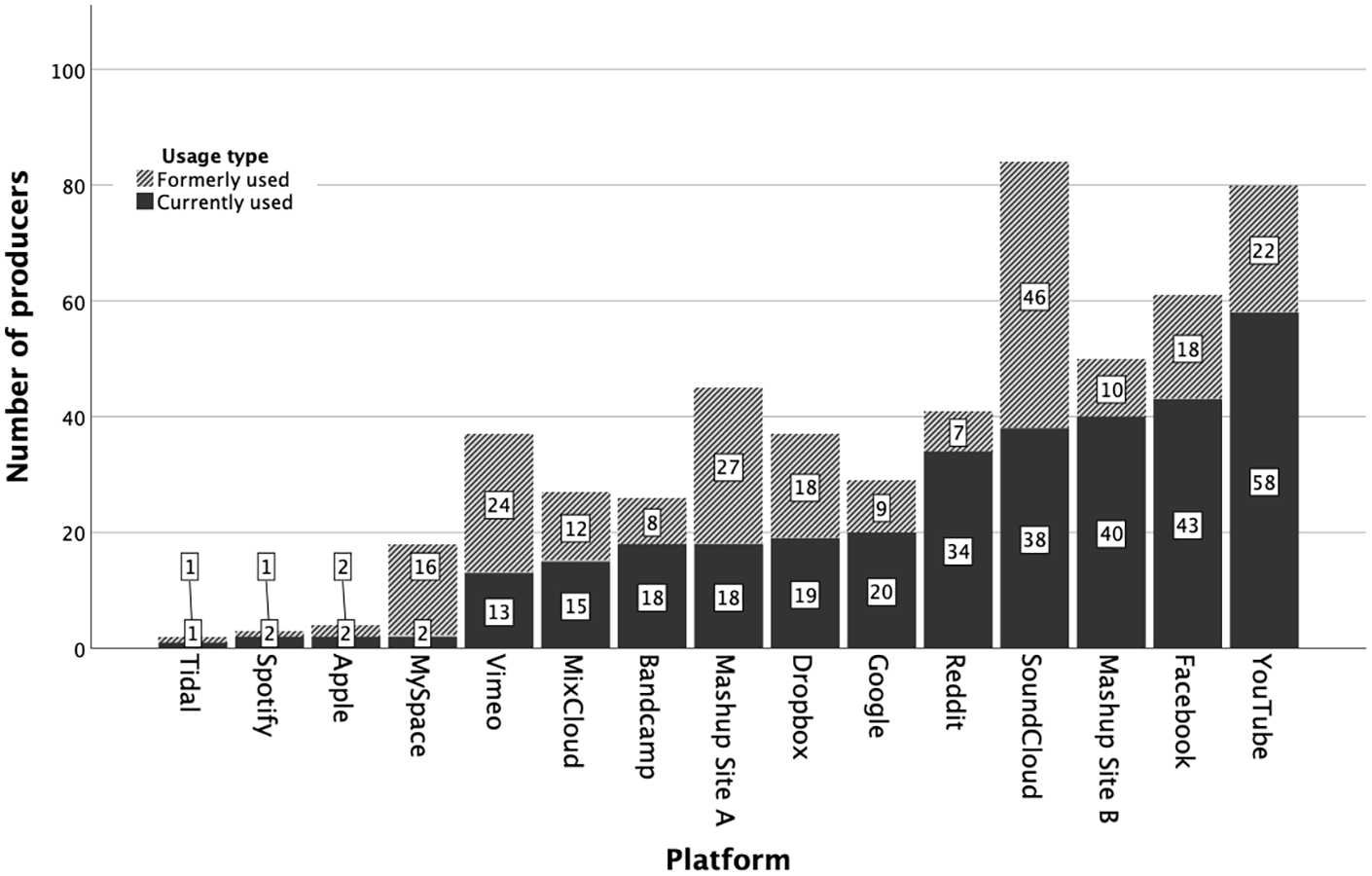
Most popular platforms by current users, including number of former users.
When distributing mashups, producers often employ tactics aimed at minimising their potential losses. One notable example of this is the use of ‘test’ accounts, where producers will upload new material on a different account to see how the platforms’ algorithm reacts, thus reducing the risk of their main account being hit with copyright strikes (and potential account deletion). A similarly cautious tactic is to let the main account serve as a ‘hub’ pointing followers to alternative smaller accounts to which new material is uploaded (although this is only an option on platforms which allow reposting, such as SoundCloud). Some producers only upload short excerpts of their mashups on their main account, with a link to a separate platform on which full versions are uploaded. In this way, they keep their followers and share new mashups without risking the deletion of their main account.
Another mitigating tactic is the use of alternative platforms. There are a handful of online forums and distribution platforms which exist more or less specifically for mashup producers (the two major ones are shown in Figure 2 under the anonymised labels ‘Mashup Site A’ and ‘Mashup Site B’).
6
These sites have similar features to well-known platforms – one of the founders of Mashup Site A described it as a ‘SoundCloud clone’ – and offer a much higher degree of ‘safety’ to individual mashup producers (although the site as a whole does still risk being taken down). This safety is a trade-off, since it means accepting a much smaller audience consisting primarily of their mashup peers; even relatively popular tracks on the main ‘SoundCloud clone’ site have total play counts in the low hundreds, compared to mashups on YouTube which often have millions of plays. The ‘spreadability’ which is a key asset of networked media platforms (boyd, 2013: 11) is greatly diminished on these sites, as DJ Poulpi explains: The problem is that [mashup-centric sites] don’t . . . there is an exposure problem with [the fact] that nobody comes there. Nobody cares. So, it’s just like putting the tracks on my own website . . . It’s not going to grow by itself. I have to bring people to the site and the track. Not like SoundCloud, where there was a huge community and it could be shared by itself.
Producers also use alternative output channels, such as podcasts (which can sometimes reach music streaming platforms while bypassing platform detection), live gigs at clubs or festivals and weekly newsletters to fans and peers with links to private mashup videos. Despite these channels being preferred by some because of the hassle they face with platforms’ content moderation, they have limited reach and are thus considered poor alternatives.
Impact on producers’ creative decisions
Scholarly literature on the ‘platformisation’ of the cultural industries has shown that many cultural forms are increasingly adjusted and amended to accommodate the requirements of platforms (Nieborg and Poell, 2018) using real-time feedback and data to make sure they are delivering ‘what the algorithm wants’. More generally, all sorts of social media users have to effectively ‘think like an algorithm’ to gain much-desired visibility (Bishop, 2018; Bucher, 2012). Since these algorithms are so often ‘black boxed’, this is a process involving guesswork, trial and error, and the communal sharing of assumptions and theories. For mashup producers, the ‘visibility’ problem is inverted: rather than seeking the algorithms’ attention, they seek to remain invisible to them. As such, when using platforms, such as YouTube and SoundCloud, the producers use many small-scale tactics to bypass detection. Many of these involve changing the content of the mashup music or video itself; consequently, content moderation also affects mashup producers’ creative decisions.
The ‘masking’ techniques they use to avoid algorithmic detection in particular include pitch-shifting, speed alteration, added processing effects or altered videos, all beyond the extent required simply to make the sampled sources fit together. Yet, such techniques also tend to degrade audio fidelity or make the sample less similar to its origin, and producers are often unwilling to compromise on this aspect within a form which relies so much on the recognisability of the original samples. For example, on the subject of pitch-shifting, Raheem D said, ‘I don’t really do that too much anymore, because I feel like it affects the quality of the overall mashup, and the sound. For me, if I know [a track] is unsafe nowadays, I probably just won’t bother’. This shows how the aesthetic restrictions imposed by content moderation might in turn lead to motivational issues.
Our data also show that content moderation impacts the creative process in terms of the music that producers choose to sample in the first place. Certain artists’ recordings are widely perceived as off limits for use in mashups, because of their high propensity to result in blocks and takedowns (Taylor Swift’s output was considered the most ‘dangerous’ in this regard). Others told us that they avoid sampling from new releases, since copyright holders seem to be particularly protective in the early phase of a release. In this way, the potential repertoire available for use is diminished.
Considering producers’ objections and the intended role of copyright exceptions
We have outlined the ways in which platforms’ content moderation poses a significant threat to mashup music as a viable cultural form. In this section, we summarise mashup producers’ objections to how mashups fare on platforms, focusing on four specific aspects which recurred in our interviews and which reflect the internal logics within the mashup scene. We include these ‘grounded’ objections here since, as we will outline, they have several notable overlaps with existing copyright exceptions.
First, mashup producers objected to blocks and takedowns on the basis that mashups are acknowledged revisions. They drew a clear distinction between their own activity and piracy or plagiarism. 7 Happy Cat Disco said, ‘I’m not going out there just saying “here’s the entire catalogue of Eminem, please download the whole thing” [. . . .] I think we can all agree that that’s not cool’. Several producers argued that mashup music is not plagiarism since they clearly attribute samples to their originators, and always present the samples as something completely different rather than as a replacement for the original work. In line with this, CFLO insisted that algorithms need to be able to differentiate between a one-to-one copy of the original and content that is altered (such as mashups and other remixes).
Second, mashup producers argued that mashups are intended to be non-commercial. Our survey reports that 82% (n = 72) of producers do not make any income from mashups, while just 2% listed them as their primary source of income. More important, in terms of their ethical perspective, is the fact that most mashup producers are not seeking any financial gains from their mashups. Sometimes this lack of interest in generating revenue is simply a pragmatic acknowledgement of the current state of affairs, but more often, this non-commercial position is ethically motivated and is linked to the producers’ view of their music as a form of reuse. This is perhaps, along with proper attribution, the most significant ethical dimension of mashup culture. Adriana A framed it as ‘like a pirate’s code of honour [. . . .] – I didn’t pay for the copyright clearances, therefore you shouldn’t either’. This ethically motivated non-commerciality is not something that algorithms can currently detect; DJ Maya Jakobson expressed a wish ‘that this algorithm would be smarter one day, and would immediately detect whether [a] producer is doing something for fun, or whether they’re trying to earn from it’.
Third, producers argued that mashups do not deny the sampled artists or copyright holders any revenue. Several producers even suggested that mashups might represent an effective promotional vehicle, offering the original artists an audience which they would not otherwise reach – and introducing the listeners to music outside of their typical repertoire or comfort zone. Regarding the latter, DJ Paul V explained, ‘To me, the greatest gift of a good mashup is that it’s hopefully going to take a fan of only one part of that song and turn them into a fan of the second or third or fourth part that’s also used’. Producers also pointed out that the notion of copyright as a form of protection is not relevant in the case of mashup since they are likely to increase – rather than decrease – the economic value of the songs they sample: I do think there’s just basic economics that these guys [i.e., the music industries] should figure out. And there are ways to evaluate that with experiments and so on. YouTube [. . . .] runs A/B testing all the time, right, so it’s not hard for them to search for every mashup and just remove them from a region for a weekend to see what happens to sales of that artist, you know? (DJ Faroff)
Furthermore, most mashup producers thought it was fair that their mashups were sometimes monetised, with advertising revenues directed to the samples’ copyright owners (although some lamented that this monetisation primarily benefits record labels and/or music publishers and not the artists they sample). This points towards a perspective that regards mashups as an auxiliary income stream for musicians, of a kind that have become crucial amid concerns over low royalty pay-outs from streaming services (Hesmondhalgh, 2020; Meier, 2017).
Finally, producers claimed that mashups do not harm the integrity of the sampled artists. Similar to many hip-hop producers (Lena, 2004), they see sampling as paying tribute to original works (or as an act of fandom). Accordingly, the perspectives of the original artists are considered more ethically relevant than those of labels and publishers. Producers related stories of popular recording artists hearing their mashups and giving some indication of their approval – often by reposting or commenting on the track. Some producers remarked that if the original artist were to disapprove of a mashup, they would immediately take it offline. This perceived solidarity with musicians stems in part from a feeling that most recording artists are motivated by passion for their art rather than monetary gain, and that they would thus approve of their music’s communicative potential being maximised and extended via remixes. Some, including DJ Surda, suggested that the reason mashup producers are able to access audio ‘stems’ (isolated vocal or instrumental tracks) is because the artist wants the material to be made available: I don’t believe that all the multi-tracks [i.e., audio stems] on the internet are because there is a hacker that is looking for multi-tracks all day. You know, for example, the producer of the song just decided to put it there because he knows there are a lot of producers who will find this stuff, and they will do new remixes, and music will get a life, a second chance.
Accordingly, producers felt frustrated that platforms’ content moderation does not take this sense of commonality between mashup producers and recording artists into account by distinguishing between plagiarism and acknowledged artistic appropriation.
Of course, the fact that mashup producers hold objections to the current state of affairs does not necessarily mean that their critiques are justified. But it is striking that several of the mashup producers’ objections outlined above strongly resonate with the aforementioned exceptions that are found within national copyright laws. This implies that they require careful legal analyses instead of outright rejection. 8 Relevant to a legal analysis of a copyright exception defence are, for example, their insistence that their mashups are recognisably different from the original work; that their sources are mentioned or otherwise made explicit; that their motive is non-harmful and non-commercial and that their mashups have no substantial effect on the commercial success of the sampled material (since the mashups are presented as obvious revisions, highly distinct from the sampled material). 9 The question of what uses fall under these exceptions is complicated by the fact that exceptions are formulated and interpreted differently among different countries, and it is often unclear which law applies (Novovic, 2019). Exceptions may also interrelate with other relevant legal factors. Accordingly, copyright disputes are resolved in court on a case-by-case basis involving careful legal analysis. Since mashup’s legal status is undefined, as it has not been tested in court, producers find it frustrating that it is outright rejected as infringement.
For our current discussion, the question of whether mashups actually fall under various copyright exceptions is less important than the fact that they might do. Platforms’ content moderation is not able to provide careful legal case-by-case analysis that accommodates for copyright exceptions and applicable law. Consequently, as our data suggest, mashup producers are largely unable to use this grey zone to their advantage.
Platforms’ occupation of the legal grey zone
Mashup producers’ current precarious position can be conceptualised by furthering the spatial metaphor of the grey zone, to consider how platforms utilise their position to effectively ‘occupy’ this zone. The ability to keep this legal grey zone ‘active’, as it were, is held primarily by platforms, as the site where so much of this contentious material is distributed (or not distributed, as the case may be).
Platforms’ content moderation holds actual consequences for the operation of law, and thus for sociocultural conditions more broadly. Sabine Jacque (2019) makes a similar argument in her examination of the parody exception, which she sees as ‘firmly anchored in the recognition of freedom of expression’ and therefore as ‘affirm[ing] essential democratic values’ (p. 71). Using Google as an example, she shows that ‘[c]ontract law is being exploited to permit these powerful actors to dictate what content is created and disseminated, regardless of the objectives of copyright law’. When this happens, she argues, ‘the careful balance [between exclusive rights and exceptions] crafted by legislators in copyright law is simply lost’ (p. 209).
This kind of ‘balance tipping’ is evident in YouTube’s guidelines regarding fair use (the most significant US copyright exception), as outlined on the platform’s own help page: Automated systems like Content ID can’t decide fair use because it’s a subjective, case-by-case decision that only courts can make. While we can’t decide on fair use or mediate copyright disputes, fair use can still exist on YouTube. If you believe that your video falls under fair use, you can defend your position through the Content ID dispute process. This decision shouldn’t be taken lightly. (Google, n.d.-a)
However, these appeal options are subject to chilling effects. As mentioned, mashup producers fear that disputing a block or takedown may expose them to greater risk than if they simply accept the initial content moderation decision. Moreover, while YouTube posits that whether or not an exception applies is a matter for the courts, the reality is that if a user decides to appeal, it will be adjudicated by the copyright claimant. On their Policy, Safety and Copyright Policies page, YouTube claims: ‘courts have held that rightsholders must consider fair use before they send a copyright takedown notice, so in many cases (though it’s a very small percentage of copyright takedowns overall), we ask rightsholders to confirm they’ve done this analysis’ (Google, n.d.-c). Yet, as Zimmerman (2014) notes, such procedures lack transparency and the defences are adjudicated by a ‘jury’ (the copyright claimant) that is hardly neutral (p. 273). This content moderation system gives copyright holders the first call at claiming their rights and puts mashup producers (and other similarly placed cultural producers) at a significant disadvantage.
The above excerpt from YouTube’s guidelines exemplifies a kind of platform-authored guidance that works to present platforms as more or less ‘neutral’ mediators caught between a rock and a hard place. And, in fact, several mashup producers regard platforms in this light: while they are frustrated by platforms’ decisions regarding content moderation, they primarily blame music industry copyright holders for the blocking or deleting of their mashups, not platforms themselves. However, this perception of platforms as disinterested and neutral mediators is wide of the mark, and does not reflect the platform’s determinative effect on how (and whether) culture circulates. Understanding platforms’ response to the grey zone requires attention to their political-economic context.
The licences which platforms have struck with major copyright holders offer an indication of the distance which platforms, such as YouTube, have travelled since the mid-2000s in terms of defusing antagonisms between ‘old’ and ‘new’ media. Platforms can no longer be characterised simply as an alternative, or challenger, to existing media corporations, and their concessions to content identification ought to be considered in the light of increasing integration between these two sectors. For example, Google Ventures – the investment arm of YouTube’s parent company Alphabet – has invested substantially in the music publishing firm Kobalt and reportedly has a multimillion-dollar stake in the ‘independent’ record label 300 Entertainment (Ingham, 2019). There are many more examples of such integration, with investment moving in both directions (as well as among competitors within sectors). Consequently, where tensions exist between platforms and copyright holders today, they are likely to be over the specificities of payment rates and revenue streams rather than over any fundamental disagreement regarding the validity (or otherwise) of a system of recording and publishing rights. This is a marked change from early rhetoric which presented the Internet as making music ‘free’, and it suggests that platforms and music companies may increasingly have a shared interest in strong copyright regimes.
Mashup’s current predicament also reflects platforms’ changing approach to content moderation more generally. Initially, the online platform was perceived as a neutral space (Gillespie, 2010); Duffy et al. (2019) suggest that labelling themselves as platforms rather than broadcasters allowed corporations like Facebook to ‘evade liability and downplay their pivotal role in shaping society’s news, information, and entertainment agendas’ (p. 1). However, in recent years, the tendency has been for platforms to move away from a libertarian-influenced, hands-off approach (which arguably permitted the growth of remix culture in the 2000s) and towards large-scale investment in moderation, in terms of both algorithmic development and human labour. While this drive to improve content moderation was in part motivated by a declining social trust in platforms, 10 it should also be understood as having a directly political-economic aspect. Most major platforms (including YouTube) are heavily reliant on advertising income, and this structures a fundamental tension regarding platform regulation between increasing the flow of content on one hand (thus creating more advertising space), and increasing control over content on the other (since advertisers tend to seek placement alongside legitimate, identifiable content).
Conclusion: remix in a changing legal and economic environment
In this article, we have shown that mashups are a form of creative practice which is substantially hindered by online platforms’ current content moderation. While platforms might act to remove or alter material on the grounds of its presumed illegality, the legal status of mashups is in fact still an open question. In the meantime, though, the practical reality is that mashups (and the much larger remix culture of which they are a part) face a threat that borders on the existential. Despite the enduring tension between sample-based music and copyright holders, the current threat to mashup producers largely stems from changes which reach beyond their music; mashups are, to an extent, accidental victims of economic, technological and legal changes and negotiations (see also Jones, 2021).
There is one particularly important legal development underway which will inevitably impact the sociocultural prospects of remix and mashup. The EU Directive on Copyright in the Digital Single Market – which was approved by the European Parliament in April 2019, and which EU states are required to implement within a 2-year timeframe 11 – contains the much-contested Article 17, which changes the relationship between copyright law and platforms. Previously, platforms were given immunity from liability on certain terms, meaning they did not infringe if they provided ‘mere conduit’ for their users (e.g. in the US Digital Millennium Copyright Act [DMCA, 17 USC § 512], and European e-Commerce Directive [ECD, Articles 12–15]). Article 17 will hold platforms making content available in the EU liable for user sharing of copyright content, which requires EU-based platforms to seek authorisations from copyright holders for their users or otherwise make the infringing content unavailable. But, as mentioned, it also requires them to ensure that users can rely on copyright exceptions. This provision poses a huge challenge for platforms: the legal quandary regarding whether a specific use of copyrighted material infringes copyright or is permitted by exceptions can hardly be sufficiently answered by a system which relies heavily on automatic detection tools and decision-making. For this reason, it seems likely that the platforms will opt to risk overregulating content rather than being held responsible for enabling content which potentially infringes copyright, especially since the scope of copyright exceptions is unpredictable.
The enforced ‘retreat’ of mashup music must be contextualised by noting that no musical culture operates in a vacuum; there are always multiple determinants that constrain, shape and enable any cultural production, including economic systems, technological possibilities, legal structures and existing aesthetic formations (Wolff, 1981: 19–47). In this case, the combined economic and technological power of online platforms currently infringes on the determining power of law, not by acting illegally but by ‘occupying’ the grey zone of copyright law and making black-and-white decisions from that position. Any rapid solution to this state of affairs seems unlikely: algorithmic and automated content moderation is a long way from boasting the necessary flexibility, while manual moderation cannot manage the scale of content involved. Mashup music, and remix culture more generally, is in this regard just one place among many where platformisation has brought significant, negative effects to bear on cultural producers and culture at large – effects which are far from what was anticipated at the dawn of Web 2.0. 12
Supplemental Material
sj-pdf-1-nms-10.1177_14614448211026059 – Supplemental material for Remix’s retreat? Content moderation, copyright law and mashup music
Supplemental material, sj-pdf-1-nms-10.1177_14614448211026059 for Remix’s retreat? Content moderation, copyright law and mashup music by Ragnhild Brøvig-Hanssen and Ellis Jones in New Media & Society
Footnotes
Acknowledgements
The authors would like to thank our colleagues on the MASHED project (researchers Irina Eidsvold-Tøien, Milos Novovic, Elisabeth Staksrud and Alan Hui, and research assistants Eirik Jacobsen, Oskar Holldorff, Øyvind Skjerdal and Ole Kristian Bekkevold). In particular, thank you to Elisabeth for her assistance with survey design, and Alan for his comments on the draft article. We are also grateful to the anonymous peer-reviewers, and to the mashup producers who contributed to our research.
Funding
The author(s) disclosed receipt of the following financial support for the research, authorship, and/or publication of this article: This work was partially supported by the Research Council of Norway through its Centres of Excellence scheme, project number 262762, and through the research project MASHED, project number 249817.

Supplemental material
Supplemental material for this article is available online.
Notes
Author biography
References
Supplementary Material
Please find the following supplemental material available below.
For Open Access articles published under a Creative Commons License, all supplemental material carries the same license as the article it is associated with.
For non-Open Access articles published, all supplemental material carries a non-exclusive license, and permission requests for re-use of supplemental material or any part of supplemental material shall be sent directly to the copyright owner as specified in the copyright notice associated with the article.
