




Abstract
Citizens are likely to encounter various types of alternative media online, especially on algorithmically personalized news channels (APNC) like social network sites or search engines. It is unclear, however, to what degree they are aware of these outlets and familiar with the concept of alternative media. This study investigates the relation between exposure to alternative media and knowledge of them, taking the role of APNC into account. Analyzing representative survey data of German Internet users, we find a gap: While many individuals report to use alternative media, few of them are able to name alternative media titles matching scholarly conceptions. Although the use of APNC increases self-reported exposure to alternative media, it does not improve actual knowledge of them. All in all, many Internet users have little awareness of alternative media and do not clearly distinguish between different types of sources they come across online.
Keywords
Introduction
The distribution and consumption of online news is increasingly shaped by algorithmically personalized news channels (APNC) like social networking sites, search engines, and news aggregators. These platforms automatically recommend content based on their user’s profiles and past behavior (Schweiger et al., 2019: 8). The Reuters Institute Digital News Report 2020, surveying online news consumers in 36 countries, shows that 58% prefer APNC as gateways to news over services that are based on editorial selection like news media websites or email newsletters (Newman et al., 2020: 24). On APNC, users are likely to be exposed to sources they would not use otherwise (Athey et al., 2017; Flaxman et al., 2016; Fletcher and Nielsen, 2018a, 2018b; Scharkow et al., 2020). One reason for this is that algorithms can promote serendipity to prevent users from getting bored by recommending sources that are new to them (Fletcher and Nielsen, 2018b; Kotkov et al., 2016). Moreover, compared with offline conditions, social network sites allow for cultivating larger networks of weak ties, that is, connections to rather distant acquaintances. As a consequence, online social networks tend to be more heterogeneous, which increases the probability of incidental exposure to unfamiliar news outlets shared by network members (Ahmadi and Wohn, 2018; Lee and Kim, 2017; Schweiger, 2017: 92).
One kind of news source that has received particular public and scholarly attention recently is so-called alternative media that oppose the established mainstream outlets (Holt et al., 2019; Newman et al, 2018). Research has shown that alternative media foster inaccurate beliefs about politics (Garrett et al., 2016), lead to an erosion of trust in mainstream news (Guess et al., 2021; Jamieson and Cappella, 2008), and contribute to partisan polarization (Theorin, 2019; Theorin and Strömbäck, 2020; Tsfati and Nir, 2017). Furthermore, evidence has been found that content from alternative media triggers high engagement on social network sites (Faris et al, 2017; Kalsnes and Larsson, 2021; Larsson, 2019, 2020; Sandberg and Ihlebæk, 2019) and that, in turn, the use of these platforms is closely related to alternative media exposure (Müller and Schulz, 2021). Hence, in times of APNC, users are increasingly likely to encounter alternative media with the potential to influence public opinion.
From a normative point of view, informed citizens should be aware of the nature of the sources they are exposed to. They should thus be familiar with the concept of alternative media and able to recognize them. So far, however, it is unclear to what extent Internet users know what alternative media are and how this is related to alternative media exposure on APNC and beyond. The aim of this study is therefore to investigate the relation between individual exposure to and knowledge of alternative media in Germany, while taking the role of APNC into account. We pursue this objective by analyzing representative survey data of German Internet users.
Alternative media from the left, the right, and beyond
Originally, the notion of alternative media is closely related to the social movements of the 1960s and 1970s, which strived to form counterpublics to the traditional media. Firmly connected to the progressive left of the ideological spectrum, these initiatives sought to establish participatory structures of media production and to raise attention for viewpoints that were perceived as missing from mainstream media coverage (Dagron, 2004; Harcup, 2019; Wimmer, 2015). In line with these roots, academic theorizing of alternative media has been mainly focused on media with a distinct left-wing orientation, viewing them as a chance to overcome hegemonic structures and democratize media systems (see, for example, Atton, 2015; Couldry and Curran, 2003; Coyer et al., 2007).
In recent years, however, new outlets have emerged, especially online, that identify themselves as alternative media. They, too, exhibit an anti-establishment stance, but are informed by far-right positions, challenging the values and institutions of liberal democracy (Holt, 2019). Not least because of this development, scholars have begun to criticize the narrow and idealizing focus on left-wing media in earlier research. They call for more neutral conceptions and an expansion of research in a way that takes all outlets with a counter-hegemonic orientation into account—regardless of their ideological leaning—due to structural, functional, and content-related similarities (Atkinson and Berg, 2012; Downey and Fenton, 2003; Downing, 2001; Haller et al., 2019; Holt, 2018, 2019; Holt et al., 2019; Kaiser et al., 2020; Rauch, 2019).
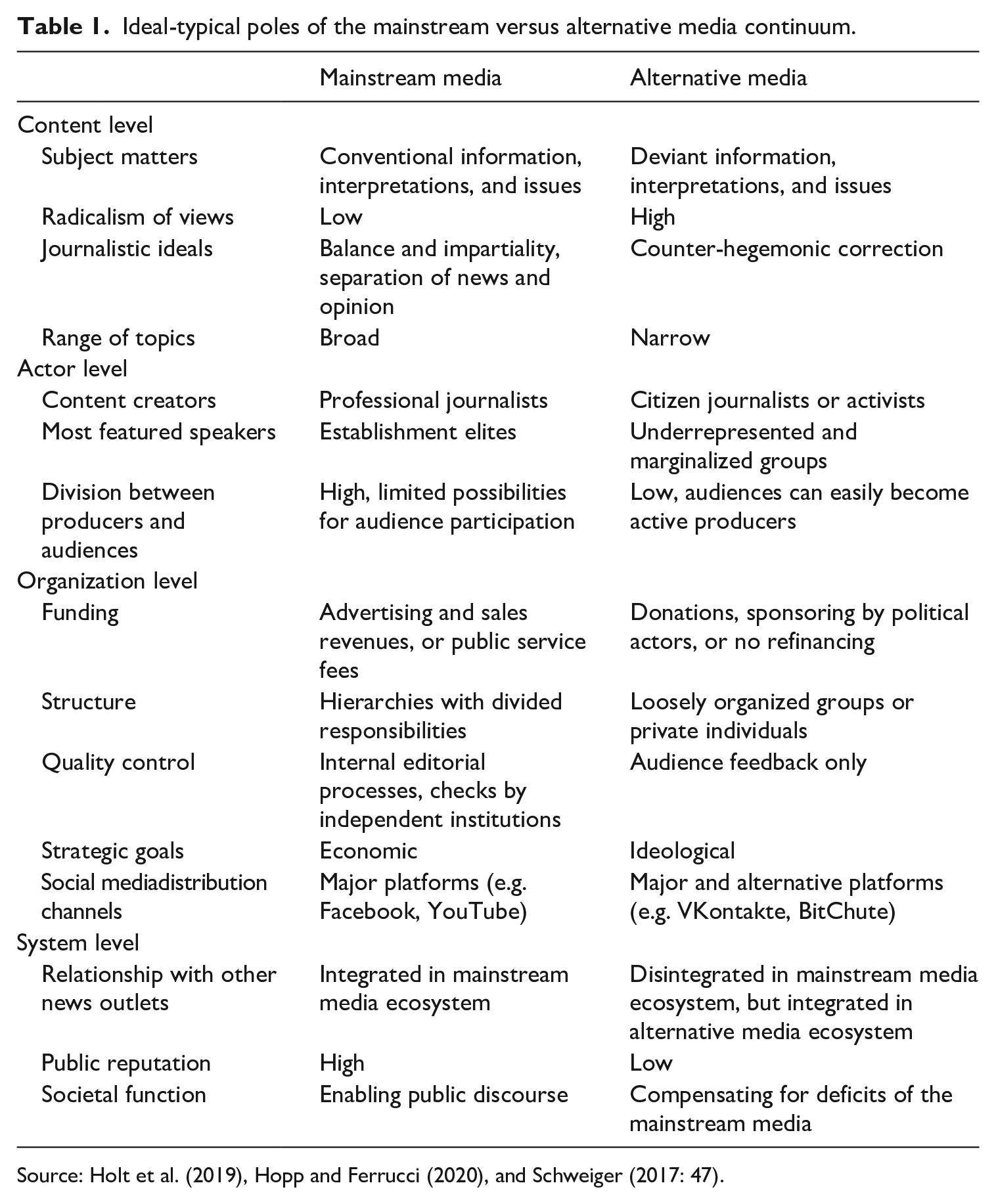
In this vein, Holt et al. (2019) propose an inclusive definition: “Alternative news media represent a proclaimed and/or (self-) perceived corrective, opposing the overall tendency of public discourse emanating from what is perceived as the dominant mainstream media in a given system” (p. 862). The authors note, however, that the relation between alternative and mainstream media should be conceived as a continuum rather than a dichotomy. Specific outlets can thus be more or less alternative depending on the presence and absence of typical characteristics on different levels (see Table 1 for an overview).
Ideal-typical poles of the mainstream versus alternative media continuum.
Source: Holt et al. (2019), Hopp and Ferrucci (2020), and Schweiger (2017: 47).
However, there are also scholars who reject such a broad definition of alternative media and argue that the term should not be granted to outlets from the far-right because it would be inextricably linked to the progressive ideas that shaped its roots. Instead, these scholars argue in favor of new terms, such as hyperpartisan media (Rae, 2021) or countermedia (Ylä-Anttila et al., 2019), which have no equivalents in other languages like German, though. Moreover, using the alternative media label for far-right outlets has become quite established in academic literature. This applies in particular to the bulk of research studying the content, audiences, reach, and effects of right-wing media in the wake of the so-called 2015 refugee crisis in Europe (Bachl, 2018; Figenschou and Ihlebæk, 2019; Frischlich et al., 2020; Haller and Holt, 2018; Heft et al, 2020; Kalsnes and Larsson, 2021; Larsson, 2020; Müller and Schulz, 2021; Nygaard, 2019; Sandberg and Ihlebæk, 2019; Theorin, 2019; Theorin and Strömbäck, 2020) and following the 2016 elections in the United States (Faris et al, 2017; Grigoryan, 2019; Heft et al, 2020; Kaiser et al., 2020; Rauch, 2019; Starbird, 2017; Starbird et al., 2018; Van den Bulck and Hyzen, 2020; Wasilewski, 2019).
It is important to note, however, that this shift in academic attention toward right-wing media does not mean that the alternative media ecosystem today is exclusively right-wing. In Germany, for example, scholars observe a heterogenic spectrum of alternative media, also comprising outlets with left-wing and idiosyncratic ideological profiles (Krüger and Seiffert-Brockmann, 2018; Linden, 2020). A special type of alternative media can further be foreign news outlets opposing domestic mainstream media. In Western countries, most notable examples are the Russian government-controlled outlets RT (formerly Russia Today) and Sputnik that offer content in several languages. Lacking clear ideological profiles, these outlets aim to appeal to various audiences detached from the political mainstream by criticizing the established news media and offering alternative perspectives on current events (Kragh and Åsberg, 2017; Miazhevich, 2018; Pomerantsev, 2015; Yablokov, 2015).
Alternative media on APNC
Despite similarities among the various types of alternative media outlined above, they differ considerably in terms of public visibility. There is no evidence that left-wing media have attained a similar reach like some of their right-wing or Russian counterparts in recent years, especially on social network sites. Comparing user interactions with mainstream media content to that of right-wing alternative media on Facebook, studies in various European countries have shown that alternative outlets occasionally outperform mainstream media in terms of shares (Fletcher et al., 2018; Kalsnes and Larsson, 2021; Larsson, 2019, 2020; Marchal et al, 2019; Sandberg and Ihlebæk, 2019; Schröder, 2018; Winterbauer, 2016). 1 The studies suggest that alternative media have a small, but active followership strongly committed to spreading their content. Since high share rates resonate with the logic of news algorithms designed to maximize user engagement, they are likely to enhance the prioritization of alternative media in personalized feeds (Papakyriakopoulos et al., 2020). This corresponds to the finding that the use of social network sites is a major predictor of alternative media exposure (Müller and Schulz, 2021; Schulze, 2020).
Although research on the diffusion of alternative news stories on other APNC like news aggregators or search engines is scarce, similar relations can be expected. Mechanisms operating on these platforms are likely to underlie the same basic logic of pushing attention-grabbing messages, favoring polarizing content (Cho et al., 2020; Schweiger et al., 2019). Consistently, many alternative outlets score high on metrics that determine a website’s search ranking (Taylor et al., 2020). Thus, as our first hypothesis, we posit:
H1. News exposure via APNC is positively associated with exposure to alternative media.
A critical feature of APNC is that they disassociate single stories from their original media sources and assemble content without taking journalistic quality or the intentions of the authors into account (Schmidt et al., 2017: 20; Schweiger et al., 2019: 12). Thus, in algorithmically personalized newsfeeds, alternative media appear side by side with professional journalistic news outlets, which could make it difficult for users to distinguish between these different kinds of sources (Pearson, 2021; Schweiger, 2017: 79–80). As a second intermediary, amplifier accounts can further contribute to this dynamic by spreading stories from various sources. For instance, populist actors share content from mainstream and alternative media alike on social media (Bachl, 2018; Haller and Holt, 2018; Serrano et al., 2018). This could make it difficult to identify alternative media as such, especially when they resemble mainstream outlets in terms of form and style (Frischlich et al., 2020; Heft et al., 2020; Nygaard, 2019), and when there is a lack of specific knowledge on part of the users.
Public knowledge and perceptions of alternative media
Mirroring the changing use of the term alternative media in academia, we can observe a similar shift in journalism. Analyzing how Swedish mainstream media frame alternative media, Andersson (2019) found that until 2010 alternative media were generally associated with progressive issues. Since then, however, the term has become increasingly applied to right-wing sites. Although there is no equivalent analysis for the context of Germany, a similar trend seems to be evident here (see, for example, Heine, 2016).
Despite this shift in academia and journalistic reporting, little is known about what citizens perceive as alternative media and whether they know alternative media at all. Surveys measuring alternative media knowledge mostly ask for the recognition of particular outlets. For instance, in a representative study of German Internet users, between 13% and 36% of the respondents recognized specific alternative media titles (Müller and Schulz, 2021). 2 We do not know, however, whether the respondents perceived these media as alternative. Research suggests that individual associations with the term alternative media vary substantially. Rauch (2015) found that self-reported alternative media users in the United States named a wide range of different sources when asked for their favorite alternative outlets. Although left-wing outlets prevailed among respondents, they also mentioned right-wing sources and other types of media, including public broadcasting services and commercial outlets. Similarly, Grigoryan (2019) interviewed focus groups of US students to explore their beliefs about alternative media. She found that only few participants were able to describe alternative media in a way matching scholarly definitions, while others, for instance, viewed social media platforms as alternative media (Grigoryan, 2019: 82). This shows that there can be a gap between what media scholars and what many media users identify as alternative media. To obtain a more differentiated view, it therefore makes sense to distinguish between self-perceived and actual knowledge of alternative media (see similarly Park, 2000). Self-perceived knowledge is given when people believe to know what alternative media are, irrespective of what they perceive as such. In contrast, people have actual knowledge when their perceptions match scholarly definitions.
As there are no studies of broader populations or the context of Germany examining the perceptions and knowledge of alternative media, we investigate these phenomena with three open research questions:
RQ1. How many Internet users have self-perceived alternative media knowledge, that is, believe to know what alternative media are?
RQ2. What types of media do Internet users perceive as alternative media?
RQ3. How many Internet users have actual alternative media knowledge, that is, are able to name specific alternative media outlets matching scholarly definitions?
It seems plausible to assume that individuals who consume alternative media regularly are better able to identify alternative media as such. Analyzing qualitative interviews with alternative media users from Finland, Noppari et al. (2019) conclude that the users did not engage with PCM [populist counter-media] content because they could not distinguish it from legacy media journalism or were unaware of its partisan nature [. . .]; rather, they made active, affective and conscious choices to consume and engage with material that contradicted the agendas and views of the dominant public sphere and promoted strong ideological stances expressed via populist address (p. 33).
Against this background, we posit:
H2. Exposure to alternative media positively predicts actual alternative media knowledge.
In this regard, it could make a difference through which gateway users access alternative media. As outlined above, immediate competition between mainstream and alternative media on APNC could blur the lines between these types of news sources. Congruently, Pearson (2021) found that design features of social media can foster “source blindness,” that is, reduced attention toward encountered news brands, diminishing the ability to recall their names. In contrast, direct access to websites or apps of news brands is associated with better memory of their names compared with APNC (Kalogeropoulos et al., 2019; Mitchell et al., 2017). Thus, we assume:
H3. Exposure to alternative media via direct access predicts actual alternative media knowledge better than exposure to alternative media via APNC.
Finally, exploring the characteristics of alternative media users may further contribute to identify factors explaining alternative media knowledge. Most importantly, alternative media users tend to have less trust in mainstream news media and more hostile attitudes toward them (Müller and Schulz, 2021; Newman et al., 2018; Prochazka and Schweiger, 2019; Prochazka, 2020; Schindler et al., 2018; Schultz et al., 2017; Schulze, 2020). Regarding demographics, German alternative media users are likely to be young and male (Müller and Schulz, 2021; Newman et al., 2018). Furthermore, frequent exposure to alternative media is associated with higher education (Müller and Schulz, 2021). Results are less consistent regarding the relationship between alternative media exposure and ideological attitude. While Newman et al. (2018) found alternative media audiences to be more ideologically extreme than those of the mainstream media, Müller and Schulz (2021) found no relations between alternative media exposure and political left–right orientation or extremity in Germany. However, their results yield a positive association between frequent alternative media exposure and populist attitudes as well as the probability to vote for the right-wing populist party Alternative für Deutschland (AfD). As these studies focused solely on factors associated with exposure to alternative media, it remains unclear to what degree these characteristics also contribute to their knowledge. Thus, we address this issue with our last research question:
RQ4. Which user characteristics predict actual knowledge of alternative media?
Method
We conducted a survey through a German commercial online access panel in spring 2019. Participants were recruited using quota sampling to reflect the population of German Internet users in terms of age, gender, and education (AGOF, 2017). The final dataset consists of 1033 respondents of which 49% are female and 38% have higher education. The age of the participants ranged from 14 to 69 years (M = 43.10, SD = 15.32).
Measures
Perceptions and knowledge of alternative media
To assess self-perceived alternative media knowledge, participants were asked whether they know alternative media outlets, “that offer a different perspective on current events than the established media.” Participants could specify whether they
(a) do not know alternative media at all,
(b) do not know alternative media but have at least an idea what that could be,
(c) know the concept of alternative media but not a specific example, or
(d) know alternative media and are able to name specific examples.
Participants choosing the latter option were asked to name one or more alternative media titles in an open response field. One hundred thirty-five respondents did so, naming 76 different titles. One of the authors manually coded each of these titles into one of ten categories presented below. In line with other studies (Heft et al., 2020; Sandberg and Ihlebæk, 2019), the classification was based on self-descriptions of the outlets, holistic assessments of their websites’ front pages, and available secondary literature about them. To ensure reliability, we further engaged in consensual coding (Jensen, 2002: 267; Kuckartz, 2014: 46–47), that is, whenever outlets could not be classified unequivocally, the authors discussed the case until agreement was reached.
We classified outlets as alternative media when they exhibited the characteristics presented in Table 1. For example, this was the case when an outlet claimed to pursue an anti-establishment stance, when media criticism was prominent on its website or when accounts on political issues clearly deviated from the German mainstream, such as when the existence of anthropogenic climate change was challenged. In cases of doubt where outlets showed characteristics of both alternative and non-alternative media, we decided to classify them in favor of alternative media. 3
Alternative outlets were further classified as left- or right-wing when this could be inferred from their self-presentation or when typical issues and positions were predominant on their websites. When media did show alternative features, but did not exhibit a conventional ideological profile, they were coded as non-classifiable alternative media. Foreign international media like RT and Sputnik were treated as another separate sub-category of alternative media. Responses that did not fall into one of these alternative media categories were classified as commercial mainstream media when these outlets covered a broad spectrum of topics, had professional structures and were mainly funded by advertising incomes. Services like social media, search engines, and news aggregators, which do not publish content on their own, were coded as intermediaries. Further categories encompassed public broadcasting services (funded by licence fees), satire news (overt parodies of real news), special-interest media (non-political focus), and other sources (no category applicable), and other sources. The Supplemental online appendix provides a list with the classification of all titles that were named by respondents.
Using this classification, we computed a binary variable indicating actual alternative media knowledge. Respondents were treated as knowing alternative media if they had named at least one outlet that we classified as alternative. Respondents were treated as lacking alternative media knowledge if they had named only outlets that we coded into the non-alternative categories or if they had claimed not to know any specific alternative media in the first place.
Media exposure
After participants had answered the questions on perceptions and knowledge of alternative media, we provided them with examples of alternative media titles and asked them how long they had used alternative media on the day before the survey (see similarly, Prochazka, 2019; Schweiger et al., 2020). Seven items measured exposure through different gateways: direct website access, direct app access, personalizable news websites, personalizable news apps, search engines, social networks, and video platforms (each item included specific examples). Respondents could rate their amount of exposure on a 7-point scale with incremental time intervals (1 = not at all, 7 = more than 2 hours). For the following analyses, each scale point was equated with its center (e.g. .5–1 hour ≙ 45 minutes). The values were then summed up into three index variables: alternative media exposure via direct access (direct website access, direct app access; M = 5.54 minutes, SD = 19.82 minutes), alternative media exposure via APNC (personalizable news apps, personalizable news websites, search engines, social networks, and video platforms; M = 22.35 minutes, SD = 52.93 minutes), and general alternative media exposure (all items; M = 27.89 minutes, SD = 66.27 minutes). The latter index was above zero in 43% of our sample, meaning that almost half of the respondents reported to have been exposed to alternative media on the previous day.
Applying similar items, we measured exposure to mainstream media, which we defined as the established journalistic media in Germany (i.e. the popular broadcasters, newspapers, and news magazines, including their online versions). Likewise, we assessed exposure to original sources, that is, public actors like politicians or organizations, which constitute a third type of information source that users can access directly or via APNC. Summing up responses to the same sets of items as above but for all three types of sources, we built index variables for total online news exposure via direct access (M = 29.28 minutes, SD = 49.09 minutes) and total online news exposure via APNC (M = 79.50 minutes, SD = 136.69 minutes).
Covariates
Political ideology was measured on a left–right self-placement scale ranging from 1 = left to 9 = right (M = 4.71, SD = 1.60). As radical political attitudes were of particular interest to our study, we additionally re-coded the variable into a 5-point scale for political extremity indicating the deviation from the theoretical midpoint of the original scale in either direction (M = 1.14, SD = 1.16; see similarly Müller and Schulz, 2021). Furthermore, we asked respondents which party they would vote for in an upcoming national election. A dummy variable was created for the intention to vote for the right-wing populist AfD (13%), as this had been shown to be associated with alternative media exposure.
We assessed general political interest with a single item from the study of Van Deth (2013) on a 5-point scale from 1 = no interest to 5 = a lot of interest (M = 3.40, SD = 1.25). Likewise, we measured internal and external political efficacy with two translated three-item batteries from the work of Gastil and Xenos (2010; e.g. “I have a clear understanding of what the political problems are in our country,” “People like me can influence what happens in politics”). For each battery, a mean index was calculated (internal efficacy: M = 2.94, SD = .90, α = .70, and external efficacy: M = 2.38, SD = .91, α = .77).
For the purpose of another study included in the same survey, trust in media was measured in four different ways using a split ballot design. One quarter of the respondents were each asked to rate their level of trust in either of the following objects on a scale from 0% to 100%: personally most used media, the news media, established journalistic media, or the most used media in Germany. As the latter three measures did not yield significantly different means, F(2, 783) = 2.57, p = .08, they were collapsed into a single variable for mainstream media trust with the remaining quarter of the sample set as missing (M = 60.17, SD = 25.10).
As demographic variables, we additionally assessed net household income (55% above 2.000€), and migration background (12%).
Results
H1 predicted a positive association between total news exposure via APNC and general exposure to alternative media. We computed a multiple linear regression with general exposure to alternative media as the outcome and total news exposure via APNC as the explanatory variable, controlling for online news exposure via direct access and all covariates. The results show that total online news exposure via APNC is the strongest predictor of general alternative media exposure (β = .74, p < .001; adj. R2 = .85, p < .001). Thus, in line with H1, the more time Internet users report to spend on consuming algorithmically personalized news, the more time they report to be exposed to alternative media content.
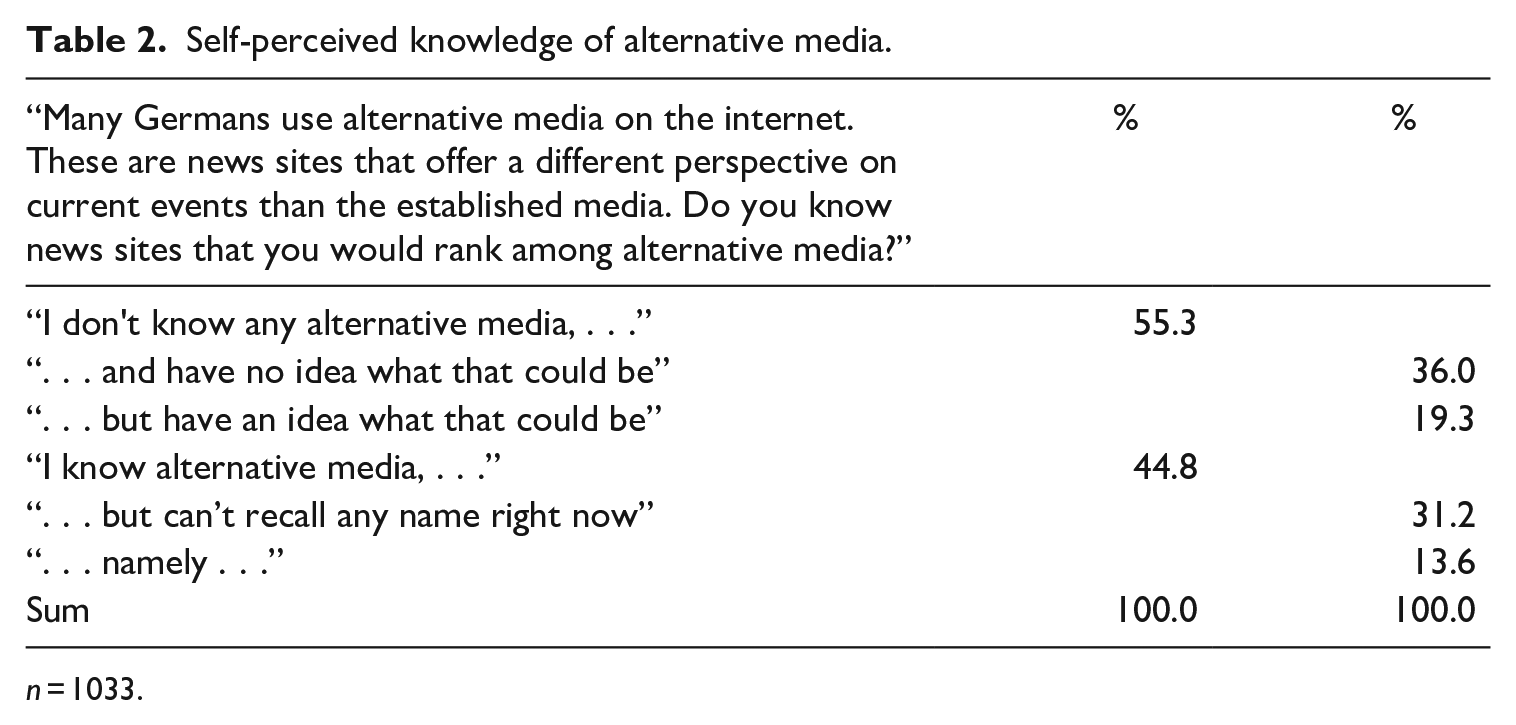
RQ1 asked how many Internet users believe to know alternative media. Table 2 presents the frequencies of all possible answers to our survey question addressing this issue. Although 55.3% of German Internet users are unfamiliar with alternative media, a remarkable share of 44.8% report to be aware of their existence. However, only 13.6% felt able to name specific titles, suggesting that the overall number of people with advanced knowledge of alternative media is rather small.
Self-perceived knowledge of alternative media.
n = 1033.
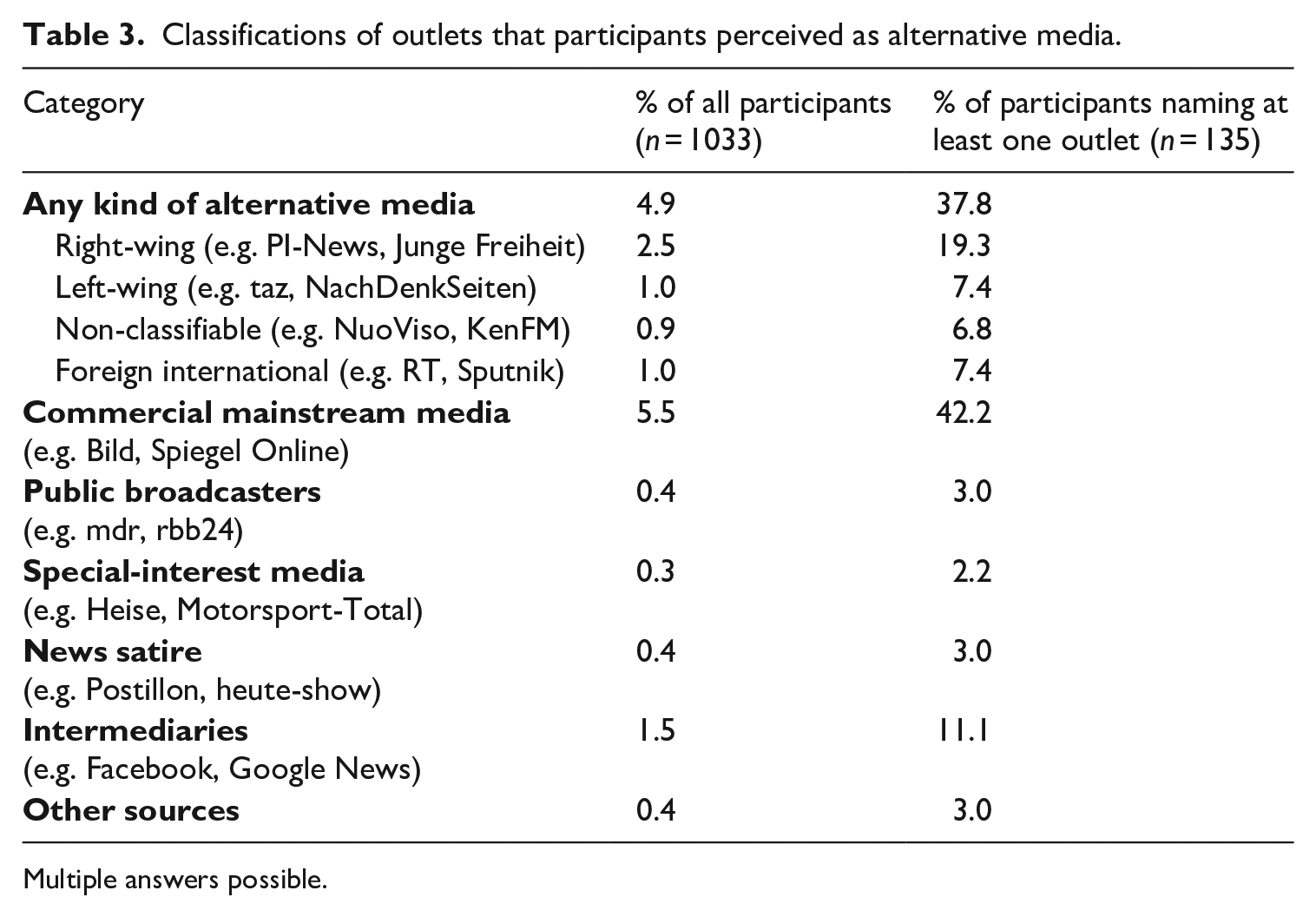
To assess what Internet users perceive as alternative media (RQ2), and how many of them prove to have actual knowledge of alternative media (RQ3), we analyzed the frequencies of the categories used to classify the open responses (see Table 3). The findings show that most respondents who believed to know alternative media named outlets that do not align with academic understandings of the concept. Most of the responses fall into the category of commercial mainstream media. For instance, the major German tabloid Bild was the most named title of all responses (n = 10). Furthermore, a considerable number of participants viewed intermediaries like social media, search engines, or news aggregators as alternative media, underlining the close relationship with APNC. Less frequently, respondents mentioned other non-alternative media like public broadcasters, news satire, or special-interest media. In contrast, about 38% of the respondents who believed to know alternative media named at least one outlet that we classified as alternative media as well. Thus, regarding our whole sample, only a small minority of 5% was able to name specific alternative media outlets matching scholarly conceptions. Of these, most participants named right-wing media.
Classifications of outlets that participants perceived as alternative media.
Multiple answers possible.
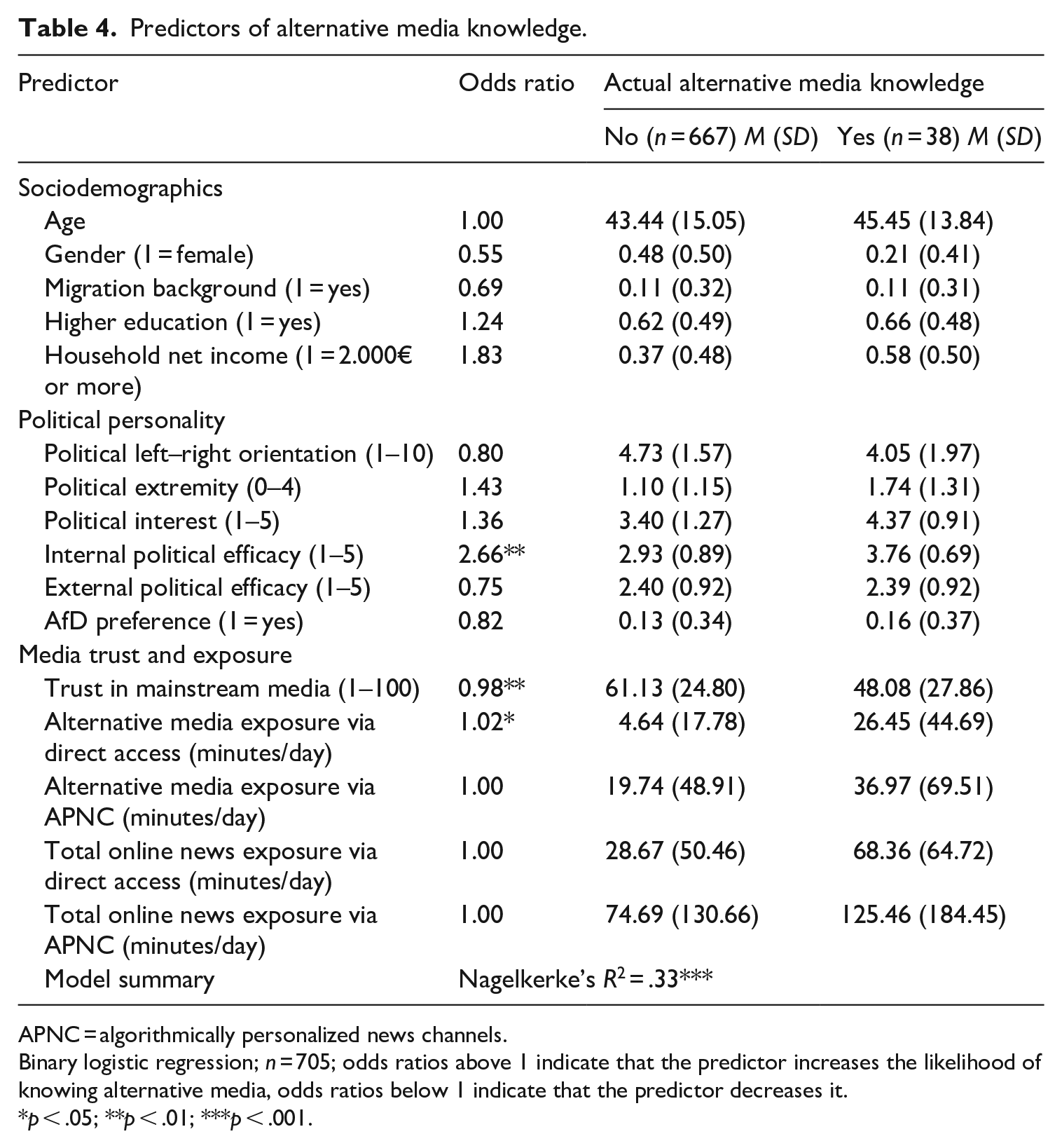
H2 assumed that alternative media exposure in general predicts actual alternative media knowledge and H3 further specified that alternative media exposure via direct access is a better predictor than exposure via APNC. Moreover, RQ4 asked for user characteristics contributing to actual alternative media knowledge. To investigate these issues, we calculated a binary variable indicating whether actual knowledge of alternative media is present (respondents who named at least one outlet matching our classification) or not (respondents with mismatching or no answers). We used this variable as the outcome of a binary logistic regression with our predictors of interest. The results are displayed in Table 4, which additionally features the means of the two groups to illustrate the findings. We find that self-reported alternative media exposure only improves the likelihood of actual alternative media knowledge when it occurs via direct access. Alternative media exposure via APNC, on the other hand, has no effect. Therefore, H2 is partly and H3 is fully supported.
Predictors of alternative media knowledge.
APNC = algorithmically personalized news channels.
Binary logistic regression; n = 705; odds ratios above 1 indicate that the predictor increases the likelihood of knowing alternative media, odds ratios below 1 indicate that the predictor decreases it.
p < .05; **p < .01; ***p < .001.
Regarding RQ4, internal political efficacy reveals to be the strongest predictor of actual alternative media knowledge. Furthermore, trust in mainstream media has a significant negative effect on actual alternative media knowledge. Hence, Internet users are more likely to perceive alternative media in a way that corresponds to scholarly definitions when they feel competent with respect to politics and are skeptical toward established news outlets. Although there are no effects of other variables, inspections of the means suggest that there may be more relationships that are not significant because of the small number of cases with actual alternative media knowledge, which is further reduced in this model because the variable for trust in mainstream media lacks responses from one quarter of the sample. Especially, the higher value of political interest among individuals with actual knowledge of alternative media is in line with positive impact of internal political efficacy. Likewise, the higher value of political extremity resonates with the finding that people who are detached from the mainstream are more aware of alternative media.
Discussion
The aim of this study was to examine the relation between individual news exposure via APNC, exposure to alternative media and knowledge of alternative media. Analyzing survey data representative of German Internet users, we assessed two types of alternative media knowledge. Self-perceived knowledge was present when people reported to know alternative media irrespective of what they perceived as such. In contrast, we measured actual knowledge by asking respondents to name specific titles and classifying the answers in accordance with scholarly definitions of alternative media. This distinction appears useful to assess whether academia and the public share a common understanding of the concept. Nevertheless, it is not without shortcomings. Just as there is no “true” understanding of alternative media, there clearly is no uniform scientific view on them. Also among scholars, there may be dissent as to whether a particular outlet should be regarded as alternative or not (and if so, which ideological subtype it belongs to). For instance, some authors argue that fake news sites and conspiracist outlets only mimic alternative media practices to gain legitimacy (Ballinger, 2011; Robertson and Mourão, 2020). Furthermore, our binary classification of outlets as either alternative or not could be criticized as simplistic. As we have outlined, it would be more appropriate to view alternativeness as a gradual phenomenon. Employing a broad definition of alternative media instead, we classified each outlet as such when it showed any features of alternative media defined in academic literature without judging whether these were authentic or just an imitation of alternative media practices. With this approach, we avoided underestimating actual alternative media knowledge by measuring it too strictly.
Our main finding seems stable, even if one would apply a somewhat different classification of media outlets: There is a clear gap between those who believe to know and to consume alternative media on one hand and those who actually know what alternative media are on the other. While 43% of our respondents stated to have used alternative media the day before the survey, only 5% could name titles matching scholarly definitions. This suggests that only a small avant-garde of Internet users—showing a high affinity for political content and low trust in mainstream media—is aware of alternative media as such. Many other users, by contrast, also notice that there is something like an alternative to mainstream media, but do not distinguish clearly between these different types or at least base their distinctions on other criteria than scholars might assume. Although we did not assess why people consider an outlet as alternative, the term seems to have a positive connotation for many. Overly high self-reported exposure to alternative media suggests that many people perceive this as desirable. Our finding that news exposure via APNC and exposure to alternative media are highly interrelated therefore remains tentative due to the heterogenic understanding of the concept. Unlike exposure to alternative media via direct access, exposure via APNC does not improve actual alternative media knowledge.
Three explanations seem plausible to account for the finding that users report relatively high exposure to alternative media, but do not know what alternative media are—especially when they report to encounter them on APNC.
First, APNC users may frequently have incidental and cursory encounters with alternative media that hardly enhance their long-term memory of specific titles. Following this argument, users would be able to recognize alternative media as such in the moment they are exposed to them, but would not be able to recall their names due to oblivion or confusion with other titles. This explanation would be in line with previous research demonstrating that news exposure via APNC hampers brand recall (Kalogeropoulos et al., 2019; Mitchell et al., 2017). Overall, however, this explanation alone does not seem sufficiently conclusive, as self-reported exposure to alternative media in our sample is too high to be simply caused by cursory encounters.
Therefore, a second explanation could be that many individuals use alternative media on a regular basis, but do not identify them as such. As outlined above, especially users of APNC are likely to be confronted with a broad variety of information, which might lead to source blindness (Pearson, 2021). This state of reduced attention could hamper the distinguishability between different types of outlets and bears the risk that recipients mistake partisan content for journalistic news. As we assessed knowledge of alternative media first and then asked our respondents for their amount of exposure—providing them with specific examples—this may have led to recognition of these titles, which would otherwise not have been perceived as alternative media. This explanation is also supported by results of other studies finding remarkably high values for recognition of specific alternative media outlets (e.g. Müller and Schulz, 2021), implying that these titles are largely known by the general public.
Our study, however, suggests a third explanation: Since a considerable number of respondents regarded commercial mainstream media as alternative media, many people may mistakenly believe to use alternative media, applying a different definition of the concept compared with academic and journalistic discourse. Even though we provided our respondents with examples of alternative media titles when asked for their exposure, we cannot be sure what they had in mind when answering this question. Following this line of reasoning, the use of APNC would only make people feel to be exposed to alternative media content simply because they encounter various types of outlets they are not familiar with.
Not only for citizens, but also for scholars, an increasing convergence between mainstream and alternative media makes the distinction between and theorizing about these categories more difficult (Kenix, 2011; Rauch, 2016). Mainstream media may become more partisan while more and more alternative media begin to develop professional structures. Nevertheless, its recent resurgence suggests that the notion of alternative media has conceptual value for scholars. Since many societies face similar disruptions of the public sphere by novel media outlets with an anti-mainstream stance, common terms are necessary to study this phenomenon. The notion of alternative media exists in several countries, making it well suited for international comparative research. However, our research suggests that scholars should not take for granted that the public is familiar with the academic concept of alternative media. Many citizens do not know the term and those who do know it differ considerably in how they understand it. From a methodological perspective, it is therefore advisable to avoid using the term alternative media in surveys altogether and to refrain from self-reported measures of generalized exposure to them. Otherwise, it would remain unclear which media respondents think of and, consequently, what is actually measured. Instead, researchers should ask for exposure to specific outlets they are interested in and have identified as alternative media in advance. Moreover, future studies should use other means of assessing exposure to alternative media, for example, tracking data (see Stier et al., 2020) or experience sampling methods.
Furthermore, it is important to bear in mind that there are substantial differences between national media systems, political conditions and public spheres that make it difficult to transfer empirical findings like the limited knowledge of alternative media from one country to another. Yet, it is plausible that the theoretical mechanisms we have outlined also apply in other countries. Future research should investigate them in more detail to improve our understanding of how individuals perceive their media environments and how they identify different types of media therein. Ultimately, perceptions of alternative media can only be fully understood if researchers take into account what they are distinguished from. Therefore, it is important not only to focus on alternative media in isolation, but also to investigate common notions of established, legacy, or mainstream media, and how citizens make use of them.
Supplemental Material
sj-pdf-1-nms-10.1177_14614448211021071 – Supplemental material for Public knowledge of alternative media in times of algorithmically personalized news
Supplemental material, sj-pdf-1-nms-10.1177_14614448211021071 for Public knowledge of alternative media in times of algorithmically personalized news by Tilman Klawier, Fabian Prochazka and Wolfgang Schweiger in New Media & Society
Footnotes
Funding
The author(s) received no financial support for the research, authorship, and/or publication of this article.

Supplemental material
Supplemental material for this article is available online.
Notes
Author biographies
References
Supplementary Material
Please find the following supplemental material available below.
For Open Access articles published under a Creative Commons License, all supplemental material carries the same license as the article it is associated with.
For non-Open Access articles published, all supplemental material carries a non-exclusive license, and permission requests for re-use of supplemental material or any part of supplemental material shall be sent directly to the copyright owner as specified in the copyright notice associated with the article.
