



Abstract
While podcasts as a storytelling media have exploded in popularity in the West since 2014, the uptake and consumption of this sonic new media was relatively slow in Africa until recently. This article explores amateur and start-up entrepreneurship podcasts that came to dominate the African mediascape during the medium’s coming of age moment between 2014 and 2018. I extend Walter Ong’s observation that broadcast and electronic media recreate the experience of oral performance, to show how the oral and aural dimensions of podcasting represent a set of approaches that can be described as new orality. This article also draws connections and distinctions between what I term the “dialogic schema” of African tech podcasts and “traditional” forms of narrative storytelling in African public cultures, as well as the emerging forms of mobile digital practices that, like podcasting, challenge easy distinctions between written and oral and literacy.
Introduction
As podcast culture has blossomed in the West (Bottomley, 2015; Llinares et al., 2018), the uptake and consumption of this sonic new media has been relatively slow in Africa. This is ironic given several factors: The well-documented “explosion” of Africa’s mobile phone industry (an audio technology); the growing Internet penetration of key Sub Saharan countries, such as Kenya, Nigeria, Ghana, and South Africa; the dominance of radio as a mass media in Africa (Tettey, 2011); and the ongoing dynamism of oral traditions, such as storytelling and proverbs in African public life (Okpewho, 1992; Willems and Mano, 2016). Podcasting has only very recently seen broader adoption in Africa’s many public spheres, despite the medium being a relatively accessible form of information and communications technology (ICT), in comparison with other digital media that require software development and/or expensive Internet infrastructure. This article explores the aesthetics and practices of amateur and start-up producers during podcasting’s coming of age moment since 2014, specifically among African media producers living at home and in diaspora. It might be natural to assume that the affordances of podcasting would be attractive to producers working in African publics, especially given the medium’s perception in popular press and marketing literature as a contemporary revival of oral storytelling traditions (Sternbergh, 2019). However, hobbyist and start-up podcasts, the likes of which have created a torrent of content in Western media markets in the last decade (Berry, 2016; Sullivan, 2019), have only recently emerged from African producers utilizing podcasting’s major outlets (Apple Podcasts, Spotify, Stitcher, etc.). Between 2014 and 2018, I documented discourse on Africa-themed podcasts on these platforms, many of which were produced by African-emigres living abroad in North America or the United Kingdom. Diaspora-based podcasters in particular have been among the earliest adopters of this format throughout the global African mediascape—a multivalent public sphere, centered on African audiences, but whose producers and consumers may live within or outside the continent (Banda et al., 2009; Royston, 2017). In this article, I argue that these techniques use digital audio in ways that extend Walter Ong’s notion of “second orality” (1982) into Africa’s media cultures. In an attempt to separate our contemporary discourse from Ong’s and others’ chauvinistic treatment of both Africa and orality (described below), I proffer the term new orality—defined as the oral aesthetics and the material effects of sound embedded in the digital consumption and production of new media tools. This article examines the structure, content, and themes of 15 programs where the focus was explicitly on technology, and the hosts were not, as yet, professional media producers. My analysis shows that their formats conform to a set of practices I describe as schematic storytelling, which rely on some conventions of African oral literature, such as formulas and repetition, though not necessarily improvisational narrative performances as typified in “traditional” storytelling (Okpewho, 1992; Scheub, 2004). I describe this technique as being germane to podcasting generally, though less noted. In the concluding discussion, I link new orality in general to emerging forms of aural digital practice that have come to characterize innovation in the African mediascape.
This research builds on a model of critical techno-cultural discourse analysis (CTDA) as described by Andre Brock (2018), linking the semiotic content, syntactical gestures and infrastructural access issues of digital media users in a composite analysis. As a multimodal research approach, I also interviewed two key African podcasters who are living outside the continent, producers in what has sometimes been termed Africa’s digital diaspora. In the section below, I preface the analysis of podcasting and interview data with a contextualization of Internet access in Africa, drawn from my experience as an ethnographer of African communities online, and with digital media users on the ground in Ghana and in West Africa (Royston, 2017, 2020).
The African mediascape: an aural ecology
The importance of orality to contemporary African life cannot be understated. Rather than an indicator of pre-modernity or a lagging stage of development compared with the Digital North, Africa’s diverse oral literature practices reflect dynamic and evolving communicative traditions: Among the most well-known are music (including “drum languages”; Nketia, 1963), storytelling (Scheub, 2004), and the exchange of cultural proverbs (Furniss and Gunner, 2008; Irele, 2001). Today, these forms of orature are manifest in mass media culture on the continent, from talk radio and TV, to blogging and online poetry (Mutsvairo, 2016; Ndemo and Weiss, 2017). On a continent where terrestrial radio (FM and AM) remains the dominant mass media form (Tettey, 2011; Wasserman, 2011), South African linguist Elizabeth Gunner’s (2007) description of Africa as “the oral continent par excellence” helps to frame the enduring role of speaking and listening practices in contemporary African societies: Orality needs to be seen in the African context as the means by which societies of varying complexity regulated themselves, organized their present and their pasts, made formal spaces for philosophical reflections, pronounced on power, questioned and in some cases contested power. . . . In this sense, orality needs to be seen not simply as “the absence of literacy” but as something self-constitutive, sui generis. (p. 67)
What may be puzzling then, is the paucity of Africa-themed podcasts emerging from the continent in the medium’s expansion years, the time period 2014–2018, during which this was research was conducted. Peter Alegi has produced a pioneering academic podcast Africa Past & Present since 2008; The China–Africa Project 1 has produced regular podcasts since 2010. Professional media agencies, such as France’s RFI and the United States’s Voice of America also put their Africa-themed radio productions online in podcast form during this time period. But the emergence of amateur, start-up and semi-professional podcasts by African media producers were difficult to locate on African news sites, blogs, and on dominant platforms, such as iTunes and Stitcher during the so-called “Golden Era” that began with programs such as NPR’s Serial in 2014 (Berry, 2015).
My fieldwork on Africa’s digital mediascape may provide a structural explanation for a seeming scarcity of podcasting in the continent’s audio cultures writ-large in the time period prior to 2018, though these observations must be understood with the caveat that conditions vary widely from country to country, and region to region. The majority of African tech users connect to the Internet via “feature” phones 2 that offer a limited number of applications for accessing content like podcasting (International Telecommunications Union (ITU), 2018). These primarily keypad-based “candy bars” or “yams,” as they are sometimes called locally, are durable, long-charging, pocket devices from companies such as Nokia, Sony-Ericsson, and Techno.
Smartphones, such as the iPhone, Pixel, and Android devices, though plentiful in connected urban centers in Egypt, Ghana, Kenya and South Africa, make up at best 20% of all mobile users on the continent—though in Nigeria, the largest African country, they number at 40% (Groupe Speciale Mobile Association (GSMA), 2018). The introduction of inexpensive Chinese smartphones from Huawei and Infinix have made higher broadband devices more accessible, but the majority of Africa’s mobile networks rely on 3G and lower Internet, and public or free Wi-Fi is often difficult to procure (GSMA, 2018; ITU 2018). 3 Many brands of mobile phones in Africa also come equipped with terrestrial radio receivers, so that users can access FM signals directly, rather than paying to download or stream audio.
Financially, pre-paid mobile data plans dominate the subscription model in African markets. Consider, then, the cost of downloading a 30- to 120-minute-long podcast, optimized for platforms such as iTunes or apps such as Stitcher, rather than for low-bandwidth users. In a “middle-income country,” such as Ghana, where the majority of the population makes less than US$10 per day, the lowest denomination of phone credit is 5 cedis (US$1). A single episode of the podcasts I have documented in this research can run as long 90 minutes, a digital file size of approximately 100 megabytes, or about half the data that 5 GHC worth of credit would get you on a good day, provided Internet reception is consistent. For many African Internet users, such audio downloading could remain financially out of reach. This makes podcasts, in general, dependent on low-cost Internet accessibility as one may find in a cybercafé or at a college, and thus the purview of highly motivated content-consumers, what I have termed elsewhere Africa’s “digital elites” (Royston, 2017). As Panji Anoff, a Ghanaian music producer and social media influencer said to me while speaking about downloading or streaming such content, “You have to ask yourself, is it worth the credit?” For many African users of the Internet, even with the widespread adoption of mobile phones, the cost of consuming content is a visceral economic choice, and the practice has been outside the user-culture of audio media consumption until very recently.
Podcasting in Africa may be challenged by market infrastructures and consumption proclivities. Still, African media producers distributing content to audiences in the homeland, demonstrate the transnational capacities of digital media. Just as Western media outlets, such as the BBC or CNN, operate as deterritorialized media organizations by making their content available outside the boundaries of the nation-state as well as localizing that content, diaspora-based media producers are also able to make good on the affordances of globalization through digital content distribution as well as production, as I describe later in this article. Just as with these global conglomerates, their impact is varied.
The media producers I have interviewed for this research describe varying degrees of audience penetration on the continent. Building the Future (BTF) is a podcast produced by Dotun Olowoporoku and his small consulting firm, The Starta. In 5 years of production, the podcast has garnered attention for his business, and helped him hire four additional employees, some of whom assist in what was formerly a one-man podcast show. On this English-language program (64 episodes as of this writing), he talks with entrepreneurs and investors from across the African continent whom he has interviewed in-person. In an interview with me, Olowoporoku stated that 80% of his listeners do come from the continent (Nigeria, Kenya, Ghana, and South Africa), and some of his most popular episodes have received as many as 5000 downloads per month, though the average is closer to 3000.
For Amadou Hanne, another podcaster interviewed for this project, the phenomena was reversed. His series Africans Building Africa (ABA), attracted attention mostly from US, Canadian and UK listeners, he told me, before it went on hiatus in 2018. Hanne similarly interviewed start-ups in Africa, via Skype from his home near Chicago, Illinois. The majority of his 1000 or so monthly downloads were based in the West, even as a handful of ABA’s more than 30 episodes were produced in French. But even if podcasting was not as mainstream in parts of Africa as it has been in the US or European media markets, the emergence of these lead-users whose audience includes digital elites on the continent points to a robust listenership that stretches transnationally.
Aurality: old, secondary, and new
Before exploring the aesthetics and content of Africa-themed podcasts in this period of the medium’s growth, it is useful to explore how this new media form in general draws upon the affordances of aurality, as recently discussed in digital studies research. In using the concept aurality, I am linking the techniques of speaking and sound production, orality, with practices of listening or hearing, aurality. The senses of these two terms have recently come together in the field of Sound Studies, especially in an attempt to provide a multimodal and cross-disciplinary understanding of sonic practices (Bull et al., 2015; Pinch and Bijsterveld, 2012). The notion of aurality particularly attempts to address the ephemeral, social, and material impact of sound practices—as documented in research in history and anthropology (Ochoa, 2014), New Media Studies (Chun and Keenan, 2006; Sterne, 2012); as well as among scholars of African diaspora studies (Jaji, 2014; Weheliye, 2005). Sound Studies theorist Frances Dyson suggests that aurality highlights the fleeting qualities of sound, but also, sound’s ability to be the product of technology, and a medium in its own right, with spatializing and material effects (Dyson, 2009).
It is no coincidence, then, that the diverse technologies we associate with new media reconstitute experiences characteristic of the aural, for sound is the immersive medium par excellence. Three-dimensional, interactive, and synesthetic, perceived in the here and now of an embodied space, sound returns to the listener the very same qualities that media mediates: that feeling of being here now, of experiencing oneself as engulfed, enveloped, absorbed, enmeshed, in short, immersed in an environment. (p. 4)
The podcasts I document here can thus be characterized as technologies that are ensconced in aurality as a sonic and material practices germane to African media (Moorman, 2008). According to the producers I have interviewed, they aim to use podcasts as instruments of informational and material transformation, particularly for new products, social-infrastructure change, and business social networking on the continent of Africa.
With the emergence of the audio-visual and interactive capacities of the Internet in the late 1990s, media theorists, such as Lev Manovitch (2001) and Wendy Hui Kyong Chun and Thomas Keenan (2006) began to revisit the qualities of new media’s “ephemerality” and reproducibility, as facilitated by mass digitization. In doing so, these theorists often drew upon Walter Ong’s notion of second orality, that is, the sense of presence and performativity that broadly characterizes the experience of electronic media forms, especially broadcast media. Although their media effects are experienced as live oral practices (what he termed “primary orality”), Ong argued that mass media (radio, TV, film, and electronic media) are reliant on technical production and writing, and thus are scripted rather than simply spontaneous. Ong (2002 [1982]) wrote in Orality and Literacy: … [T]elephone, radio, television, and various kinds of sound tape, electronic technology has brought us into the age of “secondary orality.” This new orality has striking resemblances to the old in its participatory mystique, its fostering of a communal sense, its concentration on the present moment, and even its use of formulas. But it is essentially a more deliberate and self-conscious orality, based permanently on the use of writing and print, which are essential for the manufacture and operation of the equipment and for its use as well. (p. 133, emphasis mine)
The emphasis I have made in the above citation are important for the arguments that follow.
I propose we move away from the oft-cited notion of “second orality,” and extend rather Ong’s passing phrase “new orality,” to describe digital technology where aurality plays a central role in production and reception, and yet relies on the hybrid experience of aural, written and procedural practices, rather than extemporaneous oral performance. It is important to note that the allusion to orality as a quality and mode of interaction does not necessarily support the reversion to primitivity (“primary orality”) embedded in characterizations of early Internet theorists, such as Marshall McLuhan and Ong himself. In the 2007 article “Wired Man’s Burden: The Incredible Whiteness of Being Digital,” cultural critic Mark Dery famously details how McLuhan used an essentialist characterization of African and Native American “tribes” as an analogy for his visions of a “post-literate cybernetic culture” (Dery, 2007: 39). Ong’s own writings were equally paternalistic of Black American and African communications styles, characterizing them as stuck in “primary oral” vernaculars—that is, lacking a tradition of written discourse, and thus pre-rational. While praising the enduring orality in the African and diasporic context as “complex,” Ong (2002 [1978]) also demonstrated Western chauvinism regarding sonic ways of knowing, remarking: Writing is an absolute necessity for the analytically sequential, linear organization of thought such as goes, for example, into an encyclopedia article. Without writing . . . the mind simply cannot engage in this sort of thinking which is unknown to primary oral cultures, where thought is exquisitely elaborated, not in analytical linearity, but in formulatory fashion, through rhapsodizing’ that is, stitching together proverbs, antitheses, epithets and other “commonplaces” or loci (topoi). (p. 468)
Despite this cultural bias, we can use the term new orality, drawn from Ong’s own description of the augmenting effect of scripted media on oral performances. New orality, I would argue, is a more accurate description of the audio digital media aesthetic, and describes the hybridization of written and oral forms of communication via podcasting and other digital tools, without judging their ability to demonstrate privileged kinds of knowledge.
Although the podcast format has existed for years in the form of Web-based downloadable audio via blogs or streaming net-radio (Sterne et al., 2008), its emergence as a mass media product since Serial should allow us some reconsideration of the specific affordances of this new media’s aural techniques. Unlike terrestrial radio and other broadcast media, podcasts incorporate the configurable aspects of digital media: They can be queued, slowed/sped-up and annotated by consumers. They are available to be streamed, downloaded, or made portable via mobile phones and other storage devices for asynchronous use. As media objects, they are available for editing, indexing, sampling, and mediation onto other platforms and contexts. Just as important, in the research period, podcasts were seen as predominantly user-generated, or produced by amateur and start-up producers, and thus initially distinct from corporate or state-administered mass media.
Aesthetically, Ong described electronically mediated orality as production practices that draw on the qualities of live performance and orature. These affordances have special resonance in podcasting generally (Florini, 2019), and for digital radio in Africa specifically (Avle, 2020). The term new orality can help describe the capacities of podcasts, online video, digital radio programming, audio books, texting, even voice-command and digital assistants, such as Siri, which reproduce sensations of liveness (Auslander, 2008 [1999]; Crisell, 2012), participation, narrator-driven performance, rhetoric, material spatiality, and ephemerality associated with oral (not primitive) cultures. Driven by mobile phone user interfaces and sonic practices, such as “flashing” 4 and other phenomena as described below, new media tools, especially in Africa, combine both oral and written syntax, troubling distinctions between the two modes of knowledge production. As well, the use of aural techniques I document in African tech podcasts, may be compared to conventional and historic oral practices of the African continent, such as proverbs and narrative pedagogy, central to traditions of African storytelling (Finnegan, 2012; Irele, 2001; Okpewho, 1992). Africa’s multilingual societies, its cultural practices, such as “talking drums,” the storytelling practices of griots or imbongis, along with everyday folk practices of riddles and proverbs, already favor an oral syntax that has the social power of written communications, if not more (Furniss and Gunner, 2008).
In the analysis that follows, however, I trouble any default assumption of cultural evolution or diffusion from these enduring traditional cultural forms to African podcasting today: Rather, it seems clear from my analysis of content and discursive styles, that African podcasting highlights a unique set aesthetics for aural media practices in general, that could be extended to other genres of tech practice that capitalize on formulaic and procedural modes of connection through aural interfaces, rather than strictly through formal written literacy.
Methodological Approach
The podcasts documented in this article like BTF are demonstrative of dominant narratives about technology development in the African mediascape, both in the diaspora and the homeland between the years 2014 and 2018. Using iTunes and the Stitcher audio platform, I documented over 40 talk-format podcasts which were Africa-themed, or shows hosted by African producers. These two platforms alone accounted for more than 60% of all well-documented podcasts at various times throughout this research (Interactive Advertising Bureau (IAB), 2017), though metrics on podcasting have been difficult to track (Llinares et al., 2018). The choice of these two platforms attempts to produce a sample that incorporates both Apple and an Android-friendly platform, Stitcher, with Android being the dominant smartphone operating system on the African continent. Using the terms, “Africa,” “African,” “Pan African,” and “diaspora” and searching via each of the “platforms” desktop and browser-based interfaces, I created an inventory of key, consistently produced podcasts during this time period, over 40 in total. 5 The year 2018 is significant because while podcasting has precedents that stretch back more than a decade, the medium has become ascendant since 2014 and definitively a global “mass media” by 2018 (Edison Research 2017). Developments in podcasting post-2018 fall outside the scope of this article, which documents programs during this transition to a full blown “culture industry” (Sullivan, 2019).
In this analysis, I focused on 15 programs that are reflective of amateur or start-up shows, consistently produced, and available during that time period. Many were made by emigres living abroad, owing to the integral role of Africa’s digital diaspora to its contemporary media publics (Banda et al., 2009; Bernal, 2020; Royston, 2020)—though some shows, such as African Tech-Roundup were produced on the continent. The majority of featured guests were African businessmen and women in their 20s and 30s, who had recently started firms—some of them return migrants. While this study does not aim to be comprehensive of all African podcasting across the 54 countries of the continent and its diasporas, I attempt to identify consistent practices and themes in this emerging digital media programming that signaled connections to the continent, or that marketed themselves as “African” or “Pan African.” On iTunes and Stitcher, English-language shows were predominate. 6
The aesthetic conventions discussed in my content and discursive analysis are representative of approaches across this sample of African and African-themed podcasts at the time—but especially for these 15 shows that primarily focused on technology or entrepreneurship. In my interview work, I have focused on podcasters living abroad, as these shows and hosts were among the more consistently available and identifiable “African” podcasts. Many of these programs are (or were) short-lived, running only 10–30 episodes. They are also primarily technology and/or entrepreneurial focused, perhaps owing to early-adopter nature of the form. Long-form interviews were done with two key producers, Amadou Hanne of ABA and Dotun Olowoporoku of BTF. Interacting with these producers over social media (Twitter and Facebook) has also been an important venue of our ongoing report as research participants, and provided vital insight and access for me as a researcher. In the weeks and months that followed, I sharpened my analysis of the common rhetorical structures of these podcasts, and shared my analysis with my interviewees. This mixed-method or multimodal approach to contextualizing and analyzing podcasts through content and discourse analysis, and interviews, informed by previous ethnographic fieldwork in Africa, attempts to follow Brock’s culturally centered approach toward discourse analysis (CTDA). These multiple methods integrate “the symbolic, material, and discursive aspects of the ICT under examination.” (Brock, 2018: 1016)
The sound of Africa’s tech future
On the podcast BTF, a baritone emcee announces the show’s tagline set against a 1970s Afrobeat soundtrack: The next African story will be written by Africans. Meet the people using technology, innovation, and entrepreneurship to craft this new narrative.
Since 2016, these words have introduced listeners to the podcast BTF, an audio series produced by Nigerian-born, British tech entrepreneur Dotun Olowoporoku. A former environmental researcher with a PhD, Olowoporoku broke into the tech world by building and then selling a home-delivery mobile app in Bristol in 2014. He then worked in venture capital before forming his own tech incubator called The Starta. The Starta finds budding entrepreneurs to invest in, and runs training workshops for them in Nigeria and elsewhere. After South Africa’s 2010 World Cup, the rhetoric of “Africa Rising” appealed to Olowoporoku, who has been living in the United Kingdom for more than 20 years. Now in his 30s, he started BTF in an effort to feature new clients and drum-up support for tech entrepreneurship in his homeland.
In an interview with me via Skype, Olowoporoku (2017) stated his inspiration for doing the podcast, came as a result of doing research on start-ups in Africa to invest in: I was in a coffee shop in Nigeria, talking to people about how they started their business . . . I found myself wishing these could be recorded, so that others could hear the stories behind the headline. How the struggles and the challenges allowed these guys to build their business. It was more the story, than the business. We don’t even have a good business model around [the podcast] yet. (Personal interview)
With names like ABA and Young African Entrepreneurs, the ethos of the podcasts examined here explicitly focused on socioeconomic development on the continent (see Table 1). While some shows attempted to incorporate general themes around politics, music or lifestyle issues, a general approach to the 15 shows analyzed would be to focus on technology and entrepreneurship. A common message was that entrepreneur-centered economic and social development is key to Africa’s future, in opposition to state-driven policies, and NGO-focused projects. The hosts and guests almost uniformly stated they are working against what the Zambian economist Dambisa Moyo has termed “dead aid” (Moyo, 2009).
Common questions across key African tech podcasts 2014–2018.
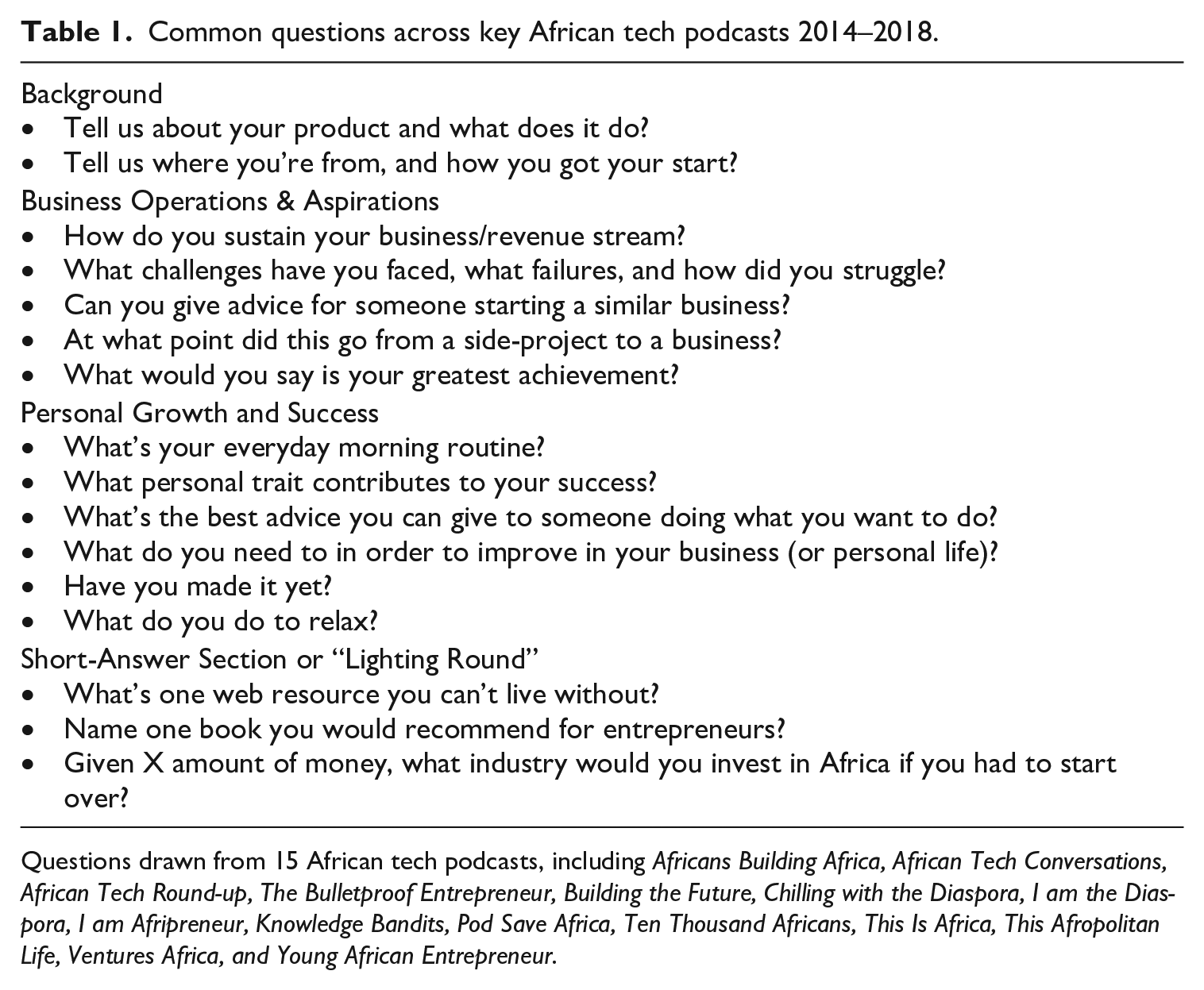
Questions drawn from 15 African tech podcasts, including Africans Building Africa, African Tech Conversations, African Tech Round-up, The Bulletproof Entrepreneur, Building the Future, Chilling with the Diaspora, I am the Diaspora, I am Afripreneur, Knowledge Bandits, Pod Save Africa, Ten Thousand Africans, This Is Africa, This Afropolitan Life, Ventures Africa, and Young African Entrepreneur.
Techniques of storytelling
During my interviews with BTF’s Dotun Olowoporoku, the podcast host spoke at a rapid pace, in a clipped, Nigerian-English accent. As in his podcast, Olowoporoku frequently interrupts dialog with questions, firing fragments of observations, and leaving statements open to be completed by his interlocutor, which he returns in favor. The booming voice that introduces the show is not his own: Olowoporoku states that he was initially reticent to speak on a mic, being self-conscious about his accent. He states that most interviews are done face-to-face for this very reason, rather than over the phone or via Skype. While audio quality for podcasting had hardly been standardized in this era, the high-fidelity sound of BTF is one way the show distinguished itself, as most other African tech podcasts I surveyed at the time hosted guests via Skype and other low-fidelity audio exchanges. Olowoporoku does not live in Africa. He travels extensively to the United States and Europe, and is based in the United Kingdom, which may explain his expressed fondness for an interview style modeled after British TV host James Altucher—beginning conversations in media res. Olowoporoku said he initially envisioned BTF as a content-marketing vehicle, that would drive interest to his business consulting. But he said he has grown fond of the medium as a form of personal expression. Now in his third season, he secured sponsorship from the UK’s cultural diplomacy mission, the British Council.
From 2016 to late 2018, Amadou Hanne, a business consultant in his mid-20s, produced the ABA podcast from his home in suburban Chicago. Hanne envisioned ABA as a forum for emerging continent-based businesses started by returnees, and he began housing the interviews on a Website of the same name, attempting to foster a virtual community. The ABA podcast was distinctive in its first year for hosting shows in both English and French. (Hanne was born in Senegal and lived there until he was 17.) Owing to the ephemerality of the Web, much of his past shows are no longer available via iTunes and Stitcher, and ABA’s Facebook and Website have not been active since summer 2018. 7
In my interview with Hanne in 2017, he described “storytelling” as what drew him to the medium. He thought that presenting business development work via a compelling narrative was something distinct he could offer to African podcasting.
I’d say [to guests], “You are doing amazing. What are you reading, is it something amazing? How do you learn, or what are you doing?” So I think those are things that I learn throughout my journey as a founder, that allow me to use as [podcast] questions today. (Hanne, 2017, personal interview)
But Hanne also stated the process of interviewing is chiefly a form of self-reflexive “capacity-building”—the NGO world’s term for skills enhancement. He stated, “I never thought of myself as a content producer. I thought of this [podcast] as, I’m learning. I’m talking to these people and it’s allowing me to learn, and therefore it’s allowing other people to learn” (Hanne, 2017, personal interview).
A key concept in contemporary media discourse is the notion of the podcast as a “storytelling” medium, as documented in research literature (Bottomley, 2015; Sterne et al., 2008), in popular discourse (Mead, 2018), and among podcasters, including my research participants. Since the widespread success of Serial and other popular series, such as The Moth Radio Hour, podcasting has been valorized as a digital innovation that draws from narrator-driven folk performances—augmented by on-demand, digital, and largely mobile audio media content and interfaces. Such long-form, journalistic shows have created a mass market, in part, by their embrace of new media affordances, such as on-demand distribution, indexability, limitless access, and ability to be edited and remixed as born-digital media.
But another new media aesthetic in podcasting is just as ascendant, though less noted; that of the interlocutor-driven format—the question-and-answer interview style, typified by popular shows, such as The Joe Rogan Experience, The Tim Ferris Show, or The Combat Jack Show. Though perhaps understood more mundanely as interviews, the aesthetic of Q&As demonstrate a dialogic encounter between the host and the guest. Most of the 15 tech podcasts I examined deployed the Q&A format, but more as an “informational interview” rather than as free-flowing conversation. The dialog between host and guest stayed within a standardized set of survey-style questions, as one might hear when a business intern is seeking a potential mentor. Whereas some of the most popular podcasts in the US remix classic radio drama and nonfiction narrative for the audio-on-demand industry, the Q&A format dominates the discursive style of African tech podcasts. In the following excerpt from BTF, Olowoporoku interviews Michael Ocansey, a tech developer from Ghana whose start-up, AgroCenta provides business information to rural farmers using mobile devices and voice-command tools. Note in this transcription, while there is some extemporaneous banter, Olowoporoku structures the exchanges around a concise set of business-oriented queries:
Michael, welcome to Building the Future.
Thank you very much, pleasure to be here.
Let’s start with you, what lead you to what, because you’re a technical person, right?
Yes.
What lead you what you’re doing now?
My co-founder and myself, we had this start-up, Swapaholics. Now, Swapaholics was all about barter-trade, so [pause] that didn’t go to well. We said, how can we pivot this to something related to agriculture.
What was the problem you trying to solve with that [Swapaholics]?
(Guest explains his early startup, Swapaholics. Host asks clarifying questions and offers an analysis of the business’s failure.)
So how did you pivot from swap to helping farmers?
So the initial idea was “How can we take this barter trade culture into agriculture?” So we paid a visit to the northern region of Ghana, that is where a lot of the farming is done.
(Ocansey explains more about AgroCenta’s market research with farmers. Host and guest briefly discuss key issues for farmers selling their crops.)
So, what was the major problem that you were solving there? 8
In this excerpt, Olowoporoku’s interjectional-style is on display, but the exchange also reveals a formulaic approach to the typical kinds of founder profiles on these podcasts. Rather than a free-flowing, emergent exchange of ideas, these episodes might be described as a schematic or formulaic encounter. Questions are driven by business vernacular, and are highly structured, in this case, eliciting an origin and branding narrative from the guest. Such a highly standardized format, as demonstrated by common questions in the chart below, shows the use of what I am terming dialogic formulas. Linguists use the term formula to describe often-repeated phrases in oral (especially folk) performances, such as “Once upon a time,” “Long ago . . .,” or “We are entering the world of make-believe ….” These standardized expressions facilitate a rapid cue for the audience that a dramatic narrative is unfolding (Scheub, 2004; Swann et al., 2004).
The Q&A schema I have examined and documented in the chart below, are largely uniform across productions and episodes. These dialogic formulas utilize an almost mechanical execution of questions, seldom departing from the scripted sequence, as demonstrated by Table 1. This format was dominant among all 15 tech-focused, amateur podcasts analyzed in this research.
Furthermore, while schematic Q&As were consistent throughout these shows—an additionally consistent feature was the use of a “rapid-fire round” of questions asked at the end of each interview. Termed as “lightning,” “fire-round,” or “rapid” round sessions, interviewees are invariably asked to respond quickly to a series of five to seven questions that encapsulate their habits and ideas about being a tech entrepreneur, usually consisting of the following:
What’s your morning ritual?
What’s an important book you’re reading?
What do you do to relax?
What’s one business or technological resource you couldn’t live without?
If you had money to invest in a tech project in Africa, what would that be?
What advice would you give to someone looking to start a new business in Africa?
Schematic storytelling
Storytelling forms the bedrock of African approaches to narrative orature, typified by conventions such as opening and closing invocations, direct address to the audience, allusions to other tales, dramatic turns, repetitive phrases, and call-and-response (Okpewho, 1992). Notably, few of these tactics including the use of axioms or cultural proverbs where found in the African tech podcasts I examined. Instead, when listening to I am Afripreneur or African Tech Round-up one hears the copious use of business terminology, such as “value proposition,” “customer acquisition,” “angel investors,” “market discovery,” “scalability,” “market valuation,” and “investment thesis.” Only music and instrumentation in the introduction and outros of these productions, draw any strong connection to traditional forms of African oral performance, but such “sound bumps” are already squarely within the approaches of mass media producers. The schematic approach to storytelling, including the use of these dialogic formulas, does gesture to traditional storytelling far as it relies on repetition and a formulaic structure.
From these observations, it seems clear that African tech podcasters are advancing the formulaic tactics germane to oral media and to business-themed podcasting, perhaps, rather than using podcasting as a natural extension of common approaches to African storytelling. As new media forms of orature, this is perhaps a reflection of the digital medium itself. By relying on scripted scenarios and computer-based production and editing, rather than extemporaneous performances on the one-hand or rigid cultural formulas on the other, these media productions demonstrate computational aesthetics: Their query-driven interactions and procedural exchanges can be interpreted as a way of optimizing information for retrieval and analysis, as one might access a database, for instance. This approach eliminates traditional aspects of African narrative orature, such as scene-setting, dramatic build-up, or allusion to other stories. The general lack of these conventions can be perhaps interpreted as a flattening of the qualities of a live storytelling experience, which often rely on spontaneity and audience participation (Scheub, 2004). The prompts, as listed in Table 1, evoke from the guest a formulaic and sometimes scripted set of responses. Amadou Hanne, ABA’s lead producer, acknowledged that this schematic approach was intentional. In our interviews, he stated that he kept questions standardized with few follow-ups, mostly as a means to keep the profiles short; it also allowed conversations to be readily editable, so that, he and his team could produce and upload episodes quickly. This approach to post-production emphasizes concise consumable soundbites, and a point-for-point dialogic exchange.
While the outputs of these formulaic interviews do not necessarily constitute storytelling in itself, they do serve as rhetorical devices that prompt forms of narrative storytelling, via ready-made anecdotes and personal stories. The repeated use of questions, such as “What inspired you to get into this field?” prompt the guest entrepreneur to describe their personal journey, thus initiating a narrative meant to provide actionable information for the listener. This schema allows guests (rather than the host) to assume the role of narrator, as they showcase their brand identity, or retell their inspiration for the business. The guest as storyteller, relays their own background as a developer, and describes the challenges they have overcome to become successful, as demonstrated in the exchange between Olowoporoku and Ocansey. This models for listeners, perhaps, a path to success. These performances, however, may also serve to frame their projects as an investment opportunity. In asking the producers about the consistency of “rapid-fire” segments across African tech podcasts, my participants stated that they learned the convention from other programs. Hanne said he was inspired to do his (calling it the “ABA moment”) from the Entrepreneurs on Fire podcast by Johnny Lee Dumas. Olowoporoku, stated that rapid-fire dialogic formulas are simply a convention common to all business podcasts, but he attempts to be more spontaneous than uniform in his responses. Indeed, the similarity of these dialogic formulas across podcasting, including on business and tech podcasting outside of the African context, may indicate the ways that podcasting attempts serve a commercial function as well—that of “content-marketing” for media producers. Hanne stated that his podcast was his main source for “view generation” for the ABA Website, a platform he had hoped to develop into a multimedia company. In my interview with Olowoporoku of BTF, he stated the podcast had not earned any money, but: “the podcast is something that is creating value, money will always follow value . . .”. He stated his focus on podcasting has become as much a passion project as it is a tech enterprise: “I will never [stop] doing the storytelling about Africa, including people who are building the future of the continent” (personal interview).
Conclusion: the multiple literacies of African digital media
Analyzing podcasts can help us understand the importance and affordances of aural media practices, be they “traditional,” mass mediated, digital and/or intimate. Podcasting has been naturalized as a medium for seemingly extemporaneous storytelling, and thus listeners do not always critique their production as constructed media objects: Yet podcasts are scripted, negotiated, scheduled, edited, shaped by audio filters, and mediated to us through listening devices, that themselves are part of larger tech ecosystems. As digital audio texts, they demonstrate the porosity of oral and written culture, and for its developers and users, lessen the need for formal literacies to access information. In this concluding section, I describe how this process is mirrored in many other contemporary African information practices.
African digital media encounters, as described in the first section, are centered around mobile phones in a more fundamental way than in the West: Primary Internet access is achieved via mobile SIM cards and hot-spotting more so than on desktop devices or Wi-Fi; “Flashing” and voice-messaging via WhatsApp are practices are common across the African mediascape. Instead of streaming FM radio via the mobile web, most listeners utilize tuners embedded in their devices (Avle, 2020; GSMA, 2018). Agricultural tech firms aimed at serving rural farmers, such as Esoko and AgroCenta in Ghana (featured on BTF), provide information services, such as weather conditions and crop news via robo-voice messages to its subscribers. They offer more services through tools, such as integrated-voice-response (IVR) or voice-command. Small fintech firms in Ghana, such as Delafone, employ voice-command support in local languages, such as Twi, Fante, Hausa, Ewe, and Ga. Written stories on popular sites, such as GhanaWeb and MyJoyOnline, are available now as audio files. These multilingual and multimodal interactions typify the unique ways that orality continues to be a defining feature of African culture in the digital age, an aesthetic aimed at mass participation and inclusion, with the mobile phone at the center of these interactions.
One may also consider how the hybridizing and informal aesthetics of new orality are at play in the use of “mobile wallets” and other SMS-based applications central to mobile phone culture in parts of Africa. Payments apps, such as M-PESA in Kenya or Vodafone’s Mobile Money in West Africa reduce the need for high proficiency in standard written dialects, favoring instead an alphanumeric literacy required to operate financial transfer software and make transactions. The programs utilize pop-up menus that display simple text via a protocol known as USSD, even on simple, feature phones. In order to do wireless financial transactions, a series of text messages prompt users to perform such functions as follows: Press *131* to access your digital wallet, Press 1 to Receive; Press 2 to Send, and Press 3 to Check Balance. These services enable financial transfers between firms, public utilities, informal traders and individuals (GSMA, 2018; Mbiti and Weil, 2016). The process does not require smart phones, or high-speed Internet to work. This reliance on a simple 16-button keypad interface may represent an inclusive approach to design that is particularly relevant in the developing world and low-resource communities globally where literacy in “standard” languages is not the norm. In Ghana, I have often seen this facilitated by technologically adept sales associates, street-corner credit resellers, and front-end staff at telecom shops, who demonstrate how to effect a transaction across multiple literacies (see Figure 1). Such dexterity also makes sense in media ecologies where a mobile phone keypad or computer keyboard contains layouts and characters for French, English, and Arabic, as well as foreign characters, such as Chinese and Korean. The preponderance of these types of interfaces especially in the secondhand market or at public cybercafés, require users to draw on schematic and procedural formulas to initiate typing, phone calls, and messaging, regardless of knowing any of these languages formally.
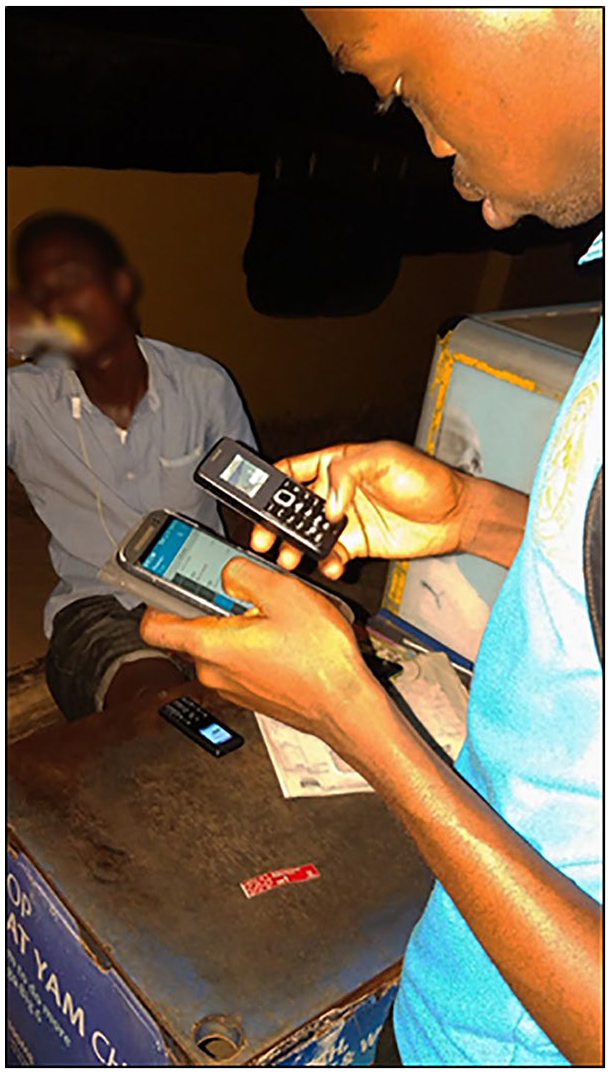
Transferring money credits via cell phone in Cape Coast, Ghana, November 2016. “Mobile money” practices rely on digital, sonic interfaces, and less formal uses of literacy in Africa. Like African podcasting’s procedural aesthetics, these forms encompass what the author calls “new orality.” Photo by author.
Some media conglomerates are increasingly adopting this approach toward new orality, as they localize their content. The BBC’s Pidgin service is one prime example. In 2017, the UK-based broadcast agency created a born-digital radio service, aimed at uniting media publics from Zimbabwe to Jamaica. Touting the new service as one that “cuts across barriers,” the announcement described the linguistic term pidgin as “A mix of English and local languages enabling people who do not share a common language to communicate . . . Primarily, an oral language without a standard agreed written form (sic)” (BBC, 2017). As in podcasting, these aural approaches serve the habitus of African users in their context, where oral discourse and informal idioms dominate social and commercial encounters.
Beyond their schematic formulas, the content of African tech podcasting demonstrates an effort to use aurality (i.e. voice/sound) to make material impact, via business development and/or social and digital inclusion. Podcasting used in these ways represent a way to rapidly learn topics, often with great detail, in an on-demand format—a horizontal pedagogy germane to participatory media in general. My research participants describe their podcasts, ABA and BTF, as tools to combat negative stereotypes about Africans’ technical agency in the West. Moving forward, it is important to ask how these narrative techniques may shape the perception of Africa’s techno-culture: What is the audience for these podcasts? What is their impact on socioeconomic development on the ground? Diasporic podcasters living in the West may provide uneven levels of visibility in the investor and developer space over their continental counterparts. Diasporic podcasters still work from within a distinct valence of the global technological and media landscapes that favor Western broadband access. Particular mobile devices, platforms, and networks emerge from those contexts that, from my own experience on the ground, do not necessarily easily intersect with the sociotechnical systems in Africa, for instance, in the areas of international calling and money exchanges (Royston, 2020). The issue is not specific to African media publics, as digital diasporic and nation-identified online forums often conflate their concerns and parochial techniques of connection and values with those of the entire homeland (Alonso and Oiarzabal, 2010; Madianou and Miller, 2012). That said, in March 2020, the first global African Podcasting Day was set to be hosted live in Nairobi, Kenya. The COVID-19 pandemic forced its postponement and transformation to virtual event in November of that year. The event was arguably more accessible, and organizers have reported a jump in downloads for most of the participants’ programming. 9
If the diaspora’s voice threatens to over-determine what is taking shape with technology on the continent, it is also important to note that African tech podcasters within this global mediascape are telling a larger story about what is happening on the continent today: Rather than these episodes simply being routes for an individual producer’s frame, these podcasts taken as a whole, are creating an archive of discourse on technology and enterprise in Africa in this moment. As such, these African techno-aesthetics speak to the desire to see technology that is development-oriented, geared to the informal via oral forms of literacy, and thus highly inclusive in-terms of its praxis and impact. As the aural features of globally deployed products, such as the Amazon Echo and Apple’s sonically immersive Airpods become more widely adopted, the attentiveness to new orality as seen in African digital media will likely become more widespread.
Footnotes
Funding
The author received funding from University of Wisconsin, Madison’s Office of the Vice Chancellor for Research and Graduate Education for the research, authorship and publication of this article.
