




Abstract
This study is designed to contribute to the debate on whether Facebook is a normalizing or equalizing force in political competition in the context of the 2019 European Parliament elections. It argues that conflicting findings in the literature are due to (a) the lack of cross-country investigations, (b) the lack of a multidimensional approach to Facebook performance, and (c) the conceptual confusion around the normalization or equalization theories. This research tests both the absolute and the relative understanding of the hypotheses in all the visibility-related dimensions (adoption, activity, number of followers, user engagement, and ad spending) in a cross-country dataset that includes all the Facebook activity of 186 parties in 28 countries. Findings demonstrate that in absolute terms the equalization thesis prevails in activity and advertising, while the normalization thesis is confirmed in the dimensions of organic direct and indirect reach. At the same time, in relative terms, social media equalize political competition in each dimension.
Keywords
While party structures had exhibited a high degree of stability in most European countries over decades, the last few years have brought profound changes in several party systems: a number of traditional major parties have lost their prominent positions (e.g. PS in France and CDA in the Netherlands), while newcomers (e.g. AfD in Germany, Podemos in Spain), and previously marginal actors (e.g. the Lega in Italy, Die Grünen in Germany) have managed to become important actors in a relatively short time (see Emanuele and Chiaramonte, 2018). While there are multiple reasons behind these remarkable transformations, it is noticeable that this is also the decade when social media platforms, which decrease the gatekeeping power of legacy media and enable parties to reach their voters directly, have become prominent channels of political communication. Indeed, numerous case studies call attention to the role of effective social media communication in newcomers’ electoral success (e.g. Arzheimer, 2015). However, beyond these anecdotal evidences, it is still an open empirical question if social media platforms are equalizing forces in political competition by providing more accessible and equal campaign interfaces for political actors with different backgrounds, and thereby, contributes to the transformation of the political landscape.
Research on the relationship between the Internet and politics has long investigated the possible role of online campaign tools in shaping the political structure. One of the oldest debates in the field is the so-called normalization versus equalization polemics (for an overview, see Gibson and McAllister, 2015). Some argue that online campaigning is a normalizing force, as existing structural inequalities are reflected in the use of such tools, and this way, larger political actors benefit from it more (Margolis and Resnick, 2000). In contrast, others claim that the online sphere is a driver of political change, and online campaigning equalizes political competition; because these devices are more accessible to smaller actors than traditional campaign tools, they may decrease such parties’ structural disadvantages in the electoral competition (Corrado and Firestone, 1996).
While research in the Web 1.0 context mostly supports the normalization thesis (e.g. Margolis and Resnick, 2000), the emergence of social media has re-opened the debate as the uniformed free and easy-to-use platforms offer stronger arguments for the equalization thesis (Gueorguieva, 2008). Numerous studies have tested the two hypotheses regarding social media platforms, but the findings are fairly mixed as there is evidence for both (e.g. Gibson and McAllister, 2015; Jacobs and Spierings, 2016; Kalnes, 2009; Klinger, 2013; Larsson, 2016). Consequently, the current state of the literature is far from offering definitive conclusions regarding the role social media play in political competition. Using a cross-country dataset, this article aims to contribute to this debate and test the hypotheses on parties’ Facebook performance in the context of the 2019 European Parliament (EP) elections.
This study argues that the mixed findings are due to the lack of extensive cross-country research and some conceptual confusion around the two concepts. First, the literature is largely dominated by single-country studies that limit our ability to generalize their findings. Second, while the theses of normalization and equalization are usually tested in relation to political actors’ visibility on these platforms, there are several dimensions of social media performance that affect visibility, such as adoption, activity, the number of followers, the level of user engagement and advertising activity. Still, most studies focus on only a few of these factors, thereby offer an incomplete picture of political actors’ social media performance. Third, both concepts are highly undertheorized (Wright, 2012), and their usual conceptualizations do not allow us to treat them as competing hypotheses. This study argues that this conceptual confusion is due to the fact that there are two underlying approaches to the understanding of structural differences behind these definitions: one focuses on absolute differences across political actors, while the other emphasizes relative deviations. The absolute approach concentrates exclusively on the existence of differences; those actors benefit from using social media who perform better on these platforms. In contrast, the other approach focuses on the extent of differences rather than their pure existence; political structure may also change when minor political actors perform better in the online sphere than expected based on their offline position and opportunities. Normalization is usually conceptualized as the absolute advantage of larger political actors, while equalization is more about a levelling playing field and shrinking gaps between major and minor actors, which is therefore more of a relative understanding of differences.
This study aims to fill the gaps by testing both the absolute and relative versions of the hypotheses in a cross-country sample in relation to all the dimensions of parties’ visibility on Facebook. The dataset includes all parties in 28 EU countries that reached at least 3% of the votes in the EP elections and ran in the last national election (N = 186), also all their Facebook posts and ads published during the last 4 weeks of the campaign. While European parties use multiple social media platforms for campaigning, Facebook is selected as it is the dominant site in each country (e.g. Newman et al., 2020). Also, it is probably the only one that is extensively used by political actors in all European member states, as the popularity of other platforms (e.g. Twitter, Instagram) is highly context-dependent (Lilleker et al., 2015). To my knowledge, this is the first study that tests the normalization and equalization hypotheses in such an extensive cross-country sample, and also the first to focus on all relevant aspects of visibility, namely adoption, activity, number of followers, level of user engagement and advertising activity. Moreover, advertising activity has not been investigated so far even though it is often referred to as one of the main normalizing forces of Facebook campaigning (Jacobs and Spierings, 2016).
Findings show that a multi-dimensional approach to Facebook performance, and the differentiation between the absolute and relative understanding of the two theories are highly justified. While in the case of the dimensions of presence and advertising, the absolute equalization thesis is confirmed, in the dimensions of organic direct (number of followers) and indirect (level of user engagement) reach, absolute normalization prevails. In relative terms, however, equalization is the main rule. Consequently, while minor and major parties are characterized by similar levels of Facebook organic and advertising activity, larger parties can reach more people with their activity even if the differences are much more modest between parties than in the electoral sphere. Consequently, it is true that larger parties dominate Facebook in terms of visibility, but social media are still able to level the playing field and decrease smaller parties’ structural disadvantages.
Social media as a normalizing or equalizing force
The normalization versus equalization debate is one of the oldest topics in the Internet and politics literature (Corrado and Firestone, 1996; Margolis and Resnick, 2000). Roughly speaking, the normalization hypothesis argues that the Internet and social media reinforce existing inequalities in the political structure, as larger political actors benefit more from using them. In contrast, the equalization hypothesis claims that the Internet and social media are equalizing forces, as they are more readily available and exploitable for smaller political actors than other campaigning tools, thereby online campaigning decreases the structural inequalities of the political sphere (e.g. Jacobs and Spierings, 2016).
In the context of Web 1.0., while some early findings had supported the equalization thesis, subsequent research largely confirms the normalization theory; as effective online presence requires sufficient resources and reputation, larger actors benefit from using websites (for an overview, see Gibson and McAllister, 2015). The emergence of social media platforms, however, has revitalized the debate. Their easy-to-use, freely available and standardized interface may support the equalization argument (Gueorguieva, 2008), while proponents of the normalization thesis argue that even in this context, resources and reputation still matter. Social media expertise and reach can be bought with money (Jacobs and Spierings, 2016), and offline popularity can be translated into online visibility through the larger numbers of followers and higher levels of user engagement (Strandberg, 2013). Empirical findings are fairly mixed in this respect (for an overview, see Lev-On and Haleva-Amir, 2018). There is evidence for both the normalization (e.g. Kalnes, 2009; Klinger, 2013; Lev-On and Haleva-Amir, 2018; Samuel-Azran and Yarchi, 2020; Strandberg, 2013; Vergeer et al., 2013) and the equalization theories (e.g. Carlson and Strandberg, 2008; Chen and Smith, 2011; Gibson and McAllister, 2015; Larsson, 2016; Samuel-Azran et al., 2015; Southern, 2015). This study argues that that lack of a definitive conclusion regarding the role of social media in the structure of political competition can be traced back to three major gaps in the literature.
The need for a cross-country approach
The first and most obvious reason behind mixed findings is the dominance of single-country studies and a complete lack of expansive cross-country investigations. Conflicting findings stem from different time periods and countries, and therefore, it is difficult to compare them with each other (Lev-On and Haleva-Amir, 2018). The present research aims at filling this gap by conducting the first extensive cross-country investigation on the topic, thereby providing more generalizable findings than previous work.
The EP election offers a unique case to investigate the two competing hypotheses in a cross-country sample. It ensures the homogeneity of electoral context as much as possible in a cross-country context; there are national parties competing with their national opponents at the same time, playing by almost the same rules and having similar gains. While EP elections had long been considered of second order, in the last few years, their importance has significantly increased (Marsh, 2020).
The context of the EP election also ensures the relative homogeneity of the unit of analysis. In national elections, parties and political leaders may play different roles, as electoral rules put different emphases on parties and candidates. During the EP elections, parties are at the forefront, as in each country citizens vote for party lists. To sum up, while perfect homogeneity of contexts cannot be achieved in a cross-country campaign research, the investigation of parties during the 2019 EP elections yields the best opportunity for comparative examination.
European parties use multiple platforms for campaigning, however, the popularity of most platforms is highly different across the member states. For instance, Twitter is a very popular site in several Western European countries, but hardly used in Central and Eastern Europe (CEE) nations (e.g. Lilleker et al., 2015), while VKontakte is a highly preferred platform in Baltic states (Teperik et al., 2018), but almost invisible in other countries. To ensure the relative homogeneity of the cross-country sample, the investigation is limited to Facebook, which is the dominant social media platform in each member state (Newman et al., 2020; Teperik et al., 2018).
Dimensions of Facebook performance
The political value of Facebook as a political communication tool is that political actors can reach voters with their messages through the platform and thereby potentially affect them. However, there are huge differences in the level of reach across Facebook pages, which are shaped by several factors. In addition to a lack of expansive cross-country investigations, the second reason for having conflicting results relates to the fact that social media performance could be conceptualized and tested in several dimensions, such as adoption, activity, the number of followers, the level of user engagement and spending on ads. While there are strong theoretical arguments for approaching and measuring social media performance as a multidimensional concept, in most existing studies, conclusions are based on the investigation of no more than one or two dimensions. However, the small number of studies that cover at least three performance indicators reveal that there are differences across dimensions (Jacobs and Spierings, 2016; Lev-On and Haleva-Amir, 2018; Vergeer et al., 2013). Consequently, the conclusion about the role of social media in the structure of political competition strongly depends on the indicator(s) under investigation. To bridge this gap, the present research aims at covering all theoretically relevant dimensions of Facebook performance related to the visibility of political actors, including spending on ads, a factor that the normalization or equalization literature has not empirically addressed so far.
No visibility can be gained without presence. The most frequently investigated dimension is thus the level of adoption (e.g. Gibson and McAllister, 2015; Southern, 2015). It is obvious that the prerequisite to exerting influence through Facebook is opening a page. Another aspect of presence is the also widely addressed dimension of activity (e.g. Jacobs and Spierings, 2016; Vergeer et al., 2013). More active political actors can convey more messages to users and build a more intensive relationship with their followers.
While being present is a crucial condition of visibility on Facebook, the visibility level of activity on pages is determined by other factors. On Facebook, pages can reach voters both directly with the users’ explicit consent (that political marketing conceptualizes as ‘pull media’) and indirectly independently of the recipients’ will (‘push media’). The main determinant of direct reach is the number of followers, as posts can directly appear on these subscribers’ News Feeds. While the News Feed is strongly curated by the algorithm of Facebook, limiting pages in reaching all of their followers (see Bossetta, 2018), all else being equal, pages with more followers can reach more users directly, therefore, the number of followers is an important indicator of Facebook performance (e.g. Klinger, 2013; Samuel-Azran et al., 2015).
However, indirect reach also plays an important role in the visibility of political actors’ messages. The organic way to convert pull media into push media is exploiting the virality-based dissemination logic of Facebook (Klinger and Svensson, 2015). Users’ engagement with political actors’ posts makes the content visible beyond followers, as their reactions, comments and shares can be seen by their own friends even if they do not follow the particular pages (Bene, 2017). Moreover, this engagement-mediated content may also be more effective in informing, mobilizing or persuading other users, as peer-influence in the social media context is widely demonstrated (e.g. Anspach, 2017). Furthermore, the level of user engagement also affects pull media performance, as reaching followers is seriously constrained by the above-mentioned algorithmic filtering of Facebook’s News Feed (see Bossetta, 2018). However, for the algorithm, the level of user engagement is one of the most important signs about the personal relevance of a particular content, therefore, highly engaged posts can reach more followers than less-engaged content (Bucher, 2012). Therefore, provoking user engagement is one of the major goals of political actors’ Facebook communication. In fact, a few research papers have addressed this factor in the context of the normalization or equalization debate (e.g. Larsson, 2016).
However, visibility can be purchased. Pages are given the option to buy ads through Facebook’s advertising platform, which offers purchasers highly sophisticated targeting possibilities based on its incredibly rich user data (Kruschinski and Bene, 2021). Ads are posts that appear on the News Feeds of some members of the pre-defined target audience even if they do not follow the particular pages. The price of specific ads determines the number of users exposed to the respective content and the sophistication of targeting settings. All else being equal, political actors who spend more money on Facebook ads are generally able to reach more non-followers with their messages in a more effective way than actors who spend less on Facebook. Also, paid content can generate additional user engagement by showing the content on more users’ News Feed, which in turn will further increase the specific post’s ‘push media’ potential (Kruschinski and Bene, 2021).
Overall, effective Facebook performance can be properly evaluated by focusing on all aspects of visibility, namely adoption, activity, number of followers, level of user engagement, and advertising activity. No research has investigated all these factors together; therefore, they have produced incomplete pictures of political actors’ Facebook performance and its determinants. Furthermore, while most factors listed have been addressed separately in the literature, the role of advertising activity in the normalization versus equalization debate has not been empirically assessed. This is because before 2018 (before 2019 in Europe) Facebook did not provide any public information about political actors’ advertising activity. Since then, they have launched the publicly available and searchable Ad Library, which includes all ads labelled as ‘political’ with a few metadata, most importantly about their prices.
This is crucial for the normalization versus equalization debate, as one of the main arguments for the normalization position is that money matters on Facebook, and larger actors with well-resourced backgrounds can boost their presence by buying visibility (Jacobs and Spierings, 2016). However, in lack of publicly available data, this argument has long been an empirically unverifiable assumption rather than a strong building block of the normalization theory. Moreover, antagonists could also argue that Facebook is still a cheaper and more accessible advertising market than its offline counterparts. Therefore, it is also conceivable that smaller actors who could access the traditional advertising options to a lesser degree are more active on this platform. The Ad Library allows to open this black box and empirically tests both theories in relation to advertising activity.
As for the other factors, there are arguments for both sides of the debate. In general, proponents of equalization argue that the wide and free availability of platforms enables political actors to compete in a context where resource differences do not matter; minor political actors can open pages, be active, recruit followers and provoke engagement the same way as major actors. In contrast, the normalization argument emphasizes that operating a page and updating it still frequently requires human resources, and the number of followers and the level of user engagement are largely shaped by the actors’ offline reputation and popularity, as well as by the quality of content the page produces.
Two approaches to normalization and equalization
The third reason behind the unclear conclusions is related to the problem that several authors have pointed out, namely that both theses are highly undertheorized and are vaguely defined (Jacobs and Spierings, 2016; Southern, 2015; Wright, 2012). While it is obvious that the equalization theory argues for the transformative role of social media platforms and the normalization hypothesis represents the ‘politics as usual’ viewpoint, it is undefined what they mean by ‘change in political structure’, the cornerstone of both approaches. Definitions used by most studies are not straightforward, and there are at least two major understandings.
A more permissive interpretation of change in the political structure appears mostly in connection with equalization, as it is described as social media levelling the playing field (Samuel-Azran et al., 2015), compensating for structural disadvantages (Klinger, 2013), strengthening or benefitting smaller political actors (Chen and Smith, 2011) and enabling fairer access to potential voters (Samuel-Azran and Yarchi, 2020). These accounts are frequently contrasted with the offline sphere, which is demonstrated to benefit larger parties in several ways (e.g. Hopmann et al., 2011; van Spanje and Azrout, 2020), arguing that by using social media smaller political actors can ‘overcome the disadvantages they typically faced in the offline media environment’ (Gibson & McAllister, 2015: 529). In contrast, normalization is more narrowly defined as the dominance of major political actors in the online sphere (Jacobs and Spierings, 2016), which thereby reproduces and reinforces existing electoral inequalities and the offline patterns of the campaign context (Southern, 2015).
The problem with these conceptualizations is that while they are generally treated as mutually exclusive hypotheses, actually both could work simultaneously. Major political actors may dominate the political social media sphere while the inequalities are narrower here, and minor actors perform better relative to their position in the political structure. The reason behind this confusion is that implicitly there are two underlying approaches to the understanding of the structural differences within these conceptualizations. If the goal is to conceptualize the two theories as competing ones, these approaches should be made explicit.
The stricter approach, which is often associated with the conceptualization of normalization, focuses exclusively on the existence of differences; those actors benefit from using social media who perform better on these platforms. It is also unclear if it is only the negative effect that supports the equalization thesis (smaller parties perform better) or the non-effect does as well (smaller parties perform similarly to larger parties), therefore there should also be a differentiation between weaker and stronger versions of the hypothesis. According to this approach, political structures change only if minor actors are as successful (weaker version) or even more successful (stronger version) on these platforms than major political actors (equalization), otherwise, existing inequalities are only reproduced (normalization). As it is only the existence of the difference that matters here, this approach can be labelled as the absolute approach to the equalization versus normalization debate. In line with this approach, two mutually excluding hypotheses are formulated and tested in this study.
H1. Absolute normalization: larger parties perform better on the different dimensions of social media performance (adoption, activity, followers, user engagement and advertising expenditure) than smaller parties. Their absolute advantage over smaller parties increases with social media use.
H2. Absolute equalization: smaller parties perform similarly (weaker version) or even better (stronger version) on the different dimensions of social media performance (adoption, activity, followers, user engagement and advertising expenditure) than larger parties. Their absolute disadvantage over larger parties does not increase (weaker version), or even decreases (stronger version) with social media use.
The other approach concentrates on the extent of differences rather than their pure existence, as it is often detected in the conceptualizations of equalization. According to this view, political structure may also change when minor political actors perform better in the online sphere than expected based on their offline position and opportunities. If the gap between larger and smaller political actors was narrower in the online sphere than in the electoral sphere, it would indicate that social media benefit smaller actors, level the playing field and compensate for their structural disadvantages (equalization). In contrast, if minor actors performed similarly (weaker version) or even poorer (stronger version) than their offline significance, then social media would not level the political structure (normalization). As the emphasis is on the extent of differences, this approach can be labelled as the relative approach to the normalization versus equalization debate. Accordingly, two competing hypotheses are proposed:
H3. Relative normalization: differences between larger and smaller parties in the different dimensions of Facebook performance (adoption, activity, followers, user engagement and advertising expenditure) are the same (weaker version) or even more substantial (stronger version) than expected based on their electoral performance. Relative advantages of larger parties over smaller parties do not change (weaker version) or even increase (stronger version) with social media use.
H4. Relative equalization: differences between larger and smaller parties in the different dimensions of Facebook performance (adoption, activity, followers, user engagement and advertising expenditure) are more moderate than expected based on their electoral performance. Relative disadvantages of smaller parties over larger parties decrease with social media use.
While conceptually, both approaches are present in the literature, empirically, the absolute approach plays the dominant role. Any significant and positive association between party size and social media performance is usually interpreted as evidence for the normalization thesis. Consequently, if larger political actors are more successful than their smaller counterparts, the normalization thesis appears to be supported even in cases when differences between major and minor actors are modest. However, as Wright argues, this absolute approach raises unrealistic and excessive expectations about the transformative role of social media, thus it implies overly pessimistic conclusions, while it is blind to the changes that actually occur. As he puts it: ‘the smaller, incremental changes that can occur (often at the periphery) remain potentially very important: there is a danger that their significance can be over-looked’ (Wright, 2012: 252). Based on the observations that larger political actors perform better on social media platforms than smaller ones, numerous studies draw the conclusion that social media do not affect the structure of political competition. However, these observations do not exclude the possibility that the structure of political competition is changing remarkably, as it may still be the case that social media platforms ‘level the playing field’, ‘compensate for structural disadvantages’ and ‘strengthen smaller political actors’ as emphasized by the equalization thesis even if the dominant absolute approach is blind to these effects. This research is designed to solve this conceptual confusion in the literature. Performance indicators are operationalized in a way to allow to test both the absolute and relative approaches of the normalization and equalization theses.
Methods
Data
To test these hypotheses, a unique dataset of parties’ Facebook activity during the 2019 European Parliament election has been compiled. First, all parties were collected that reached at least 3% of the votes in their respective countries and ran in the last national election (N = 186). This threshold was applied, as the large number of hardly existing, often ephemeral tiny parties that ran in the election without significant electoral support would remarkably distort the findings. In the case of joint lists, only their leading parties were considered, as minor associated parties can play very different roles in electoral coalitions. The only exception was the list of the European Coalition in Poland, as this was a wider oppositional coalition. In this case, those members of the Coalition were considered that had managed to enter the national parliament in 2015 or the European Parliament in 2014 on their own party lists (PO, Modern, SLD, PSL). Parties that achieved their last national election results as members of wide or balanced electoral coalitions were not considered. However, parties that ran on joint lists with minor satellite parties were included, and their joint electoral results were treated as the dominant party’s result. In Portugal, the 2019 October election was considered, because in the previous election two significant parties had run on joint lists (PSD and CDS-PP), which should be missing cases otherwise. For each party, some descriptive information was recorded, such as ideology, governmental position and age; their official Facebook accounts were also collected with some details, such as the number of followers or the year when the pages were founded. Then, right after the election all posts (N = 26,608) and ads (N = 65,459) 1 were downloaded with their metadata published by parties’ official Facebook pages during the last 4 weeks (28 days) before the Election Day. 2
Variables
Dependent variables are the dimensions listed above where differences in Facebook performance can manifest. Adoption means which parties have, or do not have a Facebook account. After the data collection, however, it turned out that the most frequently investigated dimension, the adoption of a Facebook page, had lost its relevance. Only five out of the 186 parties under scrutiny were found to have no Facebook page. All of them are minor parties receiving 3–8% of the votes, and all but one are extreme parties. Consequently, for this dimension, both the weaker version of absolute equalization thesis, and the relative equalization thesis can be confirmed without further investigation, because smaller parties have the same performance as larger parties. Level of activity is measured by the number of posts published on parties’ FB pages during the 28-day time frame. Numbers of followers were recorded a day after the last Election Day (27th May) when all Facebook data were scraped. As for user engagement, the median number of reactions, comments and shares of posts during the 28 days were applied.
When it comes to expenditure on ads, not long before the EP election, Facebook made publicly available all the political ads posted by Facebook pages in its Ad Library. While the Library offers unprecedented access to ad data, its utilization is not without limitations. Most importantly, researchers have no access to the data collection process, therefore, its reliability cannot be effectively controlled. However, there are arguments that the library is rather close to complete when it comes to parties. While after the election, some reports indicated the incompleteness of the Library (ERGA, 2019), they mostly referred to the problem that Facebook did not effectively identify what ads are political. However, parties’ central pages are automatically considered as political advertisers, and the European Regulators Group for Audiovisual Media Services (ERGA) reported that even when parties had failed to complete the authorization procedure, Facebook contacted them to ensure that the procedure was followed correctly (ERGA, 2019: 16). Furthermore, Facebook updated its Ad Library in summer 2020 with narrower price ranges and more political ads included. For the analysis, this updated dataset was used, though the differences are minor as the number of parties’ ads in the updated dataset increased by only 2%. At the same time, the number of all political ads increased by 28% in the updated Library, yielding further evidence that it is not parties’ ads that Facebook had difficulties to identify in the first round.
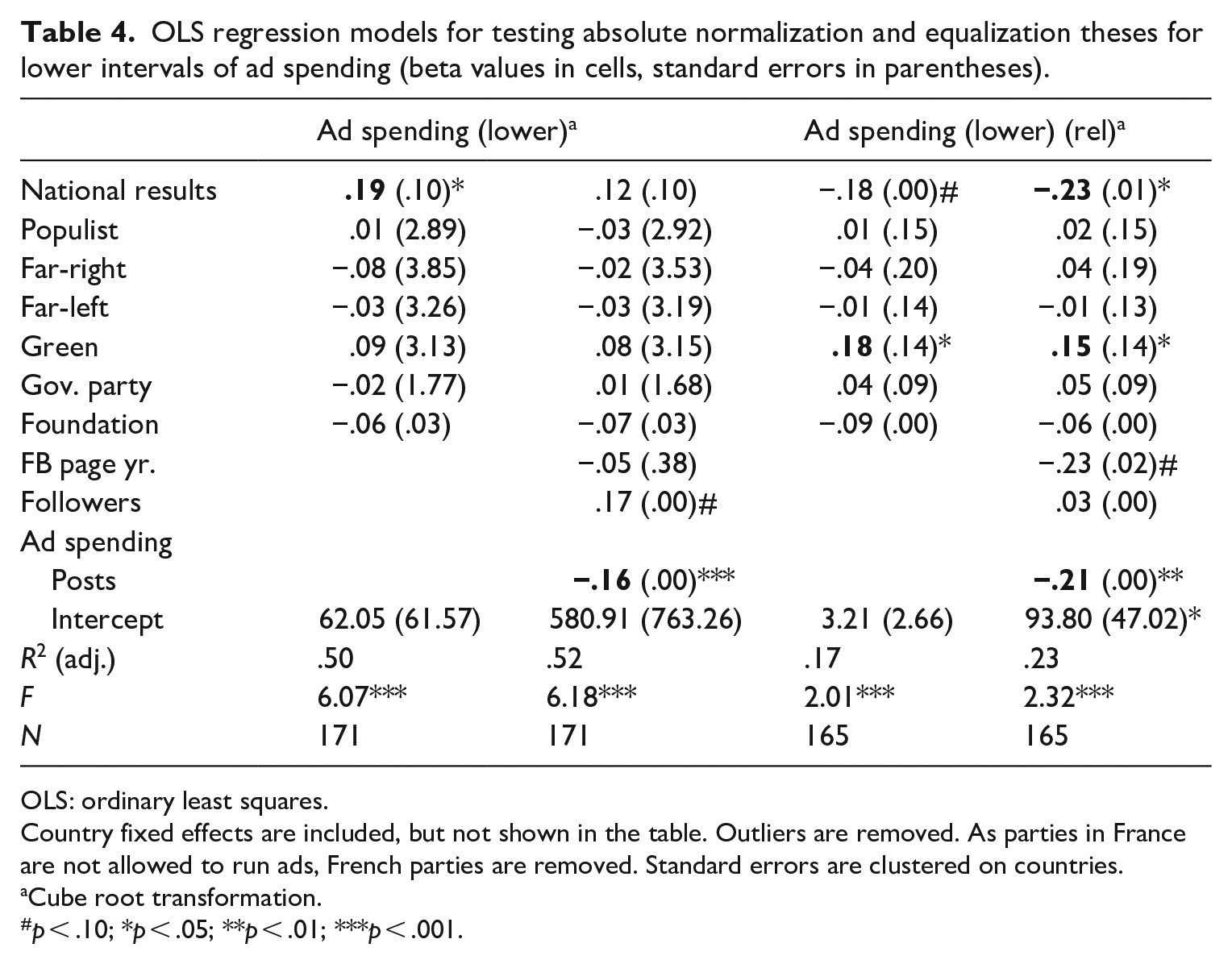
For the expenditure on individual ads, the Library only reports the intervals which the specific ad fits into in the currency it is paid in. Therefore, country-specific currencies were first transformed into euro. 3 To estimate the parties’ total expenditure, the upper intervals of individual ad prices were summed and presented during the analysis. However, as a robustness check, models with the sum of lower intervals were also calculated (see Appendix 1).
The main independent variable is the vote share for the particular party in the last national election, as it is the main indicator of a party’s position in the political sphere. The national election was chosen, as (1) it is the first-order election which is more decisive for parties’ resources, political opportunities and public images than the results on the second-order EP-election, and as (2) this way there is a time lag between the main IV and DVs, as parties’ position precedes their Facebook performance. Parties’ position could also be measured by their seat share, but this way, extra-parliamentary parties could not have been included in the final sample. Also, parties’ seat share is largely shaped by the varied electoral rules.
To obtain valid results, several additional factors were controlled for. First, the literature demonstrated that parties’ ideology and governmental position may affect their Facebook performance. Because populist (Larsson, 2016), green (Gibson and McAllister, 2015), far-right (Carlson and Strandberg, 2008) and far-left (Jacobs and Spierings, 2016) are often found to perform better on social media, these aspects were entered into the models as control variables. Also, oppositional parties are also shown to perform better on social media platforms (Vergeer et al., 2013); oppositional forces are more motivated to innovate in their campaigning strategy as they aim to change the status quo, and these efforts may produce better outcomes in their social media performance (Kreiss, 2016). This aspect is also loosely related to the normalization or equalization debate, as incumbency is an oft-discussed factor of power inequalities in the political sphere (Hopmann et al., 2011). The specific party’s foundation year is included, as older parties may have a greater reputation, affecting their Facebook performance. The year of launching the Facebook page is also controlled for, as older pages have had more time to build an effective Facebook presence. In addition, different dimensions of Facebook performance may affect each other. Specifically, the level of activity, the number of followers and the level of spending on ads may be significant. The level of activity may shape the number of followers, the level of user engagement and the pages’ advertising activity, while the number of followers may generate more organic and advertising activity and user engagement. Also, pages that spend generously on Facebook can attract users, thereby increase their follower base and the level of engagement. Therefore, these factors are also controlled for.
As for the sources of variables, election results, 4 governing status and the foundation year were collected from publicly available official resources, while for coding a party as populist, far-right or left-right the categorization of The PopuList (see Rooduijn et al., 2019), and for the identification of green parties, the ParlGov dataset (Döring and Manow, 2019) were used. Information on the age of a Facebook page is available on the respective page.
The absolute normalization hypothesis is considered supported if the electoral result is significantly associated with the dependent variables; as long as the relationship is non-existent (weaker version) or negative (stronger version), the equalization thesis is accepted. A similar research strategy is applied when testing the relative normalization and equalization hypotheses, but in this case, a transformed version of the dependent variables is employed; deviations from the expected values of each dimension were considered. Expected values were calculated based on party size in terms of electoral support and the sum of the values for each dimension by country. To obtain an expected value, the total number of posts, followers, reactions, comments, shares and euros spent on ads that parties have in each country were divided by the electoral support of particular parties. For instance, if a party received 15% of the votes, its expected value is 15% of all the reactions that the parties triggered in its country. In the next step, these expected values were compared with the actual values parties have. This ratio indicates whether a particular party outperformed or underperformed expectations based on their electoral support. If electoral support is significantly and negatively associated with these dependent variables, the relative equalization hypothesis is regarded as supported, while the lack of any significant association (weaker version) or a significant positive relationship (stronger version) suggests that the hypothesis of relative normalization can be accepted.


OLS regression is used to estimate the models. However, observations are not independent because data are nested in the level of countries. Moreover, variables used in the relative approach are more heavily dependent on other parties’ performance, because expected values are calculated based on all the parties’ performance in the respective country. This situation is very similar to models where political actors’ electoral share is predicted, as one particular actor’s electoral performance is inseparable from the competitors’ performance. Therefore, this study follows the modelling strategy these research projects usually apply, and countries as fixed effects are entered into the models, as well as standard errors are clustered on countries (e.g. Hix and Marsh, 2007; Tavits, 2012). Also, most dependent variables are log-transformed, as the assumptions of homoscedasticity were not met in their original not-normally distributed forms. For both versions of the spending on ads variable, cube root transformation was applied, as due to the relatively large number of parties (N = 21) that spent nothing during the campaign, the log-transformed data do not meet the assumptions. To distinguish the effects of extra-Facebook and Facebook-related factors, two models are run for each dependent variable: the first includes only the independent variables (electoral results, ideological and political position) and the control variable, foundation of the parties, while the second adds control variables related to parties’ Facebook presence (foundation of the page, activity, number of followers and ad spending).
Results
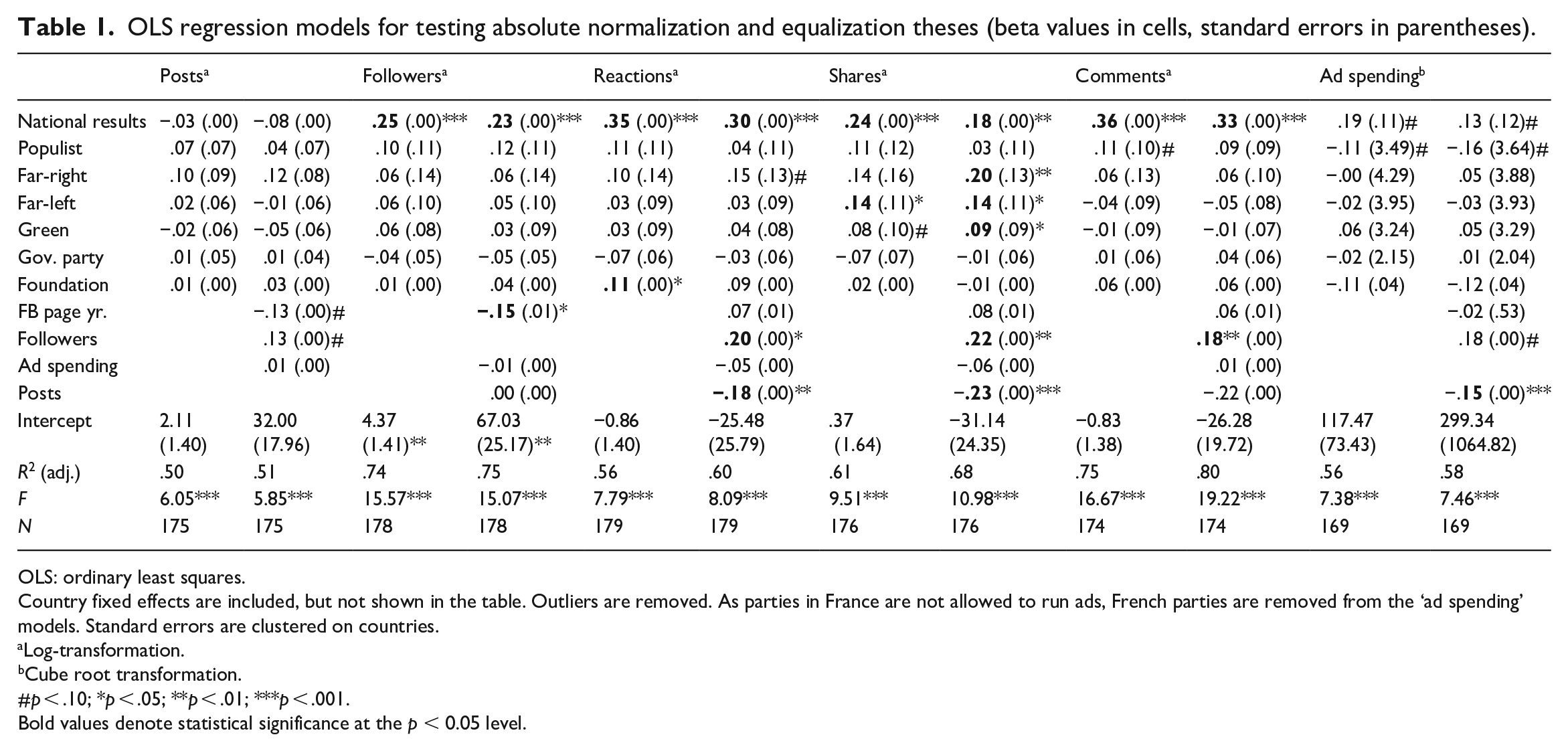
First, the absolute normalization and equalization hypotheses are tested; it is investigated whether larger parties are more successful on Facebook than smaller ones. As Table 1 shows, vote share in the national election is significantly and positively associated with the number of followers, reactions, shares and comments on Facebook. All else being equal, larger parties have more followers and can trigger more reactions, comments and, to a lesser degree, shares as well, than smaller ones. Moreover, the number of followers also significantly shapes the number of reactions, shares and comments. Therefore, party size clearly affects user engagement both directly and indirectly. Ad spending is also positively related to vote share, but this association is significant only at the .07 p-level, and it is non-significant when lower intervals are considered (see Appendix 1). Moreover, advertising activity does not indirectly affect other dimensions either. At the same time, it seems that the overall level of activity is independent of party size; smaller parties do not lag behind their larger counterparts. On the contrary, smaller parties are even more active, although this association is not significant.
OLS regression models for testing absolute normalization and equalization theses (beta values in cells, standard errors in parentheses).
OLS: ordinary least squares.
Country fixed effects are included, but not shown in the table. Outliers are removed. As parties in France are not allowed to run ads, French parties are removed from the ‘ad spending’ models. Standard errors are clustered on countries.
Log-transformation.
Cube root transformation.
p < .10; *p < .05; **p < .01; ***p < .001.
Bold values denote statistical significance at the p < 0.05 level.
To sum up, it seems that in the dimensions of followers and user engagement, the hypothesis of absolute normalization is supported, but in the case of activity (and adoption), and to a lesser degree, in that of ad spending, the weaker version of the absolute equalization thesis prevails. Also, it is important to see that while the weaker version of the absolute equalization hypothesis is supported in dimensions of presence (adoption and activity), in each dimension related to the direct and indirect organic reach, absolute normalization prevails. Thus, while there are no significant differences in parties’ Facebook presence based on their size, larger parties can probably reach more people with this level of activity than their smaller counterparts. Moreover, the level of activity cannot boost the number of parties’ followers and the level of user engagement; consequently, presence has no indirect positive effect on the dimensions of organic reach either. Actually, the significant negative effect in the case of the reactions and sharing models suggest that a heightened presence may even have a backlash effect, as highly active parties’ individual posts appear to be less reacted and shared. This result can be explained by Facebook’s algorithmic selectivity as users may be exposed to only a fragment of posts, and this way larger number of posts results in more posts that remained unnoticed which decrease the median values. Alternatively, even if Facebook allows users to be exposed to numerous posts from the same content providers, they may feel overwhelmed with the specific page, and be less keen to engage with its content.
Regarding the control variables, populist parties do not outperform other types of parties in any of the dimensions investigated here. It is only in the number of shares where far-right, far-left and green parties seem to be more successful. Also, the results indicate that opposition parties do not significantly outperform government parties in either dimension. Also, it seems that early adoption matters, as older pages have more followers which also indirectly affect the level of user engagement.
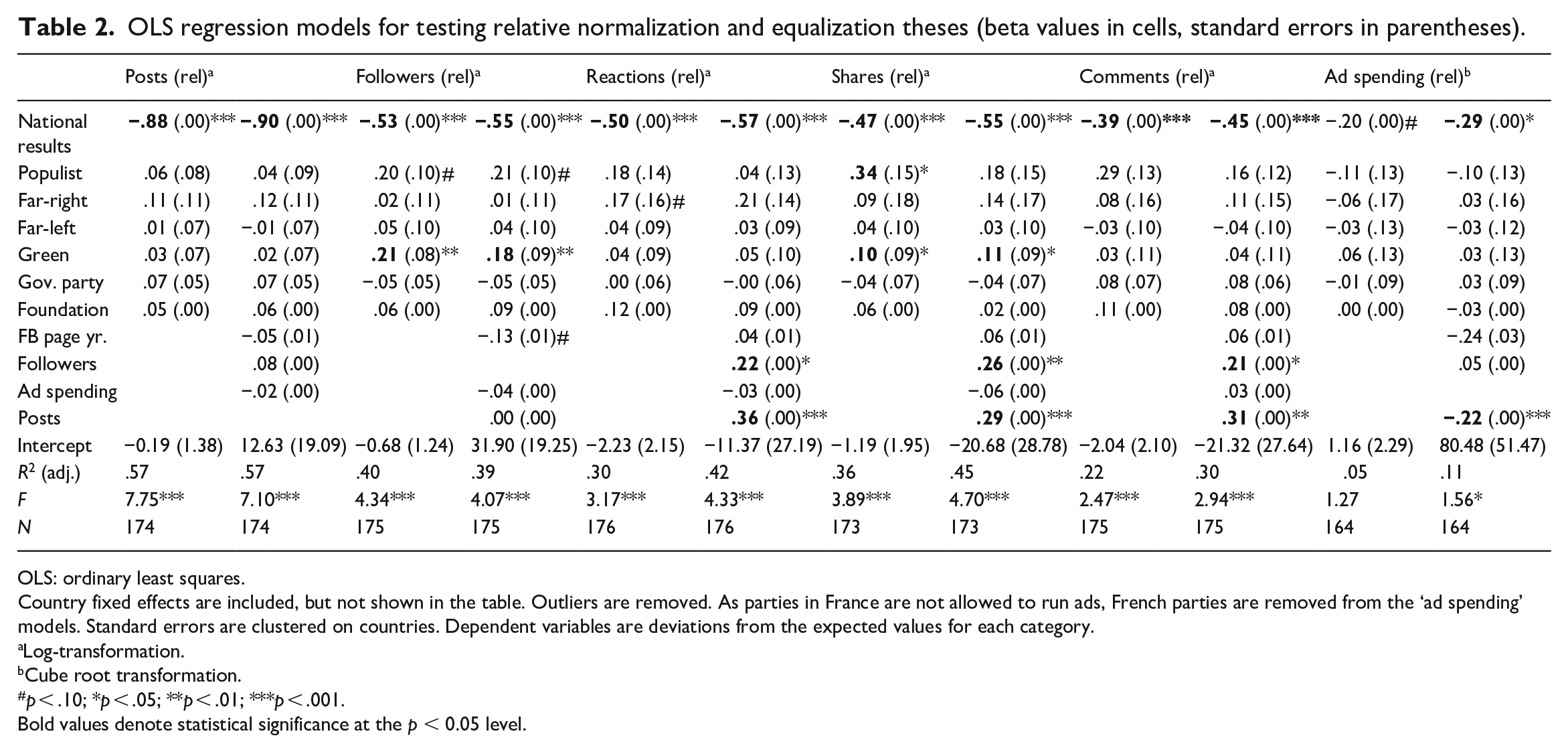
Table 2 shows that relative equalization hypotheses are supported in each dimension of Facebook performance. When the deviations from the expected values are the dependent variables, there are significant and strong negative relationships between vote share and the different dimensions of Facebook performance. Consequently, parties that post more frequently, have more followers, trigger more user engagement and spend more money (both for upper and lower intervals; for the latter, see Appendix 1) than expected based on their electoral support. Thus, Facebook levels the playing field and compensates for smaller parties’ structural disadvantages. Turning to the control variables, it seems that the ideology and government position of parties do play a negligible role in their relative performance, but green parties have more followers (populist parties as well at p = .6 level) and provoke more shares than expected based on their electoral support. The number of followers and early adoption have a similar role to the absolute performance; early adopters have more followers (at p = .9 level) than their expected values, and the number of followers increases the level of users’ engagement with their posts.
OLS regression models for testing relative normalization and equalization theses (beta values in cells, standard errors in parentheses).
OLS: ordinary least squares.
Country fixed effects are included, but not shown in the table. Outliers are removed. As parties in France are not allowed to run ads, French parties are removed from the ‘ad spending’ models. Standard errors are clustered on countries. Dependent variables are deviations from the expected values for each category.
Log-transformation.
Cube root transformation.
p < .10; *p < .05; **p < .01; ***p < .001.
Bold values denote statistical significance at the p < 0.05 level.
Conclusion
This research has tested the competing normalization and equalization hypotheses about the role of Facebook in political competition in an extensive cross-country dataset in the context of the 2019 EP election with different conceptualizations of the two hypotheses, and treating Facebook performance as a multidimensional concept. Therefore, the research fills gaps in the literature which seem to have caused inconsistent findings. The article shows that different conclusions can be drawn for the different dimensions of Facebook performance, and findings also depend on which understanding of the two concepts is applied (see Table 3).
Evaluation of the hypotheses.
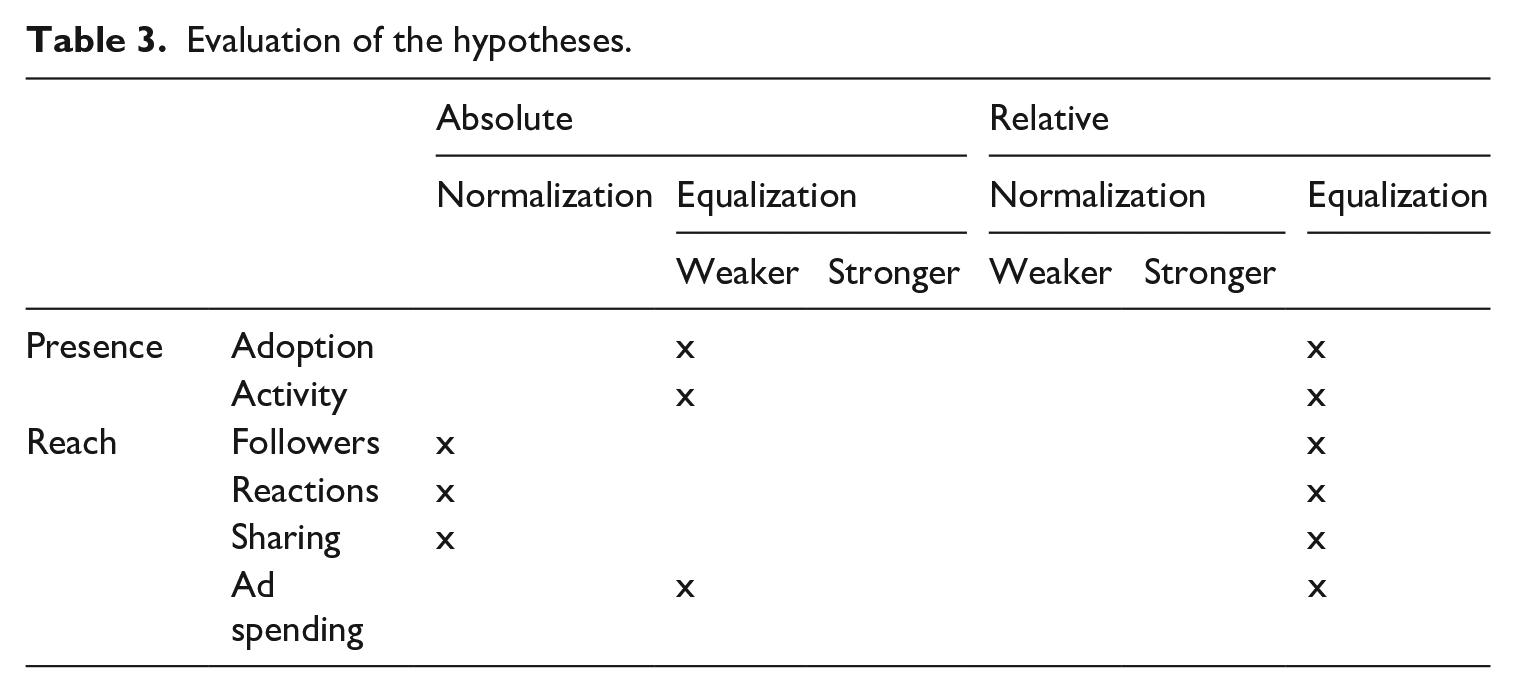
When it comes to the absolute differences based on party size, the results show that in terms of activity, smaller parties do not lag behind their larger counterparts, as adoption is now close to complete, and there is no significant difference in the overall posting and advertisement activity either. However, larger parties have more followers and provoke more user engagement, therefore, their activities can reach more users directly and indirectly than smaller parties. Moreover, when it comes to user engagement, they have dual advantages; while larger parties trigger more reactions, shares and comments even when the number of followers is controlled for, the larger follower base indirectly further increases these numbers. However, advertising activity does not seem to be a normalization force on Facebook, and it has no indirect effect on other dimensions either. Larger parties spend more money on ads, but the effect size is modest and not significant.
More uniform patterns are unveiled when the relative understanding of the two concepts is tested. In each dimension of Facebook performance, smaller parties perform better, and larger ones are weaker than expected based on their electoral share. In a relative sense, the gaps between parties are more modest in each dimension than in the electoral sphere. Consequently, Facebook seems to be a levelling force of political competition even in dimensions where larger parties have their absolute advantage. For instance, while larger parties have more followers and provoke more reactions, shares and comments, these gaps are significantly smaller than in the overall political structure, thus Facebook is able to increase these minor actors’ visibility relative to their electoral support. Also, it seems that other party-related factors such as ideology and government position play a more negligible role in Facebook performance. It is only the dimension of sharing where far-right, far-left and green parties have some advantage.
Overall, the findings suggest that Facebook is an appropriate campaign tool for minor political actors to decrease their structural disadvantages. Thereby, it may have contributed to the remarkable transformation of European political systems. While newer, less relevant and less-resourced parties are disadvantaged in traditional media platforms (e.g. Hopmann et al., 2011; van Spanje and Azrout, 2020), on Facebook, they are able to build a more visible presence even if their direct and indirect reach is more limited than it is for their larger counterparts.
The findings show how the theories of normalization and equalization work when the role of context is filtered out. However, it would also be important to see how contextual variations nuance these mechanisms. While the party-level dataset used in this study is close to complete on the EU level, it is too small in its size to test cross-level interactions and thereby context-level explanations. Future studies should address the question of the role context plays in both theories by drawing upon a larger cross-country dataset through investigating these theses on the level of individual politicians.
Naturally, this research has some limitations. First of all, while the cross-country design enables to draw more generalizable conclusions than single-country studies, the cross-sectional nature of the dataset still represents a limitation. Several authors have argued that time is an important factor in this aspect, and social media may play different roles in the different phases of its application (e.g. Jacobs and Spierings, 2016). This research grasps a moment when Facebook is widely used by political actors, and it is one of the most important political information resources in European countries. However, the digital world is a fast-changing area, and these findings cannot predict past and future patterns of social media use. Furthermore, while the EP election provides a unique case for cross-country investigation, this particular context of the research still has some implications for the findings. First, perfect homogeneity of the electoral contexts cannot be ensured, as even though the rules and stakes are highly similar in each country, the importance of EP elections is still shaped by several historical and political circumstances. Second, while the relevance of EP elections has increased in the last few years, it is still a second-order election. Parties are generally more focused on national elections than EP elections, therefore they may use their resources in line with these preferences (Petithomme, 2012). Consequently, future studies should test these theories and replicate this research in the context of national elections to see if the findings are generalizable beyond the EP election campaign.
Furthermore, the focus has been on the quantitative dimensions of Facebook performance, which is related to the visibility of parties. However, these hypotheses are sometimes tested in relation to the qualitative aspects of presence, such as the sophistication of content or the level of interactivity. This research could not address them; therefore, future work should broaden the focus with some qualitative aspects of performance.
Nonetheless, the current work contributes to the literature of the normalization and equalization debate with a detailed conceptual framework, and findings from a wide cross-country investigation. It has managed to nuance existing observations and accommodate conflicting findings by demonstrating the equalization potential of Facebook, while also showing drivers of normalization tendencies.
Footnotes
Appendix 1
OLS regression models for testing absolute normalization and equalization theses for lower intervals of ad spending (beta values in cells, standard errors in parentheses).
| Ad spending (lower) a | Ad spending (lower) (rel) a | |||
|---|---|---|---|---|
| National results | . |
.12 (.10) | −.18 (.00)# | |
| Populist | .01 (2.89) | −.03 (2.92) | .01 (.15) | .02 (.15) |
| Far-right | −.08 (3.85) | −.02 (3.53) | −.04 (.20) | .04 (.19) |
| Far-left | −.03 (3.26) | −.03 (3.19) | −.01 (.14) | −.01 (.13) |
| Green | .09 (3.13) | .08 (3.15) | . |
. |
| Gov. party | −.02 (1.77) | .01 (1.68) | .04 (.09) | .05 (.09) |
| Foundation | −.06 (.03) | −.07 (.03) | −.09 (.00) | −.06 (.00) |
| FB page yr. | −.05 (.38) | −.23 (.02)# | ||
| Followers | .17 (.00)# | .03 (.00) | ||
| Ad spending | ||||
| Posts | ||||
| Intercept | 62.05 (61.57) | 580.91 (763.26) | 3.21 (2.66) | 93.80 (47.02)* |
| R2 (adj.) | .50 | .52 | .17 | .23 |
| F | 6.07*** | 6.18*** | 2.01*** | 2.32*** |
| N | 171 | 171 | 165 | 165 |
OLS: ordinary least squares.
Country fixed effects are included, but not shown in the table. Outliers are removed. As parties in France are not allowed to run ads, French parties are removed. Standard errors are clustered on countries.
Cube root transformation.
p < .10; *p < .05; **p < .01; ***p < .001.
Funding
The author(s) disclosed receipt of the following financial support for the research, authorship, and/ or publication of this article: The research was supported by the Incubator program of the Centre for Social Sciences, Eötvös Loránd Research Network (project number: 03013645). Márton Bene is a recipient of the Bolyai János Research Fellowship awarded by the Hungarian Academy of Sciences (BO/334_20)
