




Abstract
The study of mundane, everyday uses of the Internet remains an emerging field of inquiry. Analysing data from a large seven country survey of Internet use and adapting concepts and methods developed by Bourdieu, we show that there are distinct clusters of users who use the Internet in diverse ways to solve everyday problems, such as buying a mobile phone or diagnosing an illness. Such everyday problem-solving is dependent upon degrees of economic, social, digital and cultural capital, and varies across countries. A comparative methodological strategy combined the use of multiple correspondence analysis (MCA), hierarchical cluster analysis (HCA), and for the first time in the field, multiple factor analysis for contingency tables (MFACTs). Extending the work of Bourdieu and the sociology of class more generally, we argue that digital capital functions as a bridging capital aiding the convertibility of other forms of capital to the benefit of already advantaged groups.
Keywords
Introduction
Given that a variety of technological devices, including mobile devices, and online communication have apparently become so important, not to say ubiquitous, at least in some people’s lives there has been relatively little research on the mundane use of the Internet in everyday life. According to one of its leading advocates as a field of inquiry, this newly ‘emergent continent’ has not been ‘properly explored and charted yet’ (Bakardjieva, 2011: 59). To explore Internet use and everyday life, there needs to be a focus on users, their contexts and horizons. What do people use the Internet for and how does their Internet use relate to the rest of their lives, and to what effect? This article examines mundane problem-solving uses of the Internet and how they are stratified using data from the cross-national survey in The Peoples’ Internet project. We show how mundane uses of the Internet for information searching are associated with existing inequalities and how these mundane uses in turn contribute to the reproduction and exacerbation of those inequalities.
There are, of course, conceptual resources available to provide vantage points from which to survey the everyday use of the Internet. Bakardjieva (2011) seeks to understand the Internet’s role in ‘challenging and transforming oppressive relations’ (p. 63), pointing to the work of De Certeau (1988) and to Lefebvre (1991) whose phenomenological approach seeks to understand experiences of the life-world. Work on the transformative potential of the Internet has focussed on different dimensions of Internet usage, the introduction of technological devices in daily life and issues of digital inequalities and alienation (e.g. Bakardjieva, 2005; Bengtsson, 2018; Meyen et al., 2010; van der Zeeuw et al., 2019). While these are clearly important, research on the uses of the Internet has overlooked how ‘strategies’ for everyday mundane information seeking and practical problem-solving cement further privilege and inequality (cf. Bourdieu, 1990; Bourdieu and Wacquant, 1992; Cvetičanin et al., 2014; De Certeau 1988; Savolainen, 1995). In our context, these refer to ways people adapt to changing technological and social circumstances. Another vantage point is provided by works exploring the importance of Bourdieu for understanding the reproduction of inequality through Internet use (cf. Halford and Savage, 2010; Ignatow and Robinson, 2017; Van Dijk, 2005).
The original contribution we make here is empirical, conceptual and methodological: we study strategies for information seeking and practical problem-solving across seven countries (China, Denmark, Germany, Hungary, Italy, the United Kingdom and the United States); we do so via a relational and multidimensional approach to class inequalities and life conditions inspired by Bourdieu deploying the concept of digital capital as a bridging capital; we combine insights from two traditionally separate fields, namely, Internet uses in everyday contexts and strategies for information seeking and practical problem-solving. Finally, our research design employs the quantitative approach adopted by Bourdieu, geometrical data analysis, combining multiple correspondence analysis (MCA) and hierarchical clustering, with multiple factor analysis for contingency tables (MFACTs). The latter, implemented for the first time in the field of digital media analysis, allows us to efficiently contrast our findings across our sample of countries.
Social and digital inequalities
Originally published 40 years ago, Bourdieu’s (1984) best-known work, Distinction, is still highly influential and is widely accredited to be the main inspiration behind the cultural turn in social stratification research (Savage, 2016). Recent accounts of class formations and identities have successfully shown how taste and lifestyles are embedded in economic and social relations and act as a resource in the constitution of class (e.g. Atkinson, 2017; Flemmen et al., 2019; Savage et al., 2015). Bourdieu’s multidimensional concept of class refers to the generalized social advantage and disadvantage from the influence of numerous economic, cultural and social factors as well as background characteristics (gender, ethnicity, age, etc.; Bourdieu, 1984). The conceptual ground on which Bourdieu defines class is that of relations and the different systems of dispositions that stem from different life conditions. According to this framework, association, or homology, between the space of lifestyles and that of social class structures is defined by a variety of capitals (as species of interchangeable power accumulated during the life course which allow individuals to obtain certain profits) and mediated by habitus (reproduced and inherited dispositions, preferences and interpretations acquired through socialization and experience; Bourdieu, 1984, 1986, 1990; Bourdieu and Wacquant, 1992). Cultural class analysis has, however, surprisingly failed to integrate into its frameworks the centrality of information and communication technologies within everyday contexts. The Bourdieuan framework has, nevertheless, proved useful in several existing studies of the impact of technological assets as a means to gain advantages in different arenas of social life (see Ignatow and Robinson, 2017 for a recent account, also see Halford and Savage, 2010; Hargittai, 2008). It is important to note, however, that these studies focus almost exclusively on the digital side of inequalities (the exceptions are Leguina et al., 2017; Leguina and Miles, 2017; Lindell, 2018; Yates and Lockley, 2018).
Capitals
As originally articulated by Bourdieu, capitals come in three fundamental forms: economic, social and cultural (Bourdieu, 1984, 1986). While economic capital is the one most immediately converted into money and possessions, other forms of capital can also be converted into economic advantages, but this requires effort to overcome the friction. The distribution of different forms of capitals at a given place and time are, in sum, the ‘structure of the social world’ (Bourdieu, 1986). For Halford and Savage (2010), an understanding of inequalities from the perspective of capitals allows us to recognize the impact of technological assets to gain advantages in social life. While research has indeed studied the distribution of capitals as an explanation for digital inequalities, we believe that the three fundamental forms of capitals are not fully able to capture the differential outcomes of Internet use and so another form of capital, ‘digital capital’, is needed. Different conceptualizations of ‘digital’ capital are available in the literature (cf. Ignatow and Robinson, 2017), but we wish to focus on what we consider to be their most distinctive features. Digital capital is a secondary form of capital, distinct from its primary forms (cultural, social and economic), and refers to the digital competences and technologies historically accumulated and transferred across different arenas of social life (Ignatow and Robison, 2017; Ragnedda and Ruiu, 2020).
Ragnedda and Ruiu (2020) argue that digital capital is a discrete form of capital made up of abilities and attitudes to use digital technologies and techniques, on one hand, and digital resources (hardware, software, Internet access, etc.), on the other. This conceptualization emphasizes digital inequalities and reproduction mechanisms at individual level in digital and/or physical domains, as well as the ability of digital capital to act as a ‘bridge capital’ which can be accumulated or converted into another form of capital via digital means (cf. Van Deursen and Helsper, 2018). To justify the conceptualization of the digital as a ‘Bourdieuan’ capital, Ragnedda and Ruiu (2020) explain that digital capital shares similar properties with the ‘original’ capitals: can be accumulated over time, requires investment in both time and money, can be converted or exchanged for other forms of capital and ultimately produces social benefits (Bourdieu, 1984,1986, Halford and Savage, 2010; Ignatow and Robinson, 2017). As well as being a discrete form of capital, according to Ragnedda and Ruiu (2020), digital capital plays a bridging function in two ways. First, it offers a way of connecting offline and online resources essentially allowing for the online mobilization and extension of offline forms of capital leading to online uses and experiences. Second, through this mobilization it yields economic and social benefits to the user. Such benefits then feedback to enhance the volumes of economic, social, cultural and digital capital. This explains how inequalities are reproduced and indeed exacerbated by digital technology use when those already in possession of high volumes of all forms of capital benefit the most from online activities. So, it is essential when thinking about inequality not only to think about digital inequalities (e.g. in access or use), but also about how such use leads to greater inequality generally through producing differential social benefits for users.
This bridging function is of particular importance in the context of everyday Internet use and highlights the uniqueness of digital capital. Generally speaking, capitals behave according to a principle of conservation (Bourdieu, 1986), where profits in one area are paid for by costs in another. The Internet, and particularly social media, are tools that can potentially offer great rewards for very little investment depending on one’s stocks of economic, social and cultural capital. From finding the cheapest mortgage rate or car insurance to posting a query on social media and waiting for the answer demands next to no effort for those proficient enough in its use. At the same time, not to have access to the Internet or have very limited digital skills, can reinforce the already disadvantaged position of some members of society, particularly in contexts where more and more privately and state provided services have to be accessed online (cf. Mihelj et al., 2019).
Habitus and information seeking
Habitus refers to intuitive actions and dispositions (behaviour, linguistic practices and lifestyle preferences) and how social arenas are incorporated into individuals’ bodies and minds (Bourdieu, 1990; Bourdieu and Wacquant, 1992). While capitals define the available resources and channels, habitus guides choices that appear to be natural or desirable to one’s social class. Strategies that people use to adapt to new and changing circumstances, including use of technologies in everyday contexts, are no different from other cultural practices and are, therefore, socially organized by habitus (Sterne, 2003). However, research on everyday inequalities has mainly focussed on the concept of ‘strategies’ as way to understand how people cope with unfavourable living conditions or maintain and improve economic positions (cf. Cvetičanin et al., 2014; Katz-Gerro et al., 2017). A different approach has been adopted by research interested in broader everyday strategies. From the point of view of everyday information-seeking, Savolainen (1995) argues that an individual’s habitus is as important as material equipment (capitals) to explain the adoption of certain information-seeking strategies for problem-solving. Cvetičanin et al. (2014) elaborate on some of these ideas by developing a composite definition of strategy that combines Bourdieu’s concept of strategies (sequential actions towards achieving a goal) and De Certeau’s (1988) tactics (unpredictable actions that respond to and adapt to the environment). The authors argue that they are complementary, broadly defining strategies as ‘relatively coherent patterns of behaviour in solving practical problem, specifically major life course issues, in various social fields’ (Cvetičanin et al., 2014: 214). From their mixed methods analysis of Serbian society, four typologies that combine ‘individualist/collectivist’ (in terms of social resources and influence) and ‘reactive/proactive’ (in terms of organization and focus) qualities arise. In the context of Information and communication technologies (ICTs), Robinson (2009) refers to differences between a ‘playful’ habitus from upper-middle-income families where use of ICTs are encouraged, and a task-oriented information habitus from disadvantaged youth that is linked to temporal urgencies and constraints. Meyen et al. (2010) discuss how dispositions, socialization and life situation, or the opus operatum, instinctively directs the modus operandi, or the how and why Internet is used in everyday life. Similarly, Robinson (2011) shows the relevance of informational habitus as being useful to identify distinctive information-seeking situations used by young people to plan and decide post-secondary education and career planning.
Now that we have outlined the Bourdieuan, or at least Bourdieuan-inspired, concepts that we seek to operationalize in order to examine the stratified character of mundane, everyday uses of the Internet, we can describe the diverse countries in our sample. While this is not a most different systems design there are clearly considerable differences between the countries in our sample and where we would expect prima facie considerable differences in information-seeking behaviour to occur. We should note that we would expect information-seeking behaviour not only to be influenced by levels of capital, digital or otherwise, but also by other factors, such as the type of media system that users find themselves operating in.
Countries and comparative framework
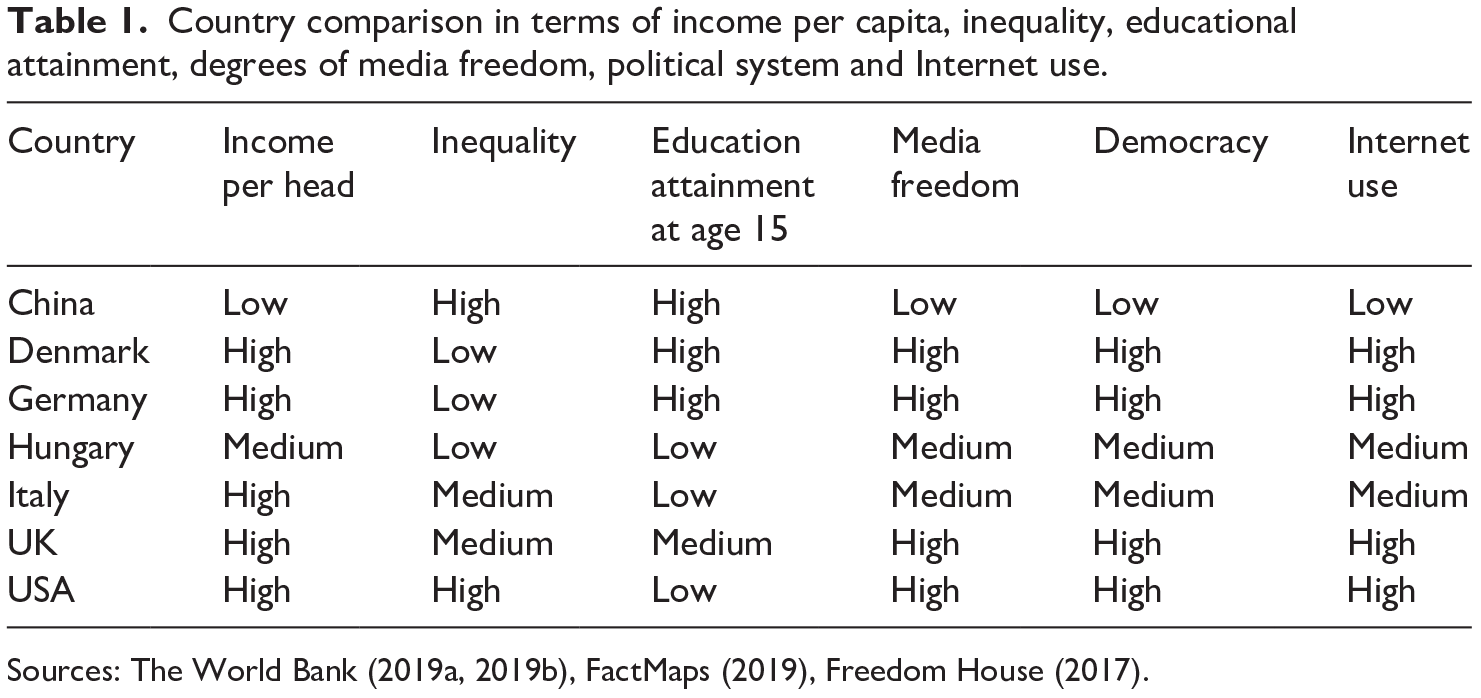
The data presented here are from a large-scale survey of media use, communicative patterns and participation in economic, social and cultural activities in seven countries: China, the United States, Denmark, Germany, Hungary, Italy and the United Kingdom. Clearly, we have a highly diverse sample that represents three centres of the global economy and world politics (Europe, China and the United States), each with national social structures, media systems and Internet penetration differing considerably (for details, see also introduction to special issue). These variations impact on individuals’ possessions of capitals, and what we could consider as ‘high’ or ‘low’ differs across national contexts. To contextualize our comparative approach, it is important to highlight such differences in terms of indicators useful to understand citizens’ economic, social, cultural and digital possessions. To do so, we compare briefly countries in terms of income per capita, inequality, educational attainment, degrees of media freedom, political system and Internet use.
In terms of income per capita calculated according to purchasing parity (in dollars in 2018), a number of the countries belong to the richest countries in the world (the United States, $62,641; Germany $53,735.2; Denmark $55,105.0; Italy, $41,630.4 and UK, $45,489.1) with one (Hungary, $30,673.1) that is middle income and one (China, $18,210.1) that is a relatively low-income country (The World Bank, 2019a). Income inequality expressed as a Gini coefficient gives a sense of how unequal these societies are relatively. Our sample includes some of the most equal countries globally (Denmark, 28.2; Hungary, 30.4 and Germany, 31.7) followed by the United Kingdom (33.2) and Italy (35.4) with China (38.6) and the United States (41.5) being the most unequal countries economically in our sample (The World Bank, 2019b) While China is the poorest country in our sample per capita and one of the most unequal it scores highly in terms of educational attainment. The Programme for International Student Assessment (PISA) ranked Chinese teenagers first in the world, followed by the United Kingdom (13th), Denmark and Germany (18th), the United States (25th), Hungary (33rd) and Italy in 34th position (FactMaps, 2019). The Economist’s Democracy Index in 2018 ranked Denmark fifth out of 167 countries, Germany 13th, the United Kingdom 14th, the United States 25th, Italy 33rd, Hungary 57th and China 130th. Freedom House’s index of media freedom also ranked Denmark as one of the most free countries followed by Germany, the United States and the United Kingdom (which are also described as free), Italy and Hungary are described as partly free, while China’s media is described as not free (Freedom House, 2017). According to the International Telecommunication Union (ITU), 97.64% of individuals in Denmark had used the Internet within the last 3 months of being asked in 2018, in the United Kingdom, it was 94.9%; in Germany, 89.74%; in the United States, 87.27% (2017 figures); Hungary, 76.07; Italy,74.39% and, in China, it was 54.3%. Table 1 compares our sample countries to each other using three categories for each measure. Given such diversity, it is intriguing to see whether there are common patterns in terms of using the Internet for everyday problem-solving and the extent to which these are socially stratified.
Country comparison in terms of income per capita, inequality, educational attainment, degrees of media freedom, political system and Internet use.
Sources: The World Bank (2019a, 2019b), FactMaps (2019), Freedom House (2017).
Research questions
We are interested in how people get mundane things done either offline or online or a combination of both. When confronted by everyday issues and problems, whether they are feeling ill or looking for a job or wish to ascertain what’s happened in politics, which means do they use to gather information?
RQ1. Which means of gathering information do people adopt in their everyday lives?
RQ2. Are there distinct clusters of people that may be distinguished by their everyday use of the Internet, their habitus and levels of economic, social, cultural and digital capital?
RQ3. Are the clusters of people similar or different across the countries in our sample? What are the plausible explanations of difference and similarity?
Data and methods
Survey data from the Internet population in all seven countries were collected by The Peoples’ Internet project in 2019 (for detailed technical information, see introduction to special issue). A total sample size of 10,772 cases was collected online in Europe (Denmark, Germany, Italy, Hungary and the United Kingdom) and the United States (non-probability sampling through Internet panels carried out by YouGov during the summer of 2018), and face-to face in China (multi-stage cluster sampling carried out by CTR Market Research from December 2018 to March 2019). The fields covered in the standardized questionnaires include general media use, communication patterns, the role of media in daily life and comprehensive questions on socio-demographic background. The analysis is based on questions about information-seeking behaviour for everyday problem-solving, first for each country and then combined in a joint analysis. These strategies cover five broadly defined sets of everyday activities that cover different activities where respondents potentially rely on a variety of strategies: finding information about job openings, diagnosing an unknown illness, buying a new mobile phone, verifying controversial information about a politician and seeking guidance on a moral dilemma. Individual questions for each topic refer to the use or not of different information-seeking strategies, ranging from ‘official’ traditional channels (job agencies, doctors and hospitals, mobile phone shops), social networks (friends and families, colleagues and partners), ‘legacy’ media (TV and radio) and Internet (search engines, social media and specialist websites). In total, 45 questions are included in the analysis. The full list of strategies and frequencies by country are shown in Tables S2 to S8 (see online supplementary information). Our approach, part of the family of geometric data analysis (GDA) methods (Le Roux and Rouanet, 2004), takes a multi-step design and seeks to describe the most important information on geometric visual representations (biplots) and specific to our research, it combines several methods for national and comparative analysis.
The first step aims to answer RQ1 and involves the construction of national social spaces of information-seeking for everyday problem-solving. This is done by applying MCA to survey questions for each country separately (RQ1). MCA is a dimension reduction technique to analyse categorical data. The objective of the analysis is to create a multidimensional spatial representation of the relationship between variables by decomposing the main sources of variation into fewer dimensions (axes) and providing summary values which can be plotted as clouds to visualize interrelations among individuals and variables. This is the method used by Bourdieu in Distinction (Bourdieu, 1984) and is often used to study the relationship between culture and social stratification. To identify the association between respondents’ strategies and class conditions, capitals are operationalized by demographic information and are added to the analysis as supplementary variables, which do not actively contribute to the configuration of the space but help us to interpret it. Here we are restricted by demographics available in the survey, which was not explicitly designed with Bourdieuan capital operationalizations in mind. As indicators of economic capital, we used employment status (unemployed and employed), income (below national average, average and above national average) and occupation (physical work, service industry, office job and student). As indicators of social capital, we used having a partner, children and taking part in at least one local, regional and national organizations (from a total of six, including cultural, sports, religious, political, civil and community organizations). As indicator of institutionalized cultural capital we used educational level (primary, lower secondary, upper secondary, vocational, university degree, masters and above) and parental educational level (higher between father and mother, same categories) acts as indicator of embodied cultural capital. As indicators of digital capital, we used the first time that the Internet was accessed (never, 5 or less years ago, 5–10 years ago, 11–20 years ago, 20 or more years ago), access to devices (none, 1, 2, 3, 4, 5 or more) and frequency of Internet use for work (regularly, frequently and rarely) and practical reasons (regularly, frequently and rarely). Analysis also includes gender (male and female), age in years (18–24, 25–34, 35–44, 45–54, 55–64 and 65–74) and place of residence (village, town and city) as background information that complements our operationalization of capitals. The interpretation of results consist of identification of patterns of strategies and capitals across each axis individually and regions in the social space formed by two axes by visual inspection of categories’ coordinates in the social space (the closer categories of strategies and capitals are, the stronger their association is), quantification of contributions (amount of variability due to a specific category or combination of categories) for each strategy, as well as deviations (the average distance between categories on each axis in the social space) of capital indicators.
The next task in our analysis is to identify whether there are distinct groups based on information-seeking strategies and, if so, to describe them in terms of capital possessions and habitus (RQ2). To do so, ascending hierarchical cluster analysis (HCA) on MCA’s first five dimensions is applied. Cluster analysis is a family of statistical procedures that classify individuals in a finite number of groups based on their similitude or ‘distance’ (Le Roux and Rouanet, 2004). Results from HCA are interpreted in conjunction with MCA from step one. MCA and HCA are applied using SPAD 9.1 (Coheris, 2019). Third and finally, we focus our attention on understanding how users’ profiles are compared across our sample of countries (RQ3). To do so, we implement MFACTs, which is a development of MCA and multiple factor analysis (MFA; Bécue-Bertaut and Pagès, 2004; Kostov et al., 2013). Data for this analysis are structured as a composite contingency table that combines country information: the 45 survey questions on its rows and each cluster in its columns. In a nutshell, MFACT allows us to compare the seven national samples in a common framework by balancing the influence of each sample in the global analysis thus avoiding the potential for one country and/or specific profile to play a dominant role. This feature of MFACT is particularly convenient for our analysis as it facilitates the comparison of several user profiles across a relatively large number of countries. The method is implemented in R’s package FactoMineR (Le et al., 2008; R Development Core Team, 2019).
Results
National social spaces of information-seeking for everyday problem-solving solving and user profiles
As an initial step, for each country we look at the first three MCA axes, which retain over 90% of the total variation (Benzecri’s modified rates). Retained variance rates are very similar across countries, with the first axis containing around 85%, the second around 7% and the third 4%. A slightly different distribution is found in China (72.6%, 15.1% and 6.6%, respectively). This reveals that while the first axis is the most important in defining national social spaces of everyday problem-solving, its relevance is less clear in China than elsewhere. This is an early indication of deeper differences in the distribution of problem-solving strategies and capitals, but also points to the particularities of Chinese social structures. Given the high variance rates retained by the first and second axes, we concentrate our interpretation in the plane drawn by them. Figure 1 illustrates our general findings by presenting the first two axes of the MCA of information-seeking strategies for everyday problem-solving in the United Kingdom (left panel) alongside selected supplementary variables (statistically significant noticeable deviations from the origin) mapped onto the way these strategies array in the constructed space (right panel). Figures 4 to 9 in Appendix 1 present results for the remaining six countries and Table S1 available in online supplementary information provides scaled deviations from the origin and significance tests for each category.
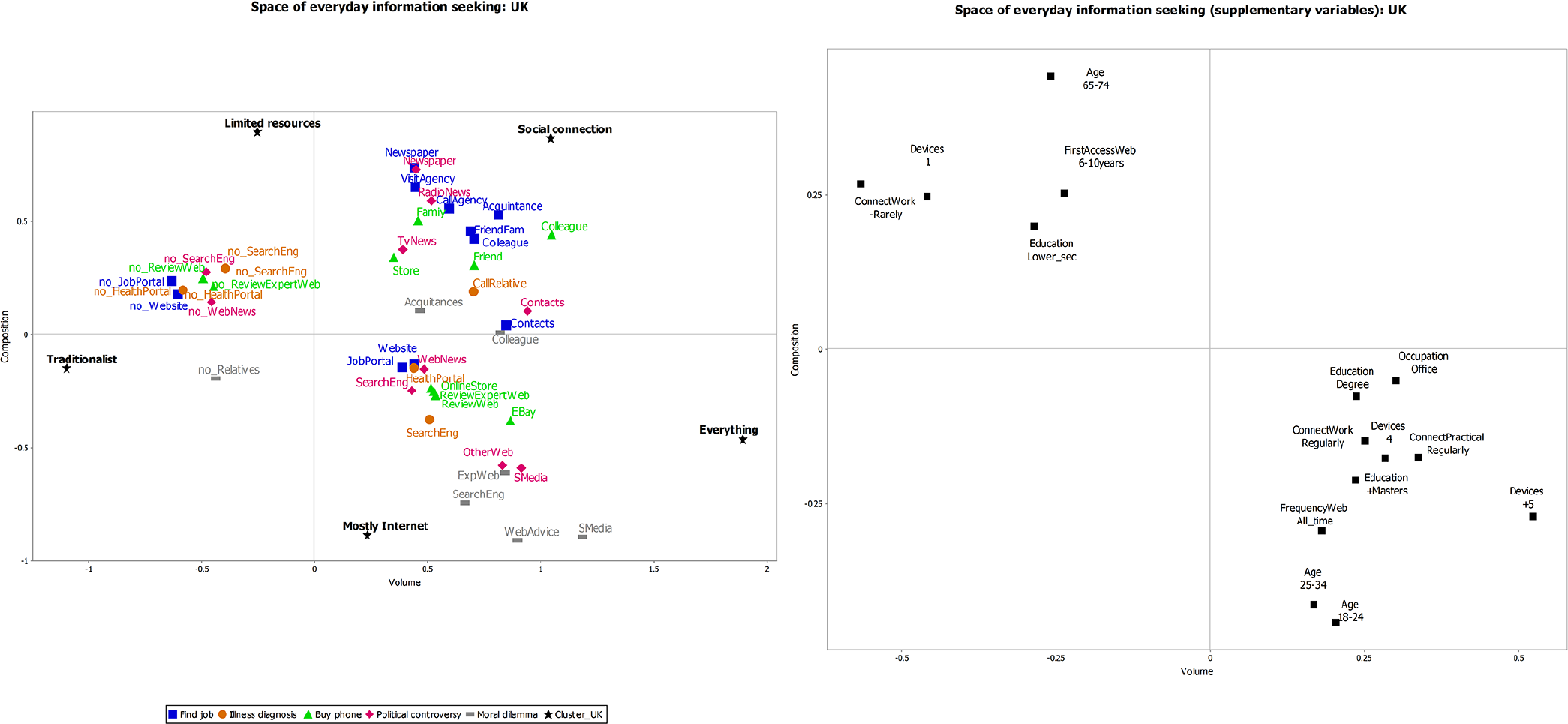
The space of everyday problem-solving in the United Kingdom. Left panel: Active categories that have contributed above average to factorial planes 1–2. Cluster affiliation (entered as supplementary variable) is represented by black stars. Right panel: Capital indicators entered as supplementary variables with noticeable deviations from the origin (threshold = .25) and statistically significant at .01 level (test value > 2.58).
Results across countries, here illustrated by the British case, show that on the first axis there is a division between those engaging in some form of information-seeking strategy, located on the right-hand side of the map, and those characterized by lack of engagement, on the left. The spatial distribution of supplementary variables reveals, as expected, the first axis represents the overall volume of capital (Bourdieu, 1984). Individuals from advantaged social positions display higher levels of education, have office-based occupations, have a large number of technological devices and use Internet for different purposes frequently and are located at the right-hand side of axis one. In contrast, those from disadvantaged backgrounds are found at the left-hand side of the axis. This axis is also clearly shaped in terms of age. The second axis distinguishes individuals who claim to engage with strategies pertaining to their social networks (friends colleagues and acquaintances), legacy media (newspapers, radio and TV) and traditional channels, such as job agencies, and located at the top of the axis, from those utilizing mostly online strategies (social media, search engines, websites, etc.). The second axis refers to the relative preponderance (or composition) of capitals. Generally speaking, it represents differences in personal and parental educational level (cultural capital), family composition (social capital) and more remarkably in several measures of digital capital and age (cf. Leguina et al., 2017). This axis highlights how online participation, similar to possession of social capital, operates as capital-enhancing activity in general (Ragnedda and Ruiu, 2020). This is digital capital functioning as bridging capital permitting the online exploitation of economic, social and cultural resources in the online realm and potentially facilitating its conversion into further advantages in the physical world.
As a second step, we focus on whether distinct profiles of people are distinguished by their problem-solving strategies. To do so, we applied HCA to MCA’s first five retained axes. HCA reveals that four-cluster solutions are the most suitable apart from Denmark and the United Kingdom, where procedure suggests five-cluster solutions are the best. This has been concluded after careful inspection of dendograms, quality indicators provided by SPAD, comparison with alternative solutions and substantive relevance of proposed clustering. Table 2 shows cluster distribution for each country and Figure 1 combine results from MCA and HCA to represent visually the association between cluster affiliation (represented by stars) and information-seeking strategies in the United Kingdom (Figures 4 to 9 elsewhere; also Tables S2 to S8 available in online supplementary information show frequency breakdown by country and according to strategy use).
Frequency of information-seeking for everyday problem-solving clusters, by country.
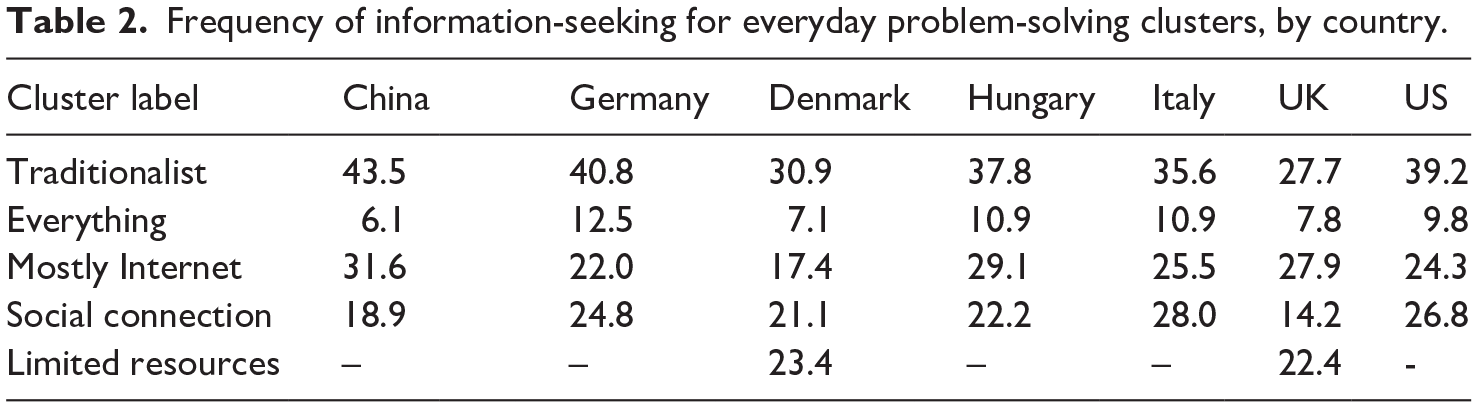
In each country, it is possible to identify groups with consistent communicative practices and similar sizes. A large cluster labelled as ‘traditionalist’ identifies those displaying the lowest access rates to all strategies and not showing preference for any in particular besides the most traditional channels to solve the most pressing problems (e.g. going to a store to ask about mobile phones, calling a doctor or hospital in case of illness). This group is identified with strategies of an individualist nature (low levels of interaction with friends, families and colleagues) that is reactive in scope (displaying an inconsistent set of strategies across each of the five arenas; Cvetičanin et al., 2014). In contrast, we found a small group of individuals showing high rates of use of a broad range of alternatives (labelled as ‘everything’), combining official channels, social networks, media and Internet in various forms regardless of the issue. These users are flexible in choosing from among the broad range of strategies to solve the problems at hand, combining individualistic (personal research) and collectivist (contacts) strategies in what is likely to be a proactive manner (displaying a consistent use of similar strategies across different problems; Cvetičanin et al., 2014). In addition to ‘traditionalists’ and ‘everything’, we found two groups of varied size. One represents a more exclusive focus on use of Internet (‘Mostly Internet’), and the other group centres their problem-solving strategies on personal contacts (‘social connection’). These groups have the highest usage rates for those sets of strategies in every country and display contrasting individualistic proactive (including consultation on specialist websites, search engines, social media and review websites) and collectivist reactive (mostly involving ask friends, family and colleagues, but no use of formal channels) strategies, respectively. Denmark and the United Statement are the only countries where an additional cluster was found. These groups (labelled as ‘limited resources’) occupy an intermediate position.
The association between user profiles and capital distribution explains the role of social inequalities in the adoption of on and offline strategies for problem-solving as well as emphasizing cross-national differences (also Tables S8 to S14 available in online supplementary information show the frequency breakdown by country and according to capital composition). With respect to clusters, one thing we observe across all countries is that differences in capitals identified by the first axis are clearly represented by tensions between those individuals belonging to ‘everything’ or ‘traditionalist’ profiles. The former display higher levels of every capital and the latter the lowest levels. In particular:
‘
‘
Although it is possible to also detect some regularities in capital distribution for the remaining clusters, national social structures play a more important role in defining strategies for problem-solving. In China, Denmark, Hungary and the United Kingdom, capital composition of ‘mostly Internet’ groups, located in the lower half of second axis, is in opposition to the ‘social connections’ group at the lower end of the axis. However, their positions within local stratification systems are not necessarily the same:
‘
‘
In the case of Germany, Italy and the United States, ‘mostly Internet’ and ‘social connection’ groups are in closer proximity. In other words, they share aspects in common in terms of their capital composition:
In Germany, both groups have young adults and middle-aged members, holding degrees and higher incomes, from villages, not part of social organizations and using Internet regularly for practical reasons.
In Italy and the United States, both groups have similar social positions in terms of origin (primary and lower secondary education parents) and no engagement with social organizations but differ in terms of other capitals. While ‘social connections’ groups are composed by an overrepresentation of older citizens with below average digital capital, ‘Mostly internet’ are markedly younger, often students and from higher income households. Regarding their digital capital, they accessed the Internet for the first time 11 or more years ago, regularly use it for practical things and frequently for work, via at least three different devices.
The ‘
In sum, we have shown how mundane practices, such as information-seeking for everyday problem-solving (as indeed any other indicator of lifestyle) show the existence of class inequalities and how its distribution, although roughly stable, varies across different societies. These differences reveal the overall impact of national stratification and media systems on shaping people’s use of off and online strategies for problem-solving.
Off- and online everyday problem-solving, the same everywhere?
The next stage of our analysis consists of understanding how these groups are internally configured in terms of their practices and how similar these profiles are across countries. To answer this question, we applied MFACT to a composite table separated by country, containing each of the 45 survey questions on its rows and clusters in its columns. This methodological innovation, applied for the first time in the field, facilitates the comparison of profiles across countries by identifying the association between clusters and strategies for problem-solving, the extent to which strategies are chosen by people from similar profiles and global similarities on the use of different strategies. MFACT’s first two axes retain approximately two thirds of the total variance (Table 3). Consequently, we focus on interpreting these results. Note also that eigenvalues for the first and second axes reach values close to the theoretical maximum (number of countries, 7), indicating that the distribution of user profiles and their responses across countries are in general structured similarly, confirming the adequate use of the method. Similar to MCA, the interpretation of results consists mainly of identification of the association between clustered profiles across each axis individually and regions in the social space formed by two axes by visual inspection (the closer clusters are, the stronger their association is) and the quantification of contributions (the amount of variability due to a specific category or combination of categories; Bécue-Bertaut and Pagès, 2004; Kostov et al., 2013).
Eigenvalues and percentage of the variance of the clustered everyday problem-solving data retained by the first five dimensions of the MFACT.
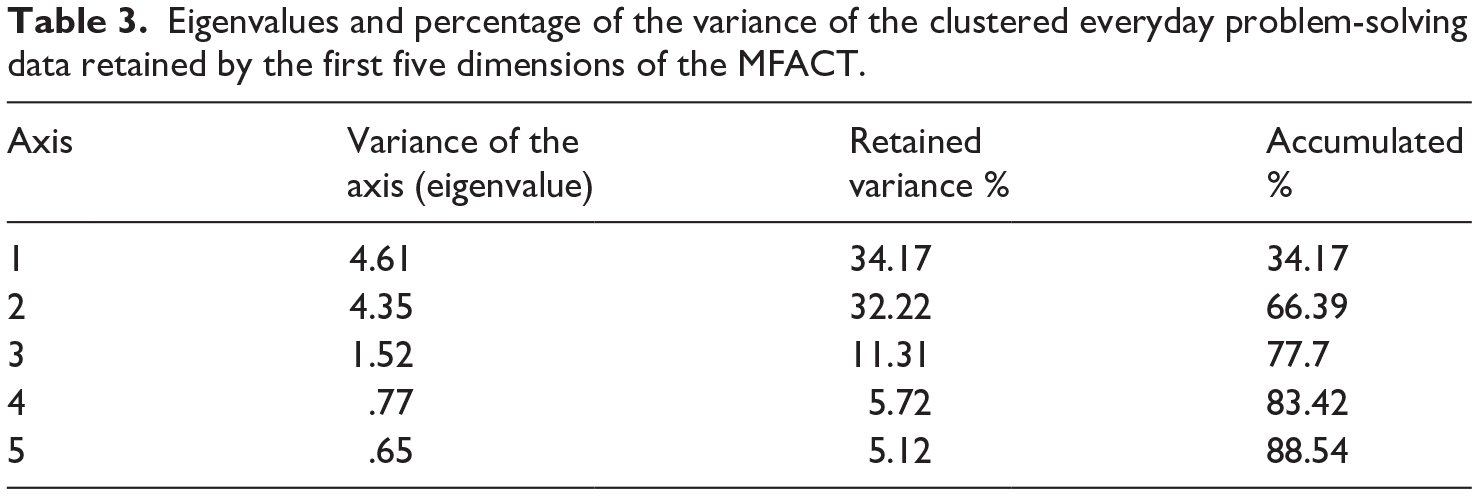
Figure 2 represents clusters on the first principal plane. The first axis identifies opposition between ‘everything’ profiles on the right, and ‘traditionalist’, ‘limited resources’ and some of the ‘social connection’ groups on the left. The second axis identifies tensions between ‘mostly Internet’ and ‘social connection’ groups highlighting their contrasting strategies. While results reveal similarities across countries on how previously identified distinctions in terms of capital volume and composition (particularly around tensions between digital and social capital) shape distribution of problem-solving strategies, it also shows that profiles have country-specific features. While ‘mostly internet’ and ‘everything’ groups seem to be very similar across countries despite the diversity of countries in the sample (cluster profiles are in very close proximity), ‘traditionalist’ and ‘social connection’ groups are more heterogeneous in their responses, confirming that heterogeneity in terms of capitals is also observed in their practices. In particular, ‘traditionalist’ in Italy is closer to ‘everything’ groups, and ‘traditionalist’ in China and Hungary is closer to ‘social connection’ in Italy and ‘limited resources’ in Denmark. Also note that ‘traditionalist’ groups are expected to be located around the origin, as these are the largest groups.
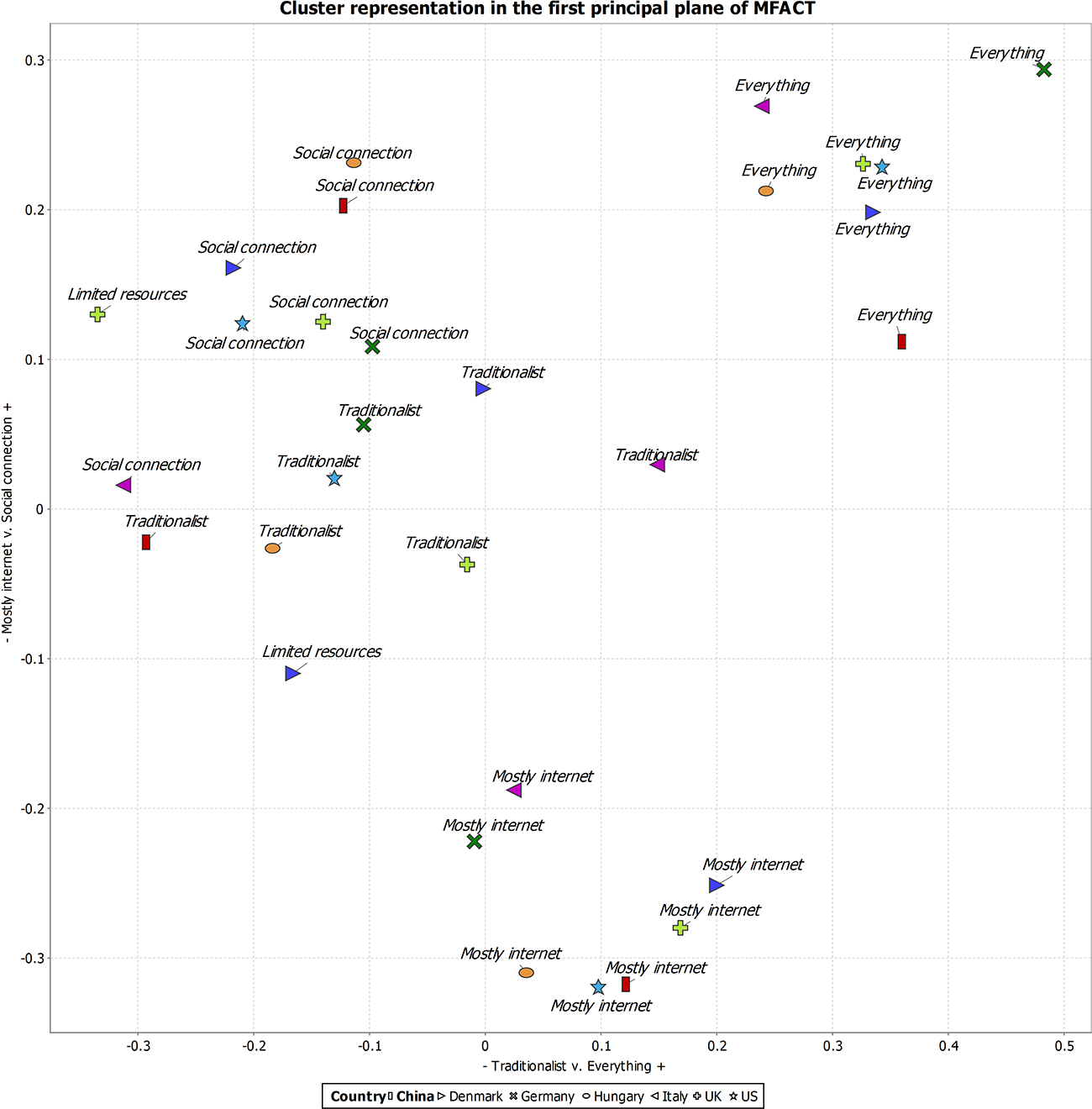
Representation of everyday problem-solving clusters in the first principal plane of MFACT.
In order to understand which combinations of practices are adopted by different profiles across countries we visualize information-seeking strategies in the principal plane (Figure 3). Inspecting this simultaneously with Figure 2, as illustrated by Kostov et al. (2013), we focus on how quadrants where clusters are located coincide with certain combinations of strategies. Here, for instance, we found that ‘everything’ groups are particularly distinct by their reliance on social media, as well as the use of traditional media (newspaper or magazines, TV shows and books), for moral dilemmas. The use of social media contrasts with behaviour of ‘mostly internet’ groups. Individuals located here are characterized by use of search engines and specialist websites to find information and solve their problems, indicating a more sophisticated way of performing Internet research and perhaps less confidence in their social networks knowing the answer (Robinson, 2009, Van Deursen and Helsper, 2018). Indeed, the composition of groups with high levels of digital capital and the ways in which problem-solving occurs is distinct. While ‘everything’ use digital capital as one of many alternatives to solve problems, for ‘mostly internet’, digital capital compensates partly for the lack of other capitals and it might be the only resource available in higher amounts to be exchanged for other social benefits (Ragnedda and Ruiu, 2020; Van Deursen and Helsper, 2018).
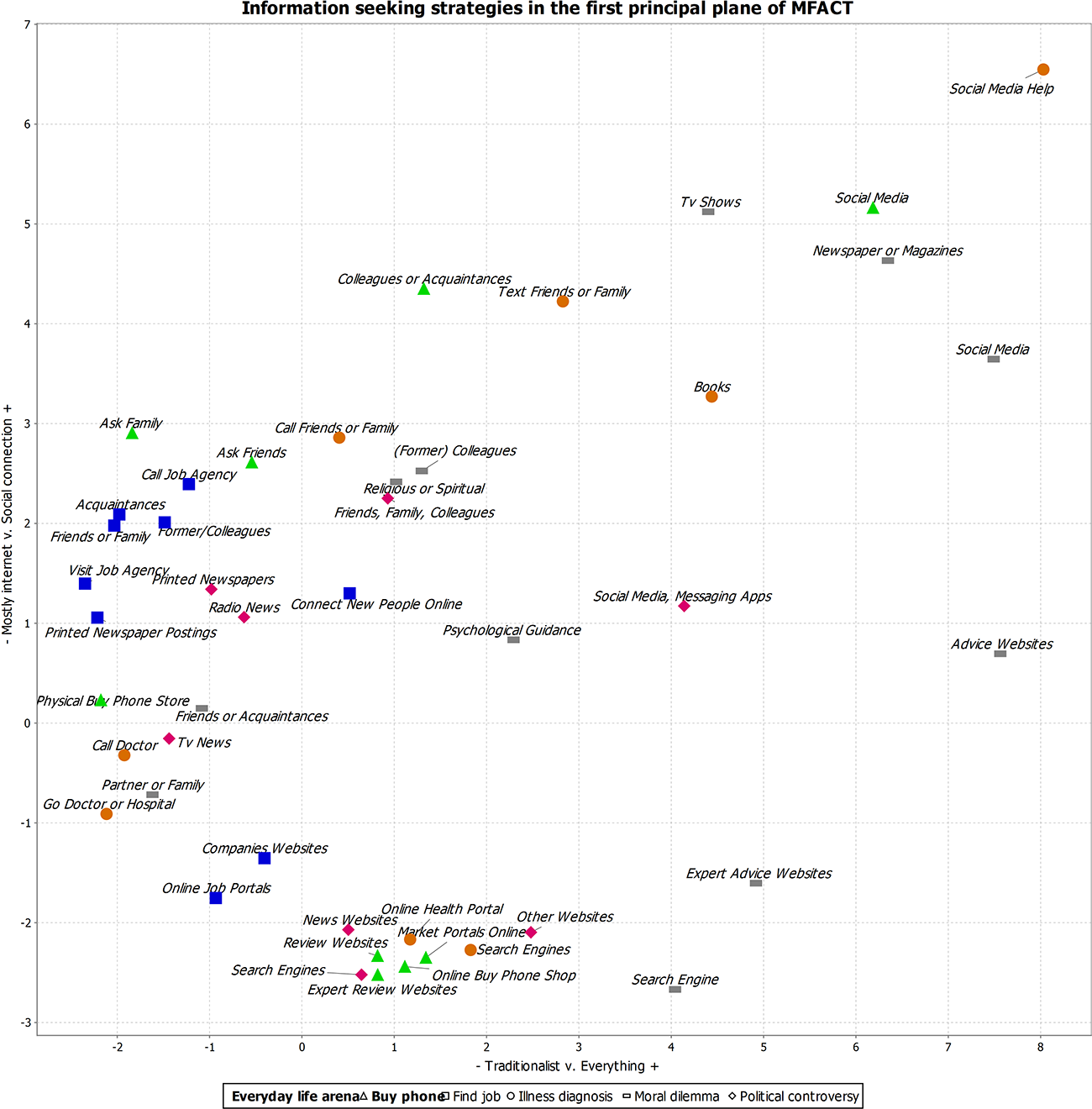
Visualization of problem-solving practices in the first principal plane of MFACT.
Those mostly using their social networks are more likely to display their resources to find jobs and potentially buy a new mobile phone. There are two interesting observations that can be made: a job hunt is one of those instances when use of all available resources is critical. It is the only explored arena where groups with lower digital capital use the Internet, yet it is still used in a limited task-oriented way, and probably utilizing lower quality Internet connection and devices (Robinson, 2009). Asking social contacts for assistance to purchase a new phone could flag a lack of technological knowledge to confidently acquire a new technological device (Helsper and Van Deursen, 2017). In other words, this reveals how digital inequalities are reproduced: low levels of digital skills (and access to contacts with low digital capital) potentially restrict access to ways of enhancing digital capital (in this case, hardware). Those ‘traditionalist’ or ‘limited resources’, contrary to what labels might suggest, are not necessarily lacking ways to solve their problems, but seem to exclusively use traditional channels, such as going to the doctor for a medical query, asking a partner or family about a moral dilemma and watching TV news for politics.
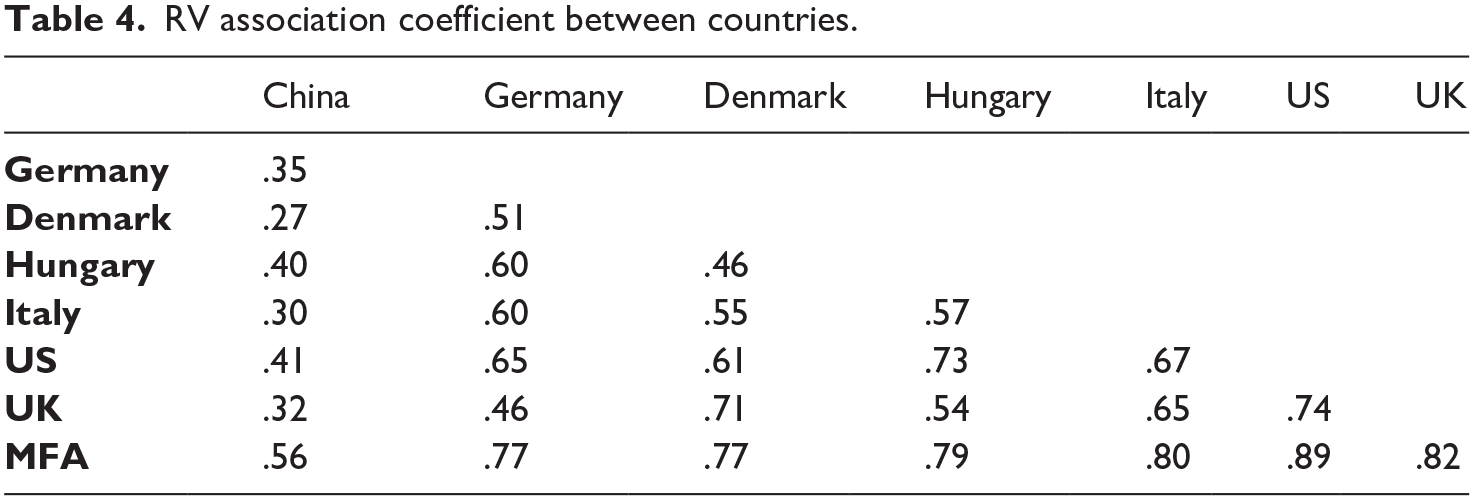
Table 4 provides a global comparison of how strategies for everyday problem-solving vary across countries. To do so, we focus on one particular MFACT outcome, namely, RV coefficient (Pagès, 2015). RV coefficient is essentially a measurement of association between two groups of multidimensional variables. Varying from 0 (distribution of strategies across clusters of one country is uncorrelated with a second country) to 1 (perfect correlation), RV coefficient accounts discrepancies and similarities identified across our analysis. The last row of Table 4 is the association between the overall solution (represented by Figures 2 and 3) and each country, and it confirms that respondents, with the notable exception of China, tend to employ similar strategies in the off and online spheres.
RV association coefficient between countries.
Conclusion
In this article, we have achieved a complex task, namely to compare mundane everyday problem-solving profiles across seven countries. Our methodological strategy, inspired by Bourdieu and using recent methodological advancements in geometric data analysis, made this possible. This innovative method together with the uniqueness of the PIN data allows for a comparative, systematic exploration of on- and offline strategies and a combination of the two for everyday problem-solving strategies.
We found that there are different stratification systems and different ways of using and converting capitals across the sample as discussed in our analysis of individual countries. However, a global comparison of how strategies for everyday problem-solving, distributed across clusters of users, demonstrates a key finding, namely that certain groups of people endowed with higher volumes of capital across extremely diverse national contexts tend to employ similar ‘Everything’ strategies in the off and online spheres. This finding suggests in turn that digital capital should indeed be understood as a bridging capital allowing already advantaged users to deploy these resources online and reap the benefits of their economic, cultural and social capital, thereby reproducing and exacerbating levels of inequality within contemporary societies. Reinforcing this idea, we also identified a group primarily composed of younger people that tends to engage with ‘Mostly internet’ information-seeking strategies. Group members engage in more sophisticated Internet use to compensate for their lack of economic and social capital, at least in comparison with the ‘Everything’ cluster. Those groups who, in contrast, rely mostly on ‘Social connections’, ‘Limited resources’ and ‘Traditionalist’ strategies, particularly in places where Internet use is the most efficient and increasingly the only way of ‘getting things done’, are the most vulnerable.
While there is this striking similarity across our sample there are also national differences. China is particularly distinctive: lower levels of media freedom and Internet penetration, alongside lower income and higher inequality, correspond to a greater polarization in terms of the distribution of strategies for information-seeking and problem-solving. Access to the right levels and types of digital, economic and cultural capital is critical, as simultaneous implementation of diverse strategies is more difficult and rarer in China than elsewhere. In contrast, the United Kingdom shows a stronger association with the remaining countries (and particularly with Denmark and US). This indicates that higher levels of media freedom and Internet penetration in these countries make online information-seeking strategies more readily available for those possessing digital capital and the choice of information-seeking strategy is less dependent upon economic resources in these countries. In other words, it is easier for those possessing digital capital to build bridges in these countries between economic and cultural capital and the effective exploitation of online resources for everyday problem-solving.
Supplemental Material
sj-docx-1-nms-10.1177_14614448211015979 – Supplemental material for Getting things done: Inequalities, Internet use and everyday life
Supplemental material, sj-docx-1-nms-10.1177_14614448211015979 for Getting things done: Inequalities, Internet use and everyday life by Adrian Leguina and John Downey in New Media & Society
Supplemental Material
sj-pdf-2-nms-10.1177_14614448211015979 – Supplemental material for Getting things done: Inequalities, Internet use and everyday life
Supplemental material, sj-pdf-2-nms-10.1177_14614448211015979 for Getting things done: Inequalities, Internet use and everyday life by Adrian Leguina and John Downey in New Media & Society
Footnotes
Appendix 1
Acknowledgements
This publication builds on The Peoples’ Internet project, a collaborative study of global Internet use funded through the Carlsberg Foundation’s Semper Ardens programme.
Funding
The author(s) received no financial support for the research, authorship and/or publication of this article.
Supplemental material
Supplemental material for this article is available online.

Author biographies
References
Supplementary Material
Please find the following supplemental material available below.
For Open Access articles published under a Creative Commons License, all supplemental material carries the same license as the article it is associated with.
For non-Open Access articles published, all supplemental material carries a non-exclusive license, and permission requests for re-use of supplemental material or any part of supplemental material shall be sent directly to the copyright owner as specified in the copyright notice associated with the article.
