



Abstract
This article proposes the concept of digital heuristics to model and explain political communication strategies in the complex environment of hybrid media systems. Insights from recent psychological and political research on heuristic decision-making are combined with literature on the current structural context and features of online communication in order to make the case for a heuristics-oriented approach to political communication strategies. I argue that despite the growing importance of data analytics, in increasingly dynamic and uncertain communication environments, political actors mainly design their strategies according to simple rules (heuristics) that rely on selective information (as well as trial and error) rather than to complex models. Analyzing interviews with communication managers from major political parties in Germany and the United Kingdom, I identify and conceptualize two types of digital heuristics in use: hybridity-based and algorithm-based. The article concludes with considerations for a future research agenda using the concept of digital heuristics.
Keywords
Since the turn of the millennium, the rise of new digital communication technologies has reanimated a number of old analytical problems concerning democratic authority, public opinion, and electioneering. Democratic legitimacy is less and less produced through formal procedures, such as voting rules and formal competencies of state actors. Instead, political elites strategically produce legitimacy through successful communicative performances (Alexander, 2004; Hajer, 2009). This task is being complicated by an increasingly complex and volatile communication environment. Commonly identified developments in the media landscape include the proliferation of channels for political communication, interactive possibilities for media users, less visible third-party influencers and metrics, audience fragmentation, and the declining control of traditional, mass news media institutions (Bennett and Iyengar, 2008; Bennett and Pfetsch, 2018; Blumler and Kavanagh, 1999; Van Aelst et al., 2017).
The acceleration of these trends in today’s “(new) hybrid media system,” to use Chadwick’s (2013) phrase, raises a number of questions about what strategies and practices are becoming standard for successful political communications. Unfolding digitalization is making the already competitive information environment ever more complex, dynamic, and hence, potentially obscure and uncertain. It is creating both additional new technical infrastructures (such as platforms) with their inherent logics and resulting behavioral patterns on the part of increasingly interactive audiences, media actors, and political competitors. This raises the question of how political actors adapt their communication strategies to these changing conditions. How are the communication strategies of elite political actors and organizations shaped by the challenges associated with the transforming communication environment? More specifically, how are political campaign communication managers orienting (or re-orienting) their strategies and practices of electioneering communications? At a time when the information, technology, and media of political communication systems are both more pivotal in democratic politics and more difficult to predictably control (McNair, 2016), how can we model the shifting communicative practices of political actors?
The mainstreaming of digitally mediated exchange, information, and back-end infrastructures is providing political actors with new opportunities and affordances, incentives, and constraints for communication (Kreiss et al., 2018; Schulz, 2014). The question of how political parties and governments are using the vast amount of newly accessible data and latest communication tools to reach their desired ends is an ongoing concern for research in political communication (Anstead, 2017; Howard, 2005; Howard et al., 2018). While the attention of this scholarly debate and much of the public discussion focuses on phenomena such as data-intensive campaigning and the more or less manipulative use of complex analytic strategies and technical tools (Baldwin-Philippi, 2017), this article assesses a different and somewhat neglected perspective on communicative behavior under current circumstances. In line with assumptions of cognitive psychology and theories of bounded rationality, this research indicates that rather than relying on complex models and procedures, social actors typically employ informational short-cuts to cope with complex situations. I argue that the concept of heuristics as simple rules of thumb or routinized strategies that guide decision-making in professional and everyday situations provides unique analytic leverage for explaining the decision-making strategies of political actors in an increasingly dynamic and, thus, uncertain communication environment. Examining political communicators’ use of heuristics in different settings allows researchers to shed light on when and why patterns of action and interaction become (de)stabilized, as well as the ways in which new ones can arise.
In the next section, I will detail how the heuristics concept is used in political science, communication, and cognitive psychology. Then I will turn to the question of how to identify digital heuristics for communication in hybrid media environments. I will develop two categories of digital heuristics against the backdrop of recent theoretical approaches to (hybrid) media logic(s) and algorithmic structures. This conceptual framework is then examined and further specified through an application to recent political campaigns using interviews with communication managers from eight major political parties in Germany and the United Kingdom. After a discussion of the empirical evidence, the article concludes by sketching an agenda for future research on digital communication heuristics in electoral contests and beyond.
Heuristics and communicative strategies
Despite conceptual variation in the literature, the heuristics concept nearly always implies an effort-saving simplification of the process of decision-making (Shah and Oppenheimer, 2008). In contrast to complex strategies of decision-making that try to mirror the complexity of a situation based on logical or statistical models and on a consideration of all relevant information, heuristics reduce complexity by ignoring some of the available information and focusing on a selection of specific cues. Voters, for example, might base their decision exclusively on the party affiliation of the candidates instead of a thorough evaluation of proposed policies. Whether actors apply heuristics or complex procedures in a given situation is an empirical question. However, theories of bounded rationality suggest that people are particularly likely to apply heuristics if they have to make decisions in complex, insecure, and unpredictable environments (Simon, 1990).
Although research on heuristic judgment and decision-making has developed into a broad and differentiated field of inquiry, few studies apply this lens to examine the communication strategies of political elites (Vis, 2018). 1 Hersh’s (2015) use of the concept to explain the constraints of American political parties in designing their target audiences in election campaigns is one notable exception. Another is Miler’s (2009) assessment of the problems that arise when Congressional representatives rely on biased information about the preferences of their constituencies. Thus, despite the importance of understanding heuristics use by the sender’s side of political communication and for the study of strategic decisions of party elites, more research is needed to understand what these heuristics look like in the digital environment.
In political science and communication research, the heuristics concept has primarily been employed to analyze the political judgments and voting decisions of citizens. Early approaches explored the positive potential of rational heuristic processing for a citizenry that does not generally engage in extensive information balancing and issue evaluation (Lupia, 1994; Mondak, 1993). Later studies examining how and when citizens use cognitive heuristics in voting decisions focused on heuristics as partisan cues (Schaffner and Streb, 2002), name recognition (Kam and Zechmeister, 2013), and as coalition participation (Fortunato and Stevenson, 2013). The emphasis on cognitive heuristics’ potential to improve people’s self-interested decision-making was challenged by scholars skeptical of the inherent rationality of heuristic processing and especially their vulnerability to manipulation through false information (Kuklinski et al., 2000). Researchers began developing a more balanced picture of the consequences of different heuristics. For example, Lau and Redlawsk (2001) investigated the advantages and disadvantages of five common political heuristics used by voters to make sense of politics in experimental election contexts and found heuristics to be a poor substitute for accurate political information, particularly for those lacking expertise. Other scholars have analyzed the problems and consequences that arise when the working conditions of heuristics are not met (Dancey and Sheagley, 2013).
Part of the scholarly disagreement regarding the (ir)rationality of heuristics can be traced back to differences in conceptualization. Among scholars of cognitive psychology, who investigate people’s use of heuristics in their everyday lives, two important programs merit attention. According to the “heuristics and biases program,” social actors switch between two distinct systems of decision-related reasoning. The first is characterized as reflective, analytical, slower, and arguably more rational, while the second is intuitive, quicker, and hence, considered more prone to bias and faulty reasoning (Kahneman, 2003; Sloman, 1996 see also Stoker et al., 2016). However, other scholars challenge this distinction as too artificial, vague, or misleading (Gigerenzer and Brighton, 2009; Hertwig and Herzog, 2009).
Rather than treating cognition as two distinct systems, scholars working in this “fast and frugal program” argue that people can employ a range of available types of cognitive short-cuts depending on the task at hand and the decision-making environment. The basic idea is that individuals rarely have full information on all relevant aspects of a situation, including the implications of alternative decisions. Far from being omniscient, people tend to base their choices on a limited selection of available information or simply follow routinized practices. The analyst’s goal, therefore, should be to model these diverse heuristics as closely as possible and use them not only to explain (and possibly predict) what political actors do, but also to account for why other actions were not considered or taken due to the constraints of available heuristics.
This article draws on this second program to conceptualize heuristics because it speaks to the core issues raised by the research question. By highlighting the relationship between an institutional environment and heuristics, this approach can address the question of how actors adapt their behavior to different contextual challenges. Heuristics can either be evolved or learned, explicit or implicit, unconscious or conscious. Importantly, although they overlook parts of the potentially available information of an environment in order to make quick and frugal decisions, they are simple and efficient, and also potentially effective if they fit the respective environment (Gigerenzer and Gaissmaier, 2011). 2 In this way, the fast and frugal perspective aligns with the focus of this research: identifying the communication heuristics actors use in an uncertain political communication environment.
Following Gigerenzer (2004: 63–64), a heuristic is a specific kind of rule characterized by three necessary qualities. First, it is simple relative to some evolved or learned capacities of a social actor. It allows for quick decisions without extensive computation. This implies that what a heuristic is depends on the capacities of the individual actor. While a specific decision strategy might serve as a heuristic for an experienced expert, it might not do so for a layperson. Second, “heuristics exploit structures of environments.” Actors learn or adopt heuristics in encounters with decision-making challenges that specific contexts pose. Therefore, heuristics always mirror some characteristics of the environments for which they are developed. Third, they describe actual processes and are distinct from “as if” optimization models. Unlike many rational choice or game theoretic models, heuristics claim to realistically describe observable practices and processes.
In this conceptualization, heuristics deploy (at least potentially) an ecological rationality by providing the most efficient and appropriate tools for problem solving in a specific context. Although heuristics can fail in cases where they do not match with the structure of the surrounding environment, research shows that they can produce better predictions than more complex computational models in highly uncertain and volatile environments (Gigerenzer and Brighton, 2009). Accordingly, if complex decision-making procedures are more appropriate the more certain and predictable an environment is, then I assume that political actors use or develop diverse kinds of heuristics in order to build efficient communication strategies in highly complex and uncertain communication environments. Furthermore, because heuristics connect the structures of a communication environment to strategic decisions and communicative practices of the political actors interacting with them, studying those links can help to explain actors’ behavior in a systematic way.
Heuristics in the digitalized world
If heuristics were relevant to understanding communicative practices before widespread digitalization, they are even more so in the digital era. As noted earlier, unfolding digitalization is making the already competitive information environment ever more complex, dynamic, and uncertain. Against this backdrop, there are two classic options to identify common communication heuristics in the digital world. We can either inductively collect and typologize the communicative strategies that political actors deploy or we can build theoretical expectations about them and test their applicability empirically. Given the dynamic character of its object and its explorative aim, this study uses an abductive approach that combines both logics (Schwartz-Shea and Yanow, 2012). In the current section, I develop theoretical expectations about existing types of digital heuristics before I probe and specify them by engaging with empirical interview material in the next section.
As outlined earlier, the principle underlying heuristic decision-making involves adaptation to complex and dynamic environments. Consequently, a first step in identifying likely types of digital heuristics comprises the examination of the specific challenges that current communication environments pose for political actors. Today, political parties use digital channels for diverse goals ranging from internal coordination over every-day public relations to external mobilization and persuasion in electoral campaigns (Chadwick and Stromer-Galley, 2016). In this study, I focus on the latter because challenges and innovative solutions become most apparent in these situations of dense and competitive communication. In their attempts to reach audiences and spread campaign messages, parties are expected to react sensitively and to the best of their knowledge to the transforming conditions of political communication.
There are at least two major trends driven by digitalization that demand adaptation for political communicators: the transformation (and evolution) of (new) media logic(s), as well as the growing influence of algorithms in political communication. These two interconnected phenomena stand for two bundles of features of the current communication environment. Emerging media logics are grounded in the diversification of channels and formats, fragmentation of audiences, increasing interactivity, and loss of control of traditional institutions (see, for example, Van Aelst et al., 2017), among others. Algorithms relate to the technical infrastructures of platforms with their pervasive inherent info-economic logics. For both, we find fruitful accounts in the current scholarly discussion.
The literature on transforming media logics centers on the concept of hybridity. Hybrid media systems are the result of old and new media interacting and merging into new structures and working routines (Chadwick, 2013). Consequently, the strategic question from political actors’ perspective of who should be addressed with what kind of message and through which channel, requires updated answers. Sending messages becomes easier in the digital era because the gatekeeping function of traditional media is weakened. However, controlling the effects of the messages becomes harder—attention is not guaranteed and interactive effects can distort the intended meaning. Therefore, the problem is not only how to get attention, but also how to obtain the intended effect.
Elements of “network media logic” could provide orientation for actors tackling these problems. Klinger and Svensson (2015) introduce the term in order to capture the argument that traditional mass media and new social media follow different “rules of the game” (p. 1251). These rules are expressed in the specific intertwining logics of production, distribution, and media usage. For example, the network logic of distribution stresses the necessity to have a message go “viral” in order to get attention (Klinger and Svensson, 2015:1284). Virality rests on content popularity. Popularity, in turn, often rests on the socially engaging and emotionally appealing content that result in social endorsements and further sharing (Messing and Westwood, 2014: 15). At the same time, network media logics do not work in isolation. In hybrid media systems, they intertwine with mass media logics (Klinger and Svensson, 2015: 1251). Thus, the challenge for parties is to send messages that can bridge both logics. Against this backdrop, I assume a set of hybridity-based heuristics that respond to the described challenges.
Turning to the increasing role of algorithms, political actors are confronted with the challenge of identifying the conditions for algorithmic success. Algorithms stand for the technical (taken-for-granted) infrastructure of new media. Yet, algorithms can also be interpreted as representations of social heuristics. This seems counterintuitive at first because algorithms as tools for analyzing (big) data come with the impression of mathematical objectivity and complex, nonhuman decision-making. However, many scholars stress how algorithm design is not objective but biased toward the ideas and interpretations that guided its creation (e.g. Bolin and Andersson Schwarz, 2015; boyd and Crawford, 2012: 667). In this sense, an algorithm is a procedure that describes a sequence of steps to solve a specific problem (Gillespie, 2015: 167). Both the problem identification and the choices made for its solution are subjective (Karpf, 2016: 29). Accordingly, algorithms must ignore some of the available information in favor of other information deemed more valuable. Therefore, an algorithm can be seen by its designer as a simplified decision rule or set of decision rules and hence as a heuristic, whereas from the perspective of a technological layperson or outsider it appears as a complex, concealed procedure.
Here, the problem becomes how those actors who have not designed the algorithms can still use them as a resource for decision-making heuristics. In order to get attention on social media platforms, political communicators must design and distribute “algorithmically recognizable” messages (Gillespie, 2014: 184). This means that they have to anticipate algorithmic success on different platforms without having complete information about the design of the respective algorithms. So, we can hypothesize the development of algorithm-based heuristics in response to this feature of the communication infrastructure. Both types of heuristics, hybridity- and algorithm-based, are expected to include simple rules that exploit structures of current communication environments and that describe actual strategies employed by political actors. I now turn to their empirical assessment.
Digital heuristics in use
The empirical analysis is based on interviews with senior communication managers and consultants from eight major German and British political parties. The selection of these country cases has two advantages. First, it allows us to gain insights into current transformations and dynamics of the political communication landscape beyond the much studied US-American case. Second, the two cases provide a representative range of European media and electoral systems and so allow for the assessment of variance and convergence when we look at the development of new communication strategies in hybrid media environments. While Germany is conventionally subsumed under the “Democratic Corporatist Model” of media systems, the British system is linked to the “North Atlantic or Liberal Model” (Hallin and Mancini, 2004). Although many pieces of evidence have suggested a tendency of convergence of media systems toward the “Liberal Model” in the last decades, relevant structural differences still exist (Hallin and Mancini, 2017: 162). In terms of political communication, for example, European and country specific data protection laws and standards moderate the adoption of new campaigning techniques from North America (Bennett, 2016). Moreover, campaign strategies can be shaped by differences between majoritarian and proportional electoral systems. The question then is how new media influence the communication strategies of political actors and whether these strategies converge or diverge according to existing differences between those systems.
A total of 11 semi-structured interviews with 12 interviewees were conducted between October 2017 and May 2018. 3 The interviews were subject to an abductive analysis according to three interrelated issues. These were derived from the conceptual framework outlined in the previous sections: the perceived features and challenges of current communication environments including differences between diverse media channels and platforms; strategies for and practices of political communication deployed against this backdrop; and, sources of knowledge and information that inform the latter. In line with abductive reasoning, the analysis consisted of an iterative-recursive process in which statements of interviewees were compared with each other and with the conceptual framework in order to probe and specify the theoretical assumptions. The abductive strategy aims at finding innovative answers to puzzling issues by engaging in theoretical reflection and empirical observation simultaneously (Schwartz-Shea and Yanow, 2012). This procedure allows for both theoretical connectivity and openness for surprising insights.
In the initial analysis, I coded the interview transcripts. The coding scheme was informed by the issues and concepts presented earlier. To secure the validity of my interpretations, I compared my results with those of a second researcher who applied the same conceptual framework to the transcripts. 4 Only relatively small differences existed which were subsequently discussed and consensually resolved. In addition, informant feedback from interviewees was requested (10 out of 12 interviewees responded) and used to validate the interpretations and paraphrases of the respective interview material. Only a few minor objections were raised that were considered accordingly for the presentation of the analysis. The two categories of hybridity and algorithm heuristics served as conceptual grids to order and systematize the findings as shown below.
Hybridity heuristics
In the interviews, we encounter a clear awareness of the hybrid character of current media environments and the challenges for political communication that come along with this. There is a broad agreement among the interviewees that online and offline communication in election campaigns are now tightly intertwined (I.1, CDU: 3; I.3, Grüne: 3; I.6, SPD: 14; I.8, Lib.Dem.: 2). However, recognizing that both channels cannot be separated does not mean that digital communication managers think there is no tension between them. Rather, they suggest that the different logics have to be aligned to each other: “[Y]ou want to create that synergy between something landing on your doorstop and something on your FB feed” (I.8, Lib.Dem.: 11). In another interview, one senior manager of online, digital, and social media news says, [I]n the area of press work and social media, communication logics also collide in a certain way. Press work . . . is all about accuracy, about the correctness of the information, but it also has something about crisis communication, something appeasing and so on. Online communication . . . lives rather from the sharpening, from polarization also from completely different contents. We have now also noticed over the years that people in the social media sector, our channels, want different content from . . . the people who want to read it in the newspapers. In fact, they often don’t want to be so much informed by us on the Internet about what we want in terms of content and program, but they think it’s great if we mark a clear position against the political right. And somehow, so to speak, these two logics of action have to be brought together. (I.6, SPD: 4)
In order to meet these challenges, interviewees strive for designing messages in such a way that they can be taken up and proliferated in other channels, contexts, and media. The question of how to do so, how to do “the viral things and going outside the bubble” from one channel or platform was underscored by multiple interviewees (I.11, Lab./Momentum: 8; see also: I.2, Grüne: 28; I.3, Grüne: 10; I.11, Lab./Momentum: 3–4). This includes adjusting formats like video to the exposure patterns of social media users by reversing the story line (start with a peak to catch attention), subtitling (for silent use), and so on (I.2, Grüne: 15; I.3, Grüne: 9; I.8, Lib.Dem.: 2; I.11, Lab./Momentum: 9). Principally, however, communication managers see the need to adjust political communication to the specificity of the online contexts which clearly differ from traditional public spheres: “That this unfiltered communication already has a force that the press might not have” (I.2, Grüne: 22). Or, somewhat differently, “What applies to all channels, one has to remember, is that they did not originate as channels for political information. It’s not called social media for nothing” (I.1, CDU: 8).
Several of the interviewees posited that political parties should not only cover strictly “political” topics, but also post on non-political themes. For instance, communications should include commentary on, for example, the International Star Trek Day or re-post relevant commentary from celebrities (I.1, CDU: 8; I.2, Grüne: 9), thereby taking into account users’ main focus on entertainment content (I.6, SPD: 13). In this view, only by thematically connecting to typical social media discourses, can the usual political discourse bubbles of experts, journalists and political actors be pierced in a way that gains political communication comparable reach and credibility (I.6, SPD: 14). Of course, this also varied by social media platform. The parties’ communication managers often see Twitter as an echo chamber in which mainly experts, journalists, political actors, and generally those highly interested in politics engage with each other, while Facebook (FB) is considered a broad forum with an average audience of mainly “regular” or “ordinary” people, for its broader reach among more diverse networks with limited interest in politics (I.1, CDU: 5; I.2, Grüne: 8; I.3, Grüne: 5, 13; I.4, Linke: 6; I.9, Lib.Dem.: 3; I.10, Lab./Momentum: 3; I.11, Lab./Momentum: 3–4). For example, one senior communications consultant says, It’s very difficult for the majority of Twitter users to get outside that bubble which not only doesn’t expose folks to views that contradict their own, it very strongly reinforces their views by convincing them that that’s really the only show in town. Similarly, if I go on my FB account, I see people of all different persuasions in terms of my football team and in terms of politics . . . (I.7, Cons.: 4)
A related aspect of this strategy is the idea that establishing a link to the personal and private sphere on social media platforms may be necessary in order to increase the number of shares and gain virality. There is a clear awareness that classic political communication is somewhat inappropriate in—or ill-suited for—social media contexts. As one interviewee states, [. . .] people share our image or our video. Because what they do then is basically: I take it and I share it, show it to all my friends and almost pass it off as mine. Or it demonstrates at least a high degree of identification with what I share. [. . .] It’s basically like printing a political message on a T-shirt and going to a family celebration or something. (I.2, Grüne: 16)
Another campaign communications manager suggests that to make this link to social media one has to think of designing messages that will also work in a personal context or provide social value: “it was a matter of communicating one or two concrete messages per day, which also affects people emotionally and motivates them to like and share” (I.4, Linke: 6; see also: I.5, FDP: 15). The dynamics of generating supporter-driven electioneering through social media sharing follows different logics in different areas of the political public sphere that have to be bridged: Imagine someone passing an election poster on the street, he makes a copy of it and then shows it to all his friends, neighbors and acquaintances. This is a completely absurd idea, but in this logic it almost works on Facebook and the other networks. (I.2, Grüne: 16)
Or consider this similar approach to building outwards from individual engagement to engaging that individual’s online community: So you might be interested in the Labour party but are not really doing anything, then this really fun and interesting video comes out—you like it and share it, so that’s a step towards politics, political action, so maybe that’s a step towards mobilisation. Then maybe some of your friends who aren’t political, maybe they would be more likely to vote—so it’s moving everyone up the ladder of commitment. (I.11, Lab./Momentum: 4)
To establish a personal link and increase the number of shares, reach, and engagement, many interviewees consider the diverse characteristics of communication contexts by making indirect reference to the principle of “homeless media” (I.3, Grüne: 3). Next to overcoming the professional–political versus colloquial communication binary, this principle suggests that to be successful, messages have to travel to new publics, and in order to travel they must be adjusted to work across a variety of contexts, platforms, and formats, as opposed to assuming that dispersed publics can be pulled into a particular medium where the information is being supplied. The following quote illustrates why this principle is considered important in the web 2.0: [I]t is basically like—imagine Facebook as a weekly market, as a market place, where life happens, there are all your friends, there is the information. And when you finally try to get people on the website, it’s a bit like standing 50 meters away from this marketplace and shouting: “Hey guys, I see you’re having fun, and this is the place where you want to be. But why don’t you come over here? I have plenty of text for you to read,” like that. And that, of course, is a logic that simply no longer works. (I.2, Grüne: 21)
Interviewees commonly touched on “loudness,” “brevity/pointedness,” “topicality,” and “emotion” as elements of communicative form (I.2, Grüne: 14; I.3, Grüne: 9; I.4, Linke: 6; I.6, SPD: 9; I.7, Cons.: 8: I.9, Lib. Dem.: 5) that can be interpreted as cues for a hybridity heuristic. Brevity and loudness are seen as important to gaining attention within the large, rapid stream of networked communications (I.2, Grüne: 14). Topicality is an old concept given new import because issues that are high on the public, political, or traditional media agenda will get more shares when they are echoed or amplified in social media platforms because people are already aware and engaged. Online communication can then reinforce offline messages and vice versa. An example of producing or layering topicality is sending targeted Facebook advertisements after leaflets have been circulated in the respective local area in order to strengthen the offline campaign through digital channels (I.8, Lib.Dem.: 2). Indeed, a prominent strand of topicality in action among the British political party communication managers is catering to local variance (I.8, Lib.Dem.: 3, 6; I.10, Lab./Momentum: 3–4, 6–7). As one interviewee stressed, localization is especially important in the British majoritarian electoral system in single-member districts: [W]e work really hard with local candidates to make sure that they are using social media well—that they are using it locally. That means that if you are doing any paid activity you are only doing it for your constituency, everything you are talking about is through the prism of—it’s about the local area; if it’s about the economy it’s about the economy in your area, if it’s about businesses, it’s about backing businesses in your local area, it’s about your local park, if it’s about transport it’s about your local bus and train services. (I.7, Cons.: 7)
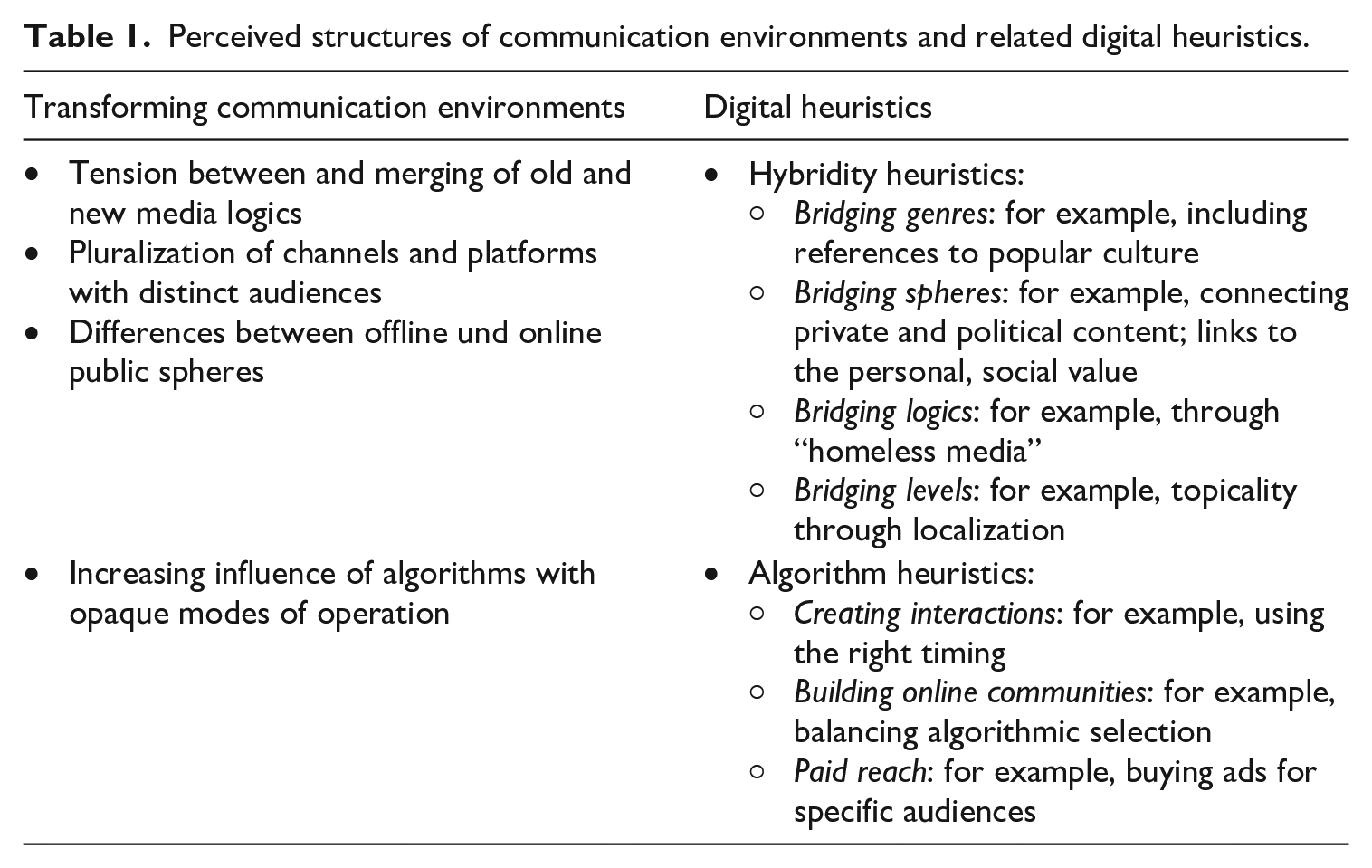
In short, hybridity heuristics show actors searching for communicative means to bridge genres (serious vs entertaining), spheres (e.g. private vs political), logics (mass vs network media), and levels (global vs local) in their messages, channels, and audiences (see Table 1). Cues, such as topicality and emotion, are used to find communicative content and occasions for designing effective messages in hybrid media environments.
Perceived structures of communication environments and related digital heuristics.
Algorithm heuristics
Although the possibility to directly reach or interact with citizens without the standard interference of gatekeepers is routinely identified as the main advantage of social media (I.1, CDU: 9; I.2, Grüne: 7; I.4, Linke: 14; I.11, Labor/Momentum: 2–3), it is not lost on party communication managers that platforms still intervene through their algorithmic infrastructures. As put by one interviewee: “[W]e are not completely free of what the medium presets” (I.4, Linke: 4). Unsurprisingly then, most of the managers consider it very important to learn and understand as much as possible about the functioning of the respective platform algorithm (I.1, CDU: 6; I.2, Grüne: 18; I.3, Grüne: 6–7). They use what they know or can learn about platform algorithms to make more advantageous campaign communication decisions, but they are also skeptical of what the algorithms are measuring and the platforms providing them.
Awareness of algorithmic parameters is not seen as a substitute for awareness of intersecting media and political system audiences, events, and agendas. From the perspective of one interviewee, catering to an algorithm does not work in isolation, you also have to know your respective community in order to develop successful communication strategies (I.1, CDU: 6). With regard to timing, algorithms can help a party reach a wider audience during election campaigns by taking the increasing relevance of campaign topics which are more often addressed by users into account, while in times beyond elections, the algorithm almost exclusively helps to reach existing supporters (I.1, CDU: 26). So, political events and agendas provide important cues for judging when postings can have a narrower or a wider reach (I.1, CDU: 27).
At the same time, interviewees also express awareness that algorithms, like the one of Facebook, can be so opaque that nobody can actually grasp or “game” them completely. This opacity is seen as the outcome of multiple people being involved in their creation and utilization, as well as based on the assumption that algorithms are constantly and automatically changing (I.2, Grüne: 17). Besides learning through exchange with the online community and other organizations and experts (I.1, CDU: 6; I.4, Linke: 7; I.5, FDP: 6; I.6, SPD: 7; I.9, Lib. Dem.: 3), platform companies also offer basic advice which interviewees, however, mostly characterize as being rather sales-oriented than operative (I.1, CDU: 12; I.2, Grüne: 12, 18; I.4, Linke: 7–8; I.7, Cons.: 8). Accordingly, the main way to gain experienced knowledge is through processes of trial and error (I.3, Grüne: 10, 12; I.4, Linke: 7–8; I.5, FDP: 7; I.6, SPD: 7, 10). As a result, party communicators have a more or less vague approximation to the functioning of the algorithm as one interviewee indicates, And in the end, as advertisers, we can only try to get near to that. By trying it out . . . : I’m taking a picture, how does it work? I do a pure text and I make a video, for example. Then you can see what works well. Or I can conceive any logics, perhaps. (I.2, Grüne: 17)
Against the backdrop of this incomplete information managers try to create as much interaction as possible on the assumption that the algorithm translates this into relevance and allocates respective content to the interacting users in the future (I.2, Grüne: 18; I.4, Linke: 6).
Based on these considerations and ongoing experiences, the party communication managers develop a set of simple rules (heuristics) that can be applied with certain expectations for success, as the following quote illustrates, One could—I haven’t written down this list, rather I have it more or less in my head, but I could basically say: “Exactly, when you post on Facebook, watch this, watch this, watch this, watch this and this. And try to achieve as many of these points as possible, and then it’s likely to work better.” But since this algorithm is so complicated, there is no guarantee that this will be the case. [. . .] I can say, for example, link to YouTube: rather not. Well, then it has to be—if the ten people who see it, find it fantastic, insanely great and if everyone shares it, then it might build itself up again. You can succeed even with that sometimes. (I.2, Grüne: 19)
The end of the quote also suggests that the working of an algorithm is seen as at least partly independent from organic reach based on hybridity heuristics: When the party fails to game the algorithm in the right way, an appealing message (design) can still promote the desired virality—and vice versa. The major challenge consists of the fact that the algorithm is a moving target. Actors realize that the algorithm has changed when their communication strategies become less successful (e.g. in terms of reach) and that they have to adapt accordingly (I.1, CDU: 6; I.3, Grüne: 6–7.; I.4, Linke: 15; I.5, FDP: 7, 27). As one consequence of recent changes of the Facebook algorithm, for example, it is considered to be less easy to get the virality or organic reach of crossing the boundaries of your own supporter groups (I.3, Grüne: 19–20).
There are basically three options according to the interview partners for dealing with the algorithmic structure of platforms. The first one is to adjust messages to what the algorithm is supposed to favor. The second one tries to control the effects of the algorithm by building and managing a strong online community that functions according to its own logic to some extent (I.3, Grüne: 5, 6; I.11, Lab./Momentum: 3) or that can be additionally triggered by push messages (I.5, FDP: 5). The third one is buying adverts to achieve paid reach as opposed to organic reach (I.6, SPD: 6; see Table 1).
In sum, for party communicators, making sense of the workings of platform algorithms is similar to poking around in the dark. The digital heuristics that emerge as a result are approximations. Due to the dynamic handling of the algorithms by the platform companies, these heuristics are still prone to instability. Nevertheless, because algorithms are powerful intervening factors, parties try to establish “rules of thumb”—or heuristics—for coping with them.
Discussion
Does the empirical evidence provided above support the assumption that digital heuristics can model and explain the strategic behavior of political communicators? The analysis has shown that rather than predominantly relying on extensive data gathering and analysis based on complex models, political communicators of British and German parties more or less deliberatively ignore (parts of) the existing information against the backdrop of an increasingly complex and dynamic communication environment in order to develop frugal and effective strategies. This is not to say that they do not make use of data analytics. Indeed they do so, but within the comparatively more narrow limitations which the European data protection laws set. However, data analytics still make up the smaller part of the daily business of professional party communicators and are often covered by (and bought from) external experts. Moreover, it is an open question how these analytics are used and if they themselves can be interpreted as heuristics (this question cannot be addressed in detail here, but see also Hersh, 2015). In this sense, the described strategies can be interpreted as heuristics as they are conceptualized in the respective literature outlined earlier. Specifically, the identified sets of hybridity and algorithm heuristics represent simple rules and observable practices that exploit the structures of their environments.
In the set of hybridity heuristics identified in the analysis, we can find rules of thumb which are used to navigate the hybrid structure of transforming and newly emerging media systems as they are described by theories of hybrid media systems and network media logics. Political actors apply relatively simple rules that suggest bridging spheres, levels, genres, and logics whenever suitable topics do emerge. In doing so, they exploit the hybrid character of environmental structures to design effective political messages. Moreover, these observations demonstrate that in hybrid media environments, digital heuristics regularly relate to the offline world as much as they do to the online one—indicating that both spheres can less and less be separated neither strategically nor analytically.
At the same time, actors do not follow “objective” representations of the hybrid media environment but base their strategies on subjective assumptions about audiences, platforms, and suitable characteristics of topics and genres. We also find evidence that these heuristics are learned not in the first instance by instruction from “experts,” but mainly in encounters with the respective environments in a process of trial and error. This is also evidenced by observing the set of heuristics that address the algorithmic structures of new media environments. Fully aware that a complete understanding of the technical working of platform algorithms is not attainable, political online communicators develop rules of thumb based on their experiences, for example, creating interaction on social media platforms will be translated into relevance by the underlying algorithm. Moreover, actors learn from time to time that those infrastructures have changed or have been adapted by the platform companies which can quickly make their previously developed practices outdated.
Thus, closely describing digital heuristics in use helps researchers explain what political actors actually do and avoids speculation about what they would do if they had full information (e.g. regarding the working of a respective platform algorithm), which they regularly do not have. Looking at the assumptions underlying digital heuristics in use helps to explain actors’ behavior and resulting communication dynamics irrespective of the question to what extent these assumptions are actually adequate. This leads us to the question of rationality that can be addressed in a fruitful manner within the framework outlined earlier. Following the “fast and frugal heuristics program” (rather than the “heuristics and biases program”) allows us to assess the ecological rationality of digital heuristics independently from their logical coherence or the comprehensiveness of the information that guides actors’ behavior. The decisive criterion for their rationality is how well they match and perform under the conditions of respective communication environments. Since we are dealing with political practices that have wider implications for democratic processes, the issue of rationality raises normative questions as well. Digital heuristics in use might impact on democratic discourses and on the flow of information. If they are effective, they could prove to be either a source for manipulation and distortion or to be a helpful means to provide orientation under increasingly complex conditions without which democratic communication would be prone to fail.
In terms of convergence and divergence, the interviews do not present any contradicting results between the two countries. This suggests that the features identified in the analysis are common to the range of systems represented by the two countries. There are rather different nuances, one of the most striking being the emphasis British party communication managers put on the issue of localization. Bridging the national and local levels that we have interpreted as part of a hybridity heuristic is brought forward exclusively by British interviewees suggesting that this dimension plays a less prominent role in strategies of German parties—at least on the federal or national party level. This can easily be explained by the different electoral systems since the local level is more important in campaigns in majority districts than in a predominantly proportional system. In sum, the signs rather indicate convergence in the communication strategies between interviewees from the two media systems, but more observations are necessary to come to more viable conclusions regarding this matter.
The approach presented here has both preliminary and systematic limitations. The present analysis is a first step toward a sufficiently fruitful framework of digital heuristics of communication in rapidly transforming hybrid media environments. For a further assessment, the identified heuristics have to be elaborated further, systematized and ideally formalized for a test on new material. The question—and potentially systematic limitation—here is, whether they are stable enough to explain the behavior of political actors because constant adaptation to dynamically transforming environments is necessary as the analysis has also indicated.
Conclusion
Digital heuristics are an appropriate analytical tool for explaining the communicative thinking and behavior of political actors in the contemporary communication environment. Although the concept of heuristics is rarely used for the analysis of the sender side of political communications, this study presents arguments as to why this perspective is plausible and fruitful. The approach has been demonstrated by linking what theoretically informed political communication heuristics in the rapidly changing and increasingly dynamic digitalized world can look like to empirical material from interviews with communication managers of political parties in Germany and the United Kingdom. The empirical analysis provides evidence that heuristics are used by political actors in their digital communication both by adapting to the hybrid structure and the network logics of current media systems and by developing approximate assumptions of the workings of the algorithmic structures of social media platforms.
Building on the assumptions made in this article, future research should address three sets of challenges. Conceptually, digital heuristics should ideally be developed into more concise or even formalized rules that can be tested on new material. Empirically, these models should be used to find out if, when, and with what effects digital heuristics are employed by political actors in diverse settings—both online and offline. Normatively, these results should be evaluated within the framework of democratic theory in order to judge what problems and positive potentials these new communication practices will pose for democratic discourse.
Supplemental Material
sj-pdf-1-nms-10.1177_14614448211012101 – Supplemental material for Digital heuristics: How parties strategize political communication in hybrid media environments
Supplemental material, sj-pdf-1-nms-10.1177_14614448211012101 for Digital heuristics: How parties strategize political communication in hybrid media environments by Andreas Schäfer in New Media & Society
Footnotes
Acknowledgements
The author would like to thank Lorenzo Mosca and Cristian Vaccari for their collegial support and collaboration in the design and organization of the interviews as well as Columba-Isabella Achilleos-Sarll who conducted and transcribed the interviews with British party communication managers. He would also like to thank Stefan Szwed for translating the German interviews, Beth Gharrity Gardner for co-analyzing the interview data and for her valuable comments and suggestions an earlier version of the manuscript, as well as Luke Shuttleworth and Johannes Gerschewski for their important comments on the latest version of the manuscript. He is moreover grateful to the three anonymous reviewers for their insightful comments and excellent suggestions. Earlier versions of the manuscript have been presented at the 2018 ECPR-General Conference and at the 2019 APSA-Annual Meeting. The author thanks Katharina Gerl, Jennifer Oser, and the participants of the respective panels for their helpful comments and questions. Finally, he would like to give thanks to all British and German interview partners for their valuable time and for sharing their perspectives.
Funding
The author received no financial support for the research, authorship, and/or publication of this article.

Supplemental material
Supplemental material for this article is available online.
Notes
Author biography
References
Supplementary Material
Please find the following supplemental material available below.
For Open Access articles published under a Creative Commons License, all supplemental material carries the same license as the article it is associated with.
For non-Open Access articles published, all supplemental material carries a non-exclusive license, and permission requests for re-use of supplemental material or any part of supplemental material shall be sent directly to the copyright owner as specified in the copyright notice associated with the article.
