




Abstract
Social media can be used to both enhance and diminish students’ experiences of university and its influence is strong for lesbian, gay, bisexual, transgender, queer and other non-heterosexual and gender-diverse (LGBTQ+) people facing stigma and discrimination. Students may feel exposed when identifying as LGBTQ+, particularly while transitioning to university life. In this study, we used theories of performance and digital personhood to explore how LGBTQ+ students use social media for identity management. We report a thematic analysis of 16 interviews. Four themes were generated from the data, showing that students use social media to explore, conceal, protect and express their identities. We found that different social media provide stages where LGBTQ+ identities are constrained by different and distinctive social factors. Thus, LGBTQ+ students’ online identities are multiple, situated and bound to specific platforms, with some alternatives to Facebook offering a space where students may feel more comfortable performing their authentic selves.
Introduction
Universities provide opportunities for students to learn, create friendships and gain the knowledge and skills required for personal growth (Arnett, 2015). Social media can support students in gaining the best experiences of university. Researchers have found that using Facebook to interact with peers is associated with better social adjustment and decreased loneliness (Yang and Brown, 2013, 2015; Yang and Lee, 2020); posting status updates enables students to access support and become known to their peers (Stephenson-Abetz and Holman, 2012; Thomas et al., 2017); interacting with future housemates online reduces feelings of uncertainty and awkwardness in offline interactions (Thomas et al., 2017); and browsing profiles helps students to learn about their peers and obtain information for navigating university (Yang et al., 2014).
However, students are not a homogeneous group, and students with different social identities will likely have different experiences of using social media, including those who are lesbian, gay, bisexual, transgender, queer and other non-heterosexual and gender-diverse identities (LGBTQ+). In this article, we understand gender as a ‘biopsychosocial construct, including aspects of identity, expression, role and experience’ (Iantaffi, 2021: 21). While many LGBTQ+ students identify university as a time for personal growth (Formby, 2017; Acciara, 2015), others report experiences of discrimination, such as verbal harassment, exposure to written discriminatory comments, physical violence and a lack of gender-inclusive spaces and inclusive practices for reporting discrimination (Allen et al., 2020; Thompson et al., 2019). Postgraduate students also report experiences of discrimination, with doctoral students outlining a range of inclusivity issues and direct instances of homophobia and transphobia (English and Fenby-Hulse, 2019).
Given these experiences of discrimination, it is likely that students will feel exposed when using social media to identify as LGBTQ+, particularly while transitioning to university. Choosing to disclose an LGBTQ+ identity on social media is therefore not only a matter of privacy, but of safety. In the next section, we discuss the literature on LGBTQ+ identities and contextualise them using theories of performance.
LGBTQ+ identity performance
While some LGBTQ+ students have identified university as a time for identity exploration (Formby, 2017; Valentine et al., 2009), others have reported hiding their LGBTQ+ identity (Miller et al., 2019; Stonewall, 2018). There are many reasons why a person may choose not to disclose an LGBTQ+ identity, such as anticipating negative emotional reactions or changes in relationships; believing that others hold stigmatising attitudes; being uncertain of one’s identity; wanting to maintain others’ perceptions; fearing rejection or punishment due to culture or religion (Schrimshaw et al., 2018). However, hiding one’s LGBTQ+ identity can also have negative consequences, leading to enhanced feelings of rejection, impaired intimacy and acceptance within social interactions; contributing to disproportionately high rates of mental health issues among this population (Bachmann and Gooch, 2018; Newheiser and Barreto, 2014). Displays of gender and sexuality are therefore carefully crafted according to specific social contexts, illustrating the performative nature of gender and sexuality – a lens that we adopt in this article. ‘Performing’ is central to social constructionist views of gender, whereby individuals are expected to outwardly perform in a way that adheres to social norms (Brickwell, 2006). Butler (1988) theorised that gender identities are co-created, reproduced, negotiated and internalised, thus taking on a performative quality. While Butler’s work focuses specifically on gender, researchers have frequently adapted her work to understand other expressions of identity, including sexuality (Van Doorn, 2010; Wadbled, 2019).
Morgenroth and Ryan (2020) used Butler’s work to develop a ‘theoretical framework of the perpetuation and disruption of the gender/sex binary’ (p. 1–2), which is also relevant to sexuality. They theorised that gender performance comprises four elements: character (i.e. categorisation as man or woman), costume (i.e. body and appearance), script (i.e. behaviour) and the stage upon which the performance takes place (i.e. the physical and cultural environment). Morgenroth and Ryan (2020) argued that sexuality is also relevant within this framework as in many westernised societies, sexuality is conceptualised in terms of heteronormativity 1 (McLean and Syed, 2015). Non-heterosexual scripts deviate from this framework and threaten the binary system. We adapt these theories of performance in our work, to interpret LGBTQ+ students’ digital performances of gender and sexuality.
In part, due to experiences of discrimination, LGBTQ+ students may feel the need to manage their identity expression, particularly while transitioning to university. In this article, we use the term ‘identity management’ to refer to the purposeful and unconscious strategies a person uses to tailor their front-stage performances (i.e. behaviour they know an audience is watching; Goffman, 1959). This is sometimes described in terms of deciding whether to ‘come out’ (i.e. the process of disclosing an LGBTQ+ identity to an audience). Unlike their heterosexual, cisgender peers, LGBTQ+ people face unique challenges where they must consciously and consistently disclose their gender and/or sexual identity (Guittar and Rayburn, 2016). Instead, Orne (2011) argues that LGBTQ+ people assess specific social situations before determining whether to disclose an LGBTQ+ identity, applying an approach of strategic outness (i.e. the continual and contextual management of sexual identity). Brumbaugh-Johnson and Hull (2019) highlight how strategic outness is also relevant to gender-diverse individuals who continuously make strategic decisions about gender performance and identity disclosure based on social context. They argue that coming out as transgender is ‘best conceptualised as an ongoing, socially embedded, skilled management of one’s gender identity’ (p. 1148).
With recent developments in technology, performances of gender and sexuality are no longer limited to offline interactions, and one important medium through which identity performance takes place is social media. In the following section, we turn to the literature on the use of social media by LGBTQ+ students and relate it to theories of digital personhood.
Digital performances of gender and sexuality
LGBTQ+ people use social media to locate online communities, create new friendships and access information that is not available offline (e.g. Adkins et al., 2018; Jenzen, 2017; McConnell et al., 2017). While interviewing LGBTQ+ youth, Bates et al. (2020) found that social media facilitates safe spaces for identity formation and exploration. This does not negate the fact that social media spaces can be hostile towards LGBTQ+ people. LGBTQ+ people report experiencing online hate-speech, trolling, harassment and threats of sexual and physical violence (Mkhize et al., 2020; Scheuerman et al., 2018). Consequently, many LGBTQ+ people carefully manage their performances of gender and sexuality on social media (Hanckel et al., 2019). To manage these performances, LGBTQ+ people use privacy and security controls; monitor self-expression; manage friendship networks; create multiple accounts; curate and edit personal photographs; restrict LGBTQ+-related content to spaces that are more anonymous (Duguay, 2016; McConnell et al., 2017; Vivienne and Burgess, 2012).
Researchers have used theories of digital personhood to study online performances of identity, with many drawing upon Goffman’s (1959) theory of self to describe the ways that people try to tailor performances of self to particular audiences. boyd (2002) recognised the ways that such performances or ‘facets’ could be particularly valuable for marginalised individuals: ‘Maintaining multiple facets can offer relief and empowerment for marginalised individuals, as they can find acceptance and support in certain communities while being shunned by society as a whole’ (p. 27). However, boyd was one of the first to recognise that the management of these different facets is particularly challenging on social media, where certain environmental cues are stripped out and where the platforms might fail to adequately differentiate between audiences – something they described as ‘context collapse’. In subsequent work, (e.g. Marwick and boyd, 2011) we learn more about the ways in which certain social media platforms, such as Twitter, remove context, making it more difficult for an individual to manage their identity selectively and effectively.
More recently, Kerrigan and Hart (2016) have drawn upon Turner’s (1960, 1974) dramaturgical approach to describe the ways that digital personhood is carefully assembled, depicted and mobilised through social media. Central to their work is Turner’s (1960) concept of liminality, referring to the state of transition of being ‘betwixt and between’ one state and another. Kerrigan and Hart (2016) identified evidence of ‘multiple temporal selves’ on social media, whereby account holders attempt to bind their activities within certain platforms to manage different states. The availability of past identity performances on social media, however, means that past selves can coexist alongside present selves, despite transitioning to a new state. Consequently, sometimes performances break down due to a ‘social media leakage’, whereby attempts at keeping different digital identities separate from one another fail. In the next section, we consider what these digital performances might mean in the context of university and explore the challenges of digital identity management when students transition to this new environment.
University students’ online performances
Previous work has highlighted how social media can facilitate students’ transition to university. We focus on this transition as a social one, through which students ‘learn the university lifestyle’ (Barnes, 2017: p. 2), rather than a physical or academic transition (Dyer, 2020). Thomas et al. (2017) interviewed students about their transition to university, mapping social media changes in the week before and the five weeks after their move. They found many students used the period prior to starting university to curate their digital selves, sometimes removing photographs of pets and family and replacing with photographs of parties and drinking.
In a follow-up study, Thomas et al. (2020) noted the disadvantages of students tailoring their performances in this way. They explored the relationship between liminal selves, social media usage and loneliness among students transitioning to university life, noting that students who concealed their previous online identities during this transition were more likely to experience loneliness. Yang et al. (2018) described such difficulties in terms of ‘identity distress’, relating to an individual’s inability to reconcile different aspects of self into a coherent whole. They noted that identity distress can be acute at the college (or university) transition, where students ‘leave behind familiar environments and social supports, lose some of their previous sense of belonging, and reconstruct their knowledge of themselves and their contexts’ (p. 93). In a subsequent study, Yang and Lee (2020) found that successful transition was in part dependent upon the social media platform used, with targeted communication with friends and family via Instagram having the strongest relationship with social adjustment.
Such findings are highly relevant to LGBTQ+ students, who may find it more difficult to present LGBTQ+ identities when starting university, who may use particular social media platforms in their performances, and who may also experience forms of identity distress while struggling to manage their liminal selves. Our overarching research aim was to explore how LGBTQ+ students use social media for identity management. We had the secondary aim of examining how LGBTQ+ students use social media while transitioning to university. We approached our work with a social constructionist lens, and used theories of gender performance (Butler, 1988; Morgenroth and Ryan, 2020) and digital personhood (Kerrigan and Hart, 2016) to guide our research.
Method
Participants
Participants were recruited via social media using opportunistic and snowball sampling methods. The study was advertised on Instagram, Twitter and university LGBTQ+ student Facebook groups. To be included in the study, participants were required to be registered as a student at a university in the United Kingdom and identify as LGBTQ+. Both undergraduates and postgraduates were included in the study to increase diversity and facilitate reflective storytelling that captures experiences at different stages of student life.
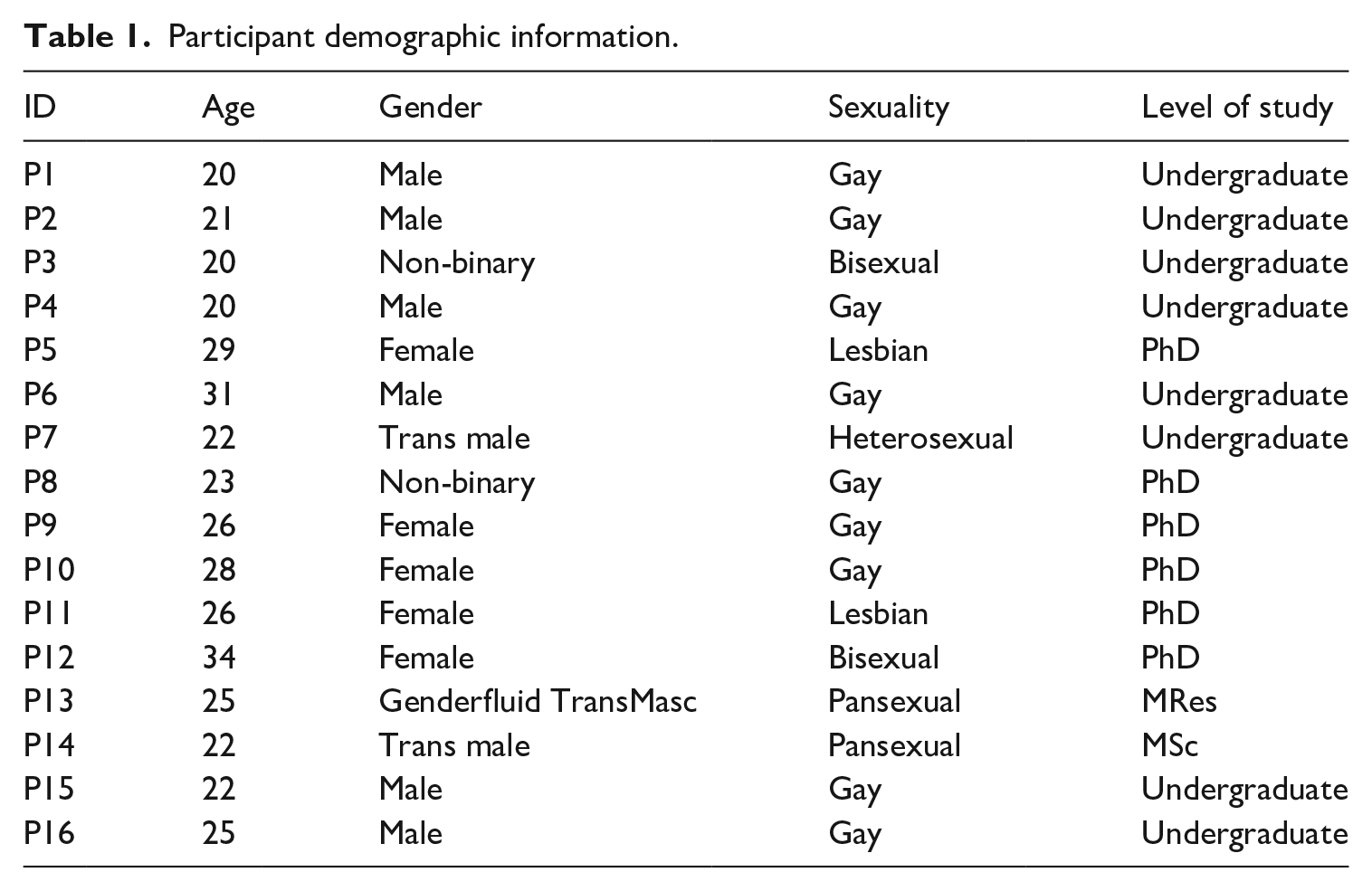
A total of 16 participants from a range of universities in the United Kingdom took part in this study. Participants were aged between 20 and 34 (M = 24.63 years, SD = 4.19 years). Following current guidelines, participants were asked to describe their gender and sexual orientation, to maximise diversity and foster inclusivity (Blair, 2016). Six participants identified as male (cisgender), five female (cisgender), two transgender (female to male; FTM), two non-binary and one gender-fluid (transmasculine). Eleven participants identified as gay/lesbian, two bisexual, two pansexual and one heterosexual. Eight participants were studying at the undergraduate level and the remaining eight at the postgraduate level. Table 1 provides demographic information about the participants and a breakdown of their gender identities.
Participant demographic information.
Procedure
Participants were emailed a study information sheet, consent form and demographic form. In the demographic form, participants were asked their pronouns, which have been used throughout this article, thus removing limitations of inherently binary language (Taylor et al., 2018). After these forms were completed, semi-structured interviews were conducted with participants between November 2019 to January 2020. Eight interviews took place in-person (P1–P5; P7; P8; P16), with the remaining eight conducted via Skype. In these interviews, participants were encouraged to tell ‘stories’ about their experiences of being LGBTQ+ at university. We began these interviews by asking participants to reflect upon their transition to university, their use of social media and how they managed their LGBTQ+ identities during this time (both online and offline). Participants were encouraged to discuss all social media spaces that were important to them while at university. Participants were subsequently asked to describe their more recent experiences of university, including their use of social media.
For interviews that took place in-person, the scroll back method was used (Robards and Lincoln, 2017), whereby participants were asked to scroll through their social media profiles and discuss them with the researcher. This methodological approach facilitated focused discussions between participants and the researcher, providing tangible evidence of their social media usage. With the permission of participants, we took screenshots of the social media content they discussed, which we later used to guide the analysis. Interviews lasted between 30 and 60 minutes.
Analyses
Interview transcripts were imported into QSR International NVivo Pro 12 software and analysed thematically, following Braun and Clarke’s (2006, 2019) approach. The first author (CVT) immersed herself in the data by reading all interview transcripts, marking initial ideas for coding. She then coded the entire dataset independently, before examining and collating codes to identify initial themes across the data. A series of thematic maps were then created to visualise the data, identify links between codes and develop the themes (see Ziebland and McPherson, 2006). Theme development was informed by a social constructionist approach to gender and sexuality. These maps were critically reviewed by the fourth author (PB) and revisions were made where appropriate. The second author (AT) provided critical feedback on these themes and made recommendations on how to interpret the data. The third author (DJR) critically reviewed transcripts, themes and the manuscript from the perspective of an LGBTQ+ community member and a gender and sexuality researcher. This added further depth to the analysis process by including both outsider and insider perspectives (Mullings, 1999). The themes and participant quotes resonated strongly with the DJR’s reading of the data and personal experiences of being an LGBTQ+ student.
The final themes were generated by CVT and agreed upon by all co-authors. Themes were named using quotations from interviews, to ground the findings in the data, ensuring LGBTQ+ youth voices remained central to the project and that results were accessible, meaningful and impactful for this group (Franklin and Toft, 2020). We used various strategies to increase rigour and trustworthiness, including engaging in reflexivity, adopting a teamwork approach to analysis, asking peers to critically review the analysis and leaving a clear audit trail.
Results
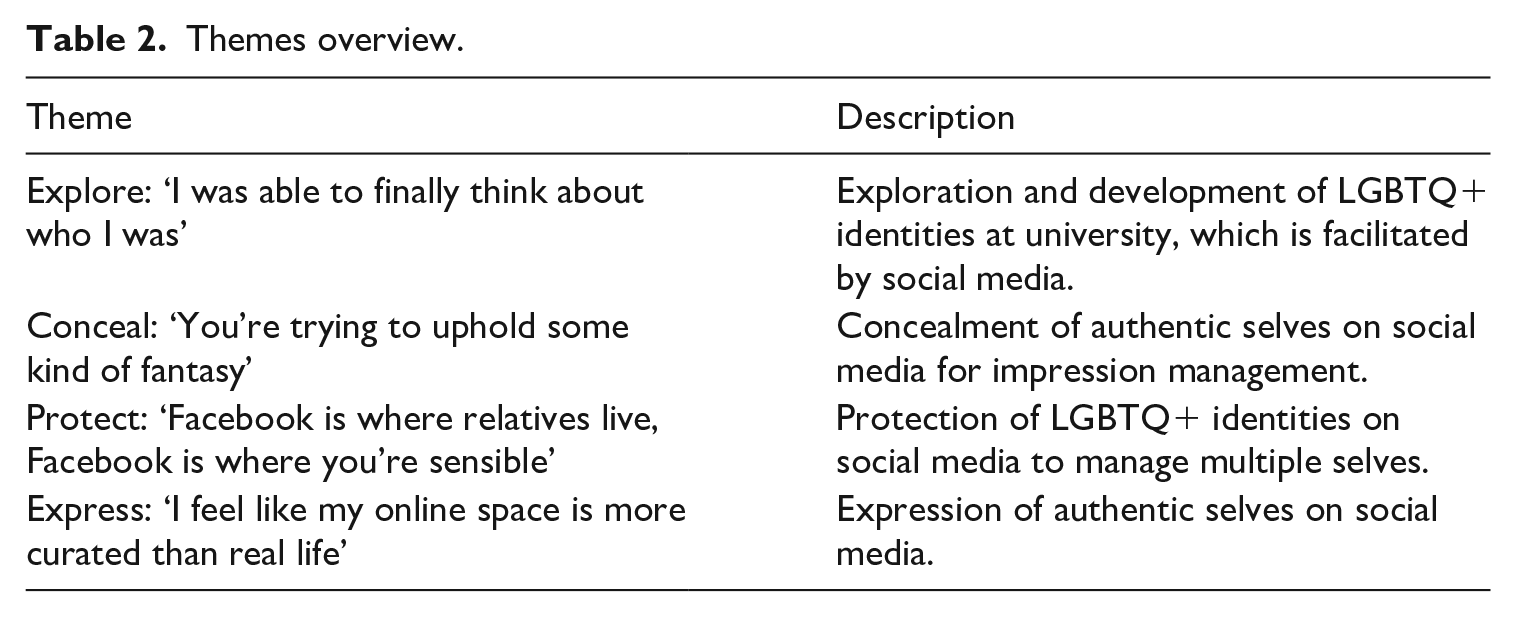
We generated four themes from the data, showing how LGBTQ+ students explore, conceal, protect and express their identities on social media (see Table 2). Participants primarily discussed their use of Facebook, which may reflect the fact that universities encourage students to use Facebook to contact peers and student groups. As a result, most themes relate to students’ Facebook usage. The process of ‘coming out’, whether that be disclosing an LGBTQ+ identity for the first time or going through this process again with a new group of people, was central to participants’ narratives. Participants applied an approach of strategic outness (Orne, 2011), whereby they used social media to selectively manage their LGBTQ+ identities.
Themes overview.
Theme 1. Explore: ‘I was able to finally think about who I was’
Some participants identified university as a place where they could safely explore and perform their LGBTQ+ identities, mirroring the work of Formby (2017). P3 describes the freedom they have been afforded at university: It was quite nice because I was able to finally think about who I was and be more free with who I was as well because I didn’t feel like I was going to get judged by anybody because no one knew me. (P3, non-binary, bisexual)
University provided participants with the opportunity to meet and learn from other LGBTQ+ people, which they felt was essential for their academic and social integration. One important way in which students connected with LGBTQ+ peers was through social media, including LGBTQ+ student Facebook groups, events and pages: There is the LGBT society Facebook page and everyone who is part of that society is a part of and I sort of friended people via that. I met them in meetings and talked to them . . . There’s people there that I would never have interacted with otherwise because they’re on other courses. (P1, male, gay)
By using Facebook pages, participants were able to create new social connections and forge important support networks. LGBTQ+ Facebook groups also provided students with the opportunity to learn what it means to be LGBTQ+ at university, supporting Acciara’s (2015) conclusion on the importance of online LGBTQ+ student groups and unions. P2 describes his experience of joining an LGBTQ+ student group on Facebook: I think I was curious to see the population that was there. I had kind of – I had my own curiosities about what being gay at university looked like, because I came from being gay in a workplace and that is very different to the kind of freedoms that you’re afforded here. (P2, male, gay)
Fox and Ralston (2016) found that LGBTQ+ individuals use social media to learn about their emerging identity. Our findings suggest that this is also true for students, whereby Facebook pages expose them to diverse performances of gender and sexuality, thus facilitating identity development.
Participants reported that LGBTQ+ visibility in universities was important for their development and transition to university, supporting research that suggests queer visibility creates positive experiences for LGBTQ+ students (Waling and Roffee, 2018). Participants’ statements also signal the important role that social media plays in supporting LGBTQ+ visibility in higher education, by promoting LGBTQ+ student groups and amplifying the voices of LGBTQ+ individuals: I just think like, the visibility, especially in higher education for students, for me anyway, I think it was really important to know that there are other LGBT people around and there are LGBT members of staff. (P11, female, lesbian)
While participants felt it was important for LGBTQ+ student groups to be visible, others expressed frustrations that certain groups were only Facebook groups and not active offline: I connected with the LGBT society straight away because I knew that I wanted to be part of it. And that was good, but I think there’s not very much – like, in some LGBT societies there’s not very much happening, so it’s kind of like you’re part of a Facebook group but that’s it. (P14, transgender male, pansexual)
It is therefore essential that these groups are not only visible but also active and accessible to all LGBTQ+ students. While these social media groups are useful for students, they are not a direct substitute for offline interaction. Instead, a combination of both in-person and online LGBTQ+ groups would be beneficial.
Our findings suggest that university provides a ‘stage’ (Morgenroth and Ryan, 2020) where some students engage in diverse performances of gender and sexuality. This stage extends to social media, where students can observe and learn from LGBTQ+ peers. Being able to access these performances is particularly important for first-year students who occupy a liminal state (Turner, 1960), thus aiding their transition to university by facilitating social connection and exploration of identity.
Theme 2. Conceal: ‘You’re trying to uphold some kind of fantasy’
Some students reported feeling nervous about disclosing their LGBTQ+ identities at university, particularly while transitioning to this new environment. Participants who had already come out at home reflected upon the challenges of going through this process again. P6 explains: ‘you’ve got to essentially come out again to a whole new load of people who you don’t know’. Therefore, participants’ experiences reflect observations that coming out is not a singular event, but an iterative process (Guittar and Rayburn, 2016). Consequently, some participants reported concealing their LGBTQ+ identities. P2 describes his experience of avoiding an LGBTQ+ student group during the first few weeks of attending university, despite publicly identifying as gay in other settings: like the LGBT society, when I went to the social fair I completely avoided that stand I was like I do not want to be – not associated with it but I don’t want to sit there and have that be something that people, if they saw me and looked at me they would be like oh well he . . . you still have that in the first couple of weeks you’ve got that protective layer about you that you’re trying to uphold some kind of fantasy. (P2, male, gay)
Here, we see evidence of P2 concealing his sexual identity by performing in a heteronormative manner during the first few weeks of university, actively avoiding anything that could cause an audience to question his sexuality. We are reminded that participants occupied two liminal states (Turner, 1960), whereby they simultaneously adjusted to being a student and being out as LGBTQ+ at university. As a result, participants adjusted their scripts (Morgenroth and Ryan, 2020) to mask LGBTQ+ identities and manage first impressions, perceivably aiding their transition to university.
These acts extended to online performances, whereby some participants reported intentionally not identifying as LGBTQ+ online. These participants reported intentionally censoring themselves online and avoiding LGBTQ+ groups. P9 explains why she avoided referencing her sexuality in her Facebook profile: It’s first impression isn’t it and I think at that age as well, I would have been 18. I was so hung up on making a good first impression, you want everyone to like you and you want to fit in. You don’t know what to expect when you go into University and halls. Those conversations I had with people there was no mention of it ever. I had no reference to it on my profile. (P9, female, gay)
These findings suggest that the public-by-default design of Facebook obstructs LGBTQ+ identity expression among students who do not want to be ‘outed 2 by the machine’ (Cho, 2018), particularly while they navigate the new university environment. This could potentially hinder LGBTQ+ students’ transition to university by limiting access to LGBTQ+ information and communities. In other studies, LGBTQ+ people have discussed the importance of Facebook groups being private (e.g. Blackwell et al., 2016), and we also see this reflected in our data. For many, it was vital that LGBTQ+ student groups were private as it enabled them to maintain a ‘buffer’ around their LGBTQ+identity, allowing them to manage first impressions and gradually come out at university.
Despite efforts to conceal their identities, there were occasions when participants’ performances were interrupted, and they were demasked on social media. One participant spoke of his experience of being outed as transgender on Facebook: We have this parenting scheme, where a second-year takes on a group of first years. Then they’ll make a separate group chat. I didn’t use my preferred name – so basically, they had my old name and then they used that and sent it in the group chat to everyone and they all saw my name. Clearly, that’s not my name on Facebook. (P7, trans male, heterosexual)
This was a distressing experience for P7, causing considerable anxiety. Unfortunately, being outed is a common experience among transgender students (Pryor, 2015). The consequences of being outed can be severe, causing harassment, discrimination, physical violence and mental health issues (Bachmann and Gooch, 2018). Universities must consider these issues, and ensure they are equipped to accommodate and support transgender students.
In the context of performance (Morgenroth and Ryan, 2020), the new ‘stage’ of university caused some students to mask LGBTQ+ scripts and act in a manner that was incongruent with their gender and/or sexual identity. This masking also took place on social media, whereby participants censored themselves or avoided connecting with LGBTQ+ student groups through fears of how audiences would perceive them. In relation to digital personhood (Kerrigan and Hart, 2016), participants tried to bind their activities on social media to selectively manage the liminal state of being out at university. Despite students’ efforts to manage their online identities, ‘social media leakage’ sometimes occurred (Kerrigan and Hart, 2016), resulting in them being outed and their performances being interrupted. This is especially salient for transgender individuals, who’s past digital performances may continue to exist online alongside their present identities.
Theme 3. Protect: ‘Facebook is where relatives live, Facebook is where you’re sensible’
Participants reported feeling unable to perform their authentic LGBTQ+ identities on Facebook. In part, this was due to them being connected to family members and other home contacts who were either unaware of their LGBTQ+ identities or who they were not comfortable viewing authentic performances of gender and/or sexuality. Thus, Facebook was a space where authentic expressions of identity were interrupted. P3 describes how they avoided posting content related to their gender and sexuality on Facebook because they had not yet come out to their family: I’ve got my uncles and cousins who I’m friends with on there, and I don’t think, especially because I’m not out to my parents yet either I’d rather not post loads on there and then my dad is on there as well. (P3, non-binary, bisexual)
Here, we see evidence of context collapse (boyd, 2002), whereby the social and spatial barriers that usually separate audiences collapsed, thus constraining students’ performances of LGBTQ+ identities. Researchers have found that Facebook provides a space for students and parents to bond, easing the transition to university (Yang, 2018). While it was important for participants to connect with family members on Facebook, many felt they could not express their authentic selves. This could be problematic, given that students who express authentic selves online are less likely to experience loneliness while transitioning to university (Thomas et al., 2020); however, for many participants, it was necessary to protect this aspect of their identities.
Facebook did not afford these participants with the same opportunities for diverse performances of gender and sexuality as in their offline university environments. These participants occupied a liminal state, whereby they were ‘betwixt and between’ (Turner, 1960) identifying as LGBTQ+ at university and being closeted at home. To manage context collapse (boyd, 2002), participants displayed different versions of self on Facebook. As P8 states: ‘Facebook is where relatives live. Facebook is where you’re sensible and don’t really say anything’. We interpret this as evidence of bounded selves (Kerrigan and Hart, 2016), whereby participants bound a specific version of self to Facebook – one which was often incongruent with their LGBTQ+ identities.
Participants also expressed concerns about performing a new identity on Facebook that conflicted with past performances. These participants expressed that they had pre-established social norms with their home contacts, which governed performances of gender and sexuality on Facebook. P8 explains: We had good school days but we no longer exist in each other’s worlds and it’s weird, and so to suddenly be on Facebook very very gay where these people are, who I don’t completely want to go off for sentimental reasons but they’re no longer really a part of my life, it would just be alienating and completely weird. (P8, non-binary, gay)
For these participants, performing an LGBTQ+ identity to their Facebook audiences would be ‘alienating’ because it directly contrasted with existing normative assumptions that had been made about their identities. Similarly, Stephenson-Abetz and Holman (2012) found that students expressed concerns that their new identities would not be accepted by existing social contacts. Given that some participants felt they could not perform their authentic selves on Facebook, they employed various privacy measures to mask their LGBTQ+ identities, including not tagging themselves in photos; not joining public LGBTQ+ groups or liking LGBTQ+ pages; not posting information related to their LGBTQ+ identity; and, adjusting who could view their posts: I had a list on Facebook of the people I’d come out to that hadn’t reacted well, so if I was posting at any stage about my sexuality or my gender identity it would be set so that those people couldn’t see those posts, because I didn’t want to have to interact with them on it. (P13, genderfluid transmasculine, pansexual)
These findings reflect Duguay’s (2016) work, showing that LGBTQ+ young people reinstate contexts on social media by tailoring their performances. Like other groups of LGBTQ+ people (Haimson et al., 2015), some participants reported having multiple Facebook accounts. P2 describes having two Facebook accounts, one which he uses to perform his authentic identity (including his LGBTQ+ identity) and another to perform in a way that he is comfortable showing to his family: This is what I want people seeing if my grandad was like – oh this is what [P2] has been up to. Then the other one is like the other kinds of things, there isn’t anything on there that’s particularly offensive or anything like that or vulgar, but it’s that little bit more of like I can add whoever I want on there and I’m free to be tagged in pictures and that is a different level of comfort. (P2, male, gay)
While it was tiring and sometimes distressing for participants to employ these privacy measures, such acts were important as it gave them control over which audiences had access to information about their LGBTQ+ identities. Reflecting upon his two Facebook accounts, P2 said: ‘people have different levels in which they need to be opened up to the idea of me being gay, and social media is a way I can make sure certain doors are open at the right time’. Social media was a valuable tool for participants to manage identity disclosure; however, it does not always support this need. Facebook emphasises authenticity by insisting on only one account per person and is designed in a way that produces ‘default publicness’ (Cho, 2018; Haimson and Hoffmann, 2016). This constrains the performances of LGBTQ+ individuals and increases the volume of work that is required to manage identity disclosure, thereby enhancing the emotional labour of protecting one’s LGBTQ+ status (Hanckel et al., 2019).
From the narratives presented in this section, we can see that the ‘stage’ (Morgenroth and Ryan, 2020) of Facebook does not always facilitate LGBTQ+ identity performances among students. In fact, participants’ performances appear to be bound by the same social norms that govern their offline performances and are further complicated by the design of Facebook’s stage, where social and temporal boundaries collapse and information is public by default (boyd, 2011; Cho, 2018). In the context of digital personhood (Kerrigan and Hart, 2016), we found evidence of temporal selves, whereby participants’ past performances of gender and sexuality (that audiences often interpreted normatively), coexisted alongside their current LGBTQ+ identities despite transitioning to a new state.
Theme 4. Express: ‘I feel like my online space is more curated than real life’
Participants discussed seeking out online spaces where they could safely perform their authentic selves while at university, reflecting research that has shown LGBTQ+ people feel safe in certain online spaces (Bates et al., 2020; Duguay, 2016). Participants identified two main online spaces where they felt safe: Twitter and Tumblr. Participants found it comforting to turn to Tumblr because it was where they first started to explore their gender and sexuality. P8 states: ‘Tumblr definitely knew I was gay long before my parents did . . . it was the first place that I was openly myself’. Cavalcante (2019) argued that Tumblr offers an important space for young LGBTQ+ people to interact, test their identities and become politically motivated, by providing a glimpse into a more promising ‘queer utopic’ (p. 1732), which is often absent from their offline environments. This was also reflected in our data, whereby participants turned to Tumblr to interact, explore and perform their identities. For example, P8 explains their experience of speaking to fellow LGBTQ+ people on Tumblr who were also transitioning to university life: I feel like I was most active on Tumblr around the first time I started university, which was probably partially because that’s what people would talk about within the community I was in. There were quite a few of us who are at that stage in our lives and so we’d talk about the process of moving to university, finding yourself and making your social networks. (P8, non-binary, gay)
Participants also felt they were more able to tailor their audiences on Twitter and Tumblr, compared with Facebook and offline. For example, P12 states, ‘I feel like my online space is more curated than real life’. Some participants described Twitter and Tumblr as being less ‘personal’ because they were less likely to engage with home contacts and peers on these platforms: On Twitter, I think I’m more openly than I do on Facebook. I think it’s because I’m a coward. So, if I post Twitter and people respond negatively chances are most of the time it’s people who I don’t know, and I can go ‘oh it’s fine, it doesn’t matter’. Whereas because everyone I’m friends with on Facebook are people I grew up with or people I’m at university with I think I’d find it more difficult if I got negative reactions. (P13, genderfluid transmasculine, pansexual)
We understand these platforms as being a key site of demasking for participants, where they could escape their Facebook and offline personas, and safely perform LGBTQ+ identities due to being ‘distanced’ from peers and home contacts. In the context of digital personhood (Kerrigan and Hart, 2016), we interpret this as evidence of participants binding their LGBTQ+ identities in Tumblr and Twitter, which enabled them to manage the liminal states of identifying as LGBTQ+, being out at university and closeted at home.
Some participants also reported using Instagram to curate authentic selves. One participant describes his experience of using Instagram to document his gender transition: I think with people on my course seeing stuff that I post on Instagram when I do post about trans related things is very nice, and when I post about, I don’t know, ‘whatever month on testosterone’. I think having people from uni see that and like it and maybe get a bit more knowledge themselves about the process in a roundabout way. Then I feel like that’s positive for them to see that and have a front-row seat of how it happens. (P14, trans male, pansexual)
P14 used social media to bring their experiences to the ‘front stage’ (Goffman, 1959), giving his peers a ‘front-row seat’ where they can be educated about trans issues. This caused P14 to feel like he was creating positive changes within his university; however, it placed considerable pressure on P14 and left him feeling like ‘a walking educational resource’. In other research, LGBTQ+ people have reported experiencing a heightened sense of responsibility for others, which they associated with burnout and compassion fatigue (Vaccaro and Mena, 2011). Participants’ experiences echo these findings, whereby cisgender and heterosexual peers’ needs of understanding sometimes took precedence over participants’ emotional exhaustion. Consequently, there is a greater need for universities and wider society to raise awareness and improve education around LGBTQ+ issues, while not taking advantage of those within the community.
Some participants raised concerns about identifying as LGBTQ+ in offline communities but felt they could claim this label online, supporting existing literature (Bargh et al., 2002). P12 recalls her experience of attending an LGBTQ+ event and being told not to disclose her bisexual identity: ‘you should never tell anyone that, you should always say that you’re gay. Because if you ever tell anyone that you aren’t a lesbian you’re just going to get rejected, no one will want to hang out with you’. Much has been written about biphobia and bi-erasure within the LGBTQ+ community. Bisexual people often have their validity questioned, are associated with negative stereotypes and experience exclusion (Monro, 2015). One non-binary participant also faced difficulties finding where they fit within offline communities. Assigned female at birth, they commented: ‘I mostly am female-presenting so it’s trying to find my space without being imposing’ (P3). However, both participants felt able to identify as their authentic selves on social media, which was both comforting and empowering: I don’t feel like I have a community in, kind of, I want to say – not real life but offline life . . . I feel like I’m more an online bi because of, I think probably because of that kind of ‘queer enough’ thing, because I’m in a relationship with a guy. (P12, female, bisexual)
While social media was a valuable tool for students to enact their authentic selves, performing LGBTQ+ identities online caused many to experience trolling. Transgender participants in particular reported being exposed to negative comments on Twitter. In other studies, transgender people have reported encountering anti-trans people and Trans-Exclusionary Radical Feminists in online spaces (Scheuerman et al., 2018). This was also true for participants: This huge amount of hate from, effectively, a faceless group of people on social media being like, ‘you’re disgusting’ ‘you shouldn’t exist’ ‘you’re a danger to society’ or ‘you’re just a really confused person who needs mental health treatment. (P13, genderfluid transmasculine, pansexual)
Previous research has shown that trolling and exposure to negative comments online can negatively affect a person’s mental health and well-being (O’Reilly et al., 2018). This was also true for participants who reported that these experiences had detrimental effects on their mental health. LGBTQ+ mental health is disproportionately worse than that of heterosexual and cisgender peers, with over half of LGBTQ+ people experiencing depression and one in eight LGBTQ+ youths attempting suicide (Bachmann and Gooch, 2018). Hiding an LGBTQ+ identity to avoid trolling is not a sustainable solution as it too can have a detrimental impact on mental health (Meyer, 2003). Universities and designers of social media might consider how they can support LGBTQ+ students and mitigate the impact of these online harms.
In the context of performance (Morgenroth and Ryan, 2020), the narratives presented in this section indicate that different social media platforms create different stages, which enable different performances of gender and sexuality. Tumblr and Twitter facilitate LGBTQ+ scripts among students, by enabling users to curate their audiences and distance themselves from peers and home contacts. The identities presented on these platforms contrasted with the identities they presented on Facebook, supporting the notion that multiple selves coexist and are bound to specific social media platforms (Kerrigan and Hart, 2016). This contrasts with Turner’s (1960) understanding of liminality, whereby a person is considered to be ‘identity-less’ when transitioning to a new state. Instead, these findings suggest that LGBTQ+ students present multiple identities, rather than being identity neutral.
Conclusion
In this study, we explored how LGBTQ+ university students use social media for identity management. We had the secondary aim of examining how LGBTQ+ students use social media to manage their identities while transitioning to university life. We approached the narratives of 16 LGBTQ+ students with a social constructionist lens, using theories of performance (Butler, 1988; Morgenroth and Ryan, 2020) and digital personhood (Kerrigan and Hart, 2016) to inform our work. From these interviews, we observed a tension between LGBTQ+ students identifying university as a time for identity expression and exploration, but also needing to protect this aspect of their identities, either from their peers or home contacts.
We identified that participants occupied multiple liminal states. They simultaneously navigated being out as LGBTQ+ at university, being closeted at home and transitioning to university life. This tension extended to students’ use of social media, whereby they adopted a ‘strategic outness’ approach (Orne, 2011) to selectively manage their performances of gender and sexuality. Because certain platforms such as Facebook produce information that is public-by-default (Cho, 2018), LGBTQ+ students employed various protective strategies to manage their online performances and liminal states. This included self-censorship; not tagging themselves in certain photos; not joining LGBTQ+ students groups or liking LGBTQ+ pages; not posting information related to their LGBTQ+ identities; adjusting their privacy settings; creating multiple accounts; and seeking out online spaces where they felt they could express their authentic selves. It took considerable effort for participants to consistently manage their online performances, and while this was frustrating, it was necessary for them to feel safe and reduce the likelihood of experiencing discrimination.
In the context of performance (Morgenroth and Ryan, 2020), we found evidence that the ‘stage’ of university was generally supportive of LGBTQ+ ‘scripts’, facilitating identity exploration and development; however, some students did feel the need to mask LGBTQ+ scripts, particularly while transitioning to university. Importantly, we found that social media provided stages where students observed and learnt from LGBTQ+ scripts and created new social connections. These online experiences were vital for supporting participants’ experiences of university and aiding their transition to the university environment. The stage of Facebook was particularly problematic for LGBTQ+ students because of context collapse (boyd, 2002), whereby audiences comprised home and university contacts who were not always aware of participants’ LGBTQ+ identities. Consequently, the same social norms that governed offline performances also limited performances on Facebook. These findings develop contemporary frameworks for understanding gender and sexuality (Morgenroth and Ryan, 2020) by applying them to online performances.
We found that other social media stages such as Tumblr and Twitter facilitated more diverse scripts of gender and sexuality, by allowing students to tailor their audiences and distance themselves from home contacts. This reflects Hanckel et al.’s (2019) finding that LGBTQ+ young people identified online spaces that were ‘for them’ and ‘not for them’, and provides evidence of bounded selves existing on social media (Kerrigan and Hart, 2016), whereby students bound different identities to different platforms to manage their liminal states. In addition to being visible on Facebook, LGBTQ+ student groups could use alternative social media spaces where students may feel more comfortable performing their LGBTQ+ identities. In turn, this could aid students’ transition to university.
Turner (1960) frames a person as being identity-neutral during transitions, as though they are neither the past identity nor the new identity. However, our findings suggest that LGBTQ+ students present multiple identities rather than being identity neutral, reflecting prior work conducted with LGBTQ+ groups (Haimson, 2018). Thus, LGBTQ+ students’ online identities are multiple, situated and bound to specific platforms. This supports Haimson’s (2018) observation about the importance of ‘social media site separation’. In the case of LGBTQ+ students, separation between social media platforms appears necessary to express different identities, which is particularly important when transitioning to university life. In an increasingly connected world, we recommend that designers also consider the importance of separation for people with stigmatised identities and the ethical implications of enabling connectivity across social media.
Our findings have important implications for the social media stages upon which performances of LGBTQ+ identities take place. The ‘public-by-default’ design of Facebook (Cho, 2018) appears to limit students’ expressions of LGBTQ+ identities, which in turn could limit access to certain information and communities that could support their transition to university and enhance well-being. It is clear from our interviews that a static and fully public approach to identity is not appropriate for LGBTQ+ students. In fact, consistently managing social media performances was emotionally demanding for participants, reflecting Hanckel et al.’s (2019) work with LGBTQ+ young people. Like Haimson and Hoffmann (2016), we recommend that designers focus on promoting flexible and fluid expressions of identity. This will benefit LGBTQ+ students who occupy liminal states, by potentially aiding their transition to university and identity development. Designers should seek to challenge normative designs and create easy-to-use systems that give LGBTQ+ students (and other LGBTQ+ groups) control over who has access to what information and when. Importantly, we recommend that the voices of LGBTQ+ students are centred in the development of social media, to create innovative designs that promote autonomy, inclusivity and fluid expressions of identity.
Our study has some limitations. First, recruiting from LGBTQ+ student Facebook groups may have biased our sample to individuals who were comfortable identifying as LGBTQ+ or were engaged with these groups. This may explain why participants tended to focus on Facebook and why discussions of specifically queer platforms were notably absent from the data. In the future, researchers could explore how LGBTQ+ students use these platforms and contrast it with expressions of self on other social media.
We also focused on the LGBTQ+ student community as a whole, meaning intersections of identity (e.g. race) were not explored. This also resulted in the experiences of transgender students being conflated with LGB+ experiences. Previous research has shown that transgender people face heightened risks (Bachmann and Gooch, 2018), and our findings suggest that transgender students have distinct experiences of using social media, facing challenges related to temporal selves (Kerrigan and Hart, 2016). We therefore recommend that future work focuses specifically on transgender student experiences. Finally, university is only one context that LGBTQ+ people exist in; therefore, future work could focus on how LGBTQ+ students transition to new contexts after university and the role that social media plays in negotiating these transitions.
In conclusion, LGBTQ+ students use social media to explore, conceal, protect and express their identities. LGBTQ+ students face distinct challenges when transitioning to university life and social media both helps and hinders this transition. LGBTQ+ students’ online identities are multiple, situated and bound to specific platforms, with some alternatives to Facebook offering a space where students may feel more comfortable performing their authentic selves. Importantly, like other LGBTQ+ groups (Kitzie, 2018), our findings show that LGBTQ+ students are not passive users of social media. Instead, they are active agents who negotiate performances of identity with the tools they have available. We recommend that designers centre the voices of LGBTQ+ students to develop social media that are safe, inclusive and celebratory of LGBTQ+ identities. In turn, this could promote LGBTQ+ student well-being and aid their transition to university.
Footnotes
Funding
The author(s) disclosed receipt of the following financial support for the research, authorship and/or publication of this article: This work was funded by the EPSRC Grant EP/M023001/1. The authors thank the participants for contributing their experiences.
