




Abstract
Digital discussion spaces have changed the shape of discursive argumentation considerably. While there is not much explicit reasoning on Twitter, many users link to external resources in their tweets. This study zooms in on the justificatory capacity of those links and investigates their deliberative function on the platform. A qualitative exploration of material from four countries shows that links to external resources support Twitter discourse by regularly substantiating user statements in the context of both information and argumentation. Links with a truth-based informative function are posted to support deliberative truth claims with empirical evidence, thus adding primarily to theoretical discourses. Links with a norm-based argumentative function are shared to legitimate positions against social standards. They contribute to practical discourses about courses of action by sustaining deliberative claims for normative rightness. The country comparison suggests that societal divisions foster a norm-based argumentative rather than truth-based informative use of links on Twitter.
Keywords
Introduction
As digital spaces have become important arenas of public contestation, deliberative theory sets high standards for the quality of user-generated debates (Friess and Eilders, 2015). It postulates a sound justification of claims in digital discourse so consensus can emerge by ‘the force of the better argument’ (Habermas, 1984: 25) – a norm that, however, many online discussions fail to achieve (Rossini and Stromer-Galley, 2020). Twitter debates are of particular concern in this respect, because deliberative reasoning is especially rare on the platform compared with other arenas such as Facebook (Oz et al., 2018) or news website comment sections (Freelon, 2015). As in ‘longer posts, people have more space to make a cogent argument or support their views with evidence’ (Oz et al., 2018: 3404), in part, this could be due to the character constraint imposed on tweets (Jaidka et al., 2019).
To compensate for space restrictions, users might link to external resources more often to substantiate their statements on Twitter than in other forums (Wessler, 2018). In fact, up to two thirds of the tweets in a debate can include a link to information located elsewhere on the Internet (Bruns et al., 2013; Himelboim et al., 2013; Moe and Larsson, 2013). The question remains, however, whether these links actually perform a deliberative task, because ‘the possible justificatory relationship between tweets and external resources has not been properly assessed to date’ (Wessler, 2018: 104).
This study takes an exploratory approach to fill this gap and conducts qualitative content analysis (QCA) to advance an in-depth understanding of the deliberative function of links on Twitter. It offers a context-bound interpretation of the phenomenon based on user-generated debates on the public role of religion and secularism in society in Australia, the United States, Germany and Switzerland. With 21st-century migrants bringing their faiths to Western countries, this is one of the most contested societal issues of our time (Göle, 2010) and therefore a relevant context for this research. In the multi-national comparison, the public debate cultures formed by the countries’ majoritarian or consensus-oriented democratic traditions (Steiner et al., 2004) and the historic division of the United States regarding state secularism (Wenger, 2010) may shape linking patterns on Twitter.
Theory
Deliberative discourse
Ideal public discussions produce a rationally motivated consensus in the interest of societal good (Cohen, 1989). From a deliberative perspective, what enables such an understanding is the general openness of public claims to criticism and the ability of actors to justify their statements (Bohman and Rehg, 2017). When people agree with someone, they accept three different validity claims: that of truth, normative rightness and sincerity (Habermas, 1984). They acknowledge that what the other person has said is factually correct, that it is morally consistent with commonly accepted social standards and that it represents the true intentions of the speaker (Warnke, 1995). These validity claims reflect the objective, the social and the subjective world in which citizens exist, consisting, respectively, of the entirety of impartially verifiable facts, the sum of broadly accepted societal norms and the totality of an individual’s personal experiences (Lafont, 2009). When accepting the validity of statements, actors assume that their sender would be able to substantiate them with good reasons, which is what happens in deliberative discourse (Bohman, 1996). In these encounters, ‘participants thematize contested validity claims and attempt to vindicate or criticize them through arguments’ (Habermas, 1984: 18). Public deliberation thus centres on the practice of reason-giving (Chambers, 2010), which is thought to increase the quality of public debates.
Based on the validity claim contested and, consequently, the kinds of argument that dominate the discussion, different types of public discourse emerge (Heath, 2019). While truth claims are negotiated in ‘theoretical discourses’ and predominantly resolved through fact-based empirical reasons, that is, reasons that relate to the objective world, claims for normative rightness are discussed in ‘practical discourses’ and met primarily with norm-based arguments (Habermas, 1984: 19). These may relate to socially recognized ethical, moral or legal principles and their practical consequences (Peters, 2008), but also to personal life episodes, values and emotions that draw on an actor’s subjective rather than the objective or social world (Dryzek, 2000). Sincerity claims, in contrast, are not debated verbally but confirmed by an individual’s action in the long run (Lafont, 2009).
Reason-giving in digital discourse
Against this background, a growing strand of online deliberation research studies the level of reasoning in user-generated debates (Rossini and Stromer-Galley, 2020). About one to three quarters of the contributions in online discussions can contain some form of justification (e.g. Esau et al., 2017; Freelon, 2015; Halpern and Gibbs, 2013; Oz et al., 2018; Ruiz et al., 2011; Stroud et al., 2015). Individuals are more likely to justify their statements in formal or semi-formal as opposed to more informal online spaces (Esau et al., 2020). The level of reasoning can increase when users are actually able to influence societal decision-making (e.g. in government forums) (Janssen and Kies, 2005) or when background information is available on a platform (Esau et al., 2017). Furthermore, online debaters provide reasoned statements more often in forums in which they are easier to identify and thus feel more accountable (Halpern and Gibbs, 2013; Oz et al., 2018). Similarly, moderation can encourage them to justify their claims (Stroud et al., 2015; Wright and Street, 2007). Research shows that frequent posters have a particular habit to support their statements with reasons (Graham and Wright, 2014) and that the justification levels are higher in user-generated discussions in countries with liberal than with polarized pluralist media systems (Ruiz et al., 2011). Generally, online debaters ground their assertions more regularly in light of opinion diversity and disagreement (Maia et al., 2020).
This study makes several contributions to this literature. By qualitatively exploring the deliberative potential of links on Twitter, it moves away from prevalent aggregate level investigations into the quality of online discussions and helps create a deeper understanding of argumentation in the digital sphere. While some studies specifically include links to external resources into their definition of deliberative reasoning (e.g. Oz et al., 2018; Stroud et al., 2015), none of them provide an in-depth account of this justificatory capacity. In so doing, this study draws specific attention to Twitter, which, in comparison to other platforms, has received relatively sparse consideration in this strand of research. As it offers little space to provide reasons in writing, the microblogging service is a particularly fruitful setting to investigate the role of links in digital discourse. Finally, placed in a multi-national environment, the study further explores hitherto understudied cultural differences in online deliberation (Ruiz et al., 2011). This creates analytical variance and allows drawing careful conclusions about the contextual antecedents of linking on Twitter.
Linking to external resources on Twitter
Links are important on Twitter because they convey a greater magnitude of information than would be possible in the characters of a tweet (Hsu and Park, 2011). Therefore, they could benefit deliberation on the platform by delivering evidence and justifications (Morales-i-Gras, 2020). Credibility for the poster and the prospect of new information are most frequently associated with links in this setting (Freelon, 2014). Linking on Twitter is ‘an intentional communicative choice’ (Sams and Park, 2014: 295) and carries social meaning. It is a key mechanism for online users to navigate societal knowledge spaces and construct public issues (Chadwick et al., 2018). In sharing external resources, individuals frequently do not just distribute information but also provide guidance on how to interpret these contents (Carlson, 2016). Bruns (2018: 27) refers to this curative process as gatewatching, describing ‘the continuous observation of material that passes through the output gates of news outlets and other sources, in order to identify relevant such material for [re]publication and discussion’. Linking on Twitter can thus be an act of both information and interpretation, and a way to frame and contextualize public issues (Moe and Larsson, 2013). In fact, individuals tend to share links with a cognitive bias towards their contents (Morales-i-Gras, 2020) and on Twitter, usually refer to external resources that reflect the political orientation of the post in which they are included (Himelboim et al., 2013). While this is far from conclusive, it points to the fact that indeed some links may substantiate claims in the associated tweet.
There are altruistic, social and self-serving motives for linking in digital discourse (Kümpel et al., 2015). In a survey of users, Holton et al. (2014) find that sharing news and other information as well as seeking new input are primary motivations for linking on Twitter. Apart from raising attention for specific contents, linking can thus also be a way for citizens to initiate debates in which they themselves gain fresh insights into the issue under discussion. Furthermore, according to the survey, social benefits from meeting people with similar interests, passing time and entertainment, or promoting their own and the work of people they know are important reasons to share external resources on Twitter. In line with the latter, research suggests that many links are also shared to broaden the reach of online contents and redirect audiences to other webpages (Sams and Park, 2014). Generally, individuals are more likely to share external contents when they are emotionally involved with an issue and those who do ‘usually have a rich media diet’ (Kümpel et al., 2015: 5).
Established sources still dominate on Twitter (Moe and Larsson, 2013). While according to Himelboim et al. (2013), most links direct to websites of traditional offline or online media outlets, many also link to grassroots information sources, defined as ‘individual or small group websites such as blogs, websites of interest, or other websites of independent organizations’ (p. 161), and only few point to video sharing, government or spam websites. Similarly, linking to other social network sites and discussion forums is rare (Moe and Larsson, 2013). Research shows that while users rely on market leaders when linking to news on Twitter, alternative media contents are frequently shared when it comes to opinion and commentary (Bruns et al., 2013). The web offers of television broadcasters receive little attention in some circumstances (Larsson and Moe, 2015).
While existing studies provide interesting insights into linking practices on Twitter, they do not paint a comprehensive picture of this phenomenon and, in particular, do not focus on the justificatory capacity of links. This study takes a qualitative content-analytical approach and addresses the following question: Which deliberative function(s) do links to external resources perform in user-generated debates on Twitter? As the patterns of linking on Twitter vary across communities (Bruns and Moon, 2019) and cultures (Moe and Larsson, 2013), cross-national analysis is important in this context.
Methodology
Data collection
The study analysed 800 tweets including at least one link to an external resource. As these were collected in an elaborately cross-validated multi-level process for a large-scale research programme on mediated contestation, this section describes the base corpus and how the material was sampled for this analysis, as shown in Figure 1.
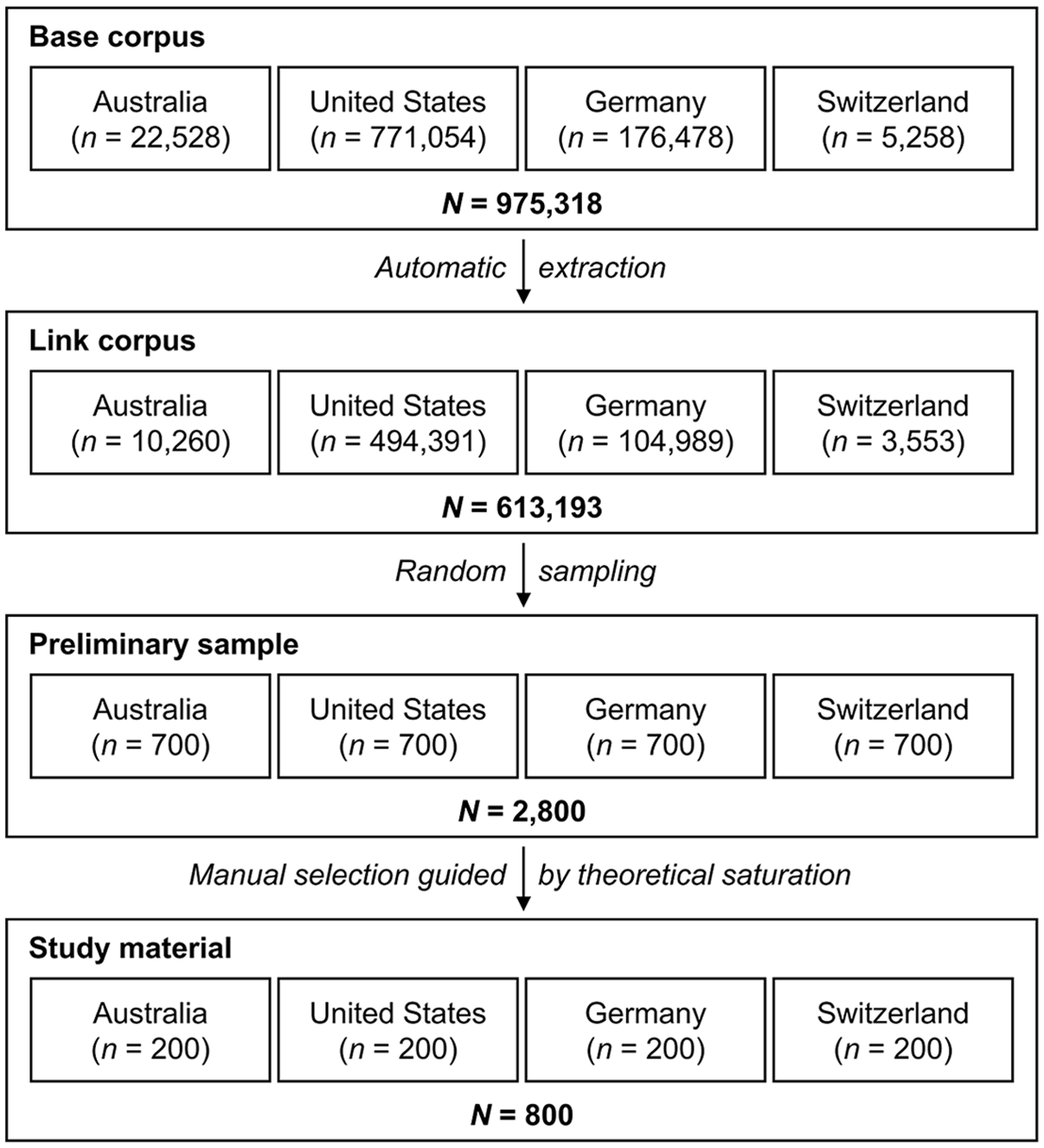
Selection of study material.
Base corpus
The base corpus contains 975,318 tweets on issues related to the public role of religion and secularism in society from Australia, the United States, Germany and Switzerland in the period of August 2015 until July 2016.
The countries represent Lijphart’s (2012) distinction of majoritarian and consensus democracies, and some variation in whether state secularism is stable or contested in a society. While in majoritarian political systems such as Australia and the United States, actors tend to stress their differences and insist on their positions in public debates, these are oriented more strongly towards cooperation and compromise in consensus-oriented democracies such as Germany and Switzerland (Steiner et al., 2004). According to Inglehart et al.’s (2014a, 2014b) World Values Survey, the United States stands out among the four as the only society in which state secularism is fundamentally contested (Wenger, 2010). Notably less American respondents agree that the interpretation of laws by religious authorities is not an essential feature of democracy than in Australia, Germany and Switzerland (Wave 5: V153; Wave 6: V132). About two-fifths would welcome more individuals with strong religious beliefs in public office (Wave 5: V196) and almost half are open to religious leaders influencing the government (Wave 5: V197). The consensus-oriented ‘spirit of accommodation’ (Lijphart, 1975: 103) in Germany and Switzerland, and the ‘religious-secular divide’ (Göle, 2010: 41) in the United States may extend to digital discourses and produce unique patterns of linking on Twitter.
Regardless of their unity or division in this respect, the public role of religion and secularism was debated controversially in all four countries from August 2015 until July 2016. This covers the campaigning phases of the 2016 elections in Australia and the United States as well as the peak of the 2015 global refugee movement, which affected Europe, and Germany in particular, especially strong. In light of increased migration, the 21st century has seen a renaissance of conservative values and religious fundamentalisms that question the separation of faith from civil society (Göle, 2010). Issues that traditionally reflect this tension are abortion, same-sex marriage or the role of religion in education. This canon has been extended recently by controversies about the integration of immigrants from predominantly Muslim countries into Western societies. Contested issues include the wearing of full-body veils and headscarves in public, greeting by handshake or, more generally, women’s equality.
A total of 64 topically relevant Twitter debate hashtags were selected in an expert-informed qualitative process to assemble the base corpus. Major debates on the public role of religion and secularism in the respective societies during the period of interest were identified by surveying 75 religion and communication studies scholars in the four countries and prominent debate hashtags corresponding these issues researched. To make sure these hashtags were used broadly, the selection was inspired by a list of 5000 hashtags mentioned frequently between August 2015 and July 2016 by the Twitter accounts of 64 partisan collective actors and 40 alternative media that, at least among other topics, have a particular interest in the public role of religion and secularism in society (e.g. the Atheist Foundation of Australia or the magazine Christianity Today). This resulted in the selection of debate hashtags such as #KimDavis or #SydneySiege (see Appendix A for a full list and further selection details). The base corpus (N = 975,318) contains all contributions from Twitter that included at least one of the 64 hashtags in the period of investigation. The data were collected through Twitter’s front-end.
Study material
To select the material for this study, all tweets that included at least one link were extracted from the base corpus into a link corpus (N = 613,193). As embedded multimedia elements that are native to the tweet were also saved as a link in these posts, the corpus still included tweets that did not actually refer to an external resource. Therefore, a preliminary random sample of 700 tweets from each country (N = 2800) was drawn from the link corpus and the study material selected by hand from there. When the links in a tweet directed to an external resource, the website’s contents were archived offline together with the post for analysis. When a link in a tweet was broken, that is, the linked contents could not be found anymore, the post was excluded from analysis because a link’s function can only be assessed properly in relation to its contents. Tweets that only included links to videos, memes or pictures that were a native part of the post, that is, not hosted on external websites, were likewise excluded from investigation. This manual selection of material was closely interwoven with the analysis and guided by theoretical saturation (Strauss and Corbin, 1993). The study started with sampling and analysing 50 tweets from each country that included one or several functioning links to an external resource. It then continued to successively add and explore further posts until the findings were well developed and no more novel insight could be generated from studying additional material. This saturation was reached after analysing 800 tweets, that is, 200 posts from each country. Only 12 tweets in the final study material (1.5%) include more than one link.
Data analysis
Qualitative content analysis (QCA) was conducted to investigate the 800 tweets. QCA is an interpretive yet structured and theory-driven approach to explore data (Mayring, 2015). It takes into account ‘that meaning is often complex, holistic, [and] context dependent, and that it is not necessarily apparent at first sight’ (Schreier, 2014: 171). This makes QCA a useful method to explore the hitherto understudied deliberative function of links on Twitter.
As qualitative exploration is about immersing oneself in the material, to maintain interpretive consistency, the same researcher performed the entire analysis, applying three intertwined strategies (Mayring, 2015: 65–114). In a summarizing QCA with multiple rounds of generalization, the tweets were clustered into abstract categories according to the primary function that the links performed in them (every post to one group). As the shape of these functions was unclear at this point, openness to the material was key. Analysis started with a preliminary cluster system inspired by theoretical considerations and prior research, which was then revised and extended inductively on increasingly more data. To assess the tweets on an overarching semantic level, the context units were the immediate contents of the linked resources and the profile descriptions of the tweets’ authors. This added an element of explicative QCA. Standardizing the context units in this way allowed considering situational differences while mitigating the influence of the researcher’s varying familiarity with the national settings on the insights. Figure 2 shows the identified function categories. 1 They are a central outcome of this study (Schreier, 2014) and presented with examples in the first findings subsection (see Appendix B for condensed category descriptions).
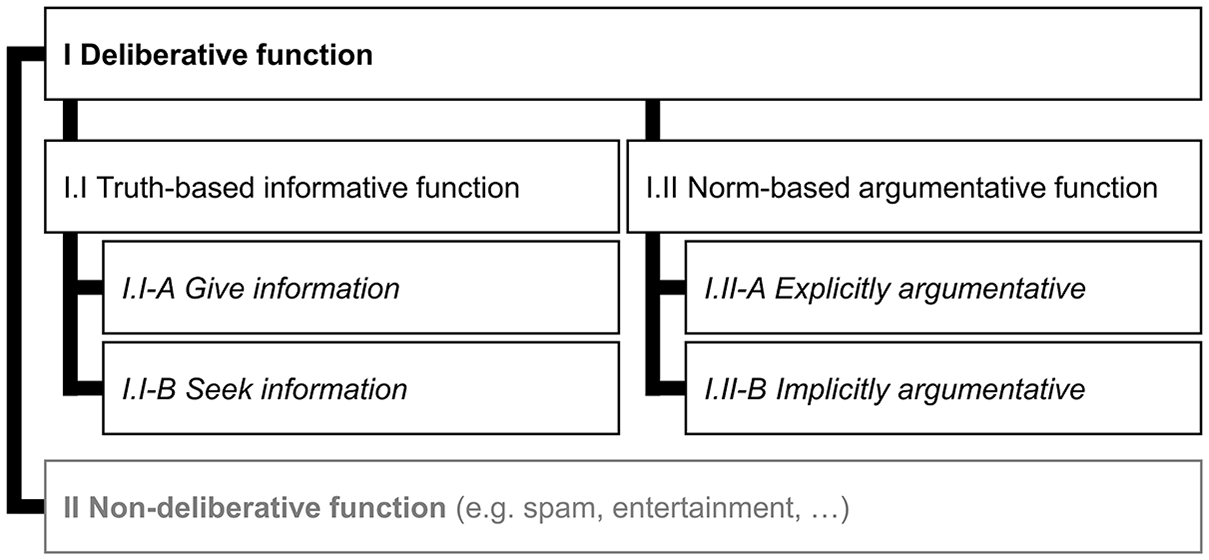
Inductively generated function categories.
After reaching theoretical saturation, the researcher went back to the data to apply these categories consistently to the entire study material in a structuring QCA. This allowed systematically identifying structural patterns through ‘a cross-section of the material under ordering criteria’ (Mayring, 2004: 269) based on simple frequency counts. While reflecting the structure of the analysed sample, these are of limited generalizability. The study compares the deliberative function of links across countries, data collection hashtags and context units. For the latter, the linked contents were clustered separately according to neutral or positional presentation and the tweets’ authors grouped inductively into media, journalists, bloggers, interest groups, private individuals and others (see Appendix B for category descriptions). 2 The second findings subsection presents the outcomes of the structural comparison.
Findings
Two dominant deliberative functions of links on Twitter
In most of the analysed tweets, links fulfil either a predominantly informative or a primarily argumentative purpose (Figure 3). Only in few contributions, links perform other, non-deliberative functions such as to spam or to entertain.
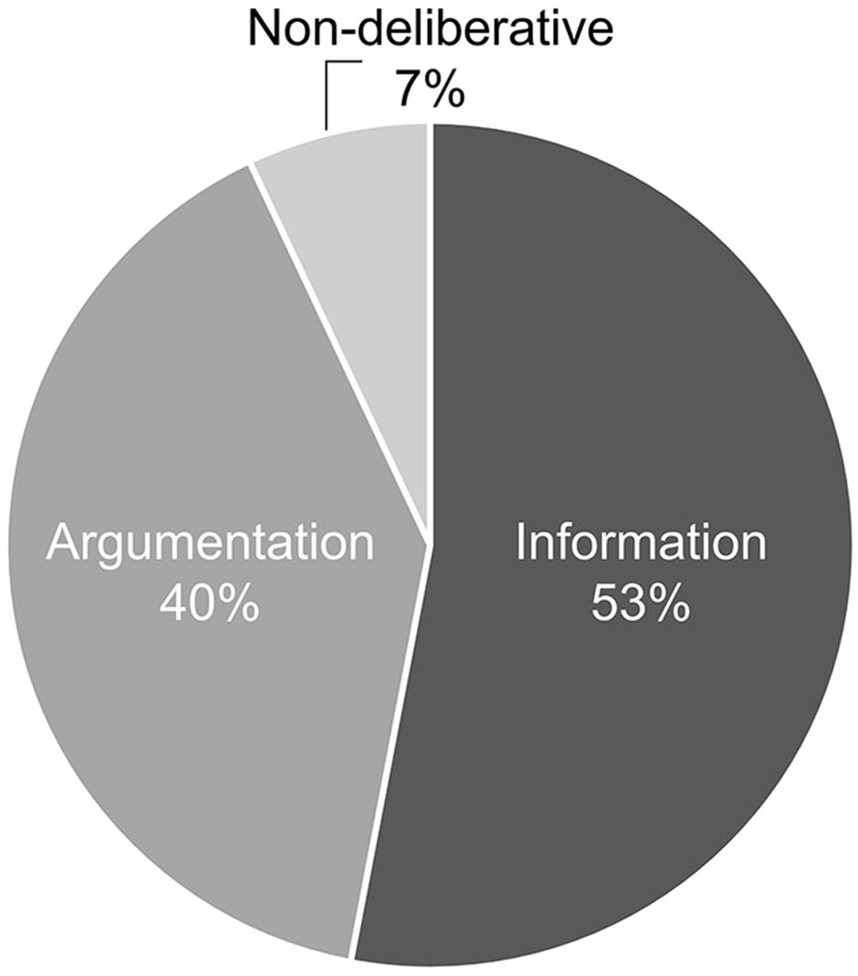
Function of links in analysed tweets (N = 800).
The truth-based informative function
Links perform a truth-based informative function in about half of the analysed tweets. Theoretically, these posts can be distinguished according to whether external resources are shared to give information to others or to seek input on an issue oneself (Holton et al., 2014). Yet, in practice, information-seeking through links is a rare exception.
Links that perform an information-giving function substantiate a piece of news or information that is provided in a tweet. In referencing events that actually occur in the world, these posts typically give a descriptive account of reality, which can be validated more objectively by engaging with the linked resources. Information-giving links thus basically act as a factual verification of a tweet’s content (Thimm et al., 2011). From a deliberative perspective, these links can be interpreted as fact-based empirical reasons (Peters, 2008) that are put forward preventively by an author to prove the accuracy of their statement. They contribute to resolving contested truth claims by providing an opportunity to verify information through public sources. This mechanism is illustrated by the tweet of a German citizen in Figure 4. 3
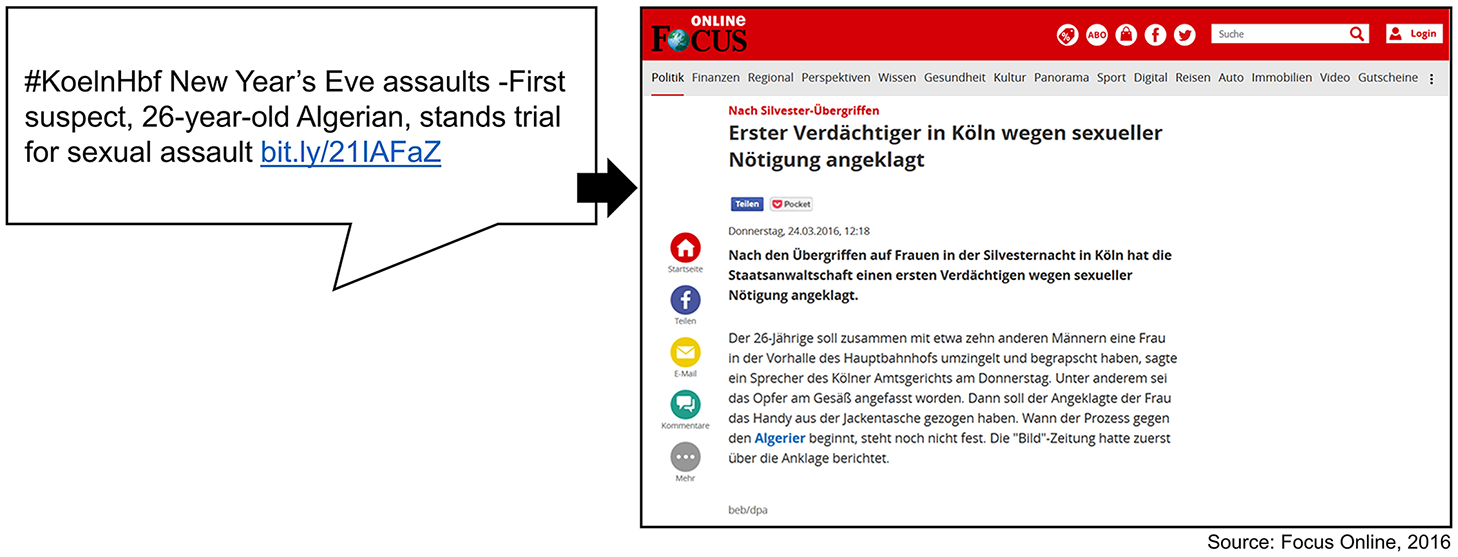
Tweet in which link performs an information-giving function.
The post refers to the 2015 New Year’s Eve festivities in Cologne, where hundreds of women were sexually assaulted by offenders of Arabian or North African descent. The events sparked lively debate on how men who grew up with patriarchal Islamic values could be better integrated into the German society. The author informs the Twitter community that the first suspect is now on trial, claiming implicitly that this information is factually correct. To substantiate this truth claim and verify his 4 statement, he links to a news report on the case. Published by one of Germany’s leading news magazines, the article is likely perceived as a reliable source of information and gives high credibility to the author.
Information-giving links are often shared with a subtle promotional overtone. This becomes particularly evident in the tweets of media outlets, journalists and some bloggers, or more generally speaking, when users link to their own work. This is epitomized by an American journalist’s tweet in Figure 5, in which he shares his own report on violent attacks by Christian-influenced anti-abortion activists. The article was originally published on a website for reproductive health news but is also hosted on the journalist’s professional website, where the tweet links. While sharing information, the author also promotes his own work, which, among others, is indicated by the fact that the wording of the tweet matches the title of the article.
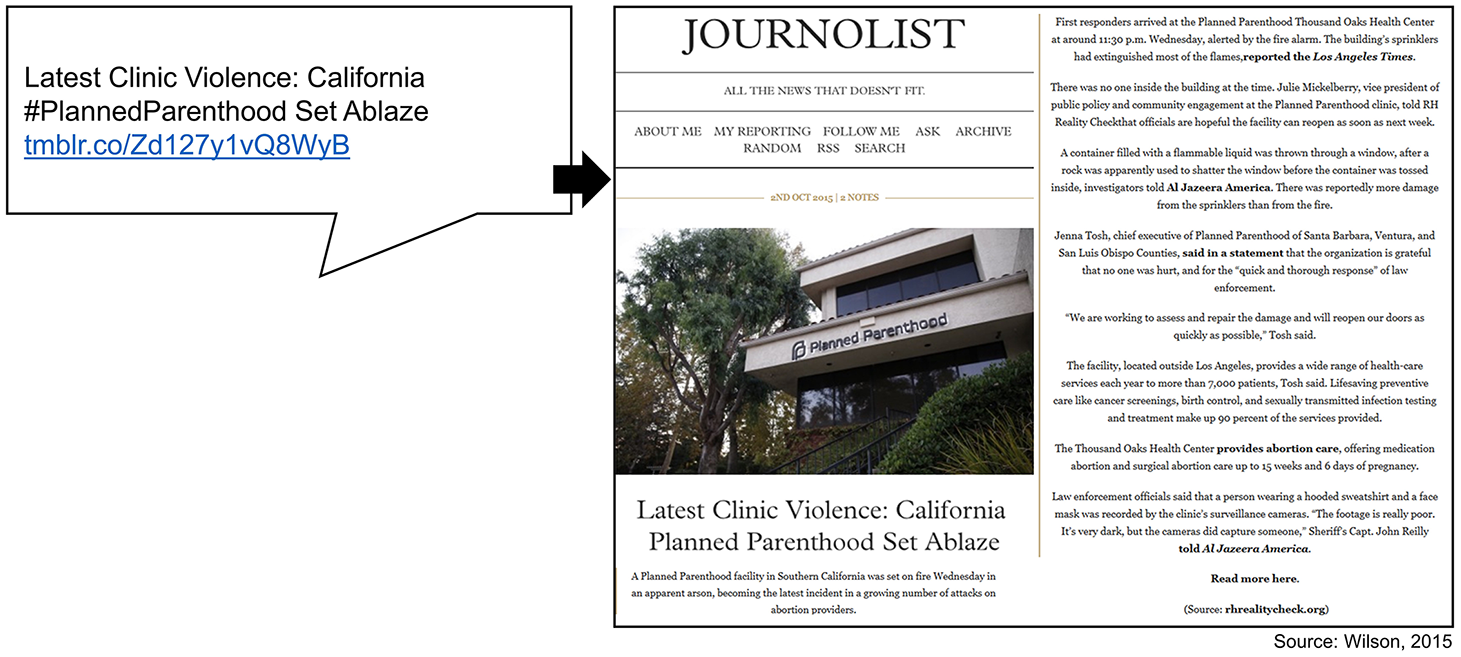
Tweet in which link performs an information-giving and promotional function.
Especially, the media routinely use Twitter to expand the reach of their contents and redirect people to their website. Such ‘audience sharing’ (Ackland et al., 2010: 447) is key to foster customer acquisition and advertising revenue. Even if news articles are shared by third parties such as ordinary citizens, however, information-giving links can have a discreet promotional function. Many media outlets provide their readers with pre-formulated tweets to share pieces. While these ready-made tweets are a convenient way for users to give information to others, they could be seen from the media’s perspective as an extended form of promotion through agents. However, even when people share their own work or ready-made tweets, above all, these links have an information-giving function on Twitter.
Occasionally, links are also tweeted to seek further information on an issue (Holton et al., 2014). Even if rare, this information-seeking function of links is a theoretically important manifestation of deliberative norms in the digital sphere because it represents instances in which events are reconstructed interactively in public discourse. Tweets in which links have an information-seeking function typically include a question on the linked contents that others might be able to answer. Those links thus essentially function to start a conversation. Thereby, the author may address fellow citizens or societal decision makers, but also the Twitter community as a whole. Clarifying questions can help users create a shared understanding of what the objective world looks like and in so doing form the basis for accepting deliberative truth claims. This is exemplified by the tweet of a Swiss journalist in Figure 6.
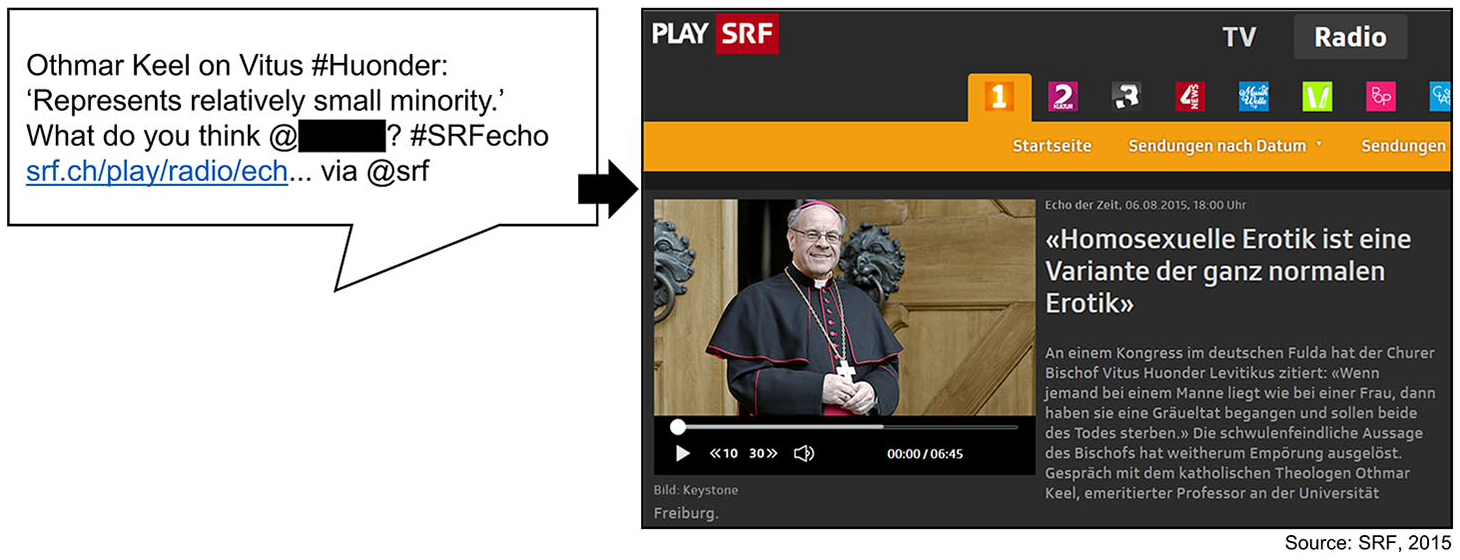
Tweet in which link performs an information-seeking function.
It was posted amid discussions about Swiss bishop Vitus Huonder quoting bible passages propagating the death penalty for homosexuals. The tweet links to a radio interview with a professor of theology stating that Huonder does not speak for the Catholic majority. Its author seems to contest the truth of this statement, addressing his post specifically to a secular activist whom he asks for his opinion on whether the professor is correct. He thus tweets the link to seek further information on the Catholic position on homosexuality and to initiate a conversation in which users can jointly develop an empirical understanding of this stance.
The norm-based argumentative function
In two-fifths of the analysed tweets, links perform a norm-based argumentative rather than truth-based informative function. Instead of referring to events that actually take place, these posts typically emphasize ‘something that should occur in the objective world’ (Habermas, 1984: 9). At least implicitly, the author passes normative judgement on how the reality should be from their perspective. While these normative positions are not always stated clearly but sometimes inherent to positional hashtags or the way a text is formulated, they can usually be inferred quite straightforwardly from the tweet by the average reader. Occasionally, however, this implicitness can make it difficult to distinguish between the truth-based informative and norm-based argumentative function of links, which will be reflected further in the discussion.
For a normative position to become an argument, it must be justified with appropriate reasons. Wessler (2018: 102) suggests to distinguish on Twitter between ‘internal justifications’ that are provided in the actual tweet and ‘external justifications’ that are featured in the content of a linked resource. Based on this distinction, analysis shows that in tweets that indicate a normative position, links can either support the reasons that are given for it in the post or actually contain the justification for the argument that the author wants to make. Accordingly, they can either have an explicitly or implicitly argumentative function. In both cases, they are shared to prove that a position is valid against commonly accepted social standards. Links with a norm-based argumentative function are thus part of an argument put forward by an author to sustain their claim for normative rightness (Habermas, 1984).
A three-quarter majority of all links that perform a norm-based argumentative function in the analysed tweets does so explicitly. Both the position and the reasons substantiating it can be concluded from the tweet itself without much interpretive effort. Links with an explicitly argumentative function thus support the argument in a tweet in a way similar to that in which links with an information-giving function substantiate empirical claims. Specifically, they can elaborate further on the justification provided in the post or strengthen the position with additional reasons. This is exemplified by the tweet of a Swiss citizen in Figure 7.
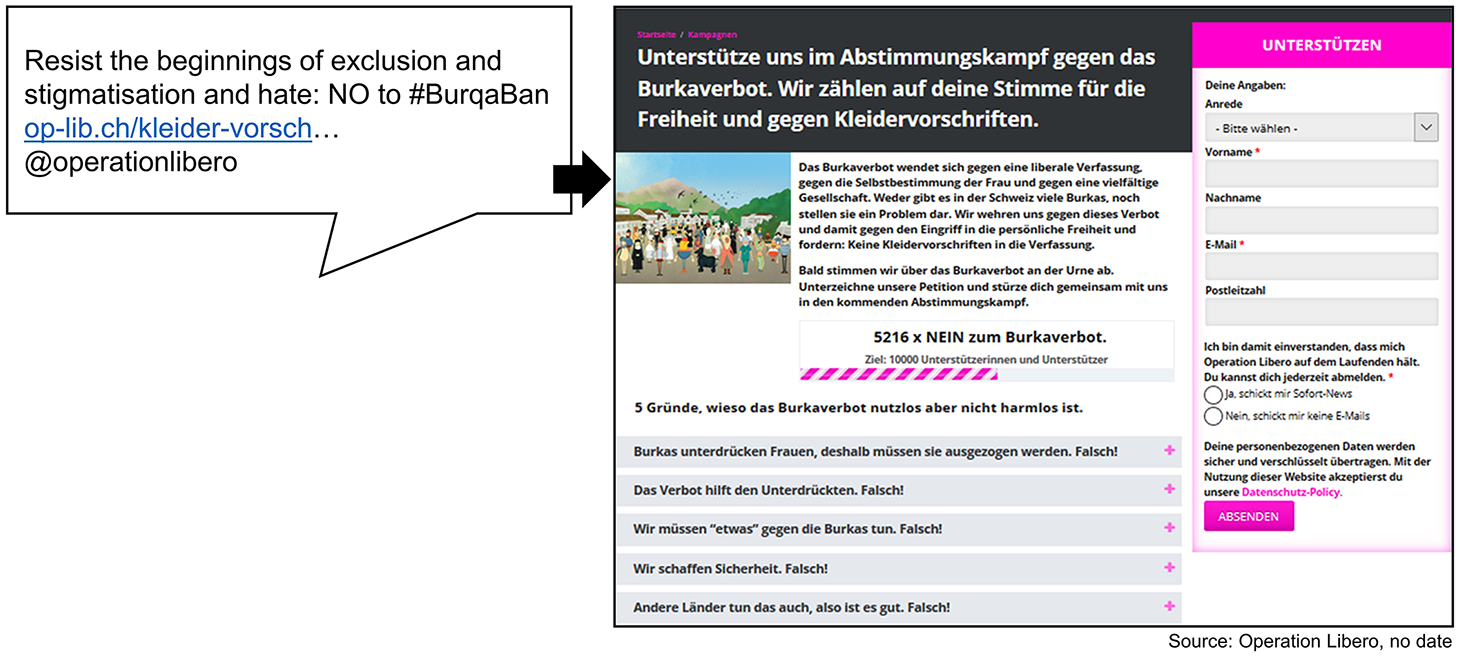
Tweet in which link performs an explicitly argumentative function.
It presupposes that discriminating religious individuals is socially inappropriate and opposes a burqa ban that was discussed in Switzerland at the time. The author justifies his position, and thereby his claim for normative rightness, saying that the ban would ostracize Muslim women and fuel hatred against the Islamic community. To substantiate this argument and demonstrate its intersubjective validity, he links to an NGO’s website that features a campaign against the burqa ban and provides five reasons not to support it. Some of these advance the internal justifications in the tweet. With respect to exclusion, for example, it is argued that the ban would stop some women from leaving the house altogether. Simultaneously, the website introduces new aspects to the tweet’s author’s general argument, for instance by pointing out that the ban would not improve public security. Links with an explicitly argumentative function thus provide an opportunity for fellow debaters to engage with an argument more extensively if they require more depth than is available in the tweet.
When links perform an argumentative function only implicitly, the tweet does not include an internal justification for the position it features. Instead, reasons are only provided in the linked content, so that the external resource contains rather than supports the argument. This is the case in a quarter of all analysed tweets in which links perform a norm-based argumentative function and illustrated by the tweet of an Australian citizen in Figure 8.
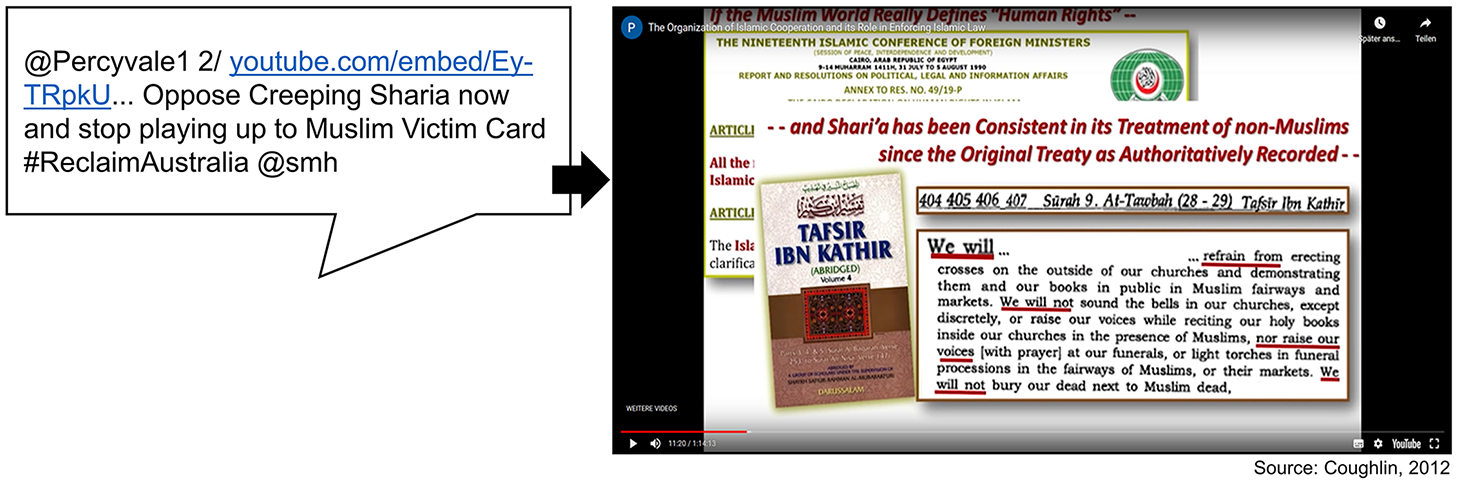
Tweet in which link performs an implicitly argumentative function.
Based on the assumption that immigrants should integrate into the culture of their host country, the author opposes the application of Islamic legislation in Australia. She gives an external justification for her claim for normative rightness, linking to the video of a former national security advisor to the US government on YouTube. In this clip, he interprets various public documents that from his point of view show how the Muslim community strategically fosters Islamic law in the Western world. The example shows that the implicitly argumentative function of links on Twitter does not readily reveal itself to fellow discussants. To understand the argument put forward and to fully comprehend the grounds on which normative rightness is claimed, other users inevitably have to engage with the linked contents first, which significantly limits the justificatory potential of those links (Wessler, 2018: 101). Consequently, tweets in which positions are justified solely by external justifications run the risk of being perceived as unqualified opinions. On another note, the tweet is a reminder that even radical positions can be presented deliberatively. Yet, as normative rightness needs to rest on standards that are shared broadly by the societal collective, hopefully, such reasoning is unlikely to prevail by the force of the better argument (Habermas, 1984).
An in-depth reading of all tweets in which links perform an explicitly argumentative function shows that external resources do not support any particular type of justification on Twitter, but a variety of arguments. While they mostly sustain pragmatic or ethical-moral arguments, references to legal principles as well as one’s own or the subjective experiences of others in the sense of a ‘narrative rationality’ (Fisher, 1984: 3) are rare. As this equals a rather comprehensive web content analysis, a similar examination for links with an implicitly argumentative function must be left for another time. It might however show resembling patterns.
Structural patterns of linking on Twitter
A majority of links with a norm-based argumentative function refers to positional contents. They often link to grassroots information sources, alternative media websites or commentary and opinionated news. In contrast, links with a truth-based informative function tend to point to websites that present their contents more neutrally, with a remarkable part linking to mainstream news media pages. In sharing information, many users thus seem to put a particular premium on sources that others tend to perceive as impartial and trustworthy.
In line with this, links perform a truth-based informative function most frequently in the tweets of media outlets and journalists, which is likely grounded in their vocational duty to inform and educate the public. To a lesser extent, bloggers also mainly use links in a truth-based informative way, which indicates that many of them also feel committed to the journalistic ethos. In the Swiss and Australian context in particular, some bloggers dedicatedly provided the Twitter community with information. In the tweets authored by interest groups, in contrast, links mostly perform a norm-based argumentative function, which is likely rooted in their passion for a specific cause. In the tweets of ordinary citizens, finally, links perform a truth-based informative and norm-based argumentative function to very similar extents. This corresponds with users stating that sharing information is one of the prime, but not their only motivation for linking on Twitter (Holton et al., 2014).
In the majority of tweets analysed in the Australian, German and Swiss context, links perform a truth-based informative function. Only in the material from the United States, most links have a norm-based argumentative function. The cultural division of the country with respect to the topic under discussion may explain this. As outlined before, the separation of church and state is seriously contested in the United States as opposed to the other three societies where the role of religion and secularism is debated publicly, but state secularism is stable. As cultural divisions produce particularly strong lines of difference in public discourse (Alexander, 2008), substantiating an argument with external resources may be all the more important in this context. Majority- or consensus-oriented public debate styles, in contrast, do not seem to play an obvious role in shaping linking practices on Twitter.
However, the function of a link also differs according to the type of hashtag that was used to collect the respective tweet. These hashtags can in themselves express a position on an issue, such as #WeWontGoBack; they can, however, also be neutral and bring together people of different opinions, such as #ParamattaShooting, or be of hybrid meaning, that is, allow for the expression of a position or the discussion of different opinions, such as #BurqaBan. In a majority of the analysed tweets that include neutral collection hashtags, links perform a truth-based informative function. The opposite holds for posts with positional collection hashtags, in which links predominantly have a norm-based argumentative function. Among others, this shows that positional hashtags often act as a signifier for normative claims. For hybrid collection hashtags, the share of tweets in which links perform a truth-based informative and norm-based argumentative function is more equally distributed. Distinct types of hashtags could thus reflect different stages of public debate. While neutral hashtags could be used more frequently to share and collect information on an issue, tweets that include positional hashtags could already be arguing about the best course of action and hybrid hashtags could offer an opportunity to do both at the same time.
Discussion
Linking towards more deliberative digital discourse
This study is the first to thoroughly explore the deliberative function of links to external resources on Twitter. It provides detailed insight into the justificatory capacity of those links and adds to a better understanding of reason-giving in digital spaces. The findings show that links to external resources support Twitter discourse by regularly substantiating user statements in the context of both information and argumentation. In so doing, most links on Twitter perform one of two deliberative functions.
Links with a truth-based informative function mainly contribute to ‘theoretical discourses’ (Habermas, 1984: 19) in which users debate contested truth claims and create a collective understanding of the world by exchanging empirical evidence. Linking to share information with others or to seek further insight into a topic are important mechanisms to form such joint presuppositions as a basis for further discussion and societal decision-making. Since many links with a truth-based informative function point to mainstream news media reports and other neutrally presented contents, they benefit Twitter discourse by creating a solid and readily accessible knowledge repository for the community (Bruns, 2018). Due to their professional identity, media outlets, journalists and some bloggers contribute in particular to this collection of empirical facts through links, even if this may also have a promotional component. Yet, while sharing information through links is common on Twitter, from a deliberative perspective, an increased amount of linking to seek information would also be desirable, as its interactive nature could foster dialogue and responsive engagements.
Links with a norm-based argumentative function mainly contribute to ‘practical discourses’ (Habermas, 1984: 19) in which users debate which actions are most appropriate to address a problem. They are shared to justify the normative rightness of proposed solutions and increase the likelihood that societal consensus is well grounded. Links with a norm-based argumentative function improve the deliberative quality of online discussions by making sure that users actually provide reasons for why they advocate specific positions and do not just give unsubstantiated opinions. This facilitates weighing different options against each other and, ideally, results in finding a common solution based on the strongest arguments. Thereby, links with an explicitly argumentative function make a more obvious contribution to reasoned debates than their less common implicitly argumentative counterparts, because the relationship between the argument in the tweet and the external resource is more readily comprehensible (Wessler, 2018). This aligns with the fact that interest groups and other actors with particularly strong views tend to use links in a norm-based argumentative way and that these links point to positional contents more frequently than those with an informative function.
When they provide relevant justifications for public statements, positional contents can make valuable contributions to online debates. For example, even though religious resources often invoke worldviews and norms that are not shared by everyone, their information and arguments have particular merit in specific discussions. However, while in ideal discourses qualified prevail over unqualified reasons by the deliberative ‘force of the better argument’ (Habermas, 1984: 25), the question remains how well this mechanism works in practice and how the Twitter community assesses the quality of external contents. This is especially important in an age of fake news and disinformation (Freelon and Wells, 2020) and requires further investigation. While Twitter (2020) currently trials labelling tweets with misleading contents, this cannot be extended comprehensively to the linked resources.
An important finding of this study is that the deliberative capacity of links on Twitter is sensitive to national contexts. In particular, the analysis suggest that societal divisions such as the ‘religious-secular divide’ (Göle, 2010: 41) in the United States foster a norm-based argumentative rather than truth-based informative use of links on the platform. This corresponds with the idea that culturally divided societies tend to produce discourses on values and principles rather than factual problems (Alexander and Smelser, 1999). It is plausible that linking on Twitter is more strongly associated with advocating positions than sharing information in this context than in non-divided Australia, Germany and Switzerland. Partly, this could be because interest groups, which are particularly prone to use links in a norm-based argumentative way, are increasingly active on Twitter in divided societies.
Contrary to the United States, most links perform a truth-based informative function in the second majoritarian democracy, Australia, which suggests that linking on Twitter is indeed shaped more strongly by socio-cultural contexts than majoritarian- or consensus-oriented discussion styles. However, it is possible that societal divisions also manifest in individual debates, conducted under positional and hybrid as opposed to more neutral debate hashtags, rather than merely at the country level. Furthermore, positional hashtags could actually be a function of societal divisions and emerge more likely in strongly divided countries. Future work should continue to investigate the contextual antecedents of linking on Twitter and unravel the manifold mechanisms involved.
On the micro level as well, the context is important with respect to the deliberative function of links on Twitter. Plenty of information is required by the audience to decide whether and what kind of reason-giving is facilitated by linking to third-party contents (Chambers, 2012) and there is a fine line between the truth-based informative and norm-based argumentative function of links to external resources. When linking to give information, for instance, individuals may sometimes share contents that they believe to be true, but which actually reflect a rather subjective worldview. Conversely, links that appear to perform a truth-based informative function might in fact carry an argumentative meaning for the sharing individual. Contextual pointers such as a user’s profile information or the presentation of the linked contents give important clues as to whether a link performs a truth-based informative or norm-based argumentative function. Nevertheless, it is important for users to express their intention in posting a link as clearly as possible and disclose any normative positions sustained by this link. Going forward, more insight is required into how authors and audiences interact with the external resources that are linked to in digital discourse, and future research should focus more strongly on both the distributor and consumer end of linking on Twitter.
Supplemental Material
The_deliberative_function_of_links_on_Twitter_Supplementary_material_With_full_project_information – Supplemental material for Supporting digital discourse? The deliberative function of links on Twitter
Supplemental material, The_deliberative_function_of_links_on_Twitter_Supplementary_material_With_full_project_information for Supporting digital discourse? The deliberative function of links on Twitter by Julia Jakob in New Media & Society
Footnotes
Author note
I hereby confirm that the article is not currently being considered for publication by any other print or electronic journal.
Funding
The author disclosed receipt of the following financial support for the research, authorship, and/or publication of this article: This work was supported by Deutsche Forschungsgemeinschaft (DFG, German Research Foundation) [grant number 260291564].

Supplemental material
Supplemental material for this article is available online.
Notes
Author biography
References
Supplementary Material
Please find the following supplemental material available below.
For Open Access articles published under a Creative Commons License, all supplemental material carries the same license as the article it is associated with.
For non-Open Access articles published, all supplemental material carries a non-exclusive license, and permission requests for re-use of supplemental material or any part of supplemental material shall be sent directly to the copyright owner as specified in the copyright notice associated with the article.
